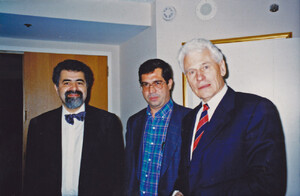
Peter J. Chelkowski (1933â2024), at right, with Saïd Amir Arjomand (left) and Ali Dehbashi (center) at a gathering of the Association for the Study of Persianate Societies in Washington, D.C. in May 2000
Citation: Journal of Persianate Studies 18, 1-2 (2025) ; 10.1163/18747167-bja10056
Photograph: Ali DehbashiPeter J. Chelkowski was one of the worldâs most accomplished scholars of the Middle East and particularly the culture of Iran and Persianate societies. His achievements as an academic and a public figure, spreading consciousness of the richness of Persian culture and its influence throughout the world, is unparalleled in modern times. He passed away in Turin, Italy on 21 October 2024 at the age of 91.
Peter (Piotr) Jan Chelkowski was born on 10 July 1933 in Lubliniec, Poland. He studied first in the School of Dramatic Arts in Krakow from 1955 to 1956, and then in the Department of Oriental Studies at Jagiellonian University in Krakow, Poland from 1953 to 1958, where he received a Masters degree. It was through these two experiences that he first was introduced to the intellectual themes that would define his career: Persian and Islamic literature, on the one hand, and theater and drama, on the other.
He continued his studies at the School of Oriental and African Studies, University of London, from 1959 to 1962 under the eminent scholars, Bernard Lewis (1916â2018) and Ann K. S. Lambton (1912â2008).1 His continued fascination with Persian language and literature led him to Iran in the 1960s, where he perfected his Persian language skills and enrolled at the University of Tehran, where he studied from 1963 to 1968, completing his Ph.D. in Persian literature, based on the work of the poet NezÄmi Ganjavi (1141â1209). He was the first Polish citizen ever to receive a doctorate in Iranian studies from the university.
The devastating 1962 Buin Zahra earthquake in the province of Qazvin, with a Richter magnitude of 7.1, prompted him to volunteer for relief work with the charitable relief organization C.A.R.E., where he came in contact with thousands of Iranians in cities and rural villages, where he engaged in building schools and bath houses. His contacts throughout Iran left him deeply impressed with the profundity of Iranian æsthetic sensibilities, which extended even to rural villagers and urban construction workers. In an undated interview provided by the Chelkowski family, he speaks of encountering construction workers who were able to quote copious works from the classic poet HÄfez ShirÄzi (c. 1315â90):
In my eyes, poetry is a pivot around which Iranian civilization turns. That day it became even clearer to me why I decided to shape my academic background around a multicultural and multi-disciplined approach.
In 1967, he joined the Department of Middle Eastern and Islamic Studies at New York University, where he spent his entire academic career until his retirement in 2013 after forty-five years of distinguished service. At NYU, he was one of the founders of the Hagop Kevorkian Center for Near Eastern Studies, where he also served twice as director from 1975 to 1978 and 1988 to 1991, as well as director of the Program in Near Eastern Studies in the Graduate School of Arts and Science during those same years. He held other leadership roles, included chair of the Department of Near Eastern Languages and Literatures (1975â78). He received the Golden Dozen Award for Excellence in Teaching in 1989 and 1996, as well as book awards and prestigious cultural awards for his academic contributions, including the Farabi International Award in Iranian and Islamic Studies in 2010.
As a highly-regarded eminent international scholar, he held numerous visiting professorships at the University of Venice, Columbia University, Fordham University, Trinity College in Hartford, Harvard University, the University of Pennsylvania, Stanford University, the New School for Social Research (now The New School), and the University of Utah.
During his early years at NYU, he became famous nationally for his work bringing Persian culture and art to a wide audience through the CBS television program, Sunrise Semester, in 1970, where he appeared for forty-six thirty-minute episodes presenting âIranian (Persian) Culture and Civilization.â This highly popular appearance resulted in an article in the TV Guide magazine, entitled âPeter Chelkowski, Ph.D., I Love Youâ (Efron). One of his enthusiastic fans, Mrs. Abby Weed Grey, a collector of Near Eastern art in Minnesota, was even inspired in 1975 to donate her collection, along with an endowment, to NYU, establishing the Grey Art Gallery (now the Grey Art Museum).
Peter Chelkowskiâs scholarly interest in the Persian theater form, taÊ¿ziya (known also as shabihkhÄni) began to in the early 1970s, inspired by his earlier work in rural Iran, where he witnessed taÊ¿ziya performances in villages and towns throughout Iran during the months of Moharram and Safar. Although nineteenth-century European scholars, such as Alexander Chodżko (1804â91), Ahatanhel Krýmský (1871â1942), and Jan Rypka (1886â1968), and more contemporary Iranian scholars such as Bahram Beyzaie (b. 1938), Mayel Baktash (1935â95), and Farrokh Ghaffary (1922â2006) had conducted scholarly research on taÊ¿ziya, it was Prof. Chelkowski who was instrumental in bringing knowledge of this remarkable theater form to the attention of twentieth-century Western scholarship.
Through the Festival of Arts in Shiraz, headed by Ghaffary, he organized in 1976 an international symposium on taʿziya, along with a collection of taʿziya performances directed by Mohammad Bagher Ghaffari (b. 1944). He edited and published the symposium papers as Taʿziyeh, Ritual and Drama in Iran (Chelkowski 1979), which has become a classic scholarly collection on the topic. He continued his research and publication on taʿziya and its manifestations throughout the world (idem 1985; 2010; Chelkowski and Ghaffari), including Moharram observances among Muslims in Trinidad (Chelkowski 2005b).
In the summer of 2002, Prof. Chelkowski had an unprecedented opportunity to participate in organizing a gala presentation of six taʿziya dramas for the Lincoln Center Festival in New York City. The performances were again directed by Mohammad Bagher Ghaffari and included a symposium on taʿziya open to the public. The festival was widely acclaimed with thousands of spectators and resulted in a special edition of the leading theater journal TDR: The Drama Review, which he edited and to which he also contributed an article (idem 2005a; 2005b).
In addition to his continued work on taÊ¿ziya performance, he turned his attention in the years following the Iranian Revolution of 1978â79 to broad aspects of Persian culture and the influence of Iranian thought, including post-revolutionary rhetoric (Chelkowski and Dabashi) and mystical thought and poetry (Chelkowski 2011; 2013; Chelkowski and Pranger). In 2007, he was honored with a festschrift by many prominent contributors grateful for his work (Khorrami and Ghanoonparvar).
But in all he accomplished, Prof. Chelkowski will be remembered fondly as an inspirational teacherâto both university students and to his friends and colleaguesâinfluenced both by his extraordinary scholarship and his inspiration from theater and drama. In a statement about his teaching philosophy that he offered upon receiving the Golden Dozen Award at NYU, he wrote:
It was my research in Asian theater that first introduced me to the concept of eliminating barriersâphysical, intellectual, and emotionalâ between performer and audience. Where the viewers often become part of the drama, part of the action and are required to participate emotionally, not just as passive by-standers, but as active and empathetic accomplices to the drama. These experiences of the stage deeply influenced my style and approach as an educator.
His friends, students and colleagues will certainly agree.
Peter J. Chelkowski is survived by his wife Goga, his daughter Monica Chelkowski Tarony, his son Peter, and his grandchildren Paolo Tarony, Sofia Tarony, Clyde Chelkowski, and Earl Chelkowski.
Bibliography
A full bibliography of Peter Chelkowskiâs publications appears in his CV (last updated in 2015), which I have uploaded to my Academia.edu profile: https://www.academia.edu/127797400/Peter_J_Chelkowski_1933_2024_Curriculum_Vitae.
P. J. Chelkowski, Taʿziyeh, Ritual and Drama in Iran, New York University Studies in Near Eastern Civilization 7, New York City, 1997.
P. J. Chelkowski, âShia Muslim Processional Performances,â The Drama Review: TDR 29.3 (Autumn 1985), pp. 18â30, DOI 10.2307/1145650.
P. J. Chelkowski, âFrom Karbala to New York City: TaÊ¿ziyeh on the Move,â TDR: The Drama Review 49.4 (Winter 2005a), pp. 12â14.
P. J. Chelkowski, âFrom the Sun-Scorched Desert of Iran to the Beaches of Trinidad: TaÊ¿ziyehâs Journey from Asia to the Caribbean,â TDR: The Drama Review 49.4 (Winter 2005b), pp. 156â170.
P. J. Chelkowski, Eternal Performance: Taʻziyeh and Other Shiite Rituals, Enactments, London/New York City, 2010.
P. J. Chelkowski, ed., The Gift of Persian Culture: Its Continuity and Influence in History, Reza Ali Khazeni Memorial Lectures in Iranian Studies 1, Salt Lake City, 2011.
P. J. Chelkowski, ed., Crafting the Intangible: Persian Literature and Mysticism, Reza Ali Khazeni Memorial Lectures in Iranian Studies 2, Salt Lake City, 2013.
P. J. Chelkowski and H. Dabashi, Staging a Revolution: The Art of Persuasion in the Islamic Republic of Iran, New York City, 1999.
P. J. Chelkowski and M. Ghaffari, âMohammad B. Ghaffari: TaÊ¿ziyeh Director,â TDR: The Drama Review 49.4 (Winter 2005), pp. 113â129.
P. J. Chelkowski and R. J. Pranger, eds., Ideology and Power in the Middle East: Studies in Honor of George Lenczowski, Durham/London, 1988, DOI 10.1515/9780822381501.
E. Efron, âPeter Chelkowski, Ph.D., I Love You,â TV Guide 18.47 (21 November 1970), pp. 42â45.
M. M. Khorrami and M. R. Ghanoonparvar, eds., Critical Encounters: Essays on Persian Literature and Culture in Honor of Peter J. Chelkowski, Costa Mesa, 2007.
Another later mentor was his fellow Polish colleague, George (Jerzy) Lenczowski (1915â2000), for whom he co-edited a festschrift in 1988 (Chelkowski and Pranger).