Abstract
In many Western states, Muslims are more likely than the general public to doubt certain scientific theories, notably human evolution. The influence of Islamic knowledge has often been posited as the explanation. Yet those who transmit Islamic knowledge â Islamic scholars (âulama) â have been badly neglected by sociologists. This article analyses the views of British Muslim religious leaders about science, drawing on 40 interviews, 5 focus groups, and observations at four Islamic educational institutions. Our analysis is oriented around two religio-scientific movements: 1) âIslamic creationismâ, and 2) the claim that the Qurâan anticipated modern scientific discoveries (iâjaz âilmi). Our participants were overwhelmingly reluctant to read scientific ideas into the Qurâan. Their views on evolution were more varied but were typically flexible and did not amount to focused opposition. We thus stress the importance of distinguishing scholarly, popular and lay religion for understanding Muslim science rejection and countering anti-Muslim stereotypes.
1 Introduction
In many Western states, Muslim minorities are far more likely than the general public to doubt certain scientific theories, notably human evolution. In the UK, for example, on which this article will focus, 26.9% of Muslims agree that âhumans have developed from simpler, non-human life formsâ, compared with 66.5% for the country as a whole (Unsworth and Voas, 2018: 82; for similar findings from the US, see Barnes et al., 2021). Muslimsâ beliefs about science have accordingly been the subject of periodic controversies focusing on the influence of Islamic knowledge: Islamic teachings are frequently characterised as inimical to the acceptance of evolution and even to science in general (Jones et al., 2019; Unsworth, 2019). Yet despite this, the people typically viewed as custodians of Islamic knowledge â Islamic scholars, or âulama (singular, âalim [m.]/âalima [f.]) â have been almost entirely ignored in sociological studies of perceptions of science. Research on Muslimsâ views about science focuses, as we shall see, on professional elites and laypeople, with religious leadersâ views, and their influence, being neglected.
This neglect, we argue in this article, has facilitated confusion and potentially prejudice about Islamâs role in influencing responses to science. We present findings from 40 interviews and 5 focus groups with current and in-training British Muslim religious leaders about Islam and science, supplemented by observational research at four Islamic educational institutions. Our principal, though not exclusive, focus is on individuals who have been, or are now, students or teachers in UK âseminaryâ contexts and are regarded by their communities as current or future âulama. Using this data, we show that the connection between religious authorities and religiously justified opposition to science is less clear than often assumed. We look at levels of support for two overlapping religio-scientific movements that are prominent in discussions of Islam and science: so-called âIslamic creationismâ and the notion, prominent in many Muslim contexts, that the Qurâan anticipated modern scientific discoveries (referred to here as âiâjaz âilmiâ). Our participantsâ views about these subjects varied considerably, but we highlight multiple examples of religious leaders, even from ostensibly conservative Islamic traditions, arguing against these movements. Our participants overwhelmingly opposed the idea that scientific ideas can be âdiscoveredâ in the Qurâan. Their views on evolution were more mixed; in the past, the subject of human evolution has been the source of fierce controversy in Muslim Britain, and we did encounter questions and debates focusing on the status of Adam as the first human. Nevertheless, we highlight an increasingly open discussion about evolution among British Islamic scholars. While we did encounter rejection of and hostility toward evolution, the perspectives we encountered were typically uncertain or flexible and did not amount to focused opposition.
Based on our findings, we highlight the importance of distinguishing between scholarly, popular and lay religion, and posit that in Britain support for these movements, especially iâjaz âilmi, is a popular more than a scholarly phenomenon. We begin by reviewing existing research on the two movements, and argue, with Jessica Carlisle, Salman Hameed and Fern Elsdon-Baker (2019), that journalistic and some academic accounts of Muslimsâ views about science have frequently viewed Islam through Christian lenses and wrongly assumed a direct association between Islamic knowledge and opposition to science. After contextualising our data with an overview of the development of Muslim religious leadership and Islamic education in Britain, we then turn to our interview and focus groups, outlining our participantsâ views and considering some of the background social factors influencing those views.
As we shall see, notable among these factors was the sense that Muslims are, in the UK as across the West, treated with suspicion. Muslims are among the most stigmatised groups in Britain (Heath and Li, 2015; Jones and Unsworth, 2024). Derogatory narratives frequently stereotype them as a community whose beliefs are irrational and âanti-scienceâ (Ecklund et al., 2019; Jones et al., 2019; Unsworth, 2019). This context played a significant role in stimulating discussion of evolution in our research sites but it also, we propose, lends significance to our findings, which offer resources for understanding Muslim rejection of science and for challenging Islamophobic stereotypes.
2 âIslamic Creationismâ: A topic Misunderstood?
A good way to get a sense of how explosive the topic of Islam and evolution has been in Muslim Britain is to look at the case of Usama Hasan. Hasan is a Research Consultant at the Tony Blair Institute for Global Change who, until 2012, worked as an academic and imam at a mosque in Leytonstone, London. From a line of religious scholars, Hasan was raised in a context in which rejection of evolution was the norm but came to accept the idea when studying for his physics degree and during his time working as at the Royal Observatory in Greenwich. Feeling split between his religion and professional role, Hasan published his views on evolution in The Guardian (Hasan, 2008) before the bicentenary of Darwinâs birth. Its criticisms of Muslimsâ perspectives were amplified by the editors (who paraphrased him as saying Muslims have a âchildlikeâ view of science) and he received vicious criticism from some of his co-religionists. This impacted his mosque, from which he resigned after challenges by his congregation and elements of the group of trustees. Some of this criticism was dangerous: he received multiple death threats and was placed briefly under police protection. The case accordingly prompted significant media outrage (Brown, 2013).
As with many apparent conflicts between religion and science over history (Numbers, 2010), Hasanâs story was more complex than it seemed. Although the conflict was undoubtedly ugly and became, for a time, extremely serious, evolution was not the only factor at play, with family ties, sectarian splits and political divisions all having a role. Hasan has roots in India and Pakistan, his father being a senior leader in the Ahl-i-Hadith movement, a South Asian revivalist tradition that laid the foundations for Salafism in the UK (Amin and Majothi, 2022). Hasan became involved in highly politicised and conservative Salafi groups in the 1990s but split from them as he grew older. The conflict in his former mosque was coloured by this and by the fact that Hasan had, around the time of the articleâs publication, started advising Quilliam, a âcounter-extremism think-tankâ that helped shape the British governmentâs contentious âPreventâ counter-terrorism strategy (Bowen, 2016: 218â225; on Prevent, see OâToole et al., 2016). Such information was left out of media coverage of the conflict, which portrayed it as a latter-day Galileo affair: Hasanâs experience was viewed as evidence of tension between science and parts â if not all â of the Islamic tradition, which aligned with media narratives about Muslims âimporting creationismâ into schools (Gardham, 2008) and universities (Grimston, 2011).
Against the backdrop of such controversies, research into Muslims and science has taken evolution acceptance as the key theme. As Carlisle, Hameed and Elsdon-Baker (2019: 163) have observed in a detailed review of research literature on the subject, the number of sociological studies of Muslimsâ views of evolution far exceeds that of any other aspect of science. We agree with Carlisle, Hameed and Elsdon-Baker, however, that only rarely is the topic adequately contextualised. In this research literature, as well as in journalism, the term âIslamic creationismâ is widely used to describe Muslim opposition to evolution (Riexinger, 2009; Hameed, 2015), but this can cause confusion. The term âcreationismâ initially referred to US Protestant movements, especially the âYoung Earthâ movement. The term thus tends to imply systematically developed worldviews, publicly propagated by groups such as the US-based organisation Answers in Genesis, involving a series of interdependent propositions about the age of the Earth and human origins (Hill, 2014). Muslimsâ views are, however, distinct from such worldviews. Human exceptionalism and a belief in a literal Adam and Eve are common among Muslims (Unsworth and Voas, 2018), but the idea that the earth is 10,000 years old is based on a distinct Biblical hermeneutic. More importantly, while there are Muslim organisations dedicated to systematically âdebunkingâ evolution, which we would characterise as propagating a form of âIslamic creationismâ, these are far less prominent than their Protestant Christian counterparts. Such organisations â notably the âenterpriseâ of Adnan Oktar (aka Harun Yahya) (Moran, 2019; Hameed, 2015) â have flourished in certain contexts, notably Turkey (Peker, Comert and Kence, 2010). The publication and circulation of Oktarâs Atlas of Creation in 2006 led to widespread media coverage in the West, and scholarly analyses have sometimes assumed his work has had a profound impact on Muslims (see, for example, Blancke et al., 2013; Fuller, 2020). Oktarâs enterprise dramatically collapsed in the late 2010s, however, following his imprisonment in Turkey for offences including espionage and sexual abuse, and recent research, including this study, has cast doubt on whether he retains widespread influence (Moran, 2019).
Carlisle , Hameed and Elsdon-Baker (2019) go further in their criticism of extant research into Muslims and evolution, arguing that many studies presuppose that evolution rejection among Muslims is: widespread (if not universal); important to Muslim identity; and motivated by Islamic knowledge. Analysis of large-scale international surveys and interview data, they note, sometimes assumes that âbeing Muslimâ is sufficient to explain evolution rejection (ibid.). Such assumptions are, however, questionable. Research into evolution rejection among Christians emphasises that, in general, laypeopleâs views tend to be unsystematic and determined by social factors (Hill, 2014; 2019). John Evans (2018) has persuasively argued that it is moral and social, rather than epistemological, differences that best explain conflict between religion and science in the US context. Research into Muslimsâ views suggests something similar. Quantitative studies of Muslims show a lack of awareness of evolution, especially beyond the West, as well as wide variations in levels of its acceptance across countries (Clément, 2015; Carlisle, Hameed and Elsdon-Baker, 2019). Qualitative research by Jeffrey Guhin (2016) and Glen Moran (2018) has also highlighted how evolution is often not âsalientâ to Western Muslims; even in communities where evolution is rejected, rarely does the issue act as a âboundary markerâ separating in- and out-groups, as is the case with some Evangelical Protestant communities. This points to the dangers of using the term âIslamic creationismâ to describe Muslims and evolution doubts, outside of anti-evolution movements and their sphere of influence.
3 Attending to iâjaz âilmi
This is not, of course, to say that research on Muslim views of evolution is unimportant, but that the almost exclusive focus on the subject, and the assumptions built into analysis, often say as much about researchersâ assumptions as they do about Muslimsâ own interests. This is nowhere better illustrated than in the neglect of other Islamic discourses about science, notably what we call here iâjaz âilmi. This phrase can be closely translated as âinimitable knowledgeâ but is often rendered as âscientific miracleâ. The broader concept of iâjaz alludes to the mainstream Islamic notion that the Qurâanâs inimitability is evidence of its divine nature, but iâjaz âilmi discourses extend this to propose that the Qurâan contains descriptions of modern scientific ideas (for example, of an expanding universe or the development of the embryo) that could not have been known at the time of the Prophet Muhammad (CE 570â632). There are different varieties of iâjaz âilmi (Guessoum, 2008), but in its stronger forms these narratives seek to bolster Islamâs truth-claims by co-opting the epistemic authority of science for the tradition.
Iâjaz âilmi is often associated with Maurice Bucaille (1920â1988), a French convert to Islam and physician to the Saudi King Faisal bin Abdulaziz Al Saud until the latterâs death in 1975 (Unsworth, 2019). Bucailleâs book The Bible, The Qurâan and Science (2000 [1976]) advanced the claim that the Qurâan, unlike the Bible, is vindicated by modern scientific knowledge. Iâjaz âilmi is sometimes thus referred to as âBucailleismâ. This overstates the authorâs influence â the core idea, and many associated claims, did not originate with him â but his systematisation of iâjaz âilmi discourses helped them subsequently flourish in print, television and, especially, online. It has hugely influential advocates such as the late Egyptian TV personality Zaghloul El-Naggar, the Indian televangelist Zakir Naik and, before his downfall, Oktar. (Notably, none of these three individuals, nor Bucaille, are traditionally trained Islamic scholars/âulama.) Conferences are dedicated to the topic in Muslim-majority countries and analyses appear in peer-review-mimicking journals (Guessoum, 2008; Bigliardi, 2017). Its presence may have a geopolitical dimension, with iâjaz âilmi being circulated via Saudi proselytisation efforts in the later twentieth century (Unsworth, 2019; on Saudi knowledge dissemination activities, see Mandaville, 2022).
With widespread presence and high-profile support, iâjaz âilmi is a movement arguably comparable in scope (if not content) to âYoung Earthâ creationism. What is remarkable, however, is that, while the latter is the focus of multiple empirical sociological studies (many book-length) since the 1990s (Toumey, 1994; Hill, 2014; Kaden, 2018), we know of only one empirical study of Muslimsâ views of iâjaz âilmi, and even there it is a minor point of focus (Unsworth, 2019). There is overlap between Islamic anti-evolution discourses and iâjaz âilmi narratives: figures like Oktar and Naik propagate both. Opposition to evolution is typically, however, with the obvious exception of Oktar, an ancillary focus. Iâjaz âilmi is the more dominant narrative, and is one that, in Nidhal Guessoumâs (2008: 422) words, has âexpanded to quickly occupy large parts of the cultural landscape of the Islamic worldâ. It is, then, a phenomenon that warrants dedicated sociological investigation.
4 Contextualising British Muslim Religious Leadership
We turn, then, to focus at how these two themes â evolution opposition and iâjaz âilmi â are seen by British Muslim religious leaders. This focus on leaders, as previously noted, contrasts with extant studies of Muslims and science, which have focused on evolution perceptions among professionals such as teachers and doctors (Hokayem and BouJaoude, 2008; BouJaoude, Asghar, et al., 2011; BouJaoude, Wiles, et al., 2011; Asghar 2013; Everhart and Hameed, 2013) as well as, more recently, lay Muslim publics (Moran, 2018; Unsworth and Voas, 2018; Unsworth, 2019). Only the most internationally prominent Muslim religious leaders have attracted researchersâ attention (Bigliardi, 2014; Hameed, 2015; Gardner, Mayes and Hameed, 2018; Moran, 2021). Although valuable, none of this research sheds light on the question of whether iâjaz âilmi and evolution opposition are encouraged in mosques or Islamic educational institutions. Furthermore, it is unable to appraise one common assumption about survey data on Muslimsâ views: that those who accept evolution are more âsecularisedâ while those who reject it are more âreligiousâ. Such a reading, while it recognises variation among Muslim populations, still positions the Islamic tradition as an opponent of science and religious scholars as a group likely to be homogeneously sceptical of evolution. Looking at religious authorities and traditions of knowledge within Islam provides one means of effectively interrogating this interpretation.
Islam in Britain is, of course, distinctive. Britain is home to a mix of Islamic traditions, mostly traceable to South Asia and, to a lesser extent, the Middle East, reflecting postcolonial immigration patterns (Gilliat-Ray, 2010). While many imams are sourced from these contexts, there is a growing body of UK-born religious leaders, generally referred to as âulama, who have graduated from âseminariesâ founded since the late 1970s. While Shia and Barelwi institutions have been established, most influential among British seminaries are Deobandi institutions (dar al-ulums), which exist in a semi-formal network and typically function as both private schools and centres of religious formation (Scott-Baumann and Cheruvallil-Contractor, 2015). The traditionâs UK-based dar al-ulums are typically single-sex and follow a teaching format that separates âsecularâ and âreligiousâ: compulsory subjects that make up the English National Curriculum are taught in the morning and then religious study in the afternoon (or vice versa). Older sociological accounts (Lewis, 2002; Gilliat-Ray, 2005) have portrayed them as highly conservative in ethos, utilising austere teaching methods and avoiding communication technologies. They have accordingly been a source of consternation for some UK policy-makers, who have described them as antithetical to British culture and public norms (Jones, 2020).
Pushing against this representation, however, is a growing body of scholarship highlighting how British Islamic education has been undergoing profound, and unfinished, changes. âBridgingâ institutions have been established to train seminary-educated students for pastoral and public roles. Relatedly, an increasing number of seminary graduates, male and female, are pursuing higher education in publicly funded universities and work in communities as teachers or chaplains. Seminaries have also been adapting and engaging in outreach work (Gilliat-Ray, 2018) driven by a British-born generation of âulama (Sidat, 2019). Partnerships have even been set up between Islamic institutions and universities (Scott-Baumann et al., 2019). The portrayal of Deobandi seminaries as âclosed worldsâ (Gilliat-Ray, 2005) resistant to outsiders is thus fast becoming outdated.
This potentially has significant implications for Islam and science in the UK, where most Islamic educational institutions utilise curricula derived from South Asia, with both Barelwi and Deobandi institutions following a set of teachings known as the Dars-i Nizami. The Dars-i Nizami emerged in eighteenth-century South Asia and incorporated a rich set of Persian-influenced teachings, encompassing logic and philosophy alongside traditional Islamic sciences (Jones, 2020). As older accounts of UK Islamic education have emphasised, however, this tradition was attenuated in the decades following the collapse of the Mughal Empire, turning toward the study of fiqh and hadith. There are, as David Jalajel and Shoaib Malik (2025) have emphasised, rich traditions of scholastic rationalism (kalam) in Sunni Islamic theology, as well as, since the 1980s, an identifiable transnational field specialising in Islam and science in university philosophy and theology departments. These historical and contemporary discourses had little impact on British seminaries in the late twentieth and early twenty-first centuries. Yet, what has not been studied is whether recent changes, and the interplay of secular and religious knowledge they imply, have altered this, shaping discussions about Islam and science in British Muslim communities.
5 Methodology
The aim of the research supporting this article was to study views about science among Muslim religious leaders, defined as individuals whose role is to sustain and transmit Islamic knowledge. Our primary focus was on hitherto neglected forms of leadership associated with localised and institutionalised transmission. Beyond this focus on local institutions, our intention when designing this study was to include as broad a range of British Muslim religious leaders as possible, accounting for the variety of Islamic traditions and trajectories of institutional change. Our research was oriented around four Islamic educational institutions at which we carried out 2 or 3 brief (1â3 day) observational visits, alongside interviews with teachers and student focus groups:
One âtraditionalâ boys-only Sunni Deobandi seminary/school offering English National Curriculum subjects alongside religious instruction (ages 11â21);
One coeducational Shia seminary (hawza) offering religious training via full-time and micro-credentialed courses (ages 18+);
One coeducational Sunni âbridgingâ institution set up to provide traditionally trained seminary students with applied qualifications (ages 18+);
One coeducational (but gender-separated) Sunni supplementary weekend madrasa offering after-school education alongside public outreach (ages 11â16).
We encountered some challenges gaining access to research sites. While we recruited from progressive and conservative spaces, we were not able to access a womenâs or Barelwi institution â the other larger British South Asian Sunni tradition â despite significant efforts. Partly to correct for this, we conducted 40 semi-structured interviews with mixed participants, some associated with our institutions and others unconnected. We sampled purposively to include female (14) and male (26) leaders, underrepresented traditions, ethnic diversity (15 Pakistani, 10 Indian, 3 Bangladeshi, 4 white-British [all converts], 2 Arab, 1 Turkish, 1 white-European, 4 mixed heritage) and a broad age range (21â60). Twenty-five of the 40 interviewees were born in the UK. Crucially, all but six interviewees had, or were going through, formal institutional training, most commonly an âalimiyya course lasting up to six years. Such participants had attained, or were working towards, a leadership role and recognition in their communities as âulama. Twenty-six were actively teaching in an Islamic institution. Six of our interviewees had founded, or were leading, a seminary-type institution. The other six interviewees were included because they had relevant community roles, such as an educational or local media position focusing on Islam and science (although most interviewees did not see themselves as especially knowledgeable on the topic). The complexity of British Islam means it is hard to draw clear generalisable conclusions, especially from a mid-size qualitative study. One should bear in mind that the findings presented below reflect the influence of private seminaries from specific traditions and might have looked different had our focus been on university Islamic studies students. Nevertheless, this is one of, if not the, most extensive studies of science and Muslim leadership and gives a strong indication of British Muslim religious leadersâ views as well as of the state of intra-Muslim debate in Britain.
As research was carried out in 2021/2022, when some COVID restrictions were in place, we offered interviewees the option of a virtual or in-person meeting. Twenty-five interviews were virtual and 15 in-person, with interviews lasting 50â120 minutes. The focus groups and observational research were both carried out later in 2022, allowing for all of them to be in-person. All 40 interviews and 5 focus groups (three boysâ and two girlsâ groups, including 20 participants overall) were recorded and professionally transcribed. The interviews were coded by the research team using certain pre-set nodes that aligned with interview questions (on, for example, religious formation, interest in science, or human origins). Following initial coding, the research team iteratively added nodes on significant emergent themes (such as international networks and collaborations).
The analysis presented in this article is based on exhaustive reviews of node trees on âScience and human originsâ and âScripture and scienceâ, which encompassed dedicated nodes on iâjaz âilmi, evolution and closely related themes. The evolution analysis was supplemented by a process of post-coding classification. As we shall see below, our participantsâ accounts of their beliefs about evolution were complex and sometimes contradictory, meaning that reviewing coded passages alone would have led to misrepresentative accounts of our sample. To avoid this, the team iteratively developed a framework for classifying participantsâ evolution beliefs, and then independently, over a two-stage process, classified each interviewee using the interview transcript and a supporting interviewee summary developed by the team member who conducted the interview. During classification, the team also made a record of how easily they could be classified (that is, whether they were firmly committed to a single view, or remained open to several options).
6 Research Findings
6.1 Evolution: Opening Interpretive Space?
In one sense, our data cuts against earlier research that stresses the non-salience of evolution among Muslims (Guhin, 2016; Moran, 2018). Evolution acceptance was not a clear boundary marker separating in-group and out-group, but it was âsalientâ in the sense that evolution was a point of discussion in several institutions we visited. One had developed teaching materials on the topic, while another had employed research fellows on Islam and science. A third institution we engaged with during access negotiations had run a module on Islam and science, while a fourth had held public seminars on evolution.
Otherwise, however, our research aligned with extant studies of lay Muslims. Participantsâ views on evolution were uncertain, flexible and often open. US-focused surveys on evolution have shown that people often move between, or select multiple, evolution belief options (Ecklund and Scheitle, 2018; Hill, 2019). We found something similar. When we mapped prevalent views on evolution discussed by interviewees, we found that over half, although they may have tended toward a position, did not commit to one view. Sometimes, they were uncertain. As Saliha, an âalima in her 40s, observed: âI donât have anything in the Qurâan saying to me species do not change. I donât have anything saying to me they do change. Itâs something of [an] unknown for me.â In other cases, they outlined a range of acceptable options or adopted a stance of âsuspended judgementâ. Fatima, an âalima in her 30s, commented: âThe Islamic narrative doesnât put a timeframe on the existence of the world. It is very vague about those things, and I think that is deliberately so.â Similarly, Haroon, a student at our âbridgingâ institution, said: âI would be reluctant to say anything [about evolution] until Iâve done a lot of research, or at least a bit more thoroughly looked into it.â In still other cases, they were inconsistent. Haneefa, a student in her 20s at the same institution, stated â[T]here could potentially be evolution into different speciesâ, before, minutes later, rejecting evolution from one species to another.
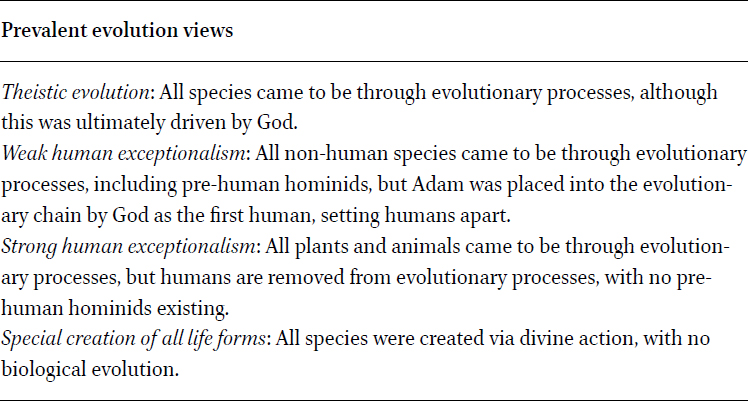
This ambiguity caused obvious challenges in saying which beliefs were most popular within our sample. After classifying both firm and tentative commitments, however, four positions were inductively identified as the most prevalent: theistic evolution; âweakâ human exceptionalism; âstrongâ human exceptionalism; and special creation of all life forms. Ideal-typical descriptions of these are set out in Table 1. (None of these descriptions were presented to research participants during the study, as they emerged later during the analysis stage.)

Prevalent evolution views
Citation: Journal of Muslims in Europe 15, 2 (2026) ; 10.1163/22117954-bja10150
There were a small number of strong advocates for theistic evolution, as in the case of Hugh, a convert in his 30s and Muslim chaplain:
Itâs frustrating because nowadays youâve got Muslims following Harun Yahya and passing off this Southern Baptist simpleton creationist kind of ideology as if it has anything to do with Islam. Yet historically, Muslims wouldnât have had a problem with Darwin.
More commonly, though, the interviewees who spoke positively about theistic evolution, especially those who were seminary trained, did so without fully committing. For example, Zuby, an âalima and research scientist in her 30s, was reluctant to take a position on evolution between species: âI canât say that Iâve got any expertise in cross-species evolution and things like that. Iâm not going to say anything on that.â Nevertheless, she later expressed clearer feelings:
So, I think often people feel that evolution is really problematic because it just puts us in a line of animals and then weâre not as special, and we were created differently. But I think thatâs just humans trying to make themselves feel better and above the rest of creation.
The main cause for ambiguity was, in the case of theistic evolution and other positions discussed, the status of Adam. Multiple participants, such as Ali, a doctoral student in theology, observed that, while they were open to multiple possibilities about evolution, âthe story of Adam [in the Qurâan] is explicitly non-figurativeâ. Those who inclined towards theistic evolution thus tended to retain a space of uncertainty concerning the created-ness of Adam and the emergence of humans. For some, such as Zuby, this was provisional in the sense that it was linked to a perceived lack of knowledge. In other cases, however, as with Fatima above, who ultimately could not be aligned with any view about evolution, this entailed a principled non-commitment rooted in the view that, even if Adamâs status in the Qurâan is clear, it is less clear on themes such as the age of the earth.
Partly due to this uncertainty, theistic evolution blurred into what we call âweakâ human exceptionalism, which accepts the existence of pre-human hominids, but sees Adam as placed on earth through divine action at the point humans emerged (see Moran, 2021). Interviewees such as Adil, a Deobandi âalim in his 20s, saw Adam as exceptional, though he hypothetically accepted species change and other aspects of biological evolution:
[E]ven the idea of evolution [is OK], as long as you make the exclusion, as far as it comes to the idea of Adam, because there is just an overwhelming level of evidence from the Qurâan and hadith that suggests that Adam was â he was an event independent of anything that would just be a chain of events.
A small number of interviewees subscribed to a version of this in which Adam is placed into evolution by God, amidst other humans. This view, sometimes called âAdamic exceptionalismâ (Malik, 2021), was seen as contentious, however, because it denies Adamâs status as the first human. More often, the human species was marked out, as by Raheel, a Shia seminary founder in his 60s:
I donât think evolution is a problem in terms of the genesis of humanity because you can integrate that humans came from apes, and why not? But when the earth was ripened enough to accept humanity, well, maybe God just created human beings separately, Adam and Eve, and sent them here.
In turn, âweakâ human exceptionalism blurred into a âstrongâ human exceptionalism that refuses the idea of pre-human hominids. Examples of this included the following:
[T]he idea of evolution is a very Qurâanic and Islamic idea. Rabb, you know, the proper translation of that is the Evolver [â¦]. But [â¦] I believe, obviously [â¦] the human was created by Allah in his amazing, miraculous way [â¦]. So, this idea that He would have taken a monkey and changed a monkey into a human being is not something that appeals to me at all (Ismail, 60s, Barelwi âalim).
With the theory of evolution, personally, I believe that evolution is a thing, but we didnât come from apes and stuff, we came from Adam. But adaptation and evolution and all of that does exist (Girlsâ student focus group, supplementary madrasa).
âStrongâ exceptionalism implies a sharper break with biological science. We accordingly started to see in these accounts distrust of scientists, emphasis on the fallibility of science, an association between evolution and atheism and, interestingly, the claim that modern scientific paradigms are Eurocentric, neocolonial constructs. Similar claims were even more pronounced among those who inclined toward our fourth position, the idea that all life was an act of special creation, with no evolution at all. Some of these participants borrowed terms from Christian creationism, with several, such as Anis, the headteacher of our Deobandi seminary, using the common creationist trope, âItâs just a theoryâ:
Right, so this is something Iâm vague on, because biology has never been my forte ⦠[but] when you hear science in popular programmes, they talk of evolution as a fact, whereas Iâve always thought itâs a theory, and the evidence on it is circumstantial evidence [â¦]. I know Muslims out there have researched it, and theyâve debunked the theory of evolution, or theyâve debunked the theory of evolution being taken as a fact.
Others, such as Yasmeen, an âalima teaching at a girlâs seminary, also spoke about evolution posing a challenge to their faith:
My belief obviously goes back to the historical Islamic side of stuff, where Allah created everything [â¦]. So thatâs my belief on it. Do I know much about it? I have to confess I donât, and I think that itâs not just â I think there is probably a small element of wilful ignorance in there, because I might be a little bit worried about what my reaction [is] to things.
Crucially, though, these views were also rarely firmly held. Several who tended toward rejection of human and animal evolution did so in an ambiguous way, expressing awe at the power of evolutionary explanations. Some were also accommodating of other views. For example, Omar, a dar al-ulum-educated âalim in his 40s, was distrustful of scientists and expressed scepticism of âmacroevolutionâ, yet he stated that he was happy for his students to accept evolution, so long as they accept Adam was created. Additionally, although a few interviewees employed Christian creationist topes, participantsâ views were distinctively Islamic; the influence of organised (Islamic or Christian) creationism was limited and haphazard. With the exception of two cases, our participants saw the Qurâanic creation narrative as compatible with deep time. As Jameel, an Islamic Studies lecturer, put it: â[T]here are no dates or times [in the Qurâan]. [T]his whole thing has been blown up [â¦] because of certain fundamentalist Christian understandings about a literal biblical storyâ. (Interestingly, in surveys, 12% of lay UK Muslims agree that âThe earth is young â less than 10,000 years oldâ [Unsworth and Voas, 2018: 82].) The influence of the intelligent design movement appeared limited too, with only two participants explicitly drawing on these ideas. Oktar was also dismissed as, in one intervieweeâs words, a âdodgy characterâ who has mixed Islam with âstuff that comes out of places like Texasâ. Overwhelmingly for our Muslim leaders, discussions of evolution revolved around the theological and biological status of Adam, with other questions, such as the earthâs age, being less important.
Overall, none of these four positions stood out as markedly more popular than the others, especially given the level of uncertainty and overlap. Demographic trends in our data were also limited. Perhaps unsurprisingly, participants who were active Science, Technology, Engineering, and Mathematics (STEM) researchers (our sample included three research scientists) tended to be among the most open to evolution, but we found few clear tendencies beyond that. Yet, this very absence of strong tendencies is revealing, highlighting variation and debate within Islamic traditions. While evolution scepticism did appear slightly more marked in conservative Deobandi contexts, it did not fall clearly along sectarian lines; we spoke to some Deobandi-trained âulama, alongside those in other traditions, who spoke positively of theistic evolution and weak human exceptionalism. This suggests a degree of internal variation and, possibly, change. We would tentatively suggest that institutional developments in the British Islamic context have engendered a more open-ended engagement with evolution and human origins since the Usama Hasan controversy.
Furthermore, one can draw conclusions from the fact that our sample was marked by flexibility and a lack of clear-cut views about evolution. This suggests the absence of focused opposition to evolution among British Muslim leaders. We certainly encountered scepticism and rejection of evolution, but our participantsâ views were mixed and rarely held in an uncompromising way, even among evolution sceptics. Beyond affirming the general notion of a divine creator, most were not, or were only weakly, committed to a view. Participantsâ lack of firm commitment was also frequently accompanied by willingness to discuss and potentially change perspective. This was also reflected in our observational research, where discussions and teaching materials frequently did not advocate for or against evolution but sought to open up interpretive space. Teachers sought not to say what one should believe about evolution but to point to what one could believe by offering reflections on the status of Adam or specific passages of the Qurâan by, for example, in the case of one Sunni scholar, pointing to traditions of non-literal interpretation (e.g., majaz, which refers to figurative readings of the Qurâan). For many participants, this was a nascent conversation, one that is not as yet recognised in secular settings in Britain but that is emerging in Muslim seminary networks.
7 Iâjaz âilmi: Popular Support, Elite Rejection?
We turn now to participantsâ views about iâjaz âilmi, where we found more consensus. Virtually all participants, including younger students, were familiar with iâjaz âilmi narratives. Many spoke of encountering iâjaz âilmi at a young age and being, as Huda, an âalima and research scientist in her 30s, observed, âmind-blownâ. Huda, like several interviewees, discovered these ideas via Zakir Naik, who was among the most mentioned individuals in our research (Kuiper, 2018). Naik had, for a time, persuaded several participants that iâjaz âilmi narratives were meaningful. Ultimately, however, there was a near consistent pattern of participants inclining away from iâjaz âilmi as they grew older. As Jameel, a convert to Islam, noted: âI think itâs great as an initial attention-grabber, if youâre new to Islam, in whatever way. But it could eventually become an Achilles heel, I think, if weâre not careful.â
We did find several examples of acceptance of what one might call âsoftâ iâjaz âilmi âthe idea that there is something miraculous in the text of the Qurâan, and openness to the possibility that this can involve anticipating scientific discoveries, but wariness of âprovingâ Islam with reference to specific scientific theories. Huda and Nazneen were two advocates of âsofterâ iâjaz âilmi:
[W]ith water, when I looked up water in the Qurâan and then looked at the composition of the human body and things like that I just thought, âOh all of this is marrying up, this makes senseâ (Huda).
[S]peaking about things like blood vessels and your veins and that sort of thing [â¦]. You just sort of think, âWell, how could they have known that that long ago?â [â¦]. But at the same time, Iâm slightly cautious about it too, because the thing is that the Qurâan, when it was sent down, it was sent to be a book for all of humanity, for all of humankind across all timespans (Nazneen, 20s, in-training âalima).
What was most striking in our research, however, was how participants found formalised varieties of iâjaz âilmi uncompelling. Numerous respondents independently stated that âThe Qurâan is not a book of scienceâ, cautioning against the impulse to âdiscoverâ theories in specific verses. Rather, reflecting classical understandings of Quraânic exegesis, iâjaz was related to the Qurâanâs linguistic and rhetorical inimitability:
I cringe when [people] talk about it because they donât have any sense of what science is. The iâjaz of the Qurâan is something else, actually. I think we must understand iâjaz means the inimitability, the expressions of the way the Qurâan presents simple facts of life, and of course of nature as well (Ismail).
âThe Qurâan contains scientific miraclesâ [â¦] was really my line for a number of years [â¦]. [But when] I started to study the Qurâan specifically from a linguistic and grammatical point of view [â¦] each word is just so rich [â¦]. Itâs like, okay, how are you affirming this very particular meaning, which just so happens to concord with something that has just been discovered? (Ibrahim, 20s, âbridgingâ institution student).
[W]hat happens when modern science moves on and maybe that theory is overshadowed by another theory? [â¦] [W]eâve almost been trying to apply science to the Qurâan, whereas actually, in my opinion, from a theological perspective, there isnât really a need for us to do that (Hannah, 40s, Islamic Studies lecturer).
Our research suggested two possible exceptions to this. Some interviewees pointed to the Ahmadi community, a minority movement from South Asia, as a context where iâjaz âilmi narratives remain popular. Though widely excommunicated by Muslim authorities, Ahmadi leaders in the UK have been active in proselytisation and public communication efforts, including the London-based âVoice of Islamâ radio featuring a regular âScience Hourâ. One such leader, Mirza Tahir Ahmad (d. 2003), made iâjaz âilmi-like arguments in his book Revelation, Rationality, Knowledge and Truth (1998), which, according to two interviewees, popularised iâjaz âilmi among Ahmadis.
The other exception was Salafi Islam, a Saudi-influenced tradition that takes inspiration from Islamâs early followers (salaf). We interviewed three participants from Salafi backgrounds, although all questioned Salafi ideas and no longer described themselves in these terms. While the break was definitive in one case, the other two remained immersed in what one might term âdaâwa cultureâ â that is, Salafi-influenced networks that advocate for a âpurerâ form of Islam and engage in (often web-based) apologetics. These participants questioned iâjaz âilmi but observed that it was popular among peers. As one, Yaqub, noted: â[T]here are scholars in the Salafi community that promote Dr Zakir Naik and use him as a reference when it comes to daâwa and apologetics. So, I wouldnât say that [iâjaz âilmi] is only an online thing, because there is a whole environment behind these people.â
8 Discussion: The Social Context of Islam and Science
What our data thus pointed towards was an important distinction between scholarly, popular and lay conceptions of Islam and its relationship with science. The work of Olivier Roy (2010) has shown that a divide between scholarly and popular religion is increasingly characteristic not only of Islam but of religions globally, with lay believers being influenced less by scholarly forms of religion transmitted by localised institutions, and more by mass-mediated popular discourses (whether Pentecostal or Salafi) that emphasise an immediate understanding of truth through faith. In the Islamic context, this has facilitated the rise of what Dale Eickelman and James Piscatori (1996) call ânew religious intellectualsâ who stand outside of, and offer a challenge to, traditionally educated Islamic scholars. Iâjaz âilmi, in Western contexts at least, appears to be a phenomenon aligned with such individualised modes of transmission and distrusted by traditionally educated scholars. Our data, and the extant literature, do point toward iâjaz âilmi being influential in certain milieus. However, the general scepticism of iâjaz âilmi narratives among British âulama suggests it is a popular variety of Islam, disseminated by evangelists via mass media, rather than one transmitted via seminary institutions. This distinction is relevant to our findings on evolution too. The fact that, as we previously observed, one in ten lay Muslims agrees with Young Earth perspectives in surveys, despite these being hardly mentioned in our interviews, indicates a separation between laypeople and âulama, with the former being shaped by other social and intellectual forces rather than Islamic knowledge.
This distinction between scholarly, popular and lay conceptions was recognised by several participants, who viewed themselves as operating in a challenging context, often fighting against popular forms of Islam for the hearts and minds of lay Muslims. Almost all participants felt that Islam was, in secular Britain, under pressure. For those who tended toward evolution rejection, this sometimes manifested in the view that âWesternâ ideas were being âimposedâ on Muslims. Those who were more sympathetic to evolution saw the situation differently, believing the problem was that (young) Muslims are not being equipped to answer questions posed by an anti-religious society. Such figures often saw evolution rejection by younger Muslims as a form of rebellion. As Sayyid, put it, â[I]tâs a cool, rebellious thing to do to say evolution is all wrong and universities are all wrong, the professors are all wrong.â This, however, was regarded as a fragile worldview that could lead to secularisation once challenged. In the view of Asad, the founder of our supplementary madrasa, the claim that acceptance of evolution requires atheism is âleading a vast array of Muslims to either denounce their faith or join an ever-growing number of in-closet ex-Muslimsâ. â[P]arents come to meâ, agreed Arshad, an Islamic studies lecturer. âIâm dealing with two families whose kids are atheists, because of evolution.â These figures saw themselves as providing philosophical arguments for theism, and the possibility of theistic evolution, that counter zero-sum assumptions among lay Muslims.
It helps to situate these arguments against the backdrop of the institutional developments in Islamic Britain discussed earlier in the article. Islamic educational institutions in the UK, as we have seen, are being reconfigured by a combination of real and perceived student needs and outside pressures. This has led to deepening interactions between Islamic and secular domains in a range of contexts â not just in education but in law, politics and civil society activism (see Jones, 2020). The growing willingness among some British âulama to discuss evolution and pass on to their students a âtheological toolkitâ for discussing Islam and science might be regarded as another example of this.
9 Conclusion
Islam is often misperceived in the West, with accounts of the tradition, both historically and today, frequently depicting it as an undifferentiated whole dominated by a fixed set of teachings. This tendency, and the preconceptions it generates, are visible in media narratives that assume Muslims will inevitably âimport creationismâ into Western states. What is perhaps most concerning is that the discipline of sociology, and researchers of science and society specifically, have not always taken opportunities to correct these stereotypes and indeed have sometimes fostered them. We have seen that, even in academic and policy research publications, crude assumptions can be made about the views Muslims hold about science and what shapes these, with such assumptions being guided by the idea that Islam unidirectionally undermines science acceptance.
Against this, this research has emphasised that Islamic knowledge is a complex, multivalent category. Certainly, Islamic knowledge traditions do shape distinctive perspectives on science and evolution, with the theological status of Adam being of greater concern than issues such as the age of the earth. Indeed, this article has stressed the need to treat Islam on its own terms rather than viewing it through Western Christian lenses. Nevertheless, much like Christian responses to science, Muslimsâ views are varied and are shaped and made salient (or not) by social context. We can see this most clearly in the distinction we have drawn between lay Muslims, mass-mediated popular Islam, and the scholarly class of Muslims who lead Islamic educational institutions. These different carriers of Islamic knowledge can, and do, stand in tension with one another on questions about how Islam engages with science. In the UK, we can see examples of Islamic scholars pushing back against what they deem simplistic understandings of the Qurâan and evolution held by lay Muslims and popularised by transnational online evangelists. Such examples place into question common social scientific approaches that posit âreligiosityâ as a single dependent variable that can be used to explain peopleâs rejection of evolutionary science.
There is an irony in the fact that, while Muslim religious leaders are sometimes stereotyped as the most inflexible opponents of science, in our research they were flexible, uncertain and, in some cases, more open to contested scientific ideas than their laity. This is not to deny that there are points of sometimes profound tension between science and these religious authorities. It is, however, to emphasise the point that the secular academy needs to be able to speak of religion accurately, doing justice to internal variation, and that this is all the more important given that, as our research has suggested, secular-religious interactions are among the main forces shaping Muslimsâ views. There may be instances where traditionally trained religious scholars, their authority in late modern society waning, can find common cause with science communicators, a group that has tended to treat religious leaders with indifference at best, and as implacable adversaries at worst.
Acknowledgements
The authors of this article are grateful to Elaine Howard Ecklund and John H. Evans for supporting this research, and to Fern Elsdon-Baker, Will Mason-Wilkes, James Riley, Alex Hall and Carissa Sharp for providing feedback on early versions of the article. This research was supported by the Rice University âSociology of Science and Religion: Identity and Belief Formationâ subgranting scheme, funded through the Templeton Religion Trust and coordinated by The Issachar Fund.
References
Ahmad, Mirza Tahir, Revelation, Rationality, Knowledge and Truth (Tilford: Islam International Publications, 1998).
Amin, Hira, and Majothi, Azhar, âThe Ahl-e-Hadith: From British India to Britainâ, Modern Asian Studies, 56 (2022), 176â206. https://doi.org/10.1017/S0026749X21000093.
Asghar, Anila, âCanadian and Pakistani Muslim teachersâ perceptions of evolutionary science and evolution educationâ, Evolution: Education and Outreach, 6 (2013), 1â12. https://doi.org/10.1186/1936-6434-6-10.
Barnes, M. Elizabeth, Roberts, Julie A., Maas, Samantha A., and Brownell, Sara E., âMuslim undergraduate biology studentsâ evolution acceptance in the United Statesâ, PLOS ONE, 16/8 (2021), e0255588. https://doi.org/10.1371/journal.pone.0255588.
Bigliardi, Stefano, âWhoâs afraid of theoscientography? An interpretative hypothesis on Harun Yahyaâ, Zygon: Journal of Religion & Science, 49 (2014), 66â80.
Bigliardi, Stefano, âThe âscientific miracle of the QurâÄnâ, pseudoscience, and conspiracismâ, Zygon: Journal of Religion & Science, 52 (2017), 146â171. https://doi.org/10.1111/zygo.12321.
Blancke, Stefaan, Hjermitslev, Hans Henrik, Braeckman, Johan, and Kjærgaard, Peter C., âCreationism in Europe: Facts, gaps, and prospectsâ, Journal of the American Academy of Religion, 81 (2013), 996â1028. https://doi.org/10.1093/jaarel/lft034.
BouJaoude, Saouma, Asghar, Anila, Wiles, Jason R., Jaber, Lama, Sarieddine, Diana, and Alters, Brian, âBiology professorsâ and teachersâ positions regarding biological evolution and evolution education in a Middle Eastern societyâ, International Journal of Science Education, 33 (2011), 979â1000.
BouJaoude, Saouma, Wiles, Jason R., Asghar, Anila, and Alters, Brian, âMuslim Egyptian and Lebanese studentsâ conceptions of biological evolutionâ, Science & Education, 20 (2011), 895â915. https://doi.org/10.1007/s11191-011-9345-4.
Bowen, John R, On British Islam: Religion, Law, and Everyday Practice in Shariâa Councils (Princeton, NJ: Princeton University Press, 2016).
Brown, Andrew, âHow a creationist fatwa proved a shocking example of Wahhabi Islamâs influenceâ, The Guardian, 4 December 2013. https://www.theguardian.com/commentisfree/belief/2013/dec/04/creationist-fatwa-wahhabi-islam-usama-hasan.
Bucaille, Maurice, The Bible, the Qurâan, and Science: The Holy Scriptures Examined in the Light of Modern Knowledge (New Delhi: Islamic Book Service, 2000).
Carlisle, Jessica, Hameed, Salman, and Elsdon-Baker, Fern, âMuslim perceptions of biological evolution: A critical review of quantitative and qualitative researchâ, in Science, Belief and Society: International Perspectives on Religion, Non-Religion and the Public Understanding of Science, Stephen H. Jones, Tom Kaden, and Rebecca Catto (eds.) (Bristol: University of Bristol Press, 2019), pp. 147â172.
Clément, Pierre, âMuslim teachersâ conceptions of evolution in several countriesâ, Public Understanding of Science 24 (2015), 400â421. https://doi.org/10.1177/0963662513494549.
Ecklund, Elaine Howard, Johnson, David R., Vaidyanathan, Brandon, Matthews, Kirstin R. W., Lewis, Steven W., Thomson Jr., Robert A., and Di, Di, Secularity and Science: What Scientists around the World Really Think about Religion (New York: Oxford University Press, 2019).
Ecklund, Elaine Howard, and Scheitle, Christopher P., Religion vs. Science: What Religious People Really Think (New York: Oxford University Press, 2018).
Eickelman, Dale F., and Piscatori, James, Muslim Politics (Princeton, NJ: Princeton University Press, 1996).
Evans, John H., Morals Not Knowledge: Recasting the Contemporary U.S. Conflict between Religion and Science (Oakland: University of California Press, 2018).
Everhart, Donald, and Hameed, Salman, âMuslims and evolution: A study of Pakistani physicians in the United Statesâ, Evolution: Education and Outreach 6 (2013), 1â8. https://doi.org/10.1186/1936-6434-6-2.
Fuller, Michael, âScience and religion in a global contextâ, in Routledge International Handbook of Religion in Global Society, Jayeel Cornelio, François Gauthier, Tuomas Martikainen, and Linda Woodhead (eds.) (London: Routledge, 2020), pp. 478â487.
Gardham, Duncan, âRichard Dawkins: Muslim parents âimport creationismâ into schoolsâ, The Telegraph, 3 August 2008. https://www.telegraph.co.uk/news/uknews/2494397/Richard-Dawkins-Muslim-parents-import-creationism-into-schools.html.
Gardner, Vika, Mayes, E. Carolina, and Hameed, Salman, âPreaching science and Islam: Dr. Zakir Naik and discourses of science and Islam in Internet videosâ, Die Welt des Islams, 58 (2018), 357â391. https://doi.org/10.1163/15700607-00583P04.
Gilliat-Ray, Sophie, âClosed worlds: (Not) accessing Deobandi dar ul-uloom in Britainâ, Fieldwork in Religion, 1 (2005), 7â33.
Gilliat-Ray, Sophie, Muslims in Britain: An Introduction (Cambridge: Cambridge University Press, 2010).
Gilliat-Ray, Sophie, âFrom âclosed worldsâ to âopen doorsâ: (Now) accessing Deobandi darul uloom in Britainâ, Fieldwork in Religion, 13 (2018), 127â150. https://doi.org/doi.org/10.1558/firn.35029.
Grimston, Jack, âMuslim medics boycott lectures on Darwin and evolutionâ, The Times, 27 November 2011. https://www.thetimes.com/travel/destinations/uk-travel/england/london-travel/muslim-medics-boycott-lectures-on-darwin-and-evolution-df0dc2lp60x?gaa_at=eafs&gaa_n=AWEtsqctczabTSVMAuxT3XExxcdRekzesbs8VE_lYl07IkyGVkacy_1DDzLc1NN-efE%3D&gaa_ts=69a97924&gaa_sig=IBSCVd7L8a8B-gY3U6qzBGma4m1V74GsI3MfB7rRbRjhYzF1HPkfSANQWhgb5w5W-iiU9Ba1W7W6Z1J4MEIgRA%3D%3D.
Guessoum, Nidhal, âThe Qurâan, science, and the (related) contemporary Muslim discourseâ, Zygon: Journal of Religion & Science, 43 (2008), 411â431. https://doi.org/10.1111/j.1467-9744.2008.00925.x.
Guhin, Jeffrey, âWhy worry about evolution? Boundaries, practices, and moral salience in Sunni and evangelical high schoolsâ, Sociological Theory, 34 (2016), 151â174. https://doi.org/10.1177/0735275116649220.
Hameed, Salman, âMaking sense of Islamic creationism in Europeâ, Public Understanding of Science 24 (2015), 388â399. https://doi.org/10.1177/0963662514555055.
Hasan, Usama, âKnowledge regainedâ, The Guardian, 11 September 2008. https://www.theguardian.com/commentisfree/2008/sep/11/religion.darwinbicentenary.
Heath, Anthony, and Li, Yaojun, Review of the Relationship between Religion and Poverty: An Analysis for the Joseph Rowntree Foundation, CSIWorking Paper (Oxford: Centre for Social Investigation, Nuffield College, 2015).
Hill, Jonathan P., National Study of Religion and Human Origins (Grand Rapids, MI: BioLogos Foundation, 2014).
Hill, Jonathan P., âSurvey-based research on science and religion: A review and critiqueâ, in Science, Belief and Society: International Perspectives on Religion, Non-Religion and the Public Understanding of Science, Stephen H. Jones, Tom Kaden, and Rebecca Catto (eds.) (Bristol: University of Bristol Press, 2019), pp. 25â54.
Hokayem, Hayat, and BouJaoude, Saouma, âCollege studentsâ perceptions of the theory of evolutionâ, Journal of Research in Science Teaching, 45 (2008), 395â419. https://doi.org/10.1002/tea.20233.
Jalajel, David Solomon, and Malik, Shoaib Ahmed, âThe role of classical SunnÄ« theology in Islam and science: Responding to Nidhal Guessoumâ, Zygon: Journal of Religion and Science, 60 (2025). https://doi.org/10.16995/zygon.16545.
Jones, Stephen H., Islam and the Liberal State: National Identity and the Future of Muslim Britain (London: Bloomsbury/IB Tauris, 2020).
Jones, Stephen H., Catto, Rebecca, Kaden, Tom, and Elsdon-Baker, Fern, ââThatâs how Muslims are required to view the worldâ: Race, culture and belief in non-Muslimsâ descriptions of Islam and scienceâ, Sociological Review, 67 (2019), 161â177. https://doi.org/10.1177/0038026118778174.
Jones, Stephen H., and Unsworth, Amy, âTwo Islamophobias? Racism and religion as distinct but mutually supportive dimensions of anti-Muslim prejudiceâ, British Journal of Sociology, 75 (2024), 5â22. https://doi.org/10.1111/1468-4446.13049.
Kaden, Tom, Creationism and Anti-Creationism in the United States: A Sociology of Conflict (Cham: Springer, 2018).
Kuiper, Matthew J., Daâwa and Other Religions: Indian Muslims and the Modern Resurgence of Global Islamic Activism (London: Routledge, 2018).
Lewis, Philip, Islamic Britain (London: IB Tauris, 2002).
Malik, Shoaib Ahmed, Islam and Evolution: Al-GhazÄlÄ« and the Modern Evolutionary Paradigm (London: Routledge, 2021).
Mandaville, Peter, Wahhabism and the World: Understanding Saudi Arabiaâs Global Influence on Islam (New York: Oxford University Press, 2022).
Moran, Glen, âBritish Muslim perceptions of evolutionâ, PhD thesis (Liverpool: Liverpool Hope University, 2018).
Moran, Glen, âHarun Yahyaâs influence in Muslim minority contexts: Implications for research in Britain, Europe, and beyondâ, Zygon: Journal of Religion & Science, 54 (2019), 837â856. https://doi.org/10.1111/zygo.12555.
Moran, Glen, âThe final domino: Yasir Qadhi, Youtube, and evolutionâ, Zygon: Journal of Religion & Science, 56 (2021), 34â53. https://doi.org/10.1111/zygo.12666.
Numbers, Ronald L., Galileo Goes to Jail and Other Myths about Science and Religion (Cambridge, MA: Harvard University Press, 2010).
OâToole, Therese, Meer, Nasar, DeHanas, Daniel Nilsson, Jones, Stephen H., and Modood, Tariq, âGoverning through Prevent? Regulation and contested practice in stateâMuslim engagementâ, Sociology 50 (2016), 160â177. https://doi.org/10.1177/0038038514564437.
Peker, Deniz, Comert, Gulsum Gul, and Kence, Aykut, âThree decades of anti-evolution campaign and its results: Turkish undergraduatesâ acceptance and understanding of the biological evolution theoryâ, Science & Education 19 (2010), 739â755. https://doi.org/10.1007/s11191-009-9199-1.
Riexinger, Martin, âPropagating Islamic creationism on the Internetâ, Masaryk University Journal of Law and Technology, 2 (2009), 99â112.
Roy, Olivier, Holy Ignorance: When Religion and Culture Part Ways (London: C. Hurst, 2010).
Scott-Baumann, Alison, and Cheruvallil-Contractor, Sariya, Islamic Education in Britain: New Pluralist Paradigms (London: Bloomsbury Academic, 2015).
Scott-Baumann, Alison, Ebbiary, Alyaa, Mohammad, Shams Ad Duha, Dhorat, Safiyya, Begum, Shahanaz, Pandor, Hasan, and Stolyar, Julia, âTowards contextualized Islamic leadership: Paraguiding and the universities and Muslim seminaries project (UMSEP)â, Religions 10 (2019), 662. https://doi.org/10.3390/rel10120662.
Sidat, Haroon, âShedding light on the modalities of authority in a dar al-uloom, or religious seminary, in Britainâ, Religions, 10 (2019), 653. https://doi.org/10.3390/rel10120653.
Toumey, Christopher P., Godâs Own Scientists: Creationists in a Secular World (New Brunswick, NJ: Rutgers University Press, 1994).
Unsworth, Amy, âDiscourses on Science and Islam: A view from Britainâ, in Science, Belief and Society: International Perspectives on Religion, Non-Religion and the Public Understanding of Science, Stephen H. Jones, Tom Kaden, and Rebecca Catto (eds.) (Bristol: University of Bristol Press, 2019), pp. 263â288.
Unsworth, Amy, and Voas, David, âAttitudes to evolution among Christians, Muslims and the non-religious in Britain: Differential effects of religious and educational factorsâ, Public Understanding of Science, 27 (2018), 76â93. https://doi.org/10.1177/0963662517735430.