Abstract
This study analyses the rules and regulations section of the websites of two major institutions responsible for road safety: Spain’s Dirección General de Tráfico (DGT) and the UK’s Department for Transport (DfT). The goal is to explore how interpersonality is created in this digital genre from a cross-linguistic perspective. A database of the most relevant sections of both websites was compiled and analysed mainly using a Critical Discourse Analysis (CDA) approach (Baker et al., 2008), combining corpus linguistics tools (Sketch Engine’s word lists and concordance analysis) with a slightly modified version of Martin and White’s engagement system (2005). The results reveal that, in both corpora, engagement is accomplished through dialogic contraction and expansion strategies that help establish interaction with readers. Nevertheless, whereas dialogicity seems to be more explicitly marked in the British corpus, in the Spanish dataset, this dialogicity appears to be more implicit.
1 Introduction
How road safety rules and regulations are communicated through institutional channels is paramount to public health and safety (e.g., Nathanail and Adamos, 2013; Elvik, 2016). Although road safety communication has been studied extensively before by considering its persuasive rhetorical effect (e.g., Elder et al., 2004; Boulanger et al., 2007; Delhomme et al., 2009; Philips et al., 2011; Nanail and Adamos, 2013; Guttman, 2015; Faus et al., 2021; Alonso et al., 2021; Faus et al., 2023; Lucas et al., 2024; Faus et al., 2024), the way interpersonality is created in a specific digital genre like the institutional website has not been explored so far. The legal information incorporated into institutional sites is the most salient reference for citizens regarding road safety regulations. Therefore, how interpersonal discourse is construed in this modality deserves an in-depth analysis, both because of its theoretical relevance in interpersonal discourse studies (Moreno, 1997; Dafouz Milne, 2003; Valero-Garcés, 1996; Lorés-Sanz, et al. 2010; Suau Jiménez, 2016) and its professional applications for practitioners of these areas and the specific genre under study. By comparing how interpersonality is realized across Spanish and British institutional websites, the present study contributes to the field of contrastive pragmatics by offering empirical insights into how socio-pragmatic norms shape engagement strategies in public digital discourse.
2 Literature Review
Road safety communication literature highlights the need for a structured theoretical background in designing road safety communication (e.g., Delhomme et al., 2009; Nathanail and Adamos, 2013). Numerous subsequent studies have sought to fulfill this objective by integrating a range of behavioral frameworks, highlighting the significance of theoretical constructs, such as the Theory of Planned Behavior (TPB), the Health Belief Model (HBM), Protection Motivation Theory, and the Extended Parallel Process Model.” (Adamos and Nathanail, 2016).
However, persuasion as a salient interpersonal discursive practice remains heavily under-researched in this context. Faus et al. (2023) note that communication campaigns on road safety are informative and persuasive in nature, mainly oriented towards promoting beneficial attitudes and behaviors. Delhomme et al. (2009) define road safety communication campaigns as “essentially purposeful attempts to inform, persuade, or motivate people” and Guttman (2014) essentially approaches communication, public discourse, and road safety campaigns as phenomena that deal with the subject of how to persuade people to be safer. Delhomme et al. (2009) even underline the importance of carefully using emotional appeal in road safety messaging. Although some of these previous studies also describe different communicative strategies used in Spanish road safety advertisements, such as informative, persuasive, emotional, and humorous techniques (Faus et al., 2023), to our knowledge, there is no study today addressing interpersonal discourse, specifically the engagement strategies used by road safety institutions in their websites from a linguistics, discursive and pragmatics point of view.
Drawing on the premise above, the objective of this research is to examine the rules and regulations section of the websites of the most important institutions in charge of road safety in Spain DGT (Dirección General de Tráfico), and its counterpart in the UK government DfT (Department for Transport). Specifically, our research aims to analyse how interpersonality, and more specifically engagement, is constructed in these institutional websites from a cross-linguistic viewpoint.
In this regard, the engagement system (Martin and White, 2005) stands out as one of the most crucial rhetorical elements shaping many academic and professional genres. By means of engagement, writers engage with their readers (Hyland, 2008). In particular, the institutional websites related to road safety can be considered persuasive texts in which writers (the members of that organisation) intend to convince readers (citizens and drivers) of how they must behave when driving vehicles at the least possible risk. Nevertheless, the manner in which the intended audience is persuaded to take action on institutional websites may differ from the persuasive intent of the content creator. In other words, the message might not convince people the way it was meant to, because readers can understand and react to it differently than the person who wrote it expected. In this vein, road safety communication could be approached as an integral part of public health discourse, posing serious societal and behavioral impacts (e.g., Faus et al., 2022; Faus et al., 2024) if the appropriate interactional metadiscourse strategies are not taken into consideration. Hence, this seems to be a critical research gap in road safety communication that deserves to be further explored.
3 Theoretical Framework
Engagement is considered one of the most persuasive linguistic elements to establish an interaction between the writer and the reader in academic, professional, and social genres, as shown in the well-known model designed by Martin and White (2005) within their Appraisal Theory framework. This framework, which emerged from Systemic-Functional Linguistics (SFL) (Halliday, 1994; Matthiessen, 1995), draws its attention towards analysing the language of evaluation.
The relevance of this framework lies in the techniques for the systematic analysis of evaluation and stance as they operate in whole texts and groupings of texts. In addition, it is mainly concerned with the social function of these resources, not simply with how individual speakers/writers express their feelings and take stands, but with how they engage with socially-determined value positions and thereby align and disalign themselves with the social subjects who hold to these positions. In other words, linguistic phenomena are better explained by reference to the social functions performed by language, by reference to the functional demands placed upon language by its users (see, for example, Halliday 1971: 330–68). Additionally, it holds that these social functions fall into three broad dimensions: a) ideational, through which language represents the world of experience; b) interactional, that is, how social roles and relationships are constructed, and c) textual, through which texts are made coherent, both internally and for the context in which they operate (see Halliday, 1994). Within this context, the appraisal framework is directed towards developing the account of interpersonal functionality, with extended descriptions and understanding of those aspects of language by which speakers/writers construct for themselves particular identities or personae and by which they position themselves and those they address.
As previously said, Martin and White’s Appraisal Theory (2005) draws its input from the Systemic Functional Linguistics theory (Halliday, 1975), and meaning-making can be divided into the three Hallidayan broad modes or ‘metafunctions.’ Therefore, Appraisal Theory is fed by and stands between Interpersonality Theory and Metadiscourse Theory. The three main subsystems of Appraisal Theory are: a) attitude or resources/markers to appraise/evaluate/judge feelings, people’s characters, and behaviour. Within attitude, one can identify three different subcategories, such as affect markers, which express emotional states; judgement markers, which express attitude towards a behaviour; and appreciation markers, which provide an aesthetic evaluation; b) engagement or resources/markers to introduce other voices into the discourse. For instance, we can identify monoglossic utterances, that is, impersonal utterances that do not make explicit reference to other voices, and heteroglossic utterances, dialogic utterances that include other voices. They can be contracting by disclaiming/denying the statement or proclaiming/reinforcing it. They can also be expanding by attributing/acknowledging the statement or entertaining/interpreting/explaining it, and c) graduation or resources/markers to express the degree or grade of the feelings/emotions.
In this study, we will delve into the analysis of the engagement system, which is intrinsically intertwined with Halliday’s (1975) interactional dimension of language. Given the interactional nature of engagement markers, they become meaningful indicators of the degree of suitability or disparity that may exist between the socio-cultural values expressed by the writer and the reader, if the latter is a non-native speaker of the source language (Ivorra-Pérez and Giménez-Moreno, 2018). These markers are influential cross-cultural rhetorical devices because, as Hyland (1999: 5) points out, “engage and influence readers in ways that conform to the norms of a discipline, values, and ideology of a community, thus expressing interpersonal meanings in a way to be credible and convincing to the audience of that community.”
Various studies have examined the use of engagement markers in different types of academic, professional, and social genres from a cross-cultural perspective. Some of them have found that these types of interactional metadiscourse strategies may be often constrained by the conventions of the particular genre under analysis (e.g., Moreno, 1997; Dafouz Milne, 2003; Lores-Sanz et al., 2010), but most of them agree that they are highly influenced by cross-cultural variation (e.g., Ivorra-Pérez, 2014, 2016; Ivorra-Pérez and Giménez-Moreno, 2018, Suau Jiménez and Ivorra-Pérez, 2023; Suau Jiménez, 2010, 2016).
The above-mentioned studies are mainly embedded within the discipline of cross-cultural pragmatics. Although the birth of this discipline dates back to the 70s and 80s with a reaction against the alleged universalism of certain linguistic theories of Anglo-Saxon origin (e.g., Grice, 1975; Brown and Levinson, 1987) and its focus on professional and academic genres started in the 90s with the seminal work of Swales (1990) and Bhatia (1993), it is in the last three decades that intercultural rhetoric has become one of the priorities of applied linguistics and translation studies (Connor et al., 2008).
Over the last decades, significant research has been published on the description and contrastive analysis of the culture-specific pragmalinguistic conventions governing speech acts, social interaction, and discourse strategies across languages (e.g., Blum-Kulka et al., 1989; Wierzbicka, 1991; Márquez-Reiter, 2000; Díaz-Pérez, 2003). According to some specialists (e.g., Kaplan, 1966; Clyne, 1994; García-Yeste, 2013; Giménez-Moreno and Skorczynska, 2013; Guillén-Nieto, 2013; Ivorra-Pérez, 2012, 2015), the differences in the rhetorical patterns of texts across cultures are more likely to reflect specific cultural and educational training factors that help shape the writing conventions learned in a culture.
The above observations led some specialists to adopt more interdisciplinary approaches, including insights from renowned anthropologists and social psychologists, such as Edward T. Hall (1976) and Geert Hofstede (1991). In the light of these studies, various cultural dimensions have been compared between English and Spanish in different professional and academic genres, such as opinion essays, business websites, press advertising, or business letters (e.g., García-Yeste, 2013; Guillén-Nieto, 2013; Ivorra-Pérez, 2012, 2014, 2015) or even the way speech acts are performed in British or American English in comparison with other languages like Russian or Ukrainian (e.g., Loukianenko Wolfe, 2008; Prykarpatska, 2008). All these studies yield important differences in communication styles between languages, mainly stemming from socio-cultural factors.
As regards the influence of cultural values on interpersonal discourse and, more particularly, on engagement markers, the works of Guillén-Nieto (2013) on the influence of cultural values on the use of interactional metadiscourse patterns in the business letter of introduction in Peninsular Spanish and British toy companies as well as Ivorra-Pérez (2014, 2015) on the impact of culture on the use of interactional metadiscourse in Peninsular Spanish, British English and American English business websites, stand out. The findings of these works reveal interesting differences in how some of Hofstede’s cultural dimensions may influence the way interpersonality is produced and interpreted in different languages and cultures.
Despite the relevance of the aforementioned studies in interpersonal discourse from a cross-cultural angle, there seems to be a loophole in the literature regarding the analysis of how interpersonality is linguistically constructed in Spanish DGT and British DfT institutional websites, which, in our view, may pose relevant professional and social implications.
4 The Study
As previously mentioned, this research aims to explore how interpersonality is construed in two institutional websites, namely the Spanish DGT and British DfT, from a cross-linguistic perspective. Therefore, considering its general scope, we attempt to answer the following research questions:
a) What are the most salient engagement strategies in communicating road safety rules and regulations on Spanish DGT websites?
b) What are the most salient engagement strategies in communicating road safety rules and regulations on British DfT websites?
c) To what extent do engagement strategies in communicating road safety rules and regulations differ cross-linguistically in both organisations?
4.1 Materials and Method
Our database was compiled from January to May 2024 and consists of websites belonging to two official institutions: the Spanish DGT (Dirección General de Tráfico) and the British DfT (UK’s Department for Transport). As regards the Spanish dataset, we focus on examining the information provided in the section Muévete con seguridad (Move safely) and the subsections Consejos para conductores (Tip for drivers), Evita conductas de riesgo (Avoid risky behaviour), Qué hacer ante un accidente de tráfico (What to do in the event of a traffic accident), and Viaja seguro (Travel safely). As for the British corpus, we address our attention towards the information incorporated into the section ‘Guidance and Regulation.’ We hold the view that these two sections are the most pertinent considering our research objectives since they are inherently related to how the members of these two organisations interact with citizens and drivers.
To the analysis, we apply a mixed methodological approach. The methodology draws upon corpus-assisted discourse studies, informed by recent developments and tools within this field (e.g. Potts et al., 2015; Maruenda-Bataller, 2021; Javadinejad, 2024a; 2024b; 2024c). The analytical procedure has been designed drawing on the methodological considerations of Javadinejad (2024a), when combining a qualitative linguistic model like Martin and White’s Appraisal Theory (2005) and quantitative corpus linguistic analysis through Sketch Engine. The methodological considerations in this study revolve around the careful integration of a qualitative linguistic model with quantitative corpus linguistic techniques. Acknowledging the epistemological and practical challenges of combining a context-sensitive, interpretive framework rooted in pragmatics with the data-driven, pattern-based approaches of Corpus Linguistics (CL), the author proposes a stepwise procedure designed to preserve the qualitative depth of the linguistic model while capitalizing on the scalability and replicability of CL. In this study, frequency analysis is used to identify semantically relevant lexical fields within the corpus, followed by the application of concordance and collocation tools to trace and categorise linguistic features from the reference model according to their context. The author underscores the necessity of qualitative, manual coding due to the evaluative and context-dependent nature of news value indicators, noting that automatic semantic annotation tools often fail to capture pragmatic variation, as the same lexical item may convey different meanings depending on its discursive environment. Consequently, methodological rigour is ensured through an iterative process that combines statistical pattern detection with concordance-based qualitative interpretation, in alignment with Appraisal Theory’s emphasis on evaluative meaning. This integrated approach yields a robust mixed-methods model capable of uncovering ideologically charged discursive patterns at scale, while remaining sensitive to the inherent subjectivity and cultural specificity involved in the construction of newsworthiness.
Accordingly, the following procedure is followed to analyse the obtained raw data: a) Extracting frequency-based word list; b) Setting the cutoff point with a frequency of 5; c) Codification of the most frequent words using concordance analysis; d) Calculating the normalised frequencies due to the unavoidable difference in the sub-corpora size (Spanish DGT 36,626 words and British DfT 5,618 words) for each analytical subcategory per 1,000 words according to the linguistic model; e) Performing a pairwise statistical test between the English and the Spanish corpus; and f) Interpreting the results. Previously to carrying out the quantitative analysis, an observational analysis was applied to identify the different linguistic engagement markers included in both corpora.
To carry out the analysis, we draw on Martin and White’s (2005) engagement system within their Appraisal Theory framework. Following Martin (2003: 142), engagement “indicates the speaker’s degree of commitment to the appraisal being expressed.” The engagement system can be divided into two main macro-categories: a) monoglossia (single voice) and b) heteroglossia (multiple voices). Given the overall scope of this research, we are particularly interested in the heteroglossic nature of communication on road safety rules and regulations in institutional channels, such as the Spanish DGT and the British DfT. Indeed, heteroglossia allows for “dialogistic alternatives” (Martin, 2000: 90), letting other voices take part in the text or as references to support and evidence. Considering this model of analysis, heteroglossia is further divided into two main dimensions: a) dialogic contraction and b) dialogic expansion.
Dialogic contraction aims at narrowing down the space for certain dialogic alternatives through ‘disclaim’ and ‘proclaim.’ In turn, disclaim is subdivided into ‘deny’ (negation) and ‘counter-expectation’ (concession), while ‘proclaim’ is subdivided into three main subcategories: ‘concur’ (alignment), ‘pronounce’ (emphasis on authorial intervention), and ‘endorsement’ (sourcing warrantable sources).
Contrary to dialogic contraction, dialogic expansion opens the dialogic space to other readers. This category is also split up into different subcategories: ‘entertaining’ (entertaining readers with possibilities, as may be reflected in modal verbs, probability adverbs, or conditional structures), ‘acknowledging’ (authorial voice standing concerning propositions like the use of reporting verbs), and ‘distancing’ (distancing away from author’s proposition employing scare quotes or lexical items like ‘claim’). In other words, dialogic expansion is reflected in semantic resources that help entertain other voices, acknowledge sources, or distance from the authorial voice.
Due to the cross-linguistic nature of this research, we cannot overlook that Martin and White’s (2005) ‘engagement system’ may pose some limitations on how engagement could work in other languages and cultures (Ivorra-Pérez, 2016; Suau Jiménez and Ivorra-Pérez, 2022). Therefore, we draw on a slightly modified version of their model of analysis. For instance, verbs in the imperative mood and second-person pronouns could be included within dialogic contraction, and more particularly within the subcategory of ‘proclaim.’ These types of linguistic markers are considered in Hyland‘s (2008) model of interactional metadiscourse as ‘engagement’ markers. As will be observed later in the findings section, our data indicate that the writer’s voice may be included in the discourse through these markers, and such modification could be considered an instrumental add-on to the existing model. In the same vein, we also consider implicit engagement and depersonalisation markers (Ivorra-Pérez, 2015, 2016; Suau Jiménez et al., 2021, 2023) as meaningful instances of dialogic expansion, as these types of linguistic markers could also be used to expand the dialogic space with other readers.
5 Findings
The following subsections are devoted to describing the main findings that have been obtained from the dataset analysed:
5.1 General Findings
In Table 1, we can observe a general overview of the quantitative findings obtained in both dialogic contraction and expansion as regards the analysis of the corpora:

General quantitative findings
Citation: Contrastive Pragmatics 7, 2 (2026) ; 10.1163/26660393-bja10152
An overall quantitative analysis reveals that, considering the normalised frequencies obtained from both datasets, the findings unearth that the British corpus presents higher frequencies in both types of heteroglossic markers. For instance, as has also been demonstrated in previous studies related to other professional and social genres (e.g., Ivorra-Pérez, 2014, 2016; Suau Jiménez, 2010; Suau Jiménez et al., 2021), the British corpus incorporates higher frequencies of dialogic expansion markers, which may be attributed to the fact that the United Kingdom, and especially England, has been traditionally considered a culture where its members, without overlooking the differences that may exist among individuals of that culture, value negative politeness (e.g., Brown and Levinson, 1987; Scollon and Scollon, 2012), mainly characterized by autonomy, deference, and non-imposition (Lewis, 1999).
In the following subsections, a more in-depth analysis of the findings corresponding to the different subcategories of dialogic contraction and expansion is described:
5.2 Findings on Dialogic Contraction
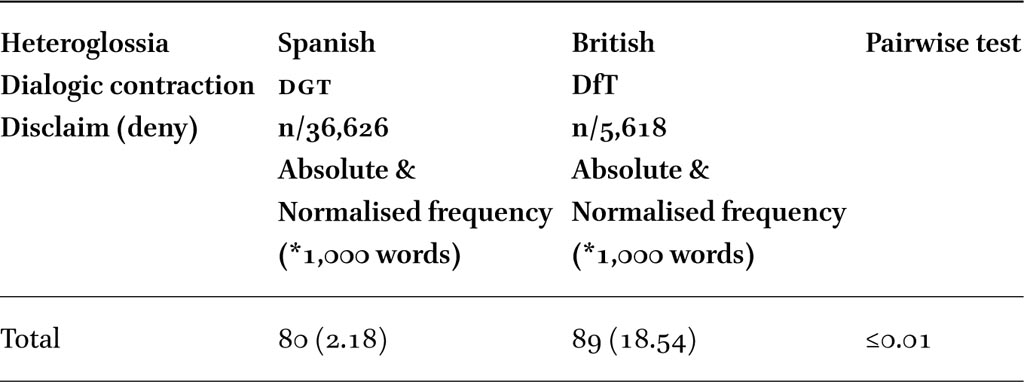
Following Martin and White’s (2005) engagement system, within heteroglossia, dialogic contraction can be split up into two main subcategories: a) disclaim (deny and counter-expectation) and b) proclaim (concur, pronounce, endorse). In Tables 2 and 3 below, we can observe the frequencies obtained in both datasets regarding the use of disclaim. Whereas deny markers are mainly used to reject other dialogistic alternatives in discourse through negative adverbs, counter-expectation markers contradict the opposing dialogic stance through concessive sentences.
Heteroglossia. Dialogic contraction. Frequencies of disclaim (deny)
Citation: Contrastive Pragmatics 7, 2 (2026) ; 10.1163/26660393-bja10152
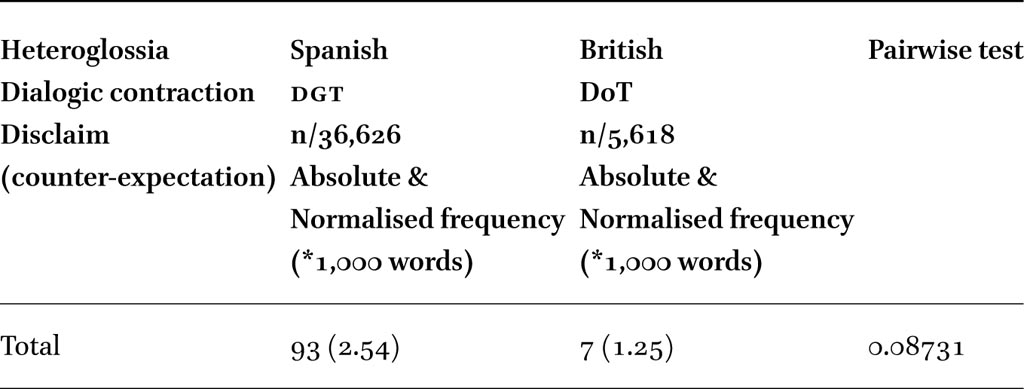
Heteroglossia. Dialogic contraction. Frequencies of disclaim (counter-expectation)
Citation: Contrastive Pragmatics 7, 2 (2026) ; 10.1163/26660393-bja10152
As regards the linguistic markers that constrain dialogic diversity through denial, it was found that the difference between the absolute frequencies encountered in both datasets is not relevant. Yet, considering their normalised frequencies, we notice that these increase in the British DfT institutional website, with highly significant statistical differences if we compare them to those found in the Spanish DGT. Some examples from the corpora are worth considering:
(1) Do not flash your headlights to convey any other message or intimidate other road users (British, DfT, Disclaim. Denial)
(2) In congested road conditions, do not change lanes unnecessarily (British DfT, Disclaim. Denial)
These findings lead us to argue that the British DfT leans more towards incorporating explicit negative adverbs to warn of the potential risks and dangers associated with rules and regulations related to transport. By using negative adverbs, the dialogic space with the recipients of that information appears to be more explicitly contracted than in the Spanish corpus.
As for the frequencies derived from the counter-expectation subcategory, the results reveal that the Spanish DGT is more prone to include this type of marker, seemingly contracting the dialogic space with readers in a more implicit way than the British DfT. As observed in the following examples, the use of concessive linking words could be regarded as softeners to mitigate the imposition that the propositional content of the utterance may have on the reader. Hence, the way disclaimers are construed in the Spanish corpus is more implicit than in the British dataset:
(3) Conducir de forma relejada no quiere decir que lo hagamos de forma distraída, pero la excesiva tensión y los nervios producen más fatiga.
Driving in a relaxed manner does not mean that we drive in a distracted manner, but excessive tension and nerves cause more fatigue1 (Spanish DGT, Disclaim. Counter-expectation)
(4) Fuera de las comidas tampoco tomaremos bebidas alcohólicas, aunque nos parezca que una copa nos ayuda a estar más espabilados.
We should not drink alcohol outside of meals, even if we think that a drink helps us to be more alert. (Spanish DGT, Disclaim. Counter-expectation)
As for proclaim, this is another category of dialogic contraction used in the text to signal how strongly committed one is to the point of view being expressed. As previously pointed out, proclamation is further subdivided into the resources of ‘concur,’ ‘pronouncement,’ and ‘endorsement.’ In ‘concur’ resources, speakers or writers represent the proposition or proposal as irrefutable, since it coincides with what is generally known or believed. Rhetorically, these resources allow for rapprochement between writer and reader (e.g., naturally, of course, admittedly, sure). Through ‘pronouncement,’ authors introduce themselves directly into the text as the source explicitly responsible for the statement (e.g., I, me, we, indeed). In this case, the pronouncement can take the form of an interpolation or explicit intervention by the speaker or writer. ‘Endorsement’ is a resource of extravocalisation that represents the speaker’s or writer’s support for the veracity or validity of the attributed statement (e.g., X demonstrates, shows, proves). Finally, ‘engagement’ (Hyland 2008) refers to those linguistic markers used by speakers or writers to address readers and involve them in the discourse (e.g., imperative verbs, second-person pronouns, rhetorical questions). Tables 4, 5, 6, and 7 incorporate the frequencies found in the previously mentioned subcategories:
Heteroglossia. Dialogic contraction. Frequencies of proclaim (pronounce)
Citation: Contrastive Pragmatics 7, 2 (2026) ; 10.1163/26660393-bja10152
Heteroglossia. Dialogic contraction. Frequencies of proclaim (concur)
Citation: Contrastive Pragmatics 7, 2 (2026) ; 10.1163/26660393-bja10152
Heteroglossia. Dialogic contraction. Frequencies of proclaim (engage)
Citation: Contrastive Pragmatics 7, 2 (2026) ; 10.1163/26660393-bja10152
Heteroglossia. Dialogic contraction. Frequencies of proclaim (endorse)
Citation: Contrastive Pragmatics 7, 2 (2026) ; 10.1163/26660393-bja10152
About contract-proclaim markers and, more specifically, those related to pronouncing, such as first-person plural pronouns, emphatic adverbs, and expressions to elaborate propositional content, the findings reveal much higher frequencies in the Spanish dataset, especially in the case of first-person plural pronouns. Although the pairwise test does not show significant statistical differences between the Spanish and the British corpus in the use of proclaim (pronounce) markers, it is in the use of first-person plural pronouns where significant statistical differences are found between both corpora, as shown in the following example from the Spanish corpus:
(5) Si nos vemos con la necesidad de adelantar, deberemos hacerlo con precaución, la anticipación es fundamental para que la frenada sea progresiva.
If we need to overtake, we should do so with caution; anticipation is essential for gradual braking. (Spanish DGT, Contract-proclaim: pronounce)
Therefore, on the Spanish DGT institutional website, first-person plural pronouns could signal involvement, solidarity, and cooperation with readers. This finding may also imply a more implicit communication style by part of the Spanish DGT, as this solidarity marker could implicitly soften the imposition frequently included in rules and regulations. Hence, we would like to argue that, besides being considered a dialogic contraction strategy, first-person plural pronouns could also be used to expand the dialogic space with readers. In our view, this finding may be considered relevant as the boundary between dialogic contraction and expansion is not always clear-cut, as revealed in the use of first-person plural pronouns.
Regarding the use of contract-proclaim-engage markers, the findings obtained are highly relevant, as the British DfT corpus incorporates imperative verbs and second-person pronouns with much higher frequencies than its Spanish DGT counterpart, along with highly significant statistical differences between both corpora. Some examples from the British corpus are worth illustrating:
(6) If, for instance, you want to stop after a side road, do not signal until you are passing the road. (British DfT, Contract-proclaim: engage)
(7) Make sure you know, understand, and act on all other traffic and information signs and road markings. (British DfT, Contract-proclaim: engage)
(8) Never assume that flashing headlights is a signal inviting you to proceed (British DoT, Contract-proclaim: engage)
In this way, and as it happened in the case of disclaim markers previously described, in the British corpus, reference to readers appears to be more explicitly marked than in the Spanish dataset, making the dialogic space between writers and readers more explicitly constrained than in the Spanish corpus. This finding may pose some contradictions regarding the preference for negative politeness by the British. That is why one should be careful about making blank statements about linguacultural groups.
As for contract-proclaim-endorse strategies, frequencies increase in the Spanish DGT dataset. This is the case of a higher recurrence of exemplifying linking words and references to external sources of information, like references to European law, as observed in the following examples:
(9) Adelantar correctamente y solo si es necesario. Por ejemplo, no adelantar si vas a detenerte unos metros más adelante.
Overtake correctly and only if necessary. For example, do not overtake if you are going to stop a few metres ahead. (Spanish DGT, Contract-proclaim: endorse)
(10) Los distintivos ambientales están referenciados a la normativa EURO de emisiones, se trata de diversas legislaciones que ha puesto en marcha la Unión Europea desde 1988 para reducir las emisiones contaminantes de los vehículos que se fabrican.
Environmental badges are referenced to the EURO emissions regulations, which are various legislations that the European Union has put in place since 1988 to reduce polluting emissions from vehicles manufactured. (Spanish DGT, Contract-proclaim: endorse)
(11) La Comisión Europea de transporte se ha encargado de recopilar la normativa de los distintos Estados Miembros para facilitar nuestros desplazamientos.
The European Transport Commission has been responsible for compiling the regulations of the different Member States to facilitate our travel (Spanish DGT, Contract-proclaim: endorse)
Like the use of counter-expectation markers described previously, endorsement markers could also function as minimisers to support the information provided by the voice of writers of that institutional website, seemingly triggering a more implicit communication style with readers.
As regards contract-proclaim-concur markers, the findings obtained cannot be considered meaningful, as very few instances have been found in the British corpus and none in the Spanish one. This result may be attributed to the fact that this type of marker could not form part of the conventions of the genre under analysis, regardless of the socio-cultural and linguistic context. An example from the British data set is shown below:
(12) Generally, if the vehicle is stationary and is likely to remain so for more than a couple of minutes, you should apply the parking brake (British DoT, Contract-proclaim: concur)
5.3 Findings on Dialogic Expansion
White (2003) divides dialogic expansion resources into two subcategories: a) consideration and b) attribution. The former includes formulations that evoke dialogic alternatives (i.e., deduction, evidence, probability), as well as certain types of rhetorical questions. The second refers to attributed discourse and is further subdivided into ‘recognition’ resources (reproducing the words of external voices through neutral verbs such as “say,” “ask,” etc.) and ‘distancing,’ with which the textual voice distances itself from the referred proposition (i.e., verbs such as “alleging,” “adducing”).
As far as dialogic expansion strategies are concerned, no attribution marker has been found in the dataset analysed, which, similar to contract-proclaim-concur markers, may not be a characteristic of this type of genre. As for expansion-consideration markers, aside from drawing on those identified in Martin’s and White’s model (2005), we have also considered other types of linguistic markers that do not seem to be contemplated in the said model. As revealed in previous studies (Ivorra-Pérez, 2020; Suau Jiménez, 2021), dialogic expansion, and more particularly consideration, can also be manifested through implicit lexical-grammatical markers. This could be the case of implicit engagement markers (i.e., reference to a third person, indefinite pronouns, nominalisation) and depersonalisation (i.e., personifications, impersonalised sentences). Table 8 below shows the frequencies obtained in the expanding-consideration markers that have been observed in the dataset analysed, taking as a point of reference Martin and White’s model (2005).
Heteroglossia. Frequencies of expanding (consideration)
Citation: Contrastive Pragmatics 7, 2 (2026) ; 10.1163/26660393-bja10152
The results reveal that the expanding-consideration lexical-grammatical markers included in Martin and White’s model (2005) present higher normalised frequencies in the British DfT corpus, along with highly relevant statistical differences when contrasting these findings to those obtained in the Spanish DGT corpus, as observed in the following examples:
(13) Always give way if it can help to avoid an incident (British DfT, Expanding-consideration: conditional structure and modal verb)
(14) Do not drive or park on a cycle lane marked by a broken white line unless it is unavoidable (British DfT, Expanding-consideration: conditional structure)
(15) Hazard warning lights. These may be used when your vehicle is stationary, to warn that is temporarily obstructing traffic (British DfT, Expanding-consideration: modal verb and conditional structure)
Important differences have been found, however, in the use of implicit engagement markers and depersonalisation strategies. As previously stated, their function may be oriented towards expanding the dialogic space with other readers in a more implicit way. In other words, this implicitness may minimize the apparent imposition frequently found in rules and regulations related to driving from an interpersonal angle. Table 9 shows the frequencies of implicit engagement markers in both datasets:
Heteroglossia. Frequencies of expanding (consideration). Implicit engagement
Citation: Contrastive Pragmatics 7, 2 (2026) ; 10.1163/26660393-bja10152
Although the absolute frequency of implicit engagement markers, such as reference to a third person in discourse and nominalisation, increases in the Spanish dataset, the normalised frequency is especially relevant in the use of a third-person reference in the British DfT corpus, with highly significant statistical differences between both corpora. Some examples can shed some light on the findings above:
(16) In stationary queues of traffic, drivers should apply the parking brake. (British DfT, Expanding-consideration: third-person reference)
(17) Los conductores deben controlar, en todo momento, los movimientos del ciclomotor. Se prohíbe conducir utilizando cascos o auriculares.
Drivers must control the movements of the moped at all times. Driving using helmets or headphones are prohibited (Spanish DGT, Expanding- consideration: third-person reference)
In Table 10, one can observe the results obtained in the use of the different depersonalisation strategies that have been identified in the corpora analysed, which may also be considered within the realm of expanding-consideration markers.
Heteroglossia. Frequencies of expanding (consideration). Depersonalisation
Citation: Contrastive Pragmatics 7, 2 (2026) ; 10.1163/26660393-bja10152
As displayed in Table 10 above, relevant differences were found in depersonalisation– strategies. This is the case of impersonal structures, whose absolute and normalised frequencies increase in the Spanish DGT corpus. The most striking statistical difference is observed in constructions such as ‘es+adjectivo/It is +adjective’ or ‘para/for+infinitive or gerund.’ This difference is also appreciated in constructions consisting of an infinitive or gerund functioning as the subject of the sentence. However, the statistical difference in the use of impersonal structures is less significant between the two datasets. The following examples can illustrate our findings:
(18) Si por la calle por la que se camina no tuviera acera o existiese algún obstáculo y fuera totalmente imprescindible pasar por este tramo, se circulará lo más possible pegado a la pared y a ser possible de cara al tráfico, de esta forma se podrá ver de frente a los vehículos que se aproximan.
If the street you are walking on does not have a sidewalk or there is some obstacle, and it is absolutely essential to cross that section, you will walk as close to the wall as possible and if possible facing the traffic. In this way, you will be able to see the approaching vehicles head on (Spanish DGT, Expanding consideration: conditional structure and impersonalisation)
(19) Para circular por carretera es más recomendable el uso de un modelo integral de calidad, que protege la barbilla, la parte inferior de la cara y la mandíbula.
For road use, it is recommended to use a quality full-face helmet, which protects the chin, lower part of the face, and jaw (Spanish DGT, Expanding-Consideration: impersonalisation)
As previously mentioned, the Spanish dataset expands the dialogic space by means of consideration strategies explicitly marked (i.e., conditional structures, probability markers, epistemic modality) along with those that seem to be more implicitly marked, as observed in the use of a wider variety of depersonalised lexical-grammatical markers. As for the British corpus, we can see that, except for a third-person reference, depersonalisation markers are minimally incorporated, as the frequencies reveal.
6 Discussion
The quantitative findings drawn from the Spanish DGT and the British DfT showed more differences than similarities in construing interpersonal relations with citizens and drivers. As for the first two research questions, the quantitative findings drawn from the Spanish DGT and the British DfT revealed more differences than similarities in construing interpersonal relations with citizens and drivers. Specifically, both data sets incorporate dialogic contraction and expansion markers, albeit with a slightly higher frequency of the latter. However, as has been observed, the lexical-grammatical markers used to express these two categories of engagement differ in their linguistic realisation.
The Spanish DGT website incorporates a mixed use of both contract and expanding strategies that are constructed in a more implicit way to establish an interaction with readers. For instance, dialogic contraction is reflected in the use of concessive linking words as far as disclaiming counter-expectation is concerned, first-person plural pronouns in the case of contract proclaim, or the recurrence of exemplifying linking words and references to other sources of information concerning the use of contract-endorse strategies. These same categories are found in the British DfT data through more explicit lexical-grammatical markers, as seen in the use of explicit negative adverbs to show disclaim-denial; and contract-proclaim-engage, as reflected in the use of second-person pronouns and verbs in the imperative mood.
Something similar seems to occur in the use of expanding-consideration strategies. As the findings show, both corpora include expanding-consideration lexical-grammatical markers, such as conditional sentences, probability markers, or modal verbs, which appear to be more explicitly marked. Notwithstanding, this dialogical expansion is also communicated in the Spanish DGT corpus through depersonalisation strategies, like impersonal structures, which seem to mirror a more implicit communicative style.
Regarding the third research question, findings drawn from this study reveal that both dialogic contraction and expansion with readers in these two institutional channels are found, which may respond to the conventions of this professional genre. Despite the constraints imposed by the conventions of the genre, the lexical-grammatical markers used to construe both types of engagement seem more explicitly marked in the case of the British corpus and more implicitly construed in its Spanish counterpart. Therefore, the interpersonal markers incorporated into these two institutional channels to convey information and establish an interaction with readers on road safety rules and regulations may respond not only to genre conventions but also to linguistic and cultural constraints, as has been previously pointed out in previous studies. The specific linguistic markers identified in our analysis directly relate to the broader literature on rhetorical devices and their persuasive power (Ivorra-Pérez and Giménez-Moreno, 2018) but also contribute to shedding light on the persuasion mechanisms and strategies in road safety communication, such as rational, emotional, and unconscious persuasion techniques (Faus et al., 2023).
The cross-linguistic variation found in our analysis also has clear implications for the design of road safety communication campaigns, emphasising the importance of understanding the target audience’s linguistic and cultural background. The findings indicate that in designing road safety and public health messages, one should not only focus on the content of the message but also on how the message is delivered, considering the linguistic preferences of the target audience (Faus et al., 2023). For example, a campaign designed for a British audience, which may respond well to explicit messaging, might be ineffective in a Spanish context, where a more implicit approach might be better. Such results raise questions about the applicability of universal communication models across different cultural contexts. The idea that certain linguistic theories of Anglo-Saxon origin (e.g., Grice 1975; Brown and Levinson, 1987; Hyland and Tse, 2004; Martin and White, 2005) may not be universally applicable is a key insight to reinforce the findings of the present analysis.
All these implications are in line with previous research that suggests that a campaign that was successful in one country might not be in another and that local differences and variables need to be considered when adapting a campaign (Delhomme, 2009). These findings suggest that a one-size-fits-all approach to road safety communication is not effective and that campaigns must be tailored to the specific cultural context of their target audience.
Notwithstanding, a critical consideration when interpreting and extrapolating the findings of this study is that, while the present research addresses a significant gap in the literature regarding persuasion strategies in road safety discourse, it does not evaluate the effectiveness of the interpersonal strategies – particularly engagement markers – within the cultural contexts in which they are adopted. The professional background of the writers or content providers responsible for these websites remains unknown. As a result, it is possible that these strategies were implemented heuristically, adhering to pervasive cultural norms and regional socio-pragmatic expectations without critical reflection on their actual effectiveness.
The need to evaluate the actual effectiveness of road safety messaging has been emphasized in prior research (e.g., Nathanail and Adamos, 2013; Adamos and Nathanail, 2016; Elvik, 2016). Particular attention has been drawn to the evaluation of communicative processes (Delhomme, 2009). Yet, there remains a notable gap in assessing communication campaigns within the road safety sector (Faus et al., 2021). This seems to be a line of research worthy of further consideration before applying the findings of the present studies directly to public messaging regarding sensitive topics.
Therefore, the interpersonal discourse constructed in this modality is worthy of consideration because of its theoretical relevance in interpersonal discourse studies and professional applications for practitioners of these areas and the specific genre under study.
7 Conclusion
This study reveals that the Spanish and British road safety institutions employ significantly different linguistic strategies to engage with the public. While both use dialogic contraction and expansion, the Spanish DGT tends to rely more on implicit rhetorical strategies, whereas the British DfT favours more explicit formulations. These patterns suggest that both genre conventions and deeper cultural-linguistic preferences shape how interpersonal discourse is realised in institutional communication. These differences should be carefully considered when designing effective cross-cultural road safety campaigns and communication strategies, especially those aimed at promoting behavioural change. Beyond its applied implications, this study also enriches contrastive pragmatics by showing how culturally embedded preferences for implicitness or explicitness in engagement are reflected in institutional online communication.
References
Adamos, Giannis, Eftihia Nathanail, and Paraskevi Kapetanopoulou. 2013. Do road safety communication campaigns work? How to assess the impact of a national fatigue campaign on driving behavior. Transportation Research Record 2364 (1): 62–70. https://doi.org/10.3141/2364-08.
Adamos, Giannis, and Eftihia Nathanail. 2016. Predicting the effectiveness of road safety campaigns through alternative research designs. Journal of Safety Research 59: 83–95. https://doi.org/10.1016/j.jsr.2016.10.003.
Alonso, Francisco, Mireia Faus, Cesáreo Fernández, and Sergio Useche. 2021. Where have I heard it? Assessing the recall of traffic safety campaigns in the Dominican Republic. Energies 14(18): 5792. https://doi.org/10.3390/en14185792.
Baker, Paul, Costas Gabrielatos, Majid Khosravinik, Michal Krzyżanowski, Tony McEnery, and Ruth Wodak. 2008. A useful methodological synergy? Combining critical discourse analysis and corpus linguistics to examine discourses of refugees and asylum seekers in the UK press. Discourse & Society 19 (3): 273–306.
Bhatia, Vijay, K. 1993. Analysing Genre. Language Use in Professional Settings. London: Longman.
Boulanger, Ankatrien, Stijn Daniels, Patricia Delhomme, Marion Deugnier, Marko Divjak, Chloé Eyssartier, et al. (2007). Campaigns and awareness-raising strategies in traffic safety. Deliverable 2.2: Comparison of research designs. Brussels, Belgium: Belgian Road Safety Institute.
Brown, Penelope, and Stephen Levinson. 1987. Politeness. Some Universals in Language Use. Cambridge: Cambridge UP.
Clyne, Michael. 1994. Intercultural Communication at Work. Cambridge: Cambridge UP.
Dafouz, Emma. 2003. Estudio de los marcadores interpersonales en el comentario periodístico: estrategias para la identificación autor-lector en el texto. Resla 19: 67–82.
Delhomme, Patricia, Werner De Dobbeleer, Sonja Forward, and Anabela Simoes. 2009. Manual for Designing, Implementing and Evaluating Road Safety Communication Campaigns. Brussels: Belgian Road Safety Institute.
Elder, Randy W., Ruth A. Shults, David A. Sleet, James L. Nichols, Robert S. Thompson, et al. (2004). Effectiveness of mass media campaigns for reducing drinking and driving and alcohol involved crashes: A systematic review. American Journal of Preventive Medicine 27(1): 57–65.
Elvik, Rune. 2016. A theoretical perspective on road safety communication campaigns. Accident Analysis & Prevention 97: 292–297. https://doi.org/10.1016/j.aap.2015.04.027.
Faus, Mireia, Francisco Alonso, Cesáreo Fernández, and Sergio Useche. 2021. Are traffic announcements really effective? A systematic review of evaluations of crash-prevention communication campaigns. Safety 7 (4): 66. https://doi.org/10.3390/safety7040066.
Faus, Mireia, Francisco Alonso, Arash Javadinejad, and Sergio Useche. 2022. Are social networks effective in promoting healthy behaviors? A systematic review of evaluations of public health campaigns broadcast on Twitter. Frontiers in Public Health 10: 1045645. https://doi.org/10.3389/fpubh.2022.1045645.
Faus, Mireia, Cesáreo Fernández, Francisco Alonso, and Sergio Useche. 2023. Different ways … same message? Road safety-targeted communication strategies in Spain over 62 years (1960–2021). Heliyon 9 (8). https://doi.org/10.1016/j.heliyon.2023.e18775.
Faus, Mireia, Francisco Alonso, Cesáreo Fernández, and Sergio Useche. 2024. Assessing the “virality” of a road safety communication campaign intended to change behavior: a case study in Spain. Frontiers in Sustainable Cities 5: 1295516. https://doi.org/10.3389/frsc.2023.1295516.
Faus, Mireia, Francisco Alonso, and Cesáreo Fernández. 2024. Estrategias de comunicación en salud pública: estudio de su efectividad. Infonomy 2 (5). https://doi.org/10.3145/infonomy.24.054.
García-Yeste, Miguel Ángel. 2013. Press advertisement for food in Spain: cultural orientations and communicative style. Ibérica 26: 195–216.
Giménez-Moreno Rosa, and Hanna Sckorczynska. 2013. Business communication across three European cultures: a contrastive analysis of British, Spanish and Polish email writing. Ibérica 26: 77–98.
Grice, Paul. 1975. Logic and Conversation. In: Peter Cole and Jerry Morgan (eds.), Syntax and Semantics: Speech Acts, Vol. 3. New York: Academic, 45–47.
Guillén-Nieto, Victoria (2013). Intercultural business pragmatics: the case of the business letter of introduction. In: Istvan Kecskes and Jésus Romero-Trillo (eds.), Research Trends in Intercultural Pragmatics. Berlin: Mouton De Gruyter, 395–420.
Guttman, Nurit. 2014. Communication, Public Discourse, and Road Safety Campaigns: Persuading People to Be Safer. Routledge.
Hall, Edward T. 1976. Beyond Culture. New York: Anchor.
Halliday, M.A.K. 1971. Language in a social perspective. Educational Review 23 (3): 165–188. https://doi.org/10.1080/0013191710230302.
Halliday, M.A.K. 1975. Learning how to mean. In: Eric H. Lenneberg, and Elizabeth Lenneberg (eds.), Foundations of Language Development. A Multidisciplinary Approach. Volume 1. Cambridge: Academic Press, 239–265.
Halliday, M.A.K. 1994. An Introduction to Functional Grammar. London: Arnold.
Hofstede, Geert. 1991. Cultures and Organizations. Software of the Mind. London: Profile.
Hyland, Ken. 1999. Talking to students: Metadiscourse in introductory coursebooks. English for Specific Purposes 18: 3–26.
Hyland, Ken, and Polly Tse. 2004. Metadiscourse in Academic Writing: A Reappraisal. Applied Linguistics 25 (2): 156–177.
Hyland, Ken. 2008. Disciplinary voices: interactions in research writing. English Text Construction 1(1): 5–22.
Ivorra-Pérez, Francisco Miguel. 2012. La dimension cultural del individualismo y su impacto en el discurso transaccional de las páginas web de negocios españolas y estado-unidenses. Revista de Lingüística y Lenguas Aplicadas 7: 147–162. https://doi.org/10.4995/rlyla.2012.1130.
Ivorra-Pérez, Francisco Miguel. 2014. Cultural values and their correlation with interactional metadiscourse strategies in Spanish and US business websites. Atlantis. Journal of the Spanish Association of Anglo-American Studies 36(2): 73–95.
Ivorra-Pérez, Francisco Miguel. 2015. The impact of cultural dimensions on the engagement markers of Spanish, British and US toy selling websites. In: María de la O Hernández-López and Lucía Fernández-Amaya (eds.), Studies in Pragmatics 14. A Multidisciplinary Approach to Service Encounters. Leiden: Brill: 141–163.
Ivorra-Pérez, Francisco Miguel. 2016. Interpersonality and culture: an approach to the movie review genre. Odisea 17: 159–183.
Ivorra-Pérez, Francisco Miguel, and Rosa Giménez-Moreno. 2018. The level of context dependence on the engagement markers in Peninsular Spanish and US business websites. Revista de Lenguas para Fines Específicos 24(2): 38–53. http://dx.doi.org/10.20420/rlfe.2018.364.
Ivorra-Pérez, Francisco Miguel. 2020. El concepto de modelo mental y su influencia en los marcadores de compromiso de artículos de opinión en español peninsular e inglés británico. Discurso y Sociedad 14: 7–29.
Javadinejad, Arash. (2024a). A corpus-assisted approach to discursive news values analysis. Research in Corpus Linguistics, 12(1), 1–29. https://doi.org/10.32714/ricl.12.01.01.
Javadinejad, Arash. (2024b). A longstanding duality: The EU vs the UK in British broadsheets. International Journal of English Studies 24(1), 49–75. https://doi.org/10.6018/ijes.554001.
Javadinejad, Arash. (2024c). Discursive construction of immigration through the lens of news values in the brexit referendum. Alicante Journal of English Studies (41): 31–52. https://doi.org/10.14198/raei.2024.41.02.
Kaplan, Robert B. 1966. Cultural thought and patterns in intercultural education. Language Learning 16 (1): 1–20.
Lorés-Sanz, Rosa, Pilar Mur, and Enrique Lafuente. 2010. Constructing Interpersonality: Multiple Perspectives on Written Academic Genres. Newcastle upon Tyne: Cambridge Scholars Publishing.
Lucas, Antonio Javier, Francisco Alonso, Mireia Faus, and Arash Javadinejad. 2024. The role of news media in reducing traffic accidents. Societies 14 (5): 56. https://doi.org/10.3390/soc14050056.
Lewis, Richard. 1999. When Cultures Collide. London: Nicholas Brealey Publishing.
Loukianenko-Wolfe, Maria. 2008. Different culture-different discourses. Rhetorical patterns of business letters by English and Russian speakers. In: U. Connor, E. Nagelhout, and William Rozycki (eds.), Contrastive rhetoric. Reaching to intercultural rhetoric. Amsterdam and Philadelphia: John Benjamins, 87–121.
Martin, James R., and Peter White. 2005. Language of evaluation: Appraisal in English. Palgrave, McMillan: London.
Matthiessen, Christian M.I.M. 1995. Lexicogrammatical cartography: English systems. Tokyo: International Language Sciences Publishers.
Moreno, Ana I. 1997. Genre constraints across languages: Casual metatext in Spanish and English RAS. English for Specific Purposes 16 (3): 161–179.
Nathanail, Eftihia, and Giannis Adamos. 2013. Road safety communication campaigns: Research designs and behavioral modeling. Transportation Research Part F: Traffic Psychology and Behaviour 18: 107–122. https://doi.org/10.1016/j.trf.2012.12.003.
Mur-Dueñas, Pilar. 2010. Attitude markers in business management research articles: A cross-cultural corpus-driven approach. International Journal of Applied Linguistics 20 (1): 50–72.
Prykarpatska, Iryna. 2008. Why are you so late?: Cross-cultural pragmatic study of complaints in American English and Ukranian. Revista Alicantina de Estudios Ingleses 21: 87–102.
Suau Jiménez, Francisca. 2010. La traducción especializada (en inglés y español en géneros de economía y empresa). Madrid: Arco.
Suau Jiménez, Francisca. 2016. What can the discursive construction of stance and engagement voices in traveler forums and tourism promotional websites bring to a cultural, cross-generic and disciplinary view of interpersonality? Ibérica 31: 199–220.
Suau Jiménez, Francisca, Rosa Lorés, Giovanna Mapelli, and Isabel Herrando. 2021. La interpersonalidad discursiva. Onomázein 54: 113–141.
Suau Jiménez, Francisca, and Francisco Miguel Ivorra-Pérez. 2022. Reader comments agentive power in COVID-19 digital news articles: challenging parascientific information? MDPI Publications 10(1): 1–16. https://doi.org/10.3390/publications10010002.
Suau Jiménez, Francisca, and Francisco Miguel Ivorra-Pérez. 2023. Dialogicidad intencionada y co-creación de la persuasión en Instagram. Cuadernos AISPI 22: 227–252. https://doi.org/10.14672/2.2023.231.
Swales, John. 1990. Genre Analysis. English in Academic and Research Settings. Cambridge: Cambridge University Press.
Valero-Garcés, Carmen. 1996. Contrastive ESP rhetoric. Metatext in Spanish-English economic texts. English for Specific Purposes 15 (4): 279–294.
White, Peter. 2003. Beyond modality and hedging: A dialogic view of the language of intersubjective stance. Text 23 (2): 259–284.
Biographical Notes
Arash Javadinejad is a lecturer at the Faculty of Teaching and Education Sciences at Universidad Católica de Valencia and a research fellow at INTRAS – the University Research Institute on Traffic and Road Safety at Universitat de València. He holds a PhD in Applied Linguistics (Cum Laude) from the University of Valencia and specialises in discourse analysis, corpus linguistics, and educational innovation. He is a member of DATS and also serves as Principal Investigator of the IGALA research group, and his interdisciplinary work spans language education, road safety communication, and public health messaging. He has published widely in peer-reviewed journals and actively participates in EU-funded projects on road safety, mobility, multilingualism and virtual exchange.
Dr Francisco Miguel Ivorra Pérez is a permanent lecturer in the English and German Department at the University of Valencia, a member of IULMA-Valencia, and Head of the Research Group SILVA (Group for Support for Investigation in Language Variation Analysis). His main areas of research are Discourse Analysis, English for Professional and Academic Purposes, and Cross-cultural Pragmatics (English-Spanish). He is the author of the book La comunicación intercultural y el discurso de los negocios, edited by the University of Alicante, and has published extensively on cross-cultural pragmatics applied to professional and academic genres in national and international journals. He has also participated in numerous international conferences. Currently, he is the coordinator of the teaching area of English Philology and the coordinator of the teaching area of English for Specific Purposes.
To keep the same type of markers, there has been a literal translation from Spanish into English.