Abstract
This article focuses on the violent deaths of the Jesuit missionaries Rodolfo Acquaviva, Marcello Mastrilli, and Diego Luis de San Vítores, who were killed in the course of their evangelical endeavors in India, Japan, and the Mariana Islands, respectively. It elucidates the ways in which the figure of St. Francis Xavier intersected with the Jesuit ideal of martyrdom, while situating the three martyred Jesuits within the history of Iberian imperialism and colonialism. Xavier became the dominant Jesuit image of apostolic sanctity, and he greatly energized the evangelical zeal of many Jesuits, eager to missionize in distant East Asia. At the same time, the Jesuit evangelical impulse in the early modern period became closely intertwined with the desire for martyrdom. In their efforts to create saintly figures of the three slain missionaries, Jesuit authors would establish a special connection between St. Francis Xavier and the martyred Jesuits, Mastrilli and San Vítores being described as almost perfect replicas of the saint, even though Xavier never experienced martyrdom.
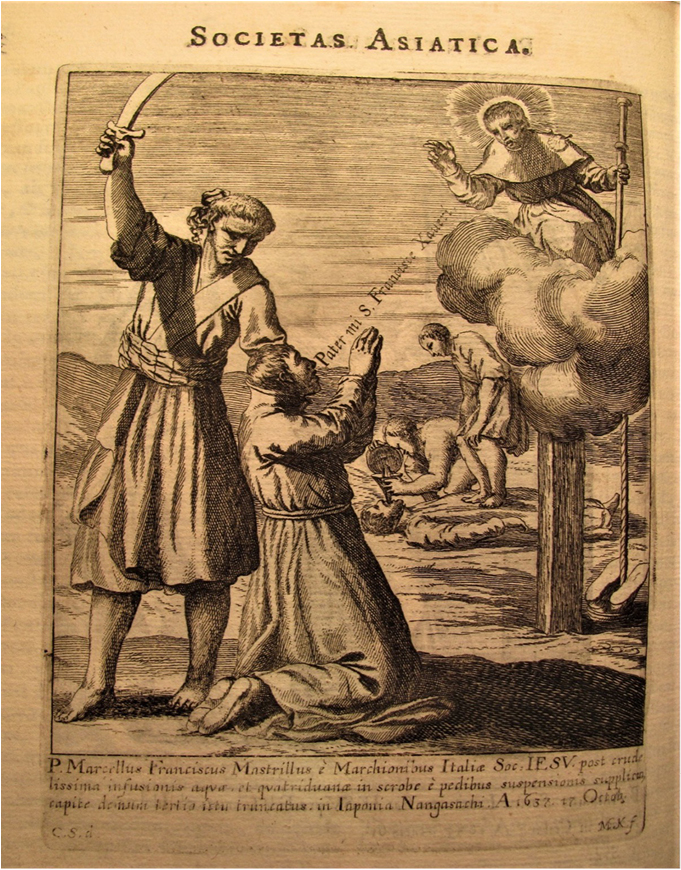
According to the many accounts printed to publicize the execution of the Neapolitan Jesuit Marcello Mastrilli (1603–37), ordered by the Japanese authorities of Nagasaki in 1637, he died invoking the name of Francis Xavier. Mastrilli had been arrested for entering Japan clandestinely and was subjected to different methods of torture for several days. In the words of one chronicler, before being struck by the executioner’s katana, “he knelt and in a loud voice clearly heard by Portuguese witnesses he said with great affection: My Father Saint Francis Xavier, My Father Saint Francis Xavier” (Fig. 1). The chronicler adds that Mastrilli might have uttered these words to fortify his resolve during his martyrdom by summoning up thoughts of the saint, or perhaps because by calling out his name, he hoped Xavier would appear to him, as the saint had done many times before.1 That the last words Mastrilli chose to utter prior to his death were Francis Xavier’s name comes as no surprise. After his canonization in 1622, and even before, his figure had greatly energized the evangelical zeal of many Jesuits. Since Ignatius of Loyola never left Europe, his companion and co-founder of the order, who had spent the last twelve years of his life constantly traveling around India and East Asia, was bound to become the dominant Jesuit figure of apostolic sanctity. The widespread diffusion of the many accounts of Mastrilli’s martyrdom would serve to enhance the reputation of the Spanish saint even more.

The execution of Marcello Mastrilli. Engraving from Mathias Tanner, Societas Jesu usque ad sanguinis et vitae profusionem militans, in Europa, Africa, Asia, et America (Prague, 1675). Original in the Library of Congress
Citation: Journal of Jesuit Studies 9, 3 (2022) ; 10.1163/22141332-09030007
After the beginning of the Jesuit mission to England in 1580, and until the end of the seventeenth century, the Jesuit evangelical impetus, so well represented in the figure of Mastrilli, became closely intertwined with the ideal of martyrdom.2 This does not mean that the Society of Jesus’s authorities systematically fomented the martyrdom of its members. On the contrary, they seem to at all times have exhibited a prudent attitude, since the conversion of “heretics” and “pagans” was always more important than martyrdom. But if a Jesuit was killed anywhere in the world, then Jesuit authors, with their superiors’ acquiescence, would get down to work to construct a most brilliant and compelling saintly figure. As shall be shown in the following pages, this is precisely what happened with the deaths of Rodolfo Acquaviva, Marcello Mastrilli, and Diego Luis de San Vítores, the three Jesuit missionaries who are the focus of this article and who were killed in the course of their evangelical endeavors in India, Japan and the Mariana Islands, respectively. Their stories allow us to elucidate the ways in which the figure of St. Francis Xavier intersected with the ideal of martyrdom and how the energizing effects of this intersection were harnessed, controlled, and utilized by the Society of Jesus.
At the same time, we also need to situate Xavier and his fellow martyred Jesuits within the history of European imperialism and colonialism. This is fundamental if we want to fully understand the dynamic role played by his figure in early modern Catholic societies, especially in the Iberian empires. By invigorating the evangelical zeal of the religious orders, the stories and images of martyrdom played a significant role in imperial politics. In many respects, the missionaries became active agents of European colonial penetration, doggedly trying to establish new missions and, in that way, pushing forward the imperial frontiers at the expense of native populations.
The history of the intersection of martyrdom and colonialism in the Jesuit Asian missions starts in 1583, when five Jesuit missionaries (two Italians, two Portuguese, and one Spaniard) and fourteen Christian Indians were killed in Cuncolim, a village south of the city of Goa, the main Portuguese colony in India. The villagers deeply resented the fact that the Jesuits, in their determined attempt to plant the Christian faith in India, had destroyed their Hindu temple.3 Years later, in 1591, to commemorate their deaths and to aid in the campaign for their canonization, Francesco Benci (1542–94), a professor of rhetoric at the Jesuit college in Rome, published a long epic poem in Latin titled Quinque martyres.4 Benci’s work was reissued as part of the widely disseminated collection of Jesuit poetry, the Parnassus Societatis Iesu (1654) and enjoyed great popularity, above all because it was used in Jesuit colleges throughout Europe as a model for the composition of hexameter verse and to teach Virgil’s style.5 Benci’s poem was so significant that it became the model for all Jesuit epics for the next two centuries.
While Quinque martyres is unusual for being written in verse, as an account of Catholic martyrdom, it is rather conventional.6 Divided into six books, the first introduces Rodolfo Acquaviva (1550–83), the leader of the martyred Jesuits, and prefigures his future martyrdom: having returned to Goa from the Mughal court, Acquaviva feels very pessimistic after his failure to convert the Mughal emperor, Akbar (r.1556–1605). But his missionary impetus is greatly revived after having a vision in which he is transported to the heavens to contemplate a procession of Christian martyrs from all times led by Christ, the king of martyrs. Book 1 closes with the Jesuit’s resolve to embrace the same fate. Book 4 recounts the religious debates that had taken place at the court of Akbar. This is simply a pretext for Benci to include an extended meditation on the Passion of Christ, which prefigures Acquaviva’s own passion. Book 5 describes the martyrdom of the five religious, who behave as conventional martyrs, awaiting their deaths at the hands of cruel heathens with dignified calm. The final book (Book 6) also follows closely the conventions of martyrdom literature by describing how the five Jesuits receive their crowns as they enter paradise. Meanwhile, on earth their miraculously uncorrupted bodies, which had been concealed in a swamp, are discovered by two boys and brought back in solemn procession to the fortress of Rachol, where they are interred.
To fully understand its meaning and significance, Quinque martyres needs to be situated in the religious and historical context in which it was produced. It was precisely in these years that the ideal of martyrdom experienced a great revival because of the confrontation between Catholics and Protestants in Europe. After the execution in England in 1581 of Edmund Campion (1540–81), leader of a clandestine Jesuit mission to the island, this ideal would be fully adopted by the Society of Jesus. In the course of their attempt to restore Catholicism in England, the Jesuits produced countless accounts of martyrdom that helped spread the ideal throughout the Catholic world.7 It is surely not by coincidence that Quinque martyres opens with Rodolfo Acquaviva feeling dejected because of his failure to convert Akbar, his pessimism only increasing after he receives news of Campion’s execution in London. Also revealing is the conclusion of the first book which portrays Rodolfo being riveted by a vision of the tortures suffered by the recent English martyrs. In this religious atmosphere, a work like Quinque martyres made perfect sense. That it was written in epic verse was exceptional, though the fact that its author was an expert in Virgilian poetry helps explain the peculiarity of its form, which also made it ideal for use as a pedagogic tool. From an institutional perspective, Benci also must have thought that this form was the most appropriate one for him to use given who the main protagonist was. Rodolfo Acquaviva was not just any Jesuit, but the nephew of the powerful and influential Claudio Acquaviva, superior general of the Society of Jesus between 1581 and 1615.8
In Book five of Quinque martyres, Benci had included a scene full of religious meaning. Right before the killing of the five Jesuits, Benci sings that God had summoned in Heaven the founders and first three superiors general of the Society of Jesus: “they all declared their happiness in their joyful expression when God revealed that the companions were prepared to confirm the faith […] by their shedding of their blood.” After Ignatius, the second Jesuit in heaven Benci mentions is Francis Xavier, “no less distinguished in his habit of white and gold.”9 Although in 1591 Francis Xavier had not yet been canonized (neither had Ignatius of Loyola), it is clear that to Benci, Xavier, as founder of the Indian mission, was second only to Ignatius in prominence in the Jesuit world. In the course of the next few decades, Xavier’s reputation would increase exponentially, so much so that by the second half of the seventeenth century, he had displaced Ignatius himself as the Jesuit saint par excellence, at least in the mind of the Jesuits working in and writing about the Asian missions.
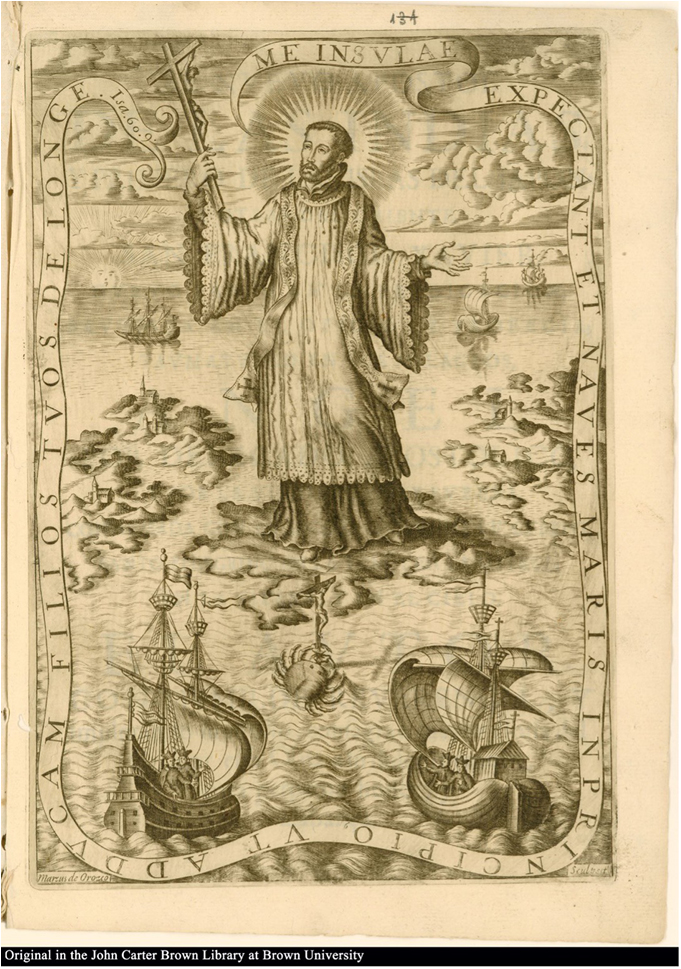
There is no better example of this displacement than the history of the Society of Jesus in the Philippine Islands published in Madrid in 1663 by Francisco Colín (1592–1660), the Jesuit provincial of the Asian archipelago at that time.10 Besides being dedicated to Saint Francis Xavier, who, according to the author, was “a new Paul in his preaching, a Baptist in his trade and prophecies, and a thaumaturge in his miracles,” the book included a frontispiece in which Xavier appears as a colossal figure standing on the Philippine Islands (fig. 2). Two ships in the foreground are sailing toward Xavier and several Jesuits are depicted on board. Between the two ships is a crab retrieving Saint Francis Xavier’s crucifix from the sea.11 The meaning of the engraving is clear: The call to evangelize Asia is being answered by the Jesuits on the ships, with the towering, miraculous figure of Saint Francis Xavier dominating the composition. He has taken over the East Asian islands, becoming the quintessential holy figure of the Asian missions, and thus he no longer needs to appear in the company of Saint Ignatius to be seen as a leading character.
Frontispiece, Francisco Colín, Labor euangelica, ministerios apostolicos de los obreros de la Compañia de Iesus, fundacion, y progressos de su Prouincia en las islas Filipinas (Madrid, 1663).
Citation: Journal of Jesuit Studies 9, 3 (2022) ; 10.1163/22141332-09030007
Further evidence of the enormous attraction that the figure of Francis Xavier had come to exert on the Jesuit imagination may be found in what can surely be considered the definitive hagiographical account of Rodolfo Acquaviva, written by the great Jesuit historian Daniello Bartoli (1608–85) and published in Rome in 1663.12 Recounting Acquaviva’s departure from Goa to take over the Salcete mission, Bartoli informs the reader that the soon-to-become-martyr only took two things with him for his journey: the Holy Scriptures and a manuscript with the life of the “saintly Father Francis Xavier.”13 We will never know whether Acquaviva actually took such a manuscript with him. But what is important here is the symbolism. While 1583 was many years before Xavier’s canonization, and he had not yet replaced Ignatius as the main holy figure energizing the Asian missions, it made perfect sense for Bartoli to include the manuscript detail in his 1663 account, an account that, let us not forget, was published the same year as Colín’s history of the Philippine mission, which featured the colossal figure of Francis Xavier.
Colín’s history is also significant because it offers an elaborate justification of Spanish colonialism. In reality, the arguments are not Colín’s, but those of Alonso Sánchez (1547–93), another Spanish Jesuit from the Philippines who, in the 1580s, had contended that the only way to introduce the Christian religion in China was through military conquest.14 Colín thoroughly agreed with Sánchez’s evangelical imperialism, dedicating 150 pages of his history to approvingly recount Sánchez’s activities in Asia and his ideas on evangelization. Sánchez had claimed that the conversion of the Asian peoples had to proceed with the military help of the Spanish crown, directly criticizing the Dominican Bartolomé de las Casas who, until his death in 1566, had vigorously opposed the forced conversion of the New World natives. For Sánchez it was clear that, without military support, the evangelization of all of these peoples would fail, as they were so “barbaric and cruel,” and so bloodthirsty that in some parts their main festivals consisted of eating human flesh; they hated foreigners and did not show any respect or reverence for the missionaries.15 It is apparent that, in his thinking, Sánchez was conflating the peoples and cultures of the West and East Indies, probably as a discursive strategy to make his arguments more sensational and impactful.
Much more nuanced was Sánchez’s contemporary and fellow Jesuit José de Acosta (1540–1600), who had systematized the civilizational hierarchy of all the peoples of the world in his manual for evangelization.16 Acosta argued that not all ‘barbarians’ were the same (to Acosta, barbarians were all non-Christians), for which reason the same methods of conversion should not be utilized with all of them. He criticized Alonso Sánchez for proposing the military conquest of China, a great civilization that should be converted using the same peaceful, rational methods the Apostles had used to convert the inhabitants of the Roman empire. However, Acosta’s ideas regarding the lowest class of barbarians were very similar to those of Sánchez. To this class belonged “savage men, similar to wild beasts” (homines silvestres feris similes): their feelings, asserted Acosta, were barely human; they possessed “no laws, no kings, no covenants, no magistrates.” The fierce nature of these peoples and the remote location of their lands made it necessary for “the soldier and the missionary to go together.” Acosta was quick to clarify that, though it would be just to subdue by force those barbarians who refused to obey, by no means could this defiance be used to justify their enslavement or slaughter. The natives, Acosta averred, “should be treated like children or women or, rather, in the manner of beasts.” The lash rather than the sword should be used against them, so that they would learn “to fear and obey.” Acosta’s evangelization program was closely intertwined with a colonial project. In his opinion, natural law gave the Spaniards the right to cultivate the barbarians’ “abandoned and arid lands” and receive the benefits of all they could produce, as long as the natives were not harmed in the process. And since the latter did not exploit the mines, it was clear that the Spaniards had all the right to do it.17 Acosta’s arguments left the door open to the commission of all kinds of abuses against the Indigenous peoples in the name of conversion. In this regard, De procuranda indorum salute constitutes a true manual of colonial Realpolitik in which the symbiosis between religion and imperial power is often presented in a blatant way. Although Acosta always tried to find the middle ground between the violent subjugation of the Indigenous populations and their defense, nevertheless, the ethnography of barbarism developed by Acosta would make it almost inevitable that practical considerations would override ideological and ethical concerns.18
The energizing power of the figure of Francis Xavier was manifested with all its force in the life story of Marcello Francesco Mastrilli, executed by the Japanese authorities in 1637. His death provoked an avalanche of publications recounting his life and martyrdom. These works constructed Mastrilli as a saintly figure resembling that of Xavier himself. Born into a noble family, Mastrilli, according to his hagiographers, had been dominated by a powerful desiderio dell Indie after having an accident resulting in a fatal head injury. Lying on his deathbed, he had implored St. Francis Xavier for a cure. Xavier obliged and, dressed as a pilgrim, appeared to Mastrilli in a vision; he urged him to undertake a mission to Japan and then miraculously restored him to health. As a sign of gratitude, Mastrilli added the name Francesco to his own name, his devotion to the saint becoming unshakable and all consuming.19 These events happened in the year 1634, and in 1635 Mastrilli would be able to realize his wish, embarking at Lisbon for the carrack to India. Constantly invoking the name of St. Francis Xavier for protection during the long sea voyage, Mastrilli was able to make it safely to Goa. There he spent a year and had the opportunity to make a pilgrimage to Xavier’s sepulcher.20 While he was sailing to Macao, on his way to Japan, his ship was diverted to Manila because of the presence of Dutch corsairs, forcing him to spend another year in the Philippines.21
While staying there, Mastrilli participated in a military expedition organized by the governor of the Philippines, Sebastián Hurtado de Corcuera, to conquer the island of Mindanao. This expedition would allow Mastrilli to put the figure and image of St. Francis Xavier at the service of Spanish imperialism. According to the published accounts of his martyrdom, his actions were decisive in the victory at Mindanao. Although initially the Spanish troops had been defeated by the natives, Mastrilli, who had retreated from the battlefield to do penance by scourging himself, later raised an image of St. Francis Xavier he always carried with him and secured the Spanish victory.22 In gratitude, the governor allowed him to travel to Japan. Disguised as a foreign merchant, he arrived in Japan on September 19, 1637. He would remain in liberty for less than a month, as he was quickly captured, tortured, sentenced to death, and beheaded at Nagasaki on October 17, 1637. As stated in all the accounts of his martyrdom, he died invoking the name of St. Francis Xavier.
From that time onwards, the news about Mastrilli’s martyrdom started to circulate widely, and, as the years went on, the story of his martyrdom and saintly disposition kept increasing in both length and complexity. What can be considered the definitive account on Mastrilli’s life and death was published in Madrid in 1640 by one of the Society’s most prestigious authors, Juan Eusebio Nieremberg (1595–1658) (see above note 1). It was reprinted in 1645, this time in excellent company, as it appeared included in a compendium of the lives of St. Ignatius Loyola and St. Francis Xavier.23 By juxtaposing the story of Mastrilli with the lives of the two Jesuit saints, the author seemed to imply that, sooner or later, he would also become a saint. As Peter Burke observed years ago, “the sacred seems to be contagious,” and “contiguity” or closeness to sainthood increased one’s chances of being canonized.24 However, “textual contiguity” was not sufficient in this case and Mastrilli was never canonized.25
The numerous publications about Mastrilli’s martyrdom and the emphasis on his sanctity could very well have been a way to compensate for the shock caused by the Portuguese father Cristóvão Ferreira’s apostasy, especially from a mission which until then had been characterized, at least according to the accounts that circulated throughout the Catholic world, by continuous suffering, abnegation, and steadfastness in the face of persecution. This was a time in which the Jesuit mission in Japan was experiencing great difficulties, having been decimated and on the brink of collapsing because of harsh repression.26 After enduring the anatsurushi torture for five hours (hanged upside down), Ferreira had apostatized. His defection shook the Society, for it was one thing for a Japanese Christian to renounce his faith, which, in their minds, was almost to be expected, but it was another, very different thing for a European priest to recant. And Ferreira was no ordinary Jesuit. He was the superior of the order in Japan, with long experience in the country, as he had lived there for twenty-four years.27 The connection between Mastrilli’s sanctity and Ferreira’s impiety would be made explicit, with the help of Francis Xavier, years later by one Jesuit historian. In his history of the Church in Japan, originally published in 1689, the French Jesuit Jean Crasset stated that the same year as “un miserable jesuite” had apostatized, St. Francis Xavier had appeared to father Mastrilli, compelling him to take a vow to go to Japan to restore the good name of Christianity and repair the damage done to the order by the apostate. This he did, enduring four excruciating days in the pit and shedding his blood ‘in the same place, the same month and the same day on which the other [Jesuit] had betrayed his faith.’ In this way, he had expiated the stain and strengthened the Christian faith that had been undermined “through his perfidy” (par sa perfidie).28
The intertwining of the figure of Francis Xavier with Jesuit evangelization, martyrdom, and colonialism in East Asia is most pronounced in the life trajectory of the Spanish Jesuit Diego Luis de San Vítores (or Sanvítores) (1627–72), known as “the apostle of the Marianas.” The initial impulse to Christianize the Mariana Islands came, not from the Society of Jesus, but from San Vítores alone, who would not relent in his efforts to establish a mission in the islands until getting the indispensable support from the Spanish crown. Neither the Spanish authorities nor the settlers in the Philippines had shown any interest in colonizing the archipelago, as it had no material benefits to offer. Even the Society’s superiors were reticent to support the mission, because they saw it as an impractical enterprise: the royal treasury could neither afford to outfit a ship to serve a group of islands which could contribute nothing to the expenses of the mission, nor could the Society afford to send some of its members to the islands, because they were sorely needed in the Philippines.29 To secure his missionary project, San Vítores decided to make use of his connections at the Spanish court (his father happened to be a member of the Consejo de Hacienda or Treasury Board). At long last, San Vítores got a license from the crown to establish a mission in the Marianas. In March 1668, he would set sail for the island of Guam, arriving there three months later in the company of five other Jesuits, three Spanish military officers and thirty soldiers, who were Mexican mestizos and Filipino natives.
Once on the island, San Vítores quickly got down to business. He renamed the islands the Marianas in honor of the Queen Regent (King Philip iv had died in 1665). He proceeded to baptize many infants, he insisted that the natives cover their nakedness with palm leaves, and he unceremoniously destroyed the skulls of the islanders’ ancestors, which they considered to be sacred objects. His actions would quickly antagonize the native population, in the same way as the actions of Rodolfo Acquaviva and his fellow Jesuits had alienated the villagers of Cuncolim. Moreover, the baptizing of children had a counterproductive effect. Because the missionaries strove to baptize those who were at risk of dying, the natives, seeing that many of the recently baptized children died soon afterwards, came to the conclusion that the baptismal water was poisoned and ended up flatly refusing the baptism of their children by the priests.30
The inhabitants of the Marianas were not willing to submit to San Vítores’s demands. For more than a century, the Chamorros, as the natives of the Marianas are known, had been in regular, peaceful contact with the Spaniards without any conflicts taking place, since no attempts had been made to impose such strange customs upon them.31 But only one year after the arrival of the first missionaries, Lorenzo Morales, a Malabar catechist, was killed by the natives, accused of being a murderer of children. Soon afterwards, in 1670, the first Jesuit priest, Luis de Medina, was killed after being attacked with spears. Chamorro resistance would continue for the next twenty-five years and San Vítores himself would be killed in 1672. After his death, several more Jesuits lost their lives. Under these circumstances, it is very likely that the mission would have been abandoned had it not been able to count on the firm support of the Queen Regent and the generous financial aid of the duchess of Aveiro (1630–1715).
After Luis de Medina’s death in 1670, the Society of Jesus abandoned all of its former reticence in regard to the Marianas mission and quickly publicized his death with two printed accounts, published in Seville and Madrid in 1673. The author of the first one was Father Francisco de Florencia (1619–95), at the time Jesuit general procurator of the Indies in Seville.32 The author of the second account was Father Francisco García (1641–85), who never left Madrid and, being very close to the duchess of Aveiro, became a great promoter of the Marianas mission.33 Both chronicles are brief and very similar in presentation, published in quarto and with large type, which made them easy to read. The style is direct, without flourishes nor digressions, and both are based on an account of the death of Medina and his companion written by San Vítores himself. Both authors briefly describe the islands and their inhabitants, whose culture and civilization are presented according to the conventions of Spanish colonial discourse: the inferiority of non-European peoples is conceptualized not so much on the basis of racial categories or skin color but as a series of civilizational defects. According to García, the people of the Marianas were godless barbarians who possessed neither religion nor priests, government, rulers, writing system, schools, or teachers, and they went about naked, as people did before the Fall.34 It was this complete lack of “civility” (policía), according to European norms, that placed the inhabitants of the Marianas on the last and lowest rung on the scale of civilizations (as described by Acosta), in this way justifying the use of force to secure their conversion.
For his part, Florencia offered the Queen Regent, to whom the book was dedicated, an optimistic outlook on the mission. According to him, thirteen islands had been converted in only two years and more than thirty thousand people had been already baptized. In his dedication, Florencia situated the conversion of the Marianas in the context of Spanish imperial history, as he compared the first gold sent to Queen Isabella as tribute from the conquest of the Western Indies to the higher-carat gold from the Marianas, a gold that had been refined in the crucible of martyrdom (this “gold” was the conversion of the islanders and was more valuable because it was not material but spiritual in nature). Florencia tells the queen that if the first shipment of gold helped carry out the greatest enterprise ever seen in history, the other one, hopefully with her support, should serve to populate the islands with “spiritual Columbuses” (espirituales Colones), who would help finish the spiritual conquest of the islands.35 Florencia appeals to the queen’s maternal instinct by reminding her that thanks to her generosity, the many children from the Marianas who had gone to heaven because they could be baptized before dying were praying for the health, prosperity and long life of her son, the future Charles II (r.1665–1700), who was only five years old at the time of Florencia’s writing. Florencia’s words had a strong emotional resonance, since two crown princes (Baltasar Carlos and Felipe Próspero) had died previously, the infant Charles being the only hope for the Spanish Habsburgs to preserve their dynasty. Florencia concluded her dedication by telling the queen that continuing her support of the Marianas mission would not only allow the Jesuits to keep propagating the faith throughout the world but would also contribute to the expansion of her “Catholic empire.”
By identifying the Jesuit missionaries with Columbus, Florencia established a clear, close connection between faith and empire. From the perspective of the natives, the invocation of Columbus was more than appropriate, as the establishment of the Jesuit mission in the Marianas had the same effect on its population as the arrival of Columbus did on the Caribbean natives: a radical decrease in the case of the former and a virtual extinction in the case of the latter. The population of the Marianas, which modern historians have estimated to be between 35,000 and 50,000 people at the arrival of the Jesuits in 1668, had plummeted to 3,539 by 1710, according to the first census of the islands taken by the Spanish authorities that year, that is, a reduction of approximately ninety percent.36 This terrible mortality rate, similar to the one experienced by many Indigenous peoples in the Americas, was caused not only by infectious diseases such as influenza and smallpox introduced inadvertently by the Spanish, but also by the continuous clashes between the Chamorros and the Spaniards, which went on for twenty-five years and produced a great loss of life among the natives. Furthermore, this situation of incessant violence brought about the displacement of entire populations, who fled to other islands to escape from the punitive expeditions of the Spanish soldiers, with the consequent disintegration of their traditional way of life, leading to a sharp decrease in the fertility rate of the native population.37 All of these factors together explain the demographic catastrophe that ravaged the native population of the Marianas.
It may be due to their natural strength, […] or to the uniformity and natural condition of their food, without the artificiality that comes of gluttony […], or to their occupations, which give them sufficient exercise, without strain, or to the lack of vices and worries, which are roses with thorns, which flatter and stab and finish men off. Or perhaps all of these contribute to the long life of these islanders. Since they have few ailments, they know few medicines, and they treat themselves with a few herbs that experience and necessity have proved helpful.38 From the Jesuit perspective, the deaths of the Chamorros were seen as some sort of ‘collateral damage,’ because the salvation of their souls mattered much more than the salvation of their bodies. Hence their obsession with baptism, especially that of children, something that appears repeatedly in the chronicles. This insistence was precisely what had led to Luis de Medina’s death and what caused that of San Vítores, two years later.39
The definitive account of San Vítores’s martyrdom did not appear until a decade later. Published in Madrid in 1683, its author was the aforementioned Francisco García. Dedicated to the duchess of Aveiro, Vida y martyrio de el venerable padre Diego de Sanvitores was an extraordinarily detailed text of over six hundred pages printed in quarto.40 Divided into five books, the first four were devoted to the life and death of San Vítores. The last and longest book recounted the progress of the mission and the deaths of six other Jesuits. Despite its title, Vida y martirio was more than a typical account of martyrdom, it was also a history of the Mariana Islands from the arrival of the Spanish in 1668 through to the year 1681. In that regard, García’s chronicle constitutes a fully developed example of the Jesuit literature on martyrdom. Narrated with dynamism and written in a terse, precise style, in it, hagiography and history are combined to perfection.41
In the process of developing San Vítores’s saintly persona, García writes that to confirm his sanctity it was enough to know that he was “a second Xavier,” noting that was how all those who knew San Vítores referred to him. García states that he could not find, in any of the Jesuit annals, anyone who resembled Saint Francis Xavier more than San Vítores, adding that “it seems that God has consoled us, who did not deserve to see the great apostle of the Indies, by giving us a portrait of his spirit, even as he consoled the world that did not know Paul by giving it Xavier.” According to García, San Vítores always used the life of Xavier as a guide, reading every day some chapter of the saint’s life, or some of his epistles and instructions. For García, “reading the life of Saint Francis Xavier is like reading the life of San Vítores.”42
In the first book, which describes the upbringing of the future martyr and his “desire for the Indies,” García included a long letter that San Vítores had allegedly sent to Father Goschwin Nickel, the Society’s general, in 1659. García had preserved a Latin draft written by San Vítores’s himself.43 In the letter, the future martyr tells the order’s superior that ever since he was a child he had wished to convert souls and become a martyr and that he had been able to overcome her mother’s strong opposition to his joining the Society after she had a vision. In this vision she saw her son wearing the order’s black robe, drenched in blood and with signs of martyrdom; Saint Ignatius was leading him by the hand and, with a clear voice, telling her to let her son be, because he was destined to become a martyr.44 In his alleged letter San Vítores wrote about a life and personal religious experiences that were uncannily similar to those of Marcello Mastrilli. As in the case of the Italian Jesuit, San Vítores’s father had also opposed his desire to travel overseas to undertake missionary work. He had been able to overcome his disapproval only after suffering a grave illness who almost took him to his grave. During his illness, he had compelled his father to take a vow that should his son survive his illness he would no longer oppose his desire to become a missionary. Thanks to the intercession of both of his protectors, St. Francis Xavier and Marcello Mastrilli, San Vítores was able to overcome the illness. It is worth pointing out that in his letter, or at least in the version of his hagiographer, San Vítores does not mention the Marianas at all. His ‘desire for the Indies’ was above all a desire to go to Japan, which still exerted a powerful attraction on the evangelical imagination of the Jesuits. If Japan was not an option, San Vítores’s second choice was China, and if this was not possible either, then he requested to be sent to the Philippines, which he saw as a way station on his journey to China or Japan.45
Although the war between the Chamorros and the Spaniards had caused the death of seven Jesuits, Francisco García concluded his chronicle with optimism, dedicating the last three chapters to detailing the progress of Christianity on the islands and “the good success of Spanish arms.” This success, however, had happened with help from Chamorro allies, as García himself acknowledges. Anticipating some criticism, given the colonial violence unleashed by the Spaniards, García, closely following Acosta’s arguments, asserts that “it has been necessary in this spiritual conquest, as experience teaches us is always the case among barbarians, that the Spanish zeal needs to carry the evangelical plough and seed in the right hand, which is the ecclesiastical one, and the sword and the spear in the left hand, which is the secular, in order to prevent anyone from hampering the ploughing.” That was the reason why San Vítores had requested two hundred Pampango natives from the Philippines for the protection of the missionaries. Although it was necessary to irrigate the Marianas with the blood of martyrs, García declared, not every missionary should become a martyr, because, while the ground requires irrigation, it also requires workers to cultivate it and sow it.46 Indeed, the Mariana fields were irrigated with Jesuit blood, but also with that of thousands of Chamorros who rejected the imposition of an alien culture and religion. The war in Guam would continue until 1685, when the Spanish could put down Indigenous resistance, but it did not cease in the rest of the archipelago until 1698, when an expedition of four hundred Spanish soldiers and their Chamorro allies invaded the northern islands and deported all of their inhabitants to Guam, where the population of the Marianas would henceforth be concentrated.47
Conclusion
The figure of Francis Xavier greatly energized the evangelical zeal of many Jesuits, eager to missionize in distant East Asia, to the point that he became the dominant Jesuit image of apostolic sanctity. At the same time, the Jesuit evangelical impulse in the early modern period became closely intertwined with the desire for martyrdom. According to his hagiographers, Xavier had also shared in this desire, seventeenth-century Jesuit missionaries only following his pious example. In the Spanish version of Orazio Torsellini’s life of Francis Xavier, published in 1620, the wish for martyrdom of the soon-to-become saint was present as early as the time when he was a student at the University of Paris and the Society of Jesus was founded. This desire persisted throughout his life and the only thing he would lament at the time of his death on a small island off the coast of China was that he was dying peacefully in his bed, suffering a natural death from disease, not dying as a martyr.48 Francisco García also refers to Xavier’s desire for martyrdom in his writings. Several years before the publication of his book on the Mariana Islands, García had published a hagiography of Francis Xavier in which the idea that he had possessed a wish for martyrdom is clearly conveyed.49
However, despite the insistence of his biographers, there is little evidence that Xavier was truly moved by a desire for martyrdom. If we examine the many letters that he wrote during his years in India and East Asia, we only find a few scattered and vague mentions of this matter, which do not go beyond the conventional Christian idea that it is more important to convert and save pagans than to care about own’s life.50 Furthermore, when Xavier was active in Asia, starting in 1540 up until his death in China in 1552, the ideal of martyrdom had not yet penetrated the Society of Jesus. It would only be after the 1580s, through the end of the seventeenth century, when the connection between evangelization and martyrdom would become dominant in the Jesuit apostolic imagination.51 Writing in the age of martyrdom and missionary zeal that went from the 1580s to the late 1600s, the Jesuit authors felt the need to enhance the martyr credentials of Xavier in order to establish a closer bond between the influential saint and the many members of the order who were dying in the Asian missions at the time. The intersection of the figure of Francis Xavier and martyrdom can be clearly discerned in the saintly stories of Acquaviva, Mastrilli and San Vítores. It was not by coincidence that so many reams of paper were used to recount their lives and deaths. Nevertheless, martyrdom does not seem to have been an especially useful factor in advancing an individual’s canonization.52 Despite the elaborate efforts of the Jesuit authors to demonstrate the sanctity of the three Jesuit martyrs discussed in this article, none of them would be canonized before the second half of the nineteenth century. This is in stark contrast with Xavier, who never experienced martyrdom, but became, with the blessings of Rome, a towering holy figure. It appears that in the minds of the early modern popes and Roman Curia, one could be either a saint or a martyr, but not both at the same time.
Juan Eusebio Nieremberg, Vida del dichoso y venerable Padre Marcelo Francisco Mastrilli, de la Compañia de Iesus, que muriò en el Japon por la Fè de Christo, sacada de los procesos Autenticos de su vida y muerte (Madrid: Por Maria de Quiñones, 1640), fol. 83r.
See Alejandro Cañeque, Un imperio de mártires: Religión y poder en las fronteras de la Monarquía Hispánica (Madrid: Marcial Pons Historia, 2020) and also Grace Harpster’s article in this special issue.
On the villagers’ resistance to Portuguese colonialism and Christianization, see Teotónio R. de Souza, “Why Cuncolim Martyrs?: An Historical Re-assessment,” in Souza and Charles J. Borges, eds., Jesuits in India in Historical Perspective ([Macao]: Instituto Cultural de Macau, 1992), 36–47; Ângela Barreto Xavier, A Invenção de Goa: Poder imperial e conversões culturais nos séculos xvi e xvii (Lisbon: Imprensa de Ciências Sociais, 2008), chap. 6; Ines G. Županov, “Between Mogor and Salsete: Rodolfo Acquaviva’s Error,” in Nadine Amsler et al., eds., Catholic Missionaries in Early Modern Asia: Patterns of Localization (New York: Routledge, 2020), 50–64.
Francisci Bencii ab Aqva Pendente e Societate Iesv, Qvinqve Martyres Libri Sex (Venice: Muschius excudebat, 1591). It has been recently translated into English as Francesco Benci’s Quinque martyres, ed. and trans. Paul Gwynne (Leiden: Brill, 2018).
Parnassus Societatis Iesu; hoc est, poemata Patrum Societatis, quae in Belgio, Gallia, Germania, Hispania, Italia, Polonia, etc. vel hactenus excusa sunt, vel recens elucubrata nunc primum evulgantur (Frankfurt: Sumptibus I. G. Schonwetteri, 1654).
Benci’s main source of information about the death of Acquaviva and his companions was a report, written in Italian in Goa, dated December 28, 1583, and then sent to the Jesuit authorities in Rome by Alessandro Valignano (1539–1606), the provincial of India. The report circulated widely, being printed several times in places such as Milan, Venice, and Rome. Benci follows Valignano’s account closely, in particular as regards the description of the martyrdoms. Although the report was written matter-of-factly, it clearly shows that Valignano, like Benci, could not escape the conventions of the martyrdom literature. See Relatione della felice morte di cinque religiosi della Compagnia di Giesu … nell’India Orientale l’anno 1583, cauata de vna del P. Alessandro Valignano (Rome: Apresso Francesco Zanetti, 1584). A slightly different version of the report appears in Francesco Benci’s Quinque martyres, 698–708.
Cañeque, Un imperio de mártires, chap. 2. On the English mission, see Thomas M. McCoog, ed., The Reckoned Expense: Edmund Campion and the Early English Jesuits (Woodbridge, Suffolk, UK: Boydell Press, 1996); McCoog, “And touching Our Society:” Fashioning Jesuit Identity in Elizabethan England (Toronto: Pontifical Institute of Mediaeval Studies, 2013).
Rodolfo Acquaviva always plays the major role in the accounts of the Cuncolim deaths, although, as Ines Županov has contended, this role is “somewhat undeserved.” He cannot be considered the real leader of the group of Jesuits who went to Cuncolim, as it was his first visit to the region, he did not know the local language, and was completely uninformed about local conditions. See Županov, “Between Mogor and Salsete,” 61. The fact that, besides being a close relation of the Society’s general, Rodolfo was born into a noble family and two of his brothers were cardinals surely has something to do with his outsized, exaggerated role.
Francesco Benci’s Quinque martyres, 320–25.
Francisco Colín, Labor euangelica, ministerios apostolicos de los obreros de la Compañia de Iesus, fundacion, y progressos de su Prouincia en las islas Filipinas (Madrid: Por Ioseph Fernandez de Buendia, 1663). The book only covers the years 1581 to 1615.
This is a reference to the “miracle of the crab.” Colín only mentions the story briefly (see Labor euangelica, 619). For the complete version, see Orazio Torsellini, Vida de S. Francisco Xavier de la Compania de Iesvs primero Apostol del Iapon, y segundo de la India, y de otras Prouincias del Oriente. Escrita en Latin por el P. Horatio Turselino, y traduzida en Romance por el P. Pedro de Guzman de la misma Compañia. (Pamplona: Por Carlos de Labayen, 1620), fol. 255. The miracle of the crab did not appear in Torsellini’s Latin original, but it was inserted into the 1623 bull of canonization of Francis Xavier.
Daniello Bartoli, Missione al gran Mogor del P. Ridolfo Aqvaviva della Compagnia di Giesv. Sua vita e morte E d’altri quattro Compagni vccisi in odio della Fede in Salsete di Goa (Rome: Per il Varese, 1663).
Bartoli, Missione al gran Mogor, 178.
On Sánchez’s scheme and his critics, see Manel Ollé, La empresa de China: De la Armada Invencible al Galeón de Manila (Barcelona: Acantilado, 2002).
Colín, Labor euangelica, 310–16.
José de Acosta, De procuranda indorum salute: Pacificacion y colonización, ed. and trans. Luciano Pereña et al. (Madrid: Consejo Superior de Investigaciones Científicas, 1984). In its first edition, the treatise formed part of a larger one dealing with the New World, published under the title De natura noui orbis libri duo, et De promulgatione Euangelii, apud barbaros, siue De procuranda indorum salute libri sex (Salamanca: Apud Guillelmum Foquel, 1589).
Acosta, De procuranda indorum salute, 63–69, 345–55.
For a more detailed discussion of Acosta’s ideas regarding evangelization, see Cañeque, Imperio de mártires, 300–11.
Nieremberg, Vida del Padre Marcelo Francisco Mastrilli, fols. 10v–17v.
It seems that, while in Goa, Mastrilli also raised money to pay for a new silver coffin for Xavier’s remains. The splendid coffin, still on display, was decorated with thirty-two silver engravings representing scenes from the saint’s life, including one that depicted the healing of Mastrilli himself by Xavier. See Ines Županov, “Passage to India: Jesuit Spiritual Economy between Martyrdom and Profit in the Seventeenth Century,” Journal of Early Modern History 16 (2012): 121–59, at 143–52.
Nieremberg, Vida del Padre Marcelo Francisco Mastrilli, fols. 26r–41v.
Nieremberg, Vida, fols. 54r–70r. On the involvement of the Jesuits in the conquest and colonization of Mindanao in the seventeenth century, see Alexandre Coello de la Rosa, “No es esta tierra para tibios: La implicación de los jesuitas en la conquista y evangelización de Mindanao y Joló (siglo xvii),” História Unisinos 23, no. 1 (January/April 2019): 47–61.
Juan Eusebio Nieremberg, Honor del gran patriarca San Ignacio de Loyola, fvndador de la Compañia de Iesus, En que se propone su vida, y la de su Dicipulo el Apostol de las Indias S. Francisco Xavier: Con la milagrosa Historia del admirable Padre Marcelo Mastrilli … (Madrid: Por Maria de Quiñones, 1645).
Peter Burke, “How to Be a Counter-Reformation Saint,” in The Historical Anthropology of Early Modern Italy (New York: Cambridge University Press, 1987), 57.
For a detailed discussion of Mastrilli’s life and death see Županov, “Passage to India;” Cañeque, Imperio de mártires, 263–69.
See Reinier H. Hesselink, The Dream of Christian Nagasaki: World Trade and the Clash of Cultures, 1560–1640 (Jefferson, NC: McFarland & Company, 2016), 207–25; C. R. Boxer, The Christian Century in Japan, 1549–1650 (Berkeley, CA: University of California Press, 1951), chap. viii.
The most complete study of Ferreira is Hubert Cieslik, “The Case of Christovão Ferreira,” Monumenta Nipponica 29, no. 1 (Spring, 1974): 1–54. For a discussion of the Ferreira figure from the Japanese point of view, see Elison, Deus Destroyed, 185–90.
“au même lieu, au même mois et au même jour que l’autre avoit trahi sa foi.” Jean Crasset, Histoire de l’eglise du Japon (Paris: Chez François Montalant, 1715), 647–48.
Francisco García, Vida y martyrio de el venerable padre Diego de Sanvitores, de la Compañia de Iesus, primer apostol de las islas Marianas, y sucessos de estas islas, desde el año de mil seiscientos y sesenta y ocho, asta el de mil seiscientos y ochenta y uno (Madrid: por Iuan Garcia Infanzon, 1683), 166. On San Vítores and his missionary activities in the Marianas, see Ulrike Strasser, Missionary Men in the Early Modern World: German Jesuits and Pacific Journeys (Amsterdam: Amsterdam University Press, 2020), chap. 3.
Robert F. Rogers, Landfall: A History of Guam (Honolulu: University of Hawaii Press, 1995), 49.
The Spanish had known about the existence of these islands since the beginning of the sixteenth century, when the expedition led by Magellan had accidentally discovered them in 1521. In 1565 an expedition commanded by Miguel López de Legazpi had formally taken possession of the islands in a typical act of Spanish imperialism. However, no Spaniards would settle there for a century, although the vessels that navigated between New Spain and the Philippines were well acquainted with the archipelago. See Marjorie G. Driver, “Cross, Sword, and Silver: The Nascent Spanish Colony in the Mariana Islands,” Pacific Studies 11, no. 3 (1988): 21–22.
Francisco de Florencia, Exemplar vida, y gloriosa mverte por Christo del fervoroso P. Lvis de Medina de la Compañia de Iesvs … (Seville: Por Iuan Francisco de Blas, Impressor Mayor, 1673).
Francisco García, Relacion de la vida de el devotissimo hijo de Maria Santissima y dichoso Martir Padre Luis de Medina … (Madrid: s.n., 1673). There is a modern edition: Luis de Medina SJ. Protomártir de las islas Marianas (1637–1670), ed. Alexandre Coello de la Rosa and Xavier Baró i Queralt (Madrid: Sílex, 2014).
García, Relacion de la vida, 48.
Florencia, Exemplar vida, y gloriosa mverte, dedication to the queen.
See Francis X. Hezel, “From Conversion to Conquest: The Early Spanish Mission in the Marianas,” The Journal of Pacific History 17, no. 3 (1982): 132–33.
Rogers, Landfall, 70–71.
Francisco García, The Life and Martyrdom of the Venerable Father Diego Luis de San Vitores of the Society of Jesus, First Apostle of the Mariana Islands, trans. Margaret M. Higgins, Felicia Plaza, and Juan M. H. Ledesma; ed. James A. McDonough ([Guam]: University of Guam, 2004), 168.
See Florencia, Exemplar vida, y gloriosa mverte, fols. 40v–46r; García, Vida y martyrio, 291–95.
See note 29.
The chronicle was widely read, being translated into Italian with the title Istoria Della Conuersione alla nostra Santa Fede Dell’Isole Mariane … (Naples: Per Camillo Cavallo, e Michele Luigi Mutij, 1686). García’s account has been recently translated into English (see above, note 38).
García, Vida y martyrio, 308. Ulrike Strasser has argued that San Vítores “deliberately fashioned himself into a new Francis Xavier.” See her Missionary Men in the Early Modern World, 115. However, the only evidence presented by the author is what his hagiographer Francisco García said in this regard. In the absence of further evidence, it would be more correct, to argue that it was García who constructed the figure of San Vítores as another Xavier.
The letter could be seen as a prolix, literary version of a typical littera indipeta. While most indipetae were just one page long, García’s Spanish version of San Vítores’s letter has eleven pages of tightly printed text. On the indipetae, see Camilla Russell, “Imagining the ‘Indies’: Italian Jesuit Petitions for the Overseas Missions at the Turn of the Seventeenth Century,” in Massimo Donattini, Giuseppe Marcocci, and Stefania Pastore, eds., Per Adriano Prosperi, vol. 2: L’Europa divisa e i nuovi mondi (Pisa: Edizioni della Normale, 2011), 179–89; Jennifer D. Selwyn, A Paradise Inhabited by Devils: The Jesuits’ Civilizing Mission in Early Modern Naples (Aldershot: Ashgate, 2004), 98–105; Aliocha Maldavsky, “Pedir las Indias: Las cartas indipetae de los jesuitas europeos, siglos xvi–xviii; Ensayo historiográfico,” Relaciones 132 (Fall 2012): 147–31; Elisa Frei, “Signed in Blood: Negotiating with Superiors General about the Overseas Missions,” Studies in the Spirituality of Jesuits 51, no. 4 (Winter 2019): 1–34.
García, Vida y martyrio, 69.
García, Vida y martyrio, 68–78, 596.
García, Vida y martyrio, 591. The Christianized Pampangos or Pampangan inhabited the region north of Manila.
See Rogers, Landfall, 58–73. On the process of Christianization of the Marianas, see Alexandre Coello de la Rosa, Jesuits at the Margins: Missions and Missionaries in the Marianas (1668–1769) (New York: Routledge, 2016); Scars of Faith: Jesuit Letters from the Mariana Islands (1668–1684), ed. Alexandre Coello de la Rosa and David Atienza (Chestnut Hill, MA: Institute of Jesuit Sources, 2020).
See Torsellini, Vida de S. Francisco Xavier, fols. 10v and 234v. Other mentions of Xavier’s intense desire for martyrdom can be found in fols. 17r, 36v, 151v, 206v, 231r, 274v, and 311v.
See Francisco García, Vida y milagros de S. Francisco Xavier, de la Compañía de Iesvs, Apostol de las Indias (Madrid: Ivan Garcia Infanzon, [1685]), 115, 206–7, 291.
In the almost five hundred pages of a modern edition of Xavier’s letters, these mentions are limited to a few lines in four different pages. And in the last letter he wrote before dying, the only reference to a desire for martyrdom is a vague sentence in which he manifests that “si Dios quisiere, no moriré; aunque ya pasó el tiempo en que deseé vivir más que ahora.” See Cartas y escritos de San Francisco Javier: Única publicación castellana según la edición crítica de “Monumenta Historica Soc. Iesu” (1944–1945), ed. Félix Zubillaga (Madrid: Biblioteca de Autores Cristianos, 1996), 150, 162, 191, 367, 524. Ines Županov has tried to elaborate on Xavier’s ideal of martyrdom, but her arguments are based on the scanty evidence provided by his letters. See Ines G. Županov, Missionary Tropics: The Catholic Frontier in India (16th–17th Centuries) (Ann Arbor: The University of Michigan Press, 2005), 152–56.
When in 1549 Antonio Criminali was killed in South India by soldiers of the king of Vijayanagara, some Jesuits tried to depict his death as an instance of martyrdom. However, at that time the Jesuit authorities did not seem very interested in propagating such an image and his death was never publicized with a printed account. Francis Xavier, who had praised Criminali as a saintly person, made no comment whatsoever in relation to his death. In later centuries Criminali would be represented as the protomartyr of India. For a discussion of Criminali’s life and death in India, see Županov, Missionary Tropics, 157–71.
Martyrdom does not appear among the credentials that, according to Peter Burke, greatly increased the chances of an individual of being canonized in the seventeenth century. See Burke, “How to be a Counter-Reformation Saint,” 53–57.