Abstract
In the years leading up to Francis Xavierâs canonization, hagiographers emphasized the unprecedented nature of his mission to Asia by giving him various appellations that specifically identified the places where he had spread the Gospel during his ministry, such as âthe first Apostle to Japan.â However, the 1623 canonization bull introduced new titles for Xavier, including the âApostle of the Indies,â implying both East and West, as well as the âApostle to the New Peopleâ and âthe Apostle of All the Christian World.â This more universalizing view of Xavier would have a strong influence on the development of his iconography in the visual arts. This paper will examine one manifestation of this constructed image of Xavier as a global saint, focusing on early modern paintings, prints, and sculptures of Xavier preaching to representatives of the four continents. This analysis will address the question of whether these continental representatives could be considered allegories of the continents and if so, how they fit into the taxonomies and history of such images. I will also examine how these images shaped viewersâ understanding of Xavier as a universal saint working to unite the four continents of the world in Christianity and bring about the ultimate global triumph of the Catholic Church.
These mysterious animals drove the carriage of Godâs glory throughout the world, traveling like lightning [â¦]. Because who traveled with more ease than St. Francis Xavier to where he was led by the Spirit of God to bring His glory? Who imitated more the nimbleness of a streak of lightning than our Apostle in order to walk so many thousands of leagues in so few years? [â¦] And we can say that, like those Sacred Animals, St. Francis Xavier had four faces, four wings, and four hands on four sides, because he would look at all four parts of the world with the desire to convert them to Christ; he flew everywhere to preach the Gospel and he worked in miracles and wonders.2
What part of the world did this prodigious Apostle not consecrate with his presence, not illuminate with his doctrine, not amaze with his miracles? In Europe, he passed through a few kingdoms, in Africa, he was on some islands, in Asia, he walked through many provinces, and in America he navigated the seas, never missing an opportunity to increase the empire of Christ.3
GarcÃaâs praise of Xavier as a new Apostle whose ministry had reached the entire world had its precedent in the language of the 1623 canonization bull confirming Xavierâs sanctity, where he was given various appellations such as âthe Apostle of the new people,â the Apostle of the Indies,â and âthe Apostle of the East Indies, of all the kingdoms of India, and all of the Christian world.â4 Before this bull, hagiographers were more precise in their description of Xavierâs geographic domain, generally locating his ministry in India and Japan. But afterwards, the titles of Xavierian texts increasingly refer to him in more universal terms, the most common being âthe Apostle of the Indies.â5 Without qualifying Xavierâs apostolate as belonging to the East Indies, these titles clearly implied that his territory spanned from the East to the West and all the places in between. GarcÃaâs text reflects a universalizing view of Xavier that is also apparent in the development of his iconography in the visual arts. Just as GarcÃa described Xavier as having had a presence in each part of the world, artists throughout Europe and the Iberian colonies depicted him as a global saint by representing him triumphant over the four elements or preaching to representatives of various parts of the world. This analysis will focus on the latter, examining whether these images could be considered allegories of the continents and if so, how they fit into the taxonomies and history of continental representations. I will also examine how these images shaped viewersâ understanding of the current status of Catholicism globally and present a vision of a world united in faith through the evangelizing power of Xavier.
In general, scholars have paid the most attention to monumental Jesuit ceilings with more traditional female allegories of the continents, in the tradition of Cesare Ripa (c.1555â1622), like Andrea Pozzoâs (1642â1709) illusionistic nave vault in SantâIgnazio in Rome,6 and printed illustrations in Jesuit books that became global bestsellers (for example, Cornelis Bloemaertâs (1603âc.1684) frontispiece to Danielo Bartoliâs (1608â85) Della Vita e dellâIstituto di S. Ignatio, 1659).7 However, upon careful examination of the corpus of early modern visual representations of Francis Xavier, it becomes clear that many artists included various allusions to the continents in scenes of the missionary saint preaching, baptizing, working miracles, and dying.
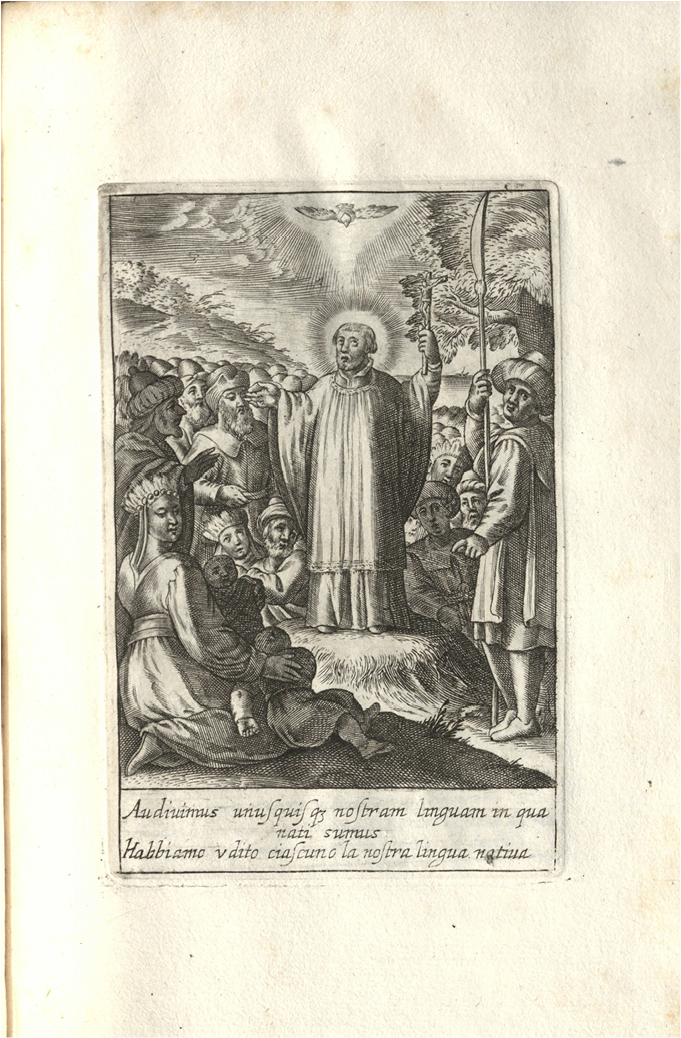
As soon as Francis Xavier was canonized, images of him preaching to or baptizing large crowds of non-Europeans became one of the most common representations of the new saint. In Rome, the ephemeral decorations that accompanied the festivities celebrating the 1622 canonization were influential on later iconographic developments. Although the actual decorations do not survive, their subjects were documented in a 1622 description by Giovanni Briccio (1579â1645) and most of their compositions were copied by the Flemish printmaker Valérien Regnard (fl. c.1622â50).8 Both Briccioâs text and Regnardâs prints contain multiple references to Xavierâs activities preaching and baptizing. One of the most famous incidents was the so-called âmiracle of the languages,â (also referred to by Elisa Frei in her essay) in which Xavier was once preaching to a crowd in Asia filled with people from âdiverse nationsâ and miraculously, all of them could hear Xavier speaking their own native tongues.9 This miraculous acquisition of foreign languages clearly casts the Jesuit missionary saint as a new Apostle, filled with Pentecostal zeal to spread the word of God and armed with the power to transcend language barriers and speak to all people of the world. Briccio wrote that a painting of this subject was hung on the left-hand side of the façade of the Gesù in Rome and Regnard included a copy of that painting in his pamphlet with the inscription âaudivimus unusquisque nostrum linguam in qua nati sumus,â language that resembles the description of the Pentecost in Acts 2:6 (Fig. 1).10 The members of the crowd exhibit a wide variety of costumes, an effective technique to underline that this is a heterogenous group of people who speak different languages.11 However, these inventive costumes also allow the figures to resist identification with specific continental allegories. The woman in the left foreground wears a regal European gown, but dons a feathered headdress, similar to several other people dispersed among the crowd. Fanciful variations upon turbans are also featured prominently on the figures. Although feathered headdresses and turbans will become key attributes for the continents of America and Asia respectively in later Xaverian images, this print lacks other important continental signifiers that would allow the figures to be securely identified as allegories of the continents.

Valérien Regnard, St. Francis Xavierâs Miracle of the Languages, Sancti Francisci Xaveriiâ¦, c.1622, published in Rome
Citation: Journal of Jesuit Studies 9, 3 (2022) ; 10.1163/22141332-09030006
photo: burns library, boston collegeIn Regnardâs series of prints, we find another image type that similarly emphasizes the global reach of Francis Xavierâs ministry, the iconography of Xavier baptizing multiple kings. In the testimony taken during Francis Xavierâs canonization process and in various hagiographies, references to Xavier baptizing kings abound, but are confused and often ahistorical.12 Some sources are vague about the identity of these kings. The canonization bull, for example, says that Xavier was the first to preach the Gospel to many different kinds of people, including the Paravars, the Japanese, and the Malaccans, and that he baptized many of their kings and great princes.13 Regnardâs image, however, is curious in that it groups three kings together, an event that, to my knowledge, is not described in any of the Xaverian hagiographies. This image seems to be borrowing from the tradition of the three Magi, and although Regnard does not depict these figures with any attributes that would associate them with Asia, America, or Europe, a knowledgeable viewer could easily make that connection and thus view Xavierâs ministry as a fulfillment of the global vision of the church offered initially in the form of the Magi.
As the iconography of Francis Xavier developed, artists continued to elaborate on these themes of heterogenous crowds and royalty gathered from diverse parts, representing a world united in faith through the power of Xavier. In some of these artworks, members of the crowd began to be depicted with more specificity and the desire to show variety coalesced into sets of four figures, each one connected to a continent in some way. However, not all artists were successful in creating true continental allegories in Xaverian images. In general, endeavors to do so can be divided into three categories. First, those where there is no real attempt to portray the allegories of the four continents, but the artist has randomly included figures with feathers to add a generically exoticizing element to the image. Second, those where various elements of non-European dress and physiognomy are muddled together and often mixed and matched (e.g. African figures wearing feathers), sometimes with the inclusion of fanciful headgear and other clothing that cannot be ascribed to a specific continent. Third and finally, those with clear consistent attributes of all four continents â figures with European dress and/or physiological features (Europe), figures with turbans or elements of Ottoman costume (Asia), figures with feathers (America), and figures with African physiological features (Africa). One variation on the third type is when artists depict coherent continental attributes, but only America, Asia, and Africa are included; the European allegory is omitted. When discussing the clarity or coherence of these continental attributes, it should be noted that I am not judging them against any standard of ethnographic accuracy; instead, I am evaluating these images for how closely they cleave to standardized European tropes that characterized the continents.
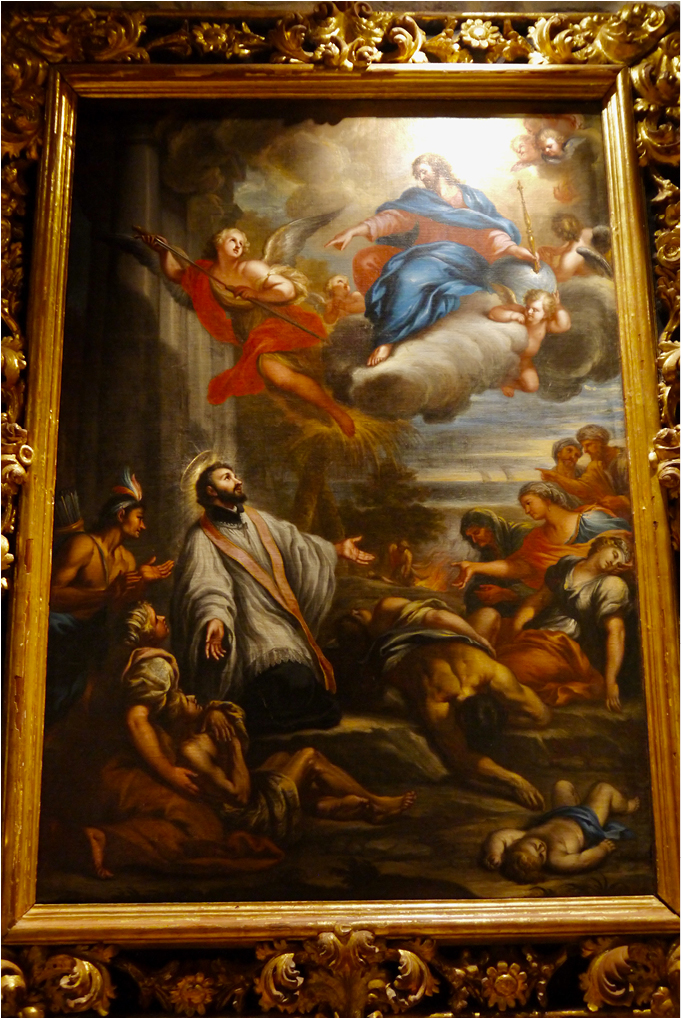
A composition originally created by Ciro Ferri (1634â89) epitomizes the first type, employing generically exoticizing elements to represent far-flung locations without precision.14 Ferri depicts Xavierâs intercession during a plague on Mannar Island, to the northwest of Sri Lanka; the saint looks plaintively up to a vision of Christ on a cloud as he gestures towards the limp bodies of plague victims surrounding him.15 A student of Ferriâs, Pietro Locatello (active in the second half of the seventeenth century), subsequently made a drawing after the work, which was later engraved by François Louvement (active in the 1680s and 1690s).16 In 1692, Godfried Maes (1649â1700) based a painting on the Louvement print, commissioned for the chapel of the Castillo de Javier, St. Francis Xavierâs birthplace (Fig. 2). In all these iterations, the artists have included a stereotypical American figure complete with feather headdress and a quiver full of arrows carried on his back. Beginning with the earliest images that emerged from American-European cross-cultural encounter, feather headdresses and skirts became the major identifying attribute of an Indigenous inhabitant of the New World. Examples of this abound, the earliest possibly being a German broadsheet from around 1505, in which Amerigo Vespucciâs (1451â1512) fanciful descriptions of the peoples of the New World were visually translated into semi-nude cannibals whose bodies were ornamented with jewels.17 As representations of the inhabitants of the Americas, Asia, and Africa became stereotypically codified into relatively standardized allegories of the four continents, the inclusion of feathers became the signifier par excellence for Amerindians.
Godfried Maes, St. Francis Xavier Advocating against the Plague, oil on canvas, 1692, Castillo de Javier, Javier, Spain
Citation: Journal of Jesuit Studies 9, 3 (2022) ; 10.1163/22141332-09030006
photo: authorFirst [â¦] a long tradition of conceiving of the Indies as a fantastical place of hybrids flourished into the sixteenth century; secondly âIndianâ had a political connotation and could refer to all goods coming from lands under Iberian control, whether in Asia or the New World.19
In such images of St. Francis Xavier, the addition of feather garments signifies his patronage over âthe new people,â with no specific geographic designation, allowing him to be viewed as a universal apostle to all the places newly encountered by Europeans in the early modern period.
The second type, in which artists have confused the attributes of the allegories, is generally the most common. One notable instance is Juan Gonzálezâs St. Francis Xavier Embarking for Asia (1703, private collection in Mexico, Fig. 3). Gonzálezâs painting is a striking example of Mexican enconchado painting where mother-of-pearl is inlaid in wood panel and then painted, a technique inspired by Japanese lacquerware imported to New Spain.20 Furthermore, Gonzálezâs painting was based upon a European print made by Cornelis Bloemaert II for inclusion in Daniello Bartoliâs Istoria della Compagnia di Gesù,21 making it a âtruly global object in its conception and fabrication.â22 In the image, Francis Xavier is presented with a map of Asia by five figures, four of which have the names of continents next to them. These labels are additions made by González and were not present in the original Bloemaert print. However, the certainty and specificity of these labels belie the confused nature of the allegorical representations. The African figure is rendered with dark skin and the Asian figure wears a turban, as expected. However, the standard feathered headdress is replaced by yet another turban for the American representative and the female allegory of Europe wears a conical hat that seems to mark her as foreign, despite her blond hair. As mentioned previously, Gonzálezâs source material, the Bloemaert print, does not contain these labels and it does not seem as if the Flemish printmaker intended these figures to be understood as continental allegories. Instead, they read as vaguely depicted representatives of the various lands around the Indian Ocean where St. Francis Xavier had traveled during his ministry. While I would caution against trying to connect each figure to a specific place, the African man may represent the people of Mozambique, where Xavier wintered on his way to India, and the regally attired female figure in the foreground could refer to Niachile Pocaraga, a queen of the Moluccas, who was baptized by Francis Xavier in Ternate in 1546 and appears with some frequency in Xaverian iconography.23 The conical crown worn by the female figure in both Bloemaertâs print and Gonzálezâs enconchado painting was also used by Bloemaert in another frontispiece made for the 1659 reprinting of the first volume of Daniello Bartoliâs Historia della Compagnia di Giesu (first published in 1650) devoted to the life of Ignatius Loyola. This print contains more familiar female allegories of the continents and the one wearing the conical crown is certainly meant to represent Asia. In summary, I propose that when González copied Bloemaertâs print of Xavier being presented with a map of Asia, he appropriated figures that were supposed to represent the types of people Xavier encountered in his travels around the Indian Ocean and without changing much else about them, added labels that identified them with the four continents.
Juan González, St. Francis Xavier Embarking for Asia, oil on wood inlaid with mother-of-pearl, 1703, private collection
Citation: Journal of Jesuit Studies 9, 3 (2022) ; 10.1163/22141332-09030006
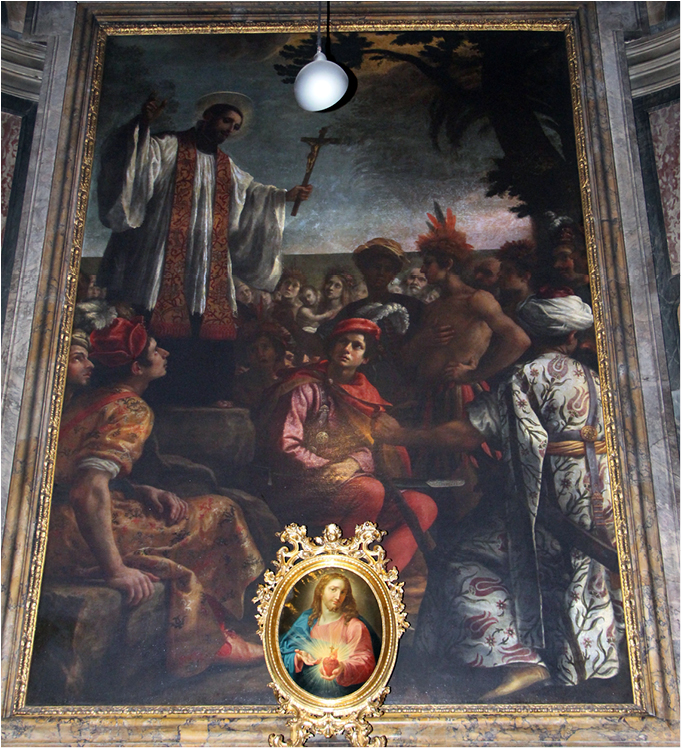
The third type, in which the artist has included four figures with clear continental attributes, is rather rare. One notable example is Francesco Curradiâs (1570â1661) St. Francis Xavier Preaching, which was also created to celebrate Xavierâs canonization in Florence and was placed in the last chapel on the right of San Giovannino, now known as San Giovannino degli Scolopi (Fig. 4).24 Located near Piazza San Lorenzo, the site was donated to the Jesuits by Grand Duke Cosimo i deâ Medici (r.1537â75) in 1554. Lacking funds to renovate the dilapidated fourteenthâcentury church on their own, Jesuits relied on the generosity of wealthy Florentines and especially the architect Bartolomeo Ammannati (1511â92), who not only designed the church with no renumeration, but also donated substantial funds for the construction costs.25 The churchâs plan features a single aisle with shallow side chapels; the decoration for these chapels was patronized by various elite Florentine families who may have been advised by Jesuits to select artists who have been considered part of the âFlorentine Reform movement.â26 Including figures like Santi di Tito (1536â1602), these were artists who, according to Sydney Freedberg, returned to the naturalism of the early Cinquecento in the wake of Florentine Mannerism.27 The side chapels seem to have been decorated by the 1590s; however, a number of them were rededicated throughout the seventeenth century.28 The final chapel on the right was originally dedicated to the crucifixion; however, the occasion of St. Francis Xavierâs canonization in 1622 prompted a change and Curradiâs painting of Xavier preaching in Asia was added to the chapel.29
Francesco Curradi, St. Francis Xavier Preaching to Representatives of the Four Continents, c.1622, San Giovannino degli Scolopi, Florence
Citation: Journal of Jesuit Studies 9, 3 (2022) ; 10.1163/22141332-09030006
photo: wikimedia commonsFerdinando Leopoldo del Migliore (1628â96) described this painting in 1684, writing that it depicted St. Francis Xavier preaching to the Indians and the barbarous nations.30 In the following century, Giuseppe Richa (1693â1761) also emphasized the foreignness of the figures in the painting, noting that it was agreeable for its various inventions of bizarre dress worn in âthese countries.â31 Based on these descriptions alone, one would not expect Curradiâs painting to have clearly legible allegorical representations; however, the artist has included a group of four figures on the right side of the canvas who coherently represent the four continents. There is a young European man wearing red hose, an embroidered doublet, cape, and hat adorned with an ostrich feather. Next to him is a young African man, identifiable by his dark skin. He speaks to an American figure with a bare chest, feather skirt, and feather headdress. The final figure in this grouping wears an Ottoman costume with a tulip pattern, complete with turban. The rest of the crowd contains figures with more generalized exotic and fantastic attributes, but these four described clearly hail from the four different parts of the world.
In the scholarly literature on Curradiâs paintings, art historians have not acknowledged this grouping of the four continents. For example, Gauvin Bailey writes: âThis delightful painting, full of exotic figures, makes the common mistake of having the âApostle to the Indiesâ preaching to the wrong kind of Indian (i.e. Native American â Saint Francis Xavier never set foot in the Americas).â32 In an article about the construction and decoration of San Giovannino degli Scolopi, Bailey similarly writes, âCurradiâs canvas shows Xavier with arms raised and cross held aloft before an exotic crowed made up not only of Asian figures wearing luxurious fabrics, but also â in a standard misunderstanding of the word âIndianâ â American Indians with feathered headdresses (Francis Xavier never traveled to the Americas).â33 While ascribing this to a mistake, Bailey then concludes, âThe scene is set against a crowd representing all of humanity: men and women, rich and poor, European and non-European.â34 This passage rightly notes the universalizing iconography of this painting, but Curradiâs inclusion of an Indigenous American figure is less likely to be an error, and much more likely to be a conscious addition meant to create a coherent grouping of the continents. There are, of course, many Xaverian artworks featuring crowds filled with befeathered individuals that could be attributed to confusion on the part of the artist, several of which are described above. However, Curradiâs painting is certainly not one of these. The figures in the crowd are far too clear and consistent in their continental attributes. The fact that these figures are male and clothed and therefore unlike the typical nude female allegories typically seen in early modern artworks makes their allegorical nature more difficult to identify. Despite their deviation from models like that of Ripa, can these figures rightly be described as allegories of the four continents? If so, how do they fit into the overall history of continental allegories?
The history of allegorical representations of the continents stretches back to antiquity. Ptolemy had divided the world into three parts, Europe, Asia, and Libya (or Africa) and we can find ancient allegorical representations of these places, especially on coins, where, for example, a figure wearing an elephant-headed headdress could personify the continent of Africa.35 This tripartite division of the world was given Christian significance in the medieval period with the story of the repopulation of the world after the Flood by the three sons of Noah and the idea that each of the three Magi had come from a different continent.36 However, Christopher Columbusâs (1451â1506) voyages across the Atlantic demonstrated that the Ptolemaic division of the world into three parts was incomplete and a fourth continent, America, needed to be added to the group.
Art historians generally trace the emergence of allegories of the four continents in the visual arts to the 1570s.37 In 1570, Abraham Orteliusâs (1527â98) Theatrum Orbis Terrarum was published in Antwerp; it is often cited as the first group image to use four female allegories to represent the continents.38 This was quickly followed by a frescoed world map at the Villa Farnese in Caprarola, created between 1573 and 1575, which also included female allegories.39 A few decades later, this nascent iconography was famously codified by Cesare Ripa (c.1555â1622) in his Iconologia, an emblem book that was used by generations of artists. Ripaâs allegorical figures are all women holding various accoutrements and accompanied by animals.40 For example, Ripaâs Africa holds a scorpion, while wearing an elephant hat. She also holds a cornucopia, a reference to the perceived fertility of Africa, and is accompanied by a snake and a lion. Ripaâs American allegory wears the obligatory feather headdress, but has bare breasts, a bow and arrow, and a salamander-like alligator. A disembodied head, shot through with an arrow, is underneath her foot.
As previously noted, except for the feather headdress, Curradiâs continental representatives have little in common with Ripaâs. We have male figures, rather than female, and they generally lack the attributes and animals that Ripa uses. The figuresâ gender and the sumptuous textiles worn by Europe and Asia suggest that this iconography is an extension of the tradition of depicting the three Magi as coming from three different continents as representatives of the non-Christian world, soon to be converted, and could be connected to other Xavierian images like Regnardâs in which Francis Xavier baptizes three kings. In a recent book chapter on gender and race in the personification of the continents, Michael Wintle has noted that while the vast majority of early modern continental allegories are female, there is a small subset of male allegories, as can be seen in a titlepage for a costume book created by Weigel Hans (1549â77) and Jost Amman (1539â91) printed in Nuremberg in 1577.41 These figures are helpfully labeled with the identity of their continent. America draws from the stereotypical image of the Tupinamba Brazilian, scantily clad with a feather headdress, while Asia and Africa are both given turbans. Wintle concludes that Asia should be read as a Janissary, while Africa is a Mamluk, his shield with a crescent moon signifying his place in the Ottoman Empire. Surprisingly, it is Europe here who is completely nude. Wintle writes that he is holding a bolt of cloth and shears, presumably to create new clothes for the figure of America, literally outfitting him in the trappings of European culture.42 Wintle also notes that when male figures are used as allegories of the continents, they are often presented as soldiers. The American, Asian, and African allegories in this printed image have prominently displayed weapons, lending the entire composition a martial quality; in the Curradi painting, we similarly see Europe and Asia with prominently displayed swords. This comparison demonstrates that it was possible for male figures to function as allegories of the continents, even if they lacked the kinds of attributes that Ripa deemed necessarily to properly signify a continent. We also see that physical features, such as skin tone and style of dress, were beginning to play an important role in the portrayal of these allegories, especially when animals and other attributes are not included.
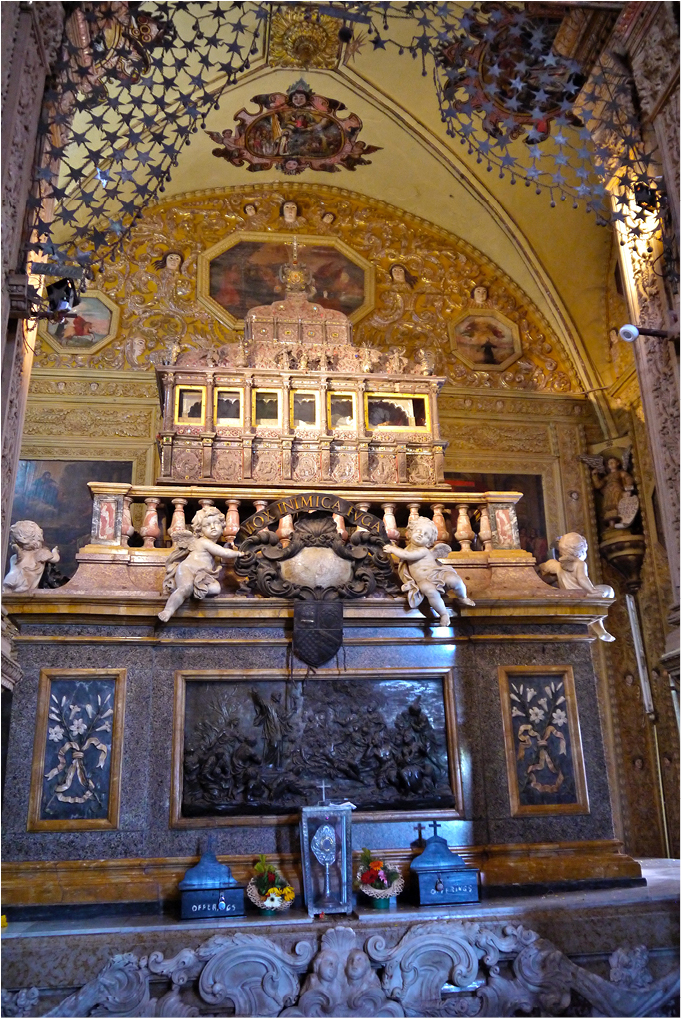
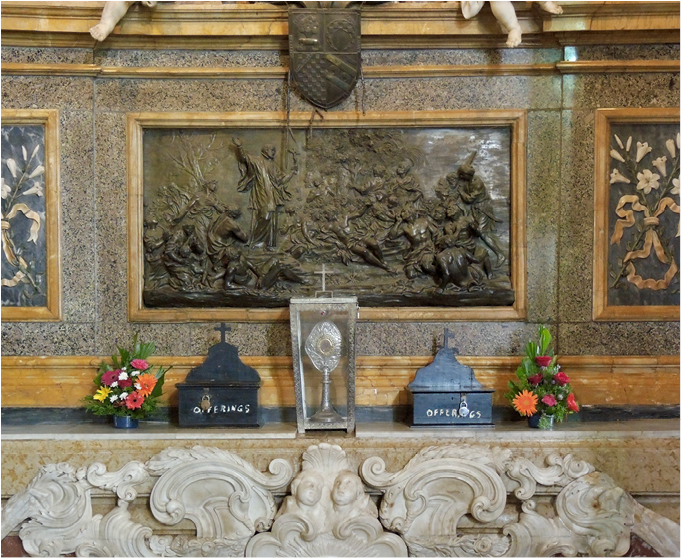
Several decades later, Curradiâs painting may have influenced another Florentine artist, Giovanni Battista Foggini (1652â1725), the head of the granducal workshops. In the 1670s, Cosimo III deâ Medici, grand duke of Tuscany (r.1670â1723), commissioned a large altar-like pedestal for the silver casket that housed St. Francis Xavierâs incorrupt remains in Goa (Fig. 5). This work was made of polychrome marble with ornamentation in pietre dure (semiprecious stones) and four bronze relief panels, which depict four events from the life of the saint. Cosimo was inspired to commission this pedestal after a visit from Francesco Sarmento, the procurator general of the Jesuits in Goa, who gave the duke a gift of a cushion upon which the head of Francis Xavier had rested in death. According to Francisco de Souza (1649â1712), during Sarmentoâs visit, Cosimo âexpressed gratitude for the gift and promised to have a splendid tomb crafted from Italian precious stone inlay â a work worthy of such a magnificent and powerful prince and of such a miraculous and glorious saint.â43
Tomb of St. Francis Xavier: Silver casket by Goan silversmiths, 1636â37 and polychromatic marble pedestal by Giovanni Battista Foggini, 1689â95, Basilica of Bom Jesus, Goa
Citation: Journal of Jesuit Studies 9, 3 (2022) ; 10.1163/22141332-09030006
photo: authorWork on the tomb pedestal was carried out between the years 1689 and 1695, with an interruption in the early 1690s, due, presumably, to financial difficulties.44 The work was completed in 1695, the same year that Cosimo received a letter from Thyrsus González de Santalla (1624â1705), the thirteenth superior general of the Jesuit order, stating his admiration for a drawing he was sent of the tomb. The monument was then displayed to the public in the Cappella dei Principi in the church of San Lorenzo in Florence for a period of two years before it was disassembled, packed in crates, and sent off first to Lisbon, then to Goa.
With the installation of the Medici pedestal, the tomb of St. Francis Xavier assumed the form in which it can be seen today. Fogginiâs contribution to the tomb is divided into three registers, the bottom-most consisting of pink and yellow marble decorated with cherub heads, scroll volutes, garlands, and shields carved with emblems, all in white marble. The second register is separated from the lower by bands of veined yellow marble and displays the four bronze panels mounted in gray marble. Flanking the bronze panels are mosaics in pietre dure representing lilies, the emblem of Florence. The upper-most register consists of a pink marble balustrade, decorated with two putti on each side, each pair holding a bronze banner surmounting cartouches composed in bronze and calcite alabaster.45 The alabaster âeyesâ are also carved with emblems.
The front view of the tomb contains a bronze relief of St. Francis Xavier preaching to representatives of the continents, harkening back to Curradiâs painting in Florence (Fig. 6). In the relief, Xavier is surrounded by many figures in various poses, almost all of whom have turned their heads towards the saint, giving him their rapt attention. Many of their gestures demonstrate the figuresâ agitation (arms flung wide), but also their reception of the Gospel message (one hand resting on the figuresâ breasts, as if their hearts are enflamed with a love of God). Most notably, a majority of the figures in the foreground are nude or seminude men, a rarity in Xaverian iconography. Lankheit has noted that the reclining figures more closely resemble classical river gods than the early modern inhabitants of the Indies and the scene in general is similar to a Bacchanal such as the one by Massimiliano Soldani Benzi (1656â1740) in the collection of the Prince of Liechtenstein (1695/1697).46 The classicized nature of these figures in the crowd lends a timelessness to the scene, but could also be considered representative of Europe, in the same way that the Hans and Amman frontispiece cited above also used a classical nude male figure to denote Europe.
Giovanni Battista Foggini, St. Francis Xavier Preaching, bronze, 1689â95, Tomb of St. Francis Xavier, Basilica of Bom Jesus, Goa
Citation: Journal of Jesuit Studies 9, 3 (2022) ; 10.1163/22141332-09030006
photo: alison flemingWhile the nude or seminude classicizing figures introduce an element of timelessness, the figures in the background on the right side of Fogginiâs St. Francis Xavier Preaching announce his geographic universality as well. The rightmost figure in the composition wears a turban, carries a curved sword, and leans forward to hear the words of Xavier, propping himself up on a staff. To the left of this figure are three men, nude from the waist up and wearing unmistakable feather headdresses. These feathers are clearly meant to designate the men as Americans. To the left of those figures can be seen a strapping young man with high cheekbones, full lips, and close-cropped curly hair, all physiological features utilized by early modern artists to describe African figures.
touched their seas because those who sail to India, fearful of the Cape of Good Hope, swing close to Brazil, the land of America. Also, [Xavier] sailed the sea that is between the Moluccas and New Spain, which some count as being part of America, according to the division of Pope Alexander VI.50
Torsellino goes to great lengths to find technicalities that would allow Xavier to claim a role in the evangelization of the Americas. The passage quoted previously from Francisco GarcÃaâs hagiography also tries to make a case for Xavierâs connection to the Americas, mentioning that he navigated the seas of America, a reference to the fact that ships often crossed the Atlantic towards Brazil as they headed south to round the southern tip of Africa.51 However, I do not believe that images of Francis Xavier preaching to the four continents are meant to be interpreted so literally. One of the goals of the present study is to demonstrate how these images were not intended to be taken as an accurate, literal account of the places visited by Francis Xavier, but were instead a metaphor for the supremacy of the Jesuit order and Francis Xavier in the global mission field.
The idea that Foggini may have used Curradiâs altarpiece as an iconographic model has never before been suggested by art historians. In fact, the chapel where Curradiâs altarpiece was displayed was also the site of Cosimo IIIâs patronage. The grand duke provided polychrome marble revetment for the shallow side chapel and also paid for a small pietre dure tabernacle, paintings for the lateral walls, and a fresco of St. Francis Xavier in Glory for the vault of the chapel. This chapel in San Giovannino and the Medici pedestal in Goa are obviously in dialogue with one another; they both feature images of the universal St. Francis Xavier evangelizing the four continents, as well as polychrome marble and inlay in pietre dure. Among the larger body of images of St. Francis Xavier, these works by Curradi and Foggini count among the few to present a coherent grouping of the four continents, which strengthens the conclusion that Foggini studied Curradiâs work in preparation for the creation of the tomb pedestal.
Fogginiâs iconographic program continues on the right side of the Goan pedestal with a bronze panel representing St. Francis Xavier Baptizing. Xavier is shown in the act of winning souls for God, the culminating act of a successful mission and the reason why Jesuits were traveling thousands upon thousands of miles. The St. Francis Xavier Baptizing panel repeats the same allegory of the four continents, with three Amerindians on the left side (all wearing feather skirts and one still wearing his feather headdress), an African figure with his back to the viewer and face in a reverse three-quarter view, and a figure with a turban behind the African manâs right shoulder. Foggini adds yet another foreign figure to this scene of baptism and includes a bare-chested man almost prostate on the ground, his hands and head by Xavierâs feet. This man has a noticeable topknot, a common way of depicting Japanese figures in the seventeenth century. Thus, Foggini created an allegory of five parts of the world, differentiating between East Asia and Western Asia.
The four scenes depicted by Foggini on the tomb faces show Xavier preaching, baptizing, being persecuted by people hostile to his message of the Gospel, and dying. These four scenes seem to have been purposefully selected to make a strong visual case for Xavier as a new Apostle. To return to the quote with which I began, Francisco GarcÃa actually positions Xavier as being superior to the Apostles. Whereas each animal from the vision of Ezekiel traditionally stands for one Gospel writer, GarcÃa says that all four of them combined are a symbol for Xavier; this chapter of his text is devoted to proving that the length and difficulty of Xavierâs travels was unparalleled and that no one in the history of Christendom, not even all of the original Apostles combined, has traveled to more kingdoms, baptized more souls, converted more kings, or walked more leagues than this new Apostle of the Indies. In essence, Xavier has fulfilled the apostolic mission that Christ had given to his original followers. The inclusion of allegories of the four continents in Curradi and Fogginiâs images of St. Francis Xavier demonstrates his triumph and creates a vision of the world brought together in religious unity, on the brink of eschatological salvation for all, a state accomplished through the missionary zeal of Francis Xavier, apostle of all the Christian World.
Francisco GarcÃa, Vida y milagros de San Francisco Xavier de la Compañia de Jesús, Apóstol de las Indias (Madrid: Marcos Ãlvarez de Arellano, 1672), 347.
GarcÃa, Vida y milagros, 347.
GarcÃa, Vida y milagros, 347.
Mariano Lecina, ed. Monumenta Xaveriana: Scripta varia de sancto Francisco Xaverio, vol. 43, Monumenta historica Societatis Iesu (Madrid: Typis Augustini Avrial, 1912), 705â6 and 715. For Mathias Peralta Calderónâs Spanish translation, see Mathias de Peralta Calderón, El Apóstol de las Indias y Nuevas Gentes San Francisco Xavier de la Compañia de Jesús (Pamplona: Gaspar MartÃnez, 1665), 4â5.
Peralta Calderón emulated the language of the canonization bull in the title of his hagiography, El Apóstol de las Indias y Nuevas Gentes⦠Cristóbal Berlanga also called him âthe Apostle to the Indies and New People,â implying that Xavierâs dominion extended over the Americas, as well as Asia. Cristóbal Berlanga, El Apóstol de las Indias Nuevas Gentes, San Francisco Javier de la Compañia de Jesús: EpÃtome de sus apostólicos hechos, virtudes, y milagros (Valencia: n.p., 1698). Francisco GarcÃa also used the âApostle of the Indiesâ appellation in the title of his hagiography. GarcÃa, Vida y milagros. These are just a few examples.
Vittorio De Feo and Vittorio Martinelli, eds., Andrea Pozzo (Milan: Electa, 1996), 66â93. For Pozzo in general, see Alberta Battisti, ed. Andrea Pozzo (Milan: Luni, 1996) and Andrew Horn, Andrea Pozzo and the Religious Theatre of the Seventeenth Century (Philadelphia: St Josephâs Press, 2019).
Philippe Lécrivain, âJesuit Cultures and Missions in the Seventeeth and Eighteenth Centuries,â in The Jesuits and the Arts, ed. John W. OâMalley and Gauvin Alexander Bailey (Philadelphia: Saint Josephâs University Press, 2003), 248â49.
Giovanni Briccio, Relatione della solenne processione fatta in Roma nella trasportatione deâ Stendardi deâ Gloriosi Santi (Rome: Giacomo Mascardi, 1622). Pietro Tacchi Venturi, âLa canonizzazione e la processione dei cinque Santi negli scritti e nei disegni di due contemporanei (Giovanni Bricci, Paolo Guidotti Borghese),â in La canonizzazione dei Santi Ignazio di Loiola e Francesco Saverio (Rome: Grafia, S.A.I. Industrie Grafiche, 1922), 70. Valérien Regnard, S. Francisci Xaverii Ind: apli Societ: Iesv: Qvædam miracvla (Rome: n.p., 1622). Not many copies of this pamphlet survive. I consulted the copy in the John J. Burns Library, Boston College, and there is another in the Biblioteca del Sanctuario de Loyola, Azpeitia (Guipúzcoa, Spain). Massimo Leone, Saints and Signs: A Semiotic Reading of Conversion in Early Modern Catholicism (Berlin: De Gruyter, 2010), 433â46. See also Juan Iturriaga Elorza, âHechos prodigiosos atribuidos a San Francisco Javier en unos grabados del siglo xvii,â PrÃncipe de Viana 55, no. 203 (1994), 467â511.
This is described in the canonization bull, issued by Pope Urban viii on August 6, 1623. Lecina, Monumenta Xaveriana: Scripta varia, 709â10. Peralta Calderón, Apóstol de las Indias, 10. For another account of the miracle of the languages, see GarcÃa, Vida y milagros, 67. MarÃa Gabriela Torres Olleta, Milagros y prodigios de San Francisco Javier (Pamplona: Fundación Diario de Navarra, 2005), 45â47. See also Elisa Freiâs contribution in this same special issue.
Leone, Saints and Signs, 442.
Massimo Leone writes âThe bizarre headgear of the crowd surrounding Francis Xavier therefore refers to the âexoticnessâ of his audience, but also to its variety.â Leone, Saints and Signs, 442.
Iturriaga Elorza, âHechos prodigiosos,â 494â97. Georg Schurhammer, âDie Konigstaufen des Hl. Franz Xaver,â in Gesammelte Studien: Xaveriana, ed. László Szilas (Lisbon: Centro de Estudos Historicos Ultramarinos, 1964). Regnard has actually created a hybrid scene here, combining two different events, the miracle of Francis Xavierâs levitation with the baptism of the kings. The inscription on Regnardâs print reads, âReges tres et multa centena hominum millia baptizat qd agens saepius a terra elevatus conspiciturâ in Latin and âBatteza trè Rè e molti centenara de migliara dâhomini nel qual atta si vede piu volte inalzato da terra.â
Lecina, Monumenta Xaveriana: Scripta varia, 709.
MarÃa Gabriela Torres Olleta, Redes iconográficas: San Francisco Javier en la cultura visual del barroco (Navarre: Universidad de Navarra, 2009), 216â21. Ricardo Fernández Gracia, âReligioso camarÃn y aula de milagros: La santa capilla del castillo de Javier entre los siglos xvii y xix,â in Sol, apóstol, peregrino: San Francisco Javier en su centenario, ed. Ignacio Arellano (Pamplona: Gobierno de Navarra, 2005), 295â307.
Ricardo Fernández Gracia, San Francisco Javier, Patrono de Navarra: Fiesta, religiosidad, e iconografia (Pamplona: Gobierno de Navarra, 2006), 281â93.
Bruce William Davis, The Drawings of Ciro Ferri (New York: Garland, 1986), 234.
Jean Michel Massing, âEarly European Images of America: The Ethnographic Approach,â in Studies in Imagery, Vol. ii: The World Discovered (London: Pindar Press, 2007), 98â99.
William C. Sturtevant, âLa Tupinambisation des Indiens dâAmerique du Nord,â in Les figures d lâIndien, ed. Gilles Thérien (Montreal Service des Publications de lâUniversité due Québec à Montréal, 1988).
Jessica Keating and Lia Markey, ââIndianâ Objects in Medici and AustrianâHabsburg Inventories: A Case-Study of the Sixteenth-Century Term,â Journal of the History of Collections 23, no. 2 (2011): 287â88.
This painting was commissioned in Mexico City by Ana RodrÃguez de Madrid, a Spanish noblewoman who had lived in New Spain for some decades. Donna Pierce, âBy the Boatload: Receiving and Recreating the Arts of Asia,â in Made in the Americas: The New World Discovers Asia, ed. Dennis Carr (Boston: mfa Publications, 2015), 64â65. See also Sonia I. Ocaña Ruiz, âEnconchados: Japanese Appropriations, Ornamentation and Light Symbolism in New Spain,â Caiana: Revista de historia del arte y cultura visual 10, no. 1 (2017): 1â17; Ocaña Ruiz, âEnconchado Frames: The Use of Japanese Ornamental Models in New Spanish Painting,â in Asia and Spanich America: Trans-Pacific Artistic and Cultural Exchange, 1500â1850, ed. Donna Pierce and Ronald Y. Otsuka (Denver: Denver Art Museum 2009).
Daniello Bartoli, DellâIstoria della Compagnia di Giesu: LâAsia, Parte Prima (Rome: Stamperia del Varese, 1667).
Pierce, âBy the Boatload,â 65. Bloemaertâs print may have been based on a composition by Jan Miel (1599â1664). Leone, Saints and Signs, 415.
The most detailed English-language account of Neachile Pocaragaâs life is Paramita R. Abdurachman, ââNiachile Pokaragaâ: A Sad Story of a Moluccan Queen,â Modern Asian Studies 22, no. 3 (1988): 571â92. Various hagiographies of Xavier mention the story of her conversion. João de Lucena, Historia da vida do padre Francisco de Xavier e do que fizerão na India os mais religiosos da Companhia de Iesu (Lisbon: Pedro Crasbeeck, 1600), 247. GarcÃa, Vida y milagros, 113. Dominique Bouhours, La vie de Saint François Xavier de la Compagnie de Jesús, Apôtre des Indes et du Japon (Paris: n.p., 1683), 292.
The church was given to the Piarists (Scolopi) in 1775, after Pope Clement xivâs suppression of the Jesuit order. Gauvin Alexander Bailey, âThe Florentine Reformers and the Original Painting Cycle of the Church of S. Giovannino,â in Spirit, Style, Story: Essays Honoring John W. Padberg, ed. John W. Padberg and Thomas M. Lucas (Chicago: Jesuit Way/Loyola Press, 2002), 150.
Bailey writes that by 1584, Ammannati had spent twelve thousand scudi of his own money on the church. Bailey, âThe Florentine Reformers,â 150. For a list of patrons, see Ferdinando Leopoldo del Migliore, Firenze città nobilissima illustrata (Florence: Stella, 1684), 192.
Bailey, âThe Florentine Reformers,â 140â41.
Sydney Freedberg, Painting in Italy, 1500 to 1600 (Penguin: Balitmore 1971), 620.
Bailey, âFlorentine Reformers,â 150.
Bailey, âFlorentine Reformers,â 157.
âIl S. Francesco Xaverio, che predica a glâIndiani, e Nazzioni Barbareâ¦â Migliore, Firenze, 193.
âper le varie invenzioni di abiti bizzarri allâuso di queâ Paesiâ¦â Giuseppe Richa, Notizie istoriche delle chiese fiorentine divise neâsuoi quartieri, 10 vols. (Florence: Viviani, 1757), 5:145â46.
Gauvin Alexander Bailey, âItalian Renaissance and Baroque Painting under the Jesuits and Its Legacy throughout Catholic Europe,â in Jesuits and the Arts, 168.
Bailey, âFlorentine Reformers,â 157.
Bailey, âFlorentine Reformers,â 157.
Maryanne Cline Horowitz, âIntroduction (1): Rival Interpretations of Continent Personifications,â in Bodies and Maps: Early Modern Personifications of the Continents, ed. Maryanne Cline Horowitz and Louise Arizzoli (Leiden: Brill, 2021), 5.
Paul H. D. Kaplan, âMagi, Winds, Continents: Dark Skin and Global Allegory in Early Modern Images,â in Bodies and Maps, 133. Kaplan, The Rise of the Black Magus in Western Art (Ann Arbor: umi Research Press, 1985).
Before appearing in the visual arts, allegories of the continents first appeared in pageants and processions celebrating particular rulers, such as Charles v and Philip ii. Horowitz, âIntroduction (1): Rival Interpretations,â 6.
Elizabeth Neumann, âImagining European Community on the Title Page of Orteliusâs Theatrum Orbis Terrarum (1570),â Word and Image 24 (2008): 442, here 427. Horowitz, âIntroduction (1): Rival Interpretations,â 3.
Elisa Antonietta Daniele, âPortraits of the World â The Four Continents at Palazzo Farnese in Caprarola: The Figurative Code, Sources, and Comparisons,â in Bodies and Maps.
Benjamin Schmidt, âCollecting Global Icons: The Case of the Exotic Parasol,â in Collecting across Cultures: Material Exchanges in the Early Atlantic World, ed. Daniela Bleichmar and Peter C. Mancall (Philadelphia: University of Pennsylvania Press, 2011). Honour, New Golden Land, 131â56. Rachel Doggett, ed. New World of Wonders: European Images of the Americas, 1492â1700 (Washington, DC: Folger Shakespeare Library, 1992).
Michael Wintle, âGender and Race in the Personification of the Continents in the Early Modern Period: Building Eurocentrism,â in Bodies and Maps, 56.
Wintle, âGender and Race,â 56â57.
âPassou por Florença o Padre Francisco Sarmento Producrado Gèral desta Provincia, e offertou ao Graõ Duque de Toscana hum cuxim, que servio de almofada muytos annos à cabeça do Santo depois de morto. Agradeceo Sua Alteza o presente, e prometteo mandar fabricar hum magestoso sepulchro de pedras rieas de Italia com embutidos, obra digna de tam mangifico, e poderoso Principe, e de tam milagrosos e abalizado Santo.â Francisco de Sousa, Oriente Conquistado (Porto: Lello e Irmão Editores, 1978), 587â88.
Evidence for this includes a letter written by Foggini, dated January 26, 1691/92. He writes, âRitrovandomi senza denari e con molta spesa per il lavoro deâ bassirilievi di bronzo.â asf, Mediceo 1535. It is assumed that was work was resumed by 1693, based on a letter regarding payment for the marble putti on the tomb, written by G. P. Baldi to A. Bassetti, dated March 4, 1689/90. asf, Mediceo 1536. Klaus Lankheit, Florentinische Barockplastik: Die Kunst am Hofe der letzten Medici (Munich: F. Bruckmann, 1962), 304.
For an excellent description of the materials used in the tomb, see Annamaria Giusti, âRitorno in India: di nuovo lâOpificio e il mausoleo di San Francesco Saverio a Goa,â opd: Restauro 11 (1999).
Lankheit, Florentinische Barockplastik, 107.
St. Jerome (c.342â420) wrote that St. Thomas went to India, as did many other ancient writers. The apocryphal Acts of Thomas confirm this, stating definitively that Thomas went to western India. However, this text also says that Thomas preached in Mazday, a city that has been interpreted as Mylapore. Leonard Fernando and G. Gispert-Sauch, Christianity in India: Two Thousand Years of Faith (New Delhi: Viking, 2004), 59â60. Cfr. Liam Matthew Brockey, âDoubting Thomas: the Apostle and the Portuguese Empire in Early Modern Asia,â in Sacred History: Uses of the Christian Past in the Renaissance World, ed. Kate Van Liere, Simon Ditchfield, and Howard Louthan (Oxford: Oxford University Press, 2012), 233â49.
D. A. Brading, The First America: The Spanish Monarchy, Creole Patriots, and the Liberal State, 1492â1867 (Cambridge: Cambridge University Press, 1991), 172â74.
Jaime Cuadriello, âXavier Indiano o los indios sin apóstol,â in San Francisco Javier en las artes: El poder de la imagen, ed. Ricardo Fernández Gracia (Pamplona: Fundación Caja Navarra, 2006), 203.
Quoted in Fernández Gracia, âSan Francisco Javier patrono,â 164.
GarcÃa, Vida y milagros, 347.