Abstract
Before the Jesuits officially received their first saints, they capitalized on the power of the portrait series to promote their martyrs. The growing ranks of Jesuit martyrs, thought to number over a hundred in the early seventeenth century, allowed the order to participate in contemporary trends of serial portraiture as a means of legitimization. This article focuses on one crucial object in this history, a 1608 print depicting one hundred and two Jesuit martyrs in a repetitive and chronological format, published by Matthäus Greuter and Paul Maupin in Rome. An analysis of Greuter’s print demonstrates how the Jesuits coopted conventions of the portrait series to associate their martyrs with notions of Christian exemplarity and apostolic succession ingrained in the genre. The making of Jesuit identity cannot be disentangled from the discourse of portraiture, a category that includes the reiterative series as well as the naturalistic likeness.
Histories of the Jesuit portrait typically revolve around the role of the true effigy, an authentic likeness, in the canonization of the Society’s first saints, their founder Ignatius of Loyola (c.1491–1556) and their foundational missionary figure, Francis Xavier (1506–52).1 The portrait was a crucial factor in procuring sainthood: it could function as evidence of a candidate’s saintly reputation and act as a miraculous intercessor. The Jesuits were not unique in their interest in the saintly true effigy—similar efforts were undertaken to promote the cults of the Oratorian Filippo Neri (1515–95) and the Milanese archbishop Carlo Borromeo (1538–84)—but they did dedicate themselves to the task with particular zeal, using death masks, extant portraits, and textual descriptions to produce accurate portraits of their future saints.2 The Jesuit investment in the true effigy has rightfully garnered much attention in the discipline of art history. However, this focus has obscured the ways in which the Jesuit order also exploited a tradition of serial portraiture, laden with its own values and connotations, as a legitimizing tool in the early Seicento.
Both of Ignatius’s most well-known true effigies, in fact, once belonged to a series. One version by Florentine artist Jacopino del Conte (1510–98) was the inaugural painting in a cycle of portraits of the Jesuit superior generals displayed at the Casa Professa in Rome.3 A second true portrait of Ignatius, commissioned by his biographer Pedro de Ribadeneyra (1527–1611), belonged to a cycle in the Jesuit College of Madrid showing Ignatius’s first ten companions.4 Martyrs, however, were the most common subject for a Jesuit portrait series. If the early seventeenth-century Jesuits counted among their members two saintly hopefuls, two blessed, five superior generals, and ten companions to Ignatius, their martyrs totaled over one hundred, a quantitative triumph that created new pictorial opportunities.5
Supra Centum Martyres
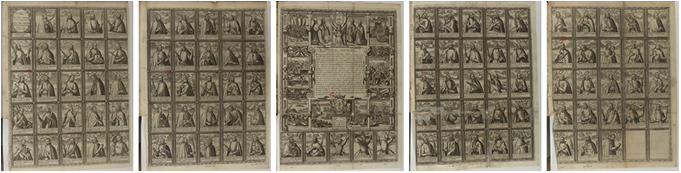
Portrait cycles of the hundred-plus Jesuit martyrs begin to appear shortly after the 1605 publication of Giovanni Camerota’s (1559–1644) Centuria prima, a history of the first hundred martyrs of the Jesuit order that was also included in Latin translation in Ribadeneyra’s 1608 catalog of Jesuit works.6 The same Ribadeneyra was involved in one of the earliest such portrait cycles: he commissioned Juan de Mesa (1583–1627) to paint one hundred and two Jesuit martyr portraits for the Jesuit college of Madrid.7 Another early exemplar, perhaps dating to 1606, was the series displayed in the novitiate complex of Sant’Andrea al Quirinale in Rome.8 The French Jesuit Louis Richeome (1544–1625) describes this now-lost Roman series in his 1611 treatise, La peinture spirituelle. Richeome’s text, a devotional treatise structured as an imagined walk-through of the novitiate grounds, details the “beautiful list” of martyr portraits that stretched along the walls of the recreation room below narrative scenes of martyrdom.9 A sense of the novitiate cycle is preserved in a 1608 print, published by Matthäus Greuter (1566–1638) and Paul Maupin (fl.1591–1635) in Rome (Fig. 1).10 The work, labeled as the Effigies et nomina quorundam ex Societatis Iesu qui pro fide vel pietate sunt interfecti ab 1549 ad 1607, lists the “effigies and names” of the Jesuits’ first one hundred and two martyrs chronologically by date of death, beginning with the Jesuit protomartyr Antonio Criminale (1520–49), who died in 1549, and concluding with Vicente Alvares, martyred in India in 1606. Gauvin Bailey first argued in 2018 that the Effigies print represents the lost portrait series at the Roman novitiate.11 His hypothesis can be further supported here by the hitherto unrecognized fact that Richeome, in his alleged description of the novitiate’s painted portraits, repeats an error only found in Greuter’s print, suggesting that Richeome viewed the print as a credible record of the painted cycle.12

Matthäus Greuter and Paul Maupin, Effigies et nomina quorundam è societate Jesu qui pro fide vel pietate sunt interfecti ab anno mdxlix ad mdcvii, 1608. 182.5 cm x 50 cm. Engraving. Bibliothèque nationale de France [ms Fr. 15782]. Reconstruction of five plates in original side-by-side configuration.
Citation: Journal of Jesuit Studies 9, 3 (2022) ; 10.1163/22141332-09030004
The Effigies print helped popularize the Jesuit martyr portrait series in the seventeenth century. The English College in Valladolid displayed fifteen bust-length portraits of recent English martyrs in 1620.13 Similar series are mentioned in Macau in the 1630s, and in Goa the following decade.14 As art historian Katherine McAllen has shown, the martyr portrait had become so commonplace in the order that when eight Jesuit missionaries died during the 1616 Tepehuan Revolt in present-day Mexico, their portraits were quickly drawn up and copies were sent to Rome.15 When Ignatius and Xavier were canonized in 1622, bestowing the Jesuit order with its first officially recognized saints, portraits of Jesuit martyrs were proudly displayed at many of the festivities. During the canonization celebrations, over a hundred Jesuit martyr portraits were displayed along the nave of the Chiesa del Gesù in Rome and along the courtyard of the Jesuit church of San Fedele in Milan.16 The Jesuits of Douai, meanwhile, strung portraits of their martyrs alongside their most notable members in the streets outside of their home church.17 This new iconographical trend is neatly encapsulated already in a 1608 engraving of Jesuits adoring the Pietà by Johannes Wierix (1549–c.1620), which labels a crowd of repetitive figures with spears and nooses as the Supra Centum Societatis Iesu Martyres (More than one hundred martyrs of the Society of Jesus).18
The success of the Effigies print, extant in three distinct versions and at least fourteen exemplars, can be attributed in part to its enterprising creators.19 The Jesuits had previously enlisted the talents of Greuter, a Strasbourg-born engraver who converted to Catholicism and moved to Rome in 1603.20 Greuter and Maupin published two versions concurrently, producing a simplified single-sheet edition alongside the far more extravagant iteration illustrated here.21 Both were dedicated to Ranuccio I Farnese, duke of Parma and Piacenza (r.1592–1622), who had contributed financially to the Jesuit missions and instituted a university in Parma with Jesuit faculty.22 As the print’s large dedicatory cartouche points out, the Jesuit protomartyr Antonio Criminale hailed from Parma, in Ranuccio’s own ducal territory. The grandeur of the larger version, printed on five separate plates that together measure nearly six feet long, suggests that it may have been a presentation copy, dedicated to Ranuccio by the printmakers in the hopes of a financial donation. This was an increasingly common printer’s strategy by the late sixteenth century, one that Greuter himself testifies to using on the record during a fellow engraver’s copyright case.23 Greuter himself may have facilitated a third edition as well: it was his former contact Johann Bussemacher (fl.1577–1627) who republished the print in Cologne with a new dedicatee.24
The publication of the Effigies also coincided with a formative moment in the history of the Jesuits’ self-understanding, as the rapidly expanding order sought to define a distinctly Jesuit iconography prior to the canonization of its first saints in 1622.25 The print was a critical instrument in this process, but its efficacy lay neither in its naturalism nor its drama. Greuter’s portraits lack the impressive illusions of presence so central to the early modern portrait, impressing in quantity rather than quality. Greuter makes hasty references to particularized features and differentiated poses—some martyrs have beards and others are youthfully bare-faced; some raise their eyes to the heavens while others somberly clasp their hands in prayer—but the overall effect is one of repetition. The print subdues narrative action, deferring the tripartite promise of Catholic post-Tridentine art to move, teach, and delight. Swords and nooses have become mere attributes rather than active agents in a story of pious suffering. This is all the more striking given the violent reality of martyrdom, newly topical in an age of expanded missionary efforts and religious conflict. The martyr provided ample narrative potential for an artist, a capacity that the Jesuits had capitalized upon in other Roman commissions, such as the infamously gruesome decapitations and disembowelings frescoed on the walls of the German-Hungarian College’s church of Santo Stefano Rotondo in 1582.26 Bereft of the singular portrait’s naturalism and the drama of violent martyrdom, the Effigies drew instead on the power of the portrait series, using well-established pictorial formulae to establish a uniquely Jesuit heritage.
The popularity of the martyrological portrait cycle within the Jesuit order might prompt us to identify a uniquely Jesuit dedication to serial imagery. It is tempting to equate the order’s emphasis on imitation or corporate culture, for example, with the formal repetition of a portrait series. Scholars have amply discussed the theme of apostolic imitation in the writings of Ignatius of Loyola and other Jesuit authors. Ignatius himself was considered a template for future Jesuits, setting off a continual process of mimesis summed up by art historian Evonne Levy as the “imitations of Ignatius.”27 The question of a recognizable collective Jesuit identity, whether as a more pragmatic political need or in relation to modern theories of the state, has played a large role in the historiography on the Society of Jesus.28 These aspects of the order’s history may have informed their frequent deployment of the portrait series. Yet the question of isolating a formal “Jesuitness” from broader stylistic trends recalls the fraught debate about the presence of a Jesuit style that, though long outmoded, still haunts art history.29 It is dangerous to map the strategies of a religious order, such as the Jesuit noster modus procedendi (our way of proceeding) or the theory of accommodation, directly onto the formal elements of art.
The Jesuits were not the only order to promote their new martyrs through serial imagery. Indeed, the spiritual status of the martyr, more than Jesuit characteristics, may have inspired this emphasis on replicability.30 Images of the twenty-six martyrs of Japan, whose cult was endorsed most prominently by the Franciscan order, who made up the great majority of the victims, make frequent recourse to replicated crucifixes and reiterative imagery.31 In 1612, the theologian George Maigret (1573–1633) published a treatise on the martyrs of the Augustinian order, each accompanied by a standing full-length portrait.32 Maigret’s series begins with the fifth-century followers of Augustine and continues into his recent present, including figures like Henry Zeghers, killed in 1587 in Brabant. An engraved series of bust-length portraits of the martyrs of Gorcum, a group of eleven Franciscans and eight other Catholics who were hanged during the Dutch Revolt in 1572, even more closely approximates the look of Greuter’s martyr likenesses.33 The Effigies was not a quintessentially Jesuit novelty and instead made a powerful argument through convention.
A Jesuit Gallery
The bust-length format and linear organization of the Jesuit martyr portraits would have evoked portrait galleries of illustrious men, or viri illustri. This tradition of displaying likenesses of accomplished historical figures was linked to the genre of exemplary biography in classical literature, popularized in the Renaissance through works like Petrarch’s (1304–74) De viris illustribus and through collections like Paolo Giovio’s (1483–1552) famed sixteenth-century portrait gallery near Como.34 Richeome explicitly tied this tradition to the martyr portraits in the Roman novitiate, writing that the series recalled the custom of the “ancient Romans,” who placed portraits of “valiant men” in their abodes.35 The viri illustri tradition remained popular with clerical circles of the post-Tridentine era, though with a confessional inflection. Archbishop Gabriele Paleotti (1522–97) officially sanctioned the practice of displaying portraits of illustrious men in his treatise on proper sacred images, but only if the sitters exemplified “moral goodness or Christian sanctity.”36 The halls of illustrious men indeed turned increasingly toward Christian exemplarity in the decades after Trent. The Dominican theologian and antiquarian Alfonso Chacón (1530–99), for example, amassed hundreds of portraits of illustrious individuals, filing saints, popes, and clerics into his pictorial catalog of valor.37 A similar weight toward sacred sitters characterized the portrait series in Archbishop Federico Borromeo’s (1564–1631) Ambrosiana Gallery in Milan.38
As Paleotti reminds us, the exemplary portrait was an efficacious tool. Armed with citations from classical authors, Paleotti dictates that portraits should function as an “incentive to others to practice virtue.”39 Presumably, it was this catalytic capacity that led high-ranking Jesuit officials like Robert Bellarmine (1542–1621) and Superior General Claudio Acquaviva (in office 1581–1615) to piously display portraits of exemplary churchmen, including Jesuits and martyrs.40 A similar belief in the power of the portrait informed the practice of using images to inspire criminals to repent and heretics to convert.41 Martyr portraits, too, functioned as agents of change. At times, they could simply encourage piety, as in the anecdote of a man who was finally driven to the confessional after seeing a portrait of an associate, Sebastião Vieria (1572–1634), among the martyrs’ images displayed in the Jesuit professed house in Goa.42 The uptick in the real potential of martyrdom, however, especially for novices hoping to join the Jesuit missions, lent a new urgency to this tradition of the efficacious exemplary portrait. Beholders more frequently knew the martyrs in these portraits personally, and some would meet a similar fate. Multiple young Jesuits who gazed upon the martyr portraits in Vallodolid’s English College in 1620, for example, were later immortalized in the series after their own violent deaths.43 The portrait’s conventional topos of exemplarity exalted a new pantheon of illustrious Jesuits and inspired new Jesuit martyrs, a cooption of the viri illustri for a different age.
A Jesuit Succession
Despite the decisive gallery of illustrious men shown in the Effigies print, the canon of Jesuit martyrs was neither firm nor unanimous. Sources disagreed on the precise list of martyrs and their numbers. Richeome’s La peinture spirituelle, as Bailey points out, adds an extra name to the collection in Greuter’s print, throwing off his numerical scheme.44 Although Camerota’s Centuria prima was clearly a source for the novitiate cycle—the 1609 edition actually mentions Greuter’s print—there are still several deviations between the two tallies.45 There are differences in order, for example, and a few martyrs appear in one source but not the other.46 The format of the Effigies concealed the practical complications of compiling this master list of Jesuit martyrs.
The print also suppresses any controversy about the status of these Jesuit martyrs. The increased stringency of canonization processes after the Council of Trent led to debates and confusion regarding the guidelines for depicting would-be saints that were not yet officially canonized.47 The Jesuits, familiar with this problem, had run into criticism for their perceived flouting of the rules, as when they circulated prints of Ignatius of Loyola’s miracles prior to his beatification in 1609.48 None of the individuals in the Effigies were beatified or canonized. Most of the Jesuit martyrs would not receive any such honors from Rome until the nineteenth century, if ever.49 Portraits of these unofficial martyrs caused concern at least once, when Superior General Muzio Vitelleschi (in office 1615–45) had the hundred-plus martyr portraits still hanging in the Gesù taken down in 1625 and moved to storage.50 Overall, however, the figure of the martyr seems to have sidestepped the same scrutiny endured by the other types of beati moderni. The hard fact of the modern martyr’s death afforded them a special heavenly status, if an ambiguous one within the bureaucracies of papal canonization.51
The martyr’s palm was only given to those killed for their faith, a qualification that was often contested in a confessional age. The Jesuits themselves had to distinguish between martyrs and the merely misfortunate. Opponents argued that these new martyrs were executed for political treason or victims of their own ill-advised forays into hostile regions.52 The martyr, as historian Brad Gregory sums up, was an “interpretive category.”53 The French collector Pierre de L’Estoile (1546–1611) makes the point abundantly clear. L’Estoile, no fan of Jesuit “drolleries,” purchased Greuter’s Effigies print in Paris for thirty-five sols in 1608, scoffing in his diary that these Jesuit men were more murderer than martyr, killed for committing “evil spells, attacks, and treason,” but “qualified in Rome by the name of martyrs” nonetheless.54
None of these ambiguities are acknowledged within the Effigies itself. It obscures controversy and more innocent irregularities alike through the historical schemata of portraiture, evoking portrait cycles of institutional, dynastic, and apostolic succession. The late sixteenth and early seventeenth centuries saw an explosion in printed portrait series.55 Some built upon traditions of illustrious men, representing valiant military leaders or famous scholars.56 Other examples were more explicitly dynastic, depicting chronologically organized portraits of rulers in a show of continuity. By the late sixteenth century, these pictorial tales of dynastic lineage were commonly printed on single sheets, visualizing chronological succession through repeated boxes and dated labels, emperor by emperor, king by king.
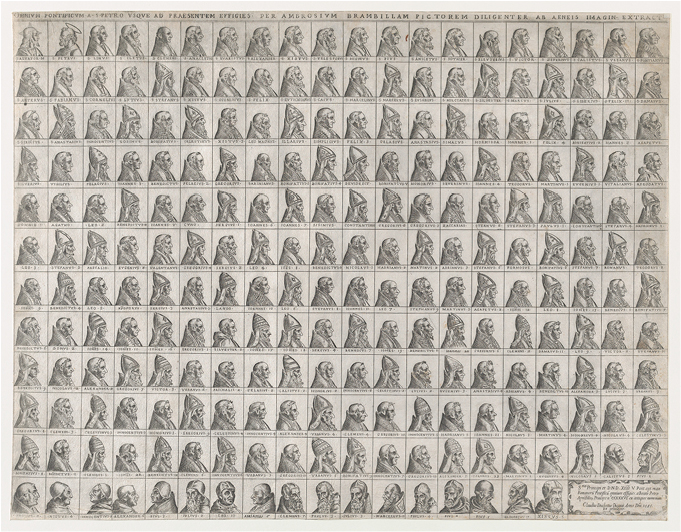
Papal portrait prints coopted the dynastic to the apostolic in the same period. In addition to books of portrait engravings, like Giovanni Battista Cavalieri’s (1526–97) 1580 Pontificum Romanorum effigies, miniature papal portraits were printed in a single-sheet format, as with Ambrogio Brambilla’s (fl.1575–95) example from 1585 (Fig. 2).57 The distinctions of each visage, many modeled after extant artworks, meld into the anonymous totality of a series, exhibiting a repetitiveness that mirrors that of Greuter’s Jesuit martyrs.58 Both prints borrow from a dynastic pictorial strategy, using a ruled grid to visually suppress any conflict or discontinuity. The theme of historical succession shown in such works took on a heightened significance in the post-Tridentine era, as history writing became embroiled in confessional polemics. Brambilla’s printed portraits visualize an apostolic succession that linked the modern papacy to Christ and Saint Peter. This view of history counteracted accusations leveled in Protestant works like the Magdeburg Centuries (1559–74), which criticized the intervening centuries of tradition as errant accretions that had only strayed from Christ’s intentions.59
Giovanni Ambrogio Brambilla, Speculum Romanae Magnificentiae: Small Portraits of the Popes from Christ to Sixtus v, 1585. Engraving. 40.4 x 51.9 cm. Metropolitan Museum of Art, New York.
Citation: Journal of Jesuit Studies 9, 3 (2022) ; 10.1163/22141332-09030004
Post-Tridentine clerics viewed serial portraiture as a time-honored church tradition. They pointed to older papal portrait cycles to make this argument, such as the terracotta bust portraits of the popes from Christ until the twelfth-century Saint Lucius in Siena Cathedral or the row of late antique portrait roundels cataloging the early popes in Rome’s church of San Paolo fuori le mura.60 Interest in these older cycles grew in the late sixteenth and early seventeenth centuries among ecclesiastical, antiquarian, and artistic circles. It was church historian Cesare Baronio (1538–1607) in 1600 who urged the grand duke of Tuscany to correct the papal busts in Siena, replacing the apocryphal figure of Pope Joan with that of Pope Zacharias.61 The round portraits of early popes in San Paolo fuori le mura, meanwhile, were used as source material for Cavalieri’s set of papal portrait engravings, often by way of the work of Onofrio Panvinio (1529–68).62 Paleotti affirms the antique roots of the tradition, praising the “unbroken succession” shown in papal portraits. He presumes that the episcopal portrait series, too, is an older practice, asserting that “paintings of good and pious bishops were made in the past in episcopal palaces, long rows of them in temporal order.”63 Greuter’s Jesuit martyrs not only made a visual argument for their legitimacy, but they did so using a venerably antique formula.
These successions of miniature portraits, built to articulate the strength of continuity, were well-suited to the needs of the post-Tridentine church. However, this type was adapted to a variety of uses. The same print collection that contained Brambilla’s papal portraits also included similar collections of renowned jurists, Ottoman sultans, and even one print cataloging the various types of Roman street vendors, also by Brambilla.64 Set against this background, Greuter’s depiction of the Jesuit martyrs appears entirely typical—indeed, this was the point. The Jesuit martyr, a category that was somewhat unofficial in actuality, was enmeshed in these broader strategies of portraiture circa 1600 that expressed exemplarity and dynastic continuity.
The serial portrait print implied further continuation by design. New popes would be elected and new kings would be crowned; more Jesuits would be martyred. This expectation could be baked into the printing technique itself. This occurred, for example, in the genre of the Effigies cardinalium nunc viventium, single sheets with portraits of the current cardinals, popularized precisely in the late sixteenth and seventeenth centuries.65 Such broadsheets needed to be updated often, so they were printed using moveable woodblocks that could be easily interchanged—Maupin, the publisher of Greuter’s Effigies, seems to have been involved in this type of project.66 Printmakers could also rework the plate to add additional sitters. In some editions of Brambilla’s papal portrait print, for example, the printer has erased the publication information to make room for portraits of the newer popes.67
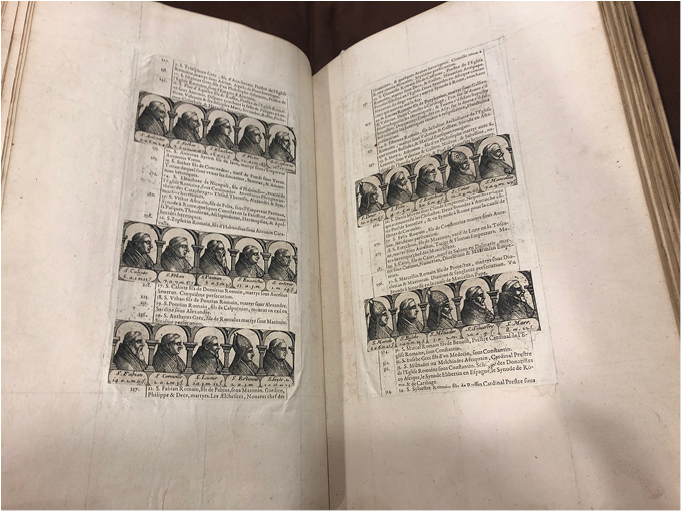
More often, however, the printed portrait series was extended through reuse. Many portrait prints were cut and pasted into larger works, allowing for easy additions or amendments. This occurred, for example, with a different Jesuit work: Hieronymus Wierix’s (1553–1619) booklet of portrait engravings of the Jesuit superior generals, called the Effigies praepositorum generalium Societatis Iesu. The series is humble in length: it was published in the 1610s when there were only five superior generals to portray. One copy of the work in the National Library of Spain, however, has been amended by more than a hundred additional portraits of Jesuits, pasted and drawn in throughout the following century.68 Emblematic in this tradition is the French phenomenon of the Chronologie collée, a sort of scrapbook of portraits and biographies pasted together in large albums, which could be personalized with the inclusion or exclusion of various sets of portraits. In such volumes, as with one 1618 iteration at the Newberry Library, small strips of portraits of kings, popes, and other sitters would be cut from larger sheets and interspersed with their accompanying textual history (Fig. 3).69 Greuter’s Effigies continued to ally itself with printed portrait collections after its publication, subjected to the processes of addition, storage, and reuse typical to the genre. It, too, was commonly cut into strips, pasted into print albums, or turned into a small booklet, with a single martyr on each page.70 This last solution can be seen in Boston College’s copy of the Effigies (Fig. 4). Each martyr has been carefully cut out from its sheet and pasted onto its own page within a stenciled red frame. This belongs to a larger economy of reused portrait prints. One could mention the printed collection of Giorgio Vasari’s (1511–74) artist portraits, published alone without the accompanying text and now bound as a booklet of strips.71 Each of the small squares from Brambilla’s print of Roman street vendors, for example, was also cut and pasted, page by page, into a booklet at the Morgan Library, receiving the same treatment as Greuter’s Jesuit martyrs.72 Continuity in the Effigies print was articulated not only through format, but through these histories of extension.
Detail from Sommaire Chronologie des papes icy pourtraits in Claude Valles, Le theatre d’honneur de plusieurs princes anciens et modernes, 1618. Newberry Library, Chicago [N7604.C57 1618].
Citation: Journal of Jesuit Studies 9, 3 (2022) ; 10.1163/22141332-09030004
Portrait of Antonio Criminale, cut and pasted into a book. From Matthäus Greuter and Paul Maupin, Effigies et nomina quorundam è societate Jesu qui pro fide vel pietate sunt interfecti ab anno mdxlix ad mdcvii, 1608. Burns Library, Boston College.
Citation: Journal of Jesuit Studies 9, 3 (2022) ; 10.1163/22141332-09030004
The inherent fluidity of a portrait series is a strength, but it can also lead to a high incidence of loss or dispersal. Ironically, painted iterations have fared less well than those produced in the ostensibly more ephemeral medium of print. Some paintings were removed from a series, prized enough to be placed upon an altar or moved into a museum.73 Other portraits, when separated from the power of the collection, were found stylistically or authorially lacking and relegated to storerooms or lost altogether. Extant portrait cycles today still often hang along hallways or above library shelves rather than in galleries.74 If uninteresting for a discipline invested in the singularity of the artwork, the good artwork, these serial martyr portraits made a powerful argument in the early seventeenth century about the relatively recently founded Society of Jesus, rendering its new martyrs illustrious and its young lineage longer. The making of Jesuit identity was a process bound up with the practice of portraiture, including not just the true effigy tradition, but the forms, connotations, and uses of the portrait series.
The classic study remains Ursula König-Nordhoff, Ignatius von Loyola: Studien zur Entwicklung einer neuen Heiligen-Ikonographie im Rahmen einer Kanonisationskampagne um 1600 (Berlin: G. Mann, 1982). For more recent analyses and bibliography, see Nina Niedermeier, “‘The Artist’s Memory’ How to Make the Image of the Dead Saint Similar to the Living: The Vera Effigies of Ignatius of Loyola,” Horti Hesperidum: Studi di storia del collezionismo e della storiografia artistica V, no. 2, vol. i (2015): 157–99, and Ralph Dekoninck, “The Founding of a Jesuit Imagery: Between Theory and Practice, between Rome and Antwerp,” in The Acquaviva Project: Claudio Acquaviva’s Generalate (1581–1615) and the Emergence of Modern Catholicism, ed. Pierre-Antoine Fabre and Flavio Rurale (Chestnut Hill, MA: Institute of Jesuit Sources, 2017), 335–50, here 344–45. For an overview of Xavier’s true portrait, see Pilar Andueza Unanua, “La vera effigies de San Francisco Javier: La creación de una imagen postridentina,” in San Francisco Javier en la artes: El poder de la imagen (Pamplona: Fundación Caja Navarra, 2006), 96–119.
For one example involving Neri, see Claudia Gerken, “Vom Porträt zum Heiligenbild: Filippo Neri als ‘Vivum Exemplar’ und die Legitimation seines Bildkultes,” in Rahmen-Diskurse: Kultbilder im konfessionellen Zeitalter, ed. David Ganz and Georg Henkel (Berlin: Reimer, 2004), 221–49. For a recent article on Borromeo’s true effigies, see Grace Harpster, “Figino’s Efficacy: Portraits, Votives, and Their Makers after Trent,” Oxford Art Journal (2021); kcab011, https://doi.org/10.1093/oxartj/kcab011 (accessed January 26, 2022).
König-Nordhoff, Ignatius von Loyola, 18, 68.
José Simón Díaz, Historia del Colegio Imperial de Madrid (Madrid: Inst. de Estudios Madrileños, 1952), 119. Cited, with additional bibliography, in König-Nordhoff, Ignatius von Loyola, 43, 56, 261. Díaz writes that this series included Ignatius’s nine first companions as well as Francisco de Borja (in office 1565–72).
When Greuter’s print was published in 1608, the only two beatified Jesuits were Luigi Gonzaga (1568–91) and Stanisław Kostka (1550–68). Ignatius and Xavier received official beatification in 1609 and 1619, respectively.
I am grateful to Jon Greenwood for informing me of this fact and sharing his research on the topic. The full title is Centuria prima, das erste Hundert der Geistlichen und Ordenspersonen, so auss der Societet Jesu … umbgebracht und gemartert worden (Munich: Nicolaum Henricum, 1605). Although the German edition was published first, Camerota likely composed his text originally in Italian or Latin. The text was printed in both languages the following year in Naples. See also Ribadeneyra, Illustrium scriptorum religionis Societatis Iesu catalogus (Antwerp: Jan Moretus, 1608), 185–200.
Cristóbal López, “Vida del P.e P.o de Ribadeneira… (1612),” in Patris Petri de Ribadeneira, Societatis Jesu sacerdotis, Confessiones, epistolae aliaque scripta inedita, ed. Daniel Restrepo, 2 vols. (Madrid: Monumenta Historica Societatis Iesu, 1920–23), 2:429–88, here 478. Cited in König-Nordhoff, Ignatius von Loyola, 102. The date is not given, but likely postdates Camerota’s text of 1605 and predates Ribadeneyra’s death in 1611.
Gauvin Bailey dates the work between 1605 and 1606. See Bailey, “A Missionary Order Without Saints: Iconography of Unbeatified and Uncanonized Jesuits in Italy and Peru, 1560–1614,” in Art and Reform in the Late Renaissance: After Trent, ed. Jesse Locker (New York: Routledge, 2018), 240–61, here 248. It likely would not have predated Camerota’s 1605 text, and could not have been completed before 1606, the date of the last martyr’s death.
“belle liste”; Louis Richeome, La peinture spirituelle ou l’art d’aimer Dieu en toutes ses oeuvres… (Lyon: Rigaud, 1611), 225–26. On Richeome’s text, see Judi Loach, “An Apprenticeship in ‘Spiritual Painting’: Richeome’s La Peinture spirituelle,” in Ut pictura meditatio: The Meditative Image in Northern Art, 1500–1700, ed. Walter Melion, Ralph Dekoninck, and Agnès Guiderdoni-Bruslé (Turnhout: Brepols, 2012), 337–99; Carolin Behrmann, “‘Le monde est une peinture’: Zu Louis Richeômes Bildtheorie im Kontext globaler Mission,” in Le monde est une peinture: Jesuitische Identität und die Rolle der Bilder, ed. Elisabeth Oy-Marra and Volker Remmert (Berlin: Akademie, 2011), 15–43. On the novitiate artistic program, see Gauvin A. Bailey, Between Renaissance and Baroque: Jesuit Art in Rome, 1565–1610 (Toronto: University of Toronto Press, 2003), 38–73.
Eckhard Leuschner and Jörg Diefenbacher, The Greuter Family, Part i: Matthäus Greuter, New Hollstein German Engravings, Etchings, and Woodcuts, 1400–1700 (Ouderkerk aan den Ijssel: Sound & Vision Publishers, 2016), 91–100. Lengthier analyses of the print have appeared only recently. See Ruth Noyes, “‘One of those Lutherans we used to burn in Campo de’ Fiori’: Engraving Sublimated Suffering in Counter-Reformation Rome,” in Visualizing Sensuous Suffering and Affective Pain in Early Modern Europe and the Spanish Americas, ed. Heather Graham and Lauren Kilroy-Ewbank (Leiden: Brill, 2018), 116–65, here 135–44; Bailey, “Missionary Order,” 248–53.
Bailey, “Missionary Order,” 248.
The smaller version of Greuter’s print, discussed later, incorrectly labels Fernandus Alvarus (#74) as Juan de San Martín, the martyr in the box directly above. This is a misprint: the text catalogs this mistaken martyr as “ex 39,” one of Ignacio de Azevedo’s (1526–70) thirty-nine companions, yet the portrait stands within the grouping of the twelve martyrs of Brazil. This second San Martín appears in no other prints or texts save for Richeome’s, which weaves San Martín into the narrative of the twelve martyrs of Brazil; Richeome, Peinture spirituelle, 233.
Michael Williams, “Images of Martyrdom in Paintings at the English College, Valladolid,” in Leeds Papers on Symbol and Image in Iberian Arts, ed. Margaret Rees (Leeds: Trinity and All Saints, 1994), 51–71, here 53.
For an extended discussion, see Liam Matthew Brockey, “Books of Martyrs: Example and Imitation in Europe and Japan, 1597–1650,” Catholic Historical Review 103, no. 2 (2017): 207–23, here 217–21.
Katherine McAllen, “Jesuit Martyrdom Imagery between Mexico and Rome,” in The New World in Early Modern Italy, 1492–1750, ed. Elizabeth Horodowich and Lia Markey (Cambridge: Cambridge University Press, 2017), 143–65, here 144.
Pietro Tacchi Venturi, “Il fratel Antonio Presutti e i suoi Ricordi sopra i festaggiamenti nelle chiese e case della Compagnia di Gesù per la canonizzazione d’Ignazio di Loiola e Francesco Saverio,” in La Canonizzazione dei Santi Ignazio di Loiola, Fondatore della Compagnia di Gesù e Francesco Saverio, Apostolo dell’Oriente, ed. Pietro Tacchi Venturi (Rome: Tipografia Grafia, 1922), 87–93, here 90. For a transcription of Piccaglia’s relation of the Milan décor, see Erminia Ardissino, “A Multimedia Jesuit Event: The Celebration for St. Ignatius and St. Francis Xavier (Milan, 1622),” Forum for Modern Language Studies 57, no. 1 (2021): 60–77, here 63.
Pierre d’Outreman, Tableaux des personnages signalés de la Companie de Jesus exposés en la solennité de la Canonization des SS. PP. Ignace, et Francois Xavier (Douai: Chez Balt. Bell. au Compas d’or, 1623), viii. Cited with analysis in see Annick Delfosse, “From Rome to the Southern Netherlands: Spectacular Sceneries to Celebrate the Canonization of Ignatius of Loyola and Francis Xavier,” in The Sacralization of Space and Behavior in the Early Modern World: Studies and Sources, ed. Jennifer Mara DeSilva (London: Routledge, 2016), 141–59, here 152.
Royal Library of Belgium (est 8-Wierix-M.-H.-1209-R/2009/25898). Illustrated in König-Nordhoff, Ignatius von Loyola, 220.
I am grateful to both Jon Greenwood and Ruth Noyes for sharing their research. Examples of the elaborate version, some only partial, include those at the Bibliothèque nationale de France (hereafter BnF) Reserve Fol-qb-201(7); BnF snr 3 Greuter (Math); BnF Dép. ms. (Ms Fr. 15782, fols. 423–27); National Portrait Gallery London (npg D25312–32); Biblioteca della Pontificia Università Gregoriana (Inv. 91 5231); Boston College Burns Library (bx4654.E34); Georgetown Booth Family Center for Special Collections (General lc bx4654.E34). For copies of Greuter’s smaller version, see Royal Library of Belgium, Brussels (S.I 26839); BnF ms. Dupuy-678, fols. 77r–78v. For the Bussemacher exemplars, see Herzog August Bibliothek Wolfenbüttel (31.8 Aug. 2°, fol. 576); British Museum (1848,0911.464); and one copy sold by the Galerie Gerda Bassenge (Auktion 106, Lot #5063). There are also copies by Greuter at the Centre d’études supérieures de la Renaissance of the Université de Tours (sr 11B-5) and at the Biblioteca Peter-Hans Kolvenbach in Rome (it\iccu\pbee\008486) but the author was unable to confirm details about their appearance. All but six are listed in Leuschner and Diefenbacher, Greuter Family, Part I, 91–95. On the copies in the National Portrait Gallery, Gregoriana Library, and British Museum, see Bailey, “A Missionary Order,” 250. On the copy sold at auction, see Auktion 106: Druckgraphik, Miscellaneen und Trouvaillen fünfzehnten-neunzehnten Jahrhunderts (Berlin: Galerie Gerda Bassenge, 2015), 32. The copies at Tours and Kolvenbach have not, to the author’s knowledge, been published.
Leuschner and Diefenbacher, Greuter Family, Part i, xxix–lxx. For an analysis of Greuter’s work in relation to his conversion, see Noyes, “‘One of those Lutherans.’”
Leuschner and Diefenbacher, Greuter Family, Part i, 94–95.
For a recent analysis of Ranuccio’s Jesuit relationships, see Paul Grendler, The Jesuits and Italian Universities, 1548–1773 (Washington, DC: Catholic University of America Press, 2017), 156–72.
This was stated during Giacomo Lauro’s (fl.1583-c.1650) 1635 court case. Michael Bury, The Print in Italy: 1550–1620 (London: British Museum, 2001), 78, 126.
On this third edition, see Wolfgang Harms, Die Sammlung der Herzog August Bibliothek in Wolfenbüttel, Deutsche Illustrierte Flugblätter des 16 und 17 Jahrhunderts, iii (Tübingen: Niemeyer, 1989), 127. Bussemacher and Greuter collaborated before the latter’s move to Rome, as shown in prints at the Staatlichen Kunstsammlungen Dresden (Inv. A 20339), the Statens Museum for Kunst in Denmark (Inv. KKS gb12456), and the Herzog Anton Ulrich-Museum (Inv. MGreuter AB 2.23).
On the formation of Jesuit iconography under Acquaviva, see Dekoninck, “The Founding of a Jesuit Imagery.”
For an overview, see Bailey, Between Renaissance and Baroque, 133–53. These, too, were translated into engravings. See Kirstin Noreen, “Ecclesiae militantis triumphi: Jesuit Iconography and the Counter-Reformation,” Sixteenth Century Journal 29, no. 3 (1998): 698–715.
Evonne Levy, “Jesuit Identity, Identifiable Jesuits?: Jesuit Dress in Theory and in Image,” in Le monde est une peinture: Jesuitische Identität und die Rolle der Bilder, ed. Elisabeth Oy-Marra and Volker Remmert (Berlin: Akademie, 2011), 127–52, here 137. On the apostolic model of Jesuit imitation, see Patrizio Foresta, “This ‘society is an imitation and representation of the apostolic order’: The Jesuits and their Self-Understanding from Jerónimo Nadal to the Imago primi saeculi Societatis Jesu (16th–17th century),” in Arts, Portraits and Representation in the Reformation Era, ed. Patrizio Foresta and Federica Meloni (Göttingen: Vandenhoeck & Ruprecht, 2019), 291–302. On Jesuit mimesis as an extension of a much longer arc, see Evonne Levy, Propaganda and the Jesuit Baroque (Berkeley: University of California Press, 2004), 116–22.
On recent revisions to this tradition, see Elisabeth Oy-Marra and Volker Remmert, “Einleitung,” in Le monde est une peinture: Jesuitische Identität und die Rolle der Bilder, ed. Elisabeth Oy-Marra and Volker Remmert (Berlin: Akademie, 2011), 9–14, here 11. Behrmann connects Habermas’s theory of collective identity directly to the novitiate portraits; Behrmann, “Le monde est une peinture,” 30.
The literature cannot be cited here for reasons of space, but for a recent bibliography, see Dekoninck, “Founding of a Jesuit Imagery,” 335–37.
On martyrological replication in relation to the Effigies, see Noyes, “‘One of those Lutherans,” 136. On imitation in relation to Jesuit missionary martyrs, see Brockey, “Books of Martyrs,” 217–23; Ulrike Strasser, “Copies With Souls: The Late Seventeenth-Century Marianas Martyrs, Francis Xavier, and the Question of Clerical Reproduction,” Journal of Jesuit Studies 2, no. 4 (2015): 558–85; https://brill.edhh.ma/view/journals/jjs/2/4/article-p558_2.xml (accessed January 26, 2022); Ines G. Županov, “Passage to India: Jesuit Spiritual Economy between Martyrdom and Profit in the Seventeenth Century,” Journal of Early Modern History 16, no. 2 (2012): 121–59.
For example, see Jacques Callot’s (1592–1635) 1627 Les Martyrs du Japon, reproduced in Brockey, “Books of Martyrs,” 218.
Georges Maigret, Reiettons sacrés pullulants de la palme triumphante des premiers martyrs de l’ordre dit des Frères Éremites de S. Augustin (Liège: Christian Ouwerx, 1612).
Júlia Tátrai, “The Beatified Martyrs of Gorcum: A Series of Paintings by David Teniers the Younger and Wouter Gysaerts,” in Geest en Gratie: Essays Presented to Ildikó Ember on her Seventieth Birthday, ed. Orsolya Radványi (Budapest: Museum of Fine Arts, 2012), 26–33, here 27. The prints, attributed to Jacob Matham (1571–1631), were included in Jan Boener’s (1591–c.1643) 1623 textual history of the Gorcum martyrs, as discussed in Brad Gregory, Salvation at Stake: Christian Martyrdom in Early Modern Europe (Cambridge: Harvard University Press, 2001), 312.
Linda Klinger Aleci, “Images of Identity: Italian Portrait Collections of the Fifteenth and Sixteenth Centuries,” in The Image of the Individual: Portraits in the Renaissance, ed. Nicholas Mann and Luke Syson (London: British Museum, 1998), 67–79; Peter Burke, “The Renaissance, Individualism and the Portrait,” History of European Ideas 21, no. 3 (1995): 393–400, here 395–98; Francis Haskell, History and its Images: Art and the Interpretation of the Past (New Haven: Yale University Press, 1993), 43–59.
“Les anciens Romains…des hommes vaillans”; Richeome, La peinture spirituelle, 237. Bailey discusses and translates this passage; Bailey, Between Renaissance and Baroque, 67.
“bontà morale, ò con santità christiana”; Gabriele Paleotti, Discorso intorno alle imagine sacre et profane (Bologna, 1582), fol. 158v. See also English translation: Gabriele Paleotti, Discourse on Sacred and Profane Images, introd. Paolo Prodi, trans. William McCuaig (Los Angeles, CA: Getty Research Institute, 2012), 205.
Ingo Herklotz, “Alfonso Chacón e le gallerie dei ritratti nell’età della Controriforma,” in Arte e committenza nel Lazio nell’età di Cesare Baronio, ed. Patrizia Tosini (Rome: Gangemi, 2009), 111–42, here 111–16.
Pamela M. Jones, Federico Borromeo and the Ambrosiana: Art Patronage and Reform in Seventeenth-Century Milan (Cambridge: Cambridge University Press, 1993), 176–89; Herklotz, “Alfonso Chacón,” 121–33.
“potessero essere incitamento alle virtù”; Paleotti, Discorso, fol. 158v. English translation after Paleotti, Discourse, 205.
For a discussion of this and archival sources, see Bailey, Between Renaissance and Baroque, 11, 13.
Gregory, Salvation at Stake, 312. The most notorious examples of this are the painted devotional panels shown to the condemned prior to their execution in early modern Italy; Samuel Edgerton, Pictures and Punishment: Art and Criminal Persecution during the Florentine Renaissance (Ithaca: Cornell University Press, 1985), 172–202.
Brockey, “Books of Martyrs,” 217.
Williams, “Images of Martyrdom,” 57.
Bailey, “A Missionary Order,” 250. Richeome cites three martyrs of Zaensi instead of the print’s two, adding Antoine Valtrain to the list. Richeome, after listing Valtrain as number 77, finishes that group of martyrs and later has to repeat the number 80 twice in order to realign with the engraving’s numerical system.
Ribadeneyra, Illustrium scriptorum religionis Societatis Iesu Catalogus (Lyon: Io. Pillehotte, 1609), 205. Again, I am indebted to Jon Greenwood for this reference.
For two examples of many, Camerota lists two extra companions for Azevedo that were not included in the print, and there are fourteen martyrs of Brazil instead of twelve.
For an overview of the reforms, see Miguel Gotor, I beati del papa: Santità, inquisizione e obbedienza in età moderna (Florence: Olschki, 2002); Simon Ditchfield, “Coping with the beati moderni: Canonization Procedure in the Aftermath of the Council of Trent” in Ite inflammate omnia: Selected Historical Papers from Conferences Held at Loyola and Rome in 2006, ed. Thomas M. McCoog (Rome: Institutum Historicum Societatis Iesu, 2010), 413–39. On the associated pictorial problems, see Ruth Noyes, “On the Fringes of Center: Disputed Hagiographic Imagery and the Crisis over the Beati moderni in Rome ca. 1600,” Renaissance Quarterly 64, no. 3 (2011): 800–46.
Noyes, “On the Fringes of Center,” 815.
There were no Jesuit martyrs beatified in the seventeenth century at all, save for three Japanese converts martyred in 1597 in Japan, beatified in 1627. On this point in relation to the print, see Bailey, “Missionary Order,” 252; Noyes, “One of those Lutherans,” 146–47.
See discussion in Ilarìo Azzolini, “Le immagini dei Martiri della Compagnia di Gesù nell’addobbo del tempio Farnesiano per la canonizzazione del 1622,” in La Canonizzazione dei Santi Ignazio di Loiola, Fondatore della Compagnia di Gesù e Francesco Saverio, Apostolo dell’Oriente: Ricordo del terzo Centenario xxi marzo 1622, ed. Pietro Tacchi Venturi (Rome: Tipografia “Grafia,” 1922), 94–99, here 99. For a recent discussion of this episode, see Emanuele Colombo, “Lacrime e sangue: Martirio e missione nella Compagnia di Gesù in età moderna,” Annali di scienze religiose 12 (2019): 53–123, here 62–68.
Gregory, Salvation at Stake, 297–303.
For an overview of Jesuit martyrdom, see Camilla Russell, “Early Modern Martyrdom and the Society of Jesus in the Sixteenth and Seventeenth Centuries,” in Narratives and Representations of Suffering, Failure and Martyrdom: Early Modern Catholicism Confronting the Adversities of History, ed. Leonardo Cohen (Lisbon: Centro de Estudos de História Religiosa, 2020), 67–99. On accusations that the English Catholics martyrs were executed for political treason, rather than religious belief, see Anne Dillon, The Construction of Martyrdom in the English Catholic Community, 1533–1603 (Aldershot: Ashgate, 2002), 3–16.
Gregory, Salvation at Stake, 5.
“exécutés pour leurs maléfices, attentats et trahisons avoient esté qualifiés à Romme du nom de Martirs”; Pierre de L’Estoile, Mémoires-Journaux de P. De L’Estoile, trans. G. Brunet et al., 11 vols. (Paris: Librairie des bibliophiles, 1875–83), 9:110. This purchase has not previously been connected to Greuter’s print, but his description leaves little room for doubt. The purchase itself has been discussed in the scholarly literature, as in Shanti Graheli, “Collections of Italian Broadsheets in French Libraries,” in Broadsheets: Single-Sheet Publishing in the First Age of Print, ed. Andrew Pettegree (Leiden: Brill, 2017), 188–206, here 188. On L’Estoile’s opinion of Jesuitical “drolleries,” see Tom Hamilton, Pierre de L’Estoile and his World in the Wars of Religion (Oxford: Oxford University Press, 2017), 141–60.
Haskell, History and Its Images, 48–59.
Examples include Aliprando Caprioli’s (fl.1574–99) 1596 Ritratti di cento capitani and Philippe Galle’s (1537–1612) 1572 Virorum doctorum de disciplinis benemerentium effigies xliii.
This was originally contained within the museum’s copy of the Speculum, a large and variable printing collection dedicated to the subject of Rome. For an introduction, see Peter Parshall, “Antonio Lafreri’s ‘Speculum Romanae Magnificentiae,’” Print Quarterly 23, no. 1 (2006): 3–28. On a similar print in the British Museum, see Bury, Print in Italy, 153–54.
On the question of authenticity, which cannot be dealt with here, see Haskell, History and Its Images, 26–79.
Simon Ditchfield, Liturgy, Sanctity, and History in Tridentine History: Pietro Maria Campi and the Preservation of the Particular (Cambridge: Cambridge University Press, 1995), 273–327.
Both examples are mentioned in Haskell, History and its Images, 41–43. See also Lucien De Bruyne, L’antica serie dei ritratti papali della basilica di S. Paolo fuori le mura (Rome: Pontificio Istituto di Archeologia Cristiana, 1934).
Vittorio Lusini, Il Duomo di Siena, 2 vols. (Siena: 1939), 2:149–50.
Haskell, History and its Images, 43.
“successione continuata”; “gia si formavano l’effigies nel palazzo episcopale con longa schiera per ordine de’ tempi”; Paleotti, Discorso, fols. 158v–159r. English translation after Paleotti, Discourse, 206.
I refer here to the Speculum Romanae Magnificentiae. On Brambilla’s street vendor print, the Ritrato de quelli che vano vendendo et lavorando per Roma, see Bury, Print in Italy, 166.
For examples, see Bury, Print in Italy, 155–57, and Box 18, Item #153 in ut Austin’s Harry Ransom Center. On the genre more generally, see Piers Baker-Bates and Irene Brooke, “Portraying the Princes of the Church,” in Portrait Cultures of the Early Modern Cardinal, ed. Piers Baker-Bates and Irene Brooke (Amsterdam: Amsterdam University Press, 2021), 21–42, here 28–30.
Bury, Print in Italy, 229. Maupin commissioned drawings of each newly created cardinal and then had them engraved.
See, for example, a second holding at the Metropolitan Museum of Art, #41.72(3.96). See also Bury, Print in Italy, 154.
Biblioteca Nacional de España er/121.
There is little research on this tradition, though it is mentioned in Michel Jeanneret, “L’homme dans l’oeuvre: vies et portraits d’écrivains à la Renaissance,” in Poètes, princes & collectionneurs, ed. Nicolas Ducimetière et al. (Geneva: Droz, 2011), 119–52.
Bailey, “A Missionary Order,” 250. The National Portrait Gallery in London’s holding of the Effigies, for example, is conserved as twenty-one separate strips.
Giorgio Vasari, Effigie di celebri pittori… (Florence: Ciotti, 1629), BnF Richelieu nb-29-4; illustrated in Maria Loh, Still Lives: Death, Desire, and the Portrait of the Old Master (Princeton: Princeton University Press, 2015), xi.
Morgan Library (pml 126239–40).
A dramatic example is Jacopino del Conte’s portrait of Ignatius, which was the only painting in the series of superior general portraits saved from a fire in 1799, as an inscription on the reverse tells us. See König-Nordhoff, Ignatius von Loyola, 68.
Many Jesuit portraits at the Jesuit college of Madrid, for example, decorated various hallways or were hung in the library already in the eighteenth century, according to an inventory, and some now hang in the library of San Isidro. See Carlos Gálvez, “Una colección de retratos de jesuitas,” Archivo español de arte y arqueología 4, no. 11 (1928): 111–34, here 115.