Abstract
This article examines two small portraits of Ignatius of Loyola painted on copper between 1598 and 1622. Rather than focusing on the true likeness of the founder of the Jesuits, it sheds light on the neglected early history of the Ignatius-ignis pun, according to which his name is juxtaposed with the Latin word for fire. For this purpose, the article connects to the growing interest in the materiality of art. In contrast to traditional supports, the use of copper generates extraordinarily brilliant pictorial effects. This “magical” production of light plays, I argue, a crucial role in representing both Pedro Ribadeneyra’s account of Ignatius’s fiery physiology and Filippo Neri’s report concerning Ignatius’s supernatural splendor. However, the presence of light is no metaphor of the divine but is closely related to the contemporary physics and metaphysics of light. With Francesco Patrizi da Cherso in mind, the portraits can be construed as allegories of light and fire.
…
“Ignis es, ignis eras, et in omne Ignatius aevum ignis eris; nomen sic ait, acta probant.”1
∵
In his Vita del P. Ignatio Loiola, first published in Latin in 1572, Pedro Ribadeneyra (1527–1611), one of the most distinguished writers of the Society of Jesus and zealous promoter of Ignatius of Loyola’s (c.1491–1556) canonization, exhorted his readers to consider Father Ignatius as a “clear, shining mirror of heroic and singular virtues.”2 While this common metaphor draws on the traditional function of the mirror as a device for self-knowledge and self-care, emblematic imagery that followed his canonization in 1622 presented Ignatius not so much as a simple mirror, but rather as a burning mirror that focuses the sun’s rays to kindle a fire.3 One of the most famous works that employed this concetto is Andrea Pozzo’s (1642–1709) 1694 ceiling fresco in Sant’Ignazio in Rome, significantly the first church dedicated to the founder of the order. The omnipresence of light and fire originates from the Trinity at the center of the vault and refracts in the heart of Ignatius from where it sets the world on fire.4 This fiery iconography became so well known that it was even ridiculed in anti-Jesuit propaganda. The frontispiece of the Pyrotechnica Loyolana, published anonymously in 1667 in the aftermath of the Great Fire of London, for which some people held the Jesuits responsible, characterizes Ignatius, dressed in the black habit of the secular priest with the biretta, as “ab igne natus,” born from fire.5
While a fiery essence was a familiar hagiographic trope indicating sanctity, research has shown that it gained additional significance in an Ignatian context: Jesuit and non-Jesuit writers alike employed the homophonic word play that juxtaposed Ignatius’s name with the Latin words ignis (fire), igneus (fiery), and igne natus (born from fire).6 This article will shed light on the rather neglected early history of Ignatius of Loyola’s fiery nature by focusing on two portraits of Ignatius painted on copper between 1598 and 1622, a period in which the Jesuits were deeply committed to promoting the canonization of their founder.7 Images, as is now well known, played a key role in both the making of the saint and in propagating Ignatius himself as a normative image.8 Although I build on the discussion of the fashioning of a saint through images, I shall not examine the portraits in the context of the true likeness of Ignatius, which was an important issue in the canonization campaign. Regarding the many faces of Ignatius, much work has been done by Ursula König-Nordhoff and, most recently, by Nina Niedermeier.9 Rather, the first part of the article will focus on iconographic and formal issues that the artists engaged with to express the Jesuit founder’s fiery essence. The second part connects to the growing body of research into the materiality of art, especially to the works of Ann-Sophie Lehmann, Monika Wagner, and Thomas Raff, who have convincingly pointed out how materials contribute to the generation of meaning.10 Following Helen Hills, who describes the predominantly metallic decoration of the Royal Chapel of the Treasure of San Gennaro as “material spirituality,” I will explore how the aesthetic properties of the copper support were employed to bring out Ignatius’s sanctity, in particular his fiery and luminous nature.11
A Flaming Radiance and the Physiology of Fire
As for the origins of the Ignatius-ignis pun, it seems that it was none other than Ribadeneyra who popularized it in his Vita. In the foreword to his Jesuit brethren, Ai carissimi fratelli in Christo della Compagnia di Giesu, he characterizes Ignatius, and saints in general, as oil lamps and celestial lights sent by God, to kindle the fire of divine love, relating this passage to Luke 12,49: “I am come to send fire on earth; and what will I, but that it be kindled?”12 A sonnet that precedes the actual biography, written not by Ribadeneyra, but by the publisher Giovanni Giolito, is most explicit. Giolito construes Ignatius as a specular image which may kindle the fire in the devout soul, purifying it from the passions, and conforming it to the exemplary model. The opening lines are among the first to point to his name’s connection with fire, and to associate it with divine fire (“You, what name of fire you had on earth, and the heart full of divine fire”).13
It is important not to understand the pun as a simple metaphor for Ignatius’s profound devotion, but rather as a physical reality in which the power of divine love became manifest in the form of light, heat, vapor, and fire. Ribadeneyra vividly described several episodes in which the abundance of inner fire temporarily transmuted the physical appearance of Ignatius. In Manresa, where he stayed for almost a year living an arduous ascetic life and spending much time in prayer, Ignatius’s soul was frequently kindled by the fire of divine love to such an extent, “that it could not help but turn its flames to vapor, and make its splendors shine.”14 In another episode, Ribadeneyra reported that Ignatius, enflamed by the fire of charity as he preached with spiritual fervor, seemed to “throw searing flames into the hearts of the audience.” Even when remaining silent, “his appearance touched the listeners with fire” and “the radiance of his face softened them and melted them through divine love.”15 According to the fifth and last book of the Vita, which focuses on his exceptional virtues, Ignatius, when preparing for meditation, retreated into the inner recesses of his heart where it was as if he caught fire and “the blazing heat even became apparent in his countenance and all of his face seemed to burn red, and be flecked with glowing fire.”16
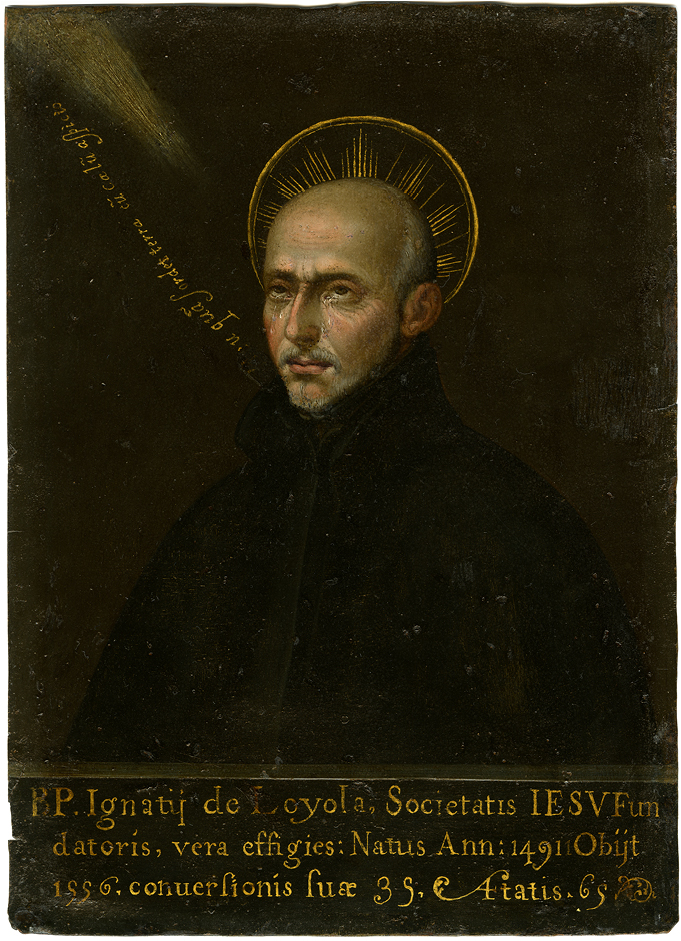
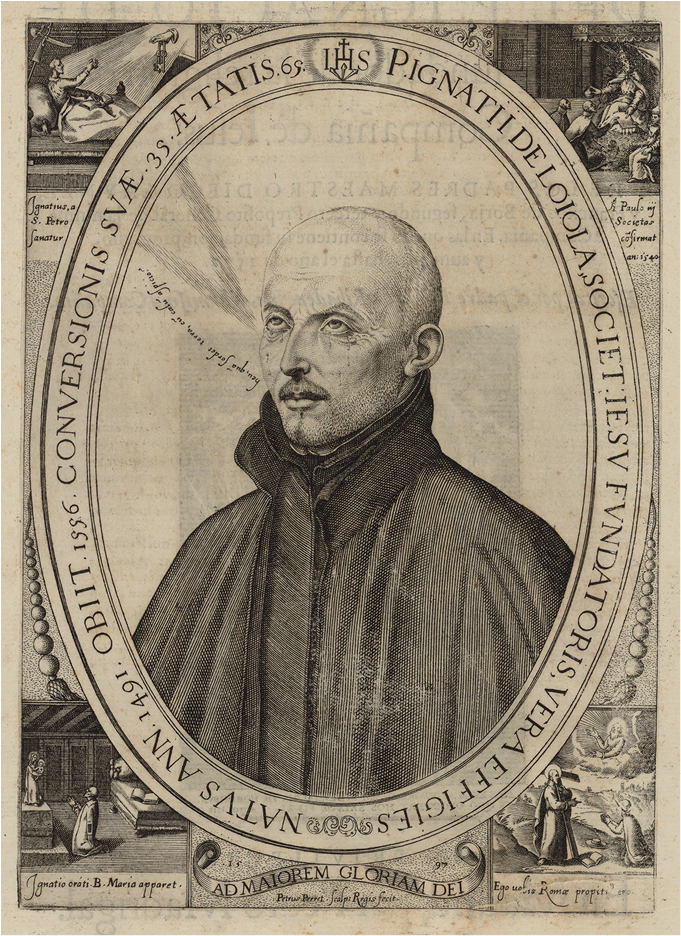
Ribadeneyra’s canonical account had an important bearing on the visual representation of Ignatius. An engraving by Jean-Baptiste Barbé (1578–1649) in the Vita beati P. Ignatii Loiolae, published in the occasion of his beatification in 1609, shows the future saint celebrating Mass in front of an altar bending slightly towards the chalice and Host (Fig. 1).17 It was then that, as the inscription states, a huge flame rose above his head. A group of worshippers, some of them Jesuits, gesture excitedly behind him gazing in wonder at the soaring flame. Although the illustrations of the Vita played a crucial role in exciting popular devotion to Ignatius, Ribadeneyra’s strong emphasis on the face (“faccia,” “volto,” “sembiante”) makes portraiture the most appropriate genre to translate his written account into a material image. The portrait of Ignatius in the Haggerty Museum of Art in Milwaukee, attributed to an unknown Spanish painter, is an instructive example (Fig. 2). The small painting (19.5 x 14 cm) was made after the likeness by Pieter Perret (c.1555–1625) in the frontispiece of the Spanish edition of Ribadeneyra’s Vita, published in 1597, which in turn was based on Alonso Sánchez Coello’s (c.1531–88) true likeness painted in close collaboration with Ribadeneyra in 1585 (Fig. 3).18 The parapet in the painting bears the same inscription as the engraving, but includes a “B[eatus],” which suggests that it was produced after 1609. The artist copied the posture and facial features of Perret’s portrait but added a circular halo around the head of Ignatius. He is depicted as a half-length figure in three-quarter view and is dressed in the black habit of the secular priest. He is shown as a contemplator of the heavens: His gaze is turned upward to the rays of light which shine down on him from the upper left corner. His eyes are rolled back and tears run down his cheeks.19 The gilded Latin words that run diagonally from his mouth toward the heavenly light is a phrase related by Ribadeneyra who heard Ignatius say “how vile and low, how nauseating and disgusting the earth seems when contemplating the heavens.”20 According to Ribadeneyra, Ignatius felt no greater delight than when beholding the beauty of the stars, a form of devotion he frequently exercised. More than reading devotional literature, it was the sight of the heavens that led him to disdain transitory things and inflamed him with the love of God (“et egli da ciò era molto più infiammato all’amor di Dio”). He remembers one occasion when he saw Ignatius standing on an open loggia beholding the heavens. After meditating for a while, his heart softened, and for the great delight he felt inside him, tears poured from his eyes.21

Jean Baptiste Barbé, “Sacram hostiam Deo dum offert, supra missam celebrantis caput, ingens emicare flamma conspicitur,” from Vita beati P. Ignatii Loiolae Societatis Iesu fundatoris (Rome, 1609), no. 69.
Citation: Journal of Jesuit Studies 9, 3 (2022) ; 10.1163/22141332-09030003
photo: courtesy of georgetown university library, the booth family center for special collectionsUnknown artist after Pedro Perret, Vera effigies of the Blessed Ignatius of Loyola, 1600–10, oil on copper, 19.5 x 14 cm, Haggerty Museum of Art, Milwaukee.
Citation: Journal of Jesuit Studies 9, 3 (2022) ; 10.1163/22141332-09030003
photo: courtesy of haggerty museum of art, milwaukeePedro Perret, Vera effigies of Ignatius of Loyola, from Pietro Ribadeneira, Vida del P. Ignacio de Loyola (Madrid, 1594), bav, Stamp. Barb. U.vi.9 (int. I). © 2022 Biblioteca Apostolica Vaticana
Citation: Journal of Jesuit Studies 9, 3 (2022) ; 10.1163/22141332-09030003
photo: courtesy of biblioteca apostolica vaticana, all rights reservedAs this episode suggests, Ignatius was famous for his gift of tears (donum lacrimarum) and for weeping frequently during prayer and Mass.22 The painter has used subtle shadows, reflections, and highlights, which bring the flow of tears vividly to life. To emphasize their holy character, he does not portray Ignatius with the distinctive physical signs of weeping, such as an open mouth and screwed-up eyes, but with a serene and undistorted countenance typical for the visual representation of saints.23 Nevertheless, his frequent weeping has left deep traces that are evident when the smooth forehead is compared with the furrowed area under the eyes.24 It is no surprise that tears were an integral part of the devotional life of prominent Jesuits such as Francis Xavier (1506–52), Stanisław Kostka (1550–68), and Luigi Gonzaga (1568–91) as well as of other Beati e santi moderni such as John of the Cross (1542–91) and Teresa of Ávila (1515–82). In the Christian tradition, tears were considered a visible sign of an inner visionary experience, a spiritual consolation, and the workings of divine grace on the soul.25 In the case of Ignatius, they indicate sanctity, but can also be understood as a physiological manifestation of his fiery essence. In his treatise on tears The Mourning of the Dove, or the Value of Tears, published in 1617, the Jesuit Cardinal Robert Bellarmine (1542–1621) might have been alluding to Ignatius, “noble example of the weeping founder,” when citing the words of Gregory the Great that those free of carnal vices “are ignited by the flame of love through tears of remorse and through beholding with the eyes of the heart the rewards of heavenly paradise.”26
In addition to the depiction of holy tears, the artist painted Ignatius blushing, reddening parts of the face, including the nose, right check, left ear, the area above the eyebrows, and the forehead, to underline his fiery nature.27 In classical antiquity, a reddish appearance usually denoted heroes and deities, often in combination with golden hair and a luminous aura that was subsequently transformed into the Christian halo.28 With a more mimetic rendering of the natural world in the Renaissance, the use of gold as the traditional painterly means to express divine light was gradually abandoned. Instead, artists had to find new conventions, and turned to red, the color of fire, to distinguish divine from natural light.29 The use of red as a cipher of the divine was particularly prompted when the text spoke of a resemblance to fire. This is the case with Ignatius where the connection between light, fire, and a reddish complexion is made explicit in Ribadeneyra’s descriptions of his countenance (“rosseggiante fuoco”). An unusual, but all the more revealing assertion was made by Eleutherius Pontanus (1527–1611), rector of the Jesuit college in Tournai. He said that the glow on Ignatius’s face and his reddish appearance may seem artificial, as if Ignatius had anointed his face and rubbed it with red paint.30 If we accept the hypothesis that this portrait was the work of a Spanish painter—and the use of Perret’s engraving as a pictorial template is a strong argument in favor of this attribution—the artist might well have known the Saint John triptych by Rogier van der Weyden (c.1399–1464), then most likely in a Carthusian monastery near Burgos, in which God the Father is painted using only different hues of red.31 Maybe he was familiar with works of Hieronymus Bosch (c.1450–1516) who often alluded to the divine nature by representing Christ and the saints with reddish complexions. His Garden of Earthly Delights, for example, had been brought to Spain in 1568 and acquired by Philip ii in 1591.32
The use of color made painting a perfect medium to render Ignatius’s fiery essence, both in details, as the vivid depiction of tears, as well as in the overall luminous qualities of the portrait. In the frontispiece, the contours of Ignatius’s black habit are clearly outlined and reinforced by dense cross-hatching, while his face shows no particular radiance as it shares the same tonal quality as the paper. The Haggerty portrait inverts this effect: the black habit is hard to discern at first glance, as it blends into the dark background. In contrast to Jacopino del Conte’s (c.1515–98) true likeness realized shortly after the death of Ignatius in 1556, the artist in this case depicts Ignatius not with a white, but with a black turned-up collar that covers almost all of his neck and completely surrounds the face with darkness. His head appears to be levitating like a disembodied vision in an undetermined space. The strong chiaroscuro highlights his glowing flesh and creates the impression of his face shining forth in the darkness.
Oil as a binding medium, which became standard in early modern paintings, contributed significantly to the luminous quality of the work, which is why Giorgio Vasari (1511–74) praised it for igniting the colors (“accende più i colori”) and by itself making them so brilliant (“accendeva il colore tanto forte”) as to give them luster (“lustro”) without requiring the use of varnish.33 An oil-based binding medium has a higher refractive index than traditional egg tempera, that makes it reflect more light and gives the paintings a shiny glazed appearance.34 This visual impression is created by the way the light interacts with the material. In contrast to an opaque medium which reflects light directly off the surface or to a transparent medium through which light passes unscattered, oil is a translucent medium in which subsurface scattering occurs: when light strikes an oil painting, it gets partially reflected, partially absorbed and internally scattered before exiting in a different direction.35
The painting’s radiance was considerably amplified when artists used copper as the support. Allegedly invented by the Venetian Sebastiano del Piombo (c.1485–1547), painting on copper became a common practice around 1600, particularly adopted by Northern artists living in Italy. The smooth, clean surface allowed for delicate brushwork and a high degree of detail, which is why they were frequently used for small cabinet pictures and miniature portraits.36 More importantly however, the material properties of copper mean that when it is used as support in combination with oil paint, this generates extraordinarily brilliant pictorial effects. The fact that the Benedictine Theophilus Presbyter (c.1070–1125) long before had referred to using oil when painting on polished metal foil, testifies to an awareness of the specific optical properties of the materials, both paint and support. In the Schedula diversarum artium (c.1100), Theophilus advised artists how to produce a “pictura translucida” (translucent painting). They should use tinfoil without any coating and carefully polish it. He stressed that the colors must be ground with linseed oil and applied to the foil only after having been considerably thinned down.37 Painting conservator Isabel Horovits has pointed out that the polish and smoothness of copper supports were still of major interest in the early modern literature on the arts: the French critic Jean-Henry de La Fontaine speaks of “well-polished copper,” the Spanish writer Antonio Palomino (1653–1726) suggests that the artist should “leave the surface very polished and even” and Robert Dossie (1717–77), an English chemist with a strong interest in the arts, advised artists that when a copper plate is prepared with flake white and fat oil, it will “polish itself very highly.”38 These preparations were necessary as increased metallic reflectivity reinforces the subsurface scattering by causing further refractions and inter-reflections of light. This makes the paintings appear to be illuminated from the inside. If the support was additionally primed with a silver-colored metallic coating, often white lead, artists could produce an extraordinary luminosity and a dazzling jewel-like tonal quality. The metallic brightness intensified the clarity and brilliance of colors creating radiant paintings that were as glossy as enamels.39 But even without a metallic coating, the polish and radiance made them easily recognizable, as the Bolognese painter and writer Carlo Cesare Malvasia (1616–93) said of Guido Reni’s (1575–1642) paintings on copper (“facilmente si riconoscono”).40 Unfortunately, no photographic reproduction can ever adequately render the unusual luminous qualities of the portrait and of paintings on copper in general. Their vibrant optics depend very much on natural light and the viewer’s sensory experience.41
Supernatural Splendor and the (Meta)physics of Light
The miniature painting of Ignatius (6.8 x 8.5 cm) in the rooms of the regional superior in Antwerp is likewise unattributed, but a note attached to the back indicates that it was part of the Roman-Belgian portrait project initiated by Superior General Claudio Acquaviva (1543–1615) and Olivier Mannaerts (1523–1614) between 1598 and 1602 (Fig. 4).42 Dissatisfied with both del Conte’s Italian portrait and Sánchez Coello’s Spanish image, they wanted to produce a more accurate likeness which Pierre-Antoine Fabre has defined as a “Flemish invention.”43 Mannaerts was superior provincial of Belgium and a former companion of Ignatius who had appointed him rector of the Roman College in 1553.44 As one of the few Jesuits still alive who had had personal contact with the founder, he must have been considered an authority in the discussion of the true likeness. The small oval portrait shows Ignatius in a three-quarter view against a yellow-greenish background that gradually darkens towards the edges. He is again depicted in a black habit without a biretta which emphasizes his broad forehead with his sparse, cropped hair. Ignatius, who has a fiery red complexion, seems to know that he is being looked at, but keeps his eyes averted. His faintly puckered brows, his gentle glance, his aquiline nose, and the slightly upturned corners of his mouth correspond to Ribadeneyra’s description of his face as “cheerfully grave and gravely cheerful.”45 There is no inscription that identifies him as saint or blessed. The radiant halo around his head, realized by irregular long brushstrokes is the only sign of sainthood. The fact that the Antwerp portrait is a far less narrative representation of Ignatius than the work in the Haggerty Museum of Art, makes the painting’s brilliance a decisive factor in the generation of meaning. All the more so, since the artist did not include any heavenly or artificial light, the production of the luminous qualities of the portrait is unmistakable: the source of light and the person depicted are one and the same. It is Ignatius who emanates light from within himself.
Unknown artist, Vera effigies of Ignatius of Loyola, ca. 1600, oil on copper, 6.8 x 8.5 cm, Office of the Regional Superior, Antwerp.
Citation: Journal of Jesuit Studies 9, 3 (2022) ; 10.1163/22141332-09030003
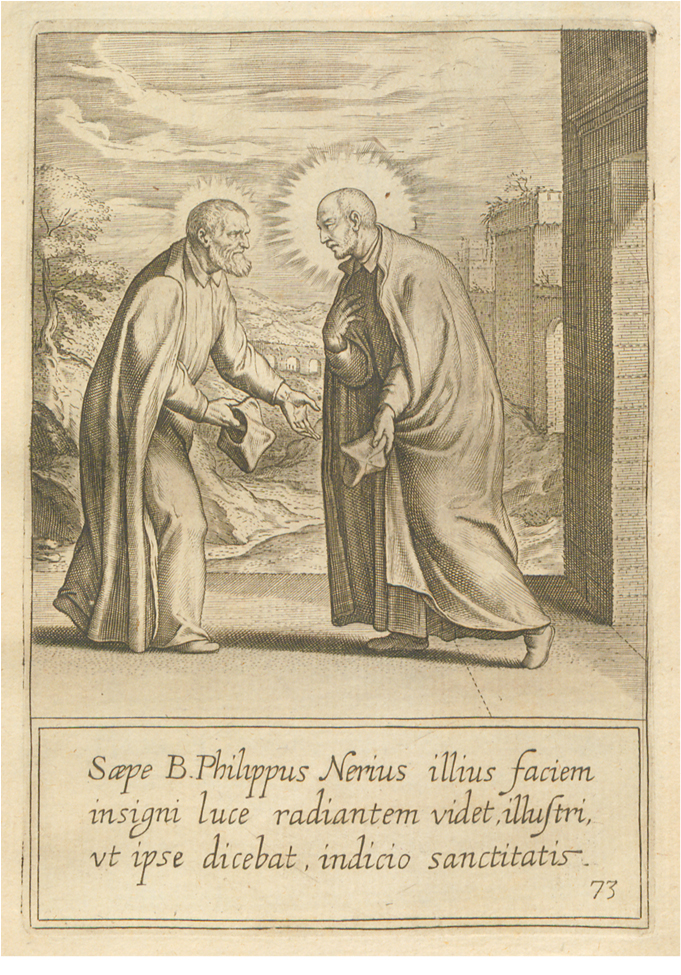
photo: courtesy of jezuïten vlaanderen en nederland, antwerpenThere are frequent reports around 1600 of an encounter between Ignatius of Loyola and Filippo Neri (1515–95), the founder of the Congregation of the Oratory, during which the latter discerned a miraculous radiance on the face of the Jesuit. This story is not found in Ribadeneyra’s Vita and was only included in his 1601 Flos sanctorum. However, it was illustrated in the 1609 Vita beati P. Ignatii Loiolae (Fig. 5).46 The engraving shows the encounter of the two future saints outside the city gate of Rome. Ignatius’s resplendent face is surrounded by a large halo by which Neri recognizes his saintly virtues.47 Given Neri’s spiritual authority—unlike Ignatius the fame of his sanctity had been constituted immediately after his death—it is no surprise that his testimony became an important argument in the Jesuit’s canonization campaign. The Oratorian Antonio Gallonio (1556–1605), among many others, affirmed that Neri had seen the face of Ignatius emanating rays of light (“raggi di splendore”).48 Significantly, Mannaerts received an account from Neri himself who told him in the presence of Superior General Mutius Vitelleschi (1563–1645) that he had noticed a certain supernatural brilliance (“splendor supranaturalis”) on the face of their founder which painting cannot fully render.49 Nevertheless, the visual representation of splendor was of particular importance for Mannaerts. When discussing various types of portraits, he preferred the depiction of Ignatius with a halo instead of a biretta. In a letter to Acquaviva dated December 1600, he compared the founder’s complexion to a beautifully colored grain of wheat, explaining that the same color was mixed with a certain supernatural splendor that delighted everyone who looked at him.50 Although Mannaerts commented on the mimetic restrictions of painting, he must have been aware that the optics of painting on copper was eminently suitable for rendering Ignatius’s fiery nature and for producing a more luminous likeness.
Jean Baptiste Barbé, “Saepe B. Philippus Nerius illius faciem insigni luce radiantem videt, illustri ut ipse dicebat, indicio sanctitatis,” from Vita beati P. Ignatii Loiolae Societatis Iesu fundatoris (Rome, 1609), no. 73.
Citation: Journal of Jesuit Studies 9, 3 (2022) ; 10.1163/22141332-09030003
photo: courtesy of georgetown university library, the booth family center for special collectionsWhile the Haggerty portrait represents Ignatius’s fiery nature in a physiological and emotional dramaturgy which is echoed by the strong chiaroscuro, the Antwerp portrait is characterized by a soft, warm and diffuse light that corresponds to Ignatius’s tender smile.51 In light of the scholastic act-habit distinction, both portraits can be considered as expressions of Ignatius’s fiery nature. Traditionally ‘habit’ refers to an innate, acquired, or divinely infused ability, whereas ‘act’ defines its exteriorization.52 Ribadeneyra’s account demonstrates that the visible manifestations of fire were in fact the consequence of actively performed devotional practices, in particular prayer and meditation through which Ignatius kindled the fire of divine love inside himself. In contrast, Neri’s encounter with Ignatius did not take place in a devotional or liturgical context. Significantly, Galloni stated that no one except Neri perceived Ignatius’s miraculous radiance. Neri’s holiness, which he shared with the Jesuit, is the reason why he was the only one privileged to recognize Ignatius’s fiery nature in a mere habitual state.53
By manipulating the transitory effects of real light to achieve a luminous permanence, the reflective quality of the metallic supports enhances the gloss of oil paint and increases the brightness of the diffused light to make it more brilliant and glowing. Medieval and baroque artists used mosaics, stained glass windows, and paintings on gold ground, or gilded stucco decoration for the production and representation of light. Painting on copper is a slightly different, more sophisticated case, as the metallic support is completely covered with paint and invisible to the beholder. The enigmatic, almost “magical” production of light was an important way to reproduce the sacred manifestations of light described by Ribadeneyra and contemporaries (“fulgore della sua faccia,” “calore lampeggiando,” “splendor supernaturalis,” “raggi di splendore”).
It would be historically inaccurate to understand the concentration of light as either physical light or simply a metaphor of the divine. As art historians Fabio Barry and Frank Fehrenbach have pointed out in the context of Baroque art and architecture, the early modern physics and metaphysics of light were closely intertwined.54 Augustine, who marks the beginning of the Christian metaphysics of light, transformed the Neoplatonic doctrine through biblical exegesis and distinguished between uncreated light and created light.55 Uncreated light, lux, is God in His essential nature, while all other light, spiritual and natural, was defined as created light, lumen, and considered to be a reflection of the original, divine light. Scholastic philosophers like Robert Grosseteste (c.1168–1253) and Albert the Great (c.1200–80) refined this interpretation into an emanative theory of creation with God at the top of the hierarchy, and with all created things as reflections or concretions of light descending from him.56
Considering the period in which the portraits were produced, I suggest to examine them against the background of Francesco Patrizi da Cherso’s (1529–97) Nova de universis philosophia, published in 1591, in which light plays a fundamental role as basic principle to ascend to the first cause (“per lucem, et lumina, ad primam causam ascenditur”).57 Patrizi was heavily influenced by Plato (c.428–c.348 bce) and his Renaissance followers, but his philosophy as a whole was most original. Although characterized by strong anti-Aristotelian sentiment, Patrizi’s ideas exerted an important influence on Jesuit thought.58 In the first part of the book, entitled Panaugia (All-splendor), Patrizi deals with the physical and metaphysical properties of light. He follows the established usage of lux and lumen that were connected with each other by rays (radii) which originate from the source and permeate the observable world. Patrizi defines light as an image of God himself and of his goodness (“Dei ipsius, eiusque bonitatis est imago”).59 God is the ultimate source of all light from which emanates lumen, first to be found in His Son and in incorporeal creatures, like angels. But God is also the ultimate source for the physical light in the world. According to Patrizi, the threefold division of perceptible light—the life-giving sun as lux, luminosity as lumen, and the rays as ignis—is a perfect analogy of the triadic nature of God with God as lux, His Son as lumen, and the Holy Spirit as calor and ignis.60 In contrast to Augustine who considered light to be the most ethereal material that comes closest to the soul, Patrizi describes rays of light as a liminal substance which is both incorporeal and corporeal, spiritual and material.61 Physical light, being a product of the emanistic creation, acts as an intermediary that links the physical senses to the realm of the immaterial and performs a unifying function.62 The connection of light with fire in Patrizi’s discussion was certainly an ideal way to promote Ignatius’s fiery essence. In the last part of his book, entitled Pancosmias (All-Cosmos), Patrizi’s point of departure is Scripture which describes God in terms of both light and fire. Pointing to their physical manifestation and incorporeal origin, he argues that light and fire are closely related to each other. Although lux produces lumen and fire generates heat, which are different sense phenomena, there is no light without fire nor fire without light. Fire, then, is warm light and light is shiny heat (“Ignis est lux calida. Lux est calor lucidus”).63 As there is nothing more effective than fire, nothing more vivifying than heat, nothing brighter than lux, nothing more pleasing than lumen, light and fire are exquisite names (“illustroria nomina”) to denote God. This is particularly true for fire which is, as Patrizi states, by itself, which shines in itself, which spreads out light from itself, and which fills everything with life-giving heat.64
The two portraits painted on copper can be considered sophisticated allegories of light and fire which present, reproduce, and negotiate Ignatius of Loyola’s resplendent nature as it was handed down by Ribadeneyra and contemporaries. The production and amplification of light by means of the metallic support helped to establish and perpetuate Ignatius’s fiery and luminous essence throughout the seventeenth century. It is no coincidence that the Ignatius-ignis tradition still played a key role in the decoration of the most important Jesuit cult site, the tomb of Ignatius of Loyola in the church of the Gesù. Pierre Legros’s (1666–1719) over-life-sized statue of Ignatius in the niche of Pozzo’s monumental altar was made of silver, a material which reflects better than any other metal. Its clear brilliance was originally reinforced by mirrors that reflected the light from a hidden window behind the head.65 Similarly, the “materialized light” of the portraits represents Ignatius’s inner likeness to the divine. The portraits are reflections of lux, their radiance mirrors the purity of his soul, and, most importantly, indicate sanctity. In particular, the yellow-golden halos, whose material color value matches the immaterial light value, reflect Patrizi da Cherso’s views of the in/corporeal character of light and constitutes a unity of transcendence and immanence. As an intermediary between the material and spiritual realm, light also establishes a unity between the painting and the beholder. The portraits of Ignatius emanate what Patrizi calls God’s vivifying fire (“ignis vitifer, et vitam ferens”).66 In affecting the soul, light procures a spiritual transformation that should prompt the viewer to imitate the virtuous example. Ignatius functioned both as a shining mirror which reflects the fire of divine love inside him and a burning mirror who enflamed others with his fire.
Ignatius Querck, Acta S. Ignatii de Lojola Societatis Jesu Fundatoris (Vienna: Leopold Voigt, 1698), 100: “Fire you are, fire you were, and for all eternity, Ignatius, fire you will be. Such is the name, the deeds prove so.” Unless otherwise indicated, all translations are my own.
I have consulted the 1586 Italian edition: Pedro Ribadeneira, Vita del P. Ignatio Loiola: Fondatore della Compagnia di Giesù (Venice: Giovanni Giolito, 1586), A’ li cariss. Fratelli in Christo della Compagnia di Giesv, not paginated.
Examples can be found in Paolo Aresi, Delle sacre imprese (Tortona: Pietro Giovanni Calenzano, 1630) 4/ii:1378; in the Imago primi saeculi Societatis Iesu (Antwerp: Plantin-Moretus, 1640), 718; and in Carlo Bovio, Ignatius insignium epigrammatum (Rome: Lazeris, 1655), Insigne xlviii and lxxxiv.
Evonne Levy, Propaganda and the Jesuit Baroque (Berkeley: University of California Press, 2004), 155–56; Steffen Zierholz, Räume der Reform: Kunst und Lebenskunst der Jesuiten in Rom 1580–1700 (Berlin: Mann, 2019), 169–72.
Anonymous, Pyrotechnica Loyolana: Ignatian Fire-works, or the Fiery Jesuits temper and behaviour being an historical compendium of the rise, increase, doctrines, and deeds of the Jesuits (London: G.E.C.T., 1667).
Ignatius adopted his Latin name when studying in Paris, even though it was not etymologically related to his Basque birth name Íñigo, Hugo Rahner, “Inigo und Ignatius,” in Hugo Rahner, Ignatius als Mensch und Theologe (Freiburg: Herder, 1964), 31–42; Gabriel Maria Verd, “De Iñigo a Ignacio: El cambio de nombre en San Ignacio de Loyola,” ahsi 60 (1991): 113–60. On the rich documentary evidence of the Ignatius-ignis pun, see Christian Hecht, “Der ‘Concetto’ von Andrea Pozzos Langhausfresko in S. Ignazio,” in Andrea Pozzo (1642–1709): Der Maler-Architekt und die Räume der Jesuiten, ed. Herbert Karner (Vienna: Verlag der Österreichischen Akademie der Wissenschaften, 2012), 37–43.
Ignatius was canonized in 1622 together with Francis Xavier, Philip Neri, Teresa of Ávila, and Isidore the Laborer. On Post-Tridentine models of sanctity, see Ronnie Po-chia Hsia, The World of Catholic Renewal, 1540–1770 (Cambridge: Cambridge University Press, 2005), 127–43; Simon Ditchfield, “Tridentine Worship and the Cult of Saints,” In The Cambridge History of Christianity, vol. vi: Reform and Expansion 1500–1660, ed. Ronnie Po-chia Hsia (Cambridge: Cambridge University Press, 2007), 201–24 and 640–43.
John W. O’Malley, Constructing a Saint through Images: The 1609 Illustrated Biography of Ignatius of Loyola (Philadelphia: Saint Joseph’s University Press, 2008); Steffen Zierholz, “Ignatius of Loyola as a Normative Image,” in Sacred Images and Normativity: Contested Forms in Early Modern Art, ed. Chiara Franceschini (Brepols: Turnhout, 2022), 138–53; on the use of images in a Jesuit context, Ralph Dekoninck, Ad imaginem: Status, fonctions et usages de l’image dans la littérature spirituelle jésuite du xvii e siècle (Geneva: Droz, 2005) and Walter S. Melion, “Introduction: The Jesuit Engagement with the Status and Functions of the Visual Image,” in Jesuit Image Theory, ed. Wietse de Boer, Karl A. E. Enenkel, and Walter S. Melion (Leiden: Brill, 2016), 1–49.
Ursula König-Nordhoff, Ignatius von Loyola: Studien zur Entwicklung einer neuen Heiligen-Ikonographie im Rahmen einer Kanonisationskampagne um 1600 (Berlin: Mann, 1982); Nina Niedermeier, Die ersten Bildnisse von Heiligen in der Frühen Neuzeit: Porträtähnlichkeit in nachtridentinischer Zeit (Regensburg: Schnell & Steiner, 2020); with an emphasis on the fifteenth century, Urte Krass, Nah zum Leichnam: Bilder neuer Heiliger im Quattrocento (Berlin: Deutscher Kunstverlag, 2012).
Thomas Raff, Die Sprache der Materialien: Anleitung zu einer Ikonologie der Werkstoffe (Münster: Waxmann, 2008); Monika Wagner, Das Material der Kunst: Eine andere Geschichte der Moderne (Munich: Beck, 2001); Ann-Sophie Lehmann, Frits Scholten, and Perry H. Chapman, eds., Meaning in Materials 1400–1800 (Leiden: Brill, 2014); further literature includes: Christy Anderson, Anne Dunlop, and Pamela H. Smith, eds., The Matter of Art: Materials, Practices, Cultural Logics, c. 1250–1750 (Manchester: Manchester University Press, 2015); Caroline W. Bynum, Christian Materiality: An Essay on Religion in Late Medieval Europe (New York: Zone Books, 2001); on the non-figurative surface texture as a semantic device, see Steffen Zierholz, “The Subiconographic Surface: Two Temptations of Saint Anthony Painted on Stone,” Art Bulletin 103, no. 4 (2021): 36–60.
Helen Hills, The Matter of Miracles: Neapolitan Baroque Architecture and Sanctity (Manchester: Manchester University Press, 2016), 4.
Ribadeneira, Vita. The Missale Romanum was to assign this verse to the proper of July 31, the feast day of Saint Ignatius, and Jesuit exegetical writings subsequently relate it to him. In his commentary on Luke 12,49, the Jesuit Cornelius a Lapide (1567–1637) links the fire of divine love to the apostles, who, enflamed by it, set out to evangelize the world, to the Jesuits who suffered martyrdom by fire in Japan, and finally to Ignatius himself, The Great Commentary of Cornelius à Lapide, 4:319–24.
Ribadeneira, Vita, following the “tavola d’alcune cose piv notabili,” not paginated: “Tu, Che nome di Foco in Terra hauesti, / E di Foco Diuino il cor ripieno, / Tu, che di gir al Cielo mostrasti à pieno / La certa via con fermi vanni, e presti; // A’me, ch’hor tento più rari gesti / Spiegar in carte, il desir non vien meno; / Ma temo, perche stil fosco terreno / Ritrar non può chiare Virtù Celesti // Hor poi ch’in Ciel ti specchi entro à quel Foco, / Ch’ad ogni foco vile il varco serra, / En tre Lumi contempli un Lume solo; // Che se ne vibri un raggio in me, t’inuoco, / Che d’ogn’affetto human mì purghi in Terra, / Sì che teco inalzar mi possa à volo.”
Ribadeneira, Vita, 25: “quando l’udivano ragionare, restavano da una parte ripieni di maraviglia, e dall’altra infiammati ed accesi per quelle bontà, che in lui scoprivano […] era però l’anima sua cosi accesa nel fuoco del divino amore, che non poteva fare si, che non ne evaporassero le sue fiamme, e scintillassero gli splendori.”
Ribadeneira, Vita, 186–87: “percioche mi ricordo d’udir in quel tempo predicar Ignatio con tanta forza, e con tanto fervor di spirito, che pareva, ch’in tal modo acceso fusse dal fuoco della Carità, che lanciasse come fiammi ardenti ne’petti degli ascoltatori. Di maniera che ancora tacendo pareva, ch’il sembiante suo infiammasse gli uditori, e che il fulgore della sua faccia gli rendesse molli, e licquefacesse con l’amor Divino.”
Ribadeneira, Vita, 454: “ed ivi di tal maniera s’infiammava, che anco esteriormente nel volto, il calore lampeggiando si dimostrava, e tutta la faccia (come molte fiate avertimmo) pareva che avampasse, e divenisse aspersa di rosseggiante fuoco.”
It was republished in 1622 with an additional engraving of the canonization ceremony, Vita beati P. Ignatii Loiolae, Societatis Iesu fundatoris (Rome, 1622), no. 69.
On Perret’s engraving, see Niedermeier, Ersten Bildnisse, 239; Claudia Gerken, Entstehung und Funktion von Heiligenbildern im nachtridentinischen Italien (1588–1622) (Petersberg: Imhof, 2015), 34; König-Nordhoff, Ignatius von Loyola, 58–60; Rafael de Hornedo, “La ‘vera effigies’ de San Ignacio,” Razón y fe 154 (1956): 203–24, here 216.
On the history of the pictorial motif, see Andreas Henning, Gregor J. M. Weber, eds., ‘Der himmelnde Blick’: Zur Geschichte eines Bildmotivs von Raffael bis Rotari (Emsdetten: Edition Imorde, 1998); on the epistemological implications of the trope in an early modern religious and philosophical context, see Steffen Zierholz, “Galileo contemplator caeli: Justus Sustermans’s Florentine Portrait of Galileo Galilei Reconsidered,” res: Anthropology and Aesthetics 75/76 (2021), forthcoming.
Ribadeneira, Vita, 15.
Ribadeneira, Vita, 14–15.
His Spiritual Diary, of which only fragments survive, is full of tears. When he started to keep it, he noted down many details of his interior life, but the last months are almost exclusively a “register of tears,” where the only information is whether he did or did not weep during prayer, Michael Plattig, “Vom Trost der Tränen,” Studies in Spirituality 2 (1992): 148–99, here 175; Christoph Benke, Die Gabe der Tränen: Zur Tradition und Theologie eines vergessenen Kapitels der Glaubensgeschichte (Würzburg: Echter, 2002), 285–99; Orsolya Száraz, “Tears and Weeping on Jesuit Missions in Seventeenth Century Italy,” ahsi 86 (2017): 7–47.
Moshe Barash, “The Crying Face,” Artibus et historiae 8, no. 15 (1987): 21–36, here 36.
This juxtaposition was also described by Ribadeneira, Vita, 444: “Haveva la faccia maestevole, la fronte spatiosa, e piana, gli occhi incavati, le palpebre contratte, e di rughe ripiene, per le molte lagrime, che di continuo spargeva.”
Tom Lutz, Crying: The Natural and Cultural History of Tears (New York: Norton & Norton, 1999), 31–66; Joseph Imorde, “Tasting God: The Sweetness of Crying in the Counter-Reformation,” in Religion and the Senses in Early Modern Europe, ed. Christine Göttler and Wietse de Boer (Leiden: Brill, 2012), 257–69, In the rules of discernment, Ignatius mentioned tears as an important sign of spiritual consolation, Ignatius of Loyola, Spiritual Exercises, ed. George E. Ganss (St. Louis, MO: Institute of Jesuit Sources, 1992), 122.
Roberto Bellarmino, Del gemito della colomba ovvero della utilità delle lagrime (Rome: Bartolomeo Zannetti, 1617), 7–8 and 609. In his treatise De gli heroici furori, published in 1585, Giordano Bruno describes an emblem that shows a flame under a skull made of bronze and dense smoke protruding out of the holes. According to Bruno’s physiological interpretation, the emblem represents the heart of the passionate which is kindled by the amorous flame. Thus, the vital substances partially glow with fire, partially boil in the form of tearful weeping, and are partially expelled in heavy sighs that enflame the air, see Giordano Bruno, Von den heroischen Leidenschaften, ed. and trans. Christiane Bacmeister (Hamburg: Meiner, 1989), 85–86.
The Haggerty portrait is no exception, Rubens also painted Ignatius with slightly reddened cheeks, in a work formerly in the Gesù in Rome, now in the Norton Simon Museum, Pasadena. In addition, he mirrored Ignatius’s fiery and luminous nature in the striking brocaded red-golden chasuble, see König-Nordhoff, Ignatius von Loyola, 80–87.
See Plutarch’s description of Alexander the Great, Plutarch, The Parallel Lives, 11 vols. (London: Heinemann, 1919), 7:223–33: “Whereas he [Alexander] was of a fair colour, as they say, and his fairness passed into ruddiness on his breast particularly, and in his face.”
Patrik Reuterswärd, “What Color is Divine Light?,” in Patrik Reuterswärd, The Visible and Invisible in Art: Essays in the History of Art (Vienna: irsa, 1991), 143–56.
Niedermeier, Ersten Bildnisse, 312.
On the Spanish provenance of the triptych, see Dirk de Vos, Rogier van der Weyden: The Complete Works (New York, 1999), 228.
Pilar Silva Maroto “Bosch in Spain: On the Works Recorded in the Royal Inventories,” in Hieronymus Bosch: New Insights into His Life and Work, ed. Jos Koldeweij, Bernard Vermet, and Barbera van Kooij (Rotterdam, 2001), 41–48; Reuterswärd, “What Color is Divine Light?,” 152. Nevertheless, the use of red was not limited to Spain, or Northern art, but was also to be found in Italy. Regarding Paris Bordone’s blushing female figures, Frank Fehrenbach has recently emphasized both gender-specific physiological processes and the etymological connection between robur (strength) and rubor (ruddiness), Frank Fehrenbach, Quasi vivo: Lebendigkeit in der italienischen Kunst der Frühen Neuzeit (Berlin: De Gruyter, 2021), esp. 288–99.
Vasari, Lives, 3:60 (Life of Antonello da Messina).
Catherine Higgitt and Raymond White, “Analyses of Paint Media: New Studies of Italian Paintings of the Fifteenth and Sixteenth Century,” National Gallery Technical Bulletin 26 (2005): 88–97, here 89 and Roy S. Berns and René de la Rie, “The Effect of the Refractive Index of a Varnish on the Appearance of Oil Paintings,” Studies in Conservation 48, no. 4 (2003): 251–62.
W. Stanley Tuft Jr. and James W. Mayer, “Optics of Paint Film,” in The Science of Paintings, ed. W. Stanley Tuft Jr. and James W Mayer (New York: Springer, 2000), 66–75.
Edgar Peter Bowron, “A Brief History of European Oil Paintings on Copper, 1560–1775,” in Copper as Canvas: Two Centuries of Masterpiece Paintings on Copper, 1575–1775, ed. Michael Komanecky (New York: Oxford University Press, 1999), 9–31, here 14. Nadia Baadj-Groeneveld, “Painting on Stone and Metal: Material Meaning and Innovation in Early Modern Northern European Art,” in Almost Eternal: Painting on Stone and Material Innovation in Early Modern Europe, ed. Piers Baker-Bates and Elena Calvillo (Leiden: Brill, 2018), 248–69.
Theophilus, The Various Arts, ed. C. R. Dodwell (Oxford: Clarendon Press, 1986), 25. This passage has been analyzed by Marjolijn Bol, “Seeing Through the Paint: The Dissemination of Technical Terminology between Three Métiers. Pictura translucida, Enameling and Glass Painting,” in Zwischen Kunsthandwerk und Kunst: Die “Schedula diversarum artium,” ed. Andreas Speer (Berlin: De Gruyter, 2014), 145–62, here 147–48.
Antonio Palomino, “El Museo pictórico y la escala óptica,” in Zahira Veliz, Artists’ Techniques in Golden Age Spain: 6 Treatises in Translation (Cambridge: Cambridge University Press, 1986), chap i. and vi, see also Francisco Pacheco, “Arte de la Pintura,” in Veliz, Artists’ Techniques, 69; Isabel Horovits, “The Materials and Techniques of European Paintings on Copper Supports,” in Copper as Canvas, 63–93, here 69.
Horovits, “The Materials and Techniques,” 68.
Carlo Cesare Malvasia, Felsina Pittrice, 2 vols. (Bologna: Domenico Barbieri, 1678), 2:5.
Curator Judith Mann has recently pointed out that of Giuseppe Cesari’s (1568–1640) various depictions of Perseus rescuing Andromeda on slate, lapis lazuli, wood panel, and canvas, the version painted on copper stands out giving “a more luminous quality to the painted surface.” Judith W. Mann, ed. Paintings on Stone: Science and the Sacred, 1530–1800 (Munich: Hirmer, 2020), 138–45, here 140. Concerning our case studies, there are no art-technological analyses that can provide us with information about possible preparatory layers the artists had employed.
Niedermeier, Ersten Bildnisse, 67–69, 201.
Pierre-Antoine Fabre, “Les voies d’une canonisation: Écriture, portrait et récit de vie dans l’invention flamande de Saint Ignace de Loyola,” in Confessional Sanctity (c. 1500–c. 1800), ed. Jürgen Beyer, Albrecht Burkardt, Fred van Lieburg, and Marc Wingens (Mainz: von Zabern, 2003), 135–48; Ralph Dekoninck, “The Founding of a Jesuit Imagery: Between Theory and Practice, Between Rome and Antwerp,” in The Acquaviva Project: Claudio Acquaviva’s Generalate (1581–1615) and the Emergence of Modern Catholicism, ed. Pierre-Antoine Fabre and Flavio Rurale (Chestnut Hill, MA: Institute of Jesuit Sources, 2017), 331–46.
François van Ortroy, “S. Ignace de Loyola et le Père Olivier Manare,” Analecta Bollandiana 12 (1913): 278–95.
Ribadeneira, Vita, 444–45: “Il sembiante della faccia era allegramente grave, e gravemente allegro, di modo che con la serenità di lui apportava allegrezza à chiunque lo riguardava, e con la gravità edificava mirabilmente.”
Ribadeneira, Flos sanctorum, o libro de las vidas de los santos, 2 vols. (Madrid: Luis Sánchez, 1601), 2:843; Vita beati P. Ignatii Loiolae, no. 73.
Ruth S. Noyes, Peter Paul Rubens and the Counter-Reformation Crisis of the Beati Moderni (London: Routledge, 2018), 59–61.
Niedermeier, Ersten Bildnisse, 200; Gallonio’s and Giacomo Crescenzi’s testimonies are published in the mhsi, Monumenta Ignatiana Series Quarta (Madrid: Gabriel López del Horno, 1918) 2:425–26 (no. 52).
Niedermeier, Ersten Bildnisse, 201.
Niedermeier, Ersten Bildnisse, 201, 312.
Smiling was generally understood as an expression of inner or heavenly light in scholastic and Neoplatonic discourses, see Peter S. Hawkins, “All Smiles: Poetry and Theology in Dante,” Publications of the Modern Language Association of America 121 (2006): 371–82; Frank Fehrenbach, “Bernini’s Light,” Art History 28 (2005): 1–42, here 16.
On the history of the concept of habitus, see Peter Nickl, Ordnung der Gefühle: Studien zum Begriff des habitus (Hamburg: Meiner, 2001) and Vernon J. Bourke, “The Role of habitus in the Thomistic Metaphysics of Potency and Act,” in Essays in Thomism, ed. Robert E. Brennan (New York: Sheed & Ward, 1942), 101–9.
In his writings, in particular in the Living Flame of Love, written around 1585, the Spanish mystic John of the Cross compares the habitual presence of the divine with the softly and gently burning embers, while its actual working corresponds to wildly soaring flames as in an oven or a forge where fire is constantly stoked and fanned. Johannes vom Kreuz, Die lebendige Liebesflamme (Freiburg: Herder, 2013), 52 and 62n101.
Fehrenbach, “Bernini’s Light,” 1–42; Fabio Barry, “Lux & Lumen: Real and Represented Light in the Baroque Dome,” Kritische Berichte 30 (2002): 22–37; Wolfgang Schöne, Über das Licht in der Malerei (Berlin: Mann, 1954).
For a summary, see Robert Dodaro, “Light in the Thought of St. Augustine,” in Light from Light: Scientists and Theologians in Dialogue, ed. Gerald O’Collins and Mary Ann Meyers (Grand Rapids, MI: Eerdmans Publishing, 2012), 195–208.
On Grosseteste, see Iain M. MacKenzie, The ‘Obscurism’ of Light: A Study into the Theological Nature of Light (Norwich: Canterbury Press, 1996).
Francesco Patrizi da Cherso, Nova de universis philosophia. In qua aristotelica methodo non per motum, sed per lucem, et lumina, ad primam causam ascenditur (Ferrara: Benedetto Mammarello, 1591).
As Thomas Leinkauf has demonstrated, Athanasius Kircher’s theory of the three realms of light in his 1646 Ars magna lucis et umbrae closely follows Patrizi’s Neoplatonist teachings from whose Nova de universis philosophia Kircher extensively quotes, see Thomas Leinkauf, Mundus combinatus: Studien zur Struktur der barocken Universalwissenschaft am Beispiel Athanasius Kirchers SJ (1602–1680) (Berlin: Akademie-Verlag, 1993), 334–42.
Patrizi, Nova philosophia, 1v.
On Patrizi’s metaphysics of light, see Eugene E. Ryan, “The ‘Panaugia’ of Franciscus Patricius: From the Light of Experience to the First Light,” in Francesco Patrizi: Filosofo platonico nel crepuscolo del Rinascimento, ed. Patrizia Castelli (Florence: Olschki, 2002), 181–95; a good introduction to Patrizi da Cherso is Paul Oskar Kristeller, Eight Philosophers of the Italian Renaissance (Stanford: Stanford University Press, 1964), esp. 110–26.
Patrizi, Nova philosophia, 6r: “Radii ergo, et corpora, et incorporei sunt, et substantiae, et formae simplices, non quales physicae, materia ut sint egentes. Neque formae, quales divinae, penitus incorporae et immensae.”
Patrizi, Nova philosophia, 1v: “Quae sese per omnia extendit. Per omnia se fundit. Per omnia permeat. Omnia permeando format, et efficit. Omnia vivificat. Omnia continet. Omnia sustinent. Omnia congregat. Omnia unit…”
Patrizi, Nova philosophia, 76r.
Patrizi, Nova philosophia, 76r: “Qui est per se, et in se lucet, et extra se lumen spargit, et calore vitali omnia replet.”
Levy, Propaganda, 169–71.
Patrizi, Nova philosophia, 76r, 120r.