Abstract
The significance of the two founder saints to the contribution made by Jesuit missionaries, many of whom became martyrs, to the making of Roman Catholicism as a world religion, was made explicit not at the canonization ceremony itself, nor in the celebratory processions made through the streets of Rome, but in events and decorations put up within spaces controlled by the Jesuits themselves at the Gesù, the Collegio Romano, and the novitiate of S. Andrea al Quirinale. This points to the wider phenomenon, pursued in complementary fashion in the six essays that follow: that how one “became” a saint and came to enjoy a cult (then as now) has more to do with particular, local appropriation and interpretation (including Rome itself) than with official papal, universal approbation.
The ceremony in the basilica of St. Peter’s on March 12, 1622, which saw the simultaneous canonization of Ignatius Loyola (c.1491–1556), Francis Xavier (1506–52), Philip Neri (1515–95), Teresa of Ávila (1515–82), and Isidore the Farmer (c.1080–1130), has become the symbol, par excellence, of the revival of the practice of papal saint-making post-Reformation, even if this began formally in 1588 with the canonization of Diego of Alcalá (c.1400–63). This is for two reasons: one obvious, the other less so. Firstly, the ceremony of 1622 was not only the first at which so many candidates were raised to the honor of the altar at the same time, but also the occasion when no fewer than four of those made saints were directly associated, as recent founders in three cases, with new (or reformed) religious orders (in addition to the Society of Jesus, these were the Congregation of the Oratory and the Discalced Carmelites).1
The second reason, which occupies our attention in this special issue, is that the event was not only memorialized in striking (and spectacular) ways, but also—a point often overshadowed by the events of March 1622 and their immediate aftermath—that this was but part of a much wider phenomenon relating to the production and consumption of the cults of the two founder saints of the Society of Jesus both before and after the official ceremony. As the essays that follow show us, the two cults not only embraced the globe: from the Italian peninsula to the Indies; the Mariana islands to Mexico City; but also did so in striking and original ways. These called upon not only the impressive mastery of technical, artistic literary skill, and imagination but also, to borrow Markus Friedrich’s term: the “long arm” of logistical bravura for which, in this current age obsessed with information and its (mis)management, the Jesuits are now seen to have been pioneers.2
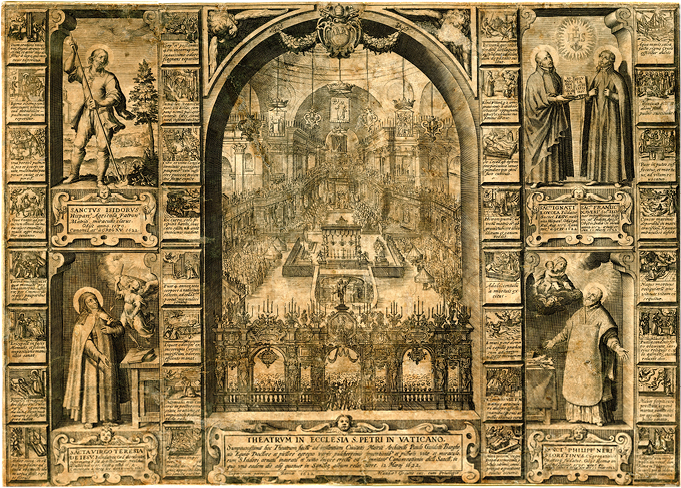
The large scale (370 x 523 cm) engraving of the ceremony was by the Strasbourg-born, former Lutheran, Matthäus Greuter (1565/66–1638), who arrived in Rome in 1603 and for which the engraver secured a papal privilege that conferred semi-official status on the image.3 Based after a drawing by Paolo Guidotti Borghese (1560–1629), who had been involved in designing the canonization theater and related decorations in the basilica, this high quality engraving, though necessarily expensive, probably circulated widely beyond the Italian peninsula and likely beyond Europe, although as is so often the case with engravings, very few copies have survived to the present day (Fig. 1).4 Such has been this image’s visual authority and influence, that despite its focus on what was essentially a kinetic ceremony and its inclusion of depictions of numerous actions in the form of miracles in cartouches surrounding each saint in their niches, it has become a static icon, apparently frozen in time. This has discouraged historians until relatively recently from paying enough attention to implications of the fact that the ceremony was itself the final outcome of what had been in every case, a painstaking, drawn out process, lasting several decades, during which time all candidates had had to undergo not only canonization but also beatification trials.5 Moreover, the celebrations themselves played out over weeks, months, and even years in places wherever the Jesuits enjoyed a presence, in Europe and beyond, notably in Mexico City as well as Goa, as scholars such as Ralph Dekoninck, Annick Delfosse, and Pamela Jones, among others, have taught us.6 In addition, there was the important role accorded to theatre in Jesuit pedagogy, an activity that provided plenty of occasions to celebrate the history of the Society.7 It is now over twenty years (2001) since Germanist Jean-Marie Valentin showed how extensively within the Holy Roman Empire theatrical events were put on in 1622 to mark the canonization of Loyola and Xavier.8 However, the essentially static understanding of the ceremony communicated by the iconicity of the Greuter print has predominated.

Matthäus Greuter after a drawing by Paolo Guidotti Borghese, Theater in St. Peter’s in the Vatican for the Canonization of Sts. Isidore, Ignatius Loyola, Francis Xavier, Philip Neri, and Teresa of Ávila on March 12, 1622. Engraving, 1622.
Citation: Journal of Jesuit Studies 9, 3 (2022) ; 10.1163/22141332-09030001
photo: archivio della congregazione dell’oratorio, rome, c.i.s., xxxvi, 4The overall composition of Grueter’s engraving calls to mind a church façade, which is perhaps unsurprising as he had already created a ceremonial decoration for the façade of St. Peter’s for Carlo Borromeo’s (1538–84) canonization in 1610.9 In this case, its vertical visual axes are defined by four figures (or strictly speaking five but with Loyola and Xavier paired), either side of the main nave, which has been opened to the viewer’s eye so that they can see through to the canonization theatre at the crossing of the basilica beyond. Ignatius Loyola and Francis Xavier, like Neri and Teresa of Ávila are depicted marginally on either side of the main scene, which showed the richly decorated theater that had been set up in the crossing of St. Peter’s to provide a setting for the inscriptions and images that celebrated the life and virtues of St. Isidore. This reflects the fact that the canonization of the four founder-saints, or beati moderni (to use the contemporary term), was added, at short notice, to the original ceremony and that the canonization theatre had already been bankrolled by no less a patron than His Most Catholic Majesty Philip iv of Spain (r.1621–60), in honor of his capital, Madrid’s new patron saint.10 Within St. Peter’s itself, high up in dome designed by Michelangelo (1475–1569) three banners attached to it seemingly float above the theater. The two Jesuits are depicted together on the left-hand banner, facing the viewer. They are shown standing next to each other, beneath the flaming sun that frames the “ihs” monogram immediately below, which are three nails referring to Christ’s passion and upon which their gaze is fixed. The other two saints are depicted, singly, on the two remaining banners) with Neri at the center, possibly in deference to his adoptive Roman status and preeminent cult in the city.11 Ignatius holds an open book facing the viewer. On the left-hand page is written the motto of the Society: “Ad maiorem Dei gloriam”; and on the right, a reference to the actualization of this informing spirit: in the form of the Society’s rule: “Regula Societatis Iesu.” Facing him, obliquely, Francis Xavier holds his cassock in both hands slightly away from his chest, which according to Pamela Jones, is to be explained by the saint’s desire to diffuse the heat generated by his heart, so full was it with his love of God and his apostolic zeal.12
The collection of contemporary accounts of the celebrations published to mark the tercentenary clearly shows that they took place not only in St. Peter’s but also in the streets of Rome as well as within Jesuit churches and buildings such as the Collegio Romano.13 The canonization of the two founding saints of the Society also provided the Jesuits with an unrivalled opportunity to celebrate the crucial role of its members in the heroic enterprise that was central to the very process of the making of Roman Catholicism as the first world religion. However, such events and displays only took place within the precincts of such Jesuit-owned buildings as their mother church of the Gesù, the nearby Collegio Romano, home to hundreds of students and novices, as well as the complex of buildings on the Quirinal hill, which actually accommodated the novitiate, centered on Sant’Andrea al Quirinale. In the Gesù itself, having passed under the decorations of the splendidly illuminated church’s façade that was dominated by four statues: one each of Loyola and Xavier together with a further two consisting of personifications of the Roman Church and of Japan, according to a contemporary description by the Jesuit temporal coadjutor Antonio Presutti (fl.1630), there were placed on display around the walls of the nave no fewer 120 portraits of Jesuits who had been killed for their faith on the missions.14 The façade, roof and cupola, and the interior of the Gesù were lit with more than two thousand expensive wax candles (each weighing several pounds). The impact of such a display on the senses was reinforced by the regular letting off of fireworks and by the background noise of bells ringing, mortars firing combined with intermittent drumming of the companies of civic musicians who are mentioned at regular intervals by Presutti.15 At the Collegio Romano, over and above the obligatory fireworks and framed impressively by massed rows of similarly large candles, the students put on a theatrical production celebrating the deeds and significance of the two saints. Divided into five acts of two scenes each, this was the product of the imagination of the Jesuit polymath, Orazio Grassi (1583–1654).16 After a prolog, which began with Wisdom descending from the clouds, each act was centered on the entry of a chariot representing various parts of the world: beginning and ending in Rome, with in between mise-en-scène representing, in order: Spain and Portugal (Act i); India and the Holy Land (Act ii); France followed by China (Act iii); Italy then China (Act iv).17 In this way, the lives and deeds of Loyola and Xavier were mapped onto the whole known world (excluding, for now, the Americas, where the Jesuits arrived as only the second wave of missionaries in the 1560s after the mendicants, but which the ingenuity of hagiographers and artists was to “correct” as Rachel Miller shows in her essay).
∵
This subtle though clearly discernible distinction between the public celebration in the streets of Loyola and Xavier as simply two out of five saintly paragons, who at the canonization ceremony itself were only differentiated from the others by their dress, and their celebration as addressed specifically to their confrères (and invited guests or spectators who sought out the interior precincts of the Collegio Romano or the nave of the Gesù) as founders of a world missionary order makes perfect sense when one turns to the themes of the essays that follow. In his suggestive account, in the first of three essays devoted to the ways in which Ignatius was good for the Jesuits to think with, Jon Greenwood considers how Loyola’s obstetric miracles circled the globe from almost thirty years before his official canonization. By doing so, Greenwood makes the important point that they “had no bearing on an official declaration of sainthood” yet they were clearly indicative of “the concentric and transoceanic nature of his [global] cult.” Instead, the miracles appear to have reflected the information flows that held the Society together; and so it was entirely appropriate so many of the relics were in fact examples of Ignatius’s signature from the thousands of letters he sent in the final decade of his life. In other words, Loyola’s cult, though materially linked to the founder of the Jesuits, took on a life of its own that was independent of the official testimony, which had only begun to be collected thirty-nine years after Ignatius’s death, in 1595, when three “ordinary” trials, convened by the local bishops (known in canon law as “ordinaries”), were held in Pamplona, Barcelona, and Vic, at which just twenty, sixteen, and seventeen witnesses, respectively, gave their testimony.18 Indeed, it needs to be remembered that it took the coordinated efforts of Cardinals Robert Bellarmine (1542–1621) and Cesare Baronio (1538–1607) in 1599 to make Ignatius’s tomb in the Gesù a focus of devotion when after a sermon by the former, the latter went to kiss the tomb before climbing a ladder to affix an image of Loyola above it.19 Up until that date, under the watchful eye of the ever cautious superior general, Claudio Acquaviva (in office 1581–1615), the founder’s tomb had remained bereft of either candles or ex-votos.20
In his essay, Steffen Zierholz has chosen to focus on two early portrait images of St. Ignatius that were painted onto copper in order to draw attention to the symbolism of light and fire that was so important to Loyola’s cult. This is evident from Antonio Presutti’s description of the numerous candles that decorated the Gesù inside and out, and as Dekoninck and his colleagues have shown with reference to the celebrations to mark the canonization that took place in Antwerp, where similar stress on “the radiance and shine of materials” was deployed as a paramount means of engaging and even overwhelming onlookers.21 In contrast to previous studies, which have shown particular interest in the degree to which devotional portraits of Ignatius represented a true likeness (vera effigies), Zierholz explores how artists sought to convey his fiery essence. Playing on Ignatius’s very name—ignis (fire), igneus (fiery), and igne natus (born from fire)—contemporaries, beginning with his first biographer, Pedro de Ribadeneyra (1527–1611), made much of this quality but, to date, scholars more often stopped to consider the term metaphorically, not, as Zierholz remarks, “as a physical reality in which the power of divine love became manifest in the form of light, heat, vapor, and fire.” Accordingly, he discusses the iconography of Ignatius’s fiery, divine spirit, such as the depictions of tears as well as a complexion of flushed red. In addition, Zierholz focuses on the material iconography of the paintings. In combination with oil paint, the copper used instead of wood or canvas also made possible a finish that was so translucent as to create an extraordinary polish and impression of radiance that was particularly well suited to artists’ attempt to depict and communicate the “supernatural splendor” of their subject.
In light of the prominence of the portraits of more than a hundred Jesuit martyrs on display in the Gesù, Grace Harpster’s choice of focus: a 1608 print, apparently depicting those very figures, is particularly significant. Truly remarkable for its dimensions, at almost six feet long (182.5 cm x 50 cm), this was another example of Greuter’s ambition and daring as an engraver. It is also revealing, Harpster argues, for what it tells us of the Jesuits’ willingness to co-opt conventions of the portrait series in paint and in print, a genre that is perhaps more closely associated with popes or cardinals; who both claimed their authority lay in their uninterrupted antiquity, as reflected in their replication. However, she also warns us not to attempt to associate this genre of serial representation with a particular “Jesuitness.” Rather than seeing it as a “Jesuit novelty,” Harpster suggests we look to the more secular genre of portrait galleries depicting viri illustri (illustrious men), whose champions included the prominent humanist man of letters and historian, Paolo Giovio (1486–1552). This connection to exemplary biography is also alluded to by the Jesuit author of La Peinture spirituelle (1611) Louis Richeôme (1544–1625), who invited his Jesuit audience—specifically novices at Sant’Andrea al Quirinale—to meditate on the frescoes that mostly depicted scenes of contemporary martyrdom. Harpster confirms the argument of Gauvin Bailey, who recently argued that Richeôme’s source here was not direct acquaintance with the frescos in situ, but in actual fact, Greuter’s print.22 But she goes further in her interpretation and reproduces the print in its entirely by placing the five sheets side by side (Fig. 1) that thereby allows us to appreciate more fully the impact this print was meant to have in inspiring its onlookers to imitate their example. The fact that only seven of these 103 martyrs were ever officially canonized as such (four in 1862 and three in 1970) reminds us, along with Greenwood, that those who were formally raised to the altar represent only a small number of tesserae from the rich mosaic of exemplarity that inspired the faithful.
∵
Elisa Frei, in the first of three articles that consider how the cult of Francis Xavier came to stand for the Society’s global missionary spirit, emphasizes the importance to this development of the work of the Jesuit Daniello Bartoli (1608–85), author of the leading vernacular account of the first half century or so of the Society’s history: the multi-volume Istoria della Compagnia di Giesù. Perhaps the most successful volume of this history, which was organized geographically, was that on Asia, first published in 1653 and in a second edition in 1567.23 The first half of this volume—books i–iv—was almost entirely devoted to the deeds of St. Francis Xavier in India and Japan and all points in between. Interestingly, although Bartoli had a preference for using mostly printed secondary narrative sources over primary, manuscript ones, he did make an exception when it came to the testimony that had been collected at the several trials instituted for his canonization. In stark contrast to Loyola, testimony began to be collected for Xavier’s canonization already in 1556–57 (Goa) at which thirteen witnesses testified; at more or less the same time, eight more appeared before tribunals at Bassein (also 1556–57) and thirteen followed in Cochin and six in Malacca (both 1557).24 These were followed by second-stage, remissorial trials (so called after the remissorial letters sent out from Rome to convene them under apostolic authority) in Rome (1613, seven witnesses); Pamplona (1614, fifteen witnesses); Lisbon (two trials 1615/15 and 1616 with, respectively, twenty-three and twenty-two witnesses); Goa (1615, fifty-six witnesses split between three sites); Malacca (1616, twenty-seven witnesses) and Cochin (1616, 138 witnesses split between four sites along the Malabar coast).25 As Frei shows, Bartoli drew extensively on this testimony. However, he did so as it had been collected and selected for the report prepared by members of the most senior court of the Roman curia, the Rota (hence the name: Relatio Rotae) for the pope and the members of the Congregation of Rites, the body ultimately responsible (since 1588) for evaluating evidence of a candidate’s sanctity, which consisted principally of accounts of miraculous cures. In order to show how this worked in practice, Frei selects two case studies: the first on accounts of Xavier’s miraculous capacity to make himself understood to all peoples despite lacking their languages; the second, the trials and tribulations that Xavier suffered trying to reach China. In both, she emphasizes not only Bartoli’s resourcefulness as an historian but also his skills as a compelling painter of words or ekphrasist.26
For Rachel Miller, although it had textual origins in several hagiographies of the saint, the idea of Francis Xavier as not only “Apostle of the Indies” but “Apostle of all the Christian World” was also diffused iconographically by means of visual imagery, including not only altarpieces but also prints and tomb sculpture. This was despite the fact that the saint never made landfall in the Americas and spent only a very short time in Africa en route to Asia. Miller points out that this “universalist” dimension to the saint’s apostolate was also emphasized in the text of the papal bull of canonization, where Xavier is referred to as Apostle of “all of the Christian world.” Miller goes on to differentiate between three approaches adopted by artists who showed varying attention to accuracy when depicting personifications of the four continents; with the type showing the greatest concern for iconographical accuracy being the rarest. However, that an example of the most iconographically accurate depiction of Xavier preaching to inhabitants of the four parts of the world was to be found in Florence, whose Medici grand dukes went on to commission the richly polychrome altar pedestal for Xavier’s tomb in Goa is more than an interesting coincidence, as she explains.
The final, panoramic and closely argued, essay by Alejandro Cañeque brings us back to the theme of martyrdom and its role not only as inspiration for Jesuit would-be missionaries to the Indies, but also its contribution to the ideology of the Iberian overseas empire. By so doing, Cañeque points up the irony of the fact that, in his own letters, unlike the thousands written by Jesuits who sought to go to the Indies (the famous litterae indipetae), Xavier actually talked very seldom about martyrdom. This reminds us of a theme common to all the essays of this special issue. How to be a Jesuit saint (then as now) was never, in truth, a single act or just the outcome of a campaign of sustained lobbying. It was, from the beginning, an unfinished, living process of becoming shaped not only by hagiographers, artists, and canon lawyers, but also, crucially, by the faithful both within and without the Society (and indeed throughout the global south). The laity shaped the cults of Ignatius Loyola and Francis Xavier with their needs and demands and the local Jesuits responded (also in Rome itself) in ways that remind us that no single stakeholder was ever in control. Ultimately, local and particular appropriation and interpretation of their cults played a more significant role in shaping both the “becoming” and the “being” of the Jesuit founder saints than did universal, papal approbation. De-centering early modern Catholicism begins at the center.
For a recent, richly contextualized account of the ceremony with bibliography, see Pamela Jones, “Celebrating New Saints in Rome and across the Globe,” in Pamela Jones, Barbara Wisch, and Simon Ditchfield, eds., A Companion to Early Modern Rome, 1492–1692 (Leiden: Brill, 2019), 148–66, at 154–58.
Markus Friedrich, Der Lange Arm Roms?: Globale Verwaltung und Kommunikation im Jesuitenorden 1540–1773 (Frankfurt: Campus, 2011).
See the entry by Maria Barbara Guerrieri Borsoi in Dizionario Biografico degli Italiani 59 (Rome: Istituto dell’Enciclopedia Italiana, 2002) [hereafter dbi]. I am grateful to Pamela Jones for pointing out that Greuter had sought and secured a papal privilege for the image and why this mattered.
The copy reproduced here comes from the Archive of the Congregation of the Oratory in S. Maria in Vallicella, Rome. I am grateful to Dr. Alberto Bianco, director of the archive, for his permission to reproduce the image here and to Professor Jones for sending me his contact details.
For the argument that the reform of canonization procedure has to be seen as a process that unfolded over several decades between the foundation of the Sacred Congregation of Rites in 1584 and the issue of the papal brief Coelestis Ierusalem cives of 1634, see Simon Ditchfield, “Coping with the Beati moderni: Canonization Procedure in the Aftermath of the Council of Trent,” in Thomas M. McCoog, ed., Ite infiammate omnia: Selected Historical Papers from Conferences Held at Loyola and Rome in 2006 (Rome: Institutum Historicum Societatis Iesu, 2010), 413–39. Cfr. Miguel Gotor, I beati del papa: Santità, inquisizione e obbedienza in età moderna (Florence, Olschki, 2002).
E.g., Ralph Dekoninck, Annick Delfosse, Rosa de Marco, and Caroline Heering, “Local Roots of the Universal Representation of the Triumph: The Aesthetic Invention of the Sacred during the Canonisation of the First Jesuit Saints,” in Fernando Quiles Garcia, José Jaime Garcia Bernal, Paolo Broggio, and Marcello Fagiolo dell’Arco, eds., A la luz di Roma: Santo y Santidad en el barroco iberoamericana, vol. 2: España, espejo de santos (Seville–Rome: Universidad Pablo de Olivade–Roma Tre Press, 2020), 259–72. Cfr. Pamela Jones, “Framing Sainthood in 1622: Teresa of Ávila, Ignatius Loyola and Francis Xavier,” Journal of Early Modern Christianity, forthcoming. I am most grateful to the author for sharing her article with me in advance of its publication.
For initial orientation and indicative bibliography, see Anne-Sophie Gallo, “Jesuit Theatre,” in Ines Županov, ed., The Oxford Handbook of the Jesuits (Oxford: Oxford University Press, 2019), 574–97.
Jean-Marie Valentin, Les Jésuites et le théâtre (1554–1680): Contribution à l’histoire culturelle du monde catholique dans le Saint-Empire romain germanique (Paris: Éditions Desjonquères, 2001), 513–21.
Maurizio Fagiolo dell’Arco, ed., Corpus delle Feste a Roma, 1 – La Festa Barocca (Rome: Edizioni De Luca, 1997), 219.
On the “beati moderni,” see, most recently, Ruth S. Noyes, Peter Paul Rubens and the Counter-Reformation Cricis of the Beati moderni (New York: Routledge, 2018).
Although the banners of Loyola and Xavier, Neri, Isidore, and Teresa have not come down to us, that of San Filippo Neri has, so we are able to know their scale and format. Though it has been trimmed down in order to make it conform to the aesthetic of a near static painting rather than that of a mobile banner, it still measures cm 270 x 204. See the detailed discussion by Alba Costamagna in La regola e la fama: San Filippo Neri e l’Arte (Milan: Electa, 1995), cat. 6, 456–59. Cfr. Vittorio Casale, L’arte per le canonizzazioni: L’attività artistica intorno alle canonizzazioni e alle beatificazioni del seicento (Turin: Allemandi, 2011).
Jones, “Framing Sainthood in 1622.”
La canonizzazione dei Santi Ignazio di Loiola fondatore della compagnia di Gesù e Francesco Saverio l’Apostolo dell’Oriente: Ricordo dell terzo centenario xii Marzo mcmxxii, Cura del Comitato Romano Ispano per le centenarie onoranze [P. Tacchi Venturi] (Rome: Tipografia Grafía, 1922).
Ricordo dell terzo centenario, 89, 94–99. Interestingly, these remained in situ right up until March 1625 when Muzio Vitelleschi, the superior general, was careful to comply with the new rules imposed by the Holy Office that explicitly forbade the public display or printing of images depicting unofficially recognized saints.
Ricordo dell terzo centenario, 89. The cost of decorating the Gesù was just over five thousand scudi (Ricordo dell terzo centenario, 128), that is to say only c. two thousand scudi less than that spent in St. Peter’s towards the ceremony.
Ricordo dell terzo centenario, 105–7.
See also the brief account, with contemporary illustrations, in Fagiolo dell’Arco, ed., Corpus delle Feste a Roma, 245–47.
Giovanni Papa, Le cause di canonizzazione nel primo periodo della Congregazione dei Riti (1588–1634) (Vatican City: Urbaniana University Press, 2001), 267–72. However, there was a process for Ignatius in Burgos in 1593, but this occurred prior to the final decision by the Fifth General Congregation (1593–94) to pursue the canonizations of Loyola and Xavier. I owe this information to Jon Greenwood in a personal communication.
Gustavo Galeota, ed., Roberto Bellarmino, Autobiografia (1613) (Brescia: Morcelliana, 1999), 79 (L’Appendice all’Autobiografia [xlvii]).
See Ditchfield, “Coping with the Beati moderni,” 433. Cfr. Gotor, Beati del Papa, 58–60.
Dekoninck et al., “Local Roots,” 271.
Gauvin Alexander Bailey, “A Missionary Order Without Saints: Iconography of Unbeatified and Uncanonised Jesuits in Italy and Peru, 1560–1614,” in Jesse Locker ed., Art and Reform in the Late Renaissance: After Trent (New York: Routledge, 2019), 240–61, at 247–53.
Other volumes were published on Japan (1660); China (1563); England (1567) and Italy (1673). There is no evidence that Bartoli even began writing volumes on either Africa or America. The best introduction to Bartoli remains the entry by Alberto Asor Rosa in the dbi 6 (1964). In English, see Simon Ditchfield, “Baroque Around the Clock: Daniello Bartoli SJ (1608–1685) and the Uses of Global History,” Transactions of the Royal Historical Society 31 (2021): 49–73 (available in Open Access at https://doi.org/10.1017/S0080440121000037 [accessed January 26, 2022]).
These figures are taken from Georg Schurhammer, Francis Xavier: His Life and Times, 4 vols. (Rome: Jesuit Historical Institute, 1973–82), 2:678–79 (appendix ii).
Schurhammer, Francis Xavier, 679.
For the wider context, see now Arthur J. DiFuria and Walter Melion, eds., Ekphrastic Image-Making in Early Modern Europe, 1599–1700 (Leiden: Brill, 2022).