Abstract
Environmental conditions may impact the development and survival of farmed black soldier fly (BSF; Hermetia illucens, Diptera: Stratiomyidae) prepupae, altering production goals by changing the fitness of breeding adults. Few studies have addressed the impact of environmental variables (e.g. substrate type or initial moisture content), or stressors like handling, on the development and survival of BSF as they transition from prepupae through adulthood. This study examined the effects of pupation substrate (corn cob grits, potting soil, vermiculite, wood chips, and frass), initial moisture content (20, 60 and 100%), and handling during the prepupal period (daily handling, no handling) on eclosion rate and timing, morphology (mass, head width, thorax length), and abdominal window fullness of adult BSF. Handling delayed adult emergence by over three days, reduced eclosion rates by 30.6%, reduced head width and wet mass in males, and reduced window fullness and head width in females. Frass resulted in the lowest eclosion rate (72.1 ± 2.4%) while corn cob grits (82.2 ± 2.3%) and wood chips (81.5 ± 2.2%) had the highest. Wood chips also resulted in the highest wet and dry mass, head width, and thorax length for adult males and females. Wood chips may be the best pupation substrate for BSF as it enhances body size and has a high eclosion rate. Significant prepupal handling delays adult emergence, reduces eclosion/survival rates, and reduces adult body size; however, more research is necessary to determine if the less chronic handling regimes that are likely present on farms produce similar effects.
1 Introduction
Trillions of black soldier flies (BSF; Hermetia illucens; Diptera: Stratiomyidae) are reared each year for use as food and feed around the world; BSF are already the most abundantly farmed food or feed animal on the globe (McKay and Shah, 2025). Interest in insect farming is driven by the ability to use insects, and especially BSF larvae, as a more sustainable source of animal protein than traditional vertebrate livestock; they can also reclaim a variety of organic waste materials (Rehman et al., 2023; van Huis et al., 2025). Accordingly, BSF may be an essential part of a circular agroeconomy that minimises waste and maximises consistent, locally-available, and secure nutrition for a growing human population (Chia et al., 2019; Lalander et al., 2025; van Huis et al., 2025). However, as BSF are a relatively recent livestock animal, understanding the basic biology and welfare of this species will be key to both optimising production and managing risk, promoting the industry’s continued growth over the next several decades (Barrett and Adcock, 2023; Barrett et al., 2023; Lemke et al., 2023).
After hatching from their eggs, BSF go through six larval instars while living in and consuming their feed (Tomberlin et al., 2002). The majority of BSF will be slaughtered as larvae; however, a subset of larvae must be retained, allowed to pupate and eclose, and then used for breeding as adults. These adults will lay eggs that will hatch into the next generation of larvae, continuing the colony cycle (Purkayastha and Sarkar, 2022). To date, the majority of research in BSF production has been aimed at optimising larval rearing. However, a facility’s overall productivity may still be impacted by conditions that affect other life stages, such as eggs, prepupae, pupae, and adults (Barrett et al., 2023; Lemke et al., 2023). As the industry has struggled with consistent adult reproduction (Lemke et al., 2023), determining early-life factors that may reduce viability of adult breeders, or hamper consistent reproduction, is essential to production goals.
At the end of the larval period, BSF spend 7-10 days in the ‘prepupal’ phase, where they stop feeding, become darkly sclerotised, and search for an appropriate pupation substrate in which to metamorphose. Successful pupation is essential to colony fitness, and factors such as the type of pupation substrate provided and its initial moisture content may influence adult emergence in BSF (Dzepe et al., 2020; Holmes et al., 2013; Liu et al., 2023; Shumo et al., 2019; Singh et al., 2022). For example, the lack of an appropriate substrate increased the time spent in the prepupal phase, decreased the time spent during the pupal phase, and reduced adult emergence (Holmes et al., 2013), a pattern also observed in other species of insects (Moore et al., 2024; Wang et al., 2018). Finding appropriate pupation substrates will assist producers in optimising adult emergence. A wide variety of substrates are reportedly used for BSF pupation on farms and in laboratories, including corn cob grits, potting soil, wood chips, vermiculite, and frass (Barrett, pers. commun.); however, few have been tested for their effects on emergence and adult morphology.
Additionally, BSF pupation and eclosion rates are expected to decrease at low moisture content (e.g. <30%), as a lack of moisture can cause desiccation (Holmes et al., 2012, 2013; Liu et al., 2023). The interactions between substrate type and moisture content have been reported to affect the time BSF spend in each developmental phase and/or mortality prior to adult emergence, as different substrates vary in their moisture retention capacities (Holmes et al., 2013; Liu et al., 2023). For example, increasing the initial moisture content of wood chips and vermiculite reduced BSF prepupal mortality by 95% and 88% and improved their pupation rates by 6 and 9%, respectively (Liu et al., 2023). However, only a few substrates have been tested for interactions with initial moisture content out of the many available and actively used in production facilities.
Finally, handling (e.g. shaking, sieving, or otherwise physically manipulating the animal) during the prepupal stage could result in stress that may affect subsequent pupation. Handling or other disturbances can increase octopamine (‘fight or flight’ hormones) levels in insects (Mezheritskiy et al., 2024; including unpublished research in BSF: Baumann, 2019), activating increased metabolism and energy utilisation as a result of adipokinetic hormone pathway stimulation (Cinel et al., 2020; Johnson and Barrett, 2025). Studies of chronic handling in BSF larvae have either shown more rapid eclosion (Nguyen et al., 2013) or no effect on eclosion and survival (Loiotine et al., 2024); however, larvae (unlike prepupae) have the capacity to continue eating to compensate for energy lost to the stress pathway. Chronic prepupal handling, even of a short duration, may thus have different effects on eclosion timing, survival, and subsequent adult morphology than chronic larval handling.
This study assessed the effect of five substrates (corn cob grits (CC), frass (FS), potting soil (PS), vermiculite (VM), and wood chips (WC)) at three initial moisture contents (20%, 60% and 100%) and two handling treatments (daily handling of prepupae for <20 s until pupation or no handling after experimental setup prior to eclosion) on developmental and morphological outcomes for BSF. These outcomes are important for understanding animal welfare (e.g. if animals are not surviving, they likely have poor welfare) and for production goals (e.g. faster colony cycles as a result of reduced development time or increased fitness as a result of larger body sizes; Addeo et al., 2022; Jones and Tomberlin, 2021). To assess how these factors influenced development, we collected data on time to eclosion and eclosion rate within 30 days. To assess how these factors influenced subsequent adult morphology, we assessed head width, thorax length, wet and dry mass, and the relative size of the fat body in the ventral abdominal window for newly-eclosed adult flies.
2 Materials and methods
Substrates and their pretreatment
Five substrates and filter paper (No. 4; VWR) were used in this study: 20/40 mesh corn cob grits (CC; Blastline USA), BSF frass (FS; Fluker Farms, which was also the source of the larvae), potting soil (PS; Miracle.Gro), vermiculite (VM; MDPQT), and wood chips (WC; P.J. Murphy’s Sani-Chips). However, we found that we could not keep the filter paper condition (meant to mimic ‘no substrate’) consistently hydrated to the correct initial moisture content (e.g. 20, 60, or 100%) like the other conditions, as the single layer of filter paper dried extremely quickly each day; therefore, data from the filter paper condition were excluded from all analyses but can still be found in the raw data files.
The dry-rehydrated moisture content for each substrate is shown in Table S1 in the Supplementary material. After 48 h of rehydration, each substrate was homogenised for 5 min by mixing in a 30-l bucket (Sterilite® ClearView, USA); the container was then stored covered with an airtight lid to prevent moisture content changes prior to the experiment.
Animal husbandry
Five thousand late-stage larvae were sourced from Fluker Farms (Port Allen, LA, USA). Upon arrival at the laboratory, the larvae were put into a plastic container (length 35 cm, width 24 cm, height 8.5 cm) and fed on Gainesville diet (50% wheat bran, 30% alfalfa meal and 20% corn) at 50% moisture content until at least 50% were darkly sclerotised prepupae. Animals were then sieved from the substrate, and only mobile, darkly sclerotised prepupae were selected for the experimental setup.
Experimental setup for substrate, moisture content, and handling
Where MC is the desired moisture content (%), R is the rehydrated dry moisture content (%), and S is the substrate weight in the cups. A total of six cups were made for each moisture content x substrate combination. All cups were covered with perforated lids to allow for gas exchange and placed in an incubator (Percival Scientific, I-36NL, USA) kept at room temperature. An 8.5-W (800 lumen) LED bulb was fixed inside the incubator to supply a 14:10 L:D cycle. A temperature/relative humidity data logger (Onset HOBO data loggers S-THB-M008) was inserted in the incubator to measure the temperature and relative humidity of the incubator during the experiment (25.84 ± 0.86 °C; 71.19 ± 16.93% RH).
Twenty mobile, darkly sclerotised prepupae were weighed as a group and transferred into each cup (n = 90 cups, without filter paper; 1,800 prepupae, total). Each substrate x moisture combination (n = 6 cups) was then further divided into 3 handled and 3 non-handled replicates. Every 24 h for 30 days, all replicates were removed from the incubator. Handled cups were then sieved for approximately 20 s to separate the prepupae from the substrate. Substrate was then returned to the cup and the number of prepupae and pupae were counted. Any pupae found in the sieve were removed from the substrate, placed individually into 28 ml cups, and covered with 2 g of their same substrate and not handled again. Non-handled 1818 ml cups were removed from, and returned to, the incubator at the same time as handled cups but otherwise not touched.

Examples of window fullness photos (2× magnification) from the ventral surface of the BSF abdomen. The fat body tissue is visualised as blue against the red background; entomological pins and modelling clay were used to hold the legs and wings out of the way for the photos.
Citation: Journal of Insects as Food and Feed 2026; 10.1163/23524588-bja10392
To assess time to eclosion for all individuals that eclosed by day 30, each non-handled 1818 ml cup, and all 28-ml cups of previously-handled pupae, were checked for any adult flies each day until day 30. Any adults found were thus 0–24 h old at the time of collection. They were immediately removed from their cup, anesthetised with isoflurane, weighed to the nearest 0.1 mg (VWR-220TC), sexed, and the day of eclosion was recorded. Within 24 h of collection, the ventral abdominal window of each fly was photographed against a red background under a dissecting microscope at 2× magnification (AmScope, SM-1TSZ-V203) in order to visualise the fat body and determine ‘window fullness’ (Figure 1; Harjoko et al., 2023; Oliveira et al., 2016). Flies were then frozen while anesthetized and stored at −20 °C.
Adult body size: head width, thorax length and dry mass
Frozen flies were allowed to thaw at room temperature. Then, the head width of the adult was measured as the distance between the widest parts of the head to the nearest 0.1 mm with a digital calliper (WEN). The thorax length was measured as the distance between the midpoint of the prescutum and the midpoint at the end of the scutellum to the nearest 0.1 mm. After these measurements were taken, flies were placed individually in open 1.5 ml plastic vials and put inside a convection oven at 60 °C for 72 h. Dry mass was then recorded to the nearest 0.1 mg on the analytical balance.
Analysing window fullness photos
Statistical analyses
All raw data files, photos, and the full protocols for the experiments conducted herein can be found at this OSF project file link: https://osf.io/hf9sj/overview and the most updated version of protocols on the lab’s github: https://github.com/insectwelfarelab/AllProtocols. Raw data are also available in the supplemental material.
All analyses were performed using R (version 4.4.2), while charts were made in GraphPad Prism (version 10.2.3). Alpha was set to 0.05. All data were tested for normality and heteroskedasticity. We analysed data for each sex independently, as BSF sexes are known to be dimorphic in development and morphology. Wet mass, dry mass, head width, and thorax length were analysed using a generalised linear mixed model (GLMM) with a gamma distribution and log link function, (including substrate, initial moisture content, and handling) with cup as a random factor. Emergence day was analysed using a GLMM with a Poisson distribution and log link function (McCullagh, 1989), and using cup as a random factor.
Eclosion rate and window fullness were analysed using beta regressions (preferred for data that are bounded at 0 and 1; Zeileis et al., 2016), with cup used as a random factor in the analysis of window fullness. For all models, we used a stepwise backwards elimination approach based on p-values (Chowdhury and Turin, 2020) to build the model of best fit for each variable, beginning with all main effects and two-way interactions and eliminating variables that did not improve the fit of the model, beginning with two-way interactions. When a main effect was not significant but was involved in a significant two-way interaction, it was retained in the model. A post-hoc Tukey’s multiple comparisons test (MCT) was used to separate means. The Emtrends function was used to assess if a trendline was significantly different from 0. Chi-square test was used in analysing the difference in the proportions of dead prepupae and dead pupae across handling treatments.
Ethical use of insects in research statement
Research on insects is not currently subject to any legally-mandated ethical review in the United States; therefore, no ethical approval was required to conduct this study. Nevertheless, we aimed to apply the 3Rs (replacement, reduction, and refinement) where possible. We calculated the appropriate sample size for reduction using a power analysis in G*Power (power = 0.8, alpha = 0.05). We also used isoflurane to anaesthetise adults prior to handling, restraint, and killing (conducted via freezing at −20 °C) as a refinement. As prior results suggested especially poor survival at <20% moisture content, we capped our lowest moisture content at 20% to safeguard against conditions that might result in particularly poor welfare without providing substantive information.
3 Results
Development time and eclosion rate
Only handling affected development time, e.g. eclosion day (for all individuals that eclosed by day 30), in both male (GLMM, Poisson with log link; n = 700,
Substrate (beta regression; n = 90;
Eclosion day is delayed by >3 days as a result of daily handling in BSF prepupae. Substrate, initial moisture content, and all two-way interactions were not significant predictors of eclosion day. (Males: GLMM, Poisson with log link; n = 700,
Citation: Journal of Insects as Food and Feed 2026; 10.1163/23524588-bja10392
Handling significantly reduced eclosion rate by day 30 in every substrate except CC and VM (all
Impacts of substrate, handling, interaction between substrate and handling, and interaction between handling and initial moisture content on eclosion rate by day 30 in flies
Citation: Journal of Insects as Food and Feed 2026; 10.1163/23524588-bja10392
Substrate and handling affected the proportion of BSF adults that eclosed by day 30. Substrate type (beta regression; n = 90;
Citation: Journal of Insects as Food and Feed 2026; 10.1163/23524588-bja10392
Impacts of substrate, handling, interaction between substrate and handling, and interaction between substrate and initial moisture content on wet and dry mass in flies
Citation: Journal of Insects as Food and Feed 2026; 10.1163/23524588-bja10392
The sample size of individuals that had not eclosed by day 30 was very small in most conditions (50% of conditions had less than 14 individuals for all three replicates combined, and some conditions had an n = 0). In analysing the proportion of individuals that died in each condition at the prepupal v. pupal stage, we found that: (1) handling did not influence the likelihood of dying as a prepupae (
Adult morphology: body mass
Only substrate type affected adult female wet mass (n = 671,
Substrate (
Males had the largest wet mass in WC (71.0 ± 1.0 mg) and CC (68.0 ± 1.0 mg), and the largest dry mass in PS (26.0 ± 0.5 mg). FS significantly reduced wet (66.0 ± 1.0 mg) and dry (24.0 ± 0.4 mg) mass, and dry mass was also reduced in CC (24.0 ± 0.4 mg) in males. Handling reduced mean wet mass by 3.0 mg (4.3%) but had no effect on dry mass (
Adult morphology: head width
Substrate (males: n = 717,
The widest heads were observed in WC for both male (3.72 ± 0.02 mm) and female (3.93 ± 0.03 mm) flies. Head width was significantly reduced in FS and VM for both males (FS: 3.60 ± 0.03; VM: 3.59 ± 0.02 mm) and females (FS and VM, both: 3.73 ± 0.03 mm) and, to a lesser extent, CC in females (3.81 ± 0.03 mm). Handling reduced mean head width by 0.06 mm (1.6%) in males and by 0.05 mm (1.3%) in females (Figure 5). As a result of these factors, head widths were highest in non-handled WC for males (3.80 ± 0.03 mm) and females (3.99 ± 0.04 mm) and lowest in handled FS (males 3.52 ± 0.04 mm; females: 3.63 ± 0.04 mm). In handled conditions, increasing initial moisture content increased the head widths of male (
Substrate type significantly affected female (A, C) and male (B, D) mass. (A, C) WC resulted in the highest mean wet and dry mass for females; PS resulted in the lowest wet mass, and FS also resulted in reduced dry mass. (B, D) WC resulted in the highest mean wet mass for males, while PS resulted in a lower wet mass but highest dry mass; FS also resulted in reduced wet and dry mass for males. Letters on graphs indicate statistically significant differences among conditions (Tukey’s;
Citation: Journal of Insects as Food and Feed 2026; 10.1163/23524588-bja10392
Impacts of substrate, handling, interaction between substrate and handling, and interaction between substrate and initial moisture content on head width in flies
Citation: Journal of Insects as Food and Feed 2026; 10.1163/23524588-bja10392
Male head width was also affected by the interaction of substrate and initial moisture content (
Adult morphology: thorax length
Substrate affected thorax length in both male (n = 717,
The interaction between substrate and initial moisture content (
Window fullness
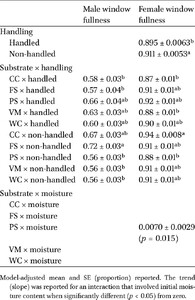
The interaction of substrate and handling affected window fullness in male (
Handling (
4 Discussion
Our results suggest that prepupal handling and pupation substrate type have significant impacts on development time and subsequent adult morphology in BSF. Short bouts of daily handling during the prepupal phase negatively affected survival, development and body size: handling reduced eclosion rate by 30.6%, increased development time in both sexes by more than 3 days, decreased male wet mass by 4.3%, decreased head widths in both males (1.6%) and females (1.3%), and decreased window fullness in females by 1.8%. The largest effects of handling on eclosion rate were observed in FS and PS. Our results mirror data from other dipterans: Kobayashi and Takanashi (2025) also found that vibrations suppressed larval development and reduced adult emergence in dark-winged fungus gnats (Diptera: Sciaridae).
The strong effects of handling on eclosion rates and adult morphology may result from a number of factors, particularly stress and/or damage. Predator-linked cues, like vibrations and/or physical touch, are known to cause significant stress in insects (Cinel et al., 2020). Acute stress can lead to the activation of the octopamine-adipokinetic hormone axis (as reviewed in Johnson and Barrett, 2025), resulting in increased metabolic rates and thereby energy consumption as the insect attempts to remove itself from the acute stressor. Octopamine has been tentatively linked to handling in BSF larvae (unpublished work: Baumann, 2019) and is known to cause mobilisation of lipid reserves, like fat body tissue, in insects (Corby-Harris et al., 2020). Additionally, handling can activate the cellular immune response: Tokusumi et al. (2018) reported stimulation of cellular immune responses when Drosophila melanogaster (Diptera; Drosophilidae) larvae were squeezed with forceps. Immune activation is also energetically costly and can divert resources away from developmental processes (Karpova et al., 2024; Zhang et al., 2019).
Handling reduced head width in both male (1.6%) and female (1.3%) flies. Letters on graphs indicate statistically significant differences among conditions (Tukey’s;
Citation: Journal of Insects as Food and Feed 2026; 10.1163/23524588-bja10392
Impacts of substrate, interaction between substrate and moisture content, and interaction between handling and initial moisture content on thorax length in flies
Citation: Journal of Insects as Food and Feed 2026; 10.1163/23524588-bja10392
Impacts of handling, interaction between substrate and handling, and interaction between substrate and initial moisture content on window fullness in flies
Citation: Journal of Insects as Food and Feed 2026; 10.1163/23524588-bja10392
As prepupae are post-feeding, they cannot compensate for any increased energy burn during their prolonged development by consuming additional nutrients. Smaller energy reserves heading into pupation may explain our data demonstrating both smaller adults (for those that survive to eclosion) and a significant proportion of individuals (30.6%) not surviving the energy-intensive process of pupation at all. Somewhat in line with this hypothesis, the window fullness of newly eclosed female BSF, which can serve as an indicator of the nutritional status and energy/lipid resources of BSF (Harjoko et al., 2023), was reduced by 1.8% in handled conditions compared to non-handled conditions; coupled with a reduction in body size, this suggests smaller energy reserves for adults emerging from handled conditions. Window fullness may be a coarse but non-invasive proxy for the amount of stored metabolic resources in adult BSF.
The lower eclosion rates observed in handled flies could also have resulted from damage to the cuticle or internal structures during daily handling. Importantly, however, lower eclosion rates in handled conditions were largely due to prepupae not surviving pupation (at which point they were no longer being handled), not animals dying at the prepupal stage. Dead pupae that were dissected from handled conditions at the end of the study were almost all partially developed into adults, indicating the beginning of metamorphosis had occurred but that it could not be completed. Further, we rarely observed damage to the pupal case or the insect upon dissection of dead individuals that had pupated – though even small amounts of damage to the pupal case can increase the likelihood of disease or desiccation (Heren et al., 2023; Taylor, 2020). Further, excessive vibration could disrupt airflow or damage tracheal tubes, chordotonal organs, imaginal discs, and other internal tissues (Nyberg and Muto, 2020; Tokusumi et al., 2018); the effects of this damage, if severe, could preclude subsequent normal eclosion even if metamorphosis begins. Finally, handling of the prepupae could result in oxidative stress and the increased production of reactive oxygen species that disrupt cellular, organ, or whole-body functions, leading to death (Apirajkamol et al., 2020).
Interestingly, prior research on BSF larvae found that daily handling either reduced development time (Nguyen et al., 2013) or did not affect it (Loiotine et al., 2024). However, our results demonstrate that daily handling at the prepupal stage prolonged development. These life-stage specific responses to predator-linked stressors might be adaptive: for instance, larvae that are exposed to a stressor may benefit from leaving the stressful feeding substrate for a safer pupation area as rapidly as possible, whereas prepupae in a stressful environment may benefit from delaying pupation and continuing to search for a safer environment to pupate in. Irrespective of functional value, this life-stage-specific variance in response to stress demonstrates how unique the behaviours of post-feeding prepupae and feeding larvae can be and justifies further research aimed at understanding the prepupal stage for both fundamental and applied work. Mechanistically, the prolonged adult emergence observed in handled flies could also have resulted from the stress-induced shifts in hormone titres, especially for juvenile hormone (JH) and ecdysone (20E) that initiate and regulate metamorphosis (Chernysh, 2018; Li et al., 2023).
We also found that substrate type (given the five substrates we provided: corn cob grits, frass, potting soil, vermiculite, and wood chips) had significant impacts on BSF development and morphology, in line with prior research (Dzepe et al., 2020; Holmes et al., 2013). In our study, “Sani-chips” wood chips (WC) consistently performed above the other substrates with the highest eclosion rate (especially when not handled), highest wet mass, thorax length, and head widths for both males and females (and a high dry mass) and no significant difference from other substrates in window fullness. Sanichips are small wood chips used for laboratory rodent bedding and have few sharp edges; they thus have many characteristics of a desirable pupation substrate for BSF: loose enough to allow movement of prepupae, low compaction, non-toxic, and capable of retaining moisture (Pascacio-Villafán et al., 2021). Dzepe et al. (2020) also observed the highest emergence rate in wood shavings when comparing emergence success in wood shavings, fine sand, wheat bran, and no substrate. Holmes et al. (2013) found no difference in the adult emergence from sand, topsoil, wood shavings and potting soil. Wood chips/shavings have a variety of textures and moisture retention abilities; larger shavings with sharper edges are not preferred by BSF prepupae in two-choice assays (Durosaro and Barrett, data not shown); the exact characteristics of the wood chips/shavings used may thus explain discrepancies between studies.
Prior studies found that initial moisture content can affect pupation and adult emergence, with low initial moisture content (0–20%) resulting in increased mortality (Liu et al., 2023). Surprisingly, we did not observe an effect of low initial moisture content (20%) on any of our response variables, though initial moisture content did sometimes interact with substrate or handling type (with few consistent trends emerging). This may have been a result of the higher relative humidity in our incubator (approx. 71% RH) compared to other studies (approx. 50% RH), which likely supplemented the poor initial moisture content in the substrates themselves. Future work that adjusts for moisture content daily (instead of only assessing initial moisture content, as in our work or Liu et al. (2023)) would be valuable to account for any effects of handling, or substrate variation in moisture retention abilities, on actual moisture content of the substrate over time.
By contrast, BSF frass (FS) performed the worst with the lowest eclosion rate, lowest wet and dry mass, and lowest head width for both sexes (though, these effects were largely driven by the handled condition, not the non-handled condition). The poor performance of FS is perhaps unsurprising given that BSF prepupae naturally leave their own frass and seek out other substrates in which to pupate (Holmes et al., 2013). In some insects, like the yellow mealworm beetle (Tenebrio molitor; Coleoptera: Tenebrionidae), frass is known to contain compounds (JH) that actively suppress or delay pupation upon consumption, thus delaying pupation at high densities (Weaver and McFarlane, 1990). In BSF prepupae, however, FS did not delay development compared to the other substrates; further, the prepupae we tested were exclusively post-feeding and therefore could not have been consuming JH if it were found in the frass. Thus, the mechanism by which FS reduces eclosion rates and alters adult morphology, particularly when prepupae experience handling-associated stress, could be further researched.
Our data demonstrate that both prepupal handling and pupation substrate type can significantly affect the survival, development, and morphology of adult BSF. Practically, frequent bouts of handling are likely to be more common in laboratory settings than production settings (though handling events may be more intense or longer in production settings with automated sieves). Our data thus highlight a gap between lab and production practices that could result in difficulty translating benchtop research to production scales, given that handling can result in phenotypic changes in adults. Our data suggest that prepupal handling can be stressful and reducing prepupal handling in either frequency or duration may improve prepupal welfare while also serving production and research goals (increased survival, faster development, larger adult males and females with more energy reserves). Dependent on cost and availability, producers may want to use small, rounded wood chips as a pupation substrate given their clear benefits for survival and adult morphology. The best eclosion rate for handled prepupae was observed in corn cob grits, which also scored intermediate on many morphological variables; therefore, producers that are live-shipping prepupae (a situation that may induce stress similar to that seen in our study) may want to use corn cob grits as the substrate, as it may increase the animals’ resilience to mechanical stress. Frass as a pupation substrate, and the lack of a pupation substrate entirely (Holmes et al., 2013), should be avoided as they resulted in the poorest welfare- and production-relevant outcomes in both our work and/or prior literature.
Corresponding author; e-mail: sodurosa@iu.edu
Acknowledgements
We thank Charlie Schmidt and Sofia Goodpaster for their assistance with data input and/or adult morphology measurements. We thank Elijah Persson-Gordon for assisting with setting up the experiment and some prepupal handling. We thank Craig Perl for the advice on statistical analysis and for helping with the R code for beta regressions.
Conflicts of interest
The authors declare no conflict of interest.
Funding
EA was supported as part of the First Year Science Apprenticeship Programme at Indiana University Indianapolis.
References
Addeo, N.F., Li, C., Rusch, T.W., Dickerson, A.J., Tarone, A.M., Bovera, F. and Tomberlin, J.K., 2022. Impact of age, size, and sex on adult black soldier fly (Hermetia illucens L. (Diptera: Stratiomyidae)) thermal preference. Journal of Insects as Food and Feed 8: 129-140. https://doi.org/10.3920/JIFF2021.0076.
Apirajkamol, N.B., James, B., Gordon, K.H.J., Walsh, T.K. and McGaughran, A., 2020. Oxidative stress delays development and alters gene expression in the agricultural pest moth, Helicoverpa armigera. Ecology and Evolution 10: 5680-5693. https://doi.org/10.1002/ece3.6308.
Barrett, M. and Adcock, S.J.J., 2023. Animal welfare science: an integral piece of sustainable insect agriculture. Journal of Insects as Food and Feed 10: 517-531.
Barrett, M., Chia, S.Y., Fischer, B. and Tomberlin, J.K., 2023. Welfare considerations for farming black soldier flies, Hermetia illucens (Diptera: Stratiomyidae): a model for the insects as food and feed industry. Journal of Insects as Food and Feed 9: 119-148.
Baumann, A., 2019. Insect welfare in food and feed production. In: Book of abstracts of the Insecta Conference 2019. 5-6 September 2019, Potsdam, Germany, 69.
Chernysh, S.I., 2018. Neuroendocrine system in insect stress. In: Ivanovic, J. (ed.) Hormones and metabolism in insect stress. CRC Press, Boca Raton, FL, pp. 69-98.
Chia, S.Y., Tanga, C.M., van Loon, J.J. and Dicke, M., 2019. Insects for sustainable animal feed: inclusive business models involving smallholder farmers. Current Opinion in Environmental Sustainability 41: 23-30.
Chowdhury, M.Z.I. and Turin, T.C., 2020. Variable selection strategies and its importance in clinical prediction modelling. Family Medicine and Community Health 8: e000262. https://doi.org/10.1136/fmch-2019-000262.
Cinel, S.D., Hahn, D.A. and Kawahara, A.Y., 2020. Predator-induced stress responses in insects: A review. Journal of Insect Physiology 122: 104039.
Corby-Harris, V., Deeter, M.E., Snyder, L., Meador, C., Welchert, A.C., Hoffman, A. and Obernesser, B.T., 2020. Octopamine mobilizes lipids from honey bee (Apis mellifera) hypopharyngeal glands. The Journal of Experimental Biology 223: jeb216135. https://doi.org/10.1242/jeb.216135
Dzepe, D., Nana, P., Mube, K.H., Fotso, K.A., Tchuinkam, T. and Djouaka, R., 2020. Role of pupation substrate on post-feeding development of black soldier fly larvae, Hermetia illucens (Diptera: Stratiomyidae). Journal of Entomology and Zoology Studies 8: 760-764.
Harjoko, D.N., Hua, Q.Q.H., Toh, E.M.C., Goh, C.Y.J. and Puniamoorthy, N., 2023. A window into fly sex: Mating increases female but reduces male longevity in black soldier flies. Animal Behaviour 200: 25-36. https://doi.org/10.1016/j.anbehav.2023.03.007
Herren, P., Hesketh, H., Meyling, N.V. and Dunn, A.M., 2023. Environment–host–parasite interactions in mass-reared insects. Trends in Parasitology 39(7): 588-602.
Holmes, L.A., Vanlaerhoven, S.L. and Tomberlin, J.K., 2013. Substrate effects on pupation and adult emergence of Hermetia illucens (Diptera: Stratiomyidae). Environmental Entomology 42: 370-374.
Holmes, L.A., Vanlaerhoven, S.L. and Tomberlin, J.K., 2012. Relative humidity effects on the life history of Hermetia illucens (Diptera: Stratiomyidae). Environmental Entomology 41: 971-978.
Johnson, M. and Barrett, M., 2025. Exploring correctness, usefulness, and feasibility of potential physiological operational welfare indicators for farmed insects to establish research priorities. Animal Suppl. 3: 101501. https://doi.org/10.1016/j.animal.2025.101501
Jones, B.M. and Tomberlin, J.K., 2021. Effects of adult body size on mating success of the black soldier fly, Hermetia illucens (L.) (Diptera: Stratiomyidae). Journal of Insects as Food and Feed 7(1): 5-20.
Karpova, E.K., Bobrovskikh, M.A., Burdina, E.V., Adonyeva, N.V., Deryuzhenko, M.A., Zakharenko, L.P., Petrovskii, D.V. and Gruntenko, N.E., 2024. Larval stress affects adult Drosophila behavior and metabolism. Journal of Insect Physiology 159: 104709. https://doi.org/10.1016/j.jinsphys.2024.104709
Kobayashi, C. and Takanashi, T., 2025. Vibrations suppress larval development in the dark-winged fungus gnat Lycoriella ingenua (Diptera: Sciaridae). Applied Entomology and Zoology: 1-7.
Lalander, C., Barrett, M., Gasco, L., Lopes, I.G., Picard, C.J., Tomberlin, J.K. and van Huis, A., 2025. Working out the bugs: navigating challenges and unlocking opportunities in the insect industry. Journal of Insects as Food and Feed 11: 1323-1337.
Lemke, N.B., Dickerson, A.J. and Tomberlin, J.K., 2023. No neonates without adults. BioEssays 45: 2200162. https://doi.org/10.1002/bies.202200162.
Li, X., Liao, S., Hou, J., Zhang, W., Yi, G. and Li, H., 2023. Interactions between 20-hydroxyecdysone and juvenile hormone I, II, and III during the developmental stages of Spodoptera frugiperda. Agronomy 13: 2177. https://doi.org/10.3390/agronomy13082177
Liu, Z., Morel, P.C.H. and Minor, M.A., 2023. Substrate and moisture content effects on pupation of the black soldier fly (Diptera: Stratiomyidae). Journal of Insects as Food and Feed 9: 415-425.
Loiotine, Z., Gasco, L., Biasato, I., Resconi, A. and Bellezza Oddon, S., 2024. Effect of larval handling on black soldier fly life history traits and bioconversion efficiency. Frontiers in Veterinary Science 11: 1330342. https://doi.org/10.3389/fvets.2024.1330342
McCullagh, P., 1989. Generalized linear models. 2nd ed. Routledge, New York, NY. https://doi.org/10.1201/9780203753736
McKay, H. and Shah, S., 2025. Forecasting farmed animal numbers in 2033. Rethink Priorities. Available at https://rethinkpriorities.org/research-area/forecasting-farmed-animal-numbers-in-2033/.
Mezheritskiy, M.I., Vorontsov, D.D., Dyakonova, V.E. and Zakharov, I.S., 2024. Behavioral functions of octopamine in adult insects under stressful conditions. Biology Bulletin Reviews 14: 535-547.
Moore, K., Bagsby, K. and Hans, K.R., 2024. The influence of substrates on blow fly (Diptera: Calliphoridae) development. Forensic Sciences 4: 409-416. https://doi.org/10.3390/forensicsci4030025
Nguyen, T.T., Tomberlin, J.K. and Vanlaerhoven, S., 2013. Influence of resources on Hermetia illucens (Diptera: Stratiomyidae) larval development. Journal of Medical Entomology 50: 898-906.
Nyberg, H.J. and Muto, K., 2020. Acoustic tracheal rupture provides insights into larval mosquito respiration. Scientific Reports 10: 2378. https://doi.org/10.1038/s41598-020-59321-8
Oliveira, F.R., Doelle, K. and Smith, R.P., 2016. External morphology of Hermetia illucens Stratiomyidae: Diptera (L. 1758) based on electron microscopy. Annual Research and Review in Biology 9: 1-10.
Pascacio-Villafán, C., Quintero-Fong, L., Guillén, L., Rivera-Ciprian, J.P., Aguilar, R. and Aluja, M., 2021. Pupation substrate type and volume affect pupation, quality parameters and production costs of a reproductive colony of Ceratitis capitata (Diptera: Tephritidae) VIENNA 8 genetic sexing strain. Insects 12: 337. https://doi.org/10.3390/insects12040337
Purkayastha, D. and Sarkar, S., 2022. Sustainable waste management using black soldier fly larva: a review. International Journal of Environmental Science and Technology 19: 12701-12726.
Rehman, K.U., Hollah, C., Wiesotzki, K., Rehman, R.U., Rehman, A.U., Zhang, J., Zheng, L., Nienaber, T., Heinz, V. and Aganovic, K., 2023. Black soldier fly, Hermetia illucens as a potential innovative and environmentally friendly tool for organic waste management: a mini-review. Waste Management and Research 41: 81-97.
Schneider, C.A., Rasband, W.S. and Eliceiri, K.W., 2012. NIH Image to ImageJ: 25 years of image analysis. Nature Methods 9: 671-675.
Shumo, M., Khamis, F.M., Tanga, C.M., Fiaboe, K.K., Subramanian, S., Ekesi, S., van Huis, A. and Borgemeister, C., 2019. Influence of temperature on selected life-history traits of black soldier fly (Hermetia illucens) reared on two common urban organic waste streams in Kenya. Animals 9: 79. https://doi.org/10.3390/ani9030079
Singh, A., Marathe, D., Raghunathan, K. and Kumari, K., 2022. Effect of Different organic substrates on selected life history traits and nutritional composition of black soldier fly (Hermetia illucens). Environmental Entomology 51: 182-189. https://doi.org/10.1093/ee/nvab135
Taylor, D., 2020. Repair of microdamage caused by cyclic loading in insect cuticle. Journal of Experimental Zoology Part A: Ecological and Integrative Physiology 333: 20-28. https://doi.org/10.1002/jez.2329
Tokusumi, Y., Tokusumi, T. and Schulz, R.A., 2018. Mechanical stress to Drosophila larvae stimulates a cellular immune response through the JAK/STAT signaling pathway. Biochemical and Biophysical Research Communications 502: 415-421. https://doi.org/10.1016/j.bbrc.2018.05.192
Tomberlin, J.K., Sheppard, D.C. and Joyce, J.A., 2002. Selected life-history traits of black soldier flies (Diptera: Stratiomyidae) reared on three artificial diets. Annals of the Entomological Society of America 95: 379-386.
van Huis, A., Rumbos, C.I., Oonincx, D.G., Rojo, S., Kovitvadhi, A. and Gasco, L., 2025. From traditional to industrial use of insects as feed: a review. Journal of Insects as Food and Feed 11: 115-137.
Vincent, J.F. and Wegst, U.G., 2004. Design and mechanical properties of insect cuticle. Arthropod Structure and Development 33: 187-199.
Wang, H., Liang, S., Ma, T., Xiao, Q., Cao, P., Chen, X., Qin, W., Xiong, H., Sun, Z., Wen, X. and Wang, C., 2018. No-substrate and low-moisture conditions during pupating adversely affect Ectropis grisescens (Lepidoptera: Geometridae) adults. Journal of Asia-Pacific Entomology 21: 657-662. https://doi.org/10.1016/j.aspen.2018.04.007
Weaver, D.K. and McFarlane, J.E., 1990. The effect of larval density on growth and development of Tenebrio molitor. Journal of Insect Physiology 36: 531-536.
Zeileis, A., Cribari-Neto, F., Gruen, B., Kosmidis, I., Simas, A.B., Rocha, A.V. and Zeileis, M.A., 2016. Package ‘betareg’. R package 3: 51.
Zhang, D., Xiao, Z., Zeng, B., Li, K. and Tang, Y., 2019. Insect behavior and physiological adaptation mechanisms under starvation stress. Frontiers in Physiology 10: 426480. https://doi.org/10.3389/fphys.2019.00163