Abstract
Sericulture, traditionally focused on silk fibre production, is increasingly recognised as an integrated bioresource system that connects mulberry cultivation, silkworm rearing, and cocoon processing with the development of functional foods and biomaterials. This review summarises the nutritional composition, key bioactive constituents, and physiological functions of sericultural products, including mulberry leaves, fruits, roots, and twigs, as well as silkworm larvae, pupae, and cocoons. Mulberry provides 1-deoxynojirimycin, phenolics, flavonoids, anthocyanins, and stilbenes, which collectively modulate glucose and lipid metabolism, oxidative stress, inflammation, vascular health, immunity, and gut health. Silkworm larvae and pupae represent high-quality protein and lipid sources that supply bioactive peptides, chitin/chitosan, and unsaturated fatty acids with demonstrated antioxidant, anti-obesity, immunomodulatory, and muscle function-enhancing activities. Cocoon-derived sericin and fibroin function as both high-protein food ingredients and versatile biomaterials that can be processed into films, hydrogels, scaffolds, and edible coatings for applications in wound healing, tissue regeneration, drug delivery, and food preservation. In addition, advances in bioprocessing and biotechnology, including optimised extraction and fractionation strategies and in vitro root culture systems, are facilitating more standardised and sustainable production of high-value metabolites, including mulberrosides, oxyresveratrol, and silk-derived peptides. Collectively, these developments position sericultural products as promising platform resources that extend the scope of conventional sericulture toward evidence-based functional foods, nutraceuticals, and regenerative biomaterials within a sustainable bioeconomy framework.
1 Introduction
The earliest evidence of sericulture dates to approximately 2640 BCE in ancient China, where the process of producing silk from cocoons spun by silkworms (Bombyx mori) feeding on mulberry (Morus alba) leaves first emerged (Islam, 2024). With the expansion of interregional trade, Chinese silk products were exported to ancient West Asia via the Silk Road. In addition to its economic significance, the Silk Road functioned as one of the earliest large-scale channels for cultural and technological exchange between the East and West, exerting a profound influence on global civilisation.
Silkworms are the only fully domesticated insects, having coevolved with humans over thousands of years (Gautam et al., 2022). As a result of long-term artificial selection, they have lost their ability to fly or survive independently and rely entirely on human management for food and reproduction. This prolonged co-evolutionary relationship between humans and silkworms reflects the integration of biological, agricultural, and cultural dimensions that characterise sericulture.
Modern sericulture is a sustainable bioeconomic model from production to consumption. It begins with the cultivation of mulberry trees and extends through silkworm rearing and cocoon production to the creation of high-quality silk fibres (Altman and Farrell, 2022). Each stage generates multiple by-products, including mulberry leaves, fruits, silkworm pupae, and sericin. These are collectively referred to as sericultural resources. These products are increasingly recognised as valuable sources of bioactive compounds with applications in the food, cosmetics, and pharmaceutical industries.
Sericulture is recognised by UNESCO as Intangible Cultural Heritage, representing both a cultural legacy and a forward-looking model for sustainable development (Mushtaq et al., 2023). Advances in bioprocessing and functional analysis mean that sericultural products are now being recognised as both textile resources and functional biomaterials that cross the boundary between food and medicine (Nazim et al., 2017; Sharma et al., 2022; Sowmya et al., 2024).
Despite the growing attention to the benefits of sericultural products, there remains a clear need to establish standardised production processes and to accumulate scientific evidence through well-designed studies. In this review, we examine the functional substances derived from sericultural products and explore their potential contributions to human health within the context of a sustainable bioeconomy.

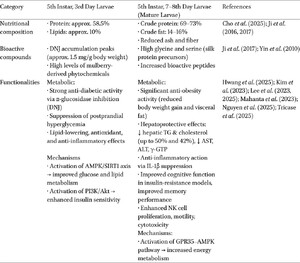
Comparison of nutritional composition, bioactive compounds, and functional properties between 5th-instar 3rd-day larvae and mature larvae (5th-instar 7–8th day)
Citation: Journal of Insects as Food and Feed 2026; 10.1163/23524588-bja10372
2 Silkworm larvae
Domesticated silkworms undergo complete metamorphosis (egg, larva, pupa, and moth), and their nutritional composition and physiological activities dynamically change according to developmental stage (Table 1). During the larval stage, plant-derived compounds from mulberry leaves, particularly the functional alkaloid 1-deoxynojirimycin (DNJ), accumulate within the body (Yin et al., 2010). RP-HPLC analysis indicates that DNJ content peaks at approximately 1.5 mg per gram of body weight in fifth-instar and third-day larvae, representing a stage of concentrated absorption and accumulation of DNJ derived from mulberry leaves. DNJ exerts α-glucosidase inhibitory activity, making it a key functional component of silkworm powder that may contribute to delayed carbohydrate hydrolysis and suppression of postprandial hyperglycaemia (Mahanta et al., 2023). Beyond its hypoglycaemic action, DNJ exhibits a wide range of biological activities, including lipid-lowering, antioxidant, anti-inflammatory, antiviral, and anticancer effects. Mechanistically, DNJ regulates the AMP-activated protein kinase (AMPK)/SIRT1 signalling axis to improve glucose and lipid metabolism, and activates the PI3K/Akt pathway in liver and muscle tissues to enhance insulin sensitivity (Tricase et al., 2025). The biochemical composition of silkworms also changes during late larval development. Freeze-dried fifth instar and third day of larvae contain approximately 58.5% protein and 10% lipids, whereas the mature larval stage (fifth instar and seventh to eighth days) exhibits increased protein and amino acid levels alongside decreased ash and fibre content, reflecting the accumulation of amino acids for silk protein (fibroin and sericin) synthesis (Ji et al., 2016; Cho et al., 2025). Ji et al. (2017) reported that steamed and freeze-dried mature silkworm powder (SMSP or Hongjam) contains 69–73% crude protein and 14–16% crude fat, with high levels of glycine, serine, and proline – precursors for silk protein synthesis.
Recent studies have consistently identified SMSP as a promising multifunctional material. In ethanol-induced fatty liver rat models, SMSP administration (50–300 mg/kg) significantly reduced hepatic triglyceride levels and AST, ALT, and γ-GTP activities while suppressing IL-1β expression and hepatic inflammation (Lee et al., 2023). SMSP also reduced hepatic triglyceride and cholesterol levels by up to 50 and 42%, respectively, in a non-alcoholic fatty liver disease mouse model (Lee et al., 2025). In addition, SMSP exerts marked anti-obesity effects by consistently suppressing body weight gain and reducing intra-abdominal adipose tissue mass (Kim et al., 2023). These metabolic improvements have been attributed to the activation of GPR35- and AMPK-mediated signalling pathways, which enhance energy metabolism (Lee et al., 2025).
In insulin resistance-induced cognitive impairment models, SMSP improved blood glucose regulation, restored hippocampal BDNF expression and long-term potentiation, and enhanced memory performance (Hwang et al., 2025). Nguyen et al. (2025) demonstrated that supercritical extracts of SMSP enhance NK cell proliferation, motility, and cytotoxicity; elevate mitochondrial complex activity and ATP production; and restore immune parameters in immunosuppressed mice (Nguyen et al., 2025).
Collectively, these findings highlight the distinct biochemical and functional characteristics of silkworms at different developmental stages. Elucidating stage-specific physiological activities and standardising the optimal accumulation periods and processing conditions of bioactive compounds at the industrial level will be pivotal for advancing the high-value utilisation of sericultural resources and expanding their applications as functional biomaterials.
3 Silkworm pupae
Silkworm pupae are by-products of silk manufacturing that have traditionally been consumed as food in several East Asian countries. They are recognised as a high-protein source. On a dry-weight basis, silkworm pupae contain approximately 55–62% protein (Sadat et al., 2022). The protein fraction is composed of 18 amino acids, and its essential amino acid (EAA) profile meets or closely approaches World Health Organization (WHO)/Food and Agriculture Organization of the United Nations (FAO) recommendations (Zhou et al., 2022) (Table 2).
Nutritional composition, bioactive components, and functional properties of silkworm pupae
Citation: Journal of Insects as Food and Feed 2026; 10.1163/23524588-bja10372
Silkworm pupae oil is the second major nutrient component after protein, accounting for roughly 20–30% of pupal dry matter, depending on the strain, of which approximately 70–78% consists of unsaturated fatty acids (Zhou et al., 2022; Zhai et al., 2024). In silkworm pupae oil, linoleic (C18:2), oleic (C18:1), and α-linolenic (C18:3) acids are predominant. Small amounts of n-3 fatty acids, such as eicosapentaenoic acid (EPA) and docosahexaenoic acid (DHA), have also been detected. These lipid components confer considerable nutritional value, particularly with respect to cardiovascular health (Sadat et al., 2022; Zhou et al., 2022).
Nutrient composition varies according to variety and sex. When four varieties, Baegokjam, Goldensilk, Juhwangjam, and YeonNokjam, were analysed, crude protein content per 100 g of pupae ranged from 54 to 65 g in females and was slightly lower in males, whereas crude fat content was higher in males (36–45 g/100 g) than that in females (25–34 g/100 g). Baegokjam has a higher proportion of oleic acid, Goldensilk contains more linoleic and linolenic acids, and Juhwangjam has higher proportions of palmitic and stearic acids, indicating distinct strain-specific fatty acid profiles (Lee et al., 2021a). Among the developmental stages of silkworms, pupae exhibit the highest oil content, yielding approximately 20% oil through mechanical pressing – substantially higher than the 3–8% obtained from larvae (Cho et al., 2025). Therefore, for the industrialisation of edible silkworm products, selecting raw materials based on developmental stage–dependent variations in nutrient composition is essential (Lee et al., 2021a).
In addition to the major nutrients, silkworm pupae contain various peptides, polyphenols, cholesterol, phytosterols (such as β-sitosterol), and chitosan and its derivatives. These constituents contribute to a broad spectrum of bioactivities, including antioxidant, antimicrobial, immunomodulatory, and antitumour effects (Lee et al., 2021b; Sadat et al., 2022; Zhou et al., 2022). A review by Wu et al. (2023) reported that silkworm pupal protein hydrolysates significantly enhance in vitro antioxidant indices, such as ABTS, DPPH, FRAP, and ORAC, while reducing reactive oxygen species generation and increasing antioxidant enzyme activities (SOD and GSH-Px) in HepG2 and neuronal cells (Wu et al., 2023). In particular, peptides obtained by hydrolysing silkworm pupae proteins with alkalase or neutral proteases exhibited strong antioxidant activity by scavenging ABTS and DPPH radicals, increasing FRAP values, and suppressing intracellular reactive oxygen species (Wu et al., 2023). These findings indicate that through food-technology-oriented approaches, such as targeted enzymatic hydrolysis and ingredient design, silkworm pupae can be developed into a range of functional proteins and peptide ingredients (Wu et al., 2023).
Comparison of sericin and fibroin derived from silkworm cocoons: composition, functionalities, and applications
Citation: Journal of Insects as Food and Feed 2026; 10.1163/23524588-bja10372
As a high-protein resource, silkworm pupae also show promise for muscle-related functions, as demonstrated in a human clinical study. Choi et al. (2023) conducted a randomised, double-blind, placebo-controlled trial in community-dwelling middle-aged and older adults at risk of sarcopenia (mean age 64 years,
Taken together, these findings support silkworm pupae as a versatile functional food ingredient with potential benefits, including regulation of oxidative stress and maintenance of muscle function in ageing populations.
4 Silkworm cocoon
Silkworm cocoons have traditionally been used as raw materials for silk fibre production. Structurally, they are unique protein composites consisting of silk fibroin, which accounts for approximately 70–75% of cocoon weight, and sericin, which accounts for 20–25% (Table 3). These two proteins are emerging as important resources in both food and biomaterials (Bungthong and Siriamornpun, 2021; Wang et al., 2021). Recent comprehensive reviews have reported that sericin exhibits diverse biological activities, including antioxidant, anti-inflammatory, antimicrobial, antidiabetic, antihypertensive, antihyperlipidaemic, and gut health-promoting effects, which vary markedly depending on molecular weight, extraction method, and cocoon origin (Wang et al., 2025). Sericin extraction methods are broadly classified into chemical extraction using alkali, acids, or urea; enzymatic extraction; and hydrothermal extraction at high temperature and pressure. Hydrothermal-enzymatic combined processes have been proposed as promising options for food applications because they minimise residual chemicals while preserving bioactivity (Wang et al., 2025).
With respect to functionality, sericin inhibits tyrosinase, thereby suppressing enzymatic browning in fruits and vegetables. In cut apples and eggplants, sericin treatment significantly reduced browning, suggesting its potential as a natural anti-browning agent and food additive. Sericin also attenuates skin hyperpigmentation through the same mechanism (Kunz et al., 2016; Wang et al., 2025). In vivo, oral administration of sericin in STZ-induced diabetic and hyperlipidaemic animal models improved glucose and lipid metabolism via activation of the PI3K/Akt pathway, increased hepatic antioxidant enzyme activities (SOD and CAT), and reduced inflammatory markers. Alterations in gut microbiota composition and protection of the intestinal mucosa suggest a potential prebiotic role of sericin (Wang et al., 2025). Collectively, these findings highlight the potential of cocoon-derived sericin as a candidate high-protein functional food ingredient rather than merely an industrial waste product.
Sericin is also used as a biomedical agent. High molecular weight sericin exhibits strong water-holding capacity, adhesiveness, emulsifying ability, and film-forming properties. These characteristics enable its processing into bulk materials such as films, hydrogels, scaffolds, and microparticles, as well as cosmetic formulations which have been applied to wound dressings, tissue engineering, drug delivery systems, and temperature- or pressure-responsive sensors in medical and healthcare fields (Biswal et al., 2022; Kim et al., 2024; Kunz et al., 2016). Sericin-based films and hydrogels exhibit antimicrobial, anti-inflammatory, and antioxidant properties, promote cell adhesion and proliferation, and accelerate wound healing by modulating inflammatory responses and enhancing collagen synthesis (Kim et al., 2024; Wang et al., 2025). These studies support the safety and biocompatibility of sericin and highlight its potential for both functional food and medical biomaterial applications.
Silk fibroin, as a structural protein, possesses a characteristic architecture in which β-sheet–rich crystalline domains coexist with amorphous regions, and its molecular weight, crystallinity, and mechanical properties are strongly influenced by degumming conditions (Wang et al., 2021). Traditionally, sericin-free fibroin has been processed into fibres, films, sponges, and scaffolds for use in tissue engineering applications such as artificial blood vessels, cartilage and skin regeneration, and nerve repair (Wang et al., 2021). More recently, whole cocoons have been directly dissolved to produce sericin–fibroin composites, thereby simplifying processing while simultaneously exploiting the mechanical strength of fibroin and the hydrophilicity and cell-friendly properties of sericin. These whole-cocoon-based materials are useful as fibres and medical scaffolds and may reduce the environmental burden associated with cocoon processing.
Silk fibroin-derived peptides are also attracting attention in the food and health sectors. BF-7™, obtained through the enzymatic hydrolysis of cocoon fibroin, exhibits neuroprotective effects and reduces oxidative stress in vitro (Hong et al., 2022). In a 4-week randomised, double-blind, placebo-controlled human clinical trial in university students, BF-7™ significantly improved short- and long-term memory as well as attentional indices, including P300 latency and amplitude. These findings indicate that cocoon-derived silk peptides may serve as potential functional ingredients for supporting cognitive performance.
Silk fibroin is also useful for food packaging and coating applications. Marelli et al. (2016) regenerated silk fibroin as an aqueous suspension and applied it as a dip coating to strawberries and bananas, forming edible fibroin films with micrometre-scale thickness. They demonstrated that water-vapour annealing can tune β-sheet content to finely control oxygen and carbon dioxide diffusion and water loss.
In summary, silkworm cocoons and silk proteins represent high-protein functional food ingredients and high-performance biomaterials that can be fabricated into films, hydrogels, scaffolds, and edible coatings. Cocoon by-product–derived sericin is a promising functional food ingredient and additive that targets oxidative stress, metabolic disorders, and gut health. Fibroin and its peptides show considerable potential as platform materials across diverse applications, including cognitive function, food preservation, and regenerative medicine.
5 Silkworm litter
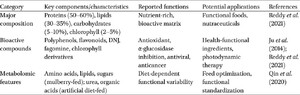
Silkworm litter (silkworm faeces) is generated during larval feeding on mulberry leaves and represents a complex biological matrix rather than a simple agricultural residue. Compositional analyses indicate that silkworm litter consists primarily of proteins (approximately 50–60%), lipids (30–35%), and carbohydrates (5–10%) on a dry-weight basis, along with substantial amounts of chlorophyll and its derivatives (2–5%; Reddy et al., 2021). In addition, silkworm litter contains organic acids, minerals (K, Ca, and P), nitrogenous compounds, sterols, uric acid, vitamins A and B complexes, and various plant-derived secondary metabolites. Bioactive compounds such as 1-deoxynojirimycin (DNJ), fagomine, and related iminosugars – known for their α-glucosidase inhibitory activity – have also been identified in silkworm litter (Ju et al., 2014). Metabolomic profiling further demonstrated that the chemical composition of silkworm litter is strongly influenced by larval diet. Silkworms fed mulberry leaves produce faeces enriched in amino acids, carbohydrates, and lipids. In contrast, artificial diets lead to higher accumulation of urea and organic acids, indicating diet-dependent metabolic regulation and functional variability (Qin et al., 2020).
Composition, functional properties, and potential applications of silkworm litter
Citation: Journal of Insects as Food and Feed 2026; 10.1163/23524588-bja10372
Silkworm litter has traditionally been used in East Asia as a medicinal material and natural colorant, and recent studies have provided experimental evidence supporting its multifunctional bioactivity. Extracts of silkworm litter exhibit antioxidant properties, including DPPH radical scavenging, SOD-like activity, and α-glucosidase inhibition, which are closely associated with their polyphenol and flavonoid contents (Ju et al., 2014). These findings suggest potential application of silkworm litter as a functional food ingredient or nutraceutical resource. Beyond antioxidant-related effects, chlorophyll derivatives such as chlorophyllin and pheophorbide isolated from silkworm litter have demonstrated antiviral and anticancer activities, particularly through photodynamic mechanisms involving reactive oxygen species generation (Reddy et al., 2021). Silkworm litter has also attracted attention as an industrial and environmental resource. For example, it has been successfully employed as a low-cost substrate for the mass production of Bacillus thuringiensis, achieving high spore yields and demonstrating economic and environmental advantages over conventional substrates (Patil et al., 2013).
Although silkworm litter has long been regarded as a sericultural waste, accumulating evidence suggests that it may represent a valuable circular bio-resource. Its continuous large-scale generation, combined with its chemical diversity and functional attributes, supports its potential integration into biorefinery strategies and circular bioeconomy frameworks (Table 4).
6 Mulberry leaf
Silkworms are monophagous insects that exclusively feed on mulberry leaves. The nutritional composition of mulberry leaves directly influences silkworm growth, silk protein synthesis, and the accumulation of functional metabolites (Table 5). Hence, mulberry leaves have long served as essential feed resources for sericulture. Recently, efforts have been made to develop artificial diets to replace mulberry leaves in large-scale automated silkworm rearing.
Nutritional composition, functional constituents, and bioactivities of mulberry leaves and their physiological importance
Citation: Journal of Insects as Food and Feed 2026; 10.1163/23524588-bja10372
According to Park et al. (2025), silkworms were successfully reared throughout their entire life cycle using artificial feed. However, the contents of total protein and major amino acids (glycine, alanine, serine, and tyrosine), as well as the accumulation of functional compounds such as DNJ, were reduced (Park et al., 2025). Furthermore, metabolite analysis revealed vitamin deficiencies in silkworm haemolymph, accumulation of nitrogen metabolism by-products (urea and uric acid), and impaired carbohydrate, energy, and lipid metabolism (Dong et al., 2017). These findings suggest that nutrient imbalances in artificial diets impair amino acid and energy metabolism, leading to poor growth and reduced silk protein synthesis. Therefore, elucidating the nutritional composition and physiological roles of mulberry leaves is essential for optimising artificial diet formulations and ensuring the high-quality production of functional materials such as DNJ.
Mulberry leaves are rich in DNJ, a functional iminosugar known for its α-glucosidase inhibitory activity, which may suppress postprandial hyperglycaemia. Yatsunami et al. (2008) analysed 276 mulberry cultivars collected in Kyoto, Japan, and found a strong positive correlation between DNJ content and α-glucosidase inhibition (
Nutritional composition and functional bioactivities and of mulberry fruits
Citation: Journal of Insects as Food and Feed 2026; 10.1163/23524588-bja10372
In addition to DNJ, mulberry leaves contain abundant phenolic compounds that have been reported to exhibit antioxidant, anti-inflammatory, antihyperglycaemic, and vasoprotective activities (Zou et al., 2012). The major bioactive constituents were chlorogenic acid, caffeic acid, isoquercitrin, rutin, quercetin, and kaempferol-3-O-glucoside (Sánchez-Salcedo et al., 2015; Song et al., 2009). Sánchez-Salcedo et al. (2015) reported total phenolic contents of 12.8–16.1 mg gallic acid equivalents/g DW and total flavonol levels of 3.7–9.8 mg/g DW in mulberry leaves. Among flavonol glycosides, rutin, quercetin, and isorhamnetin derivatives display potent DPPH and ABTS radical-scavenging activities and are associated with endothelial protection, improvements in lipid metabolism, and regulation of blood pressure (Song et al., 2009).
Mulberry leaves also provide high-quality protein (27–37%), carbohydrates (5.9–15%), and dietary fibre (9.9–13.9%) (Xue et al., 2025). Mulberry leaf protein contains 17 amino acids, with an essential amino acid (EAA)/total amino acid (TAA) ratio of 0.38 and an EAA/non-essential amino acid (NEAA) ratio of 0.61, closely matching the ideal FAO/WHO protein reference pattern (0.40/0.60). Enzymatically hydrolysed mulberry leaf protein exhibits strong DPPH and ABTS radical-scavenging activities (IC50 = 87 μg/ml) and multiple bioactivities, including angiotensin-converting enzyme (ACE) inhibition (81%), α-glucosidase inhibition, cholesterol-lowering effects (33.3%), attenuation of colitis-related markers, and immunomodulatory activity (Xue et al., 2025).
7 Mulberry fruit
Mulberry fruits vary in colour from white to deep purple-black, depending on the cultivar. Their biochemical composition differs substantially among species, with black mulberry showing the highest content of bioactive metabolites (Table 6). High-phenolic cultivars contain up to 1422 mg gallic acid equivalents 100/g fresh weight and 276 mg quercetin equivalents/100 g fresh weight of total phenolics and flavonoids, respectively (Ercisli and Orhan, 2007). The fruits consist of 70.0–87.4% moisture, 1.62–5.54% crude protein, and 1.23–2.23% crude fat. The principal fatty acids are linoleic (C18:2, 26.40–74.77%) and palmitic (C16:0, 9.29–22.26%) acids, mainly originating from the seeds (Ercisli and Orhan, 2007; Liang et al., 2012).
Phytochemical composition, biological activities, and biotechnological production of mulberry root bark and twigs
Citation: Journal of Insects as Food and Feed 2026; 10.1163/23524588-bja10372
The dark coloration of mulberry fruit is primarily attributed to cyanidin-based anthocyanins, particularly cyanidin-3-O-glucoside (C3G), which occurs at concentrations of approximately 8.65 mg/g DW in high-pigment cultivars (Jia et al., 2020). A broad spectrum of physiological activities of C3G has been reported in in vitro and animal studies, including beneficial effects on lipid metabolism, protective effects against non-alcoholic fatty liver disease, anti-obesity and antidiabetic effects, and induction of apoptosis in cancer cells (Jia et al., 2020, 2022; You et al., 2017). Mechanistically, these effects are mediated through dual regulation of energy metabolism involving both peroxisome proliferator-activated receptor-α (PPARα) and AMP-activated protein kinase (AMPK) pathways (Jia et al., 2020, 2022). C3G directly activates PPARα to enhance hepatic β-oxidation and fatty acid catabolism, thereby reducing triglyceride accumulation. In addition, C3G also indirectly stimulates AMPK via adiponectin receptor signalling, resulting in the phosphorylation and inactivation of gluconeogenic regulators, such as CRTC2 and HDAC5, ultimately improving glucose homeostasis. Coordinated activation of these metabolic regulators positions C3G as a potent natural modulator of energy metabolism and lipid utilisation.
Beyond its metabolic roles, C3G acts as a potent antioxidant by scavenging reactive oxygen species and maintaining intracellular redox balance. Through hydrogen or electron donation, C3G stabilises free radicals and prevents oxidative damage to lipids, proteins, and DNA, thereby potentially contributing to protection against ageing- and metabolism-related disorders (Carocho and Ferreira, 2013). Extraction-based studies further showed that 30–50% ethanolic mulberry extracts exhibit the highest antioxidant activity, reflecting the synergistic effects of C3G and other phenolic compounds (Lee et al., 2021).
Recent studies have also demonstrated the gastrointestinal benefits of mulberry powder. In vivo experiments showed a significant increase in intestinal transit rate, whereas ex vivo assays using human intestinal tissue confirmed enhanced smooth muscle contractility and neural responsiveness. These findings highlight mulberry fruit as a potential natural prokinetic agent, with effects reported to be superior to those of conventional drugs such as cisapride or metoclopramide (Sung et al., 2023).
8 Mulberry twig and root bark
Mulberry root bark and twigs contain a diverse array of phytochemicals that contribute to their biological activities (Table 7). According to Li et al. (2025), these tissues are rich in flavonoids, stilbenes, phenolic acids, and alkaloids, among which 19 compounds were identified exclusively in the root bark and 10 in the branch bark. This chemical diversity highlights their potential as sources of valuable bioactive materials (Jia et al., 2019; Li et al., 2025).
Numerous studies have explored the physiological functions of phytochemicals derived from mulberry roots and twigs, with particular emphasis on their vascular protective effects. Root bark extracts upregulated the expression of low-density lipoprotein receptor and ATP-binding cassette transporter A1, thereby enhancing cholesterol efflux and lowering blood cholesterol levels. These extracts also exhibited anti-inflammatory and antiplatelet aggregation activities. Notably, resveratrol (63.9 μg/g) and oxyresveratrol (374.6 μg/g), two stilbene compounds abundant in mulberry root bark (Zhou et al., 2013), demonstrated strong inhibitory effects on platelet aggregation, indicating their contribution to cardiovascular protection (Kim et al., 2022). Furthermore, the ethyl acetate fraction of mulberry root bark exhibited the highest angiotensin-converting enzyme (ACE)inhibitory activity in hypertensive mouse models, significantly reducing renin and angiotensinogen expression by 34% and 25%, respectively. These effects are mainly attributed to prenylated flavonoids, such as kuwanon G and H, which regulate the renin–angiotensin system and thereby mediate blood pressure-lowering effects (Lee et al., 2024).
Beyond its vascular benefits, mulberry root bark also contains a range of antiviral phytochemicals, including prenylated flavonoids such as leachianone G, and stilbene compounds, mulberroside C, which inhibit herpes simplex virus replication with IC50 values of 1.6 μg/ml and 75.4 μg/ml, respectively (Du et al., 2003). In addition, recent molecular docking and dynamic studies have revealed that resveratrol can bind stably to the SARS-CoV-2 spike protein–ACE2 receptor complex, suggesting its potential relevance for further investigation as an antiviral agent against COVID-19 (Wahedi et al., 2021).
Despite these promising bioactivities, large amounts of mulberry roots are required to extract sufficient quantities of reactive compounds such as stilbenes, making sustainable industrial-scale production challenging. Conventional cultivation often results in variable root quality and limited stilbene yields. To address these limitations, in vitro non-GMO root culture systems have been developed to enable controlled and high-yield production of key stilbenes, such as mulberroside A, oxyresveratrol, and resveratrol. Under optimised conditions, including an inoculum density of 3 g per 30 ml of medium and elicitation with methyl jasmonate and yeast extract, the mulberroside A content increased to 30.3 mg/g DW, representing a substantial improvement in productivity (Inyai et al., 2021).
Advances in such biotechnological approaches enable stable and scalable production of bioactive compounds derived from mulberry branches and roots. These developments are expected to significantly support future industrial applications and commercialisation within the functional materials sector.
Sericultural products as integrated resources for functional foods and biomaterials. Mulberry and silkworm derived resources obtained through sericulture exhibit diverse bioactivities based on phytochemicals and functional peptides, as well as potential for applications in biomaterials and cosmetic ingredients.
Citation: Journal of Insects as Food and Feed 2026; 10.1163/23524588-bja10372
9 Conclusions and future perspectives
Sericulture is a unique bioeconomic system in which mulberry, silkworm larvae, pupae, cocoons, and associated by-products form an integrated resource platform spanning food and medicine. Key functional constituents, including DNJ, phenolics, stilbenes, silk proteins, and their derived peptides, are associated with complementary effects on glucose and lipid metabolism, oxidative stress, inflammation, vascular and hepatic functions, immunity, cognition, and gut health (Figure 1). Advances in extraction, fractionation, and biomaterial processing have enabled the transformation of sericultural products into high-value ingredients for functional foods, nutraceuticals, edible coatings, and regenerative biomaterials, thereby supporting circular and low-waste utilisation across the sericulture value chain. Systematic standardisation of raw materials and processing conditions, together with well-designed human intervention studies, is essential to substantiate health claims and clarify dose–response relationships. Furthermore, integrating omics-based profiling, structure–activity relationship analyses, and green bioprocessing approaches will facilitate the rational design of sericulture-derived ingredients and biomaterials tailored to specific physiological targets. Collectively, these efforts may reposition sericultural products as modern evidence-based resources that bridge traditional sericulture with future-oriented strategies for promoting sustainable health.
Corresponding author; e-mail: jihae@korea.kr
Conflict of interest
The authors declare no conflict of interest.
Funding
This research was supported by the ‘Research Program for Agriculture Science and Technology Development’ (Grant No. PJ01675701) and the National Institute of Agricultural Sciences, Rural Development Administration, Republic of Korea.
References
Altman, G.H. and Farrell, B.D., 2022. Sericulture as a sustainable agroindustry. Cleaner and Circular Bioeconomy 2: 100011. https://doi.org/10.1016/j.clcb.2022.100011
Biswal, B., Dan, A.K., Sengupta, A., Das, M., Bindhani, B.K., Das, D. and Parhi, P.K., 2022. Extraction of silk fibroin with several sericin removal processes and its importance in tissue engineering: a review. Journal of Polymers and the Environment 30: 2222-2253. https://doi.org/10.1007/s10924-022-02381-w
Bungthong, C. and Siriamornpun, S., 2021. Changes in amino acid profiles and bioactive compounds of Thai silk cocoons as affected by water extraction. Molecules 26: 2033. https://doi.org/10.3390/molecules26072033
Carocho, M. and Ferreira, I.C., 2013. A review on antioxidants, prooxidants and related controversy: natural and synthetic compounds, screening and analysis methodologies and future perspectives. Food and Chemical Toxicology 51: 15-25. https://doi.org/10.1016/j.fct.2012.09.021
Cho, Y.H., Park, J.S., Park, S.K., Hwang, I.G., Lee, S.H., Park, J.W., Kang, S.K., Kim, S.W., Kim, S.R. and Lee, J.H., 2025. Characteristics and bioactivities of defatted powder obtained from silkworms at different growth stages. International Journal of Industrial Entomology and Biomaterials 49: 11-17. https://doi.org/10.7852/ijie.2025.49.1.11
Choi, J.I., Kweon, H.Y., Lee, Y.L., Lee, J.H. and Lee, S.Y., 2023. Efficacy of silkworm pupae extract on muscle strength and mass in middle-aged and older individuals: a randomized, double-blind, placebo-controlled trial. The Journal of Nutrition, Health and Aging 27: 578-585. https://doi.org/10.1007/s12603-023-1942-9
Dong, H.L., Zhang, S.X., Tao, H., Chen, Z.H., Li, X., Qiu, J.F., Cui, W.Z., Sima, Y.H., Cui, W.Z. and Xu, S.Q., 2017. Metabolomics differences between silkworms (Bombyx mori) reared on fresh mulberry (Morus) leaves or artificial diets. Scientific Reports 7: 10972. https://doi.org/10.1038/s41598-017-11592-4
Du, J., He, Z.D., Jiang, R.W., Ye, W.C., Xu, H.X. and But, P.P.H., 2003. Antiviral flavonoids from the root bark of Morus alba L. Phytochemistry 62: 1235-1238. https://doi.org/10.1016/S0031-9422(02)00753-7
Ercisli, S. and Orhan, E., 2007. Chemical composition of white (Morus alba), red (Morus rubra) and black (Morus nigra) mulberry fruits. Food Chemistry 103: 1380-1384. https://doi.org/10.1016/j.foodchem.2006.10.054
Gautam, M.P., Singh, D.K., Singh, S.N., Singh, S.P., Kumar, M. and Singh, S., 2022. A review on silkworm (Bombyx mori Linn.) an economic important insect. Biological Forum – An International Journal 14: 482-491.
Hong, J., Noh, Y.H., Lee, J.W., Whang, W.K., Zheng, Y., Won, M.H., Kang, I.J. and Kim, S.S., 2022. Improvement of attention, long-term and short-term memory by Brain Factor-7™ (BF-7™). Food Supplements and Biomaterials for Health 2: e1. https://doi.org/10.52361/fsbh.2022.2.e1
Hu, X.Q., Jiang, L., Zhang, J.G., Deng, W., Wang, H.L. and Wei, Z.J., 2013. Quantitative determination of 1-deoxynojirimycin in mulberry leaves from 132 varieties. Industrial Crops and Products 49: 782-784. https://doi.org/10.1016/j.indcrop.2013.06.030
Inyai, C., Yusakul, G., Komaikul, J., Kitisripanya, T., Likhitwitayawuid, K., Sritularak, B. and Putalun, W., 2021. Improvement of stilbene production by mulberry Morus alba root culture via precursor feeding and co-elicitation. Bioprocess and Biosystems Engineering 44: 653-660. https://doi.org/10.1007/s00449-020-02474-7
Islam, T.U., 2024. The Historical Journey of Sericulture: Insights into Sustainability from Past to Present. International Journal of Emerging Knowledge Studies 3: 719-726. https://doi.org/10.70333/ijeks-03-09-042
Ji, S.D., Kim, N.S., Kweon, H., Choi, B.H., Yoon, S.M., Kim, K.Y. and Koh, Y.H., 2016. Nutrient compositions of Bombyx mori mature silkworm larval powders suggest their possible health improvement effects in humans. Journal of Asia-Pacific Entomology 19: 1027-1033. https://doi.org/10.1016/j.aspen.2016.08.004
Ji, S.D., Nguyen, P., Yoon, S.M., Kim, K.Y., Son, J.G., Kweon, H.Y. and Koh, Y.H., 2017. Comparison of nutrient compositions and pharmacological effects of steamed and freeze-dried mature silkworm powders generated by four silkworm varieties. Journal of Asia-Pacific Entomology 20: 1410-1418. https://doi.org/10.1016/j.aspen.2017.10.010
Jia, Y., Wu, C., Kim, Y.S., Yang, S.O., Kim, Y., Kim, J.S., Jeong, M.Y., Lee, J.H., Kim, B., Oh, H.S., Kim, J., So, M.Y., Yoon, Y.E., Thach, T.T., Park, T.H. and Lee, S.J., 2020. A dietary anthocyanin cyanidin-3-O-glucoside binds to PPARs to regulate glucose metabolism and insulin sensitivity in mice. Communications Biology 3: 514. https://doi.org/10.1038/s42003-020-01231-6
Jia, Y., Wu, C., Rivera-Piza, A., Kim, Y.J., Lee, J.H. and Lee, S.J., 2022. Mechanism of action of cyanidin 3-O-glucoside in gluconeogenesis and oxidative stress-induced cancer cell senescence. Antioxidants 11: 749. https://doi.org/10.3390/antiox11040749
Jia, Y.N., Peng, Y.L., Zhao, Y.P., Cheng, X.F., Zhou, Y., Chai, C.L., Zeng, L.S., Pan, M.H. and Xu, L., 2019. Comparison of the hepatoprotective effects of the three main stilbenes from mulberry twigs. Journal of Agricultural and Food Chemistry 67: 5521-5529. https://doi.org/10.1021/acs.jafc.8b07245
Ju, W.T., Kim, K.Y., Sung, G.B. and Kim, Y.S., 2014. Effects of physiological active substance extracted from silkworm fece. International Journal of Industrial Entomology and Biomaterials 29: 179-184. https://doi.org/10.7852/ijie.2014.29.2.179
Kim, M.W., Ham, Y.J., Kim, H.B., Lee, J.Y., Lim, J.D. and Lee, H.Y., 2023. Anti-obesity effects of the larval powder of steamed and lyophilized mature silkworms in a newly designed adult mouse model. Foods 12: 3613. https://doi.org/10.3390/foods12193613
Kim, S.G., Choi, J.Y. and Kweon, H., 2024. Biomedical application of silk sericin: recent research trend. International Journal of Industrial Entomology and Biomaterials 48: 1-12. https://doi.org/10.7852/ijie.2024.48.1.1
Kim, Y.J., Kim, K., Kweon, H., Kim, H.B. and Lee, J.H., 2022. Inhibitory effect of mulberry root bark extract and its derived compounds on cholesterol regulation, inflammation and platelet aggregation. Journal of the Korean Society of Food Science and Nutrition 51: 633-639. https://doi.org/10.3746/jkfn.2022.51.7.633
Kunz, R.I., Brancalhão, R.M.C., Ribeiro, L.D.F.C. and Natali, M.R.M., 2016. Silkworm sericin: properties and biomedical applications. BioMed Research International 2016: 8175701. https://doi.org/10.1155/2016/8175701
Lee, D.Y., Ahn, H.R., Han, Y.M., Song, M.Y., Lee, S.W., Jang, Y.K., Kim, S., Go, E.J. and Kim, E.H., 2025. Processed silkworm powder (Hongjam) ameliorates metabolic dysfunction-associated steatotic liver disease via GPR35/PKA and SIRT1/AMPK pathways. Frontiers in Nutrition 12: 1727043. https://doi.org/10.3389/fnut.2025.1727043
Lee, D.Y., Song, M.Y., Han, Y.M. and Kim, E.H., 2023. Hongjam prevents hepatic damage against ethanol-induced fatty liver disease in rats. Journal of Asia-Pacific Entomology 26: 102046. https://doi.org/10.1016/j.aspen.2023.102046
Lee, J.H., Jo, Y.Y., Kim, S.W. and Kweon, H., 2021a. Analysis of nutrient composition of silkworm pupae in Baegokjam, Goldensilk, Juhwangjam and YeonNokjam varieties. International Journal of Industrial Entomology and Biomaterials 43: 85-93. https://doi.org/10.7852/ijie.2021.43.2.85
Lee, J.H., Jo, Y.Y., Kim, S.W. and Kweon, H., 2021b. Antioxidant capacity of silkworm pupa according to extraction condition, variety, pupation time and sex. International Journal of Industrial Entomology and Biomaterials 43: 59-66. https://doi.org/10.7852/ijie.2021.43.2.59
Lee, J.H., Kim, H.W., Kim, S.A., Ju, W.T., Kim, S.R., Kim, H.B., Cha, I.S., Kim, S.W., Park, J.W. and Kang, S.K., 2024. Modulatory effects of the kuwanon-rich fraction from mulberry root bark on the renin–angiotensin system. Foods 13: 1547. https://doi.org/10.3390/foods13101547
Lee, S., Koo, B., Ju, W.T., Kim, H.B., Kweon, H. and Lee, J.H., 2021. Effect of extraction conditions on chemical composition and antioxidant properties of mulberry fruit. International Journal of Industrial Entomology and Biomaterials 42: 25-32. https://doi.org/10.7852/ijie.2021.42.2.25
Li, W., Chen, L., Li, M., Peng, K., Lin, X., Feng, Y., Zou, Y. and Wu, X., 2025. Study on chemical composition, anti-inflammatory activity and quality control of the branch bark of Morus alba L. Fitoterapia 181: 106383. https://doi.org/10.1016/j.fitote.2025.106383
Liang, L., Wu, X., Zhu, M., Zhao, W., Li, F., Zou, Y. and Yang, L., 2012. Chemical composition, nutritional value and antioxidant activities of eight mulberry cultivars from China. Pharmacognosy Magazine 8: 215. https://doi.org/10.4103/0973-1296.99287
Mahanta, D.K., Komal, J., Samal, I., Bhoi, T.K., Dubey, V.K., Pradhan, K., Nekkanti, A., Gouda, M.N.R., Negi, V.S.N., Bhateja, S., Jat, H.K. and Jeengar, D., 2023. Nutritional aspects and dietary benefits of “silkworms”: current scenario and future outlook. Frontiers in Nutrition 10: 1121508. https://doi.org/10.3389/fnut.2023.1121508
Marelli, B., Brenckle, M.A., Kaplan, D.L. and Omenetto, F.G., 2016. Silk fibroin as edible coating for perishable food preservation. Scientific Reports 6: 25263. https://doi.org/10.1038/srep25263
Mushtaq, R., Qadiri, B., Lone, F.A., Raja, T.A., Singh, H., Ahmed, P. and Sharma, R., 2023. Role of sericulture in achieving sustainable development goals. Problemy Ekorozwoju 18: 199-206. https://doi.org/10.35784/pe.2023.1.21
Nazim, N., Buhroo, Z.I., Mushtaq, N., Javid, K., Rasool, S. and Mir, G.M., 2017. Medicinal values of products and by products of sericulture. Journal of Pharmacognosy and Phytochemistry 6: 1388-1392.
Nguyen, T.T.T., Jang, B., Kim, S.R., Kang, S.K., Kim, K.Y., Kim, Y.H. and Koh, Y.H., 2025. Enhanced immune functions of in vitro human natural killer cells and splenocytes in immunosuppressed mice supplemented with mature silkworm products. Nutrients 17: 417. https://doi.org/10.3390/nu17030417
Park, J.W., Kook, P.R., Park, J.S., Cho, Y.H., Park, S.K., Lee, J.H., Kang, S.K., Kim, S.W., Kim, S.R. and Jeong, S.H., 2025. Comparison of the nutritional composition of silkworms reared on artificial and mulberry leaf diets. International Journal of Industrial Entomology and Biomaterials 49: 18-25. https://doi.org/10.7852/ijie.2025.49.1.18
Patil, S.R., Amena, S., Vikas, A., Rahul, P., Jagadeesh, K. and Praveen, K., 2013. Utilization of silkworm litter and pupal waste-an eco-friendly approach for mass production of Bacillus thuringiensis. Bioresource technology 131: 545-547. https://doi.org/10.1016/j.biortech.2012.12.153
Qin, D., Wang, G., Dong, Z., Xia, Q. and Zhao, P., 2020. Comparative fecal metabolomes of silkworms being fed mulberry leaf and artificial diet. Insects 11: 851. https://doi.org/10.3390/insects11120851
Reddy, R., Jiang, Q., Aramwit, P. and Reddy, N., 2021. Litter to leaf: The unexplored potential of silk byproducts. Trends in biotechnology 39: 706-718. https://doi.org/10.1016/j.tibtech.2020.11.001
Sadat, A., Biswas, T., Cardoso, M.H., Mondal, R., Ghosh, A., Dam, P., Nesa, J., Chakraborty, J., Bhattacharjya, D., Franco, O.L., Gangopadhyay, D. and Mandal, A.K., 2022. Silkworm pupae as a future food with nutritional and medicinal benefits. Current Opinion in Food Science 44: 100818. https://doi.org/10.1016/j.cofs.2022.100818
Sánchez-Salcedo, E.M., Mena, P., Garcı́a-Viguera, C., Hernández, F. and Martı́nez, J.J., 2015. (Poly)phenolic compounds and antioxidant activity of white (Morus alba) and black (Morus nigra) mulberry leaves: their potential for new products rich in phytochemicals. Journal of Functional Foods 18: 1039-1046. https://doi.org/10.1016/j.jff.2015.03.053
Sharma, P., Bali, K., Sharma, A., Gupta, R.K. and Attri, K., 2022. Potential use of sericultural by products: a review. Pharma Innovation 11: 1154-1158.
Song, W., Wang, H.J., Bucheli, P., Zhang, P.F., Wei, D.Z. and Lu, Y.H., 2009. Phytochemical profiles of different mulberry (Morus sp.) species from China. Journal of Agricultural and Food Chemistry 57: 9133-9140. https://doi.org/10.1021/jf9022228
Sowmya, K., Krishnaveni, A., Nikhil Reddy, K.S., Shalini, K.S. and Akula, T., 2024. Revolutionizing sericulture: new trends in biotechnological applications and by-product utilization. Journal of Scientific Research and Reports 30: 397-410. https://doi.org/10.9734/jsrr/2024/v30i92363
Sung, T.S., Ryoo, S.B., Lee, C.H., Choi, S.M., Nam, J.W., Kim, H.B., Lee, J.Y., Lim, J.D., Park, K.J. and Lee, H.T., 2023. Prokinetic activity of mulberry fruit, Morus alba L. Nutrients 15: 1889. https://doi.org/10.3390/nu15081889
Tricase, A.F., Cavalluzzi, M.M., Catalano, A., De Bellis, M., De Palma, A., Basile, G., Sinicropi, M.S. and Lentini, G., 2025. Insights into the activities and usefulness of deoxynojirimycin and Morus alba: a comprehensive review. Molecules 30: 3213. https://doi.org/10.3390/molecules30153213
Wahedi, H.M., Ahmad, S. and Abbasi, S.W., 2021. Stilbene-based natural compounds as promising drug candidates against COVID-19. Journal of Biomolecular Structure and Dynamics 39: 3225-3234. https://doi.org/10.1080/07391102.2020.1762743
Wang, F., Guo, C., Yang, Q., Li, C., Zhao, P., Xia, Q. and Kaplan, D.L., 2021. Protein composites from silkworm cocoons as versatile biomaterials. Acta Biomaterialia 121: 180-192. https://doi.org/10.1016/j.actbio.2020.11.037
Wang, Y., Gao, J., Yang, Y., Zhu, L., Yang, W., Li, P., Yang, W. and Yang, W., 2025. A review on the extraction methods, bioactivities, and application in foods of silk sericin. Journal of Food Biochemistry 49(1): 2155701. https://doi.org/10.1155/jfbc/2155701
Wu, X., Yang, J., Mumby, W., Zhang, Y., Zhang, Y., Wang, C., Chen, X., Suo, H. and Song, J., 2023. Silkworm pupa protein and its peptides: preparation, biological activity, applications in foods, and advantages. Trends in Food Science & Technology 139: 104129. https://doi.org/10.1016/j.tifs.2023.104129
Xue, R., Chen, L., Sun, C., Muhammad, A. and Shao, Y., 2025. Mulberry leaf protein: extraction technologies, functional attributes and food applications. Foods 14: 2602. https://doi.org/10.3390/foods14152602
Yatsunami, K., Ichida, M. and Onodera, S., 2008. The relationship between 1-deoxynojirimycin content and α-glucosidase inhibitory activity in leaves of 276 mulberry cultivars (Morus spp.) in Kyoto, Japan. Journal of Natural Medicines 62: 63-66. https://doi.org/10.1007/s11418-007-0185-0
Yin, H., Shi, X.Q., Sun, B., Ye, J.J., Duan, Z.A., Zhou, X.L., Cui, W.Z. and Wu, X.F., 2010. Accumulation of 1-deoxynojirimycin in silkworm, Bombyx mori L. Journal of Zhejiang University SCIENCE B 11: 286-291. https://doi.org/10.1631/jzus.B0900344
You, Y., Liang, C., Han, X., Guo, J., Ren, C., Liu, G., Huang, W. and Zhan, J., 2017. Mulberry anthocyanins, cyanidin 3-glucoside and cyanidin 3-rutinoside, increase the quantity of mitochondria during brown adipogenesis. Journal of Functional Foods 36: 348-356. https://doi.org/10.1016/j.jff.2017.07.007
Zhai, M., Wang, W., Zou, Y., Liao, S., Wang, S. and Mu, L., 2024. Function, composition, digestion, and processing and utilization of silkworm pupae oil: a review. European Journal of Lipid Science and Technology 126: 2300094. https://doi.org/10.1002/ejlt.202300094
Zhou, J., Li, S.X., Wang, W., Guo, X.Y., Lu, X.Y., Yan, X.P., Huang, D., Wei, B.Y. and Cao, L., 2013. Variations in the levels of mulberroside A, oxyresveratrol and resveratrol in mulberries in different seasons and during growth. The Scientific World Journal: 380692. https://doi.org/10.1155/2013/380692
Zhou, Y., Zhou, S., Duan, H., Wang, J. and Yan, W., 2022. Silkworm pupae: a functional food with health benefits for humans. Foods 11: 1594. https://doi.org/10.3390/foods11111594
Zou, Y., Liao, S., Shen, W., Liu, F., Tang, C., Chen, C.Y.O. and Sun, Y., 2012. Phenolics and antioxidant activity of mulberry leaves depend on cultivar and harvest month in southern China. International Journal of Molecular Sciences 13: 16544-16553. https://doi.org/10.3390/ijms131216544