Abstract
To keep up with increasing demand for animal protein, alternative protein sources will need to be included in current animal production systems. The efficient growth of Hermetia illucens larvae combined with municipal waste as a substrate has the potential to increase the sustainability of protein feed production. Therefore, this study partially substituted soymeal with H. illucens larval meal (reared on municipal waste) in broiler diets to determine the effect on slow-growing broiler (ISA-JA-757 and Les Bleues) production. Growth and slaughter performance, as well as animal welfare and meat quality parameters were evaluated. No influence of H. illucens larvae meal in the diet was found for weight gain, feed efficiency and slaughter performance. Animal welfare was also not influenced by diet. Fatty acid composition of intramuscular fat was influenced by the inclusion of H. illucens in the broiler diets; however not uniformly across meat cut. Differences between animal genotype and animal sex often influenced parameters under investigation more than diet itself. Overall, H. illucens can be regarded as a suitable protein source in slow-growing broiler diets.
1 Introduction
Meeting the increasing demand for protein, including animal feedstuffs, will require the use of alternative sources (Röös et al., 2017), such as insects. Particularly, the use of waste matter as a substrate for insect rearing is necessary to mitigate land use changes and achieve sustainable production goals (Smetana et al., 2016, 2019). Sustainability concerns also coincide with growing interest in animal welfare. Slow-growing and dual-purpose chicken genotypes could ensure animal welfare (Vissers et al., 2019) by avoiding topics, such as chick-shredding (Brümmer et al., 2018) and rapid-growth leading to inactivity (Lambertz et al., 2018; Wallenbeck et al., 2016). In addition, insects as a feedstuff also present the opportunity to increase animal welfare (Dörper et al., 2021); insects are a natural component of poultry diets.
Black soldier fly (Hermetia illucens) as a poultry feed presents an opportunity to address these concerns. The insect larvae are efficient in converting nutrients and can be reared on numerous substrates, especially different food waste streams (Hopkins et al., 2021). Particularly in the currently growing debate on sustainable land use and the competition for decreasing arable land, insects could play a relevant role in sustainable circular agriculture. However, this is only achievable if insects are fed with biomass which is not directly edible by humans or livestock (Smetana et al., 2016). To date in the EU, insects must be reared using approved feed ingredients (Commission Regulation (EU) 2021/1372) in order to be approved for use in the pork and poultry sectors. Use of unprocessed foodstuffs, or food waste, containing meat or fish matter is prohibited; vegetable waste and food waste containing egg, dairy and rendered fat may be used as a substrate (Alagappan et al., 2022). Other regions do allow for the use of animal material, such as bones and tissue (e.g. Australia) or restaurant waste (e.g. USA) (Alagappan et al., 2022). Therefore, due to black soldier fly’s ability to efficiently reduce and treat waste (Hopkins et al., 2021; Zhang et al., 2021) and its suitability as a poultry feed (Altmann et al., 2020; Neumann et al., 2018), waste streams as substrates will continue to be an important aspect of sustainable protein sources.
Previous research has investigated the inclusion of black soldier fly larvae in poultry diets for various species, such as turkey (Veldkamp and Van Niekerk, 2019), quail (Cullere et al. 2016, 2018), and different chicken genotypes (e.g. Biasato et al., 2022; Hartinger et al., 2022; Heuel et al. 2022; Pieterse et al., 2019). Veldkamp and Van Niekerk (2019) found the inclusion of live larvae to increase animal welfare by decreasing plumage damage due to pecking and increasing natural foraging behaviour while increasing daily body weight gain. Biasato et al. (2022) also observed similar improvements in animal welfare, such as higher activity and lower frustration levels, with broilers (Ross 308) supplemented live larvae. Cullere et al. 2016 and Hartinger et al. (2022) found no impairment of microbial gut performance in quail and broiler chickens, respectively, when diets included black soldier fly larval meal. Altmann et al. (2020), Cullere et al. (2018), and Pieterse et al. (2019) investigated the effect of dietary black soldier fly on resulting meat fatty acid composition. All studies found increased proportions of C:12 (lauric acid) and C:14 (myristic acid); however, the results in Pieterse et al. (2019) were not statistically significant. There has been a plethora of research on insects as feed in recent years; review papers provide a comprehensive overview of the topic (e.g. Abd El-Hack et al., 2020; Dörper et al., 2021; Elahi et al., 2022).
With the aim of establishing sustainable poultry systems, this study evaluates the inclusion of insects reared on municipal food waste as a feed source for slow-growing broiler production systems. We investigate the effect of black soldier fly meal on two slow-growing broiler chicken genotypes. To the best of our knowledge, we are the first to study the possibly interaction effect of insect meal fed to two poultry genotypes within one experiment. To determine possible production implications, such as production efficiency, animal welfare, and product quality, we monitored animal growth, animal performance including slaughter performance, as well as animal welfare and fundamental meat and fat quality parameters. These aspects are important to consider when evaluating whether insect meal is suitable for marketable poultry meat products.
2 Materials and methods
This research adhered to Article 4 of Germany’s Animal Welfare Regulation. In addition, the feeding experiment was approved (#33.9-42502-04-19/3104) by the Ethics Committee of the Lower Saxony Federal Office for Consumer Protection and Food Safety (LAVES), Oldenburg, Germany.
Animals and housing
To investigate the effects of substituting soymeal with ground larvae H. illucens (HI) on two genotypes of chicken, a 2 × 2 factorial experimental design was chosen. The slow-growing broiler hybrid Hubbard ISA-JA-757 (ISA) and the dual-purpose chicken Bresse Gauloise (also known as Les Bleues; LB) were investigated. The fertilised eggs of both genotypes were incubated simultaneously at an industrial hatchery. After hatching, 140-day-old chicks of the ISA and 141-day-old chicks of the LB were transported and housed at the experimental coop of the Department of Animal Sciences, University of Goettingen, Germany. For the first week of life (until day eight) the animals were randomly allocated to two separate aviaries per genotype (ISA n = 70/aviary; LB, n = 70 and 71/aviary), each of which were equipped with two feed troughs, two water dispensers and a heat lamp around a chick ring. Sawdust was used as bedding and freshly sprinkled as needed. All animals had ad libitum food and water available. Feed spillage was monitored visually and almost no spoiling of feed occurred by animals throughout the trial. The average room temperature at the start of rearing was 27 °C with an average relative humidity of 50%.
On the eighth day of life, based on the four aviaries the following four experimental groups were built: ISA fed a diet including insect meal (ISA-INSECT), ISA fed a control diet (ISA-CON), LB fed a diet including insect meal (LB-INSECT) and LB fed a control diet (LB-CON) and animals were randomly allocated to 28 aviaries (seven aviaries/experimental group), distributed between two rooms. Due to animal losses in the first days of life, the respective experimental groups included 68 chicks (ISA-INSECT), 70 chicks (ISA-CON), 69 chicks (LB-INSECT), and 69 chicks (LB-CON) from the eighth day of life. Each aviary was stocked with nine or ten animals of the respective experimental group (min. 0.3 m2 average space per animal). In each aviary there was a hanging food dispenser and a water nipple drinker. The birds were fed and watered ad libitum throughout the rearing period. From the sixth week of life, perches were integrated into each aviary. In total, the ISA birds were reared eight weeks (until day 56), whereas the LB birds had a rearing period of eleven weeks (until day 76). For individual data collection, on the eighth day of life the birds were marked with two poultry tags during distribution to the aviaries.
Insect meal and diets
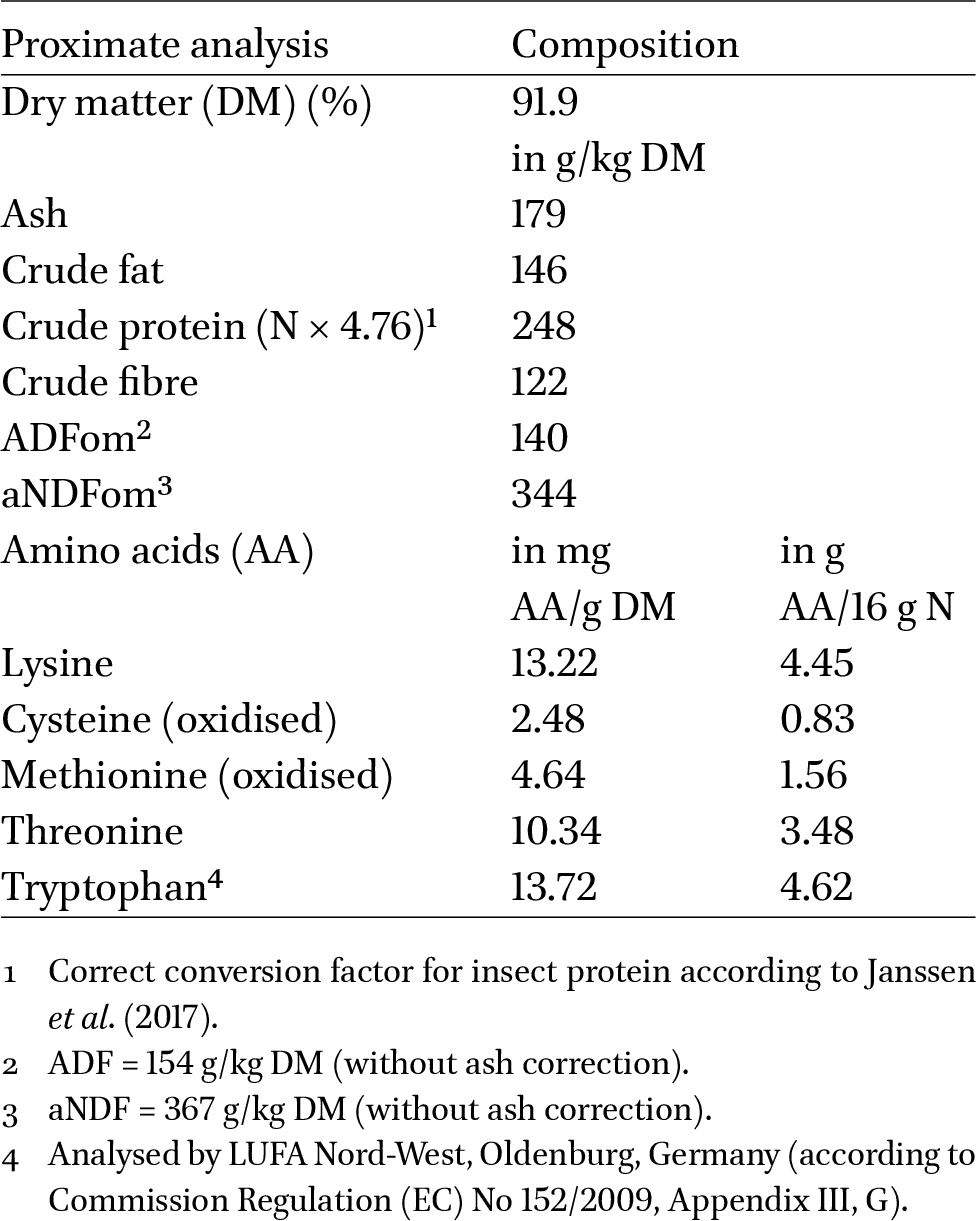
The experimental diet included a 10% share of insect meal derived from H. illucens (HI) reared on municipal organic waste. We decided on this pragmatic inclusion rate for multiple reasons: (1) municipal waste as a substrate resulted in relatively low larval meal protein content; (2) frankly, we did not have copious amounts of larval meal available; (3) supply of larval meal is still limited commercially, associated with high prices, and we do not anticipate insects being included at a high inclusion rate in animal feed in the foreseeable future. The HI larvae were part of a study at the Free University of Bozen-Bolzano, Italy. The insects came from an experimental breeding station near the EcoCenter waste recycling plant, which uses HI from the SmartBugs company (Ponzano, Italy) as a breeding colony. The larvae were reared in plastic containers measuring 60 × 40 × 20 cm; at the age of four days approx. 2000 larvae were placed in each container. The substrate in each container was 20 kg of organic municipal waste. The municipal waste was collected by the local waste disposal authority from the surrounding towns at two-week intervals. The organic fraction of the municipal waste was then processed by the EcoCenter company; after shredding and screening, two separate fractions were produced. The finer fraction was used as a fermentation substrate in a biogas plant. The coarser fraction consisting of e.g. peels, pips, and other residuals was homogenised and used as substrate for larvae cultivation. The larvae were kept at a temperature between 27 and 31 °C in the containers throughout the entire rearing process. As soon as the larvae had reached the 5th instar, the larvae were removed from the substrate by sieving; thereafter the larvae were cleaned, weighed and frozen at −20 °C. The larvae were then transported to the University of Goettingen for further processing. Larvae did not undergo fat extraction due to their low-fat content. The larvae were ground into a meal for further use in chicken diets.
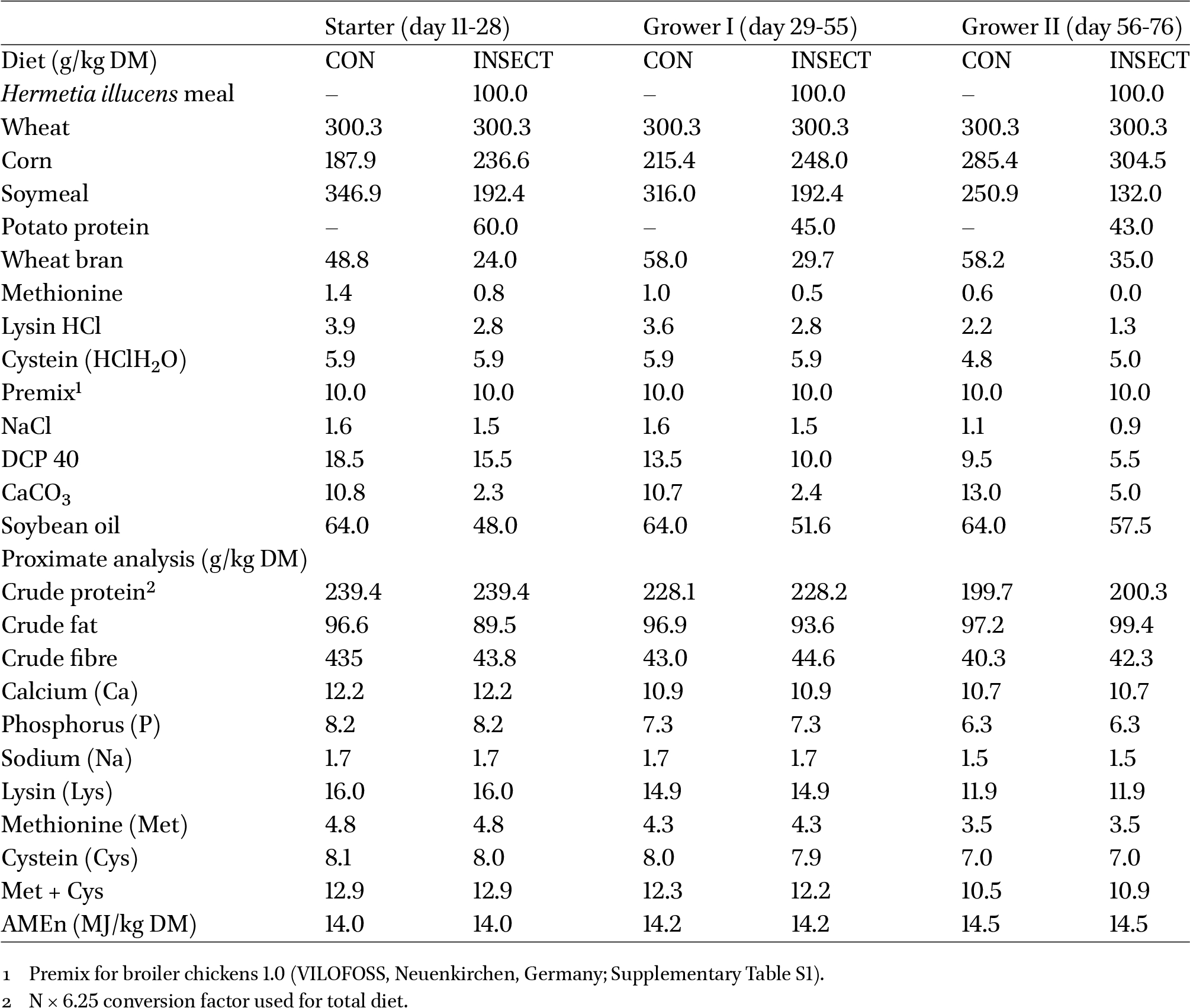
Proximate analysis of the HI larvae (Table 1) and of diets (Table 2) was carried out at the Department of Animal Sciences, University of Goettingen. The contents of the diets in terms of dry matter (DM; Method 3.1), including ash (Method 8.1), crude protein (CP; Dumas method, Method 4.1.2), crude lipid (CL; Soxhlet method, after HCl hydrolysis, Method 5.1.1), were determined according to Naumann and Bassler (1976-2004). Crude fibre (Method 6.1.2), neutral-detergent fibre (aNDFom; analysed with amylase and corrected for residual ash, Method 6.5.1) and acid-detergent fibre (ADFom; corrected for residual ash, Method 6.5.2) were also analysed (Naumann and Bassler, 2012).

Composition of Hermetia illucens larvae reared on municipal organic waste
Citation: Journal of Insects as Food and Feed 9, 11 (2023) ; 10.1163/23524588-20230035
Starter and grower (I and II) diet composition and analysed nutrient content differentiated by control (CON) and insect meal (INSECT) treatments
Citation: Journal of Insects as Food and Feed 9, 11 (2023) ; 10.1163/23524588-20230035
Amino acid composition was analysed by ion-exchange chromatography (Biochrom® 30, Biochrom Ltd. Cambridge, UK) following acid hydrolysis without and with application of an oxidation step for quantitative determination of sulphur containing amino acids (Naumann and Bassler, 1976-2004). Deviating from the procedure for the analysis of amino acids in feedstuffs, the analysis of insect proteins and insect protein containing diets was adapted on the lithium buffer system for physiological amino acids due to interference peaks under the internal standard norleucine. Apparent metabolizable energy was estimated according to World Poultry Science Association values for poultry feed (WPSA, 1984): AMEn (MJ/kg DM) = 15.51 × CP + 34.31 × CL + 16.69 × starch + 3.01 × sugars.
Due to the low protein content of the larvae, HI was only included at 10% of the experimental diet. A protein conversion factor of 4.76 of nitrogen to crude protein content was assumed for the HI larvae meal (Janssen et al., 2017) for including it into experimental diets. The experimental diet (Table 2) was supplemented with potato protein and amino acids to compensate for the low protein content and quality of HI (Table 1). Control diets also contained amino acids. In total, the soymeal content was reduced by 45% for the starter diet, by 39% for the grower I diet, and by 47% for the grower II diet.
The rearing period was more specifically divided into four individual feeding phases in order to be able to meet the needs of the animals in each phase. In the first week of life (day 1 to day 8), a standardised diet was used for both chicken genotypes. After the chicks had been divided into the respective aviaries on the eighth day, the starter feed was introduced. By blending the standard diet with the starter diet, a slow feed changeover was carried out. The standard diet was first replaced by 25% of the starter diet (day 8), on day 9 by 50%, on day 10 by 75%, and finally by 100% of the starter diet (day 11). The starter diet was fed exclusively from day 11 to day 28. The subsequent second experimental diet Grower I was fed up-to and including the eighth week of life (day 29 to day 55). From week nine, a third diet Grower II (day 56 to day 76) was used for the slower-growing dual-purpose chickens (LB).
Data collection
In total, three main categories were monitored regarding animal status: growth performance, slaughter performance and animal health and welfare. A summary overview of the target parameters is shown in Table 3. As target parameters could also be influenced by external factors, the following variables were also recorded: day of evaluation, feed, genotype, combination of feed × genotype (treatment), sex, aviary, room, temperature and humidity, and the individual animal.
Data collection categories of evaluation and level at which they were monitored
Citation: Journal of Insects as Food and Feed 9, 11 (2023) ; 10.1163/23524588-20230035
Growth performance
For the evaluation of the growth performance, the parameters individual live weight and feed intake were recorded starting at day 8, once animals were individually tagged. Each bird was taken out of the aviary once a week and weighed with a scale (DE 6K1D Kern & Sohn GmBH, Balingen-Frommern, Germany; accuracy: 0.1 g). From the weekly live weight, the weekly gain was calculated. The individual weekly gain was then divided by the number of days between the weighings to calculate the daily gain.
Slaughter performance
Slaughter performance was evaluated by carcass and cut weights. ISA birds were slaughtered after eight weeks of rearing; LB birds after eleven weeks. All birds of each genotype were slaughtered on the same day. Birds within an aviary were slaughtered together; the order of aviaries was at random. Birds were fasted prior to slaughter by depriving them of feed the night before slaughter (i.e. 12 h prior to slaughter). The birds from each aviary were placed in a transport box and transported (approx. 7 minute drive) to the slaughterhouse of the Department of Animal Sciences, University of Goettingen. The slaughterhouse is certified according to Article 4 of the European Union Regulation (EC) No 853/2004 for the slaughter of poultry.
The birds were killed and bled immediately after electrical stunning. This was followed by scalding (60 °C), defeathering, evisceration and dressing of the carcasses. Secondary sex characteristics such as size, crest formation and weight were used to classify the birds into sexes prior to slaughter. After slaughter, sex was confirmed by the presence or absence of testes during manual evisceration of a carcass. Directly after bleeding, the first and sixth (out of ten) birds per aviary were removed for other analyses (e.g. microbiome) not included in this study. Only the first bird was removed from aviaries with less than ten birds. The removal of these animals was necessary as the carcass handling, particularly the scalding process, would have affected microbiome analysis and rendered the results unusable.
Additionally, the percentage of marketable cuts was calculated separately for chicken breast meat and chicken leg cuts, i.e. the percentage of dressed carcass weight attributed to total breast meat (left and right pectoralis major muscles) or (right and left) leg cuts per bird.
Animal health and welfare
The concept of the Welfare Quality® Assessment Protocol according to Butterworth et al. (2009) was applied to monitor animal welfare. The assessment protocol was shortened to predominantly focus on animal health parameters, housing comfort, and faecal and litter quality. Each animal was scored once per week by one trained person. Good health, husbandry, and housing can be attributed to ensuring animal welfare and thus the occurrence of pododermatitis, plumage condition and soiling of feet as well as cloaca were recorded as parameters indicative of animal welfare. The occurrence of pododermatitis was rated on a scale of 0-2 (0 = absent to 2 = severe). The cleanliness condition of the plumage was evaluated with a score of 0-3 (0 = clean; to 3 = severely soiled). Further, soiling of the feet was assessed with a score of 0-2 (0 = clean to 2 = soiled) and the degree of soiling of the cloaca with a score between 0 and 3 (0 = clean to 3 = severely soiled). Additional parameters recorded were injuries, litter quality and specific injuries to the toes. Furthermore, the temperature and relative humidity were recorded hourly for each room using a climate data logger (Tinytag Plus 2 TGP-4500; Gemini Data Loggers Ltd, West Sussex, UK).
Meat quality and intramuscular fat quality
Meat pH was measured with a pH meter (Knick Portamess 911, Berlin, Germany) at 30 minutes post mortem, as well as 24 h post mortem, by inserting the glass electrode approx. 1 cm into the pectoralis major muscle. Colour was also monitored at 24 h post mortem on the skinless chicken breast ventral surface using a spectrophotometer (model: CM 600d, Konica Minolta, Tokyo, Japan) with a D65 illuminant. The device was calibrated prior to use with a white tile and enclosed cylinder (black colour) according to the manufacturer. Measurements were taken approx. 1 h after skinning (i.e. 1 h blooming time) with the sample placed on a white surface. The average over six colour measurements per sample were used in further analysis. Both pH and colour were monitored per animal.
A subset of animals per treatment group (n = 14) were designated for the determination of fat quality. Percentage of intramuscular fat (% DM; IMF) was determined prior to conducting fatty acid methyl ester (FAME) analysis on extracted fat samples. Intramuscular fat was extracted, and samples prepared according to Du et al. (2000). FAME analysis was carried out as described in detail in Altmann et al. (2020). Briefly, samples were analysed with gas chromatography coupled with a flame ionisation detector (GC-FID). Identification of fatty acids (as methylesters) was done with Supelco® 37 Component FAME Mix (Sigma-Aldrich, Munich, Germany). The amount of the separated FAME was expressed as % of the total FAME. All samples were analysed in duplicate. Fatty acids with relative areas less than 0.01% and that were not reliably identifiable across samples within a treatment group were removed from further statistical analysis. In addition, FAME analysis (Supplementary Table S2) was conducted on freeze-dried milled (1 mm) diet samples using a modified procedure by Palmquist and Jenkins (2003) as described in Altmann et al. (2020).
Statistical analysis
The software SAS® 9.4 (German) Ink and SAS® OnDemand for Academics (SAS Institute Inc., Cary, NC, USA) were used for the data analysis of growth performance, slaughter performance. Animal health and welfare data were descriptively analysed. Meat and fat quality data were analysed using SPSS software (Version 27.0, IBM Corporation, Armonk, NY, USA). Normal distribution and homogeneity of the residuals for growth and slaughter performance parameters were analysed visually using qq-plots, and statistically using Shapiro-Wilk and Levene’s tests. Not all parameters were homoscedastic, i.e. only carcass weight, dressing percentage, and percentage of marketable breast meat were homoscedastic. Nonetheless, we applied linear mixed models on original data to ensure interpretable results corresponding and comparable to other literature results. We acknowledge that violating the assumption of homoscedasticity may lead to biased standard errors and therefore increases the risk for Type 1 and Type 2 errors.
Linear mixed models were used to investigate live weight, daily gain, feed intake, feed conversion, dressed carcass weight, dressing percentage, weight of marketable cuts (breast and leg), percentage of breast meat and percentage of leg cuts. Live weight was analysed within genotypes with feed, sex, and feed × sampling day as fixed effect; daily gain was analysed with feed, genotype, feed × genotype, feed × genotype × sampling day, and sex × genotype as fixed variables. Individual and aviary were included as random effects. Post hoc Tukey tests were run in order to assign significance for the multiple pairwise mean comparisons. Models analysing feed intake and FCR included feed, genotype, feed × genotype, feed × genotype × sampling day as fixed effects; room (room one or two where the aviary was located) and aviary were included as random variables in the model. For the evaluation of the slaughter performance parameters, models included feed, genotype, feed × genotype, and sex × genotype as fixed effects, order of slaughter and room are included as random effects. The ordinally-scaled animal health and animal welfare parameters were analysed using the frequency distribution for each parameter. In order to determine significant differences and influences, a chi-squared test was carried out for each indicator; however, due to low observation frequencies for numerous values, the statistical test results were invalid/unavailable. Meat quality parameters were evaluated by a two-way analysis of variance (ANOVA), where the treatment groups were considered as a single fixed effect, rather than the feed or genotype. This was done to ensure results are interpretable considering the differing management decisions, i.e. physiological age at slaughter coinciding with genotype. Meat quality parameter models included treatment group (e.g. ISA-CON, ISA-INSECT, LB-CON, LB-INSECT), sex and the interaction of treatment group × sex, as fixed effects. Post hoc Bonferroni-tests were carried out to determine differences in treatment group means. Sex was included as a variable of interest in all statistical analysis due to its significant and relevant effect on growth and slaughter parameters; however, the focal point of this study was not on the effect of animal sex and therefore results of sex on the observed parameters are summarised in the Supplementary Results.
3 Results
Growth performance
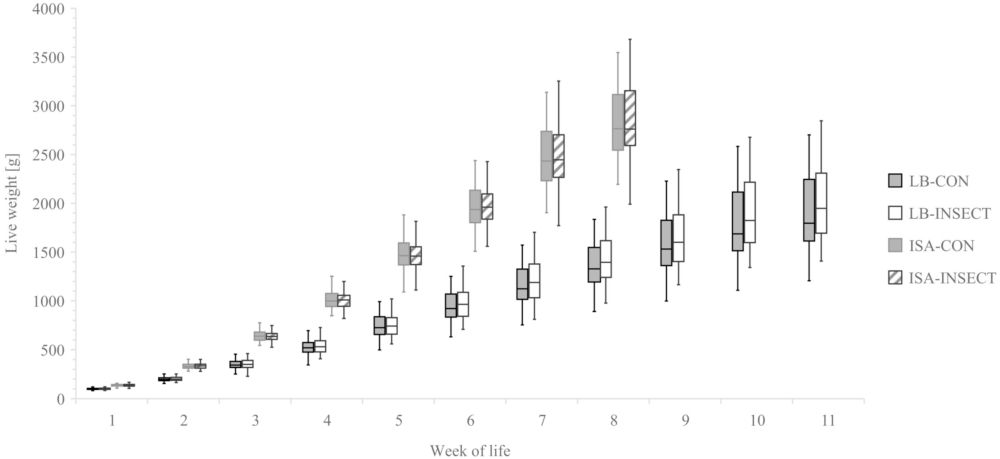
The experimental groups started the experiment (day 8) with arithmetic mean weights of 100.2 ± 10.4 g (LB-CON), 102.3 ± 9.5 g (LB-INSECT), 136.6 ± 11.2 g (ISA-CON) and 137.4 ± 13.1 g (ISA-INSECT). The individual weights were not significantly different (
Growth (live weight (g)) of ISA-JA-757 (ISA) and Les Bleues (LB) birds fed a diet with insect meal (INSECT) and a control diet (CON) for a rearing period of 8 to 11 weeks, respectively.
Citation: Journal of Insects as Food and Feed 9, 11 (2023) ; 10.1163/23524588-20230035
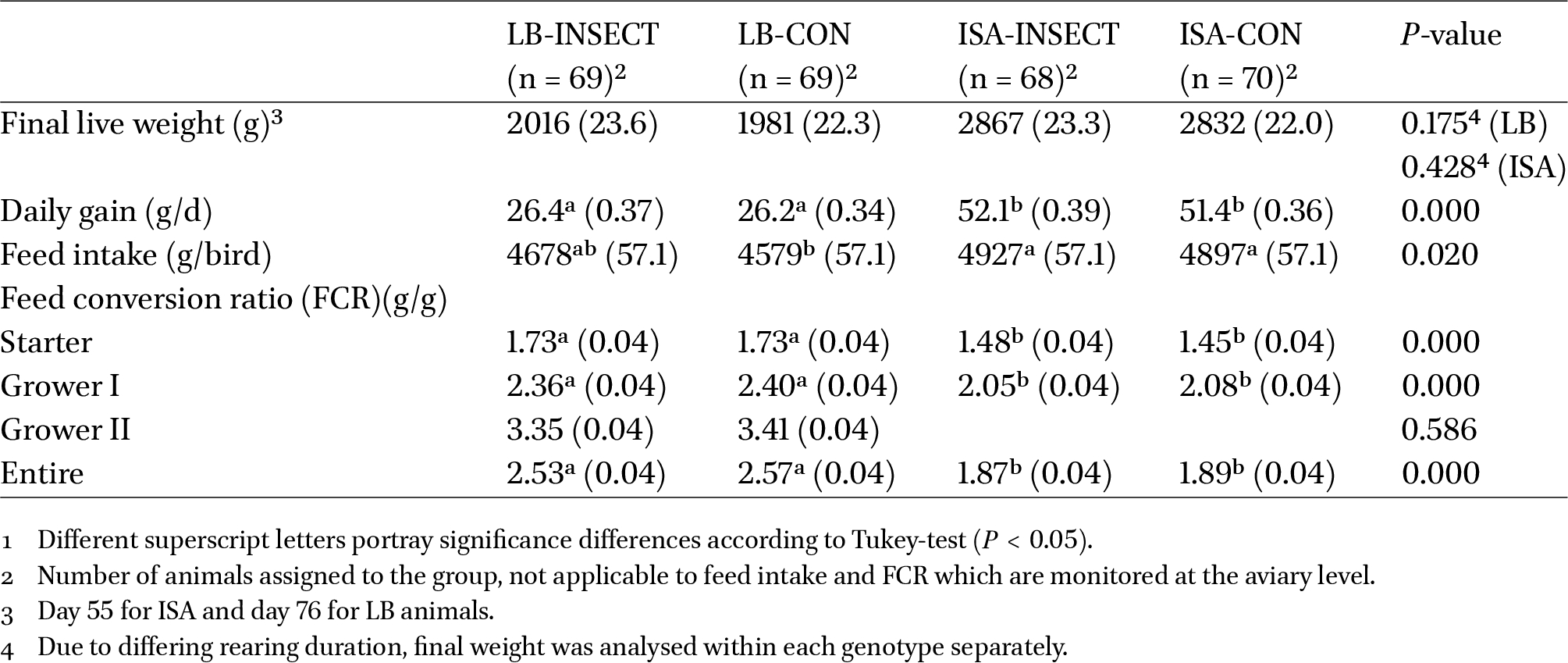
The marginal average weight difference of 34.9 g between the two ISA experimental groups was not significant (Table 4;
Estimated means (standard error) for growth development and feed efficiency of Les Bleues (LB; day 76) and ISA-JA-757 (ISA; day 55) fed either a diet with insect meal (INSECT) or a soymeal-based control diet (CON).1
Citation: Journal of Insects as Food and Feed 9, 11 (2023) ; 10.1163/23524588-20230035
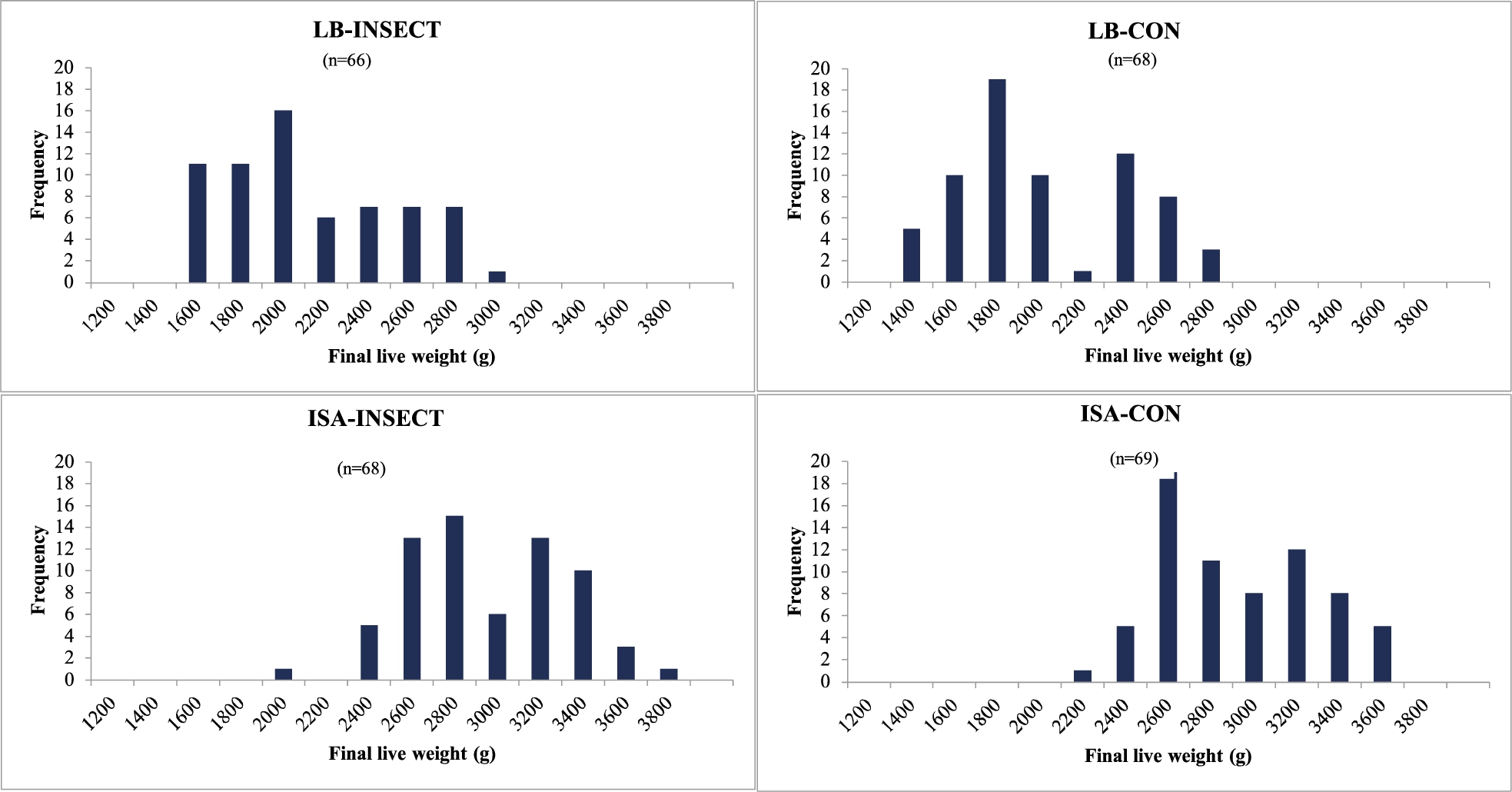
Final live weight distribution of ISA-JA-757 (ISA; day 55) and Les Bleues (LB; day 76) animals fed with insect meal (INSECT) or a control (CON) diet.
Citation: Journal of Insects as Food and Feed 9, 11 (2023) ; 10.1163/23524588-20230035
There was a significant difference (
Diet did not significantly influence the mean feed intake (g/animal until day 55 for ISA animals; until day 76 for LB animals) for either genotype; yet mean feed intake across the entire growth period (i.e. 55 days and 76 days for ISA and LB animals respectively) differed (
In order to portray the overarching growth development of the animals, the uniformity of the experimental groups was calculated. The average uniformity of the individual experimental groups at the end of the entire experiment (LB = 11 weeks, ISA = 8 weeks) was 44.8% for the LB-INSECT group, 42.7% for the LB-CON group, 67.0% for the ISA-INSECT group and 65.4% for the ISA-CON group. ISA birds developed more uniformly than LB birds (Figure 2). Insects as feed also lead to slightly higher rates of uniformity in both genotypes.
Slaughter performance
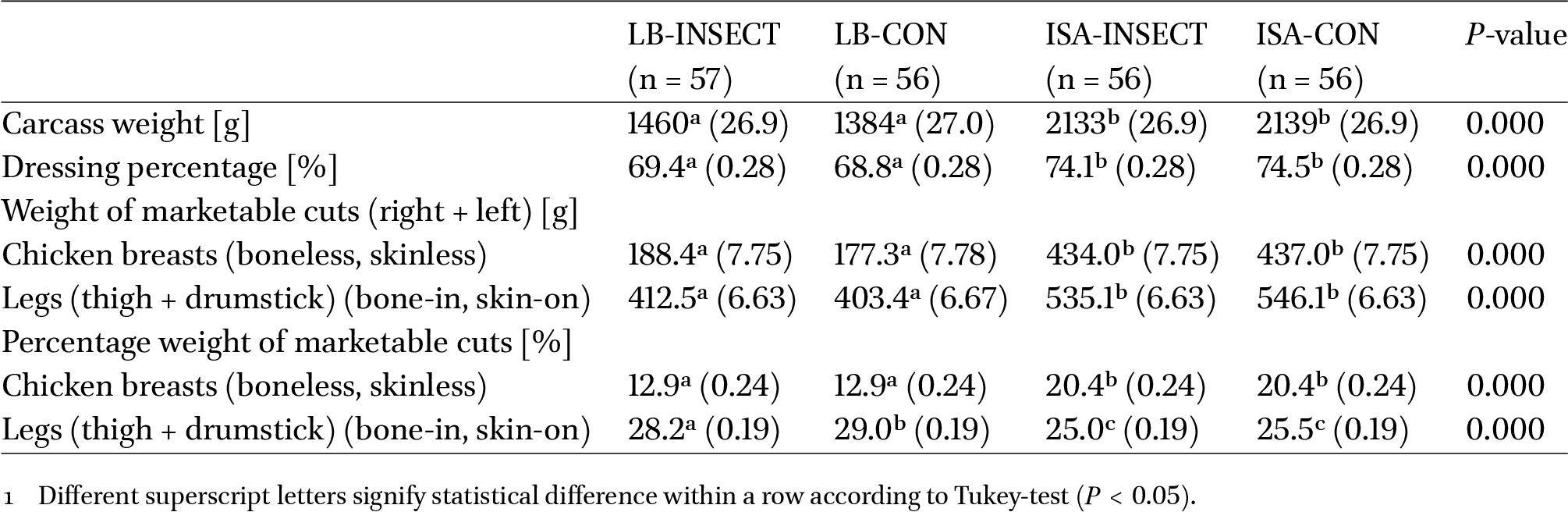
The slaughter performance of both genotypes was evaluated based on carcass weight, dressing percentage, and marketable cuts (Table 5). Significant differences in carcass weight (
Estimated means (standard error) for slaughter performance parameters of Les Bleues (LB; day 76) and ISA-JA-757 (ISA; day 55) fed either a diet with insect meal (INSECT) or a soymeal-based control diet (CON)
Citation: Journal of Insects as Food and Feed 9, 11 (2023) ; 10.1163/23524588-20230035
Animal health and welfare
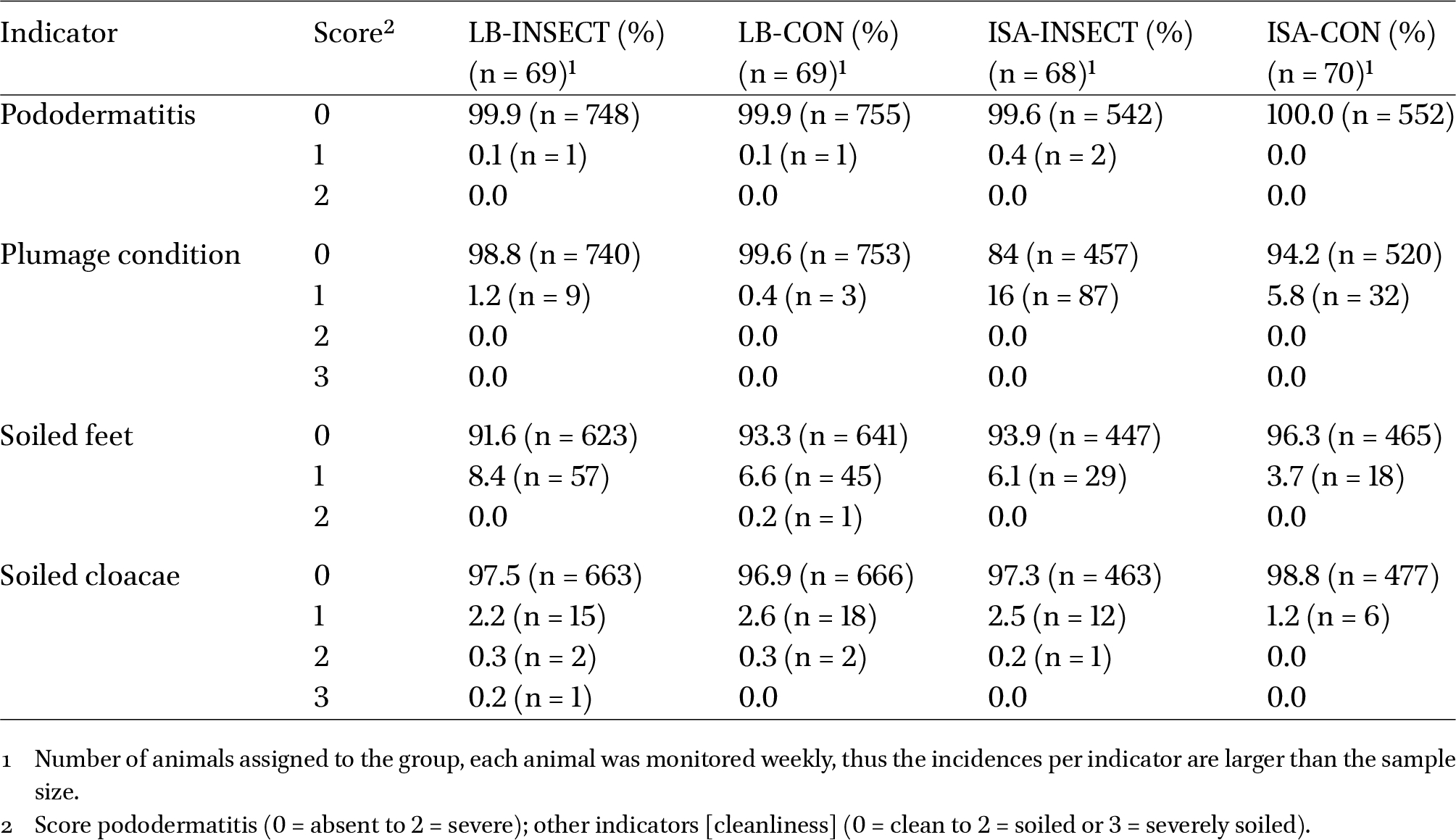
On the basis of various parameters assessed during the experiment (Table 6), conclusions could be drawn about the effect of feeding on animal welfare and animal health. Low incidences of high scores across parameters were observed, which led to invalid chi-squared tests. Overall, the birds in all treatment groups exhibited a high degree of health and welfare.
Relative frequency and absolute number of occurrences for animal health and welfare indicators of Les Bleues (LB; day 76) and ISA-JA-757 (ISA; day 55) reared either on a diet with insect meal (INSECT) or a soymeal-based control diet (CON)
Citation: Journal of Insects as Food and Feed 9, 11 (2023) ; 10.1163/23524588-20230035
Meat and fat quality
Minor, yet statistically significant, differences in meat quality were observed amongst the treatment groups (Table 7). LB breast meat was less yellow than that from the ISA animals (
Means (± standard deviations) of meat quality parameters for Les Bleues (LB; day 76) and ISA-JA-757 (ISA; day 55) animals reared either on a diet with insect meal (INSECT) or a soymeal-based control (CON).1,2
Citation: Journal of Insects as Food and Feed 9, 11 (2023) ; 10.1163/23524588-20230035
The inclusion of insect meal in the diet did significantly affect the fatty acid composition within the IMF. The INSECT diet led to increased levels of saturated fatty acids (SFA) in both genotypes compared to their CON groups (
4 Discussion and conclusions
The inclusion of black soldier fly larval meal in poultry diets, when balanced for amino acid requirements, neither improved nor compromised animal and slaughter performance in both genotypes of chicken studied, which corresponds with much of the literature on black soldier fly as a poultry feed ingredient (Bellezza Oddon et al., 2021; Cullere et al., 2016; Neumann et al., 2017; Onsongo et al., 2018; Pieterse et al., 2019). Although, others have found the inclusion of black soldier fly larval, especially in high rates, to improve performance (Altmann et al., 2020; Dabbou et al., 2018; Hartinger et al., 2022; Heuel et al., 2022; Schiavone et al., 2019). Nonetheless, our results outline that black soldier fly larval meal is an effective protein ingredient in poultry diets, regardless of poultry genetics used in the present study.
Although not the case in our study, improvements in feather condition have been observed by Star et al. (2020), who included whole black soldier fly larvae as a portion of laying hen diets. Biasato et al. (2022) also report improvements in animal welfare when broiler chicken environments are enriched with live black soldier fly larvae. We neither observe positive nor negative animal welfare effects of including black soldier fly larval meal in chicken diets. Only low incidences of waning welfare were observed indicating an overall high welfare status of all treatment groups. Possible welfare improvements from insect meal in the diet are likely superfluous given the high animal welfare associated with the slow-growing genotypes under investigation (Dörper et al., 2021). Another important aspect is that live and/or whole larvae may increase welfare to a greater extent than larval meal as the timing of feed intake will be different. In addition, live larvae elicit natural behaviours, such as foraging behaviour, which could reduce unwanted behaviours such as cannibalism (Veldkamp and Van Niekerk, 2019). Further research should focus on how to optimise the trade-offs between animal feeding nutrition and animal behaviour, health and welfare while integrating black soldier fly larvae into poultry diets.
The inclusion of black soldier fly larval meal did influence observable meat and fat quality parameters. As observed by Altmann et al. (2018) and Altmann et al. (2020), the inclusion of black soldier fly larval meal increases b* (yellow hues) in breast meat. Schiavone et al. (2019) have observed an opposite linear effect; however, their experimental diets included both corn and corn gluten at differing rate, which likely confounded the effect of insect meal on b* values in meat. Pieterse et al. (2019) also found no effect of black soldier fly insect meal on b* values with their corn-containing diets. Heuel et al. (2022) investigated the effect of black soldier fly larval meal from two different origins: only one of the meals significantly increased b* values in comparison to a soybean-based control group. More research comparing different black soldier fly meals is needed in order to ascertain the effects it may have on product appearance. This is especially relevant given that some consumers prefer the increased yellow hues of chicken raised on black soldier fly meal and are willing to pay premiums for these products (Altmann et al., 2022).
Meat pH recorded after 30 minutes post mortem was lower in the LB-INSECT group, compared to the LB-CON. The decreased pH value for the LB genetic corresponds with the findings of Altmann et al. (2018, 2020), who also found the inclusion of black soldier fly larval meal to result in statistically significant decreased pH values directly after slaughter. Altmann et al. (2020) observed a decrease in ultimate (24 h post mortem). Whereas in this study, ultimate pH values remained unaffected by the inclusion of insects as feed, which is in agreement with the findings of Heuel et al. (2022), Schiavone et al. (2019), and Altmann et al. (2018). Regardless, pH values recorded directly and 24 h after slaughter within the literature as well as those observed in this study remain within an acceptable range for broiler meat quality (Petracci et al., 2015).
Our findings remain consistent with the literature that including black soldier fly larvae in poultry diets significantly decreases the proportion of PUFA in IMF (Altmann et al., 2020; Cullere et al., 2018; Daszkiewicz et al., 2022; Heuel et al., 2022; Schiavone et al., 2019). However, the decreased proportion of PUFA has been attributed to increases in SFA (Cullere et al., 2018; Daszkiewicz et al., 2022) or monounsaturated fatty acids (MUFA) (Schiavone et al., 2019) or both (Altmann et al., 2020; Heuel et al., 2022). In our study, increased proportions of SFA were observed in the black soldier fly experimental groups; MUFA levels remained unaffected by the inclusion of black soldier fly larval meal. The increases in SFA were in large part due to lauric (C:12) and myristic (C:14) acid, which is consistent with the literature (Altmann et al., 2020; Cullere et al., 2018; Daszkiewicz et al., 2022; Heuel et al., 2022; Schiavone et al., 2019). However, unlike in our study, lauric acid is found to deposit in fast-growing broiler chicken (Daszkiewicz et al., 2022; Heuel et al., 2022; Pieterse et al., 2019; Schiavone et al., 2019) and quail (Cullere et al., 2018) breast meat when raised with black soldier fly as a feed ingredient. We also expected to find large proportions of lauric acid in our samples from insect fed chickens. The absence of lauric acid in breast muscle IMF in our samples shows that more research is needed across chicken genetic lines and with different black soldier fly meals to evaluate the deposition of C:12 in IMF. This is especially relevant, if fatty acid composition is to be used as a biomarker for insect feed ingredients (Altmann et al., 2019).
In general, black soldier fly larval meal proved to be a sufficient protein feed ingredient for slow-growing chickens. Animal and slaughter performance remained consistent across chicken genotypes. Meat quality, specifically meat colour according to Altmann et al. (2022), was improved with the inclusion of black soldier fly larval meal. From a human nutrition and health perspective, fat quality could be considered improved, as both lauric (C:12) and myristic (C:14) acids, characteristic of coconut milk, are associated with increased levels of high-density-lipoproteins (Ekanayaka et al., 2013). In addition, recent research has shown that although increased amounts of PUFA are associated with reducing mortality due to heart diseases, an increase in SFA is not associated with a higher risk of mortality (Wang et al., 2023). Therefore, chicken fed with insect meal can be a part of a healthy and varied diet. From a shelf-life perspective, meat products, particularly processed meat products may be more stable with increased SFA levels attributed to black soldier fly as feed. Future research should use the available knowledge on animal performance and effects on product quality to now optimise the inclusion of black soldier fly in poultry feed based on food waste or by-product substrate used as well as on a processor and consumer-oriented demands (Grunert et al., 2011).
Corresponding author; e-mail: brianne.altmann@agr.uni-goettingen.de
Supplementary material
Supplementary material is available online at: https://doi.org/10.6084/m9.figshare.23716923
Acknowledgements
This study was only possible thanks to the particular interest and commitment of Jeremias Ehmann as well as the technical staff at the Department of Animal Sciences, University of Göttingen.
Author contributions
The first ant the second authors contributed equally to this work.
Conflict of interest
The authors declare that there are no conflicts of interest.
Funding
This work was partially supported by EFRE-FESR ‘European Regional Development Fund’ Operational Programme n. 1033 – PROINSECT (2016-20) in collaboration with the EFRE-FESR Integrated Project n.1013 – INSECTIROL.
References
Abd El-Hack, M.E., Shafi, M.E., Alghamdi, W.Y., Abdelnour, S.A., Shehata, A.M., Noreldin, A.E., Ashour, E.A., Swelum, A.A., Al-Sagan, A.A., Alkhateeb, M., Taha, A.E., Abdel-Moneim, A.-M.E., Tufarelli, V. and Ragni, M., 2020. Black soldier fly (Hermetia illucens) meal as a promising feed ingredient for poultry: a comprehensive review. Agriculture 10: 339. https://doi.org/10.3390/agriculture10080339
Alagappan, S., Rowland, D., Barwell, R., Mantilla, S.M.O., Mikkelsen, D., James, P., Yarger, O. and Hoffman, L.C., 2022. Legislative landscape of black soldier fly (Hermetia illucens) as feed. Journal of Insects as Food and Feed 8(4): 343-355. https://doi.org/10.3920/JIFF2021.0111
Altmann, B.A., Anders, S., Risius, A. and Mörlein, D., 2022. Information effects on consumer preferences for alternative animal feedstuffs. Food Policy 106: 102192. https://doi.org/10.1016/j.foodpol.2021.102192
Altmann, B.A., Neumann, C., Rothstein, S., Liebert, F. and Mörlein, D., 2019. Do dietary soy alternatives lead to pork quality improvements or drawbacks? A look into micro-alga and insect protein in swine diets. Meat Science 153: 26-34. https://doi.org/10.1016/j.meatsci.2019.03.001
Altmann, B.A., Neumann, C., Velten, S., Liebert, F. and Mörlein, D., 2018. Meat quality derived from high inclusion of a micro-alga or insect meal as an alternative protein source in poultry diets: a pilot study. Foods 7(3): 34. https://doi.org/10.3390/foods7030034
Altmann, B.A., Wigger, R., Ciulu, M. and Mörlein, D., 2020. The effect of insect or microalga alternative protein feeds on broiler meat quality. Journal of the Science of Food and Agriculture 100: 4292-4302. https://doi.org/10.1002/jsfa.10473
Bellezza Oddon, S., Biasato, I., Imarisio, A., Pipan, M., Dekleva, D., Colombino, E., Capucchio, M.T., Meneguz, M., Bergagna, S., Barbero, R., Gariglio, M., Dabbou, S., Fiorilla, E., Gasco, L. and Schiavone, A., 2021. Black soldier fly and yellow mealworm live larvae for broiler chickens: effects on bird performance and health status. Journal of Animal Physiology and Animal Nutrition 105: 10-18. https://doi.org/10.1111/jpn.13567
Biasato, I., Bellezza Oddon, S., Chemello, G., Gariglio, M., Fiorilla, E., Dabbou, S., Pipan, M., Dekleva, D., Macchi, E., Gasco, L. and Schiavone, A., 2022. Welfare implications for broiler chickens reared in an insect larvae-enriched environment: focus on bird behaviour, plumage status, leg health, and excreta corticosterone. Frontiers in Physiology 13: 930158 https://doi.org/10.3389/fphys.2022.930158
Brümmer, N., Christoph-Schulz, I. and Rovers, A.K., 2018. Consumers’ perspective on dual-purpose chickens as alternative to the killing of day-old chicks. International Journal on Food System Dynamics 9(5): 390-398. https://doi.org/10.18461/ijfsd.v9i5.951
Butterworth, A., Arnould, C., Fiks van Niekerk, T., Veissier, I., Keeling, L., van Overbeke, G. and Bedaux, V., 2009. Welfare quality® assessment for poultry (broilers, laying hens). Welfare Quality® Consortium, Lelystad, the Netherlands.
Cullere, M., Tasoniero, G., Giaccone, V., Acuti, G., Marangon, A. and Zotte, A.D., 2018. Black soldier fly as dietary protein source for broiler quails: meat proximate composition, fatty acid and amino acid profile, oxidative status and sensory traits. Animal 12(3): 640-647. https://doi.org/10.1017/S1751731117001860
Cullere, M., Tasoniero, G., Giaccone, V., Claeys, E., de Smet, S. and Zotte, A.D., 2016. Black soldier fly as dietary protein source for broiler quails: apparent digestibility, excreta microbial load, feed choice, performance, carcass and meat traits. Animal 10(12): 1923-1930. https://doi.org/10.1017/S1751731116001270
Dabbou, S., Gai, F., Biasato, I., Capucchio, M.T., Biasibetti, E., Dezzutto, D., Meneguz, M., Plachà, I., Gasco, L. and Schiavone, A., 2018. Black soldier fly defatted meal as a dietary protein source for broiler chickens: effects on growth performance, blood traits, gut morphology and histological features. Journal of Animal Science and Biotechnology 9(1): 49. https://doi.org/10.1186/s40104-018-0266-9
Daszkiewicz, T., Murawska, D., Kubiak, D. and Han, J., 2022. Chemical composition and fatty acid profile of the pectoralis major muscle in broiler chickens fed diets with full-fat black soldier fly (Hermetia illucens) larvae meal. Animals 12(4): 464. https://doi.org/10.3390/ani12040464
Dörper, A., Veldkamp, T. and Dicke, M., 2021. Use of black soldier fly and house fly in feed to promote sustainable poultry production. Journal of Insects as Food and Feed 7(5): 761-780. https://doi.org/10.3920/JIFF2020.0064
Du, M., Ahn, D.U., Nam, K.C. and Sell, J.L., 2000. Influence of dietary conjugated linoleic acid on volatile profiles, color and lipid oxidation of irradiated raw chicken meat. Meat Science 56(4): 387-395. https://doi.org/10.1016/S0309-1740(00)00067-X
Ekanayaka, R.A.I., Ekanayaka, N.K., Perera, B. and De Silva, P.G.S.M., 2013. Impact of a traditional dietary supplement with coconut milk and soya milk on the lipid profile in normal free living subjects. Journal of Nutrition and Metabolism 2013: 481068. http://dx.doi.org/10.1155/2013/481068
Elahi, U., Xu, C., Wang, J., Lin, J., Wu, S., Zhang, H. and Qi, G., 2022. Insect meal as a feed ingredient for poultry. Animal Bioscience 35(2): 332-346. https://doi.org/10.5713/ab.21.0435
European Commission (EC), 2004. Regulation (EC) No 853/2004 of the European Parliament and of the Council of 29 April 2004 laying down specific hygiene rules for food of animal origin. Official Journal of the European Union L139: 55-205. Available at: http://data.europa.eu/eli/reg/2004/853/oj.
European Commission (EC), 2009. Commission Regulation (EC) No 152/2009 of 27 January 2009 laying down the methods of sampling and analysis for the official control of feed. Official Journal of the European Union L54: 1-130. Available at: http://data.europa.eu/eli/reg/2009/152/oj.
European Union (EU), 2021. Commission Regulation (EU) 2021/1372 of 17 August 2021 amending Annex IV to Regulation (EC) No 999/2001 of the European Parliament and of the Council as regards the prohibition to feed non-ruminant farmed animals, other than fur animals, with protein derived from animals. Official Journal of the European Union L295: 1-17. Available at: http://data.europa.eu/eli/reg/2021/1372/oj.
Grunert, K.G., Verbeke, W., Kügler, J.O., Saeed, F. and Scholderer, J., 2011. Use of consumer insight in the new product development process in the meat sector. Meat Science 89(3): 251-258. https://doi.org/10.1016/j.meatsci.2011.04.024
Hartinger, K., Fröschl, K., Ebbing, M.A., Bruschek-Pfleger, B., Schedle, K., Schwarz, C. and Gierus, M., 2022. Suitability of Hermetia illucens larvae meal and fat in broiler diets: effects on animal performance, apparent ileal digestibility, gut histology, and microbial metabolites. Journal of Animal Science and Biotechnology 13(1): 50. https://doi.org/10.1186/s40104-022-00701-7
Heuel, M., Sandrock, C., Leiber, F., Mathys, A., Gold, M., Zurbrüegg, C., Gangnat, I.D.M., Kreuzer, M. and Terranova, M., 2022. Black soldier fly larvae meal and fat as a replacement for soybeans in organic broiler diets: effects on performance, body N retention, carcass and meat quality. British Poultry Science 63(5): 650-661. https://doi.org/10.1080/00071668.2022.2053067
Hopkins, I., Newman, L.P., Gill, H. and Danaher, J., 2021. The influence of food waste rearing substrates on black soldier fly larvae protein composition: a systematic review. Insects 12(7): 608. https://doi.org/10.3390/insects12070608
Janssen, R.H., Vincken, J.P., Van den Broek, L.A.M., Fogliano, V. and Lakemond, C.M.M., 2017. Nitrogen-to-protein conversion factors for three edible insects: Tenebrio molitor, Alphitobius diaperinus, and Hermetia illucens. Journal of Agricultural and Food Chemistry 65(11): 2275-2278. https://doi.org/10.1021/acs.jafc.7b00471
Knierim, U., Andersson, R., Keppler, C., Petermann, S., Rauch, E., Spindler, B. and Zapf, R., 2016. Tierschutzindikatoren: Leitfaden für die Praxis – Geflügel. Vorschläge für die Produktionsrichtungen Jung- und Legehenne, Masthuhn, Mastpute. KTBL, Darmstadt, Germany. [In German].
Lambertz, C., Wuthijaree, K. and Gauly, M., 2018. Performance, behavior, and health of male broilers and laying hens of 2 dual-purpose chicken genotypes. Poultry Science 97(10): 3564-3576. https://doi.org/10.3382/ps/pey223
Naumann, C. and Bassler, R., 1976-2004. The chemical analysis of feedstuffs. Methodenbuch: Vol. III. VDLUFA-Verlag, Darmstadt, Germany. [In German].
Naumann, C. and Bassler, R., 2012. The chemical analysis of feedstuffs. Methodenbuch: Vol. III. VDLUFA-Verlag, Darmstadt, Germany. [In German].
Neumann, C., Velten, S. and Liebert, F., 2017. Improving the dietary protein quality by amino acid fortification with a high inclusion level of micro algae (Spirulina platensis) or insect meal (Hermetia illucens) in meat type chicken diets. Open Journal of Animal Sciences 08(01): 12-26. https://doi.org/10.4236/ojas.2018.81002
Neumann, C., Velten, S. and Liebert, F., 2018. The graded inclusion of algae (Spirulina platensis) or insect (Hermetia illucens) meal as a soybean meal substitute in meat type chicken diets impacts on growth, nutrient deposition and dietary protein quality depending on the extent of amino acid supplementation. Open Journal of Animal Sciences 8: 163-183. https://doi.org/10.4236/ojas.2018.82012
Onsongo, V.O., Osuga, I.M., Gachuiri, C.K., Wachira, A.M., Miano, D.M., Tanga, C.M., Ekesi, S., Nakimbugwe, D. and Fiaboe, K.K.M., 2018. Insects for income generation through animal feed: effect of dietary replacement of soybean and fish meal with black soldier fly meal on broiler growth and economic performance. Journal of Economic Entomology 111(4): 1966-1973. https://doi.org/10.1093/jee/toy118
Palmquist, D.L. and Jenkins, T.C., 2003. Challenges with fats and fatty acid methods. Journal of Animal Science 81(12): 3250-3254. https://doi.org/10.2527/2003.81123250x
Petracci, M., Mudalal, S., Soglia, F. and Cavani, C., 2015. Meat quality in fast-growing broiler chickens. World’s Poultry Science Journal 71(2): 363-374. https://doi.org/10.1017/S0043933915000367
Pieterse, E., Erasmus, S.W., Uushona, T. and Hoffman, L.C., 2019. Black soldier fly (Hermetia illucens) pre-pupae meal as a dietary protein source for broiler production ensures a tasty chicken with standard meat quality for every pot. Journal of the Science of Food and Agriculture 99: 893-903. https://doi.org/10.1002/jsfa.9261
Röös, E., Bajželj, B., Smith, P., Patel, M., Little, D. and Garnett, T., 2017. Greedy or needy? Land use and climate impacts of food in 2050 under different livestock futures. Global Environmental Change 47: 1-12. https://doi.org/10.1016/j.gloenvcha.2017.09.001
Schiavone, A., Dabbou, S., Petracci, M., Zampiga, M., Sirri, F., Biasato, I., Gai, F. and Gasco, L., 2019. Black soldier fly defatted meal as a dietary protein source for broiler chickens: effects on carcass traits, breast meat quality and safety. Animal 13(10): 2397-2405. https://doi.org/10.1017/S1751731119000685
Smetana, S., Palanisamy, M., Mathys, A. and Heinz, V., 2016. Sustainability of insect use for feed and food: life cycle assessment perspective. Journal of Cleaner Production 137: 741-751. https://doi.org/10.1016/j.jclepro.2016.07.148
Smetana, S., Schmitt, E. and Mathys, A., 2019. Sustainable use of Hermetia illucens insect biomass for feed and food: attributional and consequential life cycle assessment. Resources, Conservation and Recycling 144: 285-296. https://doi.org/10.1016/j.resconrec.2019.01.042
Star, L., Arsiwalla, T., Molist, F., Leushuis, R., Dalim, M. and Paul, A., 2020. Gradual provision of live black soldier fly (Hermetia illucens) larvae to older laying hens: effect on production performance, egg quality, feather condition and behavior. Animals 10(2): 216. https://doi.org/10.3390/ani10020216
Veldkamp, T. and Van Niekerk, T.G.C.M., 2019. Live black soldier fly larvae (Hermetia illucens) for Turkey poults. Journal of Insects as Food and Feed 5: 301-311. https://doi.org/10.3920/JIFF2018.0031
Vissers, L.S.M., De Jong, I.C., Van Horne, P.L.M. and Saatkamp, H.W., 2019. Global prospects of the cost-efficiency of broiler welfare in middle-segment production systems. Animals 9(7): 473. https://doi.org/10.3390/ani9070473
Wallenbeck, A., Wilhelmsson, S., Jönsson, L., Gunnarsson, S. and Yngvesson, J., 2016. Behaviour in one fast-growing and one slower-growing broiler (Gallus gallus domesticus) hybrid fed a high- or low-protein diet during a 10-week rearing period. Acta Agriculturae Scandinavica Section A: Animal Sciences 66: 168-176. https://doi.org/10.1080/09064702.2017.1303081
Wang, Y., Fang, Y., Witting, P.K., Charchar, F.J., Sobey, C.G., Drummond, G.R. and Golledge, J., 2023. Dietary fatty acids and mortality risk from heart disease in US adults: an analysis based on NHANES. Scientific Reports 13: 1614. https://doi.org/10.1038/s41598-023-28738-2
WPSA, 1984. The prediction of apparent metabolizable energy values for poultry in compound feeds. World’s Poultry Science Journal 40: 181-182.
Zhang, J., Zhang, J., Li, J., Tomerlin, J.K., Xiao, X., ur Rehman, K., Cai, M., Zheng, L. and Yu, Z., 2021. Black soldier fly: a new vista for livestock and poultry manure management. Journal of Integrative Agriculture 20(5): 1167-1179. https://doi.org/10.1016/S2095-3119(20)63423-2