Möchten Sie über diese Zeitschrift informiert bleiben? Klicken Sie bitte auf die Buttons, um unsere Alerts zu abonnieren.
Möchten Sie über diese Zeitschrift informiert bleiben? Klicken Sie bitte auf die Buttons, um unsere Alerts zu abonnieren.
In vitro assessment of protein digestibility and mineral solubility of black soldier fly larvae meals for monogastric animals
in Journal of Insects as Food and Feed
Autor:innen:
,
,
,
,
,
, und
M.S. Silva
https://orcid.org/0000-0001-8691-4054
M.S. Silva
Institute of Marine Research, P.O. Box 1870 Nordnes, 5817 Bergen, Norway.
Search for other papers by M.S. Silva in
Current site
Google Scholar
Search for other papers by M.S. Silva in
Current site
Google Scholar
R. Matos
R. Matos
Institute of Marine Research, P.O. Box 1870 Nordnes, 5817 Bergen, Norway.
Department of Biological Sciences, University of Bergen, P.O. Box 7803, 5020 Bergen, Norway.
Search for other papers by R. Matos in
Current site
Google Scholar
Department of Biological Sciences, University of Bergen, P.O. Box 7803, 5020 Bergen, Norway.
Search for other papers by R. Matos in
Current site
Google Scholar
P. Araujo
P. Araujo
Institute of Marine Research, P.O. Box 1870 Nordnes, 5817 Bergen, Norway.
Search for other papers by P. Araujo in
Current site
Google Scholar
Search for other papers by P. Araujo in
Current site
Google Scholar
E.J. Lock
E.J. Lock
Institute of Marine Research, P.O. Box 1870 Nordnes, 5817 Bergen, Norway.
Department of Biological Sciences, University of Bergen, P.O. Box 7803, 5020 Bergen, Norway.
Search for other papers by E.J. Lock in
Current site
Google Scholar
Department of Biological Sciences, University of Bergen, P.O. Box 7803, 5020 Bergen, Norway.
Search for other papers by E.J. Lock in
Current site
Google Scholar
R. Gopika
R. Gopika
Institute of Marine Research, P.O. Box 1870 Nordnes, 5817 Bergen, Norway.
Department of Biological Sciences, University of Bergen, P.O. Box 7803, 5020 Bergen, Norway.
Search for other papers by R. Gopika in
Current site
Google Scholar
Department of Biological Sciences, University of Bergen, P.O. Box 7803, 5020 Bergen, Norway.
Search for other papers by R. Gopika in
Current site
Google Scholar
P.A.J. Prabhu
P.A.J. Prabhu
Institute of Marine Research, P.O. Box 1870 Nordnes, 5817 Bergen, Norway.
Search for other papers by P.A.J. Prabhu in
Current site
Google Scholar
Search for other papers by P.A.J. Prabhu in
Current site
Google Scholar
I. Belghit
I. Belghit
Institute of Marine Research, P.O. Box 1870 Nordnes, 5817 Bergen, Norway.
Search for other papers by I. Belghit in
Current site
Google Scholar
Search for other papers by I. Belghit in
Current site
Google Scholar
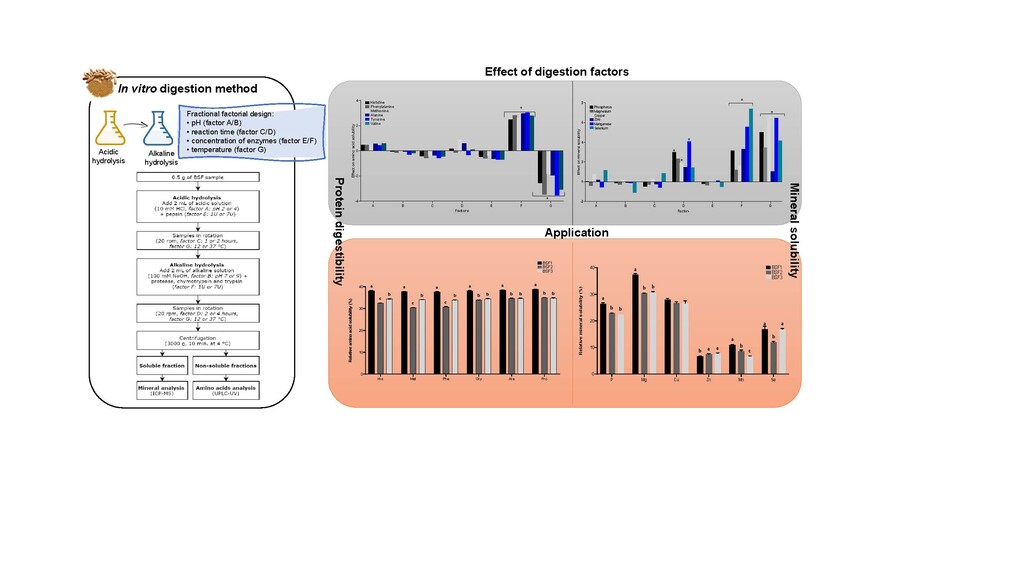
Animal farming is a fast-growing sector which demands a large supply of feed materials and the search for novel feed ingredients with a smaller impact on the global environment has been intensified. However, before the inclusion of these feed ingredients in animal feed, a preliminary assessment of the quality and performance is needed. This evaluation is usually done byin vivo feeding trials, butin vitro digestion methods have been successfully used for gathering information regarding the nutritional value of the different feed components. Therefore, in this work, anin vitro digestion method was developed using black soldier fly (BSF) larvae meals. The method included seven experimental variables, namely: pH in stomach, pH in intestine, reaction time in stomach, reaction time in intestine, enzyme concentration in stomach, enzyme concentration in intestine and temperature. The experimental variables were screened by means of a fractional factorial design (27-2) that allowed to select the concentration of enzyme in the intestine and temperature (at 7 U and 37 °C, respectively) as the most influential factors on amino acid and mineral solubility in BSF larvae meal. Performing thein vitro digestibility at 37 °C with pH of the stomach and intestine at 2 and 9, reaction time in the stomach and intestine at 1 hour and 4 hours and concentration of enzyme in the stomach and intestine at 1 U and 7 U resulted in the highest overall nutrient solubility. This optimisedin vitro digestion methodology was used to assess the nutritional stability of three batches of BSF meals delivered by the same producer. Thein vitro digestion method was able to reveal differences between the three batches of BSF meals.

ProCite
RefWorks
Reference Manager
BibTeX
Zotero
EndNote
-
Bassompierre, M., Ostenfeld, T.H., McLean, E. and Torrissen, K.R., 1998.In vitro protein digestion, and growth of Atlantic salmon with different trypsin isozymes. Aquaculture International 6: 47-56.https://doi.org/10.1023/A:1009269703297
-
Belghit, I., Liland, N.S., Gjesdal, P., Biancarosa, I., Menchetti, E., Li, Y., Waagbø, R., Krogdahl, Å. and Lock, E.-J., 2019a. Black soldier fly larvae meal can replace fish meal in diets of sea-water phase Atlantic salmon (Salmo salar). Aquaculture 503: 609-619.https://doi.org/10.1016/j.aquaculture.2018.12.032
-
Belghit, I., Liland, N.S., Waagbø, R., Biancarosa, I., Pelusio, N., Li, Y., Krogdahl, Å. and Lock, E.-J., 2018. Potential of insect-based diets for Atlantic salmon (Salmo salar). Aquaculture 491: 72-81.https://doi.org/10.1016/j.aquaculture.2018.03.016
-
Belghit, I., Lock, E.-J., Fumière, O., Lecrenier, M.-C., Renard, P., Dieu, M., Berntssen, M.H.G., Palmblad, M. and Rasinger, J.D., 2019b. Species-specific discrimination of insect meals for aquafeeds by direct comparison of tandem mass spectra. Animals 9: 222.https://doi.org/10.3390/ani9050222
-
Biasato, I., Renna, M., Gai, F., Dabbou, S., Meneguz, M., Perona, G., Martinez, S., Lajusticia, A.C.B., Bergagna, S., Sardi, L., Capucchio, M.T., Bressan, E., Dama, A., Schiavone, A. and Gasco, L., 2019. Partially defatted black soldier fly larva meal inclusion in piglet diets: effects on the growth performance, nutrient digestibility, blood profile, gut morphology and histological features. Journal of Animal Science and Biotechnology 10: 12.https://doi.org/10.1186/s40104-019-0325-x
-
Bisswanger, H., 2014. Enzyme assays. Perspectives in Science 1: 41-55.https://doi.org/10.1016/j.pisc.2014.02.005
-
Bryan, D.D.S.L. and Classen, H.L., 2020.In vitro methods of assessing protein quality for poultry. Animals 10: 551.https://doi.org/10.3390/ani10040551
-
Bryan, D.D.S.L., Abbott, D.A. and Classen, H.L., 2018. Development of anin vitro protein digestibility assay mimicking the chicken digestive tract. Animal Nutrition 4: 401-409.https://doi.org/10.1016/j.aninu.2018.04.007
-
Bryan, D.D.S.L., Abbott, D.A. and Classen, H.L., 2019. Digestion kinetics of protein sources determined using anin vitro chicken model. Animal Feed Science and Technology 248: 106-113.https://doi.org/10.1016/j.anifeedsci.2019.01.002
-
Caimi, C., Biasato, I., Chemello, G., Oddon, S.B., Lussiana, C., Malfatto, V.M., Capucchio, M.T., Colombino, E., Schiavone, A., Gai, F., Trocino, A., Brugiapaglia, A., Renna, M. and Gasco, L., 2021. Dietary inclusion of a partially defatted black soldier fly (Hermetia illucens) larva meal in low fishmeal-based diets for rainbow trout (Oncorhynchus mykiss). Journal of Animal Science and Biotechnology 12: 50.https://doi.org/10.1186/s40104-021-00575-1
-
Chen, H., Wierenga, P.A., Hendriks, W.H. and Jansman, A.J.M., 2019.In vitro protein digestion kinetics of protein sources for pigs. Animal 13: 1154-1164.https://doi.org/10.1017/S1751731118002811
-
Chia, S.Y., Tanga, C.M., Van Loon, J.J.A. and Dicke, M., 2019. Insects for sustainable animal feed: inclusive business models involving smallholder farmers. Current Opinion in Environmental Sustainability 41: 23-30.https://doi.org/10.1016/j.cosust.2019.09.003
-
Choi, H., Won, C.S. and Kim, B.G., 2021. Protein and energy concentrations of meat meal and meat and bone meal fed to pigs based onin vitro assays. Animal Nutrition 7: 252-257.https://doi.org/10.1016/j.aninu.2020.07.007
-
DiGiacomo, K. and Leury, B.J., 2019. Review: insect meal: a future source of protein feed for pigs? Animal 13: 3022-3030.https://doi.org/10.1017/S1751731119001873
-
Dryden, G.M.L., 2008. Animal nutrition science. CABI, Wallingford, UK.
'Animal nutrition science', ().
-
Espe, M., Andersen, S.M., Holen, E., Rønnestad, I., Veiseth-Kent, E., Zerrahn, J.E. and Aksnes, A., 2014. Methionine deficiency does not increase polyamine turnover through depletion of hepatic S-adenosylmethionine in juvenile Atlantic salmon. British Journal of Nutrition 112: 1274-1285.https://doi.org/10.1017/s0007114514002062
-
European Commission (EC), 2017. Commission Regulation (EU) 2017/893 of 24 May 2017 amending Annexes I and IV to Regulation (EC) No 999/2001 of the European Parliament and of the Council and Annexes X, XIV and XV to Commission Regulation (EU) No 142/2011 as regards the provisions on processed animal protein. Official Journal of the EU L 138: 92-116.
-
European Commission (EC), 2021. Commission Regulation (EU) 2021/1372 of 17 August 2021 amending Annex IV to Regulation (EC) No 999/2001 of the European Parliament and of the Council as regards the prohibition to feed non-ruminant farmed animals, other than fur animals, with protein derived from animals. Official Journal of the EU L 295: 1-17.
-
Galassi, G., Jucker, C., Parma, P., Lupi, D., Crovetto, G.M., Savoldelli, S. and Colombini, S., 2021. Impact of agro-industrial byproducts on bioconversion, chemical composition,in vitro digestibility, and microbiota of the black soldier fly (Diptera: Stratiomyidae) larvae. Journal of Insect Science 21: 8.https://doi.org/10.1093/jisesa/ieaa148
-
Gilannejad, N., Martínez-Rodríguez, G., Yúfera, M. and Moyano, F.J., 2017. Estimating the effect of different factors on the digestive bioaccessibility of protein by the Senegalese sole (Solea senegalensis); combination of response surface methodology andin vitro assays. Aquaculture 477: 28-34.https://doi.org/10.1016/j.aquaculture.2017.04.037
-
Gilannejad, N., Martínez-Rodríguez, G., Yúfera, M. and Moyano, F.J., 2018. Modelling digestive hydrolysis of nutrients in fish using factorial designs and desirability function. PLoS ONE 13: e0206556.https://doi.org/10.1371/journal.pone.0206556
-
Glencross, B.D., 2020. A feed is still only as good as its ingredients: an update on the nutritional research strategies for the optimal evaluation of ingredients for aquaculture feeds. Aquaculture Nutrition 26: 1871-1883.https://doi.org/10.1111/anu.13138
-
Graham, H., Löwgren, W. and Åman, P., 1989. Anin vitro method for studying digestion in the pig: 2. Comparison within vivo ileal and faecal digestibilities. British Journal of Nutrition 61: 689-698.https://doi.org/10.1079/BJN19890155
-
Henry, M., Gasco, L., Piccolo, G. and Fountoulaki, E., 2015. Review on the use of insects in the diet of farmed fish: past and future. Animal Feed Science and Technology 203: 1-22.https://doi.org/10.1016/j.anifeedsci.2015.03.001
-
Hua, K., Cobcroft, J.M., Cole, A., Condon, K., Jerry, D.R., Mangott, A., Praeger, C., Vucko, M.J., Zeng, C., Zenger, K. and Strugnell, J.M., 2019. The future of aquatic protein: implications for protein sources in aquaculture diets. One Earth 1: 316-329.https://doi.org/10.1016/j.oneear.2019.10.018
-
Huang, C., Feng, W., Xiong, J., Wang, T., Wang, W., Wang, C. and Yang, F., 2019. Impact of drying method on the nutritional value of the edible insect protein from black soldier fly (Hermetia illucens L.) larvae: amino acid composition, nutritional value evaluation,in vitro digestibility, and thermal properties. European Food Research and Technology 245: 11-21.https://doi.org/10.1007/s00217-018-3136-y
-
Huang, R.L., Tan, Z.L., Xing, T.X., Pan, Y.F. and Li, T.J., 2000. Anin vitro method for the estimation of ileal crude protein and amino acids digestibility using the dialysis tubing for pig feedstuffs. Animal Feed Science and Technology 88: 79-89.https://doi.org/10.1016/S0377-8401(00)00209-1
-
International Platform of Insects for Food and Feed (IPIFF), 2019. The European insect sector today: challenges, opportunities and regulatory landscape. IPIFF vision paper on the future of the insect sector towards 2030. IPIFF, Brussels, Belgium, pp. 24.
-
Janssen, R.H., Vincken, J.P., Van den Broek, L.A.M., Fogliano, V. and Lakemond, C.M.M., 2017. Nitrogen-to-protein conversion factors for three edible insects:Tenebrio molitor, Alphitobius diaperinus, andHermetia illucens. Journal of Agricultural and Food Chemistry 65: 2275-2278.https://doi.org/10.1021/acs.jafc.7b00471
-
Julshamn, K., Maage, A., Norli, H.S., Grobecker, K.H., Jorhem, L., Fecher, P. and Dowell, D., 2013. Determination of arsenic, cadmium, mercury, and lead in foods by pressure digestion and inductively coupled plasma/mass spectrometry: first action 2013.06. Journal of AOAC International 96: 1101-1102.https://doi.org/10.5740/jaoacint.13-143
-
Krogdahl, Å., Sundby, A. and Holm, H., 2015. Characteristics of digestive processes in Atlantic salmon (Salmo salar). Enzyme pH optima, chyme pH, and enzyme activities. Aquaculture 449: 27-36.https://doi.org/10.1016/j.aquaculture.2015.02.032
-
Lee, H.J., Kim, J.H., Ji, D.S. and Lee, C.H., 2019. Effects of heating time and temperature on functional properties of proteins of yellow mealworm larvae (Tenebrio molitor L.). Food Science of Animal Resources 39: 296-308.https://doi.org/10.5851/kosfa.2019.e24
-
Liland, N.S., Araujo, P., Xu, X.X., Lock, E.J., Radhakrishnan, G., Prabhu, A.J.P. and Belghit, I., 2021. A meta-analysis on the nutritional value of insects in aquafeeds. Journal of Insects as Food and Feed 7: 743-759.https://doi.org/10.3920/Jiff2020.0147
-
Liland, N.S., Biancarosa, I., Araujo, P., Biemans, D., Bruckner, C.G., Waagbo, R., Torstensen, B.E. and Lock, E.J., 2017. Modulation of nutrient composition of black soldier fly (Hermetia illucens) larvae by feeding seaweed-enriched media. PLoS ONE 12: e0183188.https://doi.org/10.1371/journal.pone.0183188
-
Lineva, A., Kirchner, R., Kienzle, E., Kamphues, J. and Dobenecker, B., 2019. A pilot study onin vitro solubility of phosphorus from mineral sources, feed ingredients and compound feed for pigs, poultry, dogs and cats. Journal of Animal Physiology and Animal Nutrition 103: 317-323.https://doi.org/10.1111/jpn.12986
-
Makkar, H.P.S., Tran, G., Heuzé, V. and Ankers, P., 2014. State-of-the-art on use of insects as animal feed. Animal Feed Science and Technology 197: 1-33.https://doi.org/10.1016/j.anifeedsci.2014.07.008
-
Manditsera, F.A., Luning, P.A., Fogliano, V. and Lakemond, C.M.M., 2019. Effect of domestic cooking methods on protein digestibility and mineral bioaccessibility of wild harvested adult edible insects. Food Research International 121: 404-411.https://doi.org/10.1016/j.foodres.2019.03.052
-
Marono, S., Piccolo, G., Loponte, R., Di Meo, C., Attia, Y.A., Nizza, A. and Bovera, F., 2015.In vitro crude protein digestibility ofTenebrio molitor andHermetia illucens insect meals and its correlation with chemical composition traits. Italian Journal of Animal Science 14: 3889.https://doi.org/10.4081/ijas.2015.3889
-
Márquez, L., Øverland, M., Martínez-Llorens, S., Morken, T. and Moyano, F.J., 2013. Use of a gastrointestinal model to assess potential amino acid bioavailability in diets for rainbow trout (Oncorrhynchus mykiss). Aquaculture 384-387: 46-55.https://doi.org/10.1016/j.aquaculture.2012.12.008
-
Melgar-Lalanne, G., Hernández-Álvarez, A.-J. and Salinas-Castro, A., 2019. Edible insects processing: traditional and innovative technologies. Comprehensive Reviews in Food Science and Food Safety 18: 1166-1191.https://doi.org/10.1111/1541-4337.12463
-
Morales, G.A. and Moyano, F.J., 2010. Application of anin vitro gastrointestinal model to evaluate nitrogen and phosphorus bioaccessibility and bioavailability in fish feed ingredients. Aquaculture 306: 244-251.https://doi.org/10.1016/j.aquaculture.2010.05.014
-
Moyano, F.J., Saénz de Rodrigáñez, M.A., Díaz, M. and Tacon, A.G.J., 2015. Application ofin vitro digestibility methods in aquaculture: constraints and perspectives. Reviews in Aquaculture 7: 223-242.https://doi.org/10.1111/raq.12065
-
National Research Council, 2011. Nutrient requirements of fish and shrimp. National Academies Press, Washington, DC, USA.https://doi.org/10.17226/13039
-
National Research Council, 2012. Nutrient requirements of swine, 11th revised edition. National Academies Press, Washington, DC, USA, 420 pp.https://doi.org/10.17226/13298
-
Nogales-Mérida, S., Gobbi, P., Józefiak, D., Mazurkiewicz, J., Dudek, K., Rawski, M., Kierończyk, B. and Józefiak, A., 2019. Insect meals in fish nutrition. Reviews in Aquaculture 11: 1080-1103.https://doi.org/10.1111/raq.12281
-
Shumo, M., Osuga, I.M., Khamis, F.M., Tanga, C.M., Fiaboe, K.K.M., Subramanian, S., Ekesi, S., Van Huis, A. and Borgemeister, C., 2019. The nutritive value of black soldier fly larvae reared on common organic waste streams in Kenya. Scientific Reports 9: 10110.https://doi.org/10.1038/s41598-019-46603-z
-
Silva, M.S., Prabhu, P.A.J., Ørnsrud, R., Sele, V., Kröckel, S., Sloth, J.J. and Amlund, H., 2020.In vitro digestion method to evaluate solubility of dietary zinc, selenium and manganese in salmonid diets. Journal of Trace Elements in Medicine and Biology 57: 126418.https://doi.org/10.1016/j.jtemb.2019.126418
-
Traksele, L., Speiciene, V., Smicius, R., Alencikiene, G., Salaseviciene, A., Garmiene, G., Zigmantaite, V., Grigaleviciute, R. and Kucinskas, A., 2021. Investigation ofin vitro andin vivo digestibility of black soldier fly (Hermetia illucens L.) larvae protein. Journal of Functional Foods 79: 104402.https://doi.org/10.1016/j.jff.2021.104402
-
Van Huis, A., 2013. Potential of insects as food and feed in assuring food security. Annual Review of Entomology 58: 563-583.https://doi.org/10.1146/annurev-ento-120811-153704
-
Van Huis, A., 2020. Insects as food and feed, a new emerging agricultural sector: a review. Journal of Insects as Food and Feed 6: 27-44.https://doi.org/10.3920/jiff2019.0017
-
Weerasinghe, V., Hardy, R.W. and Haard, N.F., 2001. Anin vitro method to determine phosphorus digestibility of rainbow troutOncorhynchus mykiss (Walbaum) feed ingredients. Aquaculture Nutrition 7: 1-9.https://doi.org/10.1046/j.1365-2095.2001.00148.x
-
Yi, L., Van Boekel, M.A.J.S., Boeren, S. and Lakemond, C.M.M., 2016. Protein identification andin vitro digestion of fractions fromTenebrio molitor. European Food Research and Technology 242: 1285-1297.https://doi.org/10.1007/s00217-015-2632-6
-
Zaefarian, F., Cowieson, A.J., Pontoppidan, K., Abdollahi, M.R. and Ravindran, V., 2021. Trends in feed evaluation for poultry with emphasis onin vitro techniques. Animal Nutrition 7(2): 268-281.https://doi.org/10.1016/j.aninu.2020.08.006

Supplementary Materials
| Insgesamt | Letzte 365 Tage | In den letzten 30 Tagen | |
|---|---|---|---|
| Aufrufe von Kurzbeschreibungen | 0 | 0 | 0 |
| Gesamttextansichten | 527 | 148 | 19 |
| PDF-Downloads | 447 | 116 | 0 |
In vitro assessment of protein digestibility and mineral solubility of black soldier fly larvae meals for monogastric animals
in Journal of Insects as Food and Feed
Autor:innen:
,
,
,
,
,
, und
M.S. Silva
https://orcid.org/0000-0001-8691-4054
M.S. Silva
Institute of Marine Research, P.O. Box 1870 Nordnes, 5817 Bergen, Norway.
Search for other papers by M.S. Silva in
Current site
Google Scholar
PubMed
Search for other papers by M.S. Silva in
Current site
Google Scholar
PubMed
R. Matos
R. Matos
Institute of Marine Research, P.O. Box 1870 Nordnes, 5817 Bergen, Norway.
Department of Biological Sciences, University of Bergen, P.O. Box 7803, 5020 Bergen, Norway.
Search for other papers by R. Matos in
Current site
Google Scholar
PubMed
Department of Biological Sciences, University of Bergen, P.O. Box 7803, 5020 Bergen, Norway.
Search for other papers by R. Matos in
Current site
Google Scholar
PubMed
P. Araujo
P. Araujo
Institute of Marine Research, P.O. Box 1870 Nordnes, 5817 Bergen, Norway.
Search for other papers by P. Araujo in
Current site
Google Scholar
PubMed
Search for other papers by P. Araujo in
Current site
Google Scholar
PubMed
E.J. Lock
E.J. Lock
Institute of Marine Research, P.O. Box 1870 Nordnes, 5817 Bergen, Norway.
Department of Biological Sciences, University of Bergen, P.O. Box 7803, 5020 Bergen, Norway.
Search for other papers by E.J. Lock in
Current site
Google Scholar
PubMed
Department of Biological Sciences, University of Bergen, P.O. Box 7803, 5020 Bergen, Norway.
Search for other papers by E.J. Lock in
Current site
Google Scholar
PubMed
R. Gopika
R. Gopika
Institute of Marine Research, P.O. Box 1870 Nordnes, 5817 Bergen, Norway.
Department of Biological Sciences, University of Bergen, P.O. Box 7803, 5020 Bergen, Norway.
Search for other papers by R. Gopika in
Current site
Google Scholar
PubMed
Department of Biological Sciences, University of Bergen, P.O. Box 7803, 5020 Bergen, Norway.
Search for other papers by R. Gopika in
Current site
Google Scholar
PubMed
P.A.J. Prabhu
P.A.J. Prabhu
Institute of Marine Research, P.O. Box 1870 Nordnes, 5817 Bergen, Norway.
Search for other papers by P.A.J. Prabhu in
Current site
Google Scholar
PubMed
Search for other papers by P.A.J. Prabhu in
Current site
Google Scholar
PubMed
I. Belghit
I. Belghit
Institute of Marine Research, P.O. Box 1870 Nordnes, 5817 Bergen, Norway.
Search for other papers by I. Belghit in
Current site
Google Scholar
PubMed
Search for other papers by I. Belghit in
Current site
Google Scholar
PubMed
Animal farming is a fast-growing sector which demands a large supply of feed materials and the search for novel feed ingredients with a smaller impact on the global environment has been intensified. However, before the inclusion of these feed ingredients in animal feed, a preliminary assessment of the quality and performance is needed. This evaluation is usually done byin vivo feeding trials, butin vitro digestion methods have been successfully used for gathering information regarding the nutritional value of the different feed components. Therefore, in this work, anin vitro digestion method was developed using black soldier fly (BSF) larvae meals. The method included seven experimental variables, namely: pH in stomach, pH in intestine, reaction time in stomach, reaction time in intestine, enzyme concentration in stomach, enzyme concentration in intestine and temperature. The experimental variables were screened by means of a fractional factorial design (27-2) that allowed to select the concentration of enzyme in the intestine and temperature (at 7 U and 37 °C, respectively) as the most influential factors on amino acid and mineral solubility in BSF larvae meal. Performing thein vitro digestibility at 37 °C with pH of the stomach and intestine at 2 and 9, reaction time in the stomach and intestine at 1 hour and 4 hours and concentration of enzyme in the stomach and intestine at 1 U and 7 U resulted in the highest overall nutrient solubility. This optimisedin vitro digestion methodology was used to assess the nutritional stability of three batches of BSF meals delivered by the same producer. Thein vitro digestion method was able to reveal differences between the three batches of BSF meals.
| Insgesamt | Letzte 365 Tage | In den letzten 30 Tagen | |
|---|---|---|---|
| Aufrufe von Kurzbeschreibungen | 0 | 0 | 0 |
| Gesamttextansichten | 527 | 148 | 19 |
| PDF-Downloads | 447 | 116 | 0 |