


Abstract
Motivated by research into multimodality and the discussion on constructionhood gradience, this paper offers insights from Modern Greek (MG) that corroborate the need for Multimodal Construction Grammar (MCxG). Specifically, we examine the pattern as éstelne(s) in monomodal and multimodal X (formerly Twitter) data over a seven-year period. The pattern instantiates the verb stélno in receding compositionality, licensed by the well-entrenched AS + IMPERFECTIVE PAST; a template prototypically associated with
1 Introduction
Discourse, often in the context of online interaction but not restricted thereto, empirically relies on language artefacts which are expressed through different sensory channels and whose ontological status relies on the pairing of different communicative modalities, in the sense of different semiotic modes and channels. Such discourse phenomena readily fall under the notion of multimodality; a key concept in this work and other recent scholarly work (Lou 2017; Dancygier & Vandelanotte 2017; Ziem 2017; Perniss 2018; Dancygier 2021; Lehmann 2024; Nikiforidou & Fried 2025) hoping to contribute to the further elucidation of the concept per se.
Aligning with the latest work in Multimodal Construction Grammar (henceforth MCxG) that seeks to contribute to the ‘multimodal turn’ in empirical research (Lehmann 2024; Nikiforidou & Fried 2025), the present paper, which is part of an ongoing, larger-scale project on the interplay of multimodality, viewpoint, and humor (Piata & Geka, forthcoming), aims to make a case for multimodality residing in the combination of verbal and visual cues. In particular, our study aims to offer novel insights from Modern Greek (MG) by examining the pattern:1
Ας /as
έστελνε /éstelne‘as’
send:IMPFV:P:3SG
(henceforth, given only in its phonetic form in our discussion and analysis of examples, but in italicized Greek letters in the examples) comprising a combination of the modal particle as (see, e.g. Klairis & Babiniotis 1999;
(1)
Επειδή
το
ξέρει ,
ας
έστελνε
ηχηρό
μήνυμα
του because
it
know:PRES:3SG
‘as’
send: IMPFV:P:3SG
loud
message
his
‘Because he knows that, he should have sent a loud message’
με
την 1
η
επίσκεψη
σε
μια
δοκιμαζόμενη
από
κρίση
χώρα .with
the
1st
visit
in
a
suffering
from
crisis
‘with his first visit to a country suffering a crisis.’
Κ (αι )
η
Μέρκελ
τ [ο ]
ξέρει
κ [αι ]
τι
κάνει ;And
the
Merkel
it
know: PRES:3SG
and
what
do: PRES:3SG
‘Merkel knows that but what has she done?’
X, May 8, 2017
(2)
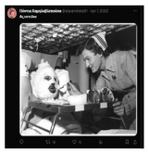
X, December 4, 2019

(3)
X, April 7, 2020
(4)
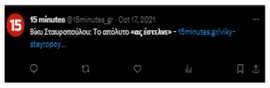
Βίκυ Σταυροπούλου :
Το
απόλυτο “
ας
έστελνε ”Vicky Stavropulu
The
absolute
‘as’
send: IMPFV:P:3SG
‘Vicky Stavropulu: The absolute “he should have texted” ’
X, February 7, 2021
In the light of such empirical evidence, we specifically aim to show that (1) is an instance of a compositional unit with a nominal complement (
In the sections that follow we propose that ultimately (1) and (2)–(4) instantiate different, although related, constructional entities with inherited and encoding properties. Specifically, we contend that as éstelne(s) has emerged through analogical extension from
Against this background and focusing on the multimodal instances of the pattern, our research aims include: (a) exploring the pattern’s developmental trajectory by offering qualitative and quantitative insights, (b) accounting for its constructional status and the properties that license its semantics and discourse-pragmatics and make it differ not only from its compositional counterpart but also from its deeply entrenched and conventional constructional sibling that motivates it (i.e. as prósexe) and, ultimately, c) informing the discussion on multimodality and constructionhood gradience in Construction Grammar (CxG) (Ungerer & Hartmann 2023).
The paper is organised into five sections. Section 2 delves into multimodality in the context of the latest CxG- and MCxG-geared research. Section 3 presents our data, including the data collection methods and our main quantitative findings. Section 4 constitutes the theoretical ‘backbone’ of the paper and comprises two subsections. The first one is devoted to tracing inheritance by identifying as + IMPERFECTIVE PAST as the licensing template of the pattern.5 The second one crystallises the constructional properties of the pattern and its use in the language. Finally, section 5 offers our concluding remarks along with some still-open questions.
2 Multimodality: Towards a(n) CxG understanding
The present section problematises the notion of multimodality by casting it as a challenge for the methodological systematicity and theoretical rigor of CxG.
Ever since its emergence, constructionist theorising has undergone continuous development which has engineered not only the evolution of the paradigm but also the definitional refinement of ‘construction’ as its cornerstone concept (Goldberg 1995, 2019; Langacker 2006; Schmid 2017). In this context, the current usage-attested multimodal developments fuel yet further advancement by raising important theoretical questions to which presently we cannot offer concrete answers, but which we certainly view as a springboard for exploration with robust implications for CxG.
The common ground reached by research on multimodality suggests the presence of three main multimodal ‘flavors’. The first one concerns the currently underrepresented area of grapholinguistics (Meletis 2020; Meletis & Dürscheid 2022). The main assumption in this case is that written language is more than just a representation of spoken language. Rather, it is a modality to be studied in its own right because it affords resources unique to it (e.g. capitalisation, punctuation) that may impact meaning and expressivity, particularly when the latter entails stance-related nuances as well.6 Accepting that graphemic properties have such a meaning-changing/-making potential has important implications for the form pole of constructions; an interesting line for further CxG-based research which, however, falls outside the purview of this paper.7
The second flavour concerns multimodality in the sense of embodied co-speech behaviour which, admittedly, cannot be exhausted in linguistic signs (Feyaerts et al. 2017). The research focus in this case is on non-verbal elements and kinesic recurrences with specific linguistic strings (Cienki 2013, 2017; Lanwer 2017). Examples of such constructional analyses involve the works of Zima (2014) on the V MOTION IN CIRCLES construction (e.g. “we ended up going in circles for twenty minutes”) and the all the way from x prep y (e.g. “all the way from Seattle area down through Oregon”). Multimodality of this sort also encompasses paralinguistic features like prosody, pitch, and intonation, as discussed in Lehmann’s (2024) recent work on tell me about it. The bone of contention in this case concerns mainly the degree of conventionality and integration of such multimodal features into a construction (Nikiforidou & Fried 2025); simply put, to what extent the frequent co-instantiation of a particular kinesic or other non-verbal element with a certain linguistic form constitutes an effective criterion for calling that combination a construction.8
The third flavour, which we contend is the one most readily associated with as éstelne(s), concerns the combination of text with other expressive modalities, such as image, leading to a stance- and viewpoint-enriched form of meaning. Examples of this type of multimodality include memes/image macros, videos, and GIF s, often cutting across different genres. As briefly outlined in the Introduction, memes are viewed as constructions because they qualify for partially schematic pairings of form and meaning, with the image contributing aspects of conventionalised meaning that cannot be compositionally derived from the caption text. Constructionist research in this direction includes the analysis of when-memes, the Said no one ever-memes, and the One does not simply memes (Lou 2017; Dancygier & Vandelanotte 2017).
Adding to the above, we observe that memes/image-macros also invite reflection on the notion of constructionhood. Dancygier & Vandelanotte (2017: 591) explicitly propose that “just as construction grammar has long recognised clines of constructionality in dimensions of size […] and abstractness […], we might begin to conceive of gradations in terms of modalities involved (from monomodal to multimodal)”. This empirically based scepticism seems to be further reflected in Goldberg’s (2019) most recent definition of constructions which views them as “emergent clusters of […] memory traces” aligned with speaker’s conceptual space “on the basis of shared form, function, and contextual dimensions” (Goldberg 2019: 7). Interestingly, this view of constructions as emergent clusters suggests that they are the outcome of a continuous process. Likewise, the reference to “shared” aspects of form, function, and context invites the interpretation that it is the amount of shared content—by default a continuous rather than a categorical notion—that determines constructionhood.
Although, as discussed in Section 4, our empirical findings also make us sympathetic to the gradient view, arguing in its favour calls for new coding heuristics and operationalisation methods that include (inter alia) ways to set, quantify, and capture constructionhood, constructional thresholds, and (network mapped) gradience (Hilpert 2018; Hoffmann 2020; Ungerer 2023; Nikiforidou & Fried 2025).
All in all, space limitations necessarily restrict our scope to only problematising the multimodal constructionist venture further rather than offering concrete answers, while openly acknowledging, as suggested by Nikiforidou & Fried (2025:18), that “a full description of one construction in its entirety through […] prosodic and/or gesture constructions coindexed with lexical and grammatical ones, or some other way is still pending”.
3 Data analysis and methods
In line with our first main research objective to explore the developmental trajectory of as éstelne(s), this section presents an overview of the pattern/meme on the basis of qualitative and quantitative findings.
As shown in Table 1, as éstelne(s) has been investigated on the basis of 2164 (N) X tokens collected manually across a seven-year period.
Table 1
Overall X data per year
|
(N) 2164 |
X data |
||||||
|---|---|---|---|---|---|---|---|
|
Year |
2017 |
2018 |
2019 |
2020 |
2021 |
2022 |
2023 |
|
(n) |
18 |
259 |
133 |
416 |
423 |
504 |
411 |
Our aim in working with X data was twofold. On the one hand, we sought to chart the ‘zero point’ of the pattern and then examine its developmental trajectory.9 On the other, from a methodological standpoint, we prioritised the need for a ‘corpus-like’ tool that affords advanced search criteria that could allow for an empirical distribution of the pattern per year.10
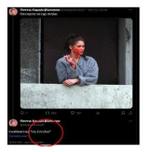
The first multimodal instance of the pattern/meme was thus traced back to January 25th, 2018. As can be seen in (5), the pattern was first used as a caption to a visual showing a woman smoking in a remarkably carefree manner while her face is covered in blood. As discussed below, such visuals relate to what we have tagged as multimodal type (c) visuals expressing forms of physical loss (i.e. vindictive punishment or threat) because of unmet couple expectations.
(5)
Θα
έπρεπε
να
είχε στείλει FUT
have to:IMPFV:P:3SG
‘na’
send:PERF:P:3SG
‘He had to have texted’
Εναλλακτικά “
ας
έστελνε ”alternatively
‘as’
send:IMPFV:P:3SG
‘In other words, “he should have texted” ’
X, January 25, 2018
To confirm that this was indeed the first instance of the idiomatic use of the pattern, we extended our scope to 2017 using the same search criteria, which yielded no results other than the fully compositional ones as in (1). This led to a first level of data classification per year with respect to: (a) compositional, (b) idiomatic, (c) liminal cases,11 or (d) false positives,12 summarised in Table (2).
The aim at this point was to establish whether frequency-wise the idiomatic instances outnumbered the compositional ones. As illustrated in Table 2, this was indeed the case by 1820 idiomatic tokens compared to 269 compositional only, a finding that was also shown to exhibit statistical significance and enhanced reliability.
Next, we annotated the idiomatic instances only, our aim being to identify which modality was more prevalent. As shown in Table (3), multimodal instances outweigh monomodal ones. A further interesting observation is that although monomodal and multimodal instances started off with minimal frequency differences, year 2021 and 2022 witnessed an increase in multimodal occurrences, with 2021 probably marking the year of greatest multimodal productivity. This also explains the creative ‘stretching’ of the pattern and its giving rise to more ‘grey area’ tokens.
Table 2
Empirical distribution of data
|
Year |
Overall X data (N) 2164 |
|||
|---|---|---|---|---|
|
Classification 1—Frequency counts |
||||
|
Compositional |
Idioms |
Liminal |
False positives |
|
|
2017 |
18 |
0 |
0 |
0 |
|
2018 |
10 |
243 |
6 |
0 |
|
2019 |
14 |
118 |
1 |
0 |
|
2020 |
49 |
360 |
7 |
0 |
|
2021 |
56 |
345 |
22 |
0 |
|
2022 |
72 |
411 |
21 |
0 |
|
2023 |
50 |
343 |
17 |
1 |
|
Total |
269 |
1820 |
74 |
1 |
Table 3
Empirical distribution of idioms per modality and year
|
Year |
Idioms X data (N) 1820 |
||
|---|---|---|---|
|
Classification 2—Frequency counts |
|||
|
Multimodal |
Monomodal |
Other/grey area |
|
|
2018 |
138 |
105 |
0 |
|
2019 |
55 |
63 |
0 |
|
2020 |
181 |
179 |
0 |
|
2021 |
228 |
103 |
14 |
|
2022 |
219 |
190 |
2 |
|
2023 |
159 |
183 |
1 |
|
TOTAL |
980 |
823 |
17 |
Our final step involved examining closely the visuals accompanying multimodal as éstelne(s) with the data pointing to the following five-category distribution:
-
Visuals expressing resentful criticism and regretful loss stemming from unmet couple dating expectations as in (6). This ranges from visuals showing a certain numeric gender imbalance between women and men striking self-complacent poses to missing out on a stunning significant other looking their best and all dressed up.
(6)
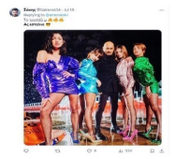
Το τραπέζι μ [ου ]the
table
my
‘That’s my table’
ας έστελνε ‘as’
send:IMPFV:P:3SG
‘S/he should have texted’
X, July 18, 2023 -
Visuals resonating with resentful criticism and regretful loss originating in unmet couple expectations but further manipulating the meme’s visual component so as to evoke ‘richer’ frames associated with politics and/or other contexts as in (7).
(7)
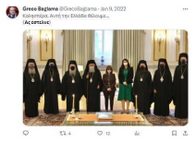
Καλησπέρα .Αυτή την Ελλάδα θέλουμε …Good afternoon
This
the
Greece
want:PRES:1PL
‘Good afternoon. This is the Greece that we want …’
(
Ας έστελνε )‘as’
send:IMPFV:P:3SG
‘(He should have texted)’
X, January 9, 2022 -
Visuals depicting forms of physical loss resulting from threats or acts of severe punishment that may range from attack (8) to destruction of one’s property (9), and ultimately even death (10).
(8)
X, March 9, 2018
(9)
X, March 5, 2018
(10)
X, March 10, 2020
-
Visuals depicting forms of non-physical loss in terms of pleasure that may range from missing out on a food- and drink-related experience as in (11) to missing out on enjoying a night out or the beauty of natural surroundings, as in (12)13–(13), respectively.
(11)
X, June 18, 2023
(12)
X, October 21, 2023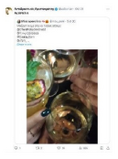
(13)
X, May 31, 2023
-
Finally, other or grey-area visuals that were hard to classify as they are most likely the result of the pattern’s creative exploitation in novel ways, which are highly user-idiosyncratic, as in (14) or (15).
(14)
X, January 8, 2023
(15)
X, February 28, 2023
Table (4) below summarises the frequencies of multimodal data per category as outlined above.
The results indicate that frequency-wise type (a) visuals rank first and may thus be reasonably regarded as the prototypical ones. This further suggests that resentful criticism and regretful loss stemming from unmet expectations form the core meaning of the pattern, followed by type (c) visuals which refer to revengeful punishment, and then type (d) which relate to the Non-Doer’s deprivation of a gustatory or other pleasant experience. This frequency-based empirical distribution of visuals points to an interesting developmental trajectory for the pattern/meme whereby resentful criticism meets physical and other forms of ramifications for the Non-Doer, thereby giving rise to a network of (sub‑)meanings. Section 4 casts more light on this network-based developmental trajectory in terms of inheritance; a key concept-mechanism in CxG theorising, according to which subtypes inherit properties of their licensing supertype (Fried & Östman 2004). But what makes the visuals cohere across the meme’s different categories?
While all visuals feature justified consequences for the expected, yet unfulfilled action of texting, punishment (of the non-texter) and indulgence of the senses (for the one expecting the text message) are seemingly—and arguably—unrelated. What we entertain is that both visuals converge as scenes of high emotional arousal, the latter being defined as a state of physiological activation involving a readiness for action and feelings of alertness/excitement (Scherer 2005). Notice that the punishment of the non-texter is likely a reward for the speaker, thus inducing a sense of ‘pleasure’ (notably different from the one associated with fatty and sugary foods, etc.).
Table 4
Classification of visuals
|
Year |
Multimodal idioms X data (N) 980 |
||||
|---|---|---|---|---|---|
|
Classification 3—Frequency counts |
|||||
|
Visuals Type (a) |
Visuals Type (b) |
Visuals Type (c) |
Visuals Type (d) |
Other/grey area |
|
|
2018 |
25 |
2 |
93 |
15 |
3 |
|
2019 |
12 |
6 |
28 |
1 |
8 |
|
2020 |
117 |
5 |
26 |
16 |
17 |
|
2021 |
160 |
9 |
26 |
20 |
13 |
|
2022 |
129 |
10 |
20 |
46 |
14 |
|
2023 |
76 |
10 |
9 |
51 |
13 |
|
TOTAL |
519 |
42 |
202 |
149 |
68 |
Another issue of theoretical import pertains to how the different meanings of as éstelne(s) relate to one another. Although we do not describe the pattern diachronically, our data have shown that the ‘punishment’ meme most likely served as the “anchor” (Attardo 2023) initiating the whole meme cycle of as éstelne(s).14 The physical loss that inheres in this category (in the form of destruction of the Non-Doer’s property, assault and battery, and even killing) is metaphorically extended to a kind of non-physical loss, namely missing out on a stunning significant other (as in the prototypical category of resentful criticism and regretful loss over unmet couple dating expectations). As for the pleasure-related memes, these can also be seen as construing a vengeful act, showing off an utterly enjoyable food or drink experience or the beauty of natural surroundings that the Non-Doer is doomed to miss as a consequence of non-texting (yet another form of non-physical loss).
We thus treat the derivation of new meanings in the network of as éstelne(s) as the result of metaphoric extension from the source domain of physical loss to the target of non-physical loss. Well established in the cognitive linguistic literature for language data (Sweetser 1990), metaphoric extension as a process for semantic change appears (rather unsurprisingly) to also apply to multimodal expressions, too. This observation has significant implications vis-à-vis how memes creatively develop new meanings that are different, yet related (see Piata & Geka forthcoming). Still, a rather more complex case is attested in category (b) of our annotation scheme, whereby criticism and regretful loss extend to the domain of politics. Space limitations do not allow us to elaborate on this category.
Although we cannot offer a detailed quantitative analysis here, we should stress that all frequency counts, as taxonomised per annotation parameter, have been subjected to rigorous statistical testing. More specifically, following the results of the Kolmogorov-Smirnov Test (K-S test) which indicated non-normal distribution, non-parametric, robust, and hence more error-resistant tests were employed (Sprent & Smeeton 2001; Ritter 2010). The two main non-parametric tests used were the Spearman’s rank order correlation coefficient and the Friedman test, respectively. All the results obtained both on the aggregate X data and the multiple subsets formed were found to be statistically significant, thereby suggesting that the correlations entertained herein regarding idiomatic instances and multimodality were anything but random. These results were further complemented with internal consistency measuring through Cronbach’s alpha (
4 Inheritance and beyond
In this section, we address our second main research objective by offering an account of as éstelne(s) as a multimodal construction in inheritance-based terms. We specifically propose that as éstelne(s) inherits the semantics-pragmatics associated with its licensing template, namely (unfulfilled) wish, (latent) conditionality, concession (see Vasilaki 2023), and ultimately, as we suggest, reprimand for the unfulfillability of a certain action that engenders negative consequences for the Non-Doer. Therefore, its emergence—by analogy with as prósexe—can be traced back to the polysemy of as, along with the counterfactuality that the pairing of as with the imperfective past motivates (Nikiforidou 1991).
4.1 Tracing inheritance: As + imperfective past
To trace the far-reaching inheritance relations at work behind as éstelne(s), this section first deals with the motivation deriving from the modal particle as and then discusses how the Imperfective Past also comes into play as a source of motivation.
The argument we wish to pursue is that the meaning of as éstelne(s) exploits the polysemy of as outlined by Nikiforidou (1991, 1996) while also carrying the deontic modality nuances as per
In addition, our treatment of as is further informed by
As noted in the Introduction, our account treats the emergence of as éstelne(s) in terms of analogical extension from as prósexe, whose meaning best exemplifies the constructional properties of as + imperfective past that as éstelne(s) inherits, namely the discourse-pragmatics of reprimand and unfulfilled wish combined with (latent) conditionality. This line of reasoning suggests a priming of as éstelne(s) by as prósexe, most likely further facilitated through a “parallelism effect” at the level of phonology (Dubey et al. 2007), including both intonation and number of syllables. This observation is empirically confirmed through example (16) cited below (and many more in our dataset), which additionally begs for parallelism in terms of the illocutionary force of reprimanding:
(16)
Ας
πρόσεχε ‘as’
be careful:IMPFV:P:3SG
‘He should have been careful’
Ας
έστελνε
λένε ‘as’
send: IMPFV:P:3SG
say:PRES:3PL
‘As the saying goes, he should have texted’
X, December 31, 2020

Interestingly, in MG the ‘reprimand’ meaning seems to be the most common function of as + IMPERFECTIVE PAST (Vasilaki 2023).16 The speaker comments on and rebukes a past action that—according to them—either happened when it should not have, or it did not happen when it should have. This reprimand meaning appears predominantly in the 3rd person singular, followed frequency-wise by the 3rd person plural. What is also crucial is that (similarly to as-wishes) it presupposes an addressee (i.e. the target of the reprimand), while its overall interpretation does not depend on either the preceding or the following context (unlike the conditional as). These features are attested also in as éstelne(s), very much like as prósexe.
Turning now to our data, consider again example (5), repeated here for convenience:
(5)
Θα
έπρεπε
να
είχε στείλει FUT
have to:IMPFV:P:3SG
‘na’
send:PERF:P:3SG
‘He had to have texted’
Εναλλακτικά “as
éstelne”
alternatively
‘as’
send:IMPFV:P:3SG
‘In other words, “he should have texted” ’
X, January 25, 2018

Being the first instance of as éstelne(s) and bearing close affinity to as prósexe, (5) instantiates the semantics-pragmatics of ‘reprimand’ for the unfulfillable as outlined above, thus felicitously allowing for the inference that the Non-Doer must face the consequences for not acting as expected by the speaker. Moreover, largely concurring with Vasilaki’s (2023) corpus findings that in MG the second most frequent meaning of as + imperfective past is that of ‘wish’ (also related to a past action that should have happened but—regretfully—did not), we further argue that as éstelne(s) features as an interesting case in this direction.
Against this background, we propose that the illocutionary force of an unfulfilled wish infiltrates all instances of as éstelne(s), thus explaining the speaker’s resentful stance over the addressee’s non-texting. This also aligns with what Joseph & Philippaki-Warburton (1987: 180) have argued about the combination of as with the Imperfective Past and its motivation of “unfulfilled wish or unfulfilled obligation”, as in the following example: “
Additionally, the context in which as éstelne(s) appears is negatively valenced in line with Vasilaki’s (2023: 26) observation that “the ‘wish’ function of as presupposes that the current situation is not the desired one”. In this sense, we argue that as éstelne(s) communicates an unfulfilled wish, as well as a reprimand, across the board in our dataset. We further maintain that the ‘wish’ meaning of as éstelne(s) carries over nuances of latent conditionality, given the causal connection between the non-fulfilment of the desired action and the negative feelings induced in the speaker (see below). Simply put, if s/he—the object of desire—had texted, things would have been better for the speaker, i.e. the meme maker.
The conditionality of as becomes prominent in the ‘punishment’ (type c) category of as éstelne(s) in which the
Unlike reprimands, whose meaning does not hinge on contextual items, conditions with as depend on the main clause and also require the presence of the coordinating conjunction
(8)
X, March 9, 2018

Here, as éstelne(s) can be paraphrased as ‘if he had texted me’, and the overall meaning communicated is that ‘since he didn’t text me, he deserves punishment’ (in the form of physical aggression). In the absence of the connective
To conclude on the polysemy of as, ‘concession’ seems also to contribute to the emergence of as éstelne(s). An instance of concession with as is instantiated in the following example:
(11)
X, June 18, 2023

The meme’s intended import can be paraphrased as ‘even though he didn’t text me, I still have fun/enjoy good food, drinks, etc.’ Such a concessive meaning can be taken as implying a sense of indifference in line with Joseph & Philippaki-Warburton (1987: 180), who argue that “forms with as express exhortation, wish, consent, indifference, probable inference, and the like”.19 To illustrate, consider the following monomodal instance. Here, as éstelne(s) appears as a punchline that reinterprets
(17)
Να
σας
πω
κάτι ;
Δεν
με
νοιάζει .‘na’
you
say: PRES:1SG
something
NEG
me
concern:PRES:1SG
‘May I tell you something? I don’t care.’
Τι
σκας ;What
bother: PRES:2SG
‘Why bother?’
Δεν
με
νοιάζει .NEG
me
concern:PRES:1SG
‘I don’t care’.
Ας
έστελνε .‘as’
send:IMPFV:P:3SG
‘He should have texted’.
X, July 5, 2018
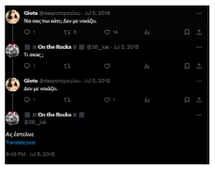
By means of inference we may consider this category as communicating comfort and consolation of some sort, much in line with the ‘food culture’ that floods social media platforms. In this sense, it is likely that latent conditionality underlies concession; if s/he had texted, the speaker would be happy, but even if s/he has not the speaker will nevertheless resort to food- and drink-related sensual pleasures and be(come) happy again (hence the indifference).
An alternative interpretation, however, would account for the food/drink experience as a kind of (non-physical) loss for the non-texter (‘s/he did not text me, therefore s/he misses the food and/or drink experience’). This can also be viewed as a source of consolation for the speaker and even as an act of revenge against the Non-Doer, suggesting that his/her act of non-texting is not as devastating for the speaker as s/he would have expected it to be. In all, the different interpretations can naturally co-exist. It rests upon each meme viewer to entertain their own inferences while making sense of the meme and decide on their preferred interpretation as either consolation for the speaker, or loss and revenge against the non-texter (or both). Be that as it may, a sense of indifference infiltrates all available interpretations.
So far, our analysis has addressed how the meaning of as éstelne(s) exploits the polysemy of as. However, the semantics-pragmatics of as éstelne(s) is also motivated and in fact licensed by the Imperfective Past, with its use being specifically associated with hypothetical and counterfactual meanings, whether in the present or in the past (Nikiforidou 1991), pretty much like a counterfactual conditional.
Typically, the Imperfective Past denotes a habitual situation, a state or a continuous event in the past (Kitis & Tsangalidis 2005). In MG, it is considered an absolute tense derived morphologically from the root of the Present Simple, its point of reference being the present (defined as the speaker’s deictic center) and its grammatical aspect that of [-perfective] (Moser 2014: 104–105). Nevertheless, forms in the Imperfective Past can receive a perfective interpretation (Tsangalidis 2012: 192). Indeed, as éstelne(s) could be interpreted as perfective (as íxe stíli), since here the act of texting is construed with respect to the posterior event that is designated in the visual and is identified as the speaker’s present (hence, an absolute-relative tense). However, its family resemblance with as prósexe clearly primes an imperfective interpretation, suggesting that the described action remains incomplete. As noted by Kitis & Tsangalidis (2005: 149), “imperfective forms transfer the focus … from the finished product to the process”, provided that “the event is amenable to such a processual analysis”. In our case, while the imperfective foregrounds unboundedness the event of sending a text message can hardly be seen as processual. The meaning of stélno ‘send’ is bounded, i.e. it has a clear endpoint, unlike proséxo ‘be careful’. In other words, in terms of Aktionsart (i.e. lexical aspect), it is a telic verb. But when stélno ‘send’ appears in the Imperfective Past following the modal particle as, its bounds are obliterated, and the designated action is construed as incomplete. In short, in the case of as éstelne(s), the imperfective meaning of aspect prevails over the telicity of Aktionsart.
Unlike Aktionsart, which is objective (i.e. ontological), aspect is subjective; that is, it depends on the speaker’s vantage point towards the described event (Moser 2014). Aspect, therefore, is a matter of the speaker’s choice, with the perfective implicating completion, and the imperfective duration or non-boundedness (Moser 2014: 108). By choosing the imperfective rather than a perfective form, the meme maker communicates more than a counterfactual conditional. They express an emotionally laden enunciation of regret and resentful criticism. Given that the Imperfective is the unmarked member of the opposition [+/-perfective],20 it is expected to have more versatile semantics than its perfective counterpart (
4.2 The emergence of the construction: AS ÉSTELNE(S)
So far, we have sought to show that the meaning potential of as éstelne(s) is largely due to the constructional template as + IMPERFECTIVE PAST that motivates its repertoire of meanings and accounts for its empirical variation. While we acknowledge that the boundaries between the different meanings of as + IMPERFECTIVE PAST involved in the pattern are far from clear or sharply delineated, we maintain that the pattern’s primary motivation lies in the ‘reprimand’ meaning of as for the following reasons:
-
unlike all other functions of as, ‘reprimands’ require the Imperfective Past;
-
the ‘reprimand’ meaning has motivated, together with conditionality, the first instance of the pattern from which the other meanings are naturally derived (as shown in Section 3);
-
the emergence of the pattern is likely due to an analogical extension from the prototypical instance of the ‘reprimand’ meaning (as prósexe);
-
reprimands can stand as independent clauses—as is the case with the pattern in focus—and their interpretation does not depend on context, thereby explaining the pattern’s versatility and creative potential; and, finally,
-
the ‘reprimand’ meaning permeates all instances of as éstelne(s); a feature shared only with wishes.21
Nonetheless, despite the attested similarities between as prósexe and as éstelne(s), the two patterns also exhibit important differences. For one, unlike the greater person-related flexibility of as prósexe, as éstelne(s) appears mostly in the 3rd person singular, in line with Vasilaki’s (2023: 34) observation that “regardless of the function expressed by the as + verb construction, the preferred grammatical person is in the 3rd singular form”.
Moreover, while as prósexe foregrounds reprimanding also through the frame evocation of CAUTION (by virtue of proséxo), this is not equally the case with stélno ‘send’ whose frame semantics pertains to a Sender causing a Theme to arrive in the hands of a Recipient. In the case of as éstelne(s), the meme maker is the alleged Recipient while the Sender is the person who was expected to text but did not (effectively the addressee of as éstelne(s)).22 Since the nominal complement is omitted, the Theme (i.e. a text message expected in dating) must be contextually inferred. Although this is not registered in any of the well-known dictionaries of Modern Greek, such use has become quite ubiquitous in technology-mediated communication, bearing the meaning of ‘texting’ (i.e. sending a text message via an electronic device). We assume that this meaning is the one evoked here. Finally, we acknowledge that the frame semantics of stélno is most likely involved in motivating the extended uses of the pattern, e.g. in the domain of politics; an issue we leave open for future research.
More importantly, the addressee of as éstelne(s) is not a participant in the actual speech situation of meme-sharing; nevertheless, s/he is the one to whom the message is addressed (i.e. the Sender). In this sense, the addressee of as éstelne(s) (notably different from the meme’s receiver, namely the reader or the viewer) is almost consistently fictive (Pascual 2002, 2014). Following Pascual’s work, when the interactional frame is applied to non-factive speech situations it gives rise to a verbal interaction that can only be fictively constructed. Fictive verbal interaction can be evoked even if it is explicitly presented through one conversational turn, since it is most commonly, if not always, addressed to someone (even if this is oneself) or constitutes a response to a previous turn or behavior of the addressee. This is also the case here. We consider as éstelne(s) as a reaction to non-texting, thus setting a scene of verbal interaction in which a person expecting a text message (i.e. the meme maker in the factive speech situation) only fictively blames a significant other for non-texting. Notice that even in the very few occurrences of as éstelne(s) in the second person singular, the second person does not refer directly to the reader in the factive situation but only to a fictive addressee, i.e. the target of resent and reprimand. Thus, the frame of conversational interaction is only conceptually evoked to structure discourse. Interestingly, unlike the language data examined by Pascual, in our dataset fictive interaction is constructed multimodally as the blame entails the (largely negative) consequences designated in the image.
Relevant to this is also the “viewpoint configuration” (Dancygier 2017) much in evidence with internet memes at large, and our data, of course. Viewpoint is a general and pervasive feature of communication, understood as a mental alignment between discourse participants (Dancygier 2021). As a conceptual category, viewpoint is not restricted to concrete, physical ways of assuming a position but also includes abstract forms in terms of epistemic knowledge, attitude, feeling, solidarity, and power dynamics. Internet memes, in particular, have been found “to express contrast, or simply construe different viewpoints”, with such viewpoint diversity serving as the very goal or result of the meme (Dancygier & Vandelanotte 2017: 4). Indeed, as éstelne(s) seems to enable multiple and/or mixed viewpoints.
We specifically suggest that as éstelne(s) conveys a particular emotional viewpoint with the speaker resentfully characterising the act of non-texting as the cause of a loss well deserved for the Non-Doer while the speaker herself is (successfully) getting over her unmet expectations (in the form of punishment or pleasure). The reader is thus invited to align, or sympathise, with this viewpoint simply because “having the meme maker and the meme viewer share the same emotional viewpoint is the point of the meme” (Dancygier & Vandelanotte 2017: 589). In our dataset, the meme maker’s viewpoint is contrasted to that of the meme’s fictive addressee, i.e. the Non-Doer. To process this viewpoint dynamics, the reader is thus invited to tap into their own experiences or at least experiences they can imagine. How modality contributes to viewpoint dynamics is an issue we aim to address in future research in the light of evidence from other genres such as videos.
5 Concluding remarks and some open questions
Taken together, our findings confirm that as éstelne(s) ultimately emerges as a construction which inherits its meaning potential from as+imperfective past but also presents its own properties, such as its receding compositionality, its propensity for a null complement configuration (and hence a stand-alone discourse use), the ‘suspension’ of telicity in its verbal filler, as well as its capacity for viewpoint alignment between the meme maker and the meme viewer against that of the meme’s fictive addressee (i.e. the Non-Doer). More importantly though, as éstelne(s) emerges as a novel and creative, instance of language use although, as shown, the pattern is itself the upshot of a multi-level priming effect from as prósexe. Specifically, we have shown that as éstelne(s) associates with a network of meanings, all of which boil down to a particular viewpoint of resent and criticism over an expected, yet unfulfilled action. Such a network of meanings is evidently paired with a specific form, whether monomodal or multimodal, with the latter offering a visualisation of the consequences—whatever these may be—of the non-texting contained in the text caption.
Still, in sketching out the account of as éstelne(s), we observe that certain open ends do remain. Very much like phonetic and gestural features in multimodal communication, the meaning contributed by the image “needs to be spelled out explicitly” (Nikiforidou & Fried 2025: 18) before it is integrated with that of the textual (or spoken) message. In as éstelne(s), the visual component evokes a loss of some kind, aimed to visually communicate the (justified) remorse that should follow for the Non-Doer. A question then arises: how can (or should) we integrate the image into our constructional notation? This is an empirical question that we leave for future consideration (cf. Nikiforidou & Fried 2025).
Yet, as éstelne(s) proves even more complex and challenging. While exploiting the polysemy of as and the meaning potential of the Imperfective Past, it has developed into a versatile meme whose original meaning is further extended from the domain of dating to that of politics and current affairs, with obvious humourous implications—one more line for future research. Meanwhile, the construction’s development from multimodal to monomodal (the latter serving various discourse functions that could not be presently addressed) raises yet another intriguing question: is it possible that the monomodal instances of as éstelne(s) inherit the meaning contained in the image?
Although still at a very early exploratory stage and despite its limitations, analyses like the present point to the need for further research with at least the following considerations: (a) how can the notions of variability, recurrence, creativity and conventionality be applied to multimodal language use, (b) at which level of abstraction is multimodal entrenchment situated, (c) and what do all these bring to the fore regarding constructionhood? Answers to such questions are expected to prompt the development of new schematic ways of crystallising constructional make-up—deliberately not ventured herein—since, as things now stand, the symbolic architecture (Croft 2001) or the box notational conventions of the past (Kay & Fillmore 1999; Fried & Östman 2004; Nikiforidou 2015) seem to fall short of the descriptive challenges that current (multimodal) language use entails. To put it in Ungerer & Hartmann’s (2023: 55) words, with full intention of the pun, the multimodal aspect of Construction Grammar “is still very much under construction”.
Acknowledgments
We would like to wholeheartedly thank the guest editors for extending us an invitation to contribute to this special issue as well as gratefully acknowledge the help of the two anonymous reviewers. Any remaining shortcomings are, of course, our own.
The glossing conventions used herein are the following: 1 first person, 2 second person, 3 third person, SG singular, PL plural, NEG negation, PRES present, P past, FUT future, PERF perfective, IMPFV imperfective, SUBJ subjunctive. Given the scope of our analysis, our glosses are focused mainly on the verb. Note that, hereafter, glosses are not repeated for all the instances containing only as éstelne.
Evidently, the modality associated with
The prototypical form is in the 3rd person singular of the Imperfective Past. However, the pattern can also feature the 2nd person singular, which although restrained in use (all the examples analysed are in the 3rd person) is the only minimal standardised formal variation that the pattern affords, hence the s-suffix placed in parentheses. This, however, does not preclude possible and markedly more creative use in the 2nd person plural, i.e. as stélnate, or even occurrences in 1st or 3rd person plural as in as stélname and as éstelnan, respectively.
The X data discussed do not exhaust the datasets collected, which include instances from various sources, e.g. Facebook posts, online magazine articles, advertisements, TV shows, TikTok, and YouTube.
The conventional use of small capitals signals constructional status.
Expressivity is herein understood as covering all supplementary, perspectivised and emotive loading related to a lexical/grammatical unit that may function as enhancement/augmentation, evaluation, or affective stance running parallel to (or on top of) referential/descriptive meaning (see Boye & Harder 2007; Foolen 2015).
The assumptions behind this multimodal flavour are not entertained any further, but it is worth noting that this line of thinking gains traction when considering the recurrent nature of single or double inverted commas as in (4) above (Dancygier 2017).
Some of the non-X video-based data in our repository tie in well with this multimodal flavour in that they exhibit (with some degree of consistency) co-instantiation with a particular kinesic movement. The same data also seem to tentatively point to a specific prosodic contour. Given our focus, however, we consciously reserve judgement on any possible correlation(s) of this sort.
While collecting data across different web sources, we came across scattered comments suggesting that the pattern was an X ‘invention’ that was extended to other social media apps. Our findings confirm that this was indeed the case.
Every single occurrence of the pattern, regardless of whether it was re-tweeted in an identical form or whether it combined the same text and visual, was counted as a token.
As in “
Only one false positive result resulting from a misspelling of the Greek acronym of the Hellenic Police (“
This is a case of re-tweeting with as éstelne(s) serving as a commentary on a previous post of drinking and partying as suggested by the visual and the accompanying caption (‘all crazy people have gathered tonight’).
See again example (5), as well as the increased frequency of ‘punishment’ memes in 2018 in Table 4.
The grammatical characterisation of
Marginally, reprimands may also appear with the Past Perfect, e.g. “
For an analysis of conditionals with as, see Nikiforidou (1996).
As pointed out by one of the reviewers, a concessive reading may be involved in other instances of the meme too. Especially in the examples featuring a new date, which also highlight pleasure and enjoyment without the non-texter, it can be arguably suggested that a concessive meaning is at work (‘I am having fun even without him texting me’). Although not precluded, we consider this a ‘freer’ interpretation.
Note that Chondrogianni (2011: 330) treats the meaning of indifference as a variation of the hortative as exemplified in
We thank an anonymous reviewer for this remark.
Intonation would be crucial here. However, in the absence of oral data, this remains a desideratum.
Gender asymmetry attested in our dataset—with the Recipient of the anticipated text message typically being a female, and the Non-Doer a male—is an interesting point, which, however, is not discussed further.
References
Attardo, Salvatore. 2023. Humor 2.0: How the internet changed humor. London: Anthem Press.
Βελούδης, Γιάννης & Ειρήνη Φιλιππάκη-Warburton. 1983. Η υποτακτική στα Νέα Ελληνικά [The subjunctive in Modern Greek].
Μελέτες για την Ελληνική Γλώσσα 4.151–168.Boye, Kasper & Peter Harder. 2021. Complement-taking predicates, parentheticals and grammaticalization. Language Sciences 88.101416. https://doi.org/10.1515%20/9783110728835
Bybee, Joan. 1985. Morphology: A study of the relation between meaning and form. Amsterdam: John Benjamins.
Bybee, Joan & Suzanne Fleischman. 1995. Modality in grammar and discourse: An introductory essay. Modality in grammar and discourse, ed. by Joan Bybee & Suzanne Fleischman, 1–14. Amsterdam: John Benjamins.
Chondrogianni, M. 2011. The pragmatics of the modal particles
να ,θα ,ας andμη (ν ). Proceedings of the 9th international conference on Greek linguistics, 322–332. Chicago.Cienki, Alan. 2013. Cognitive linguistics: Spoken language and gesture as expressions of conceptualization. Body—language—communication: An international handbook on multimodality in human interaction, ed. by Cornelia Müller, Alan Cienki, Ellen Fricke, Silva Ladewig, David McNeill, & Sedinha Tessendorf, 182–201. Berlin: De Gruyter.
Cienki, Alan. 2017. Utterance Construction Grammar (UCxG) and the variable multimodality of constructions. Linguistics Vanguard 3(s1).20160048. https://doi.org/10.1515/lingvan-2016-0048
Croft, William. 2001. Radical Construction Grammar: Syntactic theory in typological perspective. Oxford: Oxford University Press.
Dancygier, Barbara. 2017. Viewpoint phenomena in constructions and discourse. Glossa:
Α Journal of General Linguistics 2.37.Dancygier, Barbara. 2021. Fictive deixis, direct discourse, and viewpoint networks. Frontiers in Communication 6.
Dancygier, Barbara & Lieven Vandelanotte. 2017. Internet memes as multimodal constructions. Cognitive Linguistics 28.565–598. https://doi.org/10.1515/cog-2017-0074
Dubey, Amit, Frank Keller, & Patrick Sturt. 2007. The effect of phonological parallelism in coordination: Evidence from eye-tracking. Proceedings of the 2nd European cognitive science conference, 131–136. Delphi.
Feyaerts, Kurt, Geert Brône, & Bert Oben. 2017. Multimodality in interaction. The Cambridge handbook of Cognitive linguistics, ed. by Barbara Dancygier, 135–156. Cambridge: Cambridge University Press. https://doi.org/10.1017/9781316339732.010
Foolen, Ad. 2015. Expressives. The Routledge handbook of semantics, ed. by Nick Riemer, 473–490. London: Routledge.
Fried, Mirjam & Jan-Ola Östman. 2004. A thumbnail sketch of Construction Grammar. Construction Grammar in a cross-language perspective, ed. by Mirjam Fried & Jan-Ola Östman, 11–86. Amsterdam: John Benjamins. https://doi.org/10.1075/cal.2.02fri
Goldberg, Adele A. 1995. A Construction Grammar approach to argument structure. Chicago: University of Chicago Press.
Goldberg, Adele A. 2019. Explain me this: Creativity, competition, and the partial productivity of constructions. Princeton: Princeton University Press. https://doi.org/10.1515/9780691183954
Hilpert, Martin. 2018. Three open questions in Diachronic Construction Grammar. Grammaticalization meets Construction Grammar, ed. by Evie Coussé, Peter Andersson, & Joel Olofsson, 21–39. Amsterdam: John Benjamins. https://doi.org/10.1075/cal.21.c2
Hoffmann, Thomas. 2020. What would it take for us to abandon Construction Grammar? Falsifiability, confirmation bias and the future of the constructionist enterprise. Belgian Journal of Linguistics 34.148–160. https://doi.org/10.1075/bjl.00042.hof
Holton, David, Peter Mackridge, Irene Philippaki-Warburton, & Vassilios Spyropoulos. 2012. Greek: A comprehensive grammar of the Modern language. 2nd edition. London: Routledge.
Joseph, Brian D. & Irene Philippaki-Warburton. 1987. Modern Greek. Cardiff: Croom Helm.
Karantzola, Eleni. 1995. Let’s talk about concession: The case of the Modern Greek particle as. Journal of Pragmatics 24.5–75.
Kay, Paul & Charles J. Fillmore. 1999. Grammatical constructions and linguistic generalizations: The What’s X Doing Y? construction. Language 75.1–33.
Kitis, Eliza & Anastasios Tsangalidis. 2005. Expressivity as an option of tense-aspect in language: The case of Modern Greek Imperfective Past. Reviewing linguistic thought: Converging trends for the 21st Century, ed. by Sophia Marmaridou, Kiki Nikiforidou, & Eleni Antonopoulou, 143–162. Berlin: De Gruyter.
Klairis, Christos & Georgios Babiniotis. 1999. Γραμματική της Νέας Ελληνικής: Δομολειτουργική-επικοινωνιακή [Grammar of Modern Greek: Structural-functional-communicative], Vol. II (The verb). Ellinika Grammata.
Langacker, Ronald W. 2006. On the continuous debate about discreteness. Cognitive Linguistics 17.107–151. https://doi.org/10.1515/COG.2006.003
Lanwer, Jens P. 2017. Apposition: A multimodal construction? The multimodality of linguistic constructions in the light of usage-based theory. Linguistics Vanguard 3.20160071.
Lehmann, Claudia. 2024. What makes a multimodal construction? Evidence for a prosodic mode in spoken English. Frontiers in Communication 9.1–15. https://doi.org/10.3389/fcomm.2024.1338844
Lou, Adrian. 2017. Multimodal simile. English Text Construction 10.106–131. https://doi.org/10.1075/etc.10.1.06lou
Meletis, Dimitrios. 2020. The nature of writing a theory of grapholinguistics. Brest: Fluxus Editions. https://doi.org/10.36824/2020-meletis
Meletis, Dimitrios & Christa Dürscheid. 2022. Writing systems and their use: An overview of grapholinguistics. Berlin: De Gruyter. https://doi.org/101515/9783110757835
Moser, Amalia. 2014. Aspect and aktionsart: A study on the nature of grammatical categories. Major trends in theoretical and applied linguistics, ed. by Nikolaos Lavidas, Thomaï Alexiou, & Areti-Maria Sougari, 99–120. Berlin: Versita.
Nikiforidou, Kiki. 1991. Conditional and concessive clauses in Modern Greek: A syntactic and semantic description. PhD dissertation, University of California at Berkeley.
Nikiforidou, Kiki. 1996. Modern Greek as: A case study in grammaticalization and grammatical polysemy. Studies in Language 20.599–632.
Nikiforidou, Kiki. 2015. Grammatical constructions and cross-text generalizations: Empathetic narration as genre. Constructions and Frames 7.181–217.
Nikiforidou, Kiki & Mirjam Fried. 2025. Multimodality and grammar: An Introduction. Multimodal communication from a Construction Grammar perspective, ed. by Kiki Nikiforidou & Mirjam Fried, 1–23. Amsterdam: John Benjamins.
Osburn, Hobart G. 2000. Coefficient alpha and related internal consistency reliability coefficients. Psychological Methods5.343–355.
Pascual, Esther. 2002. Imaginary trialogues: Conceptual blending and fictive interaction in criminal courts. Amsterdam: LOT.
Pascual, Esther. 2014. Fictive interaction: The conversation frame in thought, language, and discourse. Amsterdam: John Benjamins.
Perniss, Pamela. 2018. Why we should study multimodal language. Frontiers in Psychology 9.1109. https://doi.org/10.3389/fpsyg.2018.01109
Piata, Anna & Vassiliki Geka. forthcoming. When meme cycles spiral: Constructional dynamics in internet memes. Humor, pragmatics, and cognition, ed. by Anna Piata & Salvatore Attardo. Berlin: De Gruyter.
Ritter, Nicola L. 2010. Understanding a widely misunderstood statistic: Cronbach’s alpha. Paper presented at the Southwestern Educational Research Association Conference.
Roussou, Anna & Anastasios Tsangalidis. 2010. Reconsidering the ‘modal particles’ in Modern Greek. Journal of Greek Linguistics 10.45–73.
Scherer, Klaus. 2005. What are emotions? And how can they be measured? Social Science Information 44.695–729.
Schmid, Hans-Jörg. 2017. A framework for understanding linguistic entrenchment and its psychological foundations. Entrenchment and the psychology of language learning: How we reorganize and adapt linguistic knowledge, ed. by Hans-Jörg Schmid, 9–36. Berlin: De Gruyter. https://doi.org/10.1037/15969-002
Sprent, Peter & Nigel, C. Smeeton. 2001. Applied nonparametric statistical methods. London: Chapman & Hall/CRC.
Sweetser, Eve. 1990. From etymology to pragmatics: Metaphorical and cultural aspects of semantic structure. Cambridge: Cambridge University Press.
Τσαγγαλίδης, Αναστάσιος. 2001. Κριτήρια τροπικότητας: Η κατηγορία των τροπικών μορίων στα Νέα Ελληνικά [Criteria of modality: The category of modal particles in Modern Greek].
Μελέτες για την ελληνική γλώσσα 21.759–770.Τσαγγαλίδης, Αναστάσιος. 2012. Υποθετικοί λόγοι στη Νέα Ελληνική [Conditionals in Modern Greek].
Το χρονικό σύστημα της Νέας Ελληνικής [The verb system of Modern Greek], ed. by Μαρία Τζεβελέκου, Αναστάσιος Τσαγγαλίδης, & Αγγελική Ψάλτου-Joycey, 125–276. Patakis.Ungerer, Tobias. 2023. A gradient notion of constructionhood. Constructions 15.1–20. https://doi.org/10.24338/cons-543
Ungerer, Tobias & Stefan Hartmann. 2023. Constructionist approaches: Past, present, future. Cambridge: Cambridge University Press.
Vasilaki, Natalia. 2023. The Modern Greek particle AS: The distinctive properties of the construction AS + IMPERFECTIVE PAST. MA dissertation, National and Kapodistrian University of Athens.
Ziem, Alexander. 2017. Do we really need a multimodal Construction Grammar? Linguistics Vanguard 3.20160095. https://doi.org/10.1515/lingvan-2016-0095
Zima, Elisabeth. 2014. Gibt es multimodale Konstruktionen? Eine Studie zu [V(motion) in circles] und [all the way from X PREP Y]. Gesprächsforschung Online-Zeitschrift zur verbalen Interaktion 15.1–48.
