Abstract
This paper explores the intersection of Construction Grammar and lexicography, a notion referred to here as “constructicography”. The study considers constructicon projects for languages such as English, German, Swedish and Russian, and aims to contribute to the emerging body of constructionist research on Greek by illuminating the path towards a Greek constructicon. By way of illustration, constructicographic practices are applied to Greek data concerning three semi-schematic constructions ([
1 Introduction
“Constructicography” is the lexicography of constructions, a new and rapidly developing linguistic subdiscipline that aims at developing “constructicons”, repositories of form-function pairings in a target language (Lyngfelt et al. 2018). Arising out of research in Construction Grammar and Frame Semantics, constructicography was initiated by the Berkeley FrameNet Constructicon Project (Fillmore et al. 2012), which soon inspired similar projects in a number of languages (for an overview, see Lyngfelt et al. 2018). In the spirit of constructionist theories, which reject the traditional distinction between grammar and lexicon, and in an attempt to move beyond a lexical FrameNet, constructicon projects aim to investigate and document the whole continuum between lexicon and grammar. Therefore, what can be included in a constructicon varies from general structures (e.g. noun phrase, imperative clause) and argument structure configurations (e.g. ditransitive, passive) to information packaging structures (e.g. clefts), idioms, morphological categories (e.g. compound), and partially schematic structures (e.g. [the X-er the Y-er], [What’s X doing Y?]) (Lyngfelt 2018: 3). The last category, semi-schematic constructions, are of particular interest to constructicographers, because they have both open and lexically specified slots, and hence “fall through the cracks of a lexicon-and-grammar approach” (Ziem & Feldmüller 2023: 205).
In this context and in an attempt to apply constructicographic practices to Greek data, this paper presents a case study of three semi-schematic constructions, exemplified in (1)–(3), and shows that they are members of the same family, the interrogative-negative exclamatives.
(1)
Και τι δεν είχε μέσα !
Kai
ti
den
eixe
mesa!
And
what
NEG
have-PST-3SG
inside!
‘And what didn’t it have inside!’
(2)
Και ποιος δεν το ξέρει !
Kai
poios
den
to
kserei!
And
who
NEG
it-ACC
know-PRS-3SG!
‘And who doesn’t know that!’
(3)
Πόσα δεν έχουμε δει μέχρι σήμερα !
Posa
den
echoume
dei
mexri
simera!
How many
NEG
have-1PL
see- PST PTCP
until
today!
‘How many things have we not seen until today!’
To set the background, Section 2 provides an overview of constructicon projects in other languages, which could serve as models in case a similar project were to be initiated for Modern Greek. Section 2 also creates a background for the study of the specific constructions by reviewing previous work on exclamatives. The case study is presented in Section 3, which starts with a dictionary review, proceeds with a corpus-based analysis of the three constructions and concludes by linking them in a construction family and a wider network. Lastly, Section 4 discusses the implications of the study for Greek lexicography and constructicography.
2 Background
2.1 An overview of constructicography
This section summarizes the theoretical background, advantages, challenges, methodological issues and diverse perspectives involved in the development of constructicons across languages. To illustrate the application of Construction Grammar in constructicography, a sample construction entry from the English Contructicon is examined.
First, it should be clarified that the term “constructicon”, like “grammar” and “lexicon”, has two meanings; it can refer to “a theoretical notion of a linguistic system” and “a corresponding descriptive resource” (Lyngfelt 2018: 2). The latter sense of constructicon as a reference work is related to constructicography. The central units of description in a constructicon are constructions, which are typically defined as “conventional, learned form-function pairings at varying levels of abstraction and complexity” (Goldberg 2013: 17). According to Construction Grammar theory, these pairings can account for the totality of linguistic knowledge and may essentially be any linguistic structure where a formal pattern (with syntactic, morphological, and phonological properties) is conventionally associated with a certain (semantic, pragmatic, or discourse-functional) meaning (Hilpert 2021). In the constructional view of language, lexicon and grammar are not seen as different in nature, but rather as two ends on a continuum; what lies in-between is “a vast range of patterns with varying degrees of schematicity and complexity, including idioms, word formation processes, and semi-fixed phrasal constructions” (Hilpert 2020: 107). Reports on constructicon projects (e.g. Lyngfelt et al. 2018; Perek & Patten 2019; Ziem et al. 2019; Ziem & Feldmüller 2023) highlight that their long-term goal is to cover the whole lexicon-grammar continuum; yet their first and primary focus is on capturing semi-schematic constructions that combine both lexical and grammatical properties. Such constructions are particularly interesting and challenging because, lying between grammar and lexicon, they have been overlooked and not considered within the scope of either grammar or lexicon.
A constructicon is much more than a dictionary + a grammar of a target language and can offer a number of advantages to the user. As Herbst (2019) notes, it provides information on all language aspects, uses a single terminological framework and links item-specific with generalized information. For example, the user can visit the entry for a specific verb, find its conventional patterns and then switch to the general description of the argument structure constructions (Herbst 2019: 6). At the same time a number of challenges arise for a constructicon; these are related to the access routes to the entries, the structure of the entries, and the presentation of the interconnections between constructions of different levels (Herbst 2019: 7). As Herbst (2019) explains, due to the different needs and skills of intended users, different access routes should be offered combining an alphabetical list of abstract constructions with lexical access strategies. As in any kind of reference work, the indented user profile and scope of the resource determine the design of the constructicon entries, the connections between the information provided in different entries and customization options.

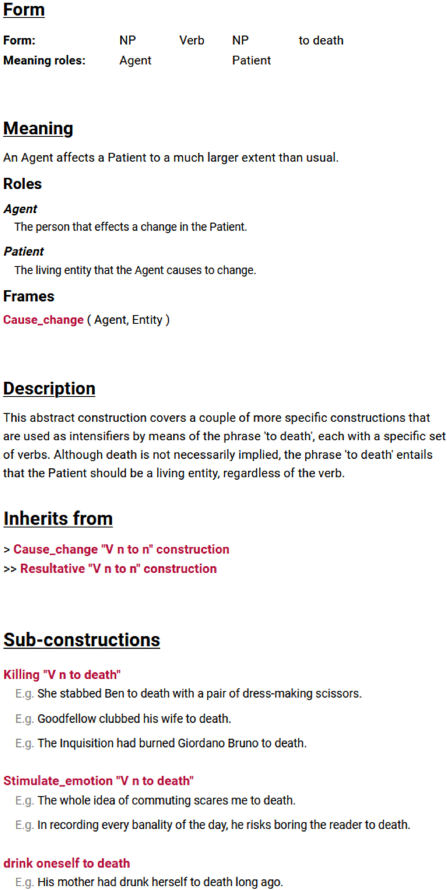
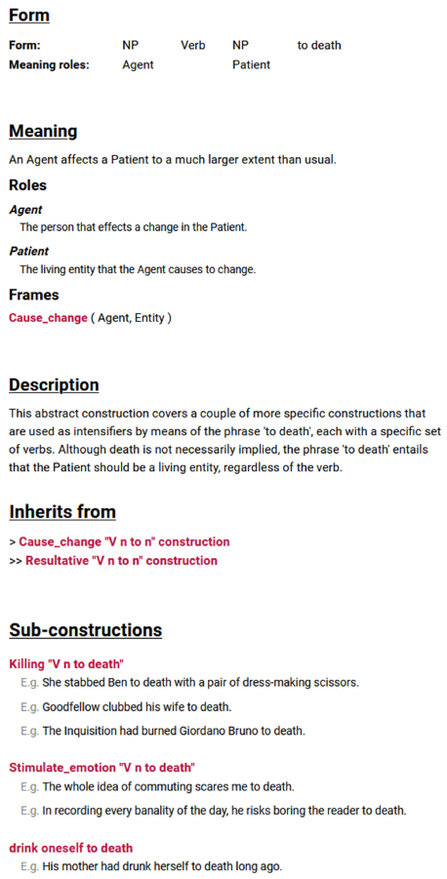
Figure 1
Intensifier V n to death construction: sample entry from the English Constructicon (2024)
Citation: Journal of Greek Linguistics 26, 1 (2026) ; 10.1163/15699846-02601005
Several constructicon projects are currently under way for languages such as English (Perek & Patten 2019), German (Ziem et al. 2019; Ziem & Feldmüller 2023), Swedish (Lyngfelt et al. 2018), Portuguese (Torrent et al. 2018), Russian (Janda et al. 2020). Among these constructicon resources there are differences in description format, annotation technicalities, workflow, or scope. For example, the English constructicon combines the COBUILD grammar patterns with FrameNet semantic frames and has a pedagogical orientation, while the German constructicon relies on a robust computational infrastructure for an in-depth annotation of semantically or functionally related constructions but has no particular application-oriented purpose. Despite differences, constructicographic work generally involves collecting constructions from authentic language data (manually or automatically) or from secondary sources, such as dictionaries, grammars, and studies, and describing their special properties of form and meaning. Exploring linking strategies also seems to be a central concern for constructicon projects and involves two main directions: linking constructions with frames and linking constructions with each other in families by organizing construction entries in networks.
To illustrate these directions, Figure 1 presents an entry from the English Constructicon. Each entry in this database contains information about the form, meaning, and use of a particular construction. The construction described in Figure 1 has the form V n to death and is used as intensifier. The slots in the form of the construction are given roles (Agent, Patient), which are mentioned in the semantic definition of the construction. It is worth noting that the construction is linked to the FrameNet frame “Cause_change” as well as to related constructions. More precisely, the entry specifies what constructions it inherits from and the constructions that inherit from it, called “sub-constructions”. We can thus navigate the inheritance hierarchy of constructions, from more specific to more general ones, and vice-versa.
Overall, constructicon projects develop relationships with other resources (dictionaries, framenets) and constructional theory (Construction Grammar), and these relationships are bidirectional. To understand the interplay between constructicography and lexicography, we can consider, for example, Perek & Patten’s (2019) account of how the Collins COBUILD English Dictionary 2nd Edition was used as a source of lexico-grammatical information in developing the English Constructicon; the other side of the coin is evident in Croft & Sutton’s claim that “a more construction-oriented notation of lexical distributions in dictionaries can substantially increase their lexicographic value” (Croft & Sutton 2017: 11). As regards the interaction between constructicons and framenets, Boas et al. (2019) classify constructicons along a framenet-relatedness continuum (from framenet-derived to framenet-influenced resources) and point out the possibility for crosslinguistic comparison by connecting constructicons across languages via frames and for adapting framenet to better suit the needs of constructicons. Boas et al. (2019) further highlight the mutual beneficial relation between constructicography and Construction Grammar; constructicography, originally inspired by constructional research, also informs theory by showing in practice how to account for a language with Construction Grammar.
In the light of theoretical and application-related benefits gained from constructicography, this paper calls for utilizing constructional research in Modern Greek for developing a constructicon for that language, which is still missing from the growing network of constructicons. To pave the way, we demonstrate the process of compiling a constructicon entry for Greek data by first collecting constructions (from dictionaries and corpora), identifying their form-meaning properties, and linking them with frames and with each other in a construction family.
2.2 On exclamative constructions
This section refers to previous studies investigating exclamatives1 within Construction Grammar in order to set the context for the analysis that follows. In this study, the umbrella term “interrogative-negative exclamative” refers to sentential exclamative structures that consist of a wh-question word, the negative particle
In the constructional approach, exclamatives are viewed as a form-meaning pairing. Although formally there is a wide variety of structural realizations, functionally they share the expression of surprise and affective stance towards some propositional content; it is this shared semantic-pragmatic relationship that justifies the grouping of structurally different expressions such as It’s amazing how much he’s grown!; God, am I late!; They’re such idiots!; I can’t believe the nerve of some people!; It’s amazing the difference! (Michaelis & Lambrecht 1996). The core semantic and formal features of the exclamative construction are defined more precisely in Michaelis (2001) based on data from various languages. With regard to the semantico-pragmatic features, Michaelis (2001) specifies the notion of surprise as entailing a “noncanonicity judgement”3 on the part of the speaker, which adds a scalar implicature to a presupposed open proposition. In other words, the speaker’s purpose in exclaiming is to express their commitment and emotional reaction to a particular scalar degree which can be recovered from the context.
These semantic aspects motivate the contexts in which exclamatives appear. According to Michaelis (2001), recurrent formal features across languages include co-occurrence with interjections, subordination to factive epistemic verbs (e.g. It’s amazing how much noise they make), topic dislocation constructions (e.g. She’s pretty sharp, my mom), anaphoric degree adverbs (meaning ‘so’), question words (wh‑ words), noun phrase (NP) complements (e.g. I can’t believe the way they treat us.), ellipsis with NP s (e.g. The indignities that the world heaps on him!), inversion (e.g. Can this kid direct second unit!). Another observation about exclamatives concerns negation; as Schröder (2024) notes, while lexical negation is possible (e.g. How unhappy she was!), sentential negation (*What a tall man he is not!) is not acceptable because it would result in negating the presupposed proposition (Schröder 2024: 5). Besides these morpho-syntactic features, another aspect of form that distinguishes exclamatives is intonation; a falling tone is usually associated with exclamatives—referred to as “exclamatory fall” (Wells 2006: 59)—and differentiates them from interrogatives, which typically show a rising intonation.4
There are various perspectives from which exclamatives have been viewed by the linguistic community (for a review of relevant studies, see Chaibeddra 2020 and Schröder 2024). Among the issues that have become the center of attention (and contention) are factivity, degree interpretation, and emotional content (Villalba 2008). For instance, Trotzkea & Giannakidou (2021) challenge the notion of a factivity presupposition and argue that exclamatives convey a presupposition of “subjective veridicality anchored to the speaker, and assert the emotion (of surprise, amazement, or a negative emotion)” (Trotzkea & Giannakidou 2021: 1). The exact nature of surprise and high degree usually associated with exclamatives is also a prominent subject of discussion; for example, concepts such as “widening” (Zanuttini & Portner 2003) and “noteworthiness” (Nouwen & Chernilovskaya 2015) have been proposed in an attempt to capture the wide range of expressive attitudes (including unexpectedness, emotional reaction, extreme quality, amazement, awe, astonishment) covered by exclamatives. Interestingly, surprise is linked to a scale of unlikelihood, undesirability, or resentment in Yoon’s (2011) discussion of exclamatives which include a negative particle; this is not referred to as “expletive negation” but rather as “evaluative negation” that triggers a pragmatic effect reflecting the speaker’s emotional attitude towards a proposition.
In this context, the following corpus-based study aims to make a contribution to the theoretical discussion of exclamatives, examining data from a language which has not been widely researched in this respect, as well as to the practical development of a network of constructions.
3 Case study: Interrogative-negative exclamatives
3.1 Dictionary review
Patterns recorded in dictionaries can be used as “points of departure for identifying more general constructions” (Lyngfelt et al. 2018: 56). This observation proves useful in the case of the closed set of interrogative pronouns/ determiners in Modern Greek, which consists of
The relevant extracts from the entries for
With regard to
Table 1
Interrogative pronouns/ determiners in the context of negation: information from dictionary entries
|
DSMG |
DMG |
HDMGL |
|
|---|---|---|---|
|
|
List of phrases under the sense “to express size, quantity” Phrase: Example: |
Subsense under the sense “in rhetorical questions” Definition: in questions with negation that imply “too many, everything” as an answer Example: |
List of phrases at the end of the entry Secondary headword: Definition: to express great surprise, desire, with expected response “too much, everything” Examples: Style: spoken, emphatic |
|
|
Separate sense Definition: for more emphasis and liveliness in an interrogative |
List of interrogative/ exclamative phrases under the sense “to express wonder, igno- |
Example under the sense “emphatic in interrogative or exclamative sentences”: |
|
negative sentence it has the meaning of everyone Example: Proverb: |
rance, surprise, or wish without reference to a specific person” Secondary headword: |
doesn’t make mistakes/doesn’t want to be happy!’) Everyone. Secondary headword: Secondary headword: |
|
|
|
– |
Subsense under the sense “as exclamation” Restriction: plural ( Definition: too many |
– |
|
Example: |
Lastly, as regards
On the whole, what we observe is that uses recorded as proverbs (e.g.
3.2 Corpus data
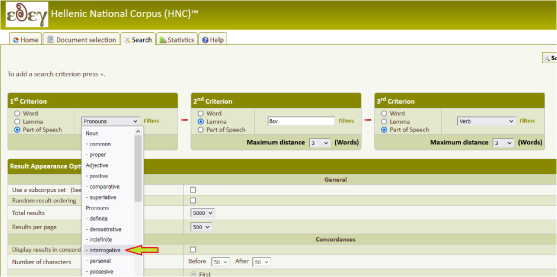
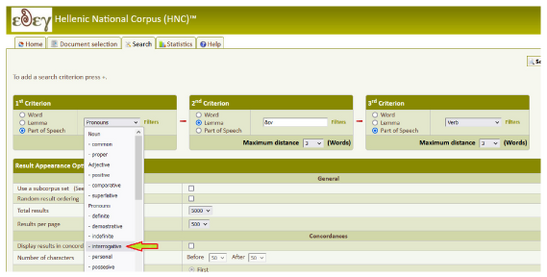
The corpus used for this study is the Hellenic National Corpus (HNC). This is a general language monitor corpus of almost 97 million running words of texts which have been written in Greek after 1990, are of high readability, and cover different publication media, genres, and topics. The HNC query system allows us to retrieve instances of the three interrogative pronouns in a negative context through a single targeted search. As shown in Figure 2, the search query used combines three criteria: the closed set of interrogative pronouns, the lemma
More than 3,000 examples were thus retrieved, which were then sifted through one by one to remove duplicate sentences, noise such as the relative pronoun
Figure 2
The search query used in HNC
Citation: Journal of Greek Linguistics 26, 1 (2026) ; 10.1163/15699846-02601005
Table 2
Frequency of interrogative-negative exclamatives headed by pronouns/ determiners in HNC
|
|
171 |
|
|
232 |
|
|
191 |
|
Total number of occurrences |
594 |
Table 3
The
|
FORM |
Morpho-syntax |
( |
|
Punctuation |
exclamation mark, full stop, ellipsis |
|
|
Intonation |
falling intonation pattern |
|
|
MEANING |
Semantics |
– Frame: Quantified_mass [ – semantic prosody: intensification |
|
Pragmatics |
– hyperbolic bias as implicature – emphatic, emotionally-charged utterance |
|
|
Discourse function |
– to exclaim about an excessive amount of things – to express surprise (positive or negative) |
3.3 Construction profiles
In this section, we identify the form and meaning properties of the three constructions based on the corpus data retrieved from HNC.
The first construction, [
(4)
Μέσα σε όλη αυτή την ατμόσφαιρα και με τα πνεύματα οξυμένα ,τι δεν ειπώθηκε … (Sent_id: 704994)
Mesa
se
oli
afti
tin
atmosfera
kai
me
ta
pnevmata
oxymena,
ti
den
eipothike
Inside
in
all
this-F
the-F
atmosphere
and
with
the-PL
spirit-PL
sharpened
what
NEG
say- PASS-PST-3SG
‘In the midst of all this atmosphere and with heightened spirits, what wasn’t said …’
(5)
Σκηνοθέτες και παραγωγοί συναγωνίζονται ποιος θα πρωτοπαρουσιάσει περισσότερες έξαλλες ερμηνευτικές και εμπορικές επιδιώξεις .Και τι δεν είδανε τα μάτια μας και τι δεν άκουσαν τα αυτιά μας . (Sent_id: 388362)
Skinothetes
kai
paragogoi
synagonizontai
poios
tha
protoparousiasei
perissoteres
exalles
ermineftikes
kai
emporikes
epidioxeis.
Kai
ti
den
eidane
ta
matia
mas
kai
ti
den
akousan
ta
aftia
mas.
Director-PL
and
producer-PL
compete-PRS-3PL
who
FUT
debut-FUT-3SG
more
wild
interpretive
and
commercial
aspiration-PL.
And
what
NEG
see-PST-3PL
the-PL
eye-PL
our
and
what
NEG
hear-PST-3PL
the-PL
ear-PL
our.
‘Directors and producers compete to see who will first present more wild interpretative and commercial aspirations. And what have our eyes not seen and what have our ears not heard.’
(6)
Και τι δεν έκανε ο τετραπέρατος ο Ρεξ !Τούμπες ,αγκαλιές ,φιλιά . (Sent_id: 2818215)
Kai
ti
den
ekane
o
tetraperatos
o
Rex!
Toumpes,
agkalies,
filia.
And
what
NEG
do-PST-3SG
the-M
clever
the-M
Rex!
Somersault-PL,
hug-PL
kiss-PL.
‘And what didn’t clever Rex [dog] do! Somersaults, hugs, kisses.’
(7)
Τι εισάγουμε από την Κίνα ;Και τι δεν εισάγουμε ,από κλιματιστικά ,ενδύματα ,υποδήματα ,τσάντες μέχρι χριστουγεννιάτικα στολίδια . (Sent_id: 91052)
Ti
eisagoume
apo
tin
Kina?
Kai
ti
den
eisagoume,
apo
klimatistika,
endymata,
ypodimata,
tsantes,
mechri
xristougenniatika
stolidia.
What
import-PRS-1PL
from
the-F
China?
And
what
NEG
import-PRS-1PL
from
air conditioner-PL
clothing-PL
shoe-PL
bag-PL
to
Christmas
decoration-PL.
‘What do we import from China? And what don’t we import, from air conditioners, clothes, shoes, bags to Christmas decorations.’
Starting with the formal properties of the construction, the sequence
The second construction, [
(8)
Και ποιος σκιέρ δεν θα ήθελε να μοιάσει στον Αλμπέρτο Τόμπα ,τον Ιταλό πρωταθλητή που σαρώνει τις διακρίσεις στο άθλημα του χιονιού ! (Sent_id: 1229461)
Kai
poios
skier
den
tha
ithele
na
moiasei
ston
Alberto
Tomba,
ton
Italo
protathliti
pou
saronei
tis
diakriseis
sto
athlima
tou
chioniou!
And
who
skier
NEG
COND
want-COND-3SG
to
be like-INF-3SG
to the-M
Alberto
Tomba,
the-M
Italian
champion
who
sweep-PRS-3SG
the-PL
award-PL
in the-PL
sport
the-GEN
snow-GEN
‘And who wouldn’t want to be like Alberto Tomba, the Italian champion who sweeps the awards in the snow sport!’
Table 4
The
|
FORM |
Syntax |
( |
|
Morphology |
preference for singular, masculine: |
|
|
Punctuation |
exclamation mark, full stop, question mark |
|
|
Intonation |
falling intonation pattern |
|
|
MEANING |
Semantics |
– Frame: Quantified_mass [ – semantic prosody: intensification |
|
Pragmatics |
– hyperbolic bias as implicature – emphatic, emotional generalization |
|
|
Discourse function |
– to exclaim about an excessive amount of people – to express surprise at the obviousness of a situation – to reinforce an argument |
(9)
Θα μου λείψει περισσότερο από όλα ο καφές !Και σε ποιον Έλληνα δεν θα έλειπε ,άλλωστε . (Sent_id: 856049)
Tha
mou
leipsei
perissotero
apo
ola
o
kafes!
Kai
se
poion
Ellina
den
tha
eleipe,
alloste.
FUT
to me
miss-FUT-3SG
more
than
everything
the-M
coffee!
And
to
who-ACC
Greek
NEG
COND
miss-COND-3SG
besides.
‘I will miss coffee the most! And which Greek wouldn’t, after all?’
(10)
Κι αλήθεια ποιος δεν έχει διαβάσει το ποίημα του Α .Βαλαωρίτη «Ο Καλογιάννης » ; (Sent_id: 4975458)
Ki
alitheia
poios
den
exei
diavasei
to
poiima
tou
A.
Valaoriti
“O
Kalogiannis”?
And
really
who
NEG
have-PRS-3SG
read-PRF
the-N
poem
the-M-GEN
A.
Valaoritis-GEN
“the-M
Kalogiannis”
‘And truly, who hasn’t read the poem “Kalogiannis” by A. Valaoritis?’
(11)
Αν συνεχώς αναλύεις ή βαθμολογείς τη ζωή σου ,πάντα θα βρίσκεις σφάλματα σε οτιδήποτε κάνεις .Εξάλλου ποιος δεν χρειάζεται βελτίωση ; (Sent_id: 4401457)
An
synexos
analyeis
i
vathmologeis
ti
zoi
sou,
panta
tha
vriskeis
sfalmata
se
otidipote
kaneis.
Exallou
poios
den
xreiazetai
veltiosi?
If
constantly
analyse-PRS-2SG
or
grade- PRS-2SG
the-F
life
your,
always
FUT
find-FUT-2SG
mistake-PL
in
anything
do-PRS-2SG
Besides
who
NEG
need-PASS-3SG
improvement
‘If you constantly analyze or grade your life, you will always find faults in everything you do. After all, who doesn’t need improvement?’
The formal properties of the construction include an optional noun slot after the interrogative pronoun/determiner8 and a preference for the singular, masculine form
The third construction under study is [
(12)
Πόσα όμως παιδάκια δεν βρίσκουν σήμερα το θάνατο από την επιδημία τύφου που έχει ξεσπάσει ! (Sent_id: 1078594)
Posa
omos
paidakia
den
vriskoun
simera
to
thanato
apo
tin
epidimia,
tifou
pou
exei
ksespasei!
How many
however
children
NEG
find-PRS-3PL
today
the-M
death
from
the-F
epidemic
typhus
that
have- PRS-3SG
break out-PRF
‘How many children, however, do not find death today from the typhus epidemic that has broken out!’
(13)
Πόσες και πόσες φιλίες χρόνων δεν χάλασαν ,πόσοι και πόσοι δεν έκοψαν την καλημέρα σε συγγενείς και γείτονες ; (Sent_id: 3517609)
Poses
kai
poses
filies
xronon
den
xhlasan
posoi
kai
posoi
den
ekopsan
tin
kalimera
se
syngeneis
kai
geitones
How many
and
how many
friendship-PL
year-GEN-PL
NEG
ruin-PST-3PL
how many
and
how many
NEG
cut-PST-3PL
the
good morning
to
relative-PL
and
neighbor-PL
‘How many friendships of years were ruined, how many people stopped greeting their relatives and neighbors?’
(14)
Πόσοι και πόσοι δεν θα έχουν σιγοτραγουδήσει παλιές ρομαντικές επιτυχίες του ! (Sent_id: 841006)
Posoi
kai
posoi
den
tha
exoun
sigotragoudisei
palies
romantikes
epityxies
tou!
How many
and
how many
NEG
COND
have-COND-3PL
hum-PRF
old-PL
romantic-PL
hit-PL
his
‘How many people have not hummed his old romantic hits!’
(15)
Μέσα στην παραζάλη και τον ίλιγγο του φόβου μας ,πόσα και πόσα εγκλήματα δεν διαπράττουμε και πόση βία δεν αναπαράγουμε στην κάθε όψη της καθημερινότητάς μας . (Sent_id: 2546954)
Mesa
stin
parazali
kai
ton
ilingo
tou
fovou
mas,
posa
kai
posa
egklimata
den
diapratoume
kai
posi
via
den
anaparagoume
stin
kathe
opsi
tis
kathimerinotitas
mas
Inside
in-the-F
daze
and
the-M
dizziness
the-GEN-M
fear-GEN
our
how many
and
how many
crime-PL
NEG
commit-PRS-1PL
and
how much
violence
NEG
reproduce-PRS-1PL
in-the-F
every
aspect
the-GEN-F
everyday-life-GEN
our
‘In the daze and dizziness of our fear, how many crimes do we commit and how much violence do we reproduce in every aspect of our daily lives?’
Table 5
The
|
FORM |
Syntax |
( polysyndetic structure |
|
Morphology |
preference for plural: |
|
|
Punctuation |
exclamation mark, full stop, question mark |
|
|
Intonation |
falling intonation pattern |
|
|
MEANING |
Semantics |
– Frame: Quantified_mass [ – semantic prosody: intensification |
|
Pragmatics |
– hyperbolic bias as implicature – emphatic, emotional reaction to a fact |
|
|
Discourse function |
– to exclaim about an excessive amount of events – to express surprise and resentment |
The [
3.4 Construction family
The construction profiles built in Section 3.3 build on the “form”, “meaning”, and “description” information categories of a constructicon entry (as shown in Figure 1); the categories “inherits from” and “sub-constructions” are discussed in this section. As explained in Section 2.1, linking constructions with frames, on the one hand, and with each other, on the other hand, is of central concern in constructicography. Having discussed the semantic frame evoked by the constructions under study in Section 3.3, we proceed to demonstrate how they are linked together in a network of constructions.
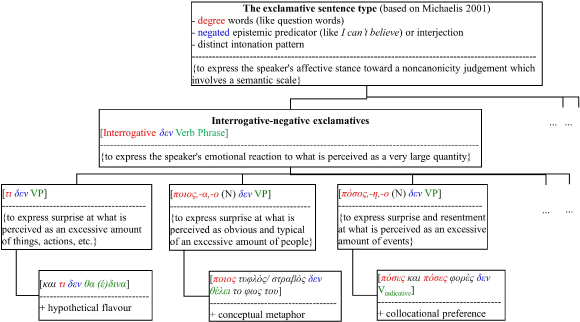
Figure 3
Partial network of exclamative constructions, focusing on interrogative-negative exclamatives headed by pronouns/determiners
Citation: Journal of Greek Linguistics 26, 1 (2026) ; 10.1163/15699846-02601005
The family of interrogative-negative exclamatives seems to comprise constructions on different levels of granularity, as shown in Figure 3. The constructions examined so far ([
At a more specific level, each one of the three constructions has sub-constructions (called “phraseological constructions” in the English Constructicon). Examples (16)–(18) illustrate the hypothetical phrase
(16)
Και τι δεν θα ‘δινα για μια αγκαλιά σου ! (Sent_id: 3696576)
Kai
ti
den
tha
‘dina
gia
mia
agkalia
sou!
And
what
NEG
COND
give-COND-1SG
for
a
hug
your!
‘And what wouldn’t I give for a hug from you!’
(17)
Εφόσον είναι καλοί —ποιος στραβός δεν θέλει το φως του —να τους κρατάει και να ανανεώνεται η θητεία τους . (Sent_id: 2002781)
Efoson
einai
kaloi
–poios
stravos
den
thelei
to
fos
tou–
na
tous
krataei
kai
na
ananeonetai
i
thiteia
tous.
Provided that
be-PRS-3PL
good
–who
blind
NEG
want-PRS-3SG
the
light
his–
to
them
keep-PRS-3SG
and
to
renew-PASS-PRS-3SG
the
term
their.
‘Since they are good—who among the blind do not want their sight—to keep them and renew their term.’
(18)
Πόσες και πόσες φορές δεν άκουσα αυτή την κουβέντα από τη γιαγιά μου . (Sent_id: 5182934)
Poses
kai
poses
fores
den
akousa
afti
tin
kouventa
apo
ti
giagia
mou.
How many
and
how many
times
NEG
hear-PST-1SG
this-F
the-F
talk
from
the-F
grandmother
my.
‘How many times have I heard this talk from my grandmother.’
In addition to inheriting the form and meaning of their parent construction, the sub-constructions display idiosyncratic behaviour in their meaning or in the kind of words that appear in the open slots. For example, when [
At a more general level, we can argue for a superordinate construction that refers to the speaker’s emotional reaction to a very large quantity, and allows not only pronouns in the interrogative slot but also other question words like the adverbs
To sum up, the above form-meaning pairs of varying degrees of idiomaticity are visualized as a structured network of constructions in Figure 3, according to the properties they share. If we compare the construction-based description in Figure 3 to the information derived from the dictionaries (Table 1), we notice that the patterns recorded in the dictionary entries tend to be too specific, while the variability and productivity revealed by the corpus analysis leads to more general constructicon entries. We also realize the great potential that a Greek constructicon would have with regard to the systematic coverage and interconnection of lexico-grammatical patterns in a more comprehensive representation of the language.
4 Conclusion
The aim of this study was to explore the blend of Construction Grammar and lexicography by applying constructicographic practices to Greek data. The illustrative study on interrogative-negative exclamatives has both theoretical and practical implications.
This investigation adds support to the theory of Construction Grammar by offering a unified account of data—not analyzed before—on interrogative-negative exclamatives in Modern Greek. Starting with the observation that there are parallel structures that consist of an interrogative pronoun/determiner and a negative particle, but whose function is different from an ordinary question and negation, we have argued for three semi-schematic exclamative constructions ([
From an applied perspective, the two-way relationship between lexicography and constructicography should be highlighted. On the one hand, lexico-grammatical patterns recorded in Modern Greek dictionaries can serve as the first step toward tracing more general constructions and a network of constructions (as was done for the case studies here). On the other hand, dictionaries can benefit from incorporating constructionist insights in microstructural components (like definitions, valence patterns, and/or examples) as well as in the access structure, by linking members of a construction family together. Further research should focus on how the flexibility offered by the electronic medium can be exploited to channel construction-based information into dictionary entries. The other direction future research can take is toward designing a new reference work, a Greek constructicon. In this respect, there are numerous questions to be considered concerning its target groups, purposes of use, extensiveness of coverage, computational infrastructure, and so forth—issues already addressed by constructicon projects for other languages.
A manageable project for a Greek constructicon could have a pedagogical goal and target recurrent semi-schematic constructions, which are crucial for achieving full mastery of the language, yet “fall between the cracks” of grammars and dictionaries. The project could start with an inventory of constructions gathered manually from existing literature on Greek constructions as well as textbooks for learners of Greek; these would be then verified and expanded using corpora to cover semantic families of constructions and create structured networks. Similarly, as regards presentation, the existing architectures of constructicons with a pedagogical orientation (like those for English, Swedish, and Russian) could offer a quick starting point for designing an interface that would provide comprehensive linguistic description along with user-friendly guidance. The various stages of such a project (collecting constructions, describing their properties of form and meaning, annotating corpus examples, identifying families of constructions, catering for pedagogical assistance, and refining the resource in content and design) should be undertaken by a team of researchers, ideally within a context of international cooperation. By aligning the new resource with international frameworks like comparable constructicons, framenets and the Common European Framework of Reference for Languages (CEFR), the status of the Greek language will be promoted through its inclusion in a multilingual network of resources.
There is a standard distinction between the terms “exclamative” and “exclamation” in the literature. Exclamative sentences are “a formal encoding of sentence-type, just as declarative or interrogative sentences”, whereas exclamations are “speech acts, just as assertions or questions. Exclamative sentences typically—but not necessarily—perform an exclamation speech act” (Villalba 2024: 66).
An exception here is Roussou (to appear), who looks at structures like the ones under study with regard to their syntactic peculiarities and refers to them as “whclaratives”. The present study takes a different perspective and builds form-meaning profiles based on data from a general-purpose Greek corpus.
A “noncanonical situation” is defined as “one whose absence a speaker would have predicted, based on a prior assumption or set of assumptions, e.g., a stereotype, a set of behavioral norms, or a model of the physical world” (Michaelis 2001: 1039).
There is experimental evidence for these functions of prosodic features from Greek data as well. For example, for a discussion of rising intonation in information-seeking wh-questions, see Baltazani et al. (2020), and of falling intonation in ela exclamatives, see Nikiforidou et al. (2014).
These wh-question words are “determiners when they modify a noun and pronouns when they stand alone” (Holton, Mackridge & Philippaki-Warburton 2012: 117).
According to the FrameNet description of the frame Quantified_mass, the frame element Individuals refers to “a collection of entities” (e.g. A number of concerned citizens have raised objections) and the frame element Mass refers to “a substance that is being quantified” (e.g. A modicum of seepage on the floor is to be expected). Lexical units that evoke this frame include all, many, several, numerous, number, degree, etc.
Indefinite Null Instantiation (INI) is explained by Ruppenhofer et al. (2010: 24–25) as follows: “with existential omissions, the nature (or at least the semantic type) of the missing element can be understood given conventions of interpretation, but there is no need to retrieve or construct a specific discourse referent”. INI is contrasted to DNI (Definite Null Instantiation) which refers to anaphoric omission (i.e. its referent has to be known in the context).
The occurrence of
For a discussion of the use of additive markers as a reinforcement of informative and argumentative structures, see De Cesare (2017).
Examples of polysyndetic structures (like loads and loads and loads, years and years and years) are discussed in relation to hyperbole by McCarthy & Carter; “polysyndetic structures are a feature of both numerical and temporal hyperboles and are very effective in ‘stretching’ the vertical reference to suggest extremes” (McCarthy & Carter 2004: 171).
It should be noted that, similarly to the previous constructions, emphatic filler
The frame Quantified_mass is in line with the indefiniteness implied by the three constructions under examination here and associated with wh-exclamatives in general (Chaibeddra 2020: 219). It is thus more reasonable to link the interrogative-negative exclamatives to this frame rather than, for instance, to the frame Quantity, which denotes specific numerical values.
As explained in Section 3.3, the hyperbolic element in examples (4)–(15) lies in the amount of things, people, events, etc., which is perceived as more extreme than the actual experience and results in an exclamatory expression of surprise. This interpretation is in line with Burgers et al.’s (2016) definition of hyperbole as “an expression that is more extreme than justified given its ontological referent” (Burgers et al. 2016: 166) as well as Colston & Keller’s (1998) finding that hyperbole is effective in creating an element of surprise.
In 134 out of 191 occurrences
Interrogative-negative exclamatives headed by adverbs like
References
Baltazani, Mary, Stella Gryllia, & Amalia Arvaniti. 2020. The intonation and pragmatics of Greek wh-questions. Language and Speech 63.1.56–94.
Boas, Hans C., Benjamin Lyngfelt, & Tiago Timponi Torrent. 2019. Framing constructicography. Lexicographica 35.41–85.
Burgers, Christian, Britta C. Brugman, Kiki Y. Renardel de Lavalette, & Gerald J. Steen. 2016. HIP: A method for linguistic hyperbole identification in discourse. Metaphor and Symbol 31.3.163–178.
Canakis, Costas. 1995. K
αι : The story of a conjunction. Unpublished PhD dissertation. The University of Chicago, Department of Linguistics.Chaibeddra, Samira 2020. An analytical description of exclamatory sentences in English. El-Tawassol 25.1.216–232.
Colston, Herbert L. & Shauna B. Keller. 1998. You’ll never believe this: Irony and hyperbole in expressing surprise. Journal of Psycholinguistic Research 27.4.499–513.
Croft, William & Logan Sutton. 2017. Construction grammar and lexicography. International handbook of modern lexis and lexicography, ed. by Patrick Hanks & Gilles-Maurice de Schryver, 1–12. Berlin: Springer.
De Cesare, Anna Maria. 2017. Introduction: On ‘additivity’ as a multidisciplinary research field. Focus on additivity: Adverbial modifiers in Romance, Germanic and Slavic languages, ed. by Anna Maria De Cesare & Cecilia Andorno, 1–22. Amsterdam: John Benjamins.
Fillmore, Charles J., Russell Lee-Goldman, & Russell Rhomieux. 2012. The FrameNet Constructicon. Sign-based construction grammar, ed. by Hans C. Boas & Ivan A. Sag, 283–322. Stanford: CSLI.
Goldberg, Adele E. 2013. Constructionist approaches. The Oxford handbook of Construction Grammar, ed. by Thomas Hoffmann & Graeme Trousdale, 15–31. Oxford: Oxford University Press.
Herbst, Thomas. 2019. Constructicons—a new type of reference work? Lexicographica 35. 3–14.
Hilpert, Martin. 2020. Constructional approaches. The Oxford handbook of English grammar, ed. by Bas Aarts, Jill Bowie, & Gergana Popova, 106–123. Oxford: Oxford University Press.
Hilpert, Martin. 2021. Lecture 1 What is construction grammar? Ten lectures on diachronic construction grammar. Leiden: Brill.
Holton, David, Peter Mackridge, & Irene Philippaki-Warburton. 2012. Greek: A comprehensive grammar. 2nd edn. London: Routledge.
Janda, Laura A., Anna Endresen, Valentina Zhukova, Daria Mordashova, & Ekaterina Rakhilina. 2020. How to build a constructicon in five years. The Russian example. Belgian Journal of Linguistics 34.1.161–173.
Lakoff, George. 1993. The contemporary theory of metaphor. Metaphor and thought, ed. by Andrew Ortony, 202–251. Cambridge: Cambridge University Press.
Lyngfelt, Benjamin. 2018. Introduction: Constructicons and constructicography. In Lyngfelt, et al., eds., 1–18.
Lyngfelt, Benjamin, Linnéa Bäckström, Lars Borin, Anna Ehrlemark, & Rudolf Rydstedt. 2018. Constructicography at work: Theory meets practice in the Swedish constructicon. In Lyngfelt et al., eds, 41–106.
Lyngfelt, Benjamin, Lars Borin, Kyoko Ohara, & Tiago Timponi Torrent (eds.). 2018. Constructicography: Constructicon development across languages. Amsterdam: John Benjamins.
McCarthy, Michael & Ronald Carter. 2004. “There’s millions of them”: Hyperbole in everyday conversation. Journal of Pragmatics 36.2.149–184.
Michaelis, Laura & Knud Lambrecht. 1996. The exclamative sentence type in English. Conceptual structure, discourse and language, ed. by Adele Goldberg, 375–390. Stanford: CSLI.
Michaelis, Laura A. 2001. Exclamative constructions. Language typology and language universals: An international handbook. Volume 20, ed. by Martin Haspelmath, Ekkehard König, Wulf Oesterreicher, & Wolfgang Raible, 1038–1049. Berlin: Walter de Gruyter.
Michaelis, Laura A. 2017. Meanings of constructions. Oxford research encyclopedia of linguistics, ed. by Mark Aronoff. Oxford: Oxford University Press.
Nikiforidou, Kiki, Sophia Marmaridou, & George Mikros. 2014. What’s in a dialogic construction? A constructional approach to polysemy and the grammar of challenge. Cognitive Linguistics 25.4.655–699.
Nouwen, Rick & Anna Chernilovskaya. 2015. Two types of wh-exclamatives. Linguistic Variation Yearbook 15.2. 201–224.
Perek, Florent & Amanda Patten. 2019. Towards an English constructicon using patterns and frames. International Journal of Corpus Linguistics 24.3.354–384.
Roussou, Anna. To appear. A peculiar distribution of wh-phrases in Greek. Selected Papers from the 26th International Symposium on Theoretical and Applied Linguistics, Aristotle University of Thessaloniki.
Ruppenhofer, Joseph, Michael Ellsworth, Miriam Petruck, Christopher Johnson, & Jan Scheffczyk. 2010. FrameNet II: Extended theory and practice. https://framenet.icsi.berkeley.edu/the_book
Schröder, Daniela. 2024. Independent wh-exclamative constructions in the history of English. London: Routledge.
Torrent, Tiago Timponi, Ely Edison da Silva Matos, Ludmila Lage, Adrieli Laviola, Tatiane Tavares, Vânia Gomes de Almeida, & Natália Sigiliano. 2018. Towards continuity between the lexicon and the constructicon in FrameNet Brasil. In Lyngfelt, et al., eds., 107–140.
Trotzke, Andreas & Anastasia Giannakidou. 2021. Exclamation, intensity, and the assertion of emotion. Manuscript. https://lingbuzz.net/lingbuzz/006137.
Villalba, Xavier. 2008. Exclamatives: A thematic guide with many questions and few answers. Catalan Journal of Linguistics 7.9–40.
Villalba, Xavier. 2024. Romance exclamative markers at the syntax-pragmatics interface: A compositional approach to exclamativity. Journal of Pragmatics 226. 64–77.
Wells, John C. 2006. English intonation. An introduction. Cambridge: Cambridge University Press.
Yoon, Suwon. 2011.‘Not’ in the mood: The syntax, semantics and pragmatics of evaluative negation. PhD dissertation, University of Chicago.
Zanuttini, Raffaella & Paul Portner. 2003. Exclamative clauses: At the syntax-semantics interface. Language 79.1. 39–81.
Ziem, Alexander & Tim Feldmüller. 2023. Dimensions of constructional meanings in the German Constructicon: Why collo-profiles matter. Yearbook of the German Cognitive Linguistics Association 11.1.203–226.
Ziem, Alexander, Johanna Flick, & Phillip Sandkühler. 2019. The German constructicon project: Framework, methodology, resources. Lexicographica 35.15–40.
Dictionaries and other sources
DMG = Babiniotis, George. 1998.
Λεξικό της Νέας Ελληνικής Γλώσσας (Dictionary of Modern Greek). Athens: Kentro Lexicologias EPE.DSMG =
Λεξικό της Κοινής Νεοελληνικής (Dictionary of Standard Modern Greek). Institute of Modern Greek Studies. https://www.greek-language.gr/greekLang/modern_greek/tools/lexica/triantafyllides/index.htmlEnglish Constructicon. https://englishconstructicon.bham.ac.uk/
FrameNet. https://framenet.icsi.berkeley.edu/
HDMGL =
Χρηστικό Λεξικό της Νεοελληνικής Γλώσσας (A Handy Dictionary of the Modern Greek Language). Athens: Academy of Athens. https://christikolexiko.academyofathens.grHNC = Hellenic National Corpus of Greek Language. https://hnc.ilsp.gr/
Sinclair, John (ed.). 1995. Collins COBUILD English Dictionary. 2nd edn. London: HarperCollins.