æè¦
Several accounts of the typologically unusual compensatory lengthening through the loss of the onset r in Samothraki Greek exist in the literature. However, none of these accounts take into consideration the precise phonetic detail of r-deletion and vowel lengthening in the language. This paper addresses this shortcoming by providing a phonetic analysis of Samothraki Greek compensatory lengthening through r-deletion. Our data show that vowels resulting from r-deletion are categorically longer than vowels not involving r-deletion. Moreover, there is no trace of r in the formant structure of vowels from compensatory lengthening. Finally, in contexts that do not allow for r-deletion, the majority of r productions are taps, most of which are accompanied by a vocoid. A new account of r-deletion in Samothraki Greek is proposed that takes into consideration the articulatory makeup of the r. The implications of this proposal for existing phonological accounts are discussed.
1. Introduction
1.1. The Problem
The loss of r in the dialect of Greek spoken on the island of Samothraki has been extensively discussed in the phonological literature (Hayes 1989, Kavitskaya 2002, Kiparsky 2011, Newton 1972a, b, Topintzi 2006, among others). The reason for this attention is that Samothraki Greek exhibits a typologically unusual process of compensatory lengthening (CL) through onset loss. This rare pattern is not predicted by any theory that relates CL to syllable structure and treats it as weight conservation within a syllable (Hayes 1989, among others).
As illustrated in (1), in Samothraki Greek the onset r deletes word-initially and post-consonantally with CL of the following vowel.

CL is broadly defined as a process whereby a segment lengthens in compensation for the deletion of a neighboring segment. The most typologically widespread (or at least the most commonly discussed) CL pattern is the deletion of a coda consonant with the lengthening of the preceding vowel, exemplified in (2).2 The theories that treat CL as weight conservation hold that in the cases like in (2) the deletion of a weight-bearing consonant happens only on the melodic tier, leaving a mora behind. The stray mora then docks onto the tautosyllabic vowel, which results in the lengthening of the vowel.
The pattern of the Samothraki Greek CL is not predicted by theories that treat CL as weight conservation (Hayes 1989), which hold that only the deletion of weight-bearing coda consonants can result in vowel lengthening. It is generally assumed and empirically demonstrated by the data from many languages that onsets cannot bear weight and do not count as moraic (for the discussion of moraic onsets and geminates see Curtis (2003), Davis (1999), among others; see, however, a recent article by Ryan (2014) which presents statistical evidence from stress and meter showing that onsets are factors in syllable weight, though they are subordinate to the rhyme with respect to weight). The cases that are problematic for the theory are reanalyzed in Hayes (1989). For example, CL through the loss of the onset r in Onondaga (Woodbury 1981) is analyzed as an instance of vowel epenthesis with the subsequent metathesis followed by r-deletion. However, as shown by Topintzi (2006), among others, the Samothraki Greek CL resists such a reanalysis, and thus could not be accounted for within the theory.
Several attempts to resolve this problem were introduced in later literature. Broadly speaking, the approaches to CL through the loss of the onset r in Samothraki Greek that were developed in these accounts can be divided into historical/phonetic and synchronic/phonological. However, in both cases the phonetic properties of the deleted rhotic and/or the resulting long vowels were at the basis of the proposed analyses, and in neither case were the actual phonetic data from Samothraki Greek examined. This paper presents a phonetic study of Samothraki Greek that documents the properties of the rhotics and surrounding vowels, and might inform the phonological analyses by providing empirical evidence for or against the existing accounts of the Samothraki Greek CL.
This paper is structured as follows. We present the data in Section 1.2 and discuss the existing accounts of the Samothraki Greek CL in Section 1.3. Section 1.4 considers the hypotheses that we test. Sections 2 and 3 follow with methods and results respectively. Section 4 continues with the discussion of our findings, and Section 5 presents our conclusions.
1.2. The Data
This section describes the facts of r-deletion using examples collected for the purposes of this study and from the literature. Our examples are transcribed using the IPA. The examples from the literature are presented as in their original source due to lack of consistent phonetic description of the Samothraki Greek dialect. In addition, these data were collected by different researchers in different time periods, and we do not always know what sound changes could have affected the examples in question.
As was previously stated, in Samothraki Greek the onset r deletes with the lengthening of the following vowel either in the absolute word-initial position, as in (3a), or after a consonant in a complex onset, both in biconsonantal clusters, as in (3b), and triconsonantal clusters, as in (3c). Note that in all cases the deleting r immediately precedes a vowel.3 The vowels of Standard Greek are [i, É, É, É, u], as described in Arvaniti (1999).
The data in (3) also show several examples of the vowel shift in Samothraki Greek, which is accounted for by the following two ordered phonological rules: 1) unstressed high vowels /i/ and /u/ are deleted unless their deletion would create syllable structures unacceptable by the phonotactics of Samothraki Greek, and 2) unstressed mid vowels /É/ and /É/ raise to /i/ and /u/ respectively. The two rules are not in a feeding relationship (Newton 1972b: 79).
As Topintzi (2006) and Katsanis (1996: 71) point out, r-deletion does not happen in clusters of the CrVV type, as shown in (4). A possible way to account for this fact is that the absence of the r-deletion with CL is due to a constraint on triply long vowels or trimoraic syllables.
Topintzi 2006: 754
Intervocalic r undergoes deletion, and the remaining sequence of identical vowels surfaces as a phonetically long vowel, as in (5a), while the sequences of different vowels remain, as in (5b).
The syllabification of the long vowels in tokens like [ËÉspuËs] âseedlessâ in Samothraki Greek is problematic. Margariti-Rogka & Tsolaki (2011) claim that the two adjacent identical vowels resulting from the deletion of intervocalic r still remain in separate syllables if the word with the deleted r has antepenultimate stress, and the r is in the last syllable. According to this description, there are three syllables in the word for âseedlessâ after the deletion of the r ([ËÉ.spu.us]), instead of two syllables where the second one includes a long vowel ([ËÉ.spuËs]). Our impressionistic judgments do not agree with the three-syllable interpretation for our data. Further perceptual testing is required in order to clarify this issue. Although the Samothraki Greek form for âseedlessâ is transcribed here as having two syllables, both syllabification alternatives are discussed in the paper.
Pre-consonantally and word-finally r is retained in Samothraki Greek, as shown in (6).
The last correspondence in (6), which comes from the data recorded by the authors, appears to present a rule-ordering paradox. As we stated before, the mid-vowel raising rule does not feed the high vowel deletion rule, and thus we expect [Êiɾi] > [jii], and not the attested [Êiɾ] in Samothraki Greek, if the underlying representation of this word is /ÊiɾÉ/, like the attested form in Standard Greek. This discrepancy can be accounted for by positing underlying /Êiɾ/ in Samothraki Greek. Note that the pronunciation of words like âbendâ is inconsistent. While [Êiɾ] is the most frequent pronunciation, some of our speakers occasionally pronounce this word as [Êiɾi], without deleting the r. Others occasionally pronounce it as [ÊiË], which points to the underlying /ÊiɾÉ/.
The coda r in Samothraki Greek was lost and subsequently restored. Newton (1972a, 1972b: 77) states that the underlying coda r surfaces as [i], creating diphthongs, such as [ai] in the examples in (7). According to Kiparsky (2011), the r-deletion in the coda is also attested in the data collected by Heisenberg (1934: 39â41).
However, in the modern Samothraki Greek r is present in the coda, as illustrated in (8).
Katsanis 1996: 48
To summarize, the onset r deletes with CL in the prevocalic position, as in (9a) (except for the cases when r is followed by a sequence of two vowels, as in (4)), but not in the intervocalic position, as in (9b). The intervocalic r deletes with the coalescence of identical vowels, while different vowels are retained. (9c) shows that the coda r does not delete.
Kiparsky (2011) argues that the r/â alternations, such as in (10), provide evidence that CL is synchronically active in Samothraki Greek (for the same claim, see also Kaisse 1975, 1977: 168â169).
However, there is no evidence of synchronic r/â alternations accompanied by vowel lengthening. That is, we have no attested examples in which one member of a semantically related pair would have the r on the surface, while the other would have no r and a long vowel as a consequence of the r-deletion. Thus it is more accurate to say that the deletion of r is a synchronic process in Samothraki Greek, while CL through the loss of r is not.
1.3. Previous Accounts
This section presents a brief overview of the accounts of the Samothraki Greek CL previously offered in the phonological literature. On the basis of Heisenberg (1921) and his own data, Newton (1972b: 76â81) offers one of the first accounts of r-deletion in Samothraki Greek. He proposes that r was replaced by a âvocalic element of a quality identical to the following vowelâ (Newton 1972b: 80) in all cases, including the intervocalic one, as in âcheeseâ in (11).
Newton 1972b: 80
Newton goes on to discuss a more perplexing case of the replacement of preconsonantal r by i, as in xartà â xaità âpaperâ. This example is not attested in our data, as the coda r was analogically restored. In order to account for this case, Newton proposed a rule of vowel epenthesis that inserted an epenthetic i between r and a following consonant in Samothraki Greek, as in xartà â xarità â xaiËtà â xaitÃ.
In his seminal paper on CL, Hayes (1989: 283) briefly acknowledges that the Samothraki Greek data does not fit his weight preservation account. To account for the r-deletion with CL, Hayes extends Newtonâs idea that preconsonantal r went through a process of vowel epenthesis of the form VrC â VriC â ViC to identical vowel epenthesis in the case of postconsonantal r, such as CrVi â CVirVi â CViË. According to Hayes, the deletion of the intervocalic r could be followed by vowel coalescence, just like in other VrV â VË cases.
However, Topintzi (2006) notes that the epenthesis account proposed by Hayes (1989) does not account for the CL through the deletion of the word-initial r. In addition, Kiparsky (2011) claims that Hayesâ analysis is problematic because it predicts that the outputs of the r-deletion from CrV and VrV should merge, but according to Kiparsky, this is not the case: there is an accentual difference between the rVÌ and VrVÌ cases. While the former always results in a vowel accented on the first mora (rVÌ â VÌV, never VVÌ, as in θrÃmi â θÃim âshardâ), the latter usually results in a vowel accented on the second mora (VrVÌ â VVÌ, as in xará â xaá âjoyâ). However, the data on the behavior of stress and a potential merger of vowels from CL and coalescence cases are controversial. Heisenberg (1921: 91) notes that if r-deletion results in a sequence of identical vowels with the stress on the second vowel, the stress shifts from the second vowel to the first one, as in /karávi/ â [káav] âshipâ. Newton (1972b: 79) interprets the stress shift as evidence for vowel contraction (coalescence), while Heisenberg himself states that the vowels remain separate and belong to different syllable in such cases (Heisenberg 1921: 90).
Margariti-Rogka & Tsolaki (2011) side with the coalescence view. According to their interpretation, cases like xará > xáa âjoyâ represent a historical stage in the development of VrVÌ, where the vowels are identical and the second vowel is stressed. The full sequence of historical events for the word âjoyâ is xará > xaá > xáa, phonetically [xaË] in modern Samothraki Greek. However, Margariti-Rogka & Tsolaki (2011) also present evidence of synchronic coexistence of the forms with and without coalescence, e.g., tÃi and tià âcheeseâ (cf. Standard Greek [ti.Ëɾi]). They attribute the existence of these doublets to their transparent origin due to the presence of equivalent forms in Standard Greek. Margariti-Rogka & Tsolaki (2011) list three cases where the vowels remain in separate syllables after intervocalic r-deletion: a) identical vowels are unstressed, e.g., plÃxuus âspaciousâ (cf. Standard Greek aplÃxoros); b) vowels are not identical, e.g., θaó âI believeâ (cf. Standard Greek θaró); c) for morphological reasons.
Kavitskaya (2002: 98â99) presents a diachronic account of the Samothraki Greek CL pattern. Kavitskayaâs account holds that lengthening of a vowel with the deletion of a consonant should have a clear phonetic motivation. As Kavitskaya (2002: 99) puts it, âr is vocalic enough to be reinterpreted as additional vowel length.â Thus, the account predicts implicitly that there is more of a chance for CL if the deleting rhotic is phonetically an approximant rather than a trill or tap, given that approximants are more sonorous, have their own formant structure throughout, and can be reinterpreted as vowels more easily. Kavitskayaâs account, however, does not completely rule out the possibility of CL affecting vowels in the environment of taps or trills, but acknowledges that such a possibility is less likely.
Topintzi (2006) develops a phonological account arguing that Samothraki Greek exhibits a genuine case of CL through onset loss, contra Hayes (1989). Under Topintziâs account, the rhotic is placeless and thus is disallowed in the onset, but nonetheless requires a segmental output correspondent. Since the onset r cannot surface due to a constraint against placeless segments in the output, but its segmental (not moraic) position needs to be preserved, its segmental slot is filled by the following vowel. According to Topintzi (2006: 79), âCL is not about mora preservation, but about position preservation via a mora.â Topintzi explicitly addresses the question of the absence of CL in CrVV sequences, attributing it to a constraint against ternary branching for the same segment (Topintzi 2006: 94).
Kiparsky (2011) proposes an account that relies on the observation that r is excluded from the onset position cross-linguistically. Typologically, high sonority segments âdo not make good onsetsâ (Kiparsky 2011: 23), and many languages that have r in their inventories, such as Korean, various Turkic languages, Basque, Piro, Telefol, etc., do not allow it in word-initial or syllable-initial positions (de Lacy 2001, Smith 2003). Languages employ different strategies to avoid onset rhotics, such as prothesis, deletion, fortition, anti-gemination, and incorporation into the nucleus (Kiparsky 2011: 26). Kiparsky proposes that in Samothraki Greek the prohibition on the onset rhotic is resolved through the latter strategy: the rhotic is syllabified as a part of the nucleus (becomes moraic so the r and the following vowel form a rising diphthong) and then deletes with CL. The proposed analysis makes reference to more than one stage of syllabification: the string with the r needs to be resyllabified from its initial state.
A common problem of the existing accounts of the Samothraki Greek CL is the absence of phonetic support. Some proposals, such as Newton (1972a and b), Hayes (1989), and Topintzi (2006), do not address the phonetics of r, while others, that is, Kavitskaya (2002) and Kiparsky (2011), refer to the phonetic properties of the Samothraki Greek rhotic without looking at the actual phonetic data. In this article, we address these shortcomings by a phonetic study of the surface rhotics and the vowels that result from r-deletion. We supplement the existing accounts with phonetic data and experimentally test several hypotheses concerning the loss of the onset r in Samothraki Greek.
1.4. The Hypotheses
In the current study, we test four hypotheses that can be supported by phonetic data. The first two hypotheses address the duration of the vowel that results from r-deletion. Hypothesis 1 focuses on four types of vowels: 1) long vowels that are a result of r-deletion accompanied by compensatory lengthening (CL), 2) long vowels that are a result of r-deletion accompanied by vowel coalescence (VC), 3) singleton vowels in polysyllabic words that presumably undergo polysyllabic shortening (e.g., Lehiste 1972), and 4) singleton vowels in monosyllabic words, which, since they are elicited in isolation, also constitute their own phrase and are expected to lengthen due to their strong prosodic position (see Fletcher 2010 for an overview of prosodic lengthening). The latter two types are used as controls for the long vowels resulting from either CL or VC. Based on these categories, Hypothesis 1 predicts that singleton vowels should be shorter in polysyllabic words than their counterparts in monosyllabic words, due to polysyllabic shortening in the former case and boundary-related lengthening in the monosyllabic words/phrases in the latter case. However, vowels that result from CL should be longer than singleton vowels regardless of their prosodic position since we expect a categorical distinction between phonologically long and short vowels. Long vowels from coalescence are also expected to be longer than singleton vowels in all positions. It is not clear, however, what the relationship between the length of the vowels that result from CL and the long vowels from coalescence would be. Hypothesis 2 will address this question.
By Hypothesis 2, if the onset r indeed goes through a stage when it is fully vocalized (as proposed by Kiparsky 2011), we expect the duration of long vowels that result from CL (VË < rV, where r is either a word-initial or a post-consonantal onset) and the duration of long vowels that result from intervocalic r-deletion (VË < V1rV2, where V1 = V2) to be similar. For instance, in the examples in (12) we expect the duration of [uË i ] to be comparable to the duration of [uË j ] assuming that both words are disyllabic.6
Hypothesis 3 addresses whether there is phonetic evidence supporting the analysis of the Samothraki Greek CL as a synchronic alternation, as suggested by Kiparsky (2011) and implicitly assumed by Newton (1972) and Topintzi (2006). We examine the F3 frequency of the long vowel that results from CL, looking for traces of the deleted r. Specifically, if F3 is lowered at the beginning of the vowel, which corresponds to the location of r-deletion (Ladefoged & Maddieson 1996), this will constitute evidence that CL through r-deletion in Samothraki Greek is a synchronic process. However, absence of a phonetic effect of the r on the following vowel will not resolve the issue, since it could be accounted for either by synchronic or historical analysis.
Finally, Hypothesis 4 concerns the phonetic nature of the Samothraki Greek rhotic. We examine the data in order to determine its most frequent phonetic manifestation. A specific prediction cannot be formed since it is well known that rhotics are produced with great variability cross-linguistically (Iskarous & Kavitskaya 2010, Wiese 2001). However, both Kavitskayaâs (2002) and Kiparskyâs (2011) accounts would be more compatible with the finding that the Samothraki Greek r is more frequently an approximant. In particular, Kavitskaya (2002) predicts that more sonorous segments have greater likelihood of deletion with CL, while Kiparsky (2011) states that the deletion of the onset rhotics is a consequence of the prohibition against highly sonorous onsets.
The suggested hypotheses, summarized in (13), allow us to investigate whether there is a connection between the proposed phonological accounts of Samothraki Greek CL and the phonetic reality of the phenomenon.
-
(13)
Hypothesis 1
- â Vowels from CL and VC are expected to be longer than singleton vowels, regardless of their prosodic position.
-
Hypothesis 2
- â If the onset r goes through a stage of being a part of a nucleus (Kiparsky 2011), then the duration of long vowels from CL and from VC will be similar.
-
Hypothesis 3
- â If there are traces of the r in the vowel, then r-deletion with CL is a synchronic alternation.
-
Hypothesis 4
- â If the most frequent phonetic manifestation of the Samothraki Greek r is that of an approximant, it would be better accommodated by the accounts of Kavitskaya (2002) and Kiparsky (2011).
2. Methods
2.1. Participants
Thirteen female and four male speakers of the Samothraki dialect of Greek were recorded in a word elicitation task. At the time of the experiment (the summer of 2008), the speakers were between the ages of 35 and 80. The participants were unaware of the purposes of the study, signed an informed consent form, and received financial compensation for their participation. Here we report the results from 3 female and 3 male speakers (coded F01, F02, F03, M01, M02 and M03). These speakers were selected for the analysis because they formed a controlled group. They were all between 55 and 70 years old and spoke the Samothraki dialect in their everyday life. The younger participants used Standard Greek and Samothraki Greek interchangeably. The older participants often had difficulty following the instructions, which resulted in incomplete datasets, ineligible for the statistical analysis targeted here. Future research will focus on the sociolinguistic aspect of r deletion by comparing the age groups.
2.2. Materials
The elicited words belonged to one of the following categories:
- a. rââ alternations in inflectional paradigms: Triplets of words from the same inflectional paradigms were collected. The first member of the triplet involves r word-finally, e.g., Ësiɾ (2nd person singular, imperative, simple past of the verb Ëseɾ.no âto dragâ). The second member of the triplet involves r in the syllable coda, e.g., Ësiɾ.ti â Ësiɾ.tÉ (2nd person plural, imperative, simple past of the verb Ëser.no âto dragâ). The third member of the triplet involves the intervocalic r deletion, e.g., ËÉ.siÉ â ËÉ.si.É¾É (1st person singular, indicative, simple past of the verb Ëseɾ.no âto dragâ). Four sets of this category were used, yielding 12 words.
- b. rââ alternations in derivational paradigms: Triplets of words from the same derivational paradigms were collected. The first member included words with the word-final r, e.g., vÉ.ËpÉɾ â vÉ.ËpÉ.ɾi âboatâ. The second member had r in the onset, e.g., vÉ.ËpÉ.ɾÊÉ âboats.â The third member involved the deletion of the intervocalic r, e.g., vÉ.pÉ.Ëu.ðÊÉ âlittle boatsâ. Four triplets resulting in 12 words were employed.
- c. Deletion of r in single onsets word-initially: 6 words of this type were used, e.g., uË.ËðÉ.ci.nÉ â ɾÉ.ËðÉ.ci.nÉ âpeachesâ, iË.Ëvi.Î¸Ã§É â ɾÉ.Ëvi. Î¸Ã§É âchickpeasâ.
- d. Deletion of r in complex onsets: This group includes 5 words, e.g., ËθiËm â Ëθɾi.mi âshard,â ËviËs â Ëvɾi.si âfaucetâ.
- e. Deletion of intervocalic r with identical adjacent vowels: This group consisted of 8 words, e.g., ËθiË.Ã°É â θi.Ëɾi.Ã°É âwindowâ, ËÉ.spuËs/ËÉ.spu.us â ËÉ.spÉ.ɾÉs âseedlessâ.
A total of 43 words were used (see Appendix A for the full list of the words). Five repetitions of each word were elicited in blocks. Within each block, the 43 test words were randomized differently. In sum, each speaker had to produce 215 utterances.
2.3. The Procedure
The audio recordings were performed at the participantsâ houses using a digital DAT recorder at 24 KHz sampling rate and a unidirectional microphone. Each session lasted approximately one hour. The participants were instructed to utter the Samothraki Greek equivalent of a word that the experimenter said in Standard Greek. This is a common elicitation method in fieldwork research, which was considered adequate in this case, given that Standard Greek was a common communication code between the experimenter and the participants. Another option would have been to ask participants to read the words. This method was not preferred, since some of the participants were elderly, and reading would have been difficult for them due to vision problems. It is also noteworthy that Samothraki Greek does not have a written form, so if the reading elicitation method had been used, the words would have been presented in Standard Greek orthography, which could possibly influence the pronunciation even more than the spoken method.
2.4. The Analysis
Depending on the hypothesis tested, different sets of data were submitted to specific phonetic analyses. All the analyses were performed using the Praat phonetic software package (Boersma & Weenink 2005).
In particular, to test hypotheses that address vowel length (such as Hypothesis 1, which predicts that vowels from CL will be longer than singleton vowels, and Hypothesis 2, which assumes that vowels resulting from CL and vowels resulting from VC have similar durations), the acoustic durations of the following types of vowels were measured:
- a. [iË] and [uË] vowels resulting from VC in the following words: [iË] in ËθiË.Ã°É (â θi.Ëɾi.Ã°É âwindowâ) and ËciË.ksÉ (âËci.ɾi.ksÉ âscold.sp.3sg.indâ); [uË] in ËÉ.spuËs (âËÉ.spÉ.ɾÉs âseedlessâ).
- b. [iË] and [uË] vowels resulting from CL in the following words: [iË] in ËθiËm (â Ëθɾi.mi âshardâ), ËviËs (âËvɾi.si âfaucetâ), and ËviË.kÉ (âËvɾi.kÉ âfind.sp.1sg.indâ); [uË] in ËÉ.spuËs (âËÉ.spɾÉs âwhiteâ).
- c. The [i] vowels in the CVr monosyllabic words (MS), e.g., [i] in Ësiɾ âdrag.sp.2sg.impâ (see Appendix A, category a.1).
- d. The [i] vowels in the first syllable of CVɾCV disyllabic words (DS), e.g., [i] in Ësiɾ.ti (â Ësiɾ.tÉ âdrag.sp.2pl.impâ) (see Appendix A, category a.2).
The vowels of the test words that elicited these types were i and u. The i-set elicited all four types (VC, CL, MS, DS), while the u-set elicited two types (VC and CL).7 Note that the u-vowels used here are the result of unstressed /É/ vowels raising to [u]. Thus, the i-vowels tested here are stressed, while the u-vowels are unstressed. Note also that the VC and CL subsets of the i-set consist of words with different number of syllables. The VC vowels are elicited by the means of disyllabic words, whereas the CL words included two monosyllabic words (ËθiËm âshardâ and ËviËs âfaucetâ) and a disyllabic one (ËviË.kÉ âfind.sp.1sg.indâ). The number and type of syllables are expected to exert temporal modifications on the vowels in question. For instance, at least in some languages, vowels in closed syllables are shorter than in open syllables (Broselow, Chen and Huffman 1997). There is also a claim in the literature that polysyllabic shortening happens (Lehiste 2012). To address the possibility of such effects confounding the results, two additional comparisons were performed, one between the VC and the CL type of the i-set including only the disyllabic words, and another one between the i-vowel in closed syllables (ËθiËm) and the i-vowel in open syllables (ËviË.kÉ).
In order to test Hypothesis 3, i.e., whether r-deletion with CL is a synchronic alternation, the following procedure was used. F3 frequency in the first part of the vowel, which would have been the location of the r were it not deleted, were compared to the first part of the vowel resulting from VC, where an underlying r is absent. For this analysis, the words ËθiËm (âËθɾi.mi âshardâ) and ËθiË.Ã°É (â θi.Ëɾi.Ã°É âwindowâ), representing the CL and the VC categories respectively, are compared to each other. These specific words were selected because they form a near-minimal pair, with a long /i/ as a result of r-deletion in a stressed syllable with the same onset. To perform the comparison, F3 in four points in the vowel was measured: 1) at the onset of the vowel, 2) 25 ms after the onset of the vowel, 3) 50 ms after the onset of the vowel, and 4) in the middle of the vowel.
To examine Hypothesis 4, i.e., whether the rhotic in question is phonetically an approximant, segmentation and phonetic transcription of the sets of data involving the presence of r were conducted based on the acoustic analysis using waveforms and spectrograms and auditory inspection. These sets consisted of the words that involved r word-finally and in the coda (see categories (a) and (b) in Section 2.2). To classify the elicited tokens, the following criteria were employed for the main classes of rhotics:
- 1) Trills: two or more constriction closures accompanied by intervening periods of voicing showing formant structures similar to those of vowels.
- 2) Taps: one short voiced closure that is or is not accompanied by a period of vowel-like formant structure.
- 3) Approximants: no closure and the presence of vowel-like formant structure.
- 4) Fricatives: aperiodic noise in the upper spectra. A fricative is classified as voiced if glottal pulses are present. Otherwise, the fricative is voiceless.
The statistical analyses, carried out in the R statistical environment (R Development Core Team, 2011), are presented in the Results section.
3. Results
3.1. The Acoustic Duration of Vowels Resulting from r-Deletion
As described in Section 2.4, in order to test Hypotheses 1 and 2 the acoustic durations of specific sets of r-related i-vowels and u-vowels were measured (see Appendix A for a complete list of the analyzed words). As a reminder, these vowels belonged to one of the following categories: 1) vowels from coalescence (VC), 2) vowels resulting from compensatory lengthening (CL), 3) vowels in monosyllabic words (MS), and 4) vowels in the first syllable of disyllabic words (DS). These durations were submitted to ANOVAs with Type (levels: VL, CL, MS, DS) and Vowel (levels: i, u) as factors. Main and interaction effects are reported, with the significance level set to 0.05. In case of significance, post-hoc pairwise t-tests with Bonferroni adjustment for multiple tests were performed (α = 0.05).
The statistical analysis revealed a main effect of Type [F(3, 329) = 137.43, p < 0.0001] and an interaction effect between Type and Vowel [F(1, 329) = 8.75, p = 0.0033]. According to the post-hoc pairwise comparisons, both vowels from coalescence and vowels from compensatory lengthening are longer than the vowels of monosyllabic words (VC > MS, p < 0.0001; CL > MS, p < 0.0001), which are in turn longer than the vowels of the first syllable of disyllabic words (MS > DS, p < 0.0001). Importantly, the durations of vowels resulting from coalescence and the durations of vowels resulting from compensatory lengthening are not significantly different from each other.
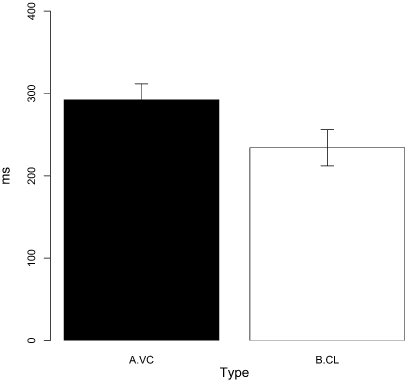
On the basis of the interaction effect found between the factors of Type and Vowel, post-hoc pairwise t-tests comparing Types to each other were performed for each Vowel separately. Figures 1 and 2 summarize these comparisons for the vowels i and u respectively. The reader is reminded that the vowel u had only two types (VC and CL) available for the analysis, while the vowel i had all four types (VC, CL, MS and DS) available.
Figure 1
Vowel duration (ms) per Type for the i-words, i.e., vowels resulting from coalescence (VC), vowels resulting from compensatory lengthening (CL), vowels in monosyllabic words (MS), and vowels in disyllabic words (DS)
Citation: Journal of Greek Linguistics 15, 1 (2015) ; 10.1163/15699846-01501009
Pairwise comparisons for words with the vowel i (Figure 1) follow the same pattern as the main effect. More specifically, vowels from coalescence and vowels from compensatory lengthening are not different from each other, but they are both longer than vowels in monosyllabic words (VC > MS, p < 0.0001; CL > MS, p < 0.0001), which are in turn longer than vowels of disyllabic words (MS > DS, p < 0.0001). The patterns shown by the VC and the CL i-vowels might be affected by closed syllable shortening and/or polysyllabic shortening. As a reminder, to eliminate this possibility additional planned comparisons were performed. One set of comparisons was conducted between i-vowels from CL in closed and open syllables (ËθiËm and ËviË.kÉ respectively). This analysis showed that the duration of i-vowels remains stable across syllable structures [closed syllable: 259ms (mean), 78 ms (SD); open syllables: 233 ms (mean), 97 ms (SD)]
The other set of comparisons was conducted between the VC and the CL i-vowels including only the disyllabic test words. This analysis confirmed that the VC and CL i-vowels do not belong to distinct categories, showing equal durations [VC: 237 ms (mean), 63 ms (SD); CL: 233 ms (mean), 97 ms (SD)].
As for the u-words (Figure 2), vowels resulting from coalescence are longer than vowels resulting from compensatory lengthening with the pairwise comparison having the p-value slightly above the set α level (VL > CL, p = 0.054).
Figure 2
Vowel duration (ms) per Type for the u-words, i.e., vowels resulting from coalescence (VC) and vowels resulting from compensatory lengthening (CL)
Citation: Journal of Greek Linguistics 15, 1 (2015) ; 10.1163/15699846-01501009
To conclude, vowels resulting from the deletion of an underlying r are longer than vowels, which do not involve r-deletion. However, it is unclear whether or not the two types of vowels that arise from r-deletion, i.e., vowels from vowel coalescence and vowels from compensatory lengthening, are characterized by distinct durational properties, since the results from the i-set and the u-set are contradictory. This contradiction may be due to a number of differences between the two sets, discussed in detail in Section 4.
3.2. Formant Structure of Vowels Resulting from Compensatory Lengthening
This section compares F3 frequencies in four temporal points in the tokens of the vowel [iË] in the word ËθiËm (â Ëθɾi.mi âshardâ), which results from compensatory lengthening, to the tokens of the vowel [iË] in the word ËθiË.Ã°É (â θi.Ëɾi.Ã°É âwindowâ), which results from coalescence. This analysis was not possible for Speaker F03, who did not produce the word ËθiËm.
Figs 3aâe
F3 frequency measured at four temporal points in vowels resulting from compensatory lengthening (CL) as opposed to coalescence (VC) for Speakers M01 (a), M02 (b), M03 (c), F01 (d) and F02 (e)
Citation: Journal of Greek Linguistics 15, 1 (2015) ; 10.1163/15699846-01501009
Figures 3aâe show the F3 frequencies, which are measured at four temporal points in the vowel [i] of ËθiËm (CL) vs. ËθiË.ða (VC) for each speaker respectively. The F3 measurements are averaged across all repetitions of each item. As shown in the figures, there is no lowering of F3 within the first half of CL vowels as opposed to VC ones, indicating the absence of any trace of r in CL vowels. This conclusion is confirmed by a set of pairwise t-tests that compare F3 frequencies in each of the four points (vowel onset, 25 ms after vowel onset, 50 ms after vowel onset, and mid point of the vowel) in CL vowels to the respective points in VC vowels for each Speaker separately. None of the pairwise comparisons was significant.
Note that in the context of a rhotic, F3 indeed lowers in Samothraki Greek, as Figures 4, 5 and 6 in Section 3.3 illustrate. In these figures, F3 lowering is pointed to by an arrow.
3.3. Acoustic Realization of Rhotics
This section examines the acoustic realization of Samothraki Greek rhotics in environments where r is retained, i.e., pre-consonantally and word-finally. As a reminder, r is also retained in onset clusters of the CrVV type, but this latter case was not recorded in the current study. Each token of word-final and pre-consonantal r was inspected separately and categorized following the criteria presented in Section 2.4. Table 1 lists the counts per rhotic category for each Speaker (F01, F02, F03, M01, M02, and M03). The rightmost column presents the overall counts within Speaker, while the last row averages across Speakers.
Counts of tokens per rhotic category observed in the data (i.e., trill, tap, fricative, and approximant) and Speaker (F01, F02, F03, M01, M02 and M03)
As indicated by Table 1, the number of tokens analyzed differs across the six Speakers. This inconsistency is due to the following reasons: 1) some data were discarded due to technical problems (e.g., noisy recordings), 2) some test words were produced differently (e.g., Speaker F03 produced [ËÊii], and not [ËÊiɾ], and [Ëðiɾton] instead of [Ëðiɾ]), and 3) some test words are repeated more than five times, mostly out of the speakerâs personal initiative, and we analyze all produced repetitions.
Table 2 translates the values of Table 1 into percentages. The last row (âOverallâ) calculates the percentage of productions per rhotic category across all Speakers, while each of the other rows presents within-speaker percentages.
Percentages of tokens per rhotic category observed in the data (i.e., trill, tap, fricative, and approximant) and Speaker (F01, F02, F03, M01, M02 and M03)
As Tables 1 and 2 indicate, speakers show large allophonic variation in the production of the single phoneme /r/, as expected. Despite this variation, the majority of the productions both within and across speakers are classified as taps. Specifically, 65% of the overall rhotic productions, and 53%, 63%, 86%, 71%, 81.5% and 41% of the rhotic productions of speakers F01, F02, F03, M01, M02 and M03 respectively are taps. Speaker M03 is the only one of the six speakers analyzed who produces more trills than taps (50% of his productions are trills). However, the class of taps is M03âs second largest set (41%).
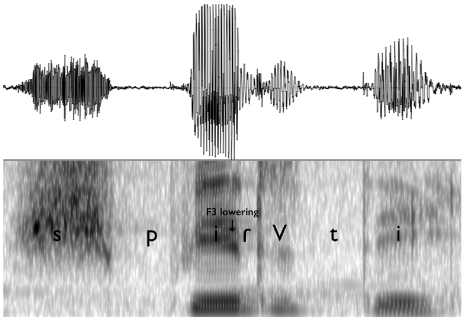
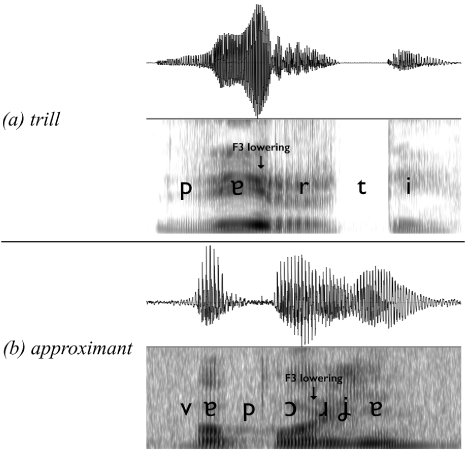
Our phonetic analysis further shows that in 60% of the overall count of detected taps (i.e., 238/400 taps) the short closure is followed by an excrescent vocoid. This high percentage is retained in the within-speaker data. Specifically, the values of taps produced with vocoids that correspond to each speaker are the following: F01: 51% (28/55 taps); F02: 53% (35/66 taps); F03: 72% (60/83 taps); M01: 72% (43/60 taps); M02: 30% (26/88 taps); and M03: 96% (46/48 taps). Figures 4 and 5 below are representative examples of a tap followed by a vocoid word-medially and word-finally respectively. Note that while word-final vocoids may be considered the remnants of the deleted final vowels in the underlying representations (e.g., vÉ.ËpÉɾ â vÉ.ËpÉ.ɾi âboatâ), this cannot be true for the word-medial cases. Figure 6 illustrates the two next most frequent realizations of the rhotic, namely, an trill (top panel) and an approximant (bottom panel).
Figure 4
Waveform (top panel) and spectrogram (bottom panel) of [É.Ëguɾ] âcucumberâ with a word-final r produced as a tap and accompanied by a vocoid. The arrow points to F3 lowering related to the rhotic.
Citation: Journal of Greek Linguistics 15, 1 (2015) ; 10.1163/15699846-01501009
Figure 5
Waveform (top panel) and spectrogram (bottom panel) of [Ëspiɾ.ti] (2nd person plural imperative of âsowâ) with a word-medial r produced as a tap and accompanied by a vocoid. The arrow points to F3 lowering related to the rhotic.
Citation: Journal of Greek Linguistics 15, 1 (2015) ; 10.1163/15699846-01501009
Figure 6
Waveform (top panel within (a) and (b) respectively) and spectrogram (bottom panel within (a) and (b) respectively) of [ËpÉr.ti] (2nd person plural of imperative of âtakeâ) produced with a trill r (a) and [vÉ.ËpÉ.ɹÊa] âlittle boatsâ produced with an approximant r (b). The arrows point to F3 lowering related to the rhotics.
Citation: Journal of Greek Linguistics 15, 1 (2015) ; 10.1163/15699846-01501009
On the basis of these results, it can be concluded that synchronically the Samothraki Greek rhotic more often surfaces as a tap, which is in turn often accompanied by a vocoid.
3.4. Summary
To summarize, the main results presented in Section 3 are as follows:
- a. Vowels that result from r-deletion are longer than vowels that do not involve r-deletion. However, comparisons of vowels from compensatory lengthening (CL) with vowels from coalescence (VC) are controversial. When the vowel is i, VC and CL are not different. When the vowel is u, VC vowels are longer than CL ones.
- b. There is no trace of r in the formant structure of the long vowel that results from CL.
- c. The productions of coda r and the analogically restored r are in their majority taps, most of which are accompanied by a vocoid.
4. Discussion
Our results show several major findings with respect to CL in Samothraki Greek. First, it is demonstrated that vowels resulting from CL are categorically longer than singleton vowels, regardless of prosodic position. These results thus support Hypothesis 1, for the first time offering phonetic data to confirm the presence of long vowels in Samothraki Greek, supporting all existing accounts (Hayes 1989, Kavitskaya 2002, Kiparsky 2011, Newton 1972a, b, Topintzi 2006, among others).
In Section 1.4, we stated Hypothesis 2 as follows: If the onset r goes through a stage of being a part of the nucleus, then the duration of long vowels from CL and those from VC should be similar. Our data are ambiguous in this respect. While they do not show the difference in duration between the long [iË] from the two sources, there is a difference between the long [uË] from CL and from VC, the latter being longer. The difference in the observed patterns may be related to the intrinsic characteristics of the compared pairs. Although we have excluded the possibility of the syllable number and type confounding the patterns shown by the i-set, the words comprising this set do not form minimal pairs. Moreover, the long [iË] in these words is stressed, which could result in the vowel reaching its durational ceiling (cf. Cambier-Langeveld 1997), masking the differences between the long [iË] from the two different sources. On the other hand, the long [uË] tokens are represented by the only minimal pair that we were able to collect: ËÉs.puËs (â ËÉs.pÉ.rÉs âseedlessâ) vs. ËÉs.puËs (â ËÉs.prÉs âwhiteâ). In addition, the long vowels in the u-pair are not stressed and thus there is no ceiling on the duration of the vowel. However, as discussed before, following Margariti-Rogka & Tsolaki (2011), there is a possibility that there are three syllables in âseedlessâ, as opposed to two syllables in âwhiteâ. If this is the case, the difference in duration may be due to the fact that we have two consecutive vowels in the first case versus one long vowel in the second case, which would imply that âseedlessâ versus âwhiteâ do not form a minimal pair. Based on our impressionistic judgment, both words are disyllabic, but our data cannot further clarify this issue. An additional investigation focused on both production and perception of CL vs. VC vowels in stressed and unstressed conditions will clarify whether the durational properties of the two types of vowels are different or not, as well as address the effect of stress on syllabification. As we will see later in the discussion, either syllabification alternative is in accordance with the theory advanced in Kiparsky (2011).
As to Hypothesis 3, the data do not show any traces of the r in the long vowel. The formant structures of [ÉË] resulting from CL and of [ÉË] resulting from VC are exactly the same. Thus, our analysis does not add phonetic support for CL through r-deletion in Samothraki Greek being a synchronic alternation. Until further research on other possible acoustic or articulatory cues to the presence of r is conducted, we remain agnostic to the synchronic (Kiparsky 2011) or historical (Kavitskaya 2002) nature of this process.
Turning to the phonetic nature of the Samothraki Greek rhotic, our results show that the r is indeed quite variable, but the majority of râs are produced as taps, not approximants, against our original interpretation of Kavitskaya (2002) and Kiparsky (2011) that served as the basis for Hypothesis 4.8 However, our finding that the majority of taps are accompanied by a vocoid allows for a different interpretation of the predictions made by Kavitskaya (2002) and Kiparsky (2011).
The phonetic realization of the tap in Samothraki Greek is similar to the one in Standard Greek (cf. Baltazani 2009, Baltazani & Nicolaidis 2013a, b, Nicolaidis & Baltazani 2011; see also Arvaniti 1999). In Standard Greek, the tap is realized in two distinct ways. In complex onsets where r is the final member of the cluster (e.g., ËkɾÉ.mÉ, âcreamâ), the vocoid precedes the tap, while in the cases of the pre-consonantal coda r at a syllable boundary (e.g., ËÉ.É£Éɾ.bÉ, âclumsilyâ), the vocoid follows the tap (Baltazani, 2009). Interestingly, in Samothraki Greek, the former consonantal context involves r-deletion, while the latter involves a tap followed by a vocoid. On the basis of a similar realization of pre-consonantal rhotics in Standard Greek and Samothraki Greek, it is valid to assume that before the r-deletion in Samothraki Greek, a vocoid preceded the tap portion of the rhotic in onset position, as in Standard Greek.
The CrVV sequences where rhotics do not delete in Samothraki Greek could function as a model of r-deletion. As discussed in Section 1.2, there is no CL in such sequences, arguably to prevent the creation of a triply long vowel. The relevant data are repeated in (14). As was stated earlier, our study did not include this type of data, and our conclusions are based on transcriptions provided by Topintzi (2006). The precise phonetic realization of the rhotic in this context has not been looked at yet.
Topintzi 2006: 75
Topintzi (2006: 75) analyzes the examples in (14) as having metathesis and glide formation. We consider this interpretation problematic because the same underlying segment i both metathesizes and becomes a glide. Instead, in light of our findings on the phonetic nature of the r, we propose a different interpretation of these data. The glide is the manifestation of the underlying i (Katsanis 1996: 42â43), and the vowel i that surfaces before the r is a manifestation of the vocoid, expected to precede the tap-portion of the post-consonantal r. This vocoid becomes a full-fledged vowel in CrjV structures, possibly resolving a dispreferred triconsonantal cluster.9 This interpretation is closer to an epenthesis account proposed by Malikouti-Drachman & Drachman (2010).
We propose an account of r-deletion that takes into consideration the articulatory makeup of the r. It is well known that rhotics are highly variable, but it has been argued that they can be unified on the basis of their articulatory characteristics. In particular, it has been proposed that rhotics, regardless of their type (e.g. trills, taps, fricatives, approximants), involve the coordination of two tongue constrictions, tongue tip and tongue body (Proctor, 2010; 2011).10 Experimental data from English (Delattre & Freeman 1968, Gick, Kang & Whalen, 2002), Spanish (Proctor 2010, 2011) and Russian (Proctor 2010, 2011) provide support for this proposal that can be extended to other languages. Two articulatory components have also been independently proposed specifically to account for the tap-and-vocoid rhotic structure reported in Greek and other languages, such as Catalan, Spanish, Romanian and Hungarian (e.g., Baltazani & Nicolaidis 2013a, b). In our view, these two articulatory components proposed for the tap-and-vocoid rhotic structures correspond to the tongue tip and the tongue body constrictions involved in all rhotics, as proposed by Gick et al. (2002) and Proctor (2010, 2011). These two articulatory components are acoustically manifested as a tap and a vocoid respectively. Similarly, we view Samothraki Greek taps accompanied by vocoids as explicit acoustic manifestations of the tongue tip and tongue body constrictions of the rhotic. In the remaining rhotics in Samothraki Greek (i.e., trills, fricatives and approximants), we assume the tongue tip and the tongue body constrictions to be active (per Proctorâs (2010, 2011) discussion about rhotics in general). Given this articulatory makeup of the rhotic, we can revisit the r-deletion patterns from the articulatory perspective.
At the basis of Kiparskyâs (2011) explanation of Samothraki Greek r-deletion with compensatory lengthening lies a well-known fact that onsets of high sonority, such as glides, are generally dispreferred (e.g., Zec 2007). The rhotic r, by being next to glides on the sonority scale, is excluded by many languages from the onset position (e.g., de Lacy 2001, Smith 2003). Samothraki Greek is considered to be one of these languages (Kiparsky 2011). We propose that Samothraki Greek resolves this dispreference by deleting the tongue tip constriction but keeping the tongue body constriction in word-initial and post-consonantal positions. In this way, Samothraki Greek eliminates a high sonority onset r, while preserving some of its segmental, and consequently temporal, information. Our hypothesis is that the degree of the tongue body constriction involved in the rhotic is that of an approximant, based on the articulatory descriptions of rhotics in other languages (Gick et al. 2002; Proctor 2010, 2011). This hypothesis is further corroborated by the presence of a vocoid in a large portion of taps in our data. The approximant constriction of the rhotic is amenable to becoming incorporated into the vowel for the following reasons. First, the same articulator, namely the tongue body, is responsible for forming both the approximant constriction of the rhotic and the vocalic constriction of the vowel in the nucleus. Second, these two articulatory constrictions are assumed to initiate roughly synchronously to each other, based on syllable coordination principles proposed by Goldstein and colleagues (Goldstein, Byrd & Saltzman 2006). The hypothesis that the rhotic, after the deletion of the tongue tip constriction, is amenable to the incorporation into the vowel is supported by the fact that in the vocoid-plus-tap structures of Modern Greek the vocoid and the following vowel have similar formant structure regardless of the type of the vowel (Baltazani & Nicolaidis 2013a, b). Acoustically, the incorporation of the tongue body constriction of the rhotic into the tongue body constriction of the following vowel would result in the long vowel attributed to compensatory lengthening. However, it is unclear whether in the process of this incorporation, the tongue body constriction of the rhotic is interpreted as a full vowel or retains its shorter temporal interval as reflected in the short duration of the vocoid in the vocoid-plus-tap structures. The results of our analysis (section 3.1) are ambiguous in this regard. The i-pair results support a full vowel interpretation of the tongue body constriction of the rhotic. Within this interpretation, the duration of the surface vowel follows from vowel coalescence, and is thus similar to the duration of vowels resulting from intervocalic r-deletion. The u-pair results, on the other hand, indicate that the tongue body constriction does not go through the stage of a full vowel, preserving its short duration. In this case, the vowel resulting from pre-vocalic r-deletion is longer than a regular short vowel, but shorter than a sequence of two consecutive vowels resulting from intervocalic r-deletion. As mentioned earlier, our data does not allow us to choose between the two alternatives. To repeat, the i-pair, and possibly the u-pair as well, do not form perfect minimal pairs. The i-pair might involve prosodic confounds related to number of syllables in the test words and stress-induced lengthening. The u-pair might also involve members of different number of syllables (cf. Margariti-Rogka & Tsolaki 2011). Future research will explicitly address this question, along with the acquisition of articulatory data that could provide direct evidence of the two tongue constrictions forming the Samothraki rhotic. A third line that future research should take is the issue of syllabification of the long vowels. These three lines of research will provide clarifications to both the phonetic reality of the onset r loss and its implications for the phonological theory.
Regardless of which alternative holds with respect to the incorporation of the tongue body constriction into the vowel, our proposal supports the account presented in Kiparsky (2011), which states that r goes through a vocalic stage with the coalescence of the following vowel. According to Kiparsky (2011), âat some point, glides were lost in the language. In Samothraki, the constraint on onsets was then further tightened by one notch: not only i, u, but also r had to be moraic (id., p. 26)â. In pre-vocalic positions these moraic râs were incorporated into the nucleus of the syllable with the following compensatory lengthening. Both alternatives discussed above involve the coalescence of a vocalic element with the following vowel, which can then be phonologized as a long vowel. Our proposal also agrees with the view expressed in Kavitskaya (2002) in that r is vocalic enough to be reinterpreted as part of the vowel. There are some similarities in our account to both Newton (1972a, b) and Hayes (1989). Newton (1972a, b) proposes that r becomes a vowel at some stage, which is reminiscent of our account, and Hayes (1989), similarly to the proposal put forward here, suggests that the long vowel is a result of vowel coalescence.
5. Conclusions
In this paper, we investigate several phonetic aspects of the Samothraki Greek r-deletion. In particular, we examine the durational and spectral properties of the vowels resulting from r-deletion and the nature of the surface rhotics. First, we show that vowels resulting from r-deletion are longer than vowels that do not involve r-deletion, phonetically confirming the very presence of long vowels from CL in Samothraki Greek. Second, there is no trace of r in the formant structure of the long vowels that result from CL. Third, we show that the majority of the surface coda rhotics are taps, most of which consist of a tap portion and a vocoid portion.
Our results have several implications for phonological accounts of compensatory lengthening through onset loss in Samothraki Greek. We propose an articulatory account of r-deletion, under which the tongue tip constriction involved in rhotics deletes and the tongue body constriction is kept due to sonority considerations. Our data allow for an interpretation that supports coalescence of two vocalic elements in line with the analysis of Kiparsky (2011). Our analysis is also compatible with the account of Kavitskaya (2002), which requires the rhotic to be vocalic enough so that it can be reinterpreted as a part of the vowel. Commonalities with other existing phonological accounts, e.g., Newton (1972a, b), Hayes (1989), and Topintzi (2006), are also discussed.
References
Arvaniti, Amalia. 1999. Illustrations of the IPA: Modern Greek, Journal of the International Phonetic Association 19, 167â172.
Baltazani, Mary. 2009. Acoustic characterization of the Greek rhotic in clusters. In Selected Papers from the 18th International Symposium of Theoretical and Applied Linguistics, Vol. 1, 87â95. Thessaloniki.
Baltazani, Mary and Katerina Nicolaidis. 2013a. Production of the Greek rhotic in initial and intervocalic position: an acoustic and electropalatographic study. In Proceedings of the 10th International Conference on Greek Linguistics, Z. Gavrilidou, A. Efthymiou, E. Thomadaki and P. Kambakis-Vougiouklis (eds.), 141â152.
Baltazani, Mary and Katerina Nicolaidis. 2013b. The Greek r in rC sequences: an acoustic and electropalatographic study. In Selected Papers of the 20th International Symposium of Theoretical and Applied Linguistics, 157â176. London: Versita de Gruyter.
Broselow, Ellen, Su-I Chen, and Marie Huffman. 1997. Syllable weight: convergence of phonology and phonetics. Phonology 14: 47â82.
Cambier-Langeveld, Tina. 1997. The domain of final lengthening in the production of Dutch, In Linguistics in the Netherlands, J. Coerts and H. de Hoop (eds.), 13â24. Amsterdam: John Benjamins.
Curtis, Emily. 2003. Geminate weight: case studies and formal models. Ph.D. dissertation, University of Washington.
Davis, Stuart. 1999. On the representation of initial geminates. Phonology 16, 93â104.
de Lacy, Paul. 2001. Markedness in prominent positions. In Proceedings of HUMIT 2000, MIT Working Papers in Linguistics 40, O. Matushansky, A. Costa, J. Martin-Gonzalez, L. Nathan and A. Szczegielniak (eds.), 53â66. Cambridge, MA: MITWPL.
Delattre, Pierre and Donald C. Freeman. 1968. A dialect study of American râs by x-ray motion picture. Linguistics, 44: 29â 68.
Fletcher, Janet. 2010. The Prosody of Speech: Timing and Rhythm. In The Handbook of Phonetic Sciences, W.J. Hardcastle, J. Laver, and F.E. Gibbon (eds.). Oxford: Wiley-Blackwell Publishing.
Goldstein, Louis M., Dani Byrd, and Elliot Saltzman. 2006. The role of vocal tract gestural action units in understanding the evolution of phonology. In From action to language: The mirror neuron system, M. Arbib (ed.), 215â249. Cambridge: Cambridge University Press.
Gick, Bryan, A. Min Kang & Douglas H. Whalen. 2002. MRI evidence for commonality in the post-oral articulations of English vowels and liquids. Journal of Phonetics 30(3): 357â371.
Hayes, Bruce. 1989. Compensatory lengthening in moraic phonology. Linguistic Inquiry 20: 253â306.
Heisenberg, August. 1934. Neugriechische Dialekttexte. Leipzig: Harrassowitz.
Holton, David, Peter Mackridge & Irene Philippaki-Warburton. 1997. Greek: A comprehensive Grammar of the Modern Language. London: Routledge.
Khalil Iskarous & Darya Kavitskaya. 2010. The interaction between contrast, prosody, and coarticulation in structuring phonetic variability. Journal of Phonetics 38: 625â639.
Kaisse, Ellen. 1975. A violation of transitivity in Modern Greek. In The Proceedings of the Chicago Linguistic Society 11, 329â339.
Kaisse, Ellen. 1977. Hiatus in Modern Greek. Ph.D. Dissertation, Harvard University.
Katsanis, Nicolaos. 1996. Το γλÏÏÏικό ιδίÏμα ÏÎ·Ï Î£Î±Î¼Î¿Î¸ÏάκηÏ. Thessaloniki: Aristotle University of Thessaloniki Press.
Kavitskaya, Darya. 2002. Compensatory lengthening: phonetics, phonology, diachrony. London: Routledge.
Kiparsky, Paul. 2011. Compensatory lengthening. In Handbook of the Syllable, C. Cairns and E. Raimy (eds.). Leiden: Brill Publishers.
Lehiste, Ilse. 1972. The timing of utterances and linguistic boundaries. Journal of the Acoustical Society of America, 51: 2018â2024.
Ladefoged, Peter and Ian Maddieson. 1996. The Sounds of the Worldâs Languages. Oxford: Blackwell.
Loporcaro, Michele. 1991. Compensatory lengthening in Romanesco. In Certamen Phonologicum II: Papers from the 1990 Cortona Phonology Meeting, P.M. Bertinetto, M. Kenstowicz, and M. Loporcaro (eds.), 278â307. Torino: Rosenberg & Sellier.
Malikouti-Drachman, Angeliki and Gaberell Drachman. 2010. Metathesis or Epenthesis in Samothraki Greek? Meletes 30, 385â397.
Margariti-Rogka, Marianna and Maria Tsolaki. 2011. Τα μακÏá½± ÏÏνήενÏα ÏÏο ιδίÏμα ÏÎ·Ï Î£Î±Î¼Î¿Î¸ÏάκηÏ. In Îεοελληνική διαλεκÏολογία 6, C. Mpasea-Mpezantakou, I. Manolessou, A. Afroudakis, G. Katsouda and S. Mpeis (eds.), 273â294. Athens: Academy of Athens.
Newton, Brian. 1972a. Loss of /r/ in a Modern Greek Dialect. Language 48, 566â572.
Newton, Brian. 1972b. The Generative Interpretation of the Dialect. Cambridge: Cambridge University Press.
Nicolaidis, Katerina & Mary Baltazani. 2011. An electropalatographic and acoustic study of the Greek rhotic in Cr clusters. In Proceedings of the 17th International Congress of Phonetic Sciences, 1474â1478. Hong Kong.
Proctor, Michael. 2011. Towards a gestural characterization of liquids: Evidence from Spanish and Russian. Laboratory Phonology, 2(2): 451â485.
Proctor, Michael. 2010. Gestural Characterization of a Phonological Class: the Liquids. Ph.D. dissertation, Yale University.
Ryan, Kevin. 2014. Onsets contribute to syllable weight: Statistical evidence from stress and meter. Language 90, 309â341.
Smith, Jennifer. 2003. Onset sonority constraints and subsyllabic structure. In Rutgers Optimality Archive 608.
Topintzi, Nina. 2006. A (not so) paradoxical instance of compensatory lengthening: Samothraki Greek and theoretical implications. Journal of Greek Linguistics 7: 71â119.
Wiese, Richard. 2001. The Phonology of /r/. In Distinctive Feature Theory, T. Alan Hall (ed.), 335â368. Berlin: Mouton de Gruyter.
Woodbury, Hanni. 1981. The loss of a phoneme. International Journal of American Linguistics 47: 103â120.
Zec, Draga. 2007. The syllable. In The Cambridge Handbook of Phonology, Paul de Lacy (ed.), 161â194. Cambridge: Cambridge University Press.
Appendix A: Speech Stimuli
This appendix includes five tables, each corresponding to one of the five categories of speech stimuli used in this study. These categories are described in Section 2.2. The first column of each table lists the Standard Greek word, as uttered by the experimenter, and the second column lists the IPA transcription of the expected Samothraki Greek equivalent. The third column includes the respective gloss into English. A key to the gloss follows. [Key: sp = simple past, spr = simple present, pc = present continuous, sg = singular, pl = plural, ind = indicative, imp = imperative]
a. rââ alternations in inflectional paradigms
b. rââ alternations in derivational paradigms
c. Deletion of r in single onsets word-initially
d. Deletion of r in complex onsets
e. Deletion of intervocalic r with identical adjacent vowels
We would like to express our gratitude to the Mayor of Samothraki in 2008, Mr. Giannis Petroudas, the municipality of Samothraki, and the speakers of Samothraki Greek for their help and support. Special thanks are due to Sharon Inkelas, Khalil Iskarous, Michael Proctor, Mariana Margariti-Rogka and Maria Tsolaki for their helpful suggestions and discussion.
See Appendix A for the key to the glosses.
While Hayesâs theory of CL applies to synchronic alternations, the actual example from Hayes (1989) given in (2) illustrates a diachronic change.
As stated in Katsanis (1996: 49â50), both l and r participated in the CL through onset loss in Samothraki Greek. The lost l, however, was restored, and currently there is no systematic attestation of its deletion. Cross-linguistically, CL through the loss of l is a rare but not an unheard of process, attested, for instance, in Romanesco Italian, where it is optional and only occurs in the definite article and in the object clitic: /lo la li le/ â [oË aË iË eË] (Loporcaro 1991).
As a reminder, the forms in this example are not in the IPA but presented as given in Topintzi (2006). The unstressed [i] that surfaces in these forms in Samothraki Greek has been discussed in Topintzi (2006) and Malikouti-Drachman & Drachman (2010) and will be further addressed in the Discussion section.
The symbol y used by Newton (1972) corresponds to [Ê] in IPA.
According to the analysis of Margariti-Rogka & Tsolaki (2011) mentioned in Section 1.3, âwhiteâ has two syllables while âseedlessâ has three. Both syllabification possibilities are addressed in the Discussion.
A set of words with the test vowel being /É/ was also used with the target to elicit all four vowel types (VC, CL, MS and DS). However, the number of VC and CL tokens produced with r-deletion was not sufficient for a statistical analysis, and as a result these words were not used.
Any unambiguous conclusions about the nature of the rhotic historically cannot be drawn from these results. A historical change from an approximant to a trill/tap r could in principle happen in Samothraki Greek, but we have no evidence for it.
In the absence of studies on the phonotactics of Samothraki Greek, we can only conjecture that Crj is a dispreferred cluster based on the fact that closely related Modern Greek allows only a few tri-consonantal onset clusters of the type /s/ + voiceless obstruent + liquid or /n/. Clusters of the type Crj as well as other clusters with two sonorants in them are not allowed by the phonotactics of Modern Greek (Holton, Mackridge & Philippaki-Warburton 1997: 8â12).
A lip constriction is also involved in the articulation of rhotics, but this is not relevant to the discussion here.
The symbol y used by Newton (1972) corresponds to [Ê] in IPA.