Abstract
More than a century of modernisation—163 years if we count from 1862 when the Tongzhi Restoration was launched—has injected new blood into the old Chinese civilisation and brought China into the orbit of a modern world. But at what cost? Scholars of China have researched and debated about modernisation from various perspectives. But few have asked: what has China lost in its quest for and in achieving modernity? This article takes a concrete look at the damage done by industrialisation and urbanisation, offering a glimpse into what has been lost. It argues that these processes have devastated traditional crafts and household/village industries, ruined traditional cities, and wrecked the urban landscape/environment. They have led to overconsumption that has and will continue to devastate the country. Conceptualising the cost of modernisation opens a unique window to interrogate the transformation of the Middle Kingdom. It exposes the problem with modernisation in China.
Introduction
There are at Canton a great number of temples, by the Europeans commonly called Pagodas. … The most considerable of these is the Pagoda of Ho-nang in the southern suburbs, of which Plate I is a plan. It occupies a large extent of ground, and contains, besides the idol-temples, lodging rooms and other conveniences for two hundred Bonzes, with hospitals for a great many animals, a large kitchen garden, and a burying ground where priests and animals are promiscuously interred, both being equally honoured with monuments and inscriptions.1
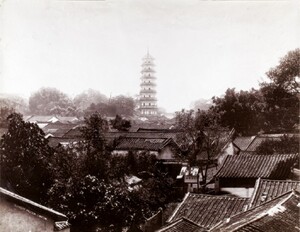
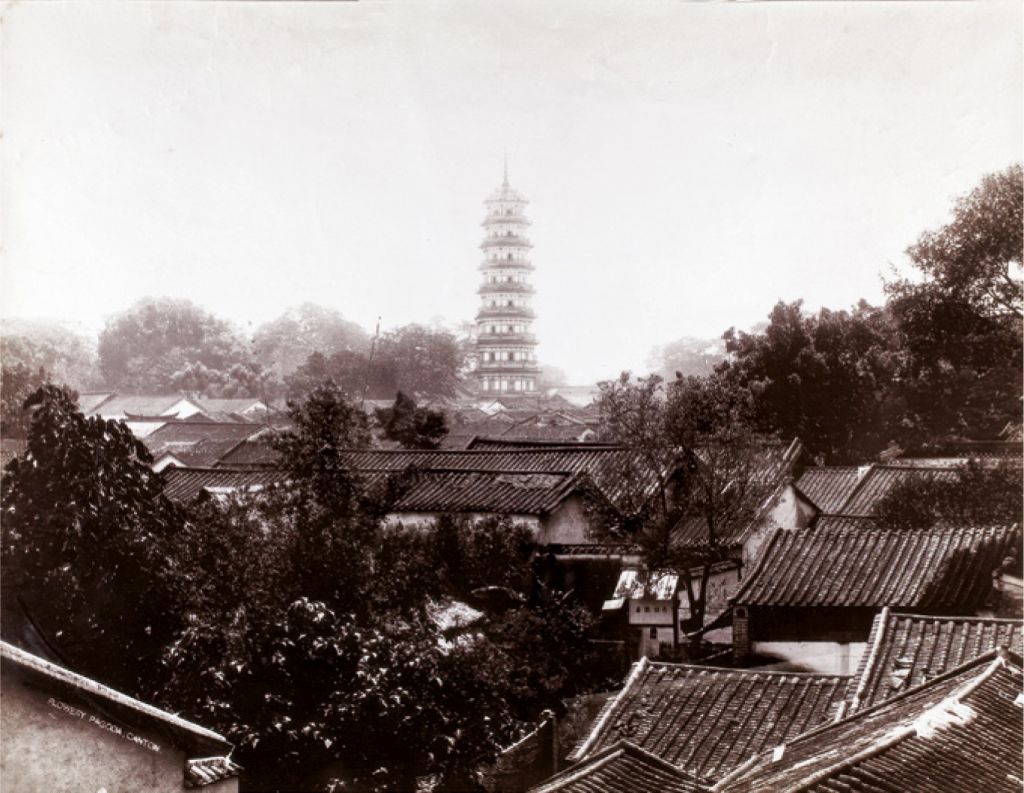
Architect William Chambers recalled the city of Guangzhou vividly after he visited in the 1740s. Chambers was so enthused by Guangzhou’s pagodas (see illustration 5) that he built a replica in Kew Gardens in the 1760s. But while Kew’s Great Pagoda still stands today, the Chinese original that inspired Chambers has drowned in a landscape of skyscrapers. China’s third largest metropolis after Beijing and Shanghai, Guangzhou is a defining example of the post-Mao economic miracle where skyscrapers dominate the urban landscape. High-rises have become a symbol of modernisation and the more a city has, the more developed it appears to be. Scholars of China have researched China’s modernisation from various perspectives. But few have asked: what has China lost in its quest for and in achieving modernity? This article probes what modernisation has destroyed, investigating the ways in which we can count the cost of China’s apparent success. Taking inventory of the damage done opens a unique window to interrogate the transformation of modern China.
Historians of China have carried on a lively debate about the nature and extent of China’s modernisation and produced outstanding scholarship. Joseph Levenson’s trilogy Confucian China and its Modern Fate set the tone for the field.2 In this debate, the industrial and progressive West is often pitted again agrarian and tradition-bound China, put perfectly by Lu Hanchao: “traditionalism was frequently associated with things indigenous and an attitude of looking back in time. Modernity, however, was associated with things foreign and an attitude of looking forward.”3 This debate has diversified in the post-Mao era. Some have studied the transformation of cities, some have probed the characters who propelled the Qing onto the path of modernity.4 Some have examined how modernisation improved education and enhanced the arts, while others have exposed the complexities and problems of modernity.5 A recent book—Making China Modern—epitomises the dominant way in which history from the late Qing to the post-Mao era continues to be studied through the story of progress.6 The problem with this approach is that it denies the traditional a voice and we lose sight of what has been lost in the name of progress. To be sure, modernisation has had its critics. Yu Yingshi for example has examined the “radicalization of the Chinese mind” during the late Qing and early Republican era.7 He highlighted the “contempt for tradition” among pro-modern intellectuals which contributed to the May Fourth Movement.8 Pierre Fuller has identified the perception that China lacked morality and that hence the country could only be saved by Western modernity, which resulted in the “civilising mission” between the May Fourth Movement and the Cultural Revolution.9 These historians encourage us to think more carefully about the notion that modernisation can be directly equated with progress. This article joins them by exposing the problem with modernisation, but from a different angle, asking what was lost.
How exactly did the “contempt for tradition” do damage in the name of progress? Answering this question takes us to the mid-nineteenth century when defeats by Britain and France in the opium wars and the inability to crush rebellions forced the Qing court to undertake reform in the name of Tongzhi Restoration in 1862. Pro-reform officials such as Zeng Guofan, Zuo Zongtang and Li Hongzhang realised that to survive in the new world dominated by European powers, they had to abandon some Chinese tradition and learn from Europe; thus began China’s long march to modernisation. Modernity is defined as “a departure from or a repudiation of accepted or traditional styles and values”; it means “embracing innovation and new ideas”.10 Key to the idea of modernity is the notion of improvement and advancement which Angelos Mouzakitis discussed in an excellent article.11 As Peter Wagner puts it: “the idea of modernity is inextricably tied up with the one of progress”.12 For Karl Löwith, “progress” has become the new “religion” where it was supposed to provide for the future.13 This is made possible by what Shmuel Einsenstadt called a “distinct civilisation with distinct institutional and cultural characteristics”.14
To repudiate Chinese tradition and embrace European beliefs and practices was an extremely difficult undertaking for most late Qing officials, which explains why reform was slow and met with resistance during the late nineteenth century. Failure to modernise in the fashion that Japan had done allowed the scramble for China to intensify in the 1890s, and efforts to salvage the situation by the Guangxu emperor led to the Hundred-days Reform in 1898.15 Although it failed, the call for modernization became louder in the 1910s. Hu Shi called for “total westernisation”, while Dr. Sun Zhongshan detailed his vision in Jiangguo fanglue [
Skills Lost to Machines
George Wilkinson joined the Royal Navy and embarked on a journey to China on Monday 8 April 1811, his frigate sailing into the Pearl River estuary on its way to Guangzhou by early November. His eyes were immediately drawn to Chinese boats:
The boat’s hull, also formed of the bamboo cane, was curiously sewed together with a cordage wrought of the same material, rendered tight and waterproof, containing a deck, the under part of which served as a cabin to live and sleep in, with mats and cushions for the latter convenience, the whole made from the bamboo, of which every article of wooden manufacture in their domestic furniture, as well as their marine requisites, were peculiarly and ingeniously constructed.17
Wilkinson was right in thinking that China’s boat-making was particularly sophisticated. Four hundred years earlier, the Ming dynasty (1368–1644) had built the most advanced ships with which Admiral Zheng sailed in the Indian Ocean and across to East Africa, 80 years before Vasco Da Gama rounded the Cape of Good Hope. As his frigate drew closer to the city, Wilkinson observed that “the numbers of every description of craft, passing and repassing, rendered our approach to the place for landing extremely difficult.”18 After landing, he strolled the streets of Guangzhou, admiring its “articles of manufacture and curiosity” from ornaments, jewellery, fans to porcelain, modellers, and bird-fanciers.19 China had been the land of crafts and industries that had drawn foreigners ever since the Sui-Tang dynastic era (581–907), if not earlier. Baghdad born El-Masudis (896–956) wrote that: “The Chinese are the most-clever people on earth: they have extraordinary skills in plastic and other arts, so that no other nation can be compared with them in any kind of workmanship. … China is rich in remarkable objects.”20 It was these “remarkable objects” that spread the name of China as Europeans arrived by the early sixteenth century. But traditional crafts and industries began to disappear with the influx of foreign goods and the onset of industrialisation by the mid-to-late nineteenth century.
Scholars of China have studied the country’s industrial modernisation from the late Qing to the Mao era.21 Thomas Rawski has called this long process “China’s transition to industrialism”; it laid a solid foundation for the post-Mao economic reform.22 Many scholars have turned their attention to the impact of post-Mao industrialisation. Alexandra Harney, Ross Garnaut and Ligang Song have questioned the labour and environmental cost of the Chinese competitive advantage.23 Fureng Dong and Chris Bramall have discussed industrial development in rural areas whereas Susanne Lingohr-Wolf has exposed its impact on rural livelihood and agriculture.24 He Bochuan, Elisabeth C. Economy and Richard Smith have highlighted the ecological degradation wrought by unprecedented industrialisation.25 Yet few have examined how industrial modernisation destroyed China’s traditional crafts and industries. Lillian Li and Linda S. Bell are the only two who have written about the silk industry in transition from the late Qing to the eve of the Japanese invasion.26 Meanwhile Jacob Eyferth has recently authored an excellent book on how papermaking survived in rural Sichuan.27 Cataloguing the loss of traditional crafts and industries will expose the cost of modernisation.
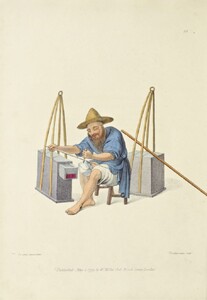
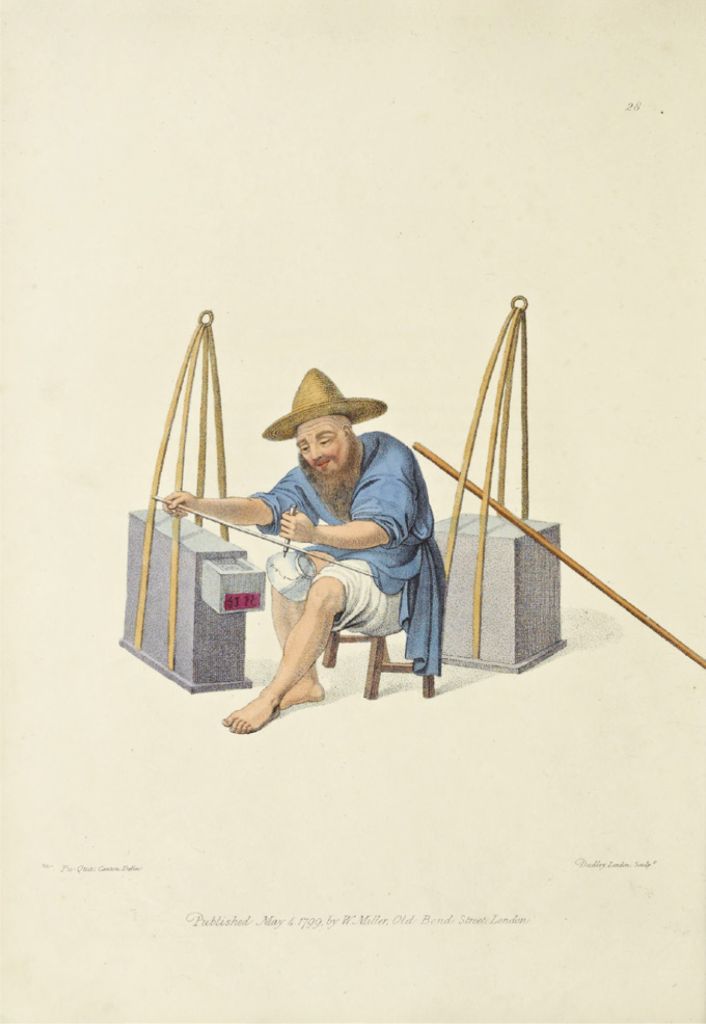
The industrialization that began in the late Qing, continued throughout the twentieth century and intensified in the post-Mao era, has destroyed small scale and demand-driven crafts that had fed, clad, housed, moved and entertained the Chinese people for thousands of years. They had fascinated many foreign visitors who left us extremely rare images. George Henry Mason, a British Army officer, travelled to China in 1789. He documented Chinese crafts in sixty engravings.28 One such craft that Mason depicted, and which would find itself under threat as a result of industrialisation, was cotton-clearing (see illustration 1). It was part and parcel of the work of traditional tailors. Some of them operated from their home or shops, some travelled, while others formed guilds. Lu Hanchao mentioned Ningbo tailor shops on street corners in late Qing–ROC (Republic of China) Shanghai.29 They monopolised the business not just in Shanghai but also in Yokohama, Japan, and colonial Hong Kong.30 Itinerant tailors stayed with families they worked for, making new clothes and accessories, like bedding, before such occasions as Chinese New Year, weddings and new birth. The host families prepared the raw material required which included cotton for the padded winter garments and duvets. While some of the cotton was new, they were mixed with cotton from old clothes and quilts—they had to be cleaned and blended. This was a skilled job called tan mianhua [

Traditional craft: cotton clearing
Citation: Journal of the Economic and Social History of the Orient 69, 1-2 (2026) ; 10.1163/15685209-12341667
George H. Mason, The costume of China illustrated by sixty engravings with explanations in English and French (London: Printed for W. Miller, 1800): 204Traditional seamsters tailor-made outfits for every individual, including babies, in the family. In many cases, old clothes and materials were recycled and transformed into new outfits for younger siblings. This kind of production was based on demand, sourcing locally and small in scale. It was personalised as each individual and family had their preferences for style and fabric which provided room for innovation. There was no waste as leftovers were used to make accessories in the household, such as beddings, quilts and pillow covers, diapers, and even mops, or be saved for future use or recycling, especially with expensive fabrics like corduroy and wool. Itinerant tailors moved from family to family to serve an entire neighbourhood. They were not just fashion-makers but also story-tellers as they recounted tales of their travels. The same can be said of itinerant carpenters as they made or repaired furniture and household necessities. Photographer John Thomson saw them in action in the 1860s and suggested that carpentry was “a branch of industry in which the Chinese may be fairly said to excel”.32 There were also itinerant knife sharpeners and popcorn makers who arrived with their unique calls and songs. However, these small-scale, demand-driven, no waste, environmentally friendly crafts have disappeared in the post-Mao era after more than a century of industrial modernisation.
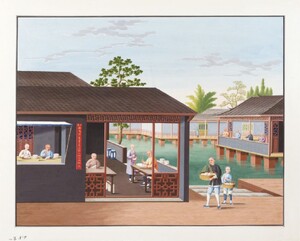
Machines revolutionized production, reduced cost and improved efficiency; they made goods/things affordable and enhanced our lives. But they have also made local craftsmen and women such as itinerant tailors redundant. They have destroyed not just traditional crafts but also household or village- based industries. Porcelain manufacturing was an ancient industry with an elaborate procedure: from crushing the raw material, mixing and forming the body to bisque-firing, glazing and firing again, not to mention the painting and decorating process.33 Chinese porcelain supplied the domestic market and met foreign demands for more than a thousand years. It fascinated Europeans and galvanised the China trade.34 This rare image from the John Rylands Library depicts porcelain making before the age of industrialisation. It catered to the European market as the sign read: “This shop accepts orders for and paints Western-style blue-and-white, multiple-coloured figures, landscapes and birds” (see illustration 2).35
Painting and decorating porcelain in Guangzhou, eighteenth century
Citation: Journal of the Economic and Social History of the Orient 69, 1-2 (2026) ; 10.1163/15685209-12341667
“Painting Porcelain”, Chinese Collection, Drawings vol 14, number 7, John Rylands Library, the University of ManchesterThe human hands are the most important tool in porcelain production; the same can be said in the case of tea- and silk-making. From plucking leaves and rolling to drying, curing and sorting, the human hands were the most important instrument in the making of tea. From raising and collecting cocoons, extracting silk threads which had to be washed, degummed, bleached and dried, to spinning and weaving, the human hands were indispensable in the manufacturing of silk. Richard Tawney (1880–1962) called this the “old industrial order”, and believed that “till the rise of machine production a century and a half ago, her technique was identical in character with that of the West, and, in quality, not infrequently superior to it.”36 This traditional “order” was still thriving in the 1850s, Wang Tao (1828–97) detailed the thriving silk industry in Jiaxing, Zhejiang province, in his diary.37 But it was threatened by machine-driven production and began to disappear by the early twentieth century. We know this from the life and work of Mao Dun (1896–1981).38 Born and raised in Jiaxing, Mao witnessed the industry’s decline and its devastation to his hometown, vividly detailed in his journalistic reports and in the novel Spring Silkworm. Some of them survived into the 1930s; Linda S. Bell has argued that a “developmental continuum exited between urban-based, machine-driven silk industry and rural household handicraft”.39 Lillian Li has discussed the stagnation, failed modernisation and resultant demise of the silk industry in the Jiangnan region from the late Qing to the late 1930s.40 Tawney elaborated China’s problem:
In technique and organisation, the major part of her industry belongs either to the pre-capitalist era or to the first infancy of capitalism. Its characteristics are not power-driven machinery, joint-stock finance and a hierarchy of economic authority, but primitive tools, handicraft methods, and minute investments of capital by merchants or small masters controlling a multiplicity of tiny undertakings.41
China had fallen behind because its industries failed to modernise and exploit machines. Tawney’s opinion was representative of both elite scholars and political leaders in China by the early twentieth century. Most of them believed that China’s industries would not survive without modernisation. China’s silk, porcelain and tea had fascinated Mongols, Persians, Arabs, and Europeans, clad them, decorated their cabinets and quenched their thirst for novelty for more than a thousand years. But more than a century of industrialisation has by now mechanized the production of not just porcelain, tea and silk but almost everything, annihilating what Tawney called the “old industrial order”.
Machines replaced hands in modern industrial production. The Industrial Revolution changed the mode, nature and scale of manufacturing. It saw the birth of factories and streamlined production operated by machines that run nonstop. The early textile factories in Shanghai that destroyed Jiaxing’s silk industry is a defining example of this. Machines elevated production to mass scale; it reduced cost and churned out products much faster—progress made possible by modernisation. But this wiped out traditional small-scale crafts and household/village-based industries.42 Instead of working from home at low agricultural season, textile workers, mostly women, became slaves to the never-ending machines in factories. Their suffering was graphically detailed in journalistic reports such as Indentured Labour [
This was only the beginning of the problems with machine produced goods. In the pre-modern era, nearly everything could be repaired and recycled; among the products that could thus be given a new lease of life included clothing, shoes, furniture, cooking utensils, even porcelain.44 George Mason noticed this, as we see in the picture above.45 Unlike handmade products, machine made products are not manufactured for repair—the factory’s goal is to churn out new generations and more sales. In other words, machine made products have a purposefully-designed life span. Once broken or malfunctioned even if slightly, consumers would have no choice but to dispose them. Industrial scale production exhausts resource and damages the environment, not once, but twice: that is, by dint not just of their production but also of their disposal. Home appliances like the electrical kettle is a good example. They make life easier for us by satisfying our need fast and conveniently. But they need steel and plastic to manufacture, and waste electricity as they are always plugged in. They consume valuable resources and drain energy. This double damage characterises all machine-made products, especially plastic and electronic devices.46
Industrial modernisation enabled economic development, generated jobs and transformed lives. But it has also destroyed cultures that identified China. Machines stifle diversity and indigenous aesthetics; they churn out standardised products devoid of human touch. They are monotonous and reductionist, T-shirts and jeans are good examples. They lack meaning and characteristics, seen in modern furniture, household utensils and architecture. Machine-made products rob us of our unique identities as everybody wears the same clothes and look increasingly similar. They break easily and cannot be repaired. But the problem does not stop here. Modern industrial production caters to the worst of human nature: greed, immediate gratification, and conspicuous consumption. Today’s female fashion is a great example: it aims at making the female body sexually appealing, robbing womenkind of their humanity.47 Industrialization has decimated traditional crafts and industries—wisdom derived from centuries of practice and experiences. Sadly, this is far from the only cost of modernisation.
Fengshui Lost to Concrete Jungles
George Wilkinson saw more than Chinese boats as his frigate sailed into the Pearl River estuary on its way to Guangzhou in early November 1811:
As we approach the land of China, our eyes were struck with a number of blue mountains, which appear to be very high. Many of these scattered over the lands in a pleasing perspective, presented to the observation a perfect conical form. … The whole country in the vicinity of Chum Pee, (the anchoring place of our frigate), is without setting bounds to the most heightened description possible, extremely beautiful. Its surrounding scenery, exhibited such a variety of charming objects, that I felt the greatest satisfaction contemplating the varied landscape as it appeared in the ship’s decks.48
If he were to take the same journey today, he would see gigantic manmade structures: the Hong Kong–Zhuhai–Macau bridge on his left, the Hong Kong International airport to his right, and then the Shenzhen International airport, followed by industrial complexes, residential clusters, holiday resorts, and new towns on both sides of the river bank. The “blue mountains” and “perfect conical form” have been dwarfed by the new landscape after more than a century of industrialization and urbanisation—processes that have wrecked the landscape and ruined traditional cities.
Historians of China have studied cities and urbanisation; they have authored excellent books on China’s ancient and major cities prior to 1949.49 Rhoads Murphey argues that China had four thousand years of “urban experience, probably longer on a continuous basis than that of any other society”.50 Joseph Esherick has edited an excellent volume on the remaking of Chinese cities in the first half of the twentieth century, whereas Wen-hsin Yeh’s edited volume explored the city and its shifting dynamics in the making of modern China.51 Rapid urbanisation in the post-Mao era has attracted much attention.52 Some scholars have examined what they called “China’s great urbanisation” as Chinese cities modernised quickly and caught up with, even surpassing, its counterparts in the West.53 Francois Gipouloux has labelled this “China’s urban century”.54 An increasing number of scholars have examined the problems, from environmental damage to socio-economic inequality.55 Some have focused on politics of urbanisation and its impact on the agricultural sector.56 However, few have examined how urbanisation devastated traditional cities; counting the cost would expose the problem with modernisation.
The urbanisation that began in the late Qing, continued in the twentieth century and accelerated in the post-Mao era has wrecked fengshui [
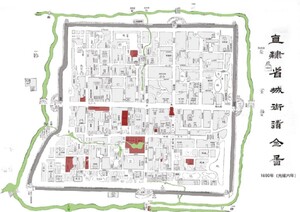
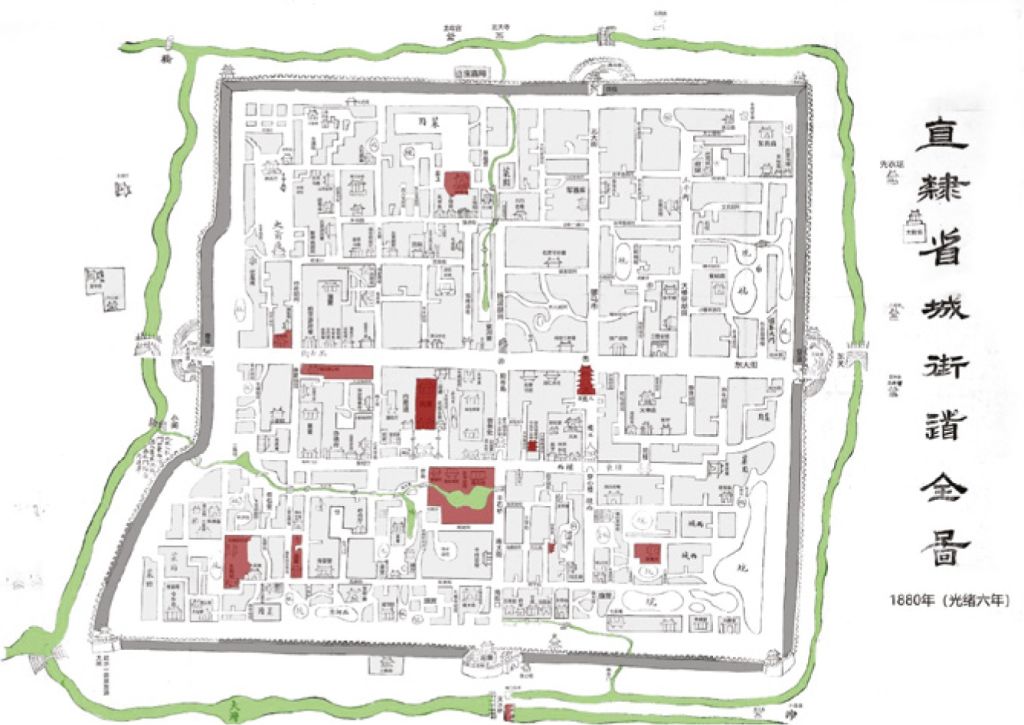
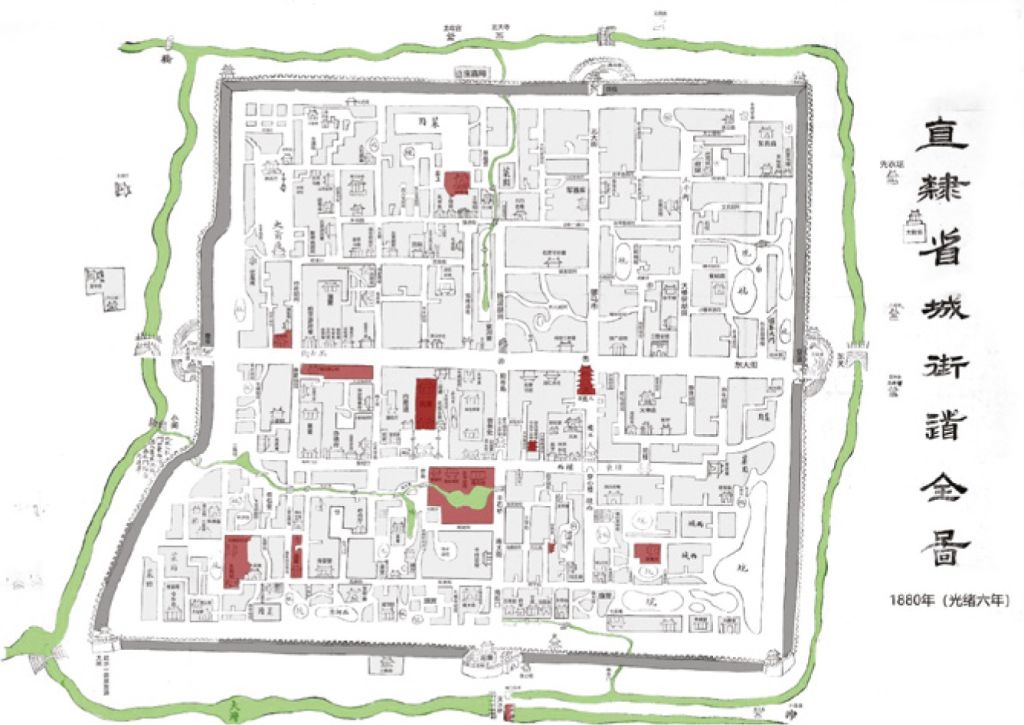
The capital of Zhili region, Baoding was home to many places of worship, government offices, two learning academies, an imperial examination hall, an orphanage, residential and commercial areas separated by the four main avenues leading to/from the four gates. Baoding was hidden among greenery and surrounded by gardens, fish ponds and cultivations of all kinds within the city wall. Guangzhou, with the pagodas that inspired Chambers, was similarly situated amidst greenery, as we see from the image below.
Living and breathing cities, they complemented and integrated into their natural surroundings. European visitors to China were struck by this aspect. Alvarez Semedo (1585–1658) served the Jesuit mission in Nanjing, Xi’an, Beijing and Guangzhou, he noticed the unassuming height of Chinese buildings in these cities.61 So did Matteo Ripa (1682–1764) who worked in Beijing during the 1710s and 1720s:
This, as well as other country residences which I have seen in China, is in a taste quite different from European; for whereas we seek to exclude nature by art, levelling hills, drying up lakes, felling trees, bring path into a straight line, constructing fountains at a great expense, and raising flows in rows, the Chinese, on the contrary by means of art endeavour to imitate nature.62
William Chambers was more explicit, concluding that, “nature is their pattern, and their aim is to imitate her in all her beautiful irregularities.”63 Chinese people respected nature and endeavoured to live in harmony with it. John Thomson, who travelled in China between 1868 and 1872, spending much time in Fuzhou, noted that:
Foochow lies about thirty-six miles inland, and three miles from the banks of the river Min. It stands in the centre of a highly tilled plain of unsurpassed fertility, which is dotted over with villages and homesteads, while mountain ranges close in the distant horizon on every side. The town itself is built around the bases of three hills, whose summits have been appropriated exclusively to temples, official residences, and pagodas. The walls make a circuit of about six miles, and the space they enclose is supposed to be occupied—as at Peking, Canton, and all other great cities—in part by the cantonments of the Tartar garrison, in part by the Chinese citizens. The actual result is a densely populated trading quarter on the west, and gardens, waste lands, and fish ponds in the eastern half.64
Fuzhou, like Guangzhou and Baoding, lived in harmony with nature. The construction of traditional cities must follow elements of fengshui and minimise disturbance to the natural habitat. Fengshui was embedded in the Qing’s legal code as “laws of the land”, local governments used it to authorise constructions and settle disputes.65 Failure to comply with the laws could lead to punishments. But missionaries such as Joseph Edkins labelled fengshui geomancy and dismissed it as superstition, as we see for instance in the words of Rev. E. J. Hardy: “no superstition has had a more cramping effect on the mind and life of a people than that which is known in China as Feng- or Fungshui”.66 Such missionary-critics were not alone. Pro-modern intellectuals and political leaders saw fengshui as another example of China’s backwardness. Anti-superstition was one of the four keystones of the New Culture Movement which Vera Schwarcz has labelled the “Chinese enlightenment”.67 The ROC regime launched “anti-superstition” campaigns as Rebecca Nedostup discussed in her book.68 The philosophy and practice of living in harmony with nature was disinherited as fallacy in the desire to embrace science and modernity. The CCP (Chinese Communist Party) was more radical, turning “anti-superstition” into a political platform sustained by waves of cleansing in the 1950s.69 The Cultural Revolution began in 1966 with the drive to destroy the “four olds”: old thought, culture, customs and habit. The “contempt for tradition” had its origin in the late Qing.
Modernisation of traditional cities began with the arrival of Europeans after China’s defeat in the First Opium War (1839–42) as they procured “settlements”—areas allotted to them where they could live and work, free from Chinese law and restriction, in Treaty-port cities such as Shanghai. They built business districts, paved and lit the streets for modern transportation and commerce. They planted foreign cities on Chinese soil, serving as a window to the West and setting the standard for modernisation. They introduced modern—or, to be more precise, Western—architecture and city planning to China.70 Rhoads Murphey argued that Treaty-port cities like Shanghai were “key to modern China” because they served as examples of progress.71 Lu Hanchao concurred “as China’s foremost cradle of new ideas and innovations, Shanghai itself was a product of modernity.”72 Marie-Claire Bergère has called Shanghai “China’s gateway to modernity”.73 Shanghai embodied everything modern and it became the prototype for urban development. John Thomson was surprised to see in the late 1860s that “there are in most cities large open spaces of tilled land that might have been used for the better accommodation of the citizens”, and he asked: “did they not prefer to crowd their houses and shops together for the purposes of trade and social intercourse, as close as the cells of a bee-hive?”74 Thomson did not have to wait long for that to happen.
Modernisation has enriched our lives, improved transportation and hygiene as well as providing easy access to amenities, education and leisure. But it has also wrought havoc on nature-friendly traditional cities. This began with the demolition of city walls—manifestation of imperial power and “ideal social order”, as Xu Yinong explained in the case of Suzhou.75 This “order” survived into the late Qing. Joseph Esherick has observed that the last decade of the Qing and the Republic of China era “saw a major effort to remake Chinese cities” where “walls were torn down, streets were straightened, widened and paved.”76 The effort to remake Chinese cities might have been initiated by foreigners, but the Chinese themselves soon came to lead the campaign. The destruction of ancient cities with their light environmental footsteps, what Wang Jun called the battle between “preservation vs. demolition” when discussing the case of Beijing, had begun.77 Tianjin was the first city to experience this. Its city wall was badly damaged by foreign troops who came to suppress the Boxer Rebellion in 1900. Instead of rebuilding it, the local government dismantled the city wall, in an effort to show its determination to break from the past—fengshui and “cosmology of the Chinese city” were destroyed, physically as well as metaphorically. This only intensified after the Nationalist Revolution when the ROC regime embarked on building a modern nation—they tore down the walls of many ancient cities starting from 1912, including:78
Shanghai 1912–
Hangzhou 1912–
Chengdu 1912–
Guangzhou 1913–
Yichang 1916
Beijing 1921–
Kunming 1922–
Changsha 1922–
Xiamen 1925–
Wuchang 1926
Fuzhou 1927–
Guiyang 1927–
Nanchang 1927–
Ningbo 1927–
Chongqing 1929–
City walls had constrained expansion; they stood in the way of modernisation. Toppling city walls meant unlimited extension into the surrounding countryside. The city had become the battleground in the ROC’s quest for a modern nation with a new identity. China’s foreign educated scholars, Wu Jingchao chief among them, argued that the government should “develop cities to relieve the countryside” [
The philosophy and practice of fitting into the natural environment and living in harmony with the gods, city god in particular, were completely abandoned. Whatever the ROC regime did not finish or start, the PRC (People’s Republic of China) picked up after 1949. The CCP regime took down the walls of many more cities. Madeleine Yue Dong and Wang Jun discussed the “city wall dismantling spree” in the capital Beijing.88 The regime destroyed not just walls but also old neighbourhoods. Joshua Goldstein wrote of today’s Beijing: “little remains of the city’s trademark alleys (hutong) or city walls of a century ago”.89 Mark Baker discussed the case of Zhengzhou where post-Mao expansion turned “suburban fringe to city centres”.90 This kind of modernisation intensified in the post-Mao era, arguably the most destructive period. An increasing number of scholars have written about coercive demolition of old neighbourhoods and forceful relocation of residents.91 But we still don’t know how many city walls and neighbourhoods have been destroyed since the late nineteenth century. We can try to gauge the expansion of cities through data compiled by mainland scholars. Their research indicates that “China’s national urban land expanded from 5619 km² circa 1949 to 74,827 km² in 2018”.92 We can also see this from the growth of urban population. The National Bureau of Statistics (NBS) monitors urbanisation by permanent resident population. The statistics are staggering:
10.64% in 1949
50.00% in 2011
59.58% in 2018.93
Urbanisation is the process during which more and more people leave the countryside to live and work in cities. Factories are located in cities. They offered better wages than the dull, dirty and back-breaking agricultural work in the countryside. Industrialisation deprived peasants of opportunities to make supplementary income that could be garnered from traditional crafts and household/village industries. It began to devastate the agriculture-based economy and social order, as noted by scholars such as Sydney D. Gamble, Li Jinghan and Fei Xiaotong.94 Some peasants went to cities at the low agricultural seasons or times of disaster to find work. But increasingly, as Lu Hanchao noted, “industrialised, and highly commercialised cities came to be seen as better places than small towns and villages”.95 Rural-to-urban migration was already “considerable” in the 1920s, as John L. Buck discussed.96 Despite that, only ten percent of Chinese lived in cities before 1949.
The Mao era saw massive growth in permanent urban population. This explains the housing and food crisis in cities, and why the Mao regime introduced a rationing system where the government issued stamps for essentials like grain, meat, cotton and textiles. The regime tried to curb rural-to-urban migration by issuing permanent resident permits, the hukou [
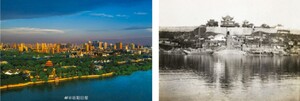
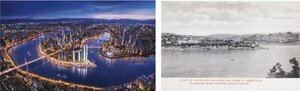
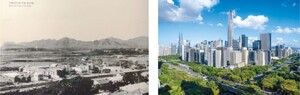
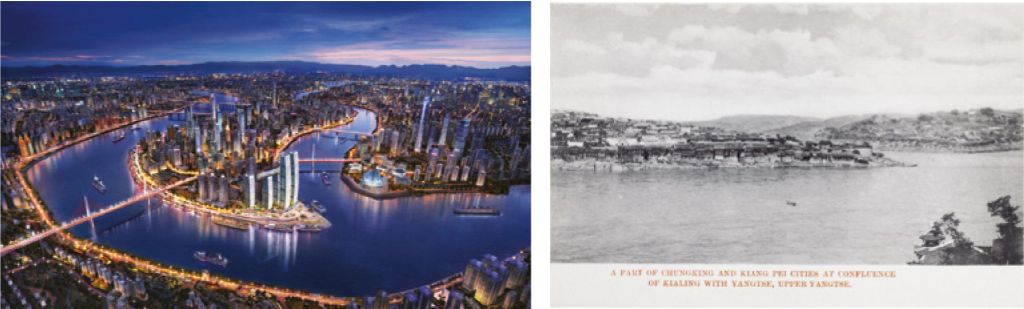
Old Yueyang hidden among greenery has now been isolated on the edge of the expanded city amidst masses of high-rises (see illustrations 6). Once a small town on the confluence of the Jialing and Yangzi rivers, Chongqing is now a mega metropolis with skyscrapers rivalling those in New York and Singapore. Yueyang and Chongqing are just two among many. The urbanisation programme in the post-Mao era is elaborate, it has to satisfy the five layers of socio-spatial configuration dictated by the regime: traditional, proto-globalization, socialist, market-led, and globalization.98 The “traditional” refers to old neighbourhoods that have been saved with a purpose—tourism, as a source of profit for governments. “Socialist” denotes communist politics, “market-led” means shopping and leisure, whereas “globalisation” indicates catching up with developed countries, most obviously through the proliferation of skyscrapers. Respecting and living in harmony with nature is absent from the list—modernisation has no need for fengshui, let alone the city god, it simply dominates and ruins the landscape. Urbanisation has accelerated in the new millennium; it has turned fields and villages into cities—destroying farmlands, forests, and the environment.99 Shenzhen is a defining example of this. A tiny settlement across the border from Hong Kong, it was surrounded by rice fields and a small number of houses that served the PRC’s border control. American journalist Harrison Salisbury left us a vivid description in 1966:
I caught my first glimpse of China through the slit of an observation post atop the barbed-wire-nested guardhouse at Lo Wu station, terminus of the 27-mile railway that runs from Kowloon through the Lease Territory to the Chinese frontier. I looked through the slit, focusing my binoculars as directed by the chief of the Hong Kong defence battalion, and saw through the lens the grim visage of the People’s Liberation Army soldiers on guard on their side of the Lo Wu Bridge …… There, across the Shumchun River, I saw cattle grazing in the green meadows on the China side and a few peasants tending them.100
Traditional craft: mending porcelain
Citation: Journal of the Economic and Social History of the Orient 69, 1-2 (2026) ; 10.1163/15685209-12341667
Mason, Costume: 128Baoding dotted with gardens, fish ponds, and cultivations, 1880
Citation: Journal of the Economic and Social History of the Orient 69, 1-2 (2026) ; 10.1163/15685209-12341667
Ji Hongmo & Guo Chun, Baoding Fuzhi (29 vols. Zhili: Baoding, 1680 edition): v1, 45; Li Peihu and Zhu Jingxuan, Baoding fuzhi (80 vols. Beijing: Tushuguan chubanshe, 1886): v 35 (no page number)Guangzhou pagoda and neighbourhood hidden among greenery, 1870
Citation: Journal of the Economic and Social History of the Orient 69, 1-2 (2026) ; 10.1163/15685209-12341667
“The flower pagoda and rooftops, Guangzhou, 1870.” Photograph by A Chan (Ya Zhen). Image courtesy of Arthur Bayley and Special Collections, Identifier AB-s03, University of Bristol Library at https://hpcbristol.net/visual/AB-s03, accessed 29 August 2023High-rises rose in the post-Mao era to dwarf 1900s Yueyang.
Citation: Journal of the Economic and Social History of the Orient 69, 1-2 (2026) ; 10.1163/15685209-12341667
Baidu public domain image and “Gate and city wall, Yochow”. Image courtesy of Bannister Family and Special Collections, Identifier Ba-s050, University of Bristol Library, at https://hpcbristol.net/visual/Ba-s050, accessed 27 August 2023A massive concrete jungle has erased 1900s Chongqing from the earth.
Citation: Journal of the Economic and Social History of the Orient 69, 1-2 (2026) ; 10.1163/15685209-12341667
Baidu public domain image and “Yuzhong and Jiangbe, Chongqing at the confluence of Jialing and Yangtze Rivers, 1905”, Cornell Plant and Special Collections, Identifier CP-s049, University of Bristol Library, at https://hpcbristol.net/visual/CP-s049, accessed 27 August 2023The settlement, with its cattle-grazing green meadows, was declared a Special Economic Zone in August 1980. Four decades later, a concrete jungle had risen in its place. Du Juan called it an “instant city”.101 Rivalling Beijing, Shanghai and Guangzhou, Shenzhen was transformed into the world’s factory, China’s high-tech city, shopping paradise and holiday destination. Home to a population of more than 17 million as of 2024, Shenzhen is only one among many that suddenly sprang up during economic reform.
Urbanisation has now been taken to rural areas in the government’s desire to alleviate poverty in less developed regions and to reduce rural-to-urban migration. This has led to rural industrialization—a process that Nick Smith has called the “end of the village”.102 Andrew B. Kipnis captures this in a volume titled From Village to City.103 From an impoverished town of 30,000 in 1988, Zouping in Shandong province had transformed into a city of 300,000 by 2013. Zouping is just one among many. In a documentary entitled White Horse Village, British journalist Carrie Gracie documented the case of Wuxi in the Sichuan basin where a small town of a few hundred grew into to a modern city of 540,000.104 This was made possible by the post-Mao regime as it tried to address the problem of “top-heavy urban development”, leaving the matter largely in the hands of regional or local governments.105 This has led to the rise of “ghost cities” as the construction boom was hit by the covid pandemic and recession.106 Economist Mark Williams estimates that China still has about 30 million unsold properties, which could house 80 million people—the entire population of Germany.107 Yujiapu in Tianjin is an example where the entire area stands empty of people and traffic. There are many others, such as Ordos in Inner Mongolia, China’s largest ghost city.
A concrete metropolis is sitting on 1960s cattle-grazing green meadows
Citation: Journal of the Economic and Social History of the Orient 69, 1-2 (2026) ; 10.1163/15685209-12341667
Baidu public domain imagesAnnual deforestation since post-Mao reform intensified in the 1990s
Citation: Journal of the Economic and Social History of the Orient 69, 1-2 (2026) ; 10.1163/15685209-12341667
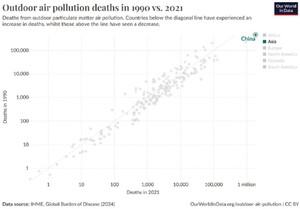
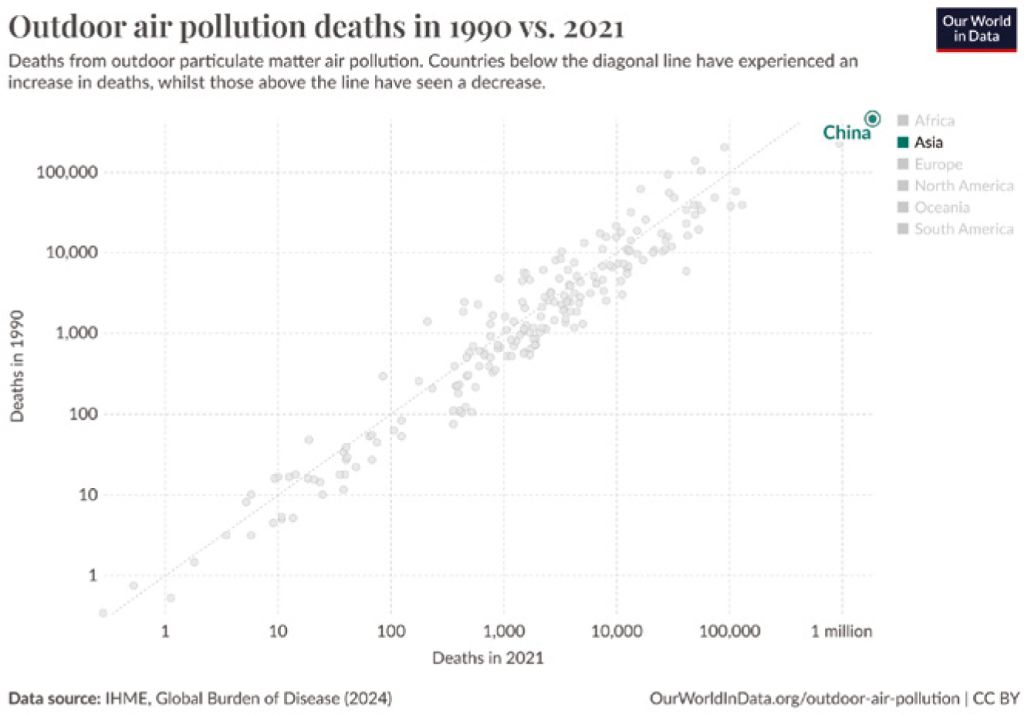
Our World in Data, “Annual deforestation, China”, at https://ourworldindata.org/grapher/annual -deforestation, accessed 2 August 2024Rising outdoor pollution death, 1990 versus 2021
Citation: Journal of the Economic and Social History of the Orient 69, 1-2 (2026) ; 10.1163/15685209-12341667
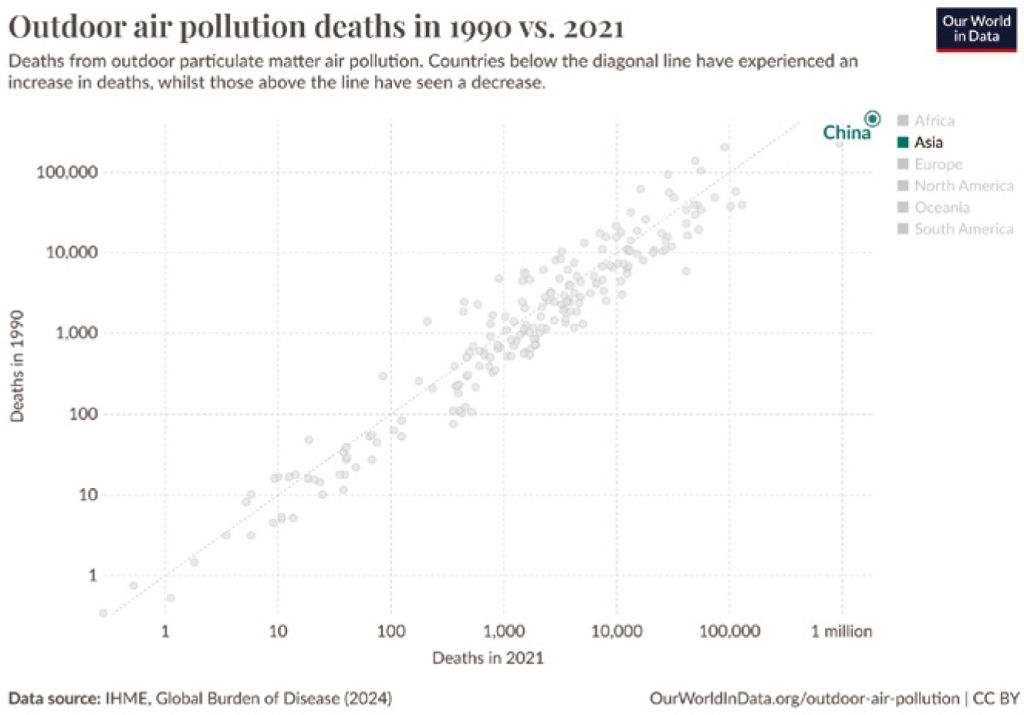
Our World in Data, “Outdoor pollution death 2009–2017 China”, at https://ourworldindata.org/grapher /outdoor-pollution-deaths-1990-2017, accessed 2 August 2024China’s rising diabetes population
Citation: Journal of the Economic and Social History of the Orient 69, 1-2 (2026) ; 10.1163/15685209-12341667
IIN, “2018 China diabetes popula tion (million)”, at http://www.chyxx.com/industry/201808/671815.html, accessed 2 August 2024; International Diabetes Federa tion, at https://diabetesatlas.org/data-by-location/global/, accessed 21 August 2024Urbanisation is destroying the very fabric of Chinese culture and society silently—it has severed ties to ancestors and roots in the countryside. Traditional cities were places for sojourners, not one’s permanent residency. Officials were often shuffled every few years, a mechanism to prevent cultivation of local power while merchants travelled to wherever business took them. They might work and live in cities but they left their family in the countryside where their ancestors were buried in family/clan cemeteries and worshipped in ancestral halls.108 They returned for important rituals/festivals and ultimately upon retirement. John Thomson saw and knew the importance of Chinese worship of ancestors:
The Hall of Ancestors, or simply the shrine, has its place in every abode. Among the poor it occupies some obscure spot, some niche or shelf on which the ancestral tablet, a simple piece of wood, inscribed with the name and rank of the deceased, is placed upright on a stand. … The tablets are objects of daily worship, the eldest son acting as high priest of the ceremony.109
But more than a century of urbanisation has severed ties to the land in the countryside and destroyed ancestor worship. Urbanisation is not new to China: as Glenn T. Trewartha argued, it “appears to be almost as old as China itself”.110 Much bigger than their European counterparts, Chinese cities like Xi’an and Quanzhou had impressed foreign visitors since the Sui-Tang era. But there is a distinction between then and now. The common phrase “returning to the countryside upon retirement” [
Lives Lost to the World of Plenty
William Chambers admired Chinese architecture and landscape art, and he marvelled at the uniqueness of Chinese culture, stating that:
Whatever is really Chinese has at least the merit of being original: these people seldom or never copy or imitate the inventions of other nations. All our most authentick relations agree in this point, and observe that their form of government, their language, characters, dress and almost every other particular belonging to them, have continued without change for thousands of years.113
Chambers saw what made the Chinese unique. Abel Bonnard expressed his concern about the survival of Chinese culture in 1921: “one wonders what unforeseen defences the Asiatic soul will present to the attack of modern influences”.114 The Chinese did put up resistance, but they eventually capitulated to the assault from the West. More than a century of modernisation has completely changed the ways in which the Chinese dress, eat, live, move, work and relax. Every morning, many Chinese wake up in their high-rise apartments—still sometimes referred to foreign house [
Maintaining such a modern lifestyle demands resources that are diminishing rapidly. More than a century of industrialization and urbanisation has for example destroyed China’s forests. Robert Marks has reminded us that increasing population from the Ming had already put pressure on the environment.117 Nanny Kim has detailed how copper mining drove deforestation during the Qing.118 Ian Miller argued that “it was only in the nineteenth century that China’s forests began to face catastrophe”.119 Meng Zhang was precise, pointing out that “in 1750 about 25 percent of China’s land surface had been forested, but by 1950 that had shrunk to less than 10 percent”.120 The mid-Qing to the ROC era saw much destruction. This continued into the Mao era. Judith Shapiro authored an excellent book on deforestation that took place during the Great Leap Forward, and which resulted in the death of millions.121 The CCP regime was the most destructive, Mao Zedong himself promoting the idea that “man will conquer nature” [
The annual rate remained steady for three decades until 2015. The sharp decline thereafter may look like good news to China, but it is bad news for the world—China has “exported” its deforestation at the cost of developing countries in Africa and Latin America, thereby giving rise to the term “imported deforestation”.123 With resources from less developed countries, China’s industrialization and urbanisation have accelerated. The NBS put the rate of urbanisation by permanent resident population in 2023 at 66.16%, an increase from 59.58% in 2018.124 The Industry Information Network (IIN) has predicted that China’s urban population will reach 1 billion by the 2030s when more than two-thirds of Chinese will live in cities.125 What more would it take to clothe, feed, house, move and entertain such a gigantic urban population?
The destruction is hardly limited to forests. Industrialisation and urbanisation have poisoned the very substance for human existence—the air. Outdoor air has deteriorated rapidly since the 1990s, contributing to lung cancer, the number one killer for both men and women, with nearly a million deaths in 2021, see above.126
Polluted air contributes to lung cancer; even more so does tobacco smoking. Industrialisation and urbanisation have completely changed the way in which tobacco is consumed. Instead of going to the local tobacconist to purchase tobacco leaves/slices, chopping, mixing and fitting them into the pipe, lighting it, and sitting down to enjoy a pipe, the cigarette makes consumption quick and easy. One can purchase and smoke anytime, anywhere, and continuously. Indeed, the cigarette itself has become a symbol of modernity, whereas the pipe denotes tradition, as Carol Benedict has argued.127 Production on an industrial scale has led to a massive increase in consumption. Smoking jumped from 80 billion cigarettes in 1949 to 1200 billion in 1990, and by the mid-1990s, China was smoking 1.7 trillion per year, “a third of the world’s total”.128 Tobacco smoking in China has become an “epidemic”.129 Even while smoking killed 1,060,600 Chinese in 2022, tobacco companies and the Chinese government have continued to pocket giant profits.130
Industrialization and urbanisation enhanced commerce and consumption, and made modern lives easy and convenient. But they also enabled overeating, leading to a multitude of diseases. Modern consumerism preys on the most vulnerable aspect of human nature: greed, immediate gratification, and conspicuous consumption. Children and young adults are the most vulnerable. Bombarded by targeted advertisements, many are lured into excessive eating and drinking. Aside from the three meals plus evening snacks [
Industrial and urban modernisation have wrought havoc not just in China, but also on a global scale. Concentration of a large population in close proximity within urban areas has led to the quick spread of pandemics that might previously have been contained locally. As the world saw with covid 19, modern transportation links turned a local epidemic into a global plague. Undeterred, China is forging ahead with new industrialisation today. The Guardian reported in March 2023 that “China leads in 37 of 44 technologies tracked in a year-long project”.134 Four months later, The EurAsian Times announced that “At 453 km/h, China tests world’s fastest, new-gen high-speed train”.135 Heavily industrialised cities are seeking further development, while urban sprawl continues to march into the vast countryside.136 Human ingenuity knows no limit. Where is the pursuit for progress and the race to outpace others leading us to, other than self-destruction?
Coda
Modernity is generally understood to entail improvement and advancement. Dynasties came and went in the past three or so thousand years; they all, to a large extent, “modernised”. But the modernisation that began in the late Qing, what Li Hongzhang called “change unseen in three thousand years”, is different.137 It is violent and it annihilates. Is it too late to put the brakes on? Perhaps we could take some comfort that modernisation has not yet destroyed everything native to China. Some city walls, such as those in Xi’an and Nanjing, and some traditional towns, such as Fenghuang and Pingyao, have survived. So too have some crafts, such as papermaking in rural Sichuan, as Jacob Eyferth has illustrated. Chinese cuisine, dialects, and traditional Chinese medicine or TCM have endured the onslaught of modernisation. The Chinese taste buds have not been coarsened; neither has the language the Chinese speak even though it has absorbed new vocabularies. In fact, TCM has been “modernised” in the ways it is researched, manufactured, and consumed. Why have these aspects of Chinese culture been more resistant than others to the assault of modernisation? This demands more research. Modernity could co-exist with tradition; they could complement each other. Charles Musgrove revealed how the ROC regime tried to modernise its capital Nanjing by turning it into a “ceremonial centre and cosmological microcosm”—whereby the traditional served a modern purpose: emulating earlier dynasties to legitimise its rule.138 A complete return to tradition is not a solution; neither is rejecting modernity. But continued industrialization and urbanisation on today’s scale is not sustainable; it is threatening the survival of nature and humanity itself. The traditional has nourished the Chinese people for thousands of years, as is the case for other civilisations, while the modern has done some deadly and irreversible damage in a relatively short lifespan. It is time we look back to tradition for inspiration in order to undo the damage done for a sustainable and renewable future.
Acknowledgments
I would like to thank my colleagues, Frank Mort, Stuart Jones, Christian Goeschel, Steven Pierce, Mark Baker, Lewis Ryder and Olivia Mitchell for suggesting sources, reading this article and giving me feedback. I am grateful to Robert Bickers of Historical Photographs of China and Bristol University who gave me permission to use their special collection.
Bibliography
Audin, Judith. 2022. Between Chai and Qian: how Unfinishedness and Ruination have Reshaped China’s Urbanity in China’s “Coal Capital” after the Construction Boom. International Journal of Urban and Regional Research 45, 6: 998–1015.
Baker, Mark. 2024. Pivot of China: Spatial Politics and Inequality in Modern Zhengzhou Cambridge: Harvard University Press.
Bakich, Olga. 1986. A Russian City in China: Harbin before 1917. Canadian Slavonic Papers 28, 2: 129–148.
Bell, Linda S. 1999. One Industry, Two Chinas: Silk Filatures and Peasant-family Production in Wuxi Country, 1865–1937. Stanford: Stanford University Press.
Bergère, Marie-Claire. 2022. Shanghai: China’s Gateway to Modernity. Stanford: Stanford University Press.
Bodley, R. V. C. 1934. Indiscretions of a Major: Some Impressions about Shanghai as Paris of the East. North China Herald 26 December: 515.
Bonnard, Abel. 1927. In China. New York: E. P. Dutton & Company.
Bracken, Gregory, ed. 2012. Aspects of Urbanization in China: Shanghai, Hong Kong and Guangzhou. Amsterdam: Amsterdam University Press.
Bramall, Chris. 2007. Industrialization of Rural China. Oxford: Oxford University Press.
Brown, Tristan. 2023. Laws of the Land: Fengshui and the State in Qing Dynasty China. Princeton: Princeton University Press.
Buck, John L. 1964. Land Utilization in China: a Study of 16,786 Farms in 168 Localities, and 38,256 Farm Families in Twenty-two Provinces in China, 1929–1933. London: Oxford University Press.
Carroll, Peter. 2006. Between Heaven and Modernity: Reconstructing Suzhou, 1895–1937. Stanford: Stanford University Press.
Chambers, William. 1757. Designs of Chinese Buildings, Furniture, Dresses, Machines and Utensils. London: Printed for the Author.
Chang, Sen-dou. 1977. The Morphology of Walled Capitals. In The City in Late Imperial China, ed. G. William Skinner. Stanford: Stanford University Press: 75–100.
Chen, Kai Jun. 2023. Porcelain for the Emperor: Manufacture and Technocracy in Qing China. Seattle: University of Washington Press.
Chen, Xujin. 1934. Zhongguo Wenhuade Chulu. Shanghai: Commercial Press.
Chu, Samuel C and Kwang-ching Liu, eds. 2015. Li Hong-chang and China’s Early Modernization. London: Routledge.
Cohen, Myron L. 1991. Being Chinese: the Peripheralization of Traditional Identity. Daedalus 120, 2: 113–134.
Dingle, Edwin J. 1911. Borderland of Eternity: Embracing “Across China on Foot”. Bristol: J. W. Arrowsmith.
Dong, Fureng. 1992. Industrialization and China’s Rural modernization. Basingstoke: Macmillan.
Dong, Madeleine Yue. 2000. Defining Beiping: Urban Reconstruction and National Identity, 1928–36. In Remaking the Chinese City, ed., Joseph Esherick. Honolulu: University of Hawaii Press: 121–138.
Du, Juan. 2020. The Shenzhen Experiment: the Story of China’s Instant City. Cambridge: Harvard University Press.
Eck, Diana L. 1986. The City as a Sacred Center. Journal of Developing Societies 2 (2): 149–159.
Economy, Elisabeth C. 2010. The River Runs Black: the Environmental Challenge to China’s Future. Ithaca: Cornell University Press.
Edkins, Joseph. 1893. Religion in China. London: Kegan Paul, Trench, Trübner, & Co. Ltd.
Eisenstadt, S. N. 2002. Some Observations on Multiple Modernities. In Reflections on Multiple Modernities: European, Chinese and Other Interpretations, eds., D. Sachsenmaier, J. Riedel and S. N. Eisensdadt. Leiden: Brill: 27–41.
El-Masudis. 1841. Historical Encyclopaedia: Meadows of Gold and Mines of Gems translated by Aloys Sprenger. London: The Oriental Translation Fund of Great Britain and Ireland.
Esherick, Joseph, ed. 2000. Remaking the Chinese City: Modernity and National Identity 1900–1950. Honolulu: University of Hawaii Press.
Eyferth, Jacob. 2009. Eating Rice from Bamboo Roots: the Social History of a Community of Handicraft Papermakers in Rural Sichuan, 1920–2000. Cambridge: Harvard University Press.
Fearnside, Philip M and Adriano M. R. Figueiredo. 2017. China’s Influence on Deforestation in Brazilian Amazonia: a Growing Force in the State of Mato Grosso. In China and Sustainable Development in Latin America: the Social and Environmental Dimension, eds., Rebecca Ray, et al.London: Anthen Press: 229–266.
Fei, Xiaotong. 1946. Neidi Nongcun. Shanghai: Shenhuo Shudian.
Fei, Xiaotong. 1987 Jiangcun Jinji. Hong Kong: Zhonghua Shuju.
Fei, Xiaotong. 1992. Xingxing Chong xingxing. Yinchuan: Ningxia Renmin Chubanshe.
French, Paul and Matthew Crabbe. 2010. Fat China: how Expanding Waistlines are Changing a Nation. London: Anthem Press.
Fuller, Pierre. 2022. Modern Erasures: Revolution, the Civilizing Mission, and the Shaping of China’s Past. Cambridge: Cambridge University Press.
Gamble, Sidney D. 1921. Peking, a Social Survey. New York: George H. Doran and 1963. North China Villages: Social, Political and Economic Activities before 1933. Berkeley: University of California Press.
Garnaut, Ross and Ligang Song. 2005. The China Boom and its Discontents. Canberra: ANU Press.
Gerritsen, Ann. 2020. The City of Blue and White: Chinese Porcelain and the Early Modern World. Cambridge: Cambridge University Press.
Gipouloux, Francois. 2015. China’s Urban Century: Governance, Environment and Socio- economic Imperatives. Cheltenham: Edward Elgar.
Goldstein, Joshua. 2021. Remains of the Everyday: a Century of Recycling in Beijing. Oakland: University of California Press.
Greene, Maggie. 2019. Resisting Spirits: Drama Reform and Cultural Transformation in the People’s Republic of China. Ann Arbor: University of Michigan Press.
Gu, Chaolin, Christian Kesteloot and Ian G. Cook. 2015. Theorising Chinese Urbanization. Urban Studies 52/14: 2564–2580.
Guldin, Gregory E. 1997. Farewell to Peasant China: Rural Urbanization and Social Change in the Late Twentieth Century. Armonk: M. E. Sharpe.
Han, Bingfeng, et al.2024. Cancer Incidence and Mortality in China, 2022. Journal of the National Cancer Centre 4, 1: 47–53.
Hao, Zhijing. 2023. Fazhan Dushi Yijiuji Nongcun yu Xiangtu Chongjian. Shehui Kexue 3: 171–180.
Hardy, E. J. 1907. John Chinaman at Home: Sketches of Men, Manners and Things in China. London: T. Fisher Unwin.
Harney, Alexandra. 2009. China Price: the True Cost of Chinese Competitive Advantage. New York: Penguin.
He, Bochuan. 1992. China on the Edge: Crisis of Ecology and Development in China. San Francisco: China Books.
He, Yimin. 2008. The Decline of Traditional Industrial and Commercial Cities in Modern China Exemplified in Suzhou, Hangzhou and Yangzhou. Frontier of History in China 3, 2: 263–292.
Hershatter, Gail. 1997. Dangerous Pleasures: Prostitution and Modernity in Twentieth-century Shanghai. Berkeley: University of California Press.
Ho, Samuel P. S. 1994. Rural China in Transition: Non-agricultural Development in Rural Jiangsu, 1978–1990. Oxford: Clarendon Press.
Holden, Constance. 2001. Tobacco Epidemic in China’s Future. Science 293, 5536: 1761.
Honneth, Axel. 2009. Pathologies of Reason translated by J. Ingram, et al.New York: Columbia University Press.
Hu, Shi. 2003. Hushi Quanji: Zhongguo Jinride Wenhua Chongtu. Heifei: Anhui Jiaoyu Chubanshe.
Huang, Xuelei. 2023. Scents of China: a Modern History of Smell. Cambridge: Cambridge University Press.
Ito, Izumi. 2021. Chinese Tailors and Dressmakers in Yokohama from Zhejiang and Jiangsu. Socio-Economic History 87, 2: 89–109.
Jaros, Kyle A. 2019. China’s Urban Champions: the Politics of Spatial Development. Princeton: Princeton University Press.
Ji, Hongmo and Guo Chun. 1680. Baoding Fuzhi. Zhili: Baoding.
Jing, Jun, ed. 2000. Feeding China’s Little Emperors: Food, Children, and Social Change. Stanford: Stanford University Press.
Kang, Wenhui. 2020. 70 Years of Urban Expansion Across China: Trajectory, Pattern and National Policies. Science Bulletin 65, 23 (12): 1970–1974.
Kim, Nanny. 2018. Fuel for the Smelters: Copper Mining and Deforestation in Northeastern Yunnan during the High Qing, 1700 to 1850. In Southwest China in a Regional and Global Perspective (c. 1600–1911): Metals, Transport, Trade and Society, eds. Theobald Ulrich and Cao Jin. Leiden: Brill: 87–123.
Kipnis, Andrew B. 2016. From Village to City: Social Transformation in a Chinese County Seat. Oakland: University of California Press and 2021. The Funeral of Mr. Wang: Life, Death, and Ghosts in Urbanizing China. Oakland: University of California Press.
Kojima, Reeitsu. 1987. Urbanization and Urban Problems in China. Tokyo: Institute of Developing Economies.
Lee, Katon. 2023. Identity Pride and Exclusiveness: Cross-border Craftsmanship and Chinese Tailors in Post-war Hong Kong, 1945–1970. Asian Ethnicity 24, 4: 571–587.
Leppman, Elizabeth J. 2005. Changing Rice Bowl: Economic Development and Diet in China. Hong Kong: Hong Kong University Press.
Levenson, Joseph R. 1965. Confucian China and its Modern Fate: a Trilogy. Berkeley: University of California Press.
Li, Hongzhang. 1997. Li Wenzhong Gong Zougao. 80 vols. Shanghai: Guji Chubanshe.
Li, Ji & Mao Zishui. 1971. Hu Shi yu Zhongxi Wenhua. Taibei: Shuiniu Chubanshe.
Li, Jinghan. 1933. Dingxian Shehui Gaikuang Diaocha. Beiping: Zhonghua Pingmin Jiaoju Cujinhui and 1939. Zhongguo Nongcun Wenti. Changsha: Shangwu Yinshuguan.
Li, Jingyu. 2009. Guodongde Mian’ao Zijizuo [过冬的棉袄自己做]. Zhongguo Chuyun 3: 41–42.
Li, Lillian M. 1981. China’s Silk Trade: Traditional Industry in the Modern World 1842–1937. Cambridge: Council on East Asia Studies, Harvard University.
Li, Peihu and Zhu Jingxuan. 1886. Baoding Fuzhi. Beijing: Tushuguan Chubanshe.
Liao, Sara. 2020. Fashioning China: Precarious Creativity and Women Designers in Shanzhai Culture. London: Pluto Press.
Lingohr-Wolf, Susanne. 2011. Industrialization and Rural Livelihoods in China: Agricultural Processing in Sichuan. New York: Routledge.
Liu, Lihua. 2013. Feng Mian’ao [缝棉袄]. Yuhua 12: 80–81.
Lowith, Karl. 1949. Meaning in History. Chicago: University of Chicago Press.
Lu, Ding, ed. 2012. The Great Urbanization of China. Hackensack: World Scientific.
Lu, Duanfang. 2006. Remaking Chinese Urban Form: Modernity, Scarcity and Space, 1949–2005. London: Routledge.
Lu, Hanchao. 1999. Behind the Neon Lights: Everyday Shanghai in the Early Twentieth Century. Berkeley: University of California Press and 2001. Review of One industry, Two Chinas: Silk Filatures and Peasant-family Production in Wuxi Country, 1865–1937 by Linda S. Bell. Journal of Social History 35, 1: 240–42.
Lukacs, Gyorgy. 1972. History and Class Consciousness: Studies in Marxist Dialectics translated by R. Livingstone. Cambridge: MIT Press.
Mackay, Judith. 1997. Battling Upstream Against the Tobacco Epidemic in China. Tobacco Control 6/1: 9–10.
Maddedu, Manuela and Xiaoqing Zhang. 2017. Harmonious Spaces: the Influence of Feng Shui on Urban Space and Design. Journal of Urban Design 22, 6: 709–725.
Mao, Dun. 1994. Mao Dun Xuanji. Chengdu: Sichuan Wenyi Chubanshe.
Marks, Robert B. 1997. Tigers, Rice, Silk, and Silt: Environment and Economy in Late Imperial South China. Cambridge: Cambridge University Press.
Mason, George H. 1800. The Costume of China, Illustrated by Sixty Engravings with Explanations in English and French. London: Printed for W. Miller.
Miller, Ian M. 2020. Fir and Empire: the Transformation of Forests in Early Modern China. Seattle: University of Washington Press.
Mostern, Ruth. 2011. “Dividing the Realm in Order to Govern”: the Spatial Organization of the Song State (960–1276). Cambridge: Harvard University Asia Center.
Mouzakitis, Angelos. 2017. Modernity and the Idea of Progress. Frontiers in Sociology 20: 03 https://www.frontiersin.org/articles/10.3389/fsco.2017.00003/full.
Muhlhahn, Klaus. 2018. Making China Modern: from the Great Qing to Xi Jinping. Cambridge: Harvard University Press.
Murphey, Rhoads. 2005. The Fading of the Maoist Vision: City and Country in China’s Development. London: Routledge and 1953. Shanghai: Key to Modern China. Cambridge: Harvard University Press.
Musgrove, Charles D. 2013. China’s Contested Capital: Architecture, Ritual, and Response in Nanjing. Honolulu: University of Hawai’i Press.
Nedostup, Rebecca. 2009. Superstitious Regimes: Religion and the Politics of Chinese Modernity. Cambridge: Harvard University Asia Center.
Pang, Laikwan. 2007. The Distorting Mirror: Visual Modernity in China. Honolulu: University of Hawai’i Press.
Peto, Richard, et al.2009. Tobacco: the Growing Epidemic in China. CVD Prevention and Control 4, 1: 61–70.
Pittwood, Linda J. 2019. Flipping Through a Magazine: the Consumed and Consuming ‘Woman’ in Contemporary Chinese art. Journal of Contemporary Chinese Art (Great Britain) 6: 113–129.
Poon, Shuk-wah. 2011. Negotiating Religion in Modern China: State and Common People in Guangzhou, 1900–37. Hong Kong: Chinese University Press.
Proctor, Robert N. 2011. Golden Holocaust: Origins of the Cigarette Catastrophe and the Case for Abolition. Berkeley: University of California Press.
Rawski, Thomas G. 1980. China’s Transition to Industrialism: Producer Goods and Economic Development in the Twentieth Century. Ann Arbor: University of Michigan Press.
Ripa, Metteo. 1846. Memoirs of Father Ripa during Thirteen Years’ Residence at the Court of Peking in the Service of the Emperor of China. New York: Wiley & Putnam.
Rogaski, Ruth. 2004. Hygienic Modernity: Meanings of Health and Disease in Treaty-port China. Berkeley: University of California Press.
Rosato, Donald V. 2004. Plastics China: Technologies, Markets and Growth Strategies to 2008. Oxford: Elsevier.
Salisbury, Harrison E. 1973. To Peking and Beyond: a Report on the New Asia. London: Arrow Books.
Schwarcz, Vera. 1986. The Chinese Enlightenment: Intellectuals and the Legacy of the May Fourth Movement of 1919. Berkeley: University of California Press.
Semedo, Alvarez. 1655. The History of that Great and Renowned Monarchy of China. London: Printed by E. Tylre for John Crook.
Shao, Qin. 2013. Shanghai Gone: Domicide and Defiance in a Chinese Megacity. Lanham: Rowman Littlefield and 2004. Culturing Modernity: the Nantong Model, 1890–1930. Stanford: Stanford University Press.
Shapiro, Judith. 2001. Mao’s War Against Nature: Politics and Environment in Revolutionary China. Cambridge: Cambridge University Press.
Shepard, Wade. 2015. Ghost Cities of China: the Story of Cities Without People in the World’s Most Populated Country. London: Zed Books.
Shi, Hongxia. 2017. Guoniande Huamian’ao [过年的花棉袄]. Huaren Shikan 1: 14.
Sit, Victor F. S., ed. 1988. Chinese Cities: the Growth of the Metropolis since 1949. Hong Kong: Oxford University Press.
Smith, Bardwell and Holly B. Reynolds, eds. 1987. The City as a Sacred Centre: Essays in Six Asian Context. Leiden: Brill.
Smith, Nick R. 2021. The End of the Village: Planning the Urbanization of Rural China. Minneapolis: University of Minnesota Press.
Smith, Richard. 2020. China’s Engine of Environmental Collapse. London: Pluto Press.
Sun, Zhongshan. 1953. The International Development of China. Taipei: China Cultural Service. and 2011. Jianguo Fanglue. Beijing: Zhongguo chang’an chubanshe.
Tawney, Richard H. 1932. Land and Labour in China. London: George Allen and Unwin.
Thomson, John. 1876. The Land and the People of China. London: Society for Promoting Christian Knowledge.
Thomson, John Stuart. 1913. China Revolutionized. Indianapolis: Bobbs Merrill.
Trewartha, Glenn T. 1952. Chinese Cities: Origins and Functions. Annals of the Association of American Geographers 42/1: 69–93.
Vänskä, Annamari. 2020. Sexualising Fashion? An Introduction to the Special Theme Issue. Sexualities 23: 692–701.
Wagner, Peter. 2017. Progress and Modernity: the Problem with Autonomy. Sociología Histórica 7: 71–94.
Wang, Jun. 2011. Beijing Record: a Physical and Political History of Planning Modern Beijing. Hackensack: World Scientific.
Wang, Mark, ed. 2014. Transforming Chinese Cities. London: Routledge.
Wang, Mengqi, Tong Lam and Megan Steffen. 2022. Villages Make the City: Displacement, Dispossession, and Class in China’s Urban Villages. Positions Asia Critique: Special Issue 30, 9: 501–522, 523–48 & 571–94.
Wang, Tao. 2015. Wang Tao Riji. Beijing: Zhonghua Shuju.
Wheatley, Paul. 1971. The Pivot of the Four Quarters: a Preliminary Enquiry into the Origins and Character of the Ancient Chinese City. Edinburgh: Edinburgh University Press.
Wilkinson, George. 1814. Sketches of Chinese Customs and Manners in 1811–12. Bath: Printed by J. Browne, Union-Passage.
Wright, Arthur. 1977. The Cosmology of the Chinese City. In The City in Late Imperial China ed. G. William Skinner. Stanford: Stanford University Press: 33–73.
Wu, Jingchao. 1929. Dushi Shehuixue. Shanghai: Shijie Shuju and 1936. Disizhong Guojiade Chulu. Beijing: Shangwu Yinshuguan.
Xia, Lingen. 1989. Jiu Shanghai Sanbai Liushihang. Shanghai: Huadong Shifang Daxue Chubanshe.
Xia, Yan. 2005. Xiayan Quanji. Hangzhou: Zhejiang Wenyi Chubanshe.
Xiao, Gongquan. 1960. Rural China: Imperial Control in the Nineteenth Century. Seattle: University of Washington Press.
Xuan, Chaoqing and Chen Xuhua. 2019. Yi Dushi Zhenxing Xiangcun Shehui. Renwen Zazhi 1: 113–121.
Yeh, Wen-hsin. 2008. Shanghai Splendor: Economic Sentiments and the Making of Modern China, 1843–1949. Berkeley: University of California Press and 2000. Becoming Chinese: Passages to Modernity and Beyond. Berkeley: University of California Press.
Yu, Yingshi. 2016. Chinese History and Culture: Seventeen Through Twentieth Centuries. New York: Columbia University Press.
Yu, Yinong. 2000. The Chinese City in Space and Time: the Development of Urban Form in Suzhou. Honolulu: University of Hawai’i Press.
Yusuf, Shahid and Tony Saich. 2008. China Urbanizes: Consequences, Strategies and Policies. Washington DC: World Bank.
Zarrow, Peter. 2015. Educating China: Knowledge, Society, and Textbooks in a Modernizing World, 1902–1937. Cambridge: Cambridge University Press.
Zhang, Li, Richard LeGates and Min Zhao. 2016. Understanding China’s Urbanization: the Great Demographic, Spatial, Economic and Social Transformation. Cheltenham: Edward Elgar.
Zhang, Meng. 2021. Timber and Forestry in Qing China. Seattle: University of Washington Press.
Zheng, Yongnian, et al., eds. 2017. China’s Great Urbanization. Abingdon: Routledge.
Other Sources
Drawing
Painting Porcelain. Chinese Collection. Drawings 14:7. John Rylands Library, University of Manchester.
Newspaper/Media
Hurst, Daniel. 2023. China Leading US in Technology Race in All but a Few Fields. The Guardian Thursday 3 March. At https://www.theguardian.com/world/2023/mar/02/china-leading-us-in-technology-race-in-all-but-a-few-fields-thinktank-finds, accessed 22 Jan 2024.
Tiwari, Sakshi. 2023. At 453 km/h, China Tests World’s Fastest, New-gen High-speed Train. The EurAsian Times 3 July. At https://www.eurasiantimes.com/at-453-km-h-china-tests-worlds-fastest-high-speed-train-trails/, accessed 22 Jan 2024.
Toh, Michelle. 2021. Ghost Towns: Evergrande Crisis Shines a Light on China’s Millions of Empty Homes. CNN Business 15 Oct. At https://www.9news.com.au/world/ghost-towns-evergrande-crisis-shines-a-light-on-chinas-millions-of-empty-homes/2e4aada6-9e8b-4997-ba2f-a332c6c9c42d, accessed 15 August 2024.
Online Blog
Millward, James. “We Need a New Approach to the Study of Modern Chinese History.” Medium. At https://jimmillward.medium.com/we-need-a-new-approach-to-teaching-modern-chinese-history-we-have-lazily-repeated-false-d24983bd7ef2, accessed 14 August 2024.
Photograph
Gate and City Wall, Yochow. Image courtesy of Bannister Family and Special Collections, Identifier Ba-s050, University of Bristol Library. At https://hpcbristol.net/visual/Ba-s050, accessed 27 August 2023.
Yuzhong and Jiangbe, Chongqing at the Confluence of Jialing and Yangtze Rivers, 1905. Cornell Plant and Special Collections, Identifier CP-s049, University of Bristol Library. At https://hpcbristol.net/visual/CP-s049, accessed 27 August 2023.
The flower Pagoda and Rooftops, Guangzhou, 1870. Photograph by A Chan (Ya Zhen). Image courtesy of Arthur Bayley and Special Collections, Identifier AB-s03, University of Bristol Library. At https://hpcbristol.net/visual/AB-s03, accessed 29 August 2023.
Switzerland of the East. Qingda Jiyi, Qingdao Municipal Archive, Qingdao, China. At http://www.qdda.gov.cn/qddaxxw/qddaxxw/csjy/ztjyk/qdafs/2021/02/19/40281a6277b472120177b96e095f0424.html, accessed 7 June 2024.
Television
Carrie, Gracie, White Horse Village. At https://www.bbc.co.uk/news/av/world-asia-china-33394783, accessed 5 Feb 2024.
Websites
CEIC Data. China Registered Vehicles. At https://www.ceicdata.com/en/indicator/china/number-of-registered-vehicles#:~:text=China%20Number%20of%20Registered%20Vehicles%20was%20reported%20at,from%20Dec%201949%20to%202024%2C%20with%2076%20observations, accessed 22 August 2025.
Chinese Ministry of Public Security. Registered Vehicles and Drivers 2024. At https://www.mps.gov.cn/n2254314/n6409334/c9939035/content.html, accessed 22 August 2025.
Health Sina. China Death Rate and Statistics by Cancer. 7 Nov 2022. At https://health.sina.com.cn/news/2022-11-07/doc-imqmmthc3665161.shtml, accessed 2 August 2024.
Industry Information Network (China). Global Diabetic Population: China at 53%. At https://www.chyxx.com/industry/202103/940741.html, accessed 2 August 2024.
2018 China Diabetic Population. At http://www.chyxx.com/industry/201808/671815.html, accessed 2 August 2024.
Statistics and Prediction on Urban Permanent Resident Population 2019–2030. At https://www.chyxx.com/industry/202006/872559.html, accessed 2 August 2024.
International Diabetes Federation. Diabetes Global Report 2000–2050. At https://diabetesatlas.org/data-by-location/global/, accessed 21 August 2024.
Mintel (UK-based global market research firm). Health and Convenience Drive Rapid Growth in China’s Tea Market. At https://www.mintel.com/press-centre/health-and-convenience-drive-rapid-growth-in-chinas-tea-market/, accessed 22 August 2025.
National Bureau of Statistics (China). Rate of Urbanization by Permanent Resident Population. At http://www.gov.cn/shuju/2019-08/16/content_5421576.htm, accessed 31 Oct 2020.
2023 Statistics on Economic and Social development. At https://www.stats.gov.cn/sj/zxfb/202402/t20240228_1947915.html, accessed 2 August 2024.
Our World in Data. Annual Deforestation, China. At https://ourworldindata.org/grapher/annual-deforestation, accessed 2 August 2024.
Oxford English Dictionary. Modernity. At https://www.oed.com/dictionary/modernity_n?tab=meaning_and_use#36530095, accessed 29 August 2022.
William Chambers, Designs of Chinese buildings, furniture, dresses, machines and utensils (London: Printed for the Author, 1757): A/1.
Joseph Levenson, Confucian China and its modern fate: a trilogy (Berkeley: University of California Press, 1965).
Lu Hanchao, Behind the neon lights: everyday Shanghai in the early twentieth century (Berkeley: University of California Press, 1999): 10.
Wen-hsin Yeh, Shanghai splendor: economic sentiments and the making of modern China, 1843–1949 (Berkeley: University of California Press, 2008); Peter Carroll, Between heaven and modernity: reconstructing Suzhou, 1895–1937 (Stanford: Stanford University Press, 2006); Qin Shao, Culturing modernity: the Nantong model, 1890–1930 (Stanford: Stanford University Press, 2004); Samuel C. Chu and Kwang-ching Liu, eds., Li Hong-chang and China’s early modernization (London: Routledge, 2015).
Peter Zarrow, Educating China: knowledge, society, and textbooks in a modernizing world, 1902–1937 (Cambridge: Cambridge University Press, 2015); Laikwan Pang, The distorting mirror: visual modernity in China (Honolulu: University of Hawaii Press, 2007); Ruth Rogaski, Hygienic modernity: meanings of health and disease in treaty-port China (Berkeley: University of California Press, 2004); Gail Hershatter, Dangerous pleasures: prostitution and modernity in twentieth-century Shanghai (Berkeley: University of California Press, 1997).
Klaus Muhlhahn, Making China modern: from the great Qing to Xi Jinping (Cambridge: Harvard University Press, 2018). See also James Millward, “We need a new approach to the study of modern Chinese history.” Medium at https://jimmillward.medium.com/we-need-a-new -approach-to-teaching-modern-chinese-history-we-have-lazily-repeated-false-d24983 bd7ef2, accessed 14 August 2024.
Yu Yingshi, Chinese history and culture: seventeen through twentieth centuries (New York: Columbia University Press, 2016): 178–97 (179).
Ibid.: 183. See also Myron L. Cohen, “Being Chinese: the peripheralization of traditional identity.” Daedalus 120, 2 (spring 1991): 113–34.
Pierre Fuller, Modern erasures: revolution, the civilizing mission, and the shaping of China’s past (Cambridge: Cambridge University Press, 2022).
“Modernity”, Oxford English Dictionary at https://www.oed.com/dictionary/modernity _n?tab=meaning_and_use#36530095, accessed 29 August 2022.
Angelos Mouzakitis, “Modernity and the idea of progress.” Frontiers in Sociology 20 (2017–03): online at https://www.frontiersin.org/articles/10.3389/fsoc.2017.00003/full, accessed 10 Sept 2020. Angelos highlighted that Immanuel Kant believed “learning” can “direct” progress, see Axel Honneth, Pathologies of reason translated by J. Ingram, et al (New York: Columbia University Press, 2009): 14–17; Karl Marx’s “dream of a classless society” constitutes progress, see Gyorgy Lukacs, History and class consciousness: studies in Marxist dialectics translated by R. Livingstone (Cambridge: MIT Press, 1972): 17.
Peter Wagner, “Progress and modernity: the problem with autonomy.” Sociología Histórica (Murcia) 7 (2017): 71–94.
Karl Lowith, Meaning in history (Chicago: University of Chicago Press, 1949): 61.
S. N. Eisenstadt, “Some observations on multiple modernities.” In Reflections on multiple modernities: European, Chinese and other interpretations, eds., D. Sachsenmaier, J. Riedel and S. N. Eisensdadt (Leiden: Brill, 2002): 27–41 (28).
See books by Xiao Gongquan, Joseph Esherick, Luke Kwong, Rebecca Karl, Peter Zarrow and Xiaobing Tang.
Hu Shi, Hushi quanji: Zhongguo jinride wenhua chongtu (10 vols. Heifei: Anhui jiaoyu chuzbanshe, 2003): v5; Li Ji & Mao Zishui, Hu Shi yu Zhongxi wenhua (Taibei: Shuiniu chubanshe, 1971): 139–40; Chen Xujin, Zhongguo wenhuade chulu (Shanghai: Commercial Press, 1934); Wu Jingchao, Disizhong guojiade chulu (Beijing: Shangwu yinshuguan, 1936); Sun Zhongshan, The international development of China (Taipei: China Cultural Service, 1953) and Jianguo fanglue (Beijing: Zhongguo chang’an chubanshe, 2011).
George Wilkinson, Sketches of Chinese customs and manners in 1811–12 (Bath: Printed by J. Browne Union-Passage, 1814): 107–08.
Ibid.: 109–10.
Ibid.: 183–84.
El-Mas’udi’s, Historical encyclopaedia: meadows of gold and mines of gems translated by Aloys Sprenger (London: The Oriental Translation Fund of Great Britain and Ireland, 1841): 340–41.
They include Albert Feuerwerker, Kang Zhao, John K. Chang, Ellsworth Carlson, Jon Sigurdson, Yen-ping Hao, David Pong, Samuel C. Chu, Kwang-ching Liu, and Koji Hirata for example.
Thomas Rawski, China’s transition to industrialism: producer goods and economic development in the twentieth century (Ann Arbor: University of Michigan Press, 1980).
Alexandra Harney, China price: the true cost of Chinese competitive advantage (New York: Penguin, 2009); Ross Garnaut and Ligang Song, The China boom and its discontents (Canberra: ANU Press, 2005).
Fureng Dong, Industrialization and China’s rural modernization (Basingstoke: Macmillan, 1992); Chris Bramall, Industrialization of rural China (Oxford: Oxford University Press, 2007); Susanne Lingohr-Wolf, Industrialisation and rural livelihoods in China: agricultural processing in Sichuan (New York: Routledge, 2011).
He Bochuan, China on the edge: crisis of ecology and development in China (San Francisco: China Books, 1992); Elisabeth C. Economy, The river runs black: the environmental challenge to China’s future (Ithaca: Cornell University Press, 2010); Richard Smith, China’s engine of environmental collapse (London: Pluto Press, 2020).
Lillian M. Li, China’s silk trade: traditional industry in the modern world 1842–1937 (Cambridge: Council on East Asia Studies, Harvard University, 1981); Linda S. Bell, One industry, two Chinas: silk filatures and peasant-family production in Wuxi country, 1865–1937 (Stanford: Stanford University Press, 1999).
Jacob Eyferth, Eating rice from bamboo roots: the social history of a community of handicraft papermakers in rural Sichuan, 1920–2000 (Cambridge: Harvard University Press, 2009).
George H. Mason, The costume of China illustrated by sixty engravings with explanations in English and French (London: Printed for W. Miller, 1800).
Lu, Neon lights: 14.
Izumi Ito, “Chinese tailors and dressmakers in Yokohama from Zhejiang and Jiangsu.” Socio-Economic History 87, 2 (2021): 89–109; Katon Lee, “Identity pride and exclusiveness: cross-border craftsmanship and Chinese tailors in post-war Hong Kong, 1945–1970.” Asian Ethnicity 24, 4 (2023–10): 571–587.
Li Jingyu, “Guodongde mian’ao zijizuo [
John Thomson, The land and the people of China (London: Society for Promoting Christian Knowledge, 1876): 178.
Kai Jun Chen, Porcelain for the emperor: manufacture and technocracy in Qing China (Seattle: University of Washington Press, 2023).
Anne Gerritsen, The city of blue and white: Chinese porcelain and the early modern world (Cambridge University Press, 2020).
“Painting Porcelain.” Chinese Collection, Drawings 14:7, John Rylands Library, University of Manchester.
Richard H. Tawney, Land and labour in China (London: George Allen and Unwin, 1932): 109.
Wang Tao, Wang Tao riji (Beijing: Zhonghua shuju, 2015): 25 (entry for 29 Oct 1858).
Mao Dun, Mao Dun xuanji (5 vols. Chengdu: Sichuan wenyi chubanshe, 1994): v5 (
Bell, One industry and Lu Hangchao Review. Journal of Social History 35, 1 (2001): 240–42.
Li, Silk trade.
Tawney, Land and labour: 110.
Yimin He, “The decline of traditional industrial and commercial cities in modern China exemplified in Suzhou, Hangzhou and Yangzhou.” Frontier of History in China 3, 2 (2008): 263–92.
Xia Yan, Xiayan quanji (3 vols. Hangzhou: Zhejiang wenyi chubanshe, 2005): v1 and Xia Lingen, Jiu Shanghai sanbai liushihang (Shanghai: Huadong shifang daxue chubanshe, 1989): 72–77.
Joshua Goldstein, Remains of the everyday: a century of recycling in Beijing (Oakland: University of California Press, 2021).
Mason, Costume: 128.
Donald V. Rosato, Plastics China: technologies, markets and growth strategies to 2008 (Oxford: Elsevier, 2004).
Linda Jean Pittwood, “Flipping through a magazine: the consumed and consuming ‘woman’ in contemporary Chinese art.” Journal of Contemporary Chinese Art (Great Britain) 6 (2019-03): 113–129; Annamari Vänskä, “Sexualising fashion? An introduction to the special theme issue.” Sexualities 23 (2020-09): 692–701; Sara Liao, Fashioning China: precarious creativity and women designers in Shanzhai culture (London: Pluto Press, 2020).
Wilkinson, Sketches: 107–08. Chum Pee [
They include Paul Wheatley, Arthur Wright, Frederick Mote, William G. Skinner, and also Linda C. Johnson, Susan Naquin, Antonia Finnane, William Rowe, Wen-hsin Yeh, Peter Carroll, and Lu Hanchao.
Rhoads Murphey, The fading of the Maoist vision: city and country in China’s development (London: Routledge, 2005): 18.
Joseph Esherick, ed., Remaking the Chinese city: modernity and national identity 1900–1950 (Honolulu: University of Hawaii Press, 2000); Wen-hsin, Yeh, ed., Becoming Chinese: passages to modernity and beyond (Berkeley: University of California Press, 2000).
Victor F. S. Sit, ed., Chinese cities: the growth of the metropolis since 1949 (Hong Kong: Oxford University Press, 1988); Duanfang Lu, Remaking Chinese urban form: modernity, scarcity and space, 1949–2005 (London: Routledge, 2006); Mark Wang, ed., Transforming Chinese cities (London: Routledge, 2014); Li Zhang, Richard LeGates and Min Zhao, Understanding China’s urbanization: the great demographic, spatial, economic and social transformation (Cheltenham: Edward Elgar, 2016).
Zheng Yongnian, et al, eds., China’s great urbanization (Abingdon: Routledge, 2017).
Francois Gipouloux, China’s urban century: governance, environment and socio-economic imperatives (Cheltenham: Edward Elgar, 2015).
Reeitsu Kojima, Urbanization and urban problems in China (Tokyo: Institute of Developing Economies, 1987); Shahid Yusuf and Tony Saich, China urbanizes: consequences, strategies and policies (Washington DC: World Bank, 2008); Qin Shao, Shanghai gone: domicide and defiance in a Chinese megacity (Lanham: Rowman Littlefield, 2013); Mark Baker, Pivot of China: spatial politics and inequality in modern Zhengzhou (Cambridge: Harvard University Press, 2024); Lu Ding, ed., The great urbanization of China (Hackensack: World Scientific, 2012).
Kyle A. Jaros, China’s urban champions: the politics of spatial development (Princeton: Princeton University Press, 2019); Gregory Bracken, ed., Aspects of urbanization in China: Shanghai, Hong Kong and Guangzhou (Amsterdam: Amsterdam University Press, 2012); Gregory E. Guldin, Farewell to peasant China: rural urbanization and social change in the late twentieth century (Armonk: M. E. Sharpe, 1997); Andrew B. Kipnis, From village to city: social transformation in a Chinese county seat (Oakland: University of California Press, 2016); Nick Smith, The end of the village: planning the urbanization of rural China (Minneapolis: University of Minnesota Press, 2021).
Tristan Brown, Laws of the land: fengshui and the state in Qing dynasty China (Princeton: Princeton University Press, 2023): 1. See also Manuela Maddedu and Xiaoqing Zhang, “Harmonious spaces: the influence of Feng Shui on urban space and design.” Journal of Urban Design 22, 6 (2017–11): 709–25.
Paul Wheatley, The pivot of the four quarters: a preliminary enquiry into the origins and character of the ancient Chinese city (Edinburgh: Edinburgh University Press, 1971): introduction; Diana L. Eck. “The city as a sacred center.” Journal of Developing Societies 2 (2), (1986-01): 149–159; Bardwell Smith and Holly B. Reynolds, eds. The city as a sacred centre: essays in six Asian context (Leiden: Brill, 1987).
Arthur Wright, “The cosmology of the Chinese city.” In The city in late imperial China, ed., G. William Skinner (Stanford: Standford University Press, 1977): 33–73 (33); Yinong Xu, The Chinese city in space and time: the development of urban form in Suzhou (Honolulu: University of Hawaii Press, 2000): 43–47.
Ruth Mostern, “Dividing the realm in order to govern”: the spatial organization of the Song state (960–1276) (Cambridge: Harvard University Asia Center, 2011); Sen-dou Chang, “The morphology of walled capitals.” In The city in late imperial China: 75–100.
Alvarez Semedo, The history of that great and renowned monarchy of China (London: Printed by E. Tylre for John Crook, 1655): 3.
Matteo Ripa, Memoirs of Father Ripa during thirteen years’ residence at the court of Peking in the service of the emperor of China (New York: Wiley & Putnam, 1846): 74.
Chambers, Designs: 15.
Thomson, Land and people: 98.
Brown, Laws of the land: 193–222.
Joseph Edkins, Religion in China (London: Kegan Paul, Trench, Trubner, & Co. Ltd, 1893): vi and E. J. Hardy, John Chinaman at home: sketches of men, manners and things in China (London: T. Fisher Unwin, 1907): 262.
Vera Schwarcz, The Chinese enlightenment: intellectuals and the legacy of the May Fourth movement of 1919 (Berkeley: University of California Press, 1986).
Rebecca Nedostup, Superstitious regimes: religion and the politics of Chinese modernity (Cambridge: Harvard University Asia Center, 2009): 191–226; Shuk-wah Poon, Negotiating religion in modern China: state and common people in Guangzhou, 1900–37 (Hong Kong: Chinese University Press, 2011).
Maggie Greene, Resisting spirits: drama reform and cultural transformation in the People’s Republic of China (Ann Arbor: University of Michigan Press, 2019).
Charles D. Musgrove, China’s contested capital: architecture, ritual, and response in Nanjing (Honolulu: University of Hawaii Press, 2013): 90–91.
Rhoads Murphey, Shanghai: key to modern China (Cambridge: Harvard University Press, 1953).
Lu, Neon lights: 294.
Marie-Claire Bergère, Shanghai: China’s gateway to modernity (Stanford: Stanford University Press, 2022).
Thomson, Land and people: 96–97.
Xu, Suzhou: 124.
Esherick, Remaking the Chinese city: 2.
Wang Jun, Beijing record: a physical and political history of planning modern Beijing (Hackensack: World Scientific, 2011): 2.
These dates are procured from the history section of their municipal government websites.
Wu Jingchao, Dushi shehuixue (Shanghai: Shijie shuju, 1929): 8–12 & 22 and Disizhong guojiade chulu (Beijing: Shangwu yinshuguan, 1936): 16–17; Xuan Chaoqing and Chen Xuhua, “Yi dushi zhenxing xiangcun shehui.” Renwen Zazhi 1 (2019): 113–21; Hao Zhijing, “Fazhan dushi yijiuji nongcun yu xiangtu chongjian.” Shehui Kexue 3 (2023): 171–80.
Edwin J. Dingle, Across China on foot (Bristol: J. W. Arrowsmith, 1911): 11.
Ibid.: 105.
Abel Bonnard, In China (New York: E. P. Dutton & Company, 1927): 295.
Sidney D. Gamble, Peking, a social survey (New York: George H. Doran, 1921): 50.
Bodley, R. V. C., “Indiscretions of a Major: some impressions about Shanghai as Paris of the East.” North China Herald 26 December 1934: 515; Olga Bakich, “A Russian city in China: Harbin before 1917.” Canadian Slavonic Papers 28, 2 (1986-06): 129–148 and “Switzerland of the East.” Qingdao Municipal Archive, at http://www.qdda.gov.cn/qddaxxw/qddaxxw /csjy/ztjyk/qdafs/2021/02/19/40281a6277b472120177b96e095f0424.html, accessed 7 June 2024.
Murphey, Maoist vision: 26.
John Stuart Thomson, China revolutionized (Indianapolis: Bobbs Merrill, 1913): 375–432.
Xuelei Huang, Scents of China: a modern history of smell (Cambridge: Cambridge University Press, 2023): 2.
Madeleine Yue Dong, “Defining Beiping: urban reconstruction and national identity, 1928–36.” In Remaking the Chinese city: 121–38 and Wang, Beijing record: 332, 392–455.
Goldstein, Remains: 4.
Baker, Pivot: 30.
Judith Audin, “Between chai and qian: how unfinishedness and ruination have reshaped China’s urbanity in China’s “coal capital” after the construction boom.” International Journal of Urban and Regional Research 45, 6 (2022-11): 998–1015.
Wenhui Kang, “70 years of urban expansion across China: trajectory, pattern and national policies.” Science Bulletin 65, 23 (2020-12): 1970–74.
National Bureau of Statistics (NBS), “Rate of urbanization by permanent resident population” at http://www.gov.cn/shuju/2019-08/16/content_5421576.htm, accessed 31 Oct 2020.
Sydney D. Gamble, North China villages: social, political and economic activities before 1933 (Berkeley: University of California Press, 1963); Li Jinghan, Dingxian shehui gaikuang diaocha (Beiping: Zhonghua pingmin jiaoju cujinhui, 1933) and Zhongguo nongcun wenti (Changsha: Shangwu yinshuguan, 1939); Fei Xiaotong, Neidi nongcun (Shanghai: Shenhuo shudian, 1946), Jiangcun jinji (Hong Kong: Zhonghua shuju, 1987) and Xingxing chong xingxing (Yinchuan: Ningxia renmin chubanshe, 1992); Gongquan Xiao, Rural China: imperial control in the nineteenth century (Seattle: University of Washington Press, 1960).
Lu, Neon lights: 5.
John L. Buck, Land utilization in China: a study of 16,786 farms in 168 localities, and 38,256 farm families in twenty-two provinces in China, 1929–1933 (London: Oxford University Press, 1964): 72, 295 & 397.
Gregory Eliyu Guldin, Farewell to peasant China. For more on hukou, see books by Fei-ling Wang (2005), Tian Ma (2022), Yang Song (2023), and articles by Maarten Bosker, Steven Brakman, Harry Garretsen and Marc Schramm (2012), Farzana Afridi, Sherry Xin Li and Yufei Ren (2015), Qian Song and James P. Smith (2021), Samantha Vortherms and Gordon Liu (2022), Zhu Chen, Qianqian Shang and Jipeng Zhang (2024).
Chaolin Gu, Christian Kesteloot and Ian G. Cook, “Theorising Chinese urbanization.” Urban Studies 52, 14 (Nov 2015): 2564–2580.
Mengqi Wang, Tong Lam and Megan Steffen, “Villages make the city: displacement, dispossession, and class in China’s urban villages.” Positions Asia Critique: Special Issue 30, 9 (August 2022): 501–22, 523–48 & 571–94.
Harrison E. Salisbury, To Peking and beyond: a report on the new Asia (London: Arrow Books, 1973): 15.
Du Juan, The Shenzhen experiment: the story of China’s instant city (Cambridge: Harvard University Press, 2020).
Samuel P. S. Ho, Rural China in transition: non-agricultural development in rural Jiangsu, 1978–1990 (Oxford: Clarendon Press, 1994); Bramall, Industrialization of rural China; Dong, China’s rural modernization; and Smith, End of the village.
Kipnis, Village to city.
Carrie Gracie, White Horse village at https://www.bbc.co.uk/news/av/world-asia-china -33394783, accessed 5 Feb 2024.
Kyle A. Jaros, China’s urban champions: the politics of spatial development (Princeton: Princeton University Press, 2019): 4.
Wade Shepard, Ghost cities of China: the story of cities without people in the world’s most populated country (London: Zed Books, 2015).
Michelle Toh, “Ghost towns: Evergrande crisis shines a light on China’s millions of empty homes.” CNN Business 15 Oct 2021 at https://www.9news.com.au/world/ghost-towns-ever grande-crisis-shines-a-light-on-chinas-millions-of-empty-homes/2e4aada6-9e8b-4997 -ba2f-a332c6c9c42d, accessed 15 August 2024.
Murphey, Maoist vision: 23.
Thomson, Land and people: 167–68.
Glenn T. Trewartha, “Chinese cities: origins and functions.” Annals of the Association of American Geographers 42, 1 (March 1952): 69–93.
Translated as “take off armors, return to the field”, it means returning to the countryside upon retirement.
Andrew B. Kipnis, The funeral of Mr. Wang: life, death, and ghosts in urbanizing China (Oakland: University of California Press, 2021).
Chambers, Designs: preface (a).
Bonnard, In China: 18–19.
The Chinese Ministry of Public Security registered 353 million cars and 506 million drivers in 2024, see https://www.mps.gov.cn/n2254314/n6409334/c9939035/content.htm, whereas the lead global data firm CEIC put the number of cars at 352+ million, see https://www .ceicdata.com/en/indicator/china/number-of-registered-vehicles#:~:text=China%20Number%20of%20Registered%20Vehicles%20was%20reported%20at,from%20Dec%201949%20to%202024%2C%20with%2076%20observations, accessed 22 August 2025.
Tea bag consumption is gaining momentum in China; between 2015 and 2020, it achieved a compound annual growth rate of 28.8%, according to UK-based lead market research firm Mintel, see https://www.mintel.com/press-centre/health-and-convenience-drive -rapid-growth-in-chinas-tea-market/, accessed 22 August 2025.
Robert B. Marks, Tigers, rice, silk, and silt: environment and economy in late imperial south China (Cambridge: Cambridge University Press, 1997): 16–52. See also the works of Mark Elvin, David Bello, Jonathan Schlesinger and Ruth Mostern, among others.
Nanny Kim, “Fuel for the smelters: copper mining and deforestation in Northeastern Yunnan during the High Qing, 1700 to 1850.” In Southwest China in a regional and global perspective (c. 1600–1911): metals, transport, trade and society, eds. Theobald Ulrich and Cao Jin (Leiden: Brill, 2018): 87–123.
Ian M. Miller, Fir and empire: the transformation of forests in early modern China (Seattle: University of Washington Press, 2020): 11.
Meng Zhang, Timber and forestry in Qing China (Seattle: University of Washington Press, 2021): 10.
Judith Shapiro, Mao’s war against nature: politics and environment in revolutionary China (Cambridge: Cambridge University Press, 2001): 67–93.
Yu, Chinese history and culture: 185.
Philip M. Fearnside and Adriano M. R. Figueiredo, “China’s influence on deforestation in Brazilian Amazonia: a growing force in the state of Mato Grosso.” In China and sustainable development in Latin America: the social and environmental dimension, eds., Rebecca Ray, et al. (London: Anthen Press, 2017): 229–66.
NBS, “2023 statistics on economic and social development” at https://www.stats.gov.cn/sj /zxfb/202402/t20240228_1947915.html, accessed 2 August 2024.
IIN, “Statistics and prediction on urban permanent resident population 2019–2030” at https://www.chyxx.com/industry/202006/872559.html, accessed 2 August 2024.
For more on lung cancer, see articles by Yu Zhao, Shuxiao Wang, Kristin Aunan, Hans Martin Seip and Jiming Hao (2006), Chengcheng Liu, Jufang Shi, Hong Wang, Xinxin Yan, Le Wang, Jiansong Ren, Mark Parascandola, Wanqing Chen and Min Dai (2021).
Carol Benedict, Golden-silk smoke: a history of tobacco in China, 1550–2010 (Berkeley: University of California Press, 2011): 178–98 & 199–239.
Robert N. Proctor, Golden Holocaust: origins of the cigarette catastrophe and the case for abolition (Berkeley: University of California Press, 2011): 51.
Judith Mackay, “Battling upstream against the tobacco epidemic in China.” Tobacco Control 6, 1 (1997): 9–10; Richard Peto, et al., “Tobacco: the growing epidemic in China.” CVD Prevention and Control 4, 1 (2009-01): 61–70; Constance Holden, “Tobacco epidemic in China’s future.” Science 293, 5536 (2001-09): 1761.
Health Sina, “China death rate and statistics by cancer.” 7 Nov 2022 at https://health.sina .com.cn/news/2022-11-07/doc-imqmmthc3665161.shtml, accessed 2 August 2024; Bingfeng Han, et al., “Cancer incidence and mortality in China, 2022.” Journal of the National Cancer Centre 4, 1 (March 2024): 47–53.
For China’s changing diet, see Jun Jing, ed., Feeding China’s little emperors: food, children, and social change (Stanford: Stanford University Press, 2000); Elizabeth J. Leppman, Changing rice bowl: economic development and diet in China (Hong Kong: Hong Kong University Press, 2005); and articles by Shufa Du, Tom A. Mroz, Fengying Zhai and Barry M. Popkin (2004), Yvaine Ye and Jack Leeming (2024).
See Paul French and Matthew Crabbe, Fat China: how expanding waistlines are changing a nation (London: Anthem Press, 2010), and articles by Tian-Jiao Chen, Bitte Modin, Cheng-Ye Ji and Anders Hjern (2011), Zhou Min (2019), and Erik Hemmingsson (2021).
IIN, “Global diabetic population: China at 53%” at https://www.chyxx.com/industry /202103/940741.html, accessed 2 August 2024. For more, see works by Gregory Bock and Jamie Goode (2007), Chenghan Gao (2019), and Liming Chen (2024).
Daniel Hurst, “China leading US in technology race in all but a few fields.” The Guardian Thursday 3 March 2023 at https://www.theguardian.com/world/2023/mar/02/china -leading-us-in-technology-race-in-all-but-a-few-fields-thinktank-finds, accessed 22 Jan 2024.
Sakshi Tiwari, “At 453 km/h, China tests world’s fastest, new-gen high-speed train.” The EurAsian Times 3 July 2023 at https://www.eurasiantimes.com/at-453-km-h-china-tests -worlds-fastest-high-speed-train-trails/, accessed 22 Jan 2024.
Mark Wang, et al., Old industrial cities seeking new road of industrialisation: models for revitalising northeast China (Hackensack: World Scientific, 2014).
Li Hongzhang, Li wenzhong gong zougao (80 vols. Shanghai: Guji chubanshe, 1997): v24, 11B (622).
Musgrove, Contested capital: 125–66.