Abstract
Han Dynasty chroniclers recorded valuable information about key settlements in the Xiongnu Empire, specifically those where the residence of the Chanyu was located. Though the first nomadic empireâs political centre is linked to theories of early urbanisation in the eastern steppe, detailed examination of the historiographical terminology is lacking. We analyse the terminology to assess how settlements were perceived through the lens of Han culture and language. Six Chinese and two Xiongnu terms describing settlement form or function are identified and compared with form and function of the settlements known from archaeological materials. Some of the terms relate to traditional mobile structures, whereas others attest to substantial earthen structures of unquestionable political and ceremonial import influenced by Han technologies. We also propose a solution to the problem of when and how these technologies were introduced into nomadic society.
Introduction
Soon after 209 BC, the unification of various tribes and kingdoms in the eastern Eurasian Steppe led to the formation of a large-scale, complex polity, often referred to as the âfirst nomadic empireâ (Barfield 1981; Kradin 2001: 23; 2011: 77; Miller 2024). Known in the historical accounts of the Han Dynasty (202 BCâAD 220) as the Xiongnu
The main Xiongnu political centre has been the subject of much academic debate, primarily focused on identifying its geographic location and establishing whether there was one centre or several, whether they were mobile or fixed places, and how the names recorded by other polities relate to archaeological remains (e.g. Wang 1983; Tan 1996; Yü 2008: 384; De Crespigny 2007; Bemmann 2011; Loginov 2012; Iderkhangai et al. 2020). Another theme has been to examine the political centre within the broader context of urbanism in the eastern steppe, since Han Dynasty chroniclers began referring to certain Xiongnu settlements as âcitiesâ (cheng
Han written records represent the main sources on Xiongnu political centres; however, this information is yet to be the subject of focused analyses. Specifically, the Han sources use a variety of different names to refer to the political centre. Following the basic principles of the semiotic approach to analyses of historical narratives (Lotman 1990), including analyses from both synchronic and diachronic perspectives (Saussure 1959), we examine the terminology for rulersâ residences in the Han records and then compare this to the archaeological record attributed to the Xiongnu to verify the accuracy of the texts. The synchronic aspect involves compiling the list of names used by Han authors for Xiongnu settlements then analysing these comparatively and contextually to elucidate the structure, proper naming conventions, and connection to the sociocultural and linguistic environments, and to identify different names for the same settlements. The diachronic aspect involves determining the date of each name according to information provided in the texts or inference from general context and then comparing the chronologies and meanings of different names with known Xiongnu history, geography, and archaeology. This allows us to trace changes both in the names for rulersâ residences and in the settlementsâ attributes over time and across regions.
1 Our Sources
The primary source of information is the historical records of the Han Empire: the Shiji
Archaeology presents another source of information. More than 20 structurally diverse, walled sites, some with palatial remains (which is an obvious indicator of a high-level political power), have been discovered in Mongolia, as well as Transbaikal, and Southern Siberia (Perlee 1957; Kyzlasov 2001; 2006; Turbat 2013; Danilov and Zhavoronkova 1995; Danilov et al. 2016; 2018; Eregzen 2017; Botalov and Battulga 2017; Ankhbayar 2017; Egiimaa 2019; Miller et al. 2019; Iderkhangai et al. 2020). Traditional mobile dwellings are also depicted in Xiongnu art (Miniaev and Sakharovskaia 2007). In contrast to the historical records, the archaeological data comprises settlements of all types. Not only do these have clear geographical locations, but they also provide evidence for construction technologies, materials, and architectural features.
Both forms of evidence offer information about Xiongnu rulersâ residences that the other lacks, and an interdisciplinary investigation of the two can provide a deeper understanding of architecture and settlement patterns, as well as the history and culture of the Xiongnu. Some settlements mentioned in the texts have even been identified with archaeological finds in recent years, such as one on the Orkhon River that produced roof tiles marked with the title of the Xiongnu ruler (Iderkhangai 2021). Similarly, a settlement with a Han-style palace in Southern Siberiaâpreviously argued to be the residence of Xiongnu nobles Li Ling
2 Terms for the Chanyuâs Residence
In the historical records of the Han Dynasty, several Chinese terms are used simultaneously to designate the place where the Xiongnu ruler, the chanyu

The frequencies of compound names for Xiongnu rulersâ residences in Han-Dynasty historical records
Citation: Journal of the Economic and Social History of the Orient 68, 1-2 (2025) ; 10.1163/15685209-12341640
2.1 Quluo
The residence of the founder of the steppe empireâModu Chanyu
(1â3) Locations of the main Xiongnu rulersâ residences, (a) the rock inscription composed by Ban Gu, (b) the Tsaraam cemetery, and probable identification of several toponyms: Zhiju shui é
å±
æ°´ for Selenga river; Anhou he å®ä¾¯æ²³ for Orkhon river; Yuwu shui ä½å¾æ°´ for Ongi river; Zhuoye shan 涿éªå±± for Gurvan Saikhan mountains; Tianyan shan 窴é¡å±± / éé¡å±± , Yanran shan çç¶å±± for Khangai mountains. The seats of the Han commanderies, Yunzhong é²ä¸ , Dai 代 , and Shanggu ä¸è°· , are also marked. Red â Shiji; Green â Han Shu; Blue â Hou Han Shu
Citation: Journal of the Economic and Social History of the Orient 68, 1-2 (2025) ; 10.1163/15685209-12341640
2.2 Ying
In chapter 110 of the Shiji, the place where the chanyu lived is designated with the word ying
The method of arranging carts to form a defensive structure was also utilised by the Xiongnu. A nobleâs residence protected by carts in front of the qionglu is depicted on a vessel from an elite Xiongnu burial in the Tsaraam Valley, Transbaikal, dating to the end of the 1st century BCâ1st century AD (Fig. 2). The excavators suggest that this was the grave of the chanyu or one of his close relatives (Miniaev and Sakharovskaia 2007: 50). Due to its geographical location in the lands of the Dingling (Esin 2022a: 34â5, fig. 9), it could be the grave of the King of Dingling (Dingling wang
A birch bark box decorated with a depiction of the mobile residence of a high-ranking Xiongnu noble from Tsaraam cemetery. The biggest qionglu of the highest status (d) sits at the centre of several smaller qionglu (c, e) and covered carts (a, b, f) with flags (1). After Miniaev and Sakharovskaia (2007: fig. 11)
Citation: Journal of the Economic and Social History of the Orient 68, 1-2 (2025) ; 10.1163/15685209-12341640
It is possible that this type of camp used by some Han military leaders was an adaptation of nomadic warfare tactics, as seen in other aspects of military operations against the Xiongnu (Di Cosmo 2002: 273). Unfortunately, the spatial and chronological usage of the word ying as a chanyuâs residence is not defined in the Shiji. The general context indicates that the term ying was used to denote the rulerâs residence in the early period of Xiongnu history. However, mobile types of residence undoubtedly existed throughout Xiongnu history to accommodate the ruler and aristocracy during military campaigns and other trips. The same practice was true for the Han.
2.3 Ting
The place where the chanyu lived is most often designated with the character ting
According to the Shuowen jiezi
Across different periods of Xiongnu history, the geographical location of the ting varied greatly. Conversely, however, within these periods, the location was stable. In the Shiji, there is one definite description that relates to the 2nd century BC: âThe court of the Chanyu is located opposite [i.e. to the north of] the Dai and Yunzhong [commanderies]â (
From the end of the 2nd century BC, the chanyusâ residence is described as lying to the north of the Gobi on the Orkhon River, which the Han Shu calls the âAnhou Riverâ (Anhou he
After the division of the Xiongnu into northern and southern states in the mid-1st century AD, the Orkhon ting remained in the hands of the northern faction but was destroyed in AD 89â91 during hostilities with the Han. Meanwhile, the Southern Chanyu established his ting near a bend of the Yellow River. According to the Hou Han Shu (ch. 89: 2943 and 2945), in AD 50 the Guangwu Emperor (r. AD 25â57) ordered the ting be established 80 li from the western part of the frontier (xibu sai
Though the Han sources suggest that the chanyusâ residences ting were more geospatially fixed and permanent than the modern theories argue, this does not preclude the use of traditional nomadic dwellings there. The Shiji (ch. 110: 2913) records that the Wuwei Chanyu
Archaeological materials support the interpretation of ting as relating to a palatial structure, with Han-style palaces appearing in the steppe at a certain point. The Orkhon River residence is a prime example of this, with two main, south-facing palaces (Figs 3.a.1 and 3.a.2) and a large pond (Fig. 3.a.3) in the central part. These are enclosed by an earthen wall forming a rectangle with dimensions 250Ã210 m (Fig. 3.a.4) set with gates. The entire complex has an earthen outer wall with a perimeter of approx. 550Ã550 m (Fig. 3.a.5; Iderkhangai et al. 2020; Iderkhangai 2023). In addition to the extant, long-term structures, there is plentiful space to pitch yurts both within and without the central enclosure. The Han influence on the structure is clearly demonstrated by the construction materials used for the roof and inscriptions on it. The majority of finials of the roof tiles (wadang
(a) Plan of the Kharganyn Dörvölzhin walled site on the Orkhon river, 1 and 2: main palaces; 3: pond; 4: inner palace wall; 5: outer wall; 6: southern gate of the inner palace wall. (b) The main type of a roof tile finial (diameter â 17.5 cm) with moulded inscription with the title Tianzi Chanyu 天 åå®äº âSon of Heaven Chanyuâ, and (c) less common type with word zhu 主 ârulerâ. After Iderkhangai (2021; 2023)
Citation: Journal of the Economic and Social History of the Orient 68, 1-2 (2025) ; 10.1163/15685209-12341640
Complicating the concept of ting as exclusively the chanyuâs residence is the fact that the same historical records use the term for residences of the highest echelons of Xiongnu aristocracy. Chapter 110 of the Shiji includes references to the ting of the Xiongnu kings (wang ting
The earliest, narrowly-dated example of ting being used in relation to the Xiongnu in the Shiji relates to an incident in 124 BC, when the court of the Worthy King of the Right (You xian wang ting
2.4 Cheng
The word cheng
The most thorough data on the architecture and layout of the cheng settlement is provided in chapter 70 of the Han Shu, specifically in the description of the fortified residence of Zhizhi Chanyu
The city was protected by an earth/clay wall (tu cheng
When Han soldiers broke through the earth wall, more than 100 defenders retreated to the rulerâs palace (danei
The Han Shu records that, â[he] sent the people to build the city, 500 persons worked every day; therefore, it was finished in two yearsâ (
The structural components, materials and methods, construction time, and size of the labour force described could be relevant to other Xiongnu walled settlements in the 2ndâ1st centuries BC. This is demonstrated both by archaeological sites and by another part of the Han Shu describing the activities of the Han defector Wei Lü
Besides the architecture, another important feature of Zhizhiâs City were the five-colour flags (wucai fanzhi
The colours on Zhizhiâs flags are notable, since chapter 7 of the Shiji interprets the combination of five colours (wucai
2.4.1 Longcheng and the problem of the word long
The most common compound name with a cheng component is Longcheng
Longcheng is written with two variants: Longcheng
The first is that it may be the Chinese transcription of a Xiongnu name for the settlement (De Groot 1921: 59; Pulleybank 1962: 241). According to De Groot (1921: 59 and 166) it could originate from a place name in Central Mongolia associated with the name of the Ongi River. The main problems with his hypothesis are that the original Longcheng was not located in Central Mongolia, and that the name given for the Ongi in the Shiji (chps 110, 111, and 126) and the Han Shu (ch. 94a) is Yuwu shui
An alternative explanation is that long is a Han translation or adaptation of a Xiongnu name, a theory first put forward by Cui Hao
The most compelling argument against the dragon etymology of the cityâs name, however, is that the character used for long in the Shiji has a grass radical, which gives it a completely different meaning. Some translate it as âwater weedâ (Nienhauser 2010: note 174ââWater-weed Cityâ) or interpret it as lush vegetation (Matsushita 2023: 65ââSteppe Cityâ), while others assume the character meant âa cover, to coverâ, which could suggest a âburial moundâ or a âbarrowâ (Vyatkin et al. 2002: 445). However, the fact that the name Longcheng is used repeatedly despite changes in the cityâs geographical location suggests that the character may relate more to the function of the city than any of these options. Another meaning is âto crowd, to gatherâ (Oshanin 1983â1984, 4: 12293), which fits more closely with the cityâs function. This is particularly the case as Longcheng is constantly emphasised in the historical records as the venue for regular gatherings where the Xiongnu would conduct sacrifices and discuss state matters. The Shiji describes three gatherings per year:
æ³æ£æï¼è«¸é·å°æå®äºåºï¼ç¥ ãäºæï¼å¤§æè¢åï¼ç¥å ¶å ã天å°ã 鬼ç¥ãç§ï¼é¦¬è¥ï¼å¤§æè¹æï¼èª²æ ¡äººçè¨ã
On the first moon every year, there is a small gathering of chiefs at the Chanyu ting, [they] perform sacrifices. On the fifth moon, there is a big gathering at Longcheng, [they] make sacrifices to the ancestors, Heaven, Earth, and the spirits. In the autumn, when horses are fattened, there is a big gathering at Dailin, [they] count and verify the number of men and livestock (Shiji, ch. 110: 2892).
Thus, it is very likely that Longcheng denotes a walled city with a rulerâs residence, and that the character was chosen to reproduce the phonetics of a foreign word in the Han records, while emphasising that big gatherings took place there.
The difference between Chanyu ting and Longcheng in the given quotation is also noteworthy. In this case, Longcheng would be the bigger summer residence (the fifth month corresponds approximately to June in the modern calendar) and Chanyu tingâthe smaller winter one, which would be consistent with the traditional way of nomad life. A similar practice, for example, is known among the Uyghurs and Kyrghyz during the Early Middle Ages: the rulersâ smaller winter residences were located about 60 and 90 km respectively from the cities where they spent the summer (de La Vaissiere 2024; Esin 2022b: 87).
In the late 2nd century BC, the Han court seemed to consider Longcheng to be the Xiongnuâs main, permanent political centre, and Wei Qingâs military force headed there in the autumn not the summer. In another fragment of the Shiji, however, the Xiongnuâs main political centre is called the âCourt of the Chanyuâ (Chanyu zhi ting
In the Hou Han Shu (ch. 89: 2942), all annual gatherings in the AD 40s were called âcourt gatheringsâ (ting hui
The last mention of Longcheng appears in relation to the death of Xulüquanqu Chanyu
Since the Shiji and Han Shu localize Longcheng in different places and even describe the Xiongnu as a nomadic people without cities or constant residences (Shiji, ch. 110: 2879), some researchers have concluded that Longcheng was not a fixed city but simply the name of a specific geographic location (Wang 1983: 143). For example, it has been described as âLung-Cheng, âThe Dragon Siteâ, the nomadic tribal encampment and headquarters of the Hsiung-nu shan-yuâ (Ishjamts 1994: 154), or âthe sacred siteâ (Di Cosmo 2002: 237; De Crespigny 2007: 171). Following the same idea other researchers avoid Longcheng when discussing settlements of the Xiongnu (Kradin et al. 2020; Vasyutin 2022). This, however, contradicts the meaning of the component cheng which well corresponds to the walls around many archaeological sites attributed to the Xiongnu including the residence of their rulers on the Orkhon River, as well as the walls that are noted in detailed descriptions (see above) of Zhizhi Chanyuâs last residence on the Talas River, captured by the Han troops in 36 BC (Han Shu, ch. 70: 3013â4).
2.5 Du
When describing the Xiongnu civil war in the middle of the 1st century BC, the Han Shu refers to the new political centres several times as du
é復é½å®äºåºã
After that [Huhanye] restored [his] capital to Chanyu ting (Han Shu, ch. 94b: 3796).
å¼ééªç ´ï¼å ¶å µèµ°ï¼é æ¯é½å®äºåºã
Huhanye was defeated, his warriors fled, Zhizhi relocated [his] capital to Chanyu ting (Han Shu, ch. 94b: 3796).
These examples show that Chanyu ting for the Han author denoted not one or another elite group but rather a certain place, which was considered the permanent, fixed political centre of the entire Xiongnu state. It can be identified with the walled palace site of Kharganyn Dörvölzhin (Fig. 3).
Around 49 BC, Zhizhi Chanyu left Chanyu ting and soon founded a new du in the Jiankun
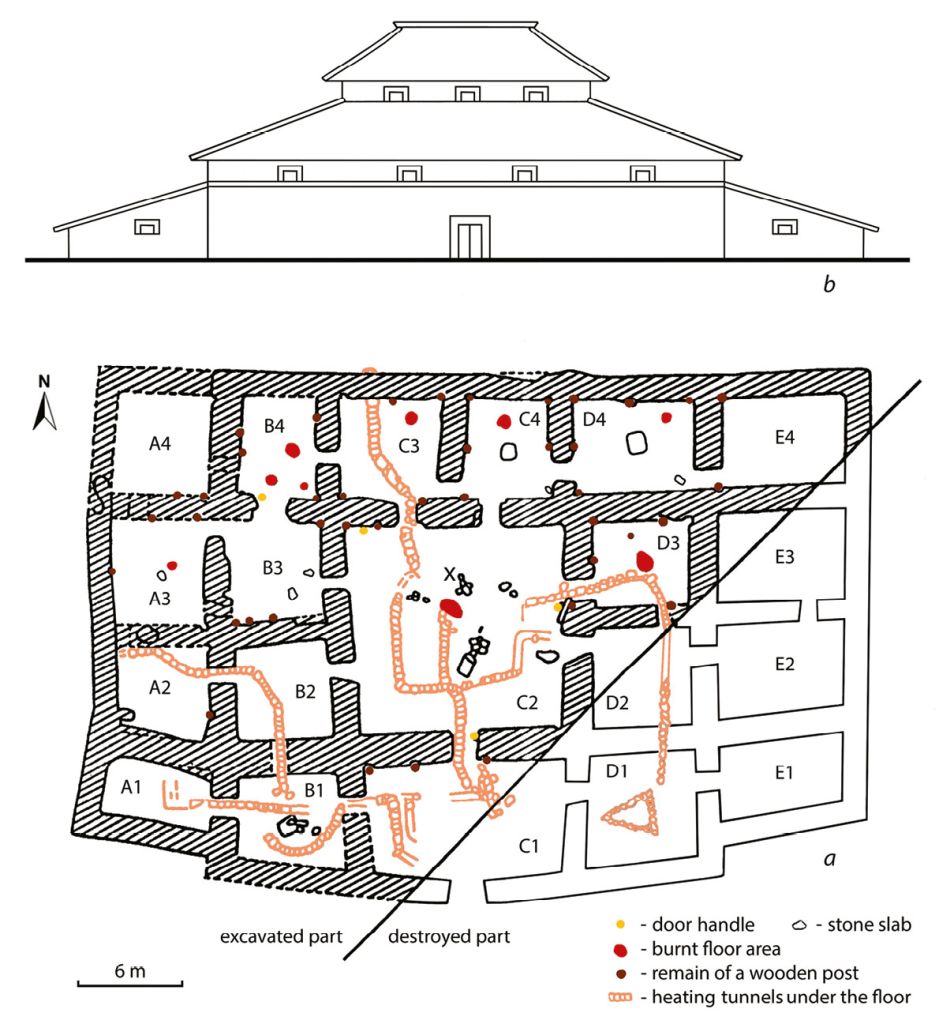
(a) Plan of the Abakan Palace based on documentation of the excavated area in 1940â46 (see Evtyukhova 1947 and Kyzlasov 2001) and (b) reconstruction of the front view. Probable function of the rooms: C1 â entrance hall; C2 â hall for receptions, gatherings, and various ceremonies (X â place for the ruler); A1, B1, D1, E1 â rooms for heating system operation, for servants and guards; C4, D4 â rooms for cooking; D3 â private room of the ruler.
Citation: Journal of the Economic and Social History of the Orient 68, 1-2 (2025) ; 10.1163/15685209-12341640
2.6 Ci
One more designation, Longci
Ci has two possible semantic emphases, the first of which is placed on the physical place where sacrifices were conducted. The majority of researchers favour the interpretation that Longci denotes a specific place, thus some translations of the Hou Han Shu have even replaced Longci with Longcheng to show continuity with the Shiji and Han Shu (Taskin 1973: 70 and 82; De Crespigny 1984: 271; 2007: 16). Alternatively, it has also been translated as âaltarâ (Taskin 1973: 98), which likewise places the emphasis on location rather than action. An example supporting the emphasis on place reads:
究æ©å ¶çªç©´ï¼èº¡å追å¥ä¸åé¤éï¼éç ´é¾ç¥ ï¼çç½½å¹ï¼é¬åè§ï¼ æ¢é¼æ°ã
launched a surprise attack on their lair, followed them north, chasing across more than 3000 li, completely destroyed Longci, burnt woolen tents down, buried the 10 Horns7 alive, [and] shackled the Yanzhi (Hou Han Shu, ch. 89: 2967).
This example relates to the Northern Xiongnu and describes the successful campaign of the Han army and its allies to the north of the Gobi in AD 89. The use of Longci here parallels the use of Longting in chapter 23 of the Hou Han Shu when describing the same campaign, meaning that at least in this case the two names were used interchangeably to denote the same place. The verb used to describe what happened to Longci (contrasting to the woolen tents) indicates the presence of permanent structures. The capture of the Yanzhi here is also noteworthy, since the Han Shu, describing events in 60 BC, mentioned the Yanzhi living in Longcheng.
Alternatively, another meaning of ci is that, as opposed to the physical place where sacrifices were conducted, it emphasises the act of making sacrifices. Examples include the below:
å奴ä¿ï¼æ²æä¸é¾ç¥ ï¼å¸¸ä»¥æ£æãäºæãä¹æææ¥ç¥å¤©ç¥ã
According to Xiongnu customs, three longci take place every year: constantly on the wu day of the first, fifth, and ninth moons, [they] make sacrifices to Heaven and the spirits (Hou Han Shu, ch. 89: 2944).
å·²å諸é¨å´å µé¦¬ï¼è¨ä¹æé¾ç¥ ï¼æéæ²³ä¸ã
[I] have already ordered all divisions to prepare warriors and horses and by the longci of the ninth moon gather in entirety at the river [Yellow River] (Hou Han Shu, ch. 89: 2952).
å ©éª¨é½ä¾¯é è¦ºå ¶æï¼æäºæé¾ç¥ ï¼å ç½å®äºï¼è¨èé¬æ¥éå¤ä¾æ¬²çº ä¸åï¼è¥ä¸èª ï¼ä¸äºåã
Both guduhou fully perceived his intentions, and [when] gathering for the longci of the fifth moon, reported to the Chanyu, saying that Yujian rizhu had had long-standing improper desires, and if [he] were not executed, [he] would throw the nation into disorder (Hou Han Shu, ch. 89: 2942).
The two first examples use longci in relation to events concerning the territory of the southern Xiongnu; the second one is from the Southern Chanyuâs letter of AD 88 about preparations for the joint campaign with the Han against the northern Xiongnu. The last event took place in AD 47 and the description corresponds to the annual gatherings at Chanyu ting on the Orkhon River. In these examples, longci designates the main state ritual (âlong sacrificesâ) involving the chanyu as opposed to the chanyuâs residence itself.
3 Dailin and outuo
Besides Longcheng, another major gathering mentioned in the Shiji took place at Dailin
The same toponym is, however, also seen in other areas (Malyavkin 1981: 145), indicating that this ritual was not exclusively the prerogative of the ruler but also performed at the local level in different parts of the nomadsâ lands. The name Dailin in this case may originate from the ritual known as dai. In chapter 94a of the Han Shu, Yan Shigu comments that the Xianbei
Researchers have typically viewed the autumn gatherings as an event related to taxation and therefore significant to the Xiongnu economy (Kychanov 1997: 33; Kyzlasov 2006: 145). However, well-fed, healthy horses and skilled riders will have been key to successful military campaigns, so such an event was a way for the chanyu, as well as other, lower-ranking chiefs of the polity, to assess available forces, as suggested by the Southern Chanyuâs letter of AD 88 quoted above in which he orders horses and warriors from all parts of his domain to attend the autumn sacrifice in preparation for a military campaign (Hou Han Shu, ch. 89: 2952).9
Another word encountered throughout the Shiji and Han Shu deserves attentionâoutuo
In 80 BC, during a raid, Outuo Wang was captured. Fearing that he would show the Han army the way through the Gobi, the Xiongnu retreated from the southern border and âsent people to encamp at outuo.11 The next year, [they] again sent 9,000 horsemen to encamp at Shouxiangcheng12 for defence against the Hanâ (
The last use of outuo in the records dates to 43 BC (Han Shu, ch. 94b: 3801), but in Han terminology associated with the Xiongnu other similar transcriptions can be found. In 7 BC one such word appears slightly modified as part of a noble title Wen Outu Wang
Analysis in synchronic perspective suggests that the title wang
The number of riders mentioned in the records gives some indication as to the maximum size of these camps. They could have been structured into discrete groups of traditional mobile dwellings. If post-Han commentators are correct, then such camps had earthen structures, feasibly earthworks and ditches, around their perimeters. From the end of the 2nd century BC, when the Xiongnu resettled north of the desert and before the collapse of the Northern Xiongnu, border camps were permanently located south of the Ongi River near the Gurvan Saikhan Mountains on a key route from the Ordos Loop of the Yellow River through the Gobi to Khangai. This area was adjacent to the Han fortresses outside the fortified line, which were used from 104â68 BC and the remains of which have already been discovered (Shiji, ch. 110: 2915; Han Shu, ch. 94a: 3787; Amartüvshin et al. 2011; Kovalev et al. 2011).
Modern linguistic analysis has shown that it is phonetically impossible to reduce outuo to orduâthe word is more comparable to the Proto-Turkic *
4 Discussion
The terms characterizing Xiongnu settlements can be divided into three groups based on the features they highlight. Those in the first group describe architectural features or components of a settlement (Table 2.A). Among them, qionglu is probably a transcription of a non-Chinese word14 for the traditional, domed dwellings made of willow branches and felt of the nomads. In the Hou Han Shu, however, this Xiongnu word was replaced by the Chinese words zhang (tent) and jimu
Summary and classification of terms describing Xiongnu settlements in Han-Dynasty historical records. Black: Chinese words; Green: Chinese transcriptions of Xiongnu words
Citation: Journal of the Economic and Social History of the Orient 68, 1-2 (2025) ; 10.1163/15685209-12341640
Terms for designating settlements form two groups. One includes names associated with the form and structural elements of settlements (Table 2.B). Among them are cheng, indicating the presence of long-term defensive walls, quluoâas a name for a traditional Xiongnu settlement, and yingâcamp. All of them evidently included dwellings in the form of felt tents, but cheng could also have long-term buildings such as palaces. Ying undoubtedly had some kind of protective fence, for which, for example, carts placed in a circle might be used. It is difficult to say what was meant by quluo. One possibility is that it was a settlement similar to ying, but without an external fence. For Xiongnu military camps, the records also used a term from their own languageâoutuo. In the Shiji this latter is undoubtedly a term associated with the form of settlement. In the Han Shu, however, it seems that this name is rather applied not to any military camps, but to camps in one specific location; that is to say, it sometimes gets the value of a place name for the Han authors. If the characters for this transcription were selected considering the correspondence of their meaning to certain aspects of the designated object (as in many other cases), then the earliest ou
Another group is formed by terms indicating the special status/function of settlements (Table 2.C). Among them is the Xiongnuâs own name for the rulerâs settlementâlong. Han authors perceived this latter more as a place name, so they constantly combined it with some Chinese terms into compound names. It has two Chinese equivalents: (a) ting âcourtâ, indicating the location of the ruling family along with close associates; (b) du âcapitalâ, denoting the political, economic, religious centre of the country. Another term used was ci, which specifically referred to the ritual function of this political centre.
The most common words for the rulerâs residenceâting, cheng, and ciâare usually part of a compound name. At some point, all three words are combined with the transcribed Xiongnu word long, forming Longting, Longcheng, and Longci. The repeated use of long suggests that these three names may designate the same settlement. In general, compound names for the rulersâ residences have two parts: 1) a term for the settlement form or function (cheng, ting, ci); and 2) an individual qualifier to specify the particular settlement from the Han point of view. This individual qualifier came from four potential themes: 1) the Xiongnu term for a rulerâs residence; 2) the title of the Xiongnu ruler; 3) geographic or ethnic characteristics; and 4) the name of the founder or owner (Fig. 5). As a functional term, long for the Xiongnu was as applicable to traditional mobile settlements with felt dwellings as to sites with earthen walls and palaces. For the Han, however, there were some restrictions in the use of terms. In particular, for the Han cultural milieu, the concept of ting was inseparable from a palace. Similarly, du and ci also had associations with long- term structures.
Schema of compound name construction for Xiongnu rulersâ residences in Han-Dynasty historical records: the central triangle shows common terms for the settlement form or function and the circles show words used to specify and contextualise specific places. Grey: Chinese words; Green: Chinese transcriptions of Xiongnu words; Bold: typical combinations. The frequencies are indicated in red (Shiji), green (Han Shu), and blue (Hou Han Shu), see also Table 1
Citation: Journal of the Economic and Social History of the Orient 68, 1-2 (2025) ; 10.1163/15685209-12341640
All six Chinese terms represent an interpretation of Xiongnu settlements from the perspective of Han language and culture. There are several possible reasons that different words were used, including the existence of different settlement types, changes to settlement structure over time, and the individual observations or preferences of different compilers and different authors in different periods, whose primary reports were later used to compile the Han Dynasty records.
Differences in the meanings of the terms over time (Fig. 6) could reflect chronological changes to the appearance of the settlements. Thus, in his memorial text on the military campaign against the Xiongnu, Ban Gu calls the residence of Modu a quluo, but refers to the residence of his successor Laoshang as a ting, creating a chronological distinction between the residences (Hou Han Shu, ch. 23). These may reflect information available to Ban Gu from Western Han period documents, and, if so, reflect real changes in the arrangement of the chanyuâs residence, with palatial structures appearing. A few decades after the reign of Laoshang, by 124 BC, the upper echelons of Xiongnu aristocracy also had palace structures that were referred to in the Han records as ting.
Chronological usage of the Chinese terms for Xiongnu rulersâ residences in Han-Dynasty historical records.
Citation: Journal of the Economic and Social History of the Orient 68, 1-2 (2025) ; 10.1163/15685209-12341640
In reference to narrowly dated events, the word cheng appears later than ting, being used for the first time for the proper name Longcheng around 134 BC when plans for a military campaign against the Xiongnu were being discussed at the Han court. However, since Longcheng was perceived to be the Xiongnuâs permanent political centre, the settlement had presumably already existed for more than one decade.
Ci is the latest term to be used for a chanyuâs residence, appearing in Han sources only during the Eastern Han. Use of ci emphasises the residenceâs ceremonial value and may even reflect the emergence of special temples at the rulerâs residence. Such temples, probably constructed in the late years BCâ early years AD, have recently been identified at the site of Talyn Gurvan Kherem near the chanyuâs residence at Kharganyn Dörvölzhin (Ochir et al. 2020). However, it is most likely that the use of ci arose through increased exposure of Han culture to activities and ceremonies held at the Southern Chanyuâs residence in Xihe Commandery. Unfortunately, the remains of this residence have not yet been discovered.
The question of how
At the end of the 80s BC, under the leadership of the former Han ambassador Wei Lü and in collaboration with âQin peopleâ (Qin ren
Since people from the Han Empire played a key role in building later cities with walls in Xiongnu lands, they were probably also involved in the appearance of the first Xiongnu city south of the Gobi, Longcheng. One possible scenario is that the courtiers who accompanied Han princesses dispatched to the chanyuâs residence as part of the heqin
The first Han princess sent to the Xiongnu in 198 BC had higher status than the one sent later to the Wusun: she was introduced to the Xiongnu as the eldest daughter of the emperorâs main wife. The emperor and his court had great hopes for her marriage and long-term plans to subjugate the Xiongnu through family ties and generous gifts (Shiji, ch. 99: 2719). Her retinue had to constructed a palace for her at the chanyuâs residence too, though in the Shiji there is no such detailed information about princess for the Xiongnu as in the case of the Wusun in the Han Shu. During the reign of Laoshang, this palace may have become the summer residence of the Chanyu himself and was given the name Longting in Han records. Soon after, the settlement became bigger and was referred to as Longcheng. A Chanyu advisor from the Han court, Zhonghang Yue
Among features of the Xiongnu cities in the historical records, the palace, rammed earth walls, and silk flags indicate significant Han influence on their architecture, materials, and construction methods. This is substantiated by technologies identified at archaeologically excavated palaces and settlements, where the mass-produced roof tiles, a process developed in dynastic China, are especially indicative. Simultaneously, adaptation of Han traditions and technologies due to a different cultural environment, as well as natural conditions, took place. For example, Abakan palace lacks the ubiquitous earth platform and had specific, underground heating system (Kyzlasov 2001: 61â87). Roof tiles at Terelzhiin Durvulzhin and other places sometimes have the wave-line design specific to Xiongnu pottery decoration and squared impressions in the central part of the wadang similar to the technological features on the bottom of their pottery (Danilov and Tsydenova 2011). These indicate that the craftspeople who made Xiongnu pottery were potentially involved in the production of roof tiles. The application of the rulerâs title and noble clan-emblems on the roof tile finials also reflects the specific cultural traditions of the Xiongnu. In addition, on the tiles from the Abakan Palace and from Kharganyn Dörvölzhin, clan-emblems and images were sometimes drawn on the raw clay before firing by those who made them or controlled the manufacturing process; both the drawings and emblems related to the traditions of the nomads (Kyzlasov 2001: fig. 40â41; Iderkhangai et al. 2022; Iderkhangai 2023).
5 Conclusion
The existence of palaces and cities with fortifications, demonstrated by both written and archaeological sources, contradicts the Shijiâs and Yan Tie Lunâs claim that the Xiongnu have no such objects. As has been discussed in this article, the Han historical accounts generally show that only the early Xiongnu, before the reign of Laoshang, can be considered to have had âno citiesâ. This corresponds with analyses of the Shijiâs textual construction, which substantiates the fact that the information in this passage was based on a pre-Han text (Di Cosmo 2010: 312; Goldin 2011: 233 and 240). At the same time, such a view represents the sedentary authorsâ general impression of ways of life among the main body of the Xiongnu. It was characteristic of many members of the Han elite, and would persist for many centuries, even in relation to mediaeval nomads.
The analysed terms include six Chinese and two Xiongnu words that were used to refer to Xiongnu settlements in Han historical records. They can be divided into two groups: (1) those that characterise the visible form and structure; and (2) those that characterise the function.
The first group includes: (а) quluo, indicating a special, non-Chinese type of nomadic settlementâencampments with traditional mobile structures; (b) ying, denoting a settlement in the form of a mobile military camp; (c) outuo, meaning military camp in the Xiongnu language; and (d) cheng, which highlights the presence of permanent walls in the settlement.
The second group includes: (a) ting, denoting the inner space of a palace where the ruling family and their entourage resided and hosted major sociopolitical engagements; it was also possible for high-ranking aristocrats of the wang status related to the chanyu to have their own ting; (b) du, denoting the city with the state rulerâs residence and the centre of state power in all its aspectsâpolitical, economic, religious; (c) ci, specifically highlighting the religious significance of a settlement as a place of ritual veneration for noble lineages and ancestors (including the Han Emperor during the Southern Xiongnu), as well as deities and spirits that legitimised Xiongnu rule, its rulers and bequeathed prosperity to the state; and (e) long, denoting the residence of the ruler in the language of the Xiongnu themselves, which is partly equivalent to the Chinese terms ting and du.
The six Chinese terms reflect the authorsâ interpretations of the residence of the Xiongnu ruler from a Han cultural perspective. This made it possible for different terms to be used in parallel to refer to the same settlement, highlighting its different aspects. At the same time, this research has demonstrated chronological trends. The earliest residences of the Xiongnu rulers are designated by the terms quluo and ying. The term ci, on the contrary, was used only in the period of Eastern Han. The term cheng began to be used in the second half of the 2nd century BC but from the end of the 1st century BC it was completely replaced by the term ting, the first dated mention of which is associated with Laoshang Chanyu. The frequency of use of each of these terms in the records shows that Han authors considered the key feature of Xiongnu political centres to be the presence of a court with palatial buildings as its attribute rather than a city wall or the collective sacrifices conducted there. In many cases, the authors emphasise the political status of the settlement further by merging ting and cheng with the title of a ruler, and geographical (north, south) or ethnic (Xiongnu, lu) characteristics.
Unlike the Chinese terms ting and du, the concept of long arose in a nomadic pastoral society centred on the seasonal movement of settlements, and thus it does not show any connection to the built environment. The main method of governance in such a society was the regular gathering of the nobility for the most significant rituals of the annual cycle, organised by the ruler. The seasonal movements of the rulerâs headquarters (Chinese terms in the records for this type of residenceâquluo and ying) were limited to the central part of the country with regular places for different seasons. With the emergence of palaces and permanent walled settlements among the Xiongnu, this tradition did not disappear, at least in the early stages. The holding of three annual rituals in different places and the opposition of Chanyu ting and Longcheng in one passage of the Shiji reflects precisely this practice. At the same time, from the standpoint of the Han cultural environment, the use of the words ting and cheng in the names means that both of these seasonal settlements had earth/clay architecture, but the second, summer one was larger. Consequently, the use of a new type of constructions was adapted to the seasonal rhythm of life and other traditions of the steppe society: each settlement was used by the ruler only for part of the year, and the rest of the time its population was reduced. The summer settlement was apparently more populated, where some of the rulerâs wives, children, other relatives, and probably also some officials, craftspeople, high status foreigners, and envoys could live permanently. In later sources, however, the contrast between the names disappeared: in the 1st century BC the same settlement on the Orkhon River is called both ting and cheng, and then only ting. There is no such opposition among the southern Xiongnu either. Perhaps by this time the rulers began to conduct rituals of the 1st and 5th months in the same residence, and the autumnal ritual in a location close by.
Although traditional yurt-type dwellings remained in use throughout the Xiongnu Empire, the main rulerâs residence at certain point came to be modelled on Han palaces. Complex technologies for the production of all necessary materials and the construction of both palace-type buildings and other structures could not have appeared in the steppe without the participation of people who were familiar with them and had mastered aspects of their construction. This is even more evident than in the case of the construction of another type of complex architectural objectâthe terraced tombs of the Xiongnu nobility (Polosâmak, Bogdanov 2015: 118). The first palace was most likely built by a Han princessâ retinue when she married the Xiongnu ruler in the early 2nd century BC, which, perhaps, later became the first Longcheng. Over the next century, Han immigrants, like Zhao Xin and Wei Lü, continued to play key roles in the construction of palaces and long-term fortifications relying on the experience and labour of other people from Han territory, of whom there were quite a few among the Xiongnu. Local people were also involved at different stages of the construction processes which together with other factors opened the way for the adaptation of new technologies. However, the construction of such objects corresponded to the interests, resources and wills of chanyus themselves, otherwise they could not have appeared. Along with exotic trade items like silk textiles, rare jewellery, and Chinese chariots found in the tombs of the Xiongnu elite, Han-style architecture began to be used by the cosmopolitan steppe rulers for their own cultural politics as a symbol of status and power.
Acknowledgments
The main part of the work on this article by Y. Esin was carried out for the project âExploring the Northernmost Capital of the Xiongnu and the Function of the Palace in Xiongnu Societyâ (Gerda Henkel Foundation, Grant No. AZ 21/Fl/22). R. OâSullivan is funded by the âHearth and Homeâ project (Gerda Henkel Foundation, Grant No. AZ 47/F/21). The authors are indebted to Dr. Yegor Grebnev and Dr. Jarkyn Tursun for their helpful feedback, and to the reviewers and the editor for a productive discussion of the manuscript text.
Bibliography
Primary Sources
Bei Shi åå² [History of the North], comp. Li Yanshou æ延壽. Beijing: Zhonghua shuju, 1974.
Guoyu åèª (Rechi tsarstv) [Discourses of the Kingdoms], trans. V.S. Taskin. Moscow: Nauka, 1987.
Han Shu æ¼¢æ¸ [Book of Han]. 12 vols, comp. Ban Gu çåº. Beijing: Zhonghua shuju, 1962.
Hou Han Shu å¾æ¼¢æ¸ [Book of Later Han]. 12 vols, comp. Fan Ye èæ. Beijing: Zhonghua shuju, 1965.
Liao Shi é¼å² [History of Liao], comp. Tuo Tuo è±è±. Beijing: Zhonghua shuju, 1974.
Shiji å²è¨ [Records of the Grand Historian]. 10 vols, comp. Sima Qian å¸é¦¬é·. Beijing: Zhonghua shuju, 1959.
Shuowen jiezi zhu 說æ解å注 [An annotated explaining simple and analysing compound characters], comp. Xu Shen 許æ , commentary by Duan Yucai 段çè£. Shanghai: Shanghai guji chubanshe, 1988.
Yan Tie Lun Jiaozhu çéè®ºæ ¡æ³¨ [An edited and annotated Discussions on Salt and Iron], commentary by Wang Liqi çå©å¨. Beijing: Zhonghua shuju, 2017.
Secondary Literature
Amartüvshin, Ch., Zh.-O. Gantulga and D. Garamzhav. 2011. On the Walled Site of Mangasyn Khuree in Galbyn Gobi. In Xiongnu Archaeology: Multidisciplinary Perspectives of the First Steppe Empire in Inner Asia, ed. U. Brosseder and B.K. Miller. Bonn: VFG-Arch Press: 509â514.
Ankhbayar, B. 2017. Khunnskoe poselenie v Zaan Khoshuu. In Aktualânye voprosy arkheologii i etnologii Tsentralânoy Azii: Materialy II Mezhdunarodnoy nauchnoy konferentsii (g. Ulan- Ude, 4â6 dekabrya 2017 g.), ed. B.V. Bazarov and N.N. Kradin. Ulan-Ude: The Buryat Scientific Center SB RAN: 90â100.
Bailey, H.W. 1985. Indo-Scythian studies, being Khotanese texts, VII. Cambridge University Press.
Barfield, T.J. 1981. The Hsiung-nu Imperial Confederacy: Organization and Foreign Policy. Journal of Asian Studies 41/1: 45â62.
Batsuren, B. 2013. Longcheng. In Encyclopaedia Xiongnu, ed. Ts. Turbat. Ulaanbaatar: ADMON: 127.
Battulga, Ts., G. Badamsambuu and B. Batjargal. 2016. Baruun ilgenii ertnii bichees [An ancient inscription at Baruun Ilgen]. Mongolian Journal of Anthropology, Archaeology and Ethnology 9(1): 57â68.
Baxter, W.H. and L. Sagart. 2014. Old Chinese: A New Reconstruction. Oxford-New York: Oxford University Press.
Bemmann, J. 2011. Was the Center of the Xiongnu Empire in the Orkhon Valley? In Xiongnu Archaeology: Multidisciplinary Perspectives of the First Steppe Empire, ed. U. Brosseder and B.K. Miller. Bonn: VFG-Arch Press: 441â461.
Bessonova, E.A., B.A Bazarov, N.V. Imenokhoev, and D.A. Miiagashev. 2020. Osobennosti prostranstvennoy organizatsii gorodishcha Bayan-Under (po rezulâtatam georadiolokatsii). Mulâtidistsiplinarnye issledovaniia v arkheologii 2: 136â151.
Bichurin, N.Ya. 1950. Sobranie svedenii o narodakh, obitavshikh v Srednei Azii v drevnie vremena, vol. 1. Moscow-Leningrad: Izd-vo AN SSSR.
Botalov, S.G. and O. Battulga. 2017. Istoriia izucheniia poselencheskikh pamyatnikov khunnu v Mongolii. Problemy istorii, filologii, kulâtury 2: 69â76.
Chen Xiaowei éæä¼. 2016. âOutuoâ zhidu xin tanâlun xiongnu shehui youmu zuzhi yu caoyuan fen di zhi âç¯è±âå¶åº¦æ°æ¢â论å奴社ä¼æ¸¸ç§ç»ç»ä¸èååå°å¶ [A new study of the âOutuoâ: On the social nomadic organization of the Xiongnu and the system of pastures distribution]. Shixue yuekan å²å¦æå 5: 5â12.
Chin, T.T. 2010. Defamiliarizing the Foreigner: Sima Qianâs Ethnography and Han-Xiongnu Marriage Diplomacy. Harvard Journal of Asiatic Studies 70(2): 311â354.
Danilov, S.V. 2004. Goroda v kochevykh obshchestvakh Tsentralânoi Azii. Ulan-Ude: The Buryat Scientific Center SB RAN.
Danilov, S.V., N.V. Imenokhoev, B.Z Nanzatov, A.I. Simukhin, A. Ochir and L. Erdenebold. 2016. Goroda epokhi khunnu na vostoke Mongolii. Izvestiia Irkutskogo gosudarstvennogo universiteta. Seriia âGeoarkheologiia. Etnologiia. Antropologiiaâ 17: 74â93.
Danilov, S.V., N.V. Imenokhoev, B.Z Nanzatov, A.I. Simukhin, D.K. Tulush and L. Erdenebold. 2018. Goroda epokhi khunnu na territorii Tuvy. Izvestiia Irkutskogo gosudarstvennogo universiteta. Seriia âGeoarkheologiia. Etnologiia. Antropologiiaâ 24: 74â92.
Danilov, S.V. and N.V. Tsydenova. 2011. Ceramic Roof Tiles from Terelzhiin Dörvölzhin. In Xiongnu Archaeology: Multidisciplinary Perspectives of the First Steppe Empire in Inner Asia, ed. U. Brosseder and B.K. Miller. Bonn: VFG-Arch Press: 341â347.
Danilov, S.V. and T.V. Zhavoronkova. 1995. Gorodishche Bayan Underânovyi pamyatnik khunnu v Zabaikalâe. In Kulâtury i pamyatniki bronzogo i rannego zheleznogo vekov Zabaikalâia I Mongolii, ed. P.B. Konovalov. Ulan-Ude: 26â36.
De Crespigny, R. 1984. Northern Frontier: The Policies and Strategy of the Later Han Empire. Canberra: Australian National University.
De Crespigny, R. 2007. A Biographical Dictionary of Later Han to the Three Kingdoms (23â220 AD). Leiden-Boston: Brill.
De Groot, J.J.M. 1921. Die Hunnen der vorchristlichen Zeit (Chinesische Urkunden zur Geschichte Asiens I). Berlin-Leipzig: Walter de Gruyter.
Di Cosmo, N. 2002. Ancient China and Its Enemies: The Rise of Nomadic Power in East Asian History. Cambridge: Cambridge University Press.
Di Cosmo, N. 2010. Ethnography of the Nomads and âBarbarianâ History in Han China. In Intentional History: Spinning Time in Ancient Greece, ed. Lin Foxhall. Stuttgart: Steiner: 299â325.
Dmitriev, S.V. 2009. K voprosu o Karakorume. In Obshchestvo i gosudarstvo v Kitae: XXXIX nauchnaia konferentsiia. Moscow: Vost. lit: 76â100.
Dybo, A.V. 2007. Lingvisticheskie kontakty rannikh tyurkov. Leksicheskii fond: pratyurkskii period. Moscow: Vost. lit. RAN.
Egiimaa, Ts. 2019. Sravnitelânyi analiz stroitelânykh materialov khunnskikh gorodishch Terelzhiin durvulzhin i Gua dov. Rossiia i ATR 1: 62â81.
Eregzen, G. 2017. Novye gipotezy o naznachenii i konstruktivnykh osobennostyakh khunskogo gorodishcha Guadov. In Aktualânye voprosy arkheologii i etnologii Tsentralânoi Azii, ed. B.V. Bazarov and N.N. Kradin. Ulan-Ude: BNTs SO RAN: 245â255.
Esin, Yu.N. 2020. An Eastern Tibetan Tool for Managing Draught Cattle. Archaeology, Ethnology & Anthropology of Eurasia 48(3): 107â116.
Esin, Yu.N. 2021. Novaia gipoteza o vladelâtse Abakanskogo dvortsa. In Drevnie kulâtury Mongolii, Yuzhnoi Sibiri i Severnogo Kitaia: Materialy XI Mezhdunarodnoi nauchnoi konferentsii, ed. A.V. Polyakov, M.T. Kashuba and A.D. Tsybiktarov. Abakan: IIMK RAN: 147â153.
Esin, Yu.N. 2022a. Dvorets Syna Neba vo vladenii Tszyanâkunâ. Nauchnoe obozrenie Saiano-Altaia 1(33): 4â52.
Esin, Yu.N. 2022b. Strana kyrgyzov na kartakh bolâshogo Atlasa al-Idrisi. Nauchnoe obozrenie Saiano-Altaia 1(33): 53â109.
Evtyukhova, L.A. 1946. Drevnekitaiskoe zdanie na Srednem Enisee. Vestnik drevnei istorii (1): 107â111.
Evtyukhova, L.A. 1947. Razvaliny dvortsa v âZemle khyagyasâ. Kratkie soobshcheniia Instituta istorii materialnoy kultury 21: 79â85.
Falkenhausen, L. von. 2008. Stages in the Development of âCitiesâ in Pre-Imperial China. In The Ancient City: New Perspectives on Urbanism in the Old and New World, ed. J. Marcus and J. Sabloff. Santa Fé: School of Advanced Studies Press: 209â228.
Goldin, P.R. 2011. Steppe Nomads as a Philosophical Problem in Classical China. In Mapping Mongolia: Situating Mongolia in the World from Geologic Time to the Present, ed. P. Sabloff. Philadelphia: University of Pennsylvania Press: 220â246.
Honeychurch, W. 2015. Inner Asia and the Spatial Politics of Empire: Archaeology, Mobility, and Culture Contact. New York: Springer.
Honeychurch, W. and Ch. Amartuvshin. 2006. States on horseback: The rise of Inner Asian confederations and empires. In Archaeology of Asia, ed. M. Stark. Malden: Blackwell: 255â278.
Iderkhangai, T. 2021. Khünnü gürnii uls töriin töv, Kharganyn Dörvölzhingiin Khünnügiin khaany zuny ord Lunchen buyuu Luut khot [The Xiongnu rulerâs summer residence named Longcheng or Dragon City at Kharganyn Dörvölzhin, the political center of the Xiongnu Empire]. In Drevnie kulâtury Mongolii, Yuzhnoi Sibiri i Severnogo Kitaia: Materialy XI Mezhdunarodnoi nauchnoi konferentsii, eds A.V. Polyakov, M.T. Kashuba and A.D. Tsybiktarov. Abakan: IIMK RAN: 183â191.
Iderkhangai, T. 2023. Kharganyn Dörvölzhin dekh Khünnü gürnii khaany zuny ordny maltlaga sudalgaany tovch ür düngees [Brief results of the excavation of the summer residence of the Xiongnu ruler at Kharganyn Dörvölzhin]. In SÅgen sekai no kyÅdo. 2023 nichimÅ kyÅdÅ kenkyÅ« kokusai shinpojiumu yokÅ-shÅ« èåä¸çã® å奴2023æ¥èå ±åç 究å½éã·ã³ãã¸ã¦ã äºç¨¿é [Xiongnu of the Steppe World. Proceedings of the 2023 Japan-Mongolian Joint Research International Symposium], ed. Daisuke Nakamura ä¸æ大ä». Chiba: 32â34.
Iderkhangai, T., S. Orgilbayar, D. Tsend, B. Batchimeg, B. Amgalanbat, P. Erdenepürev and P. Bayansan. 2020. Arkhangai aimgiin Ãlziit sumyn nutag dakhâ Kharganyn Khöndiid orshikh Khünnügiin khotyn tuurind yavuulsan maltlaga sudalgaa [Excavations at the ruins of the Xiongnu city in the Khargan Valley in the Ãlziit sum of Arkhangai aimag]. In Mongolyn arkheologi-2020: Erdem shinzhilgeenii khurlyn emkhetgel, ed. Ch. Amartuvshin. Ulaanbaatar: 24â28.
Iderkhangai, T., S. Orgilbayar, D. Tsend, B. Batchimeg, P. Erdenepürev, L. Khüslen, A. Namsraizhamts, Kh. Uyanga, B. Bayansan, J. Enkhzul, M. Mönkhzhin, B. Batkhishig, D. Azzayaa, B. Amgalanbat and E. Davaakhüü. 2022. âKhünnügiin Luut khotâ tösliin khüreend Arkhangai aimgiin Ãlziit sumyn nutag Kharganyn Dörvölzhin dekh khünnügiin khaany zuny ordond yavuulsan 2022 ony maltlaga sudalgaany ür tovch düngees [Brief results of the 2022 excavations carried out at the summer residence of the Xiongnu ruler at Kharganyn Dörvölzhin in the Ãlziit sum of Arkhangai aimag as part of the âXiongnu Dragon Cityâ project]. In: Mongolyn arkheologi â 2022. Ulaanbaatar: 120â125.
Ishjamts, N. 1994. Nomads in Eastern Central Asia. In History of Civilizations of Central Asia, vol. II: The Development of Sedentary and Nomadic Civilizations: 700 B.C. to A.D. 250, ed. J. Harmatta. Paris: UNESCO Publishing: 151â169.
Janhunen, J. 2010. Reconstructing the Language Map of Prehistorical Northeast Asia. Studia Orientalia 108: 281â303.
Kilunovskaia, M.E. and P.M. Leus. 2020. Azhurnye bronzovye pryazhki epokhi khunnu v Tuve. Nauchnoe obozrenie Saiano-Altaia 1(25): 97â126.
Kovalev, A.A. 2011. Imperator Kitaia v khakasskoi stepi. In Khunnu: arkheologiia, proiskhozhdenie kulâtury, etnicheskaia istoriia. Ulan-Ude: Izd-vo BNTs SO RAN: 77â144.
Kovalev, A.A., D. Erdenebaatar, S.S. Matrenin and I.Iu. Grebennikov. 2011. The Shouxiangcheng fortress of the Western Han periodâExcavation at Bayan Bulag, Nomgon sum, Ãmnögovâ aimag, Mongolia. In Xiongnu Archaeology: Multidisciplinary Perspectives of the First Steppe Empire in Inner Asia, ed. U. Brosseder and B.K. Miller. Bonn: VFG-Arch Press: 475â508.
Kradin, N.N. 2001. Imperiia khunnu. Moscow: Logos.
Kradin, N.N. 2011. Stateless Empire: The Structure of the Xiongnu Nomadic Super-Complex Chiefdom. In Xiongnu Archaeology: Multidisciplinary Perspectives of the First Steppe Empire in Inner Asia, ed. U. Brosseder and B.K. Miller. Bonn: VFG-Arch Press: 77â96.
Kradin, N.N. 2019. Goroda v kochevykh imperiiakh Vnutrennei Azii. In V poiskakh sushchnosti: Sbornik statei v chestâ 60-letiia N.D. Russeva, ed. M.E. Tkachuk and G.G. Atanasov. Kishinev: 149â170.
Kradin, N.N., A.L. Ivliev, A.V. Kharinskii, A. Ochir, S.A. Vasyutin, E.V. Kovychev and L. Erdenebold. 2017. Raskopki gorodishcha Terelzhiyn-Durvulzhin i nekotorye itogi izucheniia khunnskoy urbanizatsii. In Aktualânye voprosy arkheologii i etnologii Tsentralânoi Azii. Materialy II mezhdunar. nauch. konf., ed. B.V. Bazarov, N.N. Kradin. Ulan-Ude: BNTs SO RAN: 163â175.
Kradin, N.N., A.L. Ivliev, S.A. Vasyutin, Ye.V. Kovychev, A.V. Kharinskiy and L. Erdenebold. 2020. Terelzhiyn-Durvulzhin i drugiye khunnskiye gorodishcha v Mongolii: osobennosti funktsionalânoy interpretatsii. Mulâtidistsiplinarnye issledovaniia v arkheologii 2: 42â56.
Krykov, M.V. and V.P. Kurylev. 2000. K rannei istorii yurty (po kitaiskim istochnikam 3 v. do n.e.â13 v. n.e.). In Kochevoye zhilishche narodov Srednei Azii i Kazakhstana. Moscow: Nauka: 10â19.
Kychanov, E.I. 1997. Kochevye gosudarstva ot gunnov do manâchzhurov. Moscow: Izd-vo Vost. lit. RAN.
Kyuner, N.V. 1961. Kitaiskie izvestiia o narodakh Yuzhnoi Sibiri, Tsentralânoi Azii i Dalânego Vostoka. Moscow: Izd-vo Vost. lit.
Kyzlasov, L.R. 2001. Gunnskii dvorets na Yenisee: Problema rannei gosudarstvennosti Yuzhnoi Sibiri. Moscow: Vost. lit.
Kyzlasov, L.R. 2006. Gorodskaia tsivilizatsiia Sredinnoi i Severnoi Azii: istoricheskie i arkheologicheskie issledovaniia. Moscow: Vost. lit.
La Vaissière, Ã. de. 2024. Asie centrale 300â850: Des routes et des royaumes. Paris: Les Belles Lettres.
Loginov, V.V. 2012. Lokalizatsiia stavki khunnuskogo shanâyuya. In Obshchestvo i gosudarstvo v Kitae, vol. XLII, ed. A.I. Kobzev et al. Moscow: IV RAN: 53â64.
Lotman, Yu. 1990. Universe of the Mind: A Semiotic Theory of Culture. Bloomington & Indianapolis: Indiana University Press.
Malyavkin, A.G. 1981. Istoricheskaia geografiia Tsentralânoi Azii (materialy i issledovaniia). Novosibirsk: Nauka.
Matsushita, Kenichi æ¾ä¸æ²ä¸. 2023. KyÅdo no ryÅ«jÅ ni tsuite å奴ã®é¾åã«ã¤ã㦠[On the Longcheng of the Xiongnu]. In SÅgen sekai no kyÅdo. 2023 nichimÅ kyÅdÅ kenkyÅ« kokusai shinpojiumu yokÅ-shÅ« èåä¸çã® å奴ã2023æ¥èå ±åç 究å½éã·ã³ãã¸ã¦ã äºç¨¿é [Xiongnu of the Steppe World. Proceedings of the 2023 Japan-Mongolian Joint Research International Symposium], ed. Daisuke Nakamura ä¸æ大ä». Chiba: 64â66.
Miller, B.K. 2015. The Southern Xiongnu in Northern China: Navigating and Negotiating the Middle Ground. In Complexity of Interaction Along the Eurasian Steppe Zone in the First Millennium CE, ed. J. Bemmann, M. Schmauder. Bonn: VFG-Arch Press: 127â198.
Miller, B.K. 2024. Xiongnu: The Worldâs First Nomadic Empire. Oxford: Oxford University Press.
Miller, B.K., M. Furholt, J. Bayarsaikhan, T. Tüvshinjargal, L. Brandtstätter, J. Wright, T. Ayush and T. Wunderlich. 2019. Proto-Urban Establishments in Inner Asia: Surveys of an Iron Age Walled Site in Eastern Mongolia. Journal of Field Archaeology 44(4): 267â286.
Miniaev, S.S. and L.M. Sakharovskaia. 2007. Investigation of a Xiongnu Royal Tomb Complex in the Tsaraam Valley. Part 2: The Inventory of Barrow No. 7 and the Chronology of the Site. The Silk Road 5(1): 44â56.
Miiagashev, D.A., B.A. Bazarov and Ya.V. Dikiy. 2021. Primenenie metoda distantsionnogo zondirovaniia zemli dlya poiska fortifitsirovannykh obâyektov na territorii Mongolii i Zapadnogo Zabaykalâya. Arkheologiia evraziyskikh stepei 4: 80â95.
Nienhauser, W.H., ed. 2010. The Grand Scribeâs Records, vol. 9. Bloomington: Indiana University Press.
Ochir, A., Y.-Z. Chen, B. Saranbileg, P.-F. Cheng and B. Ankhbayar. 2020. Newly Discovered Monuments of Worship of Xiongnu. Mulâtidistsiplinarnyye issledovaniia v arkheologii 2: 82â106.
Oshanin, I.M., ed. 1983â1984. Bolâshoi kitaisko-russkii slovarâ, 4 vols. Moscow: Nauka.
Perlee, H. 1957. K istorii drevnikh gorodov i poselenii v Mongolii. Sovetskaia Arkheologiia 3: 43â53.
Polosâmak, N.V. and E.S. Bogdanov. 2015. Kurgany Sutszukte (Noin-Ula, Mongoliia), pt. 1. Novosibirsk: Infolio.
Psarras, S.-K. 2003. Han and Xiongnu: A Reexamination of Cultural and Political Relations (I). Monumenta Serica 51: 55â236.
Pulleyblank, E.G. 1962. The Consonantal System of Old Chinese: Part 2. Asia Major 9: 206â265.
Pulleyblank, E.G. 1966. Chinese and Indo-Europeans. Journal of the Royal Asiatic Society of Great Britain and Ireland 1(2): 9â39.
Qimudedaoâerji (Chimitdorj) é½æ¨å¾·éå°å and Gao Jianguo é«å»ºå½. 2019. Youguan âfeng Yanranshan mingâ moya de san ge wenti æå ³ãå°çç¶å±±éãæ©å´çä¸ä¸ªé®é¢. Xibei minzu yanjiu 西åæ°æç 究 1: 108â118.
Robbeets, M., J. Janhunen, A. Savelyev and E. Korovina. 2020. The homelands of the individual Transeurasian proto-languages. In The Oxford guide to the Transeurasian languages, ed. M. Robbeets, A. Savelyev and N. Hübler. Oxford University Press: 753â771.
Rogers, J.D., E. Ulambayar and M. Gallon. 2005. Urban centres and the emergence of empires in Eastern Inner Asia. Antiquity 79: 801â818.
Rosthorn, A. von. 1923. Die Hochburg von Zentralasien. In Hirth Anniversary Volume, ed. by B. Schindler, London: Probsthain & Co: 286â297.
Saussure, F. de. 1959. Course in General Linguistics, ed. C. Bally and A. Sechehaye, trans. W. Baskin. New York: The Philosophical Society.
Savelyev, A. and Ch.-W. Jeong. 2020. Early Nomads of the Eastern Steppe and Their Tentative Connections in the West. Evolutionary Human Sciences 2: e20. doi:10.1017/ehs.2020.18.
Schuessler, A. 2007. ABC Etymolological Dictionary of Old Chinese. Honolulu: University of Hawaiâi Press.
Tan, Q.-X., ed. 1996. The Historical Atlas of China, vol. 2: Qin Dynasty Period, Western Han and Eastern Han Dynasty Period. Beijing: China Cartographic Publishing House.
Taskin, S., ed. 1968. Materialy po istorii syunnu (po kitaiskim istochnikam), 1. Moscow: Nauka.
Taskin, S., ed. 1973. Materialy po istorii syunnu (po kitaiskim istochnikam), 2. Moscow: Nauka.
Turbat, Ts. 2013. Settlements or Cities. In Encyclopaedia Xiongnu, ed. Ts. Turbat. Ulaanbaatar: ADMON: 160â162.
Vainshtein, S.I. 1976. Problemy istorii zhilishcha stepnykh kochevnikov Yevrazii. Sovetskaia etnografiia 4: 42â62.
Vasyutin, S.A. 2022. Faktory gradostroitelâstva v stepyakh Vnutrennei Azii i urbanizatsiia po-khunnski. Mulâtidistsiplinarnyye issledovaniia v arkheologii 2: 51â67.
Vovin, A. 2000. Did the Xiong-nu speak a Yeniseian language? Central Asiatic Journal 44(1): 87â104.
Vovin, A., E. Vajda and Ã. de La Vaissière. 2016. Who were the *kjet (羯) and what language did they speak? Journal Asiatique 304(1): 125â144.
Vyatkin, R.V., A.M. Karapetâyants and A.R. Vyatkin, trans. 2002. Syma Tsyanâ. Istoricheskie zapiski: Shi tszi, vol. 8 [in 9 vols]. Moscow: Vost. lit.
Wang Weimao 汪ç¶æ. 1983. Xiongnu Longcheng kaoban å奴é¾åè辦 [Examination of the Xiongnu Longcheng]. Lishi yanjiu åå²ç 究 2: 142â144.
Watson, B., trans. 1993. Records of the Grand Historian of China by Sima Qian. Han Dynasty, vol. 2. New York: Columbia University Press.
Waugh, D. 2010. Nomads and Settlement: New Perspectives in the Archaeology of Mongolia. The Silk Road 8: 97â124.
Yu, T.-S. and Q.-Ch. Li. 2014. A Concise Commentary on the Memoirs on the Western Regions in the Official Histories of the Western and Eastern Han, Wei, Jin, and Southern and Northern Dynasties. Beijing: Commercial Press.
Yü, Y.-S. 2008. The Hsiung-nu. In The Cambridge History of China, vol. 1: The Châin and Han Empires, 221 B.C.âA.D. 220, ed. D. Twitchett and M. Lowe. Cambridge: Cambridge University Press: 383â405.
Zhou Liankuan å¨è¿å®½. 1956. Sulian nan Xiboliia suo faxian de Zhongguo shi gongdian yizhi èèå西伯å©äºæåç°çä¸å½ å¼å®«æ®¿éå [Chinese-style palace architecture discovered in Siberia, Soviet Union]. Kaogu xuebao èå¤å¦æ¥ 4: 55â66.
Its general description is given in the Yan Tie Lun (ch. 52: 503): âThe woven [twigs of the] willow serve as dwelling, the felt mats serve as roofâ (
The meaning of the characters corresponds well to the object they denote: Qiong
The Shiji, ch. 93 also mentions Tuidangcheng
A similar interpretation of this pit as a former grain store, but without explanation, was given by Yan Shigu
The use of two flags at once coincides with a Chinese rule recorded in chapter 6 of the 5thâ4th-century BC Guoyu
This identification is supported both by the geographical context in the records and by the ancient phonetic forms of the characters (see Baxter & Sagart 2014).
âHornsâ refers to the 10 highest military leaders of the Xiongnu.
The description in the Bei Shi also mentions several other elements of the High Carts autumn ritual: the sacrifice of a black ram and white curdled milk, the lighting of a fire, the drawing of swords, and incantations for purification by a female shaman.
A similar ritual with a visible military aspect involving armed, combat-age men and their horses is still practised among herders in eastern Tibet. One of the authors observed this practice in August 2018 near Saikang Monastery on the upper reaches of the Yangtze River (Esin 2020: Fig. 1). Though the ritual has undoubtedly received substantial Buddhist influences over the centuries, the format bears similarities to the earlier records. At sunrise, riders from the district were gathered by their chiefs close to a river on a large flat area near the sacred mountain. Horses were first arranged in several lines for ritual purification, which involved monks reading hymns and splashing the horses with liquid while various plants were burnt on a special altar. The ritual culminated with multiple collective horse rides from east to west then back again around the altar (i.e. along the course of the Sun). This tradition may have been transmitted to eastern Tibet via a branch of the Xianbeiâthe Tuyuhun
Ou
These camps, according to the text, were located south of the Yuwu River but north of the Han fortresses, i.e. somewhere in the area of the modern Gurvan Saikhan Mountains.
âTown for receiving surrenderââa Han fortress outside of the fortifications of the northern border.
The second character in the title has two alternative readings: traditionally in the literature on the Xiongnu it was considered as yu
On the possible eastern Iranian origin of qionglu, see Bailey (1985: 29).
This was a Xiongnu term for the Chinese who lived among them (after the Qin dynasty) (Taskin 1973: 138).
These settlements have not yet been identified. It is possible that these could include several walled sites on the upper reaches of the Ongi River (Miiagashev et al. 2021).
Transcription of the title of the Wusunâs king.
âQionglu became [my] home, felt became walls!â (