Abstract
The present paper aims to reconstruct tentative ways, in which the Black Death (the first wave of the Second Plague Pandemic) spread from its now-established home in the Tian Shan region to Western Eurasia between c.1338/41 and 1346. On the basis of all the available evidenceâtextual, palaeogenetic, archaeological, topographic, numismatic and palaeoclimatalogicalâthe article argues for two phases of the plague spread: (1) the slow phase of c.1338/41â45, hindered by political and commercial crises in the Mongol Empire, but especially the Chaghadaid khanate, as well as by local environmental conditions and (2) the fast phase of 1345â6, once the plague reached the territories of the Golden Horde. As it will be argued, commercial networks, both long-distance and local, across long-distance trade routes (so-called âSilk Roadsâ) played a paramount role in facilitating the spread of the plague. Although not claiming to have solved the mystery of the westbound plague spread, the paper aims to provide a first full-scale study of this kind, raising new research questions and forming a starting point for future research.
Introduction
Arguably, no other plague history-related question has been so hotly and meticulously debated as that regarding the geographic and chronological origins of the Black Death (and, by extension, of the Second Plague Pandemic of the fourteenth to early nineteenth centuries).1 At least since the publication of Joseph de Guignesâs Histoire générale des Huns, des Turcs, des Mogols et des autres Tartares occidentaux (1756â8), which argued that the disaster originated in China,2 historians and scientists alike have proposed a range of geographic theories. Some adopted the âChinese Originâ theory, locating the beginnings of the catastrophe within regions situated inside todayâs borders of China (including the Qinghai-Tibet plateau and the Yunnan/Burma borderland). Other plague historians locate the source of the Black Death in âCentral Asiaâ, more particularly the Tian Shan region. By contrast, some other historians have put forth alternative origin theories, including North Iraq/East Anatolia, the Pontic-Caspian region, the Volga, the Caucasus, the West Urals, Western Siberia, the Mongolian-Manchurian steppe/Gobi Desert, and India.3 One scholar even argued that the Black Death was initiated by some unknown cosmic event.4
The question of the chronological origins of the Black Death (and Second Plague Pandemic, in general) has recently also become a subject of controversy. The traditional dating of the beginning of the disaster to the 1340s has been moved back to the late twelfth or the early thirteenth century, in light of a seminal 2013 publication by a team of microbiologists led by Yujun Cui et al. In this work, Cui and his colleagues identified a so-called âGreat Polytomyâ or âBig Bangââa multifurcation event preceding the Black Death, whereby the main plague lineage (Branch 0) split into four new plague lineages (Branches 1, 2, and another short branch, which soon would split into two branchesâBranches 3 and 4). In the same publication, Cui and his colleagues dated this event to a period between 1142 and 1339 (with the median date of 1268, which has subsequently been re-calibrated to 1170 or 1196 ±~200 years). In addition, they suggested that, owing to its phylogenetic diversity, Yersinia pestis may have originated in the Tibetan-Qinghai Plateau.5 Drawing on this latter work, Robert Hymes hypothesised that the pandemic may have spread from the Tibetan-Qinghai Plateau, by the way of the Gansu corridor, into China proper, in conjunction with early Mongol campaigns of the 1210sâ1230s.6 In 2023, Hymes reiterated his hypothesis that the Second Pandemic began in the early thirteenth century, interpreting some medical depictions of clinical signs in thirteenth-century China as those of bubonic plague, and linking these to the Mongol conquest of North China in the 1210sâ1220s.7 In 2020 and 2021, Monica Green hypothesised a more complex scenario, placing the ultimate origins of the Black Death (the Big Bang/Great Polytomy/multifurcation event) in early thirteenth-century Tian Shan region, and its proximate origins in the Caucasus-Volga region in the 1330s/early 1340s. In particular, Green argued that following the emergence of the Great Polytomy (which Green dates to the early thirteenth century), new plague branches and their strains were spread by mobile Mongol armies in the course of their expansion campaigns across Eurasia, in the thirteenth century, with Branch 1 (responsible for the Black Death) being seeded in a putative reservoir around the Caucasus-Volga region in the 1250s.8 More recently, Timur Khaydarov suggested Armenian Highlands around the Van Lake in the 1320s to have been the proximate origins of the Black Death.9
Notwithstanding their individual merits, in the absence of palaeogenetic analysis of aDNA from any late-medieval Central Asian context, all the above theories remained purely hypothetical and the enigma of the Black Death origins would remain unsolved. Most recently, the situation has drastically changed with the publication by Spyrou et al. of aDNA of three specimens from a late-medieval East Syriac (Nestorian) cemetery at Kara-Djigach in the Chüy Valley, northern Kyrgyzstan (about 11 km to the south-east of the capital Bishkek), associated with a 1338â9 outbreak in the region. The publication in question has ended the centuries-old debate regarding the spatio-temporal origins of the Black Death and the âSecond Plague Pandemicâ on the one hand, and the recent controversy about the spatio-temporal origins of the polytomy, on the other. In particular, the study revealed that: (1) the âpestilenceâ (mawtÄnÄ in Syriac) noted on ten tombstones from 1338â9 was indeed caused by plague bacterial agent Yersinia pestis; (2) the phylogenetic position of the Kara-Djigach genomes is situated right on a node (the Great Polytomy Node),10 which just preceded the âBig Bangâ/Great Polytomy, representing its direct progenitor, and (3) the Great Polytomy itself followed shortly the Kara-Djigach outbreak (see Figure 3 below).11 Notwithstanding the precise dating of the Kara-Djigach gravestones and specimens, which, in turn, indicates that the Great Polytomy occurred either during the Kara-Djigach outbreak or shortly after (as discussed below),12 some authors, including Green,13 Hymes,14 and Eaton et al.,15 continue to adhere to the hypothesis that the polytomy should be dated to the thirteenth century.
Now that the chronological and geographic origins of the Black Death have been established,16 it is necessary to answer another pressing question: How did the plague spread from the Tian Shan to Crimea, between 1338 and 1346? Although a handful of historians have long asserted that the plague spread from its original home somewhere in Asia by the way of international trade routes, they have refrained from reconstructing the geographic particulars of the said spread.17 They had good reason to do so: with no known textual sources indicating plague in intermittent regions of Central Asia, any such attempt, however bold, would not go beyond a speculative hypothesis. However, there is one notorious exception. In his 1983 The Black Death, Robert Gottfried stated that â[n]arrative records show that later in the year [1339] plague reached Belasagun [sic], Talas, and perhaps Samarkand, along the rivers Jaxartes and Oxus in Transoxiana. By 1345, it was at Sarai, a major trading centre astride the Lower Volgaâ.18 Remarkably, Gottfried neither indicated nor cited his sources allegedly mentioning the outbreaks in Balasaghun, Taraz (or elsewhere in the Talas Valley) and Samarqand and it appears if his statement is based on his conjunctural assessment, rather than on actual sources.19 Nevertheless, Gottfriedâs account has been taken at face value by several historians.20
In the absence of textual attestations, the prospect of trying to reconstruct and contextualize the spread of the plague, its dynamics, mechanisms, and the route/s it took while travelling its ~3,700km-long journey from Kara-Djigach to the Sea of Azov Sea is indeed barely possible, without entering the domain of speculation.21 Nevertheless, the darkness is not entirely impenetrable. In a 2019 paper, providing an initial appraisal of the environmental context of the Kara-Djigach outbreak of 1338â9 (without being able to determine, in absence of aDNA data, whether the same outbreak constituted the beginning of the Black Death or if it was an unrelated plague crisis), I have suggested that the same outbreak may have spread around the Chüy Valley and other parts of Central Asia via the movement of goods (grain and cloths) and people (free and slaves). This argument was based only on a small handful of textual sources, and I was thus unable to develop it in a detailed manner.22 One obvious way to fill the gap is to look for, assess and analyse all the available evidence, textual and non-textual (archaeological, numismatic, topographic, palaeoclimatic and palaeogenetic), that can shed any light, however indirect or fragmentary, on the environmental, climatic, geographic and socio-economic circumstances in which plague moved from its original home in the Tian Shan into Western Eurasia.
1 From the Tian Shan to the Golden Horde: Textual Evidence
The available textual sources provide, for the most part, frustratingly little, and invariably vague, information about the plagueâs origin in and spread from Central Asia to the west. Thus, Ibn al-WardÄ« (1291/2â1348/9), a Syrian intellectual, who himself died from the plague, stated, in a confused and misleading manner, that the plague commenced in the âLand of Darknessâ (west-Siberian taiga near the Arctic Circle), before spreading into China (Ṣīn), India (al-Hind), North India (al-Sind), the âLand of Ãz Begâ (bilad al-Uzbak = the Golden Horde), and Transoxiana (MÄ warÄʾ an-nahr), where it âbroke many backsâ. From there, he writes, it spread westwards into Iran, Crimea and Byzantium, and eastwards into the âland of the Khitaiâ (bilad al-Khiá¹Ä = in this context, either North China, or the territories roughly overlapping with the north-eastern parts of the former Qara-Khitai Empire and the Chaghadaid ulus plus parts of Mongolia).23
Other Islamic authors are even vaguer. Even al-MaqrÄ«zÄ«, the single most detailed and trustworthy narrator of the plague in Mamluk Syria and Egypt, merely commented that the plague âcommenced in the Land of the Great Qaʾanâ (bilÄd al-qÄn al-kabÄ«r), which is the âland of the Khitaiâ (bilÄd al-Khiá¹Ä) and the Mongols (bilÄd al-Mughul), where local tribes died on their summer and winter pastures, together with their livestock. From Central Asia, it spread into the Golden Horde (bilad al-Uzbak), Anatolia and the Middle East.24 Similarly, the Andalusian Ibn K̲h̲Ätima (d. 1369 CE),25 and Ibn al-K̲h̲aá¹Ä«b (1313â74)26 mentioned bilÄd al-Khiá¹Ä as the original home of the plague, but did not explain how it spread into the Middle East and Spain.
One Islamic author who is alleged to provide more accurate information is Muḥammad Ibn ShÄkir al-KutubÄ« (1287â1363), an important Damascene historian and intellectual. In his Ê¿UyÅ«n al-tawÄrÄ«kh (âThe Historical Sourcesââa multi-volumed history of Islamic rulers and lands from the dawn of Islam until the early 1360s), he stated in a chapter dealing with 749 AH (=1348â9) that the plague came from âTurkestanâ (Turkastan = literally, Central Asian lands east of the Syr-Darya and west of China)27âthe âland of the Infidelsâ (bilÄd al-kuffÄr)âspreading from there into Balasaghun (bilÄd ṢīghÅ«n, identified with Burana, a major city in the Chüy Valley), Kashgar (KÄshghar), the Tashkent region (ash-ShÄsh), and Fergana (FarghÄnah) and its surroundings, before arriving in Samarqand.28 In Samarqand, it ravaged for a month and a half (from Shawwal 10 until the end of DhÅ« al-QaÊ¿da), in the course of which allegedly 236,000 people (an undoubtedly an exaggerated figure) died.29 In other words, Ibn ShÄkir clearly indicated (albeit in a disorderly fashion) a complex and multi-directional spread of plague, whereby the plague spread from its original home in âTurkestanâ southwards into the Kashgar region, and south-westwards via the Fergana and Tashkent valleys to Samarqand, via the âsouthernâ branch of the long-distance trans-Asian trade routes (often referred to as the so-called âSilk Roadâ).30
However, Ibn ShÄkirâs description of both the plague in Samarqand and its westbound spread is nothing but a verbatim reproduction of a passage from Mirʾat al-ZamÄn fÄ« TawarÄ«kh al-ʾAyÄn, a multi-volume historical encyclopaedia by Sibá¹ Ibn al-JawzÄ« (1185â1256), where the latter described an outbreak of an epidemic disease in Qarakhanid Central Asia in 449 AH (1057â8 CE).31 Hence, it is possible that in reproducing Sibá¹ Ibn al-JawzÄ«âs narrative of a mortality crisis from an altogether different chronological period, Ibn ShÄkir meant to embellish his text with some colourful details, without troubling himself with its accuracyâand perhaps, without knowing much about the geographic origins of the plague wave in his own days. However, we should not entirely dismiss Ibn ShÄkir as fanciful and factually incorrect: it is possible that he reproduced Sibá¹ Ibn al-JawzÄ«âs text precisely because he knew that it reflected, in general terms, the reality of plagueâs westbound spread from Central Asia in his own days. In any event, Ibn ShÄkirâs narrative has to be approached with caution.
Another issue we come across is Ibn ShÄkirâs dating of the alleged plague outbreak in Samarqand. Although he reports it under AH 749 (=1348â9 CE), the year of the plague in his native Damascus, it does not mean that he implied that the Samarqand outbreak occurred in the same yearâprovided it indeed reached the city at some point in the 1340s. Rather, he seems simply to have interpolated Sibá¹ Ibn al-JawzÄ«âs synoptic narrative, including the plague origins and spread geography, into the yearâs annalistic entry, including its origins and spread geography. Given that (1) Samarqand was situated on the southern branch of the route along which the plague spread from the Tian Shan; (2) the plague spread from the Tian Shan to the Caspian in a westward direction; and (3) the pandemic is known to have arrived in Ãrgench, as we shall see below, in late 1345, we may deduce that the plague must have been present in Samarqand before it arrived in Ãrgench, namely before late 1345âmuch earlier than the date of Shawwal 10 of AH 749 (1 January 1349), reported by Ibn ShÄkir.32
Importantly, Ibn ShÄkir was not the only Mamluk author to refer to and cite Sibá¹ Ibn al-JawzÄ«âs passage about the 449 AH/1057â8 CE outbreak in Central Asia, when discussing plague of their own days. Thus, in his AlḥÄn as-sawÄjiÊ¿ bayn al-bÄdÄ« wa-l-murÄjiÊ¿ (âTunes of Cooing Doves, between the Initiator and Responderâ), asÌ£-á¹¢afadÄ« (1297â1363), mentioned and cited the same passage, when discussing the Black Death in Syria-Palestine.33 Also, Sibá¹ Ibn al-JawzÄ«âs narrative has been mentioned by Ibn Ḥajar al-Ê¿â AsqalÄnÄ« (1372â1449) in the final chapter of his treatise Badhl al-mÄÊ¿Å«n fÄ« fawÄʾid al-tÌ£ÄÊ¿Å«n (âOffering Aid on the Merits of the Plagueâ), where the author summarised what he saw as the most notable plague outbreaks in Islamic history.34 The plague outbreak in Samarqand was also mentioned by Badr al-Din al-ʾAynÄ« (1360â1451), who, although stating that he had learnt of the event from his late father, may, in fact, be relying either upon Sibá¹ Ibn al-JawzÄ« or possibly on Ibn ShÄkir or asÌ£-á¹¢afadÄ« (directly or via his father).35 Just like Ibn ShÄkir, al-ʾAynÄ« reports the plague in Samarqand in his entry for the year AH 749, but gives no more precise chronological information than this.
While there could well be additional (unpublished) Islamicate sources shedding light on the initial spread of plague in the regions of âTurkestanâ, I am not aware, at this point, of any such sources. The nearest references, in space and time, come from several Persian sources. One such reference is to be found in the TÄrÄ«kh-i ṬabaristÄn va RÅ«yÄn va MÄzandarÄn by áºahÄ«r al-DÄ«n MarÊ¿â ashÄ« (d. 1487), according to which a plague broke out in the province of MÄzandarÄn (on the southern Caspian shore) after the SarbadÄr invasion of DhÅ« l-QaÊ¿da 743 (=April 1343), led by VajÄ«h ad-DÄ«n Masʾūd against Hasan II, the last Bavandid ruler of that province (1334â49).36 In the later TÄrÄ«kh-i MÄzandarÄn by Shaykh Ê¿â AlÄ« GÄ«lÄnÄ«, active in the late sixteenth/early seventeenth century, the same plague occurred during (rather than after) VajÄ«h ad-DÄ«n Masʾūdâs invasion.37 Unfortunately, these outbreaks are not mentioned by other contemporary Persian historians, such as the mid-fourteenth--century continuator of Ibn IsfandiyÄrâs TÄrÄ«kh-i ṬabaristÄn, as well as AwliÄ-AllÄh Ämoli and GhiÄt-al-Din Faryumadi and it is unclear what sources did MarÊ¿â ashÄ« and GÄ«lÄnÄ« drew upon.
Further north, the plague is mentioned in Ãrgench (Dj̲urdj̲ÄniyÄ, the ruined site of Konye-Urgench in Northern Turkmenistan, on the Turkmenistan- Uzbekistan border), a major international trade hub, under Jochid control. In his Mujmal-i Faṣīḥī (finished c.1442), FasÌ£iÌhÌ£ KhvaÌfiÌ mentioned that the plague (wabÄâ) was in the city by Rajab 746 AH (=November 1345 CE), killing most of its citizens. On 24 November 1345 local inhabitants took to the cityâs plaza and beseeched God to stop the plague, after which the epidemic ended.38 A handful of Russian chronicles, mostly copying the same information from earlier compilations and, hence, repeating each other, mention a plague in Ornach/Arnach (most likely, Ãrgench) in the year 6854 (1 September 1345â31 August 1346, according to the Byzantine and Russian Orthodox calendars).39 Some of these chronicles mention specifically the plague among âthe Besermens of Ornachâ, while some others just note the âBesermensâ, referring here to the Muslims of the lower Syr-Darya region.40
Conjoining the palaeogenetic and epigraphic evidence from Kara-Djigach (mentioned above) with the texts of Ibn ShÄkir,41 several Persian historians and Russian chronicles, the following fragmented (and, at this point, still hypothetical) picture emerges. The plague started in or shortly before summer 1338 somewhere in the Inner Tian Shan region (somewhere in proximity to the Chüy Valley and Issyk-Kul Lake),42 a natural home of several marmot plague reservoirs; this region may have been the same âTurkestanâ mentioned by Sibá¹ Ibn al-JawzÄ« and Ibn ShÄkir. From there it seems to have spread, concurrently, in multiple directions: southwards to the Kashgar region, and south-westwards to the Fergana Valley and the Tashkent Oasis, from where it presumably arrived in Samarqand via the southern branch of the long-distance trans-Asian trade routes. Neither Sibá¹ Ibn al-JawzÄ«, when describing the 1057â8 outbreak, nor Ibn ShÄkir when reproducing and repurposing Sibá¹ Ibn al-JawzÄ«âs account to describe the 1340s wave, mention if the plague spread concurrently via the northern branchâthat is, via the Talas, Badam, Arys and Syr-Darya valleys towards the Caspian. In any event, in autumn 1345 the plague was in Ãrgench, ready to cross into the Caspian littoral and then into the Crimea, before continuing on its infamous journey into Europe, the Middle East and North Africa.
The appearance of plague in MÄzandarÄn (allegedly in 1343) is much more difficult to explain: it is possible that it spread there from the Tian Shan via a southern trade route, passing through Termez, Herat and Golestan Province. We do not hear about plague elsewhere in Iran until an outbreak in Tabriz and other regions in Äd̲h̲arbÄijÄn in 747 AH (1346â7 CE), told by several sources.43 It is possible that it spread there from the North Caspian, where it is attested in 1345â6 (as discussed below), via the Caucasus, but it is equally possible that it arrived there from MÄzandarÄn, if it had indeed been present there in 1343, as claimed by MarâashÄ« and GÄ«lÄnÄ«. Tracing the spatio-temporal contours of that plague outbreak in Iran lies outside the scope of this paper.
2 From the Tian Shan to the Golden Horde: trade routes
How did the plague travel from its Tian Shan home to Ãrgench and then further west to the Caspian and Crimea? In order to reach Ãrgench, it had to traverse a distance of between c.1,650km and c.1,950km (depending on the route taken) and pass dozen of urban and quasi-urban settlements, not to count an unknown number of rural settlements, caravanserais and nomadic stations.44 Although no source states how the plague spread from its presumed home in the Tian Shan region to the Caspian before travelling further west, several hypothetical scenarios are possible, based on our current geographic knowledge
of the trans-Asian trade routes (Figure 1; Supplementary Information, Tables 2â3 and 5).
As Figure 1 and Supplementary Information, Tables 2â3 and 5 indicate, there could be, in theory, several (mutually inclusive) scenarios whereby the pathogen could have reached Ãrgench and the Caspian shores in late 1345. One scenario postulates that the disease arrived in the Fergana Valley before it did in the Tashkent Oasis, in which case it would have made its way from its Tian Shan home southwards via the Inner Tian Shan route (the red line on the map), connecting Issyk-Kul with the Fergana Valley. The route in question ran via mountainous paths, characterised by nomadic stations and caravanserais (including Tash-Rabat), rather than sedentary settlements. Crossing the Fergana Range, the plague would have passed via the cities of Uzgen and Osh, two major commercial and cultural centres, into the Fergana Valley. From there, it would then carry on (possibly concurrently) in two directions: westwards via the Fergana-Usrushana route (the purple line) all the way to Samarqand, and northwards via the Shash-Ilaq route (the yellow line) to the Tashkent Oasis. Unlike the Inner Tian Shan, the Fergana, Usrushana, Ilaq and Shash regions were characterised by a multitude of sedentary settlements (urban, quasi-urban and rural).
An alternative scenario postulates that the plague travelled from its Tian Shan home along the northern Chüy-Badam route (green line), connecting along Issyk Kul in the east and the Shash region (North-Eastern Uzbekistan) in the west. In such case, the pathogen would have travelled westwards via sparsely populated regions along the riverbanks of the Chüy, Aspara, Talas and Badam. At Isfijab (todayâs Sayram), the journey would take the southbound Shash-Ilaq route (yellow line) into the Tashkent Oasis, passing via a series of caravanserais and urban centres (including Binket, todayâs Tashkent), and then further south into the Usrushana valley. Here, the plagueâs journey could have bifurcated, with some carriers transmitting it eastwards to the Fergana Valley and some westwards to Samarqand.
In addition, there were several additional routes connecting northern Tian Shan ranges with the Fergana Valley and the Tashkent Oasis, by way of narrow mountainous passes (Figure 1 and Supplementary Information, Tables 3 and 5). In theory, there could be additional paths taken by the plague on its way from the Tian Shan to Samarqand. Alternatively, it could have have arrived in the Fergana Valley, the Tashkent Oasis and Samarqand from Otrar, through MirzachoÊ»l (the âHungry Steppeâ) on the left bank of the Syr Darya, via a number of caravanserais. However, these scenarios are much less likely compared to those outlined above, given that these were much less trodden routes and these regions were very thinly populated by local nomadic communities, with few sedentary settlements.

Main trade routes and settlements between the Caspian and the Tian Shan, c.1340
Citation: Journal of the Economic and Social History of the Orient 66, 5-6 (2023) ; 10.1163/15685209-12341601
Source: S.P. Tolstov, Drevnii Khorezm (Moscow: MGU, 1948); S.P. Tolstov, âRaboty Khorezmskoi Arkheologo-Etnograficheskoi Ekspeditsii AN SSSR v 1949â1953 gg.â In Arkheologicheskiye i Etnograficheskiye Raboty Khorezmskoi Ekspeditsii 1949â1953, ed. S.P. Tolstov and T.A. Zhdanko, Trudy Khorezmskoi Arkheologo-Etnograficheskoi Ekspeditsii 2 (Moscow: Izdatelâstvo Akademii Nauk SSSR, 1958): 7â258; P.N. Kozhemyako, Rannesrednevekovye Goroda i Poseleniya Chuiskoi Doliny (Frunze: Akademia Nauk Kirgizskoi SSR, 1959); S.P. Tolstov, Po Drevnim Delâtam Oksa i Yaksarta (Moscow: Izdatelâstvo Vostochnoi Literatury, 1962): 246â94; P.N. Kozhemyako, âOsedlyye Poseleniya Talasskoi Doliny.â In Arkheologicheskie Pamyatniki Talasskoi Doliny (Frunze: Akademia Nauk Kirgizskoi SSR, 1963): 145â224; D.F. Vinnik, âK Istoricheskoi Topografii Srednevekovykh Poselenii Issyk-Kulâskoi Kotloviny.â In Drevnyaya i Ranesrednevekovaya Kulâtura Kirgistana (Frunze: Akademia Nauk Kirgizskoi SSR, 1967): 91â113; K.M. Baipakov and L.B. Yerzakovich, Drevniye Goroda Kazakhstana (Alma-Ata: Nauka, 1971); A.M. Belenitskii, I.B. Bentovich and O.G. Bolâshakov, Srednevekovyi Gorod Srednei Azii (Leningrad: Nauka, 1973); Yu.F. Buryakov, Po Drevnim Karavannym Putyam Tashkentskogo Oazisa (Tashkent: FAN, 1978); Yu.F. Buryakov, Genezis i Etapy Razvitiya Gorodskoi Kulâtury Tashkentskogo Oazisa (Tashkent: Fan, 1982); K.M. Baipakov, Srednevekovaya Gorodskaya Kulâtura Yuzhnogo Kazakhstana i Semirechâya (VI-Nachalo XIII v.) (Alma-Ata: Nauka, 1986); V.P. Mokrynin and V.M. Ploskikh, Issyk-Kulâ: Zatonuvshie Goroda (Frunze: Ilim, 1988); E.V. Rtveladze, âDrevnyaya BaktriyaâSrednevekovyi Tokharistan. Dinamika Istoriko-Kulâturnogo Razvitiyaâ, PhD Thesis, Moscow State University, 1988; Kh. Yusupov, Putevoditelâ po Arkheologo-Arkhitekturnym Pamyatnikam Tashauzskoi Oblasti (Ashgabat: Turkmenistan, 1989); M.A. Itina et al., âArkheologicheskiye Pamyatniki na Drevnikh Torgovykh Putyakh vdolâ Beregov Amudarâi.â In Drevnosti Yuzhnogo Khorezma, ed. M.A. Itina, Trudy Khorezmskoi Arkheologo-Etnograficheskoi Ekspeditsii, ed. M.A. Itina, Trudy Khorezmskoi Arkheologo-Etnograficheskoi Ekspeditsii 16 (Moscow: Nauka, 1991): 11â33; Yu.A. Zadneprovskii, âOsnovnye Etapy Istorii Kulâtury Yuzhnogo Kyrgyzstana v Svete Novykh Dannykh (1976â1984 gg.).â In Drevnii i Srednevekovyi Kyrgyzstan, ed. K.I. Tashbayeva (Bishkek: Ilim, 1996): 15â32; K. M. Baipakov, Drevnie Goroda Kazakhstana (Almaty: Aruna, 2007); Z. Samashev, K. Kusherbayev, Ye. Amanshayev and A. Astafâyev, Sokrovishcha Ustyurta i Mankystau (Almaty: Arkheologiya, 2007): 287â333; V.N. Yagodin, âGlava 3. Priaralâskii Mikrorayon v VII-nachale XIV vv.â In Arkheologiya Priaralâya, Vol. 7, ed. V.N. Yagodin (Tashkent: Fan, 2008): 125â43; K. M. Baipakov, G.A. Kapekova, D.A. Voyakin and A.N. Marâyashev, Sokrovishcha Drevnego i Srednevekovogo Taraza i Zhambylskoi Oblasti (Taraz: Arkheologicheskaya Ekspertiza, 2011); K.Sh. Tabaldyyev, Drevniye Pamyatniki Tyanâ-Shanya (Bishkek: V.R.S. Company, 2011); V. Ploskikh, Istoriya i Problemy Issledovaniya Zatonuvshikh Pamyatnikov Issyk-Kulya (Bishkek: KRSU, 2012); M. Frachetti, C. Smith, C. Traub, and T. Williams, âNomadic Ecology Shaped the Highland Geography of Asiaâs Silk Roads.â Nature, 543 (2017): 193â98, Source Data for extended data figure 6. (https://www.nature.com/articles/nature21696#Sec20); M. D. Kalmenov, Arkheologicheskiye Pamyatniki Ustyurta i Mangistau na Srednevekovykh Karavannykh Putyakh (XâXIV vv.). PhD Thesis, Kazan Federal University, 2013; R.G. Muradov, âRegionalânye Osobennosti Arkhitektury Karavan-Sarayev v Karakumakh.â Voprosy Vseobshchei Istorii Arkhitektury 10 (2018): 197â221; K. M. Baipakov, T.V. Savelâyeva and I. Kamaldinov, âSrednevekovye Goroda Iliiskoi Doliny (Severo-Vostochnoye Zhetysu-Semirechâye) na Velikom Shelkovom Puti v VIIIâXIV vv.â Narody i Religii Evrazii 3 (2020): 7â34Once the plague arrived in Samarqand, it was bound to carry on westwards via the Transoxiana route (orange line), via Bukhara, and then up the Amu-Darya route (white line), via Git, to finally arrive in Ãrgench in later 1345. But it is, of course, possible that the plague may have reached the city via an additional route, from the north. If this were indeed the case, this would imply that the pathogen would continue from Isfijab westwards by the Badam-Syr-Darya route (pink line) towards Otrar, and then further west to Jand or/and Jankent. From either city, the disease would then have travelled southwards through the Kazylkum desert route (blue line), reaching Ãrgench either directly (if travelling from Jankent), or via Git (if descending from Jand).
From Ãrgench, the plague would have travelled to the north-western littoral of the Caspian Sea either by following the caravanserai route across the Ustyurt Plateau, or by crossing the sea from one of the ports of the Mangyshlak Peninsula.45 Although the ÃrgenchâSaray-Jük route, running diagonally through the Ustyurt Plateau, was a popular tract taken by long-distance travellers, it was not the only one connecting the Caspian with Transoxiana. There was also an additional route running directly from the Caspian shore to the Syr-Darya valley, through northern Ustyurt Plateau and the Aral Sea region. As both palaeohydrological and textual evidence suggests, the period of c.1300â50 saw a drastic shrinkage of the Aral Sea, while between c.1410â1550 it was completely dried up.46 The drying up of the Aral Sea allowed travellers to cut the distance by going directly from Saray-Jük to Otrar in just 50 days on camelback (in contrast with 55â60 days, if going through Ãrgench), as noted in two early fourteenth-century Florentine commercial manuals.47 Once on the Caspian shore, the plague would have spread rapidly northwards into the heartland of the Golden Horde via the Volga and Ural rivers, and westwards towards the Azov Sea and northern Black Sea shores, through the Pontic-Caspian steppe and the Don river. The contours of the further spread of the deadly pandemic into West Eurasia and North Africa are well known.48
3 From the Tian Shan to the Golden Horde: Why Did It Take So Long?
An important point to consider is the speed of plague transmission. A close analysis of the available textual evidence reveals a rather complex situation. Here, we have to distinguish between two main phases of spreadâthe âslowâ and the âfastâ phases. Let us consider the slow phase first. As we have seen, according to FasÌ£iÌhÌ£ KhvaÌfiÌ, plague (wabÄâ) had arrived in Ãrgench by at least 24 November 1345, which was the date when local inhabitants took to the cityâs plaza and beseeched God to stop the plague, after which the epidemic abated.49 Given that the plague seems to have emerged in the Inner Tian Shan by 1338, this would imply that it took the plague about seven years and four months to travel the average distance of about 1,800km from the Inner Tian Shan to Ãrgench, implying an average speed of about 0.6km per day: a rather slow speed compared with inland travel speed during the Black Death (1â2km a day) and pestis secunda of 1356â66 (about 1.1km a day) in Europe.50
The speed of transmission during the second phase was altogether different. Venetian chroniclers Rafaino Caresini and Lorenzo de Monacis reported the plague in the Golden Horde lands in late 1345/early 1346, while Byzantine historian Nikephoros Gregoras noted that it reached Tana (Azov) in Spring 1346.51 According to several Russian chroniclers, the plague was ravaging Golden Horde cities along the VolgaâAstrakhan, Bezdesh (=Beldjamen), Sarai (most likely, New Sarai)âas well as Ornach/Arnach (most likely, Ãrgench) in the year 6854 (1 September 1345â31 August 1346, according to the Byzantine and Russian Orthodox calendar), possibly in the summer.52 Importantly, some Russian chronicles mention in the same entry that the plague also broke out in other cities and lands among the âTatars, Armenians, Abazins (Obezy),53 Jews, âFranksâ (Fryazi, meaning Italians), and Circassiansâ. Since it was not until late 1347 and 1348 that the plague reached, respectively, the Italian city-states and the Armenian Kingdom of Cilicia,54 the chronicles most likely meant regions populated by those ethnic groups, rather than their mother countries. If this interpretation is correct, then the Russian chroniclers would seem to have been talking about international trade hubs of the Pontic-Azov region, and in particular Genoese and Venetian colonies. Since the plague may have not reached Crimean cities until mid-Autumn 1346,55 which would be early 6855
(rather than 6854) according to the Byzantine and Russian Orthodox calendar, the chronicles may, in fact, have been referring to Tanaâa Venetian colony and a vibrant multi-cultural city, where all the above-mentioned groups, except the Abazins, are mentioned in local records around the time of the 1346 outbreak.56 Around the same time, the Abazins inhabited what is today the Krasnodar region around the Kuban river and the eastern littoral of the Azov seaâthat is, to the south of Tana.57
If the plague reached Tana, Abazin territories and the Volga cities from Ãrgench in early 1346, before spreading further west into Italian trade hubs in the Crimea in the summer and autumn of the same year, then it would have travelled at a daily speed of about 18km, as will be shown later.58 In other words, it is apparent that the second phase of plague spread was considerably faster than the first one. In order to understand the disparity in the speed of plague travel, is it essential to consider both the exogenous (climatic and ecological) and endogenous (political, military and commercial) realities along trans-Asian long-distance international trade routes in the late 1330s and the 1340s.
At the same time, it is also possible that the 1338â9 outbreak remained confined to local communities in the Tian Shan, receding by the time Franciscan Giovanni deâ Marignolli, Pope Benedict XIIâs legate to Toghon Temür Qaʾan, travelled in the region some 18 months later. Rather, it may have been another plague outbreak, commencing in the same region in summer 1341 that spread westwards, initiating what became known as the Black Death of the later 1340s and early 1350s.
4 Two Plague Outbreaks (1338â9 and 1341â2)?
Thus, one possible factor explaining the slow spread of the pathogen from its original Tian Shan home to the Caspian shores and beyond may be that the 1338â9 outbreak, documented in Kara-Djigach, was the beginning of the Second Pandemic, but not the same quasi-global pandemic wave known as the âBlack Deathâ of the later 1340s and early 1350s. Importantly, Franciscan Giovanni deâ Marignolli, Pope Benedict XIIâs legate to Toghon Temür Qaʾan, who travelled from New Sarai to Almaliq in 1340 (and then from Almaliq to Khanbaliq/Beijing in late 1341/early 1342), did not mention plague in his travelogue.59 A close analysis of both palaeogenetic and epigraphic evidence suggests that there may have been yet another plague outbreak in Kara-Djigach (and surrounding areas) in 1341â2, initiating the spread of the Black Death wave from Central into West Eurasia, with the earlier 1338â9 outbreak remaining confined to local communities.
According to a recent estimate, the 1338â9 outbreak killed about 75 per cent of Kara-Djigachâs population, reducing it from about 1,070 people on the eve of the plague to about 250 in 1340.60 As Figure 2 shows, of 159 headstones erected between 1338 and 1345 (154 in Kara-Djigach and 5 in Burana), 118 are dated to 1338â9 (114 in Kara-Djigach and 4 in Burana).61 If this disastrous catastrophe was not bad enough, it was followed by another heavy mortality crisis in 1341â2, with a further 36 tombstones erected in the course of these two yearsâ22 in the Year 1652 (1 October 1340â30 September 1341) and 14 in the Year 1653 (1 October 1341â30 September 1342) of the Seleucid Era (used by local East Syriac communities)âimplying that virtually all the survivors of the 1338â9 outbreak died in this crisis.62 Unlike the 1338â9 crisis, which can be associated with plague on the basis of both palaeogenetic and epigraphic evidence (ten headstones specify âpestilenceâ (mawtÄnÄ in Syriac) as a cause of death), there is, unfortunately, no similar evidence to explain the mortality crisis in 1341â2. The possibility that the 1341â2 spike in the number of headstones may reflect the second plague wave has already been advanced by Uli Schamiloglu.63
Annual tombstone counts of the Kara-Djigach and Burana Cemeteries, 1248â1345
Citation: Journal of the Economic and Social History of the Orient 66, 5-6 (2023) ; 10.1163/15685209-12341601
Source: Spyrou et al., âSourceâ; Slavin, âRise and FallâIt is, perhaps, tempting to associate the 1341â2 crisis with the anti-Christian persecution by Ê¿â AlÄ« Sulá¹an, a Muslim pretender to the Chaghadaid throne (1339/40â40/1), culminating with the martyrdom of Almaliq Catholics and destruction of their churches in 1339 or/and 1340. This interpretation is, however, undermined by the fact that the mortality crisis seems to have started
(several months?) after Ê¿â AlÄ« Sulá¹an was killed in Almaliq (in late 1340/early 1341), and the life of the Christian community of Almaliq seems to have been restored (at least for the time being), as reflected in Giovanni deâ Marignolliâs report.64
At first sight, such a short gap between the two outbreaks appears unusual, compared to the situation in mid- to late-fourteenth-century Europe, where an âaverageâ time-lag between plague waves would be in the region of 7â10 years. However, we have to bear in mind the possibility that the pathogen activity may have been both more virulent and persistent around the Big Bang event, that is, at the very beginning of the Second Plague Pandemic. We should also bear in mind that the Tian Shan was ecologically very different from both the Mediterranean and boreal regions of West Eurasia, and not least because it boasts by far higher diversity and thicker population densities of plague-bearing rodents, as well as several plague reservoirs (as of today).65 One should not be surprised, therefore, if the behaviour of Yersinia pestis in the Tian Shan c.1340 was very different from that in, say, Central Germany c.1360.
Palaeogenetic evidence may provide a further support to the hypothesis regarding two back-to-back plague outbreaks in the Tian Shan regionâin 1338â9 and 1341â2. As the most recent analysis by Spyrou et al. of Yersinia pestis genomes from three Kara-Djigach specimens known to have died in the 1338â9 outbreak has firmly established, the phylogenetic position of the Kara-Djigach genomes is situated right on the âGreat Polytomy Nodeâ, just preceding the Great Polytomy (aka the âBig Bangâ) event itself (Figure 6). In other words, the Great Polytomy birthing Branches 1, 2, and another short branch, which soon would split into two branches (Branches 3 and 4), happened after the beginning of the Kara-Djigach outbreak in summer 1338. To put it another way, although the 1338â9 outbreak at Kara-Djigach may be considered as the beginning of the Second Plague Pandemic, it was caused by a pre-polytomy and not by a post-polytomy strain.
Importantly, the Great Polytomy Node and the Great Polytomy itself are separated by one SNP (single nucleotide polymorphism)âa variation (or, mutation) in a single nucleobase at a certain genomic position, occurring when a mutation in a single cell replicates itself many millions of times and becoming a genomic signature of a lineage.66 Currently, all the available palaeogenetic evidence indicates that no two consecutive plague waves were caused by the same strain, and there would be at least one SNP between them. Palaeogenetic work has firmly established that the Black Death wave in West Eurasia was caused by early strains of post-polytomy Branch 1. The closest Black Death-associated aDNA in space and time to the Kara-Djigach material comes from the archaeological site of Laishevo (Tatarstan), most likely associated with the early 1346 outbreak in the Volga basin. As the phylogenetic analysis of the Laishevo genome (LAI009) revealed, it was situated on post-polytomy Branch 1, just one SNP away from the Great Polytomy Node on which the Kara-Djigach genomes are positioned (Figure 6).67 Hence, the 1338â9 outbreak on the one hand and the wave leading to and associated with the Black Death in West Eurasia on the other must have been two separate events, with a close but not the same phylogenetic positioning. That is to say, the Black Death wave probably commenced shortly after the Kara-Djigach outbreak.
If the 1338â9 outbreak, associated with the Great Polytomy Node, indeed remained confined to the Tian Shan region, then the 1341â2 crisis could have been the same outbreak that marked the beginning of the westbound spread of the same plague wave that is commonly known as the âBlack Deathâ in West Eurasia and North Africa. By the time the same wave reached Laishevo in Tatarstan (and possibly Dagom in North Ossetia),68 Branch 1 was still separated by just one SNP from the Great Polytomy Node, having not yet acquired any additional (second) SNP. After all, there is no absolute time lag between two SNP events on the same genetic lineage: in theory, two Yersinia pestis SNPs can be situated several months, or several decades apart. In the case of the early history of Branch 1 and the subsequent history of Branch 1A (with its several sub-branches), responsible for the Second Plague Pandemic, however, SNPs seem to have occured, on average and with some periodic variances, every four or five years.69 These mutations could be accumulated either in plague reservoirs between two waves radiating from the same reservoir, or during the geographic spread of the same wave, presumably because of the bacteriaâs exposure to new eco-bio-climatic systems.70 By the time it reached West Mediterranean ports in early 1348 (Barcelona, Toulouse, Sienna, as well as Saint-Laurent-de-la-Cabrerisse, about 30km east of Narbonne), Branch 1 of Yersinia pestis acquired an additional (second) SNP in relation to the polytomyâpossibly via exposure to new eco-bio-climatic systems, which created molecular stress leading to mutagenesis. At the moment, there is no aDNA from intermediate regions between Laishevo and the aforesaid West Mediterranean cities, so it is unclear where and when exactly Branch 1 acquired an additional (second) SNP in relation to the Great Polytomy Node between early 1346 and early 1348. Remarkably, the evidence from nine genomes from seven European Black Death contexts (1348â50) indicates that Branch 1 did not acquire any additional (third) SNP defining the same branch, during its spread in Western and Central Europe. Thus, the genetic signature of Branch 1 was the same when it arrived in Barcelona in Spring 1348 as it was when it came to Oslo a year laterâand in all instances, European Black Death genomes were two SNPs away from the Great Polytomy Node, on which the Kara-Djigach genomes are positioned, and one SNP from the Great Polytomy itself.71
Evolutionary history of Y. pestis, c.1270â1350 (SNP numbers are in relation to the âPolytomy Nodeâ)
Citation: Journal of the Economic and Social History of the Orient 66, 5-6 (2023) ; 10.1163/15685209-12341601
Source: Redrawn and deriving from Spyrou et al., âSourceâ: Supplementary Figure 11; Slavin, âBirth of the Black Death,â Supplementary Figure 3The possibility that the first plague wave of 1338â9 may not have travelled far from its epicentre, and that it was rather the second wave of 1341â2 that spread far and wide, transforming a regional epidemic into a global pandemic, may be further supported by the fact that Giovanni deâ Marignolli did not say a word about a plague during his 1340 journey from New Sarai to Almaliq, whither he arrived either in late 1340 or in early 1341. Given that excess mortality was reported in Kara-Djigach in both the years of 1652 (1 October 1340â30 September 1341) and 1653 (1 October 1341â30 September 1342) of the Seleucid calendar, and the fact that the crossover from marmots to humans happened most likely outside of the marmot hibernation season (lasting from September to April/May), it appears that the outbreak started in the summer of 1341, lasting at least a few months into later 1341-early 1342. In other words, Giovanni deâ Marignolli, whether he took the ânorthernâ or the âsouthernâ route, travelled between the two outbreaks: after the end of the 1338â9 one and before the 1341â2 one. Consequently, his silence regarding the plague is hardly surprising: if our hypothesis that the 1338â9 outbreak was confined to the Tian Shan region is correct, then deâ Marignolli may have not even been aware that it had occurred. By the time the 1341â2 outbreak started spreading from its Tian Shan home, he was on his way to Khanbaliq, by the way of the Gobi Desert. At present, there is no evidence that the same plague wave reached Almaliq. If it did, however, then it certainly happened after deâ Marignolliâs departure from the city in late 1341/early 1342 and his arrival in the Qaʾanâs capital in Summer 1342.72
5 The Long Way to the Caspian: 1338/41â45
Whether the plague spread from the Tian Shan into West Eurasia started with the 1338â9 or 1341â2 outbreak, it implied, in either scenario, a slow speed of transmission, when considering the first half of its journey (from the Tian Shan to North Caspian shores). An estimated 0.6km a day in the former scenario and 1.1km a day in the latter one was considerably slower than 18km a day during the second half of the journey from the Caspian to the Azov and Black Sea littorals.73 Several factors, both endogenous and exogenous, can help explain this conundrum.
5.1 Warfare and Disruption along Trans-Asian Trade Routes
Any attempt to assess the dynamics and mechanisms of long-distance plague spread should begin by considering the nature of commercial situation along the trans-Asian inland trade routes. After some 70 years of relative tranquillity and prosperity along these routes, facilitated by Mongol encouragement of long-distance tradeâa situation often referred to by historians as so-called Pax Mongolica (or, as Marie Favereau much more aptly calls is, âMongol Exchangeâ)74âthere was a sudden disruption of international trade and travel in Central and East Eurasia. The once buoyant trade routes going through Iran, Transoxiana, the Tian Shan, and the Central Asian steppe, described as perfectly safe in the 1320s and early 1330s in both Christian and Muslim sources, including Marino Sanudo Torsello, an anonymous Florentine manual of c.1320, Pegolotti, Ibn Baá¹á¹Å«á¹a and Ibn Faá¸lallÄh al-Ê¿UmarÄ«,75 began to fall into decay. This was largely the consequence of an unfortunate combination of political and military crises across all four Mongol uluses.
Within the Chaghadaid ulus, the situation began to deteriorate in the late 1330s. The usurpation of Yisün Temür Qan in 1336â7 and the subsequent civil war leading to the murder of his then-reigning brother Changshi Qan a year later (1337â8), marked the beginning of the end of Chaghadaid rule in Central Asia. In 1339â40, there was a conflict between the pagan Yisün Temür and the Muslim Ê¿â AlÄ« Sulá¹an from the house of Ãgedei, characterised by plunder and depredation of Central Asian regions.76 Having killed his archnemesis, Ê¿â AlÄ« Sulá¹an established his rule over the northern territories of the Chaghdaid ulus, with the Chaghadaid Muhammad Qan ruling over the southern territories of the ulus. Ê¿â AlÄ« Sulá¹anâs attitude towards non-Muslims was characterised by pronounced intolerance, which manifested itself in the martyrdom of Almaliq Catholics and destruction of their churches in 1339 or/and 1340. A year later (1340â1, most likely in 1340),77 Ê¿â AlÄ« Sulá¹an was himself killed in Almaliq, while Muhammad Qan was overthrown by the rebellious princes K̲h̲alÄ«lullÄh (1341/2â1343/4) and Qazan Qan (1341/2â1347), sons of Yasavur.78 According to Ibn Baá¹á¹Å«á¹aâs Riḥla, a certain Chaghadaid leader called K̲h̲alÄ«l had established his rule in Transoxiana by the mid-1330s, having been allegedly involved in the deposition and murder of Buzan Qan in 1335â6, but it is unclear if Ibn Baá¹á¹Å«á¹aâs K̲h̲alÄ«l and K̲h̲alÄ«lullÄh Qan are the same person.79 If anything, it should be kept in mind that Ibn Baá¹á¹Å«á¹aâs narrative, in addition to many valuable reports, is embellished with inaccurate, misleading, and at times fictious information, and as such it should be approached with caution.80 According to several Timurid-era historians, after two years of a co-rule, Qazan became a sole ruler, under unclear circumstances. His reign was remembered as that of cruelty and suppression, prompting Amir Qazaqan, a leader of the Qaraʾunas (Mongols of Northern Afghanistan) based in Transoxiana, to lead an open rebellion against him in 1346. A year later, Qazan was killed by Qazaqan and the Qaraʾunas.81
The situation was made worse not only by the internal strife among Chaghadaid rulers and claimants, but also by tense relationships with their neighbours. Thus, in 1341, shortly before his death, Ãz Beg, Qan of the Golden Horde (1313â41), sent his oldest son and heir apparent of the Ulus Jochi, Tini Beg to attack and conquer neighbouring Chaghadaid territories, from his base at Sighnaq (in todayâs Kyzylorda region). It is unclear where the raids took place, but one source indicates that these were âthe nearest regions of al-Khiá¹Äâ, perhaps implying the northern parts of the Chaghadaid ulus, bordering with the Golden Horde-controlled Dasht-i QipchÄq (the Steppe of the Kipchaks). Upon hearing the news of his fatherâs death, Tini Beg moved his forces back towards New Sarai, only to be met, near Saray-Jük (a major international trade hub on the lower Ural, not far from the Caspian littoral), by his conspiring brother Jani Beg, who had him killed. Shortly after his enthronement in 1342, Jani Beg went back to attack those Chaghadaid regions.82 To this we may add Ibn Baá¹á¹Å«á¹aâs report alleging that Chaghadaid ruler K̲h̲alÄ«l (possibly to be identified with K̲h̲alÄ«lullÄh Qan) led an extensive military campaign from Herat, via Samarqand, into Yuan territories, taking Almaliq, Beshbaliq and Qaraqorum. Ibn Baá¹á¹Å«á¹a relates that Toghon Temür Qaʾan (1333â68) opted for peace, and K̲h̲alÄ«l returned to Transoxiana.83 Given that these events are not described in any other source, and that Ibn Baá¹á¹Å«á¹aâs reports on the situation in Chaghadaid and Yuan Central Asia are often misleading, we may dismiss his account as a likely fiction.84 Still, it may reflect his vague knowledge of the deterioration of security in the Chaghadaid ulus, as well as Yuan territories (partially confirmed by Chinese sources and discussed below).
The situation in Iran was similarly chaotic, following the disintegration of the Ilkhanate in the aftermath of the death of the last Ilkhan AbÅ« SaÊ¿Ä«d Bahador in 1335 and the ensuing tension and struggle between emergent state-dynastiesâmost notably, the Chobanids, Jalayrids, Sarbadars, Injuids, Bavandids, Muzzafarids and Kartids.85 The beginning of Chobanid rule in the late 1330s was marked by the harassment of Italian (mostly, Genoese) merchants based in Tabriz. The situation became especially severe under Ḥasan-i KÅ«chik (1338â43)âto the point that in 1340 and again in 1341, Genoese authorities imposed a commercial embargo against the Chobanids, resulting in the expulsion of the Genoese from Tabriz. The latter were invited back by Ḥasanâs successor Malek Ashraf (1343â57), only to be robbed and killed in 1344. All the attempts by Jalayirid Sultan Shaykh Uvays (1356â74) to revive the trade with the Italians failed.86 Similarly, the rise of the Sarbadars in western Khurasan under Ê¿â Abd al-RazzÄq in 1337â8 went hand-in-hand with raids on merchant caravans and cattle in the hinterland of Sabzevar (north-eastern Iran).87 The expansionist policies of Ê¿â Abd al-RazzÄqâs brother VajÄ«h ad-DÄ«n Masʾūd (1338â42) led to an inevitable clash, first with AmÄ«r ArghÅ«n ShÄh (1340), a Khorasan commander and the leader of the JÄʾūn-i QurbÄn tribe, and then with the Kartid dynasty based around Herat (1342).88 Further adding to tensions was the struggle of Togha Temür, a claimant to the Ilkhanate throne, with the Chobanids, Jalayirids and Sarbadars.89 The resultant political and military chaos paralysed international trade in Iran and the nearby areas corresponding to todayâs north-eastern Iraq, eastern Anatolia, southern Caucasus, Tajikistan, southern Turkmenistan and northern Afghanistan.
Around the same time there was also a commercial crisis in the Pontic- Caspian region, part of the Ulus Jochi (the âGolden Hordeâ). The already tense relations between Italian merchants of Tana and Caffa and the local (predominantly Muslim) population grew into a riot in September 1343. Jani Beg Qan (1342â57) reacted by arresting some Italian merchants of Tana, a Venetian colony. Those Italian inhabitants of Tana who evaded the arrest, left the city and fled to Genoese-controlled Caffa. In June 1344, Venetians and Genoese imposed a joint embargo against the Ulus Jochi, which was violated several times by the Genoese side in the course of the same year. Between 1344 and 1347, the city of Caffa was besieged by Jani Begâs forces on two occasions (February 1344-late 1344, and July 1345-early 1347), and it was not until early 1347 that Genoa and the Golden Horde reached peace (albeit without signing a formal treaty), at which point plague had been already ravaging the Pontic-Caspian region for a year. Shortly after the peace, Venice dropped its trade embargoes, and the shipment of goods across the Black Sea resumed, allowing the plague to cross, for the first time, into the Mediterranean and beyond.90
Finally, we may turn to a crisis that was reported in the easternmost parts of the trans-Asian trade routes, passing via Uyghuristan/northern Xinjiang and Mongolia. As we have seen, Ibn Baá¹á¹Å«á¹a mentioned K̲h̲alÄ«lâs campaigns into Yuan territories, in the course of which he supposedly took Almaliq, Beshbaliq and Qaraqorum.91 Although this account may be dismissed as a fiction, it may still reflect Ibn Baá¹á¹Å«á¹aâs awareness of political instability in Yuan territories. Indeed, later in his Riḥla, Ibn Baá¹á¹Å«á¹a describes a further deterioration of security, related to an ongoing struggle among Mongol nobles in the Qaraqorum region, commencing no later than 1344.92 This later account may be an inaccurate reflection of a rebellion of Mongol nobles in the West Altai region, as reported in Yuan-Shi (the official history of the Yuan Dynasty).93 The Chinese chronicle also reports banditry activity along the Uyghur roads and other parts of Yuan dominions, as do several minor chronicles of the late Yuan and early Ming periods.94
Thus, the assertions of Marino Sanudo, the anonymous Florentine manual of c.1320, Pegolotti, Ibn Baá¹á¹Å«á¹a and al-Ê¿UmarÄ« that the long-distance trans-Asian trade routes were safe undoubtedly reflect the earlier reality of the 1320s and the early 1330s, rather than that of the late 1330s and 1340s. The disruption of international trade along these routes in the late 1330s is reflected well in a letter of Brother Pascal de Vittoria, a Spanish Franciscan missionary travelling to Almaliq in 1338. As Pascal himself stated, his caravan travel was constantly delayed in cities along the way, âfor fear of war and plunderâ, because âthe Emperor of the Tartars had been slain by his natural brotherâ (referring to Changshiâs murder by Yisun Temür). As a result, it took Pascal over 6 months (from about 2 February to shortly before 10 August 1338) to travel from Saray-Jük to Almaliq. In particular, it took him no less than 50 days to reach Ãrgench in camel-drawn waggons in late March 1338 from Saray-Jük, and about 107 days to reach Almaliq from Ãrgench, first in camel-, then in donkey-waggons.95 By contrast, according to both Ibn Baá¹á¹Å«á¹a (passing through the region in February 1333) and Francesco Pegolottiâs commercial handbook Pratica della Mercatura (written c.1340 but reflecting the reality of the 1320s and early 1330s), it would normally take 30â40 days to travel between Saray-Jük and Ãrgench, while according to Pegolotti, the journey between Ãrgench and Almaliq, via Otrar, should take 80 days.96
Annual numbers of known western inland voyages to Central Asia and China, and papal licences to trade with the Mamluks, 1301â90
Note: By âwestern inland voyagesâ it is meant trips undertaken by traders, diplomats and missionaries (often overlapping categories), natives of West Eurasia by overland trans-Asian routes east of the Caspian to the Tian Shan region, Mongolia or China.
Citation: Journal of the Economic and Social History of the Orient 66, 5-6 (2023) ; 10.1163/15685209-12341601
Source: F.E. Reichert, Begegnungen mit China. Die Entdeckung Ostasiens im Mittelalter (Sigmaringen: Jan Thorbecke Verlag, 1992): 288â92; B.Z. Kedar, Merchants in Crisis: Genoese and Venetian Men of Affairs and the Fourteenth Century Depression (New Haven: Yale University Press, 1976): 223, note 54; S.K. Stantchev, Embargo: The Origins of an Idea and the Implications of a Policy in Europe and the Mediterranean, ca. 1100âca. 1500. PhD Thesis, University of Michigan, 2009): 515â21The appreciation of various risks and hazards related to long-distance travel along the trans-Asian trade routes is reflected in the following episode. In summer 1343, Leonardo Ultramarino, a Genoese merchant, was preparing to leave Ãrgench for the âregions of China and Indiaâ (in partibus Catay et Indie). Aware of the dangers, he specified to his brothers, who gave him the sum of £580 12s and 6d to be spent on various merchandise, that he would charge a third rather than the more usual 25% of all profits, were he to make it to the regions of China, Delhi or India (ad partes Catay, vel Deli, vel Indie).97 Whether he managed to make it to his destination or not remains unknownâand it is possible that his travel plans may have been disrupted, because of the unexpected closure of the trans-Asian trade routes soon after his departure from Ãrgench.
5.2 The Closure of Trans-Asian Trade Routes
The ongoing widespread crisis prompted Mongol authorities to shut tracts of trans-Asian trade routes that had hitherto been frequented uninterruptedly, under the auspices of the so-called Pax Mongolica, by traders, diplomats, missionaries, and pilgrims since c.1303 (after a previous ten-year closure).98 The Chaghadaid ulus routes connecting the Caspian with the Tian Shan, via the Sogdia and Fergana valleys in the south and the Syr-Darya and Talas valleys in the north, seem to have been shut at some point in 1343, as is reflected in the following case. In the same year, the Genoese merchant Tommasino Gentile and his companions, were unable to travel to China via overland routes and had to take an alternative one via Tabriz (defying their cityâs embargo on trade with the Chobanids), carrying on southwards towards the Persian Gulf. The company found itself stuck on Hormuz Island. Tommasino himself, having fallen sick and entrusted his capital to his companions, went back to Genoa, and it is unclear whether his companions ever managed to reach their final destination via the Indo-Pacific maritime route.99
The disruption and eventual closure of trade routes within the Chaghadaid ulus are also reflected in the news that was received by the Caffans from Venetian envoys in late 1344-early 1345. On 26 October 1344, Venetian envoys reported to Caffans that although the âRoad of the Middle Empireâ (that is, the Chaghadaid khanate) should, according to Armenian and Jewish merchants of Solgat (Eski Qırım/Staryi Krym), have been open (âcaminum Inperii de medio sit aparatumâ), âthey could ânot know that for certainâ (â[h]oc non possimus scire pro certoâ).100 Half a year later, on 16 March 1345, it was made known to the Caffans that âthe Road of the Middle Empire is entirely ruined and is in a worse state than it used to be beforeâ (âllo chamin de llo Imperio de Meço dell tuto è roto e in piçor aseto che ello fose acorâ). At the same time, however, it was asserted that Ãrgench (a part of the Ulus Jochi) still had large quantities of spices and silk available for trade.101 Given the omnipresent chaos in the Chaghadaid ulus, we can only surmise that the silk in question may have been produced and secured from either Tabriz or Merv via the caravan routes of the Karakum Desert, rather than from China or Central Asiaâa point we shall discuss below.102 It appears that the Amu-Darya Valley and Ustyurt Plateau, both under Jochid control, were among the few lucky regions along trans-Asian trade routes that were not affected by warfare and pathogens, and where long-distance trade was being conducted as usualâat least, for the time being. This, in turn, may explain why the speed of plague spread accelerated once it reached Ãrgench.
The roads were shut also further east, in Uyghuristan/Xinjiang and Mongolia. âÃgedeiâs Postal Roadâ (running via the Sayram and Alaqol lakes, the Altai and Khangai mountains, passing through the city of Qaraqorum, and descending into the Gobi Desert towards Inner Mongolia) was shut in October 1347, after several years of struggle among Mongol nobles in the West Altai region. The Uyghur roads, passing along the Tarim basin into the Hexi Corridor in the south, or along the eastern Tian Shan ranges into the Gobi Desert in the north, had been ravaged for some time by ongoing banditry, and seem to have been already shut a few years earlier.103 Indeed, Marignolli, leaving Khanbaliq in 1345 via Pacific-Indian maritime route, stated that the overland road had been shut, on account of warfare.104 Marignolliâs observation is supported by the fact that there is no reference to any pilgrim, merchant, missionary or emissary taking either Ãgedeiâs Postal Road or any route via East Uyghuristan/Xinjiang between c.1342 and 1349. Thus, out of 19 dateable fourteenth-century inscriptions of Buddhist Uyghur pilgrims to Dunhuang shrines, five can be dated to the 1319â31 period and fourteen to the c.1350â1390 period, with none dated to a period in between.105 Similarly, of 128 official Mongol-era documents (in Uyghur and Mongol languages, dating from c.1250 to 1374) related to travel and administration in different regions of Uyghuristan/Xinjiang, there are none dated to the period c.1339â1349.106
As Figure 4 indicates, there is no evidence that any âwesternâ (roughly, ânatives of West Eurasiaâ, defined here as âterritories west of the Caspianâ) traveller dared to undertake an overland journey to China between c.1342 and 1350. Indeed, the closure of the inland routes prompted those few travellers, who still dared to undertake a risky adventure to take a safer, but much longer and more costly maritime route connecting the Middle East and China via the Persian Gulf and the Indian and Pacific Oceans. As we have seen, already in 1343 Tommasino Gentile and his companions could not travel along the overland routes and had to try their luck by crossing Iran to Hormuz (on the Persian Gulf coast), to carry on via the Indo-Pacific maritime route.107 The intention of Leonardo Ultramarino to travel from Ãrgench to the territories of âChina and Indiaâ may imply that he had in mind a maritime, rather than an overland route.108 Similarly, Giovanni deâ Marignolli in 1345, and Ibn Baá¹á¹Å«á¹a a year later, both stated they had to leave China from Quanzhou via a safer sea-route via Malabar in India, and then the Middle East, rather than overland from Khanbaliq via Central Asia, because of warfare and insecurity.109 The question whether Ibn Baá¹á¹Å«á¹a ever visited (and hence, left) Chinaâa scenario which is dismissed or doubted by some historiansâcannot be explored here.110 Regardless, his statement closely echoes that of deâ Marignolli and is corroborated by Chinese chronicles, indicating that he was, at the very least, aware of a political turmoil in Yuan China and along long-distance inland roads connecting it with Central Asia.
The crisis along the trans-Asian trade routes is also reflected in the ethnic composition of slaves traded in Italian-controlled Crimean ports. In contrast with the first decade of the fourteenth century and early 1360s, no Mongol slaves seem to have been sold in Crimean markets during the commercial crisis years (as seven surviving contracts from December 1343âApril 1344, selling eight slaves originating in the northern Caucasus, Volga region and Russia, indicate),111 while in the later fourteenth century the vast majority of local slaves were Golden Horde Tatars, followed by Caucasians (Circassians, Abkhazians and/or Abazins, and Alans) and Russians.112 In other words, the disruption in long-distance trade implies that the supply of slaves from distant regions was no longer a viable option. It is also possible that the rise in an average price of a Crimean slave from about 10 ducats in the 1320s to 20 ducats in 1343â4, before rising further to about 30 ducats in the 1350s and 1360s, may indicate that the shortage of slaves was initially caused by the disruption and closure of the trans-Asian trade routes, and later aggravated by the demographic decline caused by the Black Death and recurrent plague waves.113
By 1344 the situation was certainly grave enough for western merchants to petition Pope Clement VI to relax a ban on the trade with the Mamluks (on 27 April), imposed in 1291 following the fall of Crusader Acre.114 This resulted in the reorientation of international trade, with Venetian, Genoese and Catalan merchants diverting their attention from Iran, Central Asia and China to Middle Eastern and North African markets, which, in the preceding fifty or so years, could be accessed only either by purchasing a special and expensive license, or by defying the papal ban.115 Indeed, between 1344 and 1349, the pope issued at least 11 trade licenses to at least 56 Venetian and Catalan vessels, and an uncertain number of licenses to their Genoese counterparts (Figure 4).116 As the figure indicates, a similar pattern would return in the 1360s, when political and commercial instability in Central Asia and China would disrupt travel and trade along the trans-Asian inland routes once more, this time ending the so-called Pax Mongolica and shutting these routes once moreâeffectively, for good, at least for âwesternâ travellers.
It was precisely this political and military insecurity and disruption in international trade, and the eventual closure of the trans-Asian trade routes, that delayed the spread of the plague from its Tian Shan home to the Caspian. This was a similar situation to what happened in the Caspian-Crimean region, where plague remained âcontainedâ to that region in 1346â7, and it was only after the temporary truce between the Golden Horde and the Italians and the resumption of trade and shipping that plague was âreleasedâ into the Mediterranean in summer 1347 and then into mainland Europe.117
5.3 Local and Regional Trade and Travel
Given the widespread evidence of the disruption of long-distance trade and the eventual closure of the trans-Asian trade routesâapparently all the way from the Ãrgench region in the west to China in the eastâit appears that the plague reached Ãrgench in a long chain of intermediate stages and networks, via local, short- and medium-distance trade and travel, conducted by local Central Asian individuals and communities. Although local trade in medieval Central Asia tends to be massively overshadowed in scholarship in favour of long-distance trade, its importance was paramount, as it facilitated the exchange between urban, rural and nomadic communities, thus acting as the main trigger of economy and trade velocity there.
Contrary to some misconceived notions, nomads have never existed in isolation from the outside world and always depended on socio-economic contacts with their sedentary neighboursâboth urban and rural.118 In the context of early fourteenth-century Central Asia, there is abundant evidence, both textual and archaeological, that nomadic stations were situated in proximity to sedentary sitesâas was indeed the case in the Chüy, Talas, Usrushana, Syr-Darya and Amu-Darya valleys.119 There were abundant exchange outlets in local urban and quasi-urban sites. In major cities, smaller towns, forts and caravanserais, trade could be conducted both at entry gates and in the inner parts. In major cities, such as Taraz, Otrar, Binkent, Samarqand and Bukhara, bazars were found in both the rabad (outer) and shahrestan (inner) parts.120 Here, nomads would supply livestock, wool, hides, felts and dairy products, with agriculturalists bringing in grain (wheat, barley, millet and rice), fruit and fibre crops (especially cotton), while urban dwellers would offer ceramics, carpets, finished cotton cloths, glassware (including mirrors), bricks, metalware and jewellery.121 That these urban goods ended up in nomadic communities is supported by ample archaeological evidence from mound burials (kurgans).122 Some kurgan burials, including Korolevka (Talas Valley) and Mokrinskii (the Ural Valley, West Kazakhstan), have thirteenth- and fourteenth-century coins.123 Also, it should be noted that local gorodishchaâurban and quasi-urban settlementsâwere sometimes homes to a mixture of sedentary and nomadic inhabitants, and the distinction between âurban settlersâ and âpastoral nomadsâ in these environments is sometimes blurred.124
Although the presence of coins in nomadic burials undoubtedly indicates the flourishing of local and regional trade, the political chaos and military crisis of the 1340s had a disastrous impact on the volume of coin minting and, by extension, money supply. As Figure 5 shows, fewer than 200 coins minted between 1341 and 1345 are known to have been unearthed from various Central Asian sitesâin contrast with about 600 in 1321â5, 1326â30, and 1336â40 and about 300 in 1331â5. This drastic contraction, reflecting the political instability and inability of the authorities to keep and exercise their ius cudendae monetae as state issuers, may have aggravated the already existing disruption of long-distance trade, leading to the eventual closure of trans-Asian trade routes.
The Number of Datable Coins from Central Asian Hoards (30 Sites), and Individual Coin Finds, 1321â60 (in five-years means)
Note: For sites, chronology, quantities, and sources, see the Numismatic Appendix
Citation: Journal of the Economic and Social History of the Orient 66, 5-6 (2023) ; 10.1163/15685209-12341601
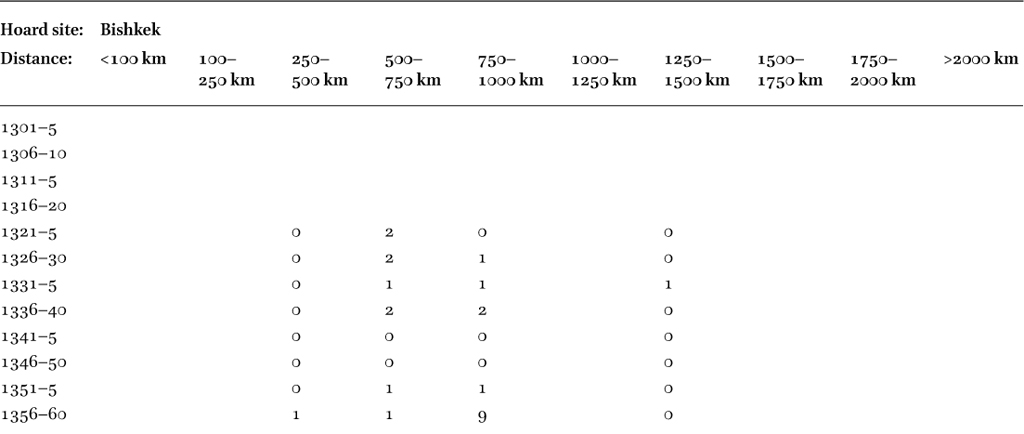
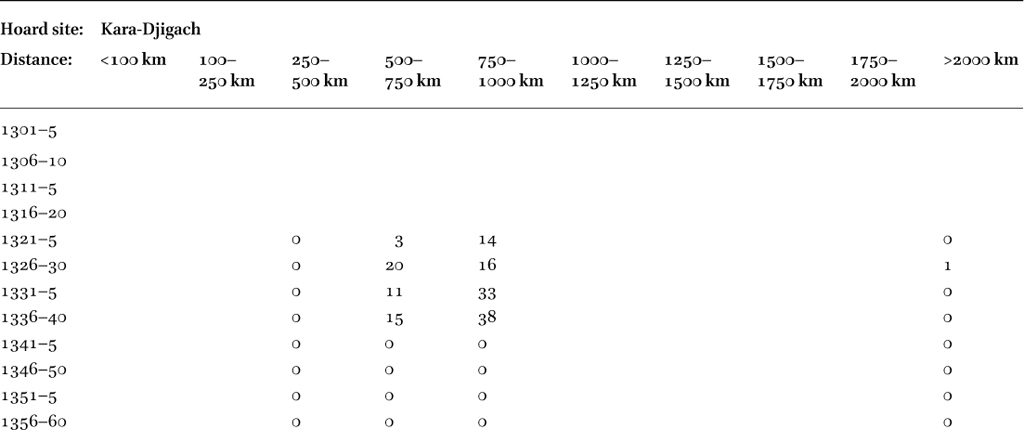
Another manifestation of the commercial crisis along the long-distance trade routes is the decline in the share of coins minted at distant mints in relation to the sites they were hoarded. Thus, as Table 1 indicates, between 1321â40, over a quarter of all unearthed coins were minted within a radius of between 750 and 1,250km, with a further 42 or so per cent coming from a distance of 250â750km, and about 30 per cent originating from a distance of less than 250km. During the crisis years of 1341â5, the proportion of coins minted within a radius of 750â1250km fell to 9 per cent. Conversely, the share of coins struck at mints situated between 250 and 750km away rose to over 71 per cent, while those coming from nearby mints (250km or less) declined to 18 per cent.
Distance between Hoard Sites and Minting Provenances of Coins, 1321â60
Citation: Journal of the Economic and Social History of the Orient 66, 5-6 (2023) ; 10.1163/15685209-12341601
While the fall in the proportion of distantly minted coins seems to reflect the disruption of long-distance trade, the concurrent decline in the share of coins originating at close-by mints may reflect some structural changes and alternative exchange strategies undertaken by local traders, involved in local and short-distance trade. To sustain local and regional trade in the circumstances of money shortage, local producers and merchants could either shift to barter or resort to counterfeit money, with two options not being mutually exclusive. The shift to barter economy was nothing new in Central Asian trade, where this form of exchange had always been a commonplace, on both local and long-distance levels. For instance, in their Sketch of the Black Tatars (1237), Peng Daya and Xu Ting of Song China commented that the Mongols bartered salt for rice, and horses and sheep for gold, silver and fine silks.125
Summer precipitation and temperature levels based on dendrochronology and stalagmite data from the Alay and Sarydzhaz regions of Kyrgyzstan, 1301â60 (precipitation levels indexed on 1301â60 (1301â60 = 100)); temperatures are expressed in centigrade degree deviation from the average indexed on 1301â60 (1301â60 = 0.00)
Citation: Journal of the Economic and Social History of the Orient 66, 5-6 (2023) ; 10.1163/15685209-12341601
Source: J. Esper, S.G. Shiyatov, V.S. Mazepa, R.J.S. Wilson, D.A. Graybill and G. Funkhouser, âTemperature-Sensitive Tian Shan Tree Ring Chronologies Show Multicentennial Growth Trends.â Climate Dynamics 21 (2003): 699â706 (I am grateful for Prof. Esper for being kind and supplying me with the annual data in conjunction with this study); O. Solomina, O. Maximova and E. Cook, âPicea Schrenkiana Ring Width and Density at the Upper and Lower Tree Limits in the Tien Shan Mts, Kyrgyz Republic as a Source of Paleoclimatic Information.â Geography, Environment, Sustainability 1 (2014): 66â79 (annual data available at https://www.ncdc.noaa.gov/paleo-search/study/15248); J. Fohlmeister, B. Plessen, A.S. Dudashvili, R. Tjallingii, Ch. Wolff, A. Gafurov and H. Cheng, âWinter Precipitation Changes during the Medieval Climate Anomaly and the Little Ice Age in Arid Central Asia.â Quaternary Science Reviews 178 (2017): 24â36; H-Q. Wang, F/ Chen, B. Ermenbaev and R. Satylkanov, âComparison of Drought-Sensitive Tree-Ring Records from the Tien Shan of Kyrgyzstan and Xinjiang (China) during the Last Six Centuries.â Advances in Climate Change Research 8 (2017): 21â2.Regarding the use of counterfeit money, meanwhile, there is numismatic evidence about the rise of counterfeit minting activities in the late 1330s, into the following decades. Counterfeit coins, imitating genuine counterparts struck at the mints of Almaliq, Otrar and Ordu Bazar, as well as counterfeit dies have been found in several coin hoards in the Talas and Chüy valleys and the Tashkent Oasis.126 The rise of counterfeit minting reflects the continuous demand for money on a local and regional level, which could not be satisfied by the declining authority of the Chaghadaid khanate, because of the warfare, instability and disruption of the late 1330s and 1340s. The flourishing of counterfeit coins, substituting official coins, whose minting declined because of the political and military crises, implies that unlike long-distance trade, local and regional trade went on, despite the crisis, facilitating the movement of goods, people and pathogens.
Of all traded goods, grain and textiles (wool, felts, cotton cloths, and carpets) are particularly known to have attracted rodents (grain) and sheltering their fleas (both grain and textiles). Hence, they may have played a paramount role in spreading plague on both regional and inter-regional levelsâin particular, when transported.127 Given the more geographically restricted nature of local and regional trade and travel, the plague would spread, during its initial stages, slower than it would in the context of long-distance trade. Instead of âmetastatic leapsâ, whereby infected fleas could survive without hosts and their bloodmeals for about a month in grain sacks, textiles or rugs and hence cover, at least in theory, about 1,000km,128 plague would spread via âinter-local stepsâ, at a much slower pace, which, unfortunately, cannot be quantified. In other words, plague bacteria could, at least in theory, thrive in those host-less environments for short periods of time, with grains and textiles being stored and slowly transported. If this is true, then we may hypothetically regard those grain and textile storage materials as an alternative type of (very) short-term, temporary reservoirs. We shall return to the role of grain stores (in the context of military campaigns) later in this study.
5.4 Climate of the 1330â40s and Wild Rodent Hosts
Although there is no doubt that trade fortunes played a paramount role in dictating the pace and dynamics of plague spread, they cannot explain these alone. To appreciate the complexity of the situation, it is necessary to consider other factors of an exogenous nature. Let us start with climatic aspects. Palynological analyses of water sediments of the Aral basin and adjacent riversâAmu-Darya and Syr-Daryaâand the latterâs tributaries, Arys and Baldan, indicate that the period between c.1300 and 1350 was marked by an excessive drought in these regions, with average annual precipitation levels falling from about 500mm in the thirteenth century to 370mm. These climatic conditions are also reflected in dendrochronological and stalagmite records from the Tian Shan ranges, recording annual summer precipitation and temperature levels (Figure 6). As the figure indicates, the summers of 1314â22 and the 1330s stand out as particularly dry and warm, while the years of 1325â9 and 1341â7 experienced the reverse trends of wet and, as a rule, mild or cool summers. Could it be that the dry and warm conditions of the late 1330s were yet an additional factor in slowing down the spread of the plague, but once wet and colder spells kicked in in the early 1340s, the pathogen started spreading at a faster pace?
The annual number of datable coins minted in Ãrgench, found in Central Asian Hoards (17 Sites), and individual coin finds, 1321â60
Note: For sites, chronology, quantities, and sources, see the Numismatic Appendix
Citation: Journal of the Economic and Social History of the Orient 66, 5-6 (2023) ; 10.1163/15685209-12341601
Clearly, dry and hot weather may have depressed commercial traffic along the trans-Asian trade routes, with people, pack animals and goods travelling in smaller quantities and volumes and at a slower pace. In particular, the reduction in biomass availability could be devastating in mountainous regions of the Tian Shan and Pamir ranges, where horses and donkeys, depending on grass fodder, were employed as pack animals. Hence, this could be one âhiddenâ factor slowing down the plague spreadâuntil wet and cool conditions returned in the early 1340s, once again making it easier to travel.
In addition to influencing human travel patterns, climatic conditions also play an important role in plague cycles, as a series of recent studies have established.129 In the arid and lowland Central Asian steppe, semi-desert and desert environment, dry and hot summers would create bad conditions for plagueâs spread along the long-distance trans-Asian trade routes overlapping with these regions. On the most basic level, dry and hot weather can be devastating for the survival of ectoparasitesâespecially fleas (and particularly when their foreguts are blocked by Yersinia pestis bacteria), but also lice, and ticksâas well as for their egg laying and hatching. While it is possible that humans became the primary carriers of the disease once the plague crossed over from its initial marmot hosts to humans in or shortly before 1338 in the Tian Shan, it is equally possible that after the zoonotic crossover the plague was carried and spread by both humans and rodents: marmots in the Tian Shan region and gerbils in the steppe, semi-desert and desert regions of Central Asia (in case of a hypothetical spill-over from marmots to gerbils).130 In the steppe and semi-desert environments, dry and hot summers would also mean the reduction in biomass availability, essential for supporting large and high-density gerbil populations.
The persistence of long-term Yersinia pestis reservoirs in gerbils is facilitated by the presence of plague-resistant phenotypes in some individuals and lack of such in others (that is, while some gerbils are resistant to plague infection and circulation in their colonies, some others are susceptible to the bacteria), as one recent study of a plague reservoir in the Gurbantünggüt desert of the Junggar Basin in north-western Uyghuristan/Xinjiang has shown.131 In theory, such plague-resistant phenotypes could have allowed the maintenance of the strains in migrating gerbil reservoirs, which, in turn, could be yet another trigger facilitating the (slow) movement of plague.132 Although it is theoretically possible, there is no evidence that gerbils had the same resistance phenotypes to the newly emergent and virulent strains of Branch 1, responsible for the Black Death and subsequent waves of the Second Plague Pandemic.133 If anything, the absence of Branch 1 strains from modern-day gerbil reservoirs in steppe-, semi-desert and desert environments (or indeed marmot reservoirs in highland regions) of Central Asia may hint to the contrary: that Branch 1 either never seeded a persistent reservoir in Central Asiaâin contrast with South-Central Germany, where the same branch got focalised with the plague arrival there in 1349âor if it did, it became extinct at some point.134
In any event, dry and hot summers would decrease the availability of grass biomass for rodents, essential for the growth of rodent populations, thus, keeping their densities low and hindering the spread of plague. Conversely, wet and cool summers would be the ideal conditions for its spread: they would encourage the hatching, survival and, consequently, population growth of ectoparasites (vectors) on the one hand and create abundant biomass for rodents (hosts), and thus increase their population densities, on the other.135 The population densities of both vectors (ectoparasites) and hosts (rodents) would, thus, determine the population densities of Yersinia pestis bacteria in both rodents and humans, and, consequently, the intensity of their activity and potentially the speed of its spread.
5.5 Landscapes and Human Population Densities
One may hypothesise that the role of Yersinia pestis co-hosting (whereby plague strains could be harboured in two or more mammalian hosts at the same time) was particularly important in the sparsely populated areas of the Inner Tian Shan, as well as those around Lake Issyk-Kul, the Chüy, Aspara, Talas, and Badam valleys. Owing to its peculiar topography characterised by high altitude and abundant grassland, the Inner Tian Shan region has always been a home for nomadic pastoralists, rather than sedentary settlements. A different situation prevailed in the Issyk-Kul region, and the Chüy, Aspara, Talas, and Badam valleys. Once a prosperous centre of urban life, the region underwent a major environmental transformation in the early Mongol period. A wide range of thirteenth-century Latin, Syriac and Persian sources indicate that the Mongol conquest of the region, then a part of the Qara-Khitai empire, in 1218â9 resulted in the destruction of its arable and urban space and its piecemeal conversion into pasturage for grazing livestock of both the Mongol elite and native Turkic and Iranic populations.136
Although impossible to accurately quantify, all the available archaeological evidence suggests that the number of settlements in this particular part of the Semirechâye region may have fallen considerably, as the result of Mongol campaigns. By 1338, there were only about 17 urban and quasi-urban settlements in the in the Chüy, Aspara, Talas and Badam valleys (Figure 1); around 1200, there were at least 42. The urban and demographic decline around Issyk-Kul was caused by an unfortunate combination of the early Mongol conquests, and a series of major seismic events in the Central Tian Shan ranges, which resulted in the submersion of several littoral towns around Issyk-Kul.137 As a result, the number of urban and quasi-urban settlements declined from about three dozen to less than a dozen.
It was this shrinking of urban and arable space sustaining a human population on the one hand and a shift to a pastoral and nomadic landscape with the abundance of grassland on the other, that created ideal conditions for the expansion of lower-altitude wild marmot populations, already undoubtedly abundant in the region before the Mongol era.138 At the same time, the greater physical distance between sedentary settlements and nomadic communities, characterised by low population densities, implies that plague spread would be slow in these regions. Indeed, as Ibn ShÄkir statedâagain, reproducing Sibá¹ Ibn al-JawzÄ«âs narrativeâplague may have been less prevalent among local elites (referred by him as al-mulÅ«k wa al-Ê¿â asÄkir, namely âkings and soldiersâ, possibly implying nomadic rulers and nobles) than among âcommon peopleâ (al-Ê¿â awÄmm, possibly meaning local sedentary communities).139 Therefore, it may have taken both the human and rodent hosts to sustain plague in these socio-ecological circumstances.
However, once the plague spread past the Inner Tian Shan in the south and the Badam valley in the north into more densely populated sedentary regionsâthe Syr-Darya valley, the Fergana valley and the Tashkent oasisâthe pace of the spread may have become faster, thanks to much denser sedentary populations, higher numbers of sedentary settlements and a shorter distance between these. A faster spread of the pathogen would be, moreover, facilitated by wetter and cooler conditions that begun in the early 1340s, making the transportation of people and goods faster and more plentiful.
5.6 Modes of Transportation
Also significant in determining the pace of plague transmission were the modes of transportation along the trans-Asian trade routes. Different kinds of pack-animals were utilised on differing legs of the journey. As all the available textual evidence suggests, the initial journey legs passing through the Inner Tian Shan region and the Fergana-Usrushana valleys towards Samarqand, or along the Chüy, Aspara, Talas and Badam valleys towards the city of Otrar, would involve travelling in donkey- or horse-carts.140 Donkeys would be a better fit if going through narrow mountainous paths of the Inner Tian Shan, connecting the Fergana valley with the Kashgar and Issyk-Kul regions, but they are about 2.5 times slower than horses.141 However, at Otrar, Osh, or Binkent (depending on the route taken), travellers would change from donkeys or horses to camels, to traverse through the desert and semi-desert environment of Transoxiana. From that point until reaching the Caspian shores (say, Saray-Jük), camels would be the sole mode of transportation.142
Unlike equids, camels are potential plague carriers.143 There are abundant examples of plague transmission from rodent to camels (via fleas) and from camels to humans (via fleas or human consumption of camel meat) from different geographic and chronological contexts, including early twentieth-century Imperial and Soviet Central Asia and late twentieth-century Mauritania.144 In particular, in the steppe and semi-desert environments of Central Asia, camels tend to graze on shrubs, where most rodent burrows tend to be concentrated.145 Thus, the contacts between infected rodents, humans and camels in these environments may have added yet another mechanism of the disease spread. Interestingly, Ibn ShÄkir mentioned that plague ravaged not only in humans, but also in camels and wild beasts.146
Moreover, camels are fast animals, covering longer distances at a trot than both donkeys and even horses. This is related not as much to their speed as to their physiology and stamina. When traveling at a regular speed, camels are about 1.5 faster than donkeys. Camels tend to consume any type of desert and steppe vegetation (particularly, shrubs) and can survive several days without water. Indeed, Ibn Baá¹á¹Å«á¹a, passing through the the Ustyurt Plateau and the Amu Darya valley in Spring 1333, commented on the fast speed of camel-riding in these regions. Thus, it took him just a week to cross from Git to Bukharaâabout 400km. As he noted, local camels were forced to cross the desert so fast that most of them would either perish or arrive at their destination totally exhausted and emaciated.147
Conjoining the potential of camels to be an additional plague carrier with their fast travel speed, we may appreciate why the plague would spread much faster on later journey legs, compared to earlier travel stages, involving primarily donkeysâslower animalsâor horses, with neither of the two being susceptible to plague. Hypothetical spatio-temporal models of plague transmission, based on both âequal speedâ and âdifferentiated speedâ scenarios (assuming camels to be 1.5 times faster than donkeys) are given in Supplementary Information, Table 5.
5.7 Warfare (again) and Plague Spread, c.1338/41â45
Contrary to the idea that plague was spread from Central Asia into West Eurasia by fast- and far-moving Mongol armies or/and international merchants,148 the evidence and analysis above suggest exactly the opposite: that the ongoing military conflicts inhibited the fast spread of the pathogens, and it was via local and regional trade, transport and infrastructure that they moved, at a slow pace, across vast territories and a range of different landscapes. In other words, warfare was somewhat of a brake, rather than a trigger of the spread of new plague strains, just born out of the Great Polytomy, in the late 1330sâearly 1340s. This does not mean, of course, that warfare was not an important enabler and trigger of the spread of epidemic diseases. There are many examples how large-scale conflicts would facilitate a widespread and intense spread of plague, with the Thirty Yearsâ War (1618â48), the Great Northern War (1700â21) and the Russo-Turkish War (1768â74) being just a few notable instances.149 Yet the situation in Mongol Central Asia in the 1330s and 1340s was different from that in early modern Europe: the aforementioned wars were regional, rather than trans-regional conflictsâin contrast with thirteenth-century expansionist campaigns of the Mongol Empire. This fact, coupled with the eventual closure of the of trans-Asian trade routes in the Chaghadaid and Yuan uluses, implies that the ongoing warfare could not have been a decisive factor in facilitating the spread of plague across Central Asia.
This, however, does not mean that certain aspects of the ongoing conflicts did not play an amplifying role in spreading the plague, on local and regional levels, via raids, movements (of people, animals and goods) and ecological destruction. Unfortunately, the available textual sources, patchy as they are, do not provide any detailed information about the various local Central Asian campaigns that occurred around the time of the westbound migration of the newly born plague strains. Hence, these can be inferred, in a hypothetical manner, from other references.
One obvious mechanism of plague transmission, in times of ongoing warfare, could be the transportation of grain by Mongol armies. The transportation of grains and their storage, in a coarse and milled form in linen sacks, at special stations, for the use of Mongol soldiersâa custom prescribed in law in 1234 by Ãgödei Qaʾan150âhas already been noted by some historians as potential contributors to plague spread.151 In the AkhbaÌr-i MughuÌlaÌn, ascribed to Quá¹b al-DÄ«n al-ShÄ«rÄzÄ« (1236â1311), the author alleged that during the north Iranian campaign of Hülegü Qanâs general Kitbuqa in 1252â3, these stations were situated at a distance of just half a parasang (~3.2km) from each other.152 While commensal rodents are usually attracted to unmilled rather than milled grains, infected fleas are capable of thriving in both flour and unprocessed cereals.153
In addition, some sources report that Mongol soldiers would hunt marmots, prepare and consume their meat and collect their pelts.154 Although some of the Chaghadaid soldiers may have converted to Islam or possibly East Syriac Christianity, and hence regard marmot meat as âuncleanâ food, the vast majority probably adhered to their traditional Shamanist beliefs and saw no obstacle in consuming it.155 That hunting, processing and consumption of infected marmots facilitates plague spill-over to humans and outbreaks in the latter is confirmed by numerous reports from late nineteenth-, twentieth- and twenty-first-century Central Asia.156
Another potential mechanism of plague transmission was the destruction of pasturage by warring sides. This could have a paramount effect on marmot coloniesâoften situated close to grazing grounds of nomadsâ livestock (especially extensive spring and summer pastures)âwhose population growth and densities are determined by the availability and quality of vegetation biomass.157 The destruction of pastures is mentioned in a number of sources. Thus, in his Baḥr al-asrÄr, MahmÅ«d ibn ValÄ« (c.1595âc.1650) stated that during the short reign of Könchek Qan (1307â8), the Tian Shan region experienced environmental destruction by both Chaghadaid and Yuan armies, plundering arable, pasture and livestock.158 Similarly, Ê¿â Abuʾl-QÄsem al-QÄshÄnÄ« stated in his TÄrÄ«kh-i Oljaitu (c.1325) that in 1316, in the course of a conflict between the Chaghadaid ruler Esen-Buqa Qan and Buyantu Qaʾan (Great khan) (1311â20), Chongur, a Yuan general, seized and plundered Esen-Buqaâs winter pastures near Issyk-Kul.159 If similar raids occurred in the Tian Shan region in the late 1330sâearly 1340s, then these could have had a serious impact on marmot population numbers. The decline in the volume and quality of the available grassland for marmot colonies could decrease their size and densities, and potentially cause starving bacteria-carrying fleas to cross over from marmots to humans, in their search for new hosts providing blood meals. Clearly, therefore, ongoing warfare may have been yet another enabling factor for the plague spread on a local or regional level.
6 From the Caspian to Crimea: a Fast Spread, 1345â6
Once the plague reached the south-eastern limits of the Golden Hordeâ Sighnaq on the Syr-Darya and Git and Ãrgench on the Amu-Daryaâthe remainder of the journey to Crimea was fast. Despite the ongoing political and commercial crisis with Venetian and Genoese residents of the Crimea and the Azov region, Jani Beg and the Jochid authorities certainly encouraged the flow of trade and goods. As noted above, the trade route between Ãrgench, where the plague is attested in late November 1345, and the Black Sea was open around that time. As we have seen, the Genoese merchant Leonardo Ultramarino spent the spring and summer of 1343 in Ãrgench. In March 1345, it was reported in Caffa that large quantities of spices and silk were found on Ãrgench markets, implying that business was going as usual. The fact that the routes further east were shut at that point may hint that silk was brought there from Tabriz or/and Merv, while spices were perhaps being procured from the Indian Ocean region, rather than from the Far East. As we have seen, Genoese-Chobanid trade in Tabriz was severely disrupted in 1340â1 and then, after 1344, terminated for good. This new reality may have been exploited by local Muslim traders from Ãrgench, who, to facilitate trans-Eurasian silk trade and make a profit, may have assumed a new role as middlemen between Tabriz and Merv silk producers on the one hand, and Italian merchants on the other.
That business went on as usual in Ãrgenchâin contrast with the state of affairs in the Chaghadaid ulus and disintegrated Ilkhanateâis supported by numismatic evidence. The Ãrgench mint was striking coins in 1344â6 (AH 744â6), with AH 746 (the year of the plague) standing out as a year of particularly voluminous minting (Figure 7). Ãrgench coins from these years have been found at various regions of the Golden Horde territory, including the cityâs own immediate hinterland (Ak-Kala and Shakherlik), Ustyurt Plateau caravanserais, the Caspian littoral (Saray-Jük), the Volga-Ural region (Mokrinskii and Selitrennoye), and as far as north Kazakhstan (Auliekol).160 At first, it might appear surprising that long-distance trade in Ãrgench does not seem to have been affected by the plague outbreak, as reflected in minting activity. Two factors may account for this. First, as we have seen, FasÌ£iÌhÌ£ KhvaÌfiÌ records that the plague, arriving in the city at some point in later 1345 (most likely by or before early November), abated soon after 24 November, when the cityâs inhabitants had made their public prayer.161 As AH 746 ran from 4 May 1345 to 23 April 1346, the outbreak covered only a small fraction of the year, leaving plenty of time for commercial activities. Secondly, and linked to the previous point, plague (unlike war) does not tend to disrupt economic activities, local or internationalâat least not in the pre-quarantine era. For instance, the total volume of wool export from all English ports in 1348 and 1349 (plague years) was higher than the annual average in the period of 1338â47.162 In Flanders, the total mint output in the plague year of 1350 was more than three times higher than in an average year in the period of 1346â9.163 Indeed, the international trade in the Pontic and Azov colonies in the 1340s was disrupted not because of plague, but because of the ongoing conflict between Jochid authorities and Italian merchants, and it resumed precisely at the height of a plague outbreak in Crimea in spring 1347.164
As we have seen, Ãrgench was connected with other regions of the Golden Horde via two caravan routes: the Kyzylkum desert to the Aral Sea and the Ustyurt Plateau-Mangyshlak Peninsula to the Caspian shore. From both the Aral and Caspian shores, westbound routes would continue to the Volga and Ural estuaries, before turning northwards to the Volga-Ural cities or westwards to the Don valley into Crimea. In theory, it would not take the pathogen long to cross from Ãrgench to the north Caspian and then to Crimea. Unless hindered by a sudden plague outbreak, camels would cross from Ãrgench to Saray-Jük (about 900km) in as little as 20 days, implying a daily speed of up to 45km, as reported by both the anonymous Florentine manual of c.1320 and Pegolotti.165 As we have seen, Ibn Baá¹á¹Å«á¹a (travelling in the region in early 1333), stated in his account that camels would be driven through the desert very fastâto the point that the majority of them would either not make it, or barely make it, in an exhausted and emaciated state.166
According to Rafaino Caresini (c.1314â90) and Lorenzo de Monacis (c.1351â1428), both Venetian diplomats and historians, the plague had arrived by 1345 in the âTartar landsâ, which Monacis referred to as âScythiaâ, namely the Pontic-Caspian steppe between the Black and Caspian seas.167 Given that the medieval Venetian year ran from 1 March to 27/28 February, the reference to â1345â implies either late 1345 (namely, after the Ãrgench outbreak), or early 1346. According to the Byzantine historian Nikephoros Gregoras (c.1295â1360), the plague was at the mouth of the Don (namely, the Tana region) in spring 1346.168 Hence, while the plague may not have been spreading as fast as 45km a day, it was certainly traversing at a remarkable pace: to cover some 1,930km from Ãrgench to Tana in about 3.5 months (say, from early/mid-November 1345 to early/mid-March 1346), it would need to travel at the speed of about 18km a day. Such a fast speedâone much faster than the 1â2km and 1.1km a day during, respectively, the Black Death and pestis secunda in Europeâcan only be explained, once we bear in mind the fast camel-riding across the Ustyurt Plateau on the one hand, and active trade within Golden Horde territories between Ãrgench and Tana, on the other.
The only reason why a further spread of the plague to the westâfirst to Constantinople and then to Western Mediterraneanâwas delayed by some 12â14 months (the plague did not reach Constantinople until late April 1347), was that here commercial and political conditions were very different from those prevailing between Ãrgench and Tana. As shown by Hannah Barker, trade embargos and a military conflict between the Golden Horde and Italian merchants created much disruption in travel and exchange between the Pontic-Caspian region and West Eurasia. However, once the crisis was (temporarily) over and business resumed in early spring 1347, it was only a matter of some short time, before the first of several infected ships crossed the Black Sea, first to Constantinople (most likely, in late April) and then to Messina (early June).169
Conclusions
Apart from exploring the routes and mechanisms by which the early fourteenth-century plague travelled from its now confirmed home in or around the Tian Shan to the Caspian and then Crimea, the present study touches upon and contributes to several ongoing debates. First and foremost, it addresses the connection between Mongol rule, international travel, and plague spread, in the context of trans-Asian long-distance inland trade routes (often referred to as the âSilk Roadâ). It has been recently hypothesized that the Mongol control of Central and East Eurasia was a paramount factor in the spread of plague, whether via long-distance military campaigns or long-distance trade.170 In particular, Monica Green suggested that with the emergence of the Great Polytomy (placed by Green in the early thirteenth century), newly born plague lineages and their strains were spread all over Eurasia by the Mongol armies during their expansionist campaigns, in the course of the thirteenth century.171 The current study argues for a different interpretation, showing that the early plague spread happened in exactly the opposite circumstancesâand indeed in a different period.
The recent aDNA analysis of three Kara-Djigach specimens from firmly dated 1338â9 burials by Spyrou et al. has established that the genomes associated with same burials fall exactly on a node that preceded and led to the emergence to the Great Polytomy/Big Bang.172 This places the Great Polytomyâand by extension the beginning of the Second Plague Pandemic in general and the Black Death in particularâto the late 1330sâearly 1340s, rather than the early thirteenth century. Drawing upon Spyrou et al.âs analysis, the present paper has attempted to investigate under what circumstances the newly-born plague strains (associated with Branch 1 born out of the Great Polytomy) spread from their Tian Shan home all the way to the Caspian Sea and Crimea, in the course of the 1340s. Given the place of Mongol armies in the ongoing debate about plague spread across and from Central Asia, in conjunction with the beginning of the Second Plague Pandemic, the present paper has duly considered this aspect. However, on the basis of all the available textual and archaeological evidence, it has instead reached the opposite conclusion from that offered by Green. True, there were military conflicts and thus movements of soldiers and possibly captives, in the late 1330s and early 1340s, but these were conducted on a regional and small scaleâcertainly compared to earlier Mongol campaigns of the 1210s to 1270s. If anything, these campaigns disrupted long-distance trade, forcing local communities and merchants to shift to local and short-distance trade. It was in this context of trade and travel disruption and closure of trade routes that plague was spreadingâindeed, at a slower pace than in later stages of transmissionâfrom its Tian Shan home to the Golden Horde lands, in short âinter-local stepsâ, rather than long-distance âmetastatic leapsâ. Its spread was facilitated by a dense network of urban centres and caravanserais, situated amidst the vast terrain of grassland and desert, and their commercial contacts with rural and nomadic neighbours, and not by Mongol armies and international merchants, as has hitherto been claimed. The importance of slower spread via inland routes (in contrast with âmetastatic leapsâ via maritime routes) has been most recently stressed in a study of the origins and spread of the pestis secunda of 1356â66.173
The situation changed drastically once the plague reached the south-eastern limits of the Golden Horde (Sighnaq on the northern route and Git and Ãrgench on the southern route). Unlike the case in the Chaghadaid ulus, trade of goods and movement of people was not disrupted in the southern and south-eastern territories of the Golden Horde, connecting the Pontic-Caspian region to Transoxiana. The contrast between slowly-spreading pace in environments where travel and trade were impeded and fast-spreading pace in regions where there was a steady flow of goods and people corroborates Barkerâs recent study of the plague spread from the Azov and Black seas to Constantinople and further west to the Mediterranean.174
Although there is no doubt that tradeâboth short-distance trade within the Chaghadaid territories and long-distance trade within the Ulus Jochiâplayed a paramount role in plague spread, it was not the only factor triggering it. As the paper argues, in order to appreciate the dynamics and mechanisms of the plague spread, we have to consider exogenous (natural) and demographic factors, too. Thus, the slow pace of pathogen dissemination during the initial travel routes and legs may have also been triggered by climatic conditions, ecological attributes, and biological peculiarities of local environments. The hot and dry summers of 1339â41 may have impeded the spread, not only because of discomfortable travel conditions for humans, but also because of fodder deficiency for pack-donkeys and horses and grassland deficiency for plague-carrying rodents (assuming that plague was co-hosted by rodents and humans). It was particularly important in the mountainous ranges of the Tian Shan, where people and goods were travelling in donkey- and horse-trains, rather than camel-caravans. Unlike camels, equids are not susceptible to plague. But they are also more âcapriciousâ animals, requiring to be fed on green fodderâin contrast with camels, who are happy to graze on desert and semi-desert shrubs. Moreover, donkeys, unlike horses, are, overall, slower than camels, at least when travelling at a trot. Finally, we need to bear in mind the nature of different types of human environments. While the Inner Tian Shan has always been a predominantly nomadic environment, in the early fourteenth century, the ânomadisationâ of adjacent regions (the Issyk-Kul littoral and the valleys of the Chüy, Aspara, Talas and Badam rivers) had been a relatively recent process, occurring since the early thirteenth century. This implies that these regions were characterised by very thinly populated communities, which may have presented a further impediment to a fast plague spread. Conversely, once the plague moved to the more urbanised and densely populated environments of the Syr-Darya valley, the Fergana valley, and the Tashkent Oasis, where camels were the most prominent modes of transportation and haulage, its speed may have accelerated. Finally, although the ongoing warfare seems to have slowed down rather than expedited the spread of plague, some of its aspectsâmost notably, the transportation of grain, marmot hunting and potential disruption of local ecologiesâcould have still played some role in enabling its spread, on a local or regional level.
Furthermore, the paper has been proposed that the 1338â9 outbreak may have, in fact, remained confined to the Tian Shanâprecisely because of trade disruptions and climatic conditionsâand that there may have been a further plague outbreak, commencing in 1341â2 (as exemplified in another spike in Kara-Djigach burials). It may be that it was the 1341â2 outbreak, rather than the 1338â9 one, that initiated a long and lethal wave of plague that travelled through Central Asia into the Caspian and Pontic regions, before spreading all over West Eurasia and North Africaânamely, the âBlack Deathâ. This may partially be supported by the fact that Kara-Djigach genomes are phylogenetically positioned on the Great Polytomy Node, shortly preceding the Great Polytomy (âBig Bangâ) event itself, which gave birth to four new lines, while all the so-far sequenced Black Death genomes (from Laishevo in Tatarstan to Oslo) are shown to belong to one of these multifurcated branches born out of the polytomyâBranch 1. In other words, Black Death genomes shared genetic attributes of a distinct line, which differed from their âsiblingsâ (Branches 2â4), born out of the polytomy, while the Kara-Djigach genomes are phylogenetically positioned just before the Great Polytomy. However, in the absence of palaeogenetic data from the context of 1341â2 burials, this interpretation remains purely hypothetical.
Taking these facts and scenarios together, we may appreciate why the plague was spreading slower in its earlier stages and faster in its later ones. But what is particularly important is that the reconstruction of its spread from the Tian Shan to the Caspian shows, once more, that environmental disasters are triggered and aggravated by a complex interaction of exogenous (natural), demographic and endogenous (anthropogenic, institutional) factors. The beginnings of the Black Death (and indeed of the Second Plague Pandemic) is a classic example of a biological crisis initiated by purely exogenous forces (the âBig Bangâ), and aggravated by both other exogenous forces (weather, topography, ecology, types of animal haulage), demographic factors (human population densities) and endogenous aspects (trade and military conflicts). The interaction between exogenous, demographic and endogenous factors, highlighted in some recent studies, reveals that the incredible complexity of biological and socio-economic crises can only be appreciated once we consider these factors, their respective derivatives and their mutual inter-dependence, in a detailed manner.175 Although it is impossible, at this stage, to offer a reliable chronology of the plagueâs spread from its Tian Shan home to the Caspian and Crimean regions (in the manner of Benedictowâs well-known âmap of the Black Deathâs spread in West Eurasia and North Africa in 1346â53, appearing in both editions of his Black Death), I have attempted to simulate several hypothetical scenarios, timing the spatio-temporal contours of plagueâs westward advance.176
Lastly, the paper shows the importance of a strongly trans-disciplinary approach to the history of infectious diseases. The recent COVID-19 crisis has raised some pressing questions which cannot be answered through the prism of a single discipline. To appreciate and explain a range of complex phenomena related to emerging diseases, such as the mechanisms and dynamics of their spread, it is imperative to gather, deploy and analyse evidence and methods from a number of diverse but inter-connected disciplines dealing with the same topics and asking the same questions. While the nature of the present paper is purely historical, written sources alone, without palaeogenetics, palaeoclimatology, palaeoecology, archaeology and numismatics, would not be sufficient to assess and reconstructâas closely as the available evidence permitsâthe bio-ecological, demographic and socio-economic contexts in which the recently born Second Plague Pandemic made its way from its Tian Shan home to the Caspian region and then Crimea. One can hope that such a trans-disciplinary creed will be applied to the study of other pandemics, past and presentâin order to make us better equipped to face any such pandemics that may occur in the future.
Appendix 1. Numismatic Data Publications Used in This Study
*** = data consulted, entered into a dataset and analysed in conjunction with Figures 5, 7 and Table 1
** = data consulted, entered into a dataset, and analysed with conjunction with Figure 5, but not with Figure 7 and Table 1
* = data particulars are not available in a published format, hence not consulted, not entered into a dataset and not analysed in conjunction with Figures 5, 7 and Table 1
I am grateful to Dr. Ilia Mozias for being so helpful in reading and summarising the contents of publications associated with nos. 3â5.
(1) Ili Valley Sites
1. Uch-Aral (Ilibalyk/Ilanbalyk)***: Chronology: 1030sâ1341/2; total number of coins: 209; number of dateable coins: 196
Source: P.N. Petrov et al., âSrednevekovyi Gorod, Obnaruzhennyi v Doline Reki Ili (Numizmaticheskii Aspekt).â Numizmatika Zolotoi Ordy 4 (2014), 61â76; http://www.exploration-eurasia.com/inhalt_english/frameset_projekt_aC.html (accessed January 2023).
2. Khorgas***: Chronology: 1286/7â1338/9; total number of coins: 224; number of dateable coins: 202
Source: P.N. Petrov, âNakhodki Monet XIV v. bliz Khorgosa.â Monety i Medali, ed. N.M. Smirnova (Moscow: GMII im. A.S. Pushkina, 2004), 2: 169â238.
3. Almaliq***: Chronology: 1321/2â1347/8; total number of coins: 29; number of dateable coins: 24
Source: Wang Hailin, âChahetai hanguo wanqi qianbi yanjiuâ (âA Study of Late Chaghadaid Khanate Coinsâ). Xinjiang Numismatics 2022 (4): 12â20.
4. Emil***: Chronology: 1230/1â1347/8; total number of coins: 135; number of dateable coins: 135
Source: Wang Hailin, âZai Xinjiang chu tu de Meng Yuan diguo de qianbiâ (âCoins of Mongol Yuan Empire Found in Xinjiang Provinceâ). Xinjiang Numismatics 2004 (3): 191â214.
5. Hotan**: Chronology: 1263/4â1276/7; total number of coins: 21; number of dateable coins: 7
Source: Cao Guansheng, âGuanyu Nanjiang faxian de Chahetai qianbi ju chubu yanjiuâ (âOn Chaghadaid coins found in Nanjiang and their Preliminary Studyâ), Xinjiang Numismatics 2006 (1): 13â20.
(2) Issyk-Kulâ region Sites
6. Almaty***: Chronology: 1290sâ1330s; total number of coins: 690; number of dateable coins: 689
Source: Vostochnye Monety iz Fondov Tsentralânogo Gosudarstvennogo Muzeya Respubliki Kazakhstan: Almatinskii Klad Chagataidskikh Monety. Illyustrirovannyi Nauchnyi Katalog, Vol. 1:1 (Almaty: Gosudarstvennyi Muzei Respubliki Kazakhstan, 2013), pp. 248â315.
(3) Chu Valley Sites
7. Kara-Djigach***: Chronology: 1286/7â1340/1; total number of coins: 165; number of dateable coins: 155
Source: Ye. S. Ochkasov, âKomplekt Monet Chagataidov XIIIâXIV vv. iz Chuiskoi Doliny.â Numizmatika Zolotoi Ordy 6 (2016): 109â112; M. Fedorov, âA Hoard of Fourteenth Century Chaghatayid Silver Coins from North Kirghizstan.â The Numismatic Chronicle 162 (2002): 404â19.
8. Krasnaya Rechka***: Chronology: c.1240/1âc.1348/9â1359/60; total number of coins: 20; number of dateable coins: 5
Source: P.N. Petrov and A.M. Kamyshev, âChuiskaya Dolina po Numizmatichekim Dannym (XIII-Pervaya Polovina XIV vv.).â In Tsentralânaya Aziya ot Akhemenidov do Timuridov. Arkheologiya, Istoriya, Etnologiya, Kulâtura. Materialy Mezhdunarodnoi Nauchnoi Konferentsii, Posvyashchennoi 100-Letiyu so Dnya Rozhdeniya Aleksandra Markovicha Belenitskogo. Sankt-Peterburg, 2â5 Noyabrya 2004 Goda (St. Petersburg: Institut Istorii Materialânoi Kulâtury RAN, 2005): 286â90.
9. Suyab (Ak-Beshim)***: Chronology: 1252/3â1335/6; total number of coins: 35; number of dateable coins: 3
Source: P.N. Petrov and A.M. Kamyshev, âChuiskaya Dolina po Numizmatichekim Dannym (XIII-Pervaya Polovina XIV vv.).â In Tsentralânaya Aziya ot Akhemenidov do Timuridov. Arkheologiya, Istoriya, Etnologiya, Kulâtura. Materialy Mezhdunarodnoi Nauchnoi Konferentsii, Posvyashchennoi 100-Letiyu so Dnya Rozhdeniya Aleksandra Markovicha Belenitskogo. Sankt-Peterburg, 2â5 Noyabrya 2004 Goda (St. Petersburg: Institut Istorii Materialânoi Kulâtury RAN, 2005): 286â90.
10. Kyzyl-Tuu*: Chronology: c.1348/9â1359/60; total number of coins: > 200?; number of dateable coins: > 200?
Source: A. Kamyshev, âFalâshivomonetchestvo v Chagataiskom Uluse.â Zolotoi Chervonets 45:4 (2018): 78â81.
11. Burana**: Chronology: 1222/3â1232/3; total number of coins: 7; number of dateable coins: 3
Source: S.V. Akindinov, A.M. Kamyshev and P.N. Petrov, âBalasagun i Orduâ Monetnye Dvory Vtoroi Chetverti XIII Veka.â Epigrafika Vostoka 29 (2011): 14â28; P.N. Petrov, A.M. Kamyshev and S.V. Akindinov, âBalasagun i OrdaâMonetnye Dvory Chuiskoi Doliny Pervoi Treti XIII Veka.â Izvestiya Natskonalânoi Akademii Nauk Respubliki Kazakhstan 2002: 168â177.
12. Bishkek region***: Chronology: 1277/8â1359/60; total number of coins: 46; number of dateable coins: 31
Source: P.N. Petrov and A.M. Kamyshev, âNakhodki Chagataiskikh Monet na Territorii Chuiskoi Doliny.â In Trudy Mezhdunarodnykh Numizmaticheskikh Konferentsii. Monety i Denezhnoye Obrashcheniye v Mongolâskikh Gosudarstvakh XIIIâXV Vekov (Moscow: Institut Vostokovedeniya RAN, 2005): 88â90.
13. Petrovka***: Chronology: 1353/4â1364/5; total number of coins: 19; number of dateable coins: 19
Source: V.G. Koshevar, âO Nakhodkakh Dzhuchidskikh Monet v Chuiskoi Doline.â Numizmatika Zolotoi Ordy 1 (2011): 121â3.
14. Unknown site in the Chu Valley (âHoard No. 4â)**: Chronology: early 1270s; total number of coins: 18; number of dateable coins: 10
Source: P.N. Petrov and V.G. Koshevar, âKlad No. 4 iz Kirgizii (Monetnye Franktsii Reformy Masâud-Beka).â In Drevnosti Povolzhâya i Drugikh Regionov, Vol. 5:4, ed. P.N. Petrov (Moscow: Numizmaticheskaya Literatura, 2004): 226â34.
15. Unknown site in the Chu Valley (âHoard No. 5â)***: Chronology: 1252/3â1345/6; total number of coins: 55; number of dateable coins: 23
Source: P.N. Petrov and V.G. Koshevar, âKlad No. 5 i Otdelânye Numizmaticheskiye Nakhodki iz Kirgizii.â Numizmatika 3:3 (2003): 23â27.
(4) Talas Valley Sites
16. Orlovka (Kulâ)***: Chronology: 1308/9â1357/8; total number of coins: 64; number of dateable coins: 36
Source: M.Ye. Masson, âIstoricheskii Etyud po Numizmatike Dzhagataidov.â Trudy Sredneaziatskogo Gosudarstvennogo Universiteta 111 (1957): 41â108.
17. Yangi-Taraz***: Chronology: 1221/2â1359/60; total number of coins: 201; number of dateable coins: 162
Source: P.N. Petrov and A.M. Kamyshev, âYangi-Taraz XIIIâXIV vv. i Otkrytiye ego Geograficheskogo Mestonakhozhdeniya po Numizmaticheskim Dannym.â Zolotoordynskoye Obozreniye / Golden Horde Review 7:2 (2019), 266â82.
(5) Badam-Arys Valley
18. Sayram (Isfijab)-Shymkent***: Chronology: 1221/2â1417/8; total number of coins: 2,863; number of dateable coins: 2,108
Source: B.A. Baitanayev and P.N. Petrov, âSayramskii Klad Chagataidskikh Monet,â Izvestiya Natsionalânoi Akademii Nauk Respubliki Kazakhstan: Seriya Obshchestvennykh i Gumanitarnykh Nauk 5 (297) (2014): 218â9; B.A. Baitanayev and P.N. Petrov, âNakhodki Monet Velikoi Mongolâskoi Imperii i Gosudarstva Chagataidov v Okruge Goroda Shymkent.â In Kazakhskoye Khanstvo v Potoke Istorii. Sbornik Materialov Mezhdunarodnoi Nauchnoi Konferentsii, Posvyash- chennoi 550-Letiyu Kazakhskogo Khanstva, ed. B.A. Baitanayev (Almaty: Institut Arkheologii im. A.Kh. Margulana, 2015): 157â69.
19. Otrar and Otrar hinterland***: Chronology: c.1251/2â1354/5; total number of coins: 41; number of dateable coins: 5
Source: R.Z. Burnasheva, âMonety s Gorodishcha Otrar-Tobe i Otrarskogo Oazisa (Materialy 1969â1970 gg.).â In Arkheologicheskie Issledovaniya v Kazakhstane (Alma-Ata: Nauka, 1973): 81â96.
(6) Tashkent Oasis
20. Tashkent***: Chronology: 1321/2â1366/7; total number of coins: 957; number of dateable coins: 929
Source: P.N. Petrov, ââTashkentskiiâ Klad Chagataiskikh Monet, 768-Nachalo 770-kh / 1336â7â1368â1370 gg.â In Trudy Mezhdunarodnykh Numizmaticheskikh Konferentsii. Monety i Denezhnoye Obrashcheniye v Mongolâskikh Gosudarstvakh XIIIâXV Vekov. III MNKâStaryi Krym, 3â9 Oktyabrya 2004 (Moscow: Numizmaticheskaya Literatura, 2005): 49â122.
(7) Syr-Darya Valley
21. Shoytobe/Shavgar**: Chronology: c.1251/2â1307/8; total number of coins: 30; number of dateable coins: 27
Source: Ye.A. Smagulov, âNovvye Dannye k Ustanovleniyu Vremeni Ugasaniya Zhizni Shavgara (Gorodishche Shoitobe, Tuskestanskii Oazis).â edu.e-history.kz 4:16 (2018).
22. Kyz-Kala (Barshynkent)***: Chronology: c.1336/7â1385/6; total number of coins: 12; number of dateable coins: 4
Source: A. V. Pachkalov, Materialy po Istorii Denezhnogo Obrashcheniya Zolodoi Ordy (Moscow: Knorus, 2020): 101.
23. Dzhan-Kala (Jand)***: Chronology: c.1251/2â1366/7; total number of coins: 141; number of dateable coins: 83
Source: G.A. Fedorov-Davydov, âNumizmatika Khorezma Zolotoordynskogo Perioda.â Numizmatika i Epigrafika 5 (1965): 179â219; A. Pachkalov and D. Voyakin, âMonetnye Nakhodki na Gorodishche Dzhan-Kala.â In Istoriko-Kulâturnoye Naslediye Aralo-Kaspiiskogo Regiona. Materialy II Mezhdunarodnoi Nauchno- Prakticheskoi Konferentsii, Aktau, 26â28 Avgusta 2010 (Aktau: 2010): 55â63; Pachkalov, Materialy, p. 101.
24. Uygarak***: Chronology: late thirteenth century-1367/8; total number of coins: 25; number of dateable coins: 12
Source: Pachkalov, Materialy: 101.
25. Aral-Asar***: Chronology: c. 1336/7â1373/4; total number of coins: 47; number of dateable coins: 23
Source: Ye. Yu. Goncharov, âMonety so Dna Aralâskogo Morya.â Epigrafika Vostoka 31 (2015): 202â12.
(8) Transoxiana
26. Saidkent (Bukhara Oasis)*: Chronology: c.1320âc.1360; total number of coins: 816; number of dateable coins: c.200
Source: B. Kurbanov and Sh. Babadzhanov, âNakhodki Saidkenta.â Moziydan Sado 2:78 (2018): 22.
(9) Amu-Darya Valley
27. Janpyk-Kala*: Chronology: 1336/7â1370/1; total number of coins: unknown; number of dateable coins: unknown
Source: Pachkalov: 109.
28. Shakherlik***: Chronology: 1301/2â1390s; total number of coins: 891; number of dateable coins: 686
Source: G.A. Fedorov-Davydov, âMonety s Gorodishcha Shakherlik.â In Etnografiya i Arkheologiya Tsentralânoi Azii (Moscow: Nauka, 1979): 122â126; Pachkalov, Materialy: 107â8.
29. Ak-Kala***: Chronology: 1287/8â1388/9; total number of coins: 67; number of dateable coins: 49
Source: Pachkalov, Materialy: 108.
(10) Ustyurt Plateau
30. Ustyurt Plateau caravanserais***: Chronology: 1336/7â1390s; total number of coins: 24; number of dateable coins: 17
Source: Pachkalov, Materialy: 109.
(11) Caspian littoral
31. Saray-Jük**: Chronology 1: 1295/6â1389; total number of coins: 961; number of dateable coins: 878; Chronology 2: 1476/7â1493; total number of coins: 12; number of dateable coins: 890: 12
Source: Z. Samashev, R. Burnasheva, N. Bazylkhan and V. Plakhov, Monety Saraichika (Almaty: Institut Arkheologii im. A. Kh. Margulana, 2006): 93â115; Pachkalov, Materialy: 97â100.
32. Mokrinskii I***: Chronology: 1310/1â1351/2; total number of coins: 34; number of dateable coins: 29
Source: A.V. Pachkalov, âNumizmaticheskiye Nakhodki v Mogilânike Mokrinskii I.â Voprosy Istorii i Arkheologii Zapadnogo Kazakhstana 1 (2009): 276â81; Pachkalov, Materialy: 100.
(12) North Kazakhstan
33. Auliekol Lake***: Chronology: 1306/7â1360/1; total number of coins: 39; number of dateable coins: 34
Source: P.N. Petrov and T.N. Smagulov, âNumizmaticheskie Nakhodki XIV Veka iz Nekropolya u Ozera Auliekol.â Stratum Plus 6 (2018): 1â18.
(13) Individual Chaghadaid Coins (Mostly, Private Collections)
34. Unknown provenances***: Chronology: 1304/5â1369/70; total number of coins: 683; number of dateable coins: 683
Source: https://www.zeno.ru/ (accessed January 2023).
Acknowledgments
The author wishes to thank three anonymous reviewers for their helpful comments and suggestions, as well as (in alphabetical order) Prof. Reuven Amitai, Prof. Michal Biran, Prof. Stuart Borsch, Dr. Yasmin Faghihi, Mr. Alexander Grinberg, Prof. Dai Matsui, Dr. Ilia Mozias, Dr. Pavel Petrov, Dr. Maria Spyrou, Dr. Márton Vér and Dr. Helen Wang, for their helpful suggestions and generous help with sources. All errors remain mine.
Bibliography
Primary Sources
Manuscripts
Istanbul, Topkapı Sarayı Müzesi Kütüphanesi, MS Ahmet III 2922, vol. 24 (Muḥammad Ibn ShÄkir al-KutubÄ«, Ê¿UyÅ«n al-tawÄrÄ«kh).
Cambridge, Cambridge University Library, MS Add. 2923 (Muḥammad Ibn ShÄkir al-KutubÄ«, Ê¿UyÅ«n al-tawÄrÄ«kh).
Edited Texts
An Abridged Translation of the History of Ṭabaristán Compiled about A.H. 613 (A.D. 1216) by Muḥammad b. Al-Ḥasan b. Isfandiyár, trans. by Edward G. Browne. Leyden: Brill, 1905.
AbÅ« al-GhÄzÄ« BahÄdur KhÄn. The Shajrat Ul Atrak, or Genealogical Tree of the Turks and Tatars, trans. by Col. Miles. London: William H. Allen and Co, 1838.
Al-MaqrÄ«zÄ«. As-SulÅ«k li-MaÊ¿rifat Duwal al-MulÅ«k, ed. Muḥammad Ê¿Abd al-QÄdir Ê¿Aá¹Ä. Beirut: DÄr al-Kutub al-Ê¿ilmÄ«ya, 1997.
Ämoli, TÄrikh-i RuyÄn, ed. Manuchehr Sotudeh. Tehran: BunyÄd-i Farhang-i ĪrÄn, 1969.
Anonim Iskandara, trans. by O.F. Akimushkin, in Materialy po Istorii Kirgizov i Kirgizii, Vol. 1, ed. V.A. Romodin. Moscow: Nauka, 1973: 113â127.
AsÌ£-á¹¢afadÄ«, AlḥÄn as-sawÄjiÊ¿ bayn al-bÄdÄ« wa-l-murÄjiÊ¿. Damascus: DaÌr al-BashaÌâir, 2004.
Basic Annals of Ming Tâai-Tsu, trans. by Romeyn Taylor. San Francisco: Chinese Materials Center Inc., 1975.
Cathay and the Way Thither, trans. by Henry Yule. London: The Hakluyt Society, 1914.
Diplomatarium Veneto-Levantinum sive Acta et Diplomata Res Venetas, Graecas atque Levantis Illustrantia. A. 1300â1350, ed. Georg Martin Thomas. Venice: Sumptibus Societatis, 1880.
Dols, Michael W. âIbn Al-WardÄ«âs RisÄlah al-Nabaâ âan al-Wabaâ, a Translation of a Major Source for the History of the Black Death in the Middle Eastâ, in Near Eastern Numismatics, Iconography, Epigraphy and History: Studies in Honor of George C. Miles., ed. Dickran Kouymjian. Beirut: American University of Beirut, 1974: 443â455.
FaryÅ«madiÌ Dhayl-i MajmaÊ¿ al-ansÄb, ed. Mirhashem Muhaddith. Tehran: AmiÌr KabiÌr, 1984.
FasÌ£iÌhÌ£ KhvaÌfiÌ. Mujmal-i Faṣīḥi. Fasikhov Svod, trans. by D. Yu. Yusupova. Tashkent: Fan 1980.
Francesco Balducci Pegolotti. La Pratica della mercatura, ed. Allan Evans. Cambridge, Mass.: Medieval Academy of America, 1936.
GiÌlaÌniÌ. TaÌriÌkh-i MaÌzandaraÌn. Tehran: BunyaÌd-i Farhang-i IraÌn, 1973.
La grande peste en Espagne musulmane au XIVe siècle. Le récit dâun contemporain De la pandémie du XIVe siècle, trans. by Suzanne Gigandet. Damascus: Presses de lâIfpo, 2011.
Ibn al-WardÄ«. TaʾrÄ«kh Ibn al-WardÄ«. Al-Najaf: al-MatÌ£baâah al-HÌ£aydariÌyah, 1969.
Das Keng-Shen Wai-Shih. Eine Quelle zur späten Mongolenzeit, trans. Helmut Schulte- Uffelage. Berlin: Akademie Verlag, 1963.
Kholmogorskaya Letopisâ. Dvinskoi Letopisets, in Polnoye Sobraniye Russkikh Letopisei 33. Leningrad: Nauka, 1977.
Laurentii de Monacis Veneti Cretae Cancellarii Chronicon de Rebus Venetiis. in Rerum Italicarum ed. Flaminius Corenlius. Venice: Ex Typographia Remondiniana, 1758.
Letopisnyi Sbornik Imenuyemyi Patriarsheyu ili Nikonovskoyu Letopisâyu. in Polnoye Sobraniye Russkikh Letopisei 10. St Petersburg: Tipografiya Ministerstva Vnutrennikh Del, 1885.
Letopisnyi Svod 1497 g. in Polnoye Sobraniye Russkikh Letopisei 28. Moscow: Izdatelâstvo Akademii Nauk, 1963.
MarâashÄ«. TÄrÄ«kh-i ṬabaristÄn va RÅ«yÄn va MÄzandarÄn, ed. M.H. TasbÄ«hÄ«. Tehran: Muâassasah-i MatbÅ«âÄt-Ä« Sharaf, 1966.
âMarino Sanudo Torsello. The Book of the Secrets of the Faithful of the Cross, ed. Peter Lock. London: Routledge, 2011.
Das Mongolische Weltreich: Al-âUmarÄ«âs Darstellung der Mongolischen Reiche in seinem Werk MasÄlik al-Abá¹£Är fÄ« MamÄlik al-Amá¹£Är, trans. by Klaus Lech. Wiesbaden: Harrassowitz, 1968.
Merits of the Plague by Ibn Hajar al-Asqalani, ed. and trans. J. Blecher and M. Syed. London: Penguin Classics, 2023.
The Mongols in Iran: Quá¹b al-DÄ«n al-ShÄ«rÄzÄ«âs AkhbÄr-i MoghÅ«lÄn, trans. by George Lane. Abingdon: Routledge, 2018.
Morozzo della Rocca, Raimondo, Notizie Da Caffa, in Studi in Onore di Amintore Fanfani. Milan: Giuffrè, 1962: 266â295.
Moskovskii Letopisnyi Svod Kontsa XV Veka, in Polnoye Sobraniye Russkikh Letopisei 25. Moscow: Izdatelâstvo Akademii Nauk, 1949.
Müller, Marc Joseph, âIbnulkhatîbs Bericht über die Pest,â Sitzungsberichte der philosophisch-philologische Klasse der Bayerischen Akademie der Wissenschaften München 2 (1863), 1â34.
Nicephori Gregorae Byzantina Historia, in Corpus Scriptorum Historiae Byzantinae ed. Ludwig Schopen. Bonn: Impensis Ed. Weberi, 1830.
Notai genovesi in oltremare. Atti rogati a Caffa e a Licostomo (sec. XIV), ed. by Giovanna Balbi and Silvana Raiteri. Genova: Istituto Internazionale di Studi Liguri, 1973.
Novgorodskaya Letopisâ po Spisku P.P. Dubrovskogo, in Polnoye Sobraniye Russkikh Letopisei 43. Moscow: Yazyki Slavyanskoi Kulâtury, 2004.
Parvisi-Berger, Maryam. 1968. Die Chronik des QÄÅ¡ÄnÄ« über den Ilchan ÃlÄäitü (1304â1316). Edition und Kommentierte Ãbersetzung. PhD Thesis, University of Göttingen.
Pskovskiya i Sofiiskiya Letopisi, in Polnoye Sobraniye Russkikh Letopisei 5. St Petersburg: Eduard Prats, 1851.
Raphayni de Caresinis Cancellarii Venetiarum Chronica AA. 1343â1388, in Rerum Italicarum Nuova Edizione, ed. Ester Pastorella. Bologna: 1922.
Rashid al-Din, The Successors of Genghis Khan, trans. by J. A. Boyle. New York: Columbia UP, 1971.
Rogozhskii Letopisets, in Polnoye Sobraniye Russkikh Letopisei 15. Petrograd: 1922.
Russkii Khronograf, in Polnoye Sobraniye Russkikh Letopisei 22:1. St Petersburg: Tipografiya M.A. Aleksandrova, 1911.
Sbornik Materialov Otnosyashchikhsya k Istorii Zolotoy Ordy, ed. V. Tizengauzen. St Petersburg: Tipografiya Imperatorskoi Akademii Nauk, 1884.
Sanjian, Avedis K. ed. Colophons of Armenian Manuscripts, 1301â1480: A Source for Middle Eastern History. Cambridge, MA: Harvard University Press, 1969.
Sharaf al-DÄ«n âAlÄ« YazdÄ«, Zafar-Name, trans. by Ashraf Akhmedov. Tashkent: Sanâat, 2008.
Sibá¹ Ibn al-JawzÄ«â. Mirâat al-ZamÄn fÄ« TawarÄ«kh al-âAyÄn. Beirut: DÄr al-Kutub al-âÊ¿IlmÄ«yah, 2013.
Simeonovskaya Letopisâ, in Polnoye Sobraniye Russkikh Letopisei 18. St Petersburg: Tipografiya M.A. Aleksandrova, 1913.
Sinica Franciscana, Vol.1. ed. P. Anastasius van den Wyngaert. Quaracchi: Apud Collegium S. Bonaventurae, 1929.
A Sketch of the Black Tatars by Peng Daya and Xu Ting of the Southern Song, in The Rise of the Mongols. Five Chinese Sources, trans. by Christopher P. Atwood and Lynn Struve. Indianapolis: Hackett Publishing Company Inc, 2021.
Sofiiskaya Pervaya Letopisâ po Spisku I.N. Tsarskogo, in Polnoye Sobraniye Russkikh Letopisei. Moscow: Nauka, 1994.
TaârÄ«kh-i Shaykh Uwais (History of Shaikh Uwais). An Important Source for the History of ÄdharbaijÄn in the Fourteenth Century, trans. by Johannes Baptist van Loon. The Hague: Moulton & Co., 1954.
ThalÄth RasÄâil Andalusiyya fÄ« al-ṬÄâÅ«n al-JÄrif, ed. Muḥammad Ḥasan. Tunis: Bayt al-Ḥikma, 2014.
The Travels of Ibn Baá¹á¹Å«á¹a, trans. by H.A.R. Gibb. Cambridge: Cambridge University Press, 1971.
Troitskaya Letopisâ. Rekonstruktsiya Teksta, ed. M.D. Priselâkov. Moscow: Izdatelâstvo Akademii Nauk SSSR, 1950.
Vér, Márton. The Postal System of the Mongol Empire in Northeastern Turkestan. PhD Thesis, University of Szeged, 2016.
Vér, Márton. Old Uyghur Documents Concerning the Postal System of the Mongol Empire. Turnhout: Brepols, 2019.
Vladimirskii Letopisets. Novgorodskaya Vtoraya Letopisâ, in Polnoye Sobraniye Russkikh Letopisei. Moscow: Nauka, 1965.
Voskresenskaya Letopisâ, in Polnoye Sobraniye Russkikh Letopisei. St Petersburg: Eduard Prats, 1856.
Wiet, Gaston. âLa Grande peste noire en Syrie et en Egypte,â in Ãtudes dâorientalisme dédiées à la mémoire de Lévi-Provençal. Paris: G. P. Maisonneuve & Larose, 1962: 367â384.
Yermolinskaya Letopisâ, in Polnoye Sobraniye Russkikh Letopisei 23. St Petersburg: Tipografiya M.A. Aleksandrova, 1910.
Databases
John Munroâs Datasets on Medieval and Early-Modern Money and Coinage: England, the Low Countries, France, and Italy (https://economics.utoronto.ca/munro5/MoneyCoinage.htm) (accessed January 2023).
ZENO.RUâOriental Coins Database (https://www.zeno.ru/) (accessed January 2023).
Secondary Literature
Aberth, John. 2000. From the Brink of the Apocalypse. Confronting Famine, War, Plague, and Death in the Later Middle Ages. Abingdon: Routledge.
Aberth, John. 2011. Plagues in World History. New York: Rowman & Littlefield Publishers.
Adshead, Samuel A. M. 1995. China in World History. 2nd edn. New York: Palgrave.
Akishev, K.A., K.M. Baipakov, and L.B. Yerzakovich. 1987. Otrar v XIIIâXV Vekakh. Alma-Ata: Nauka.
Akmatov, K.T. 2017. Vooruzheniye i Konskoye Snaryazheniye Kochevnikov Tyanâ-Shanya v Mongolâskoye Vremya. PhD Thesis, Novosibirsk State University.
Alexander, John T. 1980. Bubonic Plague in Early Modern Russia. Public Health and Urban Disaster. Baltimore: The Johns Hopkins University Press.
Anantayeva, Dinara T. 2019. Istoriya Rasprostraneniya Islama na Territorii Kyrgyzstana. PhD Thesis, Kyrgyzstan State University.
Anke, Bodo, Andreas Nerlich, Michail I. Moskalev, Oros A. Soltobaev, and Kuvat S. Tabaldiev. 1997. âAusgrabungen auf dem Gräberfeld von Süttü-Bulak, Raj. KoÄkorka, Kyrgyzstan,â Eurasia Antiqua 3: 513â570.
Ashtor, Eliyahu. 1984. Levant Trade in the Middle Ages. Princeton: Princeton University Press.
Astafâyev, A.Ye. and P.N. Petrov. 2017. Poluostrov Mangyshlak v Morskom Torgovom Soobshchenii Epokhi Zolotoi Ordy. Arkheologiya Yevraziiskikh Stepei 6:101â115.
Baillie, Mike. 2006. New Light on the Black Death: The Cosmic Connection. Stroud: Tempus.
Baipakov, K.M. 2007. Drevnie Goroda Kazakhstana. Almaty: Aruna.
Baipakov, K.M. 1986. Srednevekovaya Gorodskaya Kulâtura Yuzhnogo Kazakhstana i Semirechâya (VI-Nachalo XIII V.). Alma-Ata: Nauka.
Baipakov, K.M., G.A. Kapekova, D.A. Voyakin, and A.N. Marâyashev, 2011. Sokrovishcha Drevnego i Srednevekovogo Taraza i Zhambylskoi Oblasti. Taraz: Arkheologicheskaya Ekspertiza.
Baipakov, K.M., T.V. Savelâyeva, and I. Kamaldinov. 2020. Srednevekovye Goroda Iliiskoi Doliny (Severo-Vostochnoye Zhetysu-Semirechâye) na Velikom Shelkovom Puti v VIIIâXIV vv. Narody i Religii Evrazii 3: 7â34.
Baipakov, K.M. and L.B. Yerzakovich. 1971. Drevniye Goroda Kazakhstana. Alma-Ata: Nauka.
Balard, Michel. 1973. Les Génois en Asie centrale et en extrême-orient au XIVe siècle: un cas exceptionnel. In Ãconomies et sociétés au Moyen Ãge. Mélanges offerts à Edouard Perroy. Paris: Publications de la Sorbonne: 681â689.
Balard, Michel. 1974. Precursori di Colombo: I Genovesi in Estremo-Oriente nel XIV Secolo. In Atti del Convegno Internazionale di Studi Colombiani, 13 e 14 Ottobre 1973. Genoa: Civico Istituto Colombiano: 149â164.
Barker, Hannah. 2021. Laying the Corpses to Rest: Grain, Embargoes, and Yersinia Pestis in the Black Sea, 1346â48. Speculum 96: 97â126.
Barker, Hannah. 2019. That Most Precious Merchandise: The Mediterranean Trade in Black Sea Slaves, 1260â1500. Philadelphia: University of Pennsylvania Press.
Bartold, V. V. 1965a. Ocherk Istorii Semirechâya. in V.V. Bartolâd, Sochineniya, Vol. 2, Part 1. Moscow: Vostochnaya Literatura: 23â108.
Bartold, V. V. 1965b. Svedeniya ob Aralâskom More i Nizovâyakh Amu-Darâi s Drevneishikh Vremen do XVII Vekaâ, in V.V. Bartolâd, Sochineniya Vol. 3. Moscow: Vostochnaya Literatura: 15â94.
Bautier, Robert Henri. 1971. Les Relations des occidentaux avec les pays dâOrient au Moyen Ãge. Points de vue et documents. In Sociétés et compagnies de commerce en Orient et dans lâOcéan Indien, ed. Michel Molat du Jourdin. Paris: SEVPEN: 263â331.
Belenitskii, A.M., I.B. Bentovich, and O.G. Bolâshakov. 1973. Srednevekovyi Gorod Srednei Azii. Leningrad: Nauka.
Belyavskii, A.K. 1895. O Chume Tarbaganov. Zapiska po Povodu 7 Smertnykh Sluchayev ot Upotrebleniya v Pishchu Surkov, Porazhennykh Chumoyu v Poselke Sok-Tusvskom. Vestnik Obshchestvennoi Gigieny, Sudebnoi i Prakticheskoi Meditsiny 26 (April): 1â6.
Benedictow, Ole J. 2010. What Disease Was Plague?: On the Controversy over the Microbiological Identity of Plague Epidemics of the Past. Berlin: De Gruyter.
Benedictow, Ole J. 2021. The Complete History of the Black Death. Woodbridge: Boydell Press.
Bernshtram, A. N. 1952. Istoriko-Arkheologicheskie Ocherki Tsentralânogo Tyanâ-Shanya i Pamiro-Alaya. Moscow: Izdatelâstvo Akademii Nauk SSSR.
Bibikov, D.I. 1965. Surki i Chuma v Gorakh Srednei Azii. Alma-Ata.
Bibikov, D.I. 1967. Gornye Surki Srednei Azii i Kazakhstana. Moscow: Nauka.
Biran, Michal. 1997. Qaidu and the Rise of the Independent Mongol State in Central Asia. Richmond, Surrey: Curzon Press.
Biran, Michal. 2002. The Chaghadaids and Islam: The Conversion of Tarmashirin Khan (1331â34). Journal of the American Oriental Society 122: 742â752.
Biran, Michal. 2013. Rulers and City Life in Mongol Central Asia (1220â1370). In Turko- Mongol Rulers, Cities and City Life, ed. David Durand-Guedy. Leiden: Brill: 257â283.
Biran, Michal. 2015. Encounters among Enemies: Preliminary Remarks on Captives in Mongol Eurasia. Archivum Eurasiae Medii Aevi 21: 27â42.
Borsch, Stuart and Tarek Sabraa. 2017. Refugees of the Black Death: Quantifying Rural Migration for Plague and Other Environmental Disasters. Annales de démographie historique 134: 63â93.
Bos, Kirsten I., Verena J. Schuenemann, G. Brian Golding, Hernán A. Burbano, Nicholas Waglechner, Brian K. Coombes, Joseph B. McPhee, Sharon N. DeWitte, Matthias Meyer, Sarah Schmedes, James Wood, David J. D. Earn, D. Ann Herring, Peter Bauer, Hendrik N. Poinar, and Johannes Krause. 2011. A Draft Genome of Yersinia Pestis from Victims of the Black Death. Nature 478: 506â510.
Bos, K. I., A. Herbig, J. Sahl, N. Waglechner, M. Fourment, S. A. Forrest, J. Klunk, V. J. Schuenemann, D. Poinar, M. Kuch, G. B. Golding, O. Dutour, P. Keim, D. M. Wagner, E. C. Holmes, J. Krause, and H. N. Poinar. 2016. Eighteenth Century Yersinia Pestis Genomes Reveal the Long-Term Persistence of an Historical Plague Focus. Elife 5: e12994.
Brykina, G.A. 1974. Karabulak. Moscow: Nauka.
Buryakov, Yu. F. 1978. Po Drevnim Karavannym Putyam Tashkentskogo Oazisa. Tashkent: Fan.
Buryakov, Yu.F. 1982. Genezis i Etapy Razvitiya Gorodskoi Kulâtury Tashkentskogo Oazisa. Tashkent: Fan.
Campbell, Bruce M. S. 2016. The Great Transition: Climate, Disease and Society in the Late-Medieval World. Cambridge: Cambridge University Press.
Carmichael, Ann G. 2014. Plague Persistence in Western Europe: A Hypothesis. The Medieval Globe 1: 157â192.
Carus-Wilson, E.M. and Olive Coleman. 1963. Englandâs Export Trade, 1275â1547. Oxford: At the Clarendon Press.
Cleaves, Francis Woodman. 1952. The Sino-Mongolian Inscription of 1346. Harvard Journal of Asiatic Studies 15: 1â123.
Cui, Yujun, Chang Yu, Haihong Han, Dongfang Li, Yanjun Li, Thibaut Jombart, Lucy Weinert, Zuyun Wang, Zhaobiao Guo, Lizhi Xu, Yujiang Zhang, Hancheng Zheng, Nan Qin, Xiao Xiao, Mingshou Wu, Xiaoyi Wang, Dongsheng Zhou, Zhizhen Qi, Zongmin Du, and Ruifu Yang. 2013. Historical Variations in Mutation Rate in an Epidemic Pathogen, Yersinia Pestis, Proceedings of the National Academy of Sciences of the United States of America 110: 577â582.
Cumpston, J.H.L. and F. McCallum, 1926. The History of Plague in Australia. Melbourne: H.J. Green.
Dai Ruixia, Baiqing Wei, Haoming Xiong, Xiaoyan Yang, Yao Peng, Jian He, Juan Jin, Yumeng Wang, Xi Zha, Zhikai Zhang, Ying Liang, Qingwen Zhang, Jianguo Xu, Zuyun Wang, and Wei Li. 2018. Human Plague Associated with Tibetan Sheep Originates in Marmots. PLOS Neglected Tropical Diseases, 12 (2018), e0006635.
De Guignes, Joseph. 1756â8. Histoire générale des Huns, des Turcs, des Mogols et des autres Tartares occidentaux. 4 vols. Paris: Desaint & Saillant.
Dunn, Ross E. 1986. The Adventures of Ibn Battuta: A Muslim Traveler of the 14th Century. London: Croom Helm.
Eaton, Katherine, Leo Featherstone, Sebastian Duchene, Ann Carmichael, Nükhet Varlik, G. Golding, Edward Holmes, and Hendrik Poinar. 2022. Plagued by a Cryptic Clock: Insight and Issues from the Global Phylogeny of Yersinia Pestis. Communications Biology 6, DOI: 10.1038/s42003-022-04394-6.
Eckert, Edward A. 1996. The Structure of Plagues and Pestilences in Early Modern Europe: Central Europe, 1560â1640. Basel: Karger.
Edmunds, David, Elizabeth Williams, Donal OâToole, Kenneth Mills, Amy Boerger- Fields, Paula Jaeger, Robert Bildfell, Peggy Dearing, and Todd Cornish. 2008. Ocular Plague (Yersinia Pestis) in Mule Deer (Odocoileus Hemionus) from Wyoming and Oregon. Journal of Wildlife Diseases 44: 983â987.
Eroshenko, G., N. Popov, Zh Alâkhova, A. Balykova, L. Kukleva, and V. Kutyrev. 2019. Phylogenetic Analysis of Yersinia Pestis Strains of Medieval Biovar, Isolated in Precaspian North-Western Steppe Plague Focus in the XX Century. Problems of Particularly Dangerous Infections: 55â61.
Eroshenko, G., L. Kukleva, Zh Alâkhova, A. Balykova, N. Popov, Ya Krasnov, N. Chervyakova, and V. Kutyrev. 2020. Phylogenetic History of Kara Kum Desert Focus. Problems of Particularly Dangerous Infections: 56â61.
Eroshenko, Galina, Nikolay Popov, Zhanna Alâkhova, Lyubov Kukleva, Alina Balykova, Nadezhda Chervyakova, Ekaterina Naryshkina, and Vladimir Kutyrev. 2021. Evolution and Circulation of Yersinia Pestis in the Northern Caspian and Northern Aral Sea Regions in the 20thâ21st Centuries. PloS One 16: e0244615.
Eroshenko, G., E. Oglodin, A. Balykova, Ya Krasnov, E. Naryshkina, T. Ayazbaev, Nikolay Popov, and V. Kutyrev. 2022. Tracing the Spatial Circulation of Yersinia Pestis of Medieval Biovar in the Eastern Caspian Sea Region in the 20th Century Based on Genome-Wide SNP Analysis. Problems of Particularly Dangerous Infections: 75â85.
Eskey, C. R. 1932. Epidemiological Study of Plague in Peru: With Observations on the Antiplague Campaign and Laboratory. Public Health Reports 18: 2191â2207.
Esper, Jan, S. Shiyatov, Valeriy Mazepa, Rob Wilson, D. A. Graybill, and G. Funkhouser. 2003. Temperature-Sensitive Tien Shan Tree Ring Chronologies Show Multi- Centennial Growth Trends. Climate Dynamics, 21: 699â706.
Fancy, Nahyan and Monica H. Green. 2021. Plague and the Fall of Baghdad (1258). Medical History 65: 157â177.
Fancy, Nahyan and Monica H. Green. 2021. Plague and the Fall of Baghdad (1258)â Corrigendum. Medical History 66: 285.
Favereau, Marie. 2021. The Horde: How the Mongols Changed the World. Cambridge, Mass.: Harvard University Press.
Fazlinejad, Ahmad and Farajollah Ahmadi. 2018. The Black Death in Iran, According to Iranian Historical Accounts from the Fourteenth through Fifteenth Centuries. Journal of Persianate Studies 22: 56â71.
Fedorov-Davydov, G.A. 1965. Numizmatika Khorezma Zolotoordynskogo Perioda. Numizmatika i Epigrafika 5: 179â219.
Ferrand, Gabriel. 1913â4. Relations de voyages et textes géographiques arabes, persans et turks relatifs à lâExtrême Orient du VIII au XVIII siècles, 2 Vols. Paris: Ernest Leroux.
Fohlmeister, Jens, Birgit Plessen, Alexey Dudashvili, Rik Tjallingii, Christian Wolff, Abror Gafurov, and Hai Cheng. 2017. Winter Precipitation Changes during the Medieval Climate Anomaly and the Little Ice Age in Arid Central Asia. Quaternary Science Reviews 178: 24â36.
Frachetti, Michael, C. Smith, Cynthia Traub, and Tim Williams. 2017. Nomadic Ecology Shaped the Highland Geography of Asiaâs Silk Roads. Nature 543: 193â198.
Frandsen, Karl-Erik. 2010. The Last Plague in the Baltic Region, 1709â1713. Copenhagen: Museum Tusculanum Press.
Franke, Herbert. 1966. Sino-Western Contacts under the Mongol Empire. Journal of the Hong Kong Branch of the Royal Asiatic Society 6: 49â72.
Franke, Herbert. 1971. Die Gesandtschaft des Johann von Marignola im Spiegel der chinesischen Literatur. In Asien. Tradition Und Fortschritt. Festschrift Für Horst Hammitzsch Zu Seinem 60. Geburtstag, eds. Lydia Brüll and Ulrich Kemper. Wiesbaden: Harrassowitz: 117â134.
Gasquet, Francis Aidan. 1893. The Great Pestilence (A.D. 1348â9), Now Commonly Known as the Black Death. London: Simpkin Marshall.
Giffin, Karen, Aditya Kumar Lankapalli, Susanna Sabin, Maria Spyrou, Cosimo Posth, Justina KozakaitÄ, Ronny Friedrich, ŽydrÅ«nÄ MiliauskienÄ, Rimantas Jankauskas, Alexander Herbig, and Kirsten Bos. 2020. A Treponemal Genome from an Historic Plague Victim Supports a Recent Emergence of Yaws and Its Presence in 15 Century Europe. Scientific Reports 10: 94.
Gottfried, Robert S. 1983. The Black Death: Natural and Human Disaster in Medieval Europe. New York: The Free Press.
Green, Monica H. 2018. Putting Africa on the Black Death Map: Narratives from Genetics and History. Afriques, DOI: 10.4000/afriques.2125.
Green, Monica H. 2020. The Four Black Deaths. American Historical Review 125: 1601â1631.
Green, Monica H. 2022. Out of the East (or North or South): A Response to Philip Slavin. Past & Present 256 (August): 283â323.
Green, Monica H. 2022. Putting Asia on the Black Death Map. The Medieval Globe 8: 61â89.
Green, Monica H. 2022. A New Definition of the Black Death: Genetic Findings and Historical Interpretations. De Medio Aevo 11: 139â155.
Grekov, B. D. and A. Yu. Yakubovskii. 1950. Zolotaya Orda i Eyo Padeniye. Moscow: Izdatelâstvo Akademii Nauk.
Guellil, Meriam, Oliver Kersten, Amine Namouchi, Stefania Luciani, Isolina Marota, Caroline Arcini, Elisabeth Iregren, Robert Lindemann, Gunnar Warfvinge, Lela Bakanidze, Liana Bitadze, Mauro Rubini, Paola Zaio, Monica Zaio, Damiano Neri, Nils Chr Stenseth, and Barbara Bramanti. 2020. A Genomic and Historical Synthesis of Plague in 18th Century Eurasia. Proceedings of the National Academy of Sciences 117, no. 45: 1â8.
Hecker, Justus Friedrich Carl. 1832. Der Schwarze Tod im vierzehnten Jahrhundert: Nach den Quellen für Ãrzte und Gebildete Nichtärzte Bearbeitet. Berlin: Herbig.
Hermes, Taylor R. Michael D. Frachetti, Elissa A. Bullion, Farhod Maksudov, Samariddin Mustafokulov and Cheryl A. Makarewicz. 2018. Urban and Nomadic Isotopic Niches Reveal Dietary Connectivities along Central Asiaâs Silk Roads. Scientific Reports 8: 5177.
Hussein, Mansour F. 2021. Yersinia Pestis (Camel Plague). In Infectious Diseases of Dromedary Camels. A Concise Guide, eds. Abdelmalik I. Khalafalla and Mansour F. Hussein, Cham: Springer: 201â204.
Hymes, Robert. 2014. Epilogue: A Hypothesis on the East Asian Beginnings of the Yersinia Pestis Polytomy. The Medieval Globe 1: 285â308.
Hymes, Robert. 2022. âBuboes in Thirteenth-Century China: Evidence from Chinese Medical Writings,â The Medieval Globe 8: 3â59.
Itina, M.A. 1991. Arkheologicheskiye Pamyatniki na Drevnikh Torgovykh Putyakh Vdolâ Beregov Amudarâiâ. In Drevnosti Yuzhnogo Khorezma, ed. M.A. Itina. Moscow: Nauka: 11â33.
Jackson, Peter. 1998. Marco Polo and his âTravelsâ. Bulletin of the School of Oriental and African Studies 61: 82â101.
Jacoby, David. 2010. Oriental Silks Go West: A Declining Trade in the Later Middle Ages. In Islamic Artefacts in the Mediterranean World. Trade, Gift Exchange and Artistic Transfer, eds. Arcangeli Schmidt, Catarina and Gerhard Wolf. Venice: Marsilio: 71â88.
Jacoby, David. 2015. Venice and the Papal Embargo against Mamluk Egypt, 1291â1344. Thesaurismata 45: 137â154.
Jacoby, David. 2016. Oriental Silks at the Time of the Mongols: Patters of Trade and Distribution in the West. In Oriental Silks in Medieval Europe, ed. Juliane von Fircks and Regula Schorta. Riggisberg: Abegg-Stiftung: 93â123.
Janssens, Herman F. 1948. Ibn Batouta, âle Voyageur de lâIslamâ (1304â1369). Brussels: Office de Publicité. Jenks, Stuart. 1986. A Review of The Black Death: Natural and Human Disaster in Medieval Europe by Robert S. Gottfried. Journal of Economic History 46:3: 815â823.
Kalmenov, M. D. 2013. Arkheologicheskiye Pamyatniki Ustyurta i Mangistau na Srednevekovykh Karavannykh Putyakh (XâXIX vv.). PhD Thesis, Kazan Federal University.
Kamyshev, A.M. 2018. Falâshivomonetchestvo v Chagataiskom Uluse. Zolotoi Chervonets 45: 78â81.
Kaniewski David and Nick Marriner. Conflicts and the Spread of Plagues in Pre- Industrial Europe, Humanities and Social Sciences Communication 7 (2020): 162.
Karayev, O.K. 1995. Chagataiskii Ulus. Gosudarstvo Khaidu. Mogulistan. Obrazovaniye Kyrgyzskogo Naroda. Bishkek: Kyrgyzstan.
Karpov, S.P. 2021. Istoriya Tany (Azova) v XIIIâXIV vv. St Petersburg: Aletheia.
Kausrud, Kyrre, Mike Begon, Tamara Ben Ari, Hildegunn Viljugrein, Jan Esper, Ulf Büntgen, Herwig Leirs, Claudia Junge, Bao Yang, Meixue Yang, Lei Xu, and Nils Chr Stenseth. 2010. Modelling the Epidemiological History of Plague in Central Asia: Palaeoclimatic Forcing on a Disease System over the Past Millennium. BMC Biology 8: 112.
Kedar, Benjamin Z. 1976. Merchants in Crisis: Genoese and Venetian Men of Affairs and the Fourteenth Century Depression. New Haven: Yale University Press.
Keller, Marcel, Maria Spyrou, Michael McCormick, Kirsten Bos, Alexander Herbig, and Johannes Krause. 2019. Ancient Yersinia Pestis Genomes Provide No Evidence for the Origins or Spread of the Justinianic Plague. bioRxiv; DOI: https://www.biorxiv.org/content/10.1101/819698v2.full.
Kelly, John. 2005. The Great Mortality. An Intimate History of the Black Death, the Most Devastating Plague of All Time. New York: Harper Collins.
Khaydarov, Timur F. 2018. Epokha âChernoi Smertiâ v Zolotoi Orde i Prilegayushchikh Regionakh, Konets XIIIâPervaya Polovina XV vv. Kazan: Institut Istorii im. Sh. Mardzhani.
Khaydarov, Timur F. 2021. Rolâ Ordynsko-Russkoi Politii i Krupnykh Epidemicheskikh Vspyshek Chumy v Istorii Tatar. In Zolotoordynskoye Naslediye. Materialy Mezhdunarodnoi Nauchnoi Konferentsii âTransformatsiya Politiko-Etnicheskoi Karty Vostochnoi Yevropy: Velikaya Vengriya, Volzhskaya Bulgariya i Obrazovaniye Zolotoi Ordyâ: Sbornik Statei, ed. I. M. Mirgaleyev. Kazan: Institut Istorii im. Sh. Mardzhani: 190â226.
Khazanov, Anatoly M. 1994. Nomads and the Outside World. Madison: University of Wisconsin Press.
Kibirov, A.K. 1959. Arkheologicheskie Raboty v Tsentralânom Tyanâ-Shane. In Trudy Kirgizskoi Arkheologo-Etnograficheskoy Ekspeditsii, ed. G. F. Debets. Moscow: Izdatelâstvo Akademii Nauk SSSR.
Klein, J. M, J. M. Alonso, G. Baranton, A. R. Poulet, and H. H. Mollaret. 1975. La Peste en Mauritanie. Médecine et Maladies Infectieuses 5: 198â207.
Korjenkov, Andrey, Ramon Arrowsmith, Christopher Crosby, Ernes Mamyrov, Lyubov Orlova, Irina Povolotskaya, and K. Sh. Tabaldiev. 2006. Seismogenic Destruction of the Kamenka Medieval Fortress, Northern Issyk-Kul Region, Tien Shan (Kyrgyzstan). Journal of Seismology 10: 431â442.
Korjenkov, Andrey, V. Kolâchenko, Ph Rott, and S. Abdieva. 2012. Strong Mediaeval Earthquake in the Chuy Basin, Kyrgyzstan. Geotectonics 46: 303â314.
Korzhenkov, Andrey, D. V. Luzhanskii, S. V. Abdieva, E. V. Deev, Terry Pavlis, E. Rogozhin, I. V. Turiva, and A. S. Yudakhin. 2017. On Traces of a Strong Earthquake in Walls of the Sary-Bulun Medieval Sites Along the Great Silk Route (Western Issyk-Kul Lake Region, Northern Tien Shan). Seismic Instruments 53: 309â322.
Korzhenkov, Andrey, Andrey Strelnikov, E. V. Deev, L. Korzhenkova, Jiao Liu, J. Mazeika, E. Rogozhin, S. Rodina, I. Turova, M. Usmanova, and A. Fortuna. 2020. Adyr Faults: Generators of Strong Earthquakes in the Lake Issyk-Kul Depression (a Case Study of the Kultor Fault Zone). Seismic Instruments 56: 578â598.
Korzhenkov, Andrey M. et al., 2018. Silânye Istoricheskie i Paleozemletraseniya Priissykkulâya i Ikh Polozheniye v Strukture Severnogo Tyanâ-Shanya. Moscow: IFZ RAN.
Korzhenkov, Andrey M., V. A. Kolâchenko, D. V. Luzhanskii, Ye. A Rogozhin, M. Kazmer, I. V. Mazheika, Ye. V. Deev, A. B. Fortuna, D. Shen, A. S. Yudakhin, V. Abdieva, and S. N. Rodina. 2015. Arkheoseismologicheskoye Issledovaniye Kurmentinskogo Srednevekovogo Gorodishcha (Severo-Vostochnoye Priissykkulâye, Kyrgyzstan)â, Voprosy Inzhenernoi Seismologii 42: 70â81.
Kozhemyako, P.N. 1959. Rannesrednevekovye Goroda i Poseleniya Chuiskoi Doliny. Frunze: Akademia Nauk Kirgizskoi SSR.
Kozhemyako, P.N. 1963. Osedlyye Poseleniya Talasskoi Doliny. In Arkheologicheskie Pamyatniki Talasskoi Doliny. Frunze: Akademia Nauk Kirgizskoi SSR: 145â224.
Krivonogov, S.K. 2009. Extent of the Aral Sea Drop in the Middle Age. Doklady Earth Sciences 428: 1146â1150.
Krivonogov, S.K., G.S. Burr, Y.V. Kuzmin, S.A. Gusskov, R.K. Kurmanbaev, T.I. Kenshinbay, and Voyakin. D.A. 2014. The Fluctuating Aral Sea: A Multidisciplinary-Based History of the Last Two Thousand Years. Gondwana Research 26: 284â300.
Kutyrev, V. V. and A. Yu. Popova. 2016. Kadastr Epidemicheskikh i Epizooticheskikh Proyavlenii Chumy na Territorii Rossiskoi Federatsii i Stran Blizhnego Zarubezhâya s 1876 po 2016 gg. Saratov: Mikrob.
Lavrov, L.I. 1946. âObezyâ Russkikh Letopisei. Sovetskaya Etnografiya 4: 161â170.
Lopez, Robert S. 1943. European Merchants in the Medieval Indies: The Evidence of Commercial Documents. Journal of Economic History 3: 164â184.
Mahmoudi, Ahmad, Boris Krystufek, Alexander Sludsky, Boris Schmid, Alzira Almeida, Xu Lei, Beza Ramasindrazana, Eric Bertherat, Aidyn Yeszhanov, Nils Chr Stenseth, and Ehsan Mostafavi. 2021. Plague Reservoir Species throughout the World. Integrative Zoology 16: 820â833.
Makarikhin, V.P. and A.I. Tarasov. 2009. Meshcherskii Yurt v XIVâXV Vekakh: Sistema Upravleniya. In Musulâmanskaya Tsivilizatsiya Volgo-Surskogo Regiona v Epokhu Feodalizma, ed. D.Z. Khairetdinov. Nizhny Novgorod: Medina: 24â31.
Maksimova, A.G. 1965. Pogrebeniye Voina. Vestnik Akademii Nauk Kazakhskoi SSR 6: 85â91.
Maksudov, Farhod, Elissa Bullion, Edward Henry, Taylor Hermes, Ann Merkle, and Michael Frachetti. 2019. Nomadic Urbanism at Tashbulak. A New Highland Town of the Karakhanids. In Urban Cultures of Central Asia from the Bronze Age to the Karakhanids, eds. Christoph Baumer and Mirko Novák. Wiesbaden: Harrassowitz: 283â305.
Masson, M. Ye. 1933. Klad Utvari Masterskoi Falâshivomonetchika XIV Veka pod Tashkentom. Tashkent: Uzbekskii Komitet po Okhrane Pamyatnikov Materialânoi Kulâtury.
Masson, M. Ye. 1957. Istoricheskii Etyud po Numizmatike Dzhagataidov (Po Povodu Talasskogo Klada Monet XIV >V.). Trudy Sredneaziatskogo Gosudarstvennogo Universiteta. Arkheologiya Srednei Azii 4: 41â108.
Matsui, Dai. 2017. TonkÅ Sekkutsu Uigurugo, Mongorugo Daiki Meibun ShÅ«sei (Uyghur and Mongol Inscriptions of the Dunhuang Caves). In TonkÅ Sekkutsu Tagengo ShiryÅ ShÅ«sei (Multilingual Source Materials of the Dunhuang Grottoes), eds. Dai Matsui and Shintaro Arakawa. Tokyo: Research Institute for Languages and Cultures of Asia and Africa: 1â161.
Micheau, FranÒ«oise. 1987. Ibn Baá¹á¹Å«á¹a à Constantinople la Grande. Médiévales 12: 55â65.
Mokrynin, V.P. and V.M. Ploskikh. 1988. Issyk-Kulâ: Zatonuvshie Goroda. Frunze: Ilim.
Matuzeviciute, G. Motuzaite, E. Lightfoot, T.C. OâConnell, D. Voyakin, X. Liu, V. Loman, S. Svyatko, E. Usmanova and M.K. Jones. 2015. The Extent of Cereal Cultivation among the Bronze Age to Turkic Period Societies of Kazakhstan Determined Using Stable Isotope Analysis of Bone Collagen. Journal of Archaeological Science 59: 23â34.
Morozova, Irina, Artem Kasianov, Sergey Bruskin, Judith Neukamm, Martyna Molak, Elena Batieva, Aleksandra PudÅo, Frank Ruhli, and Verena Schuenemann. 2020. New Ancient Eastern European Yersinia Pestis Genomes Illuminate the Dispersal of Plague in Europe. Philosophical transactions of the Royal Society of London. Series B, Biological Sciences 375: 20190569.
Muradov, R.G. 2018. Regionalânye Osobennosti Arkhitektury Karavan-Sarayev v Karakumakh. Voprosy Vseobshchei Istorii Arkhitektury 10: 197â221.
Namouchi, Amine, Meriam Guellil, Oliver Kersten, Stephanie Hänsch, Claudio Ottoni, Boris Schmid, Elsa Pacciani, Luisa Quaglia, Marco Vermunt, Egil Bauer, Michael Derrick, Anne Jensen, Sacha Kacki, Samuel Cohn, Nils Stenseth, and Barbara Bramanti. 2018. Integrative Approach Using Yersinia Pestis Genomes to Revisit the Historical Landscape of Plague During the Medieval Period. Proceedings of the National Academy of Sciences 115: 201812865.
Nilsson Pernille, Mark Ravinet, Yujun Cui, Paul R. Berg, Yujiang Zhang, Rong Guo, Tao Luo, Yajun Song, Emiliano Trucchi, Siv. N. K. Hoff, Ruichen Lv, Boris V. Schmid, W. Ryan Easterday, Kjetill S. Jakobsen, Nils Chr. Stenseth, Ruifu Yang and Sissel Jentoft. 2022. Polygenic Plague Resistance in the Great Gerbil Uncovered by Population Sequencing. PNAS Nexus 1: pgac211.
Nohl, Johannes. 1924. Der Schwarze Tod: Eine Chronik Der Pest 1348â1720, unter Benutzung Zeitgenössischer Quellen. Potsdam: G. Kniepenheuer.
Ochkasov, Ye. S. 2016. Komplekt Monet Chagataidov XIIIâXIV vv. iz Chuiskoi Doliny. Numizmatika Zolotoi Ordy 6: 109â112.
Ostrowski, Donald. 1998. City Names of the Western Steppe at the Time of the Mongol Invasion. Bulletin of the School of Oriental and African Studies 61: 465â475.
Pachkalov, A.V. 2009. Numizmaticheskiye Nakhodki v Mogilânike Mokrinskii I. Voprosy Istorii i Arkheologii Zapadnogo Kazakhstana 1: 276â281.
Pachkalov, A.V. 2020. Materialy Po Istorii Denezhnogo Obrashcheniya Zolotoi Ordy. Moscow: Knorus.
Petrov, P. N. 2009. Khronologiya Pravleniya Khanov v Chagataiskom Gosudarstve v 1271â1368 gg. (Po Materialam Numizmaticheskikh Pamyatnikov). In Tyurkologicheskii Sbornik 2007â2008. Istoriya I Kulâtura Tyurskikh Narodov Rossii, eds. S.G. Klyashtornyi, T.I. Sultanov and V.V. Trepavlov. Moscow: Vostochnaya Literatura: 294â319.
Petrov, P. N. and A.M. Kamyshev. 2005. Nakhodki Chagataiskikh Monet na Territorii Chuiskoi Doliny. 2005. In Trudy Mezhdunarodnykh Numizmaticheskikh Konferentsii. Monety i Denezhnoe Obrashchenie v Mongolâskikh Gosudarstvakh XIIIâXV Vekov, ed. P. N. Petrov. Moscow: 88â90.
Petrov, P. N. and T.N. Smagulov. 2018. Numizmaticheskie Nakhodki XIV Veka iz Nekropolya u Ozera Auliekolâ. Stratum Plus 6: 1â18.
Petrushevskii, I.P. 1960. Zemledeliye i Agrarnye Otnosheniya v Irane XIIIâXIV Vekov. Moscow: Izdatelâstvo Akademii Nauk SSSR.
Ploskikh, V.V. 2012. Istoriya i Problemy Issledovaniya Zatonuvshikh Pamyatnikov Issyk- Kulya. Bishkek: KRSU. R. Pollizer. 1954. Plague. Geneva: WHO.
Pribyl, Kathleen. 2017. Farming, Famine and Plague. The Impact of Climate in Late Medieval England. Cham: Springer.
Rabino, H.L. 1925. Mázandarán and Astarábád. London: Gibb Memorial Trust.
Reichert, Folker E. 1992. Begegnungen mit China. Die Entdeckung Ostasiens im Mittelalter. Sigmaringen: Jan Thorbecke Verlag.
Rivkus, Yu. and A.G. Blyummer. 2016. Endemiya Chumy v Pustynyakh Srednei Azii i Kazakhstana. Voronezh: no publisher.
Roemer, Hans Robert. 1986. The Jalayirids, Muzaffarids and SarbadÄrs. In The Cambridge History of Iran, Volume 6. The Timurid and Safavid Periods, ed. Peter Jackson. Cambridge: Cambridge University Press: 1â40.
Rtveladze, E.V. 1988. Drevnyaya BaktriyaâSrednevekovyi Tokharistan. Dinamika Istoriko- Kulâturnogo Razvitiya. PhD Thesis, Moscow State University.
Ryan, James D. 1998. Preaching Christianity along the Silk Route: Missionary Outposts in the Tartar âMiddle Kingdomâ in the Fourteenth Century. Journal of Early Modern History 2: 350â373.
Samashev, Z., R. Burnasheva, N. Bazylkhan, and V. Plakhov. 2006. Monety Saraichika. Almaty: Institut Arkhelogii im. A. Kh. Margulana.
Samashev, Z., K. Kusherbayev, Ye. Amanshayev, and A. Astafâyev. 2007. Sokrovishcha Ustyurta i Mankystau. Almaty: Arkheologiya.
Schamiloglu, Uli. 1991. The End of Volga Bulgarian. In Varia Eurasiatica. Festschrift für Professor András Róna Tas. Szeged: Department of Altaic Studies: 157â163.
Schmid, Boris, Ulf Büntgen, W. Ryan Easterday, Christian Ginzler, Lars Walløe, Barbara Bramanti, and Nils Chr Stenseth. 2015. Climate-Driven Introduction of the Black Death and Successive Plague Reintroductions into Europe. Proceedings of the National Academy of Sciences 112: 3020â3025.
Seguin-Orlando, Andaine, Caroline Costedoat, Clio Sarkissian, Stéfan Tzortzis, Célia Kamel, Norbert Telmon, Love Dalén, Catherine Thèves, Michel Signoli, and Ludovic Orlando. 2021. No Particular Genomic Features Underpin the Dramatic Economic Consequences of 17th Century Plague Epidemics in Italy. iSscience 24: 102383.
Seleznev, Yu. V. 2009. Elita Zolotoy Ordy. Kazan: Fen.
Senigova, T.N. 1972. Srednevekovyi Taraz. Alma-Ata: Nauka.
Shim, Hosung. 2014. The Postal Roads of the Great Khans in Central Asia under the Mongol-Yuan Empire. Journal of Song-Yuan Studies 44: 405â469.
Slavin, Philip. 2019a. Death by the Lake: Mortality Crisis in Early Fourteenth-Century Central Asia. Journal of Interdisciplinary History 50: 59â90.
Slavin, Philip. 2019b. Experiencing Famine in Fourteenth-Century Britain. Turnhout: Brepols.
Slavin, Philip. 2020. Mites and Merchants: The Crisis of English Wool and Textile Trade Revisited, c. 1275â1330. Economic History Review 73:4: 885â913.
Slavin, Philip. 2021. Out of the West: Formation of a Permanent Plague Reservoir in South-Central Germany (1349â1356) and Its Implications. Past & Present, 252 (August): 3â51.
Slavin, Philip. 2022. Out of the Westâand Neither East, nor North, or South. Past & Present 256 (August): 325â360.
Slavin, Philip. 2023a. A Rise and Fall of a Chaghadaid Community: Demographic Growth and Crisis in âLate-Medievalâ Semirechâye (Zhetysu), c.1248â1345. Journal of the Royal Asiatic Society 33 (2023): 513â544.
Slavin, Philip. 2023b. The Birth of the Black Death: Biology, Climate, Environment and the Beginnings of the Second Plague Pandemic in Early Fourteenth-Century Central Asia. Environmental History 28:2 (forthcoming in 2023); early view: https://www.journals.uchicago.edu/doi/10.1086/723955.
Slavin, Philip. 2023c. Plague, Demography and Society in Late-Medieval Europe. In Debating Medieval Europe: The Early Middle Ages, c. 1050âc. 1500, ed. Stephen Mossman. Manchester: Manchester University Press (forthcoming).
Smith, John Mason Jr. 1970. The History of the SarbadÄr Dynasty, 1336â1381 A.D. and its Sources. The Hague: Moulton & Co.
Smith, John Mason Jr. 1984. Mongol Campaign Rations: Milk, Marmots, and Blood?. Journal of Turkish Studies 8: 223â228.
Smith, John Mason Jr. 2000. Dietary Decadence and Dynastic Decline in the Mongol Empire, Journal of Asian History 34: 35â52.
Solomina, Olga, Olga Maximova, and Edward Cook. 2014. Picea Schrenkiana Ring Width and Density at the Upper and Lower Tree Limits in the Tien Shan Mts Kyrgyz Republic as a Source of Paleoclimatic Information. Geography, Environment, Sustainability 7: 66â79.
Sorrel, Philippe, Speranta-Maria Popescu, Stefan Klotz, Jean-Pierre Suc, and Hedi Oberhänsli. 2007. Climate Variability in the Aral Sea Basin (Central Asia) During the Late Holocene Based on Vegetation Changes. Quaternary Research 67: 357â370.
Spengler, Robert N., Farhod Maksudov, Elissa Bullion, Ann Merkle, Taylor Hermes and Michael Frachetti. 2018. Arboreal Crops on the Medieval Silk Road: Archaeobotanical studies at Tashbulak.â PLoS ONE 13 (8): e0201409.
Spyrou, Maria A., Rezeda Tukhbatova, Michal Feldman, Joanna Drath, Sacha Kacki, Julia Beltrán de Heredia Bercero, Susanne Arnold, Airat Sitdikov, Dominique Castex, Joachim Wahl, Ilgizar Gazimzyanov, Danis Nourgaliev, Alexander Herbig, Kirsten Bos, and Johannes Krause. 2016. Historical Y. Pestis Genomes Reveal the European Black Death as the Source of Ancient and Modern Plague Pandemics. Cell Host & Microbe 19: 874â881.
Spyrou, Maria A., Rezeda Tukhbatova, Chuan-Chao Wang, Aida Andrades Valtueña, Aditya Kumar Lankapalli, Vitaly Kondrashin, Victor Tsybin, Aleksandr Khokhlov, Denise Kühnert, Alexander Herbig, Kirsten Bos, and Johannes Krause. 2018. Analysis of 3800-Year-Old Yersinia Pestis Genomes Suggests Bronze Age Origin for Bubonic Plague. Nature Communications 9: 2234.
Spyrou, Maria A., Marcel Keller, Rezeda I. Tukhbatova, Christiana L. Scheib, Elizabeth A. Nelson, Aida Andrades Valtueña, Gunnar U. Neumann, Don Walker, Amelie Alterauge, Niamh Carty, Craig Cessford, Hermann Fetz, Michaël Gourvennec, Robert Hartle, Michael Henderson, Kristin von Heyking, Sarah A. Inskip, Sacha Kacki, Felix M. Key, Elizabeth L. Knox, Christian Later, Prishita Maheshwari-Aplin, Joris Peters, John E. Robb, Jürgen Schreiber, Toomas Kivisild, Dominique Castex, Sandra Lösch, Michaela Harbeck, Alexander Herbig, Kirsten I. Bos, and Johannes Krause. 2019. Phylogeography of the Second Plague Pandemic Revealed through Analysis of Historical Yersinia Pestis Genomes. Nature Communications 10: 4470.
Spyrou, Maria A., Lyazzat Musralina, Guido A. Gnecchi Ruscone, Arthur Kocher, Pier-Giorgio Borbone, Valeri I. Khartanovich, Alexandra Buzhilova, Leyla B. Djansugurova, Kirsten I. Bos, Denise Kühnert, Wolfgang Haak, Philip Slavin, and Johannes Krause. 2022. The Source of the Black Death in Fourteenth-Century Central Eurasia. Nature 606: 7915: 718â724.
Stantchev, Stefan K. 2009. Embargo: The Origins of an Idea and the Implications of a Policy in Europe and the Mediterranean, ca. 1100âca. 1500. PhD Thesis, University of Michigan.
Stantchev, Stefan K. 2014. Spiritual Rationality: Papal Embargo as Cultural Practice. Oxford: Oxford University Press.
Suntsov, Victor. 2019. Origin of the Plague: Prospects of EcologicalâMolecularâGenetic Synthesis/ Herald of the Russian Academy of Sciences 89: 271â278.
Susat, Julian, Joanna Bonczarowska, ElÄ«na PÄtersone-Gordina, Alexander Immel, Almut Nebel, Guntis Gerhards, and Ben Krause-Kyora. 2020. Yersinia Pestis Strains from Latvia Show Depletion of the Pla Virulence Gene at the End of the Second Plague Pandemic. Scientific Reports 10: 14628.
Tabaldyyev, K. Sh. 2011. Drevniye Pamyatniki Tyanâ-Shanya. Bishkek: V.R.S. Company.
Tabaldiev, Kubatbek. 1996. Kurgany Srednevekovykh Kochevnykh Plemen Tyanâ-Shanya. Bishkek: Aibek.
Teplyashina, T.I. 1970. Etnonim Besermyane. In Etnonimy, ed. V.A. Nikonov Moscow: Nauka: 177â188.
Tolstov, S.P. 1948. Drevnii Khorezm. Moscow: MGU.
Tolstov, S.P. 1962. Po Drevnim Delâtam Oksa i Yaksarta. Moscow: Izdatelâstvo Vostochnoi Literatury.
Tolstov, S.P. 1958. Raboty Khorezmskoi Arkheologo-Etnograficheskoi Ekspeditsii AN SSSR v 1949â1953 gg. In Arkheologicheskiye I Etnograficheskiye Raboty Khorezmskoi Ekspeditsii 1949â1953, eds. S.P. Tolstov and T.A. Zhdanko. Moscow: Izdatelâstvo Akademii Nauk SSSR: 7â258.
Toonen, H.J., Mark G. Macklinc, Giles Dawkes, Julie A. Durcang, Max Lemanh, Yevgeniy Nikolayev, and Alexandr Yegorov. 2020. A Hydromorphic Reevaluation of the Forgotten River Civilizations of Central Asia. Proceedings of the National Academy of Sciences 117: 32982â32988.
Varlık, Nükhet. 2015. Plague and Empire in the Early Modern Mediterranean World. The Ottoman Experience, 1347â1600. Cambridge: Cambridge University Press.
Vér, Márton. 2023. Interregional Mobility in Eastern Central Asia as Seen in the Old Uyghur and Middle Mongolian Sources and the Mid-Fourteenth Century Crisis. Journal of the Royal Asiatic Society (forthcoming).
Vernadsky, George. 1953. The Mongols and Russia. New Haven: Yale University Press.
Vinnik, D.F. 1967. K Istoricheskoi Topografii Srednevekovykh Poselenii Issyk-Kulâskoi Kotloviny. In Drevnyaya i Ranesrednevekovaya Kulâtura Kirgistana. Frunze: Akademia Nauk Kirgizskoi SSR: 91â113.
Wang, Hui-Qin, Ermenbaev Bakytbek, and Satylkanov Rysbek. 2017. Comparison of Drought-Sensitive Tree-Ring Records from the Tien Shan of Kyrgyzstan and Xinjiang (China) during the Last Six Centuries. Advances in Climate Change Research 8: 18â25.
Wilschut, Liesbeth, Anne Laudisoit, Nelika Hughes, Elisabeth Addink, Steven De Jong, Hans Heesterbeek, Jonas Reijniers, Sally Eagle, Vladimir Dubyanskiy, and Mike Begon. 2015. Spatial Distribution Patterns of Plague Hosts: Point Pattern Analysis of the Burrows of Great Gerbils in Kazakhstan. Journal of Biogeography 42: 1281â1292.
Wing, Patrick. 2016. The Jalayirids: Dynastic State Formation in the Mongol Middle East. Edinburgh: Edinburgh University Press.
Xi, Jinxiao, Ran Duan, Zhaokai He, Lei Meng, Daqin Xu, Yuhuang Chen, Junrong Liang, Guoming Fu, Li Wang, Hua Chun, Shuai Qin, Dongyue Lv, Hui Mu, Deming Tang, Weiwei Wu, Meng Xiao, and Huaiqi Jing. 2022. First Case Report of Human Plague Caused by Excavation, Skinning, and Eating of a Hibernating Marmot (Marmota Himalayana). Frontiers in Public Health 10: 910872.
Yagodin, V.N. 2008. Glava 3. Priaralâskii Mikrorayon v VII-Nachale XIV vv. In Arkheologiya Priaralâya, ed. V.N. Yagodin. Tashkent: Fan: 125â143.
Yakubovskii, A. 1932. âFeodalânoye Obshchestvo Srednei Azii i Ego Torgovlya s Vostochnoi Yevropoi v XâXV vv.â In Materialy po Istorii Uzbekskoi, Tadzhikskoi i Turkemnskoi SSR. Chastâ 1. Torgovlya s Moskovskim Gosudarstvom i Mezhdunarodnoye Polozheniye Srednei Azii v XVIâXVII vv. Leningrad: Izdatelâstvo Akademii Nauk SSSR: pp. 1â60.
Yusupov, Kh. 1989. Putevoditelâ po Arkheologo-Arkhitekturnym Pamyatnikam Tashauzskoi Oblasti. Ashgabat: Turkmenistan.
Zadneprovskii, Yu. A. 1996. Osnovnye Etapy Istorii Kulâtury Yuzhnogo Kyrgyzstana v Svete Novykh Dannykh (1976â1984 gg.). In Drevnii i Srednevekovyi Kyrgyzstan, ed. K.I. Tashbayeva. Bishkek: Ilim: 15â32.
Zhang, Yujiang, Tao Luo, Chao Yang, Xihong Yue, Rong Guo, Xinhui Wang, Mingde Buren, Yuqin Song, Ruifu Yang, Hanli Cao, Yujun Cui and Xiang Dai. 2018. Phenotypic and Molecular Genetic Characteristics of Yersinia Pestis at an Emerging Natural Plague Focus, Junggar Basin, China. The American Journal of Tropical Medicine and Hygiene 98/1: 231â237.
Supplementary Information Tables
Transportation types and speed in trans-Asian trade routes, as reported by contemporary authors
Citation: Journal of the Economic and Social History of the Orient 66, 5-6 (2023) ; 10.1163/15685209-12341601
Sources: Anonymous Florentine manual Robert-Henri Bautier, âLes relations des Occidentaux avec les pays dâOrient au Moyen Ãge. Points de vue et documents.â In Sociétés et compagnies de commerce en Orient et dans lâOcéan Indien, ed. Michel Molat du Jourdin (Paris: SEVPEN, 1971): 315Pegolotti Francesco Balducci Pegolotti, La Pratica della mercatura, ed. Allan Evans (Cambridge, Mass.: Medieval Academy of America, 1936): 21Ibn Baá¹á¹Å«á¹a The Travels of Ibn Baá¹á¹Å«á¹a, trans.H.A.R. Gibb (Cambridge: Cambridge University Press, 1962), 2: 517; The Travels of Ibn Baá¹á¹Å«á¹a, trans. by H.A.R. Gibb (Cambridge: Cambridge University Press, 1971), 3: 539â50al-Ê¿UmarÄ« Das mongolische Weltreich: al-âUmarÄ«âs Darstellung der mongolischen Reiche in seinem Werk MasÄlik al-abá¹£Är fÄ« mamÄlik al-amá¹£Är, trans. Klaus Lech (Wiesbaden: Harrassowitz, 1968): 111Pascal de Vittoria Cathay and the Way Thither, trans. and ed. by Henry Yule, rev. by Henri Cordier (London: The Hakluyt, 1914), 3: 81â8Proposed classification of select route tracts between Kara-Djigach and Tana, where the plague spread between c.1338/1341 and 1346
Citation: Journal of the Economic and Social History of the Orient 66, 5-6 (2023) ; 10.1163/15685209-12341601
The details of different route legs, where the plague spread between c.1338/1341 and 1346
Citation: Journal of the Economic and Social History of the Orient 66, 5-6 (2023) ; 10.1163/15685209-12341601
Plague spread scenarios, general aspects
Citation: Journal of the Economic and Social History of the Orient 66, 5-6 (2023) ; 10.1163/15685209-12341601
Plague spread scenarios, hypothetical particulars
Citation: Journal of the Economic and Social History of the Orient 66, 5-6 (2023) ; 10.1163/15685209-12341601
Distance (in km) between Hoard Sites and Minting Provenances of Coins found in Local Hoards, 1321â60, expressed in the aggregate number of coins deriving from different distance ranges, in quinquennial means
Citation: Journal of the Economic and Social History of the Orient 66, 5-6 (2023) ; 10.1163/15685209-12341601
Sources: see the Numismatic AppendixBy the âSecond Plague Pandemicâ, I mean here a long series of plague waves that hit Western and Central Eurasia and North Africa (and later on also Sub-Saharan Africa), from the early fourteenth to the early nineteenth century. Conversely, the âBlack Deathâ it defined here as the first wave of the Second Plague Pandemic, which spread all over Central and West Eurasia and North Africa in the 1340s and early 1350s.
J. de Guignes, Histoire générale des Huns, des Turcs, des Mogols et des autres Tartares occidentaux, Tome 4 (Paris: Desaint & Saillant, 1758): 223â4.
For the history of the Black Death origins historiography, see M.A. Spyrou et al., âThe Source of the Black Death in Fourteenth-Century Central Eurasia.â Nature 606: 7915 (23 June 2022): 718â724 DOI: 10.1038/s41586-022-04800-3 Supplementary Information 1, and P. Slavin, âPlague, Demography and Society in Late-Medieval Europe.â In Debating Medieval Europe: The Early Middle Ages, C. 1050âC. 1500, ed. S. Mossman (Manchester: Manchester University Press, 2023) (forthcoming).
M. Baillie, New Light on the Black Death: The Cosmic Connection (Stroud: Tempus, 2006).
Y. Cui et al., âHistorical Variations in Mutation Rate in an Epidemic Pathogen, Yersinia pestis.â PNAS 110 (2013): 580, Table 1; M.A. Spyrou et al., âAnalysis of 3800-Year-Old Yersinia Pestis Genomes Suggests Bronze Age Origin for Bubonic Plague.â Nature Communications 9 (2018): Supplementary Table 9, doi: 10.1038/s41467-018-04550-9.
R. Hymes, âA Hypothesis on the East Asian Beginnings of the Yersinia Pestis Polytomy.â The Medieval Globe 1 (2014): 285â308.
R. Hymes, âBuboes in Thirteenth-Century China: Evidence from Chinese Medical Writings.â The Medieval Globe 8 (2022): 3â59.
M. H. Green, âFour Black Deaths.â American Historical Review 125 (2020): 1601â31; N. Fancy and M. H. Green, âPlague and the Fall of Baghdad (1258).â Medical History 65 (2021): 157â77.
T. F. Khaydarov, âRolâ Ordynsko-Russkoi Politii i Krupnykh Epidemicheskikh Vspyshek Chumy v Istorii Tatar.â In Zolotoordynskoye Naslediye. Materialy Mezhdunarodnoi Nauchnoi Konferentsii âTransformatsiya Politiko-Etnicheskoi Karty Vostochnoi Yevropy: Velikaya Vengriya, Volzhskaya Bulgariya I Obrazovaniye Zolotoi Ordyâ: Sbornik Statei, ed. I. M. Mirgaleyev (Kazan: Institut Istorii im. Sh. Mardzhani, 2021): 190â226.
The Great Polytomy Node (also known as N07) was an evolutionary event, a mutation, whereby a new strain emerged on the main plague branch (arbitrarily called âBranch 0â). The same strains would define the origin of the Great Polytomy. In other words, the same strain should be regarded as a direct source of the polytomy with its from where newly birthed branches 1â4 emerged.
Spyrou et al., âSourceâ.
See also, P. Slavin, âThe Birth of the Black Death: Biology, Climate, Environment and the Beginnings of the Second Plague Pandemic in Early Fourteenth-Century Central Asia.â Environmental History 28:2 (2023): 300â34.
In her âPutting Asia on the Black Death Map.â The Medieval Globe 8 (2022): 61â89 and âA New Definition of the Black Death: Genetic Findings and Historical Interpretations.â De Medio Aevo 11 (2022): 139â55, Green reiterated her original hypothesis about an earlier timing of the Great Polytomy and the spread of the early post-Great Polytomy lineages and their strains in thirteenth century Central Asia. In particular, Green noted that âSpyrou and colleagues were able to retrieve only about 93.5 percent of the postulated Kara-Djigach genomesâ (Green, âPutting Asiaâ: 70â1). This argument is hardly of any relevance, for the following reason. Sequenced genomes are never fully (100%) retrieved. When retrieving genomes (during so-called âpost-capture genomic data processingâ phase), aDNA scientists map genomic fragments against a reference genome, using special filters for mapping quality (MAPQ) to remove all reads that are mapped equally well to more than one position in the genomeâmeaning that any repetitive regions within a genome are not considered. See, for instance, Spyrou et al., âSourceâ: âMethodsâ section. The application of such filters reduces the completeness percentage across sequenced genomes, resulting that no reconstructed genome is 100% completeâimportantly, regardless of how high or low their genomic coverage is (determined by the state of their aDNA preservation). As of early 2023, of the total of 75 Second Pandemic genomes, the average genome coverage (at x-1 fold coverage) is about 83 percent (calculated from K.I. Bos et al.), âA Draft Genome of Yersinia pestis from Victims of the Black Death.â Nature 478 (2011): 506â10; K.I. Bos et al., âEighteenth Century Yersinia Pestis Genomes Reveal the Long-Term Persistence of an Historical Plague Focus.â Elife 5 (2016): e12994; M. A. Spyrou et al., âHistorical Y. Pestis Genomes Reveal the European Black Death as the Source of Ancient and Modern Plague Pandemics.â Cell Host & Microbe 19 (2016): 874â81; M. A. Spyrou et al. âPhylogeography of the Second Plague Pandemic Revealed through Analysis of Historical Yersinia pestis Genomes.â Nature Communications 10 (2019): doi: 10.1038/s41467-019-12154-0; K. Giffin et al., âA Treponemal Genome from an Historic Plague Victim Supports a Recent Emergence of Yaws and Its Presence in 15 Century Europe.â Scientific Reports 10 (2020): 9499; M. Guellil, et al., âA Genomic and Historical Synthesis of Plague in 18th Century Eurasia.â Proceedings of the National Academy of Sciences 117, no. 45 (2020): 1â8; Julian Susat et al., âYersinia Pestis Strains from Latvia Show Depletion of the Pla Virulence Gene at the End of the Second Plague Pandemic.â Scientific Reports 10 (2020): 14628; I. Morozova et al., âNew Ancient Eastern European Yersinia Pestis Genomes Illuminate the Dispersal of Plague in Europe.â Philosophical Transactions of the Royal Society of London. Series B, Biological Sciences 375 (2020): 20190569; A. Seguin-Orlando et al., âNo Particular Genomic Features Underpin the Dramatic Economic Consequences of 17th Century Plague Epidemics in Italy.â iScience 24 (2021): 102383; Spyrou et al., âSourceâ), with the fullest-covered genome being Gdansk8 from (presumably late) fifteenth-century GdaÅsk, with 96 per cent (Morozova et al., âNew Ancient Eastern Europeanâ: Supplementary Table 3). Hence, if anything, the combined 93.5% percent for the Kara-Djigach genomes are higher than average.
Hymes, âBuboesâ, drawing upon Greenâs arguments, argues that the Great Polytomy may have indeed occurred in the early thirteenth century and spread to North China, in conjunction with Mongol campaigns and sieges of the 1210sâ1220s (Hymes, âBuboesâ: 3â5). At the same time, he concedes that the same campaigns and medical depictions of what he interprets as clinical signs of plague in thirteenth-century Chinese literature may be associated with pre-Great polytomy strains (Hymes, âBuboesâ: 4).
K. Eaton et al., âPlagued by a Cryptic Clock: Insight and Issues from the Global Phylogeny of Yersinia Pestis.â Communications Biology 6 (2023), DOI: 10.1038/s42003-022-04394-6. In this study, re-estimating divergence dates of main Yersinia pestis lineages on the basis of 601 sequenced genomes (both aDNA and modern), the authors estimated the Great Polytomy to have emerged between 1214 and 1315 CE. It is important to note that Eaton et al. inferred that date range without including the Kara-Djigach genomes published by Spyrou et al. 2022. In other words, the Kara-Djigach genomes were not included among 601 sequenced genomes, listed in Table S8 of Eaton et al.âs publicationâdespite the fact that their study came out seven months after Spyrou et al.âs 2022 paper (which is cited by Eaton et al.). Although Eaton et al. were aware about the discrepancy between Spyrou et al.âs analysis and their own calculations, they did not address it in their paper (Eaton et al., âPlagued by a Cryptic Clockâ: 7 and 10).
The environmental context of the Kara-Djigach outbreak and the ensuing âGreat Polytomyâ is discussed in a detail in Slavin, âBirth of the Black Deathâ.
See, for instance, J.F.C. Hecker, Der schwarze Tod im vierzehnten Jahrhundert: Nach den Quellen für Ãrzte und gebildete Nichtärzte bearbeitet (Berlin: Herbig, 1832): 15, 26; F.A. Gasquet, The Great Pestilence (A.D. 1348â9), Now Commonly Known as the Black Death (London: Simpkin Marshall, 1893): 4; J. Nohl, Der Schwarze Tod: Eine Chronik der Pest 1348â1720, unter Benutzung Zeitgenössischer Quellen (Potsdam: G. Kniepenheuer, 1924): 10; G. Vernadsky, The Mongols and Russia (New Haven: Yale University Press, 1953): 204â5; J. Aberth, From the Brink of the Apocalypse. Confronting Famine, War, Plague, and Death in the Later Middle Ages (Abingdon: Routledge, 2000): 81; J. Aberth, Plagues in World History (New York: Rowman & Littlefield Publishers, 2011): 34; B.M.S. Campbell, The Great Transition: Climate, Disease and Society in the Late-Medieval World (Cambridge: Cambridge University Press, 2016): 7â8, 251.
R. Gottfried, The Black Death. Natural and Human Disaster in Medieval Europe (New York: The Free Press, 1983): 36.
For a long list of problems related to Gottfriedâs book, see its review: S. Jenks, âA Review of The Black Death: Natural and Human Disaster in Medieval Europe by Robert S. Gottfried.â Journal of Economic History 46:3 (1986): 815â23.
For instance, S.A.M. Adshead, China in World History, 2nd Edition (New York: Palgrave, 1995): 149; J. Kelly, The Great Mortality: An Intimate History of the Black Death, the Most Devastating Plague of All Time (New York: Harper Collins, 2005): 8. Most recently, the Balasaghun-Taraz-Samarqand route has been reiterated by Khaydarov: Khaydarov, âRolââ: 209.
All distances are given âas the road goesâ, rather than âas the crow fliesâ. For particulars, see Supplementary Information, Tables 3â5; for sources, see Figure 1.
Slavin, âDeath by the Lakeâ 79â82. With the recent aDNA analysis of the Kara-Djigach specimens, confirming the dating of the Great Polytomy and the beginning of the Black Death (and, by extension, the Second Plague Pandemic), the environmental context of this major evolutionary event has been explored in a much more thorough way in Slavin, âBirth of the Black Deathâ.
M. Dols, âIbn al-WardÄ«âs RisÄlah al-nabaʾ Ê¿â an al-Wabaâ. A Translation of a major source for the history of the Black Death in the Middle East.â In Near Eastern Numismatics, Iconography, Epigraphy and History: Studies in Honor of. George C. Miles, ed. D. K. Kouymjian (Beirut: American University of Beirut, 1974), 448. Whether Ibn al-WardÄ« understood bilad al-Khiá¹Ä to be North China or North-East Chaghadaid territories cannot be established here. On the one hand, Ibn K̲h̲Ätima learnt from a âtrustworthyâ individual of Samarqand that bilad al-Khiá¹Ä and bilad al-Ṣīn is the same thing (ThalÄth RasÄâil Andalusiyya fÄ« al-ṬÄâÅ«n al-JÄrif, ed. M. Ḥasan (Tunis: Bayt al- Ḥikma, 2014): 143; La grande peste en Espagne musulmane au XIVe siècle. Le récit dâun contemporain de la pandémie du XIVe siècle, trans. S. Gigandet (Damascus: Presses de lâIfpo, 2011), p. 16). On the other hand, Ibn Baá¹á¹Å«á¹a referred to both Beshbaliq (in Northern Uyghuristan/Xinjiang) and Qaraqorum, the once capital of the Mongol Empire in Central Mongolia, as Khiá¹Ä (The Travels of Ibn Baá¹á¹Å«á¹a, trans. H.A.R. Gibb (Cambridge: Cambridge University Press, 1971), IV: 907â8). For the identification of Khiá¹Ä with the former territories of Qara-Khitai Empire, see Green, âFour Black Deathsâ: 1622, no. 60.
al-MaqrÄ«zÄ«, As-SulÅ«k li-maÊ¿rifat duwal al-mulÅ«k, ed. M. Ê¿â Aá¹Ä (Beirut: DÄr al-Kutub al-Ê¿ilmÄ«ya, 1997), 2.3: 772â7; G. Wiet, âLa Grande peste noire en Syrie et en Egypte.â In Ãtudes dâorientalisme dédiées à la mémoire de Lévi-Provençal (Paris: G. P. Maisonneuve & Larose, 1962): 368â80.
ThalÄth RasÄâil: 143; La grande peste en Espagne: 16.
ThalÄth RasÄâil: 116; M.J. Müller, âIbnulkhatîbs Bericht über die Pest.â Sitzungsberichte der philosophisch-philologische Klasse der Bayerischen Akademie der Wissenschaften München 2 (1863): 22.
It is unclear what specific parts of âTurkestanâ Ibn ShÄkir (and Sibá¹ Ibn al-JawzÄ«, whose narrative he copied) referred to, but given its designation as the bilÄd al-kuffÄr, we may postulate that he had in mind those parts of the Chaghadaid khanate settled by Turkic populations that had not yet converted to Islamâpossibly, Semirechâye (south-eastern Kazakhstan and north-eastern Kyrgyzstan) and the Tian Shan region, where the acceptance of Islam by local communities (Kazakhs, Kyrghyz, Uyghurs, Karluks and Naimans), nomads or sedentary, was very slow, despite the recent conversion of the Chaghadaid ruling elite. On the (very gradual) Islamization of what is now Kyrgyzstan, see D. T. Anantayeva, âIstoriya Rasprostraneniya Islama na Territorii Kyrgyzstanaâ, PhD Dissertation, Kyrgyzstan State University, 2019. On the conversion of Chaghadaid rulers, see M. Biran, Qaidu and the Rise of the Independent Mongol State in Central Asia (Richmond, Surrey: Curzon Press, 1997): 92â5; M. Biran, âThe Chaghadaids and Islam: The Conversion of Tarmashirin Khan (1331â34).â Journal of the American Oriental Society 122 (2002): 742â52.
This plague-related excerpt by Ibn ShÄkir has been most recently translated, and discussed by Fancy and Green, âPlagueâ: 176. As this part of Ibn ShÄkirâs has not been published yet, the authors used the Istanbul manuscript (Topkapı Sarayı Müzesi Kütüphanesi, MS Ahmet III 2922, Vol. 24, fol. 95r), for their translation and discussion. I was initially unable to see this manuscript, and used a different manuscript (Cambridge University Library, MS Add. 2923, fols. 91râ91v (I am grateful to Dr. Yasmin Faghihi, the Head of the Near and Middle Eastern Department at the Cambridge University Library, for making possible for me to visit the library during COVID-19-related access restrictions, in order to consult and photograph the manuscript; I am equally grateful to Prof. Michal Biran for her invaluable suggestion regarding BilÄd ṢīghÅ«n, as well as to Prof. Michal Biran and Prof. Stuart Borsch for helping me reading the manuscript excerpt). Subsequently, when revising this paper, I was able to consult the relevant section of the Istanbul manuscript as well, to confirm my understanding of Ibn ShÄkirâs text. In their study, Fancy and Green did not identify âbilÄd ṢīghÅ«nâ and read AltanÄs (unidentified) instead of ash-ShÄsh (of a note, the Istanbul manuscript has it as ash-ShÄs rather than ash-ShÄsh, which is the only variance within the same sentence dealing with the westbound plague spread between the two manuscripts).
Fancy and Green, âPlagueâ: 176, note 96; Cambridge University Library, MS Add. 2923, fol. 91v.; Istanbul, Topkapı Sarayı Müzesi Kütüphanesi, MS Ahmet III 2922, Vol. 24, fol. 95r. Borsch and Sabraa, unaware of Ibn ShÄkirâs reproduction of al-JawzÄ«âs narrative, suggested that half of Samarqandâs population died during this outbreak (estimating that 100,000 out of 200,000 [rather than 236,000] inhabitants died): see, Stuart Borsch and Tarek Sabraa, âRefugees of the Black Death: Quantifying Rural Migration for Plague and other Environmental Disasters.â Annales de Démographie Historique 134:2 (2017): 87â8.
Fancy and Green, âPlagueâ: 176, note 96, working with the Istanbul manuscript, misunderstood the geographic trajectory of plague spread in Ibn ShÄkirâs text, arguing that it âposits an eastward movement of plague from the Caspian Sea towards the regions around Issyk Kulâ, while the text, in both the Istanbul and Cambridge manuscripts, suggests exactly the opposite: a westbound movement from âTurkestanâ, and not from the Caspian. As noted, both the Cambridge and Istanbul manuscripts have an identical text in that sentence dealing with the westbound plague spread, except one toponym (ash-ShÄsh in the Cambridge manuscript and ash-ShÄs in the Istanbul one).
Sibá¹ ibn al-JawzÄ«, Mirʾat al-ZamÄn fÄ« TawarÄ«kh al-AÊ¿yÄn (Beirut: DÄr al-Kutub al-Ê¿IlmÄ«yah, 2013), 19: 14. Subsequently, Fancy and Green became aware of Ibn ShÄkirâs reproduction of al-JawzÄ«âs narrative and published an erratum notice (N. Fancy and M. H. Green, âPlague and the Fall of Baghdad (1258)âCorrigendum.â Medical History 66:3 (2022): 285). Importantly, Ibn ShÄkir himself acknowleged Ibn al-JawzÄ«âs narrative of the 1057â8 outbreak as his source (Cambridge University Library, MS Add. 2923, fol. 90v.; Istanbul, Topkapı Sarayı Müzesi Kütüphanesi, MS Ahmet III 2922, Vol. 24, fol. 94v).
Fancy and Green, âPlagueâ: 176 interpret Ibn ShÄkirâs dating of the plague in Samarqand as between Shawwal 10 and the end of DhÅ« al-QaÊ¿da AH 749 (=1 Januaryâ15 February 1349).
AsÌ£-á¹¢afadÄ«, AlḥÄn as-sawÄjiÊ¿ bayn al-bÄdÄ« wa-l-murÄjiÊ¿ (Damascus: DaÌr al-BashaÌʾir, 2004), 116â18.
Merits of the Plague by Ibn Hajar al-Asqalani, ed. and trans. J. Blecher and M. Syed (London: Penguin Classics, 2023), 194.
The fact that al-Ê¿â AynÄ« mentioned the plague in Samarqand is noted in Fancy and Green, âPlague,â p. 176, note 96.
áºahÄ«r al-DÄ«n MarÊ¿â ashÄ«, TÄrÄ«kh-i ṬabaristÄn va RÅ«yÄn va MÄzandarÄn, ed. M.H. TasbÄ«hÄ« (Tehran: Muʾassasah-i MatbÅ«Ê¿Ät-Ä« Sharaf, 1966): 120. I am grateful to Mr. Alexander Grinberg for translating this excerpt for me. The date of VajÄ«h ad-DÄ«n Masʾūdâs campaign and death in DhÅ« l-QaÊ¿da 743 is also mentioned by the mid-fourteenth-century continuator of Ibn IsfandiyÄrâs TÄrÄ«kh-i ṬabaristÄn and by AwliÄ-AllÄh Ämoli in his TÄrikh-i RuyÄn (completed in 1362 and much of which has been reused by MarÊ¿â ashÄ«), and in GhiÄt-al-Din Faryumadiâs Dhayl-i MajmaÊ¿ al-ansÄb. See, An Abridged Translation of the History of Ṭabaristán Compiled about A.H. 613 (A.D. 1216) by Muḥammad b. Al-Ḥasan b. Isfandiyár, trans. by E. G. Browne (Leyden: Brill, 1905): 265; AwliÄ-AllÄh Ämoli, TÄrikh-i RuyÄn, ed. M. Sotudeh (Tehran: BunyaÌd-i Farhang-i ĪrÄn, 1969): 189; GhiÄt-al-Din Faryumadi, Dhayl-i MajmaÊ¿ al-ansÄb, ed. M. Muhaddith (Tehran: AmiÌr KabiÌr, 1984): 348.
Shaykh Ê¿â AliÌ GiÌlaÌniÌ, TaÌriÌkh-i MaÌzandaraÌn (Tehran: BunyaÌd-i Farhang-i IraÌn, 1973): 51. I am grateful to Mr. Alexander Grinberg for translating this excerpt for me. This outbreak is discussed in H.L. Rabino, Mázandarán and Astarábád (London: Gibb Memorial Trust, 1925): 35, where the author misinterpreted á¹ÄÊ¿Å«n as âcholeraâ.
Fasikh Khavafi (FasÌ£iÌhÌ£ KhvaÌfiÌ), Mujmal-i Faṣīḥi. Fasikhov Svod, trans. by D. Yu. Yusupova (Tashkent: Fan, 1980), pp. 73â4.
Troitskaya Letopisâ. Rekonstruktsiya Teksta, ed. M.D. Priselâkov (Moscow: Izdatelâstvo Akademii Nauk SSSR, 1950): 368; Pskovskiya i Sofiiskiya Letopisi. In Polnoye Sobraniye Russkikh Letopisei 5 (St Petersburg: Eduard Prats, 1851): 225; Voskresenskaya Letopisâ. In Polnoye Sobraniye Russkikh Letopisei 7 (St Petersburg: Eduard Prats, 1856): 210; Letopisnyi Sbornik Imenuyemyi Patriarsheyu ili Nikonovskoyu Letopisâyu. In Polnoye Sobraniye Russkikh Letopisei 10 (St Petersburg: Tipografiya Ministerstva Vnutrennikh Del, 1885): 217; Rogozhskii Letopisets. In Polnoye Sobraniye Russkikh Letopisei 15 (Petrograd 1922): 57; Simeonovskaya Letopisâ. In Polnoye Sobraniye Russkikh Letopisei 18 (St Petersburg: Tipografiya M.A. Aleksandrova, 1913): 95; Russkii Khronograf. In Polnoye Sobraniye Russkikh Letopisei 22:1 (St Petersburg: Tipografiya M.A. Aleksandrova, 1911): 410; Yermolinskaya Letopisâ. In Polnoye Sobraniye Russkikh Letopisei 23 (St Petersburg: Tipografiya M.A. Aleksandrova, 1910): 108; Moskovskii Letopisnyi Svod Kontsa XV Veka. In Polnoye Sobraniye Russkikh Letopisei 25 (Moscow: Izdatelâstvo Akademii Nauk, 1949): 175; Letopisnyi Svod 1497 g. In Polnoye Sobraniye Russkikh Letopisei 28 (Moscow: Izdatelâstvo Akademii Nauk, 1963): 71; Vladimirskii Letopisets. Novgorodskaya Vtoraya Letopisâ. In Polnoye Sobraniye Russkikh Letopisei 30 (Moscow: Nauka, 1965): 108; Kholmogorskaya Letopisâ. Dvinskoi Letopisets. In Polnoye Sobraniye Russkikh Letopisei 33 (Leningrad: Nauka, 1977): 83; Sofiiskaya Pervaya Letopisâ po Spisku I.N. Tsarskogo. In Polnoye Sobraniye Russkikh Letopisei 39 (Moscow: Nauka, 1994): 109 Novgorodskaya Letopisâ po Spisku P.P. Dubrovskogo. In Polnoye Sobraniye Russkikh Letopisei 43 (Moscow: Yazyki Slavyanskoi Kulâtury, 2004): 115; T. F. Khaydarov, Epokha âChernoi Smertiâ v Zolotoi Orde i Prilegayushchikh Regionakh (Konets XIIIâPervaya Polovina XV vv.) (Kazan: Institut Istorii im. Sh. Mardzhani2018): 191â2. Although Ornach/Arnach is almost certainly Ãrgench (H. Barker, âLaying the Corpses to Rest: Grain, Embargoes, and Yersinia pestis in the Black Sea, 1346â48,â Speculum 96 (2021): 111), some historians identify it with, respectively, Tana (D. Ostrowski, âCity Names of the Western Steppe at the Time of the Mongol Invasion.â Bulletin of the School of Oriental and African Studies 61:3 (1998): 465â475; O. J. Benedictow, The Complete History of the Black Death (Woodbridge: Boydell Press, 2021): 140â1), and Saryklych (later, Sarov) in the Nizhny Novgorod region (V.P. Makarikhin and A.I. Tarasov, âMeshcherskii Yurt v XIVâXV Vekakh: Sistema Upravleniya.â In Musulʾmanskaya Tsivilizatsiya Volgo-Surskogo Regiona v Epokhu Feodalizma, ed. D.Z. Khairetdinov (Nizhny Novgorod: Medina, 2009): 24â31.
For instance, Troitskaya Letopisâ. Rekonstruktsiya Teksta, ed. M.D. Priselâkov (Moscow: Izdatelâstvo Akademii Nauk SSSR, 1950): 368; Voskresenskaya Letopisâ. In Polnoye Sobraniye Russkikh Letopisei 7 (St Petersburg: Eduard Prats, 1856): 210; Russkii Khronograf. In Polnoye Sobraniye Russkikh Letopisei 22:1 (St Petersburg: Tipografiya M.A. Aleksandrova, 1911): 410. On this ethnonym, see T.I. Teplyashina, âEtnonim Besermyaneâ. In Etnonimy, ed. V.A. Nikonov (Moscow: Nauka 1970): 177â88.
Assuming that Ibn ShÄkir indeed reproduced the 1057â8 account of Sibá¹ Ibn al-JawzÄ« and imposed it on the 1340s wave in Central Asia because he was conscious of a possible similarity in geographic trajectory between the two outbreaks.
For the suggestion that it may have started specifically in the summer of 1338, see P. Slavin, âA Rise and Fall of a Chaghadaid Community: Demographic Growth and Crisis in âLate-Medievalâ Semirechâye (Zhetysu), c.1248â1345.â Journal of the Royal Asiatic Society (2023): 531â32
A. Fazlinejad and F. Ahmadi, âThe Black Death in Iran, according to Iranian Historical Accounts from the Fourteenth through Fifteenth Centuries.â Journal of Persianate Studies 11 (2018): 64â5.
For particulars, see Supplementary Information, Tables 3â5.
On shipping and trade in the Golden Horde-era Caspian, see A.Ye. Astafâyev and P.N. Petrov, âPoluostrov Mangyshlak v Morskom Torgovom Soobshchenii Epokhi Zolotoi Ordy.â Arkheologiya Yevraziiskikh Stepei 6 (2017): 101â15.
On this topic, see V.V. Bartolâd, âSvedeniya ob Aralâskom More i Nizovâyakh Amu-Darâi s Drevneishikh Vremen do XVII Veka.â In V.V. Bartolâd, Sochineniya (Moscow: Vostochnaya Literatura, 1965), 3: 15â94; P. Sorrel et al., âClimate Variability in the Aral Sea Basin (Central Asia) during the Late Holocene Based on Vegetation Changes.â Quaternary Research 67:3 (2007): 357â70; S.K. Krivonogov, âExtent of the Aral Sea Drop in the Middle Age.â Doklady Earth Sciences 428:1 (2009): 1146â50; S.K. Krivonogov et al., âThe Fluctuating Aral Sea: A Multidisciplinary-Based History of the Last Two Thousand Years.â Gondwana Research 26: 1 (2014): 284â300; W.H.J. Toonen et al., âA Hydromorphic Reevaluation of the Forgotten River Civilizations of Central Asia.â Proceedings of the National Academy of Sciences 117:52 (2020): 32982â88.
An anonymous Florentine commercial manual of c.1320 and Francesco Balducci Pegolottiâs commercial manual from c.1340 (but borrowing from the former and hence reflecting a 1320s/early 1330s reality): R.-H. Bautier, âLes relations des Occidentaux avec les pays dâOrient au Moyen Ãge. Points de vue et documents.â In Sociétés et compagnies de commerce en Orient et dans lâOcéan Indien, ed. M. Molat du Jourdin (Paris: SEVPEN, 1971): 315â6; Francesco Balducci Pegolotti, La Pratica della mercatura, ed. A. Evans (Cambridge, Mass.: Medieval Academy of America, 1936): 21.
The single most detailed (and up-to-date) study of Black Death spread geography in Europe is Benedictow, Complete History: 160â637.
Fasikh Khavafi (FasÌ£iÌhÌ£ KhvaÌfiÌ), Mujmal-i Faṣīḥi. Fasikhov Svod, pp. 73â4.
O. J. Benedictow, What Disease Was Plague? On the Controversy over the Microbiological Identity of Plague Epidemics of the Past (Leiden: Brill, 2010): 170â3; Philip Slavin, âOut of the West: Formation of a Permanent Plague Reservoir in South-Central Germany (1349â1356) and Its Implications.â Past & Present 252 (August 2021): 39â40.
Barker, âLaying corpsesâ: 112; Laurentii de Monacis Veneti Cretae Cancellarii Chronicon de Rebus Venetiis, ed. F. Corenlius, Rerum Italicarum 8 (Venice: Ex Typographia Remondiniana , 1758): col. 313; Raphayni de Caresinis Cancellarii Venetiarum Chronica AA. 1343â1388, ed. E. Pastorella, Rerum Italicarum Nuova Edizione 12:2 (Bologna: Nicola Zanichelli, 1922): 4â5. Nicephori Gregorae Byzantina Historia, ed. L. Schopen, Corpus Scriptorum Historiae Byzantinae 19:2 (Bonn: Impensis Ed. Weberi, 1830): 797 (for English translation see, C. S. Bartsocas, âTwo Fourteenth Century Greek Descriptions of the âBlack Deathââ, Journal of the History of Medicine and Allied Sciences 21 (1966): 396).
Troitskaya Letopisâed.â): 368; Pskovskiya i Sofiiskiya Letopisi: 225; Voskresenskaya Letopisâ,: 210; Letopisnyi Sbornik Imenuyemyi Patriarsheyu ili Nikonovskoyu Letopisâyu,: 217; Rogozhskii Letopisets,: 57; Simeonovskaya Letopisâ,: 95; Yermolinskaya Letopisâ,: 108; Moskovskii Letopisnyi Svod Kontsa XV Veka,â: 175; Letopisnyi Svod 1497 g.,â: 71; Vladimirskii Letopisets. Novgorodskaya Vtoraya Letopisâ,: 108; Kholmogorskaya Letopisâ. Dvinskoi Letopisets,: 83; Sofiiskaya Pervaya Letopisâ po Spisku I.N. Tsarskogo,: 109; Novgorodskaya Letopisâ po Spisku P.P. Dubrovskogo,â: 115; Khaydarov, Epokha âChernoi Smertiââ: 191â2. The possibility that chroniclers referred to a summer outbreak derives from the Old Russian clause âtogo zhe letaââwhich can be translated either as âin the same yearâ or âin the same summerâ.
In his analysis of the 6854 (1345â6) plague entry in two Russian chronicles, Benedictow translated âObezyâ as âAbkhaziansâ, rather than âAbazinsâ (Benedictow, Complete History: 146). This interpretation, going back to the late 18th century, appears to be incorrect, as shown in L.I Lavrov, ââObezyâ Russkikh Letopisei.â Sovetskaya Etnografiya 1946 (4): 161â170, establishing that the term Obezy indeed refers to Abazins.
For the early spread in Italy, see Benedictow, Complete History: 233â58; our information about the situation in Armenian lands is very patchy (see Benedictow, Complete History: 144â5 and 166â7; Nükhet Varlık, Plague and Empire in the Early Modern Mediterranean World. The Ottoman Experience, 1347â1600 (Cambridge: Cambridge University Press, 2015): 104). Plague outbreak in Tivrik/DivriÄi (eastern Anatolia), occurring in late summer/early September 1348, is mentioned by a local scribe: see, A. K. Sanjian, Colophons of Armenian Manuscripts, 1301â1480: A Source for Middle Eastern History (Cambridge, MA: Harvard University Press, 1969): 86; another scribe mentions plague ravaging, alongside with Chobanid oppression and famine, the Yerevan region in 1349: see, Sanjian, Colophons: 86â7. The history of late-medieval plague (and the Second Pandemic in general) in Armenia (and the Caucasus in general) is yet to be studied.
According to Ibn al-WardÄ«âs informer, the plague reached al-Qirim in Rajab 747AH= OctoberâNovember 1346. TaʾrÄ«kh Ibn al-WardÄ« (al-Najaf: al-MatÌ£baÊ¿â ah al-HÌ£aydariÌyah, 1969), 2: 492. Al-Qirim may be interpreted as either Crimea, or Solgat/Eski Qırım/Staryi Krymâan important trade city and a local centre of Jochid administration in the south-eastern part of the peninsula. Barker, âLaying corpses,â pp. 98, 111 and 117â8, identified al-Qirim, in this context, with Solgat. I tend to accept this interpretation for the following reason: Ibn al-WardÄ«âs informer stated that during the outbreak, a thousand or so funerals took place per day. When estimating daily mortality/burial rates, however exaggerated, Islamicate authors provided figures for specific cities rather for entire regions. I am also grateful to Prof. Reuven Amitai for sharing his insights about the use of the toponym al-Qirim in Mamluk sources.
S.P. Karpov, Istoriya Tany (Azova) v XIIIâXIV vv. (St Petersburg: Aletheia, 2021): 146, 148, 187â8, 191, 194â5, 222, 226, 281.
Lavrov, âObezyâ.
For particulars, see Supplementary Information, Tables 4â5.
Sinica Franciscana, ed. P. Anastasius van den Wyngaert (Quaracchi: Apud Collegium S. Bonaventurae, 1929), 1: 527â9.
Slavin, âRise and Fallâ.
Spyrou et al., âSourceâ, Supplementary Table 1.
The only post-1342 headstone was erected in 1345, after which the community seems to have been abandoned forever: see, Slavin, âRise and Fallâ; Spyrou et al., âSource,â Supplementary Table 1.
U. Schamiloglu, âThe End of Volga Bulgarian. In Varia Eurasiatica. Festschrift für Professor András Róna Tas (Szeged: Department of Altaic Studies): 161â2.
Sinica Franciscana, 1: 527â8; Slavin, âRise and Fallâ: Appendix 1.
This is not to say that Europe did not have its own plague reservoirs. The pestis secunda of 1356â66, and seemingly following plague waves of the later fourteenth and fifteenth centuries, originated in a South-Central German reservoir: see, Slavin, âOut of the Westâ. The existence of an early-modern Alpine reservoir has been postulated by A. G. Carmichael in her âPlague Persistence in Western Europe: A Hypothesisâ, Medieval Globe 1 (2014): 157â91.
M. H. Green, âPutting Africa on the Black Death Map: Narratives from Genetics and History.â Afriques 9 (2018): 11â12.
Spyrou et al. âPhylogeographyâ; Spyrou et al., âSourceâ: Supplementary Information, Figures 10â11. For the association of the Laishevo genome with the 1346 outbreak in the Volga region, see Spyrou et al., âSourceâ, Peer Review File, Reviewer Comments & Author Rebuttals.â
There is a genome from Dagom, North Ossetia (DA147), whose accurate phylogenetic position cannot be established, because of its low average coverage (0.24-fold), but which may potentially be situated, together with the Laishevo genome, one SNP between the Great Polytomy and the Black Death genomes (M. Keller et al., âAncient Yersinia pestis genomes provide no evidence for the origins or spread of the Justinianic Plague.â bioRxiv 2019, doi: http://dx.doi.org/10.1101/819698, Fig. 1C). If this is the case, then it may reflect plagueâs southward spread from the northern Caspian littoral into the Caucasus in 1346, before spreading into Äd̲h̲arbÄijÄn later the same or the next year (747 AH=1346â7 CE, although it is possible that the plague may have reached this province from MÄzandarÄn, if it had indeed been presented there in 1343, as claimed by MarâashÄ« and GÄ«lÄnÄ«; see above) and eastern Anatolia late 1347. Importantly, On the spread in northern Iran, see, Fazlinejad and Ahmadi, âBlack Death in Iranâ: 64â5; for Anatolia, see Varlık, Plague and Empire: 99â107.
Green, âPutting Africaâ: note 47; Slavin, âOut of the Westâ: 26â28. For the debate about the frequency of SNP acquisition, in the context of Branch 1A, see, M. H. Green, âOut of the East (or North or South): A Response to Philip Slavinâ, Past & Present 256 (August 2022): 299, and P. Slavin, âOut of the Westâand Neither East, nor North, or South.â Past & Present 256 (August 2022), pp. 338â39. For periodic variances in SNP rates, see Spyrou et al. âPhylogeographyâ: Figure 3. Recently, Eaton et al., calculated the mean figure of one SNP every 4.63 years for the same branch (referred by them as âBranch 1.PREâ) (Eaton et al., âPlagued by a Cryptic Clockâ, SI, Table S4).
On the impact of environmental stress on genetic mutation and outbreaks of Yersinia pestis, see V.V. Suntsov, âOrigin of the Plague: Prospects of EcologicalâMolecularâGenetic Synthesis,â Herald of the Russian Academy of Sciences 89 (2019): 271â278.
K. I. Bos et al., âDraft Genomeâ (the London, East Smithfield genomes); M. A. Spyrou et al., âHistorical Y. pestis Genomes Reveal the European Black Death as the Source of Ancient and Modern Plague Pandemics.â Cell Host and Microbe 19:6 (2016): doi: 10.1016/j.chom.2016.05 .012 (the genome from Barcelona, 1348); A. Namouchi et al., âIntegrative Approach using Yersinia pestis Genomes to Revisit the Historical Landscape of Plague during the Medieval Period.â PNAS 115 (2018) (the genomes from Saint-Laurent-de-la-Cabrerisse, 1348; Oslo, 1349/50, and Sienna, 1348): doi.org/10.1073/pnas.1812865115; M. A. Spyrou et al., âPhylogeographyâ (the genomes from Laishevo, Tatarstan, c.1345; Toulouse, 1348; Nabburg, Bavaria, 1349â50); Spyrou et al., âSourceâ: Supplementary Information, Figures 10â11.
Marignolliâs embassy was, apparently, considered a significant one, as it is merited being] reported in the Yuan-Shi chronicle. See, H. Franke, âSino-Western Contacts under the Mongol Empire.â Journal of the Hong Kong Branch of the Royal Asiatic Society 6 (1966): 57 and idem, âDie Gesandtschaft des Johann von Marignola im Spiegel der chinesischen Literatur.â in Asien. Tradition und Fortschritt. Festschrift für Horst Hammitzsch zu seinem 60. Geburtstag, ed. L. Brüll and Ulrich Kemper (Wiesbaden: Harrassowitz, 1971): 117â134.
Supplementary Information: Tables 4â5.
M. Favereau, The Horde: How the Mongols Changed the World (Cambridge, Mass.: Harvard University Press, 2021): 163â7.
Marino Sanudo Torsello, The Book of the Secrets of the Faithful of the Cross, trans. P. Lock (London: Routledge, 2011): 49â66 (describing trade routes, inland and maritime, to Crimea, the Caucasus, the Caspian, Iran and the Middle East, but not Central Asia); Bautier, âRelationsâ: 315â6; Pegolotti, Pratica: 21; Travels of Ibn Baá¹á¹Å«á¹a, 3: 539â50; Das mongolische Weltreich: al-Ê¿UmarÄ«âs Darstellung der mongolischen Reiche in seinem Werk MasÄlik al-abá¹£Är fÄ« mamÄlik al-amá¹£Är, trans. by Klaus Lech (Wiesbaden: Harrassowitz, 1968): 111.
(AbÅ« al-GhÄzÄ« BahÄdur KhÄn), The Shajrat ul Atrak, or Genealogical Tree of the Turks and Tatars, trans. by Col. Miles (London: William H. Allen and Co, 1838): 373.
Giovanni deâ Marignolli (see above) seems to have arrived in Almaliq in late 1340/early 1341, where he spoke about the martyrdom of Almaliq Christians in the past tense and reported that he was able to freely preach, celebrate masses and baptise, implying that Ê¿â AlÄ« Sulá¹an was, most likely, dead at that point. See Sinica Franciscana, 1: 527â8.
P. N. Petrov, âKhronologiya Pravleniya Khanov v Chagataiskom Gosudarstve v 1271â1368 gg. (po Materialam Numizmaticheskikh Pamyatnikov.â In Tyurkologicheskii Sbornik 2007â2008. Istoriya i Kulâtura Tyurkskikh Narodov Rossii, ed. S.G. Klyashtornyi, T.I. Sultanov and V.V. Trepavlov, (Moscow: Vostochnaya Literatura, 2009): 309â13.
Travels of Ibn Baá¹á¹Å«á¹a, 3: 565â7. It could well be that Ibn Baá¹á¹Å«á¹a confused Kh̲alÄ«lullÄh with Buzanâs cousin Changshi Qan, a much more likely candidate for the rebellion against and deposition of Buzan in 1335â6. See also, V.V. Bartolâd, âOcherk Istorii Semirechâya.â In V.V. Bartolâd, Sochineniya (Moscow: Vostochnaya Literatura, 1963) 2.1: 77â8; Petrov, âKhronologiyaâ: 313.
On this subject, see, inter alia, F. Micheau, âIbn Baá¹á¹Å«á¹a à Constantinople la Grande.â Médiévales 12 (1987): 55â65; H. F. Janssens, Ibn Batouta, âle Voyageur de lâIslamâ (1304â1369) (Brussels: Office de Publicité, 1948): passim.
Sharaf al-DÄ«n Ê¿â AlÄ« YazdÄ«, Zafar-name, trans. Ashraf Akhmedov (Tashkent: Sanʾat, 2008): 15; Shajrat ul Atrak: 374â6; âAnonim Iskandaraâ, trans. O.F. Akimushkin. In Materialy po Istorii Kirgizov i Kirgizii, ed. V.A. Romodin (Moscow: Nauka, 1973): 1: 119; M. Biran, âRulers and City Life in Mongol Central Asia (1220â1370).â In Turko-Mongol Rulers, Cities and City Life, ed. D. Durand-Guedy (Leiden: Brill, 2013): 277.
âBiografiya Elemelik-Eynasyra.â in Sbornik Materialov Otnosyashchikhsya k Istorii Zolotoy Ordy, ed. and trans. V. Tizengauzen (St Petersburg: Tipografiya Imperatorskoi Akademii Nauk, 1884), 1: 254â5, 263â4; TaârÄ«k̲h̲-i S̲h̲ayk̲h̲ Uwais (History of Shaikh Uwais). An Important Source for the History of Äd̲h̲arbaijÄn in the Fourteenth Century, trans. J. B. Van Loon (The Hague: Moulton & Co., 1954): 76; B.D. Grekov and A. Yu. Yakubovskii, Zolotaya Orda I Eyo Padeniye (Moscow: Izdateâstvo Akademii Nauk, 1950): 314; Yu. V. Seleznev, Elita Zolotoy Ordy (Kazan: Fen, 2009): 74.
To complicate matters further, Ibn Baá¹á¹Å«á¹a did not indicate the chronology of this campaign, and it is unclear if these (most likely fictious) events happened (shortly) before or after K̲h̲alÄ«lullÄhâs enthronement in 1341/2 (assuming that Ibn Baá¹á¹Å«á¹aâs K̲h̲alÄ«l and K̲h̲alÄ«lullÄh are the same person). All Ibn Baá¹á¹Å«á¹a states in this regard is that the campaign in question took place after the deposition and death Buzan Qan (1335â6). Travels of Ibn Baá¹á¹Å«á¹a,3: 565â7. See also, Bartolâd, âOcherkâ: 77â8, Petrov, âKhronologiyaâ: 313.
As indeed noted in Travels of Ibn Baá¹á¹Å«á¹a, 3: 565, note 99.
H. R. Roemer, âThe Jalayirids, Muzaffarids and SarbadÄrs.â In The Cambridge History of Iran, Volume 6. The Timurid and Safavid Periods, ed. Peter Jackson (Cambridge: Cambridge University Press 1986): 1â40.
P. Wing, The Jalayirids: Dynastic State Formation in the Mongol Middle East (Edinburgh: Edinburgh University Press, 2016): 118â19.
I.P. Petrushevskii, Zemledeliye i Agrarnyye Otnosheniya v Irane XIIIâXIV Vekov (Moscow: Izdatelâstvo Akademii Nauk SSSR, 1960): 433â7; J. M. Smith Jr., The History of the SarbadÄr Dynasty, 1336â1381 A.D. and Its Sources (The Hague: Mouton, 1970): 93â102; Roemer, âJalayirids, Muzaffarids and SarbadÄrsâ: 23.
Petrushevskii, Zemledeliye: 437â40; Smith, SarbadÄr Dynasty: 103â21; Roemer, âJalayirids, Muzaffarids and SarbadÄrsâ: 24â27.
Roemer, âJalayirids, Muzaffarids and SarbadÄrsâ.
The events of 1343â7 in Tana and Caffa, leading to the spread of plague from the Pontic- Caspian region to Europe, have been recently analysed, in a detailed manner, by Barker (see Barker, âLaying Corpsesâ).
Travels of Ibn Baá¹á¹Å«á¹a, 3: 565â67.
Travels of Ibn Baá¹á¹Å«á¹a, 4: 909â11.
H. Shim, âThe Postal Roads of the Great Khans in Central Asia under the Mongol-Yuan Empire.â Journal of Song-Yuan Studies 44 (2014): 456â57.
Shim, âPostal Roadsâ: 456â7; Basic Annals of Ming Tâai-tsu, trans. R. Taylor (San Francisco: Chinese Materials Center Inc., 1975): 32 (under 1344); Das Keng-Shen Wai-Shih. Eine Quelle zur späten Mongolenzeit, trans. Helmut Schulte-Uffelage (Berlin: Akademie Verlag, 1963): 52 (under 1345). See also, Márton Vér, âInterregional Mobility in Eastern Central Asia as Seen in the Old Uyghur and Middle Mongolian Sources and the Mid-fourteenth Century Crisis.â Journal of the Royal Asiatic Society (forthcoming in 2023). Intriguingly, these upheavals and disruptions did not prevent the rebuilding of a great Buddhist temple at Qaraqorum (1342â6) by Toghon Temür Qaʾan: see, F. W. Cleaves, âThe Sino-Mongolian Inscription of 1346.â Harvard Journal of Asiatic Studies 15 (1952): 1â123.
Cathay and the Way Thither, trans. and ed. H. Yule, rev. by H. Cordier (London: The Hakluyt, 1914), 3: 81â8.
Travels of Ibn Baá¹á¹Å«á¹a, 3: 539; Pegolotti, Pratica, p. 21.
M. Balard, âPrecursori di Colombo: I Genovesi in Estremo-Oriente nel XIV secolo.â in Atti del Convegno Internazionale di studi colombiani, 13 e 14 Ottobre 1973 (Genoa: Civico Istituto Colombiano, 1974): 157; idem, âLes Génois en Asie centrale et en extrême-orient au XIVe siècle: un cas exceptionnel.â In Ãconomies et sociétés au Moyen Ãge. Mélanges offerts à Edouard Perroy (Paris: Publications de la Sorbonne, 1973): 687.
On the c.1293â1303 closure, see J. D. Ryan, âPreaching Christianity Along the Silk Route: Missionary Outposts in the Tartar âMiddle Kingdomâ in the Fourteenth Century.â Journal of Early Modern History 2:4 (1998): 358â9.
R.S. Lopez, âEuropean Merchants in the Medieval Indies: the Evidence of Commercial Documents.â Journal of Economic History 3:2 (1943): 182â3; Balard, âPrecursoriâ: 156â7. That Tommasino and his companions travelled via Tabriz, rather than Central Asian routes, out of necessity, rather than will, is reflected in the clause âhe travelled out of a reason of necessityâ (cum casu necessario pergerit), as recorded as recorded by the Genoese notary Tommaso Casanova, in the context of the hearing of Tommasinoâs case before the Board of Eight Wisemen of Navigatio (Lopez, âEuropean Merchantsâ: 183, note 76).
R. Morozzo della Rocca, âNotizie da Caffa.â In Studi in onore di Amintore Fanfani (Milan: Giuffrè, 1962), 3: 279. Barker, âLaying corpsesâ: 116 concludes from this passage that the Chaghadaid roads were still open, thus differing from my interpretation.
Morozzo della Rocca, âNotizieâ: 286; Barker, âLaying Corpsesâ: 116.
On different production and trade centres of silk in thirteenth- and fourteenth-century Central Asia and the Middle East, see D. Jacoby, âOriental Silks Go West: A Declining Trade in the Later Middle Ages.â In Islamic Artefacts in the Mediterranean World. Trade, Gift Exchange and Artistic Transfer, ed. Catarina Schmidt Arcangeli and Gerhard Wolf (Venice: Marsilio, 2010): 71â88; idem, âOriental Silks at the Time of the Mongols: Patters of Trade and Distribution in the West.â In Oriental Silks in Medieval Europe, ed. Juliane von Fircks and Regula Schorta (Riggisberg: Abegg-Stiftung, 2016): 93â123.
Shim, âThe Postal Roadsâ: 456â7.
Sinica Franciscana, 1: 536; Travels of Ibn Baá¹á¹Å«á¹a, 4: 909â11.
Dai Matsui, âTonkÅ sekkutsu Uigurugo, Mongorugo daiki meibun shÅ«sei (Uyghur and Mongol Inscriptions of the Dunhuang Caves).â In TonkÅ sekkutsu tagengo shiryÅ shÅ«sei (Multilingual Source Materials of the Dunhuang Grottoes), ed. Dai Matsui and Shintaro Arakawa (Tokyo: Research Institute for Languages and Cultures of Asia and Africa, 2017): nos. 167 (1319), 32 (1323), 23 (1331), 97 (1331?) and 111 (1331?); 15 (1350/62), 218 (1352), 95 (1363), 131 and presumably 147, 163, 263 (1343/55/67, with the two latter dates are the more likely), 159 (1345/57/69), 174 (1344/56/68 (with the two latter dates are the more likely), 176 (1366/70/78), 203 (1369); 219 (possibly 1390); 104 and 147 are dated to the âZhizheng Eraâ, namely 1341â71).
Márton Vér, âThe Postal System of the Mongol Empire in Northeastern Turkestanâ, PhD Thesis, University of Szeged, 2016: 141â274; idem, Old Uyghur Documents Concerning the Postal System of the Mongol Empire (Turnhout: Brepols, 2019): 59â200.
Lopez, âEuropean Merchantsâ: 182; Balard, âPrecursoriâ: 156â7.
Balard, âPrecursoriâ: 157; idem, âGénois en Asieâ: 687.
Sinica Franciscana, 1:536.
Sceptical or doubtful views include G. Ferrand, Relations de voyages et textes géographiques arabes, persans et turks relatifs à lâExtrême Orient du VIII au XVIII siècles (Paris: Ernest Leroux, 1913â14), 2: 429; R. E. Dunn, The Adventures of Ibn Battuta: A Muslim Traveler of the 14th Century (London: Croom Helm, 1986): 252â3, 260; P. Jackson, âMarco Polo and his âTravels.â Bulletin of the School of Oriental and African Studies 61 (1998): 89.
Notai genovesi in oltremare. Atti rogati a Caffa e a Licostomo (sec. XIV), ed. G. Balbi and S. Raiteri (Genova: Istituto Internazionale di Studi Liguri, 1973): 29â30 (no. 7âa Russian slave girl aged 12); 38 (no. 14âa Circassian slave boy, aged 14â15); 56â8 (no. 25âa male slave designated as âde genere Avogasiorumâ, which could be either Abkhazian or Abazin, of unspecified age); 66â67: (no. 29âan Alan slave boy aged 13); 91â3 (no. 46âa Tatar slave women aged 22); 101 (no. 52âa Circassian slave boy, aged c.15); and 102â3 (no. 54âa Russian slave woman of unspecified age and her son aged two).
H. Barker, That Most Precious Merchandise: The Mediterranean Trade in Black Sea Slaves, 1260â1500 (Philadelphia: University of Pennsylvania Press, 2019): 132, 136, 142â3, 163, 175. A somewhat similar situation prevailed in Tana, where between 1359 and 1385, the vast majority of slaves (over three-quarters) were Golden Horde Tatars, followed by Circassians, Mongols, Alans and Russians. See, Karpov, Istoriya Tany: 280â8. Unfortunately, there is no data on slave trade in Tana before 1359, so there is no way to ascertain if Mongol slaves were not to be found there during the commercial crisis years of the 1340s.
For the data on slave prices, see Barker, Most Precious Merchandise: 104â7. On slave capture and trade in Mongol Eurasia, see Michal Biran, âEncounters Among Enemies: Preliminary Remarks on Captives in Mongol Eurasia.â Archivum Eurasiae Medii Aevi 21 (2015): 27â42.
E. Ashtor, Levant Trade in the Later Middle Ages (Princeton: Princeton University Press, 1983): 64; D. Jacoby, âVenice and the Papal Embargo against Mamluk Egypt, 1291â1344.â Thesaurismata 45 (2015): 137â154; S. K. Stantchev, Spiritual Rationality: Papal Embargo as Cultural Practice (Oxford: Oxford University Press, 2014): 145â53. The document printed in Diplomatarium Veneto-Levantinum sive Acta et Diplomata Res Venetas, Graecas atque Levantis Illustrantia. A. 1300â1350, ed. Georg Martin Thomas (Venice: Sumptibus Societatis, 1880): 2017: 167â8.
Ashtor, Levant Trade: 17â44.
S. K. Stantchev, âEmbargo: The Origins of an Idea and the Implications of a Policy in Europe and the Mediterranean, ca. 1100âca. 1500.â PhD Thesis , University of Michigan, 2009: 515â6.
Barker, âLaying corpses.â: 119â25.
A. M. Khazanov, Nomads and the Outside World, trans. J. Crookenden (Madison: University of Wisconsin Press, 1994): 198â227; Frachetti et al., âNomadic Ecologyâ.
As Ê¿â Abuʾl-QÄsem al-QÄshÄnÄ« in his TÄrÄ«kh-i Oljaitu (c.1325) noted, Chaghadaid Qan Esen- Buqa (1310â8) had his winter pasture near Issyk-Kul, while his summer pasture was in the Talas Valley (M. Parvisi-Berger, âDie Chronik des QÄÅ¡ÄnÄ« über den Ilchan ÃlÄäitü (1304â1316). Edition und kommentierte Ãbersetzung,â PhD Thesis, University of Göttingen, 1968: 181 (138a)). Likewise, Qaidu Qan (d. 1301) had his pastures, most likely, between the Talas and the Chüy rivers (Biran, âRulers and City Lifeâ:, ed. 267). For archaeological evidence, consult K.T. Akmatov, âVooruzheniye i Konskoye Snaryazheniye Kochevnikov Tyanâ-Shanya v Mongolâskoye Vremya.â PhD Dissertation, Novosibirsk State University, 2017: 167â8.
Baipakov, Drevnie Goroda, passim.
A. Yakubovskii, âFeodalânoye Obshchestvo Srednei Azii i Ego Torgovlya s Vostochnoi Yevropoi v XâXV vv.â In Materialy po Istorii Uzbekskoi, Tadzhikskoi i Turkemnskoi SSR. Chastâ 1. Torgovlya s Moskovskim Gosudarstvom i Mezhdunarodnoye Polozheniye Srednei Azii v XVIâXVII vv. (Leningrad: Izdatelâstvo Akademii Nauk SSSR, 1932): 1â60; T.N. Senigova, Srednevekovyi Taraz (Alma-Ata: Nauka, 1972): 169â77; K.A. Akishev, K.M. Baipakov and L.B. Yerzakovich, Otrar v XIIIâXV Vekakh (Alma-Ata: Nauka, 1987): 129â218; G.A. Brykina, Karabulak (Moscow: Nauka, 1974), passim. For archaeobotanical record of cereal cultivation in medieval Central Asia, see G. Motuzaite Matuzeviciute, E. Lightfoot, T.C. OâConnell, D. Voyakin, X. Liu, V. Loman, S. Svyatko, E. Usmanova and M.K. Jones, âThe Extent of Cereal Cultivation among the Bronze Age to Turkic Period Societies of Kazakhstan Determined Using Stable Isotope Analysis of Bone Collagen.â Journal of Archaeological Science 59 (2015): 23â34; T.R. Hermes, M.D. Frachetti, E.A. Bullion, F. Maksudov, S. Mustafokulov and C. A. Makarewicz, âUrban and Nomadic Isotopic Niches Reveal Dietary Connectivities along Central Asiaâs Silk Roads.â Scientific Reports 8 (2018): 5177; R. N. Spengler, F. Maksudov, E. Bullion, A. Merkle, T. Hermes and M. Frachetti, âArboreal Crops on the Medieval Silk Road: Archaeobotanical studies at Tashbulak.â PLoS ONE 13 (8)(2018): e0201409.
A.N. Bernshtram, Istoriko-Arkheologicheskie Ocherki Tsentralânogo Tyanâ-Shanya i Pamiro- Alaya, (Moscow: Izdatelâstvo Akademii Nauk SSSR, 1952): 23â31; A.K. Kibirov, âArkheo- logicheskie Raboty v Tsentralânom Tyanâ-Shane.â In Trudy Kirgizskoi Arkheologo-Etnograficheskoy Ekspeditsii, Vol. 2, ed. G.F. Debets (Moscow: Izdatelâstvo Akademii Nauk SSSR, 1959): 63â138; K. Tabaldiyev, Kurgany Srednevekovykh Kochevnykh Plemen Tyanâ-Shanya (Bishkek: Aibek, 1996): 115â34; B. Anke et al., âAusgrabungen auf dem Gräberfeld von Süttü-Bulak, Raj. KoÄkorka, Kyrgyzstan.â Eurasia Antiqua 3 (1997): 513â70; Akmatov, Vooruzheniye, passim.
A.G. Maksimova, âPogrebeniye Voina.â Vestnik Akademii Nauk Kazakhskoi SSR 6 (1965): 85â91; A.V. Pachkalov, Materialy po Istorii Denezhnogo Obrashcheniya Zolotoi Ordy (Moscow: Knorus, 2020): 100.
F. Maksudov, E. Bullion, E. Henry, T. Hermes, A. Merkle, and M. Frachetti, âNomadic Urbanism at Tashbulak. A New Highland Town of the Karakhanids.â In Urban Cultures of Central Asia from the Bronze Age to the Karakhanids, ed. Christoph Baumer and Mirko Novák (Wiesbaden: Harrassowitz, 2019): 283â305.
âA Sketch of the Black Tatars by Peng Daya and Xu Ting of the Southern Song.â In The Rise of the Mongols Five Chinese Sources, ed. and trans. Ch. P. Atwood and L. Struve (Indianapolis: Hackett Publishing Company Inc., 2021): 100 (12.1).
M.Ye. Masson, Klad Utvari Masterskoi Falâshivomonetchika XIV Veka pod Tashkentom (Tashkent: Uzbekskii Komitet po Okhrane Pamyatnikov Materialânoi Kulâtury, 1933); idem, âIstoricheskii Etyud po Numizmatike Dzhagataidov.â Trudy Sredneaziatskogo Gosudarstvennogo Universiteta 111 (1957): 66, 73; P.N. Petrov and A.M. Kamyshev, âNakhodki Chagataiskikh Monet na Territorii Chuiskoi Doliny.â In Trudy Mezhdunarodnykh Numizmaticheskikh Konferentsii. Monety i Denezhnoye Obrashcheniye v Mongolâskikh Gosudarstvakh XIIIâXV Vekov (Moscow: Institut Vostokovedeniya RAN, 2005): 89; Ye. S. Ochkasov, âKomplekt Monet Chagataidov XIIIâXIV vv. iz Chuiskoi Doliny.â Numizmatika Zolotoi Ordy 6 (2016): 110â1; A. Kamyshev, âFalâshivomonetchestvo v Chagataiskom Uluse.â Zolotoi Chervonets 45:4 (2018): 78â81.
On the importance of grain and textiles as triggers of plague spread in late-medieval Central Asia, see P. Slavin, âDeath by the Lake: Mortality Crisis in Early Fourteenth-Century Central Asia.â Journal of Interdisciplinary History 50 (2019):79â81 and Green, âFour Black Deathsâ: 1622â4 and 1630.
The idea that a camel waggon was capable of running at a speed of 30â40km a day derives from fourteenth-century travellersâ observations. For particulars, see Supplementary Information, Table 1. For the ability of infected fleas to live without a host for a month or even longer, see Benedictow, Complete History: 53â6. For the idea of âmetastatic leaps, see Benedictow, What Disease Was Plague?: 151â93.
K. L. Kausrud et al., âModeling the Epidemiological History of Plague in Central Asia: Palaeoclimatic Forcing on a Disease System over the Past Millennium.â BMC Biology 8 (2010):112. http://www.biomedcentral.com/1741-7007/; B. V. Schmid et al. âClimate-driven Introduction of the Black Death and Successive Plague Reintroductions into Europe.â Proceedings of the National Academy of Sciences of the United States of America 112 (2015): 3020â3025; Campbell, Great Transition: 228â30; K. Pribyl, Farming, Famine and Plague. The Impact of Climate in Late Medieval England (Cham: Springer, 2017): 213â23; Slavin, âDeath by the Lakeâ; Slavin, âOut of the Westâ; Slavin, âBirth of the Black Deathâ.
On transmission modes, vectors and hosts in plague outbreaks in late nineteenth- and twentieth-century Central Asia, see V.V. Kutyrev and A.Yu. Popova, Kadastr Epidemicheskikh i Epizooticheskikh Proyavlenii Chumy na Territorii Rossiskoi Federatsii i Stran Blizhnego Zarubezhâya s 1876 po 2016 gg. (Saratov: Mikrob, 2016); Yu. Z. Rivkus and A. G. Blyummer, Endemiya chumy v pustynyakh Sredney Azii i Kazakhstana (Voronezh: no publisher 2016); D.I. Bibikov, Gornye Surki Srednei Azii i Kazakhstana (Moscow: Nauka, 1967).
P. Nilsson et al., âPolygenic Plague Resistance in the Great Gerbil Uncovered by Population Sequencing.â PNAS Nexus 1, no. 5 (2022): pgac211.
On population clusters, densities and migration of plague-carrying gerbils in Kazakhstan deserts, see L. Wilschut et al., âSpatial Distribution Patterns of Plague Hosts: Point Pattern Analysis of the Burrows of Great Gerbils in Kazakhstan.â Journal of Biogeography 42 (2015): 1281â92.
In Nilsson et al.âs study, the gerbils were injected with the fully virulent Yersinia pestis strain 2505, belonging to the 2.MED1 lineage: Nilsson et al., âPolygenic Plague Resistanceâ; Yu. Zhang, et al., âPhenotypic and Molecular Genetic Characteristics of Yersinia Pestis at an Emerging Natural Plague Focus, Junggar Basin, China.â The American Journal of Tropical Medicine and Hygiene 98 (2018): 231â7. For the phylogenetic map of Second Plague Pandemic genomes, caused by Branch 1 sub-lineages, see Spyrou et al., âSourceâ: SI, Supplementary Figures 10â11.
As the analysis of 53 genomes (from 19 reservoirs in South Russia, Azerbaijan, Kazakhstan, Uzbekistan, Turkmenistan and Uyghuristan/Xinjiang) retrieved from gerbils of their ectoparasites indicates, they all belong to the 2.MED1 lineage. See Zhang, et al., âPhenotypic and Molecular Genetic Characteristicsâ; G. Eroshenko et al., âPhylogenetic Analysis of Yersinia Pestis Strains of Medieval Biovar, Isolated in Precaspian North-Western Steppe Plague Focus in the XX Century.â Problems of Particularly Dangerous Infections (2019): 55â61; G. Eroshenko et al., âPhylogenetic History of Kara Kum Desert Focus.â Problems of Particularly Dangerous Infections (2020): 56â61; Galina Eroshenko et al, âEvolution and Circulation of Yersinia Pestis in the Northern Caspian and Northern Aral Sea Regions in the 20thâ21st Centuries.â PloS One 16 (2021): e0244615; G. Eroshenko et al., âTracing the Spatial Circulation of Yersinia Pestis of Medieval Biovar in the Eastern Caspian Sea Region in the 20th Century Based on Genome-Wide SNP Analysis.â Problems of Particularly Dangerous Infections (2022): 75â85. A similar claim regarding the absence of Branch 1 strains from the Volga and Caucasus regions has been made in Slavin, âOut of the Westâand Neither Eastâ: 329â30.
D.I. Bibikov, Surki i Chuma v Gorakh Srednei Azii (Alma-Ata, 1965): 16 and 18.
Slavin, âDeath by the Lakeâ: 68â70.
As it was indeed the case of Kamenka/Jarkynbayevo (northern Issyk-Kul; N42°44â²17â³ E77°44â²29â³; see A.M. Korjenkov et al., âSeismogenic Destruction of the Kamenka Medieval Fortress, Northern Issyk-Kul Region, Tien Shan (Kyrgyzstan).â Journal of Seismology 10 (2006): 431â442 and A.M. Korzhenkov et al., Silânye Istoricheskie i Paleozemletraseniya Priissykkulâya i Ikh Polozheniye v Strukture Severnogo Tyanâ-Shanya (Moscow: IFZ RAN, 2018):. 62); Novopokrovka (Chüy Valley; N42°52â²17.7â²â² E74°43â²21.5â²â²; see A.M. Korjenkov et al., âStrong Mediaeval Earthquake in the Chuy Basin, Kyrgyzstan,â Geotectonics 46 (2012): 303â314 and A.M. Korzhenkov et al., âArkheoseismologicheskoye Issledovaniye Kurmentinskogo Srednevekovogo Gorodishcha (Severo-Vostochnoye Priissykkulâye, Kyrgyzstan).â Voprosy Inzhenernoi Seismologii 42 (2015): 70â81); Sarybulun (identified with the city of Chigu, western Issyk-Kul; N42°40â²12â³ E78°10â²52â³; see A.M. Korzhenkov et al., âOn Traces of a Strong Earthquake in Walls of the Sary-Bulun Medieval Sites along the Great Silk Route (Western Issyk-Kul Lake Region, Northern Tien Shan).â Seismic Instruments 53 (2017): 309â322 and Korzhenkov et al., Silânye Istoricheskie: 128); Grigorâyevka (north-eastern Issyk-Kul; N42°44â²02.7â³, E 77°29â²48.5â³; see A.M. Korzhenkov et al., âAdyr Faults: Generators of Strong Earthquakes in the Lake Issyk-Kul Depression (a Case Study of the Kultor Fault Zone).â Seismic Instruments 56 (2020): 599â619). Littoral settlements may have been particularly vulnerable to seismic activity. As underwater archaeological analysis of fourteenth-century earthquakes around Issyk-Kul has shown (see below), seismic events sometimes result in partial or entire submersion of settlements. It is possible, therefore, that there were some (yet accounted) similar submersion events in the context of late twelfth/early thirteenth century earthquakes.
Slavin, âBirth of the Black Deathâ.
Cambridge University Library, MS Add. 2923, fol. 91v; Istanbul, Topkapı Sarayı Müzesi Kütüphanesi, MS Ahmet III 2922, Vol. 24, fol. 95r; Sibá¹ ibn al-JawzÄ«, Mirʾat al-ZamÄn fÄ« TawarÄ«kh al-ʾAyÄn (Beirut: DÄr al-Kutub al-ʾIlmÄ«yah, 2013), 19: 14. Remarkably, Ibn al-KhatÄ«b of Granada (d. 1374), noted that North African Arabs (al-Ê¿â arab bi-IfrÄ«qya)âpresumably, Bedouinsâwere allegedly immune from plague, because they were not exposed to corrupt air. See, ThalÄth RasÄʾil: 114; Müller, âIbnulkhatîbs Bericht.â: 19. By contrast, Al-MaqrÄ«zÄ« reports that the crisis did not spare North African Bedouin Arabs: As-SulÅ«k, 2.3: 776; Wiet, âLa Grande peste.â 372.
Both the anonymous Florentine commercial manual of c.1320 and Pegolotti recommended donkey-travel between Otrar and Almaliq. See, Bautier, âRelationsâ: 315â6, and Pegolotti, Pratica: 21. Conversely, Giovanni deâ Marignolli and his companions travelled in horse carriages all the way to Khanbaliq (1340â2): Sinica Franciscana, 1: 527â8. Likewise, the reliance on donkeys and (especially) horses, rather than camels, in West Uyghuristan/Xinjiang, is attested by contemporary Uyghur documents related to Mongol postal system: see Vér, Postal System: 81â2, 279â82.
As the available evidence indicates, an average pack-donkey would cover about 25km a day in the regions under study. For particulars, see Supplementary Information, Table 1.
As indicated by the Florentine manual c.1320 (Bautier, âRelations.â: 315), Pegolotti (Pegolotti, Pratica: 21); Pascal de Vittoria, travelling in 1338, (Cathay and the Way Thither 3: 81â88), as well as Ibn Baá¹á¹Å«á¹a and al-Ê¿UmarÄ«, travelling in the 1330s (Travels of Ibn Baá¹á¹Å«á¹a, 3: 539â41, 549â50; Mongolische Weltreich: 111.
M. F. Hussein, âYersinia Pestis (Camel Plague).â In Infectious Diseases of Dromedary Camels. A Concise Guide, ed. A. I. Khalafalla and M. F. Hussein (Cham: Springer, 2021): 201â04. Indeed, an up-to-date catalogue of all vertebrate plague carries does not include equids: A. Mahmoudi et al., âPlague Reservoir Species Throughout the World.â Integrative Zoology 16 (2021): Supplementary Information.
Rivkus and Blyummer, Endemiya Chumy: 20â1, 138â41, 148â1, 155â69, 177â8, 187â91, 194â5, 198â201 and passim; Kutyrev and Popova, Kadastr: 93â6, 99â101, 105â6, 142â3, 148â511, 159â60, and passim. J. M. Klein et al., âLa peste en Mauritanie.â Medecine et Maladies Infectieuses 5 (1975): 198â207; Hussein, âYersinia Pestisâ.
Rivkus and Blyummer, Endemiya chumy: 244.
Cambridge University Library, MS Add. 2923, fol. 91v; Istanbul, Topkapı Sarayı Müzesi Kütüphanesi, MS Ahmet III 2922, Vol. 24, fol. 95r. In addition, Ibn ShÄkir, alleged that plague was seen in cats, deer and birds. Cats can indeed be infected and transmit plague, as well as a small number of migratory birds (Mahmoudi et al., âPlague Reservoir Speciesâ: Supplementary Information). Also, plague has been reported in mule deer in Wyoming and Oregon in 2004â6: see, D. Edmunds et al., âOcular Plague (Yersinia Pestis) in Mule Deer (Odocoileus Hemionus) from Wyoming and Oregon.â Journal of wildlife diseases 44 (2008): 983â7. Al-MaqrÄ«zÄ« also mentioned alleged outbreaks in horses and cattle in the âLand of the Great Qaʾanâ/ âland of the Khitaiâ and in Anatolia, as well as in North African sheep (As-SulÅ«k, 2.3: 773â4, 776; Wiet, âLa Grande peste.â: 368â9, 372). While there is evidence on Yersinia pestis infection in ovid species (R. Dai et al., âHuman Plague Associated with Tibetan Sheep Originates in Marmots.â PLOS Neglected Tropical Diseases 12 (2018): e0006635) and very limited evidence in some bovid species (Mahmoudi et al., âPlague Reservoir Species.â: Supplementary Information), the bacterium has not, as of 2023, been reported in equids.
Travels of Ibn Baá¹á¹Å«á¹a, 3: 539â41, 550.
Hecker, Der schwarze Tod: 15, 26; Gasquet, The Great Pestilence: 4; Nohl, Der Schwarze Tod: 10; Green, âFour Black Deathsâ; Fancy and Green, âPlagueâ.
E. A. Eckert, The Structure of Plagues and Pestilences in Early Modern Europe: Central Europe, 1560â1640 (Basel: Karger, 1996): 132â54; K.-E. Frandsen, The Last Plague in the Baltic Region, 1709â1713 (Copenhagen: Museum Tusculanum Press, 2010); J. T. Alexander, Bubonic Plague in Early Modern Russia. Public Health and Urban Disaster (Baltimore: The Johns Hopkins University Press, 1980): 101â24. See also, D. Kaniewski and N. Marriner. âConflicts and the Spread of Plagues in Pre-Industrial Europe.â Humanities and Social Sciences Communication 7 (2020): 162.
The enactment is described in Rashid al-Din, The Successors of Genghis Khan, trans. J. A. Boyle (New York: Columbia University Press, 1971): 62â63; see also, J. M. Smith Jr., âDietary Decadence and Dynastic Decline in the Mongol Empireâ, Journal of Asian History 34 (2000): 40.
Slavin, âDeath by the Lakeâ: 80â1 and 88; Green, âFour Black Deaths.â 1622â3.
The Mongols in Iran: Quá¹b al-DÄ«n al-ShÄ«rÄzÄ«âs AkhbÄr-i MoghÅ«lÄn, trans. G. Lane (Abingdon: Routledge, 2018): 50 and 80.
R. Pollizer, Plague (Geneva: WHO, 1954): 323; J.H.L. Cumpston and F. McCallum, The History of Plague in Australia (Melbourne: H.J. Green, 1926): 68, 202; C. R. Eskey, âEpidemiological Study of Plague in Peru: With Observations on the Antiplague Campaign and Laboratory,â Public Health Reports 18 (1932): 2203.
J. M. Smith Jr., âMongol Campaign Rations: Milk, Marmots, and Blood?,â Journal of Turkish Studies 8 (1984): 223â228; Hymes, âHypothesisâ: 298â303; Slavin, âDeath by the Lakeâ: 74â5; Green, âFour Black Deathsâ: 1617 and 1624; Slavin, âBirth of the Black Deathâ.
The penetration of Islam into the Tian Shan region was very slow: see note 27 above.
A.K. Belyavskii, âO Chume Tarbaganov. Zapiska po Povodu 7 Smertnykh Sluchayev ot Upotrebleniya v Pishchu Surkov, Porazhennykh Chumoyu v Poselke Sok-Tusvskom.â Vestnik Obshchestvennoi Gigieny, Sudebnoi i Prakticheskoi Meditsiny 26 (April 1895): 1â6; Yu. Z. Rivkus and A. G. Blyummer, Endemiya Chumy v Pustynyakh Sredney Azii i Kazakhstana (Voronezh, 2016): 34, 38â9; Kutyrev and Popova, Kadastr: 7, 82, 176, 178, 182, 185, 188â9; J. Xi et al. âFirst Case Report of Human Plague Caused by Excavation, Skinning, and Eating of a Hibernating Marmot (Marmota himalayana).â Frontiers in Public Health 10 (2022): 910872.
Slavin, âBirth of the Black Deathâ.
O.K. Karayev, Chagataiskii Ulus. Gosudarstvo Khaidu. Mogulistan. Obrazovaniye Kyrgyzskogo Naroda (Bishkek: Kyrgyzstan, 1995): 36â7; Slavin, âRise and Fallâ: Appendix 1.
Parvisi-Berger, Die Chronik des QÄÅ¡ÄnÄ«: 181 (138a); Slavin, âDeath by the Lakeâ: 179; Slavin, âBirth of the Black Deathâ.
G.A. Fedorov-Davydov, âNumizmatika Khorezma Zolotoordynskogo Perioda.â Numizmatika i Epigrafika 5 (1965): 179â219; Z. Samashev, R. Burnasheva, N. Bazylkhan and V. Plakhov, Monety Saraichika (Almaty: Institut Arkheologii im. A. Kh. Margulana, 2006): 93â115; A.V. Pachkalov, âNumizmaticheskiye Nakhodki v Mogilânike Mokrinskii I.â Voprosy Istorii i Arkheologii Zapadnogo Kazakhstana 1 (2009): 276â81; P.N. Petrov and T.N. Smagulov, âNumizmaticheskie Nakhodki XIV Veka iz Nekropolya u Ozera Auliekol.â Stratum Plus 6 (2018): 1â18; Pachkalov, Materialy po Istorii: 11â7, 97â100, 107â9.
Fasikh Khavafi (FasÌ£iÌhÌ£ KhvaÌfiÌ), Mujmal-i Faṣīḥi. Fasikhov Svod: 73â4.
The respective figures for 1348 and 1349 stood at 27,183 and 30,099 sacks, compared with the average annual figure of 21,586 for 1338â47 (one wool sack=364 lbs). Calculated from E.M. Carus-Wilson and O. Coleman, Englandâs Export Trade, 1275â1547 (Oxford: At the Clarendon Press, 1963).
Almost 41,000 £ groot, compared with just below 12,000 £ groot. John Munroâs Datasets on Medieval and Early-Modern Money and Coinage: England, the Low Countries, France, and Italy (https://economics.utoronto.ca/munro5/MoneyCoinage.htm) (accessed January 2023).
Barker, âLaying corpsesâ: 109â24.
Bautier, âRelationsâ: 315; Pegolotti, Pratica: 21.
Travels of Ibn Baá¹á¹Å«á¹a, 3: 539â41, 550.
Laurentii de Monacis Veneti Cretae Cancellarii Chronoicon de Rebus Venetiis, ed. Flaminius Corenlius, Rerum Italicarum 8 (Venice, 1758): col. 313; Raphayni de Caresinis Cancellarii Venetiarum Chronica AA. 1343â1388, ed. Ester Pastorella, Rerum Italicarum Nuova Edizione 12:2 (Bologna, 1922): 4â5.
Nicephori Gregorae Byzantina Historia: 797. An English translation is in Bartsocas, âTwo Fourteenth Centuryâ: 396.
Barker, âLaying corpsesâ: 109â24; Benedictow, Complete History: 176â96 and 233â58.
Most recent examples include, Hymes, âHypothesisâ; Campbell, Great Transition: 246â247; Green, âFour Black Deathsâ; Fancy and Green, âPlague and Fall of Baghdadâ; Hymes, âBuboes in Thirteenth-Century Chinaâ.
Green, âFour Black Deathsâ; Fancy and Green, âPlague and Fall of Baghdadâ.
Spyrou et al., âSourceâ.
Slavin, âOut of the Westâ.
Barker, âLaying corpsesâ.
Philip Slavin, Experiencing Famine in Fourteenth-Century Britain (Turnhout: Brepols, 2019); idem, âMites and Merchants: The Crisis of English Wool and Textile Trade Revisited, c.1275â1330.â Economic History Review 73 (2020): 885â913.
For particulars, see Supplementary Information, Table 5.