Abstract
This paper engages with the organization of the leadership of the Syro-Egyptian sultanate in the long ninth/fifteenth century, focusing particularly on the case of the court position of âthe Chief Head of the [sultanâs] Guardsâ (raʾs nawbat al-nuwab). It explores narrative source reports to identify the sultanateâs sixty âChief Headsâ and to reconsider what they did in this capacity. Through the analytical categories of the court, social infrastructures and military entrepreneurialism, this paper furthers understandings of how these military leaders were all constitutive participants in the eraâs complex processes of resource accumulation, violence-wielding, courtly reconfiguration, and state formation.
Introduction
Modern scholarship generally takes for granted that there existed in late medieval Egypt and Syria a longstanding sovereign order known as the Mamluk sultanate of Cairo (c. 1250â1517). This dominant perception of almost three centuries of continuous Mamluk political organization is closely related to similarly widespread explanations of this sovereign orderâs configuration as that of a well-structured bureaucratic apparatus of central power. This perspective of bureaucratic orderâwith its assumption of a concentration, multiplication, and performance of power along a strict hierarchy of administrative entities (âbureausâ), procedures and officialsâacquired paradigmatic status in the study of the sultanateâs history in the mid-twentieth century. Subsequently, most discussions and debates about the organization of the sultanateâs leadership remained limited to relatively minor issues of filling in or revisiting certain administrative details regarding particular âofficesâ (waáºÄ«fa, pl. waáºÄʾif) and âsalaried positionsâ (maná¹£ib, pl. manÄá¹£ib) that pertained to this apparatus.1 In more recent years, this bureaucratic line of enquiry has continued to be pursued, with the addition of particular new insights regarding the many substantial changesâmostly now framed as institutionalization, militarization, restoration, redistribution, commercialization, waqfization etc.âthat affected that apparatus of central power especially from the end of the eighth/fourteenth century onwards.2 In this paper, we wish to continue these enquiries into this changing organization of the sultanateâs leadership between the late eighth/fourteenth and the early tenth/sixteenth centuries. However, we also wish to move beyond the traditional structuralist frameworks of bureaucratic order that, in our view at least, continue to burden many current debates. For this reason, the sultanâs court and, more generally, social infrastructures and military entrepreneurialism will be foregrounded here as interrelated alternative concepts with which to consider the complex relationship between the sultanateâs ninth/fifteenth-century organizational changes and the institutional and social agents that brought these changes about.
In late medieval Syro-Egyptian studies, it happened only very recently that the historically and historiographically very complex notion of the sultanâs court was introduced and employed as an interpretive tool.3 This was above all the achievement of Christian Mauder, in a book-length publication on the court of the sultanateâs penultimate ruler, QÄniá¹£awh al-GhawrÄ« (r. 906â922/1501â16). In a comprehensive theoretical and empirical reflection on the court phenomenon, Mauder explicitly opts not to consider the court as a bureaucratic structure that determines leadership organization and transformation. That is to say, he proposes not to conceptualize âthe court [â¦] as an administrative institution consisting of a hierarchy of posts and officesâ, and he thus refrains from engaging in âan institutional analysis of Mamluk court offices or the administrative structure of the Mamluk ruling apparatusâ. Instead, Mauder considers the court phenomenon an analytical category of social and cultural constructed-ness around the ruler, driven by integrative strategies of socio-cultural distinction. âOn the one handâ, Mauder explains, âthis definition understands courts as performatively constituted through sequences of spatially manifested communicative events performed by, in the presence of, or on behalf of rulers, and on the other hand, as social groups made up by those who usually participate in these events and thus enjoy regular access to their rulersâ.4
Despite Mauderâs reluctance to engage in any âinstitutional analysisâ, the âhierarchy of posts and officesâ mattered enormously in any contemporary (as well as, of course, modern bureaucratic) description of the sultanateâs âsocial groupsâ that enjoyed âregular access to their rulersâ. In fact, the ninth/fifteenth century is generally considered to have witnessed an expansion of this âhierarchy of posts and officesâ, as in a process of state formation.5 Even when one chooses not to think of the court âas an administrative institutionâ, it is therefore still worth considering how particular âposts and officesâ also acted as some of the many constituents of its communicative and social construction. This is all the more relevant when one considers these âposts and officesâ not from any bureaucratic perspective, but rather as social, communicative and performative constructs in their own right. This is at least the interpretive perspective that will be adopted in this paper. Just like Mauderâs analytical category of courtly constructed-ness, this perspective aligns in many ways with New Institutionalismâs diverse and multivalent research traditions. These New Institutionalist traditions tend to see institutional constructs such as the court and its hierarchies as particular, historically and socially constituted, organizational arrangements of leadership relations that represented some of the core facilities for socio-cultural practice and political order. In line with this definition, and in order to avoid any confusion with the more traditional bureaucratic readings of the sultanateâs leadership institutions, in this paper we will refer to these institutional constructs as social infrastructures. In other words, we consider the institutional constructs of the courtâs âhierarchy of posts and officesâ as infrastructures that facilitated the formation of the sultanateâs leadership and that canalized that formation into the format of organized sets of privileges and constraints directly tied to both the courtâs communicative events and the social groups that performed them. At the same time, this means that we consider these institutional constructs as socially constituted infrastructures, which did not exist historically in and of themselves, but which existed rather in the format of reified functions of a socio-cultural practice that manifested in the courtâs communicative events and the social groups that performed them.6
The current study is part of a wider publication project that critically studies the unexplored case of one of these courtly social infrastructures that were directly related, in co-constitutive ways, to the sultanateâs leadership organization: âthe Head of [the Sultanâs] Guardâ7 (raʾs nawba). As far as we know this specific âofficeâ (waáºÄ«fa) has never been the object of any in-depth study, and it is the only one from a handful of senior positions âin the sultanâs presenceâ (bi-ḥaá¸rat al-sulá¹Än)âas some of the sultanateâs contemporary authors identify the courtly environment of âposts and officesâ8âthat started to appear in an entirely new format at the turn of the ninth/fifteenth century, as âthe Chief Head of the [Sultanâs] Guardsâ (raʾs nawbat al-nuwab).9 This case study is therefore well-positioned to offer insights not just into the interlocking social and cultural constructed-ness of the sultanateâs offices and court, but also into the complex historical process of its organizational transformation in the long ninth/fifteenth century, from the new BarqÅ«qid dispensation of the 780s/1380s and 790s/1390s and its violent disintegration in the 800s/1400s, to various successive reignsâ multivalent trajectories of organizational restoration and state formation from the 810s/1410s onwards, and to the Ottoman annihilation of the sultanateâs central leadership in the early 920s/mid-1510s. The reconstruction of the communicative/performativeâand especially historiographicâaspects of the historical relationship between the office of âChief Head of the Guardsâ, the court, and the sultanateâs changing leaderships in this long period is undertaken in a companion paper.10 The present paper, meanwhile, focuses on the social (and economic) dimensions of this relationship. It aims to understand how the âChief Headship of the Guardsâ, as a ninth/fifteenth-century social infrastructure, participated in co-constitutive ways in this periodâs multidirectional formation of the sultanateâs leadership and in the canalizing of that formation into the format of particular sets of socio-economic privileges and constraints. This means more generally that this paper aims to understand how, in the course of the long ninth/fifteenth century, the âChief Headshipâ acted as a courtly function of that leadershipâs social practice, and how its representation in contemporary sources both reflects that social practice and offers insights into its historical dynamics.11
The âChief Headship of the Guardsâ, the people appointed to this office, and their social practice are well represented in Arabic court manuals, chronicles and biographical dictionaries from the ninth/fifteenth and early tenth/sixteenth centuries. As will be demonstrated in this paper, this office is moreover sufficiently specific and at the same time sufficiently representative for a wider set of courtly social infrastructures to allow for both a comprehensively analytic and a more generalizing synthetic reading of this source material. Originating in the rulerâs household and the management of its mamlÅ«ks, this âHeadship of the Guardâ was one of many similar functions that had moved into the more public domain of the royal court in the course of the seventh/thirteenth and eighth/fourteenth centuries. The subsequent emergence of the distinctive format of âthe Chief Headship of the Guardâ (raʾs nawbat al-nuwab) from the turn of the ninth/fifteenth century onwards was a manifestation of a marked expansion of the ranks of âChief Headsâ at court as well as of a gradual distinction of several senior positions around the sultan.12 Eventually, by the middle of the ninth/fifteenth century, these senior positions, all held by commanders (amirs) of senior military rank, numbered seven so-called âLords of the Officesâ (arbÄb al-waáºÄʾif), who were arranged in a well-defined hierarchical order that did not substantially alter until the end of the sultanateâs existence.13
Following this first, introductory part of the current paper, its main two parts (parts one and two) engage with references to the âChief Head of the Guardsâ in contemporary narrative sources to determine, first, who these senior amirs were and, second, what they did in the course of the long ninth/fifteenth century. Part one, engaging with the social profile of âChief Headsâ between the 780s/1380s and 920s/1510s, demonstrates how leadership ties gradually stabilized in the course of this long period and how, rather than simply being due to bureaucratic processes or individual sultansâ agency, this related both to the survival of specific generations of former military slaves (mamlÅ«ks) and to the long and successful leadership careers of particular strongmen among them. Part two, on the social action of these âChief Headsâ, details how, despite this stabilization and careerism, these veteran strongmen and their colleagues were all similarly engaged in the sultanateâs highly competitive leadership politics. This part details how this happened through interlocking strategies that related to these strongmenâs pursuit of particular privileges and their confronting of specific constraints, and that clustered in their textual representation around processes of resource accumulationâincluding especially the centuryâs well-known waqfization processâand the organization of violence. This paperâs concluding part considers how all this contributes to current understandings of the substantially changing organization of the sultanateâs leadership in the course of this long ninth/fifteenth century. It explains especially how the analytical category of âmilitary entrepreneurialismâ can help to make more sense of these findings about both stabilizing and competitive leadership formation beyond the more well-known ranks of the centuryâs sultans.
1 âThe Chief Head of the Guardsâ and the Social Profile of Syro-Egyptian Leadership
1.1 The Contingent Stabilization of Leadership ties, 782â923/1380â1517
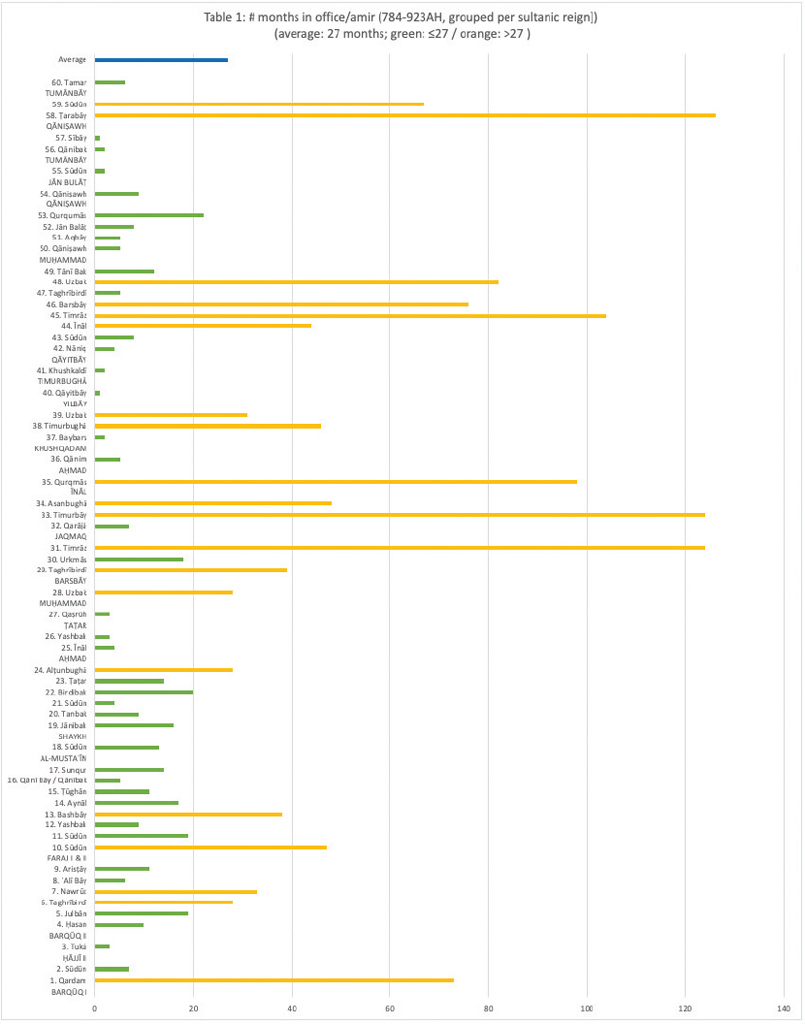
References in contemporary historiographical texts provide information about sixty high-ranking amirs who, between the late eighth/fourteenth and early tenth/sixteenth centuries, were identified as performing the position of âChief Head of the Guardsâ.14 This performance was rather short-lived if not ephemeral for most of these amirs; many periods of service were shorter than the mode average of two years and a few months, and some individuals served for as little as less than a single month (see the green columns in table 1). Only twenty of these sixty amirs served for longer than the mode average (see the orange columns in table 1). The first of these long-serving âHeadsâ was the amir Qardam al-ḤasanÄ« (1), who held the directly related office of âSecond Head of the Guardsâ between 784/1382 and 790/1388, and the last such individuals were the amirs ṬarabÄy al-SharÄ«fÄ« (58) and SÅ«dÅ«n al-DawÄdÄrÄ« (59), who held the office of âChief Head of the Guardsâ more than a century later, between 906/1501 and 922/1516.15
In fact, a historical process of stabilization of the sultanateâs leadership appears from these twenty more enduring cases (also exemplified by the prominence of shorter green columns in the lower half of table 1, and of longer orange ones in the top half). After sixteen amirs who followed in Qardam al-ḤasanÄ«âs footsteps between 790/1380 and 815/1412 (table 1, numbers 2 to 17), a quick succession of no fewer than ten amirs (18 to 27) performed the senior court office of âChief Head of the Guardsâ during the reigns of Sultan al-Muʾayyad Shaykh and his immediate successors (815â25/1412â22), and another set of three amirs (28, 29, 30) succeeded each other in this office during the first years of Sultan al-Ashraf BarsbÄyâs reign (825â31/1422â8). Eventually, in September 1428 (DhÅ« l-Ḥijja 831) TimrÄz al-QirmishÄ« (31) emerged as the first to remain in office for an entire decade, until September 1438 (RabÄ«Ê¿ al-Awwal 842) and the quick dissolution of both BarsbÄyâs court and that of his son and successor. This feat of long tenure was then repeated by the amir TimurbÄy al-TimurbughÄwÄ« (33), who remained in office for most of the reign of Sultan al-áºÄhir Jaqmaq (842â57/1438â53), from March 1439 (ShawwÄl 842) until TimurbÄyâs death in April 1449 (á¹¢afar 853). TimurbÄyâs tenure was then continued by AsanbughÄ al-NÄá¹£irÄ« al-ṬayyÄrÄ« (34) until he also passed away, in March 1453 (RabÄ«Ê¿ al-Awwal 857) in the course of the dissolution of Jaqmaqâs court. The amir QurqmÄs al-AshrafÄ« al-Jalab (35) thereupon appeared on the scene, performing the office of âChief Head of the Guardsâ during the entire reign of Sultan al-Ashraf ĪnÄl (857â65/1453â61), from March 1453 (RabÄ«Ê¿ al-Awwal 857) until February 1461 (JumÄdÄ l-ŪlÄ 865). During Sultan al-áºÄhir Khushqadamâs reign (865â72/1461â7), the amir TimurbughÄ al-áºÄhirÄ« (38) performed the office of âChief Head of the Guardsâ between October 1461 (DhÅ« l-Ḥijja 865) and May 1465 (Ramaá¸Än 869), whereupon the amir Uzbak min Ṭuá¹ukh al-SÄqÄ« (39) took over and remained in office until October 1467 (RabÄ«Ê¿ al-Awwal 872). Out of eight amirs (42â9) who performed the office of âChief Head of the Guardsâ during the very long reign of Sultan al-Ashraf QÄyitbÄy (872â901/1468â96), four stayed in office for longer than average periods, including notably TimrÄz al-ShamsÄ« (45) (July 1473âDecember 1481/á¹¢afar 878âShawwÄl 886), BarsbÄy QarÄ (46) (January 1482âFebruary 1488/DhÅ« l-QaÊ¿da 886âRabÄ«Ê¿ al-Awwal 893) and Uzbak al-YÅ«sufÄ« (48) (March 1489âNovember 1495/RabÄ«Ê¿ al-Äkhir 894âá¹¢afar 901). Only two amirs, finally, performed the office of âChief Head of the Guardsâ during the reign of Sultan QÄniá¹£awh al-GhawrÄ« (906â22/1501â16): the afore-mentioned ṬarabÄy al-SharÄ«fÄ« (58) from February 1501 (Rajab 906) until his death in April 1511 (Muḥarram 917), and SÅ«dÅ«n al-DawÄdÄrÄ« (59) from May 1511 (á¹¢afar 917) until October 1516 (Ramaá¸Än 922).
![number of months in office/amir (784â923 AH, [grouped per sultanic reign]) (average: 27 months; green: ⤠27 / orange: > 27)](/skin/a85f4cb0348593ef33a420a7855a6f4988539ef8/img/Blank.svg)
number of months in office/amir (784â923 AH, [grouped per sultanic reign]) (average: 27 months; green: ⤠27 / orange: > 27)
Citation: Journal of the Economic and Social History of the Orient 65, 5-6 (2022) ; 10.1163/15685209-12341583
From the 1420s and the reign of al-Ashraf BarsbÄy onwards, therefore, fourteen amirs appear most prominently on the courtly stage in the capacity of its âChief Head of the Guardsâ. Before the latter four and two (44, 45, 46, 48; 58, 59) who dominated the 1470s to the 1490s and the period from 1501 to 1516 respectively, eight amirs (28, 29, 31, 33, 34, 35, 38, 39) performed this office in an almost continuous succession between the 1420s and the 1460s. Among these eight, the careers of TimrÄz al-QirmishÄ« (31) and TimurbÄy al-TimurbughÄwÄ« (33) in this court office stand out, given that after four unstable decades of almost thirty predominantly short terms in office (2â30), these amirs managed to remain in office for a decade each, from 1428 to 1449. Their tenures thus marked a rapid stabilization of amirsâ connections with this office that in general continued until the end of Uzbak min Ṭuá¹ukhâs term (39) in 1467, and then resumed during the reign of QÄyitbÄy and again during that of QÄniá¹£awh.
At the same time, however, as the latter two breaks in this stabilizing sequenceâbetween 1467 and 1469 (40â43) and again between 1495 and 1501 (49â57)âalso indicate (as does the return of two sequences of green columns in the top half of table 1), these stabilizing relationships of leadership represent a more haphazard and contingent process than a generalizing overview suggests. The transition from TimrÄz to TimurbÄy in 1438â9, including the short tenure of QarÄjÄ al-ḤasanÄ« (32) between September 1438 and March 1439 (Rajab-ShawwÄl 842), coincided with, and was in fact caused by, the violent circumstances of the dissolution of BarsbÄyâs old court and political order (dawla) and the installation of Jaqmaqâs new one. The same happened in 1453, with the transition to ĪnÄlâs reign and the accession of QurqmÄs al-AshrafÄ« al-Jalab (35) to the position of âChief Head of the Guardsâ. A radical and violent re-shuffling of senior court positions in 1461 similarly marked the end of QurqmÄsâ tenure and, after the brief passage in this office by two other amirs (36â7), the investiture of TimurbughÄ al-áºÄhirÄ« (38) in October 1461. When TimurbughÄ was transferred to the court position of âAmir of the Councilâ (amÄ«r majlis) in May 1465, the amir Uzbak min Ṭuá¹ukh al-SÄqÄ« (39) took over as âChief Head of the Guardsâ for the remainder of Khushqadamâs reign, until late October 1467 (RabÄ«Ê¿ al-Awwal 872), when after Khushqadamâs demise he was made the sultanâs representative (nÄʾib al-salá¹ana) in Damascus. At that time, at the start of the short-lived reign of Sultan al-áºÄhir YilbÄy, the amir (and soon to be sultan) QÄyitbÄy (40) was made âChief Head of the Guardsâ for only the briefest period, from 9 November to 4 December 1467 (11 RabÄ«Ê¿ al-Äkhir to 7 JumÄdÄ l-ŪlÄ 872). During the subsequent similarly short-lived reign of Sultan (and former âChief Head of the Guardsâ) al-áºÄhir TimurbughÄ, the amir KhushkaldÄ« al-BaysaqÄ« (41) performed the court position of âChief Head of the Guardsâ. This tenure lasted less than two months, from 6 December 1467 to 30 January 1468 (9 JumÄdÄ l-ŪlÄ - 7 Rajab 872), when KhushqaldÄ« fled the court, after the aborted attempt by his companion al-Ê¿Ädil Khayrbak to secure sultanic authority, and the enthronement of Sultan al-Ashraf QÄyitbÄy. This total disruption of the sultanateâs leadership and this rivalry between different leadership groups in the later 1460s only slowly subsided in the course of the first two years of QÄyitbÄyâs reign.16 During these and subsequent years, and after the quick succession of another two amirs (42â3) who both held the position for just a handful of months each, tenure of the office of âChief Head of the Guardsâ again stabilized, with two sequential appointees each holding office for a longer than average period of time. Amir ĪnÄl al-Ashqar (44) was appointed to the position in December 1469 (JumÄdÄ l-Äkhira 874), and upon his transfer to the court office of âAmir of Armsâ (amÄ«r silÄḥ) in July 1473 (á¹¢afar 878) he was succeeded by TimrÄz al-ShamsÄ« (45), who, as mentioned, remained in office for more than eight years. The similarly disruptive and violent times that marked the transition from QÄyitbÄy to QÄniá¹£awh at the end of the century took even longer to settle down.17 The unsuccessful attempts of four sultans, including QÄyitbÄyâs son al-NÄá¹£ir Muḥammad (r. 901â3/1496â8), to establish their authority between 1496 and 1501 (901â6) again also manifested in the relatively quick succession of eight amirs (50â7) in the position of âChief Head of the Guardsâ, until in February 1501 (Rajab 906) ṬarabÄy al-SharÄ«fÄ« (58) was appointed and remained in office during the first decade of Sultan QÄniá¹£awhâs reign.
As we examine this list of the sixty âChief Heads of the Guardsâ more closely, we see that the stabilization of tenure of this office was tied less to any process of ninth/fifteenth-century institutionalization than to the repeated successes of the disruptive reconstruction of leadership ties and claims around a handful of the centuryâs different sultans. After the highly unstable decades that marked the turn of the century, the social practice of ninth/fifteenth-century Syro-Egyptian leadership ensured that every time the violence and disruption of a transitional phase receded, those ties and claims settled down around a new sovereign courtly order and its performers. The leadership ranks of these closely tied performers obviously included the âChief Head of the Guardsâ and the other âLords of the Officesâ, and their ranks and ties stabilized in the consolidation of a new sultanâs rise to central power. TimrÄz al-QirmishÄ« thus performed the position of âChief Head of the Guardsâ in the formation of Sultan BarsbÄyâs court; TimurbÄy and, after his death, AsanbughÄ did the same at Jaqmaqâs court, as did QurqmÄs at ĪnÄlâs, and TimurbughÄ and Uzbak min Ṭuá¹ukh at Khushqadamâs. Between 1469 and 1496 ĪnÄl al-Ashqar, TimrÄz, BarsbÄy and Uzbak al-YÅ«sufÄ« succeeded each other as âChief Head of the Guardsâ at Sultan QÄyitbÄyâs longstanding court; and between 1501 and 1516 ṬarabÄy and, after his death, SÅ«dÅ«n similarly contributed to the formation of QÄniá¹£awhâs court.
In this process of the repeated formation of the court and political order of six sultans, social infrastructures such as that of the court office of âChief Head of the Guardsâ obviously mattered. In fact, seen from the perspective of the ninth/fifteenth-century Syro-Egyptian leadershipâs social profile, these infrastructures appear as very visible markers, and even conduits, of the stabilization of particular sets of social ties and leadership claims. The direct parallels between the recurrent stabilization of the office of âChief Head of the Guardsâ in the hands of particular individuals on the one hand and of wider courtly orders on the other hand suggest how the performance and constitution of such infrastructures were indeed highly social phenomena, closely related to the formation and empowerment of particular social groups. The court office of the âChief Head of the Guardsâ and the other âLords of the Officesâ identified, distinguished, and âproducedâ individuals as leading members not only of the court in general, but also of a particular close-knit courtly group of strongmen. Once this groupâs ties and claims to power stabilized, competition between its members was minimized by the shared concern for the maintained performance of the courtly order that best served their interests, as suggested by, and as resulting in, equally stabilizing and long office tenures.
1.2 The Contingent Survival of mamlÅ«k Peers, 782â923/1380â1517
Any of these strongmenâs violent and then also performative rises to courtly distinction and leadership stability evidently represented only one set of ties, claims, and experiences amidst many others. The further study of these ties, claims, and experiences and of this leadershipâs social profile more in general lies beyond the scope of the current paper.18 Nevertheless, the changing profiles of the sixty senior amirs who performed the court office of the âChief Head of the Guardsâ already allow certain inferences that may inform more general inquiries across the entire range of groups of strongmen. On the one hand, as has already been observed in various earlier publications on ninth/fifteenth-century Syro-Egyptian politics, differences in mamlÅ«k origins of successive âChief Heads of the Guardsâ suggest that successive groups of strongmen also belonged to different generational cohorts.19 On the other hand, parallels and shifts in previous leadership experiences suggest that membership of these small groups of strongmen was defined along more than mere generational lines.20
The most important generational breaks occurred in the middle of the century, with the installation in 857/1453 of sultan ĪnÄl and his courtly order, and at the turn of the century, with the stabilization of leadership from 906/1501 onwards around Sultan QÄniá¹£awh. Prior to 857/1453, almost all âChief Heads of the Guardsâ shared several years of mamlÅ«k service in the royal households of Sultan BarqÅ«q during the 1380s and â90s, or of his son Faraj during the opening decade of the ninth/fifteenth century.21
After 857/1453, and for most of the remainder of the century, almost all âChief Heads of the Guardsâ had arrived in Egypt in the 1420s, â30s and â40s, as mamlÅ«k members of the royal households of BarsbÄy and, especially, Jaqmaq. Indeed, while sultan ĪnÄlâs âChief Head of the Guardsâ QurqmÄs (35) started his career in mamlÅ«k service to sultan BarsbÄy,22 the most important âChief Headsâ during and after Khushqadamâs reign in the 1460s had been mamlÅ«ks of Jaqmaq.23 This was also true for the later Sultan QÄyitbÄy (40), who briefly acted as âChief Head of the Guardsâ in RabÄ«Ê¿ al-Awwal-JumÄdÄ l-ŪlÄ 872/November-December 1467, during the short-lived reign of Sultan YilbÄy. QÄyitbÄy allegedly arrived in Egypt in 839/1435â6, when he was in his late teens. He then appears to have been acquired as a mamlÅ«k for Sultan BarsbÄy, only to be manumitted a handful of years later while he was in Sultan Jaqmaqâs royal service.24 Similar connections of mamlÅ«k service to Sultan Jaqmaq continued to mark most âChief Heads of the Guardsâ during the long reign of Sultan QÄyitbÄy.25 The continuity of this association, from the 1460s to the 1490s, with Jaqmaqâs royal household is also attested by references to continued marriage ties with Sultan Jaqmaqâs family. Uzbak min Ṭuá¹ukh al-SÄqÄ« (39), âChief Head of the Guardsâ between 869/1465 and 872/1467, was said to have married one (or two) of Jaqmaqâs daughters during his term of office.26 TimrÄz al-ShamsÄ« (45), originally a mamlÅ«k of Sultan BarsbÄy and manumitted by his son al-Ê¿AzÄ«z YÅ«suf, is reported to have married one of Jaqmaqâs granddaughters shortly after his accession to the position of âChief Head of the Guardsâ in July 1473/á¹¢afar 878.27
After 901/1496, finally, a third and final clear generational shift occurred. By that time, at the accession of the sultanateâs penultimate Sultan QÄniá¹£awh, most âChief Heads of the Guardsâ had started to share origins in the dense ranks of Sultan QÄyitbÄyâs former mamlÅ«ks, the majority of whom had been acquired and manumitted in the 1470s and â80s.28 This was also the case for Sultan QÄniá¹£awh (54) himself, who briefly performed the position of âChief Head of the Guardsâ in 905/1500, and who, as Carl Petry in his biographical study concluded, âwas purchased for military service and imported into Egypt during the early years of QÄytbÄyâs reignâ.29
1.3 The Contingent Careerism of Veteran Strongmen, 782â923/1380â1517
Broadly speaking, all âChief Heads of the Guardsâ can be situated within one of three different generations of mamlÅ«k peers that originated especially in the royal households of BarqÅ«q and his son, of Jaqmaq, and of QÄyitbÄy. In addition to these three major generational continuities and breaks, and to the aforementioned interlocking overarching processes of stabilization and repeated courtly reconfiguration, the group of âChief Headsâ is also marked by parallel careers that display remarkably synchronous micro-chronologies. A long time separates QÄniá¹£awhâs purchase and import âduring the early years of QÄytbÄyâs reignâ, around 1470, and his brief appearance as âChief Head of the Guardsâ in 1500. This substantial gap of several decades between arriving in Egypt as a young mamlÅ«k and rising to courtly distinction actually marks the career of most prominent âChief Heads of the Guardsâ. The biography of QÄyitbÄy, who arrived in 1435â6 and was briefly âChief Head of the Guardsâ in 1467, offers another case in point, as does that of TimrÄz al-ShamsÄ« (45), who arrived in Egypt in 836/1432â3 and was manumitted by sultan al-Ê¿AzÄ«z YÅ«suf b. BarsbÄy in 842/1438, but only rose to courtly distinction and the office of âChief Head of the Guardsâ in 878/1473, during those same âearly years of QÄytbÄyâs reignâ.30 Several decades as well as changes of leaderships and courts similarly separated the appointments of TimrÄz al-QirmishÄ« (31) and TimurbÄy al-TimurbughÄwÄ« (33) to the position of âChief Head of the Guardsâ, in 1428 and 1439 respectively, and their mamlÅ«k origins in the 1390s and the 1400s.31 What these many years of military and related service and gradual empowerment actually looked like for many of these amirs is illustrated by the well-known cases of, again, QÄyitbÄy and QÄniá¹£awh. Their modern biographer Carl Petry aptly summarizes how the latter âwas already fortyâ when he
received his first significant office in DhÅ«âl-QaÊ¿da of 886/December 1481âJanuary 1482, when QÄytbÄy named him inspector (kÄshif) of Upper Egypt. [â¦] Nothing more was said about al-GhawrÄ« until he was promoted to the rank of amir of ten in RabÄ«Ê¿ II 889/AprilâMay 1484, and designated to ride in the abortive Ottoman expedition of that year. Soon thereafter, he began an extended tour of duty in Syria and southeastern Anatolia when QÄytbÄy assigned him the governorship over the march town of ṬarsÅ«s. From this time on we hear more of al-GhawrÄ«, who appears to have been a reliable, if somewhat ruthless, provincial administrator.32
Unlike QÄniá¹£awhâs âextended tour of duty in Syria and southeastern Anatoliaâ, which included also further terms of office as chamberlain in Aleppo and as royal representative in Malaá¹ya before âbeing recalled [â¦] to Cairoâ to become âChief Head of the Guardsâ in 905/1500,33 QÄyitbÄyâs career prior to his rise to the position of âChief Head of the Guardsâ in 872/1467 was a far courtlier affair throughout. As Carl Petry again summarized, Sultan Jaqmaq promoted QÄyitbÄy
to the office of third executive secretary (dawÄdÄr thÄlith). Following Jaqmaqâs decease and ĪnÄlâs succession [in 857/1453] [â¦] he was advanced to the rank of amir of ten. ĪnÄlâs successor, Khushqadam, promoted QÄytbÄy to an amirship of forty and granted him the superintendancy of royal provisions (shÄdd al-shurÄbkhÄnÄh). Soon thereafter [in 868/1464], QÄytbÄy received the ultimate rank of an officerâs career, the commandership of a thousand MamlÅ«ks (taqaddimat alf) [sic], and thereby entered the ruling oligarchy.34
These two careers of service on the peripheries and at the center of the sultanate were not just unusually successful, crowned as they both were by accession to sultanic authority, but also exemplary for the careers of most amirs who rose to courtly leadership and, especially, the position of âChief Head of the Guardsâ. Their promotions to high office all followed an âextended tour of dutyâ in the sultanateâs center or peripheries, which kept most of themâas Petry also noted for QÄytbÄyâânoticeably absent from [contemporary chroniclersâ] comments on distinctive service or political intrigueâ.35 This model of slow leadership-building in the sultanateâs socio-political margins followed by a swift rise to courtly prominence certainly marks the career of TimrÄz al-QirmishÄ« (31). TimrÄz is reported to have acted for many years as a royal representative at QalÊ¿at al-RÅ«m and then at Gazza before being called to Cairo by sultan BarsbÄy in ShawwÄl 831/JulyâAugust 1428 to become amir commander (amÄ«r muqaddam) and âChief Head of the Guardsâ.36 This model similarly marks what is known about TimurbÄy al-TimurbughÄwÄ« (33). His career is reported to have started in the early 1420s with the positions of third and then second executive secretary at the court, accompanied by promotions to the ranks of amir first of ten and then of forty. At the start of Jaqmaqâs reign in early 842/late 1438, the second executive secretary TimurbÄy was rewarded for siding with Jaqmaq in the succession struggle and made an amir commander (amÄ«r muqaddam). He was then sent away to act as the sultanâs new representative in Alexandria, only to be recalled to Cairo in ShawwÄl 842/March 1439 to assume the position of âChief Head of the Guardsâ at Jaqmaqâs court.37 This career model of slow leadership-building in the slipstream of the sultanateâs successive courts in Cairo appears as the default pattern for the majority of the âChief Heads of the Guardsâ who preceded or succeeded TimurbughÄâs accession in 842/1439.38 The more unusual model of TimrÄz and QÄniá¹£awh, marked by an âextended tour of duty in Syria and southeastern Anatoliaâ, was echoed by the careers of UrkmÄs al-áºÄhirÄ« (30),39 ĪnÄl al-Ashqar (44),40 and to some extent also of the sultanateâs penultimate âChief Headâ SÅ«dÅ«n al-DawÄdÄrÄ« (59). SÅ«dÅ«n occasionally shows up as an amir in contemporary reports of the violent years that led up to QÄniá¹£awhâs accession to the sultanate in 906/1501. Subsequently, however, he remained almost unnoticed during his âtour of dutyâ as a royal representative in Safed and Tripoli until being called to Egypt in 917/1511.41
The case of the âChief Head of the Guardsâ clearly suggests that the chains of leadership ties, claims and experiences, whereby time and again memberships of successive groups of generational peers were whittled down to the limited but effective size of the so-called âLords of the Officesâ, tended to be very long ones. It also suggests that the majority of these chains must have had loose ends. Many from the royal households of BarqÅ«q, Jaqmaq and QÄyitbÄy as well as from their likes must have embarked on âtours of dutyâ in the sultanateâs socio-political margins. Few, however, are known to have eventually risen to courtly prominence, and even fewer survived the eraâs repeated searches for new socio-political stability and the formation of new courtly orders, whenâjust as the contemporary chronicler Ibn IyÄs remarked for the transitional years between the reigns of QÄyitbÄy and QÄniá¹£awhââthe circumstances of the senior amirs (al-umarÄʾ al-muqaddamÄ«n) tended to be extremely volatile due to the occurrence of all kinds of clashes and killings [â¦]â.42 As demonstrated (see table 1), from the sultanateâs sixty âChief Heads of the Guardsâ only twenty veteran amirs sufficiently managed to align their interests with those of their courtly peers so to remain in office for substantial periods of time. And of these twenty, only fourteen stood out as the major âChief Headsâ of the long centuryâs six main sultans, from Uzbak al-áºÄhirÄ« (28) at BarsbÄyâs court to SÅ«dÅ«n al-DawÄdÄrÄ« (59) at QÄniá¹£awhâs.
At the same time, the majority of those who made it to the position of âChief Headâ did so not only after long careers, but also when their individual circumstances of leadership had stabilized enough for them to remain in positions of power, even when their term of office as âChief Head of the Guardsâ ended. Half of all the known end-of-term cases in fact concerned a âChief Headâs transfer to another office, mostly to another courtly position of leadership within the small group of the âLords of the Officesâ, and occasionally to Syria to rule one of its major towns.43 In the other half of cases a âChief Headâs term ended in violence, capture or even death. However, almost all terms of office that ended in a âChief Headâs capture occurred before the stabilization that came with the long tenure of Sultan BarsbÄyâs âChief Headâ TimrÄz (30) from 831/1428 onwards.44 The majority of lethal cases furthermore appears to have been age- and health-related, often naturally ending long careers of leadership.45
The general pattern that therefore emerges is one of extremely powerful veteran survivors of decades of service and political transformation, whoâif and when their courtly position as âChief Headâ stabilized in the wake of a sultanâs empowermentâmonopolized, together with their colleague âLords of the Officesâ, the sultanateâs main leadership ties and claims in a collaborative configuration that remained largely unchallenged until the end of their sultanâs reign. Seen from the perspective of the ninth/fifteenth-century Syro-Egyptian leadershipâs social profile, social infrastructures such as that of the âChief Head of the Guardsâ (as well as, by association, that of the sultan) appear therefore not just as conduits for the stabilization of particular collective sets of social ties and leadership claims, but also as highly valued ultimate prizes to be won by only a very happy few, after long and winding individual careers as fighters, royal agents, and courtiers in the many shadows of the sultanateâs limelight.
2 âThe Chief Head of the Guardsâ and the Social Action of Syro-Egyptian Leadership
2.1 The Blurred Boundaries of Courtly Duties and Privileges
Senior court offices such as that of the âChief Head of the Guardsâ did not only top long careers of service, reward fortunate political choices, award courtly distinction, and confirm individual membership of the dominant leadership group. As social infrastructures, they also canalized wider opportunities and constraints into the endless process of the stabilization of that groupâs membership. Ninth/fifteenth-century manuals of court protocol are very explicit in listing the specific set of opportunities and constraints that in their view belonged to the court office of âChief Head of the Guardsâ.46 Understandings of this court office in modern scholarship have therefore all been primarily informed by descriptions in these manuals, and they have all tended to stress the fact that the âChief Head of the Guardsâ was responsible, with other âHeads of the Guardâ of lower rank, for maintaining discipline, law, and order among the sultanâs mamlÅ«ks.47 This information was especially derived from al-QalqashandÄ«âs (d. 1418) multi-volume á¹¢ubḥ al-AÊ¿shÄ, completed in the early 1410s and well-known to modern scholarship since its publication in the early twentieth century.48 More detail and nuance were added to this rather limited picture from al-SaḥmÄwÄ«âs (d. 1464) al-Thaghr al-BÄsim, completed in the 1440s and more widely accessible only following the publication of its scholarly edition in the early twenty-first century. Picturing the âChief Head of the Guardsâ as an effective intermediary between the sultan and his mamlÅ«ks, al-SaḥmÄwÄ« also lists an interesting range of courtly privileges that were specific to this position.
He was the first to enter with the ruler at the time of the audience session, the one to capture anyone whose capture had been ordered, and the one to sprinkle with sand when the royal signature was taken [â¦] The financial administration over the ShaykhÅ«niyya, the á¹¢arghitmishiyya, the ḤijÄziyya, the green mosque, etc., was vested in him.49
According to these scribal descriptions, the veterans who performed the office of âChief Head of the Guardsâ were supposed to mediate the sultanâs relationship with his personal mamlÅ«ks, to act in the sultanâs name against those who lost his favor, to manage particular religious infrastructures in Cairo with major waqf estates, and to benefit from ceremonial privileges that confirmed their priority status in the sultanâs entourage.
When we compare contemporary narrative reports of what the centuryâs sixty âChief Heads of the Guardsâ actually did to this list of whatâin these two court scribesâ viewsâthey were supposed to do, it becomes apparent that their most prominently described task of mediation between the sultan and his mamlÅ«ks remains remarkably underrepresented in the historiographical record. In fact, the hundreds of âChief Headâ-related references include only two mediation reports.50 In both cases, however, the âChief Headsâ dealings with the sultanâs mamlÅ«ksâwhich were anything but successfulâalso involved mediation by other âlords of the officesâ. Similar impressions of a lack of historiographical interest as well as of greater practical complexity and more collective involvement are left by a handful of reports that relate to al-SaḥmÄwÄ«âs statement that the âChief Head of the Guardsâ was âthe one to capture anyone whose capture had been orderedâ. Again, only four such cases have been recorded that involved a âChief Headâ.51 Three of these reports merely concern the transfer of prominent prisoners to Alexandria, and all mention the equal involvement of various amirs and âlords of the officesâ. In general, this handful of reports about moments of mediation and arrest also connect with a few very particular references to two âChief Headsâ direct involvement in legal rulings (ḥukm) beyond any courtly or military milieu.52 Rather than identifying the specific duties and privileges of a âChief Headâ these sparse references again appear to have to do with a more collective practice that marked the wider group of âLords of the Officesâ for most of the long ninth/fifteenth century, and that related to their all but straightforward direct involvement in the maintenance and enforcement of social, economic, and legal order.53
When we consider contemporary narrative reports of what the centuryâs sixty âChief Heads of the Guardsâ actually did, we find that there is both a practical complexity of continuously blurred boundaries between the courtly duties and privileges of different âLords of the Officesâ and a general absence of any real historiographical interest in what they were supposed to do.54 In fact, most historiographical reportsâeven by historians who were courtly insidersâturn out to prioritize other, non-courtly types of social action. Rather than with any courtly duties or privileges, these more widely recorded types of action align more with the practice of maintaining, and enforcing, social, economic, and legal order. They materialized in the form of a strong entanglement with the sultanateâs exploding number of waqf endowments and of an even stronger organization of that social action around the sultanateâs region-wide politics of violence wielding and resource accumulation.
2.2 The waqfization of the Sultanateâs Leadership Formation
The only set of duties and privileges from al-SaḥmÄwÄ«âs list that is mentioned somewhat more extensively in contemporary narrative reports concerns the administration of particular religious infrastructures in Cairo and of their waqf estates in Egypt and Syria. In all, fifteen historiographical references have so far been identified that confirm this formal connection between the court position of âChief Head of the Guardsâ and what al-SaḥmÄwÄ« identified as âthe administration over the ShaykhÅ«niyya, the á¹¢arghitmishiyya, the ḤijÄziyya, the Green Mosque, etc.â. No fewer than five of these references concern the amir Uzbak al-áºÄhirÄ« (28), who was âChief Head of the Guardsâ in the early days of the formation of sultan BarsbÄyâs court, from 824/1421 until 827/1424.55 Similar references recur for other âChief Heads of the Guardsâ throughout the entire period. In DhÅ« l-QaÊ¿da 820/December 1417, the amirâand later sultanâṬaá¹ar (23), who briefly was âChief Headâ at al-Muʾayyad Shaykhâs court in 820â1/1417â8, âwas appointed to the position of administrator of the ShaykhÅ«niyyaâ, the contemporary historian al-MaqrÄ«zÄ« reported, tellingly adding the explanation that such an appointment was âthe usual practice for the Heads of the Guards.â56 Several âChief Headsâ are indeed recorded to have preceded Ṭaá¹ar in being appointed, including BashbÄy min BÄkÄ« (13), identified as administrator of the á¹¢arghitmishiyya in 809/1406 and of the ShaykhÅ«niyya at the time of his death in office in 811/1408,57 as well as SÅ«dÅ«n al-Ashqar (18) in 815/141258 and both SÅ«dÅ«n al-ḤamzÄwÄ« (11) and SÅ«dÅ«n al-MÄridÄnÄ« (10) in and before 805/1403 respectively.59 Successors of Ṭaá¹ar who were similarly referred to as administrators of, especially, the ShaykhÅ«niyya, include Sultan Jaqmaqâs longstanding âChief Headsâ TimurbÄy (33) and AsanbughÄ (34), QÄnim al-TÄjir (36) at the start of the brief reign of Sultan ĪnÄlâs son Aḥmad, BarsbÄy QarÄ (46) as one of Sultan QÄyitbÄyâs âChief Headsâ, and Sultan QÄniá¹£awhâs last âChief Headâ SÅ«dÅ«n al-DawÄdÄrÄ« (59).60
Appointment to the position of administrator (nÄáºir) of a religious infrastructure meant that one was awarded the responsibility for the management of the flows of resources that were tied to the infrastructureâs maintenance and organization via one or more religious endowments (waqf). The general growth of endowments in the sultanateâs political economy from the mid-eighth/fourteenth century onwardsâalso referred to as a waqfization processâhas been well attested, as have been some of the profound changes that this process generated in the course of the ninth/fifteenth century.61 Daisuke Igarashi has recently surmised that these changes included a growing competition over waqf administratorships as well as the practice of linking the administration of some of the sultanateâs religious infrastructures and their endowments to the courtly positions of the âLord of the Officesâ.62 This resonates with some of the reports about appointments of âChief Headsâ to the position of administrator, which represent them as part of wider occasions that involved the parallel appointments of their courtly peers to similar positions of waqf administrator.63 These connections between courtly positions and waqf administratorships appear therefore to have become an intrinsic, well-known component of these positionsâ privileges and duties. These connections actually stabilized over time around the fixed links between particular high-profile waqf estates and particular court offices, so that, as Igarashi concluded, âthese administratorships became a sort of perquisite of the posts which the appointees would acquireâ.64
As both these general insights and the above-mentioned specific source references suggest, appointments to the ninth/fifteenth-century position of âChief Head of the Guardsâ regularly seem to have involved subsequent appointments to positions of financial administrator (naáºar) of the ShaykhÅ«niyya and the á¹¢arghitmishiyya, two major religious infrastructures on Cairoâs á¹¢alÄ«ba street originally constructed in the mid-eighth/fourteenth century.65 The direct connection between these two administratorships and the âChief Headshipâ was rooted in the careers of the QalÄwÅ«nid grandees who founded these infrastructures as well as in the managerial conditions stipulated by these founders in the original endowment deeds.66 It is only from the early 800s/1400s onwards, however, that this connection became more stable and prominent, or at least more explicitly referenced in the extant narrative source material.67 The historian al-MaqrÄ«zÄ« suggests that these early years of the ninth/fifteenth century actually witnessed a substantial break in the administration of the ShaykhÅ«niyya, and of many other endowed infrastructures in Cairo, involving appropriations by sultan al-NÄá¹£ir Faraj and substantial losses of income.68 It is therefore not unlikely that the direct connection between the position of âChief Head of the Guardsâ and the administration of the ShaykhÅ«niyya, the á¹¢arghitmishiyya and their like emerged as part of the wider transformation and stabilization processes that defined the sultanateâs new leaderships in the decades that followed sultan Farajâs disastrous reign.
In his study of land tenure in Egypt and Syria during the long ninth/fifteenth century, Igarashi referred especially to practical reasons for the emergence of these direct connections between the sultanateâs leading court officials and its major endowment estates. The extensive military and administrative capacities of these officialsâ entourages would have positioned them best to deal with two major challenges: the continuously unstable relationships between Cairo and these endowmentsâ main assets in the sultanateâs rural areas on the one hand and on the other, the substantial and unwieldy sizes of these endowmentsâ estates and their administrations.69 At the same time, however, Igarashi also acknowledges that assuming this task was a potentially highly profitable business. âAn administrator was usually the highest paid official among the staff who received salaries from the waqf.â Moreover, given the fact that the major waqfsâ income tended to âexceed the running expenses of the religious institutions they supported,â administrators âcould access the interests the wÄqif had garnered from the waqf while livingâ and benefit directly from these surplus resources.70
Amidst a general process of waqfization, these quickly stabilizing direct connections between specific administratorships and the courtâs âLords of the Officesâ provided a secure, unchallenged and legitimate access to some of the sultanateâs most important resource flows for these âLordsâ, including for the âChief Head of the Guardsâ. Whereas the actual details of these arrangements eluded contemporary historians, they were clearly considered among the more relevant duties and privileges that court scribes such as al-SaḥmawÄ« associated with the position of âChief Head of the Guardsâ. They tied the âChief Headsâ, their peers and their personal entourages collectively and directly to the management of all the major religious infrastructures and endowment estates that were set up in the course of the later seventh/thirteenth, the eighth/fourteenth and the early ninth/fifteenth centuries, and they allowed them to tap into their urban and rural resource flows throughout their terms of office.
2.3 The Politics of Organized Violence and Resource Accumulation
What seems to have mattered even more to chroniclers and their audiences than these fixed administratorships was a type of social action that did not appear at all in al-SaḥmawÄ«âs and his colleaguesâ descriptions, and that is directly related to the senior military position of âamir commander of 1,000 [troopers]â (amÄ«r muqaddam alf) that was the default rank for a âChief Headâ and his peer âLordsâ. Indeed, the action that is most extensively recorded in contemporary chronicles concerns âChief Headsâ active involvement in a variety of military campaigns at the sultanateâs frontier zones. In all, we have retrieved some one hundred and forty references to no fewer than thirty nine cases of violent campaigning that explicitly attest to the active participation in such displays of military force and violence in the sultanâs service by twenty eight âChief Headsâ.71 These cases ranged from the amir NawrÅ«z al-ḤÄfiáºÄ«âs (7) dispatch by Sultan al-áºÄhir BarqÅ«q to fight the HawwÄra bedouin in Upper-Egypt in 798/1396, to the amir SÅ«dÅ«n al-DawÄdÄrÄ« (59), sent out by Sultan QÄniá¹£awh to northern Syria in 920â1/1514â5 as one of the leading commanders of an extensive military force that was to confront Ottomans and Safavids.72 Just like in these two cases, these displays of military force and violence mostly concern punitive expeditions as well as elaborate military campaigns against subversive bedouin groups in Egypt and against rebellious amirs and Turkmen leaderships in Syria or eastern Anatolia.73 But they also included those high-profile cases when, in the later 820s/mid-1420s, during the reign of BarsbÄy, and again in the mid 840s/early 1440s, during that of Jaqmaq, the âChief Headsâ TaghrÄ«birdÄ« al-MaḥmÅ«dÄ« (29) and TimurbÄy al-TimurbughÄwÄ« (33) took a leading role in maritime operations against, respectively, Cyprus and Rhodes.74
Most importantly, twelve of these twenty-eight campaigning amirs belonged to the ranks of the centuryâs aforementioned fourteen major âChief Headsâ. Their relatively stable terms of office therefore seem to have included not just court service in Cairo, but always also a very active involvement as amirs commanders in the hazardous task of the coercive enforcement of their sultanâs authority in the sultanateâs many peripheries. Furthermore, the centuryâs two major âChief Headsâ for whom so far no similar information has been retrievedâUzbak al-áºÄhirÄ« (28) during Sultan BarsbÄyâs reign and TimurbughÄ al-áºÄhÄ«rÄ« (38) during that of Sultan Khushqadamâ, certainly were no strangers to campaigns and acts of violence.75 In fact, it is very likely that, given their similar military origins and experience, the thirty two other âChief Headsâ were all also at some time in their careers involved in the sultanateâs campaigns, as were most of their peer âLordsâ. QÄyitbÄyâs first and second âChief Headsâ, the amirs NÄniq al-MuḥammadÄ« (42) and SÅ«dÅ«n al-Qaá¹£rÄwÄ« (43), were both in office when they were killed in encounters with Turkmen leaderships in eastern Anatolia, in late 872/mid-1468 and late 873/mid-1469 respectively.76 QÄyitbÄyâs third âChief Headâ, the amir ĪnÄl al-Ashqar (44), participated with many of his colleague âLords of the Officesâ in another major Turkmen campaign in the period 875â7/1470â2.77 Eventually, in mid-879/early 1475âafter his transfer to the position of âAmir of Weaponsâ in 877/1473âseveral months of campaigning against local Bedouin groups in Egyptâs eastern Delta region were cut short by ĪnÄlâs sudden illness and quick demise.78 In late 893/1488, in the course of yet another big campaign on the sultanateâs northern frontier, this time against the Ottomans, another one of QÄyitbÄyâs âChief Heads of the Guardsâ, the amir TaghrÄ« BirdÄ« Ṭaá¹ar al-áºÄhirÄ« (47), is similarly reported to have passed away.79 In general, when we consider the full scope of reported military activities of âChief Headsâ throughout the long ninth/fifteenth century, we see that most of these activities did not prove as lethal as was the case for the amirs NÄniq, SÅ«dÅ«n, ĪnÄl and TaghrÄ« BirdÄ« Ṭaá¹ar during the reign of QÄyitbÄy. Nevertheless, all of these activities of campaigning, policing, fighting, causing havoc and looting along relatively stable but highly permeable frontier zones appear to have unfolded in similar ways. Whatever the actual levels of violence and physical risk involved, many if not most âChief Headsâ emerge from the extant narrative records as very mobile, active, skilled, and seasoned horsemen and military commanders, who throughout their long careers were occasionally severely affected by the violent circumstances of their regular military services to the sultan.
These century-long similarities furthermore also extended to the ways in which the organization of these campaigns were described in contemporary reports. These reports always recounted the deployment of a combination of forces from Cairo, commissioned by the sultan and under the leadership of several âLords of the Officesâ, irrespective of these âLordsâ actual court duties and privileges. In the majority of reported military campaigns involving a âChief Head of the Guardsâ, he is therefore described almost always as one of several participating senior amirs and, occasionally, also as their chief commander (muqaddam, bÄsh or raʾs).80 The extant source material furthermore suggests that this composite organizationâwith one or more âLordsâ and other senior amirs, junior amirs, and an anonymous mass of sultanic mamlÅ«ks81âwas the norm for all of these campaigns, irrespective of whether they targeted Christian strongholds in the Mediterranean, Turkmen insurgents in Anatolia, Arabic chieftains in Egypt, or more formidable foes such as Ottomans and Safavids. At the same time, there were substantial variations in the sizes of these composite campaign forces. The average number of participating âLordsâ and other âamirs commanders of 1,000 [troopers]â was four. However, the six major campaigns that involved a âChief Head of the Guardsâ, all targeting Turkmen foes in eastern Anatolia, included seven up to sixteen âamirs commandersâ, as well as many more junior amirs.82 Further details about the actual organization, deployment and movement of these composite troops mostly remain extremely vague. The only additionalâbut equally vagueâreferences that occasionally feature in chronicle reports in this respect concern these âLordsâ and senior amirsâ personal entourages of servants and mamlÅ«ks, mostly identified as their á¹ulb.83
Of equal, if not more, interest to contemporary historians were the benefits and stipends, including especially an ad hoc stipend (nafaqa, nafaqat al-safar), that all campaigning âChief Headsâ and their peers received from the sultan in return for their military service.84 Thus, according to Ibn IyÄs, the amount that was paid as a nafaqa to the âeleven amirs commanders of 1,000 [troopers] who had been assigned to the [Ottoman] campaign [of 893/1488]â, to âthe amirs of forty and ten [mamlÅ«ks] who numbered about fiftyâ and to the mamlÅ«k troopers came to about 1,000,000 dÄ«nÄr. âThat was considered highly unusualâ, Ibn IyÄs explained,85 as was the fact that this enormous amount would have included a nafaqa of 15,000 dÄ«nÄr for the unfortunate âChief Headâ TaghrÄ« BirdÄ« Ṭaá¹ar al-áºÄhirÄ«.86 More usual figures that are mentioned for the nafaqa of the âChief Headâ and his peer âLordsâ range from 2,000 dÄ«nÄr by the end of Sultan BarsbÄyâs reign, in 841/1437, to 4,000 dÄ«nÄr on the eve of the fatal encounter with the Ottomans, in 922/1516, with the commander of the campaign generally receiving 1,000 dÄ«nÄr more and the other senior and junior amirs as well as the sultanâs mamlÅ«ks gradually less.87 In this way, every time a campaign force was set up, each of its main components received its usual due directly from the sultan, so that not just the commanding amir, his peers from the âLords of the Officesâ, and their juniors, but also the sultanâs mamlÅ«ks could prepare at minimal personal cost.88
In fact, many probably managed to benefit from these additional occasions to tap the sultanâs resources. At least, as also suggested by Ibn IyÄsâ reference to the enormous nafaqa expenditure of 1,000,000 dÄ«nÄr for the Ottoman campaign of 893/1488, these campaigns put a heavy and constant burden on those resources, and offered many opportunities for campaign participants to maximize their share, in cash via the nafaqa, but also in kind, in the format of gifts of horses, camels, textiles, arms and armor, food, and precious robes of honor (khilÊ¿at al-safar).89 Especially during Sultan QÄyitbÄyâs long reign, these politics of resource accumulation appear to have spiraled out of control. Just as with TaghrÄ« BirdÄ« Ṭaá¹ar (47) and his peer âLordsâ in the Ottoman campaign, in the Turkmen campaign of 875/1470 QÄyitbÄyâs âChief Headâ ĪnÄl al-Ashqar (44) and his peers reportedly managed to triple the default nafaqa amounts of their predecessors. At that time, all chroniclers explain how ĪnÄl played these politics of resource accumulation the hard way. When the sultan needed him to leave quickly to northern Syria, ĪnÄl started negotiating for an appointment to Syrian leadership; more importantly, when ĪnÄl eventually completed his military preparations, the personal campaign forces and equipments that he presented before the sultan were considered to substantially fall short of the unprecedented resources (â12,000 dÄ«nÄrâ, âa lot of weapons, cloth, camels, horses and grainâ, as well as âgold and the likeâ) that had been made available to him.90
This flow of benefits is reported to have continued upon the amirsâ return from these campaigns, when they were rewarded for their military service to the sultan, especially by the gift of a precious robe of honor (khilÊ¿a).91 These specific occasions of gift-giving are in fact directly related to various other references to resource flows from which âChief Headsâ as well as all other âLordsâ and amirs are reported to have benefited. These include first and foremost references to the robes of honor that âChief Heads of the Guardâ and their peers received from the sultan on many other occasions, from their formal investiture as âChief Headsâ, to their occasional confirmation in office, and their participation in many of the sultanateâs ceremonies.92 These robes represented not just important tokens of both the sultanâs continued favor and a âChief Headâs distinguished status at court, but also valuable gifts and additions to their wealth.93 Other references concern the reception of occasional or more regular gifts, rewards and ceremonial benefits, as well as prebendal iqá¹ÄÊ¿ allotments changing hands.94
Just as is the case with the afore-mentioned administration of particular waqf assets and infrastructures, these many references to various ad hoc as well as more regular benefits demonstrate how even in contexts of organized violence the office of the âChief Head of the Guardsâ appears above all as one of those valuable organizational platforms that bundled specific arrangements of legitimate opportunities to access the sultanateâs surplus resources, or rather to take part in the endless competition for the sultanateâs assets. This competition materialized first and foremost in endlessly negotiated exchanges of military, economic and other services and benefits between, especially, the sultan and his âLordsâ and amirs. It furthermore aligned in very complex ways not with the running of a bureaucratic apparatus of power and its rationalized division of the labor of leadership, but rather with the many contingencies of maintaining and enforcing order in Cairo as well as in the sultanateâs many peripheries. This complex social practice and the social infrastructures it interacted with repeatedly allowed a selection of veteran strongmen to defend, manage and negotiate their own as well as the sultanateâs interests, and to further their material as well as symbolic distinction as the leading makers of their sultanâs court, and therefore as the sultanateâs men of central power and authority.
3 âChief Heads of the Guardsâ, the Sultanateâs âLords of the Officesâ, and âMilitary Entrepreneurialismâ
The successive empowerments of these stabilizing groups of courtly âLordsâ and the parallel economic and military activities of these highly experienced veteran strongmen and their entourages invite us to consider these sixty âChief Headsâ and their social practice through the interpretive lens of âmilitary entrepreneurialismâ. In a seminal volume organized around historical case studies from early modern Europe and the Ottoman world, Jeff Fynn-Paul, Marjolein ât Hart and Griet Vermeersch suggest that a useful âumbrella definition of the âmilitary entrepreneurâ [â¦] might be âa person who undertakes to supply the state with the means to wage warâ.â They emphasize furthermore the direct link with state formation processes, and explain that
[w]hereas it was once held that entrepreneurs were detrimental to the smooth functioning of military operations, due to their profit-seeking activities, the majority of our authors suggest that entrepreneurs were quite simply the most efficient option for any state to pursue, given the limitations of government at the time. Contracting, therefore, is increasingly looking less like a sign of incapacity, and more like a pragmatic adoption of what would work best.95
The ninth/fifteenth-century Syro-Egyptian sultanate was of course very different from these authorsâ early modern cases, and one should always remain alert to the inevitable bias that comes with the adoption of interpretive models from elsewhere. Military entrepreneurialism can therefore only be legitimately adopted in the present context in its most minimalist, generic and practice-oriented definition, as geared towards the interpretation of a particular, negotiated type of social action that involved supplying the ruler with the means to wage war.96 In this qualified way, the concept of military entrepreneurialism allows us to think about social actors who supply the ruler with these means as being involved in a particular type of social practice that implies empowering strategies of mutual exchange as well as a substantial agency in charting their course of leadership performance. In the specific context of ninth/fifteenth-century Syro-Egyptian state formation, with its haphazardly stabilizing apparatus of courtly order and central leadership, this means that this concept of âmilitary entrepreneurialismâ invites us to consider the contingent, composite and multidirectional nature of this state formation process as well as the constitutive strategies of its different participants. Drawing on this concept enables us to consider the sultanateâs âChief Headsâ and other âLordsâ as much more than mere cogs in, or obstacles to this maelstrom of transformations. It also permits us to give much better credit to the representation in contemporary sources both of the social profile that defined âChief Headsâ as generational peers, veteran survivors and members of close-knit leadership groups, and of the social action of their accumulation of resources and their organization of violence. In fact, the concept of âmilitary entrepreneurialismâ makes it possible for us to consider these highly competitive politics and occasional reconfigurations of different sultansâ courts simultaneously with the relative stabilization of âChief Headsâ social profile as well as of wider leadership arrangements, as a kind of dialectic process of ninth/fifteenth-century state formation. In so doing, we can recognize court offices such as the âChief Headship of the Guardsâ not only as platforms that shaped, and were shaped by, that process, but also as integrative mediators of the agency of these strongmen to negotiate their resource accumulation, violence-wielding and leadership, and thus to participate actively and autonomously in that process, even allowing some former âChief HeadsââṬaá¹ar (23), TimurbughÄ (38), QÄyitbÄy (40) and QÄniá¹£awh (54)âto rise to the position of sultan.
Indeed, considering the dominant contemporary representation of generic opportunities and constraints that were the shared preserve of the sultanateâs veteran âLords of the Officesâ and which ranged from the management of major endowments and the reception of precious gifts to the rallying of military muscle and campaigning in the sultanateâs marches, âmilitary entrepreneurialismâ appears as a very apt common denominator to understand the careers of the sultanateâs sixty âChief Headsâ. Predominantly originating in the royal households of BarqÅ«q and his son, then of Jaqmaq, and ultimately of QÄyitbÄy, the majority of these âChief Headsâ engaged not just in long careers of service in the shadows of the sultanateâs shifting limelight, but also in equally long trajectories of building the personal entourages, connections, expertise and resources required in order for them to survive when most of their peers perished, and to eventually thrive as one of the happy few âLords of the Officesâ. As demonstrated, the latter thriving only became possible from the stabilizing contexts of the 1420s onwards, during the reigns of six sultans, and it specifically defined the terms in office of these sultansâ fourteen major âChief Headsâ. In each of these fourteen cases a balance of leadership ties was achieved that was marked by an apparent lack of strong internal competition as well as by the ongoing negotiation of the alignment of interests. The central stake in all these negotiations is reported to have consisted of access to specific resources: courtly privileges, endowment management, royal gifts in cash and kind, manpower, and military expertise. Social infrastructures such as the court in general and the position of âChief Head of the Guardsâ in particular, acted as the platforms, conduits, and structuring mechanisms for these negotiations, with the outcome defined by precedent or ad hoc arrangements depending on the circumstances. Thus, ad hoc stipends and gift-giving seem in particular to have allowed sultans time and again to contract the necessary means to wage their wars, that is, to deploy the manpower, material and expertise that they needed to deal with specific issues at the many frontiers of their authority. In return, âLordsâ, amirs of different ranks, and even sultanic mamlÅ«ks showed themselves willing to take substantial risks. When successful, this generated profitable solutions for all who were involved in these negotiations, even when these arrangements continuously drained the sultanateâs resources.
Ibn IyÄsâ obituary of âChief Headâ ṬarabÄy al-SharÄ«fÄ« (58) aptly illustrates the scale of the personal entourages and wealth that enterprising amirs and, especially, veteran âLordsâ such as the âChief Heads of the Guardsâ managed to accumulate from such profitable solutions. When ṬarabÄy passed away in Muḥarram 917/April 1511, after a decade of service as Sultan QÄniá¹£awhâs âChief Headâ, Ibn IyÄs explains that âhis mamlÅ«ks were examined by the sultan and distributed over the barracks [that housed the sultanâs own mamlÅ«ks].â According to this contemporary historian, hearsay furthermore had it âthat [ṬarabÄy] had turned out to possess immense wealth, including goods, horses, camels, weapons, textiles, and their like (min amwÄl wa-khuyÅ«l wa-jamÄl wa-silÄḥ wa-birak wa-ghayr dhalika).â Ibn IyÄs then ends his obituary with an insightful personal observation about the successful entrepreneurialism not only of ṬarabÄy and one of his peer âLordsâ, but also of the sultan, when the latter managed to deploy a legal stratagem upon the demise of both that enabled him to, as it were, renegotiate his losses:
[ṬarabÄyâs] wealth exceeded that of the atÄbak QurqmÄs by large. There were only three months and twelve days that separated the passing of the atÄbak QurqmÄs and of the amir ṬarabÄy. [This] was considered the good fortune of Sultan QÄniá¹£awh al-GhawrÄ«, for in the course of this short time he had become the legal heir of both amirs (waritha hÄdhayni l-amÄ«rayn) and he had laid his hands on the known and hidden wealth of both.97
Appendix: List of all âChief Heads of the Guardsâ
Note:
For the period from the 780s/1380s up to 815/1412, there is considerable ambiguity, variation, and confusion in the available source material about the titles raʾs nawba, raʾs nawba kabÄ«r, raʾs nawbat al-nuwab, raʾs nawbat al-umarÄʾ and raʾs nawba thÄnÄ«. Being faced with this complexity when writing his works of history in the middle of the ninth/fifteenth century, Ibn TaghrÄ«birdÄ« offers on some occasions useful clarifications to disentangle these messy titular situations (even though every so often he still continued to add to the confusion). On the position of raʾs nawbat al-umarÄʾ he explains that
this position is currently (=the 840s/1440s) absent in Egypt; this position used to be on a par with that of the atÄbak; it was performed by the amÄ«r kabÄ«r Aytmish al-BajÄsÄ« for many years during the second Sultanate of BarqÅ«q; then it was performed in the reign of al-NÄá¹£ir Faraj by the amir NawrÅ«z al-ḤÄfiáºÄ« and then for a short time by the amir AqbÄy al-ḤÄjib; thereafter, it has been vacant until this day.98
On the position of raʾs nawba thÄnÄ« Ibn TaghrÄ«birdÄ« explains in the annal for 784/1382 that âthis position is now the position of raʾs nawbat al-nuwab, as we have already clarified on several occasions.â99 Given the centrality of the position of raʾs nawbat al-nuwab from the 810s/1410s onwards, some historians indeed confusingly use this title also before the 810s/1410s when they actually refer to the raʾs nawbat al-umarÄʾ. To avoid further confusion, therefore, we offer below a disambiguated list of the handful of amirs who were raʾs nawbat al-umarÄʾ and who occasionally are also referred to in our sources as raʾs nawbat al-nuwab. This is followed by the full list of all amirs who were raʾs nawbat al-nuwab, starting with those who were raʾs nawba thÄnÄ« when there also was a raʾs nawbat al-umarÄʾ and who occasionally are equally referred to in our sources as raʾs nawbat al-nuwab.100
In every case, all the different âChief Headâ titles mentioned in our sources are identified, as well as any other positions that are mentioned simultaneously. All performers of these positions are grouped by a sultanâs reign. The ḥijrÄ« dates of their tenure of this position is added, together with the main relevant source references.
A Raʾs nawbat al-umarÄʾ
al-áºÄhir BarqÅ«q I (784â791)
-
a. Aytmish al-BajÄsÄ« (3/782â4/791):
-
raʾs nawba kabÄ«r, raʾs nawbat al-umarÄʾ, raʾs nawbat al-nuwab + atÄbak al-Ê¿asÄkir/aá¹Äbak
-
Ibn al-FurÄt, TÄrÄ«kh, 55; al-MaqrÄ«zÄ«, SulÅ«k, 3: 388, 478, 599, 600; Ibn TaghrÄ«birdÄ«, NujÅ«m, 11: 180, 226, 237; 13: 12; Ibn TaghrÄ«birdÄ«, Manhal, 3: 144.
-
-
b. QarÄ DamurdÄsh al-AḥmadÄ« (5â6/791):
-
raʾs nawba kabÄ«r + atÄbak al-Ê¿asÄkir + naáºr al-MÄristÄn al-ManṣūrÄ«
-
Ibn al-FurÄt, TÄrÄ«kh, 73 (âinstead of the amir Aytmish al-BajÄsÄ«â), 74, 83, 86.
-
al-Manṣūr ḤÄjÄ« II (791â2)
-
c. Alá¹unbughÄ al-JÅ«bÄnÄ« (6â8/791):
-
raʾs nawba kabÄ«r, raʾs nawbat al-umarÄʾ, raʾs nawbat al-nuwab
-
Ibn al-FurÄt, TÄrÄ«kh, 108, 117; al-MaqrÄ«zÄ«, SulÅ«k, 3: 633; Ibn TaghrÄ«birdÄ«, NujÅ«m, 12: 120; Ibn IyÄs, BadÄʾiÊ¿, 1/2: 406 (âinstead of QarÄ DamurdÄsh al-AḥmadÄ«â), 411.
-
-
d. TamÄn Tamur al-AshrafÄ« (10/791â?):
-
raʾs nawba kabÄ«r, raʾs nawbat al-nuwab + naáºr al-MÄristÄn al-ManṣūrÄ«
-
Ibn al-FurÄt, TÄrÄ«kh, 143; al-MaqrÄ«zÄ«, SulÅ«k, 3: 659; Ibn TaghrÄ«birdÄ«, NujÅ«m, 11: 351 (referring also to other amirs appointed âraʾs nawba/raʾs nawba thÄnÄ«â [= n° 3], âthÄlithâ and ârÄbiÊ¿â)
-
al-áºÄhir BarqÅ«q II (792â801)
-
e. Alá¹unbughÄ al-JÅ«bÄnÄ« (2â3/792):
-
raʾs nawba kabÄ«r, raʾs nawbat al-umarÄʾ, raʾs nawbat al-nuwab + aá¹Äbak
-
Ibn al-FurÄt, TÄrÄ«kh, 9/1: 202, 205; al-MaqrÄ«zÄ«, SulÅ«k, 3: 707, 710; Ibn TaghrÄ«birdÄ«, NujÅ«m, 12: 6, 8, 120.
-
-
f. Aytmish al-BajÄsÄ« (5â6/794â2/800?):
-
raʾs nawba kabÄ«r, raʾs nawbat al-nuwab, raʾs nawbat al-umarÄʾ + aá¹Äbak
-
Ibn al-FurÄt, TÄrÄ«kh, 302, 478; al-MaqrÄ«zÄ«, SulÅ«k, 3: 766, [889]; Ibn TaghrÄ«birdÄ«, NujÅ«m, 12: 37; 13: 12; Ibn TaghrÄ«birdÄ«, Manhal, 3: 144.
-
al-NÄá¹£ir Faraj I (801â805)
-
g. NawrÅ«z al-ḤÄfiáºÄ« (5/802â10/804?):
-
raʾs nawba, raʾs nawba kabÄ«r, raʾs nawbat al-umarÄʾ + atÄbak + naáºr al-khÄnqÄh al-ShaykhÅ«niyya
-
al-MaqrÄ«zÄ«, SulÅ«k, 3: 999, [1085]; Ibn Ḥajar, InbÄʾ, 4: 112; [5: 13]; Ibn TaghrÄ«birdÄ«, NujÅ«m, 12: 197, 199, 299; 13: 199; 14: 128.
-
al-NÄá¹£ir Faraj II (805â815)
-
h. Baktamur al-RuknÄ« (10/805â12/807):
-
raʾs nawbat al-umarÄʾ + atÄbak?
-
al-MaqrÄ«zÄ«, SulÅ«k, 3: 1104 (+ n° 11 appointed raʾs nawba kabÄ«r), [1165]; Ibn TaghrÄ«birdÄ«, NujÅ«m, 12: 299 (âinstead of NawrÅ«z al-ḤÄfiáºÄ«â; + n° 11 appointed raʾs nawbat al-nuwab), 322; Ibn TaghrÄ«birdÄ«, Manhal, 3: 402; al-Malaá¹Ä«, Nayl, 3: 90 (spoken to as âthe atÄbakâ).
-
-
i. ÄqbÄy al-Ṭuruná¹Äʾī (5/808â6/812):
-
raʾs nawbat al-umarÄʾ
-
al-MaqrÄ«zÄ«, SulÅ«k, 4: 11, 129; Ibn Ḥajar, InbÄʾ, 6: 180â1; Ibn TaghrÄ«birdÄ«, NujÅ«m, 13: 48, 176; Ibn TaghrÄ«birdÄ«, Manhal, 2: 466.
-
-
j. Baktamur Jalak al-NÄá¹£irÄ« (?/814â6/815):
-
raʾs nawbat al-umarÄʾ, raʾs nawbat al-nuwab
-
al-Maqrīzī, Sulūk, 4: 196, 203, 239; Ibn Taghrībirdī, Nujūm, 13: 132.
-
B Raʾs nawbat al-nuwab
al-áºÄhir BarqÅ«q I (784â791)
-
1. Qardam al-ḤasanÄ« (10/783 and/or 9/784â10/790):
-
raʾs nawba thÄnÄ«, raʾs nawba, raʾs nawba kabÄ«r, raʾs nawbat al-nuwab
-
Ibn al-FurÄt, TÄrÄ«kh, 36, 37; al-MaqrÄ«zÄ«, SulÅ«k, 3: 478, 584; Ibn TaghrÄ«birdÄ«, NujÅ«m, 11: 227, 320; Ibn TaghrÄ«birdÄ«, Manhal, 9: 53â4; Ibn IyÄs, BadÄʾiÊ¿, 1/2: 295, 321, 392.
-
-
2. SÅ«dÅ«n al-Ṭuruná¹Äʾī (12/790â?):
-
raʾs nawba thÄnÄ«
-
Ibn al-FurÄt, TÄrÄ«kh, 37 (âinstead of the amir Qardam al-ḤasanÄ«â).
-
al-Manṣūr ḤÄjÄ« II (791â2)
-
3. TukÄ al-AshrafÄ« (10/791â?):
-
raʾs nawba, raʾs nawba thÄnÄ«
-
al-MaqrÄ«zÄ«, SulÅ«k, 3: 660; Ibn TaghrÄ«birdÄ«, NujÅ«m, 11: 351 (referring also to other amirs appointed âraʾs nawbat al-nuwabâ [= d] as well as âraʾs nawba thÄlithâ and ârÄbiÊ¿â)
-
al-áºÄhir BarqÅ«q II (792â801)
-
4. Ḥasan QujÄ (?â4/792):
-
raʾs nawba, raʾs nawba kabīr, raʾs nawbat al-nuwab
-
Ibn al-FurÄt, TÄrÄ«kh, 206; al-MaqrÄ«zÄ«, SulÅ«k, 3: 711, 729; Ibn TaghrÄ«birdÄ«, NujÅ«m, 12: 9.
-
-
5. JulbÄn al-KumushbughÄwÄ« QarÄ Saqal (4/792â11/793):
-
raʾs nawba, raʾs nawba kabīr, raʾs nawbat al-nuwab
-
Ibn al-FurÄt, TÄrÄ«kh, 206 (âinstead of the amir Ḥasan QujÄ al-SayfÄ«â), 271; al-MaqrÄ«zÄ«, SulÅ«k, 3: 711, 753; Ibn TaghrÄ«birdÄ«, NujÅ«m, 12: 9; Ibn TaghrÄ«birdÄ«, Manhal, 5: 8.
-
-
6. TaghrÄ« BirdÄ« min BashbughÄ (c.9/794â1/797):
-
raʾs nawba, raʾs nawba thÄnÄ«, raʾs nawba kabÄ«r, raʾs nawbat al-nuwab
-
Ibn al-FurÄt, TÄrÄ«kh, 259, 306, 396; Ibn TaghrÄ«birdÄ«, NujÅ«m, 12: 59, 76; Ibn TaghrÄ«birdÄ«, Manhal, 4: 36; 5: 8 (âmy fatherâGod rest his soulâwas appointed raʾs nawbat al-nuwab after [JulbÄn QarÄ Saqal])â
-
-
7. NawrÅ«z al-ḤÄfiáºÄ« (7/797â5/800):
-
raʾs nawba thÄnÄ«, raʾs nawba á¹£aghÄ«r thÄnÄ«, raʾs nawba, raʾs nawbat al-nuwab
-
Ibn al-FurÄt, TÄrÄ«kh, 406 (âinstead of the amir Sayf al-DÄ«n TaghrÄ« BirdÄ« min QashbughÄ [sic]â); Ibn TaghrÄ«birdÄ«, NujÅ«m, 12: 78; 14: 128; Ibn TaghrÄ«birdÄ«, Manhal, 8: 247, 392; 12: 34.
-
-
8. Ê¿AlÄ« BÄy (5â11/800):
-
raʾs nawba, raʾs nawba kabīr, raʾs nawbat al-nuwab
-
Ibn Ḥajar, InbÄʾ, 3: 393; Ibn TaghrÄ«birdÄ«, NujÅ«m, 12: 78 (âinstead of NawrÅ«z al-ḤÄfiáºÄ«â), 88; Ibn TaghrÄ«birdÄ«, Manhal, 8: 247.
-
-
9. Arisá¹Äy min KhwÄjÄ Ê¿AlÄ« (11/800â10/801):
-
raʾs nawba, raʾs nawba kabīr, raʾs nawbat al-nuwab
-
al-MaqrÄ«zÄ«, SulÅ«k, 3: 908, 962â3; Ibn Ḥajar, InbÄʾ, 3: 393 (appointed âin the rank of muqaddam of Ê¿AlÄ« BÄy as well as in his office, which is [that of] the raʾs nawba kabÄ«râ); [4: 29]; Ibn TaghrÄ«birdÄ«, NujÅ«m, 12: 88, 174â5; Ibn IyÄs, BadÄʾiÊ¿, 1/2: 507, 539, 540, 543.
-
al-NÄá¹£ir Faraj I (801â808)
-
10. SÅ«dÅ«n al-MÄridÄ«nÄ« (11/801â10/805):
-
raʾs nawba, raʾs nawba kabÄ«r, raʾs nawbat al-nuwab + naáºr ShaykhÅ«
-
al-MaqrÄ«zÄ«, SulÅ«k, 3: 967 (âinstead of Arisá¹Äyâ), 1104, 1105; Ibn Ḥajar, InbÄʾ, 5: 78; Ibn TaghrÄ«birdÄ«, NujÅ«m, 12: 175, 178, 299; Ibn TaghrÄ«birdÄ«, Manhal, 4: 144; 6: 125, 141.
-
-
11. SÅ«dÅ«n al-ḤamzÄwÄ« (10/805â5/807):
-
raʾs nawba, raʾs nawba kabÄ«r, raʾs nawbat al-nuwab + naáºr ShaykhÅ«
-
al-MaqrÄ«zÄ«, SulÅ«k, 3: 1104 (âinstead of SÅ«dÅ«n al-MÄridÄ«nÄ«â), 1105, 1137, 1141; Ibn Ḥajar, InbÄʾ, 5: 77â8, 199â201; Ibn TaghrÄ«birdÄ«, NujÅ«m, 12: 299 (+ n° h appointed raʾs nawbat al-umarÄʾ); Ibn TaghrÄ«birdÄ«, Manhal, 4: 144; 6: 125, 287.
-
-
12. Yashbak Ibn Azdamur (5/807â2/808):
-
raʾs nawba, raʾs nawba kabīr, raʾs nawbat al-nuwab
-
al-MaqrÄ«zÄ«, SulÅ«k, 3: 1141 (âinstead of SÅ«dÅ«n al-ḤamzÄwÄ«â), 1171; Ibn Ḥajar, InbÄʾ, 5: 204, 276; Ibn TaghrÄ«birdÄ«, NujÅ«m, 12: 323; 14: 129; Ibn TaghrÄ«birdÄ«, Manhal, 3: 218; 12: 131.
-
al-Manṣūr ʿAbd al-ʿAzīz (808)
al-NÄá¹£ir Faraj II (808â815)
-
13. BashbÄy al-ḤÄjib min BÄkÄ« (3/808â6/811):
-
raʾs nawba, raʾs nawba kabÄ«r, raʾs nawbat al-nuwab + naáºr al-ShaykhÅ«niyya & madrasat á¹¢arghitmish
-
al-MaqrÄ«zÄ«, SulÅ«k, 3: 1174 (âinstead of Yashbak b. Azdamurâ); 4: 77, 78, 88; Ibn Ḥajar, InbÄʾ, 5: 280, 287â8; 6: 92; Ibn TaghrÄ«birdÄ«, NujÅ«m, 12: 324; 13: 74, 172; Ibn TaghrÄ«birdÄ«, Manhal, 3: 366; al-á¹¢ayrafÄ«, Nuzha, 2: 210, 213, 235, 248.
-
-
14. AynÄl al-MuḥammadÄ« al-SÄqÄ« á¸uá¸aÊ¿ (6/811â10/812):
-
raʾs nawba, raʾs nawba kabīr, raʾs nawbat al-nuwab
-
al-MaqrÄ«zÄ«, SulÅ«k, 4: 78 (âinstead of the amir BashbÄyâ), 121; Ibn Ḥajar, InbÄʾ, 6: 173; Ibn TaghrÄ«birdÄ«, NujÅ«m, 13: 74, 100; Ibn TaghrÄ«birdÄ«, Manhal, 3: 204, 206.
-
-
15. ṬūghÄn al-ḤasanÄ« (c.10/812?âc.9/813):
-
raʾs nawba, raʾs nawba kabīr, raʾs nawbat al-nuwab
-
al-Maqrīzī, Sulūk, 4: 133; Ibn Taghrībirdī, Nujūm, 13: 102, 115.
-
-
16. QÄnÄ« BÄy / QÄnÄ«bak al-MaḥmÅ«dÄ« al-áºÄhirÄ« (c.9/813?â2/814):
-
raʾs nawba, raʾs nawba kabīr, raʾs nawbat al-nuwab
-
al-MaqrÄ«zÄ«, SulÅ«k, 4: 150, 178, 201; Ibn Ḥajar, InbÄʾ, 7: 6â7; Ibn TaghrÄ«birdÄ«, NujÅ«m, 13: 122, 185; 14: 135; Ibn TaghrÄ«birdÄ«, Manhal, 9: 18; al-SakhÄwÄ«, á¸awʾ, 6: 198.
-
-
17. Sunqur al-RÅ«mÄ« (2/814â4/815):
-
raʾs nawba kabīr, raʾs nawbat al-nuwab
-
al-MaqrÄ«zÄ«, SulÅ«k, 4: 178 (âinstead of QanibÄyâ), 234; al-Ê¿AynÄ«, Ê¿Iqdâ1985, 132, 134; Ibn TaghrÄ«birdÄ«, NujÅ«m, 13: 122, 203; Ibn TaghrÄ«birdÄ«, Manhal, 6: 147.
-
al-Mustaʿīn (815)
-
18. SÅ«dÅ«n al-Ashqar (4/815â5/816):
-
raʾs nawbat al-nuwab, raʾs nawba, raʾs nawba kabÄ«r + naáºr madrasat ShaykhÅ« & madrasat á¹¢arghitmish
-
al-MaqrÄ«zÄ«, SulÅ«k, 4: 234 (âinstead of the amir Sunqur al-RÅ«mÄ«â), 246, 265; al-Ê¿AynÄ«, Ê¿Iqdâ1985, 134, 136, 169; Ibn Ḥajar, InbÄʾ, 7: 110; Ibn TaghrÄ«birdÄ«, NujÅ«m, 13: 203; 14: 4; Ibn TaghrÄ«birdÄ«, Manhal, 6: 147â8, 291.
-
al-Muʾayyad Shaykh (815â824)
-
19. JÄnibak al-ṢūfÄ« (5/816â9/817):
-
raʾs nawbat al-nuwab, raʾs nawba, raʾs nawba kabīr
-
al-MaqrÄ«zÄ«, SulÅ«k, 4: 265, 285; al-Ê¿AynÄ«, Ê¿Iqdâ1985, 169, 206; Ibn Ḥajar, InbÄʾ, 7: 110, 148; Ibn TaghrÄ«birdÄ«, NujÅ«m, 14: 8, 24; Ibn TaghrÄ«birdÄ«, Manhal, 4: 224; 6: 148, 291.
-
-
20. Tanbak Miyiq (9/817â6/818):
-
raʾs nawbat al-nuwab, raʾs nawba, raʾs nawba kabīr
-
al-MaqrÄ«zÄ«, SulÅ«k, 4: 285, 325, 326; al-Ê¿AynÄ«, Ê¿Iqdâ1985, 206, 231; Ibn Ḥajar, InbÄʾ, 7: 148, 192; Ibn TaghrÄ«birdÄ«, NujÅ«m, 14: 24, 34; Ibn TaghrÄ«birdÄ«, Manhal, 4: 13; 6: 150, 301.
-
-
21. SÅ«dÅ«n al-QÄá¸Ä« (7â11/818):
-
raʾs nawbat al-nuwab, raʾs nawba, raʾs nawba kabīr
-
al-MaqrÄ«zÄ«, SulÅ«k, 4: 326, 336; al-Ê¿AynÄ«, Ê¿Iqdâ1985, 232; Ibn Ḥajar, InbÄʾ, 7: 188, 192; Ibn TaghrÄ«birdÄ«, NujÅ«m, 14: 34, 38; Ibn TaghrÄ«birdÄ«, Manhal, 6: 150, 160.
-
-
22. Birdibak al-KhalÄ«lÄ« Qiá¹£qÄ (11/818â7/820):
-
raʾs nawbat al-nuwab, raʾs nawba, raʾs nawba kabīr
-
al-MaqrÄ«zÄ«, SulÅ«k, 4: 336, 413; al-Ê¿AynÄ«, Ê¿Iqdâ1985, 239; Ibn Ḥajar, InbÄʾ, 7: 188, 262; Ibn TaghrÄ«birdÄ«, NujÅ«m, 14: 38, 56; Ibn TaghrÄ«birdÄ«, Manhal, 3: 250; 6: 150, 305.
-
-
23. Ṭaá¹ar (7/820â9/821):
-
raʾs nawbat al-nuwab, raʾs nawba, raʾs nawba kabÄ«r + naáºr al-ShaykhÅ«niyya
-
al-MaqrÄ«zÄ«, SulÅ«k, 4: 413, 425; al-Ê¿AynÄ«, Ê¿Iqdâ1985, 294, 320; Ibn Ḥajar, InbÄʾ, 7: 262; Ibn TaghrÄ«birdÄ«, NujÅ«m, 14: 56; Ibn TaghrÄ«birdÄ«, Manhal, 3: 250; 6: 305, 398.
-
-
24. Alá¹unbughÄ min Ê¿Abd al-WÄḥid al-á¹¢aghÄ«r (9/821â1/824):
-
raʾs nawbat al-nuwab, raʾs nawba, raʾs nawba kabīr
-
al-MaqrÄ«zÄ«, SulÅ«k, 4: 565â6; al-Ê¿AynÄ«, Ê¿Iqdâ1985, 320; Ibn TaghrÄ«birdÄ«, NujÅ«m, 14: 172; Ibn TaghrÄ«birdÄ«, Manhal, 3: 66; 6: 398.
-
al-Muáºaffar Aḥmad (824)
-
25. ĪnÄl al-JakamÄ« (1â5/824):
-
raʾs nawbat al-nuwab, raʾs nawba, raʾs nawba kabīr
-
al-MaqrÄ«zÄ«, SulÅ«k, 4: 565â6, 578; al-Ê¿AynÄ«, Ê¿Iqdâ1989, 123, 140; Ibn TaghrÄ«birdÄ«, NujÅ«m, 14: 172, 189; Ibn TaghrÄ«birdÄ«, Manhal, 3: 197; 6: 400.
-
-
26. Yashbak ÄnÄlÄ« al-MuʾayyadÄ« (5/824â8/824):
-
raʾs nawbat al-nuwab, raʾs nawba, raʾs nawba kabīr
-
al-Ê¿AynÄ«, Ê¿Iqdâ1989, 140, 144; Ibn TaghrÄ«birdÄ«, NujÅ«m, 14: 196, 201; Ibn TaghrÄ«birdÄ«, Manhal, 6: 401; 8: 254; 12: 134; al-á¹¢ayrafÄ«, Nuzha, 2: 505, 508.
-
al-áºÄhir Ṭaá¹ar (824)
-
27. Qaá¹£rÅ«h min TimrÄz al-áºÄhirÄ« (9â12/824):
-
raʾs nawbat al-nuwab, raʾs nawba, raʾs nawba kabīr
-
al-MaqrÄ«zÄ«, SulÅ«k, 4: 593; al-Ê¿AynÄ«, Ê¿Iqdâ1989, 163; Ibn TaghrÄ«birdÄ«, NujÅ«m, 14: 201, 221; Ibn TaghrÄ«birdÄ«, Manhal, 2: 339; 9: 69.
-
al-á¹¢Äliḥ Muḥammad (824â825)
-
28. Uzbak al-áºÄhirÄ« al-DawÄdÄr (12/824â3/827):
-
raʾs nawbat al-nuwab, raʾs nawba, raʾs nawba kabÄ«r + naáºr al-ShaykhÅ«niyya & madrasat á¹¢arghitmish
-
al-MaqrÄ«zÄ«, SulÅ«k, 4: 593, 660; al-Ê¿AynÄ«, Ê¿Iqdâ1989, 163, 164, 225, 231; Ibn Ḥajar, InbÄʾ, 8: 40; Ibn TaghrÄ«birdÄ«, NujÅ«m, 14: 221, 264; Ibn TaghrÄ«birdÄ«, Manhal, 2: 339.
-
al-Ashraf BarsbÄy (825â841)
-
29. TaghrÄ«birdÄ« al-MaḥmÅ«dÄ« (3/827â6/830):
-
raʾs nawbat al-nuwab, raʾs nawba, raʾs nawba kabīr
-
al-MaqrÄ«zÄ«, SulÅ«k, 4: 660, 742; al-Ê¿AynÄ«, Ê¿Iqdâ1989, 225, 313, 314; Ibn Ḥajar, InbÄʾ, 8: 40, 121; Ibn TaghrÄ«birdÄ«, NujÅ«m, 14: 264, 307; Ibn TaghrÄ«birdÄ«, Manhal, 4: 51â2, 169; 9: 19; al-SakhÄwÄ«, Tibr, 3: 58.
-
-
30. UrkmÄs al-áºÄhirÄ« (6/830â12/831):
-
raʾs nawbat al-nuwab, raʾs nawba, raʾs nawba kabīr
-
al-MaqrÄ«zÄ«, SulÅ«k, 4: 742, 784; al-Ê¿AynÄ«, Ê¿Iqdâ1989, 314, 338; Ibn Ḥajar, InbÄʾ, 8: 151; Ibn TaghrÄ«birdÄ«, NujÅ«m, 14: 307, 321; Ibn TaghrÄ«birdÄ«, Manhal, 2: 329; 4: 148; al-SakhÄwÄ«, Tibr, 3: 58.
-
-
31. TimrÄz al-QurmishÄ« (12/831â3/842):
-
raʾs nawbat al-nuwab, raʾs nawba, raʾs nawba kabīr
-
al-MaqrÄ«zÄ«, SulÅ«k, 4: 784, 1089; al-Ê¿AynÄ«, Ê¿Iqdâ1989, 338, 516; Ibn Ḥajar, InbÄʾ, 8: 151; 9: 40; Ibn TaghrÄ«birdÄ«, NujÅ«m, 14: 321; 15: 262; Ibn TaghrÄ«birdÄ«, Manhal, 2: 329; 4: 62, 148, 280, 285, 303; 7: 353; 9: 50.
-
al-Ê¿AzÄ«z YÅ«suf (841â842)
al-áºÄhir Jaqmaq (842â857)
-
32. QarÄjÄ (QarÄ KhujÄ) al-ḤasanÄ« (3â10/842):
-
raʾs nawbat al-nuwab, raʾs nawba, raʾs nawba kabīr
-
al-MaqrÄ«zÄ«, SulÅ«k, 4: 1089, 1122; al-Ê¿AynÄ«, Ê¿Iqdâ1989, 516; Ibn Ḥajar, InbÄʾ, 9: 40; Ibn TaghrÄ«birdÄ«, NujÅ«m, 15: 262, 305; Ibn TaghrÄ«birdÄ«, Manhal, 4: 285, 303; 9: 50; al-SakhÄwÄ«, Tibr, 2: 207.
-
-
33. TimurbÄy al-TimurbughÄwÄ« (10/842â2/853):
-
raʾs nawbat al-nuwab, raʾs nawba kabÄ«r + naáºr al-ShaykhÅ«niyya
-
al-MaqrÄ«zÄ«, SulÅ«k, 4: 1122; al-Ê¿AynÄ«, Ê¿Iqdâ1989, 544; Ibn TaghrÄ«birdÄ«, NujÅ«m, 15: 305, 535, 543; Ibn TaghrÄ«birdÄ«, Manhal, 3: 82; 4: 91â2, 303; Ibn TaghrÄ«birdÄ«, Extracts, 1: 44; 2: 352; al-SakhÄwÄ«, Tibr, 2: 162, 199.
-
-
34. AsanbughÄ al-ṬayyÄrÄ« (3/853â3/857):
-
raʾs nawbat al-nuwab, raʾs nawba kabīr
-
Ibn TaghrÄ«birdÄ«, NujÅ«m, 15: 392; 16: 48, 162; Ibn TaghrÄ«birdÄ«, Manhal, 2: 440; 4: 303; Ibn TaghrÄ«birdÄ«, Extracts, 2: 352; al-SakhÄwÄ«, Tibr, 2: 352; al-SakhÄwÄ«, á¸awʾ, 2: 311; Ibn IyÄs, BadÄʾiÊ¿, 2: 273, 305.
-
al-Manṣūr Ê¿UthmÄn (857)
al-Ashraf ĪnÄl (857â865)
-
35. QurqmÄs al-AshrafÄ« al-Jalab (3/857â5/865):
-
raʾs nawbat al-nuwab
-
Ibn TaghrÄ«birdÄ«, NujÅ«m, 16: 60, 221; Ibn TaghrÄ«birdÄ«, Extracts, 3: 730; al-SakhÄwÄ«, á¸awʾ, 6: 218; Ibn IyÄs, BadÄʾiÊ¿, 2: 309, 371; al-Malaá¹Ä«, Nayl, 5: 390; 6: 101, 377.
-
al-Muʾayyad Aḥmad b. ĪnÄl (865)
-
36. QÄnim min á¹¢afar KhujÄ al-MuʾayyadÄ« al-TÄjir (5â10/865):
-
raʾs nawbat al-nuwab + naáºr al-ShaykhÅ«niyya
-
Ibn TaghrÄ«birdÄ«, NujÅ«m, 16: 221, 222; Ibn TaghrÄ«birdÄ«, Extracts, 3: 728; al-SakhÄwÄ«, á¸awʾ, 6: 201; Ibn IyÄs, BadÄʾiÊ¿, 2: 371, 443; al-Malaá¹Ä«, Nayl, 6: 101, 120, 250.
-
al-áºÄhir Khushqadam (865â872)
-
37. Baybars KhÄl al-Ê¿AzÄ«z al-AshrafÄ« (10â12/865):
-
raʾs nawbat al-nuwab, raʾs nawba kabīr
-
Ibn TaghrÄ«birdÄ«, NujÅ«m, 16: 260, 261, 263; Ibn TaghrÄ«birdÄ«, Extracts, 3: 408, 728; al-SakhÄwÄ«, á¸awʾ, 3: 21; Ibn IyÄs, BadÄʾiÊ¿, 2: 381, 388; al-Malaá¹Ä«, Nayl, 6: 120, 127, 369.
-
-
38. TimurbughÄ al-áºÄhirÄ« (12/865â9/869):
-
raʾs nawbat al-nuwab, raʾs nawba kabīr
-
Ibn TaghrÄ«birdÄ«, NujÅ«m, 16: 263, 289; Ibn TaghrÄ«birdÄ«, Extracts, 3: 595; al-SakhÄwÄ«, á¸awʾ, 3: 40; Ibn IyÄs, BadÄʾiÊ¿, 2: 388, 429, 467; al-Malaá¹Ä«, Nayl, 6: 127, 214; 7: 124â5.
-
-
39. Uzbak min Tutukh (9/869â4/872):
-
raʾs nawbat al-nuwab
-
Ibn TaghrÄ«birdÄ«, NujÅ«m, 16: 289; Ibn TaghrÄ«birdÄ«, Extracts, 3: 666; al-SakhÄwÄ«, á¸awʾ, 2: 271; Ibn IyÄs, BadÄʾiÊ¿, 2: 429, 462; 3: 402; al-Malaá¹Ä«, Nayl, 6: 214, 287, 291.
-
al-áºÄhir YilbÄy (872)
-
40. QÄyitbÄy al-Mahmudi (4â5/872):
-
raʾs nawbat al-nuwab
-
al-SakhÄwÄ«, á¸awʾ, 6: 202; Ibn IyÄs, BadÄʾiÊ¿, 2: 462, 469; 3: 2; al-Malaá¹Ä«, Nayl, 6: 291, 298.
-
al-áºÄhir TimurbughÄ (872)
-
41. KhushkaldÄ« al-BaysaqÄ« (5â7/872):
-
raʾs nawbat al-nuwab
-
Ibn TaghrÄ«birdÄ«, Extracts, 3: 620; al-SakhÄwÄ«, á¸awʾ, 3: 177; Ibn IyÄs, BadÄʾiÊ¿, 2: 469; al-Malaá¹Ä«, Nayl, 6: 298, 308, 310.
-
al-Ashraf QÄyitbÄy (872â901)
-
42. NÄniq al-MuḥammadÄ« al-áºÄhirÄ« (7â11/872):
-
raʾs nawbat al-nuwab, raʾs nawba kabīr
-
Ibn TaghrÄ«birdÄ«, Extracts, 3: 620, 666, 670; al-á¹¢ayrafÄ«, InbÄʾ, 2, 25; al-SakhÄwÄ«, á¸awʾ, 10: 197; Ibn IyÄs, BadÄʾiÊ¿, 3: 11, 21; al-Malaá¹Ä«, Nayl, 6: 324, 349.
-
-
43. SÅ«dÅ«n al-Qaá¹£rÄwÄ« (3â11/873):
-
raʾs nawbat al-nuwab, raʾs nawba kabīr
-
Ibn TaghrÄ«birdÄ«, Extracts, 3: 731, 734; al-á¹¢ayrafÄ«, InbÄʾ, 25, 27, 109â10; al-SakhÄwÄ«, á¸awʾ, 3: 285; Ibn IyÄs, BadÄʾiÊ¿, 3: 21, 33, 39; al-Malaá¹Ä«, Nayl, 6: 349, 378.
-
-
44. ĪnÄl al-Ashqar (6/874â2/878):
-
raʾs nawbat al-nuwab
-
al-á¹¢ayrafÄ«, InbÄʾ, 160; al-SakhÄwÄ«, á¸awʾ, 2: 330; Ibn IyÄs, BadÄʾiÊ¿, 3: 39, 86, 99; al-Malaá¹Ä«, Nayl, 7: 84.
-
-
45. TimrÄz al-ShamsÄ« (2/878â10/886):
-
raʾs nawbat al-nuwab, raʾs nawba kabīr
-
al-SakhÄwÄ«, á¸awʾ, 3: 37; Ibn IyÄs, BadÄʾiÊ¿, 3: 86, 185; al-Malaá¹Ä«, Nayl, 7: 73, 84, 299.
-
-
46. BarsbÄy QarÄ (11/886â3/893):
-
raʾs nawbat al-nuwab, raʾs nawba kabÄ«r + naáºr al-á¹¢arghitmishiyya
-
al-SakhÄwÄ«, á¸awʾ, 3: 10; Ibn IyÄs, BadÄʾiÊ¿, 3: 185, 244; al-Malaá¹Ä«, Nayl, 7: 300; 8: 58, 103â4.
-
-
47. TaghrÄ« BirdÄ« Ṭaá¹ar al-ShamsÄ« (3â8/893):
-
raʾs nawbat al-nuwab, raʾs nawba kabīr
-
al-SakhÄwÄ«, á¸awʾ, 3: 28; Ibn IyÄs, BadÄʾiÊ¿, 3: 244, 248, 258; al-Malaá¹Ä«, Nayl, 8: 103â4, 117.
-
-
48. Uzbak al-YÅ«sufÄ« (4/894â2/901):
-
raʾs nawbat al-nuwab, raʾs nawba kabīr
-
al-SakhÄwÄ«, á¸awʾ, 2: 272; Ibn IyÄs, BadÄʾiÊ¿, 3: 258, 309, 404; al-Malaá¹Ä«, Nayl, 8: 146.
-
-
49. TÄnÄ« Bak QarÄ (2/901â2/902):
-
raʾs nawbat al-nuwab, raʾs nawba kabīr
-
Ibn IyÄs, BadÄʾiÊ¿, 3: 309, 331, 421.
-
al-NÄá¹£ir Muḥammad (901â904)
-
50. QÄniá¹£awh al-ShÄmÄ« (2â7/902):
-
raʾs nawba kabīr
-
Ibn IyÄs, BadÄʾiÊ¿, 3: 331, 349.
-
-
51. AqbÄy al-ṬawÄ«l NÄʾib Ghazza (7â12/902):
-
raʾs nawbat al-nuwab, raʾs nawba kabīr
-
Ibn IyÄs, BadÄʾiÊ¿, 3: 349, 362, 368; Ibn al-Ḥimṣī, ḤawÄdith, 300.
-
-
52. JÄn BalÄá¹ al-GhawrÄ« (1â9/903):
-
raʾs nawbat al-nuwab, raʾs nawba kabīr
-
Ibn IyÄs, BadÄʾiÊ¿, 3: 368, 380, 381; Ibn al-Ḥimṣī, ḤawÄdith, 300, 329, 330.
-
-
53. QurqumÄs min WalÄ« al-DÄ«n (10/903â8/905):
-
raʾs nawbat al-nuwab, raʾs nawba kabīr
-
Ibn IyÄs, BadÄʾiÊ¿, 3: 381, 422; 4: 198; Ibn al-Ḥimṣī, ḤawÄdith, 330, 375.
-
al-áºÄhir QÄniá¹£awh (904â906)
-
54. QÄniá¹£awh al-GhawrÄ« (8 or 11/905â[5/906]):
-
raʾs nawbat al-nuwab, raʾs nawba kabīr
-
Ibn IyÄs, BadÄʾiÊ¿, 3: 422, 444, 448; 4: 2; Ibn al-Ḥimṣī, ḤawÄdith, 378, 390.
-
al-Ashraf JÄn BulÄá¹ (906, Cairo)
-
55. SÅ«dÅ«n al-Ê¿AjamÄ« (5/906â?):
-
raʾs nawba kabīr
-
Ibn IyÄs, BadÄʾiÊ¿, 3: 444.
-
al-Ê¿Ädil TumÄnbÄy (906, Damascus, Cairo)
-
56. QÄnibak al-SharÄ«fÄ« (5â6/906):
-
raʾs nawba kabīr
-
Ibn IyÄs, BadÄʾiÊ¿, 3: 444, 450.
-
-
57. SÄ«bÄy (6â7/906):
-
raʾs nawbat al-nuwab
-
Ibn al-Ḥimṣī, ḤawÄdith, 389, 392.
-
al-Ashraf QÄniá¹£awh (906â922)
-
58. ṬarabÄy al-SharÄ«fÄ« (7/906â1/917):
-
raʾs nawbat al-nuwab, raʾs nawba kabÄ«r + aá¹Äbak (907)
-
Ibn IyÄs, BadÄʾiÊ¿, 3: 460, 461; 4: 208, 214; Ibn al-Ḥimṣī, ḤawÄdith, 392, 467, 470.
-
-
59. SÅ«dÅ«n al-DawÄdÄrÄ« (2/917â9/922):
-
raʾs nawbat al-nuwab, raʾs nawba kabÄ«r + naáºr al-ShaykhÅ«niyya & al-á¹¢arghitmishiyya
-
Ibn IyÄs, BadÄʾiÊ¿, 4: 214, 237; 5: 109; Ibn al-Ḥimṣī, ḤawÄdith, 470.
-
al-Ashraf ṬumÄnbÄy (922â923)
-
60. Tamar al-ḤasanÄ« (9/922â3/923):
-
raʾs nawbat al-nuwab
-
Ibn IyÄs, BadÄʾiÊ¿, 5: 109, 169.
-
Acknowledgments
This paper has been written within the framework of the project âThe Mamlukisation of the Mamluk Sultanate II: Historiography, Political Order and State Formation in Fifteenth-Century Egypt and Syriaâ (UGent, 2017â21); this project has received funding from the European Research Council (ERC) under the European Unionâs Horizon 2020 research and innovation program (Consolidator Grant agreement No 681510). We thank MMS-II team members as well as the two anonymous reviewers for their valuable feedback and suggestions.
Bibliography
Primary Sources
Documents
WizÄrat al-AwqÄf: qism al-maḥfÅ«áºÄt wa-l-wathÄʾiq [daftarkhÄna], 3195q.
Edited Texts
Al-Ê¿AynÄ«. Ê¿Iqd al-JumÄn fÄ« TÄrÄ«kh Ahl al-ZamÄn: al-HawÄdith wa-l-TarÄjim min sanat 815h. ilÄ sanat 823h., ed. Ê¿A.R. al-Ṭaná¹ÄwÄ« al-QarmÅ«á¹. Cairo: Maá¹baÊ¿at al-ZahrÄʾ li-l-IÊ¿lÄm al-Ê¿ArabÄ«, 1985.
Al-Ê¿AynÄ«. Ê¿Iqd al-JumÄn fÄ« TÄrÄ«kh Ahl al-ZamÄn: al-HawÄdith wa-l-TarÄjim, ed. Ê¿A.R. al-Ṭaná¹ÄwÄ« al-QarmÅ«á¹. Cairo: Maá¹baÊ¿at al-ZahrÄʾ li-l-IÊ¿lÄm al-Ê¿ArabÄ«, 1989.
Ibn al-FurÄt. TÄrÄ«kh Ibn al-FurÄt, vol. 9/1, ed. Q. Zurayq. Beirut: American University of Beirut, 1936.
Ibn al-FurÄt. TÄrÄ«kh Ibn al-FurÄt, vol. 9/2, ed. Q. Zurayq. Beirut: American University of Beirut, 1938.
Ibn Ḥajar. InbÄʾ al-Ghumr bi-AnbÄʾ al-Ê¿Umr, ed. M.Ê¿A. KhÄn. 9 vols. in 5. Beirut: DÄr al-Kutub al-Ê¿Ilmiyya, 1967.
Ibn al-Ḥimṣī. ḤawÄdith al-zamÄn wa-wafayÄt al-shuyÅ«kh wa-l-aqrÄn, ed. Ê¿A.Ê¿A. FayyÄḠḤarfÅ«sh. Beirut: DÄr al-NafÄʾis, 2000.
Ibn IyÄs. BadÄʾiÊ¿ al-ZuhÅ«r fÄ« WaqÄʾiÊ¿ al-DuhÅ«r, eds. M. Sobernheim, P. Kahle & M.M. Muá¹£á¹afÄ. 5 vols. Wiesbaden: Franz Steiner Verlag, 1961, 1972â5; Istanbul: Maá¹baÊ¿at al-Dawla, 1931â6.
Ibn TaghrÄ«birdÄ«. Al-Manhal al-á¹¢ÄfÄ« wa-l-MustawfÄ« baÊ¿da l-WÄfÄ«, eds. M.M. AmÄ«n et al. 13 vols. Cairo: al-Hayʾa al-Miá¹£riyya al-Ê¿Ämma li-l-KitÄb, 1984â2009.
Ibn TaghrÄ«birdÄ«. Al-NujÅ«m al-ZÄhira fÄ« MulÅ«k Miá¹£r wa-l-QÄhira, eds. I.Ê¿A. ṬarkhÄn et al. 16 vols. Cairo: al-Hayʾa al-Miá¹£riyya al-Ê¿Ämma li-l-KitÄb, 1963â72 (2nd ed.).
Ibn TaghrÄ«birdÄ«. Extracts from Abû âl-Mahâsin ibn Taghrî Birdîâs chronicle, entitled Ḥawâdith al-Duhûr fî madâ âl-ayyâm wash-shuhûr, ed. W. Popper. 4 vols. Berkeley: University of California Press, 1930â42.
Ibn TaghrÄ«birdÄ«. ḤawÄdith al-DuhÅ«r fÄ« mada l-AyyÄm wa-l-ShuhÅ«r, ed. F.M. ShaltÅ«t. Cairo: Lajnat IḥyÄʾ al-TurÄth al-IslÄmÄ«, 1990.
Al-JawharÄ« al-á¹¢ayrafÄ«. InbÄʾ al-Ḥaá¹£r bi-AbnÄʾ al-Ê¿Aá¹£r, ed. Ḥasan ḤabashÄ«. Cairo: al-Hayʾa al-Miá¹£riyya al-Ê¿Ämma li-l-KitÄb, 2002.
Al-JawharÄ« al-á¹¢ayrafÄ«. Nuzhat al-NufÅ«s wa-l-AbdÄn fÄ« TawÄrÄ«kh al-ZamÄn, ed. Ḥ. ḤabashÄ«. 4 vols. Cairo: al-Hayʾa al-Miá¹£riyya al-Ê¿Ämma li-l-KitÄb, 1970â3, 1994.
Al-Malaá¹Ä«. Nayl al-Amal fÄ« Dhayl al-Duwal, ed. Ê¿U.Ê¿A. TadmurÄ«. 9 vols. Beirut: al-Maktaba al-Ê¿Aá¹£riyya, 2002.
Al-Malaá¹Ä«. KitÄb al-RawḠal-BÄsim fÄ« ḤawÄdith al-Ê¿Umur wa-l-TarÄjim, ed. Ê¿U.Ê¿A. TadmurÄ«. 4 vols. Beirut: al-Maktaba al-Ê¿Aá¹£riyya, 2014.
Al-MaqrÄ«zÄ«. KitÄb al-MawÄÊ¿iẠwa-l-IÊ¿tibÄr bi-dhikr al-Khiá¹aá¹ wa-l-ÄthÄr; ed. Kh. al-Manṣūr. 4 vols. Beirut: DÄr al-Kutub al-Ê¿Ilmiyya, 1998.
Al-MaqrÄ«zÄ«. KitÄb al-SulÅ«k li-MaÊ¿rifat Duwal al-MulÅ«k, eds. M.M. ZiyÄda & S.Ê¿A. Ê¿ÄshÅ«r. 4 vols. Cairo: Maá¹baÊ¿at DÄr al-Kutub, 1934â58; 1970â3.
Al-QalqashandÄ«. á¹¢ubḥ al-AÊ¿shÄ fÄ« á¹¢inÄÊ¿at al-InshÄʾ. 14 vols. Cairo: al-Maá¹baÊ¿a al-AmÄ«riyya, 1913â9.
Al-SakhÄwÄ«. al-Tibr al-MasbÅ«k fÄ« Dhayl al-SulÅ«k, eds. N.M. KÄmil, L.I. Muá¹£á¹afá. Cairo: Maá¹baÊ¿at DÄr al-Kutub wa-l-WathÄʾiq al-Qawmiyya, 2002â7.
Al-SakhÄwÄ«. Al-á¸awʾ al-LÄmiÊ¿ li-ahl al-qarn al-tÄsiÊ¿. 12 vols. in 6. Beirut: DÄr al-JÄ«l, 1992.
Al-SaḥmÄwÄ«. al-Thaghr al-BÄsim fÄ« á¹¢inÄÊ¿at al-KÄtib wa-l-KÄtim, ed. A.M. Anas. 2 vols. Cairo: Maá¹baÊ¿at DÄr al-Kutub wa-l-WathÄʾiq al-Qawmiyya, 2009.
Secondary Literature
AbÅ« GhÄzÄ«, Ê¿ImÄd B.D. 2000. FÄ« TÄrÄ«kh Miá¹£r al-IjtimÄÊ¿Ä«: Taá¹awwur al-ḤiyÄza al-ZirÄÊ¿iyya zaman al-MamÄlÄ«k al-JarÄkisa (DirÄsa fÄ« BayÊ¿ AmlÄk Bayt al-MÄl). al-Haram: Ê¿Ayn li-l-DirÄsÄt wa-l-Buḥūth al-InsÄniyya wa-l-IjtimÄÊ¿iyya.
Apellániz Ruiz de Galarreta, Francisco J. 2009. Pouvoir et finance en Méditerranée prémoderne: le deuxième état mamelouk et le commerce des épices (1382â1517). Madrid: Consejo Superio des Investigaciones Cientificas.
al-Ashqar, Muḥammad Ê¿A. 1999. NÄʾib al-Salá¹ana al-MamlÅ«kiyya fÄ« Miá¹£r (min 648â923 h/1250â1517 h). Cairo: al-Hayʾa al-Miá¹£riyya al-Ê¿Ämma li-l-KitÄb.
al-Ashqar, Muḥammad Ê¿A. 2003. AtÄbak al-Ê¿AsÄkir fÄ« l-QÄhira Ê¿Aá¹£r SalÄá¹Ä«n al-JarÄkisa (784â923 h â 1382â1517 m). Cairo: Maktabat MadbÅ«lÄ«.
Ayalon, David. 1953, 1954. Studies on the Structure of the Mamluk Army. IâIII. Bulletin of the School of Oriental and African Studies 15: 203â228, 448â476; 16: 57â90.
Ayalon, David. 1958. The System of Payment in MamlÅ«k Military Society. Journal of the Economic and Social History of the Orient 1: 37â65, 257â296.
Bacharach, Jerry L. 1989. The Court-Citadel: an Islamic Urban Symbol of Power. In Urbanism in Islam: Proceedings of the International Conference on Urbanism in Islam, 22thâ28th October 1989. Tokyo: Middle Eastern Culture Center in Japan: 205â245.
Bauden, Frédéric. 2014. TaqÄ« al-DÄ«n Aḥmad ibn Ê¿AlÄ« al-MaqrÄ«zÄ«. In Medieval Muslim Historians and the Franks of the Levant, ed. A. Mallett. Leiden: Brill: 161â200.
Behrens-Abouseif, Doris. 1988. The Citadel of Cairo: Stage for Mamluk Ceremonial. Annales islamologiques 24: 25â79.
Behrens-Abouseif, Doris. 2007. Cairo of the Mamluks. A History of the Architecture and its Culture. Cairo: The American University in Cairo Press.
Bosworth, Clifford E. 1996. Arab Attacks on Rhodes in the Pre-Ottoman Period. Journal of the Royal Asiatic Society 6/2: 157â164.
Brinner, William M. 1970. The Struggle for Power in the MamlÅ«k State: Some Reflections on the Transition from BaḥrÄ« to BurjÄ« Rule. In Proceedings of the 26th International Congress of Orientalists, New Delhi, 4â10 January 1964. New Delhi: 231â234.
Chamberlain, Michael. 1994. Knowledge and Social Practice in Medieval Damascus, 1190â1350. Cambridge: Cambridge University Press.
Chapoutot-Remadi, Rachida. 1993. Liens et relations au sein de lâélite mamlÅ«ke sous les premiers sultan Baḥrides. 648/1250â741/1340. PhD Thesis, Université de Provence, Aix-Marseille I.
Clifford, Winslow W. 1993. Some Observations on the Course of Mamluk-Safavi Relations (1502â1516/908â922): IâII. Der Islam 70/2: 245â265, 266â278.
Dâhulster, Kristof. 2020. The Road to the Citadel as a Chain of Opportunity: Mamluksâ Careers between Contingency and Institutionalization. In Trajectories of State Formation across Fifteenth-Century Islamic West-Asia. Eurasian Parallels, Connections and Divergences, ed. J. Van Steenbergen. Leiden: Brill: 159â120.
Diem, Werner. 2002. Ehrendes Kleid und ehrendes Wort: Studien zu tašrīf in mamlūkischer und vormamlūkischer Zeit. Würzburg: Ergon.
Elbendary, Amina. 2015. Crowds and Sultans. Urban Protest in Late Medieval Egypt and Syria. Cairo: The American University in Cairo Press.
Eychenne, Mathieu. 2013. Liens personnels, clientélisme et réseaux de pouvoir dans le sultanat mamelouk (milieu XIIIâfin XIV siècle). Damascus: Presses de lâInstitut français du Proche Orient.
Farrell, Henry. 2018. The Shared Challenges of Institutional Theories: Rational Choice, Historical Institutionalism, and Sociological Institutionalism. In Knowledge and Institutions, eds. Johannes Glückler, Roy Suddaby and Regina Lenz. Cham: Springer eBooks: 23â44.
Fernandes, Leonor. 1987. Mamluk Politics and Education: the Evidence from Two Fourteenth Century Waqfiyya. Annales islamologiques 23: 87â98.
Flinterman, Willem, and Jo Van Steenbergen. 2015. Al-Nasir Muhammad and the Formation of the Qalawunid State. In Pearls on a String: Artists, Patrons and Poets at the Great Islamic Courts, ed. Amy Landau. Baltimore: The Walters Art Museum and University of Washington Press: 86â113.
Fuess, Albrecht. 2011. Between DihlÄ«z and DÄr al-Ê¿Adl: Forms of Outdoor and Indoor Royal Representation at the Mamluk Court in Egypt. In Court Cultures in the Muslim World (7thâ19th centuries), eds. Albrecht Fuess and Jan-Peter Hartung. London: Routledge: 149â167.
Fuess, Albrecht. 2020. The Syro-Egyptian Sultanate in Transformation, 1496â1498. Sultan al-NÄá¹£ir Muḥammad b. QÄytbÄy and the reformation of mamlÅ«k institutions and symbols of state power. In Trajectories of State Formation across Fifteenth-century Islamic West-Asia. Eurasian Parallels, Connections and Divergences, ed. Jo Van Steenbergen. Leiden: Brill: 201â223.
Fynn-Paul, Jeff, Marjolein ât Hart and Griet Vermeersch. 2014. Introduction. Entrepreneurs, Military Supply and State Formation in the Late Medieval and Early Modern Periods: New Directions. In War, Entrepreneurs, and the State in Europe and the Mediterranean, 1300â1800, ed. Jeff Fynn-Paul. Leiden: Brill: 1â12.
Garcin, Jean-Claude. 1995. Un centre musulman de la Haute-Egypte médiévale: QÅ«á¹£. Cairo: Institut français dâarchéologie orientale (2nd ed.).
Garcin, Jean-Claude. 1998. The Regime of the Circassian MamlÅ«ks. In The Cambridge History of Egypt. Volume one. Islamic Egypt, 640â1517, ed. Carl F. Petry. Cambridge: Cambridge University Press: 290â317.
Gaudefroy-Demombynes, Maurice. 1923. La Syrie à lâépoque des mamelouks dâaprès les auteurs arabes. Description géographique, économique et administrative précédé dâune introduction sur lâorganisation gouvernementale. Paris: Librairie orientaliste, Paul Geuthner.
Glückler, Johannes, Roy Suddaby and Regina Lenz, eds. 2018. Knowledge and Institutions. Cham: Springer eBooks.
Har-El, Shai. 1995. Struggle for Domination in the Middle East: The Ottoman-Mamluk War, 1485â1491. Leiden: Brill.
Holt, Peter M. 1977. The Structure of Government in the Mamluk Sultanate. In The Eastern Mediterranean Lands in the Period of the Crusades, ed. Peter M. Holt. Warminster: Aris and Phillips: 44â61.
Holt, Peter M. 1986. The Age of the Crusades. The Near East from the Eleventh Century to 1517. London: Longman.
Holt, Peter M. 1998. Literary Offerings: a Genre of Courtly Literature. In The Mamluks in Egyptian Politics and Society, eds. Thomas Philipp and Ulrich Haarmann. Cambridge: Cambridge University Press: 3â16.
Holt, Peter M. 2008. The Mamluk Institution. In A Companion to the History of the Middle East, ed. Youssef M. Choueiri. Chichester: Wiley-Blackwell: 154â169.
Humphreys, R. Stephen. 1977. The Emergence of the Mamluk Army. Studia Islamica 45: 67â99; 46: 147â182.
Igarashi, Daisuke. 2014. Land Tenure and Mamluk Waqfs. Berlin: EBVerlag Dr. Brandt.
Igarashi, Daisuke. 2015. Land Tenure, Fiscal Policy, and Imperial Power in Medieval Syro-Egypt. Chicago: Middle East Documentation Center.
Igarashi, Daisuke. 2017. The Office of the UstÄdÄr al-Ê¿Äliya in the Circassian Mamluk Era. In Developing Perspectives in Mamluk History: Essays in Honor of Amalia Levanoni, ed. Yuval Ben-Bassat. Leiden: Brill: 115â142.
Irwin, Robert. 1986. Factions in Medieval Egypt. Journal of the Royal Asiatic Society: 228â246.
Irwin, Robert. 2002. The Privatization of âJusticeâ under the Circassian Mamluks. MamlÅ«k Studies Review 6: 63â70.
Levanoni, Amalia. 2004. The Sultanâs Laqab: A Sign of a New Order in Mamluk Factionalism? In The Mamluks in Egyptian and Syrian Politics and Society, eds. Michael Winter and Amalia Levanoni. Leiden: Brill: 79â115.
Levanoni, Amalia. 2010. AtÄbak (Atabeg). EI3, online, http://dx.doi.org/10.1163/1573-3912_ei3_COM_23689.
Loiseau, Julien. 2010. Reconstruire la maison du sultan. 1350â1450. Ruine et recomposition de lâordre urbain au Caire, 2 vols. Cairo: Institut français dâarchéologie orientale.
Martel-Thoumian, Bernadette. 1991. Les civils et lâadministration dans lâétat militaire mamlÅ«k (IXe/XVe siècle). Damascus: Institut français de Damas.
Mauder, Christian. 2021. In the Sultanâs Salon: Learning, Religion, and Rulership at the Mamluk Court of QÄniá¹£awh al-GhawrÄ« (r. 1501â1516), 2 vols. Leiden: Brill.
Northrup, Linda S. 1998. From Slave to Sultan: The Career of al-Manṣūr QalÄwÅ«n and the Consolidation of Mamluk Rule in Egypt and Syria (678â689A.H./1279â1290A.D.). Stuttgart: Franz Steiner Verlag.
Onimus, Clément. 2016. La question du cursus honorum mamelouk au tournant du XIVeâXVe siècles. Bulletin des études orientales 64: 365â390.
Onimus, Clément. 2019. Les maîtres du jeu. Pouvoir et violence politique à lâaube du sultanat mamlouk Circassien (784â815/1382â1412). Paris: Editions de la Sorbonne.
Ouerfelli, Mohamed. 2004. Les relations entre le royaume de Chypre et le sultanat mamelouk au XVe siècle. Le Moyen Ãge 110/2: 327â344.
Petry, Carl F. 1981. The Civilian Elite of Cairo in the Later Middle Ages. Princeton, NJ: Princeton University Press.
Petry, Carl F. 1993. Twilight of Majesty. The Reigns of the MamlÅ«k Sultans al-Ashraf QÄytbÄy and QÄnṣūh al-GhawrÄ« in Egypt. Seattle: University of Washington Press.
Petry, Carl F. 1994. Protectors or Praetorians? The Last MamlÅ«k Sultans and Egyptâs Waning as a Great Power. Albany: State University of New York Press.
Petry, Carl F. 2000. Waqf as an Instrument of Investment in the Mamluk Sultanate: Security vs. Profit?. In Slave Elites in the Middle East and Africa: A Comparative Study, ed. Toru Miura and John E. Philips. London: Kegan Paul International: 99â115.
Petry, Carl F. 2001. Robing Ceremonials in Late Mamluk Egypt: hallowed traditions, shifting protocols. In Robes and Honor. The Medieval World of Investiture, ed. Stewart Gordon. New York: Palgrave: 353â377.
Popper, William. 1955, 1957, 1963. Egypt and Syria under the Circassian Sultans, 1382â1468 A.D.: Systematic Notes to Ibn Taghrî Birdîâs Chronicles of Egypt, 3 vols. Berkeley: University of California Press.
Rabbat, Nasser O. 1995. The Citadel of Cairo: A New Interpretation of Royal Mamluk Architecture. Leiden: Brill.
Rapoport, Yossef. 2012. Royal Justice and Religious Law: SiyÄsah and Shariâah under the Mamluks. MamlÅ«k Studies Review 16: 70â102.
Richards, Donald S. 1998. Mamluk amirs and their families and households. In The Mamluks in Egyptian Politics and Society, eds. Thomas Philipp and Ulrich Haarmann. Cambridge: Cambridge University Press: 32â54.
Schultz, Warren. 2009. Amīr majlis. EI3, online. http://dx.doi.org/10.1163/1573-3912_ei3_COM_23062.
Schultz, Warren. 2009. AmÄ«r silÄḥ. EI3, online. http://dx.doi.org/10.1163/1573-3912_ei3_COM_23064.
Sievert, Henning. 2014. Family, friend or foe? Factions, households and interpersonal relations in Mamluk Egypt and Syria. In Everything is on the Move. The Mamluk Empire as a Node in (Trans-)Regional Networks, ed. Stephan Conermann. Bonn: V&R unipress, Bonn University Press: 83â125.
Springberg-Hinsen, Monika. 2000. Die Ḫilʿa: Studien zur Geschichte des geschenkten Gewandes im islamischen Kulturkreis. Würzburg: Ergon.
Stowasser, Karl. 1984. Manners and Customs at the Mamluk Court. Muqarnas: an Annual of Islamic Art and Architecture 2: 13â20.
Tarawneh, Taha Th. 1987. The Province of Damascus during the Second MamlÅ«k Period (784/1382â922/1516). PhD Thesis, Indiana University.
Van Steenbergen, Jo. 2006. Order Out of Chaos. Patronage, Conflict and Mamluk Socio-Political Culture, 1341â1382. Leiden: Brill.
Van Steenbergen, Jo. 2013. The Mamluk Sultanate as a Military Patronage State: Household Politics and the Case of the QalÄwÅ«nid bayt (1279â1382). Journal of the Economic and Social History of the Orient 56: 189â217.
Van Steenbergen, Jo, and Maya Termonia. [2022]. Historiography and the Making of the Sultanâs Court in Fifteenth-Century Cairo. The case of the court office of the âChief Head of the Guardsâ (raʾs nawbat al-nuwab). Annales Islamologiques 56. In press.
Van Steenbergen, Jo, Patrick Wing and Kristof Dâhulster. 2016a. The Mamlukization of the Mamluk Sultanate? State Formation and the History of Fifteenth Century Egypt and Syria. Part I: Old Problems and New Trends. History Compass 14/11: 549â559.
Van Steenbergen, Jo, Patrick Wing and Kristof Dâhulster. 2016b. The Mamlukization of the Mamluk Sultanate? State Formation and the History of Fifteenth Century Egypt and Syria. Part II: Comparative Solutions and a New Research Agenda. History Compass 14/11: 560â569.
Yosef, Koby. 2012. Mamluks and Their Relatives in the Period of the Mamluk Sultanate (1250â1517). MamlÅ«k Studies Review 16: 55â69.
Yosef, Koby. 2016. Masters and slaves: Substitute kinship in the MamlÅ«k Sultanate. In Egypt and Syria in the Fatimid, Ayyubid and Mamluk Eras, VIII, ed. Urbain Vermeulen, Kristof DâHulster, and Jo Van Steenbergen. Leuven: Peeters: 557â579.
Ziadeh, Nicola A. 1953. Urban Life in Syria under the Early Mamlūks. Beirut: American University of Beirut.
See, e.g. A. Levanoni, âAtÄbak (Atabeg)â, EI3, online: 2010, http://dx.doi.org/10.1163/1573-3912_ei3_COM_23689; W. Schultz, âAmÄ«r majlisâ, EI3, online: 2009, http://dx.doi.org/10.1163/1573-3912_ei3_COM_23062; Schultz, âAmÄ«r silÄḥâ, EI3, online: 2009, http://dx.doi.org/10.1163/1573-3912_ei3_COM_23064; P.M. Holt, âThe Mamluk Institutionâ, in A Companion to the History of the Middle East, ed. Youssef M. Choueiri (Chichester: Wiley-Blackwell, 2008 [2005]): 154â69; M.Ê¿A. al-Ashqar, NÄʾib al-Salá¹ana al-MamlÅ«kiyya fÄ« Miá¹£r (min 648â923 h/1250â1517 h) (Cairo: al-Hayʾa al-Miá¹£riyya al-Ê¿Ämma li-l-KitÄb, 1999); al-Ashqar, AtÄbak al-Ê¿AsÄkir fÄ« l-QÄhira Ê¿Aá¹£r SalÄá¹Ä«n al-JarÄkisa (784â923 h - 1382â1517 m) (Cairo: Maktabat MadbÅ«lÄ«, 2003); L.S. Northrup, From Slave to Sultan: The Career of al-Manṣūr QalÄwÅ«n and the Consolidation of Mamluk Rule in Egypt and Syria (678â689 A.H./1279â1290 A.D.). (Stuttgart: Franz Steiner Verlag, 1998): 200â42 (âThe Bureaucracyâ); R. Chapoutot-Remadi, âLiens et relations au sein de lâélite mamlÅ«ke sous les premiers sultan Baḥrides. 648/1250â741/1340â, PhD Thesis, Université de Provence, Aix-Marseille I, 1993: 193â207 (âLes fonctions émiralesâ); B. Martel-Thoumian, Les civils et lâadministration dans lâétat militaire mamlÅ«k (IXe/XVe siècle) (Damascus: Institut français de Damas, 1991): 35â76 (âles structures administrativesâ); T.Th.Tarawneh, âThe Province of Damascus during the Second MamlÅ«k Period (784/1382â922/1516)â, PhD Thesis, Indiana University, 1987: 6â48 (âThe MamlÅ«k Administration of the Provinceâ); P.M. Holt, The Age of the Crusades. The Near East from the Eleventh Century to 1517 (London: Longman, 1986): 138â54 (âInstitutions of the Mamluk Sultanateâ); C.F. Petry, The Civilian Elite of Cairo in the Later Middle Ages (Princeton, NJ: Princeton University Press, 1981): 19â25 (âThe Administration of the Circassian Sultansâ); R.St. Humphreys, âThe Emergence of the Mamluk Army.â Studia Islamica 45 (1977): 67â99; 46 (1977): 147â82; P.M. Holt, âThe Structure of Government in the Mamluk Sultanateâ, in The Eastern Mediterranean Lands in the Period of the Crusades, ed. P.M. Holt (Warminster: Aris and Phillips, 1977): 44â61; W.M. Brinner, âThe Struggle for Power in the MamlÅ«k State: Some Reflections on the Transition from BaḥrÄ« to BurjÄ« Rule.â In Proceedings of the 26th International Congress of Orientalists, New Delhi, 4â10 January 1964 (New Delhi: 1970): 231â4; W. Popper, Egypt and Syria under the Circassian Sultans, 1382â1468 A.D.: Systematic Notes to Ibn Taghrî Birdîâs Chronicles of Egypt, 3 vols. (Berkeley: University of California Press, 1955, 1957, 1963); D. Ayalon, âStudies on the Structure of the Mamluk Army.â Bulletin of the School of Oriental and African Studies 15 (1953): 203â28, 448â76; 16 (1954): 57â90; N.A. Ziadeh, Urban Life in Syria under the Early MamlÅ«ks (Beirut: American University of Beirut, 1953); M. Gaudefroy-Demombynes, La Syrie à lâépoque des mamelouks dâaprès les auteurs arabes. Description géographique, économique et administrative précédé dâune introduction sur lâorganisation gouvernementale (Paris: Librairie orientaliste, Paul Geuthner, 1923).
See e.g. D. Igarashi, Land Tenure, Fiscal Policy, and Imperial Power in Medieval Syro-Egypt (Chicago: Middle East Documentation Center, 2015); Igarashi, Land Tenure and Mamluk Waqfs (Berlin: EBVerlag Dr. Brandt, 2014); C. Onimus, Les maîtres du jeu. Pouvoir et violence politique à lâaube du sultanat mamlouk Circassien (784â815/1382â1412) (Paris: Ãditions de la Sorbonne, 2019): 65â86 (âEnjeux institutionnels de la compétition amiraleâ); Onimus, âLa question du cursus honorum mamelouk au tournant du XIVeâXVe siècles.â Bulletin des études orientales 64 (2016): 365â90; K. Dâhulster, âThe Road to the Citadel as a Chain of Opportunity: Mamluksâ Careers between Contingency and Institutionalization.â In Trajectories of State Formation across Fifteenth-Century Islamic West-Asia. Eurasian Parallels, Connections and Divergences, ed. J. Van Steenbergen (Leiden: Brill, 2020): 159â200; J. Van Steenbergen, P. Wing, K. Dâhulster, âThe Mamlukization of the Mamluk Sultanate? State Formation and the History of Fifteenth Century Egypt and Syria. Part I: Old Problems and New Trends.â History Compass 14/11 (2016): 549â59; Van Steenbergen, Wing, Dâhulster, âThe Mamlukization of the Mamluk Sultanate? State Formation and the History of Fifteenth Century Egypt and Syria. Part II: Comparative Solutions and a New Research Agenda.â History Compass 14/11 (2016): 560â9; A. Elbendary, Crowds and Sultans. Urban Protest in Late Medieval Egypt and Syria (Cairo: The American University in Cairo Press, 2015): 19â43 (âThe Mamluk State Transformedâ); J. Loiseau, Reconstruire la maison du sultan. 1350â1450. Ruine et recomposition de lâordre urbain au Caire, 2 vols. (Cairo: IFAO, 2010), 1: 179â214 (âRefondation de lâétat, redistribution du pouvoir: vers un nouvel ordre mameloukâ); F.J. Apellániz Ruiz de Galarreta, Pouvoir et finance en Méditerranée prémoderne: le deuxième état mamelouk et le commerce des épices (1382â1517) (Madrid: Consejo Superio des Investigaciones Cientificas, 2009); Ê¿I.B.D. AbÅ« GhÄzÄ«, FÄ« TÄrÄ«kh Miá¹£r al-IjtimÄÊ¿Ä«: Taá¹awwur al-ḤiyÄza al-ZirÄÊ¿iyya zaman al-MamÄlÄ«k al-JarÄkisa (DirÄsa fÄ« BayÊ¿ AmlÄk Bayt al-MÄl) (al-Haram: Ê¿Ayn li-l-DirÄsÄt wa-l-Buḥūth al-InsÄniyya wa-l-IjtimÄÊ¿iyya, 2000).
For earlier publications that have considered the sultanâs court a useful category to study the sultanateâs leadership, utilizing it as a descriptive rather than as an analytical tool, see K. Stowasser, âManners and Customs at the Mamluk Courtâ, Muqarnas: an Annual of Islamic Art and Architecture 2 (1984): 13â20.; D. Behrens-Abouseif, âThe Citadel of Cairo: Stage for Mamluk Ceremonial.â Annales islamologiques 24 (1988): 25â79; J.L. Bacharach, âThe Court-Citadel: an Islamic Urban Symbol of Power.â In Urbanism in Islam: Proceedings of the International Conference on Urbanism in Islam, 22thâ28th October 1989 (Tokyo: Middle Eastern Culture Center in Japan, 1989): 205â45; N.O. Rabbat, The Citadel of Cairo: A New Interpretation of Royal Mamluk Architecture (Leiden: Brill, 1995); P.M. Holt, âLiterary Offerings: a Genre of Courtly Literature.â In The Mamluks in Egyptian Politics and Society, eds. Th. Philipp, U. Haarmann (Cambridge: Cambridge University Press, 1998): 3â16; J. Van Steenbergen, Order Out of Chaos. Patronage, Conflict and Mamluk Socio-Political Culture, 1341â1382 (Leiden: Brill, 2006): 40â5; A. Fuess, âBetween DihlÄ«z and DÄr al-Ê¿Adl: Forms of Outdoor and Indoor Royal Representation at the Mamluk Court in Egypt.â In Court Cultures in the Muslim World (7thâ19th centuries), eds. A. Fuess, J-P. Hartung (London: Routledge, 2011): 149â67; M. Eychenne, Liens personnels, clientélisme et réseaux de pouvoir dans le sultanat mamelouk (milieu XIII-fin XIV siècle) (Damascus: Presses de lâifpo, 2013): 489â94; W. Flinterman, J. Van Steenbergen, âAl-Nasir Muhammad and the Formation of the Qalawunid State.â In Pearls on a String: Artists, Patrons and Poets at the Great Islamic Courts, ed. A. Landau (Baltimore: The Walters Art Museum and University of Washington Press, 2015): 86â113.
Chr. Mauder, In the Sultanâs Salon: Learning, Religion, and Rulership at the Mamluk Court of QÄniá¹£awh al-GhawrÄ« (r. 1501â1516), 2 vols. (Leiden: Brill, 2021), 1: 14â72, quotes 13â4.
See Van Steenbergen et al., âMamlukization. Part IIâ.
See J. Glückler, R. Suddaby, R. Lenz (eds.), Knowledge and Institutions (Cham: Springer eBooks, 2018), especially Chapter 2: H. Farrell, âThe Shared Challenges of Institutional Theories: Rational Choice, Historical Institutionalism, and Sociological Institutionalismâ: 23â44, which proposes âan account of institutions that (a) stresses that institutions are built of beliefs, and (b) looks at how differences in individual beliefs may have consequences for institutional changeâ. See also Dâhulster, âMamluksâ Careersâ; Onimus, âLa question du cursus honorumâ; M. Chamberlain, Knowledge and Social Practice in Medieval Damascus, 1190â1350 (Cambridge: Cambridge University Press, 1994): 62, 66, 92 (referring in this context to âmaná¹£absâ [sic] as âmonetized honorsâ around which âelite social competitionâ was organized).
This and similar English renderings of Arabic institutional titles are inspired by Popper, Systematic Notes, Part two: Government; we have decided to favor the use of these English renderings in this article for practical reasons of accessibility and readability, but we fully acknowledge that they can never entirely represent the specific meanings of these Arabic titles; we therefore always include them in inverted commaâs (ââ¦â), to remind readers of the inevitably inaccurate and biased nature of any English renderings.
On the complex relationship between the notions of ḥaá¸ra (âpresenceâ) and âcourtâ, see Mauder, In the Sultanâs Salon, 1: 18â9.
Popper, Systematic Notes, Part two: Government: 91; Ayalon, âStudiesâ: 60â1; Onimus, âLa question du cursus honorumâ: 371â2. See the Appendix for a reconstruction of this transformation, which remained mostly uncommented and often appeared with substantial titular confusion in contemporary administrative and historiographical sources.
J. Van Steenbergen, M. Termonia, âHistoriography and the Making of the Sultanâs Court in Fifteenth-Century Cairo. The case of the court office of the âChief Head of the Guardsâ (raʾs nawbat al-nuwab)â, which includes a detailed critical discussion of this officeâs handful of brief representations in modern scholarship and in contemporary court manuals; whereas in these manuals this office is usually considered a household position that moved into the more public domain of the sultanâs court, modern scholarship presents it rather as a functional component in an ahistoric and idealized bureaucratic system.
For a related argument that inspired this positive appreciation of these source representations, see Chamberlain, Knowledge: 19 (âWhether these anecdotes were true or false is in some respects less important than that to those who told them and listened to them they made sense. It is their plausibilityâhow these memorialized accounts of individual lives fit into a social logic that our sources and their subjects sharedâthat we need to understand.â)
On this earlier history of âthe Headship of the Guardâ (but from a more traditionally bureaucratic perspective), see Igarashi, Land Tenure, Fiscal Policy, and Imperial Power: 34â6; also Van Steenbergen, Order Out of Chaos: 44. For the sake of clarity, it is relevant to emphasize that this paperâs central argument about the long fifteenth centuryâs leadership organization will be built on the assumption that this expanding organization concerned a substantial transformation from the sultanateâs leadership formations between the later seventh/thirteenth and mid-eighth/fourteenth centuries, especially also as far as the social practice of âHeads of the Guardâ and their courtly peers was concerned (on these earlier formations, see J. Van Steenbergen, âThe Mamluk Sultanate as a Military Patronage State: Household Politics and the Case of the QalÄwÅ«nid bayt (1279â1382),â Journal of the Economic and Social History of the Orient 56 (2013): 189â217; Flinterman, Van Steenbergen, âAl-Nasir Muhammad and the Formation of the Qalawunid State.â).
See further details and references, also on the communicative agencies of these contemporary narrative sources in the construction of this courtly arrangement, in Van Steenbergen, Termonia, âHistoriography.â
See the Appendix for the full chronological list of âChief Headsâ, including main source references and an explanation for the reason to include more ambiguous late eighth/fourteenth century references to âSecond Heads of the Guardsâ.
For the direct historical relationship between the office of âSecond Head of the Guardsâ and that of âChief Headâ, see the Appendix.
See C. Petry, Twilight of Majesty. The Reigns of the MamlÅ«k Sultans al-Ashraf QÄytbÄy and QÄnṣūh al-GhawrÄ« in Egypt (Seattle: University of Washington Press, 1993): 34â57.
See Petry, Twilight of Majesty, 125â32; A. Fuess, âThe Syro-Egyptian Sultanate in Transformation, 1496â1498. Sultan al-NÄá¹£ir Muḥammad b. QÄytbÄy and the reformation of mamlÅ«k institutions and symbols of state power.â In Trajectories of State Formation across Fifteenth-century Islamic West-Asia. Eurasian Parallels, Connections and Divergences, ed. J. Van Steenbergen (Leiden: Brill, 2020): 201â23.
On these ties in general, see e.g. D.S. Richards, âMamluk amirs and their families and households.â In The Mamluks in Egyptian Politics and Society, eds. Th. Philipp and U. Haarmann (Cambridge: Cambridge UP 1998): 32â54; K. Yosef, âMamluks and Their Relatives in the Period of the Mamluk Sultanate (1250â1517).â MamlÅ«k Studies Review 16 (2012): 55â69; Yosef, âMasters and slaves: Substitute kinship in the MamlÅ«k Sultanate.â In Egypt and Syria in the Fatimid, Ayyubid and Mamluk Eras, VIII, eds. U. Vermeulen, K. DâHulster, and J. Van Steenbergen (Leuven: Peeters, 2016): 557â79; H. Sievert, âFamily, friend or foe? Factions, households and interpersonal relations in Mamluk Egypt and Syria.â In Everything is on the Move. The Mamluk Empire as a Node in (Trans-)Regional Networks, ed. St. Conermann (Bonn: V&R unipress, Bonn UP, 2014): 83â125.
See R. Irwin, âFactions in Medieval Egypt.â Journal of the Royal Asiatic Society (1986): 228â46; Holt, Age of the Crusades: 178; J.-C. Garcin, âThe Regime of the Circassian MamlÅ«ks.â In The Cambridge History of Egypt. Volume one. Islamic Egypt, 640â1517, ed. C.F. Petry (Cambridge: Cambridge UP, 1998): 290â317: 300â2; Loiseau, La maison du sultan: 196â203.
On this point, see also A. Levanoni, âThe Sultanâs Laqab: A Sign of a New Order in Mamluk Factionalism?â In The Mamluks in Egyptian and Syrian Politics and Society, eds. M. Winter and A. Levanoni (Leiden: Brill, 2004): 79â115.
Al-MaqrÄ«zÄ«, KitÄb al-SulÅ«k li-MaÊ¿rifat Duwal al-MulÅ«k, eds. M.M. ZiyÄda & S.Ê¿A. Ê¿ÄshÅ«r, 4 vols. (Cairo: Maá¹baÊ¿at DÄr al-Kutub, 1934â58; 1970â3), 4: 588 (n° 23), 599 (n° 24), 742 (n° 29); Ibn TaghrÄ«birdÄ«, al-Manhal al-á¹¢ÄfÄ« wa-l-MustawfÄ« baÊ¿da l-WÄfÄ«, 13 vols., eds. M.M. AmÄ«n et al. (Cairo: al-Hayʾa al-Miá¹£riyya al-Ê¿Ämma li-l-KitÄb, 1984â2009), 2: 298 (n° 9), 309 (n° 6), 329 (n° 30), 338 (n° 28); 3: 66 (n° 24), 204 (n° 14), 366 (n° 13); 4: 13 (n° 20), 31 (n° 6), 51 (n° 29), 148 (n° 31), 224 (n° 19); 5: 8 (n° 5); 6: 110 (n° 3), 123 (n° 11), 141 (n° 10), 147 (n° 18), 150 (n° 21), 397 (n° 23); 7: 19 (n° 15); 8: 246 (n° 8); 9: 18 (n° 16), 50 (n° 32), 69 (n° 27); 12: 34 (n° 7), 130 (n° 12); Ibn TaghrÄ«birdÄ«, al-NujÅ«m al-ZÄhira fÄ« MulÅ«k Miá¹£r wa-l-QÄhira, eds. I.Ê¿A. ṬarkhÄn et al., 16 vols. (Cairo: al-Hayʾa al-Miá¹£riyya al-Ê¿Ämma li-l-KitÄb, 1963â72 [2nd ed.]), 14: 115 (n° 6), 128 (n° 7), 151 (n° 22); Ibn TaghrÄ«birdÄ«, ḤawÄdith al-DuhÅ«r fÄ« mada l-AyyÄm wa-l-ShuhÅ«r, ed. F.M. ShaltÅ«t (Cairo: Lajnat IḥyÄʾ al-TurÄth al-IslÄmÄ«, 1990), 1: 86â7 & 180 (n° 31, 32), 254 (n° 30); on the origins of TimrÄz (31), see also Levanoni, âThe Sultanâs Laqabâ: 103. Exceptions to this general generational profile are ĪnÄl al-JakamÄ« (25) and Yashbak ÄnÄlÄ« al-MuʾayyadÄ« (26), who are identified as former mamlÅ«k members of sultan al-Muʾayyad Shaykhâs household (al-MaqrÄ«zÄ«, SulÅ«k, 4: 671; Ibn TaghrÄ«birdÄ«, Manhal, 3: 196; 12: 134), as well as Tuka al-AshrafÄ« (3), who had QalÄwÅ«nid origins (Ibn TaghrÄ«birdÄ«, Manhal, 4: 81). No clear information has been found on the origins of Ḥasan QujÄ (4) and Sunqur al-RÅ«mÄ« (17). Although TimurbÄy al-TimurbughÄwÄ« (33) and AsanbughÄ al-ṬayyÄrÄ« (34) did not originate in al-NÄá¹£ir Farajâs royal household, they too belonged to the generation of mamlÅ«ks who had arrived in Egypt in the early 1400s (Ibn TaghrÄ«birdÄ«, Manhal, 2: 438; 4: 91).
Ibn TaghrÄ«birdÄ«, Extracts from Abû âl-Mahâsin ibn Taghrî Birdîâs chronicle, entitled Ḥawâdith al-Duhûr fî madâ âl-ayyâm wash-shuhûr, ed. W. Popper, 4 vols. (Berkeley: University of California Press, 1930â42), 3: 730; al-SakhÄwÄ«, al-á¸awʾ al-LÄmiÊ¿ li-ahl al-qarn al-tÄsiÊ¿, 12 vols. in 6 (Beirut: DÄr al-JÄ«l, 1992): 6: 218; al-Malaá¹Ä«, Nayl al-Amal fÄ« Dhayl al-Duwal, ed. Ê¿U.Ê¿A. TadmurÄ«, 9 vols. (Beirut: al-Maktaba al-Ê¿Aá¹£riyya, 2002), 6: 377; al-Malaá¹Ä«, KitÄb al-RawḠal-BÄsim fÄ« ḤawÄdith al-Ê¿Umur wa-l-TarÄjim, ed. Ê¿U.Ê¿A. TadmurÄ«, 4 vols. (Beirut: al-Maktaba al-Ê¿Aá¹£riyya, 2014), 4: 157; Ibn IyÄs, BadÄʾiÊ¿ al-ZuhÅ«r fÄ« WaqÄʾiÊ¿ al-DuhÅ«r, eds. M. Sobernheim, P. Kahle & M.M. Muá¹£á¹afÄ, 5 vols. (Wiesbaden: Franz Steiner Verlag, 1961, 1972â5; Istanbul: Maá¹baÊ¿at al-Dawla, 1931â6), 3:32.
Ibn TaghrÄ«birdÄ«, Manhal, 4: 101 (n° 38); al-SakhÄwÄ«, á¸awʾ, 2: 270 (n° 39); 3: 40 (n° 38); al-Malaá¹Ä«, Nayl, 7: 124 (n° 38); Ibn IyÄs, BadÄʾiÊ¿, 2: 467 (n° 38); 3: 402 (n° 39). This was not true for QÄnim al-TÄjir (n° 36), who stemmed from Sultan Shaykhâs household; unlike n° 38 and n° 39, however, QÄnim was in office for only a very brief and transitional period (al-SakhÄwÄ«, á¸awʾ, 6: 200; al-Malaá¹Ä«, Nayl, 6: 250; Ibn IyÄs, BadÄʾiÊ¿, 2: 443). Just as n° 35 (QurqmÄs), Baybars al-AshrafÄ« (n°37)âagain very briefly in office onlyâoriginated from sultan BarsbÄyâs household (al-SakhÄwÄ«, á¸awʾ, 3: 21). Details remain unclear for KhushkaldÄ« al-BaysaqÄ« (n° 41), but his participation in the court of Sultan Khushqadam as an amirâfirst of low and then of high rankâsuggests that he was a member of the same generation that originated in the courts of BarsbÄy and/or Jaqmaq (al-SakhÄwÄ«, á¸awʾ, 3: 177).
Al-SakhÄwÄ«, á¸awʾ, 6: 201; Ibn IyÄs, BadÄʾiÊ¿, 3: 2; Petry, Twilight of Majesty, 24, 29.
Ibn TaghrÄ«birdÄ«, Extracts, 3: 666 (n° 42), 731 (n° 43); al-SakhÄwÄ«, á¸awʾ, 2: 272 (n° 48), 330 (n° 44); 3: 10 (n° 46), 28 (n° 47), 36 (n° 45); 10: 197 (n° 42); Ibn IyÄs, BadÄʾiÊ¿, 3: 99 (n° 44), 248 (n° 47), 404 (n° 48). Only TimrÄz al-ShamsÄ« (n° 45) and TÄnÄ« Bak QarÄ (n° 49) did not share these origins in Jaqmaqâs entourage (for TimrÄz, originating in BarsbÄyâs household but also pursuing strong links with Jaqmaq, see footnote 28; TÄnÄ« Bak performed the office extremely briefly at the very end of QÄyitbÄyâs reign and originated in sultan ĪnÄlâs household [Ibn IyÄs, BadÄʾiÊ¿, 3: 420]).
Ibn TaghrÄ«birdÄ«, Extracts, 3: 524; al-SakhÄwÄ«, á¸awʾ, 2: 271; al-Malaá¹Ä«, Nayl, 6: 245; al-Malaá¹Ä«, Rawá¸, 3: 141.
Al-SakhÄwÄ«, á¸awʾ, 3: 36â7; Ibn IyÄs, BadÄʾiÊ¿, 3: 364.
Al-SakhÄwÄ«, á¸awʾ, 6: 199 (n° 50); Ibn IyÄs, BadÄʾiÊ¿, 3: 380 (n° 52), 419 (n° 51); 4: 2 (n° 54), 198 (n° 53), 208 (n° 58); 5: 3 (n° 59), 79 (n° 56). No information has been retrieved on the origins of QÄnÄ«bak (n° 56) (who was in office very ephemerally only, in direct competition with SÅ«dÅ«n al-Ê¿AjamÄ« [n° 55]) and of Tamar al-ḤasanÄ« (n° 60) (who briefly performed the office in the handful of months between the devastating defeats of the sultanateâs leaderships by the Ottomans in northern Syria and Egypt).
Ibn IyÄs, BadÄʾiÊ¿, 4: 2; Petry, Twilight of Majesty: 123â4.
Al-SakhÄwÄ«, á¸awʾ, 3: 36â7; Ibn IyÄs, BadÄʾiÊ¿, 3: 364; see also Petry, Twilight of Majesty: 29: âQÄytbÄy served nine sultans before his own accession, over a span of thirty-three years.â
Ibn TaghrÄ«birdÄ«, NujÅ«m, 14: 243; Ibn TaghrÄ«birdÄ«, Manhal, 4: 91, 100; Ibn TaghrÄ«birdÄ«, ḤawÄdith, 1: 185.
Petry, Twilight of Majesty: 124.
Petry, Twilight of Majesty: 124; see also Ibn IyÄs, BadÄʾiÊ¿, 4: 2.
Petry, Twilight of Majesty: 29; see also al-SakhÄwÄ«, á¸awʾ, 6: 201; Ibn IyÄs, BadÄʾiÊ¿, 3: 2.
Petry, Twilight of Majesty: 29.
Ibn Taghrībirdī, Manhal, 4: 148.
Ibn TaghrÄ«birdÄ«, Manhal, 4: 91â2.
See especially the brief but explicit reconstructions of long courtly careers in the shadows in Ibn TaghrÄ«birdÄ«, Manhal, 2: 438â40 (n° 34); 4: 51â2 (n° 29), 101â2 (n° 38); 6: 150 (n° 21); 9: 50 (n° 32), 69 (n° 27); 12: 130â1 (n° 12); Ibn TaghrÄ«birdÄ«, NujÅ«m, 14: 151 (n° 22); Ibn TaghrÄ«birdÄ«, Extracts, 3: 666 (n° 42), 730 (n° 35), 731 (n° 43); al-SakhÄwÄ«, á¸awʾ, 2: 270â1 (n° 39), 272 (n° 48); 3: 21 (n° 37), 36â7 (n° 45), 40 (n° 38), 177 (n° 41); 6: 200â1 (n° 36), 218 (n° 35); 10: 197 (n° 42); al-Malaá¹Ä«, Rawá¸, 4: 157 (n° 35); al-Malaá¹Ä«, Nayl, 7: 124â5 (n° 38); Ibn IyÄs, BadÄʾiÊ¿, 2: 467 (n° 38); 3: 380 (n° 52).
Ibn Taghrībirdī, Manhal, 2: 329.
Al-SakhÄwÄ«, á¸awʾ, 2: 330; Ibn IyÄs, BadÄʾiÊ¿, 3: 99.
Ibn IyÄs, BadÄʾiÊ¿, 3:382, 440, 444; 4: 6, 34, 162, 168, 214.
Ibn IyÄs, BadÄʾiÊ¿, 3: 386. In this respect, Robert Irwin, in his study of the careers of the mamlÅ«ks of sultan al-Muʾayyad Shaykh, concludes how the c. â5000 MuâayyadÄ«s [â¦] spent BarsbÄyâs reign, many of them in Syria, kicking their heels in remote garrison posts. [â¦] Most were low troopers, mamluks without iqtÄâ subsisting on monthly pay and rationsâ (p. 233â4); for the reign of Khushqadam in the 1460s, Irwin explains that âIbn TaghrÄ«birdÄ« notes that the MuâayyadÄ«s were by now a small group of about fifty, but most of them were emirs.â (p. 235) In 1467, eventually, âageing MuâayyadÄ«s [were removed] from high office and replaced [â¦] with AshrafÄ« and other younger formations of royal mamluks. That was the end of the MuâayyadÄ« faction. Like most mamluk factions it perished of old age. The MuâayyadÄ« group played no further part in Mamluk politics.â (Irwin, âFactionsâ: 235).
There are twenty-nine recorded transfer cases: twenty-one concern transfers to other courtly offices, especially to that of âAmir of the Councilâ (amÄ«r majlis) (eight cases) and to that of âChief Amir of the Horseâ (amÄ«r ÄkhÅ«r kabÄ«r) (five cases); eight concern transfers to a position of royal representation in a Syrian urban center (nÄʾib), especially in Aleppo (five cases). For the former, see al-MaqrÄ«zÄ«, SulÅ«k, 4: 265 (n° 18, amÄ«r majlis), 285 (n° 19, amÄ«r silÄḥ), 325 (n° 20, amÄ«r ÄkhÅ«r), 593 (n° 27, amÄ«r ÄkhÅ«r), 660 (n° 28, dawÄdÄr), 784 (n° 30, dawÄdÄr), 1089 (n° 31, amÄ«r ÄkhÅ«r), 1122 (n° 32, amÄ«r ÄkhÅ«r); Ibn Ḥajar, InbÄʾ al-Ghumr bi-AnbÄʾ al-Ê¿Umr, ed. M.Ê¿A. KhÄn, 9 vols. in 5 (Beirut: DÄr al-Kutub al-Ê¿Ilmiyya, 1967), 5: 78 (n° 10, amÄ«r majlis); 7: 110 (n° 18, amÄ«r majlis), 148 (n° 19, amÄ«r silÄḥ), 192 (n° 20, amÄ«r majlis); 8: 40 (n° 28, dawÄdÄr), 151 (n° 30, dawÄdÄr); 9: 40 (n° 31, amÄ«r ÄkhÅ«r); al-Ê¿AynÄ«, Ê¿Iqd al-JumÄn fÄ« TÄrÄ«kh Ahl al-ZamÄn: al-HawÄdith wa-l-TarÄjim min sanat 815h. ilÄ sanat 823h., ed. Ê¿A.R. al-Ṭaná¹ÄwÄ« al-QarmÅ«á¹ (Cairo: Maá¹baÊ¿at al-ZahrÄʾ li-l-IÊ¿lÄm al-Ê¿ArabÄ«, 1985), 206 (n° 19, amÄ«r silÄḥ), 231 (n° 20, amÄ«r ÄkhÅ«r), 320 (n° 23, amÄ«r majlis); al-Ê¿AynÄ«, Ê¿Iqd al-JumÄn fÄ« TÄrÄ«kh Ahl al-ZamÄn: al-HawÄdith wa-l-TarÄjim, ed. Ê¿A.R. al-Ṭaná¹ÄwÄ« al-QarmÅ«á¹ (Cairo: Maá¹baÊ¿at al-ZahrÄʾ li-l-IÊ¿lÄm al-Ê¿ArabÄ«, 1989), 163 (n° 27, amÄ«r ÄkhÅ«r), 225 (n° 28, dawÄdÄr), 516 (n° 31, amÄ«r ÄkhÅ«r); Ibn TaghrÄ«birdÄ«, Manhal, 2: 329â30 (n° 30, dawÄdÄr), 339â40 (n° 28, dawÄdÄr); 4: 149 (n° 31, amÄ«r ÄkhÅ«r); 6: 141 (n° 10, amÄ«r majlis), 147â8 (n° 18, amÄ«r majlis), 398 (n° 23, amÄ«r majlis); 9: 50 (n° 32, amÄ«r ÄkhÅ«r), 69 (n° 27, amÄ«r ÄkhÅ«r); Ibn TaghrÄ«birdÄ«, NujÅ«m, 12: 78 (n° 7, amÄ«r ÄkhÅ«r), 299 (n° 10, amÄ«r majlis); 16: 221 (n° 35, amÄ«r majlis), 259 (n° 36, amÄ«r majlis), 289 (n° 38, amÄ«r majlis); Ibn TaghrÄ«birdÄ«, Extracts, 3: 730 (n° 35, amÄ«r majlis); al-SakhÄwÄ«, á¸awʾ, 2: 330 (n° 44, amÄ«r silÄḥ); 3: 37 (n° 45, amÄ«r silÄḥ); 6: 202 (n° 40, atÄbak); al-Malaá¹Ä«, Nayl, 6: 101 (n° 35, amÄ«r majlis); 120 (n° 36, amÄ«r majlis), 214 (n° 38, amÄ«r majlis), 296 (n° 40, atÄbak); 7: 84 (n° 44, amÄ«r silÄḥ), 299 (n° 45, amÄ«r silÄḥ); 8: 103â4 (n° 46, amÄ«r majlis); Ibn IyÄs, BadÄʾiÊ¿, 2: 469 (n° 40, atÄbak); 3: 90 (n° 44, amÄ«r silÄḥ), 185 (n° 45, amÄ«r silÄḥ), 244 (n° 46, amÄ«r majlis), 309 (n° 48, amÄ«r majlis), 444 & 448 (n° 54, dawÄdÄr); 5: 109 (n° 59, atÄbak); Ibn al-Ḥimṣī, ḤawÄdith al-zamÄn wa-wafayÄt al-shuyÅ«kh wa-l-aqrÄn, ed. Ê¿A.Ê¿A. FayyÄḠḤarfÅ«sh (Beirut: DÄr al-NafÄʾis, 2000), 390 (n° 54, dawÄdÄr). For transfers to royal representation in Syria, see Ibn al-FurÄt, TÄrÄ«kh Ibn al-FurÄt, vol. 9/1, ed. Q. Zurayq (Beirut: American University of Beirut, 1936), 271 (n° 5, Aleppo), 396 (n° 6, Aleppo); al-MaqrÄ«zÄ«, SulÅ«k, 3: 753 (n° 5, Aleppo); 4: 413 (n° 22, Tripoli), 572â3 (n° 24, Aleppo), 578 (n° 25, Aleppo); Ibn Ḥajar, InbÄʾ, 7: 262 (n° 22, Tripoli); al-Ê¿AynÄ«, Ê¿Iqdâ1989, 140 (n° 25, Aleppo); Ibn TaghrÄ«birdÄ«, Manhal, 3: 197 (n° 25, Aleppo); 6: 400 (n° 25, Aleppo); Ibn TaghrÄ«birdÄ«, NujÅ«m, 16: 365 (n° 39, Damascus); al-SakhÄwÄ«, á¸awʾ, 2: 271 (n° 39, Damascus); al-Malaá¹Ä«, Nayl, 6: 287 (n° 39, Damascus); Ibn IyÄs, BadÄʾiÊ¿, 2: 462 (n° 39, Damascus), 422 (n° 53, Aleppo); Ibn al-Ḥimṣī, ḤawÄdith, 375 (n° 53, Aleppo), 392 (n° 57, ḤamÄ). No specific information has been retrieved on the end of terms of TukÄ al-AshrafÄ« (3) and SÅ«dÅ«n al-Ê¿AjamÄ« (55). However, TukÄ, who was âChief Headâ for sultan al-Manṣūr ḤÄjjÄ« (r. 1389â90), continues to appear as a leading senior amir and royal representative in Cairo (nÄʾib al-ghayba) in the transition to the second reign of Sultan BarqÅ«q (r. 1390â9), until the latter had him captured and killed in 793/1391 (Ibn TaghrÄ«birdÄ«, Manhal, 4: 81); SÅ«dÅ«n, who briefly performed as âChief Headâ for the unsuccessful sultan al-Ashraf JÄn BulÄá¹ (r. 1500â1), continues to appear as senior amir âwithout any officesâ (bi-ghayr waáºÄʾif) in and beyond 1501/906, until sultan QÄniá¹£awh appointed him, from 1502/908 onwards, to several courtly offices and also briefly as nÄʾib in Damascus (Ibn IyÄs, BadÄʾiÊ¿, 4: 6, 30, 40; 5: 79).
Twelve arrests of âChief Headsâ have been recorded, the absolute majority of which (ten) were made before the stabilization that came with the accession of TimrÄz (31). See Ibn al-FurÄt, TÄrÄ«kh, 36 (n° 1); al-MaqrÄ«zÄ«, SulÅ«k, 3: 584 (n° 1), 963 (n° 9), 1171 (n° 12); 4: 178 (n° 16), 336 (n° 21), 581 (n° 26), 742 (n° 29); Ibn Ḥajar, InbÄʾ, 7: 6â7 (n° 16); al-Ê¿AynÄ«, Ê¿Iqdâ1985, 132 (n° 17); al-Ê¿AynÄ«, Ê¿Iqdâ1989, 144 (n° 26), 313 (n° 29); Ibn TaghrÄ«birdÄ«, Manhal, 2: 482 (n° 8); 3: 218 (n° 12); 4: 52 (n° 29); 6: 110 (n° 2); 8: 246â51 (n° 8); 9: 18 (n° 16); Ibn TaghrÄ«birdÄ«, NujÅ«m, 12: 323 (n° 12); 13: 122 (n° 16); 14: 38 (n° 21); 16: 261 (n° 37); Ibn IyÄs, BadÄʾiÊ¿, 3: 331 & 430 (n° 49). Five further related cases (three of which again predate TimrÄzâ accession) concern those of four amirs who managed to escape arrest in Cairo (n° 11 [al-MaqrÄ«zÄ«, SulÅ«k, 3: 1137], n° 14 [al-MaqrÄ«zÄ«, SulÅ«k, 4: 121; al-Malaá¹Ä«, Nayl, 3: 190], n° 41 [Ibn TaghrÄ«birdÄ«, Extracts, 3: 620; al-Malaá¹Ä«, Nayl, 6: 308 & 310], n° 51 [Ibn IyÄs, BadÄʾiÊ¿, 3: 368 & 402 & 412]) as well as that of the amir ṬūghÄn al-ḤasanÄ« (n° 15), who lost his office when he switched sides during one of sultan al-NÄá¹£ir Farajâs Syrian campaigns (Ibn TaghrÄ«birdÄ«, Manhal, 7: 19).
There are records of twelve deaths in office, the majority of which (seven) are reported to have had natural causes; see Ibn al-FurÄt, TÄrÄ«kh, 206 (n° 4); al-MaqrÄ«zÄ«, SulÅ«k, 3: 711 & 729 (n° 4); Ibn Ḥajar, InbÄʾ, 6: 92 (n° 13); Ibn TaghrÄ«birdÄ«, Manhal, 3: 366 (n° 13); 6: 147 (n° 17); Ibn TaghrÄ«birdÄ«, NujÅ«m, 13: 74 & 172 (n° 13); 16: 48 & 162 (n° 34); Ibn TaghrÄ«birdÄ«, ḤawÄdith, 1: 156 & 185 (n° 33), 351 & 396â7 (n° 34); al-SakhÄwÄ«, al-Tibr al-MasbÅ«k fÄ« Dhayl al-SulÅ«k, eds. N.M. KÄmil, L.I. Muá¹£á¹afá (Cairo: Maá¹baÊ¿at DÄr al-Kutub wa-l-WathÄʾiq al-Qawmiyya, 2002â7), 2: 199 (n° 33); al-SakhÄwÄ«, á¸awʾ, 3: 28 (n° 47); al-Malaá¹Ä«, Nayl, 5: 387 (n° 34); 8: 117 (n° 47); Ibn IyÄs, BadÄʾiÊ¿, 3: 248 (n° 47), 390 & 391 (n° 52); 4: 208 (n° 58); Ibn al-Ḥimṣī, ḤawÄdith, 329 (n° 52), 467 (n° 58). Only four âChief Headsâ (n° 42, n° 43, n° 50, n° 56) fell in military action, and this only occurred at very specific moments in the late 1460s/early 870s and the late 1490s/early 900s; see Ibn TaghrÄ«birdÄ«, Extracts, 3: 666 (n° 42), 731 (n° 43); al-SakhÄwÄ«, á¸awʾ, 10: 197 (n° 42); al-Malaá¹Ä«, Nayl, 6: 324 (n° 42), 378 (n° 43); Ibn IyÄs, BadÄʾiÊ¿, 3: 11 (n° 42), 33 (n° 43), 349 (n° 50), 450 (n° 56). The sultanateâs last âChief Headâ Tamar al-ḤasanÄ« (60) was executed by the Ottomans; see Ibn IyÄs, BadÄʾiÊ¿, 5: 169.
For a fuller exploration of these contemporary scribal representations in their own right, see Van Steenbergen, Termonia, âHistoriography.â
See especially Popper, Systematic Notes, 2: 91; Ayalon, âStudies-IIIâ: 60â1.
Al-QalqashandÄ«, á¹¢ubḥ al-AÊ¿shÄ fÄ« á¹¢inÄÊ¿at al-InshÄʾ, 14 vols. (Cairo: al-Maá¹baÊ¿a al-AmÄ«riyya, 1913â9), 4: 18; 5: 455.
Al-SaḥmÄwÄ«, al-Thaghr al-BÄsim fÄ« á¹¢inÄÊ¿at al-KÄtib wa-l-KÄtim, ed. A.M. Anas, 2 vols. (Cairo: Maá¹baÊ¿at DÄr al-Kutub wa-l-WathÄʾiq al-Qawmiyya, 2009), 1: 392â3 (huwa awwal man yadkhul Ê¿alÄ l-malik fÄ« l-khidma wa-l-qÄʾim Ê¿alÄ mask man yuʾmar bi-maskihi wa-yurammil ḥīn akhdh al-Ê¿allÄma [â¦] wa-ilayhi yusnad al-naáºar Ê¿alÄ l-ShaykhÅ«niyya wa-l-á¹¢arghitmishiyya wa-l-ḤijÄziyya wa-l-JÄmiÊ¿ al-Akhá¸ar wa-ghayr dhÄlika).
In 1483/888, BarsbÄy QarÄ (46) interfered in a commercial conflict involving one of the sultanâs mamlÅ«ks (Ibn IyÄs, BadÄʾiÊ¿, 3: 197; Ibn al-Ḥimṣī, ḤawÄdith, 190); in 1510/916, ṬarabÄy al-SharÄ«fÄ« (58) was called upon to mediate in a financial conflict between the sultan and his mamlÅ«ks (Ibn IyÄs, BadÄʾiÊ¿, 4: 177).
In 1421/824, Qaá¹£rÅ«h min TimrÄz (27) was involved in the arrest of a leading amir (Ibn TaghrÄ«birdÄ«, Manhal, 6: 376), as were UrkmÄs (30) in 831/1428 (al-Ê¿AynÄ«, Ê¿Iqdâ1989, 336), AsanbughÄ al-ṬayyÄrÄ« (34) in 857/1453 (al-SakhÄwÄ«, Tibr, 4: 81) and KhushkaldÄ« al-BaysaqÄ« (41) in 872/1467 (Ibn TaghrÄ«birdÄ«, Extracts, 3: 615).
ĪnÄl al-Ashqar (44) (al-JawharÄ« al-á¹¢ayrafÄ«, InbÄʾ al-Ḥaá¹£r bi-AbnÄʾ al-Ê¿Aá¹£r, ed. Ḥasan ḤabashÄ« (Cairo: al-Hayʾa al-Miá¹£riyya al-Ê¿Ämma li-l-KitÄb, 2002), 160, 188, 196; al-SakhÄwÄ«, á¸awʾ, 2: 330); BarsbÄy QarÄ (46) (Ibn IyÄs, BadÄʾiÊ¿, 3: 203; al-Malaá¹Ä«, Nayl, 7: 342, 381; al-SakhÄwÄ«, á¸awʾ, 1: 111). The following are two interesting but puzzling references in this context: the Damascene historian Ibn al-Ḥimṣī speaks of âthe bench [of the office of âChief Headâ] (dikkatahÄ)â that was set up âat Bayna l-Qaá¹£raynâ in Cairo in 905/1500 and âfrom which the amir Tanibak al-KhÄzindÄr spoke [judgement] (takallama) as a substitute [for the âChief Headâ?] in accordance with the sultanâs order (niyÄbatan ⦠ḥasaba marsÅ«m al-sulá¹Än)â (Ibn al-Ḥimṣī, ḤawÄdith, 376); various historians recount an incident with Cairoâs âGovernorâ (wÄlÄ«) in 860/1456, who was punished by the sultan âbecause with his assistants he had brought litigants (khuṣūm) who were at the gate (bÄb) of QurqumÄs al-Jalab, the âChief Head of the Guardsâ, to his own placeâ, which was considered a deviation from standard practice (wa-lam tajri al-Ê¿Äda baynahum bi-mithl dhÄlika) (al-Malaá¹Ä«, Nayl, 5: 464; also more briefly in Ibn TaghrÄ«birdÄ«, ḤawÄdith, 2: 594 [referring to âsome plaintiffs (baʿḠal-shukkÄ)â who were taken âfrom his gateâ]; Ibn IyÄs, BadÄʾiÊ¿, 2: 335).
See R. Irwin, âThe Privatization of âJusticeâ under the Circassian Mamluks.â MamlÅ«k Studies Review 6 (2002): 63â70; Y. Rapoport, âRoyal Justice and Religious Law: SiyÄsah and Shariâah under the Mamluks.â MamlÅ«k Studies Review 16 (2012): 70â102.
Apart from the handful of mediation and arrest references, only two cases involving the âsprinkling with sand when the royal signature was takenâ have been identified (Ibn TaghrÄ«birdÄ«, Manhal, 9: 32; Ibn TaghrÄ«birdÄ«, ḤawÄdith, 1: 351; Ibn TaghrÄ«birdÄ«, NujÅ«m, 13: 179; 16: 49). No historiographical reports have been found that illustrate al-SaḥmÄwÄ«âs statement that the âChief Headâ âwas the first to enter with the ruler at the time of the audience sessionâ. These differences between scribal and historiographical reports are considered here mainly for the insightful complementarity of the prescriptive and descriptive (as well as courtly and non-courtly) data which they provide, and which are considered here equally insightful representations of the social practice of these âChief Headsâ and their colleagues; for an exploration of these contemporary historiographical representations and their complex courtly relationships in their own right, see Van Steenbergen, Termonia, âHistoriography.â
Al-MaqrÄ«zÄ«, SulÅ«k, 4: 616; al-Ê¿AynÄ«, Ê¿Iqdâ1989, 164, 231; Ibn Ḥajar, InbÄʾ, 8: 40; al-JawharÄ« al-á¹¢ayrafÄ«, Nuzhat al-NufÅ«s wa-l-AbdÄn fÄ« TawÄrÄ«kh al-ZamÄn, ed. Ḥ. ḤabashÄ«, 4 vols. (Cairo: al-Hayʾa al-Miá¹£riyya al-Ê¿Ämma li-l-KitÄb, 1970â3, 1994), 2: 52, 519â20.
Al-MaqrÄ«zÄ«, SulÅ«k, 4: 425 (âistaqarra fÄ« naáºar al-ShaykhÅ«niyya Ê¿alÄ Ê¿Ädat ruʾūs al-nuwabâ).
Ibn Ḥajar, InbÄʾ, 6: 92; al-á¹¢ayrafÄ«, Nuzha, 2: 235.
Al-Ê¿AynÄ«, Ê¿Iqdâ1985, 136.
Al-Maqrīzī, Sulūk, 3: 1105; al-Ṣayrafī, Nuzha, 2: 167.
Al-Ê¿AynÄ«, Ê¿Iqdâ1989, 544; Ibn TaghrÄ«birdÄ«, NujÅ«m, 16: 222; al-Malaá¹Ä«, Nayl, 8: 58â9; al-SakhÄwÄ«, Tibr, 4: 6; Ibn IyÄs, BadÄʾiÊ¿, 4: 237. Sultan QÄniá¹£awhâs other âChief Headâ, ṬarabÄy al-SharÄ«fÄ« (58), is mentioned in a very different but related capacity, as pursuing the forced and illegal seizure of all kinds of waqf estates in the course of 912/1506â7 (Ibn IyÄs, BadÄʾiÊ¿, 4: 109).
See especially AbÅ« GhÄzÄ«, TÄrÄ«kh Miá¹£r al-IjtimÄÊ¿Ä«; Igarashi, Mamluk Waqfs (= chapter 6 of); Igarashi, Land Tenure, Fiscal Policy, and Imperial Power: 177â211.
See Igarashi, Mamluk Waqfs: 22â32; Igarashi, Land Tenure, Fiscal Policy, and Imperial Power: 188â97.
See al-MaqrÄ«zÄ«, SulÅ«k, 4: 425; al-Ê¿AynÄ«, Ê¿Iqdâ1989, 164, 544; Ibn TaghrÄ«birdÄ«, NujÅ«m, 16: 222, 381; al-á¹¢ayrafÄ«, Nuzhat, 2: 519â20; Ibn IyÄs, BadÄʾiÊ¿, 4: 237.
Igarashi, Mamluk Waqfs: 29â31 (quote 30), 42â5; Igarashi, Land Tenure, Fiscal Policy, and Imperial Power: 195â7 (quote 195).
On the mosque and khÄnqÄh of the QalÄwÅ«nid amir ShaykhÅ« (d. 1357) (constructed between 1349 and 1357) and the madrasa of ShaykhÅ«âs QalÄwÅ«nid peer and rival á¹¢arghitmish (d. 1358) (constructed in 1356) as well as on âtheir waqfs, the likes of whichâ, according to al-MaqrÄ«zÄ«, âhave not been set upâ in the sultanate, see al-MaqrÄ«zÄ«, KitÄb al-MawÄÊ¿iẠwa-l-IÊ¿tibÄr bi-dhikr al-Khiá¹aá¹ wa-l-ÄthÄr; ed. Kh. al-Manṣūr, 4 vols. (Beirut: DÄr al-Kutub al-Ê¿Ilmiyya, 1998), 4: 118, 264â5, 292; see also D. Behrens-Abouseif, Cairo of the Mamluks. A History of the Architecture and its Culture (Cairo: The American University in Cairo Press, 2007): 191â9; L. Fernandes, âMamluk Politics and Education: the Evidence from Two Fourteenth Century Waqfiyya.â Annales islamologiques 23 (1987): 87â98. No references have so far been found to connections between âChief Headsâ and the administratorships of the other religious infrastructures that al-SaḥmÄwÄ« also mentions in this context (the ḤijÄziyya madrasa and the Green Mosque [on these two infrastructures, both similarly mid-century products of later QalÄwÅ«nid wealth and patronage, see al-MaqrÄ«zÄ«, Khiá¹aá¹, 4: 134, 230â1]).
Van Steenbergen, Order Out of Chaos: 185â6; al-MaqrÄ«zÄ«, Khiá¹aá¹, 4: 118, 264, 265. See also the explicit stipulation (shará¹) in the extant endowment deed of the á¹¢arghitmishiyya, dated 27 Ramaá¸Än 757/23 September 1356, that when the founder (wÄqifâalso identified here [p. 1] as âá¹¢arghatmush al-NÄá¹£irÄ« raʾs nawbat al-umarÄʾ al-jamdÄriyya al-Malikiyya al-NÄá¹£iriyyaâ) would die without a legal heir, the endowmentâs administratorship (naáºar) should go to the âraʾs nawbat al-umarÄʾ al-jamdÄryya al-sulá¹Äniyya al-kabÄ«râ, then to the âḥÄjib al-kabÄ«râ, subsequently to the âdawÄdÄr al-sulá¹Äniyya al-muÊ¿aáºáºama al-kabÄ«râ, and finally to the religious authorities (see WizÄrat al-AwqÄf: qism al-maḥfÅ«áºÄt wa-l-wathÄʾiq [daftarkhÄna], 3195q: 38â9; also [partly] Igarashi, Mamluk Waqfs: 44). For the ShaykhÅ«niyya, to our knowledge no waqf document has survived, but in the early tenth/sixteenth century Ibn IyÄs presented a summary of this document in his chronicle, explaining amongst many other things that the amir ShaykhÅ« âassigned the administratorship over his waqf to whoever is âChief Head of the Guardsâ, in a joint venture with (maÊ¿a mushÄraka) whoever is the senior scholar of the Ḥanafiyya and the shaykh of his khÄnqÄhâ (Ibn IyÄs, BadÄʾiÊ¿, 1/1: 558); this particular arrangement of a shared administratorship that includes the âChief Head of the Guardsâ is also referred to as âthe stipulation of the founder (shará¹ al-wÄqif)â in al-MaqrÄ«zÄ«, SulÅ«k, 3: 522; al-á¹¢ayrafÄ«, Nuzha, 1: 103; see also al-SakhÄwÄ«, Tibr, 4: 6 (in 856/1452, the âChief Headâ is defined as âthe partnerâ [sharÄ«k]of the shaykh âwith regard to the administratorship [fÄ« al-naáºar]â); but see al-MaqrÄ«zÄ«, Khiá¹aá¹, 4: 292 (ShaykhÅ« âawarded the administratorship [naáºar] of the endowments of the khÄnqÄh toâ its shaykh and ḤanafÄ« teacher, without any reference to any partnership arrangement).
See al-MaqrÄ«zÄ«, Khiá¹aá¹, 4: 292, 118; al-MaqrÄ«zÄ«, SulÅ«k, 3: 522, 578, 859, 932, 969, 1003, 1105; Ibn Ḥajar, InbÄʾ, 3: 288â9; Ibn TaghrÄ«birdÄ«, NujÅ«m, 12: 199; al-á¹¢ayrafÄ«, Nuzha, 1: 103; 2: 167; Ibn IyÄs, BadÄʾiÊ¿, 1/2: 564; Fernandes, âMamluk Politics and Educationâ: 94.
al-MaqrÄ«zÄ«, Khiá¹aá¹, 4: 292: âwhen the tribulations (miḥan) [of the 1400s] occurred, there was a substantial amount of income that exceeded its expenditure, and this was appropriated by al-Malik al-NÄá¹£ir Faraj. But its circumstances began to decrease gradually until the sum due to be paid to its employees started to be delayed by a number of months. This situation continued until today [probably c. 1413 at latest]â. (for this dating of the first version of the Khiá¹aá¹, see F. Bauden, âTaqÄ« al-DÄ«n Aḥmad ibn Ê¿AlÄ« al-MaqrÄ«zÄ«.â In Medieval Muslim Historians and the Franks of the Levant, ed. A. Mallett (Leiden: Brill, 2014): 387). Al-MaqrÄ«zÄ« even records that the ḤijÄziyya madrasa was converted into a prison during the reign of al-NÄá¹£ir Faraj, although he added that âdespite this, until today [c. 1413] it is one of the most magnificent madrasas of Cairoâ (al-MaqrÄ«zÄ«, Khiá¹aá¹, 4: 231).
Igarashi, Mamluk Waqfs: 22â32, esp. 32; Igarashi, Land Tenure, Fiscal Policy, and Imperial Power: 188â97, esp. 196â7.
Igarashi, Mamluk Waqfs: 23; on this surplus and its access, see also C. Petry, âWaqf as an Instrument of Investment in the Mamluk Sultanate: Security vs. Profit?.â In Slave Elites in the Middle East and Africa: A Comparative Study, eds. T. Miura, J.E. Philips (London: Kegan Paul International, 2000): 99â115; C. Petry, Protectors or Praetorians? The Last MamlÅ«k Sultans and Egyptâs Waning as a Great Power (Albany: State University of New York Press, 1994): 196â210. See in this respect also the precedent that al-MaqrÄ«zÄ« recorded in his explanation that when things still went well for the ShaykhÅ«niyya âthere was a substantial amount of income that exceeded its expenditureâ, whereupon this surplus income âwas appropriated by al-Malik al-NÄá¹£ir Farajâ (al-MaqrÄ«zÄ«, Khiá¹aá¹, 4: 292).
âChief Headsâ numbers 1, 5, 7, 9, 13, 15, 23, 24, 29, 31, 32, 33, 34, 35, 37, 39, 42, 43, 44, 45, 46, 47, 48, 50, 53, 54, 58, 59.
Al-MaqrÄ«zÄ«, SulÅ«k, 3: 854; Ibn Ḥajar, InbÄʾ, 3: 292; Ibn IyÄs, BadÄʾiÊ¿, 4: 382, 384, 392, 447.
For the sixteen campaigns against bedouin leaderships in Egypt, especially the Berber HawwÄra of Girga, and involving âChief Headsâ, see al-MaqrÄ«zÄ«, SulÅ«k, 3: 854, 927; 4: 44â5, 451, 940; al-Ê¿AynÄ«, Ê¿Iqdâ1985, 317; al-Ê¿AynÄ«, Ê¿Iqdâ1989, 419; Ibn Ḥajar, InbÄʾ, 3: 292; 8, 349; Ibn TaghrÄ«birdÄ«, NujÅ«m, 16: 87; Ibn TaghrÄ«birdÄ«, Extracts, 1: 27, 29, 53, 54; 3: 408, 498; al-á¹¢ayrafÄ«, Nuzha, 3: 310, 314; al-SakhÄwÄ«, Tibr, 2: 178; al-Malaá¹Ä«, Nayl, 6: 215, 273; 7; 253; Ibn IyÄs, BadÄʾiÊ¿, 2: 385, 451, 460â1; 3: 159, 287, 383; 4: 51; on the berber HawwÄra of Girga and their tense relationship with Cairo, see J.-Cl. Garcin, Un centre musulman de la Haute-égypte médiévale : QÅ«á¹£ (Cairo: IFAO, 2005): 468â98.
For the thirteen campaigns with âChief Headsâ against the Turkmen leaderships of the Qaraquyunlu (823 AH), the Aqquyunlu (834, 836, 841, 880 AH), the Qaramanids (861 AH), the Dulgadirids (872, 873, 875â6, 890 AH), and eventually also the Safavids and the Ottomans (893, 920, 922), see al-MaqrÄ«zÄ«, SulÅ«k, 4: 537, 1026; al-Ê¿AynÄ«, Ê¿Iqdâ1985, 384; al-Ê¿AynÄ«, Ê¿Iqdâ1989, 400, 513; Ibn TaghrÄ«birdÄ«, NujÅ«m, 14: 100; 15: 7â8, 90, 223; 16: 105; Ibn TaghrÄ«birdÄ«, Extracts, 3: 551, 622, 625, 635, 646, 666, 703, 731; al-á¹¢ayrafÄ«, InbÄʾ, 49, 57, 199â200, 323, 324â5, 332â3, 363â4, 367, 469; al-Malaá¹Ä«, Nayl, 6: 313, 324, 359, 378, 424; Ibn IyÄs, BadÄʾiÊ¿, 2: 180, 192; 3: 6, 11, 24, 33, 49, 105, 211, 212, 215, 246, 248; 4: 382, 384, 392, 447; 5: 29, 38, 40, 44, 85; Ibn al-Ḥimṣī, ḤawÄdith, 201â2, 504â5, 520; for a specific interpretation of many of these campaigns and confrontations, see Sh. Har-El, Struggle for Domination in the Middle East: The Ottoman-Mamluk War, 1485â1491 (Leiden: Brill, 1995); also W.W. Clifford, âSome Observations on the Course of Mamluk-Safavi Relations (1502â1516/908â922): I-II.â Der Islam 70/2 (1993): 245â65, 266â78.
For the eight campaigns from Cairo that involved âChief Headsâ and that confronted sultanic opponents operating from Damascus or Aleppo (especially Miná¹Äsh in 789â90 and 793, and NawrÅ«z and Shaykh in 811, 812 and 813; also Yashbak al-YÅ«sufÄ« in 823â4, ĪnÄl al-JakamÄ« in 842â3, and Qaá¹£rÅ«h in 906 AH; occasionally coinciding with anti-Turkmen campaigns), see Ibn al-FurÄt, TÄrÄ«kh, 13, 33; TÄrÄ«kh Ibn al-FurÄt, vol. 9/2, ed. Q. Zurayq (Beirut: American University of Beirut, 1938): 260; al-MaqrÄ«zÄ«, SulÅ«k, 4: 91, 133; 4: 1112â3, 1123; Ibn TaghrÄ«birdÄ«, Manhal, 4: 290; Ibn TaghrÄ«birdÄ«, NujÅ«m, 11: 247; 13: 71; 14: 177; 15: 290â1, 306, 318; al-á¹¢ayrafÄ«, Nuzha, 4: 72, 145; Ibn IyÄs, BadÄʾiÊ¿, 1/2: 387; 3: 441â2; on the confrontations with Miná¹Äsh and with NawrÅ«z and Shaykh and their wider contexts, see Onimus, Les maîtres: 219â70.
See the âChief Headâ references in these three specific campaign contexts (829, 847, 848 AH) in al-MaqrÄ«zÄ«, SulÅ«k, 4: 719, 721, 724â5; al-Ê¿AynÄ«, Ê¿Iqdâ1989, 273, 277, 279, 280, 282, 283, 284, 594â7; Ibn TaghrÄ«birdÄ«, Manhal, 3: 263, 264, 266, 268; Ibn TaghrÄ«birdÄ«, NujÅ«m, 14: 300, 302; 15: 351â2; al-SakhÄwÄ«, Tibr, 1: 156, 200; al-á¹¢ayrafÄ«, Nuzha, 4: 271â3; Ibn IyÄs, BadÄʾiÊ¿, 2: 238, 262. On these campaigns, see M. Ouerfelli, âLes relations entre le royaume de Chypre et le sultanat mamelouk au xve siècle.â Le Moyen Ãge 110/2 (2004): 335â9; C.E. Bosworth, âArab Attacks on Rhodes in the Pre-Ottoman Period.â Journal of the Royal Asiatic Society 6/2 (1996): 162â4.
For Uzbak, see e.g. Ibn TaghrÄ«birdÄ«, Manhal, 2: 340 (he had an eye injury âwhich had been done to him in the battle [between sultan Shaykh and] NawrÅ«z al-ḤÄfiáºÄ«â). For TimurbughÄ, see e.g. al-SakhÄwÄ«, á¸awʾ, 3: 40 (involved in the violent transition from Sultan Jaqmaq to Sultan ĪnÄl, demonstrating âcourage, audacity, and horsemanshipâ), 41 (âhe mastered many crafts, such as the making of bows and arrows; he was an extremely accomplished archer; truly, he was a master in it, as he also was in other branches of horsemanship and the martial arts [min anwÄÊ¿ al-furÅ«siyya wa-l-malÄÊ¿Ä«b]â); Ibn TaghrÄ«birdÄ«, NujÅ«m, 16: 293 (appointed in mid-870/early 1466 with 6 other senior amirs to lead a first major campaign from Cairo against the Turkmen Dulgadirid leadership in eastern Anatolia).
For the detailed obituary lists of the many âLords of the Officesâ, senior and junior amirs, and other military who were killed in these two confrontations, purging the ranks of Sultan QÄyitbÄyâs leadership in an unprecedented display of extremely lethal Turkmen violence, see Ibn TaghrÄ«birdÄ«, Extracts, 3: 665â70, 730â3; al-Malaá¹Ä«, Nayl, 6: 323â6. On these confrontations, see also Petry, Twilight of Majesty: 57â72, 88â103.
Al-á¹¢ayrafÄ«, InbÄʾ, 199â200, 323, 324â5, 332â3, 363â4, 367, 469; al-Malaá¹Ä«, Nayl, 6: 424; Ibn IyÄs, BadÄʾiÊ¿, 3: 49;
Al-SakhÄwÄ«, á¸awʾ, 2: 330.
Al-SakhÄwÄ«, á¸awʾ, 3: 28; Ibn IyÄs, BadÄʾiÊ¿, 3: 243, 248, 258.
See e.g. al-Ê¿AynÄ«, Ê¿Iqdâ1989, 273, 594â7; Ibn TaghrÄ«birdÄ«, NujÅ«m, 14: 288; 15: 351â2; Ibn TaghrÄ«birdÄ«, ḤawÄdith, 1: 59, 121; al-á¹¢ayrafÄ«, Nuzha, 4: 271; al-SakhÄwÄ«, Tibr, 1: 156, 200; 2: 61â2; Ibn IyÄs, BadÄʾiÊ¿, 2: 238, 262.
See al-MaqrÄ«zÄ«, SulÅ«k, 4: 91, 451, 1112â3 (â320 khÄṣṣakiyyaâ + â330 sultanic mamlÅ«ksâ), 1123 (â650 horsemenâ); al-Ê¿AynÄ«, Ê¿Iqdâ1989, 400, 594â7 (â1,000 fully equipped sultanic mamlÅ«ksâ); Ibn TaghrÄ«birdÄ«, NujÅ«m, 15: 290â1 (660), 306, 351â2; 16: 87, 105; Ibn TaghrÄ«birdÄ«, Extracts, 1: 27 (200); 3: 408, 498, 625 (1,000), 636 (1,000), 703 (1,500); al-á¹¢ayrafÄ«, InbÄʾ, 57 (1,500); al-á¹¢ayrafÄ«, Nayl, 4: 72 (652), 271â3 (1,000); al-SakhÄwÄ«, Tibr, 156 (1,000/1,500), 200â3 (1,500; 500); 2: 61â2 (200); Ibn IyÄs, BadÄʾiÊ¿, 2: 136 (500), 385; 3: 215 (3,000), 441â2 (2,000); 4: 51, 382; Ibn al-Ḥimṣī, ḤawÄdith, 201â2 (1,000), 504â5 (4,000).
These were the campaigns against the Turkmen leaderships of the Qaraquyunlu (823â4 AH, eight commanders), the Aqquyunlu (836 AH, eight commanders + the sultan; 841â2 AH, eight commanders), the Dulgadirids (890 AH, nine commanders), and the Ottomans (893 AH, eleven commanders; 922 AH, sixteen commanders + the sultan). See al-MaqrÄ«zÄ«, SulÅ«k, 4: 537, 1026; al-Ê¿AynÄ«, Ê¿Iqdâ1985, 384; Ibn TaghrÄ«birdÄ«, Manhal, 6: 308; Ibn TaghrÄ«birdÄ«, NujÅ«m, 14: 177; 15: 7â8; Ibn IyÄs, BadÄʾiÊ¿, 3: 215, 246; 5: 38; Ibn al-Ḥimṣī, ḤawÄdith, 520.
See Ibn al-FurÄt, TÄrÄ«kh, 13; al-Ê¿AynÄ«, Ê¿Iqdâ1985, 384; Ibn TaghrÄ«birdÄ«, NujÅ«m, 14: 100; al-á¹¢ayrafÄ«, InbÄʾ, 199â200; al-SakhÄwÄ«, á¸awʾ, 3: 28; Ibn IyÄs, BadÄʾiÊ¿, 3: 212, 215, 248, 402â4; 4: 392; 5: 40; Ibn al-Ḥimṣī, ḤawÄdith, 520. On the particular (allegedly Kurdish) etymology and meaning of the word á¹ulb in this context, see the editorâs explanation in al-MaqrÄ«zÄ«, SulÅ«k, 1: 248, fn. 2. The relation between this á¹ulb and âthe additional forces (muá¸ÄfÄ«hi)â of 1,000 troopers that were supposed to operate in the service of an âamir commander of 1,000â (see Ibn TaghrÄ«birdÄ«, NujÅ«m, 14: 70) remains unclear; unlike to the á¹ulb, no explicit references to these âadditional forcesâ have so far been found in these campaigning contexts.
See D. Ayalon, âThe System of Payment in MamlÅ«k Military Society.â Journal of the Economic and Social History of the Orient 1 (1958): 56â61.
Ibn IyÄs, BadÄʾiÊ¿, 3: 246.
Ibn IyÄs, BadÄʾiÊ¿, 5: 29.
See al-MaqrÄ«zÄ«, SulÅ«k, 4: 1027 (841AH: â2,000 dÄ«nÄr Ashrafiyyaâ); al-Ê¿AynÄ«, Ê¿Iqdâ1989, 400; Ibn TaghrÄ«birdÄ«, NujÅ«m, 16: 87, 105 (861AH: 3,000 dÄ«nÄr); Ibn TaghrÄ«birdÄ«, Extracts, 3: 622 (872AH: 3,000 dÄ«nÄr), 625; al-á¹¢ayrafÄ«, Nuzha, 3: 401; 4: 73â4; al-á¹¢ayrafÄ«, InbÄʾ, 46â50 (873 AH: 3,000 dÄ«nÄr), 199 (875 AH: 12,000 dÄ«nÄr); Ibn IyÄs, BadÄʾiÊ¿, 3: 49 (875AH: 12,000 dÄ«nÄr), 211; 4: 384 (920 AH: 4,000 dÄ«nÄr); 5: 29 (922 AH: 4,000 dÄ«nÄr); al-Malaá¹Ä«, Nayl, 6: 424 (875 AH: 12,000 dÄ«nÄr).
The substantial personal cost involved in campaign participation is suggested in the obituary for Uzbak min Ṭuá¹ukh (39) (d. 904/1499), where Ibn IyÄs concludes that âif he had not spent so much money on campaigns (tajÄrÄ«d), the construction of the Azbakiyya [lake and quarter] and the dowry of his daughter SÄra, his wealth would have been impossible to calculateâ (Ibn IyÄs, BadÄʾiÊ¿, 3: 403); another relevant statement is found in the same historianâs description of the campaign of 890/1485 against the Dulgadirid leadership, where he explains that âit was saidâ (qÄ«la) that one senior amir spent âabout 80,000 dÄ«nÄrâ on the outfitting of âhis regimentâ (á¹ulbihi), which was however considered âunprecedented (lam yuÊ¿mal qaá¹á¹ mithluhu)â (Ibn IyÄs, BadÄʾiÊ¿, 3: 215).
See al-á¹¢ayrafÄ«, InbÄʾ, 199.
Al-á¹¢ayrafÄ«, InbÄʾ, 199; see also Ibn IyÄs, BadÄʾiÊ¿, 3: 49; al-Malaá¹Ä«, Nayl, 6: 424.
See al-MaqrÄ«zÄ«, SulÅ«k, 4: 725; Ibn TaghrÄ«birdÄ«, Extracts, 1: 29; al-SakhÄwÄ«, Tibr, 2: 62; al-Malaá¹Ä«, Nayl, 6: 286; 7: 253.
See al-MaqrÄ«zÄ«, SulÅ«k, 3: 962, 967; 4: 178, 234, 246, 285, 325, 413, 425, 565, 578, 593, 660, 742, 784, 1089, 1122, 1158, 1213; al-Ê¿AynÄ«, Ê¿Iqdâ1985, 134, 136, 146, 169, 206, 231, 232, 239, 320; al-Ê¿AynÄ«, Ê¿Iqdâ1989, 123, 140, 163, 225, 227, 314, 338, 516, 544; Ibn TaghrÄ«birdÄ«, Manhal, 2: 329; 3: 318; 4: 52, 148, 285; 6: 147, 148, 287, 291, 301, 305, 398, 400; 8: 247, 380; 9: 50; Ibn TaghrÄ«birdÄ«, NujÅ«m, 11: 226; 12: 5, 77, 173, 175, 178, 229, 299, 324; 13: 74, 122, 203; 14: 4, 8, 24, 34, 38, 201, 221, 264, 307, 321; 15: 262, 305, 330; 16: 60, 221, 263, 287; Ibn TaghrÄ«birdÄ«, Extracts, 3: 408; al-á¹¢ayrafÄ«, InbÄʾ, 25, 27; Ibn IyÄs, BadÄʾiÊ¿, 1/2, 321, 539, 543, 670, 736, 812, 826; 2: 8, 77, 113, 121, 200, 309, 381, 429, 469; 3: 39, 86, 185, 258, 331, 349, 368, 381; 4: 214, 237; 5: 109; Ibn al-Ḥimṣī, ḤawÄdith, 300, 330, 347, 378, 470.
For a descriptive overview of robing practices during the reigns of Sultan QÄyitbÄy and QÄniá¹£awh, see C. Petry, âRobing Ceremonials in Late Mamluk Egypt: hallowed traditions, shifting protocols.â In Robes and Honor. The Medieval World of Investiture, ed. St. Gordon (New York: Palgrave, 2001): 353â77; see also more generally M. Springberg-Hinsen, Die ḪilÊ¿a: Studien zur Geschichte des geschenkten Gewandes im islamischen Kulturkreis (Würzburg: Ergon, 2000); W. Diem, Ehrendes Kleid und ehrendes Wort: Studien zu taÅ¡rÄ«f in mamlÅ«kischer und vormamlÅ«kischer Zeit (Würzburg: Ergon, 2002).
See al-MaqrÄ«zÄ«, SulÅ«k, 3: 889 (iqá¹ÄÊ¿); al-Ê¿AynÄ«, Ê¿Iqdâ1989, 227 (a horse with rich equipment); Ibn TaghrÄ«birdÄ«, NujÅ«m, 12: 72 (iqá¹ÄÊ¿); 13: 74 (iqá¹ÄÊ¿); 14: 48 (precedence in the mawkib procession), 182 (iqá¹ÄÊ¿); 15: 229 (iqá¹ÄÊ¿); 16: 287 (a horse with rich equipment); al-á¹¢ayrafÄ«, InbÄʾ, 160 (iqá¹ÄÊ¿).
J. Fynn-Paul, M. ât Hart, G. Vermeersch, âIntroduction. Entrepreneurs, Military Supply and State Formation in the Late Medieval and Early Modern Periods: New Directions.â In War, Entrepreneurs, and the State in Europe and the Mediterranean, 1300â1800, ed. J. Fynn-Paul (Leiden: Brill, 2014): 8, 10.
See also Igarashiâs slightly related, but more specific and descriptive suggestion of the emergence of a new social group of âmilitary financiersâ in the format of âmilitary officers [â¦] who were equipped with the knowledge and expertise related to clerical and financial administrationâ (D. Igarashi, âThe Office of the UstÄdÄr al-Ê¿Äliya in the Circassian Mamluk Era.â In Developing Perspectives in Mamluk History: Essays in Honor of Amalia Levanoni, ed. Y. Ben-Bassat (Leiden: Brill, 2017): 137).
Ibn IyÄs, BadÄʾiÊ¿, 4: 209.
Ibn TaghrÄ«birdÄ«, Manhal, 3: 352; similarly, but much shorter, in Ibn TaghrÄ«birdÄ«, NujÅ«m, 16: 75. See also Popper, Systematic Notes, 2: 91; Ayalon, âStudies-IIIâ: 60â1, 70.
Ibn TaghrÄ«birdÄ«, NujÅ«m, 11: 227, similarly 11: 180, 208. See also Popper, Systematic Notes, 2: 91; Ayalon, âStudies-IIIâ: 60â1, 70.
See for the first list, and the beginning of the second, also Onimus, Les maîtres: 434â5, with a few differences.