Abstract
Diplomacy was a principal site of linguistic and cultural exchange in the early modern Persianate world. Focusing on the karÄrnÄmÄ or agreement, this paper explores how a repertoire of Marathi and Persian documentary genres, binding formulae, and graphic procedures enabled legal, commercial, and diplomatic transactions in eighteenth-century western India. The exchange of written agreements facilitated interstate relations as well as profit-sharing contractual arrangements between individuals. Despite their centrality to interactions between European and South Asian polities, these instruments met with limited success in establishing rights to property under the legal regime of the East India Company-state and instead acquired new functions in colonial revenue administration.
Introduction1
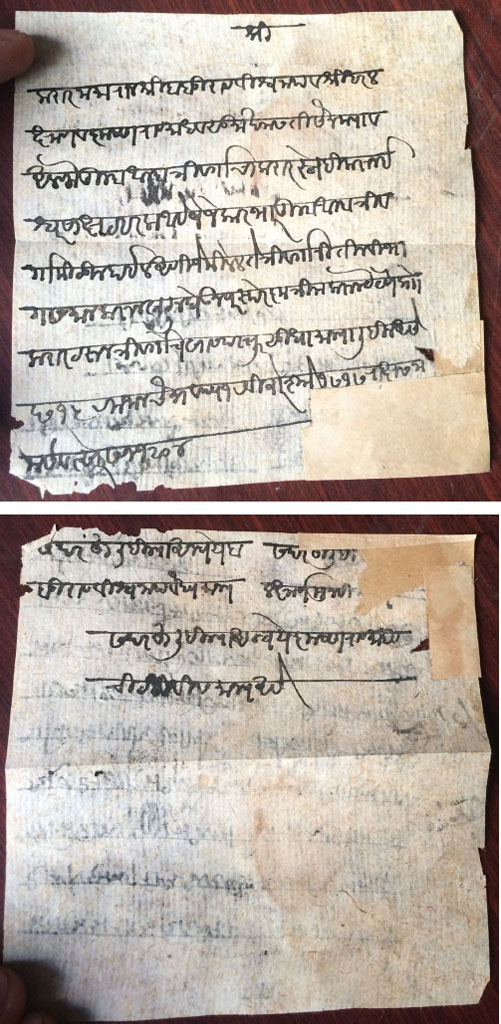
Amidst a maelstrom of high-stakes negotiations, two secretaries and a merchant in late eighteenth-century Pune in western India decided to put a professional partnership into writing. The secretaries Sridhar Lakshman and Krishnarao Madhav managed the communications of the Maratha ruler at Nagpur, while their partner, the merchant-moneylender Baburao Viswanath Vaidya, was the envoy of the Pune-based Peshwa, a powerful Brahmin minister and leader of the allied states comprising the Maratha Empire. Building on years of intimate, often clandestine consultations, these three newly made diplomats successfully brokered an alliance between their governments in anticipation of a battle with Nizam Ali Khan of Hyderabad, which took place from March 11 to March 13, 1795 at Kharda. Less than one month after its conclusion, on April 5, 1795, they struck a separate deal, commissioning an agreement, or karÄrnÄmÄ, to divide the profits of their diplomatic work (see Fig. 1a and 1b in Appendix). Currently part of the Vaidya collection in the Bharat Itihas Sanshodhak Mandal in Pune, this karÄrnÄmÄ is handwritten in Marathi in the Modi script. The main text states that an agreement of friendship between the three parties has been settled in the presence of god (tumhÄ ÄmhÄ trivargÄchÄ karÄr snehÄ« karÅ«n ishwara sÄksha t̤haharlÄ Ähe) such that any business that any of them might receive shall be divided into three parts. It further asserts that they should not deceive one another, and that they have indicated their approval of the agreement in writing. Accordingly, each partyâs name and title appears on the verso within the formula: âAs written, thus [name of contracting party] approves.â2
On the basis of its form alone, this karÄrnÄmÄ is a fascinating example of the malleability of documentation in late Persianate South Asia. The documentâs precise dating along with its call for divine oversight suggest that the three partiesâ accord was meant to endure in both the immediate present and the more uncertain future. Moreover, the parties to the agreement committed their names to a common promissory phrase, though the uniformity of handwriting throughout the document suggests that they employed an amanuensis to compose it. The document omits any further information about who may have witnessed the compact or committed it to paper. Instead, the parties have agreed to an equal and transparent division of future profits on the basis of an almost implicit understanding rooted in their existing friendship. While their arrangement ultimately did not withstand the scrutiny of the legal regime of the British East India Company, their adoption of a contractual form for the purpose of doing the business of politics raises questions about the manifold uses of Persianate legal categories and instruments in Marathi-speaking western India. What was the primary function of the documentary genre of karÄrnÄmÄ? How did the genreâs core concept of karÄr adapt to different kinds of legal, administrative, and political transactions? To what extent did these various usages sustain the political culture of the Maratha Empire and its connections with the broader âPersianate bazaarâ described in the introduction to this volume?
Examining the creative use of documents within the networks of skilled diplomats and petty bureaucrats who traversed Maratha courts promises to elucidate the shifting relationships between language, power, and communication in the early modern Persianate world. While a rich body of scholarship has shed light on the global circulation of Persian literary models and motifs, Nile Green in a recent assessment of the field has pointed out that more work needs to be done on âfunctional expressions of literacy,â specifically how skill in Persian and Persianate forms of writing, or âPersographiaâ as he puts it, shaped goal-directed practices and procedures in law, administration, and politics.3 Nandini Chatterjeeâs charting of the evolution of the mahÌ£zÌar-nÄma across multiple languages and political regimes exemplifies the benefits of this approach.4 Such inquiries are especially germane to recent attempts to chart a ânew diplomatic historyâ more attentive to the ways in which social, symbolic, aesthetic, and material concerns shaped the traditional elements of diplomacy.5 While diplomatic history itself has tended to focus on exchanges within and across the borders of Western Christendom, recent works on Islamicate chancery practice under the Mamluks, Bahmanis, Safavids, and others have demonstrated that widely shared practices and protocols of letter-writing undergirded the formation of interlocking commercial, intellectual, and diplomatic networks.6
Questions surrounding the form and function of documentation have been less central to the existing scholarship on diplomacy in early modern South Asia. Instead, the primary interest of this scholarship has been the process whereby European trading companies organized both lavish royal embassies and more modest missions, engaged the norms and protocols of courtly etiquette, and acquired limited commercial privileges and legal protection.7 By the middle of the eighteenth century, the burgeoning British East India Company-state began to more systematically penetrate local systems of information-gathering and diplomatic brokerage, enabling the gradual formation of a set of restrictive subsidiary alliances with Indian states.8 But Indian diplomats too developed sophisticated assessments of their European counterparts.9 Moreover, their intelligence-gathering, as Rosalind OâHanlon has recently explored with respect to the Maratha wakÄ«l, massaged the extensive networks of credit and capital to which European traders and diplomatic representatives sought access.10 While we have a better understanding of the infrastructure of South Asian diplomacy, it is still largely accurate that âthe sphere of politics itself (and its counterpart, diplomacy) has remained curiously absentâ from discussions of the âcomposite cultureâ of early modern South Asian polities.11
The aim of this article is to explore the ways in which cultures of documentation became central to what Rohit De and Robert Travers in an important new volume on petitioning describe as the âstandardization and routinization of political relationsâ across linguistic boundaries.12 Indeed the circulation of written documentation was integral to the continual re-adjustment of highly ramified political networks of varying orders of magnitude and significance. This essay traces the multi-valent usages of a particular genre of documentationâthe karÄrnÄmÄ and associated treaty formsâthat became central to diplomacy in the eighteenth-century Maratha Empire. Roughly a century after Shivaji Bhonsleâs founding of an independent Maratha polity and coronation as Chhatrapati (Lord of the Umbrella) in the latter half of the seventeenth century, the Maratha Empire encompassed a network of principalities, chiefdoms, feudatories and centrally administered territories with military influence and revenue claims extending, as is colloquially repeated, âfrom Attock to Cuttack.â Although Maratha rulers recognized the symbolic sovereignty of the Chhatrapati at Satara, they did not always accept the leadership of his principal minister at Pune, and even more importantly, their coteries of scribes, accountants, and diplomats crafted distinct political strategies requiring pragmatic tactics of accommodation, temporization, deflection and reconciliation as well as outright conflict. Concretely, this tactical repertoireâfalling under the umbrella term jÄb-sÄl (Persian jawÄb-suwÄl), which literally translated means âanswer-question,â or more colloquially, âconversationââinvolved the exchange of gifts, oaths, sacred objects, and most importantly, agreements, or karÄr-madÄr (Persian qarÄr wa madÄr), conveying friendly expressions of trust, affection, and clarity of mind. While these elements were not new to South Asian politics, it was their unprecedented integration and coordination through the medium of writing that enabled allied Maratha governments to mount a more nimble imperial enterprise suited to the fluid dynamics of eighteenth-century South Asia.13
The karÄrnÄmÄ between Sridhar Lakshman, Krishnarao Madhav, and Baburao Viswanath Vaidya is a case with sundry and fascinating results that I will discuss in the final section of the essay. First, I outline models of reciprocally binding agreements circulating across Islamicate Eurasia, focusing on the graphic procedures that traveled across linguistic, cultural, and political boundaries. The proliferation of binding contractual instruments in eighteenth-century Marathi-speaking western India in particular attests to a much more formally diverse and regionally nuanced development of legal, administrative, and diplomatic documentation than has hitherto been acknowledged. The karÄrnÄmÄ was one such type of diplomatic agreement, yet individuals also used karÄrnÄmÄs to record private, commercial contracts of the extemporaneous sort concocted by the three negotiators in the days following the battle of Kharda. Moreover, the term karÄr was also integral to the secure execution of transactions in several different genres of documentation, including registers of criminal fines, grants of service, and articles of agreement exchanged by Maratha governments. The latter genre most vividly exhibits the core function of karÄr: the acknowledgement of a set of terms and conditions by one or more contracting parties. I suggest that it was the relative stability of this core function that allowed for its portability between different forms and practices of documentation central to the practice of politics in the Maratha Empire.
1 Models of Diplomatic Documentation
In beginning to construct a genealogy of diplomatic forms, the Ê¿ahd-nÄma provides an apposite node of comparison and connection across the polities of Islamicate Eurasia. Long translated as âcapitulationâ in the Latinate West, the Ottoman Ê¿ahd-nÄmaâusually written in Turkish but sometimes in Italian or Greekâcontained a series of substantive articles bookended by highly formulaic introductory and concluding sections.14 Its main purpose was to govern relations between the Ottoman imperial authority and foreign merchants, especially those hailing from the seafaring city-state of Venice. Although certain elements were indispensable to any Ê¿ahd-nÄma, it was subject to continual emendation to reflect changing realities in the courts and marketplaces of the Ottoman Empire.15 Interpretersâ deeds of appointment and imperial decrees chastising their protectors supplemented and sometimes subverted the ânetwork of interconnected charters of privilegesâ of the Ê¿ahd-nÄmas.16 So robust was this documentary infrastructure that the Ottoman-Venetian Ê¿ahd-nÄma gradually became a veritable instrumentum reciprocum.17
The Ê¿ahd-nÄma was one of many forms of writing featured in compendia of stylized prose, or inshÄʾ, a genre central to the moral and intellectual self-fashioning of the Persian-educated literati of Islamicate courtly societies.18 It found an especially prominent place in the epistolary typology of the ManÄzÌ£ir al-InshÄʾ (1475-1476) of Mahmud Gawan, the Gilan-born vizier of the Bahmani Sultanate in the Deccan. In the second section of this treatise, Gawan discusses ten epistolary types hierarchized according to the relative stations of the sender and recipient.19 Whereas only a ruler can send a farmÄn, the Ê¿ahd-nÄma is shared across social stations because many possible combinations of rulers, princes, and common people may enter into an alliance (muÊ¿Ähada).20 In inspiring terror of deviating from the course of agreement and alliance (takhwÄ«f wa tarhÄ«b az jÄda-yi muâÄlafa wa muÊ¿Ähada),21 the fourth of eight constituent parts of the Ê¿ahd-nÄma resembles the warning clause (taâkÄ«d) that Gawan prescribes for the farmÄn22 as well as the sanctio of the standard Ottoman Ê¿ahd-nÄma and, as I will show, admonitory formulae in Marathi karÄrnÄmÄs.23
The example that Gawan offers in support of his analysis is an Ê¿ahd-nÄma between the boy-sultan Nizam al-Din Ahmad Shah Bahmani and Nasir al-Din Mahmud Shah, the sultan of Gujarat, from an unnamed collection of writings (munshÄt). It may be reasonably dated to 1462 when Gawan at the height of his influence played a major role in forging an alliance between the two rulers against the incursions of the sultan of Malwa.24 The third part of the agreement celebrates, in florid and metaphorical language, the practical benefits of bringing rulers into harmony:
It is clear to those who see the essence of advisability with discerning eyes and know the value of success by the light of learning that the arrangement of the gems of worldly gains on a stable thread by the strength of the fingers of kingsâ concord is renowned. The incomparable jewel of compacts and agreements (jauhar bÄ« hamtÄâÄ«-yi Ê¿ahd wa mÄ«s̲Äq) is the rein of ease and abundance of the sons of man [made] by the powerful hand of the friendship of fortunate rulers (ba-dast-i iqtidÄr-i musÌ£Ädaqat-i khawÄqÄ«n-i kÄmgÄr) and the pearl of the necklace of harmony and the amulet against hypocrisy.
Further on, the warning clause adds another layer of justification, stating that âdeviation from the conditions and regulations of agreements (sharÄâitÌ£ wa zÌawÄbitÌ£-i Ê¿ahÅ«d) is contrary to law (sharÄ«Ê¿at-i ahÌ£mad) and morality (sÄ«ra-yi maḥūd).â25 By invoking these two particular names of the ProphetâAhmad and Mahmudâthe phrasing of the clause subtly appeals to the self-images of the two rulers as equally powerful protectors of Islamic law. Finally, the treaty includes a Qurâanic justification, quoting surah 16, verse 91 on the prohibition against breaking oaths made in the presence of God.26
While Gawanâs model Ê¿ahd-nÄma takes pains to convey the parity of allied rulers, writers in the Mughal chancery tended to choose genres of documentation and forms of address that would preserve imperial claims to universal sovereignty. Take, for example, two agreements issued in 1636 by the emperor Shah Jahan to Muhammad Adil Shah of Bijapur and Abdullah Qutb Shah of Golkonda to divide the territories of the vanquished Nizam Shahi sultanate.27 Although classified as Ê¿ahd-nÄmas in both the PÄdshÄhnÄma of Ê¿Abd al-Hamid Lahori (1656-7) and the FaiyÄzÌ ul-QawÄnÄ«n (1721) of Munshi Faiyaz, the documents conform to a common Mughal imperial display of superiority.28 Rather than honoring the Deccan sultans with the title of Shah, they apply the lesser honorifics of Adil Khan and Qutb al-Mulk and describe them as seeking royal favours (Ê¿inÄyÄt bÄdshÄhÄna). Moreover, as Momin Mohiuddin points out, Shah Jahan initially proposed terms to Bijapur through a farmÄn âidenticalâ with a qaul-nÄma, and Bijapur reciprocated with a petition (Ê¿arzÌ£-dÄsht), suggesting that these interactions took place within an unmistakable hierarchy of diplomatic forms of writing.29
The Mughal chancery was equally withholding in their dealings with European trading companies, preferring to grant limited privileges by means of farmÄns. It famously exasperated the English ambassador Sir Thomas Roe that the emperor would not âdescend to article or bynde him selfe reciprocally to any prince upon termes of equalety.â30 By contrast, Dutch merchant-diplomats in the 1660s âwillingly posed as supplicants to the emperor soliciting his imperial commands.â31 Shivaji Bhonsleâs grandson Shahu adopted a similar posture to secure an independent Maratha kingdom in the Deccan.32 As an aspirant (umÄ«dwÄr) to imperial largesse, he humbly agreed to remain âon the straight path of faith and the right road of service (bar maslak-i qawÄ«m-i Ê¿aqÄ«da wa minhaj-i mustaqÄ«m-i Ê¿ubÅ«diya).â33 In exchange for his fealty, he received farmÄns establishing Maratha rights to the collection of revenue in the six Mughal provinces of the Deccan.34 Mughal reluctance to offer full extraterritoriality or enter into bilateral obligations has led many commentators to suggest that âthe idea of a âtreatyâ in the sense of a contractual agreement ⦠was largely alien to the diplomatic practices in Islamic Asia and India,â a conclusion that the following section on Maratha treaty-making aims to disprove.35
2 KarÄr and KarÄrnÄmÄ in the Eighteenth-Century Maratha Empire
Looking beyond the models of the Ottoman Ê¿ahd-nÄma and the Mughal farmÄn, the efflorescence of documentary forms in eighteenth-century western India owed much to Marathiâs incorporation of Persian terms, idioms, and genres of documentation. As the work of Richard Eaton and Sumit Guha has shown, the integration of Marathi-speaking skilled communities into the expanding Persianate cosmopolis took place under the aegis of the Bahmani and Deccan sultanates, especially the Adil Shahi sultanate of Bijapur.36 By the late sixteenth and early seventeenth centuries, the revenue administration of the Adil Shahi sultanate relied heavily on village- and district-level officials proficient in the conventions and short-forms of Marathi writing in the Modi script. At the same time, this bureaucratic argot was strongly suffused with Perso-Arabic loan words. Interest in shifting to a Sanskrit-derived vocabulary in the early years of independent Maratha rule is evident in the composition of the Persian-Sanskrit lexicon RÄjavyavahÄrakosÌ£ha (1676-7), and the widespread adoption of several new documentary types, including the ÄjnÌÄpatra (royal order), the vinantÄ«patra (petition), and the abhayapatra (deed of security) as discussed in Prachi Deshpandeâs contribution to this volume.37 Perso-Arabic words continued to inflect the Marathi language of law, commerce, politics, and government through the eighteenth and early nineteenth centuries, though their level of saturation could vary widely.38 Albeit with a more limited scope, Persian script also persisted through the diplomatic letter-writing of bilingual scribes, usually bearing the title of pÄrasnÄ«s or munshÄ«, who generated Maratha rulersâ high-level correspondence with Delhi, Hyderabad, and Calcutta among others.39
Maratha governments transacted their relations with allied, rival, and tributary states using a type of agreement bearing several different names: karÄrnÄmÄ; shartnÄmÄ (Persian shartÌ£-nÄma); taha or tahanÄmÄ; and most commonly, yÄd or yÄdÄ« (Persian yÄd-dÄsht).40 It is important to note that this type of agreement, even when explicitly bilateral, did not require the existence of two equal contracting parties; rather, it might merely apply a patina of consent to a highly coercive and extractive arrangement backed by force. For example, the Rajput kingdoms upon which the Peshwaâs government in the late 1760s imposed karÄrnÄmÄs to finance and supply Maratha armies in north India were by no means equivalent in power to their counterparts.41 The East India Company-state of the early nineteenth century systematically employed the subsidiary treaty as a device for imposing its will on Indian rulers.42 Beyond diplomacy, interpersonal contracts in the context of indentured servitude sanctioned highly unequal arrangements for the extraction of human labour, however much codified jurisprudence and legal culture presumed the free and voluntary status of the contract.43 Instead of adhering to a legal fiction of equality, we have to understand the bilateral diplomatic agreement as a critical, but not necessarily decisive element in shaping interstate and intrastate power relations.
Notwithstanding these caveats, bilateral treaties anchored in principles of diplomatic reciprocity and mutual defense proliferated between eighteenth-century Maratha states and their allies and rivals. In addition to reciprocal military aid, concrete matters of debts, gifts, revenue, provisions, personnel and jurisdiction fell under the purview of a series of bilateral agreements settled by the Bhonsle rajas of Nagpur from the 1750s to the early 1800s.44 The majority of these agreements represent the terms and conditions of nearly a half-century of peace between the Maratha governments at Pune and Nagpur following recurrent conflict in the 1760s. Yet the rajas of Nagpur also maintained a regular diplomatic correspondence and contracted formal agreements in Persian with the Nizam of Hyderabad and his deputies, the Afghan Nawabs of Achalpur (formerly Ellichpur), primarily to administer revenue collection in the former Mughal ṣuba of Berar, as well as with the British Governor-General at Calcutta. In keeping with the pragmatic approach to politics prevalent in the Maratha Empire, the Nagpur government tailored standard documentary forms to suit the constraints and priorities of political relationships.
Inter-polity treaty-making involved the composition of bilingual documents or the translation of whole documents or individual graphic elements from one language to another. Persian and Marathi copies of a 1757 agreement between Janoji Bhonsle and Nizam Ali Khan are identical in content yet reveal different procedures for writing agreements in different languages of composition. Whereas the Marathi copy organizes the fifteen articles of agreement into two columns with each article followed by the enumerative phrase âkalam 1,â or âone article,â the articles in the Persian copy are laid out horizontally, preceded by a horizontal line, and followed by a logogram for the term âbaizÌ,â conveying assent of its admission into the agreement. The Persian copy includes the seal of Nizam Ali Khan, but there is no corresponding seal in the Marathiâan omission characteristic of Marathi treaties.45
Mobile Persianate genres and graphic procedures regularly shaped the making of diplomatic documentation in Dutch, Portuguese, and English.46 Correspondence between Maratha rulers and the Estado da Ãndia shows the presence of Portuguese, Marathi, and to a more limited extent, Persian.47 Two Portuguese envoys at the court of the raja of Kolhapur pre-approved each article in a tahanÄmÄ dated September 21, 1797 by writing the words âo que escrevarão he verdade,â or âwhat [they] wrote is true,â in a fine hand, and in the conclusion, they added âestes cinquo paregraphos que escreverão he verdade,â or âthese five paragraphs that [they] wrote are true.â48 Facility between Marathi, Persian, and English enabled the composition of a trilateral agreement between the Peshwa, the Nizam, and the EIC against the Mysore ruler Tipu Sultan. A draft composed on June 1, 1790 in the residence of the minister Nana Phadnavis in Pune and copied in Persian and English into the British resident Charles Warre Maletâs letter-book on June 7 leaves conventional titles, honorifics, and technical jargon untranslated.49 The fourteenth article further notes that the Peshwa supplied copies of the treaty in Marathi and Persian, and the resident supplied copies in English and Persian with seal and signature, to finalize the alliance.50
Facilitating the movement of diplomatic agreements across linguistic, cultural, and political borders was a shared formal structure consisting of a series of articles. It was quite common for each article proposed by one party to be followed by an article communicating the response of the second party. Underlying this structure was a particular graphic procedure, or âgraphic ideologyâ as Matthew Hull terms it, entailing âsets of conceptions about graphic artifacts held by their users.â51 Maletâs assistant J. Uhthoff was a first-hand witness of the graphic procedure conducing to this structure:
A very common mode of transacting business, particularly in affairs of state, among the natives in this quarter, is for one party to present a paper called Yaad (Memorial, a Memorandum) of demands or requests: to which the other subjoins his sentiments; which latter writing is called âMukhliseh,â and seems equivalent to a ratification. In affairs of great importance, as that in question, the Yaad is occasionally divided into separate articles, each of which is closed with the words âone articleâ to preclude probably any subsequent interpolation. After each article the other party writes his âMukhliseh,â or ratification by which latter the parties are considered to be bound, rather than by the preceding article, in cases in which the âarticlesâ and âMukhlisehâ differ in spirit or letter.52
Rather than mukhlisa (Marathi makhlÄshÄ«), the term that more often performed the function of âratificationâ in diplomatic documentation is karÄr. Following this pattern of use, it may be observed that the term karÄr appears in several different types of documentation and draws on a field of signification and effectivity distinct from its meaning in the karÄrnÄmÄ.
Understanding how karÄr operated in the world of Marathi-language documentation, and how it became particularly efficacious in political transactions, requires some reflection on its complex relationship with the Islamic legal category of iqrÄr. Islamic jurisprudence defines an iqrÄr to be a binding and irrevocable acknowledgment applicable to cases of sale, debt, paternity, marriage, and inheritance among others.53 In a standalone iqrÄr-nÄma, an individualâs acknowledgment might further articulate the narrative of his or her case, as in a fascinating case adduced by Abhishek Kaicker to illustrate the âdynamic and fluid processâ of local Mughal politics.54 In the early modern western Deccan, it was more common to apply an iqrÄr clause to an existing document, often alongside the seal of a qazi. For example, according to an iqrÄr clause written at the top of a declaration dated December 19, 1696, Gaundappa Munjgonda, a cultivator based in Mannur Buzurg in the district of Akkalkot, âappeared and acknowledged that he has purchased the aforesaid trees from the house of the headman Rachappa and his brother Sidappa.â The trees in question had been the subject of a pair of merchantsâ allegation of theft, one that proved untrue and occasioned this document, one of many applications of the iqrÄr clause found in the Solapur Deshmukh collection at BISM (see Fig. 2 in Appendix).55 In what sense is it possible to link this legal principle of iqrÄr and its corresponding set of documentary forms with the usage of karÄr in Marathi documentation? Etymologically, these termsâin addition to those already mentioned, one regularly finds mukarar (Persian muqarrar)âultimately share a common Arabic root q-r-r and broadly partake in its semantic range of fixity, certainty, and stability. Yet it would be too hasty to extrapolate from a linguistic transfer to a legal one, and to thereby draw a straight line from the Perso-Arabic iqrÄr to the Marathi Persianate karÄr.56 Rather, karÄr enacted a distinct form of binding acknowledgment, albeit of varying degrees of force, in legal, political, and administrative transactions.
KarÄr clauses played an important role in the resolution of everyday civil and criminal disputes, specifically as the key term in the losing partyâs acknowledgement of any public fine that the authorities might choose to impose. The conclusion of a 1685 judgment recording a dispute over a portion of the headmanship of the village Shirale affirmed, âA fine of fifty royal gold coins, or together with interest seventy-five royal gold coins, is acknowledged with the district headman (sardeshmukhÄ« karÄr kele asetÄ«).â57 Proximate forms of administrative documentation also typically featured an acknowledgement clause. Government contracts for salaried employment or for the farming of taxes, customs, and other revenues in distant districts or provinces often carried terms and conditions in the form of a table of articles. To indicate the appointeeâs acceptance of these terms and conditions, scribes commonly added the verb phrase karÄr kará¹e, the promissory formula yeá¹e pramÄá¹e karÄr or simply the word karÄr. Having described the terms of employment of Govind Ballal, the head administrator in the province of Rajpuri, a December 15, 1774 contract concluded, âIn total six articles are acknowledged (ekÅ«n sahÄ kalame karÄr kelÄ« aset), and they should be followed accordingly.â58 Given that the karÄr clause appears so regularly across different types of contractual documentation, we may speculate that it had become more or less routine for officials to append it to a contract, regardless of whether or not the recipient had explicitly assented to its terms. It was in this sense that the Pune ministers Sakharam Bapu Bokil and Nana Phadnavis agreed that the former would write âshould give (devÄve)â on official documents, while the latter would write âaccordingly (yeá¹e pramÄá¹e).â59 Along with dates, seals, and marks of endorsement and registration, acknowledgement clauses were indispensable to the graphic procedure of administrative establishments.60
Alongside the bureaucratic routinization of karÄr usage, agreements between Maratha governments exhibited a more dynamic and dialogic process of diplomatic communication. In the most elaborate scenarios, agreements of this type replicated the usual dual structure of kalam and karÄr articles, but the latter varied in response to proposed conditions. Exemplary is an agreement reached by the Pune and Nagpur governments in 1769. This agreement contains two sets of articles, the first consisting of Nagpurâs proposals and the second containing Puneâs responses. Each article in the first set simply ends with the phrase âone article (kalam 1),â while each in the second ends with the binding acknowledgement âso resolved (yeá¹e pramÄá¹e karÄr).â Many acknowledgements either re-state or re-frame the contents of the propositions, as demonstrated by the following two articles:
It is not advisable to make a false accusation on the basis of a flimsy pretext. If there is a document (kÄgadpatra) of ours or other evidence, it should be made by the proper methods, and whatever order must be given should be given. One article (kalam 1).
You should not hold onto any sort of politics (rÄjyÄkÄraá¹a). You should not put up any violent resistance. From here too, favor shall be shown towards you with certainty and affection (nikhÄlaspanÌ£e mamatÄpurvak). So acknowledged (yeá¹e pramÄá¹e karÄr).61
The Pune government in the second article does not unconditionally acknowledge the specific request proposed in the first article by Nagpur; rather, its acknowledgement introduces a new condition on the subject of politics. In this fashion, agreements employing the karÄr device allowed for a high degree of flexibility and ambiguity in the transaction of politics.
Although the majority of articles in Maratha diplomatic agreements concerned specific material issues, a key subset made more general statements about the relationship between the two parties. Employing a relatively stable lexicon of âthickâ ethical concepts, ranging from affection to loyalty to certainty of mind, these statements were both descriptive and prescriptive.62 Consider another set of articles from the 1769 Nagpur-Pune agreement discussed above:
The dear departed Nana Saheb [Peshwa Balaji Bajirao] loved [us] like a son. Accordingly, you ought to maintain affection sincerely (akritrÄ«mpanÌ£e mamatÄ karÅ«n chÄlvÄve). Do not deviate from this.
You should behave loyally (yeknisÌ£ht̤īne). Act in such a way to preserve the well-being of the state (daulatÄ«che kalyÄn). Knowing you to be like family with sincerity and affection (akritrÄ«mpanÌ£e mamatÄpurvak), you will be favored. There will be no difficulty in this. So acknowledged.63
The articles concur in likening the existing relationship between Nagpur and Pune to a family tie; however, on the basis of this shared premise, they offer slightly different prescriptions about how one ought to behave. While both articles express an expectation of sincerity and affection, the latter article from Pune makes an additional demand for loyalty. Such action-oriented ethical statements appeared frequently in Maratha diplomatic writing, continuously setting and re-setting the terms of interstate relations in light of the current and anticipated state of affairs.
The dialogic process undergirding the creation of any bilateral diplomatic agreement could be unpredictable because it fundamentally depended on the wills of individual negotiating parties. To demonstrate this point, it may be helpful to examine another case: a yÄd in the name of Peshwa Madhavraoâs uncle Raghunathrao composed between August 3 and August 5, 1769.64 Raghunathrao had pursued schemes against his nephew for several years until finally landing himself in confinement in the summer of 1768. This document containing the terms of his release has been attributed to Nana Phadnavis, but it is evident that it is the work of two different hands. The opening date, the heading, and seven proposing articles are in the clear, perpendicular handwriting of a working scribe-administrator, while the acknowledging articles, the conclusion, the closing date, and a curiously appended eighth article against delaying Raghunathraoâs release are in a more irregular, diagonal scrawlâperhaps that of Raghunathrao himself. One can imagine that he received an initial draft of seven articles, to which he added his own before returning it to the original drafter for final approval.
What is striking about this agreement is that the final contents of the document were not pre-fabricated, but rather emerged iteratively through interaction between two or more parties with conflicting interests and agendas. As in the 1769 yÄdÄ« between Pune and Nagpur, this conflict manifests in the discrepancies between the kalam and karÄr articles. Whereas the first kalam on the upper right-hand side demands, â[You] should not send notes (chit̤ī) and documents (kÄgadpatre),â the accompanying karÄr qualifies, â[We] will not send secretly. If something must be sent, we will show it and send.â65 The eighth and final article appears after the concluding section of the document. It urges that Raghunathrao should not be detained for a fixed period of one or two years, but instead should be freed immediately upon the restoration of confidence between the two parties. Its insertion appears to be connected to the striking out of the phrase âone to two yearsâ in the concluding section and indicates a re-negotiation of the terms of Raghunathraoâs release. Through such revisions, the yÄdÄ« became a highly personal re-imagining of a Persianate form of legal documentation. But it is also a salutary reminder that unlike the iqrÄr, this type of agreement was not justiciable in a court of law should a party infringe its terms. Instead, redress of diplomatic violations relied on a somewhat more negotiable process involving the exchange of additional agreements and correspondence, and if those failed to resolve the matter, special diplomatic and state visits. Under the legal regime of the early Company state, this intermingling of the private and the public and of the personal and the political had major implications for the proprietary claims of two scribes and a merchant who affixed their names to a karÄrnÄmÄ in 1795.
3 The 1795 KarÄrnÄmÄ: Friendship and the Spoils of Diplomacy
The pact between Sridhar Lakshman, Krishnarao Madhav, and Baburao Viswanath Vaidya was the capstone of a five-year professional friendship borne out of a crucible of cutthroat diplomacy between competing Maratha governments in the eighteenth-century Deccan. Hailing from the leading scribal lineages at Nagpur, Sridhar Lakshman and Krishnarao Madhav held the offices of munshÄ« and chit̤nawÄ«s, designating the writers of Persian and Marathi correspondence, respectively. In 1790, they became the chief counsellors of the raja Raghuji II. They worked together so closely that news-writers and chroniclers often generically referred to them as âthe administratorsâ or âboth administrators.â Having recently begun his ambassadorial tenure at Nagpur, their future collaborator Baburao reported to Pune on February 7, 1791, âThey are of one mind. They are very skillful in their work and are held in great esteem. Nothing happens without [their] approval.â66 He met with the two counsellors at regular intervals over the course of the next year to plan a delegation to Pune.67 When this mission finally took place in the summer of 1794, Nagpur agreed to support the Peshwa against Hyderabad in exchange for territory worth 65 lakh rupees and additional tribute from Nizam-affiliated dependencies north of the Godavari river.68
It was difficult to broker an interstate alliance in the absence of a foundation of friendly interpersonal relations; however, friendship itself was neither a fixed nor isolated relation. Rather, friendship in the Persianate world, as Emma Flatt has usefully summarized, was âa demonstration to contemporaries as much as to oneself, of the extent to which one was embedded within a web of alliances, allegiances, and supporters.â69 In the Maratha Empire, any diplomatic friendship reinforced, challenged, or delicately co-existed with an array of intersecting commitments to patrons, dependents, partners, and kinfolk. While little is known about the background of Sridhar Lakshman, Krishnarao Madhav was a member of a prestigious extended household of Kayastha scribal bureaucrats with branches at Pune, Satara, and Nagpur.70 Perhaps even better connected was the Chitpavan Brahmin merchant Baburao Viswanath Vaidya, whose agents managed an extensive money-lending and revenue-collecting portfolio at Nagpur.71 Daily routines of interpersonal sociability within the Nagpur courtly milieu created new linkages between these entrenched familial and financial networks. On August 12, 1792, for example, the three parties to the agreement as well as Krishnaraoâs relation and teacher Babaji Govind72 attended the home of the Kayastha soldier-diplomat Mahipatrao Dinkar to celebrate the holiday of Gokulashtami.73 Hence the 1795 documentâs declaration of a friendly agreement (karÄr-snehÄ«) was not merely a rhetorical gesture, but a re-inscription of mutual interest and shared experience.
If the politics of friendship in the mature Maratha Empire are critical to understanding the substance of the agreement of the three career diplomats, its written form bears a notable resemblance to karÄrnÄmÄs that underwrote mercantile capitalâs increasing penetration of the economy of late eighteenth- and early nineteenth-century western India. KarÄrnÄmÄs recorded transactions pertaining to the cultivation of agricultural land, the collection of taxes, and the construction of urban marketplaces. Several individuals between 1799 and 1808 drew up karÄrnÄmÄs to establish revenue farms with the landlords Moro Chimnaji Parchure and Bapuji Trimbak Parchure.74 It is well-known that revenue farming became an increasingly regular practice in the heavily commercialized and monetized Maratha agrarian economy.75 Brahmin family firms in particular became central to the realization of and investment in land revenue, an important line of inquiry to which further study of the legal documentation of agrarian and commercial processes might contribute.76 For the purposes of this essay, what is significant about this type of commercial karÄrnÄmÄ is the way in which its formal structure endows it with a certain legal status. Unlike the diplomatic agreements discussed earlier, this type describes a quantifiably determinate transaction between named individuals; even more importantly, it employs several calendars to adduce an extremely precise date, often adjoining the phrase te divshÄ« (on that day), and lists the names of witnesses and the writer of the document. All of these features render it into a prototypical legal contract conferring fully justiciable rights and obligations, rather than a less binding and more flexible agreement.77 Insofar as the formal structure of the 1795 karÄrnÄmÄ fell somewhere in between these two archetypes of âcontractâ and âagreement,â it embodied the risks and possibilities of transforming political service into a personally lucrative transaction.
Sometime in the weeks and months after the three collaborators agreed to split their profits into three equal parts, shares to tax-free land revenue (inÊ¿Äm) were granted to officials who had assisted in the Kharda negotiations. Sridhar Lakshman and Krishnarao Madhav each received shares to revenue across several villages totaling to Rs 14,000. But Baburao Viswanath Vaidya, perhaps due to his death in 1795, was omitted from the distribution, and instead Ramchandra Dado, the Bhonslesâ wakÄ«l at the court of Nizam Ali Khan and a participant in the Kharda negotiations, received about half the amount of the two scribes.78 Two years later, however, Baburaoâs son Narayanrao was allotted a share in the village of Waigaon because he had âby his counsel proven very useful to the affairs of our state.â79 In addition, he seems to have received Ramchandraâs half-share in the village of Mundgaon on the occasion of that officialâs death.80
Complicating proprietary claims to the Kharda inÊ¿Äm in the years after the establishment of a British residency at Nagpur in wake of the Second Anglo-Maratha War of 1803 was the fact that several of the alienated villages were located in districts that fell under the joint administration of the Marathas and the Nizam. The Company faced numerous challenges and complaints in its implementation of a partition whereby all territories east of the Wardha River were to be administered by the Marathas, and all those west of the Wardha were to be administered by the Nizam.81 Citing direct orders from General Arthur Wellesley at the time of the peace of Deogaon, Sridhar Lakshman and his fellow recipients of the Kharda inÊ¿Äm appealed to the Nagpur resident Mountstuart Elphinstone to defend their claims.82 By the conclusion of the Third Anglo-Maratha War in 1818, they had still not been able to access the full amounts of revenue to which they were entitled.83 In January 1819, Richard Jenkins, Elphinstoneâs successor at Nagpur, requested that the inÊ¿Äm lands be returned to their former owners, âwho had by their conduct during the late disturbances, established a claim to our good offices on their behalf.â84 Here Jenkins alludes to the fact that Sridhar and Ramchandra Dadoâs son Yashwantrao had received annual pensions and houses in Varanasi for their cooperation with the Company in its pursuit of a subsidiary alliance at Nagpur.85
Narayanrao Baburao Vaidya met with less success in securing recognition of the fruits of his familyâs service in the Nagpur government. In an 1818 memorandum, Narayanrao himself described, âSince the time of Shahu Maharaj Chhatrapati, three generations have worked as the Bhonslesâ wakÄ«ls. I crafted many schemes for the kingdom of Raghoji Bhonsle. So that the village Waigaon in the sub-district Thugaon should be continued in our family line, he gave me an inÊ¿Äm.â86 Six years later, the Bombay government had still not secured Narayanraoâs title to these inÊ¿Äm shares, pleading that any decision about the villages in question be left to the discretion of the Nizamâs government.87 Rather than confining himself to Company channels, Narayanrao made use of his professional network by writing to Sridhar Lakshman about his bad fortune. Sridhar promised to look into the matter and pensively added, âThe time is very strange and difficult. Each and every mere man, whether small or mighty, should spend his days with honor in his own solicitude and confinement. This is my concern. It does not seem to be the time to give or accept anyoneâs trust. Each day that I pass is a blessing. I am bankrupt here. I do not have any money or grain. Let it be. Just as God allows, so I will live.â88 Despite having thus renounced the world of both profit and politics, Sridhar did send a letter to Yashwantrao Ramchandra, declaring, âEveryone knows that that village [Waigaon] belongs to him [Narayanrao] in inÊ¿Äm and that he has been managing it. There should be no opposition to this because his and your friendship goes way back (tyÄchÄ ÄplÄ sneha purvÄ«pÄsun chÄlat ÄlÄ).â89 Narayanrao died several years later, leaving his brother Anandrao to continue petitioning the Company to recognize their familyâs claims.90
The bonds of friendship that had been foundational to the 1795 karÄrnÄmÄ were not sufficient to protect the proprietary legacies of those who entered into it. After decades of investigation and correspondence, Company officials in 1850 and 1851 finally rejected the inÊ¿Äm claims of the descendants of Sridhar Lakshman and Krishnarao Madhav on the grounds that they were adopted and therefore had no claim to inheritance.91 The decision against the formerâs grandson Sridhar Narayan further questioned whether the primary documentary evidence submitted in support of his claimâa 1797-8 state document (sanad) issued to Sridhar, Krishnarao, and Ramchandra Dadoâwas intended to establish a hereditary claim.92 More generally, it commented that âthe villages were assigned as a bribe to the dependants of the Nagpoor Raja, and in return for the gift, the grantees were expected to use their influence with the Raja, favorably for the interests of the Peishwa. The grant was a part of the corrupt system prevalent in the Poona court in the later years of the Maratta rule, and it is not surprising that villages thus obtained should not long remain in the possession of the grantees.â93 Because the Company perceived any transaction of politicsâwhether partly or whollyâfor private ends as fundamentally âcorrupt,â the 1795 karÄrnÄmÄ could not find standing in the ascendant Company-stateâs adjudication of the rights to property that it had helped to originate.
The Companyâs suspicion towards heritable claims to alienated land revenue and attendant anxiety about the peculation of Indian officials shaped the approach to Modi legal, administrative, and political documentation that it began to develop in the early nineteenth century. For Company officials, the 1802 treaty of Bassein with Peshwa Bajirao II âhad completed an entire new system of international law amongst all the Governments of India, which left every state independent within itself, and had virtually dissolved all the former connections of allegiance before, indeed, a mere phantom, which any of the Marhatta states owed or pretended to owe to the Peshwa.â94 If the capacity of Maratha governments to engage in treaty-making was a âmere phantom,â or as the Governor-General Richard Wellesley put it, a âpretension,â then any agreement settled outside of Company authority was devoid of meaning.95 Village- and district-level revenue records too came under new scrutiny. They were sometimes not locatable, and, as Deccan Commissioner William Chaplin remarked in 1822, those that were found seemed âfull of falsifications and interpolations, and never so authentic as to be implicitly relied upon.â96 Under the Bombay Inam Commission of the 1850s and 1860s, the colonial state engaged in the vast undertaking of gathering, scrutinizing, and ultimately disciplining Modi documents and the complex bureaucratic establishments that produced and controlled them.97 Without an âoriginalâ sanad worded in unequivocal and unembellished language, it was nearly impossible to establish a legitimate individual claim to property, much less a division between several different claimants unconnected by ties of blood. The partition and capitalization of alienated revenue shares through gifts, sales, and informal partnerships was anathema to the rule of property that the Commission sought to establish. That such transfers took place in apparent contravention of the language of permanence of binding grants and agreements supported the Commissionâs argument that âproperty, under whatever name, under Native rule, was a very volatile blessing.â98 The incomprehensibility of documents like the 1795 karÄrnÄmÄ within the legal episteme of the Company-state seemed to confirm a contradiction between the public ends of the state and the private needs of the individual at the heart of Maratha governance.
Even if Modi legal records remained less than fully legible to the operations of Company regimes of property and revenue collection, they found new readers through their integration with Modi and Marathi instruction. In writing A Grammar of the Mahratta Language (1839) for the Company instructors and officials-in-training at Haileybury College, the Orientalist and grammarian James R. Ballantyne consulted a manuscript containing examples of Modi composition from the Maratha court at Thanjavur that had been prepared by âa native Braminâ for his uncle Colonel James Michael.99 Among these was a karÄrnÄmÄ penned on September 24, 1788 to acknowledge the rajaâs outstanding balance of five thousand coins with two moneylenders.100 In an appended âcollection of words and phrases adopted from the Persian + Tamul Languages + in very general use in the Revenue + Judicial Department,â he defines the karÄrnÄmÄ as âan agreement, Bond.â101 Beyond the institutional channels of the colonial revenue administration, the wider Marathi reading public consumed writing manuals and primers (lekhanÌ£apaddhati) detailing the standards and conventions for composing Modi documents. The Lekhanakalpataru (1853) of Munshi Ganpatrao Satarkarâpurportedly based on a manuscript authored by the thirteenth-century minister and polymath Hemadriâcontains an entry on the âmethod of writing a karÄrpatraâ with designations for an exact date, witnesses, the name of the author, and the signature of the owner of the document.102 The form also continued to be grounds for everyday property transactions and disputes between individuals. In one of many examples appearing in the Bombay law reports, Raghunath Ramchandra Marathe in 1862 presented a karÄrpatra given by Sultanji Trimbakji, the headman of Sirvale, in defense of his claim to an inÊ¿Äm in the village Pimple near Pune.103 The presence of the contract-type karÄrnÄmÄ in documentary manuals and actual civil proceedings in nineteenth-century Maharashtra attests to the persistence of early modern documentary forms and formulae in everyday legal life in the face of the colonial stateâs efforts to reform and streamline.
While contractual karÄrnÄmÄs came to predominate in person-to-person legal transactions, the articles of agreement of Maratha inter-state diplomacy took on new administrative, investigative, and disciplinary functions in colonial governance. The ways in which Vinayakrao Aurangabadkar, research assistant to the aforementioned Nagpur resident Richard Jenkins, classified diplomatic agreements signal the beginnings of this transition. In his summaries of agreements between Pune and Nagpur, Vinayakrao eschewed the documentsâ self-nominations in favor of new framings and classifications, such as kalambandÄ«.104 This term was capacious, referring broadly to âa writing under distinct heads, as, a code of instructions, articles of agreement.â105 Samira Sheikh in her contribution to this present volume points out that Company-appointed village accountants in Gujarat kept kalambandÄ«s (Persian qalam-bandÄ«) in furtherance of a disciplinary transformation of the information order pertaining to land and revenue.106 To what extent does one find similar efforts to re-adapt the articulated agreement for the purpose of making local economies more legible to colonial authority? In the Punjab land revenue settlements of the first half of the nineteenth century, proprietors were required to enter into iqrÄr-nÄmÄs (also known as wÄjib ul-Ê¿arz) that stipulated the rights and regulations of the village community.107 Collective revenue agreements of this kind are far fewer in colonial Maharashtra; rather, what we do find is that the Bombay Inam Commission re-purposed the articulated, conversational type of karÄrnÄmÄ to conduct investigations about individual inÊ¿Äm claims. Inam Commission clerks and district tax collectors used a pre-fixed set of questions to prepare statements (kaifiyat) of articles containing the claimantsâ answers about their name, age, caste, and the specifics of their inÊ¿Äms. Each statement in a bundle of case files for the district Karhad concludes with a variation on the following: âIn accordance with the above, the answers to the questions (suwÄlÄche jawÄb) have begun to be written in the office of the collector of the district Karhad, and on February 13, 1858, they were completed.â108 The change in the function of the question-answer format is striking. Whereas in Maratha jawÄb-suwÄl diplomacy, the gap between question and reply enabled a degree of productive indeterminacy, the questionnaires of the Inam Commission stripped answers of any context or narrative not strictly determinative of legitimate rights to property by the legal standards of the British colonial state.
Conclusion
In this paper, I have explored an important regional domain of Persianate contract- and treaty-making by examining the karÄrnÄmÄ alongside similar forms of documentation predominating in the diplomatic alliances of Maratha governments as well as in individual commercial partnerships. Although partaking in a shared articulated format rooted in the dialogic practice of jawÄb-suwÄl diplomacy, the specific formal features of treaties and agreements circulating between Maratha rulers and their allies and rivals exhibited remarkable flexibility and adaptability in response to the changing demands of political relationships. Apart from the standalone karÄrnÄmÄ, the karÄr device verified a diverse array of material transactions linking the public and private initiatives of individuals who moved through the professional networks of the mature Maratha Empire. Whether appearing at the end of a judgment or appointment letter, or following each in a series of articles within a diplomatic agreement, it worked to confirm and settle the substance of a transaction. Yet even if the karÄr device was fundamentally a binding acknowledgement, there was a certain irreducible mutability to how it functioned in any given document. To understand this mutability in historical terms, it is essential to link the formal analysis of documents with the social history of usage in proximate fields of practice.
Among the most prolific and creative fields of practice was the inter-state diplomacy of eighteenth-century South Asia. While the early colonial state described the mature Maratha Empire as a âconfederacyâ whose alliances fell outside the remit of international law, Maratha alliance-making in practice conditioned the possibility of inter-state order in a political landscape defined by the lack of a single sovereign center. In keeping with the Latin fides lying at the root of the term âconfederacy,â Maratha jawÄb-suwÄl diplomacy required a constant transaction of friendly sentiments of trust, loyalty, and affection through the exchange of forms of writing in multiple genres and languages, chiefly the form of the articles of agreement. While the gradual imposition of a Pax Britanica in South Asia severely circumscribed interstate diplomacy, the practices of writing which diplomacy helped to advance persisted in the exchange of financial and commercial agreements, and the production of manuals cataloguing these documents, both in Maratha princely states and the wider documentary bazaar of early colonial Maharashtra. In particular, it is striking that it was the karÄrnÄmÄ of the contract type, which was a staple of Maratha revenue farming, that became representative of the form, while the more fluid karÄrnÄmÄs of Maratha diplomacy were re-designed for the investigative and disciplinary functions of colonial revenue administration.
Just as diplomatic treaties and agreements co-existed with forms of legal, administrative, and commercial documentation, many practitioners of diplomacy, such as the Vaidya merchant-diplomats, simultaneously pursued projects in finance, commerce, and administration. Networks of practitioners linked courtly milieus and rural and urban economies, leaving behind trails of documentation dealing with matters of both public and private concern. Examination of such networks and the fields of practice in which they operated provides insight into the potential and limitations of particular usages of documents as well as changing patterns of idiom, script, and language across the historical periods and geographical regions where Persianate forms circulated. By attending to the itineraries of transactional instruments in distinct, but related social and political contexts across the Persianate world, we may gain a better understanding of how forms of documentation transformed and were transformed by the spaces in which they traveled.
Appendix

KarÄrnÄmÄ of Sridhar Lakshman, Krishnarao Madhav, and Baburao Viswanath Vaidya, April 5, 1795
Citation: Journal of the Economic and Social History of the Orient 64, 5-6 (2021) ; 10.1163/15685209-12341554
Recto
[1]
[2]
[3]
[4]
[5]
[6]
[7]
[8]
[9]
[10]
Verso
[1]
[2]
[3]
[4]
Recto
[1] In the name of god
[2] Agreement of Baburao Viswanath and Sridhar
[3] Lakshman and Krishnarao Madhav in 1195.
[4] The friendly agreement between the three of us
[5] is witnessed by god. Whatever business that we three
[6] may receive, and whatever [anyone] may receive, should be divided equally
[7] into three parts, and there should not be deception between us. Accordingly,
[8] an agreement has been fixed, and it has been approved with the three partiesâ own handwriting.109
[9] 15th of RamzÄn, 1st of waning fortnight of Chaitra, Monday, Shaka year 1717, RÄkshasa year,
[10] [Faṣlī] Year 1204.
Verso
[1] As so written Baburao As so written [tear]
[2] Viswanath Vaidya approves Lakshman, scribe [tear]
[3] As so written, Krishnarao Madhav,
[4] scribe, approves
Declaration of Gaundappa Munjgonda, January 10, 1696
Citation: Journal of the Economic and Social History of the Orient 64, 5-6 (2021) ; 10.1163/15685209-12341554
â«[1]
â«[2] [â¦]
â«[3]
â«[4]
â«[5]
â«[6] [â¦]
â«[7]
â«[8]
â«[9]
â«[10]
â«[11]
â«[12]
â«[13]
â«[14]
â«[15]
â«[16]
â«[17]
[1] In the name of god
[2] [â¦] Ahmad, servant of the law of Muhammad [qaziâs seal]
[3] Gaundappa Munjgonda appeared and acknowledged
[4] that he has purchased the aforesaid trees from the house of the headman Rachappa [adjacent to seal]
[5] and his brother Sidappa, and on account of this, the seal has been applied.
[6] [â¦], born in the house of Shah Alamgir [seal on right-hand margin]
[7] I, Gaundappa Munjgonda, and other cultivators of the town Greater Mannur [state that] Pawari, [son of] Dan Sethi at the time of sowing the fields of the village
[8] Nagansur made a complaint before the qazi in the office of district Akkalkot, namely that: trees associated with my garden and burial-ground
[9] of neem and other varieties have been taken and looted by you. You should make a reply [about] my property. So in the presence of all the inhabitants
[10] and notables of the said town, we [Gaundappa Munjgonda and the other cultivators] acknowledge that those trees from the garden and burial-ground of the aforesaid
[11] were purchased from Racha, the headman of the said village, and his brother Siddappa. If henceforth another kind [of complaint] should arise, we ourselves
[12] promise to respond. Such words in the form of a sanad are written such that there should be no objection in the future.
[13] Details of the trees and the persons
[14] Aforesaid Raya Karoti Brahmakup Gonda Chenappa Chaund Sethi Raya Kavadi
[15] neem tree tamarind tree tamarind tree neem tree neem tree
[16] two one one one two
[17] Written on the date of the 4th of the month Jumadi al-Sani of the regnal year 39. Ended [baizÌ logogram].
Acknowledgements
I am very grateful to the European Research Commission and the Lawforms project which provided funding for the research presented in this article. I thank Nandini Chatterjee, Elizabeth Thelen, Prachi Deshpande, Fahad Bishara, Jorge Flores, the three anonymous JESHO reviewers, and the scholars who participated in the Transactions and Documentation in the Persianate World workshop at the University of Exeter in July 2018 for their comments and suggestions. Additionally, I sincerely thank the late Dr. S.M. Bhave and the staff of the Bharat Itihas Sanshodhak Mandal for their assistance in acquiring the images included in this essay. I alone bear responsibility for any errors. I thank the European Research Commission and the Lawforms project for providing funds to publish this article, and the entire issue, in Open Access format.
Bibliography
Unpublished Sources
Bharat Itihas Sanshodhak Mandal, Pune.
Aba Chandorkar Daftar.
Solapur Deshmukh Daftar.
Vaidya Daftar.
British Library, London.
India Office Records and Private Papers.
Marathi Manuscripts.
Persian Manuscripts.
Deccan College, Maratha History Museum, Pune, Modi Rumals.
Kolhapur Records Office, Maharashtra State Archives, Kolhapur, Chitnisi Daftar.
National Archives of India, New Delhi, Hyderabad Residency Records.
Pune Abhilekhagar, Maharashtra State Archives, Pune, Inam Chaukashi Daftar.
Royal Asiatic Society of Great Britain and Ireland, London, Archives and Personal Papers, Documents Relating to Maratha History.
Shri Natnagar Shodh Samsthan, Sitamau.
D.B. Parasnis Manuscripts.
Persian Manuscripts.
Secondary Literature
Aitchison, C.U. and A.C. Talbot, ed. 1876. A Collection of Treaties, Engagements, and Sunnuds Relating to India and Neighbouring Countries, vol. 3: The Treaties, &c., Relating to the Peishwa, Nagpore and the Central Provinces, Hyderabad, Mysore, Coorg, the States Under the Madras Presidency, and Ceylon. Calcutta: Foreign Office Press.
Ali, M. Athar. 2006. âInternational Lawâ or Conventions Governing Conduct Between Asian States, Sixteenth and Seventeenth Century. In Mughal India: Studies in Polity, Ideas, Society, and Culture. New Delhi: Oxford University Press.
Ballantyne, James R. 1839. A Grammar of the Mahratta Language. Edinburgh: J. Hall.
Bayly, C.A. 1999. Empire and Information: Intelligence Gathering and Social Communication in India, 1780-1870. New Delhi: Cambridge University Press.
Bellarykar, Nikhil. 2019. Two Marathi Letters from the Arsip Nasional Republik Indonesia: A Snapshot of Dutch-Maratha Relations in the Late-Eighteenth-Century Coromandel. Itinerario 43/1: 14-31.
Bellarykar, Nikhil. 2019. Negotiating Alliances in the Face of AdversityâTracing the Maratha Preferences Before and During the Dutch Takeover of Pondicherry During 1693. BhÄrat ItihÄsa Sanshodhak ManÌ£dÌ£alÌ£a Quarterly 95: 141-160.
Bellefonds, Y. Linant de. 2012. IkÌ£rÄr. In Encyclopaedia of Islam, Second Edition, ed. P. Bearman, Th. Bianquis, C.E. Bosworth, E. van Donzel, and W.P. Heinriches. Leiden: Brill. DOI: 10.1163/1573-3912_islam_COM_0357.
Bishara, Fahad. 2017. A Sea of Debt: Law and Economic Life in the Western Indian Ocean, 1780-1950. Cambridge: Cambridge University Press.
Boogert, Maurits H. van den. 2005. The Capitulations and the Ottoman Legal System: Qadis, Consuls and Beraths in the 18th Century. Leiden: Brill.
Chaplin, William. 1877. A Report Exhibiting A View of the Fiscal and Judicial System of Administration Introduced Into the Conquered Territory Above the Ghauts Under the Authority of the Commissioner in the Dekhan. Bombay: Government Central Press.
Chatterjee, Nandini. 2016. Mahzar-namas in the Mughal and British Empires: The Uses of an Indo-Islamic Legal Form. Comparative Studies in Society and History 58/2: 379-406.
Datla, Kavita. 2015. The Origins of Indirect Rule in India: Hyderabad and the British Imperial Order. Law and History Review 33/2: 321-350.
De, Rohit and Robert Travers. 2019. Petitioning and Political Cultures in South Asia: Introduction. Modern Asian Studies 53/1: 1-20.
Dekkiche, Malika. 2016. The Letter and Its Response: The Exchanges between the Qara Qoyunlu and the Mamluk Sultan: MS Arabe 4440 (BnF, Paris). Arabica 63/6: 579-626.
Deshpande, P.N., ed. 2002. MarÄt̤hyÄnÌchyÄ ItihÄsÄchÄ« SÄdhane, vol. 2: ShivakÄl. Dhule: Rajwade Sanshodhan Mandal.
Deshpande, Prachi. 2014. Scripting the Cultural History of Language: Modi in the Colonial Archive. In New Cultural Histories of India: Materiality and Practices, ed. Partha Chatterjee, Tapati Guha-Thakurta, and Bodhisattva Kar. Oxford: Oxford University Press: 62-86.
Deshpande, Prachi. 2015. âLekhanakalpataruâ: BadaltyÄ Chit̤nÌ£isÄ« PaddhatÄ«nchÄ KÄnosÄ. Äple VÄnÌmaya Vritta. 15-21.
Eaton, Richard. 2014. The Rise of Written Vernaculars: The Deccan, 1450-1650. In After Timur Left: Culture and Circulation in Fifteenth-Century North India, ed. Francesca Orsini and Samira Sheikh. Oxford: Oxford University Press: 111-129.
Etheridge, A.T. 1874. Selections from the Records of the Bombay Government, vol. 132: Narrative of the Bombay Inam Commission and Supplementary Settlements. Bombay: Government Central Press.
Farooqi, N.R. 2004. Diplomacy and Diplomatic Procedure under the Mughals. The Medieval History Journal 7/1: 59-86.
Firishta, Muhammad Qasim. 2014 (1829). History of the Rise of the Mahomedan Power in India, till the Year AD 1612, vol. 2, trans. John Briggs. Cambridge: Cambridge University Press.
Fischel, Roy S. 2020. Local States in an Imperial World: Identity, Society and Politics in the Early Modern Deccan. Edinburgh: Edinburgh University Press.
Fisher, Michael H. 1993. The Office of AkhbÄr NawÄ«s: The Transition From Mughal to British Forms. Modern Asian Studies 27/1: 45-82.
Fisher, Michael H. 2012. Diplomacy in India, 1526-1858. In Britainâs Oceanic World: Atlantic and Indian Ocean Worlds, c. 1550-1850, ed. H.V. Bowen, Elizabeth Mancke, and John G. Reid. Cambridge: Cambridge University Press: 249-281.
Flatt, Emma J. 2017. Practicing Friendship: Epistolary Constructions of Social Intimacy in the Bahmani Sultanate. Studies in History 33/1: 61-81.
Flatt, Emma J. 2019. The Courts of the Deccan Sultanates: Living Well in the Persian Cosmopolis. Cambridge: Cambridge University Press.
Flores, Jorge. Forthcoming. Marathi Voices, Portuguese Words, Brahmanâs Pen (and Thoughts): On Fragments of Peninsular India in a Pre-Colonial Archive. Quaderno Storici.
Flores, Jorge. 2018. Unwanted Neighbors: The Mughals, the Portuguese, and Their Frontier Zones. Oxford: Oxford University Press.
Gazetteer of the Bombay Presidency, vol. 7: Baroda. 1883. Bombay: Government Central Press.
Green, Nile, ed. 2019. The Persianate World: The Frontiers of a Eurasian Lingua Franca. Oakland: University of California Press.
Guha, Sumit. 2004. Transitions and Translations: Regional Power and Vernacular Identity in the Dakhan, 1500-1800. Comparative Studies of South Asia, Africa, and the Middle East 24/2: 23-31.
Guha, Sumit. 2011. Bad Language and Good Language: Lexical Awareness in the Cultural Politics of Peninsular India, ca. 1300-1800. In Forms of Knowledge in Early Modern Asia: Explorations in the Intellectual History of India and Tibet, 1500-1800, ed. Sheldon Pollock. Durham: Duke University Press: 49-68.
Guha, Sumit. 2015. Conviviality and Cosmopolitanism: Recognition and Representation of âEastâ and âWestâ in Peninsular India c. 1600-1800. In Cosmopolitismes en Asie du Sud: Sources, itinéraires, langues (XVIe-XVIIIe siècle), ed. Corinne Lefèvre, Ines G. Županov, and Jorge Flores. Paris: Ãditions de lâÃcole des hautes études en sciences sociales: 275-292.
Hull, Matthew S. 2012. Government of Paper: The Materiality of Bureaucracy in Urban Pakistan. Berkeley: University of California Press.
Kaicker, Abhishek. 2019. Petitions and Local Politics in the Late Mughal Empire: The view from Kol, 1741. Modern Asian Studies 53/1: 21-51.
Kale, Y.M., ed. 1936. NÄgpur BhonslyÄñchÄ« Bakhar. Nagpur: C.P. Research Society.
Khare, G.H., ed. 1978. AitihÄsik SanÌkÄ«rnÌ£a SÄhitya: WÄÄ« GoshÄlÌ£Ä RÄste. BhÄrat ItihÄsa Sanshodhak ManÌ£dÌ£alÌ£a Quarterly 56: 1-85.
Kia, Mana. 2016. Indian Friends, Iranian Selves, Persianate Modern. Comparative Studies of South Asia, Africa, and the Middle East 36/3: 398-417.
Lahori, âAbd al-Hamid. 1867. BÄdshÄhnÄma, vol. 1, ed. Kabir al-Din Ahmad and Abd al-Rahim. Calcutta.
Mawjee, P.V. and D.B. Parasnis, ed. 1914. Treaties, Agreements, and Sanads. Bombay: Nirnayasagar Press.
Meersbergen, Guido van. 2017. The Dutch Merchant-Diplomat in Comparative Perspective: Embassies to the Court of Aurangzeb, 1660-1666. In Practices of Diplomacy in the Early Modern World c. 1410-1800, ed. Tracey A. Sowerby and Jan Hennings. Oxford: Routledge: 147-165.
Meersbergen, Guido van. 2019. The Diplomatic Repertoires of the East India Companies in Mughal South Asia, 1608-1717. The Historical Journal 62/4: 875-898.
Melvin-Koushki, Matthew. 2011. The Delicate Art of Aggression: Uzun Hasanâs Fathnama to Qaytbay of 1469. Journal of Iranian Studies 44/2: 193-214.
Mitchell, Colin. 1997. Safavid Imperial Tarassul and the Persian InshÄʾ Tradition. Studia Iranica 26/2: 173-209.
Mitchell, Colin P. 2009. The Practice of Politics in Safavid Iran: Power, Religion and Rhetoric. London: I.B. Tauris.
Mohiuddin, Momin. 1971. The Chancellery and Persian Epistolography Under the Mug̲̲h̲als From Bábur to S̲h̲áh Jahán (1562-1658): A Study on Ins̲h̲á, Dár al Ins̲h̲á and Muns̲h̲Ãs, based on Original Documents. Calcutta: Iran Society.
Naqvi, Naveena. 2019. The Parasnis Daftar as an Index of the Peshwaâs Location in Persianate South Asia. Unpublished conference presentation. Madison.
Nayeem, M.A., ed. 1980. Mughal Documents: Catalogue of Aurangzebâs Reign, vol. 1: 1658-1663 A.D. Hyderabad: Andhra Pradesh State Archives.
OâHanlon, Rosalind. 2020. Entrepreneurs in diplomacy: Maratha expansion in the age of the vakil. Indian Economic and Social History Review 57/4: 503-534.
Oturkar, R.V., ed. 1950. Peshwe-kÄlÄ«na SÄmÄjik wa Ärthik Patravyavahar. BhÄrat ItihÄsa Sanshodhak ManÌ£dÌ£alÌ£a Quarterly 30: 1-162.
Parasnis, D.B., ed. 1909a. AitihÄsik TipanÌ£e: SakhÄrÄmbÄpÅ« wa NÄnÄ PhadÌ£nÌ£awÄ«s HyÄñche MadhÄ«l KarÄr. ItihÄsa SanÌgraha 1/6: 41-43.
Parasnis, D.B., ed. 1909b. PararÄsÌ£ht̤rÄñchyÄ DarbÄrÄntÄ«l MarÄt̤hyÄñche WakÄ«l: NÄrÄyanÌ£a Vit̤ht̤hala Dhume. ItihÄsa SanÌgraha 1/6: 25-40.
Pawar, A.G. 1940. Some Documents Bearing on Imperial Mughal Grants to Raja Shahu (1717-1724). Proceedings of the Indian Historical Records Commission 17: 204-215.
Pissurlencar, P.S. 1983. Portuguese Mahratta Relations, trans. T.V. Parvate. Bombay: Maharashtra State Board for Literature and Culture.
Prakash, Gyan. 2009. Bonded Histories: Genealogies of Labor Servitude in Colonial India. Cambridge: Cambridge University Press.
Reid, Richard Tuohill, ed. 1904. Bombay High Court Reports, vol. 2: 1864-1866. Rajkot: Rajkot Printing Press.
Rothman, E. Natalie. 2009. Interpreting Dragomans: Boundaries and Crossings in the Early Modern Mediterranean. Comparative Studies in Society and History 51/4: 771-800.
Sane, K.N. 2009. RÄjavyavahÄrakosÌ£ha. In Shivacharitra PradÄ«pa, ed. D.V. Apte and S.M. Divekar. 2nd edition. Pune: BISM: 161-170.
Sardesai, G.S., ed. 1939. Poona Residency Correspondence, vol. 6: Poona Affairs 1797-1801 (Palmerâs Embassy). Bombay: Government Central Press.
Sarkar, Jadunath. 1955. House of Shivaji (Studies and Documents on Maratha History: Royal Period). Calcutta: M.C. Sarkar.
Satarkar, Munshi Ganpatrao. 1853. ShrÄ« HemÄdrÄ«krita Lekhanakalpataru. Mumbai.
Sheikh, Samira. 2017. Jibhabhuâs Rights to Ghee: Land Control and Vernacular Capitalism in Gujarat, circa 1803-10. Modern Asian Studies 51/1: 350-374.
Shejwalkar, T.S., ed. 1954. Nagpur Affairs (Selections from the Menavli Daftar), vol. 1. Pune: Deccan College Postgraduate and Research Institute.
Smith, Richard Saumarez. 1996. Rule by Records: Land Registration and Village Custom in Early British Punjab. Delhi: Oxford University Press.
Sowerby, Tracey A. 2016. Early Modern Diplomatic History. History Compass 14/9: 441-456.
Sowerby, Tracey A. and Jan Hennings, ed. 2017. Practices of Diplomacy in the Early Modern World c. 1410-1800. Oxford: Routledge.
Subrahmanyam, Sanjay. 2002. Frank Submissions: The Company and the Mughals Between Sir Thomas Roe and Sir William Norris. In The Worlds of the East India Company, ed. H.V. Bowen, Margarette Lincoln, and Nigel Rigby. Woodbridge: Boydell: 69-96.
Subrahmanyam, Sanjay. 2012. Courtly Encounters: Translating Courtliness and Violence in Early Modern Eurasia. Cambridge: Harvard University Press.
Theunissen, Hans. 1998. Ottoman-Venetian Diplomatics: The Ê¿Ahd-names. The Historical Background and the Development of a Category of Political-Commercial Instruments together with an Annotated Edition of a Corpus of Relevant Documents. Electronic Journal of Oriental Studies 1: 1-698.
Travers, Robert. 2018. A British Empire by Treaty in Eighteenth-Century India. In Empire by Treaty: Negotiating European Expansion, 1600-1900, ed. Saliha Belmessous. Oxford: Oxford University Press: 132-162.
Vad, G.C. et al., ed. 1902-11. Selections from the Satara Rajasâ and the Peshwasâ Diaries. 9 volumes. Pune: Deccan Vernacular Translation Society.
Vaidya, S.L., ed. 1943. Vaidya DaptarÄntun NivadÌ£lele KÄgad, vol. 1. Pune: BISM.
Vendell, Dominic. 2018. Scribes and the Vocation of Politics in the Maratha Empire, 1708-1818. Unpublished PhD dissertation. Columbia University.
Vendell, Dominic. 2020. The scribal household in flux: Pathways of Kayastha service in eighteenth-century Western India. Indian Economic and Social History Review 57/4: 535-566.
Watkins, John. 2008. Towards a New Diplomatic History of Medieval and Early Modern Europe. Journal of Medieval and Early Modern Studies 38/1: 1-14.
Wellesley, Richard. 1804. Notes Relative to the Late Transactions in the Marhatta Empire. London: J. Debrett.
Williams, Bernard. 1987. Ethics and the Limits of Philosophy. Cambridge: Harvard University Press.
Wilson, H.H. 1855. A Glossary of Judicial and Revenue Terms and of Useful Words Occurring in Official Documents Relating to the Administration of the Government of British India. London: Wm. H. Allen and Co.
Wink, André. 1983. Maratha Revenue Farming. Modern Asian Studies 17/4: 591-628.
The Romanisation of Arabic and Persian words in this article follows JESHOâs modified IJMES guidance, and a LOC-based common schema adopted for this special issue, for Bengali, Gujarati, Hindi, Marathi and Rajasthani words. To reconcile the two schemas, we have introduced minor variations to the LOC schema to ensure distinct diacritics. In many cases, the same word occurs in multiple languages but is pronounced differently; Romanisation used follows the phonetic context. For the common schema, see pp. 483-5 of this issue.
Bharat Itihas Sanshodhak Mandal (BISM), Vaidya Daftar, rumal 21, no. 14.
N. Green, âIntroduction: The Frontiers of the Persianate World (ca. 800-1900).â In The Persianate World: The Frontiers of a Eurasian Lingua Franca, ed. N. Green (Oakland: University of California Press, 2019): 8.
N. Chatterjee, âMahzar-namas in the Mughal and British Empires: The Uses of an Indo-Islamic Legal Form.â Comparative Studies in Society and History 58/2 (2016): 379-406.
J. Watkins, âTowards a New Diplomatic History of Medieval and Early Modern Europe.â Journal of Medieval and Early Modern Studies 38/1 (2008): 1-14; T.A. Sowerby, âEarly Modern Diplomatic History.â History Compass 14/9 (2016): 441-56.
For the Mamluks, see M. Dekkiche, âThe Letter and Its Response: The Exchanges between the Qara Qoyunlu and the Mamluk Sultan: MS Arabe 4440 (BnF, Paris).â Arabica 63/6 (2016): 579-626; on fathÌ£-nÄma diplomacy and related forms of letter-writing, see C. Mitchell, The Practice of Politics in Safavid Iran: Power, Religion, and Rhetoric (London: I.B. Tauris, 2009): 19-67; C. Mitchell, âSafavid Imperial Tarassul and the Persian InshÄʾ Tradition.â Studia Iranica 26/2 (1997): 173-209; Matthew Melvin-Koushki, âThe Delicate Art of Aggression: Uzun Hasanâs Fathnama to Qaytbay of 1469.â Journal of Iranian Studies 44/2 (2011): 193-214; for the Bahmanis and Islamicate networks of correspondence, see E.J. Flatt, The Courts of the Deccan Sultanates: Living Well in the Persian Cosmopolis (Cambridge: Cambridge University Press, 2019): 74-119; âPracticing Friendship: Epistolary Constructions of Social Intimacy in the Bahmani Sultanate.â Studies in History 33/1 (2017): 61-81.
For an extensive review of EIC and VOC activities, see G. van Meersbergen, âThe Diplomatic Repertoires of the East India Companies in Mughal South Asia, 1608-1717.â The Historical Journal 62/4 (2019): 875-98; also see S. Subrahmanyam, âFrank Submissions: The Company and the Mughals Between Sir Thomas Roe and Sir William Norris.â In The Worlds of the East India Company, ed. H.V. Bowen, M. Lincoln, and N. Rigby (Woodbridge: Boydell, 2002): 69-96; for Mughal-Portuguese relations, see J. Flores, Unwanted Neighbors: The Mughals, the Portuguese, and Their Frontier Zones (Oxford: Oxford University Press, 2018); for Mughal relations with the Uzbeks, Ottomans, and Safavids in this period, see N.R. Farooqi, âDiplomacy and Diplomatic Procedure under the Mughals.â The Medieval History Journal 7/1 (2004): 59-86.
The now-classic study of Company information-gathering is C.A. Bayly, Empire and Information: Intelligence Gathering and Social Communication in India, 1780-1870 (New Delhi: Cambridge University Press, 1999): 10-96; for subsidiary treaties, see R. Travers, âA British Empire by Treaty in Eighteenth-Century India.â In Empire by Treaty: Negotiating European Expansion, 1600-1900, ed. S. Belmessous (Oxford: Oxford University Press, 2018): 132-62; M.H. Fisher, âDiplomacy in India, 1526-1858.â In Britainâs Oceanic World: Atlantic and Indian Ocean Worlds, c. 1550-1850, ed. H.V. Bowen, E. Mancke, and J.G. Reid, (Cambridge: Cambridge University Press, 2012): 249-81.
S. Guha, âConviviality and Cosmopolitanism: Recognition and Representation of âEastâ and âWestâ in Peninsular India c. 1600-1800.â In Cosmopolitismes en Asie du Sud: sources, itinéraires, langues (XVIe-XVIIIe siècle), ed. C. Lefèvre, I.G. Županov, and J. Flores (Paris: Ãditions de lâÃcole des hautes études en sciences sociales, 2015): 275-92.
R. OâHanlon, âEntrepreneurs in diplomacy: Maratha expansion in the age of the vakil,â Indian Economic and Social History Review 57/4 (2020): 503-34; for Mughal information-gathering, see M.H. Fisher, âThe Office of AkhbÄr NawÄ«s: The Transition From Mughal to British Forms,â Modern Asian Studies 27/1 (1993): 45-82.
S. Subrahmanyam, Courtly Encounters: Translating Courtliness and Violence in Early Modern Eurasia (Cambridge: Harvard University Press, 2012): 102.
R. De and R. Travers, âPetitioning and Political Cultures in South Asia: Introduction.â Modern Asian Studies 53/1 (2019): 9.
For a more extended elaboration of this argument, see D. Vendell, âScribes and the Vocation of Politics in the Maratha Empire, 1708-1818,â unpublished PhD dissertation (Columbia University, 2018): 1-26.
H. Theunissen, âOttoman-Venetian Diplomatics: The Ê¿Ahd-names. The Historical Background and the Development of a Category of Political-Commercial Instruments together with an Annotated Edition of a Corpus of Relevant Documents.â Electronic Journal of Oriental Studies 1 (1998): 186-92.
There is now a substantial literature on the sociocultural dimensions of Ottoman-Venetian relations. Exemplary is E.N. Rothman, âInterpreting Dragomans: Boundaries and Crossings in the Early Modern Mediterranean.â Comparative Studies in Society and History 51/4 (2009): 771-800.
M.H. van den Boogert, The Capitulations and the Ottoman Legal System: Qadis, Consuls and Beraths in the 18th Century (Leiden: Brill, 2005): 24.
Theunissen, âOttoman-Venetian Diplomaticsâ: 225.
Chatterjee, âMahzar-namasâ: 397-400; Flatt, âPracticing Friendshipâ; Mitchell, âSafavid Imperial Tarassul.â
Gawan anthologized his own letters in the RiyÄzÌ al- InshÄʾ. For a more comprehensive discussion of the ManÄzÌ£ir, see Flatt, The Courts of the Deccan Sultanates: 175-88.
British Library (BL), Persian Manuscripts, Add. Mss 22706, ff. 60b.
BL, Persian Manuscripts, Add. Mss 22706, ff. 66a.
BL, Persian Manuscripts, Add. Mss 22706, ff. 63b.
Known as teâkid in Ottoman Turkish. See Theunissen, âOttoman-Venetian Diplomaticsâ: 187.
Muhammad Qasim Firishta, History of the Rise of the Mahomedan Power in India, trans. John Briggs, vol. 2 (Cambridge: Cambridge University Press, 2014): 471-6.
BL, Persian Manuscripts, Add. Mss 22706, ff. 66a-b.
Colin Mitchell has indicated that this Qurâanic phrase was one of several favored by Safavid scribes in their composition of Ê¿ahd-nÄmas. See Mitchell, âSafavid Imperial Tarassulâ: 204.
âAbd al-Hamid Lahori, BÄdshÄhnÄma, vol. 1, ed. K. Ahmad and A. al-Rahim (Calcutta, 1867): 203-5, 210-1; Shri Natnagar Shodh Samsthan (SNSS), Persian Manuscripts, No. 1623, ff. 64-7.
Evidence suggests that the Deccan Sultanates did not accede to the presumption of Mughal universal sovereignty. See R.S. Fischel, Local States in an Imperial World: Identity, Society and Politics in the Early Modern Deccan (Edinburgh: Edinburgh University Press, 2020): 247-53.
M. Mohiuddin, The Chancellery and Persian Epistolography Under the Mug̲̲h̲als From Bábur to S̲h̲áh Jahán (1562-1658): A Study on Ins̲h̲á, Dár al-Ins̲h̲á and Muns̲h̲Ãs, based on Original Documents (Calcutta: Iran Society, 1971): 52-3.
Quoted in Travers, âEmpire by Treatyâ: 140.
G. van Meersbergen, âThe Dutch Merchant-Diplomat in Comparative Perspective: Embassies to the Court of Aurangzeb, 1660-1666.â In Practices of Diplomacy: 149.
In this regard, he departed from Shivajiâs choice to allow his son to enter Mughal service but refuse a mansÌ£ab appointment for himself. See J. Sarkar, House of Shivaji (Studies and Documents on Maratha History: Royal Period) (Calcutta: M.C. Sarkar, 1955): 133-42.
SNSS, D.B. Parasnis Mss, ff. 32.
A.G. Pawar, âSome Documents Bearing on Imperial Mughal Grants to Raja Shahu (1717-1724).â Proceedings of the Indian Historical Records Commission 17 (1940): 204-15.
M.A. Ali, ââInternational Lawâ or Conventions Governing Conduct of Relations between Asian States, Sixteenth and Seventeenth Centuries.â In Mughal India: Studies in Polity, Ideas, Society and Culture (New Delhi: Oxford University Press, 2006): 313.
S. Guha, âTransitions and Translations: Regional Power and Vernacular Identity in the Dakhan, 1500-1800.â Comparative Studies of South Asia, Africa, and the Middle East 24/2 (2004): 23-31; âBad Language and Good Language: Lexical Awareness in the Cultural Politics of Peninsular India, ca. 1300-1800.â In Forms of Knowledge in Early Modern Asia: Explorations in the Intellectual History of India and Tibet, 1500-1800, ed. S. Pollock (Durham: Duke University Press, 2011): 49-68; R. Eaton, âThe Rise of Written Vernaculars: The Deccan, 1450-1650.â In After Timur Left: Culture and Circulation in Fifteenth-Century North India, ed. F. Orsini and S. Sheikh (Oxford: Oxford University Press, 2014): 111-29.
K.N. Sane, âRÄjavyavahÄrakosha.â In Shivacharitra PradÄ«pa, ed. D.V. Apte and S.M. Divekar, 2nd edition (Pune: BISM, 2009): 137-77.
N. Bellarykar, âTwo Marathi Letters from the Arsip Nasional Repulik Indonesia: A Snapshot of Dutch-Maratha Relations in the Late-Eighteenth-Century Coromandel.â Itinerario 43/1 (2019): 26.
Such Persian correspondence is extant for the Maratha governments at Pune, Nagpur, and Kolhapur. The Kolhapur-based Parasnis scribal household produced a volume of inshÄâ with examples of letters that they crafted for Sambhaji II to send to the Nizam of Hyderabad. The archive of the Parasnises of Pune, currently split between the Bombay and Aurangabad branches of the Maharashtra State Archives, is even more extensive, containing numerous akhbÄrÄt and diplomatic letters as well as drafts, petitions, personal correspondence, and a book of inshÄʾ. See Naveena Naqvi, âThe Parasnis Daftar as an Index of the Peshwaâs Location in Persianate South Asia,â unpublished conference presentation, Madison, 2019.
Specimens under most of these designations can be found in P.V. Mawjee and D.B. Parasnis, ed., Treaties, Agreements, and Sanads (Bombay, Nirnayasagar Press, 1914). The yÄdâs prominence in Maratha diplomacy distinguishes it from the administrative function of the yÄd-dÄsht in Mughal administration. See Mohiuddin, Chancellery: 56.
G.C. Vad et al., ed., Selections from the Satara Rajasâ and the Peshwasâ Diaries, vol. 9 (Pune: Deccan Vernacular Translation Society, 1911): 266-70, 284-5.
Travers, âEmpire by Treatyâ: 133-4, 156-7; Kavita Datla, âThe Origins of Indirect Rule in India: Hyderabad and the British Imperial Order.â Law and History Review 33/2 (2015): 337, 343-7.
The literature on this subject is vast and wide-ranging. For an illuminating discussion of how discourses of contract masked the operations of power in the South Asian labour market, see Gyan Prakash, Bonded Histories: Genealogies of Labor Servitude in Colonial India (Cambridge: Cambridge University Press, 2009), 140-183.
BL, Marathi Manuscripts, D35, ff. 108b, 137b-9a, 143a-6a, 204a-7a, 209b-11b, 249a-50b, 251a-4b; D36, 35a-6a, 91a-3b, 94a-7a, 133a-9b, 142a-6a.
BL, Marathi Manuscripts, D35, ff. 137b-9a, 143a-6a.
For text and translation of a Dutch-Marathi qaul, see N. Bellarykar, âNegotiating Alliances in the Face of AdversityâTracing the Maratha Preferences Before and During the Dutch Takeover of Pondicherry During 1693.â BhÄrat ItihÄsa Sanshodhak ManÌ£dÌ£alÌ£a Quarterly 95 (April 2018-March 2019): 141-60.
For a sensitive exploration of the interactions between Maharashtrian Brahman diplomats and their Portuguese counterparts, see J. Flores, âMarathi Voices, Portuguese Words, Brahmanâs Pen (and Thoughts): On Fragments of Peninsular India in a Pre-Colonial Archive.â Quaderno Storici, forthcoming; also see P.S. Pissurlencar, Portuguese Mahratta Relations, trans. T.V. Parvate (Bombay: Maharashtra State Board for Literature and Culture, 1983): 50, 157; D.B. Parasnis, ed., âPararÄsÌ£ht̤rÄñchyÄ DarbÄrÄntÄ«l MarÄt̤hyÄñche WakÄ«l: NÄrÄyanÌ£a Vit̤ht̤hala Dhume.â ItihÄsa SanÌgraha 1/6 (January 1909): 34-5.
Kolhapur Records Office, Chitnisi Daftar, rumal 43, nos. 7463-5. I am very grateful to Jorge Flores for his assistance with the translation.
For example, the English word âbattalionâ is simply transliterated in the Persian version of the treaty, perhaps indicating that a suitable Persian equivalent could not be found.
BL, India Office Records and Private Papers, Mss Eur F149/8, ff. 475-81; G.H. Khare, ed., âAitihÄsik SanÌkÄ«rnÌ£a SÄhitya: WÄÄ« GoshÄlÌ£Ä RÄste.â BhÄrat ItihÄsa Sanshodhak ManÌ£dÌ£alÌ£a Quarterly 56 (1978): 76-8.
M.S. Hull, Government of Paper: The Materiality of Bureaucracy in Urban Pakistan (Berkeley: University of California Press, 2012): 14.
G.S. Sardesai, ed., Poona Residency Correspondence, vol. 6 (Bombay: Government Central Press, 1939): 11-2.
Y.L. de Bellefonds, âIkÌ£rÄr.â In Encyclopaedia of Islam, Second Edition, ed. P. Bearman, Th. Bianquis, C.E. Bosworth, E. van Donzel, and W.P. Heinriches (Leiden: Brill, 2012), doi: 10.1163/1573-3912_islam_COM_0357.
A. Kaicker, âPetitions and Local Politics in the Late Mughal Empire: The view from Kol, 1741.â Modern Asian Studies 53/1 (2019): 32. For additional examples of Mughal iqrÄr-nÄmas, see M.A. Nayeem, ed., Mughal Documents: Catalogue of Aurangzebâs Reign, vol. 1, pt. 1 (Hyderabad: Andhra Pradesh State Archives, 1980): 168; Mohiuddin, Chancellery: 123; on iqrars as acknowledgements of debt in Indian Ocean commerce, see F. Bishara, A Sea of Debt: Law and Economic Life in the Western Indian Ocean, 1780-1950 (Cambridge: Cambridge University Press, 2017): 58-60.
BISM, Solapur Deshmukh Daftar, rumal 4, no. 47.
I thank Dr. Nobuaki Kondo for clarifying my thinking on this point and providing several helpful references from the Iranian context.
P.N. Deshpande, ed., MarÄt̤hyÄnÌchyÄ ItihÄsÄchÄ« SÄdhane, vol. 2 (Dhule: Rajwade Sanshodhan Mandal, 2002): 40.
Vad et al., Selections from the Satara Rajasâ and the Peshwasâ Diaries, volume 8 (Pune: Government Central Press, 1911): 2-4.
D.B. Parasnis, ed., âAitihÄsik TipanÌ£e: SakhÄrÄmbÄpÅ« wa NÄnÄ PhadÌ£nÌ£awÄ«s HyÄñche MadhÄ«l KarÄr.â ItihÄsa SanÌgraha 1/6 (January 1909): 42.
The division of this procedure between different officials was quite common. See Vad et al., Selections from the Satara Rajasâ and the Peshwasâ Diaries, vol. 3: 181-2.
BL, Marathi Manuscripts, D35, ff. 204a-b.
For âthickâ ethical concepts, see B. Williams, Ethics and the Limits of Philosophy (Cambridge: Harvard University Press, 1987), 140-141.
BL, Marathi Manuscripts, D35, ff. 205b.
Royal Asiatic Society of Great Britain and Ireland (RAS), Archives and Personal Papers, Documents relating to Maratha History, âOriginal paper in the hand writing of Nana Furnuvees and Rugoba Dada.â
RAS, âOriginal paper in the hand writing of Nana Furnuvees and Rugoba Dada.â
T.S. Shejwalkar, ed., Nagpur Affairs: Selections from the Menavli Daftar, vol. 1 (Pune: Deccan College Postgraduate and Research Institute, 1954): 100.
Shejwalkar, Nagpur Affairs: 210-6, 360-79, 390-9.
BL, Marathi Manuscripts, G33, ff. 154a-157b; Y.M. Kale, ed., NÄgpur BhonslyÄñchÄ« Bakhar (Nagpur: C.P. Research Society, 1936): 177-9.
Flatt, âPracticing Friendship,â 68; also see Flatt, The Courts of the Deccan Sultanates: 74-119; M. Kia, âIndian Friends, Iranian Selves, Persianate Modern,â Comparative Studies of South Asia, Africa, and the Middle East 36/3 (2016): 398-417.
For an account of the rise of the Satara branch of the Chitnis household, see my âThe scribal household in flux: Pathways of Kayastha service in eighteenth-century Western India,â Indian Economic and Social History Review 57/4 (2020): 535-66.
For an introduction to the familyâs history, see S.L. Vaidya, ed., Vaidya DaptarÄntun NivadÌ£lele KÄgad, vol. 1 (Pune: BISM, 1943): 1-32. Balance-sheets (shilakband) in rumal 20 of the Vaidya collection at BISM contain the names of many local people from towns in the Berar regionâas indicated by names like Akotkar, Paturkar, Rahatgaonkar, Ralegaonkarâto whom the Vaidyas lent money.
Prior to becoming the chit̤nawīs, Krishnarao had been an apprentice to Babaji Govind, the son of the Satara-based chit̤nīs and political operator Govind Khanderao. See BL, Marathi Manuscripts, D29, ff. 62a.
Deccan College, Maratha History Museum, rumal 96, file 1, no. 4.
Rajwade Sanshodhan Mandal, Modi Section, Modi Letters, âKarÄrnÄmÄ Patreâ2.â
André Wink, âMaratha Revenue Farming.â Modern Asian Studies 17/4 (1983): 591-628.
On the overlooked role of family firms in revenue administration, see S. Sheikh, âJibhabhuâs Rights to Ghee: Land Control and Vernacular Capitalism in Gujarat, circa 1803-10.â Modern Asian Studies 51/2 (2017): 350-74.
For additional examples that do not self-nominate, see R.V. Oturkar, ed., âPeshwe-kÄlÄ«n SÄmÄjik wa Ärthik Patravyavahar.â BhÄrat ItihÄsa Sanshodhak ManÌ£dÌ£alÌ£a Quarterly 30 (1950): 27, 34-7.
BISM, Vaidya Daftar, rumal 21, unnumbered yÄdÄ« of Sridhar Lakshman, Krishnarao Madhav, and Baburao Viswanath Vaidya.
BISM, Vaidya Daftar, rumal 21, three unnumbered documents issued to Narayanrao Baburao Vaidya and Divakar Vyankatesh.
BISM, Vaidya Daftar, rumal 21, unnumbered order dated 1799 from Bajirao Raghunath to the deshmukhs and deshpÄá¹á¸es of Akot; also see endorsed copies of orders to the headmen of these two villages in BISM, Aba Chandorkar Daftar, rumal 9, no. 2607.
C.U. Aitchison and A.C. Talbot, ed., A Collection of Treaties, Engagements, and Sunnuds Relating to India and Neighbouring Countries, vol. 5 (Calcutta: Foreign Office Press, 1876): 62.
National Archives of India (NAI), Hyderabad Residency Records, prog. no. 195, ff. 162-4.
NAI, Hyderabad Residency Records, prog. no. 204, ff. 494-8.
NAI, Hyderabad Residency Records, prog. no. 205, ff. 1-2.
BL, India Office Records and Private Papers, F/4/246/5554, ff. 3, 7.
BISM, Aba Chandorkar Daftar, rumal 9, no. 2565.
BISM, Vaidya Daftar, rumal 21, nos. 34 and 35.
BISM, Vaidya Daftar, rumal 21, no. 36.
BISM, Vaidya Daftar, rumal 21, no. 35.
BISM, Aba Chandorkar Daftar, rumal 9, no. 2597.
NAI, Hyderabad Residency Records, prog. no. 207, ff. 9-12; Prog. No. 489, ff. 45-50; Prog. No. 490, ff. 353-63.
NAI, Hyderabad Residency Records, prog. no. 490, ff. 359.
NAI, Hyderabad Residency Records, prog. no. 490, ff. 358-9.
NAI, Hyderabad Residency Records, prog. no. 201, ff. 119.
R. Wellesley, Notes Relative to the Late Transactions in the Marhatta Empire (London: J. Debrett, 1804): 10.
W. Chaplin, A Report Exhibiting A View of the Fiscal and Judicial System of Administration Introduced Into the Conquered Territory Above the Ghauts Under the Authority of the Commissioner in the Dekhan (Bombay: Government Central Press, 1877): 18.
P. Deshpande, âScripting the Cultural History of Language: Modi in the Colonial Archive.â In New Cultural Histories of India: Materiality and Practices, ed. P. Chatterjee, T. Guha-Thakurta, and B. Kar (Oxford: Oxford University Press, 2014): 62-86.
A.T. Etheridge, âNarrative of the Bombay Inam Commission and Supplementary Settlements.â In Selections from the Records of the Bombay Government: New Series, no. 132 (Bombay: Government Central Press, 1874): 17.
See preface of J.R. Ballantyne, A Grammar of the Mahratta Language (Edinburgh: J. Hall, 1839).
BL, Marathi Manuscripts, D11, ff. 65-66.
BL, Marathi Manuscripts, D11, ff. 88.
M.G. Satarkar, ShrÄ« HemÄdrÄ«krita Lekhanakalpataru (Mumbai: 1853): 107. I thank Prachi Deshpande for furnishing me with a copy of this text. For a far more exhaustive discussion of its historical significance, see her ââLekhanakalpataruâ: BadaltyÄ ChitnÌ£isÄ« PaddhatÄ«nchÄ KÄnosÄ.â Äple VÄnÌmaya Vritta (December 2015): 15-21.
R.T. Reid, ed., Bombay High Court Reports, vol. 2 (Rajkot: Rajkot Printing Press, 1904): 45-9.
For example, see BL, Marathi Manuscripts, D35, ff. 203b. In another manuscript, he applies the labels âsuwÄlâ and âjawÄbâ to propositions and counter-propositions within a single agreement, suggesting that diplomatic negotiation remained a key context for his understanding of interstate agreements.
H.H. Wilson, A Glossary of Judicial and Revenue Terms (London: Wm. H. Allen and Co., 1855): 251.
Samira Sheikh, âPersian in the Villages, or, the Language of Jamiat Raiâs Account Books,â Journal of the Economic and Social History of the Orient, present issue; also see Gazetteer of the Bombay Presidency, vol. 7 (Bombay: Government Central Press, 1883): 337-8, 353, 419, 445.
R.S. Smith, Rule by Records: Land Registration and Village Custom in Early British Punjab (Delhi: Oxford University Press, 1996): 64-6.
Pune Abhilekhagar, Inam Chaukashi Daftar, rumal 353, file no. 8, ff. 50.
The key phrase in this lineâkhÄs dastÅ«râmeans oneâs own handwriting or signature; however, the uniformity of the documentâs handwriting, including the attestations on the verso to which this line refers, suggests that it was composed by a scribe or amanuensis.