Abstract
KaulnÄmÄs were ubiquitous in early modern Marathi bureaucratic documentation. They were issued as deeds of assurance offering protection and confirming various rights, especially during warfare or invasion. Such documents were issued at different levels of the administrative hierarchy in the Adilshahi and Maratha administrations to prevent flight from troubled areas, extend cultivation, and encourage commerce. They also recorded grants of waste land to cultivators on graduated rates of taxation, or to merchants for developing market towns. This paper historicizes the kaulnaÌmaÌ form from the seventeenth through the early nineteenth centuries, exploring the kinds of transactions of power, sovereignty and property it was part of. Through this focus on the trajectory of particular documentary forms, it reflects on the nature of the Persianate within Marathi bureaucratic practices, and the history of the Marathi language more broadly.
Introduction1
In CE 1753, Mahadaji Ganesh Damle, who held the position of daftardÄr (keeper of records) in parganÌ£Ä Shrivardhan on the Konkan coast, received a kaulnÄmÄ from the office (aj rakhtakhaÌne) of the Siddi ruler at the coast fort Janjira. Written in a heavily Persianised Marathi in the Moá¸Ä« script, this document granted Damle permission to cultivate two bighaÌs of a patch of wasteland that had become barren after flooding in the village of Jasavali. Acknowledging a petition from the khot (hereditary village official) Naijuddin wald (son of) Shaikh Mohammad Sulaiman Naik for a favourable revenue arrangement to improve the ravaged land, the kaulnÄmÄ gave Damle the land for two years rent-free, and then specified a graduated rise in taxation from the third to the seventh year, after which it would be taxed at regular rates. It ended with an assurance to him to not have any worries on any account.2
Such kaulnÄmÄs are ubiquitous in Marathi bureaucratic documents from the sixteenth through the eighteenth centuries, produced in the Adilshahi, Maratha and Siddi administrations in western India. They regularly feature in the wide-ranging collections of Marathi archival material that have been printed from the late nineteenth century onwards. V.K. Rajwade, the early-twentieth-century historian who first collected and printed much of this archival material, set the tone for interpreting such documents on the basis of their function. Anuradha Kulkarniâs recent collection showcasing various Maratha documentary genres follows Rajwade in defining the kaulnÄmÄ as â[a document] written to the peasantry for cultivation and settlement.â3 Earlier scholarship on the Maratha state, drawing primarily on the informational content of such documents, has seen the kaulnÄmÄ as evidence of sovereign authority, diplomacy, and even as proof of agrarian improvement and concern for peasant welfare in the Maratha state.4 Drawing on diverse and insightful recent studies that have moved away from mining content towards emphasizing diverse discursive strategies in bureaucratic documentation,5 the visuality and materiality of documents,6 as well as the social lives and transformations of particular bureaucratic genres across linguistic and administrative worlds,7 in this article, I closely examine the Marathi kaulnÄmÄ from the seventeenth and eighteenth centuries. Tracking the kinds of transactions of power, sovereignty and property it enabled, and the wider grid of Persianate paper documents in which it was embedded in the Marathi Deccan, I argue that the kaulnÄmÄ form should be seen as a documentary product of, and response to, the overlapping and contested nature of Maratha sovereignty and power.
Another aim of the close focus on the Marathi kaulnÄmÄ form in this article is to probe and tease out more precise lines of inquiry about the regional contours of the âPersianate.â Perso-Arabic vocabulary abounded in early modern Marathi bureaucratic documentation. Nationalist histories of the Marathas from the late nineteenth century onwards viewed the enormous influx of Persian vocabulary and genres into Marathi as exemplifying the Muslim invasion of Maratha culture. An early modern historiography centred on the Sultanates and the Mughals has, for its part, generally viewed this Persian influx as but one regional expression of a widespread and syncretic âPersianateâ phenomenon. When it has been analysed carefully, it has been with the objective of better explicating the Mughal system as a whole.8 We do know broadly about the hierarchical bilingualism at different levels within the Sultanate states and their influence on Maratha administration,9 as well as about the complex linguistic influence of Persian on Marathi.10 Yet, as all the essays in this special issue underscore, there is still much to explore about the trajectory of specific documentary forms, and the writing practices that attended a whole host of transactions: literary, linguistic, bureaucratic, or commercial.
In a recent volume, Nile Green has called for a re-examination of the idea of the Persianate, away from broad notions of cosmopolitanism or a unidirectional Persian influence, towards a greater emphasis on the messiness of process, conflict, and power. Green also emphasizes the importance of Persographiaâespecially bureaucratic writingâin exploring the regional, multilingual experience of the Persianate, and identifying its limits and frontiers in domains that already had multiple linguistic and writing practices.11 This emphasis on Persographia as a body of particular tools, practices and skills rather than strictly writing in the nastaliq or shikastah scripts is useful for thinking about parsing the distinctive, differential presence of Persian in oral and written domains of other languages, and thereby, for probing how this presence was understood and dealt with in them. Examining the endurance and adaptation of particular forms of documentation within the early modern scriptural economy of the Deccan12 is, I suggest, a productive way not only to engage the idea of the Persianate in the Maratha sphere, but also for reimagining language history through explicitly multilingual and multiscriptual practices beyond established philological or literary frames.13
Qaul / qawl in Arabic (root q-w-l) is literally speech or utterance. As the âvoiced wordâ it signaled originality, and the primacy of the oral in relation to the written yÄd in the textual practices of Islamic jurisprudence.14 Its usage in Arabic legal documentation has extended from declarations to promises.15 In Persian usage, too, the qaulnÄma appears as a widespread documentary form, specifying agreements of various kindsâpromises made to potential allies, clauses of treaties concluded between powers, contractual agreements between the State and rural gentry regarding agrarian settlements and taxes owed. In Qajar Iran, for example, qaulnÄmas were drawn up by brokers between merchants, with buyer and seller promising to keep to the terms of their agreement. Powers of attorney given to brokers with specified terms were also called qaulnÄmas, and registered with the European consul office as well as the provincial government; in some cases they were also registered with religious authorities to acquire evidentiary status.16 In Sultanate, Mughal and post-Mughal contexts in the subcontinent, the Persian qaulnÄma spanned a range of transactions, and has been variously described as contract,17 as âtreaty-like agreement;â18 or a âformal agreement.â19 Mughal agrarian qaulnÄmas varied in form and content: some were Persian-only while others were bilingual, for example Persian-Hindi, and they could be addressed either to individuals or collectives of local officials. Nandini Chatterjeeâs evocative description of the form of the Mughal qaul-qaraÌr as a tax-collecting contract between local officials and the imperial state in the pargana of Dhar situates them persuasively within a âcomplex transactional bundle that combined local power with tax contracting.â20
It was during Sultanate rule in the Maratha Deccan that bilingual Persian-Marathi kaulnÄmÄs began to be issued, with the Marathi content in the cursive Moá¸Ä« script.21 Very few are available today in their actual bilingual, biscriptural manuscript forms; many colonial-era historians and collectors of documents usually transcribed (into the print-friendly Nagari script) and published only the Moá¸Ä«-Marathi content in various collections, often merely noting, frustratingly, the presence of fÄrsÄ« majkÅ«r (Persian content) in text or seals on the documents. Arguably the earliest Marathi kaulnÄmÄ availableâunfortunately badly fragmented, and only in its published form in the Nagari script without any information about any attendant Persian contentâis from 1448. This is a permission from Malik al-TujjÄr (probably the title of Mahmud Gawan, the Bahmani prime minister) to one Kumaji Kebaji Deshmukh (village headman/landlord), and other concerned officials, merchants, and peasants in the Pune, Supe and Shirval tracts to cultivate and settle the area.22
Such kaulnÄmÄs to bring waste or fallow land under cultivation were given on behalf of the ruler and issued from the dÄ«wÄá¹ t̤hÄá¹e (district-level revenue office) usually to the parganÌ£Ä level of the deshmukh (district-level hereditary official), and sometimes to mokadams or pÄt̤īls (village headmen) in the area, or even specific individuals. They often specified the precise terms of revenue, with istÄwÄ clauses. These were time-bound graduated increases of revenue over five or seven years, as an incentive to improve poorer lands. Similar kauls were granted to individual set̤hs and mahÄjans (merchants and moneylenders) for the settlement and improvement of pet̤hs and kasbÄs (Persian qasba, both referring to market towns), and exhorted cultivators to stay and cultivate existing land, providing assurance and protection in turbulent times. In a bilingual Adilshahi kaulnÄmÄ from CE 1674, from the dÄ«wÄá¹ t̤hÄá¹e of the kasbÄ of Solapur to the hereditary officials and peasants of various villages in the area, an initial shorter Persian text is followed by a longer Marathi elaboration of terms and details of the specific agreement. The document granted permission for a mango orchard. The Persian text and seal simply addressed the deshmukhs and village headmen of the kasbÄ, mentioned the orchard, and added that the share of revenue from it would be collected mutÌ£Äbiq-i hindawÄ«, or as per the Hindavi, in this case the Marathi part of the document.23 This Marathi part that followed the brief Persian lines, spelt out in considerable detail the names of the villages and the headmen, and the precise percentage of produce that would be divided between the peasants, village officials, and the sarkÄr, or the state. It also added further reassurances not present in the Persian section, including that any trees of the jamun fruit planted alongside would not attract a tax. This broad pattern where a shorter Persian section was followed by a longer Marathi one, sometimes with slightly different or more elaborate information, is seen in other bilingual kaulnÄmÄs from the Solapur deshmukh archive from this era as well.24
Marathi-only kaulnÄmÄs in Modi script were also regularly generated within the Adilshahi and Maratha administrations, as well as in the coastal Siddi kingdom of Janjira over the seventeenth and eighteenth centuries. A large number of kaulnÄmÄs that have survived, and have been published since the early twentieth century, are about not just agrarian permissions, but also assurances granted by rulers (or aspiring rulers) to affirm the rights of local officials, usually in the face of a recent invasion or warfare, or shifts in the local or regional power structure. Modern scholars have treated the kaulnÄmÄ as interchangeable with the abhayapatra, about which more below. The word kaul has also expanded from its original Arabic meaning and Persianate bureaucratic context to enter Marathi usage, and modern Marathi dictionaries, as a more general term for forgiveness, items pawned, or even the divine signal from a deity in response to a plea about a dilemma. On a more mundane level, the word kaul is also the Marathi word for clay tiles used as roofs for housesâkaulÄrÅ« ghar is a house with a clay-tiled roof. I might note that these two meanings, although with probably distinct etymologies, nevertheless converge very well in cementing the overall usage of kaul as a protective cover over the person to whom it was granted.25
Based on examples from the early 1600s through the 1790s, we can identify several distinguishing features and formulaic language of the Marathi kaulnÄmÄ form. A formulaic Persian vocabulary was associated with the kaulnÄmÄ: bijÄnib (addressee), bidÄnad (it should be known), sÄlbasÄl (from year to year), mÄlÅ«m kele (informed), barÄy mÄlÅ«mÄtÄ« (as per information), khÄtirjamÄ (ensure satisfaction), haklÄjimÄ (bundle of rights), kÄ«rdÄ« mÄmurÄ«, kÄ«rdÄ« ÄbÄdÄnÄ« (cultivation and settlement), istÄwÄ (graduated instalments). A few Marathi formulaic phrases were employed as well: sukharÅ«p asaá¹e, sukhÄ« asaá¹e (rest assured and happy), koá¹e bÄbe shak andeshÄ na gheá¹e (do not entertain any suspicions), piá¸hÄ« dar piá¸hÄ«, putra pautrÄdÄ« (across generations). The end of the document is usually marked with mortab shud in writing, or stamped by seal; some of Shivajiâs documents mark the end with the Sanskrit phrase maryÄdeyam virÄjate. Without exception, the form itself was identified at the beginning of the document, preceded by an ornately scribed da-kÄr, or the letter /d/ in Moá¸Ä« script. This was intended as a marker of the hierarchical status of addressor and addressee.26 The phrase kaul Äse (assurance is granted) was reiterated at the end. The header specified the granter and grantee of the kaul, locating the latter in space, usually at the parganÌ£Ä level, and in time in the Suhur era, and in some cases, the Fasli era, about which, again, more below. The granter was usually identified as the dÄ«wÄá¹ á¹hÄá¹e (of a particular tarf or parganÌ£Ä), but sometimes an individual was specifically named, usually with seal.
Most kaulnÄmÄs invoked a third partyâs initiative, information or recommendation as the trigger for its generation. The length and detail of this news, petition, or the sequence of events that led to the recommendation for the kaul, varied. Sometimes a couple of formulaic sentences, such as rayata parÄgandÄ jhÄlÄ«, (the peasantry fled), sufficed.27 Those that provided resolutions to disputes between two parties, went into much greater detail. A kaulnÄmÄ issued from the dÄ«wÄá¹ t̤hÄá¹e of Tape Sangameshwar under Shivaji settling the matter of two squabbling Brahmans over a piece of property provided considerable background to the acquisition of the property in the first place.28 Several kaulnÄmÄs granted as relief against the alleged infringement of rights also fleshed out the details of such harassment. In such detailed summaries that rehearsed past events and placed them in a concatenation of cause and effect, the narrative structure was not unlike that found in Marathi legal-testimonial forms such as mahzars, bakhars or kaifiyats. The kaulnÄmÄ form emerged from this ecology of genres that narrativized the past,29 but its narrative space was relatively abbreviated, and punctuated with formulaic phrases.
The seventeenth century was a period of great turbulence in the Deccan. The Nizamshahi (based at Ahmednagar) and the Adilshahi (based at Bijapur) kingdoms were in conflict with each other as well as with the Mughals, who had been pressing southward since the time of Akbar. From the 1640s, Shivaji Bhosale entered the fray with his efforts to carve out an independent Maratha state. Territories and loyalties, therefore, changed frequently and rapidly. For example, in CE 1619 a kaulnÄmÄ from the hawÄldÄr Baji Yakud at the dÄ«wÄá¹ t̤hÄá¹e of Talkokan (then a sammat, an administrative unit under the Nizamshahi) was issued to Kanhoji Zunzarrao, the deshmukh of Tape Kanadkhore, assuring him that if he were to return to the fold without any fear or suspicion, he would benefit and prosper. Any past crimes in the reign of the Adilshahi would be forgiven.30 The following year, Kanhoji Zunzarrao received another kaulnÄmÄ affirming this decision, this time from the office [aj rakhtakhÄne] of one Patangrau.31 This latter document was in response to a petition from Kanhoji that the local officials were harassing him for documentation and not allowing him his share of revenue. This more elaborate kaulnÄmÄ first summarized Kanhojiâs long service with the Nizamshahi and his rights and emoluments as the deshmukh. It acknowledged that when asked to present the Nizamâs farmaÌns and previous related documents about these emoluments, Kanhoji had revealed that these had been lost in the recent Adilshahi invasions into his area, but that a previous assurance had reinforced them. The appointment of Baji Yakud as hawÄldÄr to the region had reopened investigations about all such rights and claims, and, convinced of his merits and industry, Yakud had granted him a kaul, and instructed his kÄrkuns to issue other relevant documentation. This latter kaulnÄmÄ affirmed these instructions.32
A few decades later, the Adilshahis controlled this territory, with Shahji Bhosale as its jÄgirdÄr. Shahjiâs son Shivaji was, during this time, gathering a core group of followers from this very region of twelve valleys along the eastern range of the Sahyadri mountains, of which Kanadkhore was one. We have an incomplete kaulnÄmÄ dated CE 1667, issuedâmost likely by an official in the Adilshahiâto another sharer in the office, called Babaji Zunzarrao, offering him assurance of protection from Shivaji. Hedging his bets, in CE 1669 Babaji Zunzarrao also sought and received a kaul of protection, via the mediation of the senior Maratha official Moropant Pingale, from the opposite campânamely Shivaji himself.33 In CE 1688, the Adilshahi state allowed Sankaraji Zunzarrao, also named as the deshmukh of Tape Kanadkhore, to return to his post and continue settlement and cultivation, after being âin the capture of the enemy.â34 In the early eighteenth century, we have several kaulnÄmÄs issued to the family from a fourth authority, Kot Janjira (the seat of the Siddis), granting permission and graduated rates of revenue for extending cultivation.35 Other deshmukh family papers collected in the Shivacharitra SÄhitya volumes contain many such examples. Shivaji himself issued a series of such kauls to deshmukhs in the Maval region over the 1650s and 60s, as he moved to consolidate his power and garner support.36
At this stage we might observe that kaulnÄmÄs were part of the varied genres of documents that shaped, clarified, and confirmed incredibly varied and fragmented forms of property that existed in the medieval Deccan. These could be privileges and perquisites associated with watan, i.e. hereditary office, which included different rights to inaÌm, or tax-exempt, lands. Such inaÌm rights might involve access to the whole or partial revenues of a plot (or disjointed plots) of land, or the decision-making authority regarding the cultivation and management of specific plots of land. These forms of property were connected in some way or other to transferring the agrarian surplus up the socio-economic hierarchy, but they were not congruent as such with full, individual ownership of the actual land itself. Rights and offices were regularly parceled, bought and sold as property, with a wealth of documentation produced to attest to these transactions.37 The proliferation and broad standardization of the kaulnÄmÄâs format, with its formulaic vocabulary, suggests that there had developed a fairly well-oiled bureaucratic process of supplications to, and responses from, the state about the confirmation of such varied property rights during or after difficult times. When we peer a bit more closely, however, this apparently straightforward bureaucratic transaction raises questions about sovereignty, documentation, and language. Let us consider each of these.
1 Sovereignty
The Maratha state, as scholars have argued, incorporated several âco-sharersâ in power at different levels, and grew out of a network of deeply embedded ânestedâ rights of long-standing local chiefs, assemblies and officials to settle lands, gather revenue, dispense justice and bear arms.38 The Bahmani, and later the Nizamshahi and Adilshahi sultanates of the Deccan had largely adapted to these entrenched rights and incorporated these chiefs and officials into a more or less decentralized revenue and military administration. The centralizing force of Shivajiâs independent kingdom in the late seventeenth century displaced some of this local power. Yet continued conflict with the Mughals and military and territorial expansion also compelled the Maratha state to jostle, and make peace with its many co-sharers in power. Conflicts between local chiefs over nested rights became embedded in the larger Mughal-Maratha conflict as both sides sought to woo and win over these local powers. As we saw above, chiefs like the Maral deshmukh took no chances and negotiated loyalties with multiple sites of authority.39 The authority to grant various local rights and back them up via various forms of documentation was thus inseparable from the multiple claimants, as well as supplicants, to such authority, all of whom frequently overlapped within the same territory.
KaulnÄmÄs are interesting, but also slippery, to locate within this system of overlapping layers and levels of sovereignty. Andre Wink has painstakingly shown that the ability to sanction inaÌms, i.e. grant exemption from âthe kingâs shareâ of the land tax, was crucial to the assertion of sovereignty.40 For the Marathas the documentary vehicles for such exemptions were inaÌmpatras (issued at various levels) and raÌjpatras (royal deed, issued only by the Chhatrapati), whereas the Mughals issued imperial farmaÌns, princely nishaÌns, and parwaÌnaÌs by a variety of officials.41 KaulnÄmÄs, in this regard, were not usually fresh grant-conferring deeds in Maratha documentary practice; they had more of a supporting role. They offered back-up for existing inaÌms, clarified particular aspects of the perquisites included in them,42 provided assurance of safety to persons, and recorded grants of taxable agrarian land for fixed periods and contracts. Yet rather than being peacetime documents of settlement after invasions and warfare, they were part of the overall conquest and the âconsolidation of sovereignty.â43 Within this broad process, acting as both a deed of assurance and a deed for cultivation, it would seem that the kaulnaÌmaÌ form served as a bureaucratic vehicle to bring about a seamless transition from turbulence to settlement. Some examples, however, suggest that this ideal functional and temporal sequence was rather messier in practice.
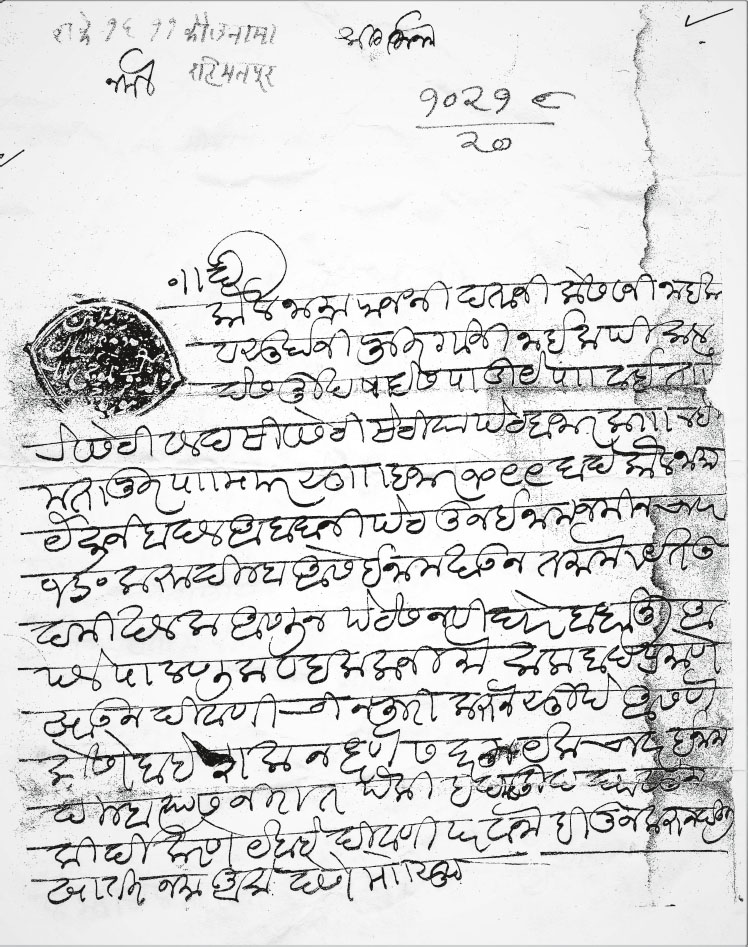
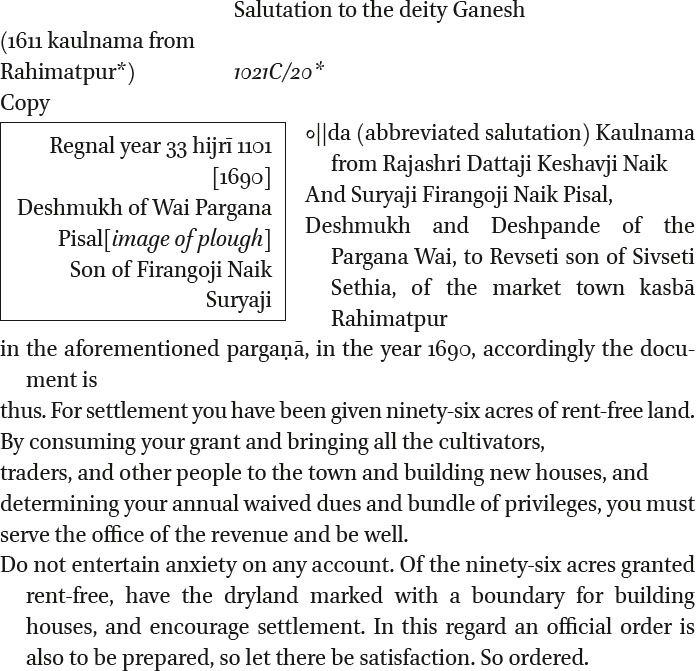
While agrarian kaulnÄmÄs were usually issued by the parganÌ£Ä-level dÄ«wÄá¹ á¹hÄá¹e, it appears that local deshmukhs themselves also issued them, with their own seals, to headmen and merchants in villages within their own parganÌ£Äs. In early 1690, the deshmukh of the Wai parganÌ£Ä, about a hundred kilometres south of Pune, issued a kaulnÄmÄ to the trader and moneylender Revsethi wald Shivsethi Sethia of the local kasbaÌ (market town) Rahimatpur. (See Fig. 1) This document confirmed the piece of inÄm (rent-free) land measuring one chÄvar44 that the trader had received, in which he had settled the area with cultivators, traders, and other people. It instructed him to determine his annual waivers and privileges, continue his service to the exchequer, and stay well without any anxiety. It also asked him to secure the dryland within this granted area with a boundary, in order to build new houses. Another kaulnÄmÄ was issued to Hambirji bin Santaji Jagtap, the village headman of Bhuinj. Recognizing his great industry in keeping his village settled and cultivated during a time of considerable turbulence, it granted him a hereditary inÄm plot within the village. A third kaulnÄmÄ was similarly issued to Ramji bin Wakoji Dhavale, the headman of the village of Nadavabal; it granted him permission to settle the barren village of Baligaon, with a portion to him as a hereditary inaÌm. A fourth kaulnÄmÄ in this quite busy year granted Mullah Musa Mujawarâs request for allotting a part of the mosqueâs inaÌm to its muezzin. A fifth such document resolved a dispute between Rakhmaji wald Vithoji Bedara and Harikrishna Dhage over a banana plantation, clarifying in great detail the distribution of resources between them.45
These kaulnÄmÄs were issued soon after the Mughals stormed the Maratha citadel of Raigad, captured Chhatrapati Sambhaji in 1689, and established their control over Maratha territories, including the Wai parganÌ£Ä. It would seem, then, that these were mundane transactions of kiÌrdiÌ maÌmuriÌ (settlement and cultivation) that followed conquest, put in place by the deshmukh of Wai to revive his war-ravaged territory. Placing these short and straightforward local documents within the large, but scattered, archive we have for this particular family, however, reveals a more complex story. At this time this deshmukh office, as well as the related one of deshkulkarnÌ£iÌ, the parganÌ£Ä accountant, was shared by two cousins of the Pisal family, Dattaji Keshavji and Suryaji. As is seen in the document appended to this article, the kaulnÄmÄs were issued in both their names, but the Persian seal was in Suryajiâs name only. A kaulnÄmÄ issued previously in 1669 by Shivaji records only Dattaji Keshavji Pisal as the deshmukh of Wai.46 Dattaji served Shivaji and assisted Sambhaji with men and material during the war against the advancing Mughals, and was subsequently appointed as the deshkulkarnÌ£iÌ of Wai as well.47 Suryaji held the pÄt̤īlkiÌ or headmanship of the village of Ozarde, among other fragmented rights within Wai. He first appears in a letter from Dattaji to the ruler Sambhaji. Dattaji requested protection from the ruler against his kinsman Suryajiâs constant depredations in his territory and harassment of the peasantry.48 In 1688, when the Mughals advanced into Maratha territory, the ambitious Suryaji accepted Mughal service. His performance in the capture of the Maratha capital Raigad in 1689 attracted the Emperor Aurangzebâs favourable attention, while Dattaji, on the Maratha side, was placed on the back foot. The end result of complicated negotiations between the Mughals and the Pisal kinsmen over their rights was that Suryaji won a half share in the deshmukhiÌ of Wai.49
A lengthy and complex documentary trail into the early eighteenth century reveals Suryaji and Dattaji locked in continuous conflict, trying to dislodge the other from the half-share in the deshmukhiÌ. Their efforts led them to appeal for fresh documentary support from all the parties in the Mughal-Maratha war at the time, from the Emperor himself,50 to the Maratha Chhatrapati Rajaram who had escaped to the fort of Gingee in the south,51 and, finally, to Chhatrapati Shahu in Satara.52 All this while, however, they continued to both singly and jointly issue and stamp documents as the rightful office-holder, and receive and issue kauls in that capacity for extending cultivation.53 Their conflict finally ended in 1710 with a truce,54 but their descendants continued to bicker over their shares into the 1750s.55
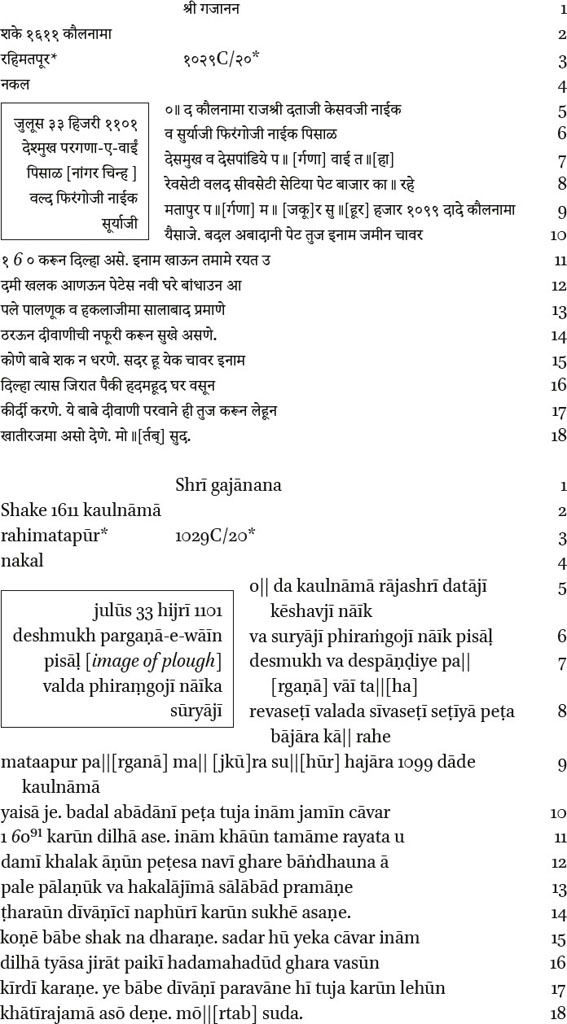
The many local kaulnÄmÄs issued by the Pisal cousins in the year 1690 were, thus, part of this changed balance of powerâboth between the Marathas and the Mughals and between the cousins themselvesâand the urge to negotiate and establish it locally. This changed balance of power was also physically represented in the documents themselves. As we can see in the appended document, these kaulnÄmÄs bore both Dattaji and Suryajiâs names as deshmukh. Suryajiâs seal in Persian bore the Mughal emperorâs regnal year 33 and the Hijri year 1101. The Hijri year 1101 began on 15 October 1689 and ended on 4 Oct 1690 CE. The Fasli year 1099 corresponds to 24 May 1689-23 May 1690 CE. Therefore, the seal was cast sometime in early 1690 CE, and the documents issued soon after. The documents also bear other marks of this changed balance of power. They are dated as âsu|| hajÄra 1099.â The year is in Marathi numerals, unlike the usual practice in Marathi documentation, which was to use the Suhur solar calendar, marked with the abbreviation su||, and spell out the date with Arabic names for day, month, and year. The numeral 1099, moreover, marked the Fasli year (corresponding to 1689-90, aligning with the dates in the seal) despite the conventional abbreviation âsu||â, suggesting the Suhur era. This use of the Fasli era with the prefix su|| hajÄra was an innovation in scribal practice peculiar to Marathi documents issued from Mughal stations in the Deccan at the turn of the eighteenth century.56 While some documents of the Maratha state after Shivajiâs coronation often used the rÄjyÄbhishek shake era (starting in 1674 CE) and the shÄlivÄhan shake era (starting in 78 CE), others also continued the older convention of using the Suhur era with Arabic names over the eighteenth century. Larger questions of military power, bureaucratic order, local authority, and linguistic representation in writing densely concentrated and overlapped in this apparently ordinary, everyday kaulnÄmÄ from a petty deshmukh to a merchant about settlement. Focusing on the documents qua documents allows us to glimpse this articulation and negotiation of authority up close.
Interestingly and unusually, a couple of the Pisal kaulnÄmÄs described above do not simply confirm older inaÌms, but actually mention the grant of fresh ones. Such grants were also a way for the deshmukh to assert a renewed local authority by granting tax-exempted land, but separate granting documents would also have been parallelly sought by, and issued to, the recipients of these particular exemptions from higher up the administration, which at this particular time in the area was Mughal. The appended kaulnÄmÄ to Revsethi reassures him that such a necessary document would also be prepared and provided for his peace of mind (diwÄá¹iÌ parwÄnaÌ hÄ« tuja karÅ«na lehÅ«na khÄtÄ«rajamÄ aso deá¹e).57 With shifting loyalties in turbulent times, and internecine conflicts between family members, the issuing authority for a panoply of documentsâwhich could range from the district revenue office of the established kingdom, to an aspiring ruler, to a petty deshmukhâreveals itself as often quite volatile. It was the fragility of the kaulnÄmÄâs assurances that, ironically, may have produced its proliferation during times of military conflict and shifting networks of powerâeveryone who could, issued one when they were able to, but it also compelled periodic renewal. Only power and posterity could tell whose assurances and kaul, inscribed on paper, endured.
The form and function of the agrarian kaulnÄmÄ, in particular, was structured as a grant of permission from a superior to an inferior to cultivate land, but was often, in effect, a confirmation of pioneering activity of clearing wasteland and occupancy already undertaken by peasant families and kin networks headed by enterprising military hopefuls. Formulaic phrases such as meherabÄnÄ« karÅ«na (having bestowed favour), and exhortations to stay on the land, be well, and koá¹e bÄbe shak andeshÄ na gheá¹e (not to entertain any suspicions or anxiety) staged the performance of hierarchy and welfare, but with at times the hint of a plea, and at others an âor else.â58 Waste land, in this context, was not always already owned by the state and then given to peasants; it was at once a space of both agrarian as well as political potential for extending the state. The format of the kaulnÄmÄ, in short, appears to paper over the ambiguity of the transactions of power and property that underlined early modern state formation and practice.
In the village-level documents issued by deshmukhs like the Pisals, moreover, the kaulnÄmÄ form also urges us to investigate further the role of petty merchants and moneylenders in this everyday revenue framework, in providing the capital needed for the actual building of houses or clearing of lands, in helping officials meet initial revenue remits with timely loans, or indeed in helping the actual peasant cultivators and settlers with cash and credit. Seths and Mahajans also enjoyed a hereditary office in villages. It is well-known that trading castes in Maharashtra were immigrants from Gujarat and Marwar in Rajasthanâsome documents are addressed to mÄravÄá¸iyÄni (Marwaris). Yet village settlement was also strongly based on caste and kin networks and a corporate brotherhood of peasant families. In such a scenario, how did merchantsâ and moneylendersâ incentive to invest money in building new market spaces, and their ability and methods to attract cultivators compare with that of village headmen, or indeed, other creditors in the village? Dattaji Keshavji noted in one of his testimonies that he had asked Manshet Sethia, one of the Seths from Wai, to accompany him along with other officials to the Mughal camp when he went to defend his watan, no doubt to assist or stay guarantee for any money that he might have to fork over.59 The traderâs role or authority in shaping the results of these negotiations is, however, not spelt out in these village-level documents, but the instruction to Revsethi in the showcased kaulnÄmÄ to âloyally serve the office of revenue and be contentâ (diwaÌniÌchiÌ nafuriÌ karuÌn sukhe asanÌ£e) also hints at a documentary performance of hierarchy as does their presence in these documents. It complicates the simplistic picture about kauls being an articulation of centralized agrarian improvement and welfare and provides a glimpse, instead, into a more dispersed, transactional practice of both the extension of agriculture and sovereignty.
2 A Documentary Grid
Most kaulnÄmÄs that confirm existing grants invoke an earlier document, such as an inÄmpatra or farmÄn, arjdÄst, or even an earlier kaulnÄmÄ itself, when specifying the grant or property under consideration. They also invoke other related documentsâa khurdkhat or dÄ«wÄnÄ« parwÄnÄ, through which the kaul being granted had to be made operational. This networkâor mazeâof documentation only hints at the complex scribal transactions, costs, and effort involved in successfully seeing a grant through to fruition on the ground. We can see a glimpse of this effort in the example above, where Kanhoji Zunzarrao had to struggle to get the terms of his kaul established and running via old and new paperwork with various local officials. The ShaÌnÌ£opanaÌchiÌ PaddhatiÌ, one of the many mestaks, or scribal manuals, that provided accountancy guidelines and outlined codes of good comportment to clerkly hopefuls in the Maratha bureaucracy, instructs the travelling kamaÌvisdaÌr on revenue collection duty to send a âkauldaÌrâ into the villages where crop-sharing of revenue (bhaÌgasthal) was the practice, clarify all the terms of contract, and check earlier collections and documents about kauls before making any fresh sanad. It is undoubtedly such routine inspections by visiting central officials that also prompted the periodic need for renewal, both of documents as well as local power relations.60
Although the format and vocabulary of the kaulnÄmÄ contains some typical formulaic phrases, these are not radically different from myriad other letters and orders relating to grants. So what precisely was the legal, which is to say enforceable, status of a kaulnÄmÄ? Did it differ when one conferred rather than confirmed rights? When was it issued or requested instead of other letter forms, and most importantly, who precisely made this decision? It is difficult to answer these questions substantially, but the Marathi epistolary convention of summarizing a previous chain of events when spelling out the reasons for writing a particular document provides a clue, albeit formulaically expressed, to this process. When issuing a kaulnÄmÄ to the headman and peasants of the village of Chinchwad in July 1673, Shivaji acknowledged their request accordingly:
Your position was declared thus, that the Mughals hold sway. It is distressing and so you cannot remain in the village. If sÄheb [i.e. Shivaji] commands, [you] will parlay with the Mughal for a kaul and stay. Thereupon a kaul is granted.
He then instructed them as follows:
When parlaying with the Mughals, a decent, able man must be placed as a go-between and through him the kaul [must be] obtained, so that there will be no trouble. Only then must you return and stay well in your village. If the Mughal kaul is not complete and you remain in the village, the Mughal will come again and harass you or take captives. This [i.e. Shivajiâs] kaul [will not cover you] if you remain in such a situation. Keeping this in mind the headman and peasants must do the needful to avoid trouble from the Mughals. So this kaul is granted. Our people will not trouble you. The kÄrkuns of the aforementioned parganÌ£Ä have been instructed accordingly.61
We see here the importance for villagers and village officials of not just negotiating an assurance in writing of protection from harassment and the importance of a mediator, but doing so simultaneously and pragmatically with multiple sites of authority. Similarly, a 1691 document from Ramchandrapant Amatya to traders, shopkeepers and sundry villagers who had fled from Wai and taken shelter elsewhere during the Mughal invasion mentioned a previous instruction to obtain dutarphaÌ kaulâassurances from both sidesâto stay in the village of Wagholi as long as the Mughals had a station in the parganÌ£Ä. With the chaotic conditions making any trade impossible there, the Amatya then issued a fresh kaul for them to stay and carry on business in Kudal instead, but also noted that they should pay dutarpha wasÅ«lâtax to both sides.62 This insight into the relative value and durability of particular documentary forms among those who sought and supplied them (as opposed to their normative status or their original Arabo-Persian meanings) is tantalizingly brief, but it is clear that the kaulnÄmÄ did not stand alone; it âworkedâ within a network and hierarchy of recommendation and documentation.
3 Language
We need more examples of bilingual manuscript kaulnÄmÄs for a comprehensive discussion of the bilingual and biscriptural division between Persian and Marathi. However, the available examples suggest that this division was functional as well as social: a senior Persian scribe at the district revenue office would write the initial, minimum content necessary with the relevant seals, and a locally more informed or junior Marathi writer would fill in the details that would be more relevant for the recipients and local officials for its operationalization in the concerned village. This longer section would also be the one periodically inspected and cross-checked by revenue collectors. This difference in length of the content in both languages was also part of the graphic ideology of such bilingual documents.63 The Persian content, punctuated by phrases such as mutÌ£aÌbiq-i-hindawiÌ (as per local practice) or dastuÌr-i-qadiÌm (ancient practice) that succinctly captured layered bureaucratic convention, also visually asserted its linguistic hierarchy and symbolic power through brevity.64
Two kaulnamas available from the 1620s, issued to the local hereditary chieftains (known as desaÌiÌs) of Kallapur in the Kannada-speaking areas around Dharwad in todayâs northern Karnataka, preserve this representation of linguistic hierarchy and scribal segmentation not only between Persian and Marathi, but also between Marathi and Kannada: a shorter Marathi section is followed by a longer section in Kannada.65 Such a hierarchy was thus also asserted trilingually and triscripturally. Marathi became âthe preferred secondary court languageâ in the Adilshahi administration in this region of the Krishna-Tungabhadra doab and further east of it from the early sixteenth century, as Maratha chiefs who got these lands in jagir brought their scribal establishments to administer them.66 While some records were maintained locally in Kannada in the family daftars of the desais, official documents issued at the parganÌ£aÌ-level were either in Persian only, or bilingual, in Perso-Marathi. Kaulnamas in other such desai daftars from the later seventeenth century were only Perso-Marathi; it is likely that wherever familiarity with Marathi-Modi was greater at the village-level scribal world in this region, or deepened over the seventeenth century, including in household daftars, this need to include a Kannada annotation to ensure comprehensibility was no longer felt; other kaulnÄmas from such desai daftars are also singly in Marathi.67 This linguistic distribution and graphic arrangement thus allows us to see the multilingual dimensions of the Persianate up close at the district, and occasionally even lower, scribal levels.
After his coronation in 1674, Shivaji commissioned a lexicon of alternatives for Persianate bureaucratic terminology, as part of his broader efforts to distance his independent state from Mughal practices and vocabularies of rule. The RÄjvyavahÄrkosh completed in 1678, accordingly, provided Sanskrit and Sanskritized alternatives for over a thousand yaÌvaniÌ (Persian) words related to the practice of statecraft, ranging from administrative positions, hereditary offices, recordkeeping practices, military personnel, animals, materials, and forts, artisans and workshops, as well as cuisine.68 Several of these words were terms for many of the documentary forms and formulaic phrases in Perso-Marathi bureaucratese. For example, the lexicon translated kaul as abhaya, or guarantee, assurance, and the kaulnÄmÄ as abhayapatra.
Persian words and phrases noticeably declined in official Maratha documents from the 1680s onwards into the early eighteenth century.69 These were not all replaced with the neologisms from the RÄjvyavahÄrkosh, however; increased use of ordinary Marathi vocabulary actually resulted in an overall lighter epistolary prose register.70 Restricting ourselves to the kaulnÄmÄ form here, the abhayapatra form came to clearly substitute for the kaulnÄmÄ over the eighteenth century as a document providing assurance, protection, and permission for cultivation.71 Some key Persian phrases changed in the abhayapatra: the closing phrase mortab shud became lekhanÄlankÄr, sandesh samaká¹£a, or nirdesh samaká¹£a, but other critical phrases such as kÄ«rdÄ« mÄmurÄ«, shak andeshÄ na dhará¹e continued. Some documents were identified as abhayapatra at the outset, but continued to employ the phrase kaul dilhÄ in the middle or ended with kaul aisÄ je.72 As Sumit Guha has suggested, familiar phrases were difficult to shake off when, presumably, âdictation was in full flow,â73 but the extent of the formal shift is nevertheless remarkable. KaulnÄmÄs also continued to be generated, but in more explicitly diplomatic contexts as Maratha power expanded into various parts of the subcontinent.74 Parties entering into an agreement each produced separate kaulnÄmÄs, which specified the terms of a kaulkarÄr (agreement) between them.75
While the impact of Shivajiâs efforts to move away from Mughal vocabularies of statecraft was clear in terms of vocabulary and register, with immediate empirical echoes in actual documents, broader everyday Marathi scribal practice over the eighteenth century remained undoubtedly messier. The long-term endurance of watan as established and respected hereditary office in the region ensured that the Persian farmÄn, the highest-level document issued by the Adilshahi Sultans and Mughal emperors, also continued to enjoy its hierarchically superior status to all other grant documents as precious documentary proof of hereditary grants and offices under the Marathas as well. In a 1691 kaulnÄmÄ confirming the deshmukhiÌ of the Jagdale family of Masur in the course of the Mughal-Maratha conflict, the Maratha subedaÌr of Satara Babaji Narayan observed that even though Sultanji Jagdale had
erred in meeting Aurangzeb and securing a farmaÌn for his position, it was after all a matter of his watan (watanaÌchaÌ maÌmlaÌ), and in keeping the practice of securing documents from that administration which was established, he too secured a farmÄn. And since he is now at the feet of the Swami [Rajaram] the Swami has forgiven him for meeting with the Mughals and granted his watanâ¦. He has a farmÄn regarding his deshmukhiÌ from the Bidar padshaÌh and a farmaÌn from Ibrahim Adilshah and another from Sultan Muhammad Shah and many supplementary documents that the Swami took into accountâ¦.76
RÄjapatram, the RaÌjvyavahÄrkoshâs suggested neologism for the farmÄn, did not catch on either as a name or as a document of comparable status. Instead, a variety of grant-related documentary forms that proliferated in Marathi over the eighteenth centuryâinÄmpatra, watanpatra, vrÌ£ttipatra, and the somewhat catch-all aÌjnÌaÌpatra as a document issuing ordersâcontinued to use the broad frame of Persian documentation, from phraseology to seal placements, even as some epistolary conventions, invocations, and dating practices changed.77 The materiality and structural importance of Persian-derived paper documentation ensured that older vocabulary also continued, despite top-down efforts at offering alternatives. This material focus allows us to situate the linguistic limits of the Maratha swarÄjya and its ideological representation through efforts such as the RaÌjvyavahÄrkosh, as well as its later, sweeping nationalist interpretations as a Hindu rejection of all things Mughal, Persian, and by extension, Muslim.
It is thus in these complex documentary, formal, and terminological trajectories that the Persianate has to be fleshed out in post-Mughal regional states with non-Persian administrations. Its enduring trace within the Maratha sphere is best captured by the ubiquitous compound terms sanadÄpatre or kÄgadpatre (both generic for bureaucratic documents, combining the Persian words sanad / document and kÄghaz / paper with the Marathi patre / document), today also short for sources, or archives. The trilingual distribution of Persian, Marathi and Kannada in Adilshahi and Maratha documents from northern Karnataka, moreover, underscores the need to see the Persianate, and the spread of Maratha power and Marathi scribal practices across the peninsula, as part of a complex, intertwined Perso-Marathi documentary formation that was a multilingual, graphic zone of adaptation, rejection, and innovation.78
Conclusion
In a recent article in Journal of the Economic and Social History of the Orient, Sumit Guha explores the implications of the inflated nature of Mughal revenue estimates and collections in contemporary records for characterizing the overall Mughal economy and state. He suggests that rather than pure facticity as such, these records of how much the Mughal state was owed, and that which it collected, were a projection of the imperial claim to the overall produce, which the state then symbolically âpermittedâ to be distributed across the administrative and social hierarchy. Revenue-collection as well as record-keeping was deeply political, shaped by struggles and transactions between the imperial-extractive machinery and local levels.79 Such an argument helps us capture the symbolic importance of the kaulnÄmÄ, as I have tried to do above, as an instrument in the performance of sovereignty. However, it also forces us to probe more carefully the meanings and purposes of documentation in general for the early modern state. In a landmark old essay, Frank Perlin argued that increased density and regularity in Maratha record-keeping was an outcome of a vertical penetration by higher civil and military elites and their commercial agents into the countryside and village, and greater class differentiation within the village.80 Guha, for his part, offers a picture with more horizontal stability, where regions with well-knit local clans and hereditary officials who could maintain a stable scribal establishment had the incentive and ability to maintain good, reliable records. It was, he suggests, precisely these regions that sought to preserve their autonomy by denying centralizing powers access to these records.81 Tracking the fortunes of particular documentary forms at different levels and transactions, I have argued in this essay, is a useful methodological entry-point into this question, one which allows us to investigate the wider purpose, as well as contradictory outcomes of recordkeeping practices, their contours of language, and the importance of the scriptural economy to the conceptual and practical domains of early modern sovereignty, law, and property. In other words, a more textured idea of the concepts, instruments, and practices through which different kinds of rights were asserted, granted, and negotiated, from sovereignty to petty control to rights to tax and produce, is critical for a more sustained understanding of the nature and bounds of premodern law and state practice.82
I conclude this article by briefly considering the short career of the kaulnÄmÄ in the early nineteenth century, when the Maratha territories came under British colonial rule. The East India Company confronted a wealth of existing land tenures across the subcontinent and tried to make sense of ideas of property, law and revenue through its own contemporary lenses of state formation, political thought, and bureaucracy. When Company officials began inquiring into local property forms in the Bombay Presidency in the early nineteenth century, they were animated by the question of whether property existed before state formation, or whether it was created by the state.83 In other words, did the act of clearing, cultivating and occupying waste lands produce property for the pioneer peasant (or groups of peasants), or did it axiomatically belong to the state? This question was propelled by the more urgent one about whether military conquest transferred all the domains conquered into the new powerâs control as property. As the new colonial government set about collecting revenue, the old debates in Bengal around the Permanent Settlement about whether the Mughal emperor was theoretically the universal landlord of his realm, or whether zamindars were private owners of their lands, were reopened in the Maratha context. Did the clause of inheritance guarantee private property, or were all Maratha grants essentially revenue contracts of varying tenure? While some officials argued that property âcreatedâ by peasants preceded the state and must be protected as private property, others like the influential William Chaplin won the day by arguing that state formation âreturnedâ property to the cultivator in a more secure form, through the joint interests of the state as well as the peasant.84 It was in this context that kauls figured in colonial discussions.
The early colonial state also adopted many early modern documentary forms and much legal-bureaucratic vocabulary, suggesting the continuation of many of these existing frameworks and practices. The Company concluded diplomatic cowlenamas with various Indian rulers and princes and declared peace within territories it had recently conquered; In the early years after conquest, the Company also granted agrarian cowls/cowles on three-, five-, or seven-year istÄwÄ clauses across the Madras and Bombay territories.85 These latter were contracted by District Collectors with hereditary village headmen, rather than with individual peasants. However, as Bhavani Ramanâs work on the making of the colonial bureaucracy in early colonial Madras has powerfully shown, this ostensible formal and lexical continuity of Persianate forms and categories was accompanied by a radical shift in the conceptual, political and linguistic worlds that had generated them, and given them meaning. The Companyâs efforts to create a bureaucracy that was transparent to oversight from London, Raman has shown, transformed the lineaments of the early modern scribal world, while producing a new âpaperealityâ where written documents acquired an unprecedented importance,86 but shorn of the complex practices of attestation and verification in which they had been previously embedded. Instead, writing practices were now at the core of a new regime of corruption, truth, and attestation, through which the colonial state both established its efficiency and honesty for the metropolitan gaze, and disciplined the subordinate native revenue bureaucracy into a racialized, hierarchical system.87
The Companyâs decision to move away from cowls in Bombay was part of this growing generalized discourse of native corruption and suspicions about existing documentation.88 The practice of giving out cowls came under a cloud as officials felt it difficult to closely monitor how the grants were actually distributed by the village Patil (headman) within villages, and whether peasants were thereby exploited by corrupt village officials.89 Moreover, while uparÄ«s (short-term tenants, or outsiders) usually got poorer, uncultivated lands on graduated revenue, the Company frowned on the fact that mirÄsdÄrs (holders of the privileged tenure in a village for long-term peasants) sometimes preferred to cultivate on istÄwÄ rates instead of their own regular assessed lands, viewing this as a loss of revenue, and an abuse of the cowl system.90
Under the Ryotwari system put in place in Bombay from the 1830s, the colonial state bypassed hereditary officials and their discretionary powers. It assumed for itself the position of universal landlord, and the right to levy revenue directly from individual peasants across the realm. This included the right to all waste lands, which were now seen as unrealized potential sources of revenue. Over the nineteenth century, Bombay revenue policy focused on the extension of cultivation across waste land. However, its simultaneous effort to increase the marketable value of cultivated lands, and promote a land market, led it to limit, and gradually abandon cowls on favourable istÄwÄ terms. Hereditary watan property forms, with their complicated bundles of rights and village services, were gradually replaced with more streamlined notions of property, labour, employment, and value. If waste land in the early modern state had served both a revenue potential as well as a means of incorporating potential co-sharers in sovereignty, under colonial political economy it became the site for imagining agrarian progress and development. It was the powerful discourse of native untrustworthiness and corruption, rather than documentary forms such as the kaulnÄmÄ, that now papered over the extractive and exploitative dimensions of the Ryotwari bureaucracy, as well as the colonial revenue administration in general.
Appendix

Pisal Deshmukh kaulnama, CE 1690
Citation: Journal of the Economic and Social History of the Orient 64, 5-6 (2021) ; 10.1163/15685209-12341547
Citation: Journal of the Economic and Social History of the Orient 64, 5-6 (2021) ; 10.1163/15685209-12341547
Translation
Citation: Journal of the Economic and Social History of the Orient 64, 5-6 (2021) ; 10.1163/15685209-12341547
*modern archival annotations in Nagari script.
Acknowledgements
I thank all the participants of the âTransactions and Documentationâ conference at the University of Exeter in July 2018, and the Paleography and Manuscriptology workshop at the University of Chicagoâs Delhi Centre in May 2019 for feedback on earlier drafts. I am especially grateful to Nandini Chatterjee and Dominic Vendell for critical support throughout this project, and the three anonymous reviewers of the manuscript for insightful suggestions that pushed me to sharpen my arguments. I thank the European Research Commission and the Lawforms project for providing funds to publish this article, and the entire issue, in Open Access format.
Bibliography
Alam, Muzaffar and Sanjay Subrahmanyam. 2011. Writing the Mughal World: Studies on Culture and Politics. Cambridge: Cambridge University Press.
Bellenoit, Hayden J. 2017. The Formation of the Colonial State in India: Scribes, Paper and Taxes, 1760-1860. New York: Taylor & Francis.
Bishara, Fahad Ahmad. 2018. âNo Country but the Oceanâ: Reading International Law from the Deck of an Indian Ocean Dhow, ca. 1900. Comparative Studies in Society and History 60/2: 338-366.
Certeau, Michel de. 1981. The Practice of Everyday Life, trans. Steven F. Randall. Berkeley: University of California Press.
Chaplin, William. 1824. Report Exhibiting a View of the Fiscal and Judicial System of Administration Introduced into the Conquered Territory above the Ghauts, Under the Authority of the Commissioner in the Dekhan. Bombay: Courier Office.
Chatterjee, Nandini. 2016. Mahzar-namas in the Mughal and British Empires: The Uses of an Indo-Islamic Legal Form. Comparative Studies in Society and History 58/2: 379-406.
Chatterjee, Nandini. 2020. Negotiating Mughal Law: A Family of Landlords across Three Indian Empires. Cambridge: Cambridge University Press.
Date, Y.R. 1932-1950. MahÄrÄá¹£há¹ra Shabdakosh. Puá¹e: Maharashtra Kosamandala.
Deo, S.S., ed. 1920. Shri Samartha SampradaÌyaÌchiÌ KaÌgadpatre, vol. 1. Dhule: the author, 1920.
Deshpande, Prachi. 2007. Creative Pasts: Historical Memory and Identity in Western India, 1700-1960. New York: Columbia University Press.
Deshpande, Prachi. 2014. Scripting the Cultural History of Language: Modi in the Colonial Archive. In New Cultural Histories of India, ed. Partha Chatterjee, Tapati Guha-Thakurta and Bodhisattva Kar. Delhi: Oxford University Press: 72-86.
Faruqui, Munis D. 2012. The Princes of the Mughal Empire, 1504-1719. Cambridge: Cambridge University Press.
Floor, W.M. 1976. The Merchants (tujjÄr) in QÄjÄr Iran. Zeitschrift der Deutschen Morgenländischen Gesellschaft 126/1: 101-135.
Fukazawa, Hiroshi. 1991. The Medieval Deccan: Peasants, Social Systems and States, Sixteenth to Eighteenth Centuries, Delhi: Oxford University Press.
Gordon, Stewart. 1985. The Marathas 1600-1818. Cambridge: Cambridge University Press.
Green, Nile, ed. 2019. The Persianate World: The Frontiers of a Eurasian Lingua Franca. Oakland: University of California Press. DOI: https://doi.org/10.1525/luminos.64.
Guha, Sumit. 2004a. Speaking Historically: The Changing Voices of Historical Narration in Western India, 1400-1900. American Historical Review 109/4: 1084-1103.
Guha, Sumit. 2004b. Transitions and Translations: Regional Power and Vernacular Identity in the Dakhan, 1500-1800. Comparative Studies of South Asia, Africa and the Middle East 24/2 (2004): 23-31.
Guha, Sumit. 2008. MÄrgÄ«, DeÅÄ« and YÄvanÄ«: High Language and Ethnic Speech in Maharashtra. In Ways of Liberation, Empowerment, and Social Change in Maharashtra, ed. M. Naito et al. Delhi: Manohar: 129-146.
Guha, Sumit. 2010. Serving the Barbarian to Preserve the Dharma: The Ideology and Training of a Clerical Elite in Peninsular India c. 1300-1800. Indian Economic and Social History Review 47/4: 497-525.
Guha, Sumit. 2011. Bad language and Good Language: Lexical Awareness in the Cultural Politics of Peninsular India, ca. 1300-1800. In Forms of Knowledge in Early Modern Asia: Explorations in the Intellectual History of India and Tibet, 1500-1800, ed. Sheldon Pollock. Durham: Duke University Press.
Guha, Sumit. 2015. Rethinking the Economy of Mughal India: Lateral Perspectives. Journal of the Economic and Social History of the Orient 58/4 (2015): 532-575.
Hull, Matthew. 2012. Government of Paper: The Materiality of Bureaucracy in Urban Pakistan. Berkeley: University of California Press.
Kulkarni A.G. 2010. Lekhanaprashastī, Mumbai: Sheel Prakashan.
Kulkarni, A.G. 2011-13. ShriÌ ShivachhatrapatiÌnÌchiÌ Patre. 2 vols. Thane, Parammitra Publications.
Kulkarni, A.G. and A.M. Patwardhan, ed. 2012. Shivacharitra SÄhitya, vol. 15. Pune: Diamond Publications.
Kulkarni, A.G. and A.M. Patwardhan, ed. 2015. Shivacharitra SÄhitya, vol. 16. Pune: Bharat Itihas Samshodhak Mandal.
Kulkarni, G.T. 1976. Land Revenue and Agricultural Policy of Shivaji: An Appraisal. Bulletin of the Deccan College Research Institute 35/3-4: 73-82.
Malshe, S.G. 1966. Mestak: ShaÌnÌ£opanaÌchiÌ PaddhatiÌ. Mumbai: Marathi Samshodhan Mandal.
Marathe, A.D., ed. 2008. ChhatrapatÄ«nÌchyÄ Preraá¹ene JhÄlelÄ RÄjkosh. Pune: Diamond Publications.
Mehendale, Gajanan Bhaskar. 2008 [1999]. ShrÄ« RÄjÄ ShivachhatrapatÄ«, 2 vols. 2nd edition. Pune: Diamond Publications.
Messick, Brinckley. 1993. The Calligraphic State: Textual Domination and History in a Muslim Society. Berkeley: University of California Press.
Ogborn, Miles. 2008. Indian Ink: Script and Print in the Making of the English East India Company. Chicago: University of Chicago Press.
Pagadi, Setumadhavrao. 2008. âManogat.â In ChhatrapatÄ«nÌchyÄ Preraá¹ene JhÄlelÄ RÄjkosh, ed. A.D. Marathe. Pune: Diamond Publications: 16-24.
Pathan, Y.M. 2007. FÄrsÄ« MarÄt̤hÄ« Anubandha: BhÄsÌ£hika, VÄngmayÄ«na va SÄá¹ská¹tika. Mumbai: Mumbai Maharashtra Rajya Sahitya ani Sanskrutik Mandal.
Pawar, S. 1978. MarÄt̤heshÄhÄ«tÄ«la PatrarÅ«pa Gadya. Kolhapur: Shivaji Vidyapith.
Perlin, Frank. 1985. State Formation Reconsidered: Part Two. Modern Asian Studies 19/3: 415-480.
Perlin, F. 1978. Of White Whale and Countrymen in the Eighteenthâcentury Maratha Deccan: Extended Class Relations, Rights, and the Problem of Rural Autonomy under the Old Regime. The Journal of Peasant Studies 5/2: 172-237.
Pickett, James and Paolo Sartori. 2019. From the Archetypal Archive to Cultures of Documentation. Journal of the Economic and Social History of the Orient 62/5-6: 773-798.
Potdar, D.V. and G.N. Muzumdar, ed. 1929. Shivacharitra SÄhitya, vol. 2. Pune: Bharat Itihas Samshodhak Mandal.
Rajwade, V.K., ed. 1898-1912. MarÄt̤hyÄnÌchyÄ ItihÄsÄchÄ« SÄdhane, 22 vols. (various places, 1898-1918). New series, ed. P.N. Deshpande, 11 vols. Dhule: Rajwade Samshodhan Mandal (www.samagrarajwade.com).
Raman, Bhavani. 2012. Document Raj: Scribes and Writing in Early Colonial Madras. Chicago: University of Chicago Press.
Sardesai, G.S., ed. 1930-4. Selections from the Peshwa Daftar. 45 vols. Bombay: Government Central Press.
Sartori, P. 2019. Seeing like a Khanate: On Archives, Cultures of Documentation, and Nineteenth-century Khvarazm. Journal of Persianate Studies 9/2: 228-257.
Sen, S.N. 1925. Administrative History of the Marathas: From Original Sources. Calcutta: University of Calcutta.
Siddique, Asheesh Kapur. 2020a. The Archival Epistemology of Political Economy in the Early Modern British Atlantic World. The William and Mary Quarterly 77/4: 641-674.
Siddique, Asheesh Kapur. 2020b. Governance through Documents: The Board of Trade, Its Archive, and the Imperial Constitution of the Eighteenth-Century British Atlantic World. Journal of British Studies 59/2: 264-290.
Strandberg, Elisabeth. 1984. The ModÌ£iÌ Documents from Tanjore in Danish Collections: Edited, Translated and Analysed. Wiesbaden: Franz Steiner Verlag.
Sturman, Rachel. 2012. The Government of Social Life in Colonial India: Liberalism, Religious Law, and Womenâs Rights. Cambridge: Cambridge University Press.
Travers, Robert. 2015. A British Empire by Treaty in Eighteenth-Century India. In Empire by Treaty: Negotiating European Expansion, 1600-1900, ed. Saliha Belmessous. Oxford: Oxford University Press.
Vad, G.C., P. Mawjee and D.B. Parasnis. 1913. Selections from the Government Records in the Alienation Office: Sanads & Letters. Mumbai: P. Mawjee.
Vaidya, S.L. 1951. Vaidya DaptaraÌtuÌn NivadÌ£lele KaÌgad, vol. 5. Pune: Bharat Itihas Samshodhak Mandal.
Wink, André. 1986. Land and Sovereignty: Agrarian Society and Politics under the Eighteenth-century Maratha SvarÄjya Cambridge: Cambridge University Press.
The Romanisation of Arabic and Persian words in this article follows JESHOâs modified IJMES guidance, and a LOC-based common schema adopted for this special issue, for Bengali, Gujarati, Hindi, Marathi and Rajasthani words. To reconcile the two schemas, we have introduced minor variations to the LOC schema to ensure distinct diacritics. In many cases, the same word occurs in multiple languages but is pronounced differently; Romanisation used follows the phonetic context. For the common schema, see pp. 483-5 of this issue.
Uncatalogued, Rajwade Samshodhan Mandal, Dhule. Accessed and downloaded electronic version at
A.G. Kulkarni, LekhanaprashastÄ« (Mumbai: Sheel Prakashan, 2010): 15-16. This volume, Kulkarniâs two-volume edited collection ShriÌ ShivachhatrapatiÌnÌchiÌ Patre, 2 vols. (Thane: Parammitra Publications, 2011-2013) and the latest Shivacharitra SÄhitya volumes that she has co-edited are notable for their inclusion of facsimiles of actual documents in the Moá¸Ä« script alongside their Nagari transcriptions. This facilitates a much-needed discussion of the visuality and materiality of Maratha historical documents alongside the mining of their content as source material. See A.G. Kulkarni and A.M. Patwardhan, vol. 15 (Pune: Diamond Publications, 2012) and vol. 16 (Bharat Itihas Samshodhak Mandal, 2015).
S.N. Sen, Administrative History of the Marathas: From Original Sources (Calcutta: University of Calcutta, 1925): 118-9; G.T. Kulkarni, âLand revenue and Agricultural Policy of Shivaji: An Appraisal.â Bulletin of the Deccan College Research Institute 35, 3/4 (1976): 73-82.
P. Sartori, âSeeing like a Khanate: On Archives, Cultures of Documentation, and Nineteenth-century Khvarazm.â Journal of Persianate Studies 9/2 (2016): 228-57; S. Dayal, âMaking the Mughal Soldier: Ethnicity, Identification, and Documentary Culture.â Journal of the Economic and Social History of the Orient 62/5-6 (2019): 856-924; E. Lhost, âFrom Documents to Data Points: Marriage Registration and the Politics of Record-Keeping in British India (1880-1950).â Journal of the Economic and Social History of the Orient 62/5-6 (2019): 998-1045.
M. Hull, Government of Paper: The Materiality of Bureaucracy in Urban Pakistan (Berkeley: University of California Press, 2012).
N. Chatterjee, âMahzar-namas in the Mughal and British Empires: The Uses of an Indo-Islamic Legal Form.â Comparative Studies in Society and History 58/2 (2016): 379-406.
André Winkâs superb, exhaustive study of the Marathas explores Maratha documentation to get âon the other side of th[e] processâ of the Mughal idiom of universal sovereignty and its sweeping condemnation of any disturbances as revolt. As part of his wider argument about the emergence of Maratha power out of the Mughal process of fitna or rule by controlled conflict, Wink examines Maratha administrative terminology and practices to understand elements of continuity and change from the Mughal system. A. Wink, Land and Sovereignty: Agrarian Society and Politics under the Eighteenth-century Maratha SvarÄjya (Cambridge: Cambridge University Press, 1985): 7. See also R.M. Eaton, The Sufis of Bijapur (Princeton: Princeton University Press): 91; R.M. Eaton, âThe Persian Cosmopolis.â In The Persianate World: Rethinking a Shared Sphere, ed. A. Abbas and A. Ashraf (Leiden: Brill, 2018): 63-83.
S. Guha, âBad Language and Good Language: Lexical Awareness in the Cultural Politics of Peninsular India, ca. 1300-1800.â In Forms of Knowledge in Early Modern Asia: Explorations in the Intellectual History of India and Tibet 1500-1800, ed. S. Pollock (Durham: Duke University Press, 2011); S. Guha, âMÄrgÄ«, DeÅÄ« and YÄvanÄ«: High Language and Ethnic Speech in Maharashtra.â In Ways of Liberation, Empowerment, and Social Change in Maharashtra, ed. M. Naito et al. (Delhi: Manohar, 2008): 129-46; S. Guha, âServing the Barbarian to Preserve the Dharma: The Ideology and Training of a Clerical Elite in Peninsular India c. 1300-1800.â Indian Economic and Social History Review 47/4 (2010): 497-525.
Y.M. Pathan, FÄrsÄ« MarÄt̤hÄ« Anubandha: BhÄá¹£ika, VÄngmayÄ«na wa SÄá¹ská¹tika (Mumbai: Maharashtra Rajya Sahitya ani Samskrutik Mandal, 2007).
N. Green, ed., The Persianate World: The Frontiers of a Eurasian Lingua Franca (Oakland: University of California Press, 2019); various articles in the recent special issue of Journal of the Economic and Social History of the Orient on âCultures of Documentationâ also emphasize, from different sites across the Persianate and Islamic worlds, the importance of critically harnessing studies of chancery and documentary practices towards fleshing out the contours of historically situated cultures of documentation. See the introduction to the issue by J. Pickett and P. Sartori, âFrom the Archetypal Archive to Cultures of Documentation.â Journal of the Economic and Social History of the Orient 62/5-6 (2019): 773-98.
M. de Certeau, The Practice of Everyday Life, trans. S.F. Randall (Berkeley: University of California Press, 1981): 131-2. De Certeau uses the phrase to describe what he calls a âtapestryâ of interlocked threads of writing and written forms that perform critical disciplinary functions in modern society. I draw on it to capture his sense of the actual pervasiveness, as well as discursive importance of writing and written documents to illuminate this reach and endurance of Persian and Persianate bureaucratic documentation.
The longer, ongoing, work of which this article is a part attempts such a reimagining of Marathi language history through the lens of the Modi script. Bringing together seemingly disparate processes from clerkly skills and multilingual recordkeeping to historicity in language, orthographic debates, and state surveillance practices enables us, I argue, to perceive a genealogy of the regional Indian âvernacularâ beyond that suggested by the dominant foci on literary histories or linguistic evolution.
B. Messick, The Calligraphic State: Textual Domination and History in a Muslim Society (Berkeley: University of California Press, 1993): 29.
F.A. Bishara, ââNo Country but the Oceanâ: Reading International Law from the Deck of an Indian Ocean Dhow ca. 1900.â Comparative Studies in Society and History 60/2 (2018): 338-66.
W.M. Floor, âThe Merchants (tujjÄr) in QÄjÄr Iran.â Zeitschrift der Deutschen Morgenländischen Gesellschaft 126/1 (1976): 118.
M.D. Faruqui, The Princes of the Mughal Empire (Cambridge: Cambridge University Press, 2012): 40.
R. Travers, âA British Empire by Treaty in Eighteenth-Century India.â In Empire by Treaty: Negotiating European Expansion, 1600-1900, ed. Saliha Belmessous (Oxford: Oxford University Press, 2015): 138.
M. Alam and S. Subrahmanyam, Writing the Mughal World: Studies on Culture and Politics (Cambridge: Cambridge University Press, 2011): 68, 85.
N. Chatterjee, Negotiating Mughal Law: A Family of Landlords across Three Indian Empires (Cambridge: Cambridge University Press, 2020): 135.
The Moá¸Ä« script was a cursive script that was used for all kinds of business writing and correspondence in Marathi from the fourteenth century onwards until as late as the early twentieth century. For a survey of Modi usage, see E. Strandberg, The ModÌ£iÌ Documents from Tanjore in Danish Collections: Edited, Translated and Analysed (Wiesbaden: Franz Steiner Verlag, 1983).
V.K. Rajwade, ed., MarÄt̤hyÄnÌchyÄ ItihÄsÄchÄ« SÄdhane, vol. 20, letter no. 2. Since I have accessed many of the documents from the MarÄt̤hyÄnÌchyÄ ItihÄsÄchÄ« SÄdhane volumes in electronic format at
Kulkarni, Lekhanaprashastī: 212-7. I am very grateful to Nandini Chatterjee and Dominic Vendell for help with the Persian translations of all these documents.
Bharat Itihas Samshodhak Mandal (BISM), G.H. Khare/Solapurkar Deshmukh collection, rumaÌl no. 4, document nos. 2, 4-5. We will return to this pattern of bilinguality later in the paper.
Y.R. Date, MahÄrÄá¹£htÌ£tra Shabdakosh (Puá¹e: Maharashtra Koshmandal, 1932-1950): 812.
In earlier printed editions, such as MarÄt̤hyÄnÌchyÄ ItihÄsÄchÄ« SÄdhane, this letter was often mis-transcribed as an Ä«- kÄr or the similar-looking letter for the long-vowel /i/.
Rajwade, MarÄt̤hyÄnÌchyÄ ItihÄsÄchÄ« SÄdhane, vol. 16: 43.
Rajwade, MarÄt̤hyÄnÌchyÄ ItihÄsÄchÄ« SÄdhane, vol. 21: 4.
S. Guha, âSpeaking Historically: The Changing Voices of Historical Narration in Western India, 1400-1900.â American Historical Review 109/4 (2004): 1084-1103.
Rajwade, MarÄt̤hyÄnÌchyÄ ItihÄsÄchÄ« SÄdhane, vol. 16: 6.
Ibid.: 7.
The next letter in the volume is a letter from Patangrau to the officials of tape Kanadkhore, ordering them to stop harassing Kanhoji Zunzarrao and the peasants in his territory. Rajwade, MarÄt̤hyÄnÌchyÄ ItihÄsÄchÄ« SÄdhane, vol. 16: 8.
Kulkarni, Patre, vol. 2: 292-3.
Rajwade, MarÄt̤hyÄnÌchyÄ ItihÄsÄchÄ« SÄdhane, vol. 16: 8, 26. The phrase used is ganimÄchyÄ tÄbyÄta. Ganim (Persian ghanÄ«m), meaning enemy, was a term regularly used for (and by) the Marathas. See P. Deshpande, Creative Pasts: Historical Memory and Identity in Western India, 1700-1960 (New York: Columbia University Press): 51-2.
Rajwade, MarÄt̤hyÄnÌchyÄ ItihÄsÄchÄ« SÄdhane, vol. 16: 36, 43, 47.
Ibid.: 8, 13, 14. Another, longer kaulnÄmÄ to Haibatrao Silambkar from Shivaji in 1671, gave much more detailed assurance of no harm to his life. Potdar, Shivacharitra SÄhitya, vol. 2: 253. See also G.S. Sardesai, ed. Selections from the Peshwaâs Daftar, vol. 31 (Bombay: Government Central Press, 1930-34): no. 72.
H. Fukazawa, The Medieval Deccan: Peasants, Social Systems and States, Sixteenth to Eighteenth Centuries (Delhi: Oxford University Press, 1991).
Wink, Land and Sovereignty; S. Gordon, The Marathas 1600-1818 (Cambridge: Cambridge University Press, 1985).
Wink describes the documentary trail of the conflicts between claimants to hereditary office (in this case the Yadav and Jagdale families of Masur) against the backdrop of the larger Maratha-Mughal conflict of the 1690s. Wink, Land and Sovereignty: 162-72.
Grants issued by royal delegates, ranging from powerful ministers to scribal officers, required appropriate adjustments in the revenue accounts until they were sanctioned with explicit royal permission. During the war with the Mughals in the 1690s, for example, the minister Ramchandra Pant Amatya, based in the Deccan to rally support to the Maratha side, issued many grants on behalf of Chhatrapati Rajaram based in Jinji. The Peshwas had all the grants they issued sanctioned by Chhatrapati Shahu until the 1740s, after which they stopped, and effectively asserted de facto power over the Maratha state. Wink, Land and Sovereignty: 240.
Chatterjee, Negotiating Mughal Law: 33.
Sardesai, Selections from the Peshwa Daftar, vol. 31: 65.
Wink, Land and Sovereignty: 179.
One chÄvar or chÄhur is equivalent to a hundred and twenty bighaÌs, with one bighaÌ in the Pune region being 0.8 acres. Date, Shabdakosh: 1179, 2269.
BISM, Pisal Deshmukh papers, Uncatalogued mss. Anuradha Kulkarni kindly provided me with facsimiles of the manuscripts of these documents, and I thank her and Shraddha Waghmare for help with deciphering some of the more difficult squiggles.
Potdar, Shivacharitra SÄhitya, vol. 2: 263.
Ibid.: 271.
Ibid.: 273.
G.C. Vad, P. Mawjee and D.B. Parasnis, Selections from the Government Records in the Alienation Office: Sanads & Letters (Mumbai: P. Mawjee, 1913): 196-7.
Vad et al., Selections.
Rajwade, MarÄt̤hyÄnÌchyÄ ItihÄsÄchÄ« SÄdhane, vol. 3: 56.
Rajwade, MarÄt̤hyÄnÌchyÄ ItihÄsÄchÄ« SÄdhane, vol. 3: 62-4.
Kulkarni, Lekhanaprashastī: 218-23.
Rajwade, MarÄt̤hyÄnÌchyÄ ItihÄsÄchÄ« SÄdhane, vol. 3: 59.
Ibid.: 61.
G.B. Mehendale, ShrÄ« RÄjÄ ShivachhatrapatÄ«, vol. 2, 2nd edition (Pune: Diamond Publications, 2008): 126-9.
Most kaulnÄmÄs I have examined restrict themselves to permissions and confirmations, but it is possible that this is a result of the kinds of documents that have survived and/or been published. Nationalist historians of the Marathas from the late nineteenth century onwards tended to publish documents that supported the reconstruction of a larger Maratha history, in particular those that mentioned important events or figures. Many mundane agrarian kaulnÄmÄs do not have seals and are on very ordinary paper; they had a more immediate purpose and limited circulation, unlike other grant documents that were carefully preserved by recipients. It is thus hard to say how unusual the Pisal examples with their elaborate, newly cast seal are; they highlight the need to search for other such uncatalogued, manuscript collections of hereditary officials. Deshpande, Creative Pasts.
In 1792, a merchant of Mouze Avarad and Peth Shahjahani of Pargana Udgir was reprimanded for not remaining in his pet̤h, and commanded to stay where he was, and be happy. Rajwade, MarÄt̤hyÄnÌchyÄ ItihÄsÄchÄ« SÄdhane, vol. 12: 2.
Vad et al., Sanads & Letters: 196-7.
S.G. Malshe, ed., Mestak: ShaÌnÌ£opanaÌchiÌ PaddhatiÌ (Mumbai: Marathi Samshodhan Mandala, 1966): verses 84-85, 130.
Kulkarni, Patre, vol. 2: 297-8.
Kulkarni, Shivacharitra SÄhitya, vol. 16: 73.
Hull, Government of Paper: 14-5.
I owe this point to Dominic Vendell. This is perhaps not dissimilar to the way modern senior bureaucrats would restrict themselves to terse phrases like âdo the needful,â leaving underlings to elaborate the how and why of said needful task.
Potdar, Shivacharitra SÄhitya, vol. 6: nos. 16-19, pp. 10-11; nos. 16-18, pp. 91-92.
G.H. Khare, âThe Archives of the Deshmukh Family of Sholapur (Bombay).â Indian History Congress Proceedings (1953): 274.
BISM, Lakshmeshwar Desai Daftar, documents no. 165 and 169 are Marathi-only kaulnÄmÄ from 1634 and 1649 respectively.
A.D. Marathe, ed., ChhatrapatÄ«nÌchyÄ Preraá¹ene JhÄlelÄ RÄjkosh (Pune: Diamond Publications, 2008). I undertake a more detailed discussion of this text in the larger, forthcoming work from which this article is drawn.
Rajwade, MarÄt̤hyÄnÌchyÄ ItihÄsÄchÄ« SÄdhane, vol. 8: âPrastavÄnÄ.â
S. Pawar, MarÄt̤heshÄhÄ«tÄ«la PatrarÅ«pa Gadya (Kolhapur: Shivaji Vidyapith, 1978).
For examples of abhayapatras see Rajwade, MarÄt̤hyÄnÌchyÄ ItihÄsÄchÄ« SÄdhane, vol. 3: 324; vol. 6: 77, 110, 603; vol. 15: 349, 353; vol. 17: 19. For references to abhayapatras in other documents, see Rajwade, MarÄt̤hyÄnÌchyÄ ItihÄsÄchÄ« SÄdhane, vol. 3: 97; vol. 8: 73, 74, 173; vol. 21: 12.
Rajwade, MarÄt̤hyÄnÌchyÄ ItihÄsÄchÄ« SÄdhane,vol. 2: 4; vol. 18: 14; also Kulkarni and Patwardhan, ed., Shivacharitra SÄhitya, vol. 16, no. 64: 73; S.S. Deo, ed., Shri Samartha SampradaÌyaÌchÄ« KaÌgadpatre, vol. 1 (Dhule: the author, 1920): nos. 67, 91, 92, 122, 173.
S. Guha, âMÄrgÄ«, DeÅÄ« and YÄvanÄ«â: 140-1.
S. Guha, âTransitions and Translations: Regional Power and Vernacular Identity in the Dekhan, 1500-1800.â Comparative Studies of South Asia, Africa and the Middle East 24/2 (2004): 23-31, 29.
Unlike the Mughal qaul-o-qaraÌr that served as an agrarian contract for revenue, therefore, the Marathi term kaulkaraÌr applied to the diplomatic agreement itself, with the kaulnaÌmaÌ its written form. In 1780, during negotiations between the Peshwa and various northern powers such as the Mughal court, Mahadji Shinde at Gwalior, and the Rohilla ruler Najibkhan, the latter sent a yÄd, a memorandum, to the Peshwa listing the clauses he wished to include in a kaulnÄmÄ, for a kaulkarÄr or agreement between them. In a private letter to his boss, however, the Peshwaâs agent wondered about the propriety of the Peshwa sending a fresh kaulnÄmÄ with new terms to Najibkhan, when one already existed. Would this not constitute a breach of faith? The persistent Najibkhan, for his part, communicated a fresh yÄd with different terms, but the Peshwa eventually prevailed on him to agree to the existing one. Rajwade, MarÄt̤hyÄnÌchyÄ ItihÄsÄchÄ« SÄdhane, vol. 1: 280, 282; vol. 12: 30; vol. 19: 56.
Rajwade, MarÄt̤hyÄnÌchyÄ ItihÄsÄchÄ« SÄdhane, vol. 15: 21.
Sumit Guha has suggested that the projection of Sanskritized alternatives to Persian within Marathi official writing, and even the adoption of some Sanskrit itself, continued to draw on Persian models. Guha, âTransitionsâ: 29.
This perhaps brings the idea of the Persianate itself closer to what Frank Perlin described elsewhere as a âlibraryâ of administrative experiences, techniques and forms that proliferated above all through paper and writing, âwithin which borrowing could occur, modifications be made and additions and experiments attempted.â F. Perlin, âState Formation Reconsidered: Part Two.â Modern Asian Studies 19/3 (1985): 433.
S. Guha, âRethinking the Economy of Mughal India: Lateral Perspectives.â Journal of the Economic and Social History of the Orient 58/4 (2015): 532-75.
F. Perlin, âOf White Whale and Countrymen in the Eighteenthâcentury Maratha Deccan: Extended Class Relations, Rights, and the Problem of Rural Autonomy under the Old Regime.â The Journal of Peasant Studies 5/2 (1978): 172-237.
Guha, âRethinkingâ: 558-61.
The arguments in this essay also resonate with those in the article in this same issue by Dominic Vendell, on the Marathi documentary form of the karÄrnaÌmaÌ.
I am following here the superb recent survey of these efforts for the Bombay presidency in R. Sturman, Government of Social Life in Colonial India: Liberalism, Religious Law, and Womenâs Rights (Cambridge: Cambridge University Press, 2012): 35-69.
W. Chaplin, Report Exhibiting a View of the Fiscal and Judicial System of Administration, Introduced into the Conquered Territory above the Ghauts, Under the Authority of the Commissioner in the Dekhan (Bombay: Courier Office, 1824): 57.
F.A. Nicholson, Manual of the Coimbatore District in the Presidency of Madras (Government Press: Madras): 108-18.
See also A.K. Siddique, âThe Archival Epistemology of Political Economy in the Early Modern British Atlantic World.â The William and Mary Quarterly 77/4 (2020): 641-74, and âGovernance through Documents: The Board of Trade, Its Archive, and the Imperial Constitution of the Eighteenth-Century British Atlantic World.â Journal of British Studies 59/2 (2020): 264-90.
B. Raman, Document Raj: Scribes and Writing in Early Colonial Madras (Chicago: University of Chicago Press, 2012). For studies of writing, clerkship and the colonial bureaucracy of paper also see M. Ogborn, Indian Ink: Script and Print in the Making of the English East India Company (Chicago: University of Chicago Press, 2008); H.J. Bellenoit, The Formation of the Colonial State in India: Scribes, Paper and Taxes, 1760-1860 (New York: Taylor & Francis, 2017).
P. Deshpande, âScripting the Cultural History of Language: Modi in the Colonial Archive.â In New Cultural Histories of India, ed. Partha Chatterjee, Tapati Guha-Thakurta and Bodhisattva Kar (Delhi: Oxford University Press, 2014): 72-86.
Chaplin, Report: 17-8.
Ibid.: 62.
This 6 is called an aÌlÌ£a in Marathi, a mark that ensures no later additions are made to numerals. Here it is also followed by a zero.
These are modern archival annotations on the document in nagari script.