Abstract
A new distiller’s high protein product (corn fermented protein – CFP) from the dry grind bioethanol process was evaluated as an alternative to soybean meal (SBM) protein in starter and grower diets for turkey poults. One-day- old male BUT6 poults (250) were distributed randomly into 50 pens. Each pen was allocated to one of the following treatments (10 pens each), control (high protein with soybean meal as primary protein source), CFP4% (4% CFP in replacement of SBM); CFP8% (8% CFP in replacement of SBM); HF-CFP4% (4% CFP with lower protein, higher fibre SBM, as primary protein source) and Premium (5% soy protein isolate (SPI) in place of high protein SBM). All diets were isonitrogenous and isoenergetic. Growth performance was measured weekly. At day 42, three poults per pen were sampled to obtain the ileal digesta. Apparent amino acid digestibility (AAAD), nitrogen retention (ANR) and apparent metabolisable energy corrected for nitrogen (AMEn) were measured. At day 42 poult weight and day 0–d42 weight gain for birds fed CFP8% were significantly better than the control. From day 0–42 feed intake nor feed conversion ratio were affected by dietary treatment (P > 0.05). Poults receiving CFP 8% had higher AMEn and ANR compared to the control (P < 0.05). The CFP8%-fed poults had significantly higher valine, isoleucine and proline digestibility compared to the control. Feeding the CFP8% diet significantly lowered growth carbon footprint (P < 0.05). In conclusion, CFP8% can increase ANR and growth performance of turkeys. This would decrease the dependency on SBM, reducing both economic and the environmental cost of turkey production.
1 Introduction
Reducing the use of fossil fuels at a pace to moderate climate change is one of the major challenges of our time (Benedek, 2017). Bioethanol has already been accepted as a renewable fuel, and the UK government raised the Renewable Transport Fuel Obligation for the inclusion of bioethanol in fuel from the 2010 level of 5.75 to 9.75% (UK GOV, 2018) leading to an increase in bioethanol production in UK. This higher production will increase the availability of useful co-products, mainly, distiller’s dried grains with solubles (DDGS). It is notable that DDGS was never a designed product but was the most convenient means of monetising the co-product stream of a dry grind ethanol plant. The DDGS is produced from two separate production streams which are combined to facilitate the efficiency of drying the material. Unfortunately, this could result in a documented inconsistency in the product (Spiehs et al., 2002).
The ethanol process generates a significant amount of yeast. Technologies for isolating the yeast proteins from the product stream (Burton et al., 2013) have created an opportunity to provide a sustainable functional protein for animal feed. The problems associated with sourcing sustainable protein for monogastric species are well documented (Van Huis and Oonincx, 2017), as there are environmental concerns over the production and transport of soybean meal (SBM). Feed protein from the EU bioethanol industry can provide a significant quantity of protein which could be used in place of imported SBM, with the added advantage of being non-GM. Furthermore, this co-product is not in competition with human food protein.
Corn fermented protein (CFP) is produced by the Maximized Stillage Co-products™ process (MSC™, Fluid Quip Technologies, Cedar Rapids, IA, USA) which recovers a high protein stream plus a large proportion of the fermentation spent yeast from a dry grind ethanol plant. This technology is used in multiple dry-grind ethanol plants in the USA and South America, producing a high protein fraction, with a significant spent yeast content (24% yeast on a dry matter basis; Omar et al., 2012). The product has already been tested successfully in aquaculture, with 20% dietary inclusion reported as optimal for performance in several species of fish (Gause and Trushenski, 2011; Omar et al., 2012). Early studies in broiler chickens showed its potential for inclusion in starter diets, and potential improvement in feed efficiency at higher levels of inclusion (>10% inclusion; Burton et al., 2013). To date, no studies have been carried out using this novel protein as protein supplement in diets for turkey poults, a species which requires high-quality protein to accommodate the sensitive neonatal gut.
Thus, the goal of the current study was to evaluate CFP as an alternative protein to soybean meal in starter and grower diets for turkey poults.
2 Materials and methods
All procedures followed Institutional and UK national NC3R ARRIVE guidelines for the care, use and reporting of animals in research (Kilkenny et al., 2010). All experimental procedures in this study were approved by the Nottingham Trent University School of Animal, Rural and Environmental Sciences ethical review committee, and logged as ARE710.
Poults and husbandry
Male BUT6 poults (n = 250) were obtained on day of hatch from a commercial hatchery. On the day of arrival at the unit poults were randomised by weight and placed in 0.64 m2 floor pens in groups of five with an average initial weight across all treatments of 66 g (±0.5 g). The poults were bedded on clean wood shavings and had free access to feed and water during the trial. Environmental temperature in the room was thermostatically controlled to give an initial temperature of 32 °C on day 1. The temperature was reduced in steps of 0.5 °C per day, until the room was maintained at 21 °C. The lighting regimen was 23 h light on day 1 and 2, with darkness increasing by 1 h per day until 8 h of darkness was reached, which was maintained throughout the remainder of the study (following EU legislation; EU Council Directive 2007/43/EC).
Production of corn fermented protein
The corn fermented protein product is produced using a ‘bolt-on’ addition to the traditional dry grind ethanol process, described as the MSC™ process (Lee, 2015). The MSC™ process is incorporated into the post-distillation whole stillage stream at the point at which it emerges from distillation. Whole stillage is the residue from fermentation, once ethanol has been recovered. The MSC™ process is a combination of multi-stage separations and water washing steps which produces a concentrated solution of suspended protein particles plus spent yeast from fermentation. The concentrated paste is then fed into a flash dryer where the material is transformed into the CFP product. The MSC™ process does not involve any addition of exogenous processing aids or any additional use of water.
Dietary treatments
The study pens were divided into five dietary treatments (10 pens/treatment): Control (high protein SBM as the primary protein source), CFP4% (4% CFP used in place of high protein SBM), CFP8% (8% was CFP used in place of high protein SBM), HF-CFP4% (4% was CFP at lower protein level, higher fibre soybean meal, was the primary protein source), and Premium (5% of the total diet was a soy protein isolate (SPI) in place of high protein SBM). The diets were formulated in two phases, starter (sieved crumb; day 0–21) and grower (short pellet; day 21–42) (Appendix A and B, respectively). For each phase, the five dietary treatments were formulated to be equal in crude protein, ileal digestible amino acids, AME, Ca, and P. The experimental diets were manufactured at a commercial mill and analysed before feeding. Titanium dioxide was added in all experimental diets at a rate of 5 g/kg to act as an inert marker for evaluation of digestibility and the dietary titanium dioxide content quantified (Morgan et al., 2014). The nutritional composition of CFP is presented in Table 1.

Nutritional composition and amino acid analysis of corn fermented protein1
Citation: Journal of Applied Animal Nutrition 12, 1 (2024) ; 10.3920/jaan2023.0002
Litter, digesta and excreta sampling
All poults were euthanised by cervical dislocation at the end of the trial after 4 h light exposure to maximise gut fill. Birds’ feet were examined for the presence of pododermatitis. The ileum was excised from three birds per pen, from Meckel’s Diverticulum to the ileal-colonic junction. Ileal digesta was then collected by gentle digital pressure then the digesta were pooled per pen, and these samples were freeze-dried and finely ground with a pestle and mortar before analysis.
Excreta samples were collected at day 42 by collection from the pens, taking care to remove litter from the excreta samples. Excreta was dried at 80 °C until constant weight and ground through a 1mm screen before analysis. Litter samples were collected from each pen on day 42 using a ‘W’ collection pattern, pooled per pen and then analysed for moisture content.
Growth performance and litter dry matter
Pen dietary treatments were randomized across the trial room. Total pen weight and feed intake were measured weekly until 42 days post-hatch and used to calculate FCR. Mortality was recorded daily.
Chemical composition of the experimental diets
Pellet quality was determined for each diet (ASAE, 2004). The ‘drop test’ was used to determine the durability of pellets of each experimental diet. Briefly, 10 pellets per diet were randomly selected and individually weighed. Each was dropped from a 1.85 m height onto a metal plate. The largest remaining fraction of the dropped pellet was reweighed afterwards. The durability index was calculated using the average of the 10 pellets per diet. Dry matter, extractable fat and protein content (calculated as nitrogen × 6.25) were analysed according to the standard methods (AOAC, 2003, method 930.15, 2003.05 and 990.03, respectively). Phosphorus and Ca content of the diets were determined by inductively coupled plasma-optical emission spectroscopy following an aqua regia digestion step (AOAC, 2003, method 985.01). Titanium dioxide content in feed and digesta samples was quantified as described in Morgan et al. (2014). Gross energy of digesta and feed samples were determined by bomb calorimetry (Robbins and Firman, 2006). Amino acid content of diets and digesta were analysed by ion exchange chromatography using a Biochrom 30 amino acid analyser. Samples were prepared for analysis by oxidation with performic acid prior to acid hydrolysis with 6N HCl. Norleucine was added as an internal standard. Amino acid standards were prepared containing 200 nmol/ml of amino acids and norleucine, and these were used to calculate amino acid content of the digesta and diets after the internal standard correction was applied. Apparent metabolisable energy (AME) of feed samples was calculated using the following equation:
AME (MJ/kg) = Gross energy of diet (MJ/kg) – (gross energy of excreta (MJ/kg) × (TiO2 in the diet(%)/TiO2 in excreta(%)))
Apparent nitrogen retention was calculated using the following equation:
Apparent nitrogen retention (g per kg diet) = N per g diet – N per g excreta × (Diet TiO2 (%)/Excreta TiO2 (%))
AMEn was then calculated using a value of 34.4 MJ per g of dietary N. Apparent amino acid digestibility was calculated using the following equation (Hill and Anderson, 1958):
Apparent amino acid digestibility = 1 – [(AAdig × marker feed) / (AAfeed × markerdig)]
Where AAdig was the amino acid content of the digesta, markerfeed the titanium concentration in the diet, AAfeed the amino acid concentration in the diet and markerdig the titanium dioxide concentration in the digesta.
Carbon footprint calculation
The life cycle analysis inventory used to calculate carbon footprint of 1 kg of poult growth is presented in Appendix C. Global Food LCA Institute database (version 28-Dec-2018, ReCiPe 2016 midpoint H assessment method, mass method of allocation) and industry data were used to obtain carbon footprint of each feed ingredient. Carbon dioxide emissions from the experimental animals and the husbandry practices were not included in these calculations. Carbon footprint is sensitive to life cycle analysis choices (Alkhtib et al., 2023). Therefore, the current study assumed that the source of all feedstuffs used in the study was UK (or France, where no figures were found for UK) to avoid misinterpretation of the results.
Data analysis
All data were analysed using R (R core Team, 2017). Data were analysed using one-way ANOVA and means were compared using LSD tests at P = 0.05 with Bonferroni adjustment.
3 Results
The treatments did not affect pellet quality of the experimental diet, with durability being between 98 and 99.3% for all the experimental diets. Table 2 shows the effect of dietary treatment on N retention and AMEn of the experimental poults. Both the CFP 4% and CFP8%- fed birds had significantly higher AMEn compared to the control (P < 0.05). Birds fed CFP8% had significantly higher N retention compared to the control (P < 0.05).
Effect of corn fermented protein on apparent metabolisable energy, apparent metabolisable energy corrected for nitrogen and nitrogen retention of turkey poults1,2
Citation: Journal of Applied Animal Nutrition 12, 1 (2024) ; 10.3920/jaan2023.0002
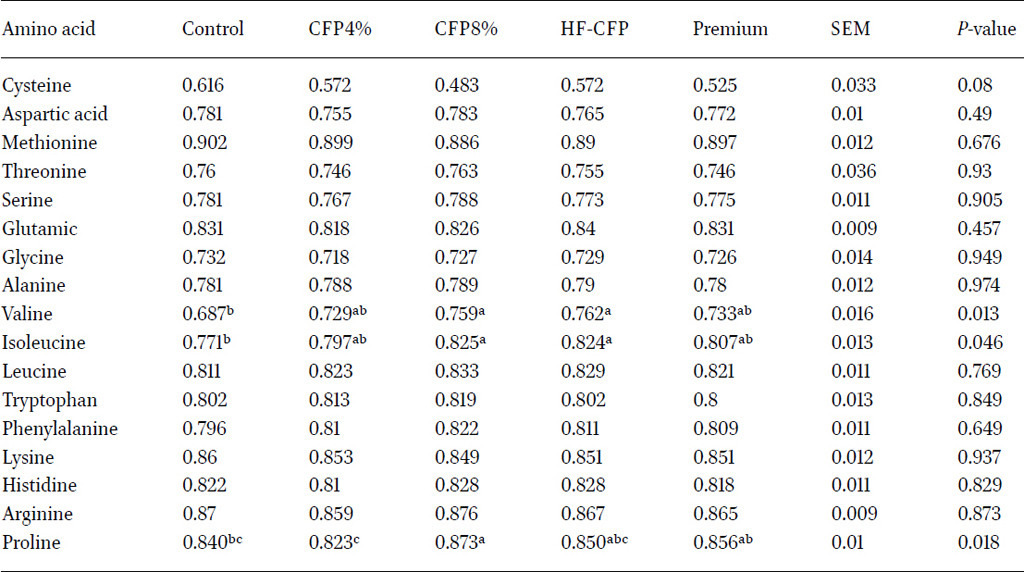
The coefficients of apparent ileal amino acid digestibility of valine, isoleucine, and proline of CFP8% were significantly higher (P < 0.05) than that of the control (Table 3).
Effect of corn fermented protein on apparent ileal amino acid digestibility coefficients of complete grower diets given to poults1,2
Citation: Journal of Applied Animal Nutrition 12, 1 (2024) ; 10.3920/jaan2023.0002
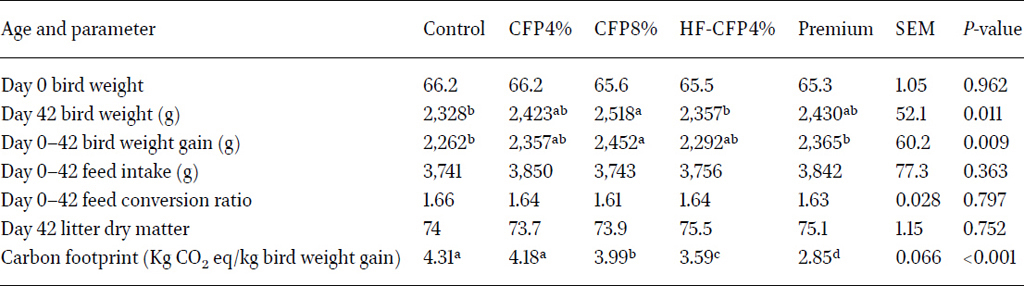
The day 42 poult weight and weight of gain CFP8% were significantly higher (P < 0.05; Table 4) than the control. However, treatments did not significantly affect feed intake, FCR or litter dry matter content. The birds fed CFP8% had significantly reduced carbon footprint for poult weight gain compared to the control.
Effect of distiller’s high protein on body weight, feed intake, feed conversion ratio and litter dry matter of turkey poults1,2
Citation: Journal of Applied Animal Nutrition 12, 1 (2024) ; 10.3920/jaan2023.0002
4 Discussion
The CFP product has a high level of protein (52.4%) and low crude fibre (4.4%; Parsons et al., 2023). It has high total amino acid ileal digestibility (>90.0%) and contains approximately 24% of DM as spent brewer’s yeast (Parsons et al., 2023). Accordingly, the current study proposed that CFP could replace approximately 6 and 12% of the SBM in the diets (4 and 8% CFP inclusion, respectively). The growth performance of poults across all treatments in this study aligned with industry standards (Aviagen, 2014). Accordingly, the diets conformed with the industry standards and indicated that CFP is a suitable protein supplement for young turkey poults.
Although the five diets were formulated to supply equivalent quantities of standardised digestible amino acids and AMEn, poults fed the CFP8% diet were significantly heavier (8.2%) and gained more weight (l8.4%) than those fed the control diet based on Hipro SBM. However, there was no significant difference in feed intake. Based on the nutrient availability measured in the poults at the end of the growth period, poults offered CFP8% had significantly higher AMEn and N retention compared to the control poults by 27 and 13%, respectively. Moreover, the digestibility of valine and isoleucine of CFP8% poults were higher than the control (by 11 and 7%, respectively). In addition to that, feed intake was not significantly affected by dietary treatment. It was reasonable to conclude that partial replacement of SBM by an equivalent supply of protein and energy from CFP resulted in increased supply of protein and energy to the poults. Thus, the supply of protein and energy of CFP8% was higher compared to the control, which explained the increase in poult weight gain in poults fed CFP8%.
The yeast components of CFP could be responsible for improved nitrogen retention and AME of the diets which, in turn, would contribute to the improved performance. Yeast contains several nutraceutical components which are reported to have beneficial effects in poultry and may indirectly improve growth performance.
While SBM is recognised as an excellent protein source, residual trypsin inhibitor, lipoxygenases and antigenic proteins retain a degree of activity post-processing, which can slightly, but significantly, reduce dietary protein digestion (Clarke and Wiseman, 2005). Thus, some of the performance improvement in the current study could be related to the reduction in anti-nutritional effects associated with replacing poorly-processed SBM with CFP.
In the current study, litter quality and foot pad score were assessed as simple indicators of gut health. The bedding remained friable and dry throughout the study and no extra bedding was added to pens for any treatment. There was little pododermatitis observed in the poults at d42, which suggested there was no adverse effect of any treatment on gut health.
The current study showed an improvement in N retention of poults fed CFP8% while litter moisture was independent of treatment. Hence, N excretion of poults were reduced in poults fed CFP8%, which would reduce emissions from litter (Nahm, 2007) since NH3 is strongly associated with litter moister. Concern has been expressed about NH3 in poultry barns regarding animal welfare (Ritz et al., 2004). Accordingly, CFP8% would improve turkey welfare.
Economic, environmental and social impacts of meat production are the three pillars of sustainable production. Use of CFP8% improved growth performance of turkeys and decreased N excretion leading to less NH3 emission and potentially better animal welfare.
The current study showed that the carbon footprint of one kg body weigh increase of CFP4% and CFP8% did not differ from the control. Carbon footprint calculations in the current study assumed that all feed ingredients were produced at the same location to account for the emissions associated with transportation. In other words, CFP and SBM were assumed to be produced at the same location. This may have been the reason why CFP diets had similar carbon footprint associated with 1 kg weight gain.
5 Conclusions
Feeding alternative protein as CFP8% can improve nitrogen retention, AMEn, growth performance and turkey welfare. This would decrease the dependency on SBM, reducing the economic and environmental cost of turkey production, leading to more sustainable production. This novel protein source can help mitigate some of the concerns surrounding first generation bioethanol in terms of land use and the conflict between the production of food and fuel.
Supplementary material
Supplementary material is available online at: https://doi.org/10.6084/m9.figshare.24241837.
Table S1. A. Nutritional composition of the experimental starter.
Table S2. Nutritional composition of corn fermented protein experimental grower diets.
Table S3. LCA specifications of the experimental feed ingredients.
Acknowledgements
The authors would like to acknowledge feed formulation advice gratefully received from Marcus Kenny.
Conflict of interest
The authors declare no conflict of interest.
References
Alkhtib, A., Burton, E., Wilson, P.B., Scholey, D. and Bentley, J., 2023. Effect of life cycle inventory choices and nutritional variation on carbon footprint of broiler meat production. Journal of Cleaner Production 383: 135463. https://doi.org/10.1016/J.JCLEPRO.2022.135463
AOAC, 2003. Official Methods of Analysis, 17th ed. AOAC International, Gaithersburg, USA.
ASAE, 2004. American society of agricultural engineers – Standards, engineering practices, and data, ASAE, St. Joseph, MI, USA.
Aviagen, 2014. Ross 308 broiler: nutrition specifications. Available at: http://en.aviagen.com/assets/Tech_Center/Ross_Broiler/Ross308BroilerNutritionSpecs2014-EN.pdf
Baurhoo, B., Phillip, L. and Ruiz-Feria, C.A., 2007. Effects of purified lignin and mannan oligosaccharides on intestinal integrity and microbial populations in the ceca and litter of broiler chickens. Poultry Science 86: 1070–1078. https://doi.org/10.1093/PS/86.6.1070
Benedek, J., 2017. Climate change is one of the biggest challenges of our times – European Environment Agency. Available at: https://www.eea.europa.eu/themes/climate/climate-change-is-one-of
Burton, E.J., Scholey, D.V. and Williams, P.E.V., 2013. Use of cereal crops for food and fuel – characterization of a novel bioethanol coproduct for use in meat poultry diets. Food and Energy Security 2: 197–206. https://doi.org/10.1002/FES3.30
Clarke, E. and Wiseman, J., 2005. Effects of variability in trypsin inhibitor content of soya bean meals on true and apparent ileal digestibility of amino acids and pancreas size in broiler chicks. Animal Feed Science and Technology 121: 125–138. https://doi.org/10.1016/J.ANIFEEDSCI.2005.02.012
Gause, B. and Trushenski, J., 2011. Replacement of Fish Meal with Ethanol Yeast in the Diets of Sunshine Bass. North American Journal of Aquaculture 73: 97–103. https://doi.org/10.1080/15222055.2011.544939
Hill, F.W. and Anderson, D.L., 1958. Comparison of metabolizable energy and productive energy determinations with growing chicks. Journal of Nutrition 64: 587–603.
Kilkenny, C., Browne, W., Cuthill, I., Emerson, M. and Altman, D., 2010. Animal research: reporting in vivo experiments: the arrive guidelines. British Journal of Pharmacology 160: 1577–1579.
Lee, C., 2015. Methods for producing a high protein corn meal from a whole stillage byproduct and system therefore. Patent US20150164114A1.
Maina, A.N., Thanabalan, A., Gasarabwe, J., Mohammadigheisar, M., Schulze, H. and Kiarie, E.G. 2022. Enzymatically treated yeast bolstered growth performance of broiler chicks from young broiler breeders linked to improved indices of intestinal function, integrity, and immunity. Poultry Science 101: 102175. https://doi.org/10.1016/j.psj.2022.102175
Morgan, N.K., Scholey, D.V. and Burton, E.J., 2014. A comparison of two methods for determining titanium dioxide marker content in broiler digestibility studies. Animal 8: 529–533. https://doi.org/10.1017/S1751731114000068
Nahm, K.H., 2007. Feed formulations to reduce N excretion and ammonia emission from poultry manure. Bioresource Technology 98: 2282–2300. https://doi.org/10.1016/J.BIORTECH.2006.07.039
Omar, S.S., Merrifield, D.L., Kühlwein, H., Williams, P.E.V. and Davies, S.J., 2012. Biofuel derived yeast protein concentrate (YPC) as a novel feed ingredient in carp diets. Aquaculture 330–333: 54–62. https://doi.org/10.1016/J.AQUACULTURE.2011.12.004
Parsons, B.W., Utterback, P.L., Parsons, C.M. and Emmert, J.L., 2023. Standardized amino acid digestibility and true metabolizable energy for several increased protein ethanol co-products produced using back-end fractionation systems. Poultry Science 102: 102329. https://doi.org/10.1016/j.psj.2022.102329
R core Team, 2017. R: A language and environment for statistical computing. R Foundation for Statistical Computing.
Ritz, C.W., Fairchild, B.D. and Lacy, M.P., 2004. Implications of ammonia production and emissions from commercial poultry facilities: a review. Journal of Applied Poultry Research 13: 684–692. https://doi.org/10.1093/JAPR/13.4.684
Robbins, D. and Firman, J., 2006. Evaluation of the metabolizable energy of poultry by-product meal for chickens and turkeys by various methods. International Journal of Poultry Science 5: 753–758. https://doi.org/10.3923/ijps.2006.753.758
Spiehs, M.J., Whitney, M.H., Shurson, G.C., 2002. Nutrient database for distiller’s dried grains with solubles produced from new ethanol plants in Minnesota and South Dakota. Journal of Animal Science 80: 2639. https://doi.org/10.2527/2002.80102639X
UK GOV, 2018. The renewable transport fuels and greenhouse gas emissions regulations 2018. Available at: https://www.legislation.gov.uk/uksi/2018/374/contents/made
Van Huis, A. and Oonincx, D.G.A.B., 2017. The environmental sustainability of insects as food and feed. A review. Agronomy for Sustainable Development 37: 1–14. https://doi.org/10.1007/S13593-017-0452-8
Vetvicka, V., Vannucci, L. and Sima, P., 2014. The effects of β-glucan on pig growth and immunity. Open Biochemistry Journal 8: 89–93. https://doi.org/10.2174/1874091X01408010089
Wang, T., Cheng, K., Yu, C.Y., Li, Q.M., Tong, Y.C., Wang, C., Yang, Z.B. and Wang, T., 2021. Effects of a yeast-derived product on growth performance, antioxidant capacity, and immune function of broilers. Poultry Science 100: 101343. https://doi.org/10.1016/j.psj.2021.101343