Abstract
This paper presents a replication study examining pre-service and early career mathematics teachersâ beliefs about teaching with technology in England. Through a close replication of Thurm and Barzelâs (2022) study with in-service teachers in Germany, we assess the validity and generalisability of their findings in a contrasting educational context, that of England. Our results confirm that beliefs about multiple representations are central to technology use across both contexts, suggesting a shared pedagogical priority. Self-efficacy beliefs about technology use exhibit context-dependent variations, shaped by differences in teacher experience, curricular mandates, and institutional support, while epistemological beliefs have a peripheral role independent of context. These findings highlight key contextual distinctions and offer insights for professional development that supports effective technology integration across diverse educational settings.
The impact sheet to this article can be accessed at https://doi.org/10.1163/26670127-bja10030 under Supplementary Materials.
1 Introduction
The integration of technology into mathematics teaching practice has long presented a persistent and complex challenge for educators and policymakers seeking to support teachers effectively. A key factor influencing this integration is teachersâ beliefs about the use of technology in mathematics education as well as their competency in using technology. Our work revolves around developing mathematics teachersâ competencies in using digital technology (DT) effectively in their practice. A few years back, we developed a survey tool for supporting and developing mathematics teachersâ mathematical digital competency (MDC, Geraniou & Jankvist, 2019) through self-reflection and self-assessment.1 We believed that to evaluate such competencies, we had to also investigate teachersâ beliefs about the use of technology in mathematics education. In our efforts to find a way to do so, we looked for inspiration, ideas and empirical evidence for how best to assess teacher beliefs in the mathematics education literature and came across the paper by Thurm and Barzel (2022) on âTeaching mathematics with technology: a multidimensional analysis of teacher beliefsâ. They carried out a survey with 198 upper secondary in-service teachers in Germany to investigate and measure teachersâ âi) beliefs about teaching with technology, ii) self-efficacy beliefs, and iii) epistemological beliefsâ, as well as teachersâ self-reported âiv) implementation of technology with respect to different modes of technology useâ (p. 41). Thurm and Barzel argued that their study addresses a âpaucity of research that investigates teacher beliefs at a finer-grained level, taking into account the multi-dimensional nature of the constructsâ (p. 42), showcasing the importance of the various dimensions and sub-dimensions, one of which involved âmultiple representationsâ. In fact, their paper makes a significant contribution by highlighting teachersâ beliefs about multiple representations as being centrally important to technology integration. They found that self-efficacy is key for a more integrated and constructivist implementation of technology and that teachersâ beliefs concerning the potential advantages of technology play a more central role than concerns about its risks. They also claimed that their findings can inform future practice in terms of professionally developing mathematics teachers with regards to the use of technology, also involving differentiated approaches. In our efforts to shed more light into beliefs of mathematics teachers in England about teaching with the use of technology and investigate if Thurm and Barzelâs (2022) findings are true in a contrasting context (that of England), we decided to replicate their study and therefore contribute to understanding how teachersâ beliefs on teaching mathematics with technology varies according to different countriesâ context and educational systems.
Following Aguilarâs (2020) twofold rationale for replication studies, we argue that replicating Thurm and Barzelâs (2022) survey in the English context enables us to examine whether the findings from Germany are context-specific or generalisable to a different educational setting and country context. Specifically, we investigate what the findings for the particular treatment (in our case a survey) would be for a sample of teachers in England under different conditions, e.g., trainee teachers (as per work by Cai et al., 2018). Our study constitutes a close replication (Hüffmeier et al., 2016, as cited in Aguilar, 2020), as we adhered closely to the original procedures without conducting an exact replication. In addition to replicating the survey, we examined the robustness of the analytical methods and explored the relationships among different belief dimensions within the English context.
We contend that this replication offers valuable insights into the generalisability of Thurm and Barzelâs (2022) findings. In line with Starâs (2018) assertion that replication should yield new and significant understanding, our study provides insight into whether and how contextual differences present challenges for replication of studies of teacher beliefs about technology, by investigating pre-service teachersâ beliefs in England using the same instrument used on in-service teachers in Germany. By generalisability, we refer to Aguilarâs (2020, p. S45) definition: âthe property of a research finding to remain true in contexts and populations other than where it was originally reported or identified.â We invite readers to consider the extent to which the original findings hold across these differing educational contexts and teacher populations.
This study examines the extent to which associations between sub-dimensions of mathematics teachersâ beliefs and their self-reported modes of technology use are replicable across distinct educational contexts. Specifically, we investigate to what extent associations between the beliefs of in-service teachers in Germany and their self-reported modes of technology use are replicable for pre-service teachers in England. We see value in reflecting upon contextual differences and how these may create challenges for replicating studies, in our case by investigating associations between teacher beliefs and modes of technology use in England. Our contribution lies in advancing a nuanced understanding of how mathematics teachersâ beliefs about technology use may vary across national contexts and in identifying challenges that complicate replication efforts. The paper continues with a review of relevant literature on teacher beliefs and technology use, followed by a comparative overview of the educational systems in England and Germany, highlighting key structural and curricular distinctions. The methodology section outlines the design of our replication study, including sample characteristics, instruments, and analytical procedures. We then present our findings and conclude with a discussion of the comparative insights gained, emphasising the implications for future research and professional development in mathematics education.
2 Theoretical and Contextual Background
First, we ought to discuss and decide what we mean by the term âtechnologyâ or âdigital technologyâ in mathematics education. Sinclair and Robutti (2020) argued that using DT in mathematics education has evolved to having two purposes: â(a) as a support for the organisation of the teacherâs work (producing worksheets, keeping grades) and (b) as a support for new ways of doing and representing mathematicsâ (Sinclair & Robutti, 2020, p. 845). Clark-Wilson and Hoyles (2017) talked about dynamic technology and defined it as technology that offers âvarious mathematical representations that teachers and pupils can manipulate and link, and by doing so engage with the underlying mathematical concepts and relationshipsâ (p. 4). In two studies that focused on teacher beliefs about technology, DT was defined as âmathematic-specific digital like function plotters, dynamic geometry systems, computer algebra systems and multi-representational toolsâ (Thurm et al., 2022, p. 2642); and as âmathematical digital technologiesâ or âmathematical multi-representation tools (MRT)â that âcombine the capabilities of scientific calculators, function plotters, spreadsheets, statistic and geometry packages, and CASâ (Thurm & Barzel, 2022, p. 43). In our study, we align with the latter definition whenever we refer to the term âtechnologyâ.
2.1 The Multi-Dimensionality of Teacher Beliefs and Their Relevance to Technology Use
The integration of DT into mathematics teaching is shaped by a complex interplay of practical constraints, teacher competencies, and belief systems (e.g., Thomas & Palmer, 2014). While infrastructural limitations â such as inconsistent access to reliable technology in schools â remain a persistent barrier (Noyes et al., 2023), research increasingly highlights the pivotal role of teachersâ self-efficacy in determining the success of technology adoption (Geraniou & Misfeldt, 2022). Ertmer et al. (2015) argue that effective technology integration requires a multifaceted support system, encompassing adequate resources, a collaborative school culture, opportunities for professional learning, and pedagogical beliefs aligned with contemporary educational goals.
Early qualitative research, such as Leatham (2007), revealed that pre-service mathematics teachers hold nuanced beliefs about the timing, accessibility, and pedagogical alignment (in terms of mathematical content) of technology use. These findings stress the deeply held convictions that shape teachersâ decisions regarding technology use, a point reinforced by Hegedus et al. (2017), who contend that altering such beliefs is inherently challenging. Thurm and Barzel (2020) further note the scarcity of studies focused on belief change about technology use in mathematics education, prompting calls from scholars like Speer and Eichler (2022) for targeted interventions during teacher training. Their study, centred on the intelligent tutoring system STACK, demonstrated that belief transformation is possible through sustained engagement, involving phases of initial enthusiasm, disillusionment, and eventual differentiation. This developmental trajectory illustrates the need for structured, reflective experiences to foster meaningful change.
The relationship between teachersâ epistemological beliefs and their use of DT has also received attention. Misfeldt et al. (2016) found that Danish secondary mathematics teachersâ beliefs about the nature of mathematics â ranging from instrumentalist to Platonist â significantly influenced their attitudes toward technology. Teachers with performance-oriented views tended to restrict technology use, while those embracing mathematics as a problem-solving discipline were more open to exploratory, student-centred applications. Similarly, Belbase (2015) documented the evolving beliefs of a pre-service teacher in the US, whose engagement with tools like JavaBars and Geometerâs Sketchpad led to a shift from reliance on manipulatives to valuing digital tools for making abstract concepts explicit. These studies collectively suggest that epistemological beliefs are not static but can be reshaped through experiential learning and reflective practice.
Thurm and Barzelâs (2020) quasi-experimental study in Germany further demonstrated that professional development can positively influence teachersâ beliefs about the pedagogical value of DT, particularly in supporting multiple representations and discovery learning. However, beliefs related to self-efficacy and epistemology remained largely unchanged, indicating their relative resistance to short-term interventions. Their findings emphasise the importance of early support for novice teachers to prevent the entrenchment of negative beliefs and advocate for professional development that explicitly addresses self-efficacy through mastery experiences.
In their 2022 study, on which this paper is focusing, Thurm and Barzel looked at in-service mathematics teachersâ beliefs and practices related to technology use in education, specifically by examining the three key dimensions: âi) beliefs about teaching with technology, ii) self-efficacy beliefs, and iii) epistemological beliefsâ (p. 42) at a finer-grained level. In fact, they claimed that these three key dimensions are âmultidimensional constructs with distinct sub-dimensionsâ (p. 42) and therefore used multidimensional scales to explore the associations between the three above mentioned key dimensions and teachersâ self-reported âmodes of technology useâ on a finer-grained level.
Regarding common modes of technology use (M) in mathematics education, Thurm and Barzel (2022) reviewed relevant literature and referred to the following five modes of use. The first one was about supporting discovery learning (M1), where digital tools enable students to explore patterns, generate examples, and investigate mathematical regularities independently. This promotes mathematics as a constructive and exploratory activity (e.g., Hoyles et al., 2013). The second one was about supporting multiple representations (M2), involving the use of technology to facilitate switching between graphical, algebraic, and numerical representations. This helps students understand mathematical concepts more deeply by linking different forms of representation (e.g., Hegedus & Roschelle, 2013). The third mode was about supporting practice (M3), for which technology is useful not only for learning new concepts but also for reinforcing and practicing previously acquired skills. This is especially valuable for consolidating foundational mathematical principles (e.g., Drijvers, 2015). The fourth one was about supporting individual learning (M4), for which technology allows for personalised learning paths. Students can choose their own solution strategies, self-check their work, and compare different approaches, fostering autonomy and deeper engagement. The fifth mode of use was about supporting reflection (M5), where technology can prompt critical reflection, especially when outputs are misleading or incorrect. Discussing when and how to use technology appropriately can enhance studentsâ mathematical reasoning and understanding (e.g., Jankvist et al., 2019).
Teachersâ beliefs about teaching with technology (T) encompass their views on its role in learning, ranging from its potential benefits to possible drawbacks (e.g., Pierce & Ball, 2009). These beliefs significantly influence how and whether teachers integrate technology into their practice. Positive beliefs â such as recognising technologyâs educational value and transformative potential â are linked to more frequent and effective use. However, research highlights several sub-dimensions of these beliefs, including views on technologyâs ability to support discovery learning and multiple representations, concerns about the time required to teach with technology, fears of diminishing studentsâ by-hand skills, worries about mindless use, and differing opinions on the appropriate timing for technology integration, as indicated in the list of beliefs, also referred in Thurm and Barzelâs 2022 paper:
(1) (T1) Beliefs about the role of technology to support discovery learning refer to teachersâ views on how technology can facilitate student exploration of mathematical concepts, such as through generating and investigating multiple examples (Doerr & Zangor, 2000).
(2) (T2) Beliefs about the role of technology to support multiple representations concern the perceived value of technology in dynamically linking various representations â like tables, graphs, and algebraic expressions â to enhance understanding (Patterson & Norwood, 2004).
(3) (T3) Beliefs about time needed to teach with technology reflect concerns that integrating technology into instruction demands additional time, particularly for teaching students how to use the software (Pierce & Ball, 2009;).
(4) (T4) Beliefs about the loss of by-hand skills express apprehension that technology use may negatively impact studentsâ ability to perform basic mathematical procedures manually, such as graphing or solving equations (Erens & Eichler, 2015).
(5) (T5) Beliefs about mindless working when teaching with technology suggest that technology might lead to superficial engagement, where students rely on âbutton pushingâ rather than engaging in meaningful mathematical thinking (Pierce et al., 2009).
(6) (T6) Beliefs about the time point of technology use involve differing opinions on when technology should be introduced â whether only after students have achieved conceptual mastery without it, or also at the beginning of the learning process (Fleener, 1995).
While these sub-dimensions are consistently identified in the literature, their relative importance and impact on teaching practices remain underexplored, with some â like beliefs about discovery learning â showing stronger associations with actual technology use than others. And this is what Thurm and Barzel (2022) aimed to address with their research study.
Another key dimension of their work involved self-efficacy beliefs about teaching with technology (S). Self-efficacy beliefs about teaching with technology â defined as beliefs in oneâs capabilities to organise and execute actions to achieve desired outcomes (Bandura, 1997) â play a significant role in shaping how teachers use technology in mathematics education. These beliefs do not reflect actual ability but rather perceived competence. Research has shown that low self-efficacy beliefs can lead to teacher-centred and rigid uses of technology (Doerr & Zangor, 2000) and may prevent teachers from implementing their intended technology-rich lesson plans (Clark-Wilson & Hoyles, 2019). Despite their importance, there is limited research on the distinct sub-dimensions of self-efficacy beliefs. Philippou and Pantziara (2015) emphasised that self-efficacy is a multidimensional construct that varies across tasks and domains, urging more nuanced research. Scherer and Siddiq (2015) demonstrated that breaking down general computer self-efficacy into three factors yields a more detailed understanding. In mathematics education, two consistently identified domains of functioning are: (S1) Task design and selection, which involves the ability to choose or create tasks that leverage technology effectively (Leung & Baccaglini-Frank, 2016), and (S2) Lesson design and implementation, which refers to the confidence in orchestrating learning through appropriate didactical configurations (Drijvers et al., 2010; Thomas & Palmer, 2014). Although these domains are not exhaustive, they highlight key areas where self-efficacy beliefs influence teaching practices, and further research is needed to explore their differential relevance.
Epistemological beliefs â defined as beliefs about the nature of knowledge and learning (e.g., Lunn et al., 2015) â play a significant role in how mathematics teachers integrate technology. These beliefs are typically divided into beliefs about the nature of mathematics and beliefs about the acquisition of mathematical knowledge (Felbrich et al., 2008). Regarding the nature of mathematics, two orientations are commonly identified: the (E1) Static perspective (rules and procedures), which views mathematics as a formal, axiomatic system built on rules and formulae (Felbrich et al., 2008), and the (E2) Dynamic perspective (inquiry), which sees mathematics as a process of problem-solving and discovering structures and regularities. Beliefs about learning mathematics are similarly categorised into the (E3) Instructivist perspective (teacher direction), where learning is teacher-centered and knowledge is transmitted (Barkatsas & Malone, 2005; Felbrich et al., 2008), and the (E4) Constructivist perspective (active learning), which emphasises student-centered environments that support learners in constructing their own mathematical meanings. Research shows that these epistemological beliefs influence technology use: teachers with stronger constructivist beliefs and a dynamic perspective tend to use technology in more student-centered ways (Erens & Eichler, 2015; Misfeldt et al., 2016), while those with instructivist beliefs often have a limited view of technologyâs potential. Despite these insights, there is a need for more nuanced research into the specific sub-dimensions of epistemological beliefs and their differential impact on technology integration.
Taken together, this body of literature emphasises that while practical barriers persist, it is teachersâ beliefs â particularly those related to pedagogy, self-efficacy, and epistemology â that critically mediate the integration of digital tools in mathematics education. These beliefs are shaped by context, experience, and professional learning, and their transformation requires sustained, reflective, and context-sensitive interventions. As mentioned above, Thurm and Barzelâs study found that multiple representations are central to teachersâ beliefs regarding the use of technology in mathematics education, while self-efficacy beliefs were found to play a central factor in constructivist technology use. Also, epistemological beliefs were found to hold a more peripheral position in technology use, revealing little or no association to technology use. Our aim is to investigate whether their findings are ârobustâ to changes in context by replicating their study in England, which has significant contextual differences from the original study. In the next sections, we set out the country contexts before identifying why these contextual differences might provide challenges for replication.
2.2 Teacher Beliefs and Technology Use in England
In the English context, teacher beliefs about DT in mathematics education have been explored through various empirical and policy-oriented studies, revealing a complex and evolving landscape. One notable project (Clark-Wilson & Hoyles, 2017), conducted between 2014 and 2016, investigated the implications of dynamic DT on mathematics teachersâ knowledge and practice. A key finding was that teachers, initially apprehensive, reported increased motivation and professional value when engaging in collaborative discussions supported by targeted professional development resources. This suggests that teacher confidence and willingness to integrate DT can be positively influenced through structured, collegial learning environments.
However, the relationship between technology use and pedagogical orientation is not straightforward. Bretscherâs (2021) survey of English secondary mathematics teachers challenged the assumption that specific technologies inherently align with particular pedagogical styles. Tools, such as spreadsheets, dynamic geometry, graphing software which are known for their transformative potential (e.g. Pierce & Stacey, 2010) are often assumed to require a student-centred approach, while Presentation and CAI tools (e.g., PowerPoint, MyMaths, Khan Academy) are often assumed by academics and mathematics educators to reinforce teacher-centred approaches. There is evidence that shows teachers with student-centred orientations may frequently use teacher-centred software, and vice versa. In addition, in England, a âdiscovery orientationâ (Askew et al., 1997) has an alternative meaning, indicating a laissez-faire approach towards mathematics pedagogy, associated with less effective teaching. These findings highlight the need to move beyond binary classifications of pedagogy and recognise the nuanced ways in which teachers adopt DT based on their individual goals, constraints, and interpretations of effective practice.
Recent policy reports further illuminate the systemic dimensions of technology integration in mathematics education in England. The Joint Mathematical Council (JMC) report (Noyes et al., 2023) and the Royal Society report (Crisan et al., 2023) both emphasise that the transformative potential of DT in mathematics education hinges not merely on access, but on its strategic integration into curriculum, assessment, and teacher development. While the JMC report advocates embedding DT within high-stakes assessments and curriculum reform to encourage adoption, the Royal Society complements this by proposing a long-term Maths EdTech Strategy focused on infrastructure, pedagogical innovation, and sustained professional learning â also recognising the importance of aligning technology use with assessment practices. Crucially, both reports highlight the importance of developing teachersâ mathematical digital competencies â not only to enhance presentation, but to foster inquiry, reasoning, and conceptual understanding.
Collectively, these studies and reports suggest that while English mathematics teachers may vary in their beliefs and practices regarding DT, meaningful integration requires more than individual initiative. It demands systemic support, nuanced pedagogical understanding, and sustained professional engagement. The literature points to a shift from viewing technology as a neutral tool to recognising it as a pedagogical resource whose impact is mediated by teacher beliefs, institutional structures, and the broader educational ecosystem.
2.3 Teacher Beliefs and Technology Use in Germany
In the German educational context, the integration of DT into mathematics teaching is shaped by a decentralised schooling system, where each federal state determines its own educational policies. Despite national initiatives promoting technology use, consistent and widespread implementation remains limited (Noyes et al., 2023). This fragmented policy landscape contributes to variability in teachersâ experiences and beliefs about DT across regions.
Empirical research in Germany has begun to explore these beliefs in greater depth. As also mentioned earlier, Thurm and Barzel (2020) examined the impact of a professional development programme on mathematics teachersâ beliefs, particularly regarding multi-representational tools. Their findings showcased the importance of early intervention for novice teachers, recommending hands-on, confidence-building experiences to foster self-efficacy and prevent the development of technology-resistant attitudes. This aligns with broader literature emphasising the role of sustained professional learning in belief transformation about technology use in teaching practice. Expanding on this work, Thurm et al. (2022) investigated pre-service teachersâ beliefs about mathematical digital competency â a construct that integrates mathematical competency with digital fluency (Geraniou & Jankvist, 2019). Their study revealed a tension in teacher beliefs: while participants acknowledged the value of DT in enhancing mathematical learning, they maintained that students should be able to engage with mathematics independently of digital tools. This suggests a persistent view of DT as supplementary rather than integral, reflecting a cautious stance toward its epistemological role in mathematics education.
The most comprehensive study in this domain, and the focus of our replication, is Thurm and Barzelâs (2022) large-scale quantitative investigation involving 198 German secondary mathematics teachers. Their research conceptualised teacher beliefs as multidimensional, encompassing pedagogical beliefs about DT, self-efficacy, and epistemological orientations. Through cluster analysis, they identified three distinct belief profiles: a constructivist-integrated cluster, where high self-efficacy â particularly in lesson design â was linked to the use of DT for discovery and individual learning; a distinct cluster, centred on the use of DT for multiple representations, which appeared more autonomous and less dependent on broader pedagogical beliefs; a peripheral cluster, characterised by concerns about skill erosion and passive learning, which had minimal influence on actual technology use. These findings suggest that positive beliefs about DT and confidence in its implementation are more predictive of classroom integration than concerns about its limitations. Importantly, the study advocates for differentiated professional development tailored to these belief structures, recognising that teachers engage with DT in varied and complex ways.
In sum, research in Germany highlights the nuanced and context-sensitive nature of teacher beliefs about DT. While professional development can foster more favourable attitudes, deeply held epistemological views and systemic constraints continue to shape how technology is perceived and used. These insights highlight the need for targeted, belief-informed interventions that address both pedagogical and structural dimensions of technology integration in mathematics education.
2.4 Potential Challenges for a Replication Study in England
Exploring the educational contexts of Germany and England reveals significant structural, curricular, and policy-related differences that shape the integration of DT in mathematics education. These differences span teacher training programmes, national curricula, and assessment practices, all of which influence teachersâ beliefs and behaviours regarding technology use. Such contextual variations present potential challenges for replicating findings from Thurm and Barzelâs (2022) study in Germany, within the English context.
A key distinction lies in the role of DT in national mathematics assessments. Both the Royal Society report (Crisan et al., 2023) and the Joint Mathematical Council (JMC) report (Noyes et al., 2023) argue that embedding DT into high-stakes assessments could incentivise its classroom use. In Germany, particularly in North Rhine-Westphalia (NRW), this shift has already begun. Prior to the 2014â2015 school year, DT was included in curriculum standards but excluded from final state examinations (Zentralabitur), resulting in fragmented and largely voluntary adoption. The inclusion of DT in these high-stakes exams from 2014 onwards compelled teachers to integrate technology into their practice to ensure student preparedness. This policy change catalysed a broader uptake of DT, although teacher readiness and experience varied considerably, as evidenced in Thurm and Barzelâs (2022) study. While professional development (PD) opportunities â such as those offered by state initiatives or the or networks like the Texas Instrumentsâ T³ (Teachers Teaching with Technology) network â were available, participation remained limited prior to the policy shift, and many teachers lacked prior exposure to DT in teaching.
At the time of Thurm and Barzelâs study, the NRW context was undergoing a transitional phase, with teachers demonstrating diverse levels of engagement with DT. The move toward digital assessment, both formative and summative, reflects a broader national trend in Germany, where external policy drivers increasingly shape classroom practices. These systemic changes have the potential to influence teacher beliefs, not only by necessitating DT use but also by reframing its pedagogical relevance.
The English context presents a markedly different picture. DT is not mandated within the mathematics curriculum or teacher standards, and national assessments remain predominantly paper-based. Consequently, technology use in mathematics classrooms is often limited to teacher-centred applications, such as presentation tools (Bretscher, 2021). The absence of formal requirements for DT integration contributes to its marginal presence in Initial Teacher Education (ITE) programmes, where training on digital pedagogy is frequently minimal or absent. Although PD opportunities exist, they are neither compulsory nor widely accessible, with financial constraints further limiting school-level support for teacher development in this area.
These contextual differences have profound implications for replicating Thurm and Barzelâs (2022) findings in the English context. In Germany, policy-driven integration has created a more structured pathway for DT adoption, albeit with challenges related to teacher preparedness and belief alignment. In England, the lack of systemic incentives and curricular mandates has resulted in a more individualised and inconsistent approach, where technology use is shaped by personal motivation rather than institutional expectation. Consequently, while German teachers may be influenced by external pressures to adopt DT, English teachers operate within a context that affords greater autonomy but less structural support. This highlights how national contexts may mediate the relationship between teacher beliefs and technology use, suggesting that belief change is not solely an individual process but one deeply embedded in broader educational structures. Such differences bring forward potential challenges for validating and generalising findings from the German context to the English educational landscape.
2.5 Our Research Question
Based on the reviewed literature and the contextual background presented above, it is evident that important gaps remain in understanding the robustness and generalisability of prior findings on teacher beliefs in relation to technology use. Consequently, the central research question for our replication study is formulated to rigorously test whether the original results hold under comparable conditions, while accounting for potential contextual variations and challenges. Our main research question (RQ) is: To what extent are Thurm and Barzelâs (2022) findings about the associations between sub-dimensions of teacher beliefs and modes of technology use in Germany replicable in the context of England?
In light of the authorsâ multi-dimensional approach and to further elaborate on the main research question, it is useful to examine the specific dimensions and sub-dimensions that may influence the robustness of the findings. Accordingly, the following sub-research question (SRQ) is proposed to provide a more nuanced understanding of the contextual factors underlying the overarching RQ: How are findings about the associations between sub-dimensions of teacher beliefs (i) about teaching with technology, (ii) self-efficacy, (iii) epistemology related to sub-dimensions of self-reported modes of technology use replicable in the context of England?
3 Methods
In this section, details of how we carried out the close replication of Thurm and Barzelâs (2022) study are presented. We set out the instruments used, sample and data analysis and to what extent they replicate the methods used in the original study.
3.1 Instruments
We implemented the instrument employed in Thurm and Barzel (2022) in full. As set out in the original paper and mentioned earlier, the instrument is designed using a multi-dimensional approach to measure teachersâ (i) beliefs about teaching with technology (scales T1âT6), (ii) self-efficacy beliefs (scales S1âS2), (iii) epistemological beliefs (scales E1âE4), and self-reported (iv) modes of technology use (scales M1âM5). The complete instrument is located in Thurm (2020).
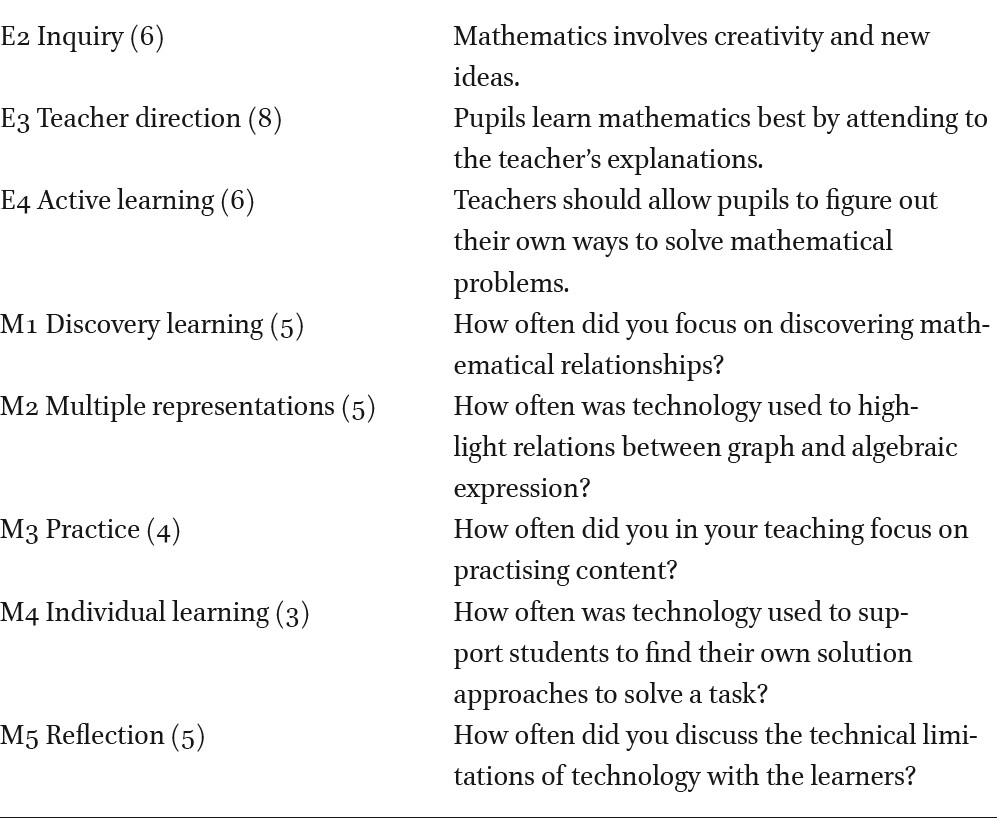
Table 1 summarises the number of items comprising each scale and provides sample items. Each T-scale item was rated using a 5-point Likert scale, scored as 1 = strongly disagree to 5 = strongly agree, to measure teachersâ beliefs about teaching with technology. For items comprising the self-efficacy scales, S1 and S2, teachers were asked to score their self-efficacy on a scale of 0â100. These self-efficacy scores were then re-scaled to a score between 0â5 for analysis in line with the original study. Scales E1â4 were measured using items with 6-point Likert scales, ranging from 1 = strongly disagree to 6 = strongly agree. Finally, for the M-scales, items in M2, M4 and M5 were rated on a 5-point Likert scales with response categories âalmost neverâ, âonce or twice a quarterâ, âonce or twice a monthâ, âonce a weekâ and âalmost every lessonâ. For the remaining M-scales (M1 and M3), items were also rated first on a 5-point Likert scale with respect to how often their teaching focussed on a particular aspect of mathematics (e.g. on practising content). Respondents were then asked to indicate on another 5-point Likert scale what proportion of this time involved technology use. These two ratings were then combined to provide an overall score for each item in M1 and M3.

Scales and sample items, adapted from Thurm & Barzel (2022)
Citation: Implementation and Replication Studies in Mathematics Education 5, 2 (2025) ; 10.1163/26670127-bja10030
We used the online survey platform Gorilla (https://gorilla.sc/) to deliver the survey to participants. This mode of delivery had significant advantages for us over a pen-and-paper format used by Thurm and Barzel (2022) since data was immediately stored in a secure, digital environment without incurring the costs associated with transferring data from an analogue to digital format.
3.2 Sample
Our survey sample differs in important respects from the participants in the original study beyond the differences in national context discussed in the opening sections of this paper. We first describe the similarities and differences between the samples before setting out the characteristics of our sample in more detail.
Our participants had less teaching experience and more variable backgrounds in terms of their mathematical education at university-level than the sample in Thurm and Barzel (2022). These differences are important because less-experienced teachers or those with more varied mathematical backgrounds may have less settled or well-developed belief systems and modes of technology use and, as a result, we might expect more variance in their survey responses. The teachers in our sample had at most two years teaching experience, with a mean average age of approximately 25 years, whereas those in the original study had an average age of approximately 43 years. In addition, the teachers in Thurm and Barzelâs (2022) study were working in upper secondary schools, which require an undergraduate-level mathematics degree to teach at this level. By contrast, the teachers in our survey sample had more varied university-level backgrounds with undergraduate degrees which were either in mathematics or mathematics-related subjects, such as computer science, physics or engineering, or non-mathematics-related degrees. Of the participants in the replication study, 52% were female compared to 54% in Thurm and Barzel (2022).
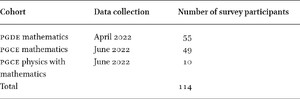
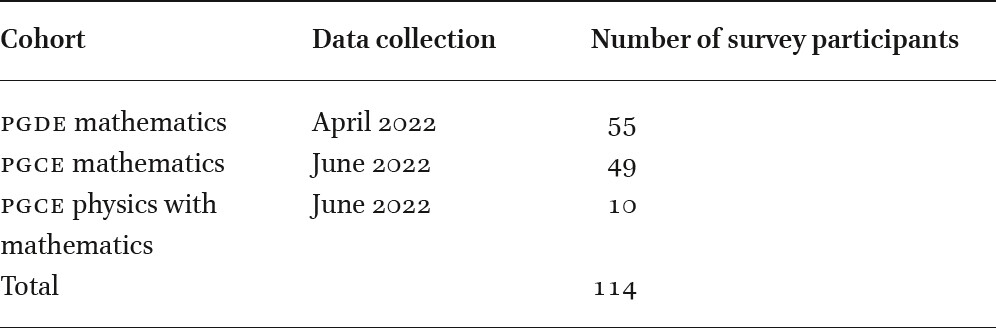
Our sample consisted of 114 pre-service and early-career teachers, studying on three different Initial Teacher Education (ITE) programmes at a university in London, England (see Table 2). Of our sample, 49 pre-service teachers were studying on the one-year Post-graduate Certificate of Education (PGCE) Mathematics programme. These pre-service teachers typically have an undergraduate degree in mathematics or a mathematics-related subject. Ten pre-service teachers were studying on the PGCE Physics with Mathematics programme. These pre-service teachers primarily focus on teaching physics, but also receive input on teaching mathematics, and their undergraduate degrees are typically mathematics-related, either in physics or engineering. Finally, 55 early-career teachers were in the second year of the two-year Post-graduate Diploma in Education (PGDE) programme and were teaching mathematics nearly full-time in school during those 2 years of their programme. These early-career teachers therefore had at least an extra year of teaching experience compared to the pre-service teachers. Early-career teachers on the PGDE programme have a more varied undergraduate background: the majority (30 out of 55) had non-mathematics-related degrees; 14 had mathematics-related degrees; and 11 had mathematics degrees.
The sample in our replication study
Citation: Implementation and Replication Studies in Mathematics Education 5, 2 (2025) ; 10.1163/26670127-bja10030
3.3 Data Analysis
We used correlation analysis to investigate the associations between teacher beliefs and self-reported modes of technology use, following the methods adopted by Thurm and Barzel (2022), in line with our aim of carrying out a close replication of their study. As Thurm and Barzel (2022) argue, the advantage of correlation analysis is that the direction of the relationship between variables is not specified, as in regression analysis, for example. As a result, correlational analysis is appropriate for the investigation of associations between teacher beliefs and modes of technology since such relationships are under-theorised and there is likely to be mutual influence and reinforcement between the variables.
For each individual, we calculated the mean item score for each subscale and then produced descriptive statistics (mean and standard deviation) for each subscale. We calculated pairwise correlation coefficients between all subscales of (i) beliefs about teaching with technology, (ii) self-efficacy beliefs about teaching with technology, (iii) epistemological beliefs, and self-reported (iv) modes of technology use. Correlations were calculated and two-tailed tests for significance carried out with Holm adjustments (Holm, 1979) for multiple tests in R, using the corr.test() function in the psych package (Revelle, 2023). In line with our close replication, we followed Hemphillâs (2003, as cited by Thurm & Barzel, 2022) guidelines for interpreting correlation size in psychological research: small < 0.20; medium = 0.20 to 0.30, and large > 0.30.
We replicated the canonical correlation analysis using the cancor() function in the Canonical Correlation Analysis (CCA) package in R (González et al., 2008). CCA is an exploratory method for analysing correlations between two datasets. This method enables exploration of the relationships between the beliefs scales and self-reported modes of technology use without stating dependent or independent variables. Such an exploratory analysis is appropriate since the relationship between beliefs and modes of use is complex and likely to be bi-directional. In addition, we report the p-value from the PillaiâBartlett test (Olson, 1976) for the canonical correlation analysis, which provides a robust approximation to the F-test, to test the number of canonical dimensions. Canonical dimensions are latent variables, analogous to the factors obtained in factor analysis, which explain the shared variance between the beliefs scales and modes of technology use. To support interpretation of these dimensions, we calculated canonical loadings which can be interpreted in a similar way to factor loadings (Hair et al., 2019). For ease of comparison, we adopt the same criteria as Thurm and Barzel (2022), namely, loadings greater than or equal to 0.45 indicate that the variable makes an important contribution to the canonical dimension. The greater the loading, the more important or dominant its contribution is to the canonical dimension.
4 Results
We first present the results of the pairwise correlation analysis between teacher beliefs and self-reported modes of technology use, focusing on teachersâ beliefs about teaching with technology (Sub-Question 1), self-efficacy beliefs (Sub-Question 2) and epistemological beliefs (Sub-Question 3) in Sections 4.1â4.3, respectively. The results of the pairwise correlation analysis are summarised in Table 3. We then present the results of the canonical correlation analysis in section 4.4.
The pairwise correlation analysis results for our sample (n = 114), with Holm adjustment for multiple tests
Citation: Implementation and Replication Studies in Mathematics Education 5, 2 (2025) ; 10.1163/26670127-bja10030
4.1 Correlation Analysis for Teachersâ Beliefs about Teaching with Technology
The reliability coefficients of the M-scales, representing self-reported modes of technology use, ranged from 0.80 to 0.92 showing good internal consistency. The reliability coefficients of the T-scales, representing teachersâ beliefs about teaching with technology, were also sound and ranged from 0.73 to 0.84 with the exception of beliefs about the high time requirements of teaching with technology (T3, Cronbachâs alpha = 0.69) which falls just short of the benchmark value of 0.7 for acceptable internal consistency. Only one technology beliefs scale showed any statistically significant correlations with self-reported modes of technology use. The sub-dimension measuring teachersâ beliefs about the role of technology to support multiple representations (T2,
4.2 Correlation Analysis for Teachersâ Self-Efficacy Beliefs
The reliability coefficients for teachersâ self-efficacy beliefs showed good internal consistency, with 0.83 for task design and selection (S1) and 0.85 for lesson design and implementation (S2). Both sub-dimensions of self-efficacy were positively correlated with self-reported modes of technology use, as reported in Table 3. Self-efficacy for task-design and selection (S1) had relatively high correlations (
Similarly, self-efficacy for lesson design and implementation (S2) showed relatively high correlations for discovery (M1,
4.3 Correlation Analysis for Teachersâ Epistemological Beliefs
The reliability coefficients for teachersâ epistemological beliefs showed good internal consistency, ranging from 0.73 to 0.82, except for beliefs about learning mathematics through active learning (E4, Cronbachâs alpha = 0.68). No statistically significant correlations were found between beliefs about the nature of mathematics (E1, E2) and self-reported modes of technology use. Similarly, no statistically significant correlations were found between beliefs about the learning of mathematics (E3, E4) and self-reported modes of technology use. For sub-dimensions E1 and E3, some correlations rose above the 0.2 threshold, however they were not statistically significant after correcting for multiple tests. For example, beliefs that mathematics is a collection of rules and procedures (E1) showed a positive correlation above the 0.2 threshold for self-reported use of technology for discovery (M1,
4.4 Results of the Canonical Correlation Analysis
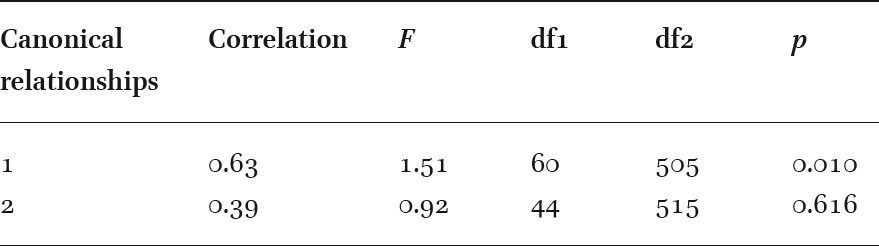
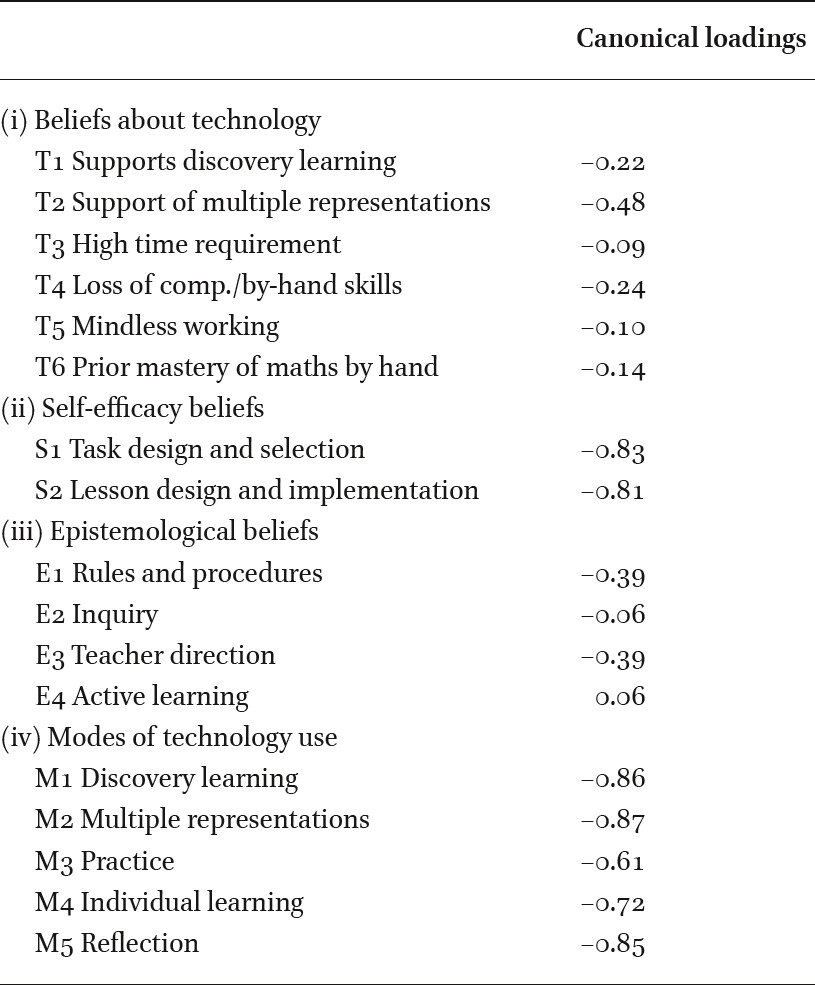
The canonical correlation analysis resulted in one significant dimension with a canonical correlation of 0.63 (p = 0.010), as reported in Table 4. A second dimension with a canonical correlation of 0.39 was not statistically significant (p = 0.616). Table 5 reports the loadings for the first, significant canonical dimension. Each of the scales of self-reported technology use have loadings of magnitude above 0.45, indicating they make an important contribution to the canonical dimension. Three modes of self-reported technology use have particularly high loadings above 0.8, including use of technology for discovery learning (M1 = â0.86), multiple representations (M2 = â0.87) and reflection (M5 = â0.85). The remaining two modes of self-reported technology have slightly lower loadings but nevertheless make an important contribution to the dimension: use of technology for practice (M3 = â0.61) and for individual learning (M4 = â0.72). Of the beliefs scales, only three make an important contribution to the canonical dimension. Both self-efficacy scales have high loadings above 0.8 (S1 = â0.83, S2 = â0.81). Of beliefs about teaching with technology, only the scale for beliefs that technology supports teaching with multiple representations (T2 = â0.48) was an important contributor to the canonical dimension. Finally, none of the epistemological beliefs about the teaching and learning of mathematics had loadings above 0.45. The results of the canonical correlation analysis seem to reflect the results of the pairwise correlation analysis between teacher beliefs and self-reported modes of technology use.
Test of the number of canonical relationships â Pillai-Barlett test
Citation: Implementation and Replication Studies in Mathematics Education 5, 2 (2025) ; 10.1163/26670127-bja10030
Canonical loadings for first two canonical relationships (note that only the first is significant)
Citation: Implementation and Replication Studies in Mathematics Education 5, 2 (2025) ; 10.1163/26670127-bja10030
5 Discussion
In this section, we revisit the results presented in section 4 in light of the findings reported by Thurm and Barzel (2022), with the aim of examining the extent to which their conclusions about the relationships between teachersâ beliefs and modes of technology use can be validated and generalised within the English educational context. Our study shows that Thurm and Barzelâs finding that multiple representations are central to teachersâ beliefs and use of digital technology is generalisable to our context of pre-service teachers in England. However, the way self-efficacy beliefs are related to technology varies according to context, presenting a challenge for replication. Thirdly, our study supports Thurm and Barzelâs finding that epistemological beliefs hold a more peripheral position in technology use, indicating this finding generalises to our study context. These findings are discussed below based on contextual considerations and the wider literature on technology in mathematics education.
5.1 Multiple Representations Are Central to Teachersâ Beliefs and Use of Digital Technology across Contexts
Beliefs about the use of DT to support multiple representations (T2) emerged as the most strongly endorsed in England, recording the highest mean scores across all six T-scales, and therefore indicating the generalisability of this finding, which also holds true in Thurm and Barzelâs study. This finding aligns with existing literature on the pedagogical value of multiple representations in mathematics education (Clark-Wilson et al., 2020; Thurm & Barzel, 2020). In both studies, the use of DT for multiple representations (M3) was positively correlated with beliefs about its pedagogical role (T2) and with self-efficacy beliefs, while showing no significant correlation with other belief dimensions. This suggests that teachers perceive multiple representations not only as a core instructional strategy but also as a relatively autonomous construct within their broader belief systems. The apparent independence of multiple representations from other belief constructs â regardless of contextual variables such as teaching experience or curriculum mandates â supports Thurm and Barzelâs (2022) proposition that multiple representations offer a promising focal point for professional development, as they resonate with teachers across diverse background and levels of experience. This also echoes Ertmer et al.âs (2015) argument that effective technology integration depends on aligning pedagogical beliefs with 21st-century practices, including the use of DT to enhance conceptual understanding through varied representations.
While the centrality of multiple representations is evident in both contexts, canonical correlation analysis revealed structural differences in how this belief dimension is embedded within teachersâ broader belief systems. In the German study, beliefs about and use of multiple representations formed a distinct sub-dimension, largely separate from other belief constructs. This may reflect systemic influences, such as curriculum mandates and assessment policies that have increasingly embedded DT into mathematics education in Germany (Noyes et al., 2023). In the English context â where DT use is not mandated and professional development is less structured (Bretscher, 2021; Crisan et al., 2023) â teachersâ beliefs about multiple representations were embedded within the only statistically significant dimension, alongside self-efficacy and all modes of technology use. This suggests that in England, beliefs about multiple representations are more tightly interwoven with teachersâ confidence and broader pedagogical practices, possibly due to the absence of systemic structures that would otherwise isolate or elevate this belief domain. These findings resonate with Speer and Eichlerâs (2022) study, which demonstrated that beliefs about DT can evolve through sustained engagement with digital tools, particularly when supported by opportunities to reflect on their pedagogical value. In this light, the centrality of multiple representations may serve as a gateway for broader belief transformation, especially in contexts like England, where DT is not yet fully embedded in curriculum or assessment. As Clark-Wilson et al. (2020) emphasise, effective technology use depends not only on access but on teachersâ ability to design meaningful tasks and orchestrate learning experiences that leverage DTâs representational affordances.
In sum, Thurm and Barzelâs (2022) findings highlight the importance of multiple representations, a finding replicated by our study. However, beyond this headline finding, the integration of multiple representations into teachersâ belief systems and practices is shaped by contextual factors. These insights support the validation and generalisability of the German findings to the English context, while also highlighting the need to address contextual challenges. Professional development that foregrounds multiple representations as a pedagogical anchor, while also supporting teacher self-efficacy and addressing systemic constraints, may offer a powerful strategy for fostering meaningful and sustained DT integration in mathematics education.
5.2 The Way Self-Efficacy Beliefs Are Related to Technology Varies According to Context
Self-efficacy is significantly correlated with all modes of technology use in both the German and English contexts, reinforcing its central role in shaping teachersâ engagement with DT, as highlighted in previous research (Ertmer et al., 2015; Geraniou & Misfeldt, 2022). However, the nature of this relationship is mediated by contextual factors such as teaching experience, curriculum mandates, and institutional support. This finding supports the generalisability of Thurm and Barzelâs (2022) conclusions, while also highlighting the need to account for contextual challenges when applying them to the English educational landscape.
In our study, canonical correlation analysis revealed that among English pre-service teachers, self-efficacy was closely associated with beliefs about multiple representations (M2) and all modes of technology use. This suggests that for novice teachers â who typically lack extensive classroom experience â self-efficacy serves as a critical driver of technology-related beliefs and practices. These findings align with Leathamâs (2007) and Belbaseâs (2015) work, which emphasise the formative nature of pre-service teachersâ beliefs and the importance of early, hands-on experiences with DT in shaping their pedagogical orientations. Moreover, Speer and Eichler (2022) further demonstrate that belief transformation is possible through sustained engagement with digital tools, particularly when supported by structured reflection and design-based learning, further underscoring the importance of building confidence during initial teacher education. In contexts like England where DT use is not mandated, voluntary engagement with technology may reflect a self-selecting group of teachers who already possess strong self-efficacy and hold positive beliefs about its pedagogical value. This is consistent with Bretscherâs (2021) findings, which challenge assumptions about the alignment between technology use and pedagogical style, showing that teachers with high self-efficacy may adopt a range of tools for diverse instructional purposes. The absence of systemic incentives or curricular requirements in England likely amplifies the role of individual motivation and belief systems in shaping technology use.
Thurm and Barzelâs (2022) study in North Rhine-Westphalia, conducted after the introduction of DT into high-stakes exams, revealed that self-efficacy was more narrowly linked to student-centred modes of technology use. The widespread adoption of DT for multiple representations â driven by curriculum and assessment mandates â appeared to reduce the extent to which self-efficacy influenced this particular mode of use. This supports the argument that systemic mandates can standardise certain practices, thereby diminishing the variability introduced by individual beliefs (Clark-Wilson et al., 2020). Importantly, Thurm and Barzel (2020) found that while professional development can positively influence beliefs about the pedagogical value of DT, self-efficacy and epistemological beliefs are more resistant to change. This suggests that in contexts where DT use is externally driven, belief transformation may require deeper, sustained interventions beyond policy mandates. Ertmer et al. (2015) similarly argue that effective technology integration depends on a multifaceted support system, including opportunities for mastery experiences that build confidence and pedagogical alignment.
In summary, we successfully replicated the finding that self-efficacy is associated with technology use, however its influence is mediated by the broader educational context. In voluntary-use settings like England, self-efficacy plays a more prominent role in shaping engagement. In contexts like Germany, where DT integration is policy-driven, self-efficacy may exert a more nuanced and mode-specific influence. These findings validate the relevance of Thurm and Barzelâs (2022) framework in the English context, while also highlighting the importance of context-sensitive professional development that not only builds technical competence but also fosters pedagogical confidence and reflective practice.
5.3 Epistemological Beliefs Hold a More Peripheral Position in Technology Use across Both Contexts
A consistent pattern regarding epistemological beliefs emerged across both the German and English studies. None of the epistemological belief scales yielded loadings above 0.45, indicating that these beliefs did not significantly contribute to the canonical dimensions. Statistically significant associations between epistemological beliefs and modes of technology use were minimal or absent in both contexts, suggesting that such beliefs occupy a peripheral role in shaping technology integration. This finding supports the generalisability of Thurm and Barzelâs (2022) conclusions and highlights the need to interpret epistemological beliefs as a secondary factor in technology-related pedagogical decision-making.
This aligns with previous research that has questioned the direct influence of epistemological beliefs on technology use. For instance, Misfeldt et al. (2016) demonstrated that teachersâ conceptions of mathematics â ranging from instrumentalist to Platonist â can influence their attitudes toward DT, but these beliefs often manifest in complex and sometimes contradictory ways. Similarly, Belbase (2015) found that while pre-service teachersâ epistemological beliefs evolved through engagement with digital tools, their initial views were shaped more by practical experiences than by abstract conceptions of mathematics. These studies suggest that epistemological beliefs are not static, but their influence on technology use may be indirect and mediated by other factors such as self-efficacy and pedagogical orientation.
In our study, scores for inquiry-based learning (E2) and active learning (E4) were lower in Thurm and Barzelâs (2022) German sample, while teacher-centred beliefs (E3) were more pronounced among English pre-service teachers. These differences may reflect context-specific interpretations of epistemological beliefs, shaped by curriculum design, assessment practices, and teacher education programmes. The greater variability in epistemological belief scores in our English sample may also be attributed to the relative inexperience of participants, echoing Leathamâs (2007) observations that pre-service teachers often hold less established beliefs and Hegedus et al.âs (2017) observations that teachers are more susceptible to change through experiential learning.
In the German context, canonical correlation analysis indicated that epistemological beliefs fell outside the two main sub-dimensions, reinforcing their peripheral status. In England, none of the epistemological belief scales loaded highly on the sole significant dimension, further confirming their limited explanatory power in relation to technology use. This finding resonates with Bretscherâs (2021) study, which challenged the assumption that technology use is inherently aligned with student-centred pedagogies. Her work demonstrated that teachers with varying epistemological orientations may adopt similar digital tools for different purposes, suggesting that technology integration is not necessarily driven by epistemological stance. Moreover, Thurm and Barzel (2020) found that professional development had limited impact on epistemological beliefs, which remained largely unchanged despite targeted interventions. This supports Ertmer et al.âs (2015) assertion that belief change â particularly in epistemological domains â requires sustained, multifaceted support beyond short-term training. As Clark-Wilson et al. (2020) argue, effective technology integration depends not only on access and technical competence but also on teachersâ ability to design meaningful tasks and reflect critically on their pedagogical goals.
In summary, our findings replicate the peripheral role of epistemological beliefs observed in Thurm and Barzelâs (2022) study. Thus, while epistemological beliefs are theoretically relevant to instructional decision-making, their practical influence on technology use appears limited across contexts. This suggests that professional development efforts may be more effective when focused on building self-efficacy and pedagogical knowledge, with epistemological beliefs addressed through longer-term, reflective engagement.
6 Conclusion
We conducted a close replication of Thurm and Barzelâs (2022) survey study on mathematics teachersâ beliefs regarding technology use in Germany, aiming to validate and extend their findings within the English educational context. By employing a distinct sample of English pre-service and early career teachers, we sought to explore the extent to which similar findings could be reproduced, thereby contributing to discussions around objectivity, credibility, certainty, and generalisability in educational research. Specifically, we investigated the research question: To what extent are Thurm and Barzelâs (2022) findings about the associations between sub-dimensions of teacher beliefs and modes of technology use in Germany replicable in the context of England?
Our study shows that several findings from Thurm and Barzel (2022) replicate to the English context and contributes to the mathematics education field and the wider education community in three ways:
Firstly, the concept of multiple representations emerges as a foundational element in teachersâ beliefs and practices concerning DT integration across the two diverse education contexts. It seems that teachers consistently recognise the pedagogical value of presenting mathematical ideas through varied formats â such as visual, symbolic, and interactive representations â which enhances conceptual understanding and supports differentiated instruction. This belief not only informs their instructional choices but also appears to drive their engagement with digital tools that facilitate such representational diversity.
Secondly, the relationship between self-efficacy beliefs and technology use was found to be context-dependent, shaped by variations in institutional support, teacher preparation, and curricular mandates. Our study revealed that self-efficacy is strongly linked to beliefs about multiple representations and all modes of technology use, particularly among novice teachers. This suggests that building confidence in using technology to support multiple representations may serve as a catalyst for broader technology integration. In contexts where technology use is voluntary â such as in England â teachers who engage with digital tools tend to already possess high self-efficacy and hold positive pedagogical beliefs. In contrast, in the German context, self-efficacy was more narrowly associated with student-centred technology use, with a weaker connection to multiple representations. This may reflect the greater teaching experience of participants in Thurm and Barzelâs (2022) study and the mandatory nature of technology integration in the German curriculum, which likely fosters a baseline competence that diminishes the influence of individual confidence.
Thirdly, epistemological beliefs â teachersâ views about the nature of mathematical knowledge and learning â occupy a more peripheral role in shaping technology use across both contexts. Although such beliefs are theoretically relevant to instructional choices, their limited statistical contribution suggests that practical considerations, such as perceived utility and ease of use, may exert a stronger influence on technology integration. This finding invites further investigation into the conditions under which epistemological beliefs become more salient and how they interact with pedagogical and affective factors in shaping digital practices.
Of course, analyses of teachersâ beliefs regarding technology use across countries with differing educational systems and contextual factors present inherent limitations. Isolating key differences is challenging, as educational practices are deeply interconnected, and beliefs about specific mathematical digital tools may significantly influence teachersâ approaches to technology integration. Importantly, reluctance to use certain tools may not stem from opposition to technology per se, but rather from a perceived lack of competence in using particular digital resources effectively. Moreover, some survey items may have been more contextually relevant to the German educational setting, potentially limiting their generalisability and applicability in the English context. This was evident in participant feedback, where several English respondents expressed uncertainty about the meaning or relevance of specific items. For instance, statements such as â(S2.2) I can adapt tasks (e.g., from schoolbooks) in such a way that the use of [technology] is useful with these tasksâ and â(S2.4) I can design good [technology]-supported examination tasks,â as presented in Thurm (2018), were queried by participants due to their limited resonance with English curricular practices. An additional limitation concerns the differences in teaching experience between the two samples. In our study, participants were predominantly trainee or early career teachers, which may have influenced their responses and technological confidence levels, further complicating the replication of a study in a differing and contrasting context.
In conclusion, our replication study provides strong evidence for the validity and generalisability of Thurm and Barzelâs (2022) findings across contexts. The English context differs significantly to the German context and therefore provides a strong test to the robustness of these findings. Nevertheless, going beneath these high-level findings, we find that contextual differences emerge. Although epistemological beliefs did not emerge as central in either the German or English context, our findings highlight the importance of contextual factors in shaping self-efficacy beliefs related to technology use. More significantly, our study provides robust evidence that beliefs about multiple representations constitute a key motivational factor for technology integration â even in settings where its use is not mandated. Accordingly, professional development programmes for both pre-service and in-service mathematics teachers should prioritise the pedagogical affordances of multiple representations as a central component of digital pedagogy and technology training. Such initiatives should also aim to build teachersâ self-efficacy through structured, collaborative, and reflective experiences, particularly for novice teachers who may be more receptive to belief transformation (Leatham, 2007; Speer & Eichler, 2022). Addressing these dimensions holistically can help overcome persistent barriers to DT integration and foster more meaningful, student-centred mathematics teaching. As Thurm and Barzel (2020) observed, epistemological beliefs are relatively resistant to short-term interventions, underscoring the need for sustained, context-sensitive professional development. These insights highlight the value of replication in educational research for confirming high-level findings across contexts, while contributing to an understanding of challenges when replicating more nuanced findings about teachersâ technology use across contexts. Thus, our findings support the development of targeted, context-sensitive strategies for promoting meaningful DT integration in mathematics education.
Acknowledgements
We are grateful for the funding provided by UCLâs Centre for Teachers and Teaching Research, which enabled us to conduct the study as part of the âTeachersâ Mathematical Digital Competencies (TeachMDC)â project (https://www.ucl.ac.uk/ioe/departments-and-centres/centre-teachers-and-teaching-research/research/teachers-mathematical-digital-competencies-teachmdc).
References
Aguilar, M. S. (2020). Replication studies in mathematics education: What kind of questions would be productive to explore? International Journal of Science and Mathematics Education, 18(1, Suppl.), S37âS50. https://doi.org/10.1007/s10763-020-10069-7.
Askew, M., Rhodes, V., Brown, M., Wiliam, D., & Johnson, D. (1997). Eï¬ective teachers of numeracy. Kingâs College London.
Bandura, A. (1997). Self-efficacy: The exercise of control. Freeman.
Barkatsas, A. T., & Malone, J. (2005). A typology of mathematics teachersâ beliefs about teaching and learning mathematics and instructional practices. Mathematics Education Research Journal, 17(2), 69â90. https://doi.org/10.1007/BF03217416.
Belbase, S. (2015). A preservice mathematics teacherâs beliefs about teaching mathematics with technology. International Journal of Research in Education and Science, 1(1), 31â44. https://ijres.net/index.php/ijres/article/view/799.
Bretscher, N. (2021). Challenging assumptions about relationships between mathematics pedagogy and ICT integration: surveying teachers in English secondary schools. Research in Mathematics Education, 23(2), 142â158. https://doi.org/10.1080/14794802.2020.1830156.
Cai, J., Morris, A., Hohensee, C., Hwang, S., Robison, V., & Hiebert, J. (2018). The role of replication studies in educational research. Journal for Research in Mathematics Education, 49(1), 2â8. https://doi.org/10.5951/jresematheduc.49.1.0002.
Clark-Wilson, A., & Hoyles, C. (2017). Dynamic digital technologies for dynamic mathematics: Implications for teachersâ knowledge and practice. UCL Institute of Education Press.
Clark-Wilson, A., & Hoyles, C. (2019). From curriculum design to enactment in technology enhanced mathematics instruction â Mind the gap! International Journal of Educational Research, 94, 66â76. https://doi.org/10.1016/j.ijer.2018.11.015.
Clark-Wilson, A., Robutti, O., & Thomas, M. O. J. (2020). Teaching with digital technology. ZDM â Mathematics Education, 52(7), 1223â1242. https://doi.org/10.1007/s11858-020-01196-0.
Crisan, C., Geraniou, E., & Hodgen, J. (2023). Educational Technologies in Mathematics Education. Royal Society Report. https://royalsociety.org/-/media/policy/projects/maths-futures/educational-technology-mathematics-education.pdf.
Doerr, H. M., & Zangor, R. (2000). Creating meaning for and with the graphing calculator. Educational Studies in Mathematics, 41(2), 143â163. https://doi.org/10.1023/A:1003905929557.
Drijvers, P., Doorman, M., Boon, P., Reed, H., & Gravemeijer, K. (2010). The teacher and the tool: Instrumental orchestrations in the technology-rich mathematics classroom. Educational Studies in Mathematics, 75(2), 213â234. https://doi.org/10.1007/s10649-010-9254-5.
Drijvers, P. (2015). Digital technology in mathematics education: Why it works (or doesnât). In S. Cho (Ed.), Selected regular lectures from the 12th International Congress on Mathematical Education (pp. 135â151). Springer. https://doi.org/10.1007/978-3-319-17187-6_8.
Erens, R., & Eichler, A. (2015). The use of technology in calculus classrooms â Beliefs of high school teachers. In C. Bernack-Schüler, R. Erens, T. Leuders, & A. Eichler (Eds.), Views and Beliefs in Mathematics Education. Results of the 19th MAVI Conference (pp. 133â144). Springer. https://doi.org/10.1007/978-3-658-09614-4_11.
Ertmer, P. A., Ottenbreit-Leftwich, A., & Tondeur, J. (2015). Teacher beliefs and uses of technology to support 21st century teaching and learning. In H. R. Fives & M. Gill (Eds.), International handbook of research on teacher beliefs (pp. 403â418). Routledge. https://doi.org/10.4324/9780203108437.
Felbrich, A., Müller, C., & Blömeke, S. (2008). Epistemological beliefs concerning the nature of mathematics among teacher educators and teacher education students in mathematics. ZDM â Mathematics Education, 40(5), 763â776. https://doi.org/10.1007/s11858-008-0153-5.
Fleener, M. J. (1995). A survey of mathematics teachersâ attitudes about calculators: The impact of philosophical orientation. Journal of Computers in Mathematics and Science Teaching, 14(4), 481â498.
Geraniou, E., & Bretscher, N. (2023). Survey design considerations for capturing teachersâ mathematical digital competency: a vignette approach. In P. Drijvers, C. Csapodi, H. Palmér, K. Gosztonyi, & E. Kónya, (Eds.) Proceedings of the Thirteenth Congress of the European Society for Research in Mathematics Education (CERME13) (pp. 2686â2693). Alfréd Rényi Institute of Mathematics; ERME. https://hal.science/hal-04410776v1.
Geraniou, E., & Jankvist, U. T. (2019). Towards a definition of âmathematical digital competencyâ. Educational Studies in Mathematics, 102(1), 29â45. https://doi.org/10.1007/s10649-019-09893-8.
Geraniou, E., & Misfeldt, M. (2022). The mathematical competencies framework and digital technologies. In U. T. Jankvist & E. Geraniou (Eds.), Mathematical competencies in the digital era (pp. 39â60). Springer. https://doi.org/10.1007/978-3-031-10141-0_3.
González, I., Déjean, S., Martin, P. G. P., & Baccini, A. (2008). CCA: An R package to extend canonical correlation analysis. Journal of Statistical Software, 23(12), 1â14. https://doi.org/10.18637/jss.v023.i12.
Hair, J. F., Black, W. C., Babin, B. J., & Anderson, R. E. (2019). Multivariate data analysis (8th ed.). Cengage Learning.
Hegedus, S., Laborde, C., Brady, C., Dalton, S., Siller, H.-S., Tabach, M., Trgalova, J., & Moreno-Armella, L. (2017). Uses of technology in upper secondary mathematics education. Springer. https://doi.org/10.1007/978-3-319-42611-2.
Hegedus, S. J., & Roschelle, J. (2013). The SimCalc vision and contributions. Springer. https://doi.org/10.1007/978-94-007-5696-0.
Hemphill, J. F. (2003). Interpreting the magnitude of correlation coefficients. American Psychologist, 58(1), 78â79. https://doi.org/10.1037/0003-066x.58.1.78.
Holm, S. (1979). A simple sequentially rejective multiple test procedure. Scandinavian Journal of Statistics, 6(2), 65â70. http://www.jstor.org/stable/4615733.
Hoyles, C., Noss, R., Vahey, P., & Roschelle, J. (2013). Cornerstone mathematics: Designing digital technology for teacher adaptation and scaling. ZDM â Mathematics Education, 45(7), 1057â1070. https://doi.org/10.1007/s11858-013-0540-4.
HuÌffmeier, J., Mazei, J., & Schultze, T. (2016). Reconceptualizing replication as a sequence of different studies: A replication typology. Journal of Experimental Social Psychology, 66, 81â92. https://doi.org/10.1016/j.jesp.2015.09.009.
Jankvist, U. T., Misfeldt, M., & Aguilar, M. S. (2019). What happens when CAS procedures are objectified? â the case ofâsolveâ andâdesolveâ. Educational Studies in Mathematics, 101(1), 67â81. https://doi.org/10.1007/s10649-019-09888-5.
Leatham, K. R. (2007). Pre-service secondary mathematics teachersâ beliefs about the nature of technology in the classroom. Canadian Journal of Science, Mathematics and Technology Education, 7(2â3), 183â207. https://doi.org/10.1080/14926150709556726.
Leung, A., & Baccaglini-Frank, A. (Eds.). (2016). Digital technologies in designing mathematics education tasks: Potential and pitfalls. Springer. https://doi.org/10.1007/978-3-319-43423-0.
Lunn, J., Walker, S., & Mascadri, J. (2015). Personal epistemologies and teaching. In H. Fives & M. G. Gill (Eds.), International handbook of research on teachersâ beliefs (pp. 319â335). Routledge.
Misfeldt, M., Jankvist, U. T., & Aguilar, M. S. (2016). Teachersâ beliefs about the discipline of mathematics and the use of technology in the classroom. International Electronic Journal of Mathematics Education, 11(2), 395â419. https://doi.org/10.12973/iser.2016.2113a.
Noyes, A., Clark-Wilson, A., Hodgen, J., & Button, T. (2023). Mathematics education and digital technology. Joint Mathematical Council of the UK report. https://atm.org.uk/write/MediaUploads/News/JMC_Digitech_Report_July_2023.pdf.
Olson, C. L. (1976). On choosing a test statistic in multivariate analysis of variance. Psychological Bulletin, 83(4), 579â586. https://doi.org/10.1037/0033-2909.83.4.579.
Patterson, N. D., & Norwood, K. S. (2004). A case study of teacher beliefs on studentsâ beliefs about multiple representations. International Journal of Science and Mathematics Education, 2(1), 5â23. https://doi.org/10.1023/B:IJMA.0000026490.21148.16.
Philippou, G. N., & Pantziara, M. (2015). Developments in mathematics teachersâ efficacy beliefs. In B. Pepin & B. Roesken-Winter (Eds.), From beliefs to dynamic affect systems in mathematics education (pp. 95â117). Springer. https://doi.org/10.1007/978-3-319-06808-4_5.
Pierce, R., & Ball, L. (2009). Perceptions that may affect teachersâ intention to use technology in secondary mathematics classes. Educational Studies in Mathematics, 71(3), 299â317. https://doi.org/10.1007/s10649-008-9177-6.
Pierce, R., Ball, L., & Stacey, K. (2009). Is it worth using CAS for symbolic algebra manipulation in the middle secondary years? Some teachersâ views. International Journal of Science and Mathematics Education, 7(6), 1149â1172. https://doi.org/10.1007/s10763-009-9160-4.
Pierce, R., & Stacey, K. (2010). Mapping pedagogical opportunities provided by mathematics analysis software. International Journal of Computers for Mathematical Learning, 15(1), 1â20. https://doi.org/10.1007/s10758-010-9158-6.
Revelle, W. (2023). psych: Procedures for psychological, psychometric, and personality research (Version 2.5.6) [Computer software]. Northwestern University, Evanston, Illinois. https://doi.org/10.32614/CRAN.package.psych.
Scherer, R., & Siddiq, F. (2015). Revisiting teachersâ computer self-efficacy: A differentiated view on gender differences. Computers in Human Behavior, 53, 48â57. https://doi.org/10.1016/j.chb.2015.06.038.
Sinclair, N., & Robutti, O. (2020). Teaching practices in digital environments. In S. Lerman (Ed.), Encyclopedia of mathematics education (2nd ed., pp. 845â849). Springer. https://doi.org/10.1007/978-3-030-15789-0_153.
Speer, A., & Eichler, A. (2022). Developing prospective teachersâ beliefs about digital tools and digital feedback. Mathematics, 10, Article 2192. https://doi.org/10.3390/math10132192.
Star, J. R. (2018). When and why replication studies should be published: Guidelines for mathematics education research journals. Journal for Research in Mathematics Education, 49(1), 98â103. https://doi.org/10.5951/jresematheduc.49.1.0098.
Thomas, M. O. J., & Palmer, J. (2014). Teaching with digital technology: Obstacles and opportunities. In A. Clark-Wilson, O. Robutti, & N. Sinclair (Eds.), The mathematics teacher in the digital era: An international perspective on technology focused professional development (pp. 71â89). Springer. https://doi.org/10.1007/978-94-007-4638-1_4.
Thurm, D. (2020). Scales for measuring teacher beliefs in the context of teaching mathematics with technology. https://doi.org/10.17185/duepublico/73523.
Thurm, D., & Barzel, B. (2020). Effects of a professional development program for teaching mathematics with technology on teachersâ beliefs, self-efficacy and practices. ZDM â Mathematics Education, 52(7), 1411â1422. https://doi.org/10.1007/s11858-020-01158-6.
Thurm, D., & Barzel, B. (2022). Teaching mathematics with technology: a multidimensional analysis of teacher beliefs. Educational Studies in Mathematics, 109(1), 41â63. https://doi.org/10.1007/s10649-021-10072-x.
Thurm, D., Geraniou, E., & Jankvist, U. T. (2022). Preservice teachersâ beliefs about mathematical digital competency â a âhidden variableâ in teaching mathematics with digital technology? In J. Hodgen, E. Geraniou, G. Bolondi, & F. Ferretti, (Eds.), Proceedings of the Twelfth Congress of the European Society for Research in Mathematics Education (CERME12). (pp. 2642â2649). Free University of Bozen-Bolzano; ERME. https://hal.science/hal-03747817.
For more information, please look at Geraniou & Bretscher (2023) and the website https://www.ucl.ac.uk/ioe/departments-and-centres/centres/centre-teachers-and-teaching-research/teachers-mathematical-digital-competencies-teachmdc.