Plain Language Summary
A field experiment in the Evrona Nature Reserve in southern Israel tested how well different bioremediation treatments could clean up soil contaminated with crude oil. The site had very shallow, rocky soil and was heavily polluted, with oil soaked up to 10 cm deep. On March 15, 2015, the area was treated with a commercial product (OSE II) containing oil-degrading bacteria and nutrients, followed by daily watering. Two smaller plots received additional treatments: one with PRP (a beeswax-based powder) and another with OB (beeswax plus corn cob chips). Soil samples were collected in April and tested for total petroleum hydrocarbons (TPH) and bacteria levels. The results showed a significant decrease in TPH over time and with soil depth, but no significant change in total organic carbon. While OSE II alone did not increase helpful bacteria, the combinations of OSE II with PRP or OB did. However, none of the treatments showed a significantly better oil reduction than the others.
Abstract
Oil spills in terrestrial environments, particularly in arid ecosystems, can have long-lasting ecological consequences due to slow natural degradation processes and limited water availability. In December 2014, a major crude oil spill occurred in the Evrona Nature Reserve in southern Israel’s Arava Valley, releasing approximately 5 million liters of oil into a fragile desert ecosystem. In response, bioremediation was employed as a primary mitigation strategy due to its ecological compatibility and potential to enhance microbial degradation of hydrocarbons. This study evaluates the effectiveness of different bioremediation treatments in promoting the degradation of total petroleum hydrocarbons (TPH) in contaminated soils at Evrona. We assessed TPH concentrations, total organic carbon (TOC), and the proliferation of TPH-degrading bacteria across three soil depths (0, 15, and 25 cm) and over one month, using a combination of chemical analyses and colony-forming unit (CFU) counts. Treatments included the application of Oil Spill Eater (OSE) alone and OSE in combination with either oil-binding (OB) agents or petroleum remediation product (PRP). Our results show a clear and significant reduction in TPH concentrations over time, particularly at deeper soil layers, indicating depth-dependent degradation. In contrast, TOC levels remained stable, suggesting that the degradation of TPH did not significantly alter the overall organic carbon pool. Bacterial growth analysis revealed that while OSE alone had minimal impact, its combination with OB or PRP significantly enhanced microbial activity. These findings support the use of integrated bioremediation strategies in arid regions and highlight the importance of microbial stimulation for effective hydrocarbon degradation.
Introduction
Crude oil spills pose significant threats to terrestrial and aquatic ecosystems, leading to long-term environmental degradation and complex remediation challenges (Mamozi et al., 2024). In terrestrial habitats, spilled hydrocarbons can persist for extended periods, altering soil chemistry, reducing biodiversity, and impairing ecological function (Truskewycz et al., 2019; Korine, 2025). The arid environments of the Middle East, characterized by low precipitation, high evaporation rates, and sparse vegetation, are particularly vulnerable to oil contamination due to the slow natural attenuation rates in such ecosystems (Ossai et al., 2020).
Bioremediation—defined as the use of microbial processes to degrade or detoxify pollutants—has emerged as a widely accepted and environmentally sustainable strategy for managing petroleum-contaminated soils (Ossai et al., 2020). Its success depends on several factors, including microbial community composition, soil characteristics, hydrocarbon type, and the availability of nutrients and oxygen. While natural attenuation can play a role in long-term hydrocarbon degradation, active bioremediation strategies such as bioaugmentation (adding hydrocarbon-degrading microbes) and biostimulation (adding nutrients or surfactants to enhance native microbial activity) are often employed to accelerate the process.
In December 2014, a major oil spill occurred in Evrona Nature Reserve, located in the southern Arava Valley of Israel. Approximately 5 million liters of crude oil were released from a breached pipeline, contaminating soils across a wide area of a delicate desert ecosystem. The spill posed an immediate threat to native flora and fauna, and prompted urgent efforts to assess and mitigate its environmental impact. Due to the ecological sensitivity of the region and limited water availability, bioremediation was identified as a preferred remediation approach.
The 2014 oil spill at Evrona Nature Reserve altered soil and ecological conditions in measurable ways. Banet et al. (2021) report that oil exposure produces marked increases in soil hydrophobicity and petroleum hydrocarbon levels, with biostimulation yielding partial recovery within one month. Rosenzweig et al. (2020) and Stavi and Rosenzweig (2020) confirm that soil hydrophobicity rises sharply, soil mechanical strength declines, and infiltration capacity shows little improvement even three years after tillage. Tran et al. (2018) document substantial total petroleum hydrocarbons at the 2014 site, noting that levels at a 40-year-old spill site are 25% lower than those in 2014.
The studies addressing ecological parameters describe several impacts on plants and animals. Ferrante et al. (2021) and Tran et al. (2018) observe significant metabolic and growth reductions in tree seedlings, while Nothers et al. (2017) record a 74% decrease in tree recruitment and changes in dominant species’ size distributions. Ignat et al. (2021) find distinct biochemical profiles in desert shrubs, and Gavish-Regev et al. (2022) report that burrow-dwelling spiders occur in significantly lower numbers on contaminated plots. Girsowicz et al. (2018) and Möller et al. (2020) also note that oil exposure reduces bacterial diversity and alters the community composition of parasitoid wasps. In controlled settings, biostimulation accelerates oil degradation, whereas tillage and soil dilution offer limited benefits under field and laboratory conditions.
One must note that while efforts were underway to contain the oil spill in the field, a much older, unreported, and unknown oil spill from 1975 was uncovered under the topsoil. This has allowed studies to evaluate the short- and long-term effects of oil spills in the same habitat, the Evrona Nature Reserve.
This study focuses on evaluating the effectiveness of various bioremediation treatments applied in Evrona, including the use of Oil Spill Eater (OSE) alone and in combination with oil-binding (OB) agents or petroleum remediation products (PRP). We assess changes in total petroleum hydrocarbons (TPH), total organic carbon (TOC), and microbial activity across soil depths and over time. These results contribute to our understanding of bioremediation dynamics in arid environments and provide data to inform remediation strategies in similar ecologically fragile regions.
Material and methods
Study site and experimental design
A field experiment was conducted at a crude oil-contaminated site in the Evrona Nature Reserve (southern Israel) to evaluate the effectiveness of bioremediation treatments under arid, rocky soil conditions. The experimental plot measured approximately 20 m², with an average width of 1.5 meters and length of 12–13 meters. The soil was predominantly stony with a shallow soil layer only a few centimeters thick. Upon initial inspection (15 March 2015), a thin layer (~1 cm) of crude black oil covered the surface, with oil penetration observed to a depth of approximately 10 cm. A localized subsurface crack (~2 m long, 0.5 m wide, and 5–10 cm deep) exhibited particularly high contamination levels, estimated to exceed 100,000 ppm TPH.
Treatment application
Initial treatment began on 15 March 2015. The entire plot was irrigated with 100 liters of tap water containing the commercial bioremediation agent OSE II (OSE Inc., USA), applied according to manufacturer instructions. OSE II is a biologically active surfactant containing enzymes (e.g., amylase, protease) and fertilizers. Oil-degrading bacteria from Bio Green Planet (USA) were also applied to the plot per manufacturer guidelines. Following treatment, the soil was plowed, and irrigation was continued daily (100 L/day; ~5 L/m²/day).
On 24 March 2015, two 2 m² subplots were established for additional treatments. In one, Petroleum Remediation Product (PRP), a powder-based bioremediation agent composed of beeswax and nutrients, was applied. In the second subplot, Oil Buster (OB), a beeswax-based product supplemented with corn cob chips for moisture retention, was applied. OSE II was re-administered via irrigation on the same day.
Sampling and analysis
On 1 April 2015, soil samples were collected from all treatment and control subplots without the use of a certified sampler. Samples were sent to the Institute for Energy and Environment (Oil Institute; Nes Tziona, Israel) for total petroleum hydrocarbon (TPH) analysis and to Aminolab Laboratory for enumeration of culturable bacteria (colony-forming units, CFU). TPH levels were measured in ppm, and bacterial concentrations were recorded as CFU per gram of dry soil.
Statistical analysis
To examine changes in total petroleum hydrocarbons (TPH) over time and across soil depths, we used chi-squared (
Bacterial growth was also assessed using chi-squared tests to determine whether the different bioremediation treatments significantly influenced the proliferation of TPH-degrading bacteria. The initial bacterial count in the control samples was compared to bacterial colony-forming unit (CFU) counts observed after 30 days in the OSE, OSE+OB, and OSE+PRP treatments. Separate chi-squared tests were conducted for each treatment to evaluate whether CFU counts differed significantly from the control. This statistical approach enabled evaluation of the effectiveness of each bioremediation treatment in stimulating microbial activity.
Results
The statistical analysis revealed a significant decrease in total petroleum hydrocarbons (TPH) over time and across soil depths (Table 1). Chi-squared tests conducted separately for 15 March and 15 April showed highly significant differences in TPH concentrations among the three sampled depths (15 March:

Concentrations of TPH and TOC measured at three soil depths during different sampling periods.
Citation: Israel Journal of Ecology and Evolution 72, 1-2 (2026) ; 10.1163/22244662-bja10117
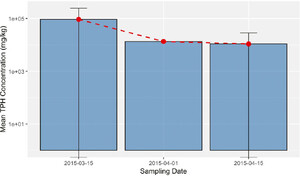
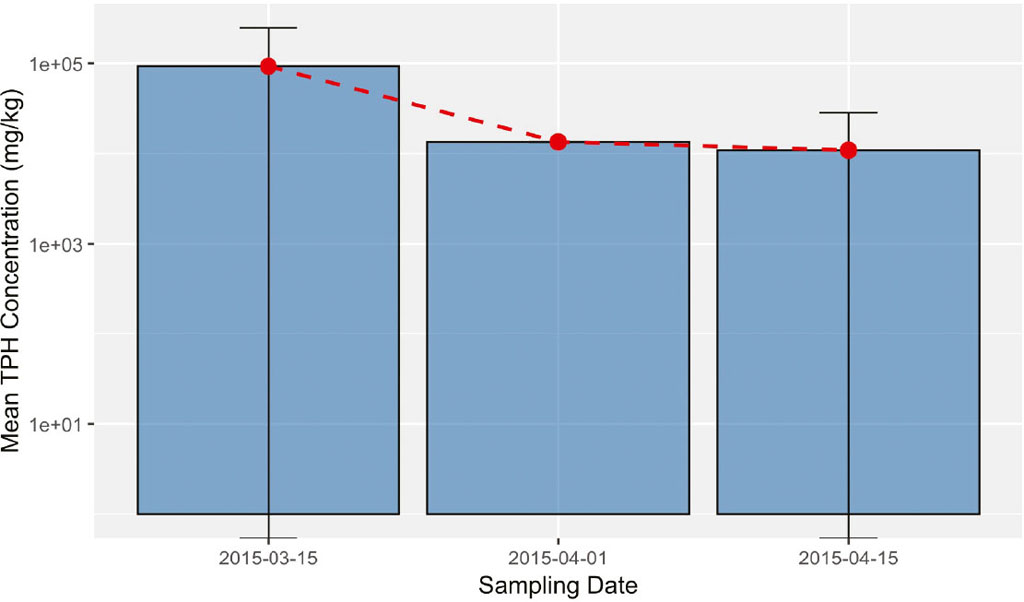
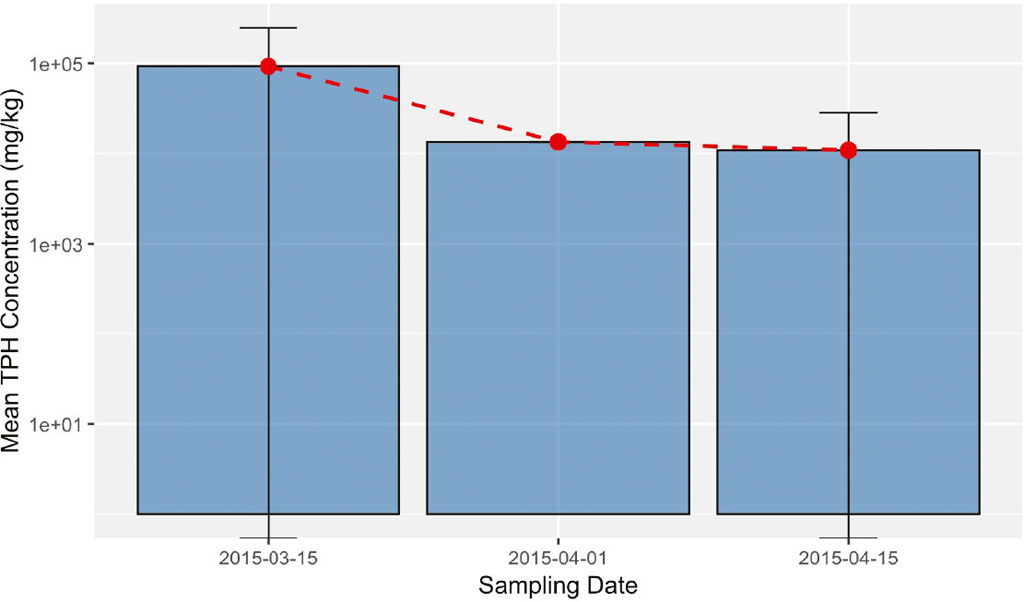
To assess the overall trend of TPH decline over time, a chi-squared test was performed using the mean TPH concentrations for each sampling date. The results were highly significant (
Decrease in TPH concentrations over time. Blue bars represent mean TPH concentrations (mg/kg) at each depth class; red dots indicate mean values; the dashed red line shows the overall downward trend. The y-axis is on a logarithmic scale to emphasize the magnitude of TPH reduction.
Citation: Israel Journal of Ecology and Evolution 72, 1-2 (2026) ; 10.1163/22244662-bja10117
In contrast, total organic carbon (TOC) concentrations did not vary significantly across depths (15 March:
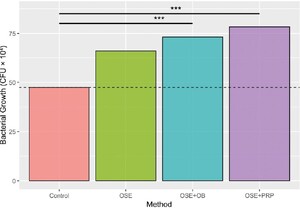
Regarding microbial activity, the application of OSE alone did not significantly increase the growth of TPH- degrading bacterial colonies (
Colony-forming unit (CFU) counts of TPH-degrading bacteria for each treatment. Horizontal bars indicate significant differences from the control group.
Citation: Israel Journal of Ecology and Evolution 72, 1-2 (2026) ; 10.1163/22244662-bja10117
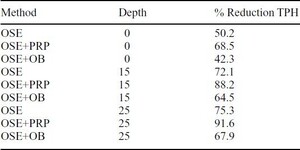
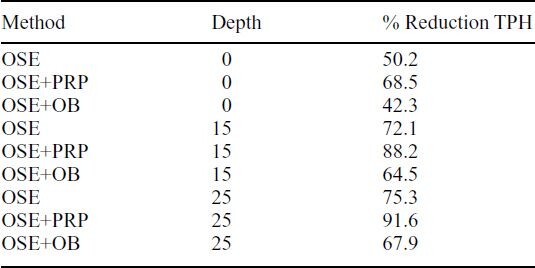
Finally, the Kruskal-Wallis test revealed no statistically significant differences in the percentage reduction of TPH among the three bioremediation treatments (
TPH reduction (%) across soil depths as a function of the applied bioremediation method.
Citation: Israel Journal of Ecology and Evolution 72, 1-2 (2026) ; 10.1163/22244662-bja10117
Discussion
The results of this study provide insight into the bioremediation dynamics following a crude oil spill in the arid environment of Evrona Nature Reserve. Our findings indicate that TPH degradation is both substantial and depth-dependent, with the most significant reductions observed at greater soil depths. This pattern may reflect natural leaching processes, microbial activity gradients, or reduced volatilization of hydrocarbons at lower depths. Importantly, total organic carbon (TOC) concentrations did not vary significantly across sampling dates or depths, suggesting that the degradation of TPH did not alter the overall organic carbon pool within the soil system. This supports the interpretation that TPH degradation was a targeted microbial or abiotic process, rather than part of a broader shift in soil organic matter composition.
The quantification of colony-forming units (CFU) of hydrocarbon-degrading bacteria revealed clear differences among bioremediation strategies. The use of Oil Spill Eater (OSE) alone did not significantly stimulate microbial growth relative to the control. However, treatments combining OSE with either oil-absorbing biopolymers (OB) or petroleum remediation product (PRP) resulted in a significant increase in CFU counts, suggesting that these amendments enhanced conditions for microbial proliferation. These findings align with previous studies indicating that microbial growth and activity can be significantly improved with the addition of nutrient-rich or surface-active compounds that increase hydrocarbon bioavailability (Khan et al., 2017).
Almost all of the studies published to date on the two Evrona oil spills have focused primarily on diverse aspects of environmental or ecological systems, including oil biodegradation (Tran et al., 2018, Banet et al., 2021), tree metabolism (Ignat et al., 2021), spider populations (Gavish-Regev et al., 2022), soil bacterial communities (Girsowicz et al., 2018), desert shrub and vegetation response (Nothers et al., 2017), parasitoid wasps (Möller et al., 2020), insectivorous bat community (Corine, 2025), soil hydrophobicity and abiotic properties (Girsowicz et al., 2018, Rosenzweig et al., 2020, Banet et al., 2021), water flow and infiltration capacity (Stavi and Rosenzweig, 2020), tillage effects on contaminated sediments (Stavi and Rosenzweig, 2020), and Acacia seedling response (Nothers et al., 2017, Ferrante et al., 2021). The methodology included observational studies, long-term monitoring of the flora and fauna, and other ex-situ experiments which included laboratory and various experimental approaches. These studies found population and diversity decrease and community composition shifts (Banet et al., 2021). Most importantly, they found ecosystem function changes in soil properties, microbial communities (Girsowicz et al., 2018), vegetation structure, and recruitment (Nothers et al., 2017).
As stated earlier, the number of studies on the different bioremediation trials is limited. Banet et al. (2021) conducted an ex-situ experiment of biostimulation with mineral fertilization and water saturation for one month and found a significant acceleration of oil degradation. They also conducted the same experiment on the earlier oil spill but found no significant effects. Stavi and Rosenzweig (2020) experimented with soil tillage 3 years post-treatment and found that it was ineffective in hyper-arid conditions. Tran et al. (2018) tried soil dilution and found that it had reduced negative effects on seedlings, but the study has not been field-tested. However, it is of interest that they found that 40 years after the oil spill in 1975, the TPH content was still 25% of that at the 2014 site. These findings are in contrast with our study, wherein we found that TPH degradation was both substantial and depth-dependent.
Although numerical differences in TPH reduction were observed between treatments, statistical significance was not achieved, likely due to high variability and the limited sample size and time allowed by the authorities. These limitations underline the need for longer-term monitoring and replication across larger spatial and temporal scales to confirm the observed trends and assess the long-term efficacy of different bioremediation treatments. This is especially paramount because ours is the only study that has shown success in bioremediation of desert soils.
In conclusion, our study demonstrates that natural attenuation processes are actively reducing hydrocarbon contamination in the Evrona ecosystem and that specific amendments can enhance microbial responses. However, taking the present reality with the KATZA Oil Company and Israeli politics, it appears that the next oil spill is only a question of time. Hence, the authorities must immediately undertake a more robust experimental framework to optimize and validate bioremediation strategies in arid and ecologically sensitive environments.
Ethical guidelines
According to the guidelines supplied by, and supervision of, Israel Nature and Parks Authority, Ministry of Environmental Protection of Israel.
The authors declare no conflicts of interest.
This research did not receive any specific grant from funding agencies in the public, commercial, or not-for-profit sectors.
References
Banet, G., Turaani, A.K., Farber, R., Armoza-Zvuloni, R., Rotem, N., Stavi, I. and Cahan, R., 2021. The effects of biostimulation and bioaugmentation on crude oil biodegradation in two adjacent terrestrial oil spills of different age, in a hyper-arid region. Journal of Environmental Management, 286, p. 112248.
Ferrante, M., Dangol, A., Didi-Cohen, S., Winters, G., Tzin, V. and Segoli, M., 2021. Oil pollution affects the central metabolism of keystone Vachellia (Acacia) trees. Sustainability, 13(12), p. 6660.
Gavish-Regev, E., Armiach Steinpress, I., Salman, I.N., Segev, N., Uzan, A., Byun, Y., Levy, T., Aharon, S., Zvik, Y., Shtuhin, R. and Shapira, Y., 2022. Five-year monitoring of a desert burrow-dwelling spider following an environmental disaster indicates long-term impacts. Insects, 13(1), p. 101.
Girsowicz, R., Koryachenko, O., Sherman, C., Mayzlish-Gati, E., Doniger, T. and Steinberger, Y., 2018. Impact of oil-spill contamination on a soil bacterial community: A 40-year history of rehabilitation in the Arava Valley. Soil and Sediment Contamination: An International Journal, 27(3), pp. 175–185.
Ignat, T., De Falco, N., Berger-Tal, R., Rachmilevitch, S. and Karnieli, A., 2021. A novel approach for long-term spectral monitoring of desert shrubs affected by an oil spill. Environmental Pollution, 289, p. 117788.
Khan, A.H.A., Tanveer, S., Alia, S., Anees, M., Sultan, A., Iqbal, M. and Yousaf, S., 2017. Role of nutrients in bacterial biosurfactant production and effect of biosurfactant production on petroleum hydrocarbon biodegradation. Ecological Engineering, 104, pp. 158–164.
Korine, C., 2025. Long-term impacts of oil spill pollution on the insectivorous bat community in the hyper-arid Evrona Nature Reserve, Israel. Science of The Total Environment, 971, p. 179056.
Mamozai, W., Hesam, A.M. and Hemma, W.H., 2024. Impacts of Crude Oils on Water Quality: A Comprehensive Review. Sciences, 2(1), pp. 126–138.
Möller, D.M., Ferrante, M., Möller, G.M., Rozenberg, T. and Segoli, M., 2020. The impact of terrestrial oil pollution on parasitoid wasps associated with Vachellia (Fabales: Fabaceae) trees in a desert ecosystem, Israel. Environmental Entomology, 49(6), pp. 1355–1362.
Nothers, M., Segev, N., Kreyling, J., Hjazin, A. and Groner, E., 2017. Desert vegetation forty years after an oil spill. Journal of Environmental Quality, 46(3), pp. 568–575.
Ossai, I.C., Ahmed, A., Hassan, A. and Hamid, F.S., 2020. Remediation of soil and water contaminated with petroleum hydrocarbon: A review. Environmental Technology & Innovation, 17, p. 100526.
Rosenzweig, R., Li, Z., Gelman, F., Crouvi, O., Arye, G. and Ronen, Z., 2020, May. Remediation and hydrological implications of oil-induced soil hydrophobicity in the Evrona nature reserve, Israel. In EGU General Assembly Conference Abstracts, p. 9195.
Stavi, I. and Rosenzweig, R., 2020. Tillage effect on hydrophobicity and hydrological properties of oil-contaminated sediments in a hyper-arid region. Arid Land Research and Management, 34(1), pp. 26–35.
Tran, T.H., Gati, E.M., Eshel, A. and Winters, G., 2018. Germination, physiological and biochemical responses of acacia seedlings (Acacia raddiana and Acacia tortilis) to petroleum contaminated soils. Environmental Pollution, 234, pp. 642–655.
Truskewycz, A., Gundry, T.D., Khudur, L.S., Kolobaric, A., Taha, M., Aburto-Medina, A., Ball, A.S. and Shahsavari, E., 2019. Petroleum hydrocarbon contamination in terrestrial ecosystems – fate and microbial responses. Molecules, 24(18), p. 3400.