Abstract
Nanotechnology offers transformative potential for the global food and agribusiness sector, yet its commercial adoption remains limited. This review examines nanomaterials from a managerial and strategic perspective, focusing on their implications for agribusiness firms, supply chain efficiency, investment decision-making, regulatory compliance, and consumer acceptance. While technical advancements in nano-enabled packaging, nutrient delivery, and sensing systems promise reduced food loss, extended shelf life, and enhanced product differentiation, significant barriers persist, including regulatory fragmentation, uncertain return-on-investment, consumer skepticism, and liability risks. Drawing on multidisciplinary evidence, we identify key strategic challenges and propose practical frameworks for agribusiness managers to evaluate, adopt, and govern nano-enabled innovations responsibly. The analysis highlights the critical need for coordinated industry–regulator–science collaboration to translate laboratory successes into viable commercial strategies within the global food system.
1. Introduction
Nanotechnology is rapidly reshaping the global food and agribusiness landscape, creating both unprecedented strategic opportunities and complex managerial challenges for industry executives and supply-chain decision-makers (Eliboev et al., 2025). Despite the rapid expansion of nanotechnology across scientific and industrial domains, its integration into food systems introduces unique functional advantages, as well as unresolved scientific uncertainties, thereby highlighting engineered nanomaterials as both promising and potentially contentious components of modern food science (de Sousa et al., 2023). For agribusiness firms, the successful commercialization of nano-enabled technologies hinges not only on scientific performance but also on regulatory compliance, consumer acceptance, cost–benefit realities, and effective risk governance across international supply chains. Nanomaterials, engineered structures with dimensions typically less than 100 nm, offer exceptional physicochemical properties such as high surface-area-to-volume ratio, tunable surface functionality, and enhanced reactivity (Ali et al., 2026; Astanov et al., 2025). These attributes enable novel solutions in food preservation, packaging, sensing, and nutrient delivery, creating opportunities for improved food quality, safety, and shelf-life (Chauhan et al., 2024; Pradhan et al., 2015; Singh et al., 2023). However, translating laboratory-scale successes into profitable, market-ready products remains limited, making this review especially relevant to agribusiness managers seeking evidence-based strategies for responsible and commercially viable adoption of nanotechnology in the global food system.
Nanoencapsulation is among the most established applications of nanotechnology in food (Taouzinet et al., 2023). It involves the entrapment of sensitive bioactive compounds such as vitamins, polyphenols, probiotics, omega-3 fatty acids, and essential oils within nanoscale carriers to protect them from environmental degradation and enhance their bioavailability. Recent advancements in biopolymeric nanocarriers have enabled targeted release in specific regions of the gastrointestinal tract, leading to improved functional efficacy (Gali et al., 2023). Although several delivery systems have shown promising results under laboratory conditions, challenges such as scalability, batch-to-batch variability, and limited in vivo validation remain unresolved, particularly for industrial translation.
Simultaneously, nanosensors are gaining traction for real-time monitoring of food quality and contamination. These sensors utilize nanostructures like metal nanoparticles, carbon-based materials, or quantum dots to detect spoilage indicators, pathogens, or chemical residues with high sensitivity and specificity (Fuertes et al., 2016). For example, nanosensors based on gold nanoparticles have demonstrated potential for colorimetric detection of Salmonella or E. coli, offering rapid and on-site solutions that complement conventional laboratory-based testing (Sadanandan et al., 2023). Yet, issues such as sensor stability in heterogeneous food matrices, signal interference, and cost-effective mass production have not been adequately addressed in previous reviews, limiting a realistic assessment of their commercial adoption.
Another critical domain of application is nanocomposite food packaging. By incorporating materials like silver or zinc oxide nanoparticles into packaging films, researchers have developed active packaging systems with antimicrobial, UV-blocking, and gas-barrier functionalities (Brandelli, 2024). These films can inhibit microbial growth, reduce oxidation, and visually indicate spoilage through integrated sensor responses. Smart packaging not only extends shelf life but also aligns with global efforts to reduce food waste and improve traceability throughout the supply chain. Nevertheless, key safety questions, particularly nanoparticle migration into food and post-disposal environmental accumulation, remain unanswered, despite intensifying academic and industrial focus on smart packaging.
However, despite these benefits, the safety of engineered nanomaterials in food applications remains a subject of considerable debate. Emerging studies suggest that some nanomaterials may induce toxicological responses, including oxidative stress, DNA damage, and immunological disturbances in animal and cell-based models (Jain et al., 2017). Their nanoscale size allows them to cross biological membranes and accumulate in tissues, raising concerns about long-term exposure and cumulative effects in humans. Moreover, the fate of nanomaterials in complex food matrices and during digestion is not fully understood, necessitating comprehensive risk assessments (Handy and Shaw, 2007). Critically, toxicological findings remain inconsistent across studies due to variations in nanomaterial size, surface chemistry, dosage, exposure duration, and interactions with food constituents, making it difficult to establish universally accepted safe application thresholds for the food industry. This scientific ambiguity represents a major research gap that continues to obstruct regulatory harmonization and limits the responsible industrial adoption of nano-enabled food technologies.
Global regulatory frameworks are gradually evolving to address the challenges associated with the use of nanomaterials in food systems. For instance, the European Food Safety Authority (EFSA) and the U.S. Food and Drug Administration (FDA) have both issued guidance documents recognizing the need for case-specific assessment of nanomaterials in food and feed applications (Fender, 2008; Kumari et al., 2023). Figure 1 conceptually summarizes the major domains of nanomaterial applications, including packaging, sensing, and delivery systems, and illustrates their interconnections with safety considerations, toxicological concerns, sustainability aspects, and evolving regulatory frameworks. However, despite the emergence of such regulatory initiatives, progress continues to lag behind technological development. As a result, definitions of nanomaterials, safety assessment protocols, and authorization criteria remain inconsistent across jurisdictions, and effective post-market surveillance mechanisms are still limited. These regulatory discrepancies not only complicate risk evaluation but also hinder harmonized industrial adoption and global market entry of nano-enabled food products.

Schematic overview of the applications, safety aspects, sustainability, and regulatory considerations of nanomaterials in the food industry.
Citation: International Food and Agribusiness Management Review 2026; 10.22434/ifamr.1477
Taken together, the literature demonstrates rapid technological advancement but also reveals three persistent research gaps: (i) limited critical comparison of nanomaterial performance under real food conditions rather than laboratory simulations, (ii) inconsistent toxicological evidence preventing clear safety thresholds, and (iii) lack of integrative assessment linking applications, risks, and regulatory constraints. Therefore, the objective of this review is not only to summarize current applications of nanomaterials in food systems but also to provide a critical and comparative evaluation of their performance, safety, and regulatory challenges. By synthesizing multidisciplinary evidence, this article aims to clarify current limitations, support responsible development, and guide future research toward safer and more sustainable integration of nanotechnology in the food sector. From a managerial standpoint, the review explicitly connects these scientific and regulatory insights to concrete decision domains faced by agribusiness leaders, including R&D portfolio selection, timing of market entry, partner and supplier choice, and risk‑governance design. In each major section, we therefore move beyond purely technical descriptions and highlight how specific nanomaterial characteristics, such as stability in complex food matrices, migration and transformation behavior, required safety testing, or labeling obligations, shape strategic opportunities and adoption barriers. This integrative lens is intended to support managers and supply‑chain actors in translating emerging nanotechnology evidence into actionable choices regarding investment, product design, and supply‑chain configuration.
2. Types of nanomaterials used in food systems
The diversity of nanomaterials employed in food systems reflects their multifunctional roles in enhancing food quality, safety, and nutritional performance. However, despite their broad applicability, the real-world effectiveness of these nanomaterials depends heavily on their behavior in complex food matrices, regulatory acceptance, scalability, and long-term safety, factors often underrepresented in previous reviews. These nanomaterials vary in origin, composition, morphology, and functionality, and can be broadly categorized into inorganic nanoparticles, biopolymeric nanostructures, carbon-based nanomaterials, lipid-based systems, nanoclays, and hybrid systems. This section provides not only a descriptive but also a critical assessment of their strengths, limitations, and existing research gaps.
2.1 Inorganic nanoparticles
Inorganic nanomaterials, such as silver (Ag), zinc oxide (ZnO), titanium dioxide (TiO₂), and silica (SiO₂) nanoparticles, are widely explored in food packaging and antimicrobial applications. Silver nanoparticles (Ag NPs), owing to their potent broad-spectrum antimicrobial activity, are among the most studied. They disrupt microbial membranes and generate reactive oxygen species, thereby extending shelf life and minimizing microbial contamination (Istiqola and Syafiuddin, 2020; Waheed et al., 2023; Zehra et al., 2025). However, their antimicrobial efficiency in real food matrices is often lower than in laboratory media due to protein–nanoparticle interactions and organic load, a detail frequently overlooked in earlier literature.
Zinc oxide nanoparticles (ZnO NPs) are similarly valued for their antibacterial and UV-blocking properties, making them suitable for active packaging films (Hossain et al., 2024; Souza et al., 2020; Sun et al., 2018). Despite this, concerns regarding their dose-dependent cytotoxicity and dissolution into Zn²⁺ ions require more comprehensive toxicokinetic evaluation. Titanium dioxide (TiO₂), used primarily as a food additive (E171), has generated debate due to concerns about its potential genotoxicity, leading to regulatory restrictions in some jurisdictions (Bischoff et al., 2021; Proquin et al., 2017; Younes et al., 2021). Meanwhile, silica nanoparticles, recognized for their inertness and high surface area, enhance mechanical strength and barrier properties in packaging films. Their ability to carry active agents further supports their role in active packaging systems (Batra et al., 2020; Dong et al., 2022; Jiang et al., 2025). However, recent findings suggest that variations in porosity, agglomeration state, and surface chemistry may significantly influence their migration behavior, underscoring the need for standardized characterization and migration-testing protocols. Overall, inorganic nanoparticles offer strong functional performance but remain the class associated with the greatest toxicological uncertainty and regulatory scrutiny.
2.2 Biopolymeric nanostructures
Biopolymeric nanomaterials such as nanoemulsions, nanoliposomes, nanogels, and biopolymer-based nanocapsules offer excellent biocompatibility and are especially suited for encapsulating and delivering sensitive bioactives like vitamins, probiotics, and antioxidants (McClements and Öztürk, 2021; Tan et al., 2023). For example, chitosan and alginate-based nanoparticles have been widely utilized to encapsulate polyphenols to improve their solubility and protect them from enzymatic degradation in the gastrointestinal tract (Ahmad et al., 2022; Chen et al., 2022). Compared with inorganic nanoparticles, biopolymer-based carriers generally exhibit superior biodegradability and lower toxicological risk, making them more acceptable for direct food incorporation. However, they often show lower mechanical stability, higher sensitivity to pH/ionic strength changes, and reduced long-term shelf-life, factors that complicate industrial-scale applications. The versatility of biopolymer based systems lies in their tunable surface chemistry and responsiveness to environmental triggers such as pH or temperature, which allows controlled release of the encapsulated compounds (Wathoni et al., 2024; Zhang et al., 2019). Despite their advantages, scalability and batch-to-batch reproducibility remain major gaps requiring further optimization.
2.3 Carbon-based nanomaterials
Carbon nanomaterials, including graphene oxide (GO), carbon nanotubes (CNTs), and carbon quantum dots (CQDs), have gained prominence for their remarkable electrical conductivity, mechanical strength, and surface area. In food applications, they are primarily used in the development of nanosensors and smart packaging materials (Khoshkalampour et al., 2023; Raul et al., 2022; Zou et al., 2024). Graphene oxide has been successfully incorporated into polymer films to create oxygen-impermeable packaging, while CQDs have been used in fluorescent nanosensors for detecting foodborne pathogens or heavy metals (Anand et al., 2019; Chowmasundaram et al., 2023; Demchenko and Dekaliuk, 2013). However, despite their functional advantages, numerous studies highlight concerns regarding the long-term fate, persistence, and potential bioaccumulation of carbon-based nanomaterials, particularly CNTs, which have demonstrated cytotoxic and membrane-disruptive effects in intestinal and microbial cells (Nguyen et al., 2015; Shahazi et al., 2023). Although CQDs exhibit relatively low toxicity, their biocompatibility is strongly influenced by synthesis route, surface chemistry, and residual precursors. Moreover, most existing data are based on simplified in vitro setups, leaving critical gaps regarding interactions with food components, gastrointestinal transformations, and chronic exposure effects.
2.4 Nanoemulsions and lipid-based carriers
Nanoemulsions submicron oil-in-water or water-in-oil dispersions are another widely used class of nanostructures in functional foods and beverages. They enhance the solubility and absorption of hydrophobic bioactives like omega-3 fatty acids, coenzyme Q10, and lipid-soluble vitamins (A, D, E, K). Due to their kinetic stability and optical transparency, nanoemulsions are well-suited for clear beverages or oral supplements. Nevertheless, their performance can be significantly influenced by processing conditions such as pasteurization, high-pressure homogenization, or pH fluctuations, which may accelerate coalescence or oxidative degradation. The lipid matrix can be tailored to achieve desired release profiles, and their size allows for enhanced cellular uptake (Aswathanarayan and Ravishankar Rai, 2019; McClements, 2013; McClements and Xiao, 2012; Salvia-Trujillo et al., 2016; Walker et al., 2015). A key limitation rarely emphasized is that simulated digestion models may overestimate absorption relative to real physiological conditions, indicating a need for more robust in vivo validation.
2.5 Nanoclays and layered nanostructures
Nanoclays such as montmorillonite and halloysite improve barrier properties against gases and moisture in packaging materials. When dispersed uniformly in polymer matrices, they increase the tortuosity of diffusion pathways, reducing permeability (Bumbudsanpharoke and Ko, 2019; Giannakas et al., 2022; Othman et al., 2019). However, achieving homogeneous dispersion remains technically challenging and often results in inconsistent barrier performance in commercial-scale films. Halloysite nanotubes have been studied for their ability to encapsulate antimicrobial agents and release them in response to spoilage conditions. While their natural origin and low cost make them attractive, variability in clay purity and presence of trace metals require more rigorous standardization to meet global regulatory expectations.
2.6 Hybrid nanomaterials
Hybrid nanomaterials, formed by integrating organic and inorganic components, combine the advantages of multiple systems such as mechanical robustness, antimicrobial activity, and functionalization capability. For instance, combining silver nanoparticles with chitosan matrices yields nanocomposites with synergistic antibacterial properties suitable for edible coatings or active packaging. Similarly, polymer–metal oxide hybrids have been used for controlled release of antimicrobials or ethylene scavengers to delay fruit ripening (Chadha et al., 2022; Oun et al., 2019; Suvarna et al., 2022). Despite their promising multifunctionality, hybrid systems present challenges including complex fabrication routes, limited scalability, and insufficient understanding of cross-material toxicological interactions. Additionally, regulatory evaluation becomes more difficult when multiple nanoscale components are combined, and standardized safety frameworks are lacking.
2.7 Categorization summary
Table 1 summarizes the major classes of nanomaterials used in food applications. As illustrated in Fig. 2, no single nanomaterial class is universally optimal; instead, each presents a distinct balance between functional performance, scalability, regulatory acceptance, and toxicological uncertainty. Inorganic nanoparticles offer high antimicrobial efficacy but raise migration and toxicity concerns, whereas biopolymeric and lipid-based nanocarriers provide safer alternatives with limitations in stability. Carbon-based nanomaterials excel in sensing but lack comprehensive safety data, and hybrid systems deliver multifunctionality at the cost of regulatory complexity. A more integrative and comparative approach is therefore essential for future research, linking the insights from Table 1 and Fig. 2 to emphasize real-world food conditions, harmonized safety assessments, and industrial feasibility.
Summary of nanomaterials used in food systems.
Citation: International Food and Agribusiness Management Review 2026; 10.22434/ifamr.1477
Classification of nanomaterials used in food systems based on their structure and function.
Citation: International Food and Agribusiness Management Review 2026; 10.22434/ifamr.1477
For managers and supply‑chain decision‑makers, these material distinctions translate directly into strategic choices about technology portfolios and vendor selection. Inorganic nanoparticles may offer rapid functional gains in antimicrobial performance but lock firms into higher regulatory and reputational risk categories, requiring more intensive safety testing, contingency planning, and insurance coverage. By contrast, biopolymeric and lipid‑based carriers are typically easier to position as natural or clean‑label but impose tighter constraints on processing conditions and shelf‑life guarantees, which must be reflected in contracts with co‑packers, distributors, and retailers. Carbon‑based and hybrid systems provide superior sensing and multifunctionality, yet their uncertain long‑term safety and higher production costs mean they are often suitable only for niche, high‑margin applications or controlled pilot projects. Table 1 and Fig. 2 can therefore be read not only as a scientific classification but also as a managerial map of risk–return profiles that informs which classes of nanomaterials are appropriate for which product lines, markets, and regulatory environments.
3. Applications in the food industry
The integration of nanomaterials into the food industry has introduced both innovative opportunities and critical scientific challenges. While their unique physicochemical properties, such as high surface-area-to-volume ratio, antimicrobial functionality, and controlled-release behavior, have enabled meaningful advancements in food preservation, nutrient delivery, and real-time safety monitoring, evidence from recent studies suggests that many laboratory-scale improvements do not consistently translate to industrial environments. Factors such as complex food matrices, variable pH, processing temperature, and scalability constraints often reduce the stability or functional performance of nano-enabled systems. This section critically evaluates major application domains across processing, packaging, storage, and safety, highlighting both demonstrated advantages and unresolved limitations. Across these domains, we emphasize a recurring translation gap: many nano‑enabled formulations are optimized and validated under controlled laboratory conditions, but their performance often degrades when exposed to complex food matrices, industrial processing operations, and real supply‑chain dynamics.
3.1 Nanoencapsulation for nutrient and bioactive delivery
Despite extensive research and numerous laboratory successes over the past decade, nanoencapsulation of bioactives remains one of the least commercially implemented nanotechnology applications in the food industry (McClements and Öztürk, 2021; Salvia-Trujillo et al., 2016; Taouzinet et al., 2023). Building on the classification in Section 2.2, current product development efforts focus mainly on biopolymeric carriers such as chitosan, alginate, gelatin, and whey protein isolate, which differ in cost, processability, and release behavior (Ahmad et al., 2022; Chen et al., 2022; Gali et al., 2023; Wathoni et al., 2024). For instance, Silvestre et al. (2023) demonstrated the use of chitosan-alginate nanoparticles for delivering curcumin, which exhibited superior stability in simulated gastrointestinal conditions (Silvestre et al., 2023). Similarly, Figueroa-Enriquez et al. (2023) explored gelatin-based nanocarriers for functional food fortification, showing that encapsulated bioactives retained their antioxidant potential over extended storage (Figueroa-Enriquez et al., 2023). In comparison, chitosan–alginate systems generally offer better pH resistance and controlled release than gelatin, making them more suitable for oral delivery, whereas gelatin remains cost-effective for large-scale production. Lipid-based systems, including nanoemulsions and liposomes, are particularly effective for solubilizing lipophilic bioactives. McClements and Öztürk (2021) showed that nanoemulsions stabilized with food-grade emulsifiers significantly improved the bioavailability of omega-3 fatty acids and vitamins D and E in human digestion models (Aswathanarayan and Ravishankar Rai, 2019; McClements, 2013; McClements and Öztürk, 2021; Salvia-Trujillo et al., 2016; Walker et al., 2015). These nanoformulations enable targeted delivery and protect actives from oxidative degradation or hydrolysis.
However, increasing evidence indicates that the functional performance of nanoencapsulation systems reported under laboratory conditions often declines when applied to complex food matrices, where variations in pH, ionic strength, macromolecular interactions, and thermal processing can trigger nanoparticle aggregation or premature release (Aswathanarayan and Ravishankar Rai, 2019; McClements and Öztürk, 2021; Salvia-Trujillo et al., 2016). Furthermore, although chitosan–alginate carriers demonstrate favorable pH-responsive behavior, they continue to face challenges related to batch-to-batch reproducibility, long-term physicochemical stability, and scalability, which limit their industrial translation (Ahmad et al., 2022; Chen et al., 2022; Wathoni et al., 2024). Similarly, nanoemulsions and liposomes, while highly efficient in controlled conditions, frequently exhibit reduced stability during large-scale processing, highlighting the need for improved formulations capable of maintaining robustness across diverse real-world environments (McClements, 2013; McClements and Öztürk, 2021; Salvia-Trujillo et al., 2016; Walker et al., 2015).
3.2 Antimicrobial packaging and shelf-life extension
The antimicrobial functionality of silver (Ag), zinc oxide (ZnO), and titanium dioxide (TiO₂) nanoparticles, as described in Section 2.1, underpins their integration into active food packaging systems (Bischoff et al., 2021; Istiqola and Syafiuddin, 2020; Souza et al., 2020; Sun et al., 2018; Waheed et al., 2023; Younes et al., 2021; Zehra et al., 2025). Brandelli (2024) reviewed a range of nanocomposite films using ZnO and Ag nanoparticles that effectively inhibited Escherichia coli, Listeria monocytogenes, and Staphylococcus aureus on meat and dairy products (Brandelli, 2024). Chitosan-based nanocomposites doped with ZnO not only provided a bacteriostatic barrier but also improved the mechanical strength and water vapor resistance of the films (Souza et al., 2020). In another study, Zehra et al. (2025) synthesized green Ag nanoparticles embedded in biodegradable films, which showed broad-spectrum antifungal activity and preserved the quality of fresh-cut fruits for up to 10 days longer than conventional films (Zehra et al., 2025).
However, despite these promising laboratory-scale results, recent evidence suggests that antimicrobial performance does not always translate directly to industrial and real food storage conditions, where variables such as pH, moisture, protein content, and lipid profiles can significantly reduce ion release and ROS generation. Consequently, antimicrobial efficacy observed in in vitro assays may be overestimated when compared to real-world applications. Furthermore, comparative findings indicate that although Ag nanoparticles often exhibit faster antimicrobial activity than ZnO due to their higher ion release rate, they also present higher risks of cytotoxicity and nanoparticle migration into food (Istiqola and Syafiuddin, 2020; Waheed et al., 2023). By contrast, ZnO nanoparticles are generally considered safer for direct food contact but may show reduced antimicrobial activity against Gram-negative bacteria under realistic physiological or food storage conditions (Souza et al., 2020; Sun et al., 2018). Similarly, while TiO₂ contributes UV shielding and antimicrobial functions, increasing regulatory scrutiny, particularly in the European Union, highlights unresolved concerns regarding long-term genotoxicity and bioaccumulation, which may restrict its future use in food packaging (Bischoff et al., 2021; Proquin et al., 2017; Younes et al., 2021).
A critical research gap across current antimicrobial packaging systems is the absence of standardized protocols for evaluating nanoparticle migration, toxicological interactions, and antimicrobial durability under prolonged storage and transportation stresses. In addition, scalability barriers, cost of nanoparticle production (especially Ag), and consumer acceptance remain persistent obstacles for industrial translation despite encouraging laboratory reports. Collectively, such systems offer an eco-friendly alternative to chemical preservatives and align with current sustainability goals in packaging design (Hossain et al., 2024; Souza et al., 2020). Nevertheless, for their safe and widespread commercial adoption, future studies must balance antimicrobial performance with toxicological safety, migration control, regulatory compliance, environmental persistence, and consumer perception, factors that have been underrepresented in the current body of literature.
3.3 Intelligent and smart packaging systems
Smart packaging employs nanosensors to monitor real-time changes in the internal or external conditions of packaged food, thereby providing early detection of spoilage, contamination, or temperature abuse. Nanosensors can detect volatile organic compounds (VOCs), gases like CO₂ and O₂, or changes in pH associated with microbial activity (Fuertes et al., 2016; Jain et al., 2017; Raul et al., 2022; Sadanandan et al., 2023; Zou et al., 2024). Fuertes et al. (2016) demonstrated a nanocomposite sensor incorporating gold nanoparticles that changed color upon exposure to ammonia, a common byproduct of protein degradation in meat and fish (Fuertes et al., 2016). Similarly, Du et al. (2020) developed a multiplex PCR assay assisted by gold nanoparticles for simultaneous detection of Salmonella typhimurium, Listeria monocytogenes, and E. coli O157:H7 in food samples (Sadanandan et al., 2023). Incorporation of quantum dots (QDs) into sensors allows for fluorescent detection with high sensitivity. Zou et al. (2024) reviewed several QD-based systems capable of quantifying trace amounts of pesticide residues, heavy metals, and toxins in complex food matrices (Zou et al., 2024). These smart systems improve food safety while reducing reliance on destructive testing and laboratory analyses.
Despite this progress, recent studies indicate that the real-world performance of nanosensors can be substantially lower than laboratory results due to signal interference caused by fats, pigments, proteins, and fluctuating humidity levels found in heterogeneous food matrices (Fuertes et al., 2016; Zou et al., 2024). In addition, although gold nanoparticles and QDs exhibit high analytical sensitivity, their commercial adoption is limited by high cost, complex fabrication processes, and concerns regarding the release of potentially toxic nanomaterials into food or the environment (Jain et al., 2017; Raul et al., 2022). Furthermore, nanosensors designed to detect single contaminants in controlled laboratory environments often fail to integrate effectively with dynamic, multi-parameter spoilage processes encountered in industrial food chains, highlighting a gap between experimental validation and industrial scalability (Fuertes et al., 2016; Zou et al., 2024).
Another critical challenge relates to the absence of standardized calibration and validation protocols for food-grade nanosensors, which prevents comparison and reproducibility among reported sensor systems and hampers regulatory approval (Jain et al., 2017). Even in cases where nanosensors demonstrate reliable performance, consumer acceptance remains a barrier; emerging studies note that consumer’s express hesitation toward packaging that contains metal-based nanostructures due to perceived safety risks and lack of labeling transparency (Jain et al., 2017; Singh et al., 2023). Collectively, nanosensors hold significant promise for intelligent packaging systems; however, their broad industrial deployment will depend on achieving a realistic balance between analytical performance, production cost, sensor stability within real food matrices, toxicological safety, and consumer acceptance, areas insufficiently addressed in current studies and requiring targeted attention for successful commercialization.
3.4 Food processing and preservation
Nanomaterials can enhance various stages of food processing, including emulsification, stabilization, clarification, and preservation (Chauhan et al., 2024; Pradhan et al., 2015). Nanoemulsions have been successfully employed to reduce the need for synthetic additives by improving dispersion and interaction of natural preservatives or flavorings (Aswathanarayan and Ravishankar Rai, 2019; Istiqola and Syafiuddin, 2020; Salvia-Trujillo et al., 2016). Salvia-Trujillo et al. (2020) showed that nanoemulsions of essential oils like thymol and eugenol provided strong antimicrobial action in fruit juices, inhibiting microbial growth without altering sensory attributes (Salvia-Trujillo et al., 2016). However, recent studies report that the antimicrobial efficiency of nanoemulsions decreases under thermal and high-shear industrial processing conditions, reducing their stability during large-scale production (Aswathanarayan and Ravishankar Rai, 2019; Salvia-Trujillo et al., 2016).
Nanoclays, such as montmorillonite and halloysite, are often used in food-grade coatings to enhance oxygen and moisture barrier properties (Bumbudsanpharoke and Ko, 2019). Othman et al. (2019) reported that PLA-based films integrated with halloysite nanotubes exhibited improved transparency, thermal stability, and significant reductions in oxygen permeability key for preserving the freshness of packaged goods like cheese, produce, and baked items (Othman et al., 2019). Yet, barrier performance largely depends on the uniform dispersion of nanoclays, and inconsistent exfoliation during mass production has been associated with variations in preservation outcomes between industrial batches (Bumbudsanpharoke and Ko, 2019; Othman et al., 2019). Collectively, nano-enabled food processing and preservation systems help maintain food freshness and reduce dependence on chemical preservatives. Nonetheless, ensuring that laboratory-scale results translate consistently to industrial processes, without compromising sensory quality or consumer safety, remains an ongoing challenge that current studies address insufficiently (Chauhan et al., 2024; Istiqola and Syafiuddin, 2020; Pradhan et al., 2015).
3.5 Edible coatings and films
Nanostructured edible coatings serve as protective barriers against microbial contamination, moisture loss, and oxidation, while being safe for direct consumption. These coatings are typically composed of polysaccharides or proteins, reinforced with nanoparticles to improve functionality (Batra et al., 2020; Dong et al., 2022; Gali et al., 202; Oun et al., 20193; Souza et al., 2020; Sun et al., 2018). For instance, Gali et al. (2023) developed lipid–biopolymer nanocomposite coatings enriched with plant-based bioactives, achieving superior adhesion and prolonged microbial inhibition on strawberries and leafy greens (Gali et al., 2023). Other studies demonstrated the use of nano-silica and nano-cellulose to enhance flexibility, gas barrier properties, and structural integrity of edible films (Batra et al., 2020; Dong et al., 2022; Oun et al., 2019).
However, the real-world applicability of such coatings remains constrained by several underreported challenges. First, the mechanical and barrier properties of nano-reinforced edible films often deteriorate under high humidity or acidic conditions commonly encountered in fresh produce, limiting their shelf-life extension potential (Othman et al., 2019; Souza et al., 2020). Second, while nano-silica and nano-cellulose are generally regarded as safe, their migration into food matrices, particularly fatty or acidic foods, has not been systematically evaluated under realistic storage and consumption scenarios (Batra et al., 2020; Dong et al., 2022). Third, most studies, including Gali et al. (2023), evaluate coating performance under static and highly controlled storage conditions, with limited consideration of temperature cycling, handling‑induced mechanical damage, or cross‑contamination events that typically occur in commercial supply chains (Gali et al., 2023; Singh et al., 2023;).
3.6 Flavor and texture enhancement
Nanostructures can interact with sensory-active molecules to modulate flavor release and mouthfeel. For example, encapsulating volatile aromas in nanocapsules enables their controlled release during consumption, intensifying perception without increasing content. Similarly, modifying food texture via nanostructured colloids can improve creaminess or stability in products like yogurts, sauces, and plant-based alternatives (Aswathanarayan and Ravishankar Rai, 2019; Gali et al., 2023; Pradhan et al., 2015; Walker et al., 2015). Walker et al. (2015) showed that omega-3-rich nanoemulsions provided better flavor masking and mouthfeel in milk alternatives compared to conventional emulsions, a critical factor for consumer acceptability (Walker et al., 2015). This opens avenues for reformulating clean-label products with reduced sugar, salt, or fat without compromising taste. However, the stability of nanoencapsulated flavors under real processing and storage conditions remains underexplored. Thermal treatments (e.g., pasteurization) or prolonged storage may trigger premature release or degradation of encapsulated volatiles, undermining sensory benefits (McClements and Xiao, 2012; Salvia-Trujillo et al., 2016). Moreover, the perception of “clean-label” foods may be compromised if nano-delivery systems are not transparently disclosed, potentially eroding consumer trust (Singh et al., 2023).
3.7 Allergen reduction and detoxification
Emerging applications include using nanomaterials for detoxifying or neutralizing allergens and contaminants. For example, magnetic nanoparticles functionalized with specific ligands can bind to aflatoxins or pesticide residues and be separated using external magnets (Targuma et al., 2021). Horky et al. (2018) demonstrated that carbon-based nanomaterials, particularly graphene derivatives, possess a remarkable capacity to adsorb mycotoxins due to their large surface area and high binding affinity. Their findings suggest that such nanomaterials can effectively reduce toxin levels in contaminated food matrices without altering the nutritional quality, highlighting their promise as low-cost and efficient detoxification agents in agricultural applications (Horky et al., 2018). However, the practical feasibility of these approaches remains limited. Most studies, including Targuma et al. (2021) and Horky et al. (2018), employ purified toxin solutions under controlled conditions, which poorly reflect real food matrices containing proteins, fats, and pigments that may competitively bind to nanomaterials and reduce detoxification efficiency. Moreover, residual nanomaterials or their degradation products may persist in treated food, raising safety concerns that are rarely addressed in current literature (Jain et al., 2017; Nguyen et al., 2015).
3.8 Categorization summary
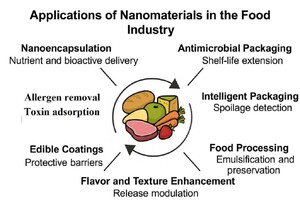
The application of nanotechnology in the food industry is reshaping how food is produced, packaged, monitored, and delivered to consumers. From enhancing the stability and efficacy of nutrients to developing intelligent packaging and real-time sensing systems, nanomaterials are at the forefront of innovation. However, while their functional benefits are compelling, a balanced approach that includes risk assessment, regulatory oversight, and consumer education is critical to ensuring their safe and ethical use. Figure 3 conceptually illustrates the diverse applications of nanomaterials in nutrient delivery, smart packaging, sensing, and preservation. Additionally, Table 2 summarizes key nanomaterial classes used in the food sector, outlining their functional roles, benefits, and potential challenges.
Schematic overview of key applications of nanomaterials in the food industry.
Citation: International Food and Agribusiness Management Review 2026; 10.22434/ifamr.1477
Categorization summary of nanomaterials applications in the food industry.
Citation: International Food and Agribusiness Management Review 2026; 10.22434/ifamr.1477
Yet, the categorization frameworks presented in current literature often lack cross-cutting critical evaluation. For instance, many nanomaterials classified as “safe” based on acute in vitro assays, such as biopolymeric carriers (Gali et al., 2023; McClements and Öztürk, 2021), may still undergo undesirable transformations during digestion or industrial processing (McClements and Öztürk, 2021; Silvestre et al., 2023; Taouzinet et al., 2023). Conversely, high-performing materials like carbon-based nanosensors (Zou et al., 2024) remain confined to lab-scale demonstrations due to unresolved toxicity and scalability issues (Nguyen et al., 2015; Raul et al., 2022). Without integrating performance data with real-world safety, stability, and regulatory feasibility, such summaries risk overpromoting technological potential while underrepresenting practical barriers to implementation.
From a managerial perspective, this means that decisions about adopting nanoencapsulation, antimicrobial films, or intelligent packaging cannot be based solely on laboratory efficacy metrics such as log‑reduction in microbial counts or in vitro bioavailability. Instead, agribusiness executives must evaluate how these technologies perform under actual processing and logistics conditions, what incremental capital and operating expenditures they require, how they affect recall risk and liability exposure, and whether they generate a value proposition that is legible and credible to customers. For example, intelligent nanosensor‑based packaging may reduce waste and enhance traceability, but only if firms can integrate sensor outputs into existing quality‑management systems and justify the additional unit cost to retailers and end‑consumers. Framing Sections 3.1–3.7 in this way turns them into a decision toolkit for assessing which nano‑applications create net value in specific product categories, distribution channels, and regulatory regimes.
4. Toxicological and safety concerns of nanomaterials in the food industry
Despite the promising applications of nanomaterials in food packaging, preservation, and nutrient delivery, their potential toxicological impacts raise significant safety concerns. The nanoscale dimensions, high surface reactivity, and unique physicochemical properties of these materials can lead to unforeseen biological interactions, necessitating comprehensive risk assessment before large-scale application (Bouwmeester et al., 2009). However, current safety evaluations remain largely fragmented, relying on idealized in vitro models and short-term exposure data that inadequately reflect real-world dietary scenarios, complex food matrices, or chronic low-dose intake, key gaps that undermine regulatory confidence and consumer trust.
4.1 Mechanisms of nanotoxicity in food systems
Nanomaterials can interact with biological systems through several pathways. Due to their small size (<100 nm), they can penetrate cellular membranes via endocytosis, leading to intracellular accumulation (Buzea et al., 2007). Once internalized, Nanomaterials may induce the formation of reactive oxygen species (ROS), causing oxidative stress, lipid peroxidation, and subsequent DNA damage (Encinas-Gimenez et al., 2024; Li et al., 2021). For example, silver nanoparticles (Ag NPs), widely used in antimicrobial food packaging, have been shown to generate ROS, disrupt mitochondrial function, and alter gene expression in intestinal epithelial cells (Ren et al., 2023).
Another key mechanism involves protein corona formation, where nanomaterials adsorb proteins from biological fluids, altering their biodistribution and cellular uptake (Cai and Chen, 2019). This phenomenon modifies surface reactivity, enhances cellular uptake in food matrices, and can influence immune responses, potentially leading to inflammation or immunotoxicity. However, most mechanistic studies rely on simplified in vitro models that expose cells to pristine nanomaterials in culture media, a scenario that poorly represents real dietary exposure. In actual food systems, nanoparticles interact with fats, proteins, and polysaccharides before ingestion, which can mask their surface, reduce reactivity, or alter bioavailability (Martirosyan and Schneider, 2014; McClements and Xiao, 2012). Consequently, reported toxicity mechanisms may overestimate risk if not validated in physiologically relevant food–gut interfaces.
4.2 In vitro and in vivo evidence of toxicity
Numerous in vitro studies have demonstrated cytotoxic and genotoxic effects of nanomaterials used in the food sector. Titanium dioxide nanoparticles (TiO2 NPs), previously utilized as food additive E171, were found to cause DNA strand breaks and chromosomal aberrations in human colon cells (Younes et al., 2021). Similarly, graphene oxide (GO) nanoparticles, applied in smart packaging, have exhibited cytotoxicity towards Caco-2 intestinal cells by compromising membrane integrity and inducing apoptosis (Nguyen et al., 2015). Animal models have further substantiated these findings. Oral exposure to ZnO nanoparticles in rodents led to bioaccumulation in the liver and kidneys, accompanied by histopathological alterations and oxidative stress markers (Sial et al., 2023). Chronic ingestion studies have also revealed potential impacts on gut microbiota composition, which could have far-reaching implications for human health (Zhang et al., 2021). However, most toxicity studies employ high-dose, acute exposures to pristine nanomaterials in simplified biological models, which poorly reflect real-world dietary intake involving low-dose, chronic exposure to food-transformed nanoparticles. Consequently, direct extrapolation of current in vitro and rodent data to human health risk remains uncertain without validation in physiologically relevant food–gut systems (Bouwmeester et al., 2009; Martirosyan and Schneider, 2014).
4.3 Human exposure and risk assessment challenges
The primary routes of human exposure to nanomaterials from food systems include ingestion, dermal contact, and inhalation during production and packaging. However, quantifying actual human exposure remains challenging due to limitations in detection methods and lack of standardized testing protocols (Xu et al., 2010). One critical gap is the scarcity of long-term epidemiological data assessing chronic, low-dose exposure to nanomaterials through diet. Additionally, the complex interaction of nanomaterials with food matrices can alter their bioavailability and toxicity, further complicating risk assessments (Martirosyan and Schneider, 2014). Crucially, current risk models often assume worst-case exposure scenarios or rely on data from pristine nanoparticles, neither of which reflects real-world conditions where nanomaterials undergo physicochemical transformations during processing, storage, or digestion (Bouwmeester et al., 2009; Martirosyan and Schneider, 2014). This mismatch undermines the reliability of safety thresholds and delays evidence-based regulatory decisions. For example, Istiqola and Syafiuddin (2020) note that migration studies on silver‑nanoparticle‑containing food‑contact materials typically report only the total amount of silver, without differentiating between ionic and particulate fractions, which complicates exposure assessment. At the same time, in vitro colon simulator work on nano‑ZnO shows that nanoparticle dissolution and transformation can markedly influence microbial responses in the gut environment (Zhang et al., 2021), underscoring why such analytical limitations are problematic for realistic risk assessment.
4.4 Regulatory landscape and current guidelines
Global regulatory bodies have acknowledged these concerns, albeit with varying degrees of stringency. The European Food Safety Authority (EFSA) has mandated detailed physicochemical characterization, including particle size distribution, surface charge, and solubility, as prerequisites for NM approval in food applications (Hardy et al., 2018). In 2021, EFSA re-evaluated TiO2 (E171) and concluded that it could no longer be considered safe as a food additive due to genotoxicity concerns (Younes et al., 2021). Similarly, the U.S. Food and Drug Administration (FDA) recommends a case-by-case assessment of nanomaterials in food contact substances, focusing on migration potential and toxicokinetics (FDA, 2014; Fender, 2008). However, these approaches remain reactive and fragmented. EFSA’s stringent stance contrasts with FDA’s non-binding guidance, creating regulatory asymmetry that complicates global product development and trade. Moreover, most current frameworks lack specific requirements for evaluating transformed nanomaterials, those altered by food processing or digestion, despite evidence that such transformations significantly influence toxicity and bioavailability (Bouwmeester et al., 2009; Martirosyan and Schneider, 2014). This gap undermines the predictive value of existing safety dossiers and highlights the need for dynamic, lifecycle-based regulatory models.
4.5 Towards safe-by-design nanomaterials
To address safety concerns, the concept of Safe-by-Design nanomaterials has emerged. This approach emphasizes engineering nanomaterials with reduced toxicity while maintaining desired functionality. Strategies include surface functionalization to minimize ROS generation, using biodegradable nanocarriers, and employing green synthesis methods to eliminate toxic reagents (Yan et al., 2019). For instance, recent studies have developed chitosan-coated Ag NPs, which demonstrated comparable antimicrobial efficacy with significantly reduced cytotoxicity compared to uncoated counterparts (Nate et al., 2018). Similarly, silica-based nanocarriers with controlled porosity have been engineered to minimize unintended tissue accumulation (Zhang et al., 2022). However, the safe-by-design paradigm remains largely conceptual in the food sector. Most demonstrations are confined to in vitro models or short-term studies, lacking validation under realistic food processing, digestion, and chronic exposure conditions. Moreover, the trade-offs between safety modifications (e.g., polymer coatings) and functional performance (e.g., antimicrobial release kinetics) are rarely quantified, raising questions about real-world efficacy (Nate et al., 2018; Yan et al., 2019).
4.6 Future perspectives and research needs
Future research in this field should focus on several key areas to advance the safe application of nanomaterials in the food industry. First, there is a need to develop standardized in vitro and in vivo models for nanomaterial toxicity screening to ensure consistent and reliable assessment of potential risks. Additionally, more studies are required to investigate the impacts of chronic low-dose exposure and the possibility of bioaccumulation of nanomaterials over time. An important area of research also involves understanding the interactions between nanomaterials and the gut microbiota, which could have significant implications for human health. Furthermore, improving detection and quantification methods for nanomaterials in complex food matrices is essential for accurate monitoring and risk assessment. Beyond research, establishing international databases for nanomaterial toxicity data and fostering collaboration among academia, industry, and regulatory agencies will be pivotal in ensuring the safe and sustainable use of nanotechnology in food systems. However, many proposed research priorities remain aspirational due to persistent gaps in funding, infrastructure, and interdisciplinary coordination. For instance, while standardized toxicity models are widely advocated (Bouwmeester et al., 2009), few studies validate them against real food processing and digestion conditions (Martirosyan and Schneider, 2014; McClements and Xiao, 2012). Without aligning future research with industrially relevant exposure scenarios, these recommendations risk remaining theoretical rather than actionable.
4.7 Summary of toxicological and safety concerns
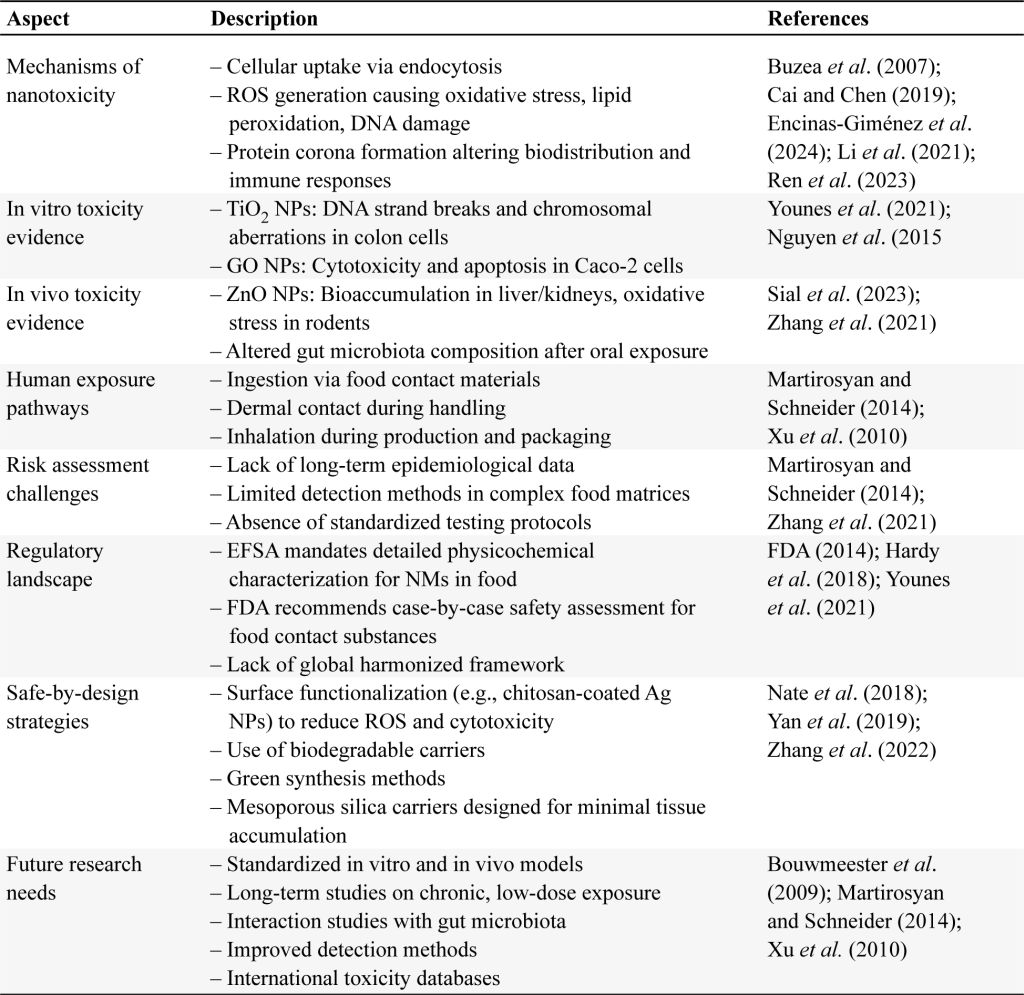
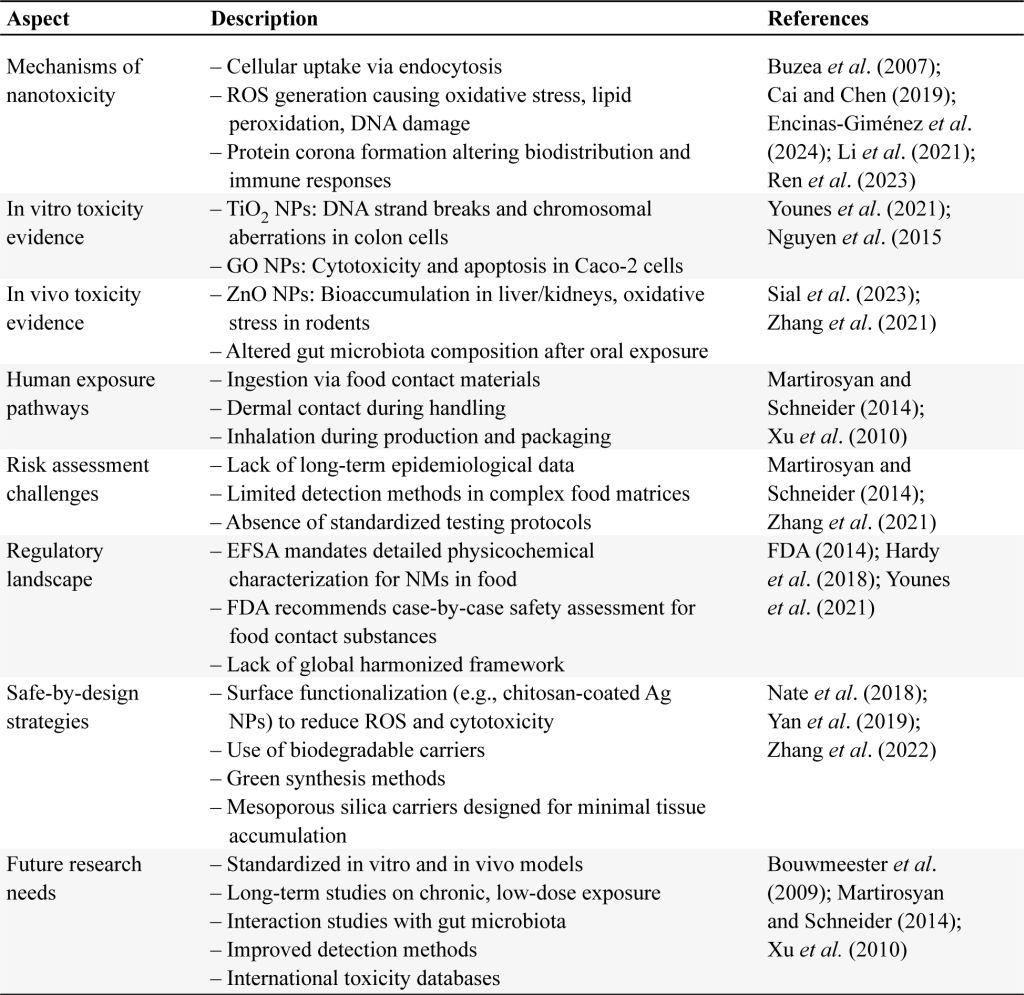
The toxicological impacts and safety challenges of nanomaterials in the food industry involve complex biological interactions, as well as regulatory and methodological limitations. To facilitate a holistic understanding, this section provides a summarized overview of the key concerns discussed in Sections 4.1–4.6.
Table 3 presents a structured summary of the major toxicological mechanisms, in vitro and in vivo evidence, human exposure routes, regulatory frameworks, Safe-by-Design strategies, and future research needs. Additionally, a conceptual infographic (Fig. 4) visualizes these interconnected factors to enhance clarity. However, such summaries often compartmentalize data across isolated domains, failing to integrate real-food exposure scenarios, transformation dynamics during digestion, and chronic low-dose effects into a unified risk narrative. Without this integration, even comprehensive tables like Table 3 may inadvertently reinforce fragmented safety assessments rather than enabling holistic, food-relevant decision-making.
Summary of toxicological and safety concerns of nanomaterials in the food industry.
Citation: International Food and Agribusiness Management Review 2026; 10.22434/ifamr.1477
Visual summary of key toxicological mechanisms, human exposure pathways, in vivo toxicity evidence, in vitro toxicity evidence, regulatory challenges, risk assessment challenges, and future research needs for nanomaterials in the food industry.
Citation: International Food and Agribusiness Management Review 2026; 10.22434/ifamr.1477
For agribusiness managers, these toxicological uncertainties translate into concrete governance and investment challenges. Firms must decide how much to invest in proprietary safety testing versus relying on supplier data, how to sequence product launches in markets with different regulatory stringency, and whether to prioritize low‑risk nanocarriers over higher‑performance but more controversial materials. Unclear exposure thresholds and evolving guidance also complicate long‑term contracting with retailers and brand owners, who may demand assurances that go beyond current regulatory minima. Consequently, the mechanisms and evidence summarized in Table 3 should be viewed as inputs to enterprise risk‑management strategies—informing choices about technology selection, risk communication, labeling policies, and crisis‑response planning— rather than as purely scientific background. These summarized insights underline the critical need for harmonized regulatory frameworks and continuous research to ensure the safe integration of nanomaterials into food systems.
5. Current regulatory status
The regulatory landscape for nanomaterials in the food industry is rapidly evolving in response to growing scientific evidence and public health concerns. Due to their unique behavior at the nanoscale such as increased surface reactivity, cellular uptake potential, and uncertain toxicokinetics nanomaterials do not always fit neatly into existing food safety frameworks, necessitating the development of tailored regulatory strategies. However, most current regulatory approaches remain reactive rather than proactive, often lagging behind technological innovation and failing to mandate pre-market safety data for nano-enabled food products (FDA, 2014; Fender, 2008).
5.1 United States
In the United States, the Food and Drug Administration (FDA) does not currently maintain a distinct regulatory framework for nanomaterials. Instead, it follows a case-by-case assessment approach, where nanomaterials in food contact substances or additives must demonstrate safety under intended conditions of use. The FDA’s 2014 guidance emphasizes that nanoscale properties may introduce new risk considerations, and thus traditional GRAS (Generally Recognized as Safe) designations may not always apply (FDA, 2014). However, no mandatory premarket approval is required unless there is a significant alteration in manufacturing or safety profile. Critically, this non-binding, voluntary framework lacks enforceable requirements for pre-market safety data or standardized characterization protocols, creating uncertainty for both regulators and industry. As a result, many nano-enabled food products may enter the market without comprehensive toxicological evaluation, potentially exposing consumers to unassessed risks (FDA, 2014; Fender, 2008).
5.2 European Union
The European Union has adopted one of the most proactive and precautionary approaches. Regulation (EU) No. 1169/2011 requires that all engineered nanomaterials used in food be explicitly labeled with the term (nano) in the ingredient list (Bleeker et al., 2013). Furthermore, the European Food Safety Authority (EFSA) mandates a comprehensive toxicological evaluation, including particle size distribution, solubility, surface properties, and in vivo bioavailability, as outlined in its 2021 updated guidance (Hardy et al., 2018). A landmark regulatory decision came in 2022 when the EU banned the use of titanium dioxide (E171) as a food additive due to concerns over genotoxicity and bioaccumulation (Blaznik et al., 2021). By contrast, E171 has remained authorized as a whitening agent in several non‑EU jurisdictions, so that the same ingredient can be simultaneously banned in one region and permitted in others (Blaznik et al., 2021; Magnuson et al., 2013). Also, the European Food Safety Authority (EFSA) updated its guidance on nanoscience applications in food and feed in 2021, emphasizing particle characterization, toxicokinetics, and the need for robust in vitro and in vivo data (Kumari et al., 2023). The U.S. FDA similarly recommends a case-by-case evaluation focusing on migration potential and toxicokinetics for food contact applications (Fender, 2008). In comparison, the EU’s precautionary regulatory stance, exemplified by the re-evaluation and restriction of TiO₂ (E171), is generally stricter than the FDA’s case-by-case approach; this enhances consumer safety assurance but may also slow technological adoption. Despite these efforts, international definitions and standardized testing protocols remain inconsistent across jurisdictions, impeding harmonized risk assessment. However, the EU’s precautionary model, while robust, often lacks flexibility for emerging safe-by-design nanomaterials that pose minimal risk. The requirement for full toxicological dossiers, even for biodegradable or food-derived nanocarriers, can discourage innovation and create disproportionate regulatory burdens for low-risk applications (Schmutz et al., 2020; Mech et al., 2018).
5.3 Asia-Pacific region
Regulatory responses to nanomaterials in the Asia-Pacific region vary significantly across countries. In Japan, food additives are regulated under the Food Sanitation Law, but there are currently no specific provisions dedicated to nanomaterials. However, the Food Safety Commission has taken proactive steps by initiating toxicity research programs on nano-enabled products (Magnuson et al., 2013). In China, the National Health Commission has introduced technical guidelines for the safety assessment of nanomaterials used in food-contact materials, emphasizing the need for data on nanoparticle behavior, migration, and stability (Wen et al., 2022). Meanwhile, in Australia and New Zealand, Food Standards Australia New Zealand (FSANZ) adopts a precautionary, risk-based approach, evaluating each application involving nanomaterials on a case-by-case basis and advocating for international harmonization of regulatory standards (Ghosh, 2014). However, this regional fragmentation, ranging from proactive research (Japan) to technical guidelines (China) and risk-based review (Australia/NZ), lacks coordination and standardized definitions, creating barriers to trade and inconsistent consumer protection across the region (Ghosh, 2014).
5.4 International harmonization efforts
Efforts to bridge regional inconsistencies have been spearheaded by organizations like the Codex Alimentarius Commission, which is working toward international guidelines for nanotechnology in food. The OECD has also published standardized test guidelines and physicochemical characterization protocols specifically for nanomaterials (Mbengue and Charles, 2013). However, a globally unified definition of nanomaterial remains elusive, with size thresholds and inclusion criteria differing across jurisdictions (Mbengue and Charles, 2013). Despite these initiatives, harmonization efforts remain largely aspirational, lacking binding authority or enforcement mechanisms. Consequently, divergent national regulations continue to prevail, creating technical barriers to trade and discouraging global investment in nano-enabled food innovations (Krishna et al., 2022; Mbengue and Charles, 2013).
5.5 Key regulatory comparison
To illustrate the diversity and convergence in regulatory practices, Table 4 summarizes key elements of nanomaterial oversight in different regions. While Table 4 clarifies procedural differences, it also reveals a systemic imbalance: stringent jurisdictions like the EU prioritize precaution at the cost of innovation speed, whereas regions like the U.S. and Japan favor flexibility but risk under-regulating emerging risks. Crucially, none of the current frameworks adequately address the dynamic behavior of nanomaterials in real food systems, such as transformation during digestion or interaction with complex matrices, meaning that even “comprehensive” evaluations (e.g., EFSA’s) may overlook critical exposure pathways (Martirosyan and Schneider, 2014; Mech et al., 2018). This gap highlights the need not just for comparison, but for convergence around food-relevant, lifecycle-based safety assessment models.
Comparative regulatory approaches to nanomaterials in the food industry.
Citation: International Food and Agribusiness Management Review 2026; 10.22434/ifamr.1477
5.6 Outlook and challenges
Despite encouraging progress, the regulatory status of food-related nanomaterials remains fragmented and reactive. Key challenges include:
(1) Lack of harmonized definitions for nanomaterials;
(2) Limited long-term exposure data;
(3) Difficulty detecting nanoparticles in complex food matrices;
(4) Insufficient international databases on toxicological endpoints.
To address these, a safe-by-design approach is being promoted, encouraging developers to engineer nanomaterials with inherently lower toxicity and better biodegradability (Schmutz et al., 2020).
Moreover, consumer transparency must improve. Mandatory labeling, especially for nano-enabled packaging and additives, would empower consumer choice while promoting accountability in the supply chain (Grieger et al., 2016). However, both safe-by-design and labeling initiatives remain largely voluntary and lack enforcement mechanisms in most jurisdictions. Without binding regulatory requirements or standardized verification protocols, these strategies risk serving as aspirational frameworks rather than actionable safeguards for public health (Fender, 2008; Schmutz et al., 2020).
These regulatory dynamics have direct strategic implications for agribusiness firms. Divergent definitions and approval pathways mean that the same nano‑enabled product may face very different time‑to‑market, labeling, and post‑market monitoring obligations across jurisdictions, forcing managers to consider staggered roll‑out strategies or differentiated formulations for different regions. Uncertainty about future regulatory tightening also affects capital budgeting and partnership decisions, as investments in specialized nano‑processing equipment or long‑term supply contracts may become stranded if key ingredients are later restricted or banned. Conversely, firms that anticipate regulatory trends, by favoring Safe‑by‑Design materials, building robust traceability systems, and engaging early with regulators, may secure first‑mover advantages and reputational benefits. Section 6 therefore builds on the regulatory analysis in Section 5 to outline how executives can incorporate these policy signals into portfolio planning, market selection, and compliance strategies.
6. Managerial and agribusiness implications
The integration of nanomaterials into food systems not only represents a scientific innovation but also introduces strategic considerations for agribusiness managers and decision-makers. From a managerial perspective, nano-enabled packaging and preservation technologies can significantly reduce post-harvest losses and spoilage rates, which remain a major economic burden within global food supply chains. Improved shelf-life and product stability enhance logistics flexibility, enable longer distribution routes, and support market expansion for perishable goods, thereby creating new opportunities for value creation in both domestic and export markets.
For food manufacturers, adopting nano-based solutions requires careful evaluation of cost–benefit dynamics. While investment in nano-enabled packaging or functional ingredient delivery systems may increase production costs, these technologies can lead to long-term financial gains through reduced waste, improved product differentiation, and enhanced brand competitiveness. Companies that successfully position nano-enabled products as high-quality, safer, or more sustainable alternatives may secure premium pricing and stronger consumer loyalty.
However, managerial decision-making must also account for regulatory variability and consumer perception. Differences in approval and labeling requirements across regions complicate market entry strategies and necessitate tailored compliance approaches for international trade. Furthermore, consumer skepticism toward nanotechnology in food highlights the importance of transparent communication, risk management, and trust-building initiatives. Agribusiness firms that proactively disclose safety measures, certification status, and sustainability benefits are more likely to achieve positive market acceptance.
Supply chain management is another critical domain affected by nanotechnology adoption. Nano-enabled sensing systems and smart packaging can improve traceability, real-time quality monitoring, and inventory control, reducing losses and enhancing operational efficiency. These technologies support data-driven decision-making and contribute to more resilient supply chains, particularly in perishable food sectors.
In recent years, several large food producers have begun integrating nano-enabled packaging films into their cold-chain distribution systems to reduce spoilage during long-distance transport. For example, one poultry processing company reported that antimicrobial nanocoatings applied to chilled packaging reduced visible spoilage and product returns during export shipments, which directly lowered financial losses and improved supply chain reliability. Such real-world outcomes demonstrate that nano-enabled packaging can generate tangible economic benefits when implemented under commercial logistics conditions, strengthening the business case for adoption among agribusiness firms.
Beyond the poultry example previously described, several other nano-enabled applications already discussed in this review offer direct managerial benefits across diverse food sectors. Nanosensors for real-time detection of spoilage indicators in meat and other food packaging (Fuertes et al., 2016; Sadanandan et al., 2023) enable proactive quality control and can reduce microbial contamination risks that currently cause significant product returns in chilled supply chains. Nanoencapsulation of vitamins, probiotics, and omega-3 fatty acids in functional beverages and dairy products (McClements and Öztürk, 2021; Taouzinet et al., 2023) has been shown to reduce lipid peroxidation by up to 75 % and maintain bioactive stability for 60–90 days under accelerated storage, supporting clean-label reformulation and premium pricing. Similarly, antimicrobial nanocoatings applied to fresh produce and meat products (Brandelli, 2024; Zehra et al., 2025) have extended shelf life by 12–28 days for fish and cheese and achieved nearly 4 months’ preservation for certain fruits while achieving low or undetectable bacterial counts. These documented performance gains directly translate into reduced post-harvest losses, extended export windows, and stronger positioning in high-value markets for early-adopting agribusiness firms.
Conceptually, the managerial implications of nanotechnology in food systems can be organized along four interrelated decision domains: (i) technological performance, (ii) regulatory and safety profile, (iii) supply‑chain and operational fit, and (iv) market and consumer response. Technological performance captures attributes such as stability in complex food matrices, release behavior, and sensitivity of nanosensors, which inform R&D prioritization and product‑design choices. The regulatory and safety profile reflects toxicological evidence, migration potential, and labeling obligations, which drive compliance costs, legal exposure, and the need for Safe‑by‑Design solutions. Supply‑chain and operational fit concerns how nano‑enabled materials interact with existing processing equipment, cold‑chain constraints, quality‑control systems, and logistics networks, influencing decisions about capital investment and supplier contracts. Finally, market and consumer response encompasses perceived naturalness, trust in labeling, and willingness to pay for enhanced functionality or sustainability, which collectively determine the viability of different positioning strategies. Mapping the nanotechnology developments reviewed in Sections 2–5 onto these four domains provides a practical framework for managers to systematically evaluate which nano‑enabled options align with their firm’s risk tolerance, operational capabilities, and target market segments.
Overall, the strategic implementation of nanotechnology can enhance competitiveness within the agribusiness sector, but successful adoption requires coordinated consideration of economic feasibility, regulatory compliance, consumer acceptance, and supply chain integration. Managers who effectively balance these factors will be better positioned to harness the transformative potential of nanomaterials while minimizing organizational and market risks.
7. Challenges and limitations
Despite the growing promise of nanomaterials in food science and technology, there are several critical challenges and limitations that must be addressed to ensure their safe and effective use (Table 5). One of the major scientific concerns is the incomplete understanding of the biological interactions of nanomaterials. Due to their nanoscale size and large surface area, these materials can traverse biological barriers, interact with cellular components, and exhibit novel behaviors not observed in their bulk counterparts, leading to uncertainties in toxicological outcomes (Hussain et al., 2020). Another significant limitation lies in the lack of standardized methods for detecting, characterizing, and quantifying nanomaterials within complex food matrices. Traditional analytical techniques often fall short in identifying nanoparticles at low concentrations or in distinguishing them from background food components (Szakal et al., 2014). This lack of standardization hinders the ability to monitor their fate during food processing, storage, and digestion. Moreover, the transformations that nanomaterials undergo in the gastrointestinal (GI) tract remain insufficiently understood. Under varying pH and enzymatic conditions, nanoparticles may aggregate, dissolve, or bind with biomolecules, thereby altering their bioavailability and toxicokinetic behavior (Setyawati et al., 2020). These changes complicate efforts to predict their long-term impact on human health.
Challenges and limitations of nanomaterials in the food industry.
Citation: International Food and Agribusiness Management Review 2026; 10.22434/ifamr.1477
From a regulatory perspective, a major challenge is the absence of harmonized global guidelines. Among the identified challenges, regulatory inconsistencies remain a top priority because they create uncertainty for industry and limit global harmonization. Definitions, risk assessment procedures, and labeling requirements for nanomaterials differ across jurisdictions, which creates uncertainty for manufacturers and complicates international trade (Chávez-Hernández et al., 2024). This fragmented landscape also stifles innovation and increases the cost of compliance for food companies. Toxicological data on chronic exposure to nanomaterials are also limited. Most existing studies are either short-term or conducted in vitro, which restricts the ability to assess potential health risks under realistic conditions of long-term dietary intake (Sahu and Hayes, 2017). Vulnerable populations such as children, the elderly, or pregnant women may face unknown risks due to this data gap. Consumer perception presents an additional socio-economic hurdle. Public concerns regarding synthetic additives and the unnatural image associated with nanotechnology in food can lead to hesitancy or rejection of nano-enabled products (Egolf et al., 2019). Existing survey and experimental work on new food technologies shows that many consumers perceive nano‑enabled foods as less natural and potentially less safe than their conventional counterparts, and that such perceptions reduce acceptance, particularly for products that are marketed as healthy or minimally processed (Egolf et al., 2019; Singh et al., 2023). Transparent labeling and public engagement are crucial to improving trust and acceptance.
Lastly, there are technical and economic limitations related to scaling up nanoparticle synthesis for industrial applications. Achieving consistent physicochemical properties, such as particle size and surface charge, at large production scales remains a formidable challenge (Patil et al., 2023). This limits the reproducibility and commercial feasibility of incorporating nanomaterials into food products. Table 5 provides a categorized overview of the primary challenges and limitations associated with the application of nanomaterials in the food industry, including biological, analytical, regulatory, toxicological, societal, and industrial aspects. However, many of these challenges are interdependent and cannot be addressed in isolation. For instance, the lack of standardized detection methods (Szakal et al., 2014) directly impedes chronic toxicity assessment (Sahu and Hayes, 2017) and regulatory harmonization (Chávez-Hernández et al., 2024). Without a coordinated, systems-level approach that links analytical advances, biological understanding, and regulatory science, proposed solutions risk remaining fragmented and ineffective in real-world food systems. Addressing these multidimensional challenges will require coordinated efforts among scientists, regulators, industry stakeholders, and consumers to unlock the full potential of nanotechnology in the food sector.
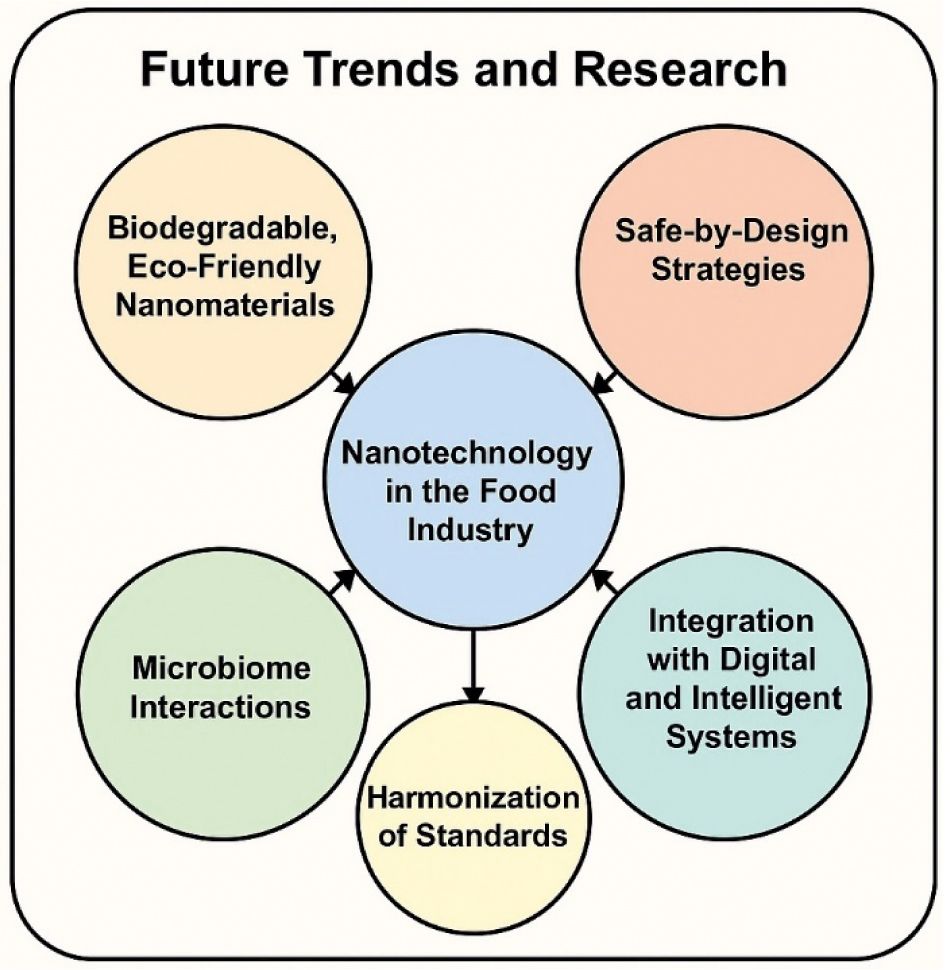
8. Future trends and research
The rapid integration of nanotechnology into the food industry necessitates continuous innovation and critical evaluation to ensure both efficacy and safety. Future research directions are poised to address current limitations while fostering sustainable and responsible applications of nanomaterials in food systems. One of the primary research avenues is the development of biodegradable and eco-friendly nanomaterials. The growing environmental concerns over plastic waste have driven the demand for green alternatives in packaging. Future studies will focus on using renewable biopolymers such as cellulose, starch, and chitosan as nanomaterial matrices, integrating naturally derived nanoparticles like lignin or plant-based nanocrystals for enhanced barrier and antimicrobial properties (Perera et al., 2023). Green synthesis methods utilizing plant extracts or microbial fermentation are expected to replace chemical synthesis, reducing environmental footprints and improving biocompatibility (Bhardwaj et al., 2020). However, production yield and scalability remain challenges compared with traditional chemical synthesis methods.
Another critical trend involves advancing safe-by-design strategies. This concept advocates for engineering nanomaterials with minimized toxicological risks from the outset. Techniques such as surface functionalization, doping with biocompatible agents, and controlling particle size distribution are being refined to mitigate adverse biological interactions (Corsi et al., 2022). For example, coating metal nanoparticles with food-grade polymers like alginate or gelatin has shown potential in reducing reactive oxygen species (ROS) generation while maintaining antimicrobial efficacy (Eremeeva, 2024).
The interactions of nanomaterials with the human microbiome represent a relatively unexplored but essential research frontier. Given the pivotal role of gut microbiota in health and disease, understanding how ingested nanomaterials influence microbial composition and function is crucial. Emerging studies suggest that chronic exposure to certain nanoparticles can disrupt gut microbial balance, leading to unintended health effects (Ma et al., 2023). Future research will aim to elucidate these interactions using advanced in vitro gut models and high-throughput sequencing techniques (Bergin and Witzmann, 2013).
Another promising area is the integration of nanotechnology with digital and intelligent systems. The future of food safety monitoring lies in the convergence of nanosensors with Internet of Things (IoT) platforms, enabling real-time, remote tracking of food quality parameters such as freshness, spoilage, and contamination. Developments in wireless, battery-free nanosensors, capable of detecting multiple analytes simultaneously, will enhance supply chain transparency and reduce foodborne illness outbreaks (Awlqadr et al., 2024; Rafi et al., 2025).
From a regulatory perspective, harmonization of global standards remains a pressing need. Disparities in definitions, risk assessment protocols, and labeling requirements create challenges for international trade and consumer trust. Collaborative efforts between organizations like the Codex Alimentarius, OECD, and national agencies will be pivotal in developing unified frameworks for nanomaterial safety evaluation (Rauscher et al., 2017). Future research will also focus on establishing robust, standardized methodologies for nanoparticle detection, characterization, and quantification in complex food matrices (Schwirn et al., 2020). In addition, toxicity assessment models are expected to evolve significantly. Traditional in vivo studies, while informative, are resource-intensive and ethically challenging. Therefore, the field is moving towards alternative models such as organ-on-chip systems, three-dimensional (3D) cell cultures, and computational toxicology approaches (Addissouky et al., 2024). In parallel, nanocomputational methods such as density functional theory (DFT), molecular docking, and molecular dynamics simulations are increasingly used to model nano–bio and bioactive–contaminant interactions under processing-relevant conditions (Baei, 2025; Khosravi et al., 2025; Mozafari et al., 2025; Safa et al., 2023, 2024). For example, recent in silico work has examined the binding of curcumin to aflatoxin molecules at processing temperatures to support the design of nano-enabled detoxification strategies in dairy systems (Baei, 2025). These models offer more predictive and human-relevant data, facilitating faster and more accurate safety assessments. Moreover, the concept of personalized nutrition through nanotechnology is gaining momentum. Nanocarriers can be tailored to deliver nutrients, probiotics, or bioactives in a controlled and targeted manner, considering individual genetic profiles and health conditions (Shah et al., 2021). This aligns with the broader trend of precision nutrition, where functional foods are designed to address specific metabolic needs or deficiencies.
Lastly, scalability and cost-effectiveness remain critical for industrial adoption. Future research will focus on optimizing large-scale production methods for nanomaterials while maintaining consistency in their physicochemical properties. Innovative manufacturing techniques such as spray-drying, electrospinning, and supercritical fluid processing are being explored to meet industrial demands (Elzoghby et al., 2017; Huang et al., 2021; Soh and Lee, 2019). However, many of these promising trends remain confined to proof-of-concept studies, with limited validation under industrially relevant conditions. For instance, green synthesis methods often lack reproducibility at scale (Bhardwaj et al., 2020), and organ-on-chip models may not yet capture the full complexity of food–gut interactions (Addissouky et al., 2024). Without bridging the gap between laboratory innovation and real-world food systems, these future directions risk remaining aspirational rather than transformative. In conclusion, the future of nanomaterials in the food industry hinges on a multidisciplinary approach that integrates material science, toxicology, microbiology, digital technology, and regulatory sciences. Addressing current gaps in safety, sustainability, and scalability will be essential to fully harness the potential of nanotechnology in enhancing food quality, safety, and functionality. A conceptual overview of these future directions is illustrated in Fig. 5, highlighting the interconnected domains of eco-friendly nanomaterials, safe-by-design approaches, microbiome interactions, digital integration, and global standard harmonization.
Conceptual diagram of future trends and research directions in nanotechnology applications in the food industry.
Citation: International Food and Agribusiness Management Review 2026; 10.22434/ifamr.1477
9. Conclusion
Nanotechnology has emerged as a transformative enabler in the food industry, offering novel solutions to long-standing challenges in safety, functionality, preservation, and sustainability. This review critically examined the classification, application, safety, and regulatory aspects of nanomaterials in food systems, highlighting both their promise and complexity. From an agribusiness perspective, nano-enabled packaging, nutrient delivery systems, and real-time sensing technologies represent strategic opportunities to reduce post-harvest losses, extend shelf-life across global supply chains, enhance product differentiation, and strengthen competitive positioning in premium markets. In the realm of food packaging, nanomaterials such as metal oxides, carbon-based nanostructures, and nanoclays have significantly enhanced barrier properties, antimicrobial efficacy, and real-time sensing capabilities, enabling smart and active packaging strategies that extend shelf life and reduce waste.
Equally important are advances in nanoencapsulation technologies, which facilitate the targeted and controlled release of bioactives ranging from vitamins and antioxidants to probiotics and essential oils thereby improving their bioavailability and functional efficacy. Lipid-based carriers, polymeric nanoparticles, and nanoemulsions have shown particular promise in this context. Moreover, the deployment of nanosensors in intelligent packaging systems exemplifies the integration of material science with digital diagnostics, offering sensitive, rapid, and non-invasive monitoring of food freshness and contamination.
However, for agribusiness firms, the path from laboratory success to profitable commercial adoption remains constrained by regulatory fragmentation, uncertain return-on-investment, consumer perception risks, and supply-chain integration challenges. Studies indicate that certain nanomaterials may interact unpredictably with biological systems, posing risks such as oxidative stress, cytotoxicity, and long-term accumulation. These concerns are compounded by the lack of standardized detection methodologies and insufficient data on chronic exposure in real-world conditions. Regulatory frameworks, while evolving, remain fragmented and inconsistent across jurisdictions, creating significant barriers for managers seeking to launch nano-enabled products in multiple markets and complicating global sourcing and distribution strategies.
Critically, successful adoption will depend on the ability of agribusiness leaders to balance innovation benefits with robust risk-governance frameworks, transparent stakeholder communication, and proactive regulatory engagement. Without coordinated efforts that prioritize food-relevant exposure scenarios, standardized safety evaluation, and transparent consumer communication, the full potential of nanotechnology in building safe, sustainable, and equitable food systems will remain unrealized. Managers who develop clear strategies for technology evaluation, regulatory compliance, supply-chain traceability, and consumer trust-building will be best positioned to capture the competitive advantages that nanomaterials can deliver.
Looking ahead, the future of nanotechnology in the food industry will be shaped by the development of biodegradable, safe-by-design nanomaterials, advanced toxicity testing models, and transparent regulatory oversight. Integrating green synthesis approaches and exploring interactions with the human microbiome will be essential to ensuring long-term safety and consumer trust. A multidisciplinary, collaborative approach, bridging material science, toxicology, regulatory science, industry leadership, and public engagement, will be pivotal in realizing the full potential of nanomaterials in building resilient, safe, and sustainable food systems. Future meta-analyses on existing toxicity data are recommended to identify research gaps and strengthen evidence-based safety evaluation in this domain.
Acknowledgement
This study received no financial support from any funding agency.
Conflict of interest
The authors affirm that there are no known financial interests or personal relationships that could have potentially influenced the findings of this study.
Data Availability
The research described in this article did not use any data.
References
Addissouky, T.A., Y. Wang, I. El Tantawy El Sayed, M.A.A. Majeed and A.A. Khalil. 2024. Transforming toxicity assessment through microphysiology, bioprinting, and computational modeling. Advances in Clinical Toxicology 9 (1): 295. https://doi.org/10.23880/act-16000295
Ahmad, R.M., Y.E. Greish, H.F. El-Maghraby, L. Lubbad, Y. Makableh and F.T. Hammad. 2022. Preparation and characterization of blank and nerolidol-loaded chitosan–alginate nanoparticles. Nanomaterials 12 (7): 1183. https://doi.org/10.3390/nano12071183
Ali, A.B.M., A.A. Abdulazez, G.P. Priya, S. Ray, A. Pal, R. Sharma, S. Usanov, Z. Atamuratova, E. Saitov, A. Smerat and M.Y. Alshahrani. 2026. Modification of graphenylene nanostructure as a promising material for adsorption and sensing of 5-fluorouracil: first-principles investigations. Journal of Molecular Graphics and Modelling 142: 109210.
Anand, A., B. Unnikrishnan, S.-C. Wei, C. P. Chou, L.-Z. Zhang and C.-C. Huang. 2019. Graphene oxide and carbon dots as broad-spectrum antimicrobial agents – a minireview. Nanoscale Horizons 4: 117–137. https://doi.org/10.1039/C8NH00174J
Astanov, O., A. Rasulev, S. Turabekov, S. Aliqulov, D. Abduraximov, A. Kuchimov, U. Yusupova, F. Khusankhodjaeva, D. Mahmudova and M. Matyakubov. 2025. Application of Fe3O4-celloluse scetate supported on hydroxyapatite multi-walled carbon nanotubes (Fe3O4-CA-HA-MWCNTs) in bone tissue engineering. Journal of Nanostructures 15: 2504–2516.
Aswathanarayan, J.B. and V. Ravishankar Rai. 2019. Nanoemulsions and their potential applications in food industry. Frontiers in Sustainable Food Systems 3: 95. https://doi.org/10.3389/fsufs.2019.00095
Awlqadr, F.H., A.B. Altemimi, Q.H. Alkaisy, S.A. Qadir, A.M. Faraj, T.A.H. Slih and F. Cacciola. 2024. Advancements in nanotechnology for enhanced food safety and hygiene: pathogen detection, smart packaging, and preservation applications. Kurdistan Journal of Applied Research 9 (2): 96–116. https://doi.org/10.24017/science.2024.2.8
Baei, M.T. (2025). DFT and molecular docking study of curcumin interactions with aflatoxins m1 and M2 at processing temperatures for reducing toxicity in milk and dairy products. Scientific Reports 15(1), 40109. https://doi.org/10.1038/s41598-025-23967-z
Batra, M., G.K. Malik and J. Mitra. 2020. Enhancing the properties of gelatin–chitosan bionanocomposite films by incorporation of silica nanoparticles. Journal of Food Process Engineering 43 (2): e13329. https://doi.org/10.1111/jfpe.13329
Bergin, I.L. and F.A. Witzmann. 2013. Nanoparticle toxicity by the gastrointestinal route: evidence and knowledge gaps. International Journal of Biomedical Nanoscience and Nanotechnology 3 (1–2): 163–210. https://doi.org/10.1504/IJBNN.2013.054515
Bhardwaj, B., P. Singh, A. Kumar, S. Kumar and V. Budhwar. 2020. Eco-friendly greener synthesis of nanoparticles. Advanced Pharmaceutical Bulletin 10 (4): 566–578. https://doi.org/10.34172/apb.2020.067
Bischoff, N.S., T.M. de Kok, D.T.H.M. Sijm, S.G. van Breda, J.J. Briedé, J.J.M. Castenmiller, A. Opperhuizen, Y.I. Chirino, H. Dirven, D. Gott, E. Houdeau, A.G. Oomen, M. Poulsen, G. Rogler and H. van Loveren. 2021. Possible adverse effects of food additive E171 (titanium dioxide) related to particle specific human toxicity, including the immune system. International Journal of Molecular Sciences 22 (1): 207. https://doi.org/10.3390/ijms22010207
Blaznik, U., S. Krušič, M. Hribar, A. Kušar, K. Žmitek and I. Pravst. 2021. Use of food additive titanium dioxide (E171) before the introduction of regulatory restrictions due to concern for genotoxicity. Foods 10 (8): 1910. https://doi.org/10.3390/foods10081910
Bleeker, E.A.J., W.H. de Jong, R.E. Geertsma, M. Groenewold, E.H.W. Heugens, M. Koers-Jacquemijns, J.M.J. Klaessens, R.E. Park and A.G. Oomen. 2013. Considerations on the EU definition of a nanomaterial: science to support policy making. Regulatory Toxicology and Pharmacology 65 (1): 119–125. https://doi.org/10.1016/j.yrtph.2012.11.007
Bouwmeester, H., S. Dekkers, M.Y. Noordam, W.I. Hagens, A.S. Bulder, C. de Heer, S.E. ten Voorde, S.W.P. Wijnhoven, H.J. Marvin and A.J. Sips. 2009. Review of health safety aspects of nanotechnologies in food production. Regulatory Toxicology and Pharmacology 53 (1): 52–62. https://doi.org/10.1016/j.yrtph.2008.10.008
Brandelli, A. 2024. Nanocomposites and their application in antimicrobial packaging. Frontiers in Chemistry 12: 1356304. https://doi.org/10.3389/fchem.2024.1356304
Bumbudsanpharoke, N. and S. Ko. 2019. Nanoclays in food and beverage packaging. Journal of Nanomaterials: 8927167. https://doi.org/10.1155/2019/8927167
Buzea, C., I.I. Pacheco and K. Robbie. 2007. Nanomaterials and nanoparticles: sources and toxicity. Biointerphases 2 (4): MR17–MR71. https://doi.org/10.1116/1.2815690
Cai, R. and C. Chen. 2019. The crown and the scepter: roles of the protein corona in nanomedicine. Advanced Materials 31 (45): 1805740. https://doi.org/10.1002/adma.201805740
Chadha, U., P. Bhardwaj, S. K. Selvaraj, K. Arasu, S. Praveena, A. Pavan, K. Shanmugavel and V. Paramasivam. 2022. Current trends and future perspectives of nanomaterials in food packaging application. Journal of Food Quality: 2745416. https://doi.org/10.1155/2022/2745416
Chávez-Hernández, J.A., A.J. Velarde-Salcedo, G. Navarro-Tovar and C. Gonzalez. 2024. Safe nanomaterials: from their use, application, and disposal to regulations. Nanoscale Advances 6 (6): 1583–1610. https://doi.org/10.1039/D3NA00881A
Chauhan, P., E. Singh Chauhan and P. Singh. 2024. A review of nanotechnology applications in food processing, packaging, and preservation. Advances in Research 25 (6): 427–441. https://doi.org/10.9734/air/2024/v25i61215
Chen, G.-L., H.-Y. Cai, J.-P. Chen, R. Li, S.-Y. Zhong, X.-J. Jia, X.-F. Liu and B.-B. Song. 2022. Chitosan/ alginate nanoparticles for the enhanced oral antithrombotic activity of clam heparinoid from the clam Coelomactra antiquata. Marine Drugs 20 (2): 136. https://doi.org/10.3390/md20020136
Chowmasundaram, A.A.P., T.L. Tan, R. Nulit, M. Jusoh and S.A. Rashid. 2023. Recent developments, applications and challenges for carbon quantum dots as a photosynthesis enhancer in agriculture. RSC Advances 13: 25093–25117. https://doi.org/10.1039/D3RA01217D
Corsí, I., M.F. Desimone and J. Cazenave. 2022. Building the bridge from aquatic nanotoxicology to safety by design silver nanoparticles. Frontiers in Bioengineering and Biotechnology 10: 836742. https://doi.org/10.3389/fbioe.2022.836742
Demchenko, A.P. and M.O. Dekaliuk. 2013. Novel fluorescent carbonic nanomaterials for sensing and imaging. Methods and Applications in Fluorescence 1 (4): 042001. https://doi.org/10.1088/2050-6120/1/4/042001
de Sousa, M.S., A.E. Schlogl, F.R. Estanislau, V.G.L. Souza, J.S. dos Reis Coimbra and I.J.B. Santos. 2023. Nanotechnology in packaging for food industry: past, present, and future. Coatings 13 (8): 1411. https://doi.org/10.3390/coatings13081411
Dong, W., J. Su, Y. Chen, D. Xu, L. Cheng, L. Mao, Y. Gao and F. Yuan. 2022. Characterization and antioxidant properties of chitosan film incorporated with modified silica nanoparticles as an active food packaging. Food Chemistry 373: 131414. https://doi.org/10.1016/j.foodchem.2021.131414
Egolf, A., C. Hartmann and M. Siegrist. 2019. When evolution works against the future: disgust’s contributions to the acceptance of new food technologies. Risk Analysis 39 (7): 1546–1559. https://doi.org/10.1111/risa.13261
Elzoghby, A., M. Freag, H. Mamdouh and K. Elkhodairy. 2017. Zein-based nanocarriers as potential natural alternatives for drug and gene delivery: focus on cancer therapy. Current Pharmaceutical Design 23 (35): 5261–5271. https://doi.org/10.2174/1381612823666170912151114
Encinas-Giménez, M., P. Martin-Duque and A. Martín-Pardillos. 2024. Cellular alterations due to direct and indirect interaction of nanomaterials with nucleic acids. International Journal of Molecular Sciences 25 (4): 1983. https://doi.org/10.3390/ijms25041983
Eremeeva, N.B. 2024. Nanoparticles of metals and their compounds in films and coatings: a review. Foods and Raw Materials 12 (1): 60–79. https://doi.org/10.21603/2308-4057-2024-1-588
FDA. 2014. Considering whether an FDA-regulated product involves the application of nanotechnology. U.S. Food and Drug Administration Guidance Document. Available online at https://www.fda.gov/regulatory-information/search-fda-guidance-documents/considering-whether-fda-regulated-product -involves-application-nanotechnology
Figueroa-Enriquez, C.E., F. Rodríguez-Félix, M. Plascencia-Jatomea, A. Sánchez-Escalante, J.M. Vargas-López, J.A. Tapia-Hernández, D. Burruel-Ibarra, B.E. García-Carvajal, J.A. Gámez-Corrales and J.L. Pompa-Ramos. 2023. Nanoparticles of betalain–gelatin with antioxidant properties by coaxial electrospraying: preparation and characterization. ACS Omega 8 (44): 41156–41168. https://doi.org/10.1021/acsomega.3c04021
Fuertes, G., I. Soto, R. Carrasco, M. Vargas, J. Sabattin and C. Lagos. 2016. Intelligent packaging systems: sensors and nanosensors to monitor food quality and safety. Journal of Sensors: 4046061. https://doi.org/10.1155/2016/4046061
Gali, L., A. Pirozzi and F. Donsì. 2023. Biopolymer- and lipid-based carriers for the delivery of plant-based ingredients. Pharmaceutics 15 (3): 927. https://doi.org/10.3390/pharmaceutics15030927
Giannakas, A.E., C.E. Salmas, D. Moschovas, M. Baikousi, E. Kollia, V. Tsigkou, A. Karakassides, A. Leontiou, G. Kehayias, A. Avgeropoulos and C. Proestos. 2022. Nanocomposite film development based on chitosan/polyvinyl alcohol using ZnO@Montmorillonite and ZnO@Halloysite hybrid nanostructures for active food packaging applications. Nanomaterials 12 (11): 1843. https://doi.org/10.3390/nano12111843
Ghosh, D. 2014. Food safety regulations in Australia and New Zealand Food standards. Journal of the Science of Food and Agriculture 94 (10): 1970–1973. https://doi.org/10.1002/jsfa.6657
Grieger, K.D., S.F. Hansen, N.P. Mortensen, S. Cates and B. Kowalcyk. 2016. International implications of labeling foods containing engineered nanomaterials. Journal of Food Protection 79 (5): 830–842. https://doi.org/10.4315/0362-028X.JFP-15-400
Handy, R.D. and B.J. Shaw. 2007. Toxic effects of nanoparticles and nanomaterials: implications for public health, risk assessment and the public perception of nanotechnology. Health, Risk and Society 9 (2): 125–144. https://doi.org/10.1080/13698570701306807
Hardy, A., D. Benford, T. Halldorsson, M.J. Jeger, H.K. Knutsen, S. More, H. Naegeli, J.C.M. Hoogstraat, C. Hogstrand, C.S. Nebbia, A.G. Rietjens, C.J.F. Rupp and EFSA Scientific Committee. 2018. Guidance on risk assessment of the application of nanoscience and nanotechnologies in the food and feed chain: Part 1, human and animal health. EFSA Journal 16 (7): e05327. https://doi.org/10.2903/j.efsa.2018.5327
Horky, P., S. Skalickova, D. Baholet and J. Skladanka. 2018. Nanoparticles as a solution for eliminating the risk of mycotoxins. Nanomaterials 8 (9): 727. https://doi.org/10.3390/nano8090727
Hossain, M.S., N.I. Hanis binti Mohd Azhar, N.A. Nurul Aini binti Mohd Azman and J.H. Shariffuddin. 2024. Sustainable food packaging: biodegradable carboxymethyl cellulose films reinforced with green-synthesized ZnO nanoparticles from pineapple waste. ChemistrySelect 9 (46): e202404773. https://doi.org/10.1002/slct.202404773
Huang, L., S. Zhao, F. Fang, T. Xu, M. Lan and J. Zhang. 2021. Advances and perspectives in carrier-free nanodrugs for cancer chemo-monotherapy and combination therapy. Biomaterials 268: 120557. https://doi.org/10.1016/j.biomaterials.2020.120557
Hussain, Z., H.E. Thu, M. Haider, S. Khan, M. Sohail, F. Hussain and A.N. Shuid. 2020. A review of imperative concerns against clinical translation of nanomaterials: unwanted biological interactions of nanomaterials cause serious nanotoxicity. Journal of Drug Delivery Science and Technology 59: 101867. https://doi.org/10.1016/j.jddst.2020.101867
Istiqola, A. and A. Syafiuddin. 2020. A review of silver nanoparticles in food packaging technologies: regulation, methods, properties, migration, and future challenges. Journal of the Chinese Chemical Society 67 (11): 1942–1956. https://doi.org/10.1002/jccs.202000179
Jain, A., S. Ranjan, N. Dasgupta and C. Ramalingam. 2017. Nanomaterials in food and agriculture: an overview on their safety concerns and regulatory issues. Critical Reviews in Food Science and Nutrition 58 (2): 297–317. https://doi.org/10.1080/10408398.2016.1160363
Jiang, W., X. Yun, J. Guo, J. Hu, L. Song, P. Pan and T. Dong. 2025. Preparation and characterization of crystalline poly (L-lactic acid)/silica nanocomposite films with high ductility and gas barrier properties. Polymer Composites 46 (1): 101–115. https://doi.org/10.1002/pc.28971
Khosravi, A., M.T. Baei, S.Z. Sayyed-Alangi and E.T. Lemeski. 2025. DFT-guided design of hydroxytyrosol- encapsulated nanocages: comparative insights into boron nitride versus carbon fullerenes for targeted drug delivery and therapeutic applications. Advanced Theory and Simulations: e00582. https://doi.org/10.1002/adts.202500582
Khoshkalampour, A., M. Ghorbani and Z. Ghasempour. 2023. Cross-linked gelatin film enriched with green carbon quantum dots for bioactive food packaging. Food Chemistry 404: 134742. https://doi.org/10.1016/j.foodchem.2022.134742
Krishna, A.R., S. Gurumoorthy, P. Elayappan, P. Sakthivadivel, S. Kumaran and P. Pushparaj. 2022. A review on the application of nanotechnology in food industries. Current Research in Nutrition and Food Science 10 (3): 871. http://dx.doi.org/10.12944/CRNFSJ.10.3.5
Kumari, R., K. Suman, S. Karmakar, V. Mishra, S.G. Lakra, G.K. Saurav and B.K. Mahto. 2023. Regulation and safety measures for nanotechnology-based agri-products. Frontiers in Genome Editing 5: 1200987. https://doi.org/10.3389/fgeed.2023.1200987
Li, Y., J. Yang and X. Sun. 2021. Reactive oxygen species-based nanomaterials for cancer therapy. Frontiers in Chemistry 9: 650587. https://doi.org/10.3389/fchem.2021.650587
Ma, Y., J. Zhang, N. Yu, J. Shi, Y. Zhang, Z. Chen and G. Jia. 2023. Effect of nanomaterials on gut microbiota. Toxics 11 (4): 384. https://doi.org/10.3390/toxics11040384
Magnuson, B., I. Munro, P. Abbot, N. Baldwin, R. Lopez-Garcia and K. Ly. 2013. Review of the regulation and safety assessment of food substances in various countries and jurisdictions. Food Additives and Contaminants: Part A 30 (6): 1147–1220. https://doi.org/10.1080/19440049.2013.795293
Martirosyan, A. and Y.-J. Schneider. 2014. Engineered nanomaterials in food: implications for food safety and consumer health. International Journal of Environmental Research and Public Health 11 (6): 5720–5750. https://doi.org/10.3390/ijerph110605720
Mbengue, M.M. and M. Charles. 2013. International organizations and nanotechnologies: the challenge of coordination. Review of European, Comparative and International Environmental Law 22 (2): 174–185. https://doi.org/10.1111/reel.12030
McClements, D.J. 2013. Nanoemulsion-based oral delivery systems for lipophilic bioactive components: nutraceuticals and pharmaceuticals. Therapeutic Delivery 4 (7): 841–857. https://doi.org/10.4155/tde.13.46
McClements, D.J. and H. Xiao. 2012. Potential biological fate of ingested nanoemulsions: influence of particle characteristics. Food and Function 3 (2): 202–220. https://doi.org/10.1039/C1FO10193E
McClements, D.J. and B. Öztürk. 2021. Utilization of nanotechnology to improve the handling, storage and biocompatibility of bioactive lipids in food applications. Foods 10 (2): 365. https://doi.org/10.3390/foods10020365
Mech, A., K. Rasmussen, P. Jantunen, L. Aicher, M. Alessandrelli, U. Bernauer, N. Ferrari-John, A. Lindh, K. Nordström, B. Nowack, A.M. Soto and S. Stahlmecke. 2018. Insights into possibilities for grouping and read-across for nanomaterials in EU chemicals legislation. Nanotoxicology 12 (2): 119–141. https://doi.org/10.1080/17435390.2018.1513092
Mozafari, E.S., M.T. Baei and E.T. Lemeski. 2025. Computational study of the therapeutic properties of allicin and its nanocomplexes using DFT and molecular docking techniques. Scientific Reports 15: 23034. https://doi.org/10.1038/s41598-025-03293-0
Nguyen, T.H.D., M. Lin and A. Mustapha. 2015. Toxicity of graphene oxide on intestinal bacteria and Caco-2 cells. Journal of Food Protection 78 (5): 996–1002. https://doi.org/10.4315/0362-028X.JFP-14-463
Nate, Z., M.J. Moloto, P.K. Mubiayi, L. Lesenyeho and N.M. Mampholo. 2018. Green synthesis of chitosan capped silver nanoparticles and their antimicrobial activity. MRS Advances 3: 2505–2517. https://doi.org/10.1557/adv.2018.368
Othman, S.H., H.N. Ling, R.A. Talib, M.N. Naim, N.P. Risyon and M. Saifullah. 2019. Bio-nanocomposite films based on PLA and different nanoclays: mechanical, barrier, and transparency properties. Journal of Nano Research 59: 77–93. https://doi.org/10.4028/www.scientific.net/JNanoR.59.77
Oun, A., A.A. Shankar and J.W. Rhim. 2019. Multifunctional nanocellulose/metal and metal oxide nanoparticle hybrid nanomaterials. Critical Reviews in Food Science and Nutrition 60 (3): 435–460. https://doi.org/10.1080/10408398.2018.1536966
Patil, S.R., Z. Whiteley, E. Osarfo-Mensah, A. Pankajakshan, D. Craig, S. Guldin, P. Gurnani and A. Gavriilidis. 2025. Microfluidic engineering of pDNA nanogels in a coaxial flow reactor: Process development, optimisation, scalability and in vitro performance. Nanoscale Advances. https://doi.org/10.1039/D5NA00558B
Perera, K.Y., A.K. Jaiswal and S. Jaiswal. 2023. Biopolymer-based sustainable food packaging materials: challenges, solutions, and applications. Foods 12 (12): 2422. https://doi.org/10.3390/foods12122422
Pradhan, N., S. Singh, N. Ojha, A. Shrivastava, A. Barla, V. Rai and S. Bose. 2015. Facets of nanotechnology as seen in food processing, packaging, and preservation industry. BioMed Research International: 365672. https://doi.org/10.1155/2015/365672
Proquin, H., C. Rodríguez-Ibarra, C.G.J. Moonen, I.M. Urrutia Ortega, J.J. Briedé, T.M. de Kok, H. van Loveren and Y.I. Chirino. 2017. Titanium dioxide food additive (E171) induces ROS formation and genotoxicity: contribution of micro and nano-sized fractions. Mutagenesis 32 (1): 139–149. https://doi.org/10.1093/mutage/gew051
Rafi, Z., H. Khan, A. Husain, A. Khanam, A. Alafnan, A. Alobaida and S. Ahmad. 2025. Food contamination and the emerging application of nanobiosensors in food safety. Journal of Food Science 90 (2): e70073. https://doi.org/10.1111/1750-3841.70073
Rauscher, H., K. Rasmussen and B. Sokull‐Klüttgen. 2017. Regulatory aspects of nanomaterials in the EU. Chemie Ingenieur Technik 89 (3): 224–231. https://doi.org/10.1002/cite.201600147
Ren, Q., J. Ma, X. Li, Q. Meng, S. Wu, Y. Xie, Y. Qi, S. Liu and R. Chen. 2023. Intestinal toxicity of metal nanoparticles: silver nanoparticles disorder the intestinal immune microenvironment. ACS Applied Materials and Interfaces 15 (23): 27774–27788. https://doi.org/10.1021/acsami.3c05692
Raul, P.K., A. Thakuria, B. Das, R.R. Devi, G. Tiwari, C. Yellappa and D.V. Kamboj. 2022. Carbon nanostructures as antibacterials and active food-packaging materials: a review. ACS Omega 7 (14): 11555–11559. https://doi.org/10.1021/acsomega.2c00848
Safa, A.N., A. Sheibani, M.T. Baei, S.Z. Sayyed-Alangi and E.T. Lemeski. 2023. Theoretical and experimental studies on sulfasalazine interactions with poly (lactic acid): impact of hydrogen bonding and charge transfer interactions on molecular structure, electronic and optical properties. Heliyon 10 (1): e23813. https://doi.org/10.1016/j.heliyon.2023.e23813
Safa, A. N., A. Sheibani, M.T. Baei, S.Z. Sayyed-Alangi and E.T. Lemeski. 2024. Oleic acid as an effective surfactant for poly (lactic acid) microparticle: a DFT study. Izvestiya Vysshikh Uchebnykh Zavedeniy Khimiya Khimicheskaya Tekhnologiya 67 (6): 65–72. https://doi.org/10.6060/ivkkt.20246706.7069
Salvia-Trujillo, L., O. Martín-Belloso and D.J. McClements. 2016. Excipient nanoemulsions for improving oral bioavailability of bioactives. Nanomaterials 6 (1): 17. https://doi.org/10.3390/nano6010017
Sadanandan, S., K. Ramkumar, N.P. Pillai and M.M. Sreejaya. 2023. Biorecognition elements appended gold nanoparticle biosensors for the detection of food-borne pathogens, a review. Food Control 148: 109510. https://doi.org/10.1016/j.foodcont.2022.109510
Sahu, S.C. and A.W. Hayes. 2017. Toxicity of nanomaterials found in human environment: a literature review. Toxicology Research and Application 1: 2397847317726352. https://doi.org/10.1177/2397847317726352
Schmutz, M., O. Borges, S. Jesus, G. Borchard, G. Perale, M. Zinn and C. Som. 2020. A methodological safe-by-design approach for the development of nanomedicines. Frontiers in Bioengineering and Biotechnology 8: 258. https://doi.org/10.3389/fbioe.2020.00258
Schwirn, K., D. Voelker, W. Galert, J. Quik and L. Tietjen. 2020. Environmental risk assessment of nanomaterials in the light of new obligations under the REACH regulation: which challenges remain and how to approach them? Integrated Environmental Assessment and Management 16 (5): 706–717. https://doi.org/10.1002/ieam.4284
Setyawati, M.I., Z. Zhao and K.W. Ng. 2020. Transformation of nanomaterials and its implications in gut nanotoxicology. Small 16 (36): 2001246. https://doi.org/10.1002/smll.202001246
Shah, A., S. Aftab, J. Nisar, M.N. Ashiq and F.J. Iftikhar. 2021. Nanocarriers for targeted drug delivery. Journal of Drug Delivery Science and Technology 62: 102426. https://doi.org/10.1016/j.jddst.2021.102426
Shahazi, R., S. Majumdar, A.I. Saddam, J. Mondal, M.M. Rahman and M.M. Alam. 2023. Carbon nanomaterials for biomedical applications: a comprehensive review. Nano Carbons 1 (1): 448. https://doi.org/10.59400/n-c.v1i1.448
Silvestre, A.L.P., A.M. dos Santos, A.B. de Oliveira, T.M. Ferrisse, F.L. Brighenti, A.B. Meneguin and M. Chorilli. 2023. Evaluation of photodynamic therapy on nanoparticles and films loaded-nanoparticles based on chitosan/alginate for curcumin delivery in oral biofilms. International Journal of Biological Macromolecules 240: 124489. https://doi.org/10.1016/j.ijbiomac.2023.124489
Sial, B.E., S. Ali, N. Aslam, R. Maqsood, S. Iqbal, Y. Mehmood and G. Mustafa. 2023. ZnO nanoparticles impact on organ systems in rats: a comprehensive exploration of diverse exposure pathways. Journal of Zoology and Systematics 1 (1): 37–51. https://doi.org/10.56946/jzs.v1i1.218
Singh, R., S. Dutt, P. Sharma, A. K. Sundramoorthy, A. Dubey, A. Singh and S. Arya. 2023. Future of nanotechnology in food industry: challenges in processing, packaging, and food safety. Global Challenges 7 (4): 2200209. https://doi.org/10.1002/gch2.202200209
Soh, S.H. and L.Y. Lee. 2019. Microencapsulation and nanoencapsulation using supercritical fluid (SCF) techniques. Pharmaceutics 11 (1): 21. https://doi.org/10.3390/pharmaceutics11010021
Souza, V.G.L., C. Rodrigues, S. Valente, C. Pimenta, J.R.A. Pires, M.M. Alves, C.F. Santos, I.M. Coelhoso and A.L. Fernando. 2020. Eco-friendly ZnO/chitosan bionanocomposites films for packaging of fresh poultry meat. Coatings 10 (2): 110. https://doi.org/10.3390/coatings10020110
Suvarna, V., A. Nair, R. Mallya, T. Khan and A. Omri. 2022. Antimicrobial nanomaterials for food packaging. Antibiotics 11 (6): 729. https://doi.org/10.3390/antibiotics11060729
Sun, Q., J. Li and T. Le. 2018. Zinc oxide nanoparticle as a novel class of antifungal agents: current advances and future perspectives. Journal of Agricultural and Food Chemistry 66 (43): 11209–11220. https://doi.org/10.1021/acs.jafc.8b03210
Szakal, C., S.M. Roberts, P. Westerhoff, A. Bartholomaeus, N. Buck, I. Illuminato and M. Rogers. 2014. Measurement of nanomaterials in foods: integrative consideration of challenges and future prospects. ACS Nano 8 (4): 3128–3135. https://doi.org/10.1021/nn5004357
Tan, Y., Y. Zi, J. Peng, C. Shi, Y. Zheng and J. Zhong. 2023. Gelatin as a bioactive nanodelivery system for functional food applications. Food Chemistry 423: 136265. https://doi.org/10.1016/j.foodchem.2023.136265
Targuma, S., P.B. Njobeh and P.G. Ndungu. 2021. Current applications of magnetic nanomaterials for extraction of mycotoxins, pesticides, and pharmaceuticals in food commodities. Molecules 26 (14): 4284. https://doi.org/10.3390/molecules26144284
Taouzinet, L., O. Djaoudene, S. Fatmi, C. Bouiche, M. Amrane-Abider, H. Bougherra, F. Rezgui and K. Madani. 2023. Trends of nanoencapsulation strategy for natural compounds in the food industry. Processes 11 (5): 1459. https://doi.org/10.3390/pr11051459
Walker, R., E.A. Decker and D.J. McClements. 2015. Development of food-grade nanoemulsions and emulsions for delivery of omega-3 fatty acids: opportunities and obstacles in the food industry. Food and Function 6 (1): 41–54. https://doi.org/10.1039/C4FO00723A
Waheed, R., M. Javaid Rana, U. Riaz, R. Khalid Iqbal, F. Deeba, N. Iqbal and E. Ali. 2023. Silver nanoparticles and their potential antimicrobial applications in food industry. The Journal of Microbiology and Molecular Genetics 4 (1): 81. https://doi.org/10.52700/jmmg.v4i1.81
Wathoni, N., Y. Herdiana, C. Suhandi, A.F.A. Mohammed, A. El-Rayyes and A.C. Narsa. 2024. Chitosan/ alginate-based nanoparticles for antibacterial agents delivery. International Journal of Nanomedicine 19: 5021–5044. https://doi.org/10.2147/IJN.S469572
Wen, H., Y. Yang and X. Geng. 2022. Market entry system considering the biosafety of nanomedical devices in China. Wiley Interdisciplinary Reviews: Nanomedicine and Nanobiotechnology 14 (6): e1821. https://doi.org/10.1002/wnan.1821
Xu, L., Y. Liu, R. Bai and C. Chen. 2010. Applications and toxicological issues surrounding nanotechnology in the food industry. Pure and Applied Chemistry 82 (2): 349–372. https://doi.org/10.1351/PAC-CON-09-05-09
Yan, L., F. Zhao, J. Wang, Y. Zu, Z. Gu and Y. Zhao. 2019. A safe-by-design strategy towards safer nanomaterials in nanomedicines. Advanced Materials 31 (45): 1805391. https://doi.org/10.1002/adma.201805391
Younes, M., G. Aquilina, L. Castle, K.-H. Engel, P. Fowler, M.J. Frutos Fernandez, R. Gündert-Remy, W.G.M.H. van den Heuvel, P. Kärensen, S. Knutsen, C. Lampen, J.C. Leblanc, A.P.F. Leblanc, R.J. MacMahon, J.L.M. Meessen, T. Notas, J.R. Patlewicz, J.J. Petersen, A. Smith, H. van Loveren and D. Wiedemann. 2021. Safety assessment of titanium dioxide (E 171) as a food additive. EFSA Journal 19 (5): e06585. https://doi.org/10.2903/j.efsa.2021.6585
Zehra, S. H., K. Ramzan, J. Viskelis, P. Viskelis and A. Balciunaitiene. 2025. Advancements in green synthesis of silver-based nanoparticles: antimicrobial and antifungal properties in various films. Nanomaterials 15 (4): 252. https://doi.org/10.3390/nano15040252
Zhang, C., H. Xie, Z. Zhang, B. Wen, H. Cao, Y. Bai, H. Wang, W. Wang, Q. Zhang and Z. Su. 2022. Applications and biocompatibility of mesoporous silica nanocarriers in the field of medicine. Frontiers in Pharmacology 13: 829796. https://doi.org/10.3389/fphar.2022.829796
Zhang, L., D.J. McClements, Z. Wei, G. Wang, X. Liu and F. Liu. 2019. Delivery of synergistic polyphenol combinations using biopolymer-based systems: advances in physicochemical properties, stability and bioavailability. Critical Reviews in Food Science and Nutrition 60 (12): 2083–2097. https://doi.org/10.1080/10408398.2019.1630358
Zhang, T., X. Zhu, J. Guo, A. Z. Guo, D. Li and J. Chen. 2021. Toxicity assessment of nano-ZnO exposure on the human intestinal microbiome, metabolic functions, and resistome using an in vitro colon simulator. Environmental Science and Technology 55 (10): 6884–6896. https://doi.org/10.1021/acs.est.1c00573
Zou, Y., Y. Shi, T. Wang, S. Ji, X. Zhang, T. Shen, X. Huang, J. Xiao, M.A. Farag, J. Shi and X. Zou. 2024. Quantum dots as advanced nanomaterials for food quality and safety applications: a comprehensive review and future perspectives. Comprehensive Reviews in Food Science and Food Safety 23 (3): e13339. https://doi.org/10.1111/1541-4337.13339
Corresponding author