Abstract
Although previous research on sustainable consumption has investigated consumers’ trade-offs of product sustainability against other valued product features, the differences in consumers’ perceptions of social versus environmental dimensions of sustainability tend to be overlooked. This study examines consumers’ choices that involve trade-offs between social and environmental sustainability. From a metacognitive perspective, this study investigates the roles that metacognitions (attitude magnitude and attitude uncertainty) play in consumers’ trade-offs. Based on 715 valid questionnaires from Chinese consumers, this study tests the distinct effects of social and environmental sustainability attributes of agricultural products on consumers’ choices using a discrete choice experiment. The results reveal that social sustainability attributes (traceability, safety certification, and poverty alleviation) have stronger effects on consumer choices than environmental sustainability attributes (packaging, location, and temperature). Consumers respond to social sustainability attributes more positively when their environmental attitudes have higher magnitude or lower uncertainty; interestingly, consumers are less responsive to environmental sustainability attributes when their environmental attitudes have a higher magnitude or lower uncertainty. These findings provide important implications for interventions on ethical consumption.
1. Introduction
With increasing concerns about environmental and social problems, consumers have begun to pursue more conscientious buying habits and demand a higher level of product safety and sustainability, which enhances their interest in environment- and society-friendly products (Sloan, 2007), especially food. For example, consumers may desire to learn how cocoa beans are produced and the benefits to local farmers (Bradu et al., 2014). Liu et al. (2016) highlight that sustainable consumption is not only about the choices of sustainable products but also related to all kinds of activities from the original production to the end consumption. Consumers may choose sustainable products after feeling guilt or pride (Antonetti and Maklan, 2014; Bradu et al., 2014).
According to information processing theory (IPT), consumers’ decision-making relies on processing the available information by examining specific products across attributes or specific product attributes across alternatives (Bettman, 1979). The implications of each piece of information are integrated to form an overall judgment of the product (Fishbein and Ajzen, 1975; Lancaster, 1966; McFadden, 1974). In recent years, to meet growing consumer expectations and align with the principle of triple bottom line, which promotes balanced development across environmental, social, and economic dimensions, many companies have developed sustainable supply chains and at the same time, actively disclose related information to influence consumer behaviour. For example, they may label their products with authorized certifications, attach traceability barcodes that could track production, processing, and transportation information, and even demonstrate projects for poverty alleviation to reflect social justice and equity, which is particularly common in agricultural products. This type of information corresponding to the processes and functions of sustainable supply chains would be delivered to consumers to help them obtain more knowledge of product attributes, which guides them to make a final choice.
Previous studies have employed experimental designs to estimate the degree to which certain consumers prioritize the ethical features of products. Some studies adopt the discrete choice experiment (DCE) and to estimate consumers’ willingness-to-pay (WTP) for these kinds of product features (e.g., Ornelas Herrera et al., 2025; Wang et al., 2023), but the psychological routes through which consumers make final choices among specific attributes are not clear. Other studies focus on the underlying psychological mechanisms of consumers evaluate and balance sustainability attributes against other attributes (e.g., Bradu et al., 2014; Luchs and Kumar, 2017). However, most of these studies do not examine how consumers response when multiple sustainability attributes are presented simultaneously. Furthermore, they argue that emotional rather than cognitive factors play a more significant role in determining consumer choice. Consumers are increasingly required to balance sustainability with other attributes, as well as make decisions among different sustainability attributes (Catlin et al., 2017; Kumar and Polonsky, 2017), so it is important to understand the underlying mechanisms. Using DCE, this study not only investigates the effects of social and environmental attributes on consumers’ food choice, but also explores the role of meta-cognition at a higher level by considering environmental attitude magnitude and uncertainty.
2. Conceptual framework
2.1 Ethical consumption and consumer responses to sustainability attributes
Although it is widely agreed that sustainability emphasizes the simultaneous importance of environmental integrity, social equity, and economic prosperity, that is, the triple bottom line (Elkington, 1997), research on sustainable consumption has often focused on environmental concerns (Trudel, 2019). By contrast, some researchers have broadly considered all the three dimensions of sustainability in the consumer context (Mai et al., 2019). However, as criticized by Catlin et al. (2017), these studies tend to combine multiple sustainability-related attributes into one product, making it difficult to determine whether different dimensions of sustainability have different effects on consumer behaviour.
Closely related to sustainable consumption, ethical consumption is defined as “decision-making, purchases and other consumption experiences that are affected by the consumer’s ethical concerns” (Cooper-Martin and Holbrook, 1993: p. 113), whereby consumers’ ethical concerns could involve fair trade, environmentally friendly, or a benefit for the community or for humanity (Escobar et al., 2023; Trudel et al., 2020). From this perspective, ethical consumption can involve both social and environmental sustainability. Because consumers often face situations where ethical features must be weighed against other product features (Luchs et al., 2010), understanding how consumers respond to such ethical choices is of interest. Using DCE, Auger et al. (2003) investigate the degree to which consumers value social product features in comparison to traditional features. From the emotion perspective, Luchs et al. (2012) examine how consumers respond when choosing between sustainability and functional performance in purchase decisions.
A common feature of these studies is that they do not consider the differences between environmental and social sustainability in affecting consumer choice. However, there is increasing evidence that social and environmental sustainability are sufficiently distinct and should be treated as separate constructs (Catlin et al., 2017; Simpson and Radford, 2014). For instance, Simpson and Radford (2014) establish that when making sustainable product choices, consumers consider the environmental dimension as the most important, followed by the economic and social dimensions. Catlin et al. (2017) demonstrate that consumers perceive differently between the environmental and social dimensions of sustainability on a psychological level.
In this study, environmental sustainability refers to aspects of the product that impact the environment, such as food production, transportation, and packaging. The corresponding attributes reflect consumers’ awareness of environmental burdens, like carbon emissions, energy consumption, and material waste. These concerns often involve long-term environmental consequences and broader global implications (Catlin et al., 2017). By contrast, social sustainability emphasizes benefits to the community and public health (Hosta and Zabkar, 2021). The related attributes include local labour protection, rural development, food safety and so on. In this context, social dimension is more associated with affective, short-term development and local considerations (Catlin et al., 2017). Therefore, we treat environmental and social sustainability as distinct constructs and classify attributes accordingly in our experimental design. Then, this study investigates how consumers respond to different social and environmental attributes in their purchase decisions.
2.2 IPT: a cognitive perspective
Information processing and decision-making are two interrelated features of human cognition. Information processing theory (IPT) explores the mechanism regarding how information is taken in and interpreted (e.g., Burnkrant, 1976; Norman, 1968). Thus, IPT has received considerable attention in the literature on consumer behaviour and consumers’ decision-making in terms of cognitive operations. According to IPT, incoming information can be stored via a process of rehearsal that involves the active association of attributes with an object (Bettman, 1979). Consumers would then examine the implications of each piece of information separately and sum these implications to form an overall judgment of the product (Lancaster, 1966; McFadden, 1974; Fishbein and Ajzen, 1975). During this period, consumers adopt two kinds of information-processing models, systematic processing, which indicates that consumers use bundles of cognitive resources to collect and integrate all useful information to compare and make a judgment, and heuristic processing, which suggests that consumers use simple decision rules or cognitive heuristics based on the impressions, cues, and product characteristics to reach a decision (Bradu et al., 2014; Chaiken, 1980; Petty and Cacioppo, 1986).
Which information-processing model is dominant remains an open question because consumers could face very complex decisions involving multiple attributes of the product. Product attributes are the specific characteristics or features that are used to assess and evaluate different options or alternatives for making a choice (Hsu and Burns, 2002). According to multi-attribute utility theory (Baron, 1985), the decision maker assesses the utility of each possible outcome on each of several dimensions. Thus, when consumers make the decision, product attributes play a crucial role as sources of information. These attributes can be derived from the actual physical product, provided intrinsic cues, or from attributes related to the product, offering extrinsic cues (Olson, 1977). Researchers have begun to explore the effects of product attributes related to the triple-bottom-line on consumers’ buying behaviours. For example, some investigate the effect of price attribute on food consumption and find that the cognition of price presenting economic information processing influences consumers’ buying intentions or behaviours (e.g., Asioli et al., 2016; Ornelas Herrera et al., 2025). Concerning environmental problems, many researchers pay more attention to packaging attributes (e.g., Koutsimanis et al., 2012; Pichierri and Pino, 2023). Via a survey of 833 Chinese consumers, Wang et al. (2018) investigate the effects of food freezing, cooling, and warming conditions of storage on consumers’ preferences, which also imply the influence of environmental information. They also focus on the influence of the production location and suggest that consumers intend to buy local products, which would bring more benefits to the local society. Thøgersen et al. (2019) reveal that consumers’ choices are affected by organic certification and the belief of the location producing organic products.
However, in terms of information processing, consumers face many obstacles. One of the challenges is to balance competing goals in decision-making (Frisch, 2011). Kumar and Polonsky (2017) suggest consumers often face the challenge of making decisions that require them to weigh product sustainability against other valued product attributes. For example, environmental corporate social responsibility enables consumers to view the relatively higher price associated with eco-friendly operations as fair and reasonable (Kim, 2017). Bradu et al. (2014) conclude that consumers primarily engage with the traceability label in a heuristic way, involving fast and affect-based judgments, rather than elaborate reasoning. The reason behind is that the ethical basis for choices translates into decision rules, which help simply complex evaluations among competing product features (Krosch et al., 2012). Moral decisions stem from moral convictions devoid of personal interests or emotions, which play a significant role in ethical decision-making (Chowdhury, 2017). For example, Trudel (2019) suggests that the purchase of ethical products is driven by the need to self-restore. Thus, information related to sustainable supply chains would help consumers make an easy decision when adopting either systematic or heuristic processing.
Thus, we establish the following hypothesis:
H1: Sustainability attributes have positive effects on consumers’ choices, and different attributes would have different effects when consumers evaluate multiple sustainability attributes.
2.3 IPT: a metacognitive perspective
Marketing researchers have identified a number of individual factors, such as age (e.g., John and Cole, 1986), gender (e.g., Kiecker et al., 2000), norms (e.g., Aggarwal and Law, 2005), regulatory focus (e.g., Yoon et al., 2011), confidence (e.g., Wan and Rucker, 2013), and so on that predict when and how consumers employ different information-processing strategies. However, consumers are limited by the cognitive strain induced by the information-processing task (Park, 1976). Under this condition, individuals tend to focus on consistent pieces of decision-relevant information and select information that aligns with their attitudes or decisions as supported by the selective information-processing literature (Sanbonmatsu et al., 1998). We examine the possibility that environmental attitude influences selective information processing, so consumers may reduce the number of attributes, focus on those presenting information consistent with their environmental attitude, but neglect those presenting information inconsistent with such attitude.
As a kind of affection and belief of the subject to the object, attitude is the intention of behaviours implemented by the subject (Ajzen, 1985). Environmental attitude is a concept in environmental psychology. Some researchers consider it as a sense, belief, and behavioural intention of environment protection (Milfont and Duckitt, 2004), while others suggest it is related to value, such as the extent of accepting the natural environment (Brügger et al., 2011). Meanwhile, some take environmental attitude as a belief based on the recognition of the whole world and the natural environment (Fergen et al., 2016). Recent studies have investigated how environmental attitude impact consumers’ behaviours from two perspectives: the effects of environmental attitude on energy consuming, and those of environmental attitude on the consumption of environment-friendly or sustainable products. The former topic is related to family consumption of traditional energy like water and electricity (e.g., Willis et al., 2011) and new energy such as wind (Fergen et al., 2016) and solar energy (Woersdorfer et al., 2011). The latter topic is related to the effects on the following kinds of product consumption: (a) green or organic food (Thøgersen et al., 2019), (b) high efficiency but low energy consuming products (Gaspar and Antunes, 2011), and (c) recyclable products (MacMillan et al., 2012). Based on IPT, consumers selectively rely on information consistent with their environmental attitude. Thus, environmental attitude as a psychological factor would affect consuming behaviours through the specific attributes of products related to environmental information (MacMillan et al., 2012; Gaspar and Antunes, 2011).
Environmental attitudes can be divided into two categories: magnitude and uncertainty (Chandrashekaran et al., 2007; Qian et al., 2015). Attitude uncertainty is whether individuals are sure about their attitude and the corresponding extent (Tormala et al., 2007). Attitude strength refers to the extent to which an attitude remains resistant to alteration and influences on cognition and behaviour (Krosnick and Smith, 1994, p. 279). Compared with uncertain attitude, the stable attitude would strongly guide the behaviours (Krishnan and Smith, 1998) and the orientation would be persistent for a long time (Bassili, 1996), making the behaviours difficult to change (Petrocelli et al., 2007). In a decision-making context with significant uncertainty, decision-making becomes more challenging (Frisch, 2011). Specifically, consumers with a high level of environmental attitude uncertainty would have more difficulty processing inconsistent information and thus find it difficult to make a choice based on product attributes presenting environmental information. Accordingly, we propose the following hypotheses:
H2: Environmental attitude moderates the relationship between product attributes presenting sustainability attributes and consumers’ choices.
H2a: Environmental attitude magnitude moderates the relationship between product attributes presenting sustainability attributes and consumers’ choices.
H2b: Environmental attitude uncertainty moderates the relationship between product attributes presenting sustainability attributes and consumers’ choices.
3. Method
3.1 Sample
This study used a questionnaire survey to collect data from Chinese consumers. In the pilot study, we distributed 139 paper-based questionnaires to undergraduate students in classes. This study collected a total of 85 valid questionnaires with the valid response rate of 61.15%. For collecting a large sample, we utilized a popular certified online survey platform (www.wjx.cn), which drew a random sample from its wide panel of urban respondents. Selected participants were invited via email to complete the online questionnaire, and prior consent was obtained from all respondents. In total, this study obtained 938 online survey entries and 715 valid questionnaires, resulting in a valid response rate of 76.22%.
3.2 Discrete choice experiment design
This study adopted a discrete choice experiment (DCE) to test the effects of information related to product attributes on consumers’ choices. DCE is widely used in behavioural economics, marketing, and transportation as a method to simulate real decisions, and can be used in marketing to investigate consumption choices (de Bekker-Grob, 2009). By simulating products with different attributes and levels, DCE provides multiple choice sets for consumers to explore the key factors affecting their choices. The steps are as follows:
The first step is to design the product attributes and levels (de Bekker-Grob, 2009). An unlabeled DCE design was used, where product options are described solely based on attribute levels without specific brand or product-type labels. This study chooses tomatoes as the object of our experiments. The main reasons are as follows: (a) the sustainability attributes of agricultural products are obvious, and (b) many researchers adopt tomatoes as the object of ethical consumption research (e.g., Chen et al., 2015; Mancuso et al., 2024). This study then uses two ways to select the attributes and levels of tomatoes: (a) reading the corresponding literature to understand the sustainable supply chain of agricultural products, and (b) visiting supermarkets and observing the information related to tomato attributes.
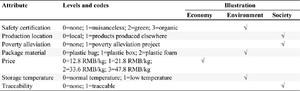
The attributes and levels of tomatoes are presented in Table 1. Specifically, price reflects the economic dimension of sustainability. Safety certification, package material, and storage temperature are categorized as environmental sustainability attributes, as they relate to the environmental impacts of production, packaging, and transportation, such as reducing carbon emissions or material waste. In contrast, production location, poverty alleviation, and traceability are considered social sustainability attributes, as they emphasize benefits to the community and public health.

Attributes and levels of tomatoes
Citation: International Food and Agribusiness Management Review 2026; 10.22434/ifamr.1353
The second step is to determine the choice set. We combine different levels of product attributes to simulate products, and then select products to form a choice set. There are two alternative products in each choice set. In this study, there are seven attributes: two attributes have four levels each, one has three levels, and four have two levels each. There could be a total of 768 simulated products. If two of them are in one choice set, there will be 294 528 choices. To reduce the number of choice sets, we adopt an orthogonal design, which is based on orthogonal arrays to estimate a linear model. The key requirements are that different levels of all attributes should be independent, and each level of each attribute should have an equal probability of being present in the choice set. Using the orthogonal design in SPSS 25.0, we obtain 16 choices. Finally, to pair the alternative product, we use the foldover method (Street et al., 2005). An example of a choice set is provided in Table A1 in Appendix A.
3.3 Measures
We develop a questionnaire comprised of three parts to collect our data. The first includes consumers’ psychological factors. The second part is the experiment design based on the DCE and respondents are required to make choices by comparing the two tomatoes in each choice set. The third part covers the characteristics of the respondents.
The literature suggests that environmental attitude is affected by values, norms, and knowledge (see measurement scales in Appendix B). To measure environmental attitude, we adopt the New Ecological Paradigm Scale developed by Dunlap et al. (2000). There are five dimensions with 15 items and the Cronbach’s
To measure value, we adopt the scale developed by Stern et al. (1999), which consists of 22 items across four dimensions, with a Cronbach’s
Norms are measured using scales developed by Hynes and Wilson (2016), Thøgersen (2006), and López-Mosquera and Sánchez (2012), covering moral norm, social norm, personal norm and subjective norm. There are 12 items and the Cronbach’s
The measures of environmental knowledge are based on the scales designed by Fryxell and Lo (2003) and the Cronbach’s
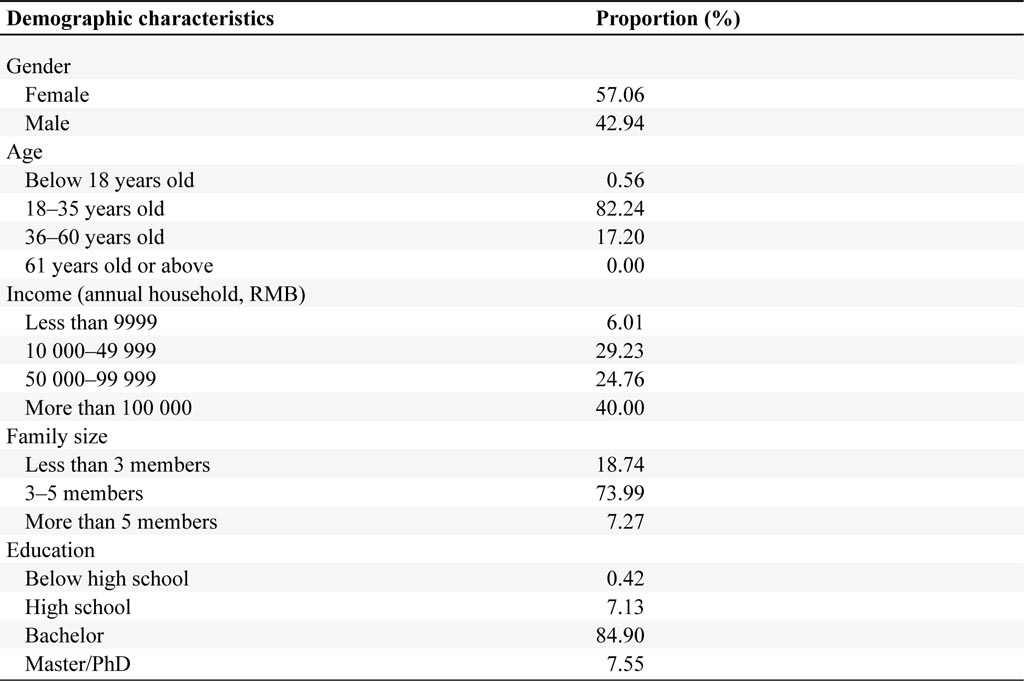
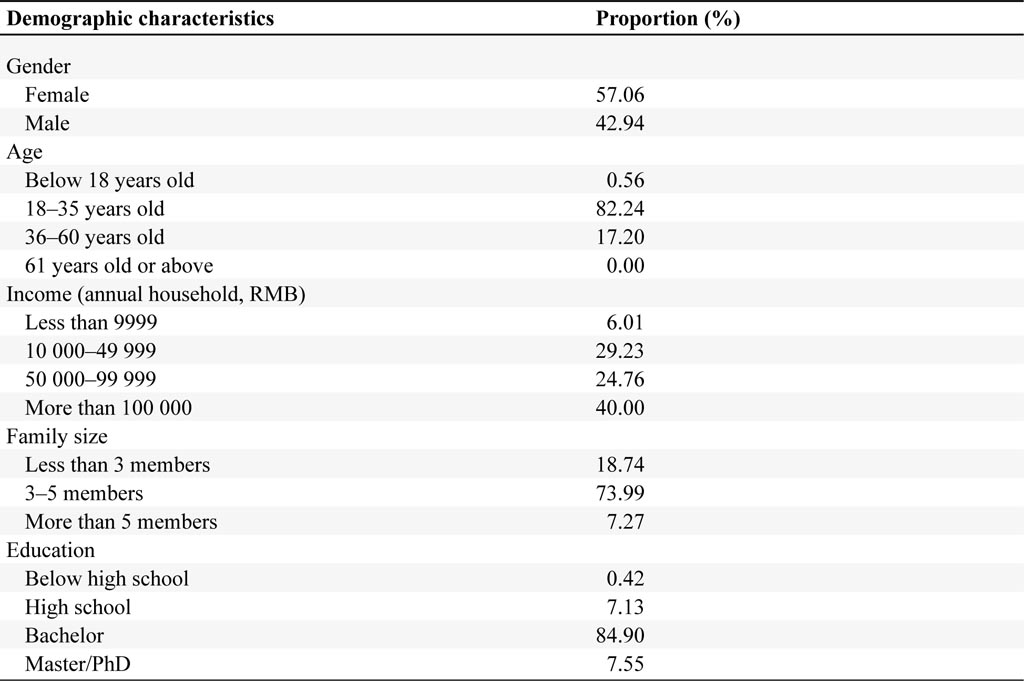
Demographic characteristics include gender, age, education, annual household income and family size. All variables are measured as categorical variables based on predefined ranges. Detailed information is provided in Table A2 in Appendix A.
3.4 Models
To test our hypotheses, we construct three interrelated models that combine the Discrete Choice Model (DCM) with the Judgment Uncertainty and Magnitude Parameters (JUMP).
To test the first hypothesis, we apply a standard DCM to assess the effects of product attributes on consumer choice, grounded in random utility theory (McFadden, 1974) and consumer demand theory (Lancaster, 1966).
Model 1:
Citation: International Food and Agribusiness Management Review 2026; 10.22434/ifamr.1353
Where Ychoice represents the consumer’s choice outcome, Xi is the attribute of product i, and opt_out captures the option of not choosing any of the given alternatives. The full specification is provided in Appendix C.
The second part of hypotheses concerns whether consumers with different levels of environmental attitude magnitude and uncertainty respond differently to different sustainability attributes.
Model 2:
Citation: International Food and Agribusiness Management Review 2026; 10.22434/ifamr.1353
Where
To estimate Attim and Attiu in Model 2, we employ the JUMP model (Chandrashekaran et al., 2007; Rotte et al., 2006), which treats attitudes as probabilistic distributions rather than fixed values. This approach enables an indirect and simultaneous estimation of both the central tendency (magnitude) and variation (uncertainty) of individual attitudes based on a self-reported judgment (i.e. environmental attitude in our study). Compared to self-report, JUMP model provides more object and independent measures and is unaffected by attitude extremity (Qian et al., 2015, 2019).
According to previous literature, we model these two dimensions of environmental attitudes as functions of personal values, norms, knowledge, and demographic characteristics.
Model 3:
Citation: International Food and Agribusiness Management Review 2026; 10.22434/ifamr.1353
Through this estimation, we obtain individual-level environmental attitude magnitude (EAM) and uncertainty (EAU), which are then used as proxies for Attim and Attiu in Model 2, respectively (see Appendix C for detailed procedures).
4. Results and analysis
4.1 Effects of product attributes on consumers’ choices
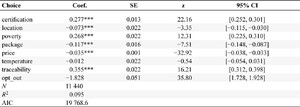
The results of testing Model 1 are reported in Table 2. We only consider the effects of product attributes including certification, production location, poverty alleviation, packaging, price, storage temperature, and traceability. First, price indicates the economic attribute. The effect of price on consumers’ buying choices is significant and negative (
Effects of product attributes on consumers’ choices
Citation: International Food and Agribusiness Management Review 2026; 10.22434/ifamr.1353
Second, regarding the environmental attributes including certification, packaging, and storage temperature, certification has a positive effect on consumers’ choices (
Third, the social attributes include product location, poverty alleviation, and traceability. For production location, the effect is significant and negative (
WTP is often used to describe the degree of willingness by calculating the marginal price that consumers would pay for a certain attribute (Jin and Zhou, 2014; Jin et al., 2017). Regarding WTP for sustainability, some researchers only focus on B2C (business-to-consumer) areas and a certain dimension of sustainability (McClenachan et al., 2016). Thus, the current study adopts WTP and covers all three dimensions of sustainability. The results are reported in Table 3. Consumers would like to pay 10.143 RMB/kg more to buy traceable products, 7.914 RMB/kg more for those with high level certifications, 7.657 RMB/kg more for those supporting poverty alleviation, 3.343 RMB/kg more for products with simple packaging, and 2.086 RMB/kg more for local products.
Results of willingness-to-pay
Citation: International Food and Agribusiness Management Review 2026; 10.22434/ifamr.1353
4.2 Effects of environmental attitude magnitude and uncertainty on consumers’ choices
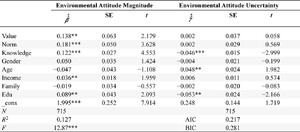
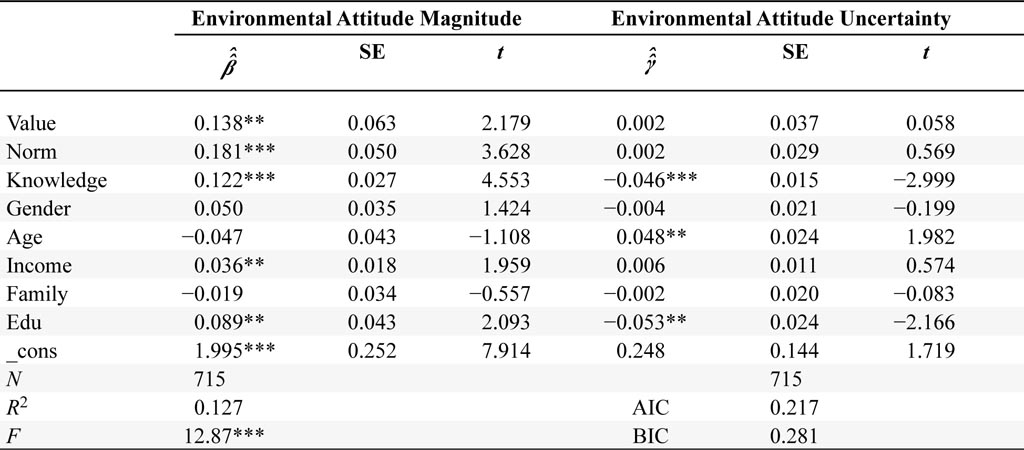
To test the effects of environmental attitude magnitude and uncertainty on consumer choices, we first use the JUMP model to estimate environmental attitude magnitude and uncertainty. The results of Model 3 are reported in Table 4. Values, norms, and knowledge all have significant and positive effects on environmental attitude magnitude (
Results of the JUMP model
Citation: International Food and Agribusiness Management Review 2026; 10.22434/ifamr.1353
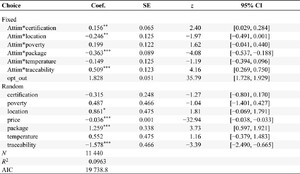
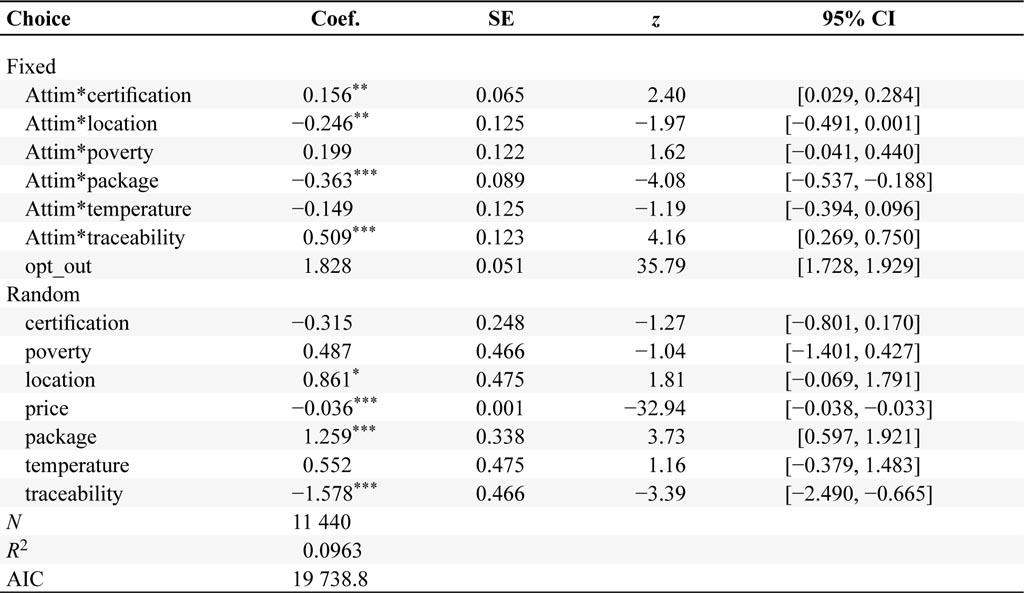
Using the estimated value of environmental attitude magnitude and uncertainty, we next test their moderating effects on consumers’ choices. The results of Model 2 are presented in Table 5 and 6, respectively. Environmental attitude magnitude positively moderates the effects of certification and traceability on consumer choices (
Effects of environmental attitude magnitude on consumers’ choices based on MXL
Citation: International Food and Agribusiness Management Review 2026; 10.22434/ifamr.1353
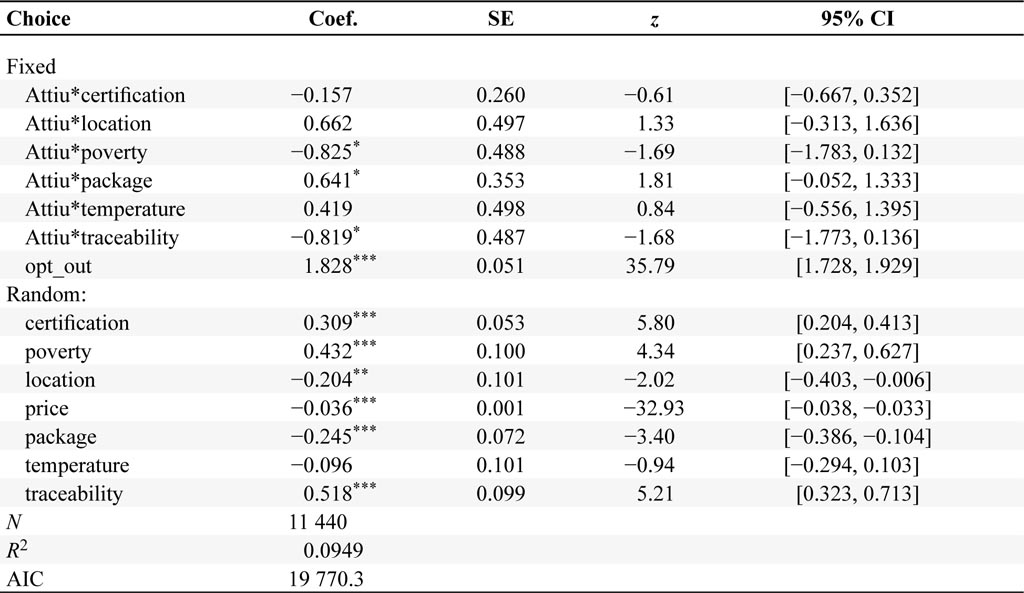
Effects of environmental attitude uncertainty on consumers’ choices based on MXL
Citation: International Food and Agribusiness Management Review 2026; 10.22434/ifamr.1353
Regarding environmental attitude uncertainty, its interactions with poverty and traceability are all significant and negative (
5. Discussion and conclusions
Based on IPT, this study investigates how consumers evaluate agricultural product attributes in the context of exposing sustainability information. Focusing on the cognitive mechanism underlying how consumers process multiple sustainability attributes, this study also considers the heterogeneity of consumers and then investigates the role of consumers’ environmental attitude in the relationship between sustainable product attributes and consumers’ choices.
5.1 Theoretical implications
The first contribution of this study is that we emphasize the importance of consumers’ cognitive psychology in decision-making regarding sustainable consumption. According to IPT, when consumers make decisions on buying products composed of different attributes, they actually need to make a balance (Fishbein and Ajzen, 1975). Although consumers pay more attention to the new attributes related to sustainability (Thøgersen et al., 2019), they would consider other traditional attributes such as price, packaging, and so on (Koutsimanis et al., 2012; Wang et al., 2023). If the company wants to communicate their values and attitudes toward sustainability and stimulate consumers’ sustainable buying behaviours, they should make all the information that involves “background data” such as the general climate change issues as well as specific “product data” such as details about the country of origin, supply chain, materials processed, labels, and certifications (Berry and McEachern, 2005; Schlaile et al., 2018). The results indicate that social sustainability attributes have stronger effects on consumer choice than environmental sustainability attributes.
The second contribution is that we not only consider consumers’ cognition of sustainable consumption but also explore the role of their meta-cognition at a higher level. It is argued that attitude toward sustainability affects how consumers respond when evaluating sustainability attributes alongside other valued attributes (Luchs and Kumar, 2017). However, consumers’ attitude would be uncertain, which plays a significant role in the decision processes (Krishnan and Smith, 1998). Most studies on the effects of environmental attitude on behaviours neglect the dimension of uncertainty (Fergen et al., 2016; MacMillan et al., 2012). JUMP is an objective method of measuring attitude uncertainty (Chandrashekaran et al., 2007; Qian et al., 2015). Using this approach, we investigate how consumers with different levels of environmental attitude magnitude and uncertainty make choices among different sustainability attributes. The results highlight that higher uncertainty increases the likelihood of choosing those associated with complex packaging, while decreases poverty alleviation and traceability. In other words, consumers with lower environmental attitude uncertainty tend to prefer products with simple packaging, featuring poverty alleviation efforts, and traceability labels.
5.2 Practical implications
According to the results, consumers prefer to buy local products that are lower in price, higher level of certification, simple packaging, support poverty alleviation, and can be traced through the whole supply chain. Managers can change the product attributes according to consumers’ demands and deliver the corresponding information, which will increase the WTP for the sustainability attributes. For economic benefits, firms should enhance efficiency and lower the costs to bring down the price. For the benefits regarding the environment, they should develop environment-friendly production methods and apply the related certifications to enhance consumers’ confidence. In addition, simple packaging can reduce the waste of resources and should be promoted at the beginning of product design. For the benefits to society, cooperation with local producers should be encouraged, companies should operate in a community environment, and find more opportunities to participate in poverty alleviation projects. In addition, to enhance the level of safety and transparency, it is better to invest in traceability technologies and establish traceability platforms that can send the upstream and downstream information to end consumers.
Using JUMP modelling, we estimated the two components of environmental attitude, environmental magnitude and uncertainty, and then tested their moderating effects. The results of the JUMP model reveal that values, norms, and knowledge all have significant effects on environmental attitude magnitude and knowledge has a significant effect on environmental attitude uncertainty. For the moderating effects, the findings suggest that both stronger magnitude and lower uncertainty in environmental attitudes are associated with greater preferences for socially and environmentally sustainable product attributes, although the specific effects differ across attributes. Specifically, environmental attitude magnitude strengthens the relationship between certification, traceability, and consumers’ choices. Additionally, environmental attitude uncertainty weakens the relationships between poverty, traceability, and consumers’ choices. In summary, consumers with a higher level of environmental attitude magnitude but a lower level of uncertainty would prefer more poverty alleviation products with a high level of certifications and traceability labels. They are target consumers who are sensitive to sustainability information sent by firms.
5.3 Limitations and future research
This study has some limitations. First, for the experiment design, it is difficult to balance the number of attributes and the complexity of the design. If there are more attributes, the simulated products would be close to the real conditions. However, there would be more choices for consumers, which will increase the difficulty of making a decision. Therefore, future studies should consider this problem and seek to create a better design to enhance the efficiency. Second, despite following standard DCE procedures, this study may still be subject to hypothetical bias like many stated preference surveys. Respondents may overstate their WTP in hypothetical scenarios compared to actual behaviour. Future studies could incorporate more techniques such as a cheap talk script or other forms of priming to improve the external validity of WTP estimates. Third, although the sample size is adequate for statistical analysis, the diversity of the sample may be limited. Most respondents are from urban areas, which may not fully capture the heterogeneity of consumer preferences across different regions and demographic segments in China. Future research could explore more diverse samples or compare consumers in different countries. Finally, this study focuses on environmental attitude as a key characteristic of consumers that could affect their choices. However, there may be other factors such as risk awareness, information avoidance, and so on that could moderate the relationships. Future studies should explore these psychological factors in more depth.
Acknowledgements
All authors contributed equally to this work and share first authorship. This study is supported by National Natural Science Foundation of China (72072174, 71902205). The authors declare no conflict of interest.
References
Aggarwal, P. and S. Law. 2005. Role of relationship norms in processing brand information. Journal of Consumer Research 32(3): 453–464. https://doi.org/10.1086/497557
Ajzen, I. 1985. From intentions to actions: A theory of planned behavior. In: J. Kuhl and J. Beckmann (eds.), Action control: From cognition to behavior, Berlin: Springer, pp. 11–39.
Antonetti, P. and S. Maklan. 2014. Feelings that make a difference: How guilt and pride convince consumers of the effectiveness of sustainable consumption choices. Journal of Business Ethics 124(1): 117–134. https://doi.org/10.1007/s10551-013-1841-9
Asioli, D., T. Næs, A. Øvrum and V.L. Almli. 2016. Comparison of rating-based and choice-based conjoint analysis models: A case study based on preferences for iced coffee in Norway. Food Quality and Preference 48: 174–184. https://doi.org/10.1016/j.foodqual.2015.09.007
Auger, P., P. Burke, T. M. Devinney and J. J. Louviere. 2003. What will consumers pay for social product features? Journal of Business Ethics 42(3): 281–304. https://www.jstor.org/stable/25074960
Baron, J. 1985. What kinds of intelligence components are fundamental? In: S. F. Chipman, J. W. Segal and R. Glaser (eds.), Thinking and Learning Skills, volume 2, Hillsdale, NJ: Erlbaum, pp. 365–390.
Bassili, J.N. 1996. Meta-judgmental versus operative indexes of psychological attributes: The case of measures of attitude strength. Journal of Personality and Social Psychology 71(4): 637–647. https://doi.org/10.1037/0022-3514.71.4.637
Berry, H. and M. McEachern. 2005. Informing ethical consumers. In: R. Harrison, T. Newholm and D. Shaw (eds), The Ethical Consumer, Sage Publications, London, pp. 69–87.
Bettman, J. R. 1979. Memory factors in consumer choice: A review. Journal of Marketing 43(2): 37–53. https://doi.org/10.1177/002224297904300205
Bradu, C., J. Orquin and J. Thøgersen. 2014. The mediated influence of a traceability label on consumer’s willingness to buy the labelled product. Journal of Business Ethics 124(2): 283–295. https://doi.org/10.1007/s10551-013-1872-2
Brügger, A., F.G. Kaiser and N. Roczen. 2011. One for all? Connectedness to nature, inclusion of nature, environmental identity, and implicit association with nature. European Psychologist 16(4): 324–333. https://doi.org/10.1027/1016-9040/a000032
Burnkrant, R.E. 1976. A motivational model of information processing intensity. Journal of Consumer Research 3(1): 21–30. https://doi.org/10.1086/208647
Catlin, J.R., M.G. Luchs and M. Phipps. 2017. Consumer perceptions of the social vs. environmental dimensions of sustainability. Journal of Consumer Policy 40: 245–277. https://doi.org/10.1007/s10603-017-9356-x
Chaiken, S. 1980. Heuristic versus systematic information processing and the use of source versus message cues in persuasion. Journal of Personality and Social Psychology 39: 752–766. https://doi.org/10.1037/0022-3514.39.5.752
Chandrashekaran, M., K. Rotte, S.S. Tax and R. Grewal. 2007. Satisfaction strength and customer loyalty. Journal of Marketing Research 44(1): 153–163. https://doi.org/10.1509/jmkr.44.1.153
Chen, M., S. Yin, Y. Xu and Z. Wang. 2015. Consumers’ willingness to pay for tomatoes carrying different organic labels: Evidence from auction experiments. British Food Journal 117(11): 2814–2830. https://doi.org/10.1108/BFJ-12-2014-0415
Chowdhury, R.M. 2017. Emotional intelligence and consumer ethics: The mediating role of personal moral philosophies. Journal of Business Ethics 142(3): 527–548. https://doi.org/10.1007/s10551-015-2733-y
Cooper-Martin, E. and M.B. Holbrook. 1993. Ethical consumption experiences and ethical space. ACR North American Advances 20: 113–118.
de Bekker-Grob, E.W. 2009. Discrete choice experiments in health care: theory and applications. Doctoral dissertation, Erasmus University, Rotterdam.
Dunlap, R., K. Van Liere, A. Mertig and R.E. Jones. 2000. Measuring endorsement of the new ecological paradigm: A revised NEP scale. Journal of Social Issues 56(3): 425–442. https://doi.org/10.1111/0022-4537.00176
Elkington, J. 1997. Cannibals with forks: The triple bottom line of 21st century business. Capstone, London.
Escobar, B.M., L. Sandoval, M.A. Palma, C. Carpio and M.D. Garcia. 2023. Coffee sustainability attributes in developing countries: the Honduran domestic coffee market. International Food and Agribusiness Management Review 26(4): 673–689. https://doi.org/10.22434/IFAMR2022.0126
Fergen, J. and J.B. Jacquet. 2016. Beauty in motion: Expectations, attitudes, and values of wind energy development in the rural US. Energy Research and Social Science 11: 133–141. https://doi.org/10.1016/j.erss.2015.09.003
Fishbein, M. and I. Ajzen. 1975. Belief, attitude, intention, and behavior: An introduction to theory and research. Reading, MA: Addison-Wesley.
Frisch, D. 2011. Interpreting conflicts between intuition and formal models. In: E. Weber, J. Baron and G. Loomes (eds), Conflict and tradeoffs in decision-making. Cambridge University Press, Cambridge, pp. 323–344.
Fryxell, G.E. and C.W. Lo. 2003. The influence of environmental knowledge and values on managerial behaviours on behalf of the environment: An empirical examination of managers in China. Journal of Business Ethics 46(1): 45–69. https://doi.org/10.1023/A:1024773012398
Gaspar, R. and D. Antunes. 2011. Energy efficiency and appliance purchases in Europe: Consumer profiles and choice determinants. Energy Policy 39(11): 7335–7346. https://doi.org/10.1016/j.enpol.2011.08.057
Hosta, M. and V. Zabkar. 2021. Antecedents of environmentally and socially responsible sustainable consumer behavior. Journal of Business Ethics 171(2): 273–293. http://www.jstor.org/stable/45386864
Hsu, H.J. and L.D. Burns. 2002. Clothing evaluative criteria: A cross-national comparison of Taiwanese and United States consumers. Clothing and Textiles Research Journal 20(4): 246–252. https://doi.org/10.1177/0887302X0202000408
Hynes, N. and J. Wilson. 2016. I do it, but don’t tell anyone! Personal values, personal and social norms: Can social media play a role in changing pro-environmental behaviours?. Technological Forecasting and Social Change 111: 349–359. https://doi.org/10.1016/j.techfore.2016.06.034
Huber, J. and K. E. Train. 2001. On the similarity of classical and Bayesian estimates of individual mean partworths. Marketing Letters 12(3): 259–269. https://doi.org/10.1023/A:1011120928698
Jin, S. and L. Zhou. 2014. Consumer interest in information provided by food traceability systems in Japan. Food Quality and Preference 36: 144–152. https://doi.org/10.1016/j.foodqual.2014.04.005
Jin, S., Y. Zhang and Y. Xu. 2017. Amount of information and the willingness of consumers to pay for food traceability in China. Food Control 77: 163–170. https://doi.org/10.1016/j.foodcont.2017.02.012
John, D.R. and C.A. Cole. 1986. Age differences in information processing: Understanding deficits in young and elderly consumers. Journal of Consumer Research 13(3): 297–315. https://doi.org/10.1086/209070
Kiecker, P., K.M. Palan and C.S. Areni. 2000. Different ways of ‘seeing’: How gender differences in information processing influence the content analysis of narrative texts. Marketing Letters 11(1): 49–65. https://doi.org/10.1023/A:1008150826550
Kim, Y. 2017. Consumer responses to the food industry’s proactive and passive environmental CSR, factoring in price as CSR tradeoff. Journal of Business Ethics 140(2): 307–321. https://doi.org/10.1007/s10551-015-2671-8
Koutsimanis, G., K. Getter, B. Behe, J. Harte and E. Almenar. 2012. Influences of packaging attributes on consumer purchase decisions for fresh produce. Appetite 59(2): 270–280. https://doi.org/10.1016/j.appet.2012.05.012
Krishnan, H.S. and R.E. Smith. 1998. The relative endurance of attitudes, confidence, and attitude-behavior consistency: The role of information source and delay. Journal of Consumer Psychology 7(3): 273–298. https://doi.org/10.1207/s15327663jcp0703_03
Krosch, A., B. Figner and E.U. Weber. 2012. Choice processes and their post-decisional consequences in morally conflicting decisions. Judgment and Decision Making 7(3): 224–234. https://doi.org/10.1017/S1930297500002217
Krosnick, J.A. and W.A. Smith. 1994. Attitude strength. Encyclopedia of Human Behavior 1: 279–289.
Kumar, P. and M.J. Polonsky. 2017. An analysis of the green consumer domain within sustainability research: 1975 to 2014. Australasian Marketing Journal 25(2): 85–96. https://doi.org/10.1016/j.ausmj.2017.04.009
Lancaster, K.J. 1966. A new approach to consumer theory. Journal of Political Economy 74(2): 132–157. https://doi.org/10.1086/259131
Liu, H., S. Wei, W. Ke, K. K. Wei and Z. Hua. 2016. The configuration between supply chain integration and information technology competency: A resource orchestration perspective. Journal of Operations Management 44: 13–29. https://doi.org/10.1016/j.jom.2016.03.009
López-Mosquera, N. and M. Sánchez. 2012. Theory of planned behavior and the value-belief-norm theory explaining willingness to pay for a suburban park. Journal of Environmental Management 113: 251–262. https://doi.org/10.1016/j.jenvman.2012.08.029
Luchs, M.G. and M. Kumar. 2017. “Yes, but this other one looks better/works better”: How do consumers respond to trade-offs between sustainability and other valued attributes? Journal of Business Ethics 140: 567–584. https://doi.org/10.1007/s10551-015-2695-0
Luchs, M.G., J. Brower and R. Chitturi. 2012. Product choice and the importance of aesthetic design given the emotion‐laden trade‐off between sustainability and functional performance. Journal of Product Innovation Management 29(6): 903–916. https://doi.org/10.1111/j.1540-5885.2012.00970.x
Luchs, M.G., R.W. Naylor, J.R. Irwin and R. Raghunathan. 2010. The sustainability liability: Potential negative effects of ethicality on product preference. Journal of Marketing 74(5): 18–31. https://doi.org/10.1509/jmkg.74.5.018
MacMillan Uribe, A.L., D.M. Winham and C.M. Wharton. 2012. Community supported agriculture membership in Arizona: an exploratory study of food and sustainability behaviours. Appetite 59(2): 431–436. https://doi.org/10.1016/j.appet.2012.06.002
Mai, R., S. Hoffmann, W. Lasarov and A. Buhs. 2019. Ethical products=less strong: How explicit and implicit reliance on the lay theory affects consumption behaviors. Journal of Business Ethics 158: 659–677. https://doi.org/10.1007/s10551-017-3669-1
Mancuso, T., R. De Cianni, G.A. Di Vita, E. Spada, F. Brun, D.C. Spadaro and R. Zanchini. 2024. Understanding Italian consumers’ perceptions of tomato agricultural innovation: Exploring the nexus between sustainability, health and consumer beliefs. Journal of Cleaner Production 435: 140528. https://doi.org/10.1016/j.jclepro.2023.140528
McClenachan, L., S.T. Dissanayake and X. Chen. 2016. Fair trade fish: Consumer support for broader seafood sustainability. Fish and Fisheries 17(3): 825–838. https://doi.org/10.1111/faf.12148
McFadden, D. 1974. The measurement of urban travel demand. Journal of Public Economics 3(4): 303–328. https://doi.org/10.1016/0047-2727(74)90003-6
Milfont, T.L. and J. Duckitt. 2004. The structure of environmental attitudes: A first- and second-order confirmatory factor analysis. Journal of Environmental Psychology 24(3): 289–303. https://doi.org/10.1016/j.jenvp.2004.09.001
Norman, D.A. 1968. Toward a theory of memory and attention. Psychological Review 75(6): 522. https://doi.org/10.1037/h0026699
Olson, J.C. 1977. Price as an informational cue: effects in product evaluations. In A.G. Woodside, J.N. Sheth and P.D. Bennett (Eds.), Consumer and Industrial Buying Behavior. North-Holland, New York, NY.
Ornelas Herrera, S.I., Y. Baba, Z. Kallas, E. Meers, E. Michels, Z. Hajdu and A.M. Spicnagel. 2025. The role of environmental attitudes and consumption patterns in consumers’ preferences for sustainable food from circular farming systems: six EU case studies. Agricultural and Food Economics 13(1): 7. https://doi.org/10.1186/s40100-025-00350-0
Park, C.W. 1976. The effect of individual and situation-related factors on consumer selection of judgmental models. Journal of Marketing Research 13(2): 144–151. https://doi.org/10.2307/3150848
Petrocelli, J.V., Z.L. Tormala and D.D. Rucker. 2007. Unpacking attitude certainty: Attitude clarity and attitude correctness. Journal of Personality and Social Psychology 92(1): 30. https://doi.org/10.1037/0022-3514.92.1.30
Petty, R.E. and J.T. Cacioppo. 1986. Communication and Persuasion: Central and Peripheral Routes to Attitude Change. Springer, New York, NY.
Pichierri, M. and G. Pino. 2023. Less saturated, more eco-friendly: Color saturation and consumer perception of product sustainability. Psychology and Marketing 40(9): 1830–1849. https://doi.org/10.1002/mar.21858
Qian, C., M. Chandrashekaran and K. Yu. 2015. Understanding the role of consumer heterogeneity in the formation of satisfaction uncertainty. Psychology and Marketing 32(1): 78–93. https://doi.org/10.1002/mar.20764
Qian, C., K. Yu and J. Gao. 2019. Understanding environmental attitude and willingness to pay with an objective measure of attitude strength. Environment and Behavior 53(2): 119–150. https://doi.org/10.1177/0013916519855140
Regier, D.A., M. Ryan, E. Phimister, and K.A. Marsh. 2009. Bayesian and classical estimation of mixed logit: An application to genetic testing. Journal of Health Economics 28(3): 598–610. https://doi.org/10.1016/j.jhealeco.2008.11.003
Rotte, K., M. Chandrashekaran, S.S. Tax and R. Grewal. 2006. Forgiven but not forgotten: Covert uncertainty in overt responses and the paradox of defection-despite-trust. Journal of Consumer Psychology 16: 281–292. https://doi.org/10.1207/s15327663jcp1603_10
Sanbonmatsu, D.M., S.S. Posavac, F.R. Kardes and S.P. Mantel. 1998. Selective hypothesis testing. Psychonomic Bulletin and Review 5(2): 197–220. https://doi.org/10.3758/BF03212944
Schlaile, M.P., K. Klein and W. Böck. 2018. From bounded morality to consumer social responsibility: a transdisciplinary approach to socially responsible consumption and its obstacles. Journal of Business Ethics 149(3): 561–588. https://doi.org/10.1007/s10551-016-3096-8
Simpson, J.K.B. and K.S. Radford. 2014. Situational variables and sustainability in multi-attribute decision-making. European Journal of Marketing 48(5–6): 1046–1069. https://doi.org/10.1108/EJM-04-2012-0219
Sloan, E. 2007. New shades of green. Food Technology 61(12): 16.
Stern, P.C., T. Dietz, T. Abel, G.A. Guagnano and L. Kalof. 1999. A value-belief-norm theory of support for social movements: the case of environmentalism. Human Ecology Review 6(2): 81–97.
Street, D.J., L. Burgess and J.J. Louviere. 2005. Quick and easy choice sets: Constructing optimal and nearly optimal stated choice experiments. International Journal of Research in Marketing 22(4): 459–470. https://doi.org/10.1016/j.ijresmar.2005.09.003
Thøgersen, J. 2006. Norms for environmentally responsible behaviour: an extended taxonomy. Journal of Environmental Psychology 26(4): 247–261. https://doi.org/10.1016/j.jenvp.2006.09.004
Thøgersen, J., S. Pedersen and J. Aschemann-Witzel. 2019. The impact of organic certification and country of origin on consumer food choice in developed and emerging economies. Food Quality and Preference 72: 10–30. https://doi.org/10.1016/j.foodqual.2018.09.003
Tormala, Z.L. and D.D. Rucker. 2007. Attitude certainty: a review of past findings and emerging perspectives. Social and Personality Psychology Compass 1(1): 469–492. https://doi.org/10.1111/j.1751-9004.2007.00025.x
Trudel, R. 2019. Sustainable consumer behavior. Consumer Psychology Review 2(1): 85–96. https://doi.org/10.1002/arcp.1045
Trudel, R., J. Klein, S. Sen and N. Dawar. 2020. Feeling good by doing good: a selfish motivation for ethical choice. Journal of Business Ethics 166: 39–49. https://doi.org/10.1007/s10551-019-04121-y
Wan, E.W. and D.D. Rucker. 2013. Confidence and construal framing: when confidence increases versus decreases information processing. Journal of Consumer Research 39(5): 977–992. https://doi.org/10.1086/666467
Wang, H., Q. Chen and B. Katare. 2023. Nudging Chinese consumers to embrace sustainable milk consumption: how should information be provided? Agribusiness 39: 1512–1534. https://doi.org/10.1002/agr.21853
Wang, O. and S. Somogyi. 2018. Consumer adoption of online food shopping in China. British Food Journal 120(12): 2868–2884. https://doi.org/10.1108/BFJ-03-2018-0139
Willis, R.M., R.A. Stewart, K. Panuwatwanich, P.R. Williams and A.L. Hollingsworth. 2011. Quantifying the influence of environmental and water conservation attitudes on household end use water consumption. Journal of Environmental Management 92(8): 1996–2009. https://doi.org/10.1016/j.jenvman.2011.03.023
Woersdorfer, J.S. and W. Kaus. 2011. Will nonowners follow pioneer consumers in the adoption of solar thermal systems? Empirical evidence for northwestern Germany. Ecological Economics 70(12): 2282–2291. https://doi.org/10.1016/j.ecolecon.2011.04.005
Yoon, Y., G. Sarial-Abi and Z. Gürhan-Canli. 2011. Effect of regulatory focus on selective information processing. Journal of Consumer Research 39(1): 93–110. https://doi.org/10.1086/661935
Appendix A
A choice set example
Citation: International Food and Agribusiness Management Review 2026; 10.22434/ifamr.1353
Demographic characteristics of the sample (n=715)
Citation: International Food and Agribusiness Management Review 2026; 10.22434/ifamr.1353
Appendix B: Scales
B1. Environmental attitude
the New Ecological Paradigm Scale (NEP) developed by Dunlap et al. (2000), (1 = “strongly disagree”, and 5 = “strongly agree”)
We are approaching the limit of the number of people the earth can support.
Humans have the right to modify the natural environment to suit their needs.
When humans interfere with nature it often produces disastrous consequences.
Human ingenuity will ensure that we do NOT make the earth unlivable.
Humans are severely abusing the environment.
The earth has plenty of natural resources if we just learn how to develop them.
Plants and animals have as much right as humans to exist.
The balance of nature is strong enough to cope with the impacts of modern industrial nations.
Despite our special abilities humans are still subject to the laws of nature.
The so-called “ecological crisis” facing humankind has been greatly exaggerated.
The earth is like a spaceship with very limited room and resources.
Humans were meant to rule over the rest of nature.
The balance of nature is very delicate and easily upset.
Humans will eventually learn enough about how nature works to be able to control it.
If things continue on their present course, we will soon experience a major ecological catastrophe.
B2. Value
scale developed Stern et al. (1999), (1 = “strongly disagree”, and 5 = “strongly agree”)
(Altruistic)
Social justice, correcting injustice, care for the weak
Preventing pollution, conserving natural resources
Equality, equal opportunity for all
Unity with nature, fitting into nature
A world of peace, free of war and conflict
Respecting the earth, harmony with other species
Protecting the environment, preserving nature
(Traditional)
True friendship, close supportive friends
Loyal, faithful to my friends
Sense of belonging, feeling that others care about me
Obedient, dutiful, meeting obligations
Self-discipline, self-restraint, resistance to temptations
Family security, safety for loved ones
Honoring parents and elders, showing respect
Forgiving, willing to pardon others
(Self-interest)
Social power, control over others, dominance
Influential, having an impact on people and events
Wealth, material possessions, money
Authority, the right to lead or command
(Openness to change)
Curious, interested in everything, exploring
A varied life, filled with challenge, novelty and change
An exciting life, stimulating experiences
B3. Norm
scales developed by Hynes et al. (2016), Thøgersen (2006), and López-Mosquera et al. (2012), (1 = “strongly disagree”, and 5 = “strongly agree”)
(moral norm)
I feel I should not waste anything if it could be used again
It would be wrong of me not to protect environment
I would feel guilty if I did not protect environment
Not protecting environment goes against my principles
(social norm)
Everybody should share the responsibility to recycle household waste
Everybody has a responsibility to contribute to environmental preservation by avoiding packaged food products
Everybody should make a contribution to promoting environmentally friendly food production by buying only these products
(personal norm)
I feel I ought to protect environment
I feel guilty when I don’t protect environment
(subjective norm)
Most of the people think that I should protect environment
Most of the people expect me to protect environment
People who I respect would protect environment
B4. Environmental knowledge
There are 30 questions with four options each, from which respondents were instructed to select “the best answer” and got corresponding points. For example:
When and where was the UN Earth Summit held?
Cairo, 1990
Rio de Janeiro, 1992
Stockholm, 1994
Istanbul, 1995
Option (b) was awarded 4 points, while all other options received 0 points.
Due to the length of the full scale, please refer to Fryxell et al. (2003) for the complete list of questions.
Appendix C: Models integrating DCM and JUMP
To test our hypotheses, we construct three interrelated models that combine the Discrete Choice Model (DCM) with the Judgment Uncertainty and Magnitude Parameters (JUMP).
C1. Model 1: Baseline DCM
To test the first hypothesis, we apply a DCM to assess the effects of product attributes on consumer choice.
Model 1:
Citation: International Food and Agribusiness Management Review 2026; 10.22434/ifamr.1353
Where Ychoice represents the consumer’s choice outcome, Xi is the attribute of product i, and opt_out captures the option of not choosing any of the given alternatives.
DCM is based on demand theory and utility theory (Lancaster, 1966; McFadden, 1974). Demand theory suggests that consumers’ demands for products are based on the combinations of different attributes, and utility theory argues that people will choice the products which bring in the highest utility (Lagarde & Blaauw, 2009).
When consumer m selects choice j in choice set Cq, the condition is as follows:
Citation: International Food and Agribusiness Management Review 2026; 10.22434/ifamr.1353
Where Umj is the utility when choice product j in choice set Cq, and Umk is the other choices expect for j.
Citation: International Food and Agribusiness Management Review 2026; 10.22434/ifamr.1353
Where Vmj is the fix effect, and
Thus, the probability of choosing product j is Pmj, which is,
Citation: International Food and Agribusiness Management Review 2026; 10.22434/ifamr.1353
The simple solution of DCM is Multinomial Logit Model (MNL), which assumes that consumers do not have any random preferences. Thus,
Citation: International Food and Agribusiness Management Review 2026; 10.22434/ifamr.1353
Model 1 only tests the effects of product attributes on consumers’ choices, so we choose MNL, and Pmj could be illustrated as follows:
Citation: International Food and Agribusiness Management Review 2026; 10.22434/ifamr.1353
Where Xji is the level of attributes of product j.
C2. Model 2: Individual heterogeneity and attitude-driven choice
Model 2 extends the baseline by incorporating heterogeneity in preferences explained by environmental attitude magnitude and uncertainty. The second part of hypotheses concerns whether consumers with different levels of environmental attitude magnitude and uncertainty respond differently to different sustainable attributes. Thus, consumers would have random preferences and then Model 1 has a random effect. Model 2 shows the fix effect together with the random effect as follows:
Model 2:
Citation: International Food and Agribusiness Management Review 2026; 10.22434/ifamr.1353
Where
Citation: International Food and Agribusiness Management Review 2026; 10.22434/ifamr.1353
For Model 2, MNL is not appropriate. Mixed Logit Model (MXL) is not constrained by IIA, so it is used to investigate the heterogeneity of choice preferences. Huber et al. (2001) and Regier et al. (2009) suggest that Bayes estimation could get accurate parameter estimation. Thus, this study used bayes based MXL to estimate Model 2. Accordingly, environmental attitude magnitude, environmental attitude uncertainty, and their interaction are fixed effects, while product attribute are random effects, which is shown from function C10 and C11.
C3. Model 3: Estimating environmental attitude magnitude and uncertainty using JUMP
Finally, to estimate Attim and Attiu in Model 2, we employ the JUMP model (Chandrashekaran et al., 2007; Rotte et al., 2006), which treats attitudes as probabilistic distributions rather than fixed values. This approach enables an indirect and simultaneous estimation of both the central tendency (magnitude) and variation (uncertainty) of individual attitudes based on a self-reported judgment (i.e. environmental attitude in our study). Compared to self-report, JUMP model provides more object and independent measures and is unaffected by attitude extremity (Qian et al., 2015; Qian et al., 2019).
Model 3:
Citation: International Food and Agribusiness Management Review 2026; 10.22434/ifamr.1353
Where,
EAT is the environmental attitude, measured by the New Ecological Paradigm Scale;
EAM (environmental attitude magnitude) is the mean of environmental attitude;
EAU (environmental attitude uncertainty) is the variance of the distribution of environmental attitude.
According to previous literature, environmental attitude is influenced by personal values, norms, knowledge, and demographic characteristics such as gender, age, income, family sizes and education. Thus,
Citation: International Food and Agribusiness Management Review 2026; 10.22434/ifamr.1353
Integrating with function C12 and C13, we can get the estimation:
Citation: International Food and Agribusiness Management Review 2026; 10.22434/ifamr.1353
Where M is the vector of all the factors affecting EAM, and U is the vector of all the factors affecting EAU.
After estimating EAM and EAU for each individual using this framework, we incorporate them into Model 2 by assigning:
Attim = EAM, representing the respondent’s environmental attitude magnitude;
Attiu = EAU, representing the respondent’s environmental attitude uncertainty.
This allows us to examine how environmental attitude magnitude and uncertainty moderate consumer preferences for sustainable product attributes.