Abstract
This case study analyses Savannah & Sahel Commodities Limited’s (SSCL) innovative raw material sourcing strategy and its role in delivering affordable, nutritious foods to address malnutrition in West Africa. The model integrates smallholder farmers into formal supply chains through out-grower schemes, cooperative development, and diversified sourcing of commodities including maize, soybeans, sesame, and shea nuts. Strategic partnerships with local governments and international organizations support cost-efficient production, enabling the provision of nutrient-rich meals to over 150 000 households and 200 000 schoolchildren in Ghana. Empirical evidence indicates substantial improvements in farmer incomes alongside increased market penetration in rural areas with high malnutrition prevalence. The study demonstrates how linking sourcing innovations to nutrition-sensitive value chains can simultaneously enhance rural livelihoods, strengthen food system resilience, and expand market opportunities for agribusinesses. The findings offer actionable insights for policymakers, practitioners, and scholars seeking scalable models for sustainable agricultural development and nutrition interventions in low-income contexts.
1. Introduction
Food insecurity and malnutrition are key challenges of national governments, especially in the developing world. It has been reported that between 713 and 757 million people or nearly one in eleven people in the world, and one out of every five in Africa are exposed to severe levels of food insecurity, and 2 billion people do not have regular access to safe, nutritious, and sufficient food (FAO, 2024). In Northern Ghana, 33% of children are stunted, 11% are underweight, and 6.3% are wasted as compared to the national averages of 19, 11 and 5% for stunting, underweight, and wasting, respectively (Antwi et al., 2023). The situation is worsened by climate change, especially in northern Ghana where the double tragedy of droughts and floods occur in the cropping seasons (Acheampong, 2022; Atanga and Tankpa, 2021). Thus, malnutrition remains a pressing challenge in northern Ghana, where various factors converge to undermine the health and well-being of vulnerable populations, particularly children.
Cereal-based foods dominate local diets, yet safety and nutritional quality remain concerns, particularly for products processed over woodfires, which risk contamination and nutrient loss (Abdulai et al., 2025; Bede-Ojimadu and Orisakwe, 2020; UC Davis Department of Food Science and Technology, 2025). While branded fortified cereals can address micronutrient deficiencies, their high retail prices, limited rural availability, and exclusion from local value chains render them inaccessible to many low-income households (Ghosh et al., 2014; Headey et al., 2023; Koech et al., 2022). Besides, such global brands offer no value to local companies, farmers, and the ordinary indigenes, hence stifling the growth of local economies.
Despite significant efforts to improve food security and nutritional outcomes, the region faces persistent issues such as poverty, limited local economic development, and inadequate education on nutrition (Wudil et al., 2022). The high rates of stunting, underweight, and wasting among children highlight the urgency of addressing this crisis, as malnutrition impairs physical growth and cognitive development, and perpetuates a cycle of poverty and poor health (FAO, 2023). The interplay of cultural practices, seasonal food scarcity, and economic constraints further complicates the situation (de Jager et al., 2023; Frumence et al., 2023; Kukeba et al., 2021), calling for comprehensive collaborations that integrate community engagement, agricultural improvement through smallholder farmer empowerment, local industry empowerment and health education to combat malnutrition effectively.
Agriculture remains a cornerstone of West African economies and also in achieving food security, but smallholder farmers face persistent challenges, including limited access to markets, modern technologies, and sustainable practices (Gyimah and Agyemang, 2015; AGRA, 2017). Ghana’s land tenure system also poses significant challenges to commercial farming (Nara et al., 2020).
Historically, food shortages were primarily linked to droughts and natural disasters, the advent of globalization has broadened the concept of food security. It is no longer solely an agricultural issue of production, but also an economic one, involving both the physical availability of food and affordable access to it (Campbell et al., 2009; Erokhin et al., 2020; FAO, 2023). Combating malnutrition, therefore, requires solutions that empower individuals economically, creating a sustainable and resilient approach to food security. Central to this are efficient and effective supply chains (also known as value chains). These chains connect producers to markets, mirroring the importance of agricultural productivity itself. By linking farmers to consumers, supply chains ensure the provision of quality food at reasonable prices while simultaneously opening new market opportunities for producers.
Short Food Supply Chains (SFSCs) have gained attention globally as a means of increasing efficiency, transparency, and resilience in food systems by reducing intermediaries and shortening the distance between producers and consumers (Petruzzelli et al., 2023). SFSCs are particularly relevant in fragile food environments, where global shocks such as the COVID-19 pandemic and the war in Ukraine have exposed vulnerabilities in long supply chains (Bayir et al., 2022). Yet, empirical evidence on how SFSC principles can be adapted to staple-based, low-income rural economies and simultaneously address malnutrition and poverty, is limited in the literature.
Savannah & Sahel Commodities Limited (SSCL), founded by Senyo Kpelly and Anane Sotowu, presents a distinctive case of an enterprise applying SFSC principles to a nutrition-sensitive, rural food system in Northern Ghana. The company sources directly from farmer cooperatives through a network of Relay Officers, embedding relational proximity and trust-based exchange into its operations. SSCL integrates value addition, community-based finance, and climate-smart agriculture, creating a hybrid SFSC model that retains value locally while delivering affordable fortified foods. By leveraging energy-efficient processing technologies and strategic partnerships, SSCL addresses both supply-side inefficiencies and demand-side affordability constraints.
The motivation for this case study is driven by the urgent need to identify and scale context-specific, market-driven interventions that address both food insecurity and chronic malnutrition in vulnerable populations. Despite widespread awareness of the nutritional challenges in Northern Ghana, practical, scalable models that integrate economic empowerment, sustainable agriculture, and nutrition-sensitive value chains remain limited. SSCL offers a unique and timely model by leveraging Short Food Supply Chains (SFSCs) to reduce post-harvest losses, lower food prices, improve access to nutritious food, and create inclusive agricultural markets for smallholder farmers.
This case study seeks to capture and analyse these interventions to inform future strategies for improving food security through locally led, enterprise-driven development approaches, by delving into SSCL’s pioneering sustainable agricultural sourcing model. We explore how SSCL integrates local farmers into its supply chain, enhancing their economic empowerment while promoting environmental sustainability and business scalability. The study examines SSCL’s multi-faceted approach, including its out-grower scheme, support for farmer cooperative formation, and strategic partnerships with local governments and international bodies. These initiatives provide farmers with training, access to essential inputs, and expanded market opportunities. We also analyse SSCL’s diversification strategy, expanding from its initial focus on shea nuts to encompass a wider range of commodities, enabling the company to serve large industrial manufacturers while addressing critical food security challenges in the region.
2. Case background
SSCL is a Ghanaian-owned agricultural enterprise operating as a farm produce aggregator and processor. It facilitates market access across the agricultural value chain for producers and buyers of all scales. SSCL’s innovative approach connects isolated, fragmented farmers, creating economies of scale and fostering an environmentally sustainable supply chain capable of meeting large-scale demands. Their model enables both smallholder farmers and larger producers to access wider markets.
The founders of SSCL bring significant experience from direct engagement with smallholder producers, having previously established SeKaf Ghana Ltd., producers of the Tama Cosmetics brand. Through SeKaf, they managed a certified organic shea nut and processed shea butter supply chain for the production of personal care products. It is important to note, however, that SSCL is not a sister company of Sekaf; rather, the two entities operate independently with distinct mandates.
The following account of SeKaf’s operations and the formation of SSCL is based on a narrative provided by Mr. Senyo, the Chief Executive Officer of SSCL, and former CEO of SeKaf, during a qualitative interview conducted in his office following a full day of business operations. This primary data was collected as part of a broader field investigation and is used here to provide contextual insights into the company’s origins and development trajectory.
SeKaf is a cosmetics company that specializes in organic products made from locally sourced shea nuts. Beyond its commercial focus, SeKaf has played a key role in community empowerment by organizing women into cooperative groups to pick the shea nuts and supporting some of them to establish small-scale shea nut processing units. These initiatives have promoted self-reliance and contributed to sustainable livelihoods among rural women.
The success of SeKaf’s inclusive model, particularly its collaboration with women’s groups, coupled with the rising global demand for agricultural commodities, led to the establishment of SSCL (Figure 1). Over time, the women’s groups became highly effective, collecting more shea nuts than SeKaf could process for its cosmetics production. The surplus shea nuts were initially sold to other businesses, and this secondary operation gradually evolved into a profitable and increasingly complex enterprise. As the scale and scope of the commodity sourcing expanded to other commodities like soyabeans, cashew nuts, sorghum etc., it became necessary to establish SSCL as a separate company dedicated to managing this aspect of the business.

Evolution of SSCL from SeKaf.
Citation: International Food and Agribusiness Management Review 2026; 10.22434/ifamr.1316
SSCL’s long-term vision includes vertical integration into manufacturing, producing semi-value-added industrial agro-based ingredients. The company is also committed to addressing food security and malnutrition in West Africa through the production of semi- and full-value-added agro-based consumer goods. In 2020, SSCL, in partnership with the University for Development Studies in Ghana and the University of York in the UK, secured a grant funded by Innovate UK under the African Agri-food Knowledge Transfer Partnerships (AAKTP) to produce a nutritious fortified blended flour for fighting malnutrition among schoolchildren and poor households in northern Ghana. This initiative aims to improve the quality of food provided to Ghanaian schoolchildren and low-income households, tackling malnutrition sustainably by enhancing SSCL’s supply and value chains as well as marketing strategy. In 2023, this initiative culminated in the production and branding of C-Real, a nutritious and instant mix-fortified blended flour, which is used to prepare nutritious, healthy and affordable daily meals for over 150,000 households and 200,000 schoolchildren in Ghana.
3. Methodology
This teaching case applies a qualitative case study approach to examine SSCL’s agricultural sourcing model and its contribution to sustainable food systems and child nutrition in West Africa. The design (Figure 2) enabled an in-depth analysis of context-specific interventions, organizational structures, and stakeholder dynamics. SSCL was purposively selected as an information-rich case due to its integrated sourcing model, engagement with smallholder farmers, and demonstrable outcomes in nutrition-sensitive agriculture.
SSCL relationship with supply chain stakeholders.
Citation: International Food and Agribusiness Management Review 2026; 10.22434/ifamr.1316
3.1 Data collection
Data were gathered from primary and secondary sources by a team of Ghanian researchers/co-authors led by the first author of the paper between April 2022 and August 2023. Primary data comprised semi-structured interviews with SSCL management, Relay Officers, cooperative leaders, and participating farmers, complemented by field visits to cooperatives, aggregation centres, and processing facilities. Observations were supplemented by consultations with external stakeholders, including the Ministry of Food and Agriculture, international partners, and affiliated academic institutions. Secondary sources included internal company documents such as the 2023 revised business plan, operational reports, and program records, as well as African Agri-food Knowledge Transfer Partnerships (AAKTP) materials, C-Real product development reports, and relevant academic, policy, and international literature.
3.2 Data analysis
Qualitative data were subjected to thematic analysis, with manual coding used to identify patterns relating to value chain integration, cooperative governance, nutritional impact, and business sustainability. The analysis was iterative and interpretive, linking SSCL’s practices to theoretical concepts in sustainable food systems, supply chain design, and rural development. Triangulation across data sources and stakeholder perspectives enhanced the credibility of findings, while comparative analysis with international cooperative-business models, including Beizhijiang–Pangu and Riverford–SDOP, enriched the study’s contextual depth.
4. Business model innovation and related supply chain design for SSCL
The agricultural sector in West Africa has undergone significant transformation in recent decades, driven by urbanization, shifting consumption patterns, and changing market dynamics. Traditional smallholder-based systems, reliant on informal market channels, have struggled to meet growing urban demand for consistent, high-quality food, creating space for innovative business models to bridge rural–urban supply gaps while addressing nutritional needs (FAO, 2023).
In Ghana, agricultural processing companies have emerged as part of this response, yet many face difficulties securing reliable, high-quality raw materials under sustainable terms. Challenges include fragmented land holdings, limited access to modern inputs, and a complex land tenure system combining customary and statutory rights, particularly acute in the northern regions (Abdul-Rahman et al., 2019; Kansanga et al., 2018). These constraints require companies to either vertically integrate, which is hindered by land acquisition barriers, or coordinate across networks of dispersed smallholders.
Within this context, SSCL evolved through distinct phases. Its origins in shea nut sourcing and processing built strong relationships with women’s groups, fostering trust and social capital essential for expansion into broader agricultural sourcing. SSCL’s hybrid structure, centralized coordination coupled with decentralized production, enables efficient resource allocation while aggregating produce from geographically dispersed farmers to meet industrial quality standards. Procurement is organized through a network of strategically located aggregation centres, about 70% privately owned, that serve as hubs for product consolidation, farmer training, and technology dissemination.
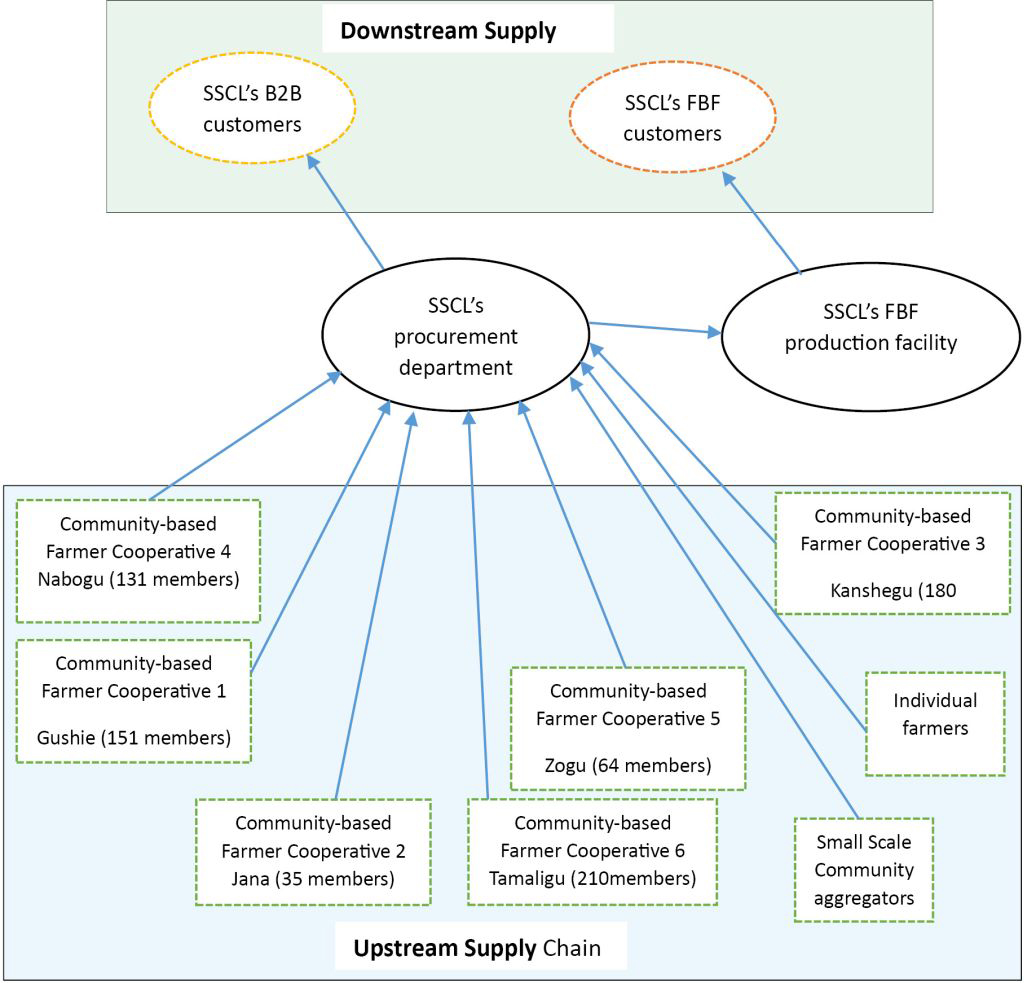
In managing supplier relationships, SSCL employs a differentiated approach based on farmer capacity and market requirements. Large-scale producers, typically farming more than 10 hectares, engage directly with SSCL’s procurement team through formal or informal supply agreements. Small-scale producers, who constitute the majority of suppliers, operate through community-based farmer groups that aggregate production and coordinate with SSCL’s field officers. This tiered system enables SSCL to maintain efficient procurement operations while providing appropriate support to different farmer segments. The interconnected supply chain of SSCL is shown in Figure 3.
SSCL’s governance system relies on cooperatives facilitated by local leaders like Assemblymen. Registered farmer cooperatives receive inputs, training, and market linkages, with decision-making led by elected representatives and supported by SSCL Relay Officers to ensure operational efficiency.
5. Sustainable initiatives
This section provides a detailed analysis of SSCL’s sustainable initiatives, strategically implemented to ensure a sustainable and dependable supply of raw materials and consequently a sustainable business that supplies affordable nutritious foods to vulnerable populations. These initiatives are integral to SSCL’s broader commitment to fostering enduring, mutually beneficial relationships throughout the agricultural supply chain. SSCL’s sustainability framework is structured around two core categories: farmer-focused initiatives and Supply Chain Management (SCM)-based initiatives.
The farmer-focused Initiatives prioritize community empowerment and capacity building through the establishment of community-based farmer cooperatives and the implementation of an out-grower scheme. The objectives are to enhance farmer livelihoods, promote sustainable agricultural practices, and bolster local economies. Central to these initiatives is the deployment of Relay Officers (ROs). These trained individuals, selected by SSCL in collaboration with community leaders, serve as SSCL representatives within the farming communities. ROs, who are SSCL employees trained by Ministry of Food and Agriculture extension officers, provide agricultural extension services to farmers participating in the out-grower scheme and the farmer cooperatives. They act as liaisons between MoFA, SSCL management, and the farmers, facilitating vital information exchange. SSCL partners with MoFA to deliver hands-on training, technical assistance, and agricultural extension services, ensuring effective support and knowledge transfer within the cooperatives.
Furthermore, SSCL collaborates with NGOs and financial institutions to provide additional support to the farmer cooperatives. This multifaceted approach enables cooperatives to leverage economies of scale, procuring inputs like herbicides and insecticides at wholesale prices, and access government resources, such as mechanized farming equipment. The cooperative structure also empowers farmers to pursue independent contracts, diversifying their income streams.
The SCM-based initiatives concentrate on optimizing post-harvest processes and enhancing supply chain efficiencies. This encompasses meticulous grain cleaning and quality control procedures to ensure product quality and minimize post-harvest losses. A centralized warehousing system, coupled with robust inventory management practices, ensures a readily available supply of raw materials to meet market demand. Furthermore, SSCL employs an innovative and cost-effective transportation strategy, leveraging existing logistics networks to minimize transportation costs and environmental impact.
These integrated initiatives demonstrate a holistic approach to sustainability, balancing farmer empowerment with logistical excellence. By combining community-based models with streamlined post-harvest and transportation processes, SSCL not only strengthens the economic resilience of local farming communities but also secures a consistent supply of affordable high-quality raw materials, to use to produce affordable nutritious foods to tackle malnutrition. The following sections provide a detailed examination of each initiative, from the operational and financial mechanisms of the farmer cooperatives to the technical and logistical aspects of the out-grower scheme and the quality control and transportation strategies that ensure business sustainability, offering a comprehensive perspective on sustainable supply chain management in contemporary agricultural contexts.
5.1 Formation and structure of SSCL-supported community-based farmer cooperatives
SSCL has developed a network of five community-based farmer cooperatives as part of its sustainable supply chain initiatives, aimed at enhancing agricultural productivity and providing market linkages for farmers. The formation of these cooperatives is initiated and coordinated by SSCL, however they neither hold any equity nor formal membership in these cooperatives. They are formed at the community level with the involvement of community leaders, such as Assemblymen, who play a crucial role in mobilizing and organizing farmers. The Assemblymen are financially incentivized by the company for their efforts, helping to ensure widespread participation. Once the members are organized and given a basic understanding of what the cooperative is about, an election is organized to select leaders to champion the affairs of the cooperatives. The farmers in the cooperatives are then registered onto SSCL’s out-grower program, which offers access to essential resources such as agricultural training, inputs (seeds, fertilizers), and reliable market opportunities.
SSCL plays a vital advisory role, guiding the cooperatives through the Relay Officers on how to maximize the power of collective action. The company provides technical expertise to cooperative leaders, helping them identify and apply for opportunities that benefit the entire group. SSCL also coordinates financial support, offering loans to farmers in the form of farm inputs, which are repaid through their harvested produce. This system ensures that farmers have access to the necessary resources to increase yields while maintaining the security of loan repayment through produce sales.
Decision-making and farmer cooperative autonomy within SSCL’s network
SSCL’s relationship with the community-based farmer cooperative centres on farmer empowerment and participatory decision-making. While SSCL plays a crucial initial role in establishing cooperatives, providing guidance, and facilitating leadership elections, the ultimate authority resides with the farmers. This fosters a sense of ownership and ensures alignment between cooperative activities and each community’s specific needs and priorities.
Key operational decisions, such as crop planning, farm size registration, and yield estimation, are made collaboratively by farmers and SSCL’s Relay Officers, integrating local knowledge with expert advice. SSCL, in partnership with the Ministry of Food and Agriculture, provides guidance on best farming practices, including seed selection and climate-smart agriculture, aligning community-level decisions with broader agricultural development goals and promoting sustainable and resilient farming systems.
Once established, the cooperatives maintain full control over their strategic direction, while SSCL provides non-intrusive support through advisory services and access to input credit schemes. Farmers repay input loans through produce sales, after which they retain full discretion over how and where to market surplus yields. Importantly, SSCL does not impose crop mandates or exclusivity clauses, allowing farmers to diversify production and engage with alternative markets.
This flexible, farmer-led model contrasts with conventional contract farming arrangements by safeguarding farmer agency and promoting diversified income sources. It strengthens economic resilience and trust, and also contributes to the long-term sustainability of the cooperatives. In this capacity, SSCL acts as a strategic enabler without undermining their autonomy or decision-making authority.
Economic empowerment through income diversification
In addition to input provision and market linkage, SSCL supports income diversification among smallholder farmers through complementary livelihood initiatives. A notable example is the distribution of C-real products on credit to farmers who manage small retail kiosks within their communities. These farmers repay the product cost after sales and retain the profit margins, enabling them to generate additional income beyond their farming activities. This model stimulates entrepreneurship, builds localized value chains, and supports rural economic development while extending the distribution of fortified food products to underserved areas, thereby improving both food access and nutrition outcomes.
By incorporating small-scale retail enterprise into its out-grower support strategy, SSCL fosters broader economic resilience. The approach empowers farmers to engage more actively in local economies and reduces reliance on seasonal agricultural earnings, thereby advancing inclusive rural development.
Integration of village Savings and Loans Associations (VSLAs)
SSCL leverages the traditional village Savings and Loans Associations (VSLA) system, a deeply ingrained informal savings and loan mechanism prevalent in Ghana and other parts of Africa, to empower its farmer cooperatives. Within the SSCL framework, each cooperative elects a financial secretary who manages the VSLA scheme. Members make regular contributions according to agreed-upon terms, meticulously recorded in a booklet with dual signatures for transparency and accountability. Active contributors become eligible for loans at a 5% interest rate, significantly lower than Ghana’s national average of 31.66%, providing crucial access to credit for urgent needs and farm investments. Savings are accumulated in a traditional “susu box,” which is opened at the end of a cycle, typically a year, with each member receiving their accumulated contributions. Profits generated from lending activities compensate the financial secretary, with any surplus allocated to collective projects like equipment rental or joint farming operations, further strengthening the cooperative’s financial capacity.
The susu system, particularly within communities with limited access to formal financial institutions, is a trusted and accessible financial tool. Traditionally, a susu collector facilitates daily contributions, returning the accumulated savings to members at the end of a cycle, minus a small commission. SSCL’s adaptation of this traditional system within its cooperatives also fosters financial inclusion, financial discipline and provides a secure platform for savings and access to credit within these communities. By integrating the susu system into its operations, SSCL effectively bridges the gap between traditional practices and modern financial needs, contributing to the overall economic empowerment of its farmer cooperatives.
Comparison of community-based farmer cooperatives with international cooperative standards
The community-based farmer cooperative model supported by SSCL demonstrates alignment with several key principles established by the International Cooperative Alliance (ICA), notably, voluntary and open membership, concern for community, and education, training, and information. The ICA defines cooperatives as “autonomous associations of persons united voluntarily to meet their common economic, social, and cultural needs and aspirations through a jointly-owned and democratically-controlled enterprise” (ICA, 1995). SSCL’s model reflects this spirit through its emphasis on community empowerment and capacity building. However, it deviates from other core ICA principles such as democratic member control, member economic participation, and autonomy and independence, which typically require full member ownership and participatory governance.
In the SSCL-supported cooperatives, while members elect their leadership and retain nominal independence, SSCL plays a central role in shaping operational and strategic decisions. This arrangement diminishes the degree of democratic member control envisioned by the ICA, where cooperatives are governed collectively on a one-member, one-vote basis. Furthermore, member economic participation is limited, as most smallholder farmers involved lack the capital to contribute meaningfully to cooperative ownership or internal financing. The ICA emphasizes that members should contribute equitably to, and democratically control, the cooperative’s capital. However, in SSCL’s model, capital and resources often originate externally, coordinated by SSCL rather than managed collectively by members.
Additionally, the ICA principle of autonomy and independence prescribes that cooperatives should remain self-directed even when engaging with external partners. In practice, SSCL’s advisory and logistical involvement, while deliberately non-equity-based, introduces a level of operational dependency. Though SSCL avoids direct ownership to preserve cooperative autonomy, its extensive influence on production, quality control, and marketing creates a functional reliance that may blur the boundary between facilitation and control. These divergences reflect broader trends across African agricultural contexts, where formal cooperative ideals often require modification to suit environments characterized by low capital intensity, weak institutions, and fragmented markets. Empirical research consistently highlights that such contexts suffer from a lack of managerial capital and governance capacity, limiting cooperatives’ ability to operate under the democratic and economic participation standards outlined by the ICA (Francesconi et al., 2021). Case studies in Benin show that maize producer cooperatives follow different trajectories largely shaped by local institutional contexts and governance arrangements (Ibikoule et al., 2023). Similar constraints, such as weak financial bases, state reliance, and poor member leadership, in Zambia and South Africa have led to hybrid or externally supported cooperative models, diverging significantly from ICA ideals of autonomy, democratic control, and member-owned capital structures (FAO, 1993; Gwiriri and Bennett, 2020; Yobe et al., 2020). In settings like Ethiopia and Namibia, cooperatives face high transaction costs and unstable governance conditions stemming from fragmented markets and informal institutional frameworks (Mersha, 2018; Uchezuba and World Academy of Productivity Science, 2016).
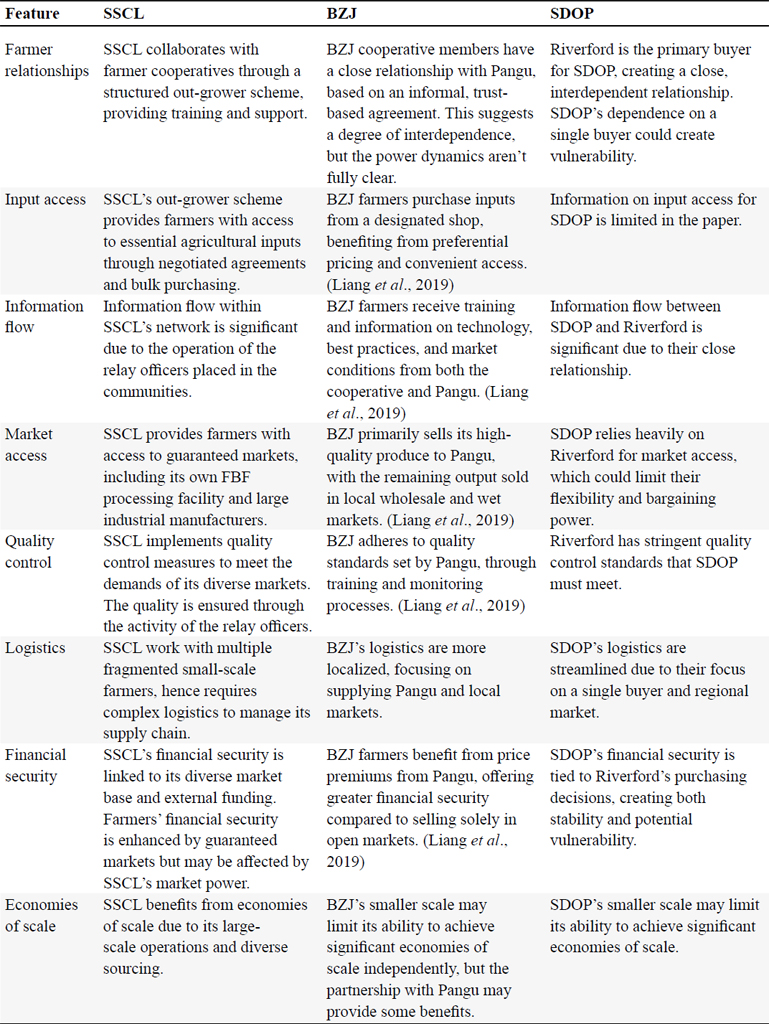
Comparing the relationships between SSCL and its farmer cooperatives, and that of BJZ-Pangu and Riverford Organic Farms Limited and South Devon Organic Producers (Riverford-SDOP thereof) share similarities. All involve collaborations between a larger entity and farmer groups, facilitating market access and support. However, the specifics of these relationships, including the degree of integration and potential power dynamics, vary.
The BJZ-Pangu operates under a unique hybrid model, with Mr. Zhang leading both entities. BZJ, a 120-member cooperative focused on vegetable production, consolidated and redistributed farmland to improve efficiency. Pangu, primarily involved in vegetable distribution, purchases from BZJ members and markets to consumers.
Both SSCL and the Beizhijiang Vegetable Cooperative engage with distinct partners, but their relationships differ significantly in structure, scale, and underlying dynamics. Savannah and Sahel Commodities Limited collaborates with farmer cooperatives through a structured out-grower scheme, providing training, inputs, and market access. SSCL actively supports cooperative development, emphasizing farmer empowerment and sustainable agriculture, by contrast to the BJZ-Pangu, led by the same individual. This close relationship offers potential synergies but raises concerns about cooperative autonomy, equitable benefit distribution, and decision-making transparency (Liang et al., 2019).
Riverford Organic Farms Limited, founded by John Watson, and later run by his son, Guy, is a prominent organic food delivery company in the UK. South Devon Organic Producers is a cooperative of organic vegetable growers based in South Devon, UK. Riverford-SDOP have a close, long-standing relationship, with Riverford being SDOP’s primary buyer. This partnership has enabled SDOP farmers to access markets and add value to their produce while providing Riverford with a reliable source of high-quality organic vegetables (Bailey et al., 2020). Bailey et al. (2020) describe how this relationship is key to SDOP’s participation in the organic food chain. While SDOP supplies other customers, Riverford plays a crucial role in providing market access for the cooperative’s organic vegetables. Table 1 summarises the comparison between SSCL community-based farmer cooperatives and that of BZJ and South Devon Organic Producers and their farmer cooperatives.
In synthesizing the comparative analysis, SSCL’s model stands out for its pragmatic adaptation of cooperative principles to suit the socio-economic realities of smallholder farmers in Ghana. Unlike the more integrated and sometimes centralized structures seen in the BZJ–Pangu and Riverford-SDOP partnerships, SSCL adopts a facilitative rather than directive role, prioritizing farmer autonomy while bridging institutional gaps in market access, training, and logistics. This hybrid model aligns partially with ICA principles but diverges in its approach to equity participation and governance. The analysis reveals that while close buyer-producer relationships can strengthen market access and operational efficiency, they also risk creating dependency or undermining cooperative autonomy. SSCL’s case offers a context-sensitive model that balances external support with farmer independence, pointing to the need for flexible cooperative frameworks in resource-constrained environments.
A detailed comparison of SSCL’s Relationship with community-based farmer cooperatives and the relationship between Riverford and SDOP and the BZJ-Pangu Cooperative is shown in Table 1.
5.2 Out-grower scheme
In many lower-income countries, the midstream segment of agricultural supply chains absorbs 30–40% of value-added costs due to inefficiencies from intermediaries and post-harvest losses. While intermediaries assist with aggregation, transport, and storage, their involvement often inflates costs and slows logistics, and poor post-harvest handling reduces product quality. SSCL addresses these challenges by integrating smallholder farmers directly into its supply chain, reducing intermediary reliance, improving traceability, and streamlining logistics for greater efficiency.
The scheme operates through SSCL’s community-based farmer cooperatives, which serve as formalized groups of smallholder farmers contracted to cultivate specific crops. Farmers receive seeds, fertilizers, and other inputs on credit, repaying with a portion of their harvest.
This input-for-output model secures SSCL’s raw material supply while promoting local economic growth and financial inclusion. The day-to-day operations are anchored by Relay Officers, deployed by SSCL, many of whom are trained by the Ministry of Food and Agriculture, who live within farming communities. They register farmers, geotag and measure plots, and document farmer capacity. Throughout the season, they provide agronomic support, monitor progress, and ensure compliance with best practices. Their presence minimizes loan defaults, curbs misreporting, and enables timely problem-solving.
Building on this structure, SSCL runs a robust monitoring and evaluation (M&E) system combining field-level oversight with centralized data management. Relay Officers submit weekly reports to a digital platform accessible to supply chain and finance teams, tracking metrics such as enrolment, repayment rates, yields, quality compliance, harvest timing, and loss levels. Seasonal review meetings with cooperative leaders use these data to address challenges and adjust operations.
To mitigate risks such as price volatility and loan defaults, SSCL implements several interrelated strategies. Price risk is managed through forward contracting, whereby fixed prices are agreed with farmers at the beginning of each planting season. This provides income predictability for farmers while allowing SSCL to manage procurement costs more effectively. To minimize the risk of loan default, the company employs a group lending model in which loans are issued to cooperatives rather than individual farmers. This model encourages peer accountability and enhances repayment compliance. Input distribution is also staggered in phases, tied to compliance with agronomic recommendations and field performance. Moreover, repayment is made in-kind through harvested produce, which helps shield both SSCL and farmers from liquidity constraints associated with volatile cash markets. SSCL also diversifies sourcing through private farmers and aggregators, buffering against localized supply shocks.
Ghana’s land tenure system, characterized by a dual structure of statutory and customary landholding, presents structural barriers to large-scale commercial farming but offers unique opportunities for engaging smallholder producers. SSCL’s strategy of working within customary tenure arrangements allows smallholders to remain on ancestral lands while integrating into commercial value chains. This alignment with local land systems fosters community trust and promotes long-term supply chain sustainability.
According SSCLs internal reports, over a three-year period, farmers participating in SSCL’s out-grower scheme reported significant income gains, with increases ranging from 30% to over 200%, and an average improvement of approximately 85%. The wide range reflects differences in baseline productivity, input utilization, and crop type across communities. These income improvements were closely associated with reported increases of over 100% in output per hectare, driven by improved agronomic practices, timely input delivery, and technical support provided by Relay Officers. Data collected through annual monitoring exercises and farmer self-reporting highlights not only rising yields and incomes but also reduced post-harvest losses and input costs. Together, these outcomes demonstrate the scheme’s tangible impact in enhancing farmer livelihoods.
5.3 Post-harvest management to ensure business sustainability
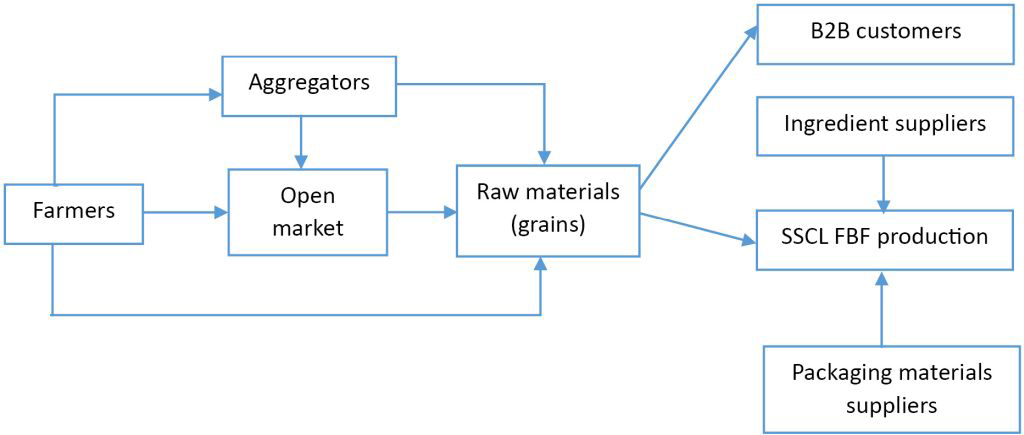
Post-harvest management is central to SSCL’s strategy for ensuring product quality, reducing losses, and sustaining business operations. The process begins in the field and intensifies after produce is collected from farmer cooperatives, out-grower schemes, private farmers, and the open market. SSCL’s approach integrates cleaning, drying, storage, inventory control, and cost-effective transport into a unified system. At the cleaning stage, a network of privately operated grain cleaning centres, supplemented by locally fabricated, electricity-free gravity cleaners, removes chaff, dust, stones, and other impurities while reducing moisture to acceptable levels. Farmers are also provided with tarpaulins to minimize contamination during harvest. These measures enhance marketability, extend shelf life, and improve farmer incomes.
Following cleaning and repackaging into standardized bags, grains are stored at SSCL’s central warehouse under conditions that protect against moisture, pests, and spoilage. Inventory is carefully monitored to ensure timely dispatch to customers. Transportation leverages a backhauling model, which utilize trucks returning empty from delivering goods to neighbouring countries(like Burkina Faso or Mali). These trucks are contracted to carry SSCL’s products south, reducing freight costs by about 50% compared to standard rates. This integrated approach, combining quality control, effective warehousing, and innovative logistics, strengthens SSCL’s supply chain, boosts competitiveness, and maximizes value for farmers while lowering environmental impact through reducing carbon emissions. Training provided through Relay Officers reinforces these practices, equipping farmers with skills in drying, sorting, identification of bad grains and contaminants, and storage to consistently meet SSCL’s quality standards.
6. Assessing economic and nutritional outcomes
The initiatives described in the preceding sections, ranging from community-based sourcing and post-harvest management to financial inclusion and fortified food production, collectively constitute a holistic strategy for reducing the risk of malnutrition in Northern Ghana. Rather than addressing nutrition in isolation, SSCL’s model tackles the interlinked drivers of food insecurity: low farmer incomes, limited access to inputs, high post-harvest losses, weak market connectivity, and poor availability of nutrient-dense foods in rural communities.
By increasing yields and securing stable markets, the out-grower scheme directly boosts household incomes, which in turn expands the economic capacity of rural families to purchase diverse and nutritious foods. These income improvements are complemented by enhanced financial literacy and access to credit through VSLAs, allowing households to better manage seasonal food insecurity and prioritize nutrition-related expenses.
Crucially, SSCL leverages its sourcing infrastructure for both raw commodity aggregation and local value addition through the production of C-Real, a fortified blended food designed to meet the nutritional needs of low-income populations. This dual function of the supply chain, as both an income-generation mechanism and a distribution network for affordable nutrition, creates a closed-loop system where the economic empowerment of farmers directly feeds into improved community health outcomes.
Although no formal feeding trials were conducted to generate clinical data on nutrition outcomes, SSCL’s internal sales records show significant uptake of C-Real in rural communities, many of which suffer from high rates of child malnutrition. The product’s formulation, certified by the Ghana Food and Drugs Authority (FDA), includes 18 essential vitamins and minerals, supporting its credibility as a nutritious food. Furthermore, anecdotal evidence from weighing centres (Child Welfare Clinics) where C-Real was introduced indicates positive responses from nursing mothers, who reported visible improvements in their infants’ overall well-being. These community-level testimonies, while not scientific, were treated as supportive indicators of improved nutrition in areas where conventional data is difficult to collect.
SSCL’s integrated model reframes the fight against malnutrition as both an agricultural and a market systems challenge. By embedding nutrition objectives into the design of its business model, the company moves beyond traditional food aid approaches, offering a sustainable, market-driven pathway for addressing chronic undernutrition in Northern Ghana.
7. Challenges and future directions
Despite its successes, SSCL continues to face several interrelated challenges that must be addressed to ensure long-term sustainability and impact. These include market dependency, infrastructure limitations, land tenure complexity, and governance constraints. One of the most pressing concerns remains market volatility, which exposes SSCL and its network of farmers to global commodity price fluctuations. The company’s reliance on industrial buyers for a substantial share of revenue increases its vulnerability to external shocks. Although SSCL has made progress in mitigating this risk through value addition and product diversification, income instability persists among its farmer base. Internal records from 2022 show that price volatility has resulted in income fluctuations of up to 25% for participating farmers, underscoring the need for more resilient market arrangements, including flexible contract mechanisms and expanded domestic processing capacity.
Operationally, infrastructural deficits continue to impede efficiency, particularly in the more remote farming communities. Poor road networks, limited rural storage facilities, and inadequate last-mile transport services collectively contribute to high post-harvest losses and increased operational costs. Current estimates suggest that these inefficiencies account for approximately 15–20% of SSCL’s total logistical expenses, eroding both farmgate margins and product competitiveness. While the company has invested in a series of strategic storage and aggregation centres in high-production areas, systemic challenges in rural infrastructure remain and will require deeper collaboration with municipal authorities, transport unions, and donor agencies to realize large-scale improvements.
A core aspect of SSCL’s long-term strategy involves scaling its integrated business model to new regions across northern Ghana, with an initial focus on the Upper West and Savannah Regions. The expansion aims to reach an additional 3000 smallholder farmers, particularly women and youth-led farming cooperatives, by 2027. This will be implemented through a combination of mobile-based farmer registration platforms (WhatsApp groups) and partnerships with decentralized departments of MoFA. However, this scaling ambition is not without significant institutional risks. Notably, SSCL must navigate diverse land tenure arrangements that vary across communities. In some districts, land is governed by customary authorities with overlapping claims. Such contexts can hinder access to land for new entrants, and introduce risks of elite capture of fertile lands. Though SSCL has thus far navigated land rights effectively through its cooperative model, scaling into new territories will require formal engagement with traditional authorities.
The cooperative governance model that anchors SSCL’s operations may face increasing pressure as the organization expands. Variations in local governance capacity, power dynamics within cooperatives, and a lack of harmonized policy guidance could compromise organizational cohesion. For example, in districts where cooperative leadership is closely tied to chieftaincy or local political structures, the risk of decision-making becoming non-transparent increases. SSCL is responding to this challenge by developing a governance strengthening package that includes leadership training, and peer learning exchanges between established and newly formed cooperatives.
Technological integration presents both promise and complexity for SSCL’s future development. The company’s efforts to roll out digital payment platforms and mobile-based extension services have achieved moderate success, with adoption rates as high as 65% among youth farmers. However, uptake remains lower among older cohorts, averaging around 30%, indicating a digital divide that could limit the inclusivity of future service delivery models. Addressing this will require blended approaches that combine digital innovations with analogue support systems such as in-person extension agents and community radio programming tailored to older or less literate farmers.
Looking ahead, SSCL’s strategic priorities are anchored in strengthening value chain integration, enhancing farmer resilience, and expanding agro-processing capabilities. The company is actively pursuing the establishment of an agro-processing hub that will serve as a nucleus for value-added production, training on nutritious food processing and employment creation. At the same time, a phased risk management framework is being developed to build resilience against future shocks. Medium-term efforts focus on promoting climate-resilient crop varieties and irrigation technologies, while long-term strategies include institutional engagement with policymakers to reform land governance frameworks and unlock financing for cooperative-led agribusinesses. By embedding foresight into its growth model, SSCL is positioning itself to scale geographically and deepen its impact through inclusive, resilient, and locally grounded systems of production and governance.
7.1 Applicability of the SSCL model in other African countries
The SSCL model offers a contextually grounded, evidence-informed framework that is adaptable to other African countries facing similar agro-economic constraints. Across sub-Saharan Africa, smallholder agriculture is dominant yet constrained by structural issues such as fragmented land tenure, limited access to inputs and credit, high post-harvest losses, weak farmer institutions, and poorly integrated markets. SSCL directly addresses these systemic bottlenecks through an integrated value chain approach that combines cooperative support, contract farming, decentralized processing, financial inclusion, and nutrition-sensitive food production.
A defining feature of SSCL’s model is its pragmatic adaptation of international cooperative principles to fit the realities of under-resourced environments. While the International Cooperative Alliance (ICA, 1995) emphasizes ideals such as democratic governance and member capital control, SSCL facilitates community-based cooperatives through non-equity input provision, technical support, and advisory services. This hybrid governance approach is especially pertinent in countries with weak institutional frameworks and low managerial capital, where conventional cooperative models have struggled to deliver sustainable outcomes. Case studies from Benin, Zambia, South Africa, and Ethiopia highlight similar adaptations, often driven by necessity rather than design (Francesconi et al., 2021; Gwiriri and Bennett, 2020; Mersha, 2018; Yobe et al., 2020).
SSCL’s out-grower scheme incorporates mechanisms that are transferable across regions: Relay Officers embedded in communities provide ongoing agronomic support and data collection; forward contracting stabilizes farm income; and group-based lending strengthens repayment through peer accountability. These mechanisms can be aligned with national agricultural extension services or embedded within donor-funded or private-led value chain programs. SSCL’s innovations in low-cost, off-grid grain cleaning machines and its use of backhauling strategies to reduce transport costs further enhance the model’s applicability in rural, logistically challenged environments.
Importantly, SSCL’s model goes beyond production and logistics to address downstream nutritional needs. Through the development and distribution of C-Real, a fortified blended food certified by Ghana’s Food and Drugs Authority, SSCL integrates nutrition directly into its value chain. This model recognizes that boosting rural incomes alone may not suffice to improve health outcomes unless accompanied by access to affordable, nutrient-dense foods. In rural contexts across Africa where formal feeding trials are scarce and market penetration of fortified foods is limited, SSCL’s approach offers a feasible solution. The company’s use of its sourcing and distribution infrastructure to make C-Real available in high-malnutrition zones, combined with anecdotal reports from Child Welfare Clinics indicating improved infant well-being, underscores the model’s potential for integrated health and agriculture outcomes.
While successful replication would require adaptation to local contexts, including land tenure regimes, policy frameworks, nutritional priorities, and crop profiles, the core elements of SSCL’s model remain broadly relevant. These include inclusive farmer engagement, adaptive cooperative facilitation, efficient logistics, embedded technical support, and value chain integration for nutrition. Taken together, SSCL’s holistic approach presents a replicable and scalable blueprint for African countries seeking to simultaneously enhance food security, rural livelihoods, and public health outcomes.
8. Conclusion
This study illustrates how SSCL offers an innovative, context-specific model for addressing chronic malnutrition and rural poverty in Northern Ghana. By embedding smallholder farmers into a nutrition-sensitive value chain through out-grower schemes, cooperative structures, and multi-level partnerships, SSCL bridges critical gaps in food security and economic empowerment. The company’s integrated approach, anchored in sustainable agriculture, climate-smart practices, and efficient short food supply chains, has contributed to lowering food costs, improving access to fortified blended foods, and enhancing household incomes in vulnerable communities.
The SSCL case underscores the value of enterprise-led solutions in transforming rural food systems. Its success offers important policy implications: first, it demonstrates the feasibility of local sourcing and decentralized processing as strategies to strengthen food system resilience; second, it highlights the need for policy frameworks that support community-based financing mechanisms, farmer training, and equitable market access. Aligning agricultural development policies with such models can foster inclusive growth, reduce dependency on expensive imported fortified foods, and enhance local ownership of nutrition outcomes.
Given the high rates of child stunting, underweight, and wasting in Northern Ghana, far exceeding national averages, scaling such models is not only timely but essential. Policymakers and development actors should consider integrating SFSCs into national nutrition strategies, prioritizing investments that promote local agro-processing enterprises capable of delivering both nutritional and economic dividends. By doing so, they can better align with the broader national objectives of combating food insecurity and malnutrition through locally driven, sustainable interventions that empower rural populations and strengthen regional food systems.
Acknowledgement
The authors gratefully acknowledge the financial support from the National Social Science Fund of China (Grant No. 24BGL106).
References
Abdulai, P.M., C. Ossai, A.N. Ezejiofor, C. Frazzoli, J. Rovira, O.C. Ekhator, C.K. Firempong, and Orish Ebere Orisakwe. 2025. Polycyclic aromatic hydrocarbons burden of meats singed with different fuel sources from abattoirs in Ghana and associated cancer risk assessment. Environmental Health Insights 19(1): 11786302241310842. https://doi.org/10.1177/11786302241310842
Abdul-Rahman, M., S.A. Donkoh, I.G.K. Ansah and I. Yahaya, I. 2019. Contract farming and adoption of improved maize production technologies in Northern Region, Ghana. In M. Nagao, J. Masinja and A. Alhassan (Eds), Sustainable development in Africa: Case studies. Spears Media Press, Lakewood, CO, pp. 121-158.
Acheampong, K. 2022. Ghana’s crop production continues to be devastated by climate change. CNBC Africa, June 13. Available online at https://www.cnbcafrica.com/2022/ghanas-crop-productioncontinuestobedevastatedbyclimatechange/
Antwi, K., C. Lyford and P. Solís, 2023. Rural household food insecurity and child malnutrition in northern Ghana. In: P. Solís and M. Zeballos (Eds) Open Mapping towards Sustainable Development Goals. Springer, Cham, pp. 47–56. https://doi.org/10.1007/978-3-031-05182-1_4
Atanga, R.A. and V. Tankpa. 2021. Climate change, flood disaster risk and food security nexus in northern Ghana. Frontiers in Sustainable Food Systems 5: 706721. https://doi.org/10.3389/fsufs.2021.706721
Aubrée, P., G. Brunori, L. Dvortsin, F. Galli, O. Gromasheva, F. Hoekstra, S. Karner, J. Lutz, L. Piccon and A. Prior. 2013. Short food supply chains as drivers of sustainable development. Available online at http://library.wur.nl/WebQuery/wurpubs/456483
Bayir, B., A. Charles, A. Sekhari and Y. Ouzrout. 2022. Issues and challenges in short food supply chains: a systematic literature review. Sustainability 14(5): 3029. https://doi.org/10.3390/su14053029
BedeOjimadu, O. and O.E. Orisakwe. 2020. Exposure to wood smoke and associated health effects in subSaharan Africa: a systematic review. Annals of Global Health 86(1): 32. March 20. https://doi.org/10.5334/aogh.2725
Chen, A. and S. Scott. 2014. Rural development strategies and government roles in the development of farmers’ cooperatives in China. Journal of Agriculture Food Systems and Community Development 4(4): 35N55. https://doi.org/10.5304/jafscd.2014.044.005
de Jager, I., G.W.J. van de Ven, K.E. Giller and I.D. Brouwer. 2023. Seasonality and NutritionSensitive Farming in Rural Northern Ghana. Food Security 15(2): 381–394. https://doi.org/10.1007/s12571-022-01325-5
Erokhin, V. and T. Gao. 2020. Impacts of COVID-19 on trade and economic aspects of food security: evidence from 45 developing countries. International Journal of Environmental Research and Public Health 17(16): 5775. https://doi.org/10.3390/ijerph17165775
FAO. 1993. The history and current structure of Zambian cooperatives. FAO Report V4595E. FAO, Rome. Available online at http://www.fao.org/3/V4595E/v4595e07.htm
FAO. 2023. The State of food security and nutrition in the World 2023. Urbanization, agrifood systems transformation and healthy diets across the rural-urban continuum. FAO, Rome. https://doi.org/10.4060/cc3017en
FAO. 2024. The state of food security and nutrition in the World 2024 – financing to end hunger, food insecurity and malnutrition in all its forms. FAO, Rome. https://doi.org/10.4060/cd1254en
Francesconi, G.N., F. Wouterse and D. Birungi Namuyiga. 2021. Agricultural cooperatives and COVID19 in Southeast Africa: The role of managerial capital for rural resilience. Sustainability 13(3): 1046. https://doi.org/10.3390/su13031046
Frumence, G., Y. Jin, A.A. Kasangala, M.A. Mang’enya, S. Bakar and B.A. Ochieng. 2023. A qualitative exploration on perceived sociocultural factors contributing to undernutrition among underfives in the southern highlands of Tanzania. International Journal of Public Health 68: 1605294. https://doi.org/10.3389/ijph.2023.1605294
Ghosh, S., K. Tano-Debrah, G.J. Aaron, G.E. Otoo, N. Strutt, K. Bomfeh, S. Kitamura, D.J. Suri, H. Murakami, C. Furuta, D. Sarpong, F.K. Saalia, Y. Nakao, H.S. Amonoo-Kuofi, R. Uauy, R. and Y. Toride. 2014. Improving complementary feeding in Ghana: Reaching the vulnerable through innovative business—the case of KOKO Plus. Annals of the New York Academy of Sciences 1331(1): 76–89. https://doi.org/10.1111/nyas.12596
Gwiriri, L.C. and J. Bennett. 2020. Balancing democracy with service delivery: Power relations, politics and accountability in cooperatives supporting emergent livestock farmers in South Africa. International Journal of the Commons 14(1): 123–138. https://doi.org/10.5334/ijc.973
Headey, D.D., O. Ecker, A.R. Comstock and M.T. Ruel. 2023. Poverty, price and preference barriers to improving diets in sub-Saharan Africa. Global Food Security 36: 100664. https://doi.org/10.1016/j.gfs.2022.100664
Ibikoule, G.E., J. Lee, B. Agalati and R. Gillette. 2023. Development and effectiveness of agricultural cooperatives: Case of maize producer cooperatives (MPCs) in the Republic of Benin. Sustainability 15(5): 4480. https://doi.org/10.3390/su15054480
ICA. 1995. Statement on the cooperative identity. Available online at https://www.ica.coop/en/cooperatives/cooperative-identity
Kansanga, M., P. Andersen, K. Atuoye and S. MasonRenton. 2018. Contested commons: Agricultural modernization, tenure ambiguities and intrafamilial land grabbing in Ghana. Land Use Policy 75: 215–224. https://doi.org/10.1016/j.landusepol.2018.03.047
Koech, K.K., C.G.K. Chege and H. Bett. 2022. Which food outlets are important for nutrientdenseporridgeflour access by the baseofthepyramid consumers? Evidence from the informal Kenyan settlements. Sustainability 14(19): 12264. https://doi.org/10.3390/su141912264
Kukeba, M.W., D. Fallon and P. Callery. 2021. Child feeding in rural northern Ghana: carer’s perceptions of food and their children’s diets. Maternal and Child Nutrition 17(2): e13085. https://doi.org/10.1111/mcn.13085
Lambrecht, I. and S. Asare. 2015. Smallholders and land tenure in Ghana: aligning context, empirics and policy. https://doi.org/10.2139/ssrn.2741867
Lambrecht, I. and S. Asare. 2016. The complexity of local tenure systems: A smallholders’ perspective on tenure in Ghana. Land Use Policy 58: 251–263. https://doi.org/10.1016/j.landusepol.2016.07.029
Liang, Q., G. Hendrikse, Z. Huang and X. Xu. 2014. Governance Structure of Chinese farmer cooperatives: evidence from Zhejiang Province. Agribusiness 31(2): 198–214. https://doi.org/10.1002/agr.21400
Mersha, D. (2018). Financing challenges of smallholder farmers: A study on members of agricultural cooperatives in Southwest Oromia Region, Ethiopia. African Journal of Agricultural Research 12(10): 285–293. https://doi.org/10.5897/AJBM.30FCF4B57153
Nara, B.B., M. Lengoiboni and J. Zevenbergen. 2020. Implications of customary land rights inequalities for food security: a study of smallholder farmers in northwest Ghana. Land 9(6): 178. https://doi.org/10.3390/land9060178
Petruzzelli, M., R. Ihle, S. Colitti and M. Vittuari. 2023. The role of short food supply chains in advancing the global agenda for sustainable food systems transitions. Cities 141: 104496. https://doi.org/10.1016/j.cities.2023.104496
Campbell, R. et al. 2009. Global food security response: West Africa rice value chain analysis, USAID, WashingTon, DC. Available online at https://www.fao.org/sustainable-food-value-chains/library/details/jp/c/274713/
Sanz Cañada, J. and J. Muchnik. 2020. Geographical indications, short food supply chains and sustainability. Sustainability 12(23): 9831. https://doi.org/10.3390/su12239831
UC Davis Department of Food Science and Technology. 2025. Polycyclic aromatic hydrocarbons (PAHs). Available online at https://ucfoodquality.ucdavis.edu/chemicalcontaminants/polycyclicaromatichydrocarbonspahs (accessed 26 July 2025).
Uchezuba, D.I. and World Academy of Productivity Science. 2016. Challenges facing agricultural cooperative system: Analysing participation using a discrete choice model for the southern communal area of Namibia. African Journal of Agricultural Research 11(31): 2860–2870. Available online at https://academicjournals.org/journal/AJAR/article-full-text/EDBA77559812
Wanyama, R., T. Gödecke, M. Jager and M. Qaim. 2019. Poor consumers’ preferences for nutritionally enhanced foods. British Food Journal 121(3): 755–770. https://doi.org/10.1108/BFJ-09-2018-0622
Wudil, A.H., M. Usman, J. Ro sakSzyrocka, L. Pilař and M. Boye. 2022. Reversing years for global food security: a review of the food security situation in subSaharan Africa (SSA). International Journal of Environmental Research and Public Health 19(22): 14836. https://doi.org/10.3390/ijerph192214836
Yobe, C.L., S.R.D. Ferrer and M. Mudhara. 2020. Measuring the financial efficiency of agricultural cooperatives in South Africa: an application of the Simar–Wilson methodology. Agrekon, 59(1): 269–286. https://doi.org/10.1080/03031853.2020.1761845
Appendix
A1. Former cooperatives in Ghana
The evolution of agricultural cooperatives in Ghana reflects broader institutional transformations in West African agriculture. Traditional communal farming practices, particularly the “nnoboa” system, provided the cultural foundation for modern cooperative structures. This indigenous system, characterized by reciprocal labour exchange and shared resource management, continues influencing contemporary cooperative governance mechanisms. The institutional development of cooperatives in Ghana can be traced through distinct historical phases:
Pre-colonial period (before the 1920s):
Dominance of traditional communal farming systems
Informal resource-sharing mechanisms
Family and clan-based agricultural organization
Colonial period (1920s–1957):
Introduction of formal cooperative structures
Focus on export crop production, particularly cocoa
Emergence of state-supervised cooperative models
Post-independence era (1957–1980s):
Integration of cooperatives into national development strategy
Establishment of state-supported marketing boards
Emphasis on cooperative modernization and formalization
Market liberalization period (1980s–present):
Transition to market-oriented cooperative models
Emergence of Farmer-Based Organizations (FBOs)
Integration with global value chains
Contemporary cooperative structures in Ghana demonstrate significant institutional hybridization, combining elements of traditional resource-sharing mechanisms with modern business practices. This evolution has produced diverse organizational forms, ranging from informal farmer groups to sophisticated agribusiness enterprises. Cooperatives have played a significant role in Ghana’s agricultural development, evolving from traditional communal practices to formal organizations. Pre-colonial farmers engaged in collective labour systems like “nnoboa,” demonstrating the ingrained value of shared effort. “Nnoboa,” involves reciprocal labour exchanges for tasks like weeding, based on familial and social ties. These informal systems formed the basis for the later development of formal cooperatives. The introduction of formal cooperatives by the British colonial administration in the 1920s, initially focused on cocoa, marked a shift towards structured agricultural development. Post-independence, Ghanaian governments continued to promote cooperatives as vital for rural development, though their success fluctuated due to changing political landscapes.
The late 1980s saw a shift towards market liberalization, leading to the decline of state-controlled cooperatives and the rise of independent farmer organizations. These FBOs, broader in scope than traditional cooperatives, emphasized income generation and agribusiness development. Significant investments from international donors and government agencies, including the World Bank and the Millennium Development Authority, supported FBO development through training, resource provision, and capacity building. This period also witnessed diversification of FBO activities into production, processing, marketing, and multipurpose groups.
The growth of FBOs, now numbering over 10 000, reflects the recognized importance of collective action in enhancing agricultural productivity and market access. Driven by NGOs, government agencies, and private investors, FBOs engage in a range of activities, from production and processing to marketing and credit access. This growth is linked to decentralization of agricultural services, a reduced state role, and a focus on community-based development, empowering farmers through enhanced bargaining power, resource access, and participation in agricultural value chains. While FBOs represent a significant step towards sustainable agricultural development, they continue to require support to address challenges such as inactivity and structural misalignment.
A2. Stakeholder relationships
SSCL business model encompasses several stakeholders both upstream and downstream. Upstream actors include smallholder farmers, input suppliers, Relay Officers, the Ministry of Food and Agriculture (MoFA), and partner NGOs, while downstream actors include industrial processors, institutional buyers, distributors, and final consumers. While upstream stakeholders primarily influence raw material quality (Figure A1) and supply chain input flow, downstream actors shape market access, pricing dynamics, and product reach. The sustainability of the business is dependent on both the pull and supply sides of the chain.
SSCL’s raw material sourcing channels.
Citation: International Food and Agribusiness Management Review 2026; 10.22434/ifamr.1316
A2.1 Upstream partnerships
SSCL’s relationship with farmers is built on a foundation of mutual benefit, focusing on providing essential resources and support while ensuring a reliable market for their produce. This interaction is structured around a cyclical exchange of goods and information, creating a dynamic and responsive system.
SSCL collaborates with MoFA and NGOs to deliver inputs and training. Farmers provide critical yield and size data, enabling SSCL to optimize logistics. The evolution of SSCL’s supply chain relationships reflects a deliberate strategy to create value through vertical coordination while maintaining flexibility in procurement arrangements. SSCL’s upstream partnerships extend beyond traditional buyer-seller relationships, incorporating elements of knowledge transfer and capacity building. The company’s field officers (Relay Officers), serve as critical intermediaries between farmers and the formal market system. These officers not only monitor production practices and quality standards but also facilitate the transfer of agricultural technologies and market information to farming communities.
SSCL’s procurement system operates on a graduated engagement model, where farmers progress through different levels of integration based on their production capacity and compliance with quality standards and contractual agreements. Entry-level suppliers typically begin with basic production contracts, receiving minimal input support but benefiting from guaranteed market access. As farmers demonstrate reliability and quality consistency, they become eligible for enhanced partnership arrangements, including access to pre-financing for inputs and technical support services. This tiered approach has proven effective in building supplier loyalty while managing procurement risks. The overall structure of SSCL’s upstream stakeholder relationships is illustrated in Figure A2, which maps the flow of goods between farmers, field officers, and the company.
SSCL downstream supply chain.
Citation: International Food and Agribusiness Management Review 2026; 10.22434/ifamr.1316
High-level product acceptability is achieved through a comprehensive quality management system implemented throughout the supply chain, from farm-level production through storage and transportation. Specific quality control measures include regular field inspections, sampling at collection points, and final quality verification at delivery points. This rigorous system has resulted in a low rejection rate (below 5%) while sourcing from a network of over 680 smallholder farmers.
Comparison of SSCL’s relationship with community based farmer cooperatives and the relationship between Riverford and SDOP and BZJ and Pangu Cooperative
Citation: International Food and Agribusiness Management Review 2026; 10.22434/ifamr.1316
A2.2 Downstream partnerships
The company’s downstream partnerships have evolved through strategic alignment with major industrial processors’ requirements. The relationship with Diageo, Guinness Ghana Brewery Limited exemplifies SSCL’s ability to meet stringent quality standards while maintaining sourcing from smallholder producers. The company achieves this through a comprehensive quality management system that begins at the farm level and extends through storage and transportation.
SSCL has established key partnerships with major manufacturers, ensuring reliable markets for the farmers within its network. Diageo-Guinness Ghana Brewery Limited utilizes SSCL-sourced grains in their beverage production, while OLVEA sources soybeans for oil production. These collaborations provide a stable demand for agricultural produce, contributing to the economic stability of the farming communities. In addition to supplying industrial partners, SSCL also produces and sells affordable nutritious fast-moving consumer goods directly to consumers, further diversifying its market reach and maximizing the value derived from its agricultural sourcing network.
SSCL’s innovative approach to market linkages extends to its consumer products division. The development of C-Real, a fortified blended flour product, represents a strategic move to capture value further down the supply chain while addressing nutritional needs in local communities. The product’s formulation, developed in partnership with the University for Development Studies and the University of York, incorporates locally sourced ingredients while meeting international nutritional standards. This initiative demonstrates how supply chain innovation can simultaneously serve commercial and social objectives. The structure of the upstream supply chain is as shown below.
The integration of multiple value chains - from basic commodities to processed consumer goods - has created operational synergies that strengthen SSCL’s market position. The company’s ability to direct raw materials to either industrial customers or its processing operations provides flexibility in responding to market conditions while maintaining stable farmer relationships. This multi-channel approach has proven particularly valuable during periods of market volatility, enabling SSCL to maintain consistent procurement volumes even when individual market segments experience downturns.
A2.3 Impact on stakeholders
Economic empowerment
SSCL’s cooperatives provide farmers access to inputs, fair markets, and training, significantly increasing their productivity and incomes. The savings and loans system within cooperatives further supports financial resilience. The impact of SSCL’s operations extends beyond direct economic benefits, creating multifaceted transformations in farming communities. The integration of smallholder farmers into structured value chains has catalyzed significant changes in agricultural practices and rural livelihoods. Farmers within SSCL’s network have experienced average productivity increases of 35-40% through improved access to inputs and technical support. This productivity gain translates into tangible income improvements, with participating farmers reporting 45–50% higher net revenues compared to non-participating peers in the same regions.
The cooperative savings and loans system, modelled on traditional “susu” practices, has emerged as a particularly effective mechanism for financial inclusion. By formalizing traditional savings practices within the cooperative structure, SSCL has created a sustainable platform for rural financial services. The system’s success is evident in its rapid adoption, with over 80% of cooperative members actively participating in savings schemes. The revolving fund has facilitated over 450 small loans since its inception, with a remarkable 95% repayment rate. This financial infrastructure has proven especially valuable for women farmers, who constitute 35% of active borrowers and historically faced significant barriers to formal credit access.
Environmental sustainability initiatives have yielded measurable improvements in resource management practices. The introduction of climate-smart agricultural techniques, including improved soil conservation methods and efficient water management systems, has reduced input costs while enhancing resilience to climate variability. Monitoring data indicates a 30% reduction in chemical fertilizer usage among participating farmers, achieved through the adoption of organic composting and integrated pest management practices. These environmental benefits extend beyond individual farms, contributing to broader landscape restoration and biodiversity conservation in farming communities.
Social transformation within farming communities is evidenced by changing patterns of leadership and decision-making. The emergence of women leaders in cooperative management positions represents a significant shift in traditional gender roles. Currently, 28% of cooperative leadership positions are held by women, compared to less than 10% in conventional farmer organizations. This increased representation has led to more inclusive decision-making and better attention to household nutrition and children’s education in community development initiatives. Youth engagement has also increased, with 25% of new cooperative members being under 35 years old, reversing the trend of youth migration from rural areas.
SSCL’s impact on local food systems extends beyond primary production to influence consumption patterns and nutritional outcomes. The introduction of fortified food products, particularly through school feeding programs, has created new market opportunities while addressing critical nutritional deficiencies. Regular monitoring of participating schools shows improved attendance rates and better learning outcomes, particularly among girls. The company’s school feeding program now reaches over 200,000 children, providing nutritionally balanced meals that meet international dietary standards while supporting local agricultural production.
Environmental sustainability
By promoting climate-smart practices such as crop rotation and composting, SSCL helps preserve soil fertility. Partnerships with Heritage Seed Company enhance access to improved seed varieties, reducing environmental impact. SSCL’s commitment to environmental sustainability extends beyond farm-level interventions to encompass broader ecosystem management approaches. Through partnerships with Heritage Seed Company and local agricultural research institutions, SSCL has established a comprehensive seed preservation program that maintains indigenous crop varieties while introducing climate-resilient cultivars. This dual approach has resulted in the preservation of 3 local crop varieties and the successful introduction of drought-resistant varieties, enhancing both biodiversity and farm resilience. The program’s success is evidenced by a 10% reduction in crop losses during recent irregular rainfall patterns compared to farms using conventional varieties.
The company’s integrated soil management program, implemented across 75% of member farms, demonstrates measurable improvements in soil health and water retention capacity. Soil testing reveals that participating farms have experienced an average 25% increase in organic matter content over three years, contributing to improved water retention and reduced irrigation requirements. Notably, farms implementing these soil conservation practices have reported improved yields. This success has attracted attention from regional agricultural authorities, leading to the adoption of SSCL’s soil management protocols as best practice guidelines for other agricultural enterprises in the region.
Social benefits
SSCL’s initiatives empower women and youth, offering leadership opportunities and employment through cooperatives and Relay Officer roles: end-of-year tours and shared infrastructure foster community solidarity. The involvement of 57 female farmers in the project, empowered them financially, contributing to changes in cultural norms and gender roles in farming communities.
SSCL’s social impact manifests through multiple interconnected channels that strengthen community resilience and social cohesion. The cooperative’s end-of-year community tours have evolved beyond simple recreational activities to become important platforms for knowledge exchange and network building. These events, attended by an average of 85% of cooperative members, include structured learning components where successful farmers share best practices and innovations. The tours have facilitated the formation of informal mentor-mentee relationships, with experienced farmers providing guidance to newer members, resulting in improved adoption rates of sustainable farming practices among new entrants.
The company’s commitment to gender inclusion has catalysed broader social transformations within farming communities. The 57 female farmers initially involved in the project have become influential community leaders, with 35% now holding positions on local agricultural planning committees. This representation has led to policy changes at the district level, including the allocation of 30% of agricultural development funds to women-led initiatives. Furthermore, female participants report increased decision-making authority within their households, particularly regarding children’s education and farm investments. Data collected through household surveys indicates that 75% of women in the program have gained greater control over farm income, compared to 30% in non-participating households.
Youth participation in agriculture has seen significant growth through SSCL’s structured mentorship program. The program, which pairs young farmers with experienced cooperative members, has retained 80% of its participants in agricultural activities over a three-year period. This success in youth retention stands in stark contrast to the regional trend of rural-urban migration. The integration of modern farming techniques and digital tools has particularly appealed to younger farmers, with 90% of participants under 35 years old adopting precision farming methods and digital marketing platforms.
Corresponding author