Abstract
This study examines the marketing practices and attitudes of a sample of US elderberry (Sambucus spp.) producers and explores the factors influencing market participation and product diversification. Using data from an online survey, a factor analysis and a double-hurdle econometric model were applied. Factor analysis condensed interrelated attitudinal variables about growersâ opinions on challenges in elderberry production into a smaller set of factors to better understand constraints faced by farmers. These factors along with farmersâ socioeconomic characteristics were used as determinants in the hurdle model to analyze market engagement and diversification decisions. Results indicate that 40% of the surveyed farmers did not market their elderberries, while the 60% who did primarily sold berries, followed by propagules and other products. On-farm sales were the primary market outlet for two-thirds of marketers. Major challenges included government regulations limiting medicinal promotion, a shortage of specialized equipment for mechanical harvesting, pests and diseases, and limited market access. Larger, more experienced farmers in the Southeast and Northeast were more likely to market elderberries, while regulatory and market concerns reduced participation. Product diversification was more prevalent among experienced, higher income farmers, and those engaged in farmersâ markets.
1. Introduction
The American elderberry (Sambucus nigra subsp. canadensis) is a deciduous fruit-bearing shrub native to eastern and midwestern North America. While its European counterpart (Sambucus nigra subsp. nigra) has a long history of commercial cultivation in Europe, the American elderberry has historically been less recognized in public and agricultural spheres in the United States (US) (Charlebois et al., 2010). Its commercial production remains relatively small compared to European elderberry (Thomas et al., 2020), but interest in cultivating and marketing American elderberry has grown in recent years. Over the past two decades, elderberries have transitioned into a commercial crop in the US. Historically, Oregon was a major producer of both European and American elderberries (Finn et al., 2008), although production there has since declined. Today, Missouri leads US production, with approximately 607 acres dedicated to elderberry (USDA National Agricultural Statistics Service, 2022).
Recently, elderberry has gained popularity in the US, driven by its perceived health benefits and the growing availability of high-quality processed products (Cai et al., 2024). Studies have highlighted its nutritional value and health-related properties, including antibacterial, antiviral, antidepressant, and antitumor effects (American Botanical Council, 2004; Charlebois, 2007; Lovell et al., 2023; MÅynarczyk et al., 2018; Thomas et al., 2020). This increased interest has led to a surge in demand for elderberry supplements, particularly during the COVID-19 pandemic (Ahl, 2023; NatMed, 2021). Industry projections suggest that the elderberry market will grow to USD 267.89 million by 2027, with an anticipated compound annual growth rate of 6.72% (Technavio, 2023). Despite this growth, the US remains a net importer of elderberries (Volza Grow Global, 2023), presenting significant opportunities for domestic production and marketing.
Despite this evident market potential, little research has focused on US farmersâ marketing attitudes and strategies for elderberries (Mohebalian et al., 2012). Previous work has examined market barriers, such as economies of scale, high startup costs, and steep learning curves (Cernusca and Gold, 2013). Additional challenges include limited access to technical and market information, financial constraints, existing biases, and low awareness of elderberry and its benefits. This study builds on this foundation by exploring US elderberry producersâ marketing practices and attitudes, as well as analyzing the key drivers and barriers to market participation, and product diversification. Studying both aspects provides a comprehensive view of how farmers engage in the market capturing both the decision to participate and the strategies they employ to diversify their product offerings. Product diversification is particularly critical in specialty crop markets, where it can serve as a strategy for managing risks, reaching diverse consumer segments, and enhancing revenue streams (De Roest et al., 2018).
The results of this study provide insights into key factors influencing market participation and marketing breadth among elderberry producers. Understanding these dynamics is essential for realizing the market potential of elderberries, increasing domestic production, and reducing dependence on imports. Moreover, this study contributes to the broader literature on specialty crop marketing by focusing on elderberries, a crop with emerging significance in the US agricultural landscape. It highlights the interplay of market dynamics, producer characteristics, and institutional barriers, offering a foundation for future research on specialty crops with similar market conditions.
The remainder of this study is structured as follows. Section 2 reviews the literature on farmersâ market participation, product diversification, and their determinants, while Section 3 presents the data used along with the empirical methodological approach. Section 4 reports and discusses the results, and Section 5 concludes the paper.
2. Literature review
2.1 Understanding agricultural market participation and product diversification: a theoretical perspective
Engaging in agricultural markets entails farmers selling their produce to gain monetary returns (Dlamini and Huang, 2019). This aligns with the concept of commercialization, making the transition from subsistence farming to a more market-oriented approach (Omiti et al., 2009). Often, small-scale farmers adopt a âproduce first, find the market laterâ philosophy, prioritizing production over pre-analysis of market needs and contractual arrangements with buyers (Blandon et al., 2009). Market-oriented production requires modernized systems, intensive production processes, and farm mechanization (Omiti et al., 2009).
The theoretical frameworks addressing agricultural market participation have extensively examined barriers such as transaction costs, which can deter farmers from engaging in markets. These costs, categorized as fixed or variable (Key et al., 2000), significantly influence both participation decisions and the intensity of engagement. Fixed costs, such as obtaining market information or negotiating contracts, impact the decision to enter markets, while variable costs directly affect the quantity of goods traded (Holloway et al., 2000). Addressing these barriers requires fostering technological progress and investing in private and public resources to improve market access and reduce costs (Barrett, 2008).
Market participation is closely linked to strategies for product diversification, which entails adding new products to existing offerings, either through related or unrelated diversification (Nouteya-Jackson, 2022). In related diversification, synergies between existing and new products often enable better alignment with market demands, improving overall performance (Arte and Larimo, 2022; Nouteya-Jackson, 2022). This strategy helps farmers manage risks by broadening their product range, catering to niche markets, and reducing reliance on single crops or markets (Hamlin et al., 2016; De Roest et al., 2018; Nouteya-Jackson, 2022). Studies show that diversification allows farmers to reduce their reliance on a single crop or livestock product, thus mitigating risks from price volatility and climate uncertainties (Arte and Larimo, 2022; Barbieri and Mahoney, 2009; Bradshaw, 2004; De Roest et al., 2018; KurdyÅ-Kujawska et al., 2021). Research in agricultural economics has shown that farmers engaging in product diversification can achieve greater financial stability and access high-value markets with higher profit margins (Lancaster and Torres, 2019; Torres et al., 2021), For elderberry farmers in this study, as detailed in subsequent sections, diversification typically aligns with a related strategy, leveraging existing expertise and market connections to broaden product offerings.
2.2 Determinants of market participation and product diversification
Shifting from theoretical foundations to empirical analysis, researchers globally have extensively explored the determinants of market participation. In the US crop marketing context, studies have predominantly centered on factors influencing marketing strategies (e.g. marketing contracts) and outlets, such as direct-to-consumer or intermediary channels (Detre et al. 2011; Dong et al. 2019; Hoque et al., 2015; Katchova et al. 2004; Kim, 2016; Low and Vogel, 2011; Plakias et al. 2020). However, relatively few have concentrated on specialty crop marketing (Monson et al., 2008; Popp et al., 2023). Some research in this area has explored opportunities and challenges related to introducing specialty crops, including marketing barriers faced by farmers (Kim, 2016; Stafne et al., 2023).
By contrast, studies analyzing market participation are more common in African agriculture (Adenegan et al., 2012; Belayneh et al., 2019; Burke et al., 2015; Dlamini and Huang, 2019; Haile et al., 2022; Hlatshwayo et al., 2021; Makhura et al., 2001; Mignouna et al., 2015; Mpombo et al., 2022; Musah et al., 2014; Olwande et al., 2001; Omiti et al., 2009; Ouma et al., 2010; Sigei et al., 2014). These studies highlight that socioeconomic characteristics such as education, farm size, farming experience, gender, household income, age, and farm location, and market-related factors are critical determinants of market participation decisions.
Education has shown mixed effects on market participation, with some studies suggesting a positive influence (Dalmini and Huang, 2019; Paul et al., 2021) and others showing a negative association (Haile et al., 2022; Ouma et al., 2010; Hlatshwayo et al., 2021). Farm size, on the other hand, consistently shows a positive relationship (Adanacioglu, 2017; Haile et al., 2022; Hoque et al., 2015; Musah et al., 2014; Osmani and Hossain, 2015). Gender and household income also play significant roles, with male-headed households and higher-income farmers more likely to participate in markers (Haile et al., 2022; Hlatshwayo et al., 2021; Musah et al., 2014; Ouma et al., 2010). However, the effects of age and farming experience are mixed, with both positive and negative findings reported across studies (Adenegan et al., 2012; Belayneh et al., 2019; Haile et al. 2022; Hlatshwayo et al., 2021; Hoque et al., 2015; Paul et al., 2021). Finally, farm location has been identified as a factor influencing market engagement, with Ouma et al. (2010) showcasing it as an important determinant of market participation. Market-related factors, such as marketing outlets and access to transportation and information, also significantly influence participation levels (Dlamini and Huang, 2019; Low and Vogel, 2011).
Product diversification is closely tied to market participation. Studies categorize the drivers of diversification into external and internal variables. External variables include factors beyond the farmerâs control, such as market and information access through extension services and networking (Anosike and Coughenour, 1990; Torres et al., 2021). Internal variables, on the other hand, pertain to farm characteristics, farmerâs demographics, and perceptions (Torres et al., 2021; Lancaster and Torres, 2019).
Market access itself has been identified as a key driver of diversification among specialty crop farmers. Torres et al. (2019) found that the number of markets accessed, and the use of value-added technologies significantly influenced diversification strategies. Transforming specialty crops into value-added products like jams, sauces, or dried goods enables farmers to access additional markets, generate off-season income, and secure price premiums (Izaba, 2021; Torres et al., 2019). Socioeconomic factors, including age, farming experience, gender and education, also shape diversification strategies (Ibrahim et al., 2009; Mishra et al., 2004). For example, women are often more likely to adopt innovative practices (Seuneke and Bock, 2015; Torres et al., 2021), while education enhances the adoption of value-added practices (Mishra et al., 2009). Farm location plays a crucial role, as areas with better market access support the adoption of value-added technologies or products (Dimitri and Oberholtzer, 2009; Torres and Marshall, 2018).
Farm size and income also play significant roles in diversification. Larger, higher income farms benefit from economies of scale, enabling them to diversify into high-value niche markets (De Roest et al., 2018; Lancaster and Torres, 2019). By contrast, medium-sized farms often face challenges accessing both wholesale and direct-to-consumer markets (Kirschenmann et al., 2008; Stevenson et al., 2014). For these farms, diversification becomes a critical strategy for capturing different market segments, managing risk and maintaining profitability. Direct-to-consumer sales also promote diversification, as they allow farmers to leverage customer relationships and direct feedback to tailor and differentiate their offerings (Lancaster and Torres, 2019).
Despite extensive research on market participation and product diversification no studies have specifically addressed the determinants of market participation and product diversification among elderberry farmers. This is a critical gap, given the unique opportunities and challenges elderberry farming presents, including its potential for value-added products and access to niche markets.
3. Data and empirical methods
3.1 Farmer sampling and survey method
The data for this research were collected through an online survey conducted in 2023, targeting elderberry farmers across the US. To ensure ethical standards were met, the survey instrument was reviewed and approved by the University of Missouri Institutional Review Board (IRB), with approval number 2095266. The IRB approval process ensured that the study met all the requirements for informed consent, confidentiality, and voluntary participation.
The survey was hosted on Qualtrics (Provo, UT, USA), a widely used online survey platform, and distributed via a single anonymous link. No personally identifiable information was collected, ensuring respondent anonymity. Participation was entirely voluntary, and respondents who completed the survey were entered into a raffle for a chance to win one of ten $100 Amazon gift cards. To maintain anonymity, participants wishing to be entered into the raffle were asked to provide their email addresses through a separate link, ensuring that their contact information was not linked to their survey responses.
Due to the lack of comprehensive lists of US elderberry farmers, probability sampling was not feasible. As such, a multi-faceted outreach strategy was employed to engage participants. The survey link was distributed via several channels, including email invitations sent to a limited number of farmers whose contact information was obtained from the Midwest Elderberry Cooperative and other networks, posting survey invitation in social media groups dedicated to elderberry growers, and engaging extension educators to share the survey with their contacts. Additionally, participants were encouraged to share the survey with other elderberry farmers they knew, a method known as snowball sampling.
To mitigate the risk of fraudulent or duplicate responses, several security measures were implemented. These included using Qualtricsâs built-in tools for bot detection and duplicate response prevention. The platformâs features such as reCAPTCHA and the RelevantID tool, helped detect and filter out responses likely generated by bots or submitted multiple times by the same individual. Additionally, measures were taken to prevent email scanning software from inadvertently opening the survey link, and search engines were blocked from indexing the survey to avoid unintended exposure.
The survey was active from January to March 2023 and was designed to capture responses exclusively from individuals who had grown elderberries in 2022. To ensure eligibility, the first question of the survey asked respondents whether they had grown elderberries in 2022. Only those who answered âyesâ were allowed to proceed with the survey, while individuals who answered ânoâ were automatically exited from the survey. This approach ensured that only eligible respondents, specifically those with experience in elderberry production and marketing, completed the survey. Qualtrics was set to mark as âcompleteâ responses that did not meet the eligibility criterion, as well as those submitted fully or partially after the survey end date. A total of 119 complete responses were received, but 36 were deemed unusable due to partial completion or non-compliance with the eligibility criterion, resulting in 83 valid responses for analysis.
3.2 Survey design
The questionnaire used to investigate elderberry marketing practices and market participation was part of a comprehensive survey instrument that also examined elderberry farmersâ production and management practices. The survey instrument was pretested with two horticulture specialists from the University of Missouri, each with 25 years of experience in elderberry research and production, as well as an agroforestry specialist from the same university and one from the University of Minnesota, all of whom are involved in a collaborative elderberry grant. Their feedback was instrumental in refining the survey, ensuring that it accurately addressed the research objectives. Following this, the questionnaire was pretested with three elderberry farmers to ensure clarity and relevance. Based on feedback from both the experts and the farmers, several revisions were made to improve the questionnaireâs clarity and ensure its relevance to the study.
For the purposes of this paper, we focus exclusively on the components relevant to our research objectives, namely: (a) elderberry marketing practices, (b) opinions on challenges for investing in elderberry production, and (c) socioeconomic characteristics.
The section on elderberry marketing strategies first asked respondents whether they marketed elderberry products in 2022. If they did, the survey then sought details on the specific products marketed and the marketing outlets utilized. The survey also gathered opinions on challenges related to investing in elderberry production. This was done through a series of 13 statements, where respondents rated the extent to which each challenge affected their operations on a scale from 1 (very low) to 5 (very high). To ensure the relevance and accuracy of the challenges, a thorough review of the relevant literature on elderberry production and marketing, as well as on other specialty crops, was conducted. This review helped identify common challenges faced by elderberry producers and growers of similar crops. These challenges were then formulated into statements, which were further refined based on feedback from both the experts and the pretested farmers. This process ensured that the statements accurately reflected the key challenges faced by respondents, allowing them to rate each challenge according to its perceived impact.
The questionnaire also gathered data on respondentsâ socioeconomic characteristics including education, age, gender, cooperative membership, household income, elderberry acreage, years of experience in elderberry cultivation, farm location, and availability of successor.
Table 1 highlights key socioeconomic features of the sample. The largest age group consists of farmers aged between 45 and 64 years, making up 40% of the respondents. Male farmers represent 58% of the sample. Regarding education, 53% of respondents have a college degree, while 40% hold graduate degrees. In terms of income, 36% of respondents report annual household earnings between $50 000 and $99 999. Additionally, 36% of the surveyed farmers are members of cooperatives. On average, the area dedicated to elderberry cultivation is 3.1 acres, with respondents having an average of about 4 years of experience in elderberry farming. Geographically, most respondents (58%) are located in the Midwest region. Finally, 46% of the surveyed farmers have a designated heir to take over their farm.

Descriptive statistics of socioeconomic characteristics of sampled elderberry farmers (n=83).
Citation: International Food and Agribusiness Management Review 2026; 10.22434/ifamr.1152
3.3 Empirical methods
Our empirical analysis comprises three main components. Initially, descriptive statistics and graphical illustrations are used to evaluate the marketing practices of elderberry producers in our sample. Subsequently, factor analysis is utilized to distil key producer perceptions regarding the challenges in investing in elderberry production. Finally, a double hurdle model is employed to explore the factors influencing elderberry producersâ market participation decisions and their product diversification. In the following sections, more details are provided regarding the use of factor analysis and the double-hurdle model.
Factor analysis
Factor analysis is used in economics to derive a set of uncorrelated variables, particularly when highly intercorrelated variables may lead to misleading results in regression analysis. It serves as a data reduction tool that examines whether a set of variables is related to a smaller number of hypothetical variables (Kim and Mueller, 1978). In this study, it served as an initial step to condense a group of interrelated attitudinal variables (originally 13 statements about growersâ opinion on challenges in investing in elderberry production measured in a five-point Likert scale) into a smaller number of factors. Additionally, it aimed to detect structure in the relationships among these attitudinal variables. By uncovering structural relationships, factor analysis contributes to a better understanding of the constraints faced by the sampled elderberry producers.
The process of factor analysis involves three key steps: (1) extracting factors from a correlation matrix, typically through principal factor analysis, (2) rotating factors, and (3) interpretating factors. For each factor, eigenvalues and factor loadings are computed. Eigenvalues represent the variance captured by a factor, while factor loadings signify the correlation between a variable and a factor. Following Skevas and Kalaitzandonakes (2020) and Hakelius and Hansson (2016), two criteria were utilized to determine a factor solution: ensuring minimum factor eigenvalues of 1.0 and excluding items with factor loadings below 0.60. After identifying and elucidating the factors, Cronbachâs alpha statistics were employed to verify their internal consistency.
Model estimation for market participation and product diversification
Following other studies that sought to analyze farmersâ market participation decision (Dlamini and Huang, 2019; Hlatshwayo et. al, 2021; Olwande and Mathenge, 2011), a modelling approach based on a two-step decision process is used. The first step involves determining whether to participate in the market. The second step, applicable only if the decision to participate is affirmative, entails deciding the number of products to market, which serves as a measure of product diversification. This two-step procedure is modeled using a double hurdle econometric model (Cragg, 1971). This model involves the joint estimation of two equations. Firstly, a binary probability model, functioning as the first hurdle, is utilized to capture the market participation decision. If the initial hurdle is cleared, a truncated count distribution model to capture the degree of product diversification (second hurdle) is estimated. In this study, the binary probability model takes the form of a probit model, while the truncated count distribution model is represented by a zero-truncated count model.
The first hurdle of the double-hurdle model is written as follows:
Citation: International Food and Agribusiness Management Review 2026; 10.22434/ifamr.1152
The second hurdle is formulated as follows:
Citation: International Food and Agribusiness Management Review 2026; 10.22434/ifamr.1152
 is a latent variable that describes elderberry farmersâ decision to participate in a market, yi is the observed market participation decision and takes the value of unity if the respondent markets at least one elderberry product;
  is a latent variable related to product diversification and si is the observed product diversification quantified as the number of marketed products; x and z are vectors of explanatory variables for market participation decision and product diversification respectively;
If the error terms in the above two equations are assumed to be uncorrelated (given all covariates), then the standard errors obtained from individual estimations are valid for statistical inference. However, if this assumption is violated, then the coefficient estimates derived from the two separate regressions above may be biased. The testing process for conditionally uncorrelated errors follows the same methodology employed in the Heckman test for selection bias (Heckman, 1979; Woodridge, 2010; as shown in Burke et al. (2015) and Skevas et al. (2022)). First, the first-stage probit model is estimated and an Inverse Mills Ratio (IMR) around the probability of market participation is predicted. Second, the second stage zero-truncated count model is estimated incorporating the predicted IMR as one of its regressors while assuming conditionally uncorrelated errors.
Although it is not technically necessary for identification, it is a standard practice to impose at least one justifiable exclusion restriction when estimating the second-stage regression. The null hypothesis tested by a standard t-statistic for the coefficient estimate on the IMR is that the first and second-stage errors are conditionally uncorrelated. If the estimate significantly differs from zero, then the null hypothesis is rejected and the model must be re-estimated to conduct valid inference.
The explanatory variables used in the first hurdle of the double hurdle model specification (denoted as x) included factors identified from the factor analysis and socioeconomic characteristics of producer such as age, gender, education level, annual income, cooperative membership, availability of successor, experience in producing elderberries, area under elderberry plantation, and farm location. In the second hurdle model, the marketing outlet (i.e., farmersâ market) was added to the vector of explanatory variables. The selection of these variables was informed by past research on factors affecting farmersâ market participation (e.g., Burke et al., 2015; Dlamini and Huang, 2019; Haile et al., 2022; Ouma et al., 2010), as well as the specific interests of this study and model performance considerations.
4. Results and discussion
4.1 Elderberry marketing practices and challenges
Figure 1 provides an overview of the sampled farmersâ decision to market elderberries. According to the figure, most survey respondents (60%) engaged in marketing elderberries in 2022. Figure 2 shows the types of elderberry products marketed by those farmers who engaged in the market. Berries were the most commonly marketed product, followed by propagules, and other products like juice, jam, and syrup. Figure 3 presents the marketing outlets used by farmers who marketed elderberries. Among these farmers, on-farm sales were the most popular outlet, with 64% of respondents using this channel. The âOtherâ outlets category which includes online sales, retail stores, breweries, and other channels, followed as the second most common outlet, with 36% of farmers using these options. Farmersâ markets were the third most common outlet, with 32% of farmers selling through them. Wineries and grower cooperatives were used by a smaller portion of the respondents, with only 8% utilizing these outlets. Since farmers could select multiple marketing outlets, these percentages reflect overlapping choices rather than a single total. Figure 4 illustrates respondentsâ perceptions regarding proposed challenges that may impact elderberry operations. The top four challenges rated as having a high or very high impact on elderberry operations were government regulations hindering the promotion of the medicinal value of elderberries (26%), the lack of dedicated equipment for mechanical harvesting (23%), pests and diseases (22%), and lack of market access (18%). This result aligns with the findings of Stanek et al. (2019), Kim (2016) and Stafne et al. (2023) which shows that potential challenges in establishing horticulture crops include policy and institutional barriers, lack of information on cultivation and marketing, lack of market access, high labor requirements, lack of mechanical harvesting equipment, and pests and diseases.
Sampled farmersâ decision to market elderberries, 83 respondents, USA, 2023.
Citation: International Food and Agribusiness Management Review 2026; 10.22434/ifamr.1152
Elderberry products marketed by sampled farmers, 50 respondents, USA, 2023. Farmers could choose multiple products. The âOtherâ category includes juice, syrup/syrup kits, wine, jam, jelly, smoothies, mead, berry dyed wool, and pulp.
Citation: International Food and Agribusiness Management Review 2026; 10.22434/ifamr.1152
Marketing outlets for elderberry used by sampled farmers, 50 respondents, USA, 2023. Farmers could choose multiple marketing outlets, reflecting diverse strategies. The âOtherâ category includes online sales (Facebook marketplace/mail orders/Facebook groups/other websites), words of friends and family, retail stores, brewery, fiber festivals, special community events, local processors, herbal tea, Rowleyâs red barn, and Craigâs list.
Citation: International Food and Agribusiness Management Review 2026; 10.22434/ifamr.1152
Perceived effect of challenges of elderberry production and marketing on sampled farmerâs operation, 83 respondents, USA, 2023. The exact question in the survey: âTo what extent do the following potential challenges affect your operation?â
Citation: International Food and Agribusiness Management Review 2026; 10.22434/ifamr.1152
4.2 Factor analysis of attitudinal variables
Factor analysis was used to extract various overlapping statements into key factors that could individually impact market participation and product diversification. The results show three factors underlying the challenges associated with investing in elderberry production, collectively accounting for 64.85% of the common variance. Factor one contributed 26.38%, factor two 22.20%, and factor three 16.27%, indicating that each factor serves as a crucial indicator of farmersâ opinions on the challenges of investing in elderberry production.
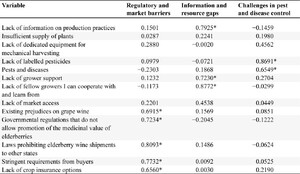
Table 2 presents the factor loadings after oblique oblimin rotation. The first factor exhibits high loadings on statements related to federal regulations restricting elderberry marketing practices, stringent buyersâ requirements, the absence of crop insurance options, and consumer preference for grape over elderberry for winemaking. The second factor is characterized by high loadings on statements emphasizing the need for growersâ support, cooperation with fellow producers, and more technical information on growing elderberries. The third factor showcases high loadings on statements pertaining to pest and disease issues. Consequently, these three factors are termed as regulatory and market barriers, information and resource gaps, and challenges in pest and disease control, respectively.
Rotated factor loadings for perceived challenges of elderberry production and marketing.
Citation: International Food and Agribusiness Management Review 2026; 10.22434/ifamr.1152
Cronbachâs alpha statistics for factors 1 and 2 exceeded 0.7, indicating strong internal consistency, while the alpha value for factor 3 was 0.51. Therefore, only factors 1 and 2 were used in further analysis, as factor 3 did not pass the internal consistency test.
4.3 Regression results of market participation decision and product diversification
Before examining the estimation outcomes, it is essential to note that different regression models were explored using diverse survey variables (see the Appendix, tables A1âA2). Our focus centers on the results derived from the preferred model, which demonstrated the lowest Akaike Information Criterion (AIC) and Bayesian Information Criterion (BIC) scores. Additionally, the appropriateness of the employed modeling approach was validated. More specifically, the probability distribution describing respondentsâ market participation was assessed. The over-dispersion parameter alpha in Table 3 is positive (2.95e-21) and statistically insignificant. This suggests that the Poisson distribution is more suitable than the Negative Binomial distribution for modeling product diversification (Greene, 2008).
Estimation of factors influencing market participation and product diversification of sampled elderberry farmers.
Citation: International Food and Agribusiness Management Review 2026; 10.22434/ifamr.1152
Next, a method similar to Heckmanâs test for selection bias was followed to test for conditionally uncorrelated errors between the two regressions in equations 1 and 2. First, a first-stage probit regression was estimated. After that, the IMR around the probability of participating in the elderberry market was calculated by dividing the normal probability density function by the normal cumulative distribution and was incorporated into the second stage regression as an additional regressor. The coefficient of IMR proved statistically significant at the 5% significance level (coefficient = 0.992, p-value = 0.022), rejecting the null hypothesis of uncorrelated errors or no selection bias. As Heckman (1979) suggests, IMR was included in the second stage regression to correct selection bias. The IMR captures the significant unobserved characteristics that affect the underlying relationship and generates parameter estimates free of selection bias (Bendig and Hoke, 2022; Certo et al., 2016; Heckman, 1979). Therefore, a double-hurdle procedure with Probit and truncated regression was used separately to address the aforementioned limitation.
The results of the double hurdle model estimation are presented in Table 3. For the probit (first hurdle) and zero-truncated Poisson model (second hurdle), the null hypothesis that the model is statistically insignificant is rejected at the 1% and 5% level, respectively.
Results show that perceived regulatory and market barriers exert a negative and significant impact on elderberry growersâ market participation decisions. More specifically, farmers who expressed heightened concerns about regulatory and market restrictions had an 8.8 percentage point lower likelihood of participating in elderberry markets, ceteris paribus. This negative relation can be partly explained by previous literature, which reports that stringent wine laws may restrict the shipment of elderberry wine beyond state borders (Cernusca and Gold, 2013), potentially discouraging elderberry producers from marketing their produce. Additionally, FDA regulations impose market limitations by prohibiting producers from advertising the medicinal benefits of elderberry without clinical trial substantiation (Cernusca and Gold, 2013). Furthermore, prevailing biases towards grape wine and the absence of industry-wide quality standards present challenges for elderberry producers, making it difficult for them to meet buyer requirements (Byers et al., 2022; Cernusca et al., 2012). These factors reflect broader market challenges that are compounded by the economies of scale required to meet stringent buyer demands (Vassalos et al., 2013; MacDonald, 2015). Small-scale producers (like the ones in this sample), who may struggle with the costs associated with scaling up production, are particularly affected by these market pressures. Additionally, while crop insurance options for elderberry farmers are available, some farmers may not be aware of these options (as reflected in the regulatory and market barriers factor), which can deter them from participating in markets due to perceived financial risks associated with crop loss or other uncertainties. This highlights the importance of outreach and education to ensure that growers are informed about available resources, including crop insurance.
Concerning the socioeconomic determinants of market participation, being male exhibits a negative association with the decision to participate in the market. The marginal effect of this variable indicates that the likelihood of males participating in elderberry market is 19.6 percentage points lower than for females. This result contradicts the findings of Haile et al. (2022) but aligns with the results reported by Sigei et al. (2014).
The coefficient for elderberry acreage is positively signed and statistically significant only in the market participation model. Its marginal effect indicates that an acre increase in the land area dedicated to elderberries increases the probability of participating in elderberry markets by 2.5 percentage points, on average. This result is in line with that of Adanacioglu (2017), Osmani and Hossain (2015), Musah et al. (2014) and Hoque et al. (2015), indicating that larger farmers are more likely to market their products, possibly due to a higher surplus of farm products. Moreover, larger farms may possess more resources to overcome barriers to market entry (Adanacioglu, 2017).
Experience in elderberry production exhibits a positive and significant effect on both the market participation decision and product diversification. Its marginal effect suggests that an increase in farmerâs experience in elderberry farming by one year increases the likelihood of market participation by 10.2 percentage points, on average. Similarly, an additional year of farming experience increases the likelihood of engaging in greater product diversification (i.e., marketing a wider variety of elderberry products) by an average of 11.2 percentage points. This result is in line with the findings of Adenegan et al. (2012), Belayneh et al. (2019), Hoque et al. (2015) and Ouma et al. (2010). Makhura (2001) argues that more experienced farmers are better equipped to overcome fixed transaction costs, thus favoring market participation. Farming experience not only reflects the accumulation of expertise in farming but is also linked to repeated transactions, reinforcing trust and building networks necessary for facilitating market information across farmers (Ouma et al., 2010).
Respondents with an annual household income of at least $150 000 had a 32-percentage point lower likelihood of marketing their elderberries. This result contrasts the findings of Musah et al. (2014). One plausible explanation could be that these respondents predominantly derive their income from off-farm employment or the sale of other crops, making them less inclined to compete in a nascent market like that of elderberries. Interestingly, respondents with annual household income between $100 000 and $150 000 had a 176-percentage point higher likelihood of engaging in greater product diversification. Higher-income farmers may be more able to reduce the subjective cost of investing in a new market and the associated risks. This result is in accord with Musah et al. (2014) and Abu (2015).
Using direct marketing outlets like farmersâ market increases the likelihood of engaging in greater product diversification by 115.4 percentage points, on average. One plausible explanation for this phenomenon could be attributed to the predominantly small-scale nature of elderberry farmers, who may encounter challenges in identifying alternative marketing channels due to their limited production scale. By participating in farmersâ market these growers have the flexibility to market a broader range of products, diversifying their offerings and potentially increasing their revenue streams (Lancaster and Torres, 2019), while also mitigating costs related to insurance, advertising, and other marketing aspects (Andreatta and Wickliffe, 2002), making it a preferable market channel for elderberry growers. Additionally, wholesalers often require minimum quantities that smaller farms may struggle to meet, leading them to prefer selling at farmersâ markets where they can more easily offer a range of products to smaller, local buyers (Popp et al., 2023).
In terms of regional dummies, the model indicates that elderberry farmers located in the Southeast and Northeast regions had on average, 37.6 and 30.6 percentage points higher likelihood to market their products, respectively, compared to farmers located in the Midwest. One possible reason for this effect could be that the farmers in these regions can tap into larger customer base with high income as this region comprise of major metropolitan areas (Detre et al., 2011).
5. Conclusions
This study explores the marketing practices and attitudes of a sample of US elderberry growers. It further uses a double hurdle model to assess the factors influencing the sampled farmersâ decisions to engage in the elderberry market and diversify their product offerings.
Results revealed that a considerable portion of sampled farmers (40%) refrained from marketing their elderberries, highlighting variability in market participation within the sample. Among those who did, berries emerged as the most marketed product, followed by propagules and other products (i.e., juice, wine, jam, syrup, etc.). On-farm sales emerged as the primary marketing outlet for these elderberry growers. The perceived challenges most crucial for elderberry operations were identified as government regulations hindering the promotion of the medical value of elderberries, the lack of dedicated equipment for mechanical harvesting, and pests and diseases.
Regression analysis results revealed that various socioeconomic characteristics and perceptions of challenges influence the market engagement and product diversification among sampled farmers. Larger, more experienced farmers, and those located in the Southeast and Northeast regions of the US, were more likely to engage in marketing their elderberries. Conversely, perceived regulatory and market barriers, along with higher household income acted as deterrents to market participation. More experienced, high-income farmers, and those participating in farmersâ markets, were found to engage in greater product diversification, highlighting the importance of diversification in their market strategies.
These findings contribute to a better understanding of the factors associated with market engagement and diversification among sampled elderberry farmers. Additionally, the role of farmersâ markets in enabling these producers to diversify their product offerings suggests that such platforms provide both marketing opportunities and flexibility, which may be particularly relevant for smaller-scale producers facing constraints with other sales channels.
While this study provides valuable insights into the marketing practices and attitudes of US elderberry growers, some limitations should be considered when interpreting the findings. The dataset used in this analysis is relatively small and was not drawn through random sampling, which means the sample may not fully represent the broader population of elderberry growers in the US. As a result, caution should be exercised when extrapolating these findings to the entire industry. The results are specific to the sampled farmers and their circumstances, and future research with larger, more representative samples would help validate and expand upon these conclusions.
Acknowledgement
This work was completed while the first author was a masterâs student in the Division of Applied Social Sciences at the University of Missouri
Conflict of interest
The authors declare that they have no conflict of interest associated with this research.
Data availability
The used data is not publicly available, ensuring the anonymity and confidentiality of the survey participantsâ responses.
Ethical approval
All the individual participants involved in this study were informed and their responses were confidential.
Funding
This research was supported by United States Department of Agriculture, National Institute of Food and Agriculture, Grant No. 2021-51181-35860.
References
Abu, B.M. 2015. Groundnut market participation in the Upper West Region of Ghana. Ghana Journal of Development Studies 12(1â2): 106â124. https://doi.org/10.4314/gjds.v12i1-2.7.
Adenegan, K.O., A. Adepoju and L.O.E. Nwauwa. 2012. Determinants of market participation of maize farmers in rural Osun State of Nigeria. International Journal of Agricultural Economics and Rural Development 5(1): 28â39. Available online at https://www.researchgate.net/publication/265466598.
Adanacioglu, H. 2017. Factors affecting farmersâ decisions to participate in direct marketing: A case study of cherry growers in the Kemalpasa District of Izmir, Turkey. Renewable Agriculture and Food Systems 32(4): 291â305. https://doi.org/10.1017/S1742170516000193.
Ahl, J. 2023. Elderberries are a successful niche crop at a crossroads: go big or stay small. Available online at https://www.stlpr.org/economy-business/2023-07-14/elderberries-are-a-successful-niche-crop-at-a-crossroads-go-big-or-stay-small.
American Botanical Council 2004. The ABC clinical guide to elderberry. Available at: http://abc.herbalgram.org/site/DocServer/Elderberry-scr.pdf?docID=165.
Andreatta, S. and W. Wickliffe. 2002. Managing farmer and consumer expectations: a study of a North Carolina farmers market. Human Organization 61(2): 167â176. https://doi.org/10.17730/humo.61.2.a4g01d6q8djj5lkb.
Anosike, N. and C.M. Coughenour. 1990. The socioeconomic basis of farm enterprise diversification decisions 1. Rural Sociology 55(1): 1â24. https://doi.org/10.1111/j.1549-0831.1990.tb00670.x.
Arte, P. and J. Larimo. 2022. Moderating influence of product diversification on the international diversification-performance relationship: A meta-analysis. Journal of Business Research 139: 1408â1423. https://doi.org/10.1016/j.jbusres.2021.10.037.
Barbieri, C. and E. Mahoney. 2009. Why is diversification an attractive farm adjustment strategy? Insights from Texas farmers and ranchers. Journal of Rural Studies 25(1): 58â66. https://doi.org/10.1016/j.jrurstud.2008.06.001.
Barrett, C.B. 2008. Smallholder market participation: Concepts and evidence from eastern and southern Africa. Food Policy 33(4): 299â317. https://doi.org/10.1016/j.foodpol.2007.10.005.
Bradshaw, B. (2004). Plus câest la même chose? Questioning crop diversification as a response to agricultural deregulation in Saskatchewan, Canada. Journal of Rural Studies 20(1): 35-48.
Belayneh, N.G., B. Tegegne and A. Ademe. 2019. Determinants of smallholder teff producer farmers market participation in Merhabete District, Amhara Region, Ethiopia. International Journal of Agricultural Economics 4(4): 135. https://doi.org/10.11648/J.IJAE.20190404.11.
Bendig, D. and J. Hoke. 2022. Correcting selection bias in innovation and entrepreneurship research: a practical guide to applying the Heckman two-stage estimation. Available online at https://dx.doi.org/10.2139/ssrn.4105207.
Blandon, J., S. Henson and T. Islam. 2009. Marketing preferences of smallâscale farmers in the context of new agrifood systems: a stated choice model. Agribusiness: An International Journal 25(2): 251â267. https://doi.org/10.1002/agr.20195.
Burke, W.J., R.J. Myers and T.S. Jayne. 2015. A tripleâhurdle model of production and market participation in Kenyaâs dairy market. American Journal of Agricultural Economics 97(4): 1227â1246. https://doi.org/10.1093/ajae/aav009.
Byers, P., A. Thomas, M. Cernusca, L. Godsey and M. Gold. 2022. Growing and marketing elderberries in Missouri. Agroforestry in Action. University of Missouri Center for Agroforestry, Columbia, MO. Available online at https://extension.missouri.edu/media/wysiwyg/Extensiondata/Pub/pdf/agguides/agroforestry/af1017.pdf.
Cai, Z., K. Stubblefield, A.L. Thomas and F.X. Aguilar. 2024. From niche to mainstream: US consumer trends and preferences for elderberry products. HortScience 59(12), 1723â1729. https://doi.org/10.21273/HORTSCI18180-24.
Cernusca, M.M., M.A. Gold and L.D. Godsey. 2012. Using the Porter model to analyze the US elderberry industry. Agroforestry Systems 86: 365â377. https://doi.org/10.1007/s10457-012-9546-0.
Cernusca, M.M. and M.A. Gold. 2013. Breaking down market barriers for elderberry growers and producers. In International Symposium on Elderberry 1061, 9 June 2013, pp. 269â277. https://doi.org/10.17660/ActaHortic.2015.1061.30.
Certo, S.T., J.R. Busenbark, H.S. Woo and M. Semadeni. 2016. Sample selection bias and Heckman models in strategic management research. Strategic Management Journal 37(13): 2639â2657. https://doi.org/10.1002/smj.2475.
Charlebois, D. 2007. Elderberry as a medicinal plant. In Issues in new crops and new uses. ASHS Press, Alexandria, VA, pp. 284â292.
Charlebois, D., P.L. Byers, C.E. Finn and A.L. Thomas. 2010. Elderberry: botany, horticulture, potential. Horticultural Reviews 37: 213â280.
Cragg, J.G. 1971. Some statistical models for limited dependent variables with application to the demand for durable goods. Econometrica 39: 829â844. https://doi.org/10.2307/1909582.
De Roest, K., P. Ferrari and K. Knickel. 2018. Specialisation and economies of scale or diversification and economies of scope? Assessing different agricultural development pathways. Journal of Rural Studies 59: 222â231.
Detre, J.D., T.B. Mark, A.K. Mishra and A. Adhikari. 2011. Linkage between direct marketing and farm income: a double-hurdle approach. Agribusiness 27(1): 19â33. https://doi.org/10.1002/agr.20248.
Dimitri, C. and L. Oberholtzer. 2009. Meeting market demand in the organic sector: handlerâsupplier relationships in the face of tight supply. Renewable Agriculture and Food Systems 24(2): 137â145. https://doi.org/10.1017/S1742170509002518.
Dlamini, S.I. and W.C. Huang. 2019. A double hurdle estimation of sales decisions by smallholder beef cattle farmers in Eswatini. Sustainability 11(19): 5185. https://doi.org/10.3390/su11195185.
Dong, H., B. Campbell and A.N. Rabinowitz. 2019. Factors impacting producer marketing through community supported agriculture. PLoS ONE 14(7): e0219498. https://doi.org/10.1371/journal.pone.0219498.
Finn, C.E., A.L. Thomas, P.L. Byers and S. Serçe. 2008. Evaluation of American (Sambucus canadensis) and European (S. nigra) elderberry genotypes grown in diverse environments and implications for cultivar development. HortScience 43(5): 1385â1391. https://doi.org/10.21273/HORTSCI.43.5.1385.
Greene W. 2008. Econometric Analysis, 7th edn. Prentice Hall, Upper Saddle River, NJ.
Haile, K., E. Gebre and A. Workye. 2022. Determinants of market participation among smallholder farmers in Southwest Ethiopia: double-hurdle model approach. Agriculture and Food Security 11(1): 18. https://doi.org/10.1186/s40066-022-00358-5.
Hakelius, K. and H. Hansson. 2016. Membersâ attitudes towards cooperatives and their perception of agency problems. International Food and Agribusiness Management Review 19(4): 23â36. https://doi.org/10.22434/IFAMR2015.0219.
Hamlin, R., J. Knight and R. Cuthbert. 2016. Niche marketing and farm diversification processes: Insights from New Zealand and Canada. Renewable Agriculture and Food Systems 31(1): 86â98. https://doi.org/10.1017/S1742170514000489.
Heckman, J. J. 1979. Sample selection bias as a specification error. Econometrica 47: 153â161. https://doi.org/10.2307/1912352.
Hlatshwayo, S.I., M. Ngidi, T. Ojo, A.T. Modi, T. Mabhaudhi and R. Slotow. 2021. A typology of the level of market participation among smallholder farmers in South Africa: Limpopo and Mpumalanga Provinces. Sustainability 13(14): 7699. https://doi.org/10.3390/su13147699.
Holloway, G., C. Nicholson, C. Delgado, S. Staal and S. Ehui. 2000. Agroindustrialization through institutional innovation Transaction costs, cooperatives and milkâmarket development in the eastâAfrican highlands. Agricultural Economics 23(3): 279â288. https://doi.org/10.1111/j.1574-0862.2000.tb00279.x.
Hoque, M.M., G.M. Artz, D.H. Jarboe and B.J. Martens. 2015. Producer participation in biomass markets: farm factors, market factors, and correlated choices. Journal of Agricultural and Applied Economics 47(3): 317â344. https://doi.org/10.1017/aae.2015.9.
Ibrahim, H., S.A. Rahman, E.E. Envulus and S.O. Oyewole. 2009. Income and crop diversification among farming households in a rural area of north central Nigeria. Agro-Science 8(2). https://doi.org/10.4314/as.v8i2.51102.
Izaba, O.F.R. 2021. Value-added strategies in the specialty crop industry: exploring farmersâ drivers and strategies at the farm level. Masterâs thesis, Purdue University, West Lafayette, IN.
Izaba, O.F.R., A.P. Torres, M.I. Marshall and A.W. Thompson. 2023. Market access and value-added strategies in the specialty crops industry. HortScience 58(1): 32â39.
Katchova, A.L., and M.J. Miranda. 2004. Two-step econometric estimation of farm characteristics affecting marketing contract decisions. American Journal of Agricultural Economics 86: 88â102.
Key, N., E. Sadoulet and A.D. Janvry. 2000. Transactions costs and agricultural household supply response. American Journal of Agricultural Economics 82(2): 245â259. https://doi.org/10.1111/0002-9092.00022.
Kim, J.O. and C. Mueller. 1978. Introduction to factor analysis: What it is and how to do it (No. 13). Sage, Thousand Oaks, CA.
Kim, H.J. 2016. Opportunities and challenges of alternative specialty crops: The global picture. HortScience 51(11): 1316â1319. https://doi.org/10.21273/HORTSCI10659-16.
Kirschenmann, F., G.W. Stevenson, F. Buttel, T.A. Lyson and M. Duffy. 2008. Why worry about the agriculture of the middle? In T.A. Lyson, G.W. Stevenson and R. Welsh (Eds) Food and the mid-level farm: renewing an agriculture of the middle. MIT Press, Cambridge, MSA, pp. 3â20.
KurdyÅ-Kujawska, A., A. Strzelecka and D. Zawadzka. 2021. The impact of crop diversification on the economic efficiency of small farms in Poland. Agriculture 11(3): 250. https://doi.org/10.3390/agriculture11030250.
Lancaster, N.A. and A.P. Torres. 2019. Investigating the drivers of farm diversification among US fruit and vegetable operations. Sustainability 11(12): 3380. https://doi.org/10.3390/su11123380.
Lee, J. and C.E. Finn. 2007. Anthocyanins and other polyphenolics in American elderberry (Sambucus canadensis) and European elderberry (Sambucus nigra) cultivars. Journal of the Science of Food and Agriculture 87(14): 2665â2675. https://doi.org/10.1002/jsfa.3029.
Lovell, S.T., K. Krishnaswamy, C.H. Lin, N. Meier, R.S. Revord and A.L. Thomas. 2023. Nuts and berries from agroforestry systems in temperate regions can form the foundation for a healthier human diet and improved outcomes from diet-related diseases. Agroforestry Systems 97(8): 1347â1360. https://doi.org/10.1007/s10457-023-00858-8.
Low, S.A. and S. Vogel. 2011. Direct and intermediated marketing of local foods in the United States. ERR-128, U.S. Department of Agriculture, Economic Research Service, Washington, DC. Available online at https://ssrn.com/abstract=2114361.
MacDonald, J.M. 2015. Trends in agricultural contracts. Choices 30(3): 1â6.
Makhura, M., J. Kirsten and C. Delgado. 2001. Transaction costs and smallholder participation in the maize market in the Northern Province of South Africa. In: Integrated approaches to higher maize productivity in the new millennium, Proceedings of the Seventh Eastern and Southern Africa Regional Maize Conference. 5â11 February 2002. Nairobi, Kenya.
Mignouna, D.B., T. Abdoulaye, A. Alene, A.A. Akinola and V.M. Manyong. 2015. Drivers of market participation decisions among small-scale farmers in yam growing areas of Nigeria and Ghana (No. 1008-2016-80294). In: International Association of Agricultural Economists (IAAE) 2015 Conference. 9â14 August 2015. Milan, Italy.
Mishra, A.K., H.S. ElâOsta and C.L. Sandretto. 2004. Factors affecting farm enterprise diversification. Agricultural Finance Review 64(2): 151â166. https://doi.org/10.1108/00214660480001160.
Mishra, A., C. Wilson and R. Williams. 2009. Factors affecting financial performance of new and beginning farmers. Agricultural Finance Review 69: 160â179. https://doi.org/10.1108/00021460910978661.
MÅynarczyk, K., D. Walkowiak-Tomczak and G.P. Åysiak. 2018. Bioactive properties of Sambucus nigra L. as a functional ingredient for food and pharmaceutical industry. Journal of Functional Foods 40: 377â390. https://doi.org/10.1016/j.jff.2017.11.025.
Mohebalian, P.M., M.M. Cernusca and F.X. Aguilar. 2012. Discovering niche markets for elderberry juice in the United States. HortTechnology 22(4): 556â566. https://doi.org/10.21273/HORTTECH.22.4.556.
Monson, J., D.Y. Mainville and N.V. Kuminoff. 2008. The decision to direct market: An analysis of small fruit and specialty-product markets in Virginia. Journal of Food Distribution Research 39(2): 1â11. http://dx.doi.org/10.22004/ag.econ.55971.
Mpombo, L., M.J. Chegere and O. Osoro. 2022. Determinants of market orientation and market participation among smallholder rice farmers in Tanzania. The African Review 51: 1â26. https://doi.org/10.1163/1821889X-bja10014.
Musah, A.B., O.A.Y. Bonsu and W. Seini. 2014. Market participation of smallholder maize farmers in the upper west region of Ghana. African Journal of Agricultural Research 9(31): 2427â2435.
NatMed. 2021. Supplement Sales Increase by 17%, Elderberry Takes Top Spot. Available online at https://naturalmedicines.therapeuticresearch.com/news/news-items/2021/november/supplement-sales-increase-by-17,-elderberry-takes-top-spot.aspx.
Nouteya-Jackson, M.S. 2022. Small Business Strategies to Implement Product Diversification Effectively. Thesis, Walden University, Minneapolis, MN.
Olwande, J. and M.K. Mathenge. 2011. Market participation among poor rural households in Kenya. In International Association of Agricultural Economists 2012 Conference, August 18â24, 2012, Foz do Iguacu, Brazil: 126711.
Omiti, J.M., D.J. Otieno, T.O. Nyanamba and E.B. McCullough. 2009. Factors influencing the intensity of market participation by smallholder farmers: A case study of rural and peri-urban areas of Kenya. African Journal of Agricultural and Resource Economics 3: 57â82. http://doi.org/10.22004/ag.econ.56958.
Osmani, A.G. and E. Hossain. 2015. Market participation decision of smallholder farmers and its determinants in Bangladesh. Economics of Agriculture 62(1): 163-179. https://doi.org/10.5937/ekoPolj1501163G.
Ouma, E., J. Jagwe, G.A. Obare and S. Abele. 2010. Determinants of smallholder farmersâ participation in banana markets in Central Africa: the role of transaction costs. Agricultural Economics 41(2): 111â122. https://doi.org/10.1111/j.1574-0862.2009.00429.x.
Paul, U.K., G. Das, M. Das and T. Mathur. 2021. Small growersâ direct participation in the market and its impact on farm income. Journal of Agribusiness in Developing and Emerging Economies 11(3): 241â254. https://doi.org/10.1108/JADEE-05-2019-0067.
Plakias, Z.T., I. Demko and A.L. Katchova. 2020. Direct marketing channel choices among US farmers: evidence from the Local Food Marketing Practices Survey. Renewable Agriculture and Food Systems 35(5): 475â489. https://doi.org/10.1017/S1742170519000085.
Popp, M., G. Mahamba, J. Thompson, T. Malone and J. Popp. 2023. Marketing strategy selection for small-scale fruit and vegetable growers: lessons from the Mid-Southern United States. Journal of Food Distribution Research 54(3): 78â101. http://dx.doi.org/10.22004/ag.econ.339708
Seuneke, P. and B.B. Bock. 2015. Exploring the roles of women in the development of multifunctional entrepreneurship on family farms: an entrepreneurial learning approach. NJAS: Wageningen Journal of Life Sciences 74(1): 41â50. https://doi.org/10.1016/j.njas.2015.07.001.
Sigei, G., H. Bett and L. Kibet. 2014. Determinants of market participation among small-scale pineapple farmers in Kericho County, Kenya. MSc thesis, Egerton University, Njoro. http://dx.doi.org/10.22004 /ag.econ.243452.
Skevas, T. and N. Kalaitzandonakes. 2020. Farmer awareness, perceptions and adoption of unmanned aerial vehicles: Evidence from Missouri. International Food and Agribusiness Management Review 23(3): 469-485. https://doi.org/10.22434/IFAMR2019.0151.
Skevas, T., R. Massey and J. Grashuis. 2022. Farmer adoption and intensity of use of extreme weather adaptation and mitigation strategies: evidence from a sample of Missouri farmers. Climatic Change 174(1â2): 18. https://doi.org/10.1007/s10584-022-03439-3.
Stafne, E.T., T. Blare, B. Posadas, L. Downey, J. Anderson, J. Crane, R. Gazis, B. Faber, D.G. Stockton, D. Carrillo, J.P. Morales-Payan, M. Dutt, A. Chambers and D. Chavez. 2023. Survey of US passionfruit growersâ production practices and support needs. HortTechnology 33(4): 357â366. https://doi.org/10.21273/HORTTECH05240-23.
Stanek, E.C., S.T. Lovell and A. Reisner. 2019. Designing multifunctional woody polycultures according to landowner preferences in Central Illinois. Agroforestry Systems 93: 2293â2311. https://doi.org/10.1007/s10457-019-00350-2.
Technavio. 2023. Elderberry Market by Application, Distribution Channel, and Geography â Forecast and Analysis 2023â2027. Available online at https://www.technavio.com/report/elderberry-market-industry-analysis.
Thomas, A.L., P.L. Byers, P.L. Vincent and W.L. Applequist. 2020. Medicinal attributes of American elderberry. In: Ã. Máthé (Ed.) Medicinal and Aromatic Plants of North America 6. Springer, Cham, pp. 119â139. https://doi.org/10.1007/978-3-030-44930-8_5.
Torres, A.P. and M.I. Marshall. 2018. Identifying drivers of organic decertification: An analysis of fruit and vegetable farmers. HortScience 53(4): 504â510. https://doi.org/10.21273/HORTSCI12792-17.
Torres, A.P., S. Philocles, O.F. Rodriguez and E.J. Velasco. 2021. Characterizing crop diversification in the US specialty crop industry. Journal of Food Distribution Research 52: 1â23.
USDA National Statistics Service. 2022. 2022 census of agriculture. Available online at https://www.nass.usda.gov/AgCensus/.
Vassalos, M., W. Hu, T.A. Woods, J. Schieffer and C.R. Dillon. 2013. Fresh vegetable growersâ risk perception, risk preference and choice of marketing contracts: a choice experiment. In Southern Agricultural Economics Association 2013 Annual Meeting, February 2â5, 2013, Orlando, Florida: 142506.
Volza Grow Global. 2023. United States elderberry imports. Available online at https://www.volza.com/p/elderberry/import/import-in-united-states/.
Woodridge, J.M. 2010. Econometric analysis of cross section and panel data, 2nd edn. The MIT Press, Cambridge, MA.
Appendix
Estimation of determinants of market participation of sampled elderberry farmers.
Citation: International Food and Agribusiness Management Review 2026; 10.22434/ifamr.1152
Estimation of determinants of product diversification of sampled elderberry farmers.
Citation: International Food and Agribusiness Management Review 2026; 10.22434/ifamr.1152
Summary statistics of additional predictors included in the product diversification regression (Table A2) (n=50).
Citation: International Food and Agribusiness Management Review 2026; 10.22434/ifamr.1152
Survey Questionnaire
Citation: International Food and Agribusiness Management Review 2026; 10.22434/ifamr.1152
THANK YOU
If you have questions about the research or any part of the questionnaire, you may contact: Dr. Teo Skevas by e-mail at skevast@umsystem.edu
Corresponding author: