Abstract
In times of crisis, a stable and secure food supply is essential. Despite Germanyâs status as a developed economy with decades of food security, recent crises have highlighted the vulnerability of the national food supply chain. This explorative study aims to provide an overview of the current state of research on food emergency preparedness in Germany along the value chain. It also uses the example of livestock production in Germany to illustrate the challenges at the level of primary agricultural production during a blackout. A semi-systematic literature review was conducted, which identified ten relevant scientific articles and ten national security research projects. While the majority of these studies focus on the middle and downstream parts of the supply chain, primary production and upstream businesses are rarely examined. In addition, eleven expert interviews were conducted with livestock experts who identified ventilation, water and feed supply as time-critical and vulnerable areas at both the farm and supply chain levels. The results of this paper bring together scientific work and practical expert knowledge from different areas of crisis management and agricultural science, highlighting the need for future research on crisis resilience of primary production and the early stages of the value chain.
1. Introduction
One crucial factor in surviving a heavy crisis situation is a sufficient, reliable and secure food supply. The causes of such crises can vary, ranging from extreme weather events, to technical and man-made failures like cyber and terrorist attacks (Brinkmann et al., 2010; Petermann et al., 2011). However, all these causes share a common impact: they potentially affect large parts of public life and critical infrastructures (CI),1 including the food sector itself (BBK, 2021a).
Despite a high level of food security in Germany since the end of the Cold War (Gerhold et al., 2019b), recent crises such as the COVID-19 pandemic and the Russian invasion of Ukraine have demonstrated how quickly food supply disruptions can occur even in stable economies like Germany and Europe (FAO, 2023; Jagtap et al., 2022; Liu, 2020; Nakamura et al., 2024; Rivera-Ferre et al., 2021).
In this context, CIs can also be considered as supply chains (SC) whose products and services make a significant contribution to society (Schätter et al., 2015). To ensure food security during times of crisis in the short and medium term, it is important to maintain the functionality of these SC at all stages. Within the food supply chain, primary agriculture production, such as livestock farming and connected up- and downstream operations, form the base of this sector. All these operations have in common that they are highly dependent on a functional energy supply (Kraatz, 2012; Martinho, 2016).
The threat of an energy shortage in 2022 due to a lack of Russian gas supplies has raised the question of how the German livestock sector is prepared or positioned in the event of an unexpected crisis. This is especially relevant, given the sectorâs significant contribution to the national food supply: In 2020, about 168,000 farms in Germany kept about 11 million cattle, 26 million pigs and 186 million laying hens, broilers, and turkeys (BMEL, 2022). Animal-based foods such as meat, milk, dairy products and eggs account for around 31% of the total calorie supply of the German population. At the same time, foods of animal origin are responsible for around 62% of the national protein supply (FAO, 2021). In addition, high self-sufficiency rates for beef (102%), pork (142%) and poultry meat (105%) as well as fresh milk products (115%), cheese (128%), eggs and egg products (76%) further underline the potential and importance of livestock farming for the national food supply (BLE, 2024).
The research focuses on the German food chain and the livestock sector in particular for several reasons. First, the German âFood Security and Emergency Preparedness Actâ (ESVG), which came into place in 2017, formally regulates responsibilities, authorizations and powers in the area of food production and supply during heavy crisis situations (ESVG, 2017). While the European Commission is aiming to expand international cooperation within the Member States of the European Union in the area of food emergency preparedness in the future (European Commission, 2021), the area of food emergency preparedness as part of emergency legislation still falls under the national jurisdiction of federal, state and local governments. According to the European Commission, nations within the EU are therefore primarily responsible for protecting their CI themselves (VoÃschmidt and Karsten, 2019). While doing so, almost every nation, even within the EU, has its own approach in the context of emergency food supply (Gerhold et al., 2019a). An international comparison of the processes to Germany is therefore only possible to a very limited extent, due to the different approaches related to resilience (Hansen et al., 2020).
The aim of this exploratory paper is to analyze the impact of such a severe crisis situation on the food chain in general and on livestock farms in particular. In addition to the impact of crisis situations on the food chain, this study examines the different effects of a power outage on German livestock farming in the course of a second step. Based on the results of a semi-systematic literature review, the study employs a semi-structured questionnaire to interview eleven livestock experts from the cattle, pig, and poultry sectors. In order to operationalize the event of such a heavy crisis situation for the expert interviews, the scenario of a blackout was assumed. The blackout scenario is suitable for this work as it occurs unexpectedly, without warning, and affects many companies at the same time. Therefore, this scenario not only tests the immediate crisis response of companies, but also reveals the critical dependencies along the entire food chain. In this study, a blackout scenario was used in which a sudden and unforeseen power outage affects large parts of Germany and lasts three to seven days.
This paper addresses the following research questions (RQs):
(1) What is the current state of research on securing the food supply in the event of a crisis situation at the different stages of the German food SC?
(2) Which areas and processes of daily production on German livestock farms are particularly vulnerable in the event of a blackout?
(3) What upstream and downstream dependencies exist in German livestock production that could lead to a collapse of the animal-based food sector in the event of a blackout?
This study contributes to published research on crisis and disaster management as well as on agricultural economics in different ways. First, it provides an overview and summary of the current state of research in this topic. Second, the study aims to identify possible bottlenecks in typical production processes that could lead to a disruption of the food chain during a blackout. Third, it provides a starting point for the development and evaluation of further resilience increasing measures of livestock farms and related upstream and downstream businesses in crisis situations.
2. Conceptual background
The following chapter presents the conceptual background of this study. Using the concepts of resilience, Business Continuity Management and Supply Chain Continuity Management, the results are critically evaluated.
2.1 Enhancing critical infrastructure resilience
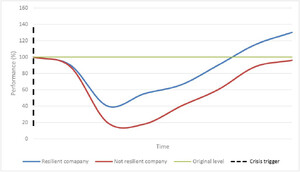
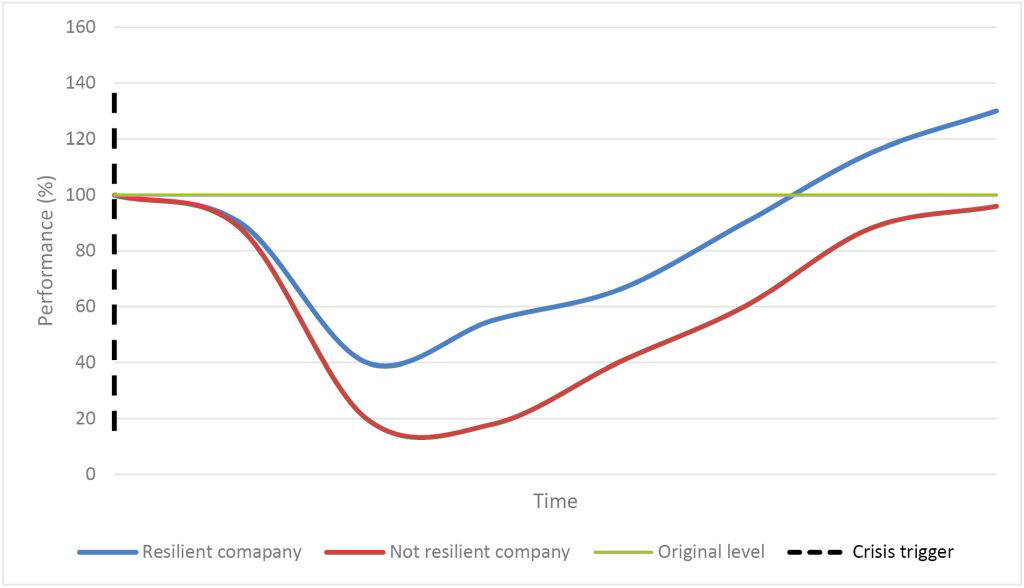
The basic concept of âresilienceâ describes the ability to cope with unknown situations or disruptions to the normal state, to adapt and recover without permanent damage, and to return to a functional state (Walker et al., 2009). The term is widely used in different fields, such as psychology, climate research, or ecology (Holling, 1973; Reid and Botterill, 2013; Southwick et al., 2014). In recent years, the concept of resilience has been steadily expanded and increasingly applied to the field of agricultural economics (Meuwissen et al., 2018; Stone and Rahimifard, 2018). As shown in Figure 1, in the event of a spontaneous crisis, resilient systems and companies are able to reduce the extent of damage and recover more quickly than less resilient companies. In addition, they are able to achieve at least the same or similar level of performance in the long term compared to the initial state.
Resilience in the agro-economic context often has three dimensions: Robustness, adaptability, and transformability. While the transformability dimension often focuses on medium- and long-term aspects like the attitude to innovation, the robustness and adaptability dimensions focus on spontaneous and short-term ones, like ecological resources and human capital (Meuwissen et al., 2018; Meuwissen et al., 2019).
In the field of crisis and disaster research and in relation to critical infrastructure, the concept of resilience describes the ability of infrastructure operators to maintain the functionality of their core business in the face of sudden and unexpected shocks (Tendall et al., 2015; VoÃschmidt and Karsten, 2019). CI operators must be able to provide a high level of robustness and adaptability so that business can continue without interruption in the event of a crisis (Rose and Krausmann, 2013). Therefore, this paper focuses on the aspects of robustness and adaptability, as these two dimensions were addressed by the second RQ (vulnerable areas and processes on farms) and third RQ (upstream and downstream dependencies of farms). Based on these two dimensions, the following three conditions must be met by all members at all stages of the value chain:

Performance of resilient and non-resilient companies over time. Source: Own compilation based on Tendall et al. (2015).
Citation: International Food and Agribusiness Management Review 29, 1 (2026) ; 10.22434/ifamr.1203
First, the individual enterprise must be resilient enough to withstand the crisis without being permanently disrupted, ensuring it can continue to contribute to the value chain at all (robustness). A total breakdown would be the case, for example, if a farmâs livestock herd were to die as a result of a ventilation failure. Secondly, companies need to be able to accept changing circumstances and find alternative solutions (adaptability). An example in the context of a livestock farm could be the sourcing of alternative feed if the local compound feed manufacturer is unable to produce due to consequential damage caused by the power outage. This business as usual, or at least the new status, needs to be maintained at least until other medium- or long-term solutions can be found, such as importing feed from other countries or regions not affected by the blackout. Thirdly, and focusing on the entire value chain, it is important to ensure that key bottlenecks and companies with a large market share (i.e., slaughterhouses or milk processors) continue to operate.
2.2 Business continuity management
The concept of business continuity management (BCM) is often used to achieve an increasingly resilient critical infrastructure (Fisher et al., 2017; Merz et al., 2009; Ruoslahti, 2020). It consists of a four-phase cycle: Plan, Do, Check and Act (ISO 22301, 2019). The first step in BCM (Plan) is to establish BCM in the organization and define an implementation strategy. The second step (Do) is to gather information about the affected business areas in the event of a crisis situation. The Business Impact Analysis (BIA) plays a key role here. The goal of BIA is to identify and assess vulnerable and time-critical processes and areas of the business. In principle, BIA can be performed both quantitatively and qualitatively. However, qualitative scenario analysis in form of interviews and workshops is often used in this context (Zsidisin et al., 2005). Defining scenarios can help to determine the scope and duration of the crisis. In addition, this phase is used to develop strategies and implement measures to mitigate the negative effects of a crisis (Merz et al., 2009). In the third phase (Check), the results are documented, adjustments are made and improvements are implemented. In the fourth phase (Act), the actions taken are audited and reviewed. BCM is a dynamic process, meaning that once a phase is completed planning for a new phase begins in order to quickly adapt to changing circumstances.
BCM enables private sector companies and CI operators to operationalize the concept of resilience for their own business and adapt it to their specific characteristics (Matteis et al., 2023). The goal of BCM is to take a holistic approach that addresses the various risks in the business environment (Fisher et al., 2017). The use of BCM to increase the resilience of critical infrastructure has been discussed in the literature (VoÃschmidt and Karsten, 2019). In particular, the area of decision support in and during crisis situations is often associated with BCM (Merz et al., 2009; Schätter et al., 2015).
In the second part, this study focuses on conducting a BIA for the specific case of livestock production and in the event of a blackout. In this context, the complexity and diversity of disruptions affecting livestock production in the event of a blackout are demonstrated. Moreover, this study provides a starting point for further research on BCM in livestock production.
2.3 Supply chain continuity management
Closely related to BCM, but receiving comparatively little attention in the literature, is the concept of supply chain continuity management (SCCM), which can also be understood as a subcategory or combination of BCM and classic Supply Chain Management (Blos et al., 2015; Zsidisin et al., 2005). BCM takes a holistic approach and focuses on the enterprise and its internal processes. SCCM focuses specifically on the continuity of the supply chain and a smooth interaction of the upstream and downstream areas in which a company is involved (Azadegan et al., 2020). The goal of SCCM is to avoid supply shortages and, if necessary, to develop alternatives that can be used in the event of supply failure.
The procedure and process of SCCM is similar to that of BCM, which Blos et al. (2010, 2015) describe as a multi-stage process. As with BCM, BIA is the central element of SCCM. Unlike BCM, however, SCCM does not focus on internal processes, but on suppliers and service providers with whom the organization has regular contact. As far as possible, all external partners, regardless of their importance to the various departments, should be classified according to the risk of failure and the possible consequential damage to the company. The next step is to identify suppliers and service providers that are particularly important to the organization, for example, because they are exposed to the same risks or because they are the only possible partner for the organization. Similar to BCM, plans and measures must then be put in place to ensure that the required supplies and services are available even in crisis situations (Kildow, 2011). This may include, for example, entering into separate contracts, creating alternative procurement channels, conducting supplier checks and audits, and planning and conducting exercises and tests. Like BCM, SCCM is a dynamic process that is constantly reviewed and evolving. The results and lessons learned from real-world exercises and incidents should be used to further adapt SCCM.
3 Methodology
This study combines the two different qualitative methodological approaches of a semi-systematic literature review and a semi-systematic expert interview. In a first step, this paper aims to analyze the current state of research on securing food supply in the event of a crisis situation at the different stages of the German food value chain (RQ 1). Based on the identified research gap, in a second step this paper uses an exploratory approach by taking an in-depth look at the challenges faced by German livestock farms during a blackout (RQ 2). In addition, it examines the upstream and downstream dependencies associated with these challenges (RQ 3).
3.1 Literature review
A semi-systematic literature review was conducted to answer the first RQ (Snyder, 2019). The strengths of this method compared to systematic literature reviews lie in its greater methodological flexibility and broader content focus. Unlike systematic reviews, which aim to provide a complete and detailed synthesis of existing literature (Sutton et al., 2019), semi-systematic reviews are designed to offer a general and interdisciplinary overview of a complex research area (Snyder, 2019). This approach is particularly suitable for broad and interdisciplinary research questions and fields (Baumeister and Leary, 1997; Wong et al., 2013). This approach was especially appropriate since results were expected from different parts of the supply chain and different disciplines, such as agricultural economics, crisis and disaster management, logistics, and veterinary science. Additionally, the inclusion and exclusion criteria for articles are less strict than in a systematic review, allowing for a wider range of relevant studies to be considered (Booth et al., 2021). Furthermore, it is particularly useful for deriving further research needs from the overview gained. Often, this form of review is followed by an additional qualitative analysis to further explore identified research gaps and gain more detailed insights into the topic analysis (Cantelmi et al., 2021; Wong et al., 2013).
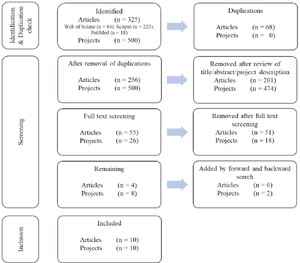
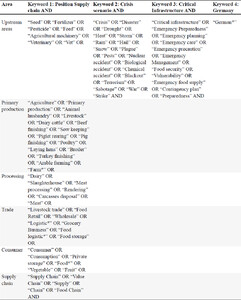
The semi-structured approach allows us to deviate from the strict procedures of a purely systematic review. The entire literature search process was documented in a Preferred Reporting Items for Systematic Reviews and Meta-Analyses (PRISMA) flowchart, as shown in Figure 2 (Moher et al., 2009). To ensure that the article search process was structured, transparent, and reproducible, a search was conducted using the keywords listed in Tables A1 and A2 in the Appendix. These terms were combined with the Boolean operators âANDâ and âORâ such that one term from each of the four listed categories had to be present. This search was carried out in the databases of Scopus, Web of Science, and PubMed. Due to the strong national focus of this work on Germany, the search was conducted in both English and German.
The results obtained were then adjusted for duplicates and screened for suitability based on the titles, abstracts, and full texts (Page et al., 2021). To enhance the comprehensiveness of this review, a forward and backward search was performed on the relevant articles identified. This involved screening the reference lists of the identified articles (backward search) and examining new articles that cited these articles (forward search) (Webster and Watson, 2002). This process enabled us to identify additional relevant articles that were not captured in the initial keyword search.
In addition to the keyword search, the approach was extended by manually screening the German National Security Research database2 for projects related to food production. These projects were then reviewed for associated journal publications, which were added to the list of individual publications. In total, ten articles and ten projects were included in this paper.
3.2 Expert interviews
Semi-structured expert interviews were used to answer the second and third RQ. This methodological approach allowed us to gain in-depth insights into the personal perspectives and experiences of experts from the German cattle, pig, and poultry sectors (Flick, 2014; Helfferich, 2014). The participants were advisors from conventional or organic livestock farming or from farm consulting services (Table A3 in the Appendix). Based on their professional expertise, the consultants interviewed were able to develop a comprehensive perspective on multiple farms and abstract from the specific conditions of individual farms (Helfferich, 2014; Przyborski and Wohlrab-Sahr, 2008). A total of eleven experts were interviewed online via Webex between November 28 and December 16, 2022. The length of the interviews varied between 48 minutes and 143 minutes. The participants were selected based on years of professional experience and specific knowledge of animal husbandry methods. The experts were recruited using the non-probability method of snowball sampling (Naderifar et al., 2017; Parker et al., 2019). Contacts with employees at the German Ministry of Food and Agriculture (BMEL) initiated the snowball sampling process.
PRISMA flowchart of the scoping review. Source: Own compilation.
Citation: International Food and Agribusiness Management Review 29, 1 (2026) ; 10.22434/ifamr.1203
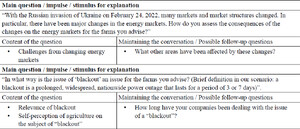
Expert statements provide a comprehensive overview of regional structures, but may vary within the expert group. To ensure comparable results, this study used an interview guideline (Helfferich, 2014) which is listed in Appendix 4. The interviewees were informed in advance of the specific interview topics to ensure that they were well prepared and able to conduct focused interviews. To make it easier for the experts to answer the interview questions, the interview was based on the hypothetical scenario of a sudden, widespread power outage (blackout) lasting three to seven days, affecting large parts of Germany (Kosow and GaÃner, 2008).
The interviews were conducted via video calls, recorded, transcribed anonymously and analyzed using qualitative content analysis according to Mayring (2015) with the help of MAXQDA software. Categories were initially formed deductively and supplemented inductively during the analysis. The text segments were then assigned to the categories by both authors. In case of discrepancies between the two authors, the relevant passages were reassessed together and assigned to a category. A total of 16 main categories and 24 subcategories were identified. This study presents six main categories and 17 subcategories, all directly aligned with the research questions (Table A4 in the Appendix).
4 Results
This chapter presents the results of the semi-structured literature review as a first step. The aim here is not to provide a detailed discussion of the articles, but to give an overview of the scope and range of the research areas covered. An interim conclusion will then summarize the findings to this point. In a second step, the results of the expert interviews are presented. These detailed and specific insights into the challenges of livestock production are used as examples to illustrate the complexity that must be taken into account in order to pursue a holistic approach to increasing the resilience of CI food systems.
4.1 Scientific articles and security research projects
Scientific articles
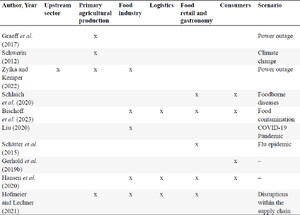
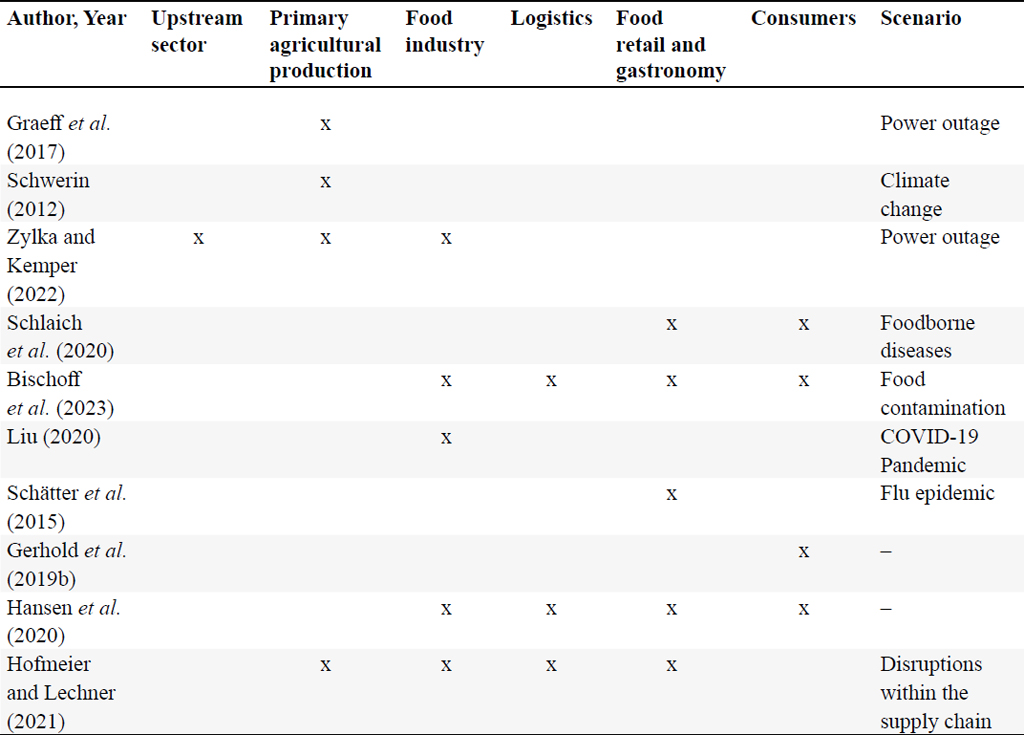
The semi-structured literature review identified a total of ten articles from academic journals that met the listed criteria. Table 1 provides an overview of the articles, the areas of the value chain covered and the scenarios used. The most striking result of the literature review is that, despite using the listed keywords, only one scientific article simultaneously addresses the issues of food security and primary agricultural production in crisis situations (see Hofmeier and Lechner, 2021). In the remaining nine articles listed, the connection between these two areas is only sporadically emphasized, if at all.
Scientific publications and supply chain levels covered
Citation: International Food and Agribusiness Management Review 29, 1 (2026) ; 10.22434/ifamr.1203
Source: Own compilation.As shown in Table 1, eight of the ten articles identified use scenario analysis or analyze an acute (climate change) or historical (Covid-19) crisis. Two articles each deal with power failure or blackout and food contamination or traceability of food contamination. Other scenarios include supply chain disruption and a flu epidemic.
Three of the articles listed focus on livestock production. While the first one of these three articles focuses on the impacts of climate change on German livestock farming (Schwerin, 2012), the other two articles focus on the impacts of power outages on livestock farming. The second livestock article examines the behavior of dairy cows when the automatic milking system fails (Graeff et al., 2017). Based on expert interviews and surveys of livestock operations, the third article identifies time-critical processes that threaten livestock operations in the event of a power outage (Zylka and Kemper, 2022). Zylka and Kemper (2022) focus primarily on the consequences for animal welfare of failures in the various functional areas of the barns (e.g., feeding, water supply, ventilation, milking system) as well as the suitability and need for action of the current regulations in Germany.
Another area addressed by the identified articles is food safety. Here, the aspects of traceability in case of food contamination (Schlaich et al., 2020) and protection against intentional contamination of food (Bischoff et al., 2023) are examined.
Two articles focus on food production in crisis situations. For example, it was found that empty supermarket shelves in Germany and France were not caused by increased demand or staff shortages during the coronavirus crisis. Rather, it was logistical problems that prevented products from reaching food retailers in time or at all (Liu, 2020). Schätter et al. (2015) also propose BCM to maintain production in food chain companies in crisis situations. In their article, the authors conceptualize a simulation model that can be used to support decision making in such situations. This article is a publication of the SEAK project, which is discussed in more detail later in this chapter.
Two articles also deal with private food storage (Gerhold et al., 2019b) and the recording of food that is currently in circulation (Hansen et al., 2020). Both articles aim to determine the periods of time that can be covered without having to produce new food. Approximately 90% of households surveyed indicated that they do not have sufficient reserves for more than 14 days (Menski et al., 2016). Food stocks currently in circulation last about two to four days, depending on the region and product (Hansen et al., 2020).
Hofmeier and Lechner (2021) examine digital resilience in the food supply chain. In a survey of several small and medium-sized enterprises at different stages of the SC (livestock farming, processing, trade, transport and logistics, gastronomy), the authors determine the influence of the degree of digitalization of the enterprises on the degree of resilience of the enterprises. The parameters for this are the factors of resilience in relation to disruptions in the supply chain and resilience in relation to disruptions within the company itself (Hofmeier and Lechner, 2021). This article is the only one of the identified articles that takes an almost holistic approach that considers the entire SC. Only the areas upstream of agriculture and the consumer sector are not covered by Hofmeier and Lechner (2021).
Security research projects
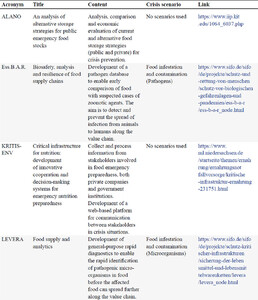
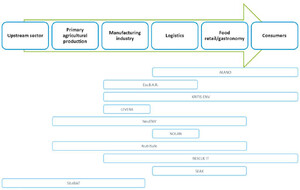
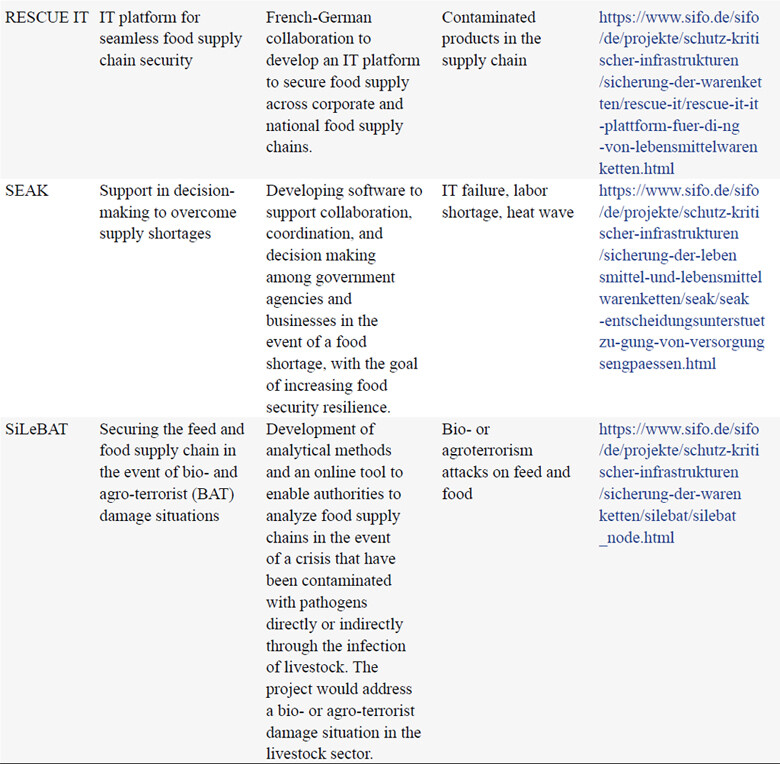
A total of ten German security research projects related to the CI food were identified. An overview of these projects is provided in Table A5 in the Appendix. The results of the projects were mainly published in journal articles, book chapters, presentations, and theses. The projects can be differentiated according to their focus, intention and the sectors covered within the food chain (Figure A1 in the Appendix).
Eight of the identified projects have been successfully completed, while two are still ongoing. A common feature of the projects is the use and analysis of crisis scenarios. Four of the identified projects (NeuENV, NOLAN, NutriSafe, SEAK) consider multiple scenarios. They cover a range of potential crises, including intentional and unintentional food contamination, natural disasters (e.g., winter storms, infrastructure failures and resource shortages) and disease outbreaks (such as influenza or African swine fever). In the selected scenarios, the NeuENV project also makes specific reference to a serious power failure in the German Münsterland region in 2005, during which not only the population but also livestock farms in particular were cut off from the power supply for several days in some cases.
Four projects (Ess.B.A.R., LEVERA, Rescue IT and SileBAT) focus on the detection and management of food contamination and aim to improve food safety. They have developed test methods, IT tools and databases to identify potential threats along the different stages of the SC. As shown in Appendix 3 Figure 1, the four projects differ with regard to the focus on individual sectors within the value chain. The NutriSafe project and the SiLeBAT project are the only two of the ten projects listed that are directly related to primary production.
Three projects (SEAK, NOLAN, and NeuENV) share the common theme of Public Private Emergency Collaboration. The projects focus on strengthening the development of public-private partnerships in crisis situations and focus on food logistics and food retailing. Priorities here include measures to coordinate authorities and businesses in food distribution and the development of decision-support systems.
The ALANO, NeuENV and KRITIS-ENV projects address the implications for government and public authority crisis management. While the ALANO project is currently analyzing the efficiency of existing storage practices and possible alternatives, the ongoing KRITIS-ENV project aims to improve crisis communication between authorities and food companies. The results of the NeuENV project have been widely recognized in the political and academic community, as it formed the basis and starting point for the revision of the ESVG in 2017.
While most of the projects have a national focus due to funding from the National Security Research Program, the ALANO, NutriSafe, and Rescue IT projects also have direct or indirect international links. While the Rescue IT and NutriSafe projects involved direct cooperation with French and Swiss partners respectively, the ALANO project compares public warehousing in Germany and Switzerland.
Interim conclusion
The literature review conducted revealed only a few relevant publications and projects on this topic and highlights the research gap regarding the resilience of the German livestock sector to severe crises. Existing studies and security research projects mainly focus on the later stages of the food SC, leaving primary production and upstream and downstream areas insufficiently studied. There is a lack of knowledge about the vulnerabilities and dependencies of these early stages of the SC.
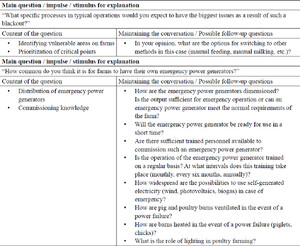
To fill this gap, the following chapter presents the results of the expert interviews on how livestock production would be affected by a blackout. The lack of information on dependencies in the early stages of the SC, the articles identified in the literature review by Graeff et al. (2017), Schwerin (2012) and Zylka and Kemper (2022) and additional literature on the basics of production methods in livestock farming (Hammerl and Klauke, 2023) formed the basis for the interview guideline (Section 2.3 in the Guide for expert interviews in the Appendix).
4.2 Expert interviews
According to the experts, a large number of internal and external processes on German livestock farms would be disrupted by a blackout. The following chapters focus on the internal aspects of emergency power supply, air, water and feed, and the external aspects of connected upstream and downstream businesses and networks.
Emergency power supply
Points frequently raised by the experts concern the availability of emergency power supplies on farms. The prevalence or presence of emergency power generators on farms is perceived differently. While it is assumed that emergency power generators are particularly common on large dairy farms (I9:19), they are less common on farms with beef fattening or cattle rearing, as most typical farm processes are not dependent on a power supply (I4:17). The prevalence of emergency power generators in pig farming is assessed differently by the experts. A few experts think that the number of farms equipped with their own emergency generators has increased in recent years, primarily due to the certification of farms under programs such as Quality and Safety (QS) and the Animal Welfare Initiative (ITW) (I2:33; I3:9). However, other experts think that these devices are only available in some cases and/or not across all farms (I2:31,33; I5:13,48,50; I6:15; I7:11,33; I11:11,13). The experts also state that there may be differences in the emergency power supply depending on the size of the business. Smaller businesses often lack the financial resources to invest in such technology. In larger companies, an emergency power supply with corresponding infrastructure is often firmly established as part of risk management (I2:31; I6:13,15). At the same time, however, it might also be the case that only one device for emergency power generation is available for several operating sites (I6:15). Several experts are of the opinion that company-owned emergency power generators are most widespread in larger poultry farms (I1:34; I8:33; I11:13). This is mainly due to stricter legal requirements (I1:34; I11:13).
Across all animal species and production directions, the experts assume that the devices are dimensioned for emergency operation rather than continuous operation (I1:36; I10:9). In the event of a power failure, the basic load of the farm (milking, ventilation and feeding) could be ensured for a short time in this way (I4:15,17; I6:17). It is estimated that in addition to urgent processes, such as ventilation or the milking system, other processes, such as water supply and manure removal, are rarely part of this emergency operation (I4:15,17).
Air, water and feed
The three areas of fresh air, water and feed supply are the most vulnerable and time-critical, as a failure of technical systems in these areas is likely to result in severe animal suffering or death within a short period of time. While in cattle farming, the predominantly open barn design ensures an adequate supply of fresh air even in the absence of a functioning power supply (I7:15; I11:17,19), in pig and poultry farming in particular, forced ventilation barns are dependent on an external air supply (I1:16; I4:15,17; I5:52; I11:17). Unfortunately, accidents in recent years have often shown that a failure in this area can lead to the death of large numbers of animals within minutes. Depending on the design of the barn and the weather, there are limits to the amount of fresh air that can be supplied by opening windows and doors. It should also be noted that changes in airflow and ventilation can, in the medium term, lead to diseases and changes in animal behavior, such as feather pecking and tail biting (I2:47; I5:17). Exceptions to this are outdoor climate barns and barns with open-air runs for pigs and poultry, which are often found in organic farming and new barns in conventional farming.
If the water supply fails, livestock can be expected to suffer within a few hours. This is also dependent on weather conditions (I6:36; I11:19,33). When it comes to water supply, a distinction has to be made between farms that have their own wells and farms that are connected to the local drinking water network. Both systems are common in practice, although there may be regional differences (I2:37; I3:27; I5:23). It is not clear to the experts which of the two systems is more advantageous in the event of a blackout. While a farm connected to the water network benefits indirectly from the precautionary and protective measures of the network operators, who are often part of the CI water, this form of water supply also implies a certain dependency on these same companies. While a failure in the power supply to a well will also result in a loss of water supply, it is comparatively easy to ensure supply in the event of a crisis by integrating the water supply into the emergency power supply. Manual feeding of drinking water into the barns is only possible on small farms due to the volume of water to be moved (I8:41).
There are major differences between livestock farms in terms of feed stocks. While cattle farms often have stocks for weeks and months (I4:25; I7:21; I9:39), poultry farms in particular have much smaller stocks of compound feed (I1:24; I11:27). In pig farming, a distinction must be made between farms that store their own feed (e.g., wheat, barley, maize) and receive only supplemental feed, and farms that only use compound feed (I2:45; I5:17; I6:32). In cattle farming, diesel-powered machinery is usually used to deliver ground feed, which can ensure feed supply even in the event of a power cut. On the other hand, pig and poultry feeding is mainly handled by electric feeding systems. Due to the design of these systems and the fact that feed is stored in silos, there is often no alternative access to feed in the event of a power failure (I2:43). As with water supply, manual feeding of livestock is only possible in small barns due to the large volumes involved (I2:33,69).
Other disrupted processes that can also pose a challenge in the event of a multi-day power outage include dairy milking (I7:45), heating and lighting barns (I1:33), barn hygiene (I7:29), data management (I9:59), and disposal of dead animals (I8:47). Milking is one of the most critical aspects of dairy farming; failure to milk can lead to severe animal suffering and mastitis, and manual milking is often not feasible due to the size of the herd (I7:45, I9:33). Depending on the weather conditions and the age of the animals, pigs and poultry may need to be heated. Depending on the seasonal availability of daylight, it may be necessary to find an external solution for lighting the sheds for animal inspection and any work in the sheds (I7:15). Failure of cleaning and hygiene measures, such as milking system cleaning and milk storage, can also lead to further problems (I7:51; I9:61).
Farm external processes and networks
Many pig farms and almost all poultry farms depend on a regular supply of feed, as on-farm feed stocks often only last a few days. In the event of a sudden power failure, a significant proportion of farms are therefore already dependent on a short-term supply of feed at the time of the power failure (I11:54). In the worst-case scenario, the loss of a large number of these animals can lead to a limited availability of pork and poultry meat in the following days, weeks and months due to reproduction and rearing times. At the same time, the downstream rendering sector plays an important role. Animal carcasses must be disposed of in a professional and timely manner in order to prevent, for example, the development of epidemics and the contamination of drinking water and groundwater.
If a power outage disrupts milk collection for several days, the value chain for milk and dairy products can be expected to grind to a halt within a few days. In this case, there is a risk of a shortage in the supply of these foods to the population (I7:45).
Experts agree that one of the biggest challenges of a multi-day power outage is the loss of normal forms of communication, such as mobile phones and email (I4:37; I10:9). This particularly affects external processes linked to other companies in the upstream and downstream sectors. In all of the following points, it should be noted that contact and coordination with the various sectors may be impossible or limited, as access to telephone and internet may be restricted.
The compound feed industry plays an important role. Poultry and pig farms in particular are dependent on a regular supply of feed. Experts estimate that delivery intervals are often no more than a few days to a few weeks (I5:17; I11:54). In the event of a crisis, this means that a large proportion of these farms are dependent on an immediate supply of compound feed, or that a scheduled delivery must be made within a few days in order to ensure a sufficient supply of feed.
In addition to supplying the farms, it is also necessary to collect milk, animals for slaughter and eggs in order to have sufficient raw materials that can be processed into food further down the value chain. While it is generally feasible to keep animals ready for slaughter a few days or weeks, longer periods can lead to significant space problems on farms (I2:71). One example in this context is the outbreak of African Swine Fever in the Lower Saxony region âEmslandâ in 2022, which led to a massive backlog of pigs in the region (I3:37). Unlike animals for slaughter, milk can only be stored for a few days on farms as it is collected daily or every two days (I4:29).
In addition, many livestock farms depend on regular veterinary care. This applies both to the treatment of individual animals and to the regular care of the entire herd. In the event of a power outage lasting several days, it may not be possible to treat individual animals adequately, or to treat a disease in the whole herd in time, or at all (I6:58; I11:60).
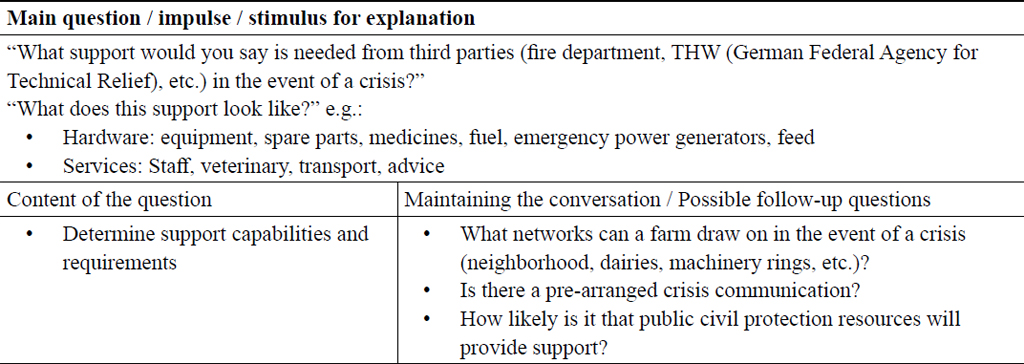
Some experts consider that there are no networks in place to provide support in the event of a crisis (I1:60; I6:58). However, some experts emphasize the strong neighborly support among the farmers (I3:45; I9:79) and the strong self-help and improvisation skills of the farmers, which were already visible on the farms during crises such as the power failure in the Münsterland region in 2005 (I3:61). In principle, machinery rings, farm support services, advisors and chambers of agriculture offer support to farms in crisis situations. However, the extent to which they can provide support in such extreme situations is questionable. The same applies to the support capacities of the public sector, e.g., in the form of technical relief or fire brigades. However, the experts assume that in the event of a nationwide blackout, these institutions will be prioritized for civil protection (health, hospitals, etc.).
5 Discussion
Increasing the resilience of CI in crisis and disaster situations is seen as a key objective to ensure the supply of essential goods and services to the public (Boin and McConnell, 2007; VoÃschmidt and Karsten, 2019; Cantelmi et al., 2021). This study has shown that the concept of resilience can, in principle, be applied to the food and livestock sector.
However, due to the broad definition of resilience, it needs to be operationalized in order to be applied in practice. On the one hand, the results of the expert interviews can show that the core element of BCM, the BIA, can also be applied to livestock production. On the other hand, the heterogeneous results regarding the vulnerable areas, which vary by species, also underline the need for a farm-specific perspective when identifying critical and vulnerable areas.
In line with the literature, the results of the expert interviews also show that focusing on internal BCM processes alone is not sufficient for livestock farming. In crisis situations, critical supplies and services are still required for the livestock farms. It is therefore necessary to extend the BCM concept in this context with elements regarding the SC. An advantage of this extension with SCCM is that the methodological approach of both procedures is very similar and can be carried out both sequentially and in parallel.
Current state of research: A semi-systematic literature review was conducted to answer the first RQ on the current state of research. The results show that the topics of primary agricultural production and livestock farming have rarely been addressed and studied in the context of food emergency preparedness and their role for the CI food. Although these parts of the SC play an important role in the event of a crisis, other areas of the food value chain have been studied more frequently and intensively. It can therefore be argued that strengthening the value chain of food production in Germany is also closely linked to the overarching objective of strengthening the CI food.
The results show that there is a lack of research that examines in detail the specific problems of primary and livestock production. At the same time, there is a lack of work that takes a holistic approach at the level of the whole SC, in particular to address the challenges of exchange between the different areas of the SC.
Vulnerable areas and processes on farms: With regard to the second RQ on the vulnerable areas and processes on farms, this study has shown that the BCM concept, which is often used in this context, can also be applied to companies within the food value chain, and in particular to livestock farms. The first exemplary BIA steps carried out for the cattle, pig and poultry industries underline the diverse and often farm- and animal-specific challenges that can arise in the context of a blackout in the livestock industry.
With regard to the management of livestock during a blackout, the results show a heterogeneous picture. Zylka and Kemper (2022) identified ventilation, water and feed supply as particularly time-critical and vulnerable in case of blackout. The results of this study show that a distinction can be made between beef fattening and cattle rearing on the one hand and dairy, pig and poultry farming on the other hand in terms of the time it takes for the farms to reach a critical state. Based on the results, it can be argued that cattle farming is less affected by a power outage lasting two to seven days. Limitations to this positive situation arise primarily in dairy farming, which depends on a functioning power supply due to the milking process (Graeff et al., 2017). In the event of a power outage in the dairy industry, it is likely that dairy cows will suffer health problems such as mastitis if they are not milked, and that the milk produced each day will spoil quickly if it is not cooled. In particular, the independence of the fresh air supply and the large stocks of ground fodder have a positive effect in cattle farming.
For pigs and poultry, even a short-term power outage poses a considerable risk. The most time-critical aspect is ventilation. Especially in the case of forced ventilation barns, the time that can be bridged without a functioning power supply is only a few minutes to a few hours. In addition, feeding is a vulnerable process in the event of a power failure, as a functioning power supply is required to dose the feed from the storage bins and then transport the feed to the troughs. Common to all types of housing is access to drinking water, which must be provided within a few hours. High outside temperatures shorten this time.
This study also demonstrates that a variety of other processes on farms can be affected, such as cleaning barns, or communicating with employees. However, the interviewed experts noted that it is difficult to generalize. Rather, the processes affected are specific to the animal species, the type of farming, the region, or the attitude and the managerâs skills and alertness. In order to be able to make well-founded statements about the extent to which livestock production is affected by power outages, further quantitative data collection on farms is necessary. This could include, for example, the distribution of emergency generators and feedstocks on farms.
Challenges in implementing BCM and SCCM arise particularly for smaller companies with few employees, which often include livestock farms. The scope of the measures implemented should be based on the size of the company on the one hand, and the importance of the company or sector for the value chain on the other. For example, it is not possible or useful to compare the BCM and SCCM of a slaughterhouse, which must comply with more stringent requirements, with the BCM and SCCM of an individual farm. At the same time, however, both levels must coordinate the derived measures to ensure smooth operations in the event of a crisis.
It is likely to be easier to implement BCM and SCCM in large companies in the upstream and downstream sectors due to greater human and financial resources, or it can be integrated into existing risk or supply chain management structures. Smaller companies and livestock farms could benefit from targeted information and training on BCM and SCCM, e.g., in the form of recommended actions and checklists. At the same time, downstream sectors such as slaughtering and milk processing could also be supported in their own SCCM efforts by providing advice to farms on how to implement BCM and SCCM and thus secure the supply of raw materials.
Dependencies within the value chain: Regarding the third RQ on dependencies within the value chain, this study highlights the importance of smooth interaction between livestock production and upstream and downstream sectors. Focusing on the livestock sector, the importance of compound feed production in poultry and pig production becomes particularly clear in terms of procurement. Feed stocks are often only available for a few days. However, in the event of a sudden breakdown in compound feed production, this does not mean that there are only a few daysâ worth of reserves available. Rather, due to the continuous process, some of the farms must be supplied with feed the same day or the next day, as all affected farms must be reached within a few days. If this supply cannot be guaranteed, or cannot be guaranteed in a timely manner, the supply of animals for slaughter and eggs for the following farms may be interrupted, which cannot be rectified even at short notice. The same applies to livestock farms that depend on a public water supply. If the CI water also fails as a result of the blackout, a large number of livestock can be expected to die within a few hours.
The collection of products from farms is a bottleneck for the entire SC. Even if downstream companies such as slaughterhouses and dairies are able to maintain their production capacity in the event of a blackout, products must also be able to reach these processing companies. While animals for slaughter can remain on farms for some time without suffering major quality losses, milk must be collected at short notice so that it does not exceed the storage capacity of the farms and spoil.
If this lack of food production and supply continues for several days and weeks, CI food shortages may occur. To summarize, a failure at one stage of the food supply chain can lead to a failure of the entire animal food production chain. If this cannot be compensated for in time or by other means, there is even a risk that the entire SC food will collapse.
When interpreting the results, some limitations of the study must be taken into account. The literature review focused on work related to German emergency food preparedness. Due to this focus, it is possible that relevant literature with an international orientation was not identified during the literature search, as it was not published in English or German. Additionally, the expert interviews followed an exploratory approach with the aim of providing a first insight into the issue. Further in-depth research is therefore required for a more detailed analysis of this issue.
6 Conclusion
Protecting CI from serious crises and disasters has become more and more important in recent years, both in politics and in academia. While a secure food supply in Germany has been considered to be stable over the past decades, global crises have shown that a secure and unrestricted food supply cannot be taken for granted at all times, even in highly developed economies such as Germany.
Little is currently known about the impact of severe crises on the food SC. The few scientific studies and projects on this topic identified in this study focus mainly on the downstream segments of the food SC. The impact on primary agricultural production, in particular livestock production, has hardly been studied. However, using a possible blackout scenario as an example, this study shows that livestock production would be severely affected by such a crisis. In particular, ventilation, water supply and feed supply are on-farm challenges that could have a significant impact in the event of a crisis.
In addition, this study highlights the critical importance of smooth interaction between upstream and downstream sectors and livestock production. The compound feed industry and water suppliers on the upstream side and slaughtering and milk processing on the downstream side play a crucial role. Their ability to function is essential to ensure a sufficient supply of food of animal origin even in times of crisis.
In order to increase the resilience of the livestock sector to future crises and disasters, it is necessary for farmers to individually identify potential risks to their businesses. Methods such as BCM and SCCM provide a suitable approach. Based on such a risk analysis, measures can be developed to strengthen the robustness and adaptability of these farms. Examples include the purchase or expansion of emergency power generators, the expansion of storage capacity, and the creation of specific contingency plans.
Future research should focus on two main areas. First, a detailed examination of the various links in the food supply chain, e.g., the slaughter industry, is needed. The aim should be to identify potential vulnerabilities and susceptibilities to crises in advance in order to avoid failures during a crisis. Second, scientific work in the future should take a holistic approach and consider the entire food SC, from the upstream industry to the consumer. It is important to synthesize existing research to get a comprehensive picture of the challenges and coordination problems between the different links in the value chain.
This study highlights the importance of anticipatory and early planning, as well as the identification of vulnerabilities in the food supply chain and in livestock production. This is essential to ensure the security of supply of food of animal origin, even in times of crisis.
References
Azadegan, A., T.A. Syed, C. Blome and K. Tajeddini. 2020. Supply chain involvement in business continuity management: effects on reputational and operational damage containment from supply chain disruptions. Supply Chain Management 25(6): 747â772. https://doi.org/10.1108/SCM-08-2019-0304
Baumeister, R.F. and M.R. Leary. 1997. Writing narrative literature reviews. Review of General Psychology 1(3): 311â320. https://doi.org/10.1037/1089-2680.1.3.311
BBK. 2021a. 10 Jahre Risikoanalyse im Bevölkerungsschutz Bund â Hintergründe, Ergebnisse und Ausblick. Bundesamt für Bevölkerungsschutz und Katastrophenhilfe. Berlin, Germany. Available online at https://www.bbk.bund.de/SharedDocs/Downloads/DE/Mediathek/Publikationen/PiB/PiB-22-10-jahre-risikoanalyse.pdf?__blob=publicationFile&v=7 (in German)
BBK. 2021b. Klärung und Erweiterung des KRITIS-Vokabulars â Kriterien und Vorgehensweise. Bundesamt für Bevölkerungsschutz und Katastrophenhilfe. Berlin, Germany. Available online at https://www.bbk.bund.de/SharedDocs/Downloads/DE/Mediathek/Publikationen/KRITIS/baukasten-kritis-vokabular-1.pdf?__blob=publicationFile&v=6 (in German)
Bischoff, C., A. Buschulte and J. Rau. 2023. Checklist âFood defenseâ: a tool for vulnerability analysis in food establishments. Journal of Consumer Protection and Food Safety 18(4): 465â470. https://doi.org/10.1007/s00003-023-01431-2 (in German)
BLE. 2024. Selbstversorgungsgrad bei landwirtschaftlichen Erzeugnissen. Bundesanstalt für Landwirtschaft und Ernährung. Available online at https://www.bmel-statistik.de/fileadmin/daten/4010200-0000.xlsx (in German)
Blos, M.F., S.L. Hoeflich and P.E. Miyagi. 2015. A general supply chain continuity management framework. Procedia Computer Science 55: 1160â1164. https://doi.org/10.1016/j.procs.2015.07.087
Blos, M.F., H.-M. Wee and J. Yang. 2010. Analysing the external supply chain risk driver competitiveness: a risk mitigation framework and business continuity plan. Journal of Business Continuity and Emergency Planning 4(4): 368â374. https://doi.org/10.69554/VEPJ6530
BMEL. 2022. Daten und Fakten â Land-, Forst- und Ernährungswirtschaft mit Fischerei und Wein- und Gartenbau. Bundesministerium für Ernährung und Landwirtschaft. Berlin. Available online at https://www.bmel.de/SharedDocs/Downloads/DE/Broschueren/daten-fakten-2022.pdf?__blob=publicationFile&v=8 (in German)
BMI. 2009. Nationale Strategie zum Schutz Kritischer Infrastrukturen (KRITIS-Strategie). Bundesministerium des Inneren. Berlin. Germany. Available online at https://www.bmi.bund.de/SharedDocs/downloads/DE/publikationen/themen/bevoelkerungsschutz/kritis.pdf?__blob=publicationFile&v=3 (in German)
Boin, A. and A. McConnell. 2007. Preparing for critical infrastructure breakdowns: the limits of crisis management and the need for resilience. Journal of Contingencies and Crisis Management 15(1): 50â59. https://doi.org/10.1111/j.1468-5973.2007.00504.x
Booth, A., A. Sutton, M. Clowes and M. Martyn-St James. 2021. Systematic approaches to a successful literature review, 3rd edn. Sage, Thouand Oaks, CA.
Brinkmann, J., C. Bach, S. Guhl, M. Witting, T. Welle and M. Schmude. 2010. State of the Art der Forschung zur Verwundbarkeit kritischer Infrastrukturen am Beispiel Strom/Stromausfall Schriftenreihe Sicherheit, Issue 2. Forschungsforum Ãffentliche Sicherheit, Berlin. http://dx.doi.org/10.17169/refubium-21689 (in German)
Cantelmi, R., G. Di Gravio and R. Patriarca. 2021. Reviewing qualitative research approaches in the context of critical infrastructure resilience. Environment Systems and Decisions 41(3): 341â376. https://doi.org/10.1007/s10669-020-09795-8
ESVG. 2017. Ernährungssicherstellungs- und Vorsorgegesetz. Available online at https://www.gesetze-im-internet.de/esvg/BJNR077210017.html (in German)
European Commission. 2021. Contingency plan for ensuring food supply and food security in times of crisis. European Commission, Brussels. Available online at https://eur-lex.europa.eu/legal-content/EN/TXT/?uri=COM%3A2021%3A689%3AFIN
FAO. 2021. FAOSTAT â Food Balances (2010â). FAO, Rome. Available online at https://www.fao.org/faostat/en/#data/FBS
FAO. 2023. Guidelines to increase the resilience of agricultural supply chains. FAO, Rome, Italy. Available online at https://openknowledge.fao.org/server/api/core/bitstreams/f0d50eaa-f966-43c3-a03e-ae652f283c34/content
Fisher, R., M. Norman and M. Klett. 2017. Enhancing infrastructure resilience through business continuity planning. Journal of Business Continuity and Emergency Planning 11(2): 163â173. PMID: 29256383
Flick, U. 2014. An introduction to qualitative research. 5th ed. SAGE, Los Angeles, CA, USA.
Gerhold, L., K. Cortez Garcia and A. Guerrero Lara. 2019a. Lebensmittelversorgung in Krisen und Katastrophen. Versorgung der Bevölkerung mit Lebensmitteln in OECD-Ländern im Falle von GroÃschadensereignissen. Forschung im Bevölkerungsschutz 22. Bundesamt für Bevölkerungsschutz und Katastrophenhilfe, Bonn.
Gerhold, L., S. Wahl and W.R. Dombrowsky. 2019b. Risk perception and emergency food preparedness in Germany. International Journal of Disaster Risk Reduction 37: 101183. https://doi.org/10.1016/j.ijdrr.2019.101183
Graeff, A., B. Misthilger, M. Hoeld, S. Woerz, J. Stumpenhausen and H. Bernhardt. 2017. Effects of power cuts on dairy cattle behaviour. Chemical Engineering Transactions 58: 835â840. https://doi.org/10.3303/CET1758140
Hammerl, G. and T. Klauke. 2023. Landwirtschaftliche Tierhaltung. Verlag Eugen Ulmer, Stuttgart. (in German)
Hansen, O., H. Friedrich and S. Transchel. 2020. An inventory management approximation for estimating aggregated regional food stock levels. International Journal of Production Research 58(19): 5769â5785. https://doi.org/10.1080/00207543.2019.1657248
Helfferich, C. 2014. Leitfaden- und Experteninterviews. In: N. Baur and J. Blasius (eds.) Handbuch Methoden der empirischen Sozialforschung. Springer Fachmedien Wiesbaden, Wiesbaden, pp. 559â574. https://doi.org/10.1007/978-3-531-18939-0_38 (in German)
Hofmeier, M. and U. Lechner. 2021. Digitalisierung und Resilienz in der Food Supply Chain. HMD Praxis der Wirtschaftsinformatik 58(4): 910â921. https://doi.org/10.1365/s40702-020-00651-6 (in German)
Holling, C.S. 1973. Resilience and stability of ecological systems. Annual Review of Ecology and Systematics 4: 1â23. https://doi.org/10.1146/annurev.es.04.110173.000245
ISO 22301. 2019. Security and resilience â business continuity management systems â requirements. International Organization for Standardization, Geneva. Available online at https://www.iso.org/standard/75106.html
Jagtap, S., H. Trollman, F. Trollman, G. Garcia-Garcia, C. Parra-López, L. Duong, W. Martindale, P.E.S. Munekata, J.M. Lorenzo, A. Hdaifeh, A. Hassoun, K. Salonitis and M. Afy-Shararah. 2022. The Russia-Ukraine conflict: its implications for the global food supply chains. Foods 11(14): 2098. https://doi.org/10.3390/foods11142098
Kildow, B.A. 2011. A supply chain management guide to business continuity. Harper Collins Leadership, New York, NY.
Kosow, H. and R. GaÃner. 2008. Methoden der Zukunfts- und Szenarioanalyse. Ãberblick, Bewertung und Auswahlkriterien. WerkstattBericht/IZT, Institut für Zukunftsstudien und Technologiebewertung 103. IZT, Berlin. (in German)
Kraatz, S. 2012. Energy intensity in livestock operations â Modeling of dairy farming systems in Germany. Agricultural Systems 110: 90â106. https://doi.org/10.1016/j.agsy.2012.03.007
Liu, S. 2020. Food supply pressure in France and Germany during COVID-19: causes from manufacturing. Journal of Agriculture, Food Systems, and Community Development 9(4): 1â4. https://doi.org/10.5304/jafscd.2020.094.007
Martinho, V.J.P.D. 2016. Energy consumption across European Union farms: efficiency in terms of farming output and utilized agricultural area. Energy 103: 543â556. http://dx.doi.org/10.1016/j.energy.2016.03.017
Matteis, J. de, G. Elia and P. Del Vecchio. 2023. Business continuity management and organizational resilience: a small and medium enterprises (SMEs) perspective. Journal of Contingencies and Crisis Management 31(4): 670â682. https://doi.org/10.1111/1468-5973.12470
Mayring, P. 2015. Qualitative Inhaltsanalyse: Grundlagen und Techniken, 12th edn. Beltz, Weinheim.
Menski, U., S. Wahl, H. Tischer, L. Gerhold and J. Braun. 2016. Solange der Vorrat reicht ⦠Ergebnisse zweier Befragungen von privaten Haushalten zur Bevorratung mit Lebensmitteln im Falle einer Versorgungskrise. In: Neue Strategien der Ernährungsnotfallvorsorge â Ergebnisse aus dem Forschungsverbund NeuENV. Schriftenreihe Sicherheit 18: 95â118. Available online at https://refubium.fu-berlin.de/bitstream/handle/fub188/17786/sr_18_a.pdf;jsessionid=F50E0756BC42056819C93045612F1789?sequence=1 (in German)
Merz, M., M. Hiete and V. Bertsch. 2009. Multicriteria decision support for business continuity planning in the event of critical infrastructure disruptions. International Journal of Critical Infrastructures 5(1/2): 156â174. https://doi.org/10.1504/IJCIS.2009.022854
Meuwissen, M.P., P.H. Feindt, A. Spiegel, C.J. Termeer, E. Mathijs, Y. de Mey, R. Finger, A. Balmann, E. Wauters, J. Urquhart, M. Vigani, K. ZawaliÅska, H. Herrera, P. Nicholas-Davies, H. Hansson, W. Paas, T. Slijper, I. Coopmans, W. Vroege, >A. Ciechomska, F. Accatino, B. Kopainsky, P.M. Poortvliet, J.J. Candel, D. Maye, S. Severini, S. Senni, B. Soriano, C.-J. Lagerkvist, M. Peneva, C. Gavrilescu and P. Reidsma. 2019. A framework to assess the resilience of farming systems. Agricultural Systems 176: 1â10. https://doi.org/10.1016/j.agsy.2019.102656
Meuwissen W.H. Paas, T. Slijper, I. Coopmans, A. Ciechomska, E. Lievens, J. Deckers, W. Vroege, E. Mathijs, B. Kopainsky, H. Herrera, S. Nitzko, R. Finger, Y. de Mey, P.M. Poortvliet, P. Nicholas-Davies, P. Midmore, M. Vigani, D. Maye, J. Urquhart, A. Balmann, F. Appel, K. Termeer, P. Feindt, J. Candel, M. Tichit, F. Accatino, S. Severini, S. Senni, E. Wauters, I. BardajÃ, B. Soriano, K. Zawalinska, C. Lagerkvist, G. Manevska-Tasevska, H. Hansson, M. Peneva, C. Gavrilescu, P. Reidsma. 2018. Report on resilience framework for EU agriculture. Available online at https://www.surefarmproject.eu/wp-content/uploads/2018/02/SURE-Farm_Deliverable-D1.1-Resilience-Framework.pdf
Moher, D., A. Liberati, J. Tetzlaff and D.G. Altman. 2009. Preferred reporting items for systematic reviews and meta-analyses: The PRISMA statement. Annals of Internal Medicine 151(4): 264â269. https://doi.org/10.7326/0003-4819-151-4-200908180-00135
Naderifar, M., H. Goli and F. Ghaljaie. 2017. Snowball sampling: a purposeful method of sampling in qualitative research. Strides in Development of Medical Education 14(3): 1â6. https://doi.org/10.5812/sdme.67670
Nakamura, T., S. Lloyd, A. Maruyama and S. Masuda. 2024. Impact of the global food crisis on Germanyâs food aid measures: in the context of COVID-19, Russiaâs invasion of Ukraine, and extreme weather. Journal of Disaster Research 19(4): 666â677. https://doi.org/10.20965/jdr.2024.p0666
Page, M.J., J.E. McKenzie, P.M. Bossuyt, I. Boutron, T.C. Hoffmann, C.D. Mulrow, L. Shamseer, J.M. Tetzlaff, E.A. Akl, S.E. Brennan, R. Chou, J. Glanville, J.M. Grimshaw, A. Hróbjartsson, M.M. Lalu, T. Li, E.W. Loder, E. Mayo-Wilson, S. McDonald, L.A. McGuinness, L.A. Stewart, J. Thomas, A.C. Tricco, V.A. Welch, P. Whiting and D. Moher. 2021. The PRISMA 2020 statement: an updated guideline for reporting systematic reviews. British Medical Journal 372: n71. https://doi.org/10.1136/bmj.n71
Parker, C., S. Scott and A. Geddes. 2019. Snowball sampling. In: Parker, C., Scott, S., & Geddes, A., (2019). Snowball Sampling, In P. Atkinson, S. Delamont, A. Cernat, J.W. Sakshaug, & R.A. Williams (eds) SAGE Research Methods Foundations. SAGE, London. https://doi.org/10.4135/9781526421036831710
Petermann, T., H. Bradke, A. Lüllmann, M. Paetzsch and U. Reihm. 2011. What happens during a blackout: Consequences of a prolonged and wide-ranging power outage. Books on Demand, Norderstedt. https://doi.org/10.5445/IR/1000103292
Przyborski, A. and M. Wohlrab-Sahr. 2008. Qualitative Sozialforschung: Ein Arbeitsbuch. Oldenbourg, Munich. (in German)
Reid, R. and L.C. Botterill. 2013. The multiple meanings of âresilienceâ: An overview of the literature. Australian Journal of Public Administration 72(1): 31â40. https://doi.org/10.1111/1467-8500.12009
Rivera-Ferre, M.G., F. López-i-Gelats, F. Ravera, E. Oteros-Rozas, M. Di Masso, R. Binimelis and H. El Bilali. 2021. The two-way relationship between food systems and the COVID-19 pandemic: causes and consequences. Agricultural Systems 191: 103134. https://doi.org/10.1016/j.agsy.2021.103134
Rose, A. and E. Krausmann. 2013. An economic framework for the development of a resilience index for business recovery. International Journal of Disaster Risk Reduction 5: 73â83. https://doi.org/10.1016/j.ijdrr.2013.08.003
Ruoslahti, H. 2020. Business continuity for critical infrastructure operators. Annals of Disaster Risk Sciences 3(1): 1â8. https://doi.org/10.51381/adrs.v3i1.46
Schätter, F., O. Hansen, M. Herrmannsdörfer, M. Wiens and F. Schultmann. 2015. Conception of a simulation model for business continuity management against food supply chain disruptions. Procedia Engineering 107: 146â153. https://doi.org/10.1016/j.proeng.2015.06.068
Schlaich, T., A.L. Horn, M. Fuhrmann and H. Friedrich. 2020. A gravity-based food flow model to identify the source of foodborne disease outbreaks. International Journal of Environmental Research and Public Health 17(2): 1â18. http://dx.doi.org/10.3390/ijerph17020444
Schwerin, M. 2012. Climate change as a challenge for future livestock farming in Germany and Central Europe. Züchtungskunde, 2012, Vol. 84, No. 2, 103â128. Available online at https://www.cabidigitallibrary.org/doi/full/10.5555/20123126262 (in German)
Snyder, H. 2019. Literature review as a research methodology: an overview and guidelines. Journal of Business Research 104: 333â339. https://doi.org/10.1016/j.jbusres.2019.07.039
Southwick, S.M., G.A. Bonanno, A.S. Masten, C. Panter-Brick and R. Yehuda. 2014. Resilience definitions, theory, and challenges: interdisciplinary perspectives. European Journal of Psychotraumatology 5: 1â14. https://doi.org/10.3402/ejpt.v5.25338
Stone, J. and S. Rahimifard. 2018. Resilience in agri-food supply chains: a critical analysis of the literature and synthesis of a novel framework. Supply Chain Management: An International Journal 23(3): 207â238. https://doi.org/10.1108/SCM-06-2017-0201
Sutton, A., M. Clowes, L. Preston and A. Booth. 2019. Meeting the review family: exploring review types and associated information retrieval requirements. Health Information and Libraries Journal 36(3): 202â222. https://doi.org/10.1111/hir.12276
Tendall, D.M., J. Joerin, B. Kopainsky, P. Edwards, A. Shreck, Q.B. Le, P. Kruetli, M. Grant and J. Six. 2015. Food system resilience: Defining the concept. Global Food Security 6: 17â23. https://doi.org/10.1016/j.gfs.2015.08.001
VoÃschmidt, S. and A.H. Karsten (eds.). 2019. Resilienz und kritische Infrastrukturen. Aufrechterhaltung von Versorgungsstrukturen im Krisenfall. Verlag W. Kohlhammer, Stuttgart, Germany. (in German)
Walker, B.H., N. Abel, J.M. Anderies and P. Ryan. 2009. Resilience, adaptability, and transformability in the Goulburn-Broken Catchment, Australia. Ecology and Society 14(1): 12. https://doi.org/10.5751/ES-02824-140112
Webster, J. and R.T. Watson. 2002. Analyzing the past to prepare for the future: Writing a literature review. MIS Quarterly: xiiiâxxiii. Available online at https://www.jstor.org/stable/4132319
Wong, G., T. Greenhalgh, G. Westhorp, J. Buckingham and R. Pawson. 2013. RAMESES publication standards: meta-narrative reviews. BMC Medicine 11: 20. https://doi.org/10.1186/1741-7015-11-20
Zsidisin, G.A., S.A. Melnyk and G.L. Ragatz. 2005. An institutional theory perspective of business continuity planning for purchasing and supply management. International Journal of Production Research 43(16): 3401â3420. https://doi.org/10.1080/00207540500095613
Zylka, I. and N. Kemper. 2022. Auswirkungen eines Blackouts auf Nutztiere in Stallhaltungen. Der Praktische Tierarzt 103(4): 400â409. https://doi.org/10.2376/0032â681X-2216 (in German)
Appendix
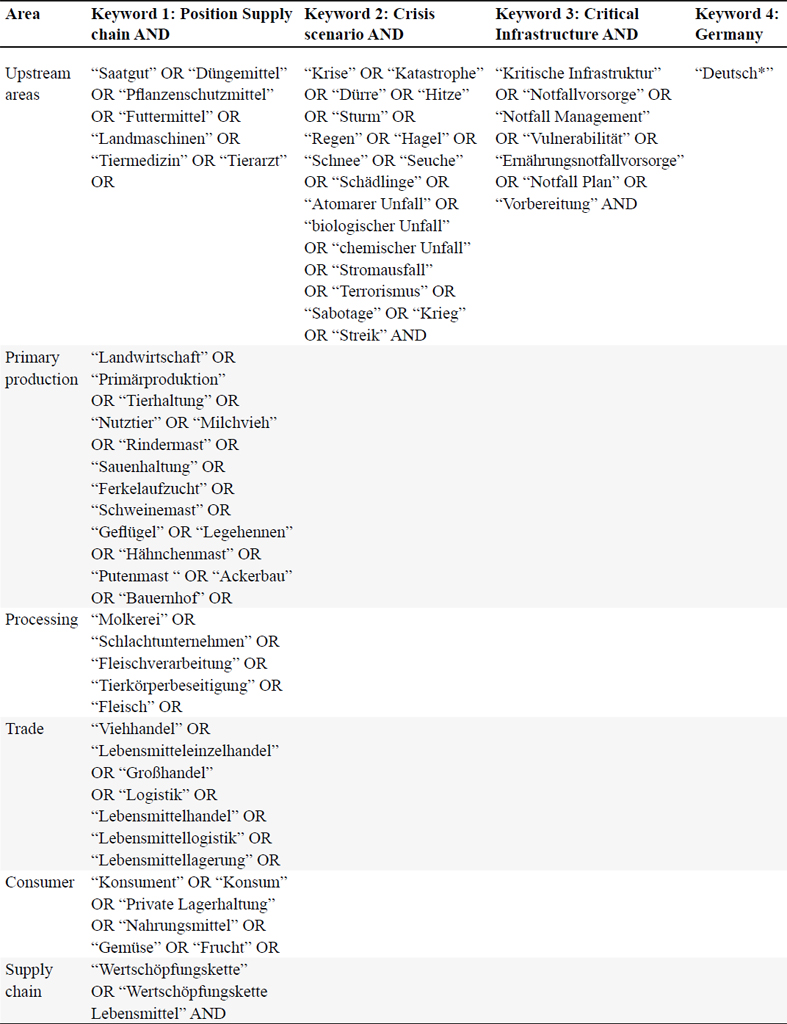
List of keywords for literature review â German
Citation: International Food and Agribusiness Management Review 29, 1 (2026) ; 10.22434/ifamr.1203
Source: Own compilation.List of keywords for literature review â English
Citation: International Food and Agribusiness Management Review 29, 1 (2026) ; 10.22434/ifamr.1203
Source: Own compilation.Expert overview
Citation: International Food and Agribusiness Management Review 29, 1 (2026) ; 10.22434/ifamr.1203
Source: Own compilationOverview of the main and subcategories and number of coded text segments
Citation: International Food and Agribusiness Management Review 29, 1 (2026) ; 10.22434/ifamr.1203
Source: Own compilation.Project overview
Citation: International Food and Agribusiness Management Review 29, 1 (2026) ; 10.22434/ifamr.1203
Source: Own compilation.Project and value chain overview. Source: Own compilation.
Citation: International Food and Agribusiness Management Review 29, 1 (2026) ; 10.22434/ifamr.1203
Guide for expert interviews
Objective: Identification of the vulnerability, robustness, adaptability and resilience of livestock farms in the event of a prolonged and widespread power outage (blackout).
RQ 2: Which areas and processes of daily production on German livestock farms are particularly vulnerable in the event of a blackout?
RQ 3: What upstream and downstream dependencies exist in German livestock production that could lead to a collapse of the animal-based food sector in the event of a blackout?
1 Introduction
1.1 Structure of the interview
(1) Consent to participate in the interview and framework conditions (recording, evaluation, etc.)
(2) Introduction
-
Sebastian Kleingräber, research associate and PhD student at the Thünen Institute of Market Analysis in Braunschweig. The Thünen Institute is a federal research institute within the portfolio of the BMEL (Federal Ministry of Food and Agriculture) with different fields of research and policy advice on rural areas, agriculture, forestry and fisheries.
-
-
(3) Aims of the research project
Conducting expert interviews with the aim of identifying vulnerable areas and sensitive points on farms. The interview will be recorded (video and audio) for later evaluation. The interview will be conducted as a semi-structured interview.
(4) All data collected will be anonymized/pseudonymized.
(5) Duration of the interview: approximately 60 minutes.
2 Interview
2.1 General questions
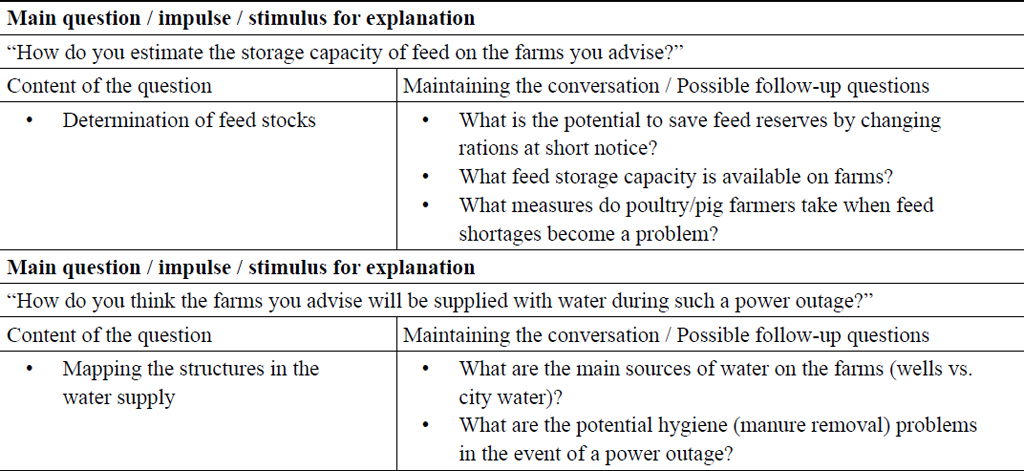
Please introduce yourself:
What company do you work for?
How long have you been in this position?
What are your responsibilities?
2.2 Introductory questions
Citation: International Food and Agribusiness Management Review 29, 1 (2026) ; 10.22434/ifamr.1203
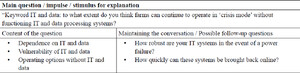
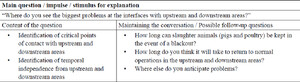
2.3 In-depth questions
Citation: International Food and Agribusiness Management Review 29, 1 (2026) ; 10.22434/ifamr.1203
Energy (electricity/gas/diesel)
Citation: International Food and Agribusiness Management Review 29, 1 (2026) ; 10.22434/ifamr.1203
Operations Management â Contingency Plans
Citation: International Food and Agribusiness Management Review 29, 1 (2026) ; 10.22434/ifamr.1203
Feed and water
Citation: International Food and Agribusiness Management Review 29, 1 (2026) ; 10.22434/ifamr.1203
Operations management â IT systems:
Citation: International Food and Agribusiness Management Review 29, 1 (2026) ; 10.22434/ifamr.1203
Impacts on/by upstream and downstream areas:
Citation: International Food and Agribusiness Management Review 29, 1 (2026) ; 10.22434/ifamr.1203
Third-party support:
Citation: International Food and Agribusiness Management Review 29, 1 (2026) ; 10.22434/ifamr.1203
2.4 Final questions
(1) What aspects have been forgotten that could cause problems in the production process (beef, pork, chicken) in the event of a blackout?
(2) How realistic do you think the blackout scenario is?
(3) What other disaster scenarios are relevant and should be considered in future studies?
(4) Is there anything else you would like to know from me?
Corresponding author
The German Federal Ministry of the Interior (BMI) defines CI as â[â¦] organisations and facilities of major importance to the national community, the failure or impairment of which would lead to lasting supply shortages, significant disruptions to public safety or other dramatic consequencesâ (translated from BMI, 2009: 3). In addition to the food sector, CI also includes the sectors of energy, finance and insurance, health, information and telecommunications, media and culture, government and administration, transport and traffic, and water (BBK, 2021b).