Abstract
This study explores how, in the eastern Democratic Republic of the Congo, the introduction of ICT technology among cacao farmer cooperative members relates to farmer-to-farmer and extension-farmer communication networks, as well as farmer knowledge and collective action. Using a mixed-methods impact evaluation approach, 563 baseline surveys, 393 endline surveys, and 29 interviews were conducted in five communities in eastern Democratic Republic of the Congo. A quantitative Difference in Difference analysis coupled with qualitative analysis were conducted to evaluate changes in farmer-to-farmer and farmer-extension communication networks, knowledge, and collaboration. It is found that the capacity of smallholder farmers in post-conflict regions to leverage ICT to their advantage, despite infrastructural and governance challenges. The ICT technology improved communication of logistical and organizational information. Enhanced connectivity enabled farmer collective action, including organizing in response to crop theft and collectively lobbying for their rights as producers. Lack of reliable infrastructure presents an obstacle to the effectiveness of ICTs, a challenge that is compounded by the precarity of regions with persistent conflict. This study provides crucial insight into the agency and innovativeness of smallholder farmers in post-conflict fragile settings.
1. Introduction
Farmers in the eastern Democratic Republic of the Congo (DRC), a fragile conflict prone area, face significant challenges in accessing and communicating agronomic information. Infrastructural challenges include poor roads, electricity, and internet access (Baker et al., 2017) create severe food insecurity and hinder supply chain processes. Regional insecurity in terms of conflict, banditry, and crop theft impacts farmer livelihoods and ability to access markets and extension assistance (Kibriya et al., 2016). Use of Information Communication Technologies (ICT) in agricultural extension (henceforth, “ICT-enabled extension”) can improve communication, best practices, and innovation among farmers, farmer groups, and extension agents (Aker, 2011; Ayim et al., 2022).
While ICT-enabled extension has the potential to be technologically advanced and integrated across multiple technologies and communication platforms (Antony et al., 2020), eastern Congo’s poor infrastructure, socio-political precarity, and farmers’ level of technological proficiency makes investment in more advanced ICT difficult (Tkach and Williams, 2018). Cellular phones and communication applications (like WhatsApp) are potentially a more accessible platform for ICT-enabled extension programs in the region (Ayim et al., 2022).
This study explores how, in the eastern DRC, the introduction of ICT technology among cacao farmer cooperative members relates to extension-farmer communications, as well as farmer connectivity, collective action, and participation in the cooperative. The objective of our analysis is to assess the impacts of this program among member farmers, and to examine the challenges and barriers to ICT adoption. We ask:
(1) Whether there is a relationship between ICT-enabled extension and participation in the farmer cooperative?
(2) If ICT-enabled extension influences communication of agricultural knowledge?
(3) If ICT-enabled extension influences smallholder collaboration with each other, with extension workers, and with management of the farmer cooperative?
(4) If any challenges stand in the way of effective uptake of ICTs in extension systems?
This paper contributes to the broader understanding of ICT as an agricultural extension service, in the context of a post-conflict region with infrastructural challenges and limited agricultural extension service capacity.
1.1 Agricultural extension and ICT
The role of agricultural extension has historically been to promote adoption and diffusion of agricultural practices and technologies in order to increase farm productivity and yields (Aker, 2011). ICT can facilitate agricultural extension by serving as a decision support tool, reducing farmer risk, strengthening collaboration, coordination, and collective action, and increasing access to markets (Bhusal et al., 2021). As a decision-support tool, ICT can enable farmers to access information regarding weather, crop varieties and inputs, agricultural practices, and market information. Through increased access to real-time information and forecasts, farmers can reduce their risks of experiencing shocks from weather extremes, disease and pest outbreaks, and market volatility. Information circulating through social networks, as well as technical information dissemination, can be facilitated through ICT platforms. Direct communication over ICT platforms between farmers and buyers can shorten value chains and increase transparency in purchasing environments (i.e., price and purchase amounts of commodities).
Along with the role extension plays, there are also diverse understandings of who should be involved, and how. Public sector extension systems in the United States and Europe have been traditionally affiliated with research centres and universities. Dissemination-based approaches to extension are an information ‘pipeline’ whereby knowledge is translated and communicated by extension and communicated to farmers through promotions of on-farm adoption of ‘best practices’ through the use of farmer field schools, extension trainings, farm visits, and technical innovation (Aker, 2011; Davis, 2008).
Extension can play a role in terms of facilitating farmer-led innovation, bottom-up problem definition and knowledge creation, and farmer-based collective action (Kibwika et al., 2009). Alternative to top-down methods of knowledge distribution, ICT-enabled extension has the potential to facilitate co-innovation among diverse stakeholders, including farmers, extension, buyers, and researchers (Ayim et al., 2022). This approach to innovation reconceives how power is distributed in agricultural value chains and knowledge networks.
2. Conceptualizing
2.1 Social networking, knowledge production, and collective action
Small-scale farmers can be geographically dispersed in regions with poor infrastructural connectivity, creating high transaction costs for extension field visits (Rivera et al., 2001). Given these infrastructural challenges in many underserved communities, ICT-enabled extension can facilitate farmer access to information, including market prices, weather, and agricultural practices and technologies (Aker, 2011; Ayim et al., 2022).
2.2 ICT in (post)conflict environments
ICT are widely dependent upon public or private infrastructure, including internet, electricity, and hardware supplies, which even in developed country contexts are subject to risk (Kuntke et al., 2022). In developing country contexts and (post)conflict contexts, ICT is even more vulnerable to infrastructure failures, climate hazards and environmental disasters, and disruptions to services due to socio-political unrest (Kuntke et al., 2022; Tkach and Williams, 2018).
There have been three main utilization strategies for agricultural ICTs via mobile phones: dissemination-based ICT programs, self-directed learning, and dialogic ICTs. Agricultural dissemination-based ICT programs can consist of information sent from a central source to farmers via short message service (SMS) and voice messaging regarding weather predictions, market prices, or agricultural production practices. Self-directed learning uses ICT to facilitate farmers’ investigation into self-identified challenges, as well as facilitating farmer collaboration (Kusnandar et al., 2021). The role of social capital in farmer organizations has been established as a driver of innovation and collective action (Heemskerk and Wennink, 2004). Farmer field schools have demonstrated success in helping farmer groups develop new knowledge, extrapolate that knowledge in novel ways to their production systems, facilitate farmer-to-farmer communication, and (re)negotiate productive relationships (i.e. with extension or other farmers) for further innovation and collaboration (Simpson and Owens, 2002). A dialectic approach to ICT extension systems — where farmers can discuss their challenges and crowd-source solutions through ICTs — could offer complimentary benefits, whether through reinforcing existing farmer-to-farmer field school models or by linking extensive farmer groups and facilitating communication when transportation is a limiting factor. For example, Martin and Abbott (2011) found that farmers in Uganda use mobile phones to obtain market information, track their financial transactions, access to farm inputs, and discuss challenges with extension agents. As they continued to use the technology, farmers found other uses for the phones, including storing market prices so they could see trends over time, speakerphone applications so they could have group discussions with extension agents, and camera applications for recording compelling aspects of farmer demonstrations.
3. Methods
3.1 Study site
This study took place in eastern Beni territory, along the western foothills of the Rwenzori Mountains, which form the border between the DRC and Uganda. Cacao as a cash crop was first introduced in the late 1990’s and is well suited to the warm, humid lowland climate of Beni territory, with a primary production period from November to May and a smaller production season from July to September. Since a string of violence and population displacements in 2008 (and despite localized incidences of violence in the surrounding areas in 2014–2016; CRG, 2016), the Rwenzori Sector has remained peaceful in recent years, allowing for the development of a thriving production and export market in cacao, papaya enzyme extracts, cinchona (used for making quinine), and vanilla. Electricity is available to a limited extent in the region from a 400-kilowatt micro-hydroelectric facility operated by the nearby Virunga National Park, as well as a community micro-grid in a village 10 kilometres north of the main town. These electric facilities — in particular the community micro-grid — have limited reliability due to irregular and seasonal rainfall patterns (Baker et al., 2017). Research by Tkach and Williams (2017) in eastern Congo has demonstrated electricity as a particular infrastructural challenge to people’s ability to reliably use ICTs; however, despite this challenge, phones have some precedent for being accessed as tools of connectivity, particularly for social security in this conflict region.
The informal market dominates much of the agricultural exchange in the region, and governmental regulation and taxation hoists heavy burdens on the few business entrepreneurs trying to operate in the formal market (Vlassenroot and Raeymaekers, 2004). The ability of a few active exporters to serve the region is further limited by difficulties in establishing effective partnerships with agricultural grower groups (Jagwe, 2011).
It is in this context that a private cacao buyer in eastern DRC introduced an ICT-enabled farmer-to-farmer component to their extension system that serves a farmer cooperative of 250 farmers. The cacao buyer purchased 40 smart phones and solar chargers, and programmed the phones with the ‘WhatsApp’ group chat application. The telephones were given to three staff and 37 lead farmers from the cooperative’s 36 farmer groups. Two training sessions on the technology were held, one for extension workers, and one for farmers. These tools were intended to enhance communication among members and enable better communication among project managers, extension workers, and farmers.
The experiment hypothesized that empowering selected farmers and enabling information flows through the use of ICT would (1) foster self-confidence, (2) build group cohesion among, and (3) instil a sense of ownership among members of the farmer cooperative. By opening new communication channels, hoped to overcome cultural and conflict-conditioned obstacles and contribute to building institutions and leadership that serve the interests of the rural communities where they operate.
3.2 Data collection and analysis
This study consisted of a baseline household survey (n=563, including 228 cooperative members), an endline survey (n=393, including 184 cooperative members), and a qualitative assessment prior to the endline survey. The survey asked farmers about their sources of agricultural information, production practices and problems, social empowerment, knowledge of Fair Trade and Organic production guidelines, and details of their social networks. Survey teams targeted all active members of the cooperative, and all non-cooperative cacao-farming households living immediately adjacent to cooperative members.
Qualitative interviews were conducted in the preferred language of the participant: French, Kiswahili, or Kinande. Interviewees included the cooperative’s founder-manager, three full-time employees, and 25 lead farmers who were connected via the WhatsApp communication platform. Under each lead farmer there were between 4–8 co-operative members. Qualitative data from field notes and interviews were coded for key themes, respondent farmer group characteristics, and number of respondents reporting on each theme. The qualitative fieldwork team debriefed daily on the interviews conducted to ensure accurate translation and understanding of participants’ input. Findings were presented to a focus group of cooperative management and farmer leaders for further discussion and feedback.
The quantitative impact evaluation approach leveraged pre- and post-treatment (repeated cross-sectional) household data gathered to use Difference in Difference (DID) methods to evaluate changes in key outcome variables between the baseline and the follow-up period. The DID method compares the change in outcomes between a treatment group (farmers affected by an intervention) and a control group (farmers not affected by the intervention).Outcomes were observed for two groups for two time periods: the first group consisted of the cooperative farmers who were part of the ICT project, while the second group was comprised of farmers not involved with the cooperative or the project. We subtracted the gains of the treatment group from the control group to estimate the treatment effect. Since we have pre- and post-treatment observations and information on different covariates, we can separate the effect of cooperative membership during the project period by examining the coefficient of the interaction effect between the group and time-period variables (Buis, 2010). In the results that follow, coefficients reported for the interaction effect in models with binary outcome variables are ‘Average Adjusted Predictions’ (Williams, 2012), using margins which measure the average impact of being exposed to the treatment across the entire population surveyed.
To avoid potential issues of self-selection we controlled for attributes that may affect changes due to the treatment. However, because of the Common Trend assumption we still risk over- or under-estimating the coefficients. In a particularly uncertain place such as North Kivu exogenous shocks cannot be ruled out. Our qualitative survey and experience in the field in this region provides an understanding of these exogenous shocks, which will inform our interpretation of our model coefficients.
4. Results
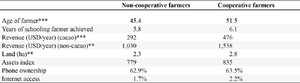
Basic summary statistics regarding control variables used in the empirical analysis are detailed in Table 1, and a key to primary outcome variables is provided in Table 2. Asterisks in Table 1 indicate significance levels for t-tests of differences in means for each variable between cooperative farmers and non-cooperative farmers.

Summary statistics for control variables
Citation: International Food and Agribusiness Management Review 29, 1 (2026) ; 10.22434/ifamr.1273
Student’s t-test results for difference in means between groups are indicated.***p<0.01, **p<0.05.Outcome variable key
Citation: International Food and Agribusiness Management Review 29, 1 (2026) ; 10.22434/ifamr.1273
The Assets Index assigns values to each of eight household goods based on accepted market values in the region. The Index sums the value of each of these items if owned by the farmer, and adds half the market value for each item that the farmer cites as ‘accessed’ and not ‘owned’ (where ‘accessed’ is defined as ‘usable without paying for that use,’ after Doss et al. (2013) and James and Versteeg (2007)). An index value of 800 is roughly equivalent to ‘accessing’ a motorcycle and ‘owning’ a bicycle, a radio, a cell phone and a television. Note that the median Index value across the population sampled is 135 — the equivalent of owning a bicycle, a radio and a cell phone.
4.1 ICT-enabled extension relates to participation in the farmer cooperative
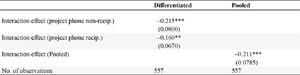
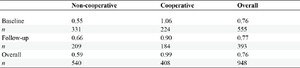
The ICT project facilitated farmer-extension interaction during a challenging period in the cooperative’s operation. Table 3 shows that, fewer cooperative farmers reported being able to access extension services in the follow-up survey period as compared to the baseline period. However, farmers who participated in the ICT project reported a smaller decline in extension services compared to non-project participants. Farmers who were unaffiliated with the cooperative reported an increase (Table 3) in extension services during the time we were conducting our study. However, these services, while increasing, were still less overall compared to the cooperative (see Table 5).
Extension access (perceived) – summary
Citation: International Food and Agribusiness Management Review 29, 1 (2026) ; 10.22434/ifamr.1273
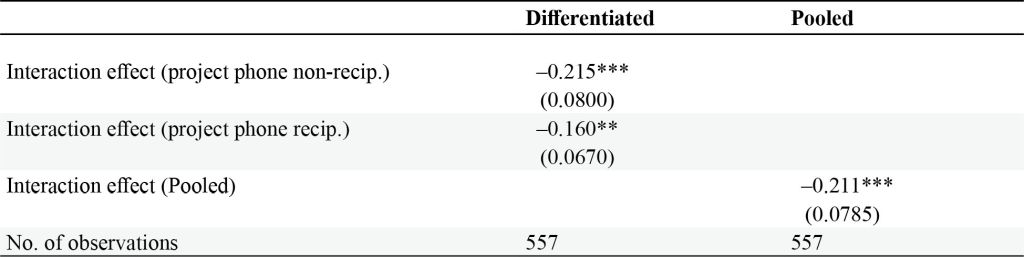
After controlling for other factors in the full analytical model (Table 4; see Table 2 for a full list of covariates used), the ICT extension project is correlated with a 21% decrease in the likelihood of a farmer reporting that they can access extension services when they need them. This perceived deterioration drops to 16% when considering only project phone recipients, indicating that direct involvement in the program may have mitigated overall declines in extension service.
Extension access (perceived) – full model (Probit)
Citation: International Food and Agribusiness Management Review 29, 1 (2026) ; 10.22434/ifamr.1273
Standard errors in parentheses.***p<0.01, **p<0.05, *p<0.1.During focus groups and farmer interviews, cooperative farmers who received project phones expressed a sense of security in the extension services they receive from the company. Farmers who received phones were chosen according to their ‘fidelity’ to the company, so traveling to their fields may be of higher priority for the agronomists than expending the resources to go see other farmers.
The number of extension visits per month reported by farmers followed a similar pattern to their perceived access. Extension visits decreased between the baseline and the follow-up for cooperative farmers, while they increased for non-cooperative farmers (see Table 5). Meanwhile the total number of visits reported by cooperative farmers remained higher than the total reported by non-cooperative farmers — indicating that in general cooperative extension agents still visit cooperative farmers more often than other extension agents.
Extension visits per month – summary
Citation: International Food and Agribusiness Management Review 29, 1 (2026) ; 10.22434/ifamr.1273
4.2 ICT-enabled extension influences communication of agricultural knowledge
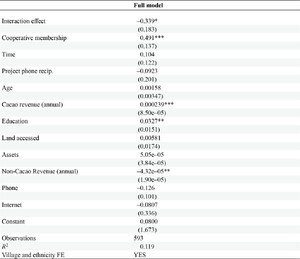
In the full analytical model (Table 6), the ICT-enabled extension project was correlated with a total decrease of 0.34 visits per month. However, this result does not necessarily mean that ICT reduced farmer group’s access to extension assistance. The project facilitated extension-to-farmer communication and exchange of knowledge, particularly regarding coordination of meetings and trainings via phone rather than in-person mobilization. Focus groups and interviews indicate that agents used to have to travel to individual farmers’ homes and fields to set appointments. This presented significant challenges, as it was difficult for the agronomists to know when and where they could meet farmers. As one cacao cooperative farmer noted:
In former times, the agronomists used to walk or motorbike between farmers, but people would not receive the invitations for trainings. For the first two trainings, we were called on our personal phones to know about the trainings. I have received three or four messages on the new phone via WhatsApp.
Extension visits per month – full model (OLS)
Citation: International Food and Agribusiness Management Review 29, 1 (2026) ; 10.22434/ifamr.1273
Standard errors in parentheses.***p<0.01, **p<0.05, *p<0.1.The phones also facilitated farmer-to-extension communication by reducing the need for farmers to travel all the way into town just to make appointments. A cooperative agronomist described during interviews that those farmers who did not receive phones ‘work at the same level as those with phones,’ because the farmers help each other coordinate communication with the office. One cooperative agronomist elaborated:
One farmer who lives 25 km from here used to come here to cocoa office for information or to wait for the agronomist. Now since he has his neighbour with a phone, it is easy to get information.
The phones filled a communication gap, and it served as a complimentary technology with other communication and information dissemination methods. The cacao cooperative produces a weekly radio program that was broadcast on the local station, and the agronomists lead workshops on production practices, sustainable certification, crop prices, and forums on security. Each form of communication has its purpose. According to most farmers interviewed, the radio promotes agricultural techniques and publicizes when a crop thief is apprehended; the group trainings are for demonstrations on crop production; and the phones are for coordinating meetings, trainings, and publicizing when cooperative is buying cacao and vanilla.
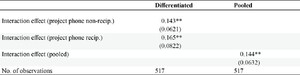
The ICT extension project was associated with a significant increase in farmer knowledge of shade management. The project is correlated with a 14.4% increase in the likelihood of a farmer correctly identifying proper shade management techniques (Table 7).
Shade management knowledge – full model (Probit)
Citation: International Food and Agribusiness Management Review 29, 1 (2026) ; 10.22434/ifamr.1273
Standard errors in parentheses.***p<0.01, **p<0.05, *p<0.1.In our full analytical model, the ICT extension project was not significantly correlated with changes in meeting participation, farmer network size, or peer communication frequency, nor was it significantly correlated with farmer knowledge as measured by understanding tool or disease management techniques. Evidence of correlations between the ICT extension program and the prevalence of farmers’ self-identified agricultural challenges was also limited. We found no significant relationships between ICT use and the likelihood of reporting plant disease, crop prices and crop transport.
4.3 ICT-enabled extension influences collective action
Participation in the ICT program, particularly among young farmers, positively impacted their sense of confidence, leadership, and authority in agricultural knowledge. Job prospects for the large youth population in eastern Congo are slim, and young farmers engaged with the ICT program gained confidence and social standing in the community. A young female cacao farmer explained:
In Congo, if there is no employment, you must go to the farm. Now, I see that farming can be a good job. [My husband and I] want to show people that they can do well with farming. We are happy with the program because the neighbours are asking about the people coming every day to our houses for news and information. We are very proud because we can tell the neighbours, “This is our group.”
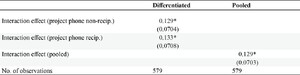
Reporting of crop theft as a significant challenge to agricultural production increased between the baseline and the follow-up periods, from 13.6% to 41.1% among non-cooperative farmers, and from 11.9% to 48.4% among cooperative farmers. In the full analytical model, the ICT extension program was correlated with a 12.9% increase in the likelihood of a farmer reporting crop theft as a primary problem (see Table 8). To explain this, we looked at vanilla cultivation rates, as theft is positively correlated with vanilla cultivation (Pearson’s correlation coefficient=0.0894). Cooperative farmers disproportionately grow vanilla: 34.6% among cooperative vs. 5.7% among non-cooperative farmers in the population surveyed. It may be that cooperative farmers are reporting more theft in the follow-up because more of them grow vanilla. However, including the binary variable for vanilla cultivation in the theft model does not change the significance of the empirical result.
Agricultural challenge: crop theft – full model (Probit)
Citation: International Food and Agribusiness Management Review 29, 1 (2026) ; 10.22434/ifamr.1273
Standard errors in parentheses.***p<0.01, **p<0.05, *p<0.1.Crop theft during this time and in this region of Congo occur mostly in cash crops like cacao, vanilla, and bananas. Outside buyers circulating in this region are willing to purchase vanilla and cacao that is not certified organic and that is not traceable to any particular farm. Cooperative farmers expressed strong loyalties to their group. As one farmer described: “Other organizations aDIDre buying fresh cacao and the price is high, but membership in the cooperative is like a marriage — a married woman must be faithful to her husband.” The cooperative can pay farmers higher rates for quality cacao and vanilla. Farmers argue that buyers without product tracing create an enabling environment for crop theft, despite paying lower rates for these cash crops. As one farmer describes: “The smugglers are taking the vanilla very young — but it is the worse quality. That could harm us here because it makes it seem like the vanilla quality in Congo is bad.”
Farmers reported that the project phones facilitated their ability to contact other cacao and vanilla-growing communities to alert them to the presence of outside buyers, as well as incidences of crop theft. Additionally, much of the crop theft is perpetrated by people who are very familiar with farm layout and timing of harvest. Cooperative farmers with project phones call each other to try and develop strategies for dealing with crop theft, and some of the people who have been stealing cacao have been caught. As one farmer described:
In a country out of control, people are stealing crops. It is easy to send messages [via the project phones] to everyone so that we can see how we can help each other find the thief. Recently I caught two people stealing on my farm. They were known people from town here. Every day that I had crops to sell to different buyers these thieves would come and steal everything. They were caught because I asked them how is it that they have goods to sell to the buyers every day, I asked, Where is your farm? They then went to the police and confessed.
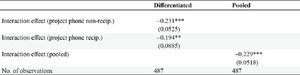
Reporting of delayed payments as a significant challenge to agricultural production decreased between the baseline and the follow-up periods, from 18.0% to 6.0% among non-cooperative farmers, and from 1.2% to 1.0% among cooperative farmers (see Table 9). In the full analytical model, the ICT extension program was correlated with a 22.9% decrease in the likelihood of a farmer reporting delayed payments as a primary problem (see Table 10).
Agricultural challenge: payment delays – summary
Citation: International Food and Agribusiness Management Review 29, 1 (2026) ; 10.22434/ifamr.1273
Agricultural challenge: payment delays – full model (Probit)
Citation: International Food and Agribusiness Management Review 29, 1 (2026) ; 10.22434/ifamr.1273
Standard errors in parentheses.***p<0.01, **p<0.05, *p<0.1.While the phones served a dissemination-based purpose for some functions (informing farmers of meeting times and scheduling farm visits), cooperative farmers argued that their greatest challenge was coordinating with the office to get paid. Farmers who brought their crops to the cooperative could face delays in payment if cash was not available:
We had gone three months of bringing our crops without being paid. We all communicated with [management] and the communication program is good because now we have pushed [management] and now there is cash for us to be paid.
Farmers with project phones organized to lobby the cooperative’s management via WhatsApp to secure cash payments rather than credit for their crops. This collective action led to a system of phone-based notifications to alert farmers (who then tell their neighbours) when payments are available at the office. One farmer describes the shift in communication and cooperative operations:
In former times, we were very far away from the boss. We had to use someone from the office to go to check email at [the nearby national park ranger station] — and the message can change when it goes through everyone. Now we are very close to the boss — it is easy to send messages to him [via WhatsApp].
4.4 Challenges to effective uptake of ICTs in extension systems
Some technical issues remained with the use of smartphones that limit the effectiveness of their use. Electricity was not always available for charging phones, due to outages at the hydroelectric facilities in the area and the limited distribution of solar electric panels among phone recipients. Limited cellular coverage in the region hampered delivery of phone and data credit, as well as application updates. Some cooperative farmers found learning the smartphone touchscreens challenging. However, all farmers expressed a willingness to continue learning how to utilize the smartphones and ICT.
5. Discussion and conclusions
We found a mix of challenges and opportunities for the ICT program, in addition to several unexpected outcomes that may address the fragile agricultural supply chain in the area. The ICT-enabled extension system was not clearly associated with improvements in most of our significant variables of interest (meeting participation, number of members in communication networks, frequency of communication with other farmers) and it was associated with declines in extension service delivery by some measures (extension visits per month, extension access, frequency of communication with extension agents). There was mixed evidence for improvements in information dissemination, limited primarily to small improvements in shade management knowledge.
While farmer communication with extension decreased over the duration of the program, we found evidence that ICT-enabled extension can facilitate dissemination and communication of logistical and organizational information in particular. Cacao farmers who received phones widely understood that the program was intended to increase their communication with extension agents and with each other. Cooperative farmers with program phones spoke nearly unanimously of their obligation to tell others in their farmer groups the news they received from the office regarding meetings and days the office would buy cacao. So in some ways project phones acted as a substitute for time-consuming travel and door-to-door organizing that the extension agents were doing before the program. Given concurrent company management decisions (i.e. the sale of extension motorcycles) it is likely that the remainder of the decline in extension service was exogenously driven.
There were unforeseen impacts of the extension project as well: Crop theft became a major issue for farmers (both within and outside of the cooperative), likely driven by the high price of vanilla on the world market and the increased presence of outside buyers in the community. Increased connectivity via the phones helped to alert Cooperative farmers and staff to the issue so that different management and preparedness strategies could be developed. The phones and these efforts to collectively organize did not decrease farmers’ concerns about theft, however, as farmers reported a significant increase in threat from theft over time. So, though qualitative work indicates that the project may have had positive impacts, further work would be required to parse out impacts on rates of theft among the populations studied.
Perhaps the most interesting result can be seen in the change in perceptions about the late payment issue: The project phones seemed to open a new avenue for communication with cooperative company management for farmers, enabling them to enhance the visibility of their preferences and their challenges in the eyes management. Increased access to management via the WhatsApp platform helped farmers shift the organization from a credit-based system to ensuring cash-on-receipt for their crops. This increased connectivity is evidence of effective communication and collaboration among farmers, as well as ‘bottom-up’ communication with company management.
A major limitation of this study is that there was no disaggregation of data regarding intersectional identities. This is problematic, given that cash crop agroforestry systems can be associated with reproducing gendered, racial, and class-based. Cocoa cash crops in this region are largely dominated by older men. Only one female farmer was affiliated with the cooperative and available for interview. Further, there was limited inquiry into the potential for people from different ethnic groups to have different experiences with agroforestry or ICT-based extension. While the region is dominated largely by the Banande ethnic group, there are other groups including the Bapere who have been historically marginalized in terms of political rights and land access. These dimensions can influence who has access to the means of production for agroforestry systems, cash crop markets, and the benefits of ICT-based extension projects. These limitations have implications for knowledge access and exchange, livelihoods, and further replication of inequalities in agricultural communities. This case study demonstrated challenges and opportunities for ICT-based farmer extension in a fragile area. This study provides suggestive evidence of the potential for small-scale farmers in a fragile areas to apply ICT resources in innovative ways to solve pressing problems of agricultural supply chain.
References
Aker, J.C. 2011. Dial “A” for agriculture: A review of information and communication technologies for agricultural extension in developing countries. Agricultural Economics 42(6): 631–647. https://doi.org/10.1111/j.1574-0862.2011.00545.x
Ayim, C., A. Kassahun, C. Addison and B. Tekinerdogan. 2022. Adoption of ICT innovations in the agriculture sector in Africa: review of the literature. Agriculture and Food Security 11(1): 22.
Antony, A.P., K. Leith, C. Jolley, J. Lu and D.J. Sweeney. 2020. A review of practice and implementation of the internet of things (IoT) for smallholder agriculture. Sustainability 12(9): 3750. https://doi.org/10.3390/su12093750
Baker, E., L. Ruyle and G. Savio. 2017. Powering development : mini hydroelectrification in North Kivu, Democratic Republic of the Congo. Conflict Trends 2017(1): 43–51. https://doi.org/doi:10.10520/EJC-6e828a678
Bhusal, A., G.C. Sagar and L. Khatri. 2021. A review article on role of information and communication technology in agriculture and factors affecting its dissemination in Nepal. Journal of Applied Biotechnology and Bioengineering 8(3): 81–85. https://doi.org/10.15406/jabb.2021.08.00257
Buis, M.L. 2010. Stata tip 87: interpretation of interactions in nonlinear models. The Stata Journal: Promoting Communications on Statistics and Stata 10(2): 305–308. https://doi.org/10.1177/1536867X1001000211
Congo Research Group. 2016. Qui sont les tueurs de Beni ? (Rapport d’enquête N °1). Center on International Cooperation, New York University, New York, NY. Available online at https://reliefweb.int/report/democratic-republic-congo/qui-sont-les-tueurs-de-beni-rapport-d-enqu-te-no-1-mars-2016
Davis, K.E. 2008. Extension in Sub-Saharan Africa: overview and assessment of past and current models, and future prospects. Journal of International Agricultural and Extension Education 15(3): 14.
Heemskerk, W. and B. Wennink. 2004. Building social capital for agricultural innovation: experiences with farmer groups in sub-Saharan Africa. Royal Tropical Institute, Amsterdam, the Netherlands.
Kibriya, S., G. Savio, E. Price and J. King. 2016. The role of conflict in farmers’ crop choices in North Kivu, Democratic Republic of the Congo. International Food and Agribusiness Management Association 19(3): 1–20. https://doi.org/10.22004/ag.econ.244690
Kibwika, P., A.E.J. Wals and M.G. Nassuna-Musoke. 2009. Competence challenges of demand-led agricultural research and extension in Uganda. The Journal of Agricultural Education and Extension 15(1): 5–19. https://doi.org/10.1080/13892240802617510
Kuntke, F., S. Linsner, E. Steinbrink, J. Franken and C. Reuter. 2022. Resilience in agriculture: communication and energy infrastructure dependencies of German farmers. International Journal of Disaster Risk Science 13(2): 214–229. https://doi.org/10.1007/s13753-022-00404-7
Kusnandar, K., O. van Kooten and F.M. Brazier. 2021. COCREATE: a selfdirected learning approach to agricultural extension programmes, Development in Practice 31(5): 636–649, https://doi.org/10.1080/09614524.2021.1908229
Lyon, F. 2000. Trust, networks and norms: the creation of social capital in agricultural economies in Ghana. World Development 28(4): 663–681. https://doi.org/10.1016/S0305-750X(99)00146-1
Martin, B. L. and E. Abbott. 2011. Mobile phones and rural livelihoods: diffusion, uses, and perceived impacts among farmers in rural Uganda. Information Technologies and International Development 7(4): 17–34.
Rivera, W. M., M.K. Qamar and L.V. Crowder. 2001. Agricultural and rural extension worldwide: Options for institutional reform in the developing countries. FAO, Rome.
Simpson, B. and M. Owens. 2002. Farmer field schools and the future of agricultural extension in Africa. Journal of International Agricultural and Extension Education 9(2): 29–36.
Tkach, B. and A.A. Williams. 2018. Mobile (in)security? exploring the realities of mobile phone use in conflict areas. Information, Communication and Society 21(11): 1639–1654. https://doi.org/10.1080/1369118X.2017.1348531
Williams, R. 2012. Using the margins command to estimate and interpret adjusted predictions and marginal effects. The Stata Journal: Promoting Communications on Statistics and Stata 12(2): 308–331. https://doi.org/10.1177/1536867X1201200209
Corresponding author