Abstract
The traveling food tourism with children industry has become a rapidly developing tourism market after the epidemic. Parents, children, and sightseeing factories have all benefited positively from their shared family travel experiences. Based on the value co-creation theory, this study analyzes literature related to traveling with children from a group perspective, selects variables and dimensions based on the characteristics of traveling with children in China, and investigate the relationships among motivation, involvement, experience value and visit intention in the context of the food tourism industry. Analysis of data from 578 respondents indicates that the proposed model fits the data well. The results indicate that the motivation of traveling with children does not have a direct positive impact on visit intention, but through tourism involvement and experience value, it can indirectly affect the visit intention of tourists with children. Empirical analysis is expected to contribute to the study on the experience theory of traveling with children. At the same time, targeted guidance and suggestions can be provided for product design, marketing strategy, and experience management in the food tourism industry.
1. Introduction
COVID-19 has profoundly transformed the dynamics of daily life and travel. On one hand, the pandemic has cultivated a deeper appreciation for familial bonds, highlighting the value of shared time. Consequently, traveling with children has emerged as a popular pursuit for families, offering an opportunity for collective engagement in tourism, thereby enriching emotional connections and strengthening parent-child relationships. Furthermore, these family trips serve as a respite from the stress and anxiety induced by the pandemic, aligning well with the emotional needs of individuals during this challenging period (Godovykh et al., 2021; Itani and Hollebeek, 2021).
The provision of experiences has emerged as a pivotal cornerstone for businesses to secure a competitive edge and generate profit (Pine and Gilmore, 1998). At the heart of this transformation lies the perception of customer value, wherein the experiential element holds paramount significance, profoundly influencing purchasing decisions. By centering attention on customers’ value pursuits throughout the consumption process, organizations can curate and amplify the experiential context, thereby shaping the perceived value of customer experiences. This strategic approach is instrumental in fostering and sustaining customer loyalty (Pullman and Gross, 2004).
However, the focus of family tourism experience research is predominantly on group interactions among family members (Schänzel, 2010). This emphasis is rooted in the understanding that family vacations foster a unified mindset among family members through the provision of shared experiences. These collective experiences and attitudes contribute to a shift in the family’s thinking, from an individualized ‘me’ and ‘you’ perspective to a collective ‘we’ mindset (Lehto et al., 2009). Extant research indicates that both parents and children derive positive benefits from shared family travel experiences. Therefore, travel suppliers and the industry alike should take into account the diverse perspectives of different family members to enhance the travel experiences for all family constituents (Miyakawa and Oguchi, 2022).
Consequently, research on traveling with children needs to introduce value co-creation theory. It not only focuses on the basic functions and service quality of travel, but also pays attention to the value experience during the travel process. Co-creation entails an integrative process involving active dialogues and co-construction of personalized experiences on the part of the participants (Prahalad and Ramaswamy, 2004). Travelers accompanied by children engage in a collective process of experiencing and comprehending shared travel encounters, including their value perception within co-created consumption scenarios (Fu and Lehto, 2018). Consequently, tourism enterprises and related institutions ought to accord significant attention to the needs of this consumer demographic. They should strive to offer an array of diverse and personalized travel products and services, tailored to satisfy the value perception and expectations of travelers with children.
Building on previous research, the main aim of this study is to construct a framework outlining the influence mechanisms and structural relationships among motivation, involvement, experience value and visit intentions within the context of travelling food tourism industry with children. This research enhances the theoretical understanding of family travel. Furthermore, the findings of this study offer practical guidance for product design and marketing strategies in the food tourism industry. The development and operation of marketing channels for food also require horizontal expansion through the development of tourism industry (Zhu et al., 2017). Experience activities in traveling with children are often accompanied by direct consumption of agri-food products. Through experience activities, parents can impart food safety knowledge to children. This helps children establish correct food safety concepts from a young age and form good eating habits. Strengthening cooperation between traveling with children and the agri-food industry can promote their common development.
Additionally, the outcomes of this research provide valuable insights and recommendations for resource distribution and experience management in agri-food industry. For example, traveling with children routes themed around agricultural products can be designed, allowing tourists to gain a deeper understanding of the production process and cultural background of agricultural products during their travels. At the same time, agricultural product processing experience activities can also be carried out, allowing tourists to personally participate in the processing of agricultural products and learn about agricultural product processing techniques and methods.
2. Literature review
2.1 Traveling with children
Within the academic discourse, Western scholars tend to categorize traveling with children under the overarching concept of family tourism. Initial research endeavors, adopting a perspective grounded in the composition of family members, have defined couple travel and travel with children as distinct forms of family tourism (Kang and Hsu, 2004; Zabriskie and McCormick, 2003). However, the consensus among a majority of researchers is that the primary constituents of family tourism comprise at least one adult and one minor child. The category of adults typically encompasses parents and other legal guardians (Schänzel, 2010; Schänzel and Yeoman, 2015).
Research topics in family tourism predominantly concentrate on tourism consumption (Alegre et al., 2013; Dolnicar et al., 2008; Fu et al., 2014; Sahoo et al., 2022; Sun et al., 2015; Zheng and Zhang, 2013), tourism decision-making (Li et al., 2020; Kim and Mokhtarian, 2021; Kim et al., 2010; Mottiar and Quinn, 2004; Rojas-de-Gracia and Alarcón-Urbistondo, 2018; Therkelsen, 2010; Xu et al., 2022), tourism experience (Carr, 2006; Miyakawa and Oguchi, 2022; Schänzel, 2010; Wu et al., 2019)and tourism function (Lehto et al., 2009; MacInnes et al., 2022; Shaw and Dawson, 2001; Yankholmes et al., 2021; Wu et al., 2021). In the extant research, the majority of scholars adopt the perspective of parents as the primary focus. This is rooted in the belief that parents serve as the primary decision-makers in tourism consumption behavior. Given that children tend to be comparatively deficient in life experience and knowledge reserves, they are often unable to make autonomous and informed decisions. Conversely, parents, with their wealth of life experience and capacity for independent judgment, are deemed capable of making more rational consumption choices during the tourism process..
Although parents often occupy a dominant role as decision-makers in actual consumption behavior, it is imperative to recognize the significant influence that children exert on parental decision-making. This influence is closely tied to the age of minor children, as their cognitive abilities progress with age, thereby contributing to an augmentation of consumption knowledge and skills (John, 1999). Concurrently, it is acknowledged that younger children may present challenges within the context of family tourism, resulting in a comparatively less substantial impact on family purchase decisions compared to older children (Gram, 2007; Watne et al., 2014).
Drawing upon the aforementioned scholarly literature, it is evident that the preponderance of studies has primarily concentrated on an individualistic perspective. In stark contrast, the current study adopts a group-oriented approach that incorporates all family members, thereby contributing significantly to the evolution and advancement of motivation and experience theories in the context of group tourism.
2.2 Motivation
In the realm of tourism studies, motivation research has consistently occupied a pivotal position. With regards to research content, apart from delving into the conceptualization and dimensional analysis of tourism motivation, it predominantly treats tourism motivation as a variable of interest. Researchers, on the one hand, scrutinize the factors that shape and influence tourism motivation, while on the other hand, they examine the mechanisms in which tourism motivation impacts travel decision-making processes, tourism experiences, and subsequent behavioral intentions.
Traveling with children serves as a beneficial means of strengthening familial cohesion and fostering emotional communication among family members (Chesworth, 2003). For families, the essence of vacations lies in the opportunity to spend quality time together and engage in mutual activities (Rhoden et al., 2016). Moreover, children hold these moments spent with their parents in high esteem (Gram, 2005). In contemporary nuclear family structures where education is paramount, parents perceive tourism as a form of diversified education for their children (Bhuiyan et al., 2010). Participating in simulated games during tourism excursions can bridge the gap between formal and informal education, thus enabling children to gain an early awareness of the social environment outside the confines of traditional education (Adukaite et al., 2017).
It is apparent that the primary motivation underlying family leisure activities is rooted in familial and parent-child relationships, with parent-child education motivation occupying a secondary position (Shaw and Dawson, 2001). However, a scrutiny of research on the motivation for traveling with children, particularly among Eastern scholars, reveals that parent-child education motivation is notably more salient than parent-child relationship motivation (Pan and Shang, 2023). Despite the disparities in the dimensionalities of tourism motivation between Eastern and Western contexts, parent-child relationship and parent-child education remain pivotal in the context of traveling with children.
Drawing upon the aforementioned scholarly works, the motivation for traveling with children builds upon and extends traditional research in motivation theory, which has predominantly focused on individual travel needs and aspirations. However, the decision-making process when traveling with children is inherently collaborative, encompassing the perspectives of both parents and children. As such, the travel motives that influence their joint decision-making should be framed in a family-oriented context (Fu et al., 2022).
2.3 Involvement
Based on the theoretical foundations of individual needs, values, and interest states, involvement is conceptualized as an individual’s cognitive assessment of the significance and relevance of various factors (Zaichkowsky, 1985). The involvement theory primarily delves into the intricacies of consumer purchasing decision-making, highlighting the fact that consumers do not always adhere to rational decision-making processes. This is attributed to the recognition that not all consumer behavior can be explained solely through rational economic principles (Yamoaha and Yawson, 2022). This notion holds particular relevance in the tourism domain, where the consumption patterns of tourists are inherently multifaceted and complex. When tourism destinations resonate with the values and needs of tourists, their consumption behavior tends to demonstrate a distinct predisposition towards those destinations (Altunel and Erkurt, 2015; Ji et al., 2023). The varied nature of tourism types, including persistent involvement, emotional involvement and situational involvement, has led to divergent measurements of tourism involvement (Gross and Brown, 2008; Kim, 2012; Zatori et al., 2018).
In the realm of tourism research, the concept of involvement transcends the sole realm of tourist involvement to embrace the involvement of residents as well (Li et al., 2021; Šegota et al., 2017). Specifically, in the context of disaster tourism destinations, resident involvement exhibits a dynamic evolution across temporal and spatial dimensions. This evolving involvement presents opportunities for destinations and policymakers to harness it as a guiding framework in facilitating residents’ recovery from disasters, while concurrently enhancing their capabilities and knowledge as tourism practitioners (Tan et al., 2022). This underscores the paramount importance of conducting research on residents’ involvement in the development and management of tourism destinations.
As an emerging segment within the tourism market, traveling with children incorporates consumption concepts that span across two generations during the travel process, along with emotional factors such as parents’ expectations and caregiving responsibilities towards their minor children. The traditional rational consumption decision-making framework falls short in addressing this multifaceted scenario. The incorporation of involvement theory offers a potential avenue for addressing this complexity.
2.4 Experience value
The concept of tourist experience value evolved from customer value in tourism, focusing on the value customers gain from experiences (Wu et al., 2018). It integrates fundamental customer value features with interactive attributes, reflecting customers’ evaluations based on firsthand experiences of enterprise products and services (Berry et al., 2002). Experience value differs subtly from perceived value, being embodied, emphasizing active participation and authenticity grounded in bodily perceptions..
It is evident that, apart from exploring the connotation and dimensions, research on experience value primarily focuses on causality (Prebensen et al., 2013; Wu et al., 2018). Interactions, services, and management within the community (Chang and Wang, 2023), involving volunteers (Kim et al., 2022) and visitors (Barnes et al., 2020; Oriade and Schofield, 2019; Yrjölä et al., 2019), collectively contribute to the experiential value for tourists.
Drawing upon the existing scholarly corpus, experience value emerges as a pivotal construct in elucidating tourism behavior. From a collective lens, this research endeavors to delineate how the perception of experience value diverges when individuals engage in family travel with children, in contrast to their general travel experiences.
2.5 Visit intention
Visit intention serves as a pivotal determinant of tourists’ travel behavior, garnering significant scholarly attention in the tourism research domain. Within the framework of tourist decision-making research, factors encompassing tourism motivation, personal values, tourism knowledge, and tourism experience have been empirically demonstrated to have a substantial influence on visit intention. Elevated levels of tourist satisfaction are positively correlated with heightened future behavioral intentions, thereby enhancing the probability of actual travel, repeat visits, and other tourism-related behaviors (An et al., 2021; Baker and Crompton, 2000; Bieszk-Stolorz et al., 2021; Molinillo et al., 2018).
Drawing on the aforementioned scholarly literature, visit intention is conceptualized as the attitudinal predisposition of tourists when making decisions pertaining to tourism. This study operationalizes visit intention as the inclination of parents to engage in tourism activities with their minor children, coupled with the magnitude of effort they are willing to expend. This definition functions as a robust predictor of the probability of future travel behavior involving children.
3. Theoretical framework and hypotheses development
3.1 The relationship between motivation and involvement
Regarding the relationship between motivation and involvement, scholars usually conduct research from two levels. The first is the conceptual level. Motivation is considered as antecedents and mediators factors influencing involvement and identification in the process in the conceptual model of the involvement-identification-loyalty relationship (Iwasaki and Havitz, 2004). The Second is the dimension level. Divide the dimensions of tourism motivation and tourism involvement, and research the relationship between each dimension (Kim, 2008; Kyle et al., 2006).
Therefore, it is observable that the stronger tourists’ motivation is, the greater it contributes to heightening their level of involvement and prompts them to make active participation decisions. Based on the aforementioned conclusions, this study advances the following hypothesis:
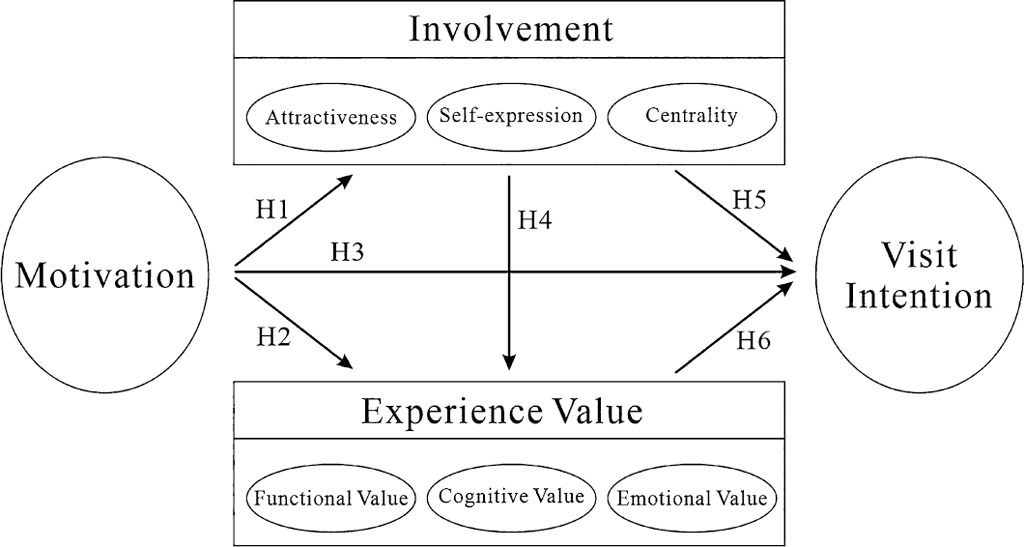
H1: Motivation positively affects involvement.
3.2 The relationship between motivation and experience value
When tourists have a good travel experience, they think that their efforts are directly proportional to their gains, and they feel that this travel activity is valuable. Everyone’s travel motives are different, and the experience value will be different. Emotional motivations for novelty and enjoyment will affect the perceived value of tourists (Duman and Mattila, 2005). This effect is generally a significant positive effect (Prebensen et al., 2013). In the field of medical tourism research, researches have shown that there is a significant relationship between tourists’ tourism motivation and travel experience perception (Drinkert and Singh, 2017).
Accordingly, this study selects three dimensions: functional value, cognitive value, and emotional value, as measures of the experience value derived from traveling with children. Based on the aforementioned conclusions, this study advances the following hypothesis:
H2: Motivation positively affects experience value.
3.3 The relationship between motivation and visit intention
Consumer psychology believes that a person has a need under certain environmental stimuli and needs to generate purchasing motivation, and purchasing motivation stimulates people’s purchasing behavior. Motivation refers to the need to cause and prompt people to produce a certain behavior to achieve a certain goal (Dann, 1981). In marketing applications, marketers induce consumers’ purchase motivations to promote consumers’ purchases. Many scholars have verified that motivation significantly affects behavioral intentions (An and Han, 2018; Baloglu, 2000; Luo and Ye, 2020; Su et al., 2020; Waqas et al., 2021).
Therefore, motivation serves as the intrinsic catalyst for behavior. Through the examination of tourism motivation, the occurrence of tourism activities can be anticipated. Based on the aforementioned conclusions, this study advances the following hypothesis:
H3: Motivation positively affects visit intention.
3.4 The relationship between involvement and experience value
In the field of consumer economics, product involvement is considered to be an important factor affecting customer perceived value. Consumer involvement will affect perceived value by affecting perceived risk (Hong, 2015). In the field of tourism, involvement can affect tourists’ perception of the value of experience (Prebensen et al., 2013). Researches have shown that leisure involvement has a positive impact on tourism experience (Park et al., 2018).
Therefore, in the decision-making process, tourists traveling with children will endeavor to mitigate perceived risks in various manners to enhance their experience value. Based on the aforementioned conclusions, this study advances the following hypothesis:
H4: Involvement positively affects experience value.
3.5 The relationship between involvement and visit intention
According to the degree-of-involvement model, the antecedent of involvement is motivation, and the consequence of involvement is behavior (Flynn and Goldsmith, 1993). When consumers are shopping, a high degree of shopping involvement can promote shoppers’ willingness to stay and go shopping (Pradana et al., 2020; Suh and Youjae, 2006; Wakefield and Baker, 1998; Walters and Long, 2012).
Therefore, involvement serves as a critical factor that significantly impacts tourism behavior. Based on the aforementioned conclusions, this study advances the following hypothesis:
H5: Involvement positively affects visit intention.
3.6 The relationship between experience value and visit intention
Experience value will positively affect behavioral intention. Some researchers have found that experience value is positively correlated with retail store preference and future patronage intention (Mathwick et al., 2001). By introducing a satisfaction model, it can be verified that experiential value positively influences customer purchasing behavior (Eggert and Ulaga, 2002).
Therefore, a favorable perception of the value of the tourism experience will enhance tourists’ behavioral intentions, including visiting, revisiting, and recommending. Based on the aforementioned conclusions, this study advances the following hypothesis:
H6: Experience value positively affects visit intention.
Drawing upon the aforementioned six hypotheses, the current investigation advances a conceptual framework, depicted in Figure 1.

Research framework.
Citation: International Food and Agribusiness Management Review 28, 4 (2025) ; 10.22434/ifamr.1113
4. Research design and methodology
4.1 Questionnaire development
The present study underscores the significant influence of preschool and school-aged children on family leisure consumption patterns, motivating parents to invest considerably more time and energy in familial pursuits. Notably, as children progress into the school-aged bracket, education assumes a paramount position, with tourism emerging as a crucial avenue for children to broaden their horizons and discover the world. Consequently, this research primarily focuses on households with preschoolers (aged 4–6) and school-aged children (aged 7–12) as the primary subjects of investigation..
The questionnaire was structured into three distinct sections. The initial segment served as a screening mechanism, aimed at identifying individuals who possessed the intention to engage in food tourism factory visits with preschool-aged children (4–6 years old) and school-aged children (7–12 years old) within the subsequent year, and to proceed with the questionnaire accordingly. The second section captured fundamental demographic information, encompassing the gender of respondents, the age range of the accompanying children, the total number of children, the anticipated frequency of tourism activities, and the type of tourism group planned. The final section constituted the research scale, encompassing variables pertaining to motivation, involvement, experience value and visit intention.
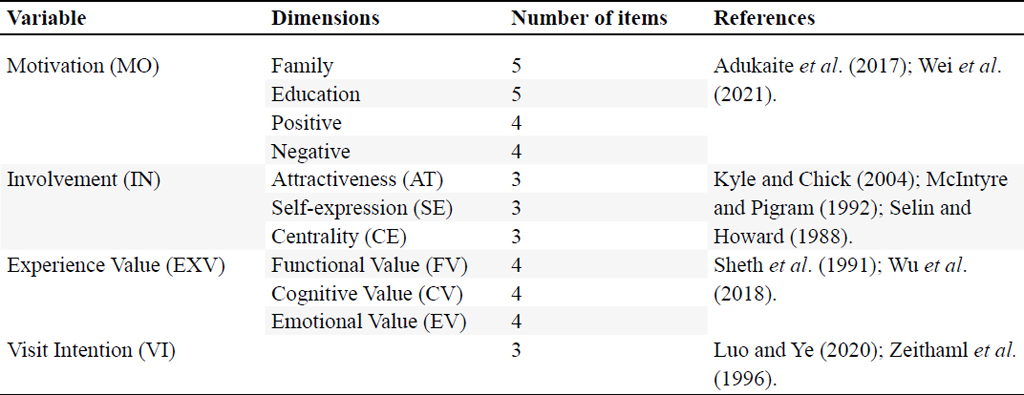
The scale utilized in this study employed a 5-point Likert scale, where 1 signified strong disagreement, 2 denoted disagreement, 3 reflected neutrality or uncertainty, 4 concurred with agreement, and 5 indicated strong agreement. The questionnaire adopted scales that have been well-established in prior research and were suitably modified to align with the specific parameters of this investigation, as detailed in Table 1. The research questionnaire was crafted and disseminated via an online format for ease of accessibility and data collection.
Measure items of the research questionnaire
Citation: International Food and Agribusiness Management Review 28, 4 (2025) ; 10.22434/ifamr.1113
4.2 Sample and data collection
Data collection for this study was conducted among a sample of Chinese family tourists between June 1 and August 10, 2023. Out of the 602 questionnaires distributed, those containing evident errors, incompleteness, or missing information were excluded from further analysis. Ultimately, 578 valid questionnaires were retained, achieving a valid response rate of 96%. The screening criteria adhered to the following guidelines: questionnaires indicating no travel plans in the coming year were discarded, and those with identical answers to every question were also eliminated. For the remaining valid questionnaires, individual Excel files were created, and statistical software packages such as SPSS 27.0 and AMOS 27.0 were employed as the primary tools for data analysis.
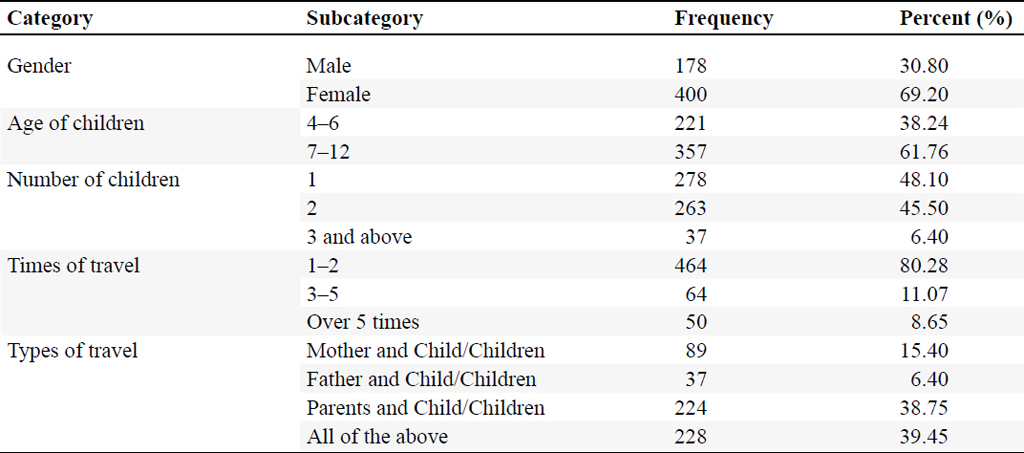
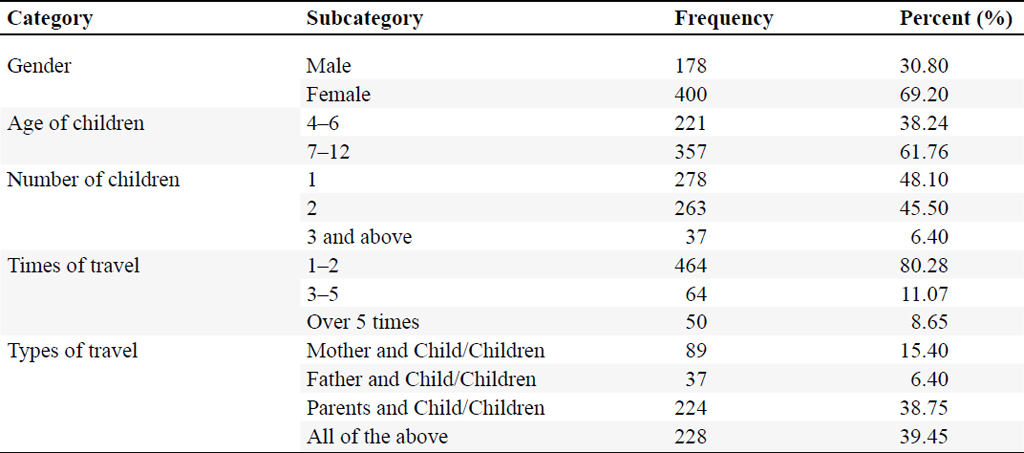
Table 2 presents a summary of the descriptive statistics pertaining to the sample. Among the participants, 178 (30.80%) were male, while 400 (69.20%) were female. The majority of respondents (61.76%) indicated that they had visited food tourism factories with children aged between 7 and 12 years. Furthermore, 93.60% of the respondents reported having one or two children. With regard to the frequency of travel, the most common occurrence was 1-2 visits per year, accounting for 80.28% of the total. Regarding the types of travel arrangements for food tourism industry visits with children, the combinations involving parents and children were diverse, with relatively fewer instances of pure “mother and child/children” or “father and child/children” configurations.
Demographic profile of sample (N=578)
Citation: International Food and Agribusiness Management Review 28, 4 (2025) ; 10.22434/ifamr.1113
5. Research results
5.1 Reliability, validity, and discriminant analysis
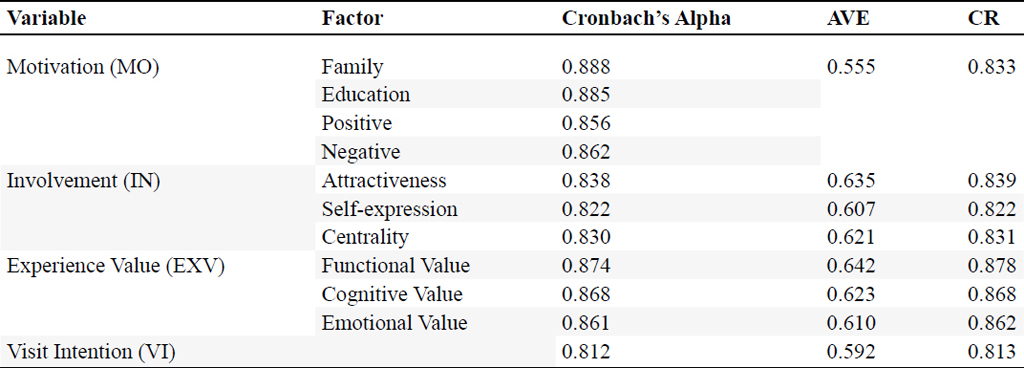
To assess the consistency of the questionnaire’s research variables across measurement items, a reliability analysis utilizing Cronbach’s Alpha coefficient was performed. As evidenced in Table 3, the reliability of each dimension and the overall dimension exceeded 0.8, suggesting a relatively high level of reliability for the questionnaire data. Prior to embarking on the factor analysis, the correlation matrix’s factorability was validated through two statistical tests: Bartlett’s Test of Sphericity (BTS), yielding a value of 12983.384 (P<0.000), and the Kaiser-Meyer-Olkin (KMO) Measure of Sampling Adequacy, with a score of 0.924. These results confirmed the appropriateness of applying Exploratory Factor Analysis (EFA) to the dataset.
Reliability and validity analysis.
Citation: International Food and Agribusiness Management Review 28, 4 (2025) ; 10.22434/ifamr.1113
The factor structure for the confirmatory tests was derived from an EFA with the VARIMAX orthogonal rotation method (Dagger et al. 2007). It can be seen that a total of 11 factors were obtained from the factor analysis results. The commonality values corresponding to all research items are higher than 0.4, which means that there is a strong correlation between the research items and factors, and the factors can effectively extract information.
The overall fit of the measurement models was adequate. CMIN/DF is 1.079, which is lower than 3; GFI (0.959), NFI (0.956), RFI (0.948), and IFI (0.997) are all higher than 0.9; RMR is 0.024, which is less than 0.08; RMSEA is 0.012, which is less than 0.08. This study analyzed the CR (Construct Reliability) and the AVE (Average Variance Extracted) values to analyze the convergent validity of each variable. As shown in Table 3, the AVE values corresponding to all variables are greater than 0.5, and the CR values are all greater than 0.7 (Fornell and Larcker, 1981), which means that the data analyzed in this analysis has good convergent and convergent validity.
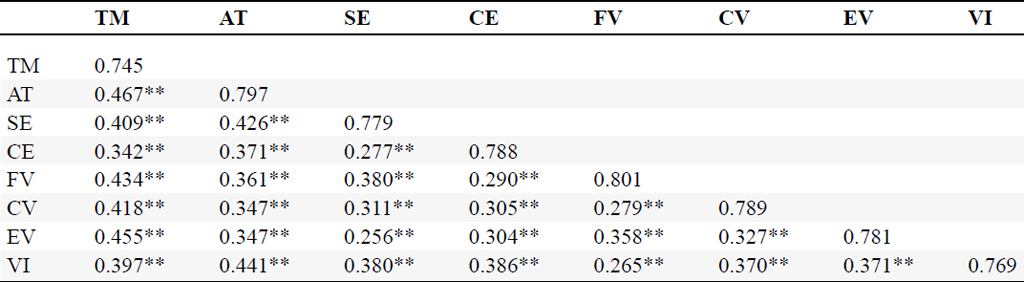
In the current study, the AVE method was employed as a rigorous approach to assess the discriminant validity. Specifically, this evaluation was based on the criterion that the square root of the AVE for a given factor must exceed the absolute value of the correlation coefficient between that factor and all other factors. As presented in Table 4, the satisfaction of this criterion for all factors indicates that the discriminant validity of the measurement model is adequate.
Discriminant analysis.
Citation: International Food and Agribusiness Management Review 28, 4 (2025) ; 10.22434/ifamr.1113
5.2 Hypothesis testing
This study uses the maximum likelihood method in AMOS 27.0 for estimation. The overall fit of the measurement models was adequate. CMIN/DF is 1.270, which is lower than 3; TLI (0.986), IFI (0.980), and CFI (0.988) are all higher than 0.9; RMR is 0.043, which is less than 0.08; RMSEA is 0.022, which is less than 0.08.
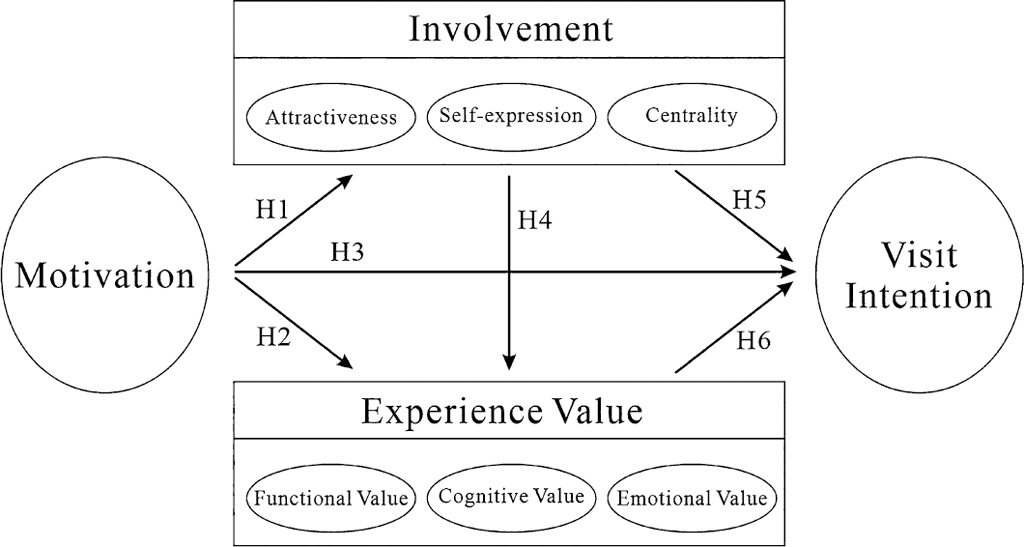
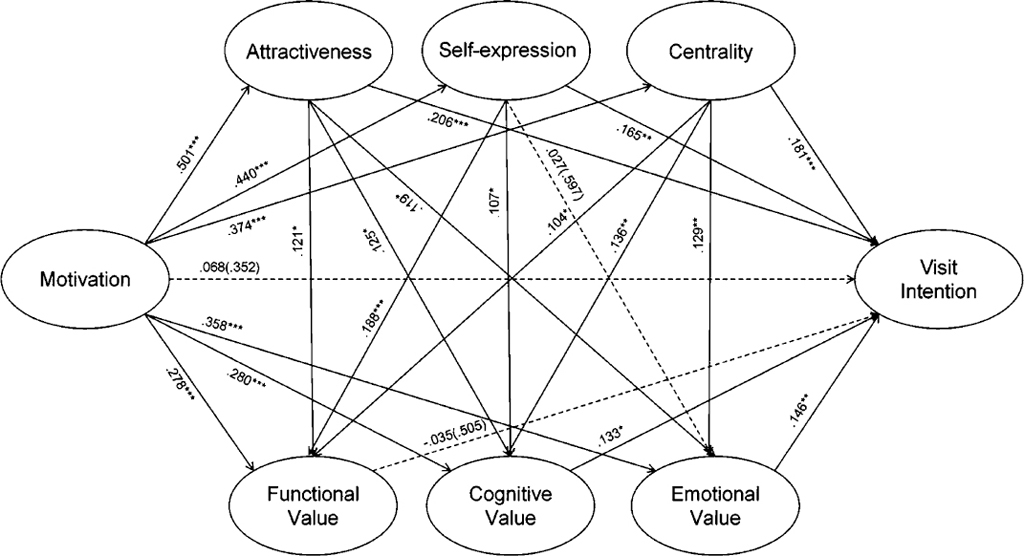
As shown in Figure 2, H1, H2, H4, H5 and H6 are all supported, but H3 is not supported. That is, motivation positively affects involvement, motivation positively affects experience value, involvement positively affects experience value, involvement positively affects visit intention and experience value positively affects visit intention. But tourism motivation does not positively affect visit intention. It is worth noting that self-expression does not positively affect emotional value and functional value does not positively affect visit intention.
Results of research model. *P<0.05, **P<0.01, ***P<0.001.
Citation: International Food and Agribusiness Management Review 28, 4 (2025) ; 10.22434/ifamr.1113
6. Discussion
The theory of value co-creation emphasizes positive interaction and cooperation between consumers and producers to jointly create personalized experiences and value. In the context of traveling food industry with children, this co-creation process is particularly important. On the basis of previous research, the key content of this study is to construct a framework that outlines the impact mechanisms and structural relationships between motivation, involvement, experience value, and visit intention. Through research, it has been found that children’s travel motivation does not have a direct positive impact on their willingness to visit, but through involvement and experience value, it can indirectly affect the willingness of children to visit. The specific conclusion is as follows:
Firstly, this study shows that motivation positively affects involvement, thus providing support for H1. These results are consistent with previous researches (Kyle et al., 2006). This research indicates that a robust motivation among travelers with children is conducive to enhancing their involvement, thereby promoting more proactive participation decisions. Furthermore, motivation exerts a positive influence on diverse aspects of involvement, albeit to varying degrees. Notably, travelers with children tend to prioritize attractiveness and self-expression, reaffirming the perception that traveling with children is conducive to familial development and personal fulfillment.
Secondly, this study shows that motivation positively affects experience value, thus providing support for H2. These results are consistent with previous researches (Duman and Mattila, 2005; Jeong, 2021; Prebensen et al., 2013). Individual motivation emerges as a pivotal factor in shaping value perception, and its influence is modulated by the heterogeneity of motivations. Consequently, it is anticipated that experience value will exhibit variation across individuals. Furthermore, motivation exerts a positive influence on each dimension of experience value, albeit to varying degrees. Notably, travelers with children tend to prioritize cognitive and emotional values, reflecting the dual aims of educational and emotional enrichment when traveling with children.
Thirdly, this study does not show that motivation positively affects visit intention, thus providing unsupported for H3. Not all motivations will positively affects behavioral intention (Su et al., 2020; Joo, 2021). In practical contexts, consumer purchasing behavior is seldom solely attributed to a single motive. Rather, it is often propelled by a multifaceted array of motivations, encompassing both conscious and unconscious factors. Among these motivations, some serve to stimulate purchase behavior, while others may inhibit it. The present study’s findings validate that the motivation behind traveling with children, examined from a group perspective, constitutes a complex motivational system. Consequently, it is imperative to acknowledge that not all motivations exert a positive influence on behavioral intentions.
Fourthly, this study shows that involvement positively affects experience value, thus providing support for H4. These results are consistent with previous researches (Park et al., 2018; Prebensen et al., 2013). The present study elucidates that as involvement intensifies among travelers accompanied by children, there is a corresponding augmentation in the perception that the tourist destination will gratify their aspirations for pleasure and happiness, in addition to offering educational value. It is crucial to highlight that each dimension of involvement exerts a distinct influence on various facets of experience value. Notably, self-expression does not confer a positive effect on emotional value. Instead, self-expression pertains to tourists’ quest for self-awareness and self-worth during tourism endeavors. This suggests that in the context of group tourism, particularly when traveling with children, individual self-expression does not significantly contribute to the group’s emotional dynamics.
Fifthly, this study shows that involvement positively affects visit intention, thus providing support for H5. These results are consistent with previous researches (Suh and Youjae, 2006). The study demonstrates that an elevated level of involvement during travel with children positively correlates with parents’ propensity to engage in tourism activities with their offspring and the degree of effort they are willing to expend. Each facet of involvement exerts a favorable influence on visit intention, albeit with varying degrees of impact across dimensions. Notably, attractiveness emerges as the most significant determinant of visit intention, underscoring the pivotal role of tourists’ interest in the destination.
Sixthly, this study shows that experience value positively affects visit intention, thus providing support for H6. These results are consistent with previous researches (Joo, 2021). A positive perception of the experience value ascribed to traveling with children augments the probability of such travel endeavors. Specifically, cognitive and emotional values exhibit a beneficial influence on visit intention, whereas functional value does not contribute to a positive effect. This suggests that the dual primary objectives of traveling with children are to foster the parent-child bond and facilitate parent-child education (Chesworth, 2003; Shaw and Dawson, 2001).
6.1 Theoretical implication
Firstly, this study unveils the impact of motivation on the negative behavior of travelers with children in food tourism industry from a group perspective and value co-creation theory, marking a significant shift in the research on traveling with children. Prior research has established that motivation exerts a positive influence on individual behavior. However, this paper, adopting a group-oriented perspective, reveals that motivation does not consistently translate into positive behavioral outcomes. It demonstrates that not all motivations elicit behavioral responses, as motivation constitutes a complex system, particularly within the context of group dynamics. Therefore, this paper theoretically contributes to enriching motivation theory and advancing the comprehension of motivational behavior. Furthermore, it lays a solid theoretical foundation for investigating traveling with children from a group-based perspective.
Secondly, this study introduces the theory of involvement to shed new light on the consumption behavior associated with traveling food tourism industry with children. Given the multigenerational consumption perspectives and emotional factors like parental concerns in the emerging tourism market, traditional rational consumption models may be insufficient. The introduction of involvement theory is viewed as an opportune approach. The findings suggest that involvement not only manifests as behavior but also mirrors tourists’ level of consumption and experience in tourism activities.
Thirdly, the research confirms that traveling to food tourism factories with children primarily aims to foster parent-child relationships and educational experiences. Cognitive perceptions and emotional values gained during the trip greatly influence travel intentions. The study emphasizes that traveling food tourism industry with children diverges from traditional sightseeing tourism, where cognitive and emotional factors are pivotal in shaping travel experiences.
6.2 Practical implication
In the realm of the experience economy, travelers with children seek not merely tourism products but an exquisite, holistic purchasing experience that encompasses the environment, service, and emotional engagement. For food tourism factories, the development of differentiated parent-child experience activities that trigger behavioral intentions is paramount for the formulation of effective marketing strategies.
Firstly, there is a pressing need to augment involvement. This research underscores that travelers with children prioritize attractiveness and self-expression, viewing travel as a cornerstone for familial growth and personal fulfillment. Consequently, food tourism factories must prioritize elevating tourists’ interest and fostering self-realization. Customizing marketing strategies to various types and dimensions of tourism involvement is imperative for expanding market share and enhancing competitiveness in the parent-child travel segment. This approach will further contribute to heightened tourist satisfaction and profitability, thereby advancing the holistic development of travel experiences encompassing children.
Secondly, actively diversifying the functionalities of tourism products is paramount. The research underscores the significant influence of cognitive and emotional values on visit intentions. Therefore, food tourism factories must prioritize these needs by developing products that facilitate parent-child interactions, educational opportunities, and enriching experiences. Introducing a broader array of family-oriented tourism activities and experiences can strengthen the bond between parents and children, enhance children’s cognitive development, and support their holistic growth.
Thirdly, there is an imperative need to comprehensively enhance the quality of the tourism experience. In the decision-making process, tourists with children in food tourism industry utilize various strategies to reduce perceived risks and maximize the experience value. This research highlights that a heightened level of parent-child involvement in tourism correlates with stronger beliefs in a destination’s capacity to fulfill desires for pleasure, happiness, and educational enrichment. Consequently, food tourism factories should focus on enhancing the environmental aspects of tourist destinations to create a parent-child-friendly atmosphere. Moreover, the enhancement of food safety management is essential for food tourism industry to establish a secure and enjoyable environment for families traveling with children (Li et al., 2020). Through agricultural experience activities in traveling with children, parents can impart food safety knowledge to children, such as understanding and preventing issues related to pesticide residues and food additives. This helps children establish correct food safety concepts from a young age and form good eating habits.
7. Limitations and directions for future research
Firstly, there exists a pressing need for a more profound examination of motivations when traveling with children from a collective perspective. The current study did not delve deeply into the role of diverse motivations in traveling with children. Consequently, future research should prioritize the exploration of specific motivations, thereby fostering a more comprehensive comprehension of this facet.
Secondly, in regard to the selection of mediating variables, this study utilized structural equation modeling to establish tourism involvement and experience value. For future research, it is advisable to consider identifying alternative potential mediating variables, such as family intimacy and family interaction, to further scrutinize their influence on behavioral intentions when traveling with children. This approach would contribute to a more nuanced understanding of the underlying dynamics.
Acknowledgements
This study was supported by the Social Sciences Foundation of Anhui Province in China (NO. SK2021A0744). The interpretations, conclusions, and recommendations, however, are the authors’ and do not necessarily represent the positions of the institution. No conflict of interest exists in the submission of this manuscript, and the manuscript is approved by all authors for publication.
References
Adukaite, A., I. van Zyl, S. Er and L. Cantoni. 2017. Teacher perceptions on the use of digital gamified learning in tourism education: the case of South African secondary schools. Computers and Education 111: 172–190. https://doi.org/10.1016/j.compedu.2017.04.008
Alegre, J., S. Mateo and L. Pou. 2013. Tourism participation and expenditure by Spanish households: the effects of the economic crisis and unemployment. Tourism Management 39: 37–49. https://doi.org/10.1016/j.tourman.2013.04.002
Altunel, M. C. and B. Erkurt. 2015. Cultural tourism in Istanbul: the mediation effect of tourist experience and satisfaction on the relationship between involvement and recommendation intention. Journal of Destination Marketing and Management 4(4): 213–221. https://doi.org/10.1016/j.jdmm.2015.06.003
An, S., Y. Choi and C.-K. Lee. 2021. Virtual travel experience and destination marketing: effects of sense and information quality on flow and visit intention. Journal of Destination Marketing and Management 19: 1–10. https://doi.org/10.1016/j.jdmm.2020.100492
An, S.-Y. and J.-S. Han. 2018. A study on the influence of viewing motivation of a TV reality travel program on viewing satisfaction and visit intention. International Journal of Tourism and Hospitality Research 32(2): 5–19. https://doi.org/10.21298/IJTHR.2018.02.32.2.5
Baker, D.A. and J.L. Crompton. 2000. Quality, satisfaction and behavioral intentions. Annals of Tourism Research 27 (3): 785-804. https://doi.org/10.1016/S0160-7383(99)00108-00105
Baloglu, S. 2000. A path analytic model of visitation intention involving information sources, socio- psychological motivations, and destination image. Journal of Travel and Tourism Marketing 8: 81–90. https://doi.org/10.1300/J073v08n03_05
Barnes, S.J., J. Mattsson, F. Sørensen and J.F. Jensen. 2020. Measuring employee-tourist encounter experience value: a big data analytics approach. Expert Systems with Applications 154: 1–10. https://doi.org/10.1016/j.eswa.2020.113450
Berry, L.L., L.P. Carbone and S.H. Haeckel. 2002. Managing the total customer experience. MIT Sloan Management Review 43: 85–90.
Bhuiyan, M. A. H., R. Islam, C. Siwar and S. M. Ismail. 2010. Educational tourism and forest conservation: diversification for child education. Procedia - Social and Behavioral Sciences 7: 19–23. https://doi.org/10.1016/j.sbspro.2010.10.003
Bieszk-Stolorz, B., K. Dmytrów, J. Eglinskiene, S. Marx, A. Miluniec, K. Muszyńska, G. Niedoszytko, W. Podlesińska, A. Rostoványi and J. Swacha. 2021. Impact of the availability of gamified e-guides on museum visit intention. Procedia Computer Science 192: 4358–4366. https://doi.org/10.1016/j.procs.2021.09.212
Carr, N. 2006. A comparison of adolescents’ and parents’ holiday motivations and desires. Tourism and Hospitality Research 6: 129–142.
Chang, K.-C. and K.-E. Wang. 2023. Pleasure and restriction: the relationships between community tourism experience value and visitor management. Journal of Outdoor Recreation and Tourism 42: 1–13. https://doi.org/10.1016/j.jort.2023.100613
Chesworth, N. 2003. The family vacation: a double‐edged sword. International Journal of Consumer Studies 27: 346–348.
Dann, G. M. 1981. Tourist motivation an appraisal. Annals of Tourism Research 8 (2): 187–219. https://doi.org/10.1016/0160-7383(81)90082-7
Dagger, T.S., J.C. Sweeney and L.W. Johnson. 2007. A hierarchical model of health service quality: scale development and investigation of an integrated model. Journal of Service Research 10(2): 123–142. https://doi.org/10.1177/1094670507309594
Dolnicar, S., G. I. Crouch, T. Devinney, T. Huybers, J.J. Louviere and H. Oppewal. 2008. Tourism and discretionary income allocation. Heterogeneity among households. Tourism Management 29(1): 44–52. https://doi.org/10.1016/j.tourman.2007.04.008
Drinkert, A. and N. Singh. 2017. An investigation of American medical tourists’ posttravel experience. Journal of Hospitality Marketing and Management 26: 335–346. https://doi.org/10.1080/19368623.2017.1241199
Duman, T. and A.S. Mattila. 2005. The role of affective factors on perceived cruise vacation value. Tourism Management 26(3): 311–323. https://doi.org/10.1016/j.tourman.2003.11.014
Eggert, A. and W. Ulaga. 2002. Customer perceived value: a substitute for satisfaction in business markets? Journal of Business and Industrial Marketing 17: 107–118. https://doi.org/10.1108/08858620210419754
Flynn, L.R. and R.E. Goldsmith. 1993. Application of the personal involvement inventory in marketing. Psychology and Marketing 10(4): 357–366. https://doi.org/10.1002/MAR.4220100409
Fornell, C. and D.F. Larcker. 1981. Structural equation models with unobservable variables and measurement error: algebra and statistics. Journal of Marketing Research 18(3): 382–388. https://doi.org/10.2307/3150980
Fu, X. and X. Lehto. 2018. Vacation co-creation: the case of Chinese family travelers. International Journal of Contemporary Hospitality Management 30(2): 980–1000. https://doi.org/10.1108/IJCHM-09-2016-0533
Fu, X., X. Lehto and O. Park. 2014. What does vacation do to our family? Contrasting the perspectives of parents and children. Journal of Travel and Tourism Marketing 31: 461–475. http://doi.org/10.1080/10548408.2014.883350
Fu, X., X. Liu, H. Li, Y. Wang and Z. Li. 2022. Creating a balanced family travel experience: a perspective from the motivation-activities-transformative learning chain. Tourism Management Perspectives 41: 100941. https://doi.org/10.1016/j.tmp.2022.100941
Godovykh, M., A. Pizam and F. Bahja. 2021. Antecedents and outcomes of health risk perceptions in tourism, following the COVID-19 pandemic. Tourism Review 76(4): 737–748. https://doi.org/10.1108/TR-06-2020-0257
Gram, M. 2005. Family holidays: a qualitative analysis of family holiday experiences. Scandinavian Journal of Hospitality and Tourism 5(1): 2–22. https://doi.org/10.1080/15022250510014255
Gram, M. 2007. Children as co-decision makers in the family? The case of family holidays. Young Consumers 8(1): 19–28. http://doi.org/10.1108/17473610710733749
Gross, M.J. and G. Brown. 2008. An empirical structural model of tourists and places: progressing involvement and place attachment into tourism. Tourism Management 29(6): 1141–1151. https://doi.org/10.1016/j.tourman.2008.02.009
Hong, I.B. 2015. Understanding the consumer’s online merchant selection process: the roles of product involvement, perceived risk, and trust expectation. International Journal of Information Management 35(3): 322–336. https://doi.org/10.1016/j.ijinfomgt.2015.01.003
Itani, O. S. and L. D. Hollebeek. 2021. Light at the end of the tunnel: visitors’ virtual reality (versus in-person) attraction site tour-related behavioral intentions during and post-COVID-19. Tourism Management 84: 1–12. https://doi.org/10.1016/j.tourman.2021.104290
Iwasaki, Y. and M.E. Havitz. 2004. Examining relationships between leisure involvement, psychological commitment and loyalty to a recreation agency. Journal of Leisure Research 36(1): 45–72. https://doi.org/10.1080/00222216.2004.11950010
Jeong, B.S. 2021. The relationship among ecotourism motivation, ecotourism experience, tourism value, environment friendly attitude and behavior intention of tourists: focusing on the effects of social media. PhD thesis, Dong-Eui University, Busan, Sotuh Korea.
Ji, F., F. Wang and B. Wu. 2023. How does virtual tourism involvement impact the social education effect of cultural heritage? Journal of Destination Marketing and Management 28: 1–11. https://doi.org/10.1016/j.jdmm.2023.100779
John, D.R. 1999. Consumer socialization of children: a retrospective look at twenty-five years of research. Journal of Consumer Research 26(3): 183–213. http://doi.org/10.1086/209559
Joo, J.-S. 2021. The effect of the personal value propensity on the behavioral intention through selection attributes of travel places and experienced perceptual value of fair travel. PhD thesis, Gyeong-Ju University, Gyeongsangbuk-do, South Korea.
Kang, S.K. and C.H. Hsu. 2004. Spousal conflict level and resolution in family vacation destination selection. Journal of Hospitality and Tourism Research 28(4): 408–424. https://doi.org/10.1177/1096348004265281
Kim, K. 2008. Analysis of structural equation model for the student pleasure travel market: motivation, involvement, satisfaction, and destination loyalty. Journal of Travel and Tourism Marketing 24(4): 297–313. https://doi.org/10.1080/10548400802156802
Kim, M., H. Kim and D. Kim. 2022. Volunteers of mega-events as co-creators of host destinations: volunteers’ experience, value, and satisfaction toward host destination. Tourism Management Perspectives 44: 1–11. https://doi.org/10.1016/j.tmp.2022.101044
Kim, S. 2012. Audience involvement and film tourism experiences: emotional places, emotional experiences. Tourism Management 33(2): 387–396. https://doi.org/10.1016/j.tourman.2011.04.008
Kim, S. H. and P. L. Mokhtarian. 2021. Who (never) makes overnight leisure trips? Disentangling structurally zero trips from usual trip generation processes. Travel Behaviour and Society 25: 78–91. https://doi.org/10.1016/j.tbs.2021.05.011
Kim, S. S., S. Choi, J. Agrusa, K.-C. Wang and Y. Kim. 2010. The role of family decision makers in festival tourism. International Journal of Hospitality Management 29(2): 308–318. https://doi.org/10.1016/j.ijhm.2009.10.004
Kyle, G. and G. Chick. 2004. Enduring leisure involvement: the importance of personal relationships. Leisure Studies 23(3): 243–266. https://doi.org/10.1080/0261436042000251996
Kyle, G.T., J.D. Absher, W.E. Hammitt and J. Cavin. 2006. An examination of the motivation—involvement relationship. Leisure Sciences 28(5): 467–485. http://doi.org/10.1080/01490400600851320
Lehto, X.Y., S. Choi, Y.C. Lin and S.M. MacDermid. 2009. Vacation and family functioning. Annals of Tourism Research 36(3): 459–479. https://doi.org/10.1016/j.annals.2009.04.003
Li, J., L. Pan and Y. Hu. 2021. Cultural involvement and attitudes toward tourism: examining serial mediation effects of residents’ spiritual wellbeing and place attachment. Journal of Destination Marketing and Management 20: 1–10. https://doi.org/10.1016/j.jdmm.2021.100601
Li, M., W. Xu and Y. Chen. 2020. Young children’s vacation experience: through the eyes of parents. Tourism Management Perspectives 33: 1–9. https://doi.org/10.1016/j.tmp.2019.100586
Li, R., C. H. Lee, Y.T. Lin and C.W. Liu. 2020. Chinese consumers’ willingness to pay for organic foods: a conceptual review. International Food and Agribusiness Management Review 23(2): 173–187. https://doi.org/10.22434/IFAMR2019.0037
Luo, J.M. and B.H. Ye. 2020. Role of generativity on tourists’ experience expectation, motivation and visit intention in museums. Journal of Hospitality and Tourism Management 43: 120–126. https://doi.org/10.1016/j.jhtm.2020.03.002
MacInnes, S., F. Ong and S. Dolnicar. 2022. Travel career or childhood travel habit? Which better explains adult travel behaviour? Annals of Tourism Research 95: 1–12. https://doi.org/10.1016/j.annals.2022.103413
Mathwick, C., N. Malhotra and E. Rigdon. 2001. Experiential value: conceptualization, measurement and application in the catalog and internet shopping environment. Journal of Retailing 77(1): 39–56. https://doi.org/10.1016/S0022-4359(00)00045-2
McIntyre, N. and J.J. Pigram. 1992. Recreation specialization reexamined: the case of vehicle‐based campers. Leisure Sciences 14(1): 3–15. https://doi.org/10.1080/01490409209513153
Miyakawa, E. and T. Oguchi. 2022. Family tourism improves parents’ well-being and children’s generic skills. Tourism Management 88: 1–6. https://doi.org/10.1016/j.tourman.2021.104403
Molinillo, S., F. Liébana-Cabanillas, R. Anaya-Sánchez and D. Buhalis. 2018. DMO online platforms: image and intention to visit. Tourism Management 65: 116-130. https://doi.org/10.1016/j.tourman.2017.09.021
Mottiar, Z. and D. Quinn. 2004. Couple dynamics in household tourism decision making: women as the gatekeepers? Journal of Vacation Marketing 10(2): 149–160. https://doi.org/10.1177/135676670401000205
Oriade, A. and P. Schofield. 2019. An examination of the role of service quality and perceived value in visitor attraction experience. Journal of Destination Marketing and Management 11: 1–9. https://doi.org/10.1016/j.jdmm.2018.10.002
Pan, Y. and Z. Shang. 2023. Linking culture and family travel behaviour from generativity theory perspective: a case of confucian culture and Chinese family travel behaviour. Journal of Hospitality and Tourism Management 54: 212–220. https://doi.org/10.1016/j.jhtm.2022.12.014
Park, K.-S., L. Zhao and S. Kim. 2018. Examining the influence of leisure involvement and experience quality on behavioral intentions. The Journal of the Korea Contents Association 18(10): 644–656. https://doi.org/10.5392/JKCA.2018.18.10.644
Petrick, J.F. 2004. The roles of quality, value, and satisfaction in predicting cruise passengers’ behavioral intentions. Journal of Travel Research 42(4): 397–407. https://doi.org/10.1177/0047287504263037
Pine, B. J. and J.H. Gilmore. 1998. Welcome to the experience economy. Harvard Business Review 76: 97–105.
Pradana, M., R. Huertas-García and F. Marimon. 2020. Spanish Muslim’s halal food purchase intention. International Food and Agribusiness Management Review 23(2): 189–202. https://doi.org/10.22434/IFAMR2019.0200
Prahalad, C. K. and V. Ramaswamy. 2004. Co-creation experiences: the next practice in value creation. Journal of Interactive Marketing 18(3): 5–14. https://doi.org/10.1002/dir.20015
Prebensen, N.K., E. Woo, J.S. Chen and M. Uysal. 2013. Motivation and involvement as antecedents of the perceived value of the destination experience. Journal of Travel Research 52(2): 253–264. https://doi.org/10.1177/0047287512461181
Pullman, M. and M.A. Gross. 2004. Ability of experience design elements to elicit emotions and loyalty behaviors. Decision Sciences 35(3): 551–578.
Rhoden, S., P. Hunter-Jones and A. Miller. 2016. Tourism experiences through the eyes of a child. Annals of Leisure Research 19: 424–443. http://doi.org/10.1080/11745398.2015.1134337
Rojas-de-Gracia, M.-M. and P. Alarcón-Urbistondo. 2018. Couple roles in subdecisions on family vacations. Cornell Hospitality Quarterly 59(2): 160–173. http://doi.org/10.1177/1938965517734941
Sahoo, B. K., R. Nayak and M. K. Mahalik. 2022. Factors affecting domestic tourism spending in India. Annals of Tourism Research Empirical Insights 3(2): 1–11. https://doi.org/10.1016/j.annale.2022.100050
Schänzel, H. A. 2010. Whole-family research: towards a methodology in tourism for encompassing generation, gender, and group dynamic perspectives. Tourism Analysis 15: 555–569. https://doi.org/10.3727/108354210X12889831783314
Schänzel, H.A. and I. Yeoman. 2015. Trends in family tourism. Journal of Tourism Futures. 1(2): 141–147. https://doi.org/10.1108/JTF-12-2014-0006
Šegota, T., T. Mihalič and K. Kuščer. 2017. The impact of residents’ informedness and involvement on their perceptions of tourism impacts: the case of Bled. Journal of Destination Marketing and Management 6(3): 196–206. https://doi.org/10.1016/j.jdmm.2016.03.007
Selin, S.W. and D.R. Howard. 1998. Ego involvement and leisure behavior: a conceptual specification. Journal of Leisure Research 20(3): 237–244. https://doi.org/10.1080/00222216.1988.11969777
Shaw, S. M. and D. Dawson. 2001. Purposive leisure: examining parental discourses on family activities. Leisure Sciences 23(4): 217–231. https://doi.org/10.1080/01490400152809098
Sheth, J.N., B.I. Newman and B.L. Gross. 1991. Why we buy what we buy: a theory of consumption values. Journal of Business Research 22(2): 159–170. https://doi.org/10.1016/0148-2963(91)90050-8
Su, L., Q. Lian and Y. Huang. 2020. How do tourists’ attribution of destination social responsibility motives impact trust and intention to visit? The moderating role of destination reputation. Tourism Management 77: 1–13. https://doi.org/10.1016/j.tourman.2019.103970
Suh, J.-C. and Y. Youjae. 2006. When brand attitudes affect the customer satisfaction-loyalty relation: the moderating role of product involvement. Journal of Consumer Psychology 16(2): 145–155. https://doi.org/10.1207/s15327663jcp1602_5
Sun, P. C., H.S. Lee and T.S. Chen. 2015. Analysis of the relationship between household life cycle and tourism expenditure in Taiwan: an application of the infrequency of purchase model. Tourism Economics 21(5): 1015–1033. https://doi.org/10.5367/te.2014.0389
Tan, X., T. Ying, D. Mariska, B. Liu-Lastres, S. Ye and H. Kim. 2022. Residents’ involvement in disaster tourism as a practice: the case of an Islam destination, Aceh. Annals of Tourism Research 96: 1–14. https://doi.org/10.1016/j.annals.2022.103467
Therkelsen, A. 2010. Deciding on family holidays—role distribution and strategies in use. Journal of Travel and Tourism Marketing 27(8): 765–779. https://doi.org/10.1080/10548408.2010.526895
Wakefield, K.L. and J. Baker. 1998. Excitement at the mall: determinants and effects on shopping response. Journal of Retailing 74(4): 515–539. https://doi.org/10.1016/s0022-4359(99)80106-7
Walters, A. and M. Long. 2012. The effect of food label cues on perceptions of quality and purchase intentions among high-involvement consumers with varying levels of nutrition knowledge. Journal of Nutrition Education and Behavior 44(4): 350–354. https://doi.org/10.1016/j.jneb.2011.08.008
Waqas, M., F. Yahya, A. Ahmed, Y. Rasool and L. Hongbo. 2021. Unlocking employee’s green behavior in fertilizer industry: the role of green hrm practices and psychological ownership. International Food and Agribusiness Management Review 24(5): 827–843. https://doi.org/10.22434/IFAMR2020.0109
Watne, T.A., L. Brennan and T.M. Winchester. 2014. Consumer socialization agency: implications for family decision-making about holidays. Journal of Travel and Tourism Marketing 31(6): 681–696. https://doi.org/10.1080/10548408.2014.884966
Wei, Y., K. Park, L. Hengyu and Y. Zhao. 2021. Influence of parent-child travel push-pull motivation, experience on behavioral intention. The Journal of the Korea Contents Association 21(2): 462–473. https://doi.org/10.5392/JKCA.2021.21.02.462
Wu, H.-C., C.-C. Cheng and C.-H. Ai. 2018. A study of experiential quality, experiential value, trust, corporate reputation, experiential satisfaction and behavioral intentions for cruise tourists: the case of Hong Kong. Tourism Management 66: 200–220. https://doi.org/10.1016/j.tourman.2017.12.011
Wu, M.-Y., G. Wall, Y. Zu and T. Ying. 2019. Chinese children’s family tourism experiences. Tourism Management Perspectives 29: 166–175. https://doi.org/10.1016/j.tmp.2018.11.003
Wu, W., M.-Y. Wu, L. Yi and X. Lehto. 2021. Measuring Chinese adolescents’ learning outcomes in family travel: a scale development approach. Journal of Destination Marketing and Management 20: 1–11. https://doi.org/10.1016/j.jdmm.2021.100617
Xu, W., M. Li, G. Lin and X. Feng. 2022. The socialization of preadolescents in family holidays: a serial mediation model. Tourism Management 93: 1–12. https://doi.org/10.1016/j.tourman.2022.104578
Yamoaha, F.A. and D.E. Yawson. 2022. Promoting global well-being through fairtrade food: the role of international exposure. International Food and Agribusiness Management Review 26(2): 243–265. https://doi.org/10.22434/IFAMR2021.0078
Yankholmes, A., B. McKercher and N. L. Williams. 2021. A latent class approach to examining migrant family travel behavior. Tourism Management 87: 1–13. https://doi.org/10.1016/j.tourman.2021.104387
Yrjölä, M., T. Rintamäki, H. Saarijärvi, J. Joensuu and G. Kulkarni. 2019. A customer value perspective to service experiences in restaurants. Journal of Retailing and Consumer Services 51: 91–101. https://doi.org/10.1016/j.jretconser.2019.05.030
Zabriskie, R.B. and B.P. McCormick. 2003. Parent and child perspectives of family leisure involvement and satisfaction with family life. Journal of Leisure Research 35(2): 163–189. https://doi.org/10.1080/00222216.2003.11949989
Zaichkowsky, J.L. 1985. Measuring the involvement construct. Journal of Consumer Research 12: 341–352. https://doi.org/10.1086/208520
Zatori, A., M.K. Smith and L. Puczko. 2018. Experience-involvement, memorability and authenticity: the service provider’s effect on tourist experience. Tourism Management 67: 111–126. https://doi.org/10.1016/j.tourman.2017.12.013
Zeithaml, V.A., L.L. Berry and A. Parasuraman. 1996. The behavioral consequences of service quality. Journal of Marketing 60(2): 31–46. https://doi.org/10.2307/1251929
Zheng, B. and Y. Zhang. 2013. Household expenditures for leisure tourism in the USA, 1996 and 2006. International Journal of Tourism Research 15(2): 197–208. https://doi.org/10.1002/jtr.880
Zhu, Q., C.J. Wachenheim, Z. Ma and C. Zhu. 2017. Supply chain re-engineering: a case study of the tonghui agricultural cooperative in inner mongolia. International Food and Agribusiness Management Review 21(1): 133–160. https://doi.org/10.22434/IFAMR2016.0095
Corresponding author