Abstract
This paper examines three Sasanian bullae, to date unpublished, from the fire temple of Ädur GuÅ¡nasp at Takht-e SolaymÄn, located in the Northwestern Azerbaijan province of Iran. The bullae, excavated in 2003 by Yousef Moradi and his team, feature impressions of administrative seals with Middle Persian inscriptions. Additionally, these bullae display impressions of so-called âwitness sealsâ, used by individuals who were required to authenticate the validity of the documents or objects to which the bullae were once affixed. The administrative seals represent juridico-religious, clerical, and civil administrations. The article discusses the significance of each office within the Sasanian administrative structure. Furthermore, it argues that, unlike other bullae archives, which were predominantly âlocalâ or âprovincialâ, the archive at Takht-e SolaymÄn functioned as a âsupraregionalâ archive. It contained impressions of both personal and administrative seals from not only ÄdurbÄdagÄn but also from other provinces. The article also provides evidence for the first time, that the Å¡ahrab of ÄdurbÄdagÄn held two different administrative seals.
1 Introduction: Administrative Seals within the Takht-e SolaymÄn Collection
Takht-e SolaymÄn in the Northwestern Azerbaijan province of Iran housed one of the most revered fires of the Zoroastrian religion, known as Ädur GuÅ¡nasp, the fire of âwarriors and military chieftainsâ (artÄÅ¡tÄrÄn ud spÄhbedÄn). The performance of rituals centred on the sacred fire, which the sanctuary housed. Being one of the most important ritual centres of Sasanian Iran, this site had a royal palace and served as a pilgrimage destination. As a meeting place of divine and earthly powers, the site underscores the profound link between kingship and priesthood in the Sasanian state. From the 5th century, it became a tradition for the newly crowned king to journey to this fire temple from Ctesiphon, where he was coronated. Similarly, before embarking on military campaigns, after victories, and during the Nowruz and mid-winter Sadeh festivals, the Sasanian king would visit the temple to attend the ritual ceremonies he had commissioned. Since gift-giving was integral to the kingâs pilgrimage ritual, kings would show their gratitude to Ohrmazd (Ahura MazdÄ in Avestan), the supreme deity, by making lavish and extravagant royal gifts to the fire temple (Moradi/Hintze 2020: 131). Moreover, the bullae discovered by Moradi and his team bear seal impressions belonging to Christians and Jews. They indicate that Takht-e SolaymÄn also served as a site of inter-religious engagement within institutional or administrative contexts (Moradi/Hintze 2023).
In 1963â1964, Rudolf Naumann and his team from the German Archaeological Institute discovered over 250 Sasanian bullae and four vessel lids bearing over 800 seal impressions in total. They were found in Room Z, which was identified as the archive1 of the fire temple of Ädur GuÅ¡nasp at Takht-e SolaymÄn (Göbl 1976: 3). This collection of bullae was published by Göbl in a seminal volume in 1976. Later in 1977, Huff re-excavated room Z and discovered nine more clay bullae (Huff 1987: 369). These additional bullae are presently housed in the National Museum of Tehran. They were subsequently published by Cereti/Bassiri (2016: 9, 13â17), who, however, report fifteen, rather than nine, bullae as coming from excavations conducted between 1976 and 1978 at Takht-e SolaymÄn.
From 2002â2008, an Iranian Archaeological Team under the direction of Yousef Moradi, discovered 824 more bullae at Takht-e SolaymÄn bearing nearly 2000 seal impressions. These bullae were excavated in room Z and in the peristyle courtyard of the fire temple of Ädur GuÅ¡nasp. In addition, Moradi and his team unearthed bullae in the Ilkhanid structures located between the fire temple and the Northern Gate of the complex. These bullae originally also belonged to the archive of the fire temple but were accidentally transported to the Ilkhanid strata when construction materials from the Sasanian structures were reused.
Of the bullae excavated by the German and Iranian teams, only 44 examples bear the impressions of administrative seals. They belong to nine different administrative offices. These administrative seals typically manifest as aniconic yet epigraphic. The inscription usually indicates the name of the office and a toponym. Among the bullae discovered during the excavations undertaken by the German Archaeological Institute and its partners in 1963, 1964, 1976, and 1977 were 30 impressions of administrative seals (Table 1) representing the following six administrations: âOffice of the mo

Figure 1
Sasanian provinces and their associated administrations as represented on the impressions of administrative seals from Takht-e SolaymÄn
Citation: Iran and the Caucasus 29, 4-5 (2025) ; 10.1163/1573384X-02904002
drawing by Z. ValizadehTable 1
List of the administrative seals from Takht-e SolaymÄn published by Göbl (1976) and Cereti/Bassiri (2016) and the corresponding sigla used by Gyselen (1989; 2019)
|
No. |
Administration |
Cereti & Basseri 2016 |
Göbl 1976 |
Göbl 1976 |
Gyselen 1989 |
Gyselen 2019 |
|---|---|---|---|---|---|---|
|
1 |
office of the mowÅ«h of JÄwag abarwÄr. The house of the fire of GuÅ¡naspâ |
TSÂ 8 |
ATb946a |
|||
|
2 |
Å¡ahrab of ÄdurbÄdagÄn |
*64/37 Tafel 25 |
*696 Tafel 47 |
B109 |
ATb109a |
|
|
3 |
advocate and judge of the poor of Weh ⦠|
*63/146-2 Tafel 17 |
*694 Tafel 47 |
B107 |
ATb107a |
|
|
4 |
advocate and judge of the poor of Weh-Ardašīr |
*63/96-1 Tafel 10 |
*704 Tafel 47 |
B110 |
ATb110a |
|
|
5 |
framÄdÄr of Ädur GuÅ¡nasp |
*63/110-1 Tafel 13 |
*695 Tafel 47 |
B108 |
ATb108a |
|
|
6 |
mowbed of Ädur GuÅ¡nasp |
*63/44-1 Tafel 3 |
*703 Tafel 47 |
B111 |
ATb111a |
|
|
7 |
mowbed of Ädur GuÅ¡nasp |
*63/45-1 Tafel 3 |
B112 |
ATb112a |
||
|
8 |
mowbed of Ädur GuÅ¡nasp |
*63/46-1 Tafel 3 |
B113 |
ATb113a |
||
|
9 |
mowbed of Ädur GuÅ¡nasp |
*63/69 Tafel 5 |
B114 |
ATb114a |
||
|
10 |
mowbed of Ädur GuÅ¡nasp |
*63/76-7 Tafel 6 |
B115 |
ATb115a |
||
|
11 |
mowbed of Ädur GuÅ¡nasp |
*63/77-2 Tafel 6 |
B116 |
ATb116a |
||
|
12 |
mowbed of Ädur GuÅ¡nasp |
*63/79-1 Tafel 7 |
B117 |
ATb117a |
||
|
13 |
mowbed of Ädur GuÅ¡nasp |
*63/81-10 Tafel 7 |
B118 |
ATb118a |
||
|
14 |
mowbed of Ädur GuÅ¡nasp |
*63/82-2 Tafel 7 |
B119 |
ATb119a |
||
|
15 |
mowbed of Ädur GuÅ¡nasp |
*63/83-4 Tafel 8 |
B120 |
ATb120a |
||
|
16 |
mowbed of Ädur GuÅ¡nasp |
*63/86-1 Tafel 8 |
B121 |
ATb121a |
||
|
17 |
mowbed of Ädur GuÅ¡nasp |
*63/87-4 Tafel 8 |
B122 |
ATb122a |
||
|
18 |
mowbed of Ädur GuÅ¡nasp |
*63/88-2 Tafel 9 |
B123 |
ATb123a |
||
|
19 |
mowbed of Ädur GuÅ¡nasp |
*63/89-2 Tafel 9 |
B124 |
ATb124a |
||
|
20 |
mowbed of Ädur GuÅ¡nasp |
*63/90-2 Tafel 9 |
B125 |
ATb125a |
||
|
21 |
mowbed of Ädur GuÅ¡nasp |
*63/93-8 Tafel 10 |
B126 |
ATb126a |
||
|
22 |
mowbed of Ädur GuÅ¡nasp |
*63/103-1 Tafel 11 |
B127 |
ATb127a |
||
|
23 |
mowbed of Ädur GuÅ¡nasp |
*63/104-1 Tafel 11 |
B128 |
ATb128a |
||
|
24 |
mowbed of Ädur GuÅ¡nasp |
*63/106-6 Tafel 12 |
B129 |
ATb129a |
||
|
25 |
mowbed of Ädur GuÅ¡nasp |
*63/107-1 Tafel 12 |
B130 |
ATb130a |
||
|
26 |
mowbed of Ädur GuÅ¡nasp |
*63/149-10 Tafel 18 |
B131 |
ATb131a |
||
|
27 |
mowbed of Ädur GuÅ¡nasp |
*64/13-1 Tafel 23 |
B132 |
ATb132a |
||
|
28 |
mowbed of Ädur GuÅ¡nasp |
*64/14-1 Tafel 23 |
B133 |
ATb133a |
||
|
29 |
mowbed of Ädur GuÅ¡nasp |
*64/26-1 Tafel 24 |
B134 |
ATb134a |
||
|
30 |
mowbed of Ädur GuÅ¡nasp |
*64/41-2 Tafel 25 |
B135 |
ATb135a |
All these seal impressions, except for no. 1, were first discussed by Göbl (1976: 55â57) and subsequently by Gyselen (1989; 2019). The bulla bearing seal impression no. 1 was discovered by Huff in 1976 and is now held in the National Museum of Iran under the inventory number TS 76 39.4.3 This seal impression was published by Cereti and Bassiri (2016: 15) who refer to this sealing as TS8. They transcribe and translate the inscription as Å ÅkÄf RawÄr maguh kadag Ä« Ädur Ä« GuÅ¡naspÄn âOffice of the MoÉ£ of Å ÅkÄf RawÄr. House of the GuÅ¡naspÄn Fireâ. More convincing, however, is Gyselenâs (2019: 116) reading as JÄwag abarwÄr mowÅ«h Kadag-Ä«-Ädur-Ä«-GuÅ¡naspÄn. The image of the seal impression provided by Cereti and Bassiri (2016: 15) is too small and unclear to be certain about the reading, while the drawing in Gyselen (2019: 116) is clear but reflects Gyselenâs interpretation. But even the small image provided by Cereti and Bassiri indicates that the first character is unlikely to be Å¡Ä«n but rather a gimel followed by alÄph, as Gyselen proposes. New photographs of this sealing, which we have been able to obtain thanks to the kindness of colleagues at the National Museum of Iran, confirm Gyselenâs reading (Figs. 2â3). The inscription at the centre of the seal impression is arranged in three lines, while the inscription around the margin appears as a single line. It reads as follows:
Figures 2â3
Impression of the seal of the mowÅ«h of JÄwag abarwÄr
Citation: Iran and the Caucasus 29, 4-5 (2025) ; 10.1163/1573384X-02904002
photo by S. Fereidouni, drawing by Z. ValizadehCentre: Line 1 â¨gʾwk ʾpLine 2 lwʾlLine 3 mgwhâ©Rim, starting at 10 oâclock: â¨BYTʾ ZY ʾtwl ZY gwÅ¡nspʾnâ©
Regarding the inscription in the margin, Gyselen is of the view that it refers to a toponym representing the province of Kadag-Ä«-Ädur-Ä«-GuÅ¡naspÄn. Considering the formula found on other administrative seals, which typically follows the pattern of a title + the name of the province in the margin and a title + the name of one or several cantons in the centre, Gyselenâs interpretation of KÄdag-Ä« Ädur-Ä« guÅ¡naspÄn as the name of a province where the canton of JÄwag abarwÄr is located, is plausible. However, the heterogram â¨BYTʾ⩠in the main seal of Ädur GuÅ¡nasp could perhaps better be interpreted as /xÄnag/ and as referring to the fire temple of Ädur GuÅ¡nasp itself rather than to a province by that name (Moradi/Hintze 2022: 78â80, figs. 3â7). This interpretation is supported by several episodes in the Å ÄhnÄmeh of Ferdowsi (Khaleghi-Motlagh 1992: III, 7, 9, dis. 67, 113; idem 1994: IV, 311, dis. 2204, 2210; Khaleghi-Motlagh/Omidsalar 2005: VI, 516, dis. 1345), which refer to the â(house) of Azar GuÅ¡aspâ as xÄn rather than kadag. The Å araf-nÄma by the 12th-century poet NeáºÄmÄ« GanjavÄ« (ed. Dastgerdi 1956: 350) also explicitly refers to the âhouse (xÄneh) of Azar GuÅ¡aspâ, albeit erroneously placing it in Balkh, Afghanistan. This provides further support for our interpretation of the Aramaic heterogram â¨BYTʾ⩠as /xÄnag/ âhouseâ. Accordingly, we transcribe and translate the inscription of sealing TS8 (inv. no. TS 76 39.4) as
Centre: Line 1 /jÄwag ab-Line 2 arwÄrLine 3 mowÅ«hRim: xÄnag-Ä« Ädur-Ä« guÅ¡naspÄn/Lines 1â3 âThe office of the priest of JÄwag abarwÄrâRim: âThe house of the fire of GuÅ¡naspâ
The bullae excavated in 2002â2008 by the Iranian Archaeological Team provide 14 more impressions of administrative seals. These seals once belonged to different offices. They provide further examples of no. 2 âÅ¡ahrab of ÄdurbÄdagÄnâ (one example), no. 5 âframÄdÄr of Ädur GuÅ¡naspâ (one example), and of nos. 6â30 âmowbed of Ädur GuÅ¡naspâ (seven examples). We have discussed these seals in depth elsewhere (Moradi/Hintze 2022). In addition, however, the collection includes the following five new administrative seals: the âadvocate and judge of the poor of ÄdurbÄdagÄnâ (one example), a different seal of the âÅ¡ahrab of ÄdurbÄdagÄnâ (one example), âthe mowbed of â¦â of an unknown province (one example). Bulla 2362.8 bears an impression of an administrative seal with a line of inscription in the margin and a line at the center, and bulla 7914 bears an impression of an administrative seal with an inscription of five lines. We are currently trying to decipher the inscriptions on these two sealings. What follows presents and examines the first three of the new impressions of administrative seals from the Moradi collection of bullae. The characteristics of these bullae and the other impressions of personal seals they bear are discussed in section 3 below.
2 Administrative Offices
2.1 Juridico-religious Administration
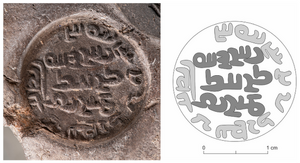
Seal impression no. 1 on bulla inv. no. 7775 shows two lines of text in the centre and one line of text encircling the circumference, all in Middle Persian lapidary script (Figs. 4â5). While the text in the centre is partly effaced, it can be confidently reconstructed when compared to a similar seal impression on a bulla that resides in the Bibliothèque nationale de France (Gignoux 1978: 81, 2.1a, pl. XXXIII, 2.1a). Although the provenance of the Paris bulla is unknown, it is improbable that it originated from Takht-e SolaymÄn, as this site has never been subject to unauthorised excavations. The inscription on sealing 1 of bulla 7775 reads as follows:
Line 1 (starting at ca. 2 oâclock) â¨Ê¾tw[l]â©Line 2 (starting at ca. 4 oâclock) â¨pʾtknâ©
Line 1 /Ädur/Line 2 /bÄdagÄn/
Margin, starting at ca. 3 oâclock â¨dlgwšʾny yʾtngwby W dʾtwblyâ©/drÄ«yÅÅ¡Än jÄdaggÅw ud dÄdwar/âAdvocate and judge of the poor of ÄdurbÄdagÄnâ
There is no uncertainty about the reading of the text in the margin. The characters are clear and legible. If it is not a scribal error, the inscription on this seal impression shows that two different forms of spelling for the title jÄdaggÅw âadvocateâ coexist on Sasanian seals. The first spelling shows a nÅ«n â¨nâ© as the fourth letter, i.e. â¨yʾtngwbyâ©, as is the case in the sealing under discussion here. This spelling is also attested on the seals of this office in other the provinces. Frye (1973: 52, 62, D. 199, 63, D. 207) neglects the presence of the letter nÅ«n â¨nâ© in the spelling â¨yʾtngwbyâ© (jÄdaggÅw) despite its clear appearance on sealing D. 207 within the Qasr-Ä« Abu Nasr collection of bullae. The second spelling is with a kaf â¨kâ© as the fourth letter, i.e. â¨yʾtkgwbyâ©. This spelling of the word appears on the seals of this office across different local jurisdictions (Gyselen 2019: 266). It is noteworthy that this word is spelled as â¨yʾtkgwbâyhâ© in the 7th-century Sasanian Law-Book MÄdayÄn Ä« HazÄr DÄdestÄn (MHD 93.8; Macuch 1993: 593).
Figures 4â5
Impression of the seal of the advocate and judge of the poor of ÄdurbÄdagÄn
Citation: Iran and the Caucasus 29, 4-5 (2025) ; 10.1163/1573384X-02904002
photo by R. Maleki, drawing by Z. ValizadehScholars have translated the title drÄ«yÅÅ¡Än jÄdaggÅw ud dÄdwar in various ways, for example âSolicitor-judge of the poorâ (Herzfeld 1938: 417), âSpokesman of the poor and judgeâ (Henning 1977: 357), âAttorney-judge of the poorâ (Perry 1978: 205), âProtector of the poor and judgeâ (Daryaee 2022: 50), âAdvocate and judge of the worthy poorâ (Shaki 1989: 167), âIntercessor and judge of the poorâ (Gignoux 2005), and âJudge and protector of the poorâ (Akbarzadeh /Daryaee 2012: 2, 6, 7, 9, 18, 21). Referring to the existence of the title drÄ«yÅÅ¡Än jÄdaggÅw on its own Gyselen (2019: 266) opts for the interpretation that the full expression drÄ«yÅÅ¡Än jÄdaggÅw ud dÄdwar denotes two distinct offices âDefender of the poorâ (drÄ«yÅÅ¡Än jÄdaggÅw) and âjudgeâ (dÄdwar). Frye (1973: 52) posits that â¨yʾtkgwbyâ© should be understood as referring to an âattorney and judge combinedâ and that dÄdwar means âlegal expertâ rather than âjudgeâ because according to him the office of jÄdaggÅw was one of general representation of the poor in various affairs. However, as suggested by Gignoux (1974: 174, 177, 183; 1976: 104â105; 1978: 81, 90, 116), it seems more accurate that each of the two terms designates a particular role. The holder of the office of drÄ«yÅÅ¡Än jÄdaggÅw ud dÄdwar probably had the dual function of aiding the poor through legal defense while also administering judgment in their cases. Based on the use of the title on the seal impressions as well as on the definitions in the MHD and in certain religious texts, such as the Pahlavi gloss of the Ahuna Vairya prayer and the DÄnkard, which do not include the title of âjudgeâ (dÄdwar), de Menasce (1963: 285) highlights the religious aspect of the formula and asserts that the Ç°Ädag-gÅw is âessentially a mowbed, specifically a mowbed from PÄrsâ. With reference to MHD 93.7â9, quoted below, Shaked (1975: 213, 215â216) suggests that âadvocacy of the poorâ was not an âofficeâ or âfunctionâ, but rather an honorific title designating the mowbeds of PÄrs in particular.
However, Gignoux (1976: 105) rightly concludes that the presence of seals from various regions outside of PÄrs challenges the idea that the title drÄ«yÅÅ¡Än jÄdaggÅw ud dÄdwar applies solely to mowbeds from PÄrs and instead views it as a specific function distinct from that of mowbed. Sigillographic evidence has indisputably demonstrated that the title of âadvocate and judge of the poorâ was by no means exclusively reserved for PÄrs. Seventy-one seal impressions from different regions (Dang 2022: 64) show that this office operated in at least 19 distinct provincial jurisdictions if not throughout the Sasanian realm. Several of these seal impressions have been studied by Gignoux (1974: 174, 177, 183; 1976: 104â106; 1978: 81, 90, 116) and Gyselen (1989: 31â33; 2019: 266â268).
As Garsoïan (1981: 23) points out, questions remain open concerning the meaning and application of the formula drÄ«yÅÅ¡Än jÄdaggÅw ud dÄdwar: to what extent does it incorporate religious elements? Does it generally serve to honour the charity of various individuals, or does it refer to a specific role? Referring to MHD 93.4â9, which mentions that the mowbed of the province of PÄrs has his seal inscribed not with the title of mowbed but with the title of the office of drÄ«yÅÅ¡Än jÄdaggÅw, Perry (1978: 205) proposes that this position was not necessarily an âindependent office but a function assumed ex officio by the mageâ. This office seems to have functioned as a judiciary entity, likely with religious overtones. It was instituted by the mowbeds, the chief priests of the Zoroastrians, to advocate for the poor and the oppressed. Shaki (1978: 293, fn. 46; 1989: 168; 1993), who assumes that the office was established at the order of KawÄd (r. 488â496, 498â531), and Daryaee (2001: 184; 2022: 50) suggest that the creation of this title might have been in response to the Mazdakite movement. Daryaee (2001: 183â184) also notes that advocacy for the poor was a general trend not only in Zoroastrianism but also in Christianity and later in Islam.
Although not referring to the complete title of drÄ«yÅÅ¡Än jÄdaggÅw ud dÄdwar that appears in Sasanian administrative seals, but to drÄ«yÅÅ¡Än jÄdaggÅw, the passage MHD 93.5â9 describes the creation of this office and its seal in the following manner:
MHD 93.5â9 (5) Eine (Entscheidung ist) diese: Das Siegel für die Ausübung der Amtsgewalt: dasjenige der mowbedÄn und der hamgÄragÄn wurde zuerst (6) auf Befehl von KawÄd i PÄrÅzÄn (hergestellt) und dasjenige der dÄdwarÄn zuerst auf Anordnung von Husraw i (7) KawÄdÄn. Als man das Siegel der mowbedÄn von PÄrs eingravierte, wurde die Bezeichung des mowbed nicht mit dem Titel âmowbedâ, (8) sondern mit dem Titel âdriyÅÅ¡Än Ç°Ädag-gÅwâ (âAnwalt der Armenâ) eingeprägt. Und aus diesem Grunde ist (dieser Titel) auf (9) Siegel der gleichen Art eingeprägt worden.4
This passage clearly indicates that the office of the drÄ«yÅÅ¡Än jÄdaggÅw was instituted during the reign of Khosrow I (r. 531â579). This is confirmed by a later Arabic literary source, which states that Khosrow I claimed to have fostered an ideal, reciprocal relationship between the powerful and the poor, establishing the office of the drÄ«yÅÅ¡Än jÄdaggÅw to oversee their relations.5
While there is no ambiguity in the meaning of jÄdaggÅw (âadvocate, intercessor, defender, protectorâ) and dÄdwar (âjudgeâ) on the administrative seals, it is difficult to be certain whether the term drÄ«yÅÅ¡Än âpoorâ in this title is meant in the literal or in a metaphorical sense because both meanings are present in Avestan, Pahlavi, and Islamic sources. Perry (1978: 205) citing de Menasce (1963: 285â286) believes that the term âpoorâ does not refer to those who are simply impoverished by circumstance, but rather to an inherently patient and virtuous individual born into the working class. This person is content with and even takes pride in their situation, embodying both the ascetic and devout characteristics of a drÄ«yÅÅ¡, while also reflecting the noble attributes of the âcommon manâ of the Romantics. Preferable, however, is the view of Macuch (1993: 506), who draws attention to Pahlavi RivÄyat accompanying the DÄdestÄn Ä« DÄnÄ«g 62.12 (Williams 1990: I/222â223, II/108; Macuch quotes the passage from Dhabharâs edition as 196.3â¯ff.), according to which among the responsibilities of the drÄ«yÅÅ¡Än jÄdaggÅw was to speak up in the interest of widows, malnourished children, on behalf of sacred ritual fires, of domestic animals and of the powerless in general.6 Furthermore, she rightly points out that the drÄ«yÅÅ¡Än jÄdaggÅw also had important legal responsibilities.
2.2 Civil Administration
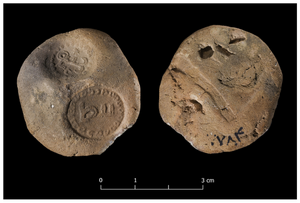
Bulla inv. no. 7784 bears the administrative title Å¡ahrab of ÄdurbÄdagÄn (Figs. 6â7). The beginning and the end of the inscription are separated by six annulets. The inscription is rendered in Middle Persian lapidary script.
Figures 6â7
Impression of the seal of the Å¡ahrab of ÄdurbÄdagÄn
Citation: Iran and the Caucasus 29, 4-5 (2025) ; 10.1163/1573384X-02904002
photo by R. Maleki, drawing by Z. ValizadehIn the margin circling anticlockwise from ca. 2 oâclock to 6 oâclock:
â¨Ê¾twlpʾtkn Å¡tlpyâ©/ÄdurbÄdagÄn Å¡ahrab/âgovernor of ÄdurbÄdagÄnâ
In the field, starting at ca. 3 oâclock, two letters are written in a single line and in a double-stroke script as follows:
â¨Ê¾tâ©/Ät/
The letters â¨Ê¾tâ© /Ät/ of the field are probably an abbreviation for the toponym ÄdurbÄdagÄn. This abbreviation also occurs on drachms from Yazdgird I (r. 399â420â¯A.D.) onwards and on Arab-Sasanian coinage as mint signature standing for ÄdurbÄdagÄn (Malek 1995: 70).
A fragmentary bulla bearing the impression of the seal of the Å¡ahrab of ÄdurbÄdagÄn was discovered by the German Archaeological Institute (Göbl 1976: 56, Tafeln 47, no. 696, 55. IIa.4). Additionally, there is an identical sealing (Figs. 8â9) within the new collection of bullae discovered by Moradi and his team (Moradi/Hintze 2022: 82â85, figs. 11â13). However, there are notable differences between those two sealings as compared with that on bulla 7784. The sealing on bulla 7784 is larger and almost ellipsoid, whereas the other two sealings are smaller and circular. The beginning and the end of the inscription on the sealing on bulla 7784 are separated by six annulets rather than three. In addition, the word Å¡ahrab on the other sealings excludes the final yod â¨yâ©. Furthermore, they have the letter â¨dâ© in line 2 of the field, which is unclear what it stands for.
Figures 8â9
Impression of the seal of the Å¡ahrab of ÄdurbÄdagÄn
Citation: Iran and the Caucasus 29, 4-5 (2025) ; 10.1163/1573384X-02904002
photo by R. Maleki, drawing by Z. ValizadehThe paleography of the inscription on bulla 7784 also differs from that of the other sealings. For instance, the letter kaf â¨kâ© on bulla 7784 has the horizontal tail extending to the right, whereas in other sealings, it resembles a dÄlet â¨dâ©. Moreover, the letter Å¡in â¨Å¡â© on bulla 7784 appears as two connected wÄws with a tail to the right and is separated from the succeeding letter, while in the other sealings it resembles an alef â¨Ê¾â© with a tail to the right and linked to the succeeding letter.
These differences clearly indicate that the sealing on bulla 7784 was produced with a different sealstone. This means that the office of the Å¡ahrab of ÄdurbÄdagÄn had two distinct administrative seals. However, it remains uncertain whether both seals were used simultaneously or in two different timeframes. If the latter is the case, it is unknown, which seal predates the other.
In the Sasanian administrative system, the term Å¡ahrab typically denoted an office or an individual responsible for overseeing the civil administration of a Å¡ahr âcityâ, or a district, or of a province (Gyselen 1989: 28â29; idem 2002: 106â110, 117â119; idem 2019: 315â316; Nikitin 1994: 367; Payne 2015: 135; Khosrowzadeh et al. 2020: 90). However, based on the evidence from the Sasanian administrative seals, it appears that the title Å¡ahrab on our bullae is used to refer to the âprovinceâ of ÄdurbÄdagÄn, rather than to a Å¡ahr âcityâ or Å¡ahrestÄn âprovincial cityâ (Moradi/Hintze 2022: 82â85).
2.3 Clerical Administration
Figures 10â11
Impression of the seal of a magupat (chief priest)
Citation: Iran and the Caucasus 29, 4-5 (2025) ; 10.1163/1573384X-02904002
photo by R. Maleki, drawing by Z. ValizadehA fragmentary bulla (inv. no. 7827) bears an impression of one administrative seal belonging to a mowbed (Figs. 10â11). Most of the inscription on the seal impression has disappeared. Our reading of the surviving letters on the circumference, circling anticlockwise and starting at 12 oâclock, is as follows:
⨠]Y mgwpty m[ â©/ ] Ä« mowbed m[ /âof the chief priestâ
The term mowbed or mgwpty refers both to a position/office and a title within the Zoroastrian religious hierarchy. Specifically, it denotes the âchief of the magiâ, a Zoroastrian priest occupying the highest rank in the religious hierarchy. Literary sources indicate that the term for the supreme Zoroastrian priestly position is mowbedÄn mowbed âhigh priest of high priestsâ, but this title has not so far been attested in sigillography. Achieving the rank of mowbed was not contingent upon holding a specific provincial post; rather, it was an ecclesiastical rank attained within the Zoroastrian hierarchy, independent of royal appointments within the secular administration.
The MÄdayÄn Ä« HazÄr DÄdestÄn mentions that mowbeds were sometimes appointed by the king. In the transliteration and translation of Macuch (1981: 36, 143) the passage runs as follows:
MHDA 14.11â12 ʾpʾyytâ MN HNʾ krtâ ḥwrnâ mgwptʾnâ gwmʾrtâ ʾP̱-šʾn pṯâ prmʾny MLKʾn MLKʾ gwmʾrtâ
Sie (stÅ«r und dÅ«tak-sardÄr) sind von der vereinigten Versammlung (der) magupatÄn zu ernennen und man ernennt sie auf Befehl des Königs der Könige.7
The primary role of mowbeds was not only to ensure the maintenance of Mazdean orthodoxy and to perform the provincial religious roles but often also to fulfil judicial roles. This is evident from one of the titles assumed by the 3rd-century high priest KerdÄ«r: hÄmÅ¡ahr mowbed ud dÄdwar, or the âchief priest and judge of the whole empireâ (KSM/KNRm §â¯10; MacKenzie 1989: 42, 54, 58).
The MHD provides several examples of legal decisions rendered by mowbeds. These decisions include cases about the transfer of a monetary inheritance (MHD 100.1â5; Macuch 1993: 621), the trusteeship of a fire temple (MHD A36.1â12; Macuch 1981: 219â220), an accessory murder charge (MHD 97.1â7; Macuch 1993: 586), the authentication of a personal seal on a legal document (MHD 99.3â8; Macuch 1993: 620, 628â629), the endowment and maintenance of the RÄm-Å ÄpÅ«r fire (MHD 95.15â17, 96. 1â3; Macuch 1993: 608â609), the provision of a copy of a legal document concerning fire ownership for the judge (MHD 93.4; Macuch 1993: 596), and the submission of a copy of a written document related to the testimony of two women (MHD 98.1â5; Macuch 1993: 587).
Like other provincial administrations, the provincial mowbeds likely had an office responsible for appointing local mowbeds and overseeing their activities. The title of mowbed is found on both official and administrative seals from the Sasanian era, though it is significantly more prevalent on administrative seals in the surviving archives.
According to Syriac sources, the territorial mowbed, in Syriac mowpeá¹a â¨mwhpá¹Ê¾â©, ranks third in the hierarchy of the Mazdean church, which is headed by the mowbedÄn mowbed and followed by the chief mowbed. In the Life of Yazd-PanÄh (§â¯5) (Jullien 2023: 119â121), it is stated: âThe mowbedÄn mowbed, who was head of the magi, a chief mowpeá¹a, and the mowpeá¹a of BÄth AramÄyÄ arrived at the city of PÄrÅz-Å Äbuhrâ.8
Neither the title of mowbedÄn mowbed nor that of âchief mobedâ is currently known in the extant corpus of Sasanian seals and seal impressions or any other epigraphic sources. This absence is not unusual, as many high-ranking officials are known only through secondary sources (Gyselen 2019: 287â288). However, MHDA 38.6â7 (Macuch 1981: 64â65, 221), refers to the copy of a last will and testament sealed with the seal of the mowbedÄn mowbed:
MHDA 38.6â7 (6) ⦠LWTH ZK y hm (7) ʾdybʾtkʾr hmpcynâ y pṯâ-c mwdr mgwptʾn mgwpt â¦
(6) ⦠(Zusammen) mit jenem (Satz), der in derselben (7) Abschrift der Aufzeichnung, die mit dem Siegel (des) magupatÄn magupat (versehen war), â¦9
Returning to the remainder of the inscription on the bulla under discussion, the text in the field consists of two lines running as follows:
Line 1 (starting at ca. 2 oâclock) ]lʾ or ]lÅ¡Line 2 (starting at ca. 4 oâclock) ]ly
Line 1 ]rÄ or ]rÅ¡Line 2 ]ry
This seal has so far not been documented anywhere else. Its original provenance is therefore unknown. Although the name of the office and of the toponym for the region of jurisdiction is missing, this seal is different from the administrative seal of the mowbed of Ädur GuÅ¡nasp, which is attested in the Takht-e SolaymÄn bullae collection. Thus, it can be reasonably inferred that this seal belongs to a different jurisdiction whose mowbed either came to the fire temple of the Ädur GuÅ¡nasp to authenticate a document or sent a document or package to this fire temple.
Drawing analogy from other administrative seals, the text in the field must form part of a place name. However, we are uncertain whether it constitutes one toponym or two. If we accept that all the letters in the centre represent a single toponym, and if we read the extant letters in line 1 as â¨lÅ¡â©, there is a possibility that this toponym represents the province of â¨[ʾp]lÅ¡[t]lyâ© / abarÅ¡ahr/. Similar office is attested on a mowbed seal of this province (Gyselen 2019: 286, ATb1a). If the letters in the centre represent two toponyms, identifying their names would be challenging. There are thus far no attested toponyms with a name ending in ârÅ¡ or ârÄ that fit the available space. In the margin of an impression of a maguh seal held in the British Museum, two characters, presumably the name of a toponym, have survived. Bivar (1969: 120â121, no. 21109, ZR I, pl. 31) interprets these letters as â¨gʾ⩠/gÄ/, while Gyselen (1989: 63) suggests they read as â¨lʾ⩠/rÄ/. No literary or epigraphic source seems to mention a toponym corresponding to the province of either GÄ or RÄ. Nevertheless, this scenario does not apply to our sealing, as the original toponym consisted of more than two extant letters, but they have completely disappeared.
With regard to a possible toponym in line 2, there are several toponyms such as Abhar, ÄmÅ«l, AspzÄr, Baxl, and Staxr that end with the letters (ly) ly, and thus would fit the available space given their short names. However, there is no substantiated evidence that any of these places originally appeared on the sealing in question.
3 Catalogue of the Sealings on Bullae 7775, 7784, and 7827
Bulla inv. no. 7775 (Fig. 12) measuring 45â¯Ãâ¯47â¯Ãâ¯16â¯mm. Weight: 31.89 gr. Obv. Black (Gley1 2.5/N) and dark grey (10YR4/1). Rev. Black (Gley1 2.5/N) and dark grey (10YR4/1). On the back, there are two parallel crosswise holes through which a pair of string passed to bind the object sealed. The impression of the edge of the sealed object is recognizable. Bulla bears four seal impressions:
Figure 12
Bulla inv. no. 7775
Citation: Iran and the Caucasus 29, 4-5 (2025) ; 10.1163/1573384X-02904002
photo by R. Maleki-
At the centre, impression, 20â¯Ãâ¯20â¯mm, of a circular seal with a flat engraved face. It bears two lines of Pahlavi inscription in lapidary script in the field and one line in the margin (Figs. 4â5). The inscription is discussed in Section 2 of this article.
-
At 3 oâclock, impression, 9â¯Ãâ¯9â¯mm, of a circular seal with a flat engraved face. A lionâs head with upward-curving horns shown in frontal view. Long mane encircles the two sides of the head, but the mane on the top of the head is represented by three raised circles. Mouth is open with the tongue out, nipping at an eight-pointed rosette or star. His facial features are detailed, with a long prominent nose and large fully opened eyes with rounded pupils and prominent lids (Fig. 13). There is a horizontal, shallow indentation located at 12 oâclock above the impression.
-
At 6 oâclock, impression, 9â¯Ãâ¯9â¯mm, of a circular seal with a flat engraved face. Device, possibly a personal or clan emblem (niÅ¡Än), composed of a crescent connecting to a rhombus that links to two yokes. The imprint of a mount surrounds the impression, indicating the actual sealstone was mounted in the metal bezel of a ring (Fig. 14). In the margin, from ca. 11 to ca. 3 oâclock, there are faint traces of three Pahlavi characters in lapidary script, but the state of preservation is too bad to make sense of the letters.
Figure 13
Bulla inv. no. 7775; sealing no. 2 showing a lionâs head
Citation: Iran and the Caucasus 29, 4-5 (2025) ; 10.1163/1573384X-02904002
photo by R. MalekiFigure 14
Bulla inv. no. 7775; sealing no. 2 showing a device
Citation: Iran and the Caucasus 29, 4-5 (2025) ; 10.1163/1573384X-02904002
photo by R. MalekiBulla inv. no. 7784 (Fig. 15) measuring 37â¯Ãâ¯34â¯Ãâ¯15â¯mm. Weight: 16.16 gr. Obv. Dark grayish brown (10YR4/2) and very dark gray (10YR3/1). Rev. Reddish brown (5YR5/4) and grayish brown (10YR5/2). On the back, a crosswise slit through which a strip of leather or parchment passed to bound the object sealed. Cross imprints of fixing straps of leather or parchment (3â¯mm in width) and the edge of the sealed object are visible. Bulla bears two seal impressions:
Figure 15
Bulla inv. no. 7784
Citation: Iran and the Caucasus 29, 4-5 (2025) ; 10.1163/1573384X-02904002
photo by R. Maleki-
At the centre, impression, 15â¯Ãâ¯16â¯mm, of a circular seal with a flat engraved face. It bears a line of Pahlavi inscription in lapidary script in the margin and two characters in the field (Figs. 6â7). The inscription is discussed in Section 2 of this article.
-
At 12 oâclock, impression, 12â¯Ãâ¯14â¯mm, of a circular seal with a flat engraved face. Monogram or letter device, composed of four Pahlavi letters written in double stroke representing â¨dâ©, â¨b/gâ©, â¨nâ©, and â¨pâ©. In the field, to the right is a crescent; to the left, an eight-pointed star. All is in a pearl roundel. The imprint of the bezel appears in the impression, indicating the actual sealstone was mounted in a ring (Fig. 16).
Figure 16
Bulla inv. no. 7784; sealing no. 2 showing a monogram
Citation: Iran and the Caucasus 29, 4-5 (2025) ; 10.1163/1573384X-02904002
photo by R. MalekiBulla inv. no. 7827 (Fig. 17) measuring 35â¯Ãâ¯29â¯Ãâ¯18â¯mm. Weight: 15.24 gr. Obv. Pale brown (10YR6/3) and light brown (7.5YR6/4). Rev. Light brown (7.5YR6/4). On the back, mostly missing but the extant part displays impression of a single twisted string running longwise into the bulla. Most of the bulla has been lost and the extant portion bears two seal impressions:
Figure 17
Bulla no. 7827
Citation: Iran and the Caucasus 29, 4-5 (2025) ; 10.1163/1573384X-02904002
photo by R. MalekiFigure 18
Bulla no. 7827; sealing no. 2 showing lower part of a device
Citation: Iran and the Caucasus 29, 4-5 (2025) ; 10.1163/1573384X-02904002
photo by R. Maleki-
At the centre, impression, 15â¯Ãâ¯15? mm, of a circular seal with a flat engraved face. It bears a line of Pahlavi inscription in lapidary script in the margin and two lines in the field each containing two characters (Figs. 10â11). The inscription is discussed in Section 2 of this article.
-
At 7 oâclock, impression, 4Ã? mm, of a circular seal with a flat engraved face. Most of the sealing has been lost. The surviving part displays a horizontal line, possibly the lower part of a device, representing a personal or clan emblem (niÅ¡Än) (Fig. 18). The imprint of a mount surrounds the impression, indicating the actual sealstone was mounted in the metal lozenge-shaped bezel of a ring.
4 Conclusion
The 44 impressions of administrative seals from Takht-e SolaymÄn belong to nine different administrative offices, distributed as follows: one in Weh-ArdaÅ¡Ä«r, one in an unidentified province abbreviated as âWehâ (see fn. 2), one from an unknown province (bulla no. 7827), two in the province of ÄdurbÄdagÄn, and three in Ädur GuÅ¡nasp. The original provenance of bulla no. 7914, which we will discuss in a future publication, currently remains unknown. The spatial distribution of the toponyms on the existing administrative seal impressions points to the conclusion that they belonged to a âsupraregionalâ archive rather than to a âlocalâ or âprovincialâ one. A local or provincial archive such as Qaá¹£r-e AbÅ« Naá¹£r, Tol-e Qaleh SeyfÄbÄd, Tappe Bardnakoon, Tureng Tepe, Tepe KabÅ«dÄn, and Ak-Depe, appears more localised as it typically contains impressions of administrative seals with toponyms specific to the province in which the archive is located. The archive at Takht-e SolaymÄn provides a different picture as it includes administrative seals not only from ÄdurbÄdagÄn but also from other regions outside of ÄdurbÄdagÄn, such as Weh and Weh-Ardashir, and future excavations at Takht-e SolaymÄn may uncover more bullae with different administrative seal impressions from other provinces. This suggests that the Takht-e SolaymÄn archive was not only a local repository but also a supraregional archive, where packages and documents with impressions of administrative seals or even personal and official seals from across the empire were deposited. The existence of a supraregional archive at Takht-e SolaymÄn is plausible given the significance of the fire temple of Ädur GuÅ¡nasp as a major religious site in the realm of Eranshahr and its close ties to the royal court, as confirmed by both literary sources and sigillographic evidence (Moradi and Hintze 2020).
The presence of impressions from administrative seals of Weh-ArdaÅ¡Ä«r, Weh, and ÄdurbÄdagÄn raises two possibilities: either the bullae were produced on-site at Ädur GuÅ¡nasp, or they originated from these locations, and sealed documents or packages were sent to the sanctuary of Ädur GuÅ¡nasp. However, due to the current state of research and the lack of laboratory analysis on the mineral composition of the bullaeâs clay, which could potentially identify their original provenance, it is impossible to confirm either scenario with certainty.
If the bullae (along with the documents or parcels they sealed) were locally produced rather than brought to the fire temple of Ädur GuÅ¡nasp, it is reasonable to assume that the seals owners travelled to the temple and used their seals to authenticate documents and commodities on-site. Such practices are referenced in MHD 100.7â11 (Macuch 1993: 613â614, 621), where FrÄyzarduḫšt, the mowbed from the city of Ohrmazd-ArdaxÅ¡Ä«r (modern AhvÄz), uses the official mowbed seal of Ohrmazd-ArdaxÅ¡Ä«r to seal a document in GÅr, a town in the region of ArdaxÅ¡Ä«r-Xwarrah in Fars. This suggests that it was customary for authorities, at least for prominent priests, to use the administrative seal of their jurisdiction when conducting official business outside their own area of authority.
Acknowledgments
The research for this publication was carried out as part of the project âBeyond Discovery: Religion, economics and administration in Sasanian Iran through new clay bullae from Taxt-e Solaymanâ funded by the Arts and Humanities Research Council (AHRC), to which we are very grateful for their generous support. We are also indebted to the Iranian Centre for Archaeological Research (ICAR) for generously granting the excavation permit. Our sincere gratitude also goes to Takht-e SolaymÄn World Heritage Base for its financial support, unfailing administrative cooperation, and logistical assistance. We are also grateful to Ruzbeh Maleki for producing the photographs, and to Zeinab Valizadeh for the drawing of the seal impressions.
This room has a rectangular plan, measuring 5.35 in width and 7.60â¯m in length, The walls were constructed with rubble stone, while the original floor was paved with bricks measuring 27â¯Ãâ¯27â¯Ãâ¯6â¯cm each, though the floor is only partially preserved. A doorway, 80â¯cm wide, in the eastern wall connects this room The room leads to the truncated ayvÄn N, which in turn leads to the peristyle forecourt of the temple of Ädur GuÅ¡nasp. With regard to room Z, Huff (2002) states that âthis was a room for scribes and an office and archive for acts of civil administration, duties of which the Sasanian clergy was in charge. The location at a âhigh gateâ, at the entrance to an official area, is typical for places of this kindâ.
This seal impression bears two characters at the centre and two lines of inscription at the circumference, part of which has disappeared between 12 and 9 oâclock. According to Göbl (1976: 55, Tafel 17, no. 63/146-2, Tafel 47, no. 694), the inscription reads as follows:
Centre: â¨whâ©
Outer line: â¨whwwnd [y/p/m/t?] ⦠hly (?) dlgwšʾny ʾâ©
Inner line (starting from 3 oâclock): â¨tkgwby (W) d [ʾtwbly]â©
Göbl (1976: 55, no. 694) translates the inscription as âVehÅvand ⦠Anwalt und Richter der Armenâ (âVehÅvand ⦠advocate and judge of the poorâ). Noting that the reading â¨whwwndâ© is speculative, Göbl concurs with Gignouxâs view that this word cannot be an alternative spelling for the place name âNihÄvandâ. Instead, it would rather the name of a district. Considering the structure of the formulae on administrative seals, the word â¨whwwndâ© could be the name of a district in the province of âWehâ, whose name appears at the centre of the seal. The latter could be an abbreviation for any of the Sasanian provinces beginning with âWehâ, such as Weh-Andiyok-Å¡habur, Weh-az-Amid-KawÄd, and Weh-KawÄd. However, it is unlikely to be Weh-ArdaÅ¡ir, as the seal impression no. 704 (Göbl 1976: 57, Tafel 10, no. 63/96-1, Tafel 47, no. 704), which mentions the office of the âadvocate and judge of the poor of Weh-ArdaÅ¡Ä«râ, provides the full name of this toponym at its centre. Additionally, seal impression no. 704 features a raised dot between the two lines referring to Weh-ArdaÅ¡ir, while seal impression no. 694 shows a small crescent-shaped element on the bottom left of the abbreviated toponym at the centre. Furthermore, the title on the margin of seal impression no. 704 is written in one line, whereas on no. 694 it is written in two lines. These differences suggest that the seal impression no. 694 is associated with a different administration than Weh-ArdaÅ¡ir.
In addition to the administrative seal impression, this bulla bears the following five seal impressions: 1) At the centre, impression of a circular seal with a flat engraved face. A male bust facing right, 2) At 9 oâclock, impression of a circular seal with a flat engraved face. A bearâs head facing right, surrounded by a line of inscription that reads âÄdurbÄd son of GuÅ¡naspâ (Cereti/Bassiri 2016: 15, 3) At 10 oâclock, identical image and inscription to seal impression no. 3, 4) At 7 oâclock, impression of a rectangular seal with a flat engraved face. A bird, presumably a duck or a goose standing to the left, and 5) At 5 oâclock, impression of an elongated convex seal. A standing winged human figure facing right, holding a beribboned ring, with a six-pointed star positioned above his hands. The imprint of a mount surrounds the impression, indicating the actual sealstone was mounted in the metal bezel of a ring.
Macuch 1993: 593 (text), 596 (translation). An English rendering of Macuchâs German translation reads: â(5) One (decision is) this: The seal for the exercise of authority in office: that of the mowbedÄn and the hamÄrgarÄn was first made (6) by order of KawÄd, son of PÄrÅz, and that of the judges first by order of Husraw, son of (7) KawÄd. When the seal of the mowbeds of PÄrs was engraved, the title of the mowbed was not inscribed with the title âmowbedâ, (8) but with the title âdrÄ«yÅÅ¡Än jÄdag-gÅwâ (âAdvocate of the poorâ). And for this reason, (this title) is engraved on (9) seals of the same kindâ.
Payne 2015: 154, who cites the chapter on SÄ«rat AnÅ«Å¡irwÄn âA Passage from the Life of AnÅ«Å¡irwÄn and His Policiesâ in Arabic translation, as related by Miskawayh al-RÄzÄ«, a Persian chancery official of the Buyid era, in the tenth century (TajÄrib al-umam, ed. AbÅ« al-QÄsim ImÄmÄ« 2000: 189â191, 194â195, 200â202).
Along these lines is also the argument of Daryaee (2001: 183).
An English rendering of Macuchâs German translation is: âThey (stÅ«r and dÅ«tak-sardÄr) are to be appointed by the united assembly of the magupatÄn and are appointed by the order of the King of Kingsâ.
Gignoux (1983: 197) suggests that the passage refers to three different mowbeds: mowbedÄn mowbed, grand mowbed, and mowbed.
Text and translation by Macuch 1981: 64â65 (text), 221 (translation). The English version of Macuchâs German translation is â(together) with that (sentence) which in the same (6) copy of the document, which (had) the seal of the magupatÄn magupatâ.
Bibliography
Akbarzadeh, D./Daryaee, T. (2012), âInscribed Sasanian Bullae at the National Museum of Iranâ, e-Sasanika 12: 1â27.
Bivar, A.D.H. (1969), Catalogue of the Western Asiatic Stamp Seals in the British Museum. Stamp Seals II: The Sassanian Dynasty, London.
Cereti, C.G./Bassiri, Z. (2016), âOn a Few Sasanian Bullae from the Collections of the National Museum of Iranâ, R. Gyselen (ed.), Words and Symbols: Sasanians Objects and the TabarestÄn Archive (Res Orientales 24), Bures-sur-Yvette: 9â26.
Dang, K. (2022), Transmitters, Texts, and Traditions: the Zoroastrian Priesthood from the Sasanian to the Early Islamic Period, New Haven, CT.
Daryaee, T. (2001/1379), âThe Judge and Protector of the Needy during the Sasanian Periodâ, A.A. Sadeghi (ed.), TafazzolÄ« Memorial Volume, Tehran: 179â187.
Daryaee, T. (2022), âMazdak and Late Antique Socialismâ, M. van der Linden (ed.), Cambridge History of Socialism, Vol. 1, Cambridge: 39â55.
De Menasce, J. (1963), âLe protecteur des pauvres dans lâIran sassanideâ, Mélanges dâorientalisme offerts à Henri Massé à lâoccasion de son 75éme anniversaire, Téhéran: Imprimerie de lâuniversité, 282â287.
Frye, R.N. (1973), Sasanian Remains from Qasr-i Abu Nasr, Cambridge, MA.
Garsoïan, N. (1981), âSur le titre de Protecteur des pauvresâ, Revue des études arméniennes 15: 21â32.
Gignoux, Ph. (1974), âLes bulles sassanides de Qasr-I Abu Nasrâ, Ph. Gignoux/A. Tafazzoli (eds.), Mémorial Jean de Menasce, Louvain: 169â187.
Gignoux, Ph. (1976), âProblémes dâinterprétation historique et philologique des titres et noms propres sasanidesâ, Acta Antiqua Academiae Scientiarum Hungaricae 24: 103â108.
Gignoux, Ph. (1978), Catalogue des sceaux, camées et bulles sasanides de la Bibliothèque Nationale et du Musée du Louvre. II. Les sceaux et les bulles inscrits, Paris.
Gignoux, Ph. (1983), âTiters et fonctions religieuses sasanides dâaprès les sources syriaques hagiographiquesâ, Acta Antiqua Academiae Scientiarum Hungaricae 28: 191â203.
Gignoux, Ph. (2005), âDrÄ«yÅÅ¡ÄnjÄdag-gÅw ud dÄdwarâ, Ehsan Yarshater (ed.), Encyclopedia Iranica (available online at https://iranicaonline.org/articles/driyosan-jadag-gow-ud-dadwar, accessed on 23 July 2024).
Göbl, R. (1976), Die Tonbullen vom Tacht-e Suleiman: ein Beitrag zur spätsasanidischen Sphragistik, Berlin.
Gyselen, R. (1989), La géographie administrative de lâEmpire sassanide: Les témoignages sigillographiques, Paris: Groupe pour lâétude de la civilisation du Moyen-Orient.
Gyselen, R. (2002), Nouveaux matériaux pour la géographie historique de lâempire sassanide: sceaux administratifs de la collection Ahmad Saeedi (Cahiers de Studia Iranica, 24), Paris.
Gyselen, R. (2019), La géographie administrative de lâEmpire sassanide: Les témoignages épigraphiques en moyen-perse, Leuven.
Henning, W.B. (1977), âGabae: Additional Noteâ, W.B. Henning Selected Papers II (Acta Iranica 15), Leiden: 357.
Herzfeld, E. (1938), âNotes on the Achaemenid Coinage and Some Sasanian Mint-Namesâ, J. Allan/H. Mattingly/E.S.G. Robinson (eds.), Transactions of the International Numismatic Congress: Organized and Held in London by the Royal Numismatic Society, June 30-July 3, 1936, on the Occasion of its Centenary, London: 413â426.
Huff, D. (1987), âTechnological Observations on Clay Bullae from Takht-e Suleimanâ, Mesopotamia 21: 367â390.
Huff, D. (2002), âTaḵt-e SolaymÄnâ, in Ehsan Yarshater (ed.), Encyclopedia Iranica (available online at: http://www.iranicaonline.org/articles/takt-e-solayman, accessed on 22 June 2024).
Jullien, F. (2023), The Martyrdom of Mar Grigor Piran-Gušnasp and the Martyrdom of Mar Yazd-Panah, Piscataway, NJ.
Khaleghi-Motlagh, Dj. (1992/1371), The Å ÄhnÄmeh (The Book of Kings), vol. 3, New York.
Khaleghi-Motlagh, Dj. (1994/1373), The Å ÄhnÄmeh (The Book of Kings), vol. 4, New York.
Khaleghi-Motlagh, Dj./Omidsalar, M. (2005/1384), The Å ÄhnÄmeh (The Book of Kings), vol. 6, New York.
Khosrowzadeh, A/Norouzi, A./Gyselen, R./Habibi, H. (2020), âAdministrative Seal Impressions on Bullae Discovered on Tappe Bardnakoonâ, R. Gyselen (ed.), Persia (552BCEâ758CE): Primary Sources, Old and New (Res Orientales 28), Bures-sur-Yvette: 83â112.
MacKenzie, D.N. (1989), âKerdirâs Inscriptionâ, G. Herrmann/D.N. MacKenzie/R.H. Caldecott (eds.), The Sasanian Rock Reliefs at Naqsh-i Rustam: Naqsh-i Rustam 6, the Triumph of Shapur I (together with an account of the representations of Kerdir), Berlin: 35â72.
Macuch, M. (1981), Das sasanidische Rechtsbuch âMÄtakdÄn i hazÄr dÄtistÄnâ (Teil II), Wiesbaden.
Macuch, M. (1993), Rechtskasuistik und Gerichtspraxis zu Beginn des siebenten Jahrhunderts in Iran. Die Rechtssammlung des Farroḫmard i WahrÄmÄn, Wiesbaden.
Malek, H.M. (1995), âA Fifth Century Hoard of Sasanian Drachms (A.D.399â460)â, Iran 33: 67â84.
Moradi, Y./Hintze, A. (2020), âA New Sealing of PÄrÅz from Taḵt-e SolaymÄn and its Historical Contextâ, Rika Gyselen (ed.), Persia (552BCEâ758CE): Primary Sources, Old and New (Res Orientales XXVIII), Bures-sur-Yvette: 113â136.
Moradi, Y./Hintze, A. (2022), âThe Main Seal of the Sanctuary of Ädur GuÅ¡nasp and Some Other Administrative Sealings from Taḵt-e SolaymÄnâ, R. Gyselen (ed.), Sometimes Sasanians, always Är (Res Orientales 29), Bures-sur-Yvette: 75â99.
Moradi, Y./Hintze, A. (2023), âInteraction between Christians and Jewish Minorities and the Zoroastrian Fire Temple of Ädur GuÅ¡nasp in the Light of New Sigillographic Evidence from Taḵt-e SolaymÄnâ, R. Gyselen (ed.), Reflects dâépoques sassanide et post-sassanide (224â760) (Res Orientales 30), Bures-sur-Yvette: Groupe pour lâÃtude de la Civilisation du Moyen-Orient: 153â176.
Miskawayh al-RÄzÄ«, A. (2000/1379), TajÄrib al-umam, AbÅ« al-QÄsim ImÄmÄ« (ed.), Tehran.
NeáºÄmÄ« GanjavÄ«, J.A. (1956/1335), Å araf-nÄma, V. Dastgerdi (ed.), Tehran.
Nikitin, A.B. (1994), âThe Sasanian Å ahrab of Balkhâ, Ancient Civilizations from Scythia to Siberia I: 365â368.
Payne, R.E. (2015), A State of Mixture: Christians, Zoroastrians, and Iranian Political Culture in Late Antiquity, Oakland, Cal.
Perry, J.R. (1978), âJustice for the Underprivileged: The Ombudsman Tradition of Iranâ, Journal of Near Eastern Studies 37: 203â215.
Shaked, Sh. (1975), âSome Legal and Administrative Terms of the Sasanian Periodâ, in Monumentum H.S. Nyberg II (Acta Iranica 5, Hommages et opera minora), Leiden-Téhéran-Liège: 213â225.
Shaki, M. (1978), âThe Social Doctrine of Mazdak in the Light of Middle Persian Evidence Signalâ, ArchÃv Orientálni 46: 289â306.
Shaki, M. (1989), âA Signal Catalogue of Sasanian Seals and Bullaeâ, ArchÃv Orientálni 57: 167â169.
Shaki, M. (1993), âDÄdwar, DÄdwarÄ«hâ, Ehsan Yarshater (ed.), Encyclopedia Iranica (available online at http://www.iranicaonline.org/articles/takt-e-solayman, accessed on 23 July 2024).
Williams, A.V. (1990), The PahlavÄ« RivÄyat Accompanying the DÄdestÄn Ä« DÄnÄ«g, Part I: Transliteration, Transcription and Glossary. Part II: Translation, Commentary and Pahlavi Text, Copenhagen.