Abstract
Relying upon a very close reading of all of the definitions given in Euclidâs Elements, I argue that this mathematical treatise contains a philosophical treatment of mathematical objects. Specifically, I show that Euclid draws elaborate metaphysical distinctions between (i) substances and non-substantial attributes of substances, (ii) different kinds of substance, and (iii) different kinds of non-substance. While the general metaphysical theory adopted in the Elements resembles that of Aristotle in many respects, Euclid does not employ Aristotleâs terminology, or indeed, any philosophical terminology at all. Instead, Euclid systematically uses different types of definition to distinguish between metaphysically different kinds of mathematical object.
1 Introduction
Euclidâs Elements, c. 300 BCE,1 is the earliest extant treatise of deductive mathematics in history, and is still regarded as a paradigm of an axiomatic science.2 By deriving a large number of mathematical theorems from a relatively small number of undemonstrated principles (definitions, postulates, common notions), the Elements seems to be a purely mathematical treatise. In the present paper, however, I show that the Elements also conveys a metaphysical theory of mathematical objects. Specifically, I argue that Euclid promotes elaborate metaphysical distinctions between
-
(i) substances and non-substantial attributes of substances;3
-
(ii) different kinds of substance;
-
(iii) different kinds of non-substance.
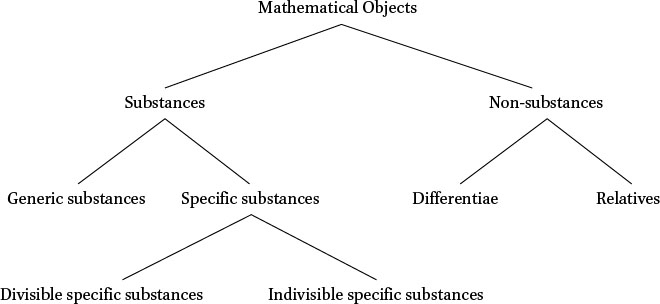
Pertaining to the subdivision of substances, I argue that Euclid distinguishes between generic and specific substances, and that he further subdivides specific substances into divisible and indivisible substances. Pertaining to the subdivision of non-substances, I argue that Euclid distinguishes between differentiae and relatives. (These Aristotelian notions will be elucidated in the course of this paper.) This yields the following ontological classification of Euclidâs mathematical universe:

Citation: History of Philosophy & Logical Analysis 23, 2 (2020) ; 10.30965/26664275-02302005
The possibility that Euclidâs definitions convey a metaphysical theory of mathematical objects has been either ignored by scholarship on Euclid and ancient philosophy, or has been rejected as false. Maziarz and Greenwood (1968, 243), for instance, believe that âthe definitions given in the Elements are merely asserted or proved, without giving any indication as to the nature of the objects defined.â
The very idea of holding Euclid to draw metaphysical distinctions between various kinds of mathematical attribute might strike the reader as surprising, and understandably so, given that Euclid at no point makes any assertions about the ontological status of the mathematical objects he studies. The Elementsâ definitions might seem rather innocent as regards their metaphysical commitments. Nothing in these definitions seems to indicate that Euclid draws any kind of metaphysical distinctions.
Or so it seems. A thorough analysis of the formulations of Euclidâs definitions reveals that Euclid draws the aforementioned metaphysical distinctions by way of subtle linguistic encryptions. Euclid in fact systematically uses different types of definition to distinguish between metaphysically different kinds of mathematical object. He thereby, without explicitly formulating a metaphysical theory, encodes a specific metaphysical theory into his mathematical text.
In this paper, I am chiefly concerned with identifying and interpreting the structural differences that Euclid uses in formulating his definitions, arguing that they serve as markers of Euclidâs metaphysical distinctions. My paper thereby provides the first self-contained study of Euclidâs method of definition, relying upon a very close reading of all of the definitions given in the Elements.
The present study shows that seemingly innocuous differences in Euclidâs formulations of definitions have substantial philosophical import. The linguistic regularities found in his definitions have unexpected consequences for interpreting Euclidâs overall project. In addition, these results even warrant revisions of Heibergâs edition of the original text of the Elements, as I will show with the case of Euclidâs infamous definition of parallel lines (El. I, Def. 23, see Section 5.4 below).4
By saying that Euclid distinguishes mathematical substances from mathematical non-substances, I do not mean to claim that Euclid regards some mathematical objects, such as numbers or triangles, as substances in the sense of being the constituent material or formal elements of physical objects. Rather, I would like to argue that Euclidâs metaphysical distinctions are in line with Aristotleâs logical treatment of some mathematical objects as quasi-substances. While Aristotle argues that mathematical objects are nothing but non-substantial attributes of concrete physical substances,5 this does not prevent Aristotle from treating some mathematical objects as quasi-substances, analogously to physical substances. For instance, Aristotle treats âlineâ as the primary substantial subject of non-substantial attributes such as âstraightâ, as well as ânumberâ as the primary substantial subject of non-substantial attributes such as âevenâ and âoddâ.6 As we shall see, Euclid follows Aristotle in this.
Still, Euclid does not employ Aristotleâs terminology, or indeed, any philosophical terminology at all.7 Metaphysical terms such as âsubstanceâ, âgenusâ, âspeciesâ (or âkindâ), âdifferentiaâ, and ârelativeâ are entirely absent in Euclidâs writings. (Remarkably, however, the Elements features the term âdefinitionâ (horos) in the headings of the lists of Euclidâs definitions at the beginnings of Books IâVII and XâXI.8) The absence of a philosophical vocabulary in the Elements calls for the introduction of a suitable terminology to capture Euclidâs metaphysical distinctions. Since Euclidâs metaphysical theory can be found to resemble Aristotleâs corresponding theory in many respects, I conveniently map Aristotleâs vocabulary onto Euclidâs distinctions. This is not supposed to suggest that Euclid was an Aristotelian philosopher. Rather, this is a speculative attempt to make sense of the fact that Euclid systematically distinguishes between different kinds of definiendum.9
In the course of the present paper, I will emphasize similarities between Euclidâs distinctions and Aristotleâs metaphysical theory, while also pointing out several divergences between Euclidâs mathematical practice and Aristotleâs theory of definition.
In view of the fact that the metaphysical theory found in Euclidâs Elements echoes related theories in Aristotle and the Platonic Academy, the Elements turns out to be an early instance of the history of the reception of ancient philosophy in the Aristotelian and Platonic tradition. Still, the study of Euclidâs definitions and their philosophical implications is equally interesting in its own right. The present inquiry offers a new perspective on a classical text, not only for historians of philosophy, but also for contemporary philosophers working on the theory of essence or philosophy of mathematics. Moreover, since the Elementsâ underlying metaphysical theory of definition has not been examined to date, the present study fillsâor, rather, opensâa research lacuna in the existing scholarship on Euclid and the history of ancient mathematics and science. Furthermore, insofar as this paper shows that the Elements encodes metaphysical distinctions by certain linguistic encryptions, it is of interest for philological scholarship concerned with the literary strategies of ancient technical texts.
2 Methodological Remarks
Already in late antiquity, attempts were made to understand Euclid from a philosophical perspective. In the fifth century CE, for example, Proclus argued that the Elements is a cosmological treatise about the geometrical elements of the physical world because the Elements culminates in the construction of the five regular, Platonic solids, which prominently figure in the cosmology of Platoâs Timaeus.10
More recent mathematicians, philosophers, and commentators have engaged in reconstructing Euclidâs intuitive conception of three-dimensional space,11 as well as the logical framework of the Elements,12 usually by pointing out deductive gaps and tacit assumptions in Euclidâs proofs. While inquiries such as these are insightful in their own right, they are based upon the anachronistic assumption that Euclidâs mathematical practice is deficient with respect to their respective authorsâ mathematical or philosophical objectives.
Fabio Acerbi, by contrast, reconstructs the logic at work in Greek mathematics solely on the basis of linguistic regularities in the texts themselves.13 By reconstructing Euclidâs metaphysical theory of mathematical objects on the sole basis of grammatical and logical features of Euclidâs definitions, my present project is intimately indebted to Acerbiâs approach.
One might wonder why there is a philosophical theory encoded in the Elements. It is possible that Euclid held metaphysical beliefs about the ontology of mathematical objects. It might also be the case that Euclid felt the need to underpin his mathematical practice by a reputable philosophical theory. Such considerations might seem of minor relevance if we accept the view that the Elements is a compilation of different, pre-Euclidean mathematical sources, such as those of the early Platonic Academy, as Proclus suggests.14 Still, this can hardly explain the regularity and systematicity with which Euclid coordinates different types of definition with different kinds of definiendum.
The safest way to explain the presence of philosophical layers to the text of the Elements is to assume that Euclid is adopting a traditional, philosophically motivated standard for formulating definitions. This would suggest that Euclid might not even be aware of the metaphysical theory that is presupposed by that standard. At any rate, one should refrain from psychological speculations concerning Euclidâs possible intentions of conveying a philosophical theory. My aim is simply to show that Euclidâs practice of definition encodes a specific philosophical theory, even if we may not be entitled to ascribe this theory to Euclid himself. Thus, when speaking of Euclidâs metaphysical distinctions, I do not necessarily refer to Euclid himself. Rather, I refer to the metaphysical theory systematically encoded in Euclidâs Elements.
Aside from Euclidâs practice of drawing structural differences in formulating his definitions, there are other candidates for markers of Euclidâs metaphysical distinctions in the Elements. These are, most notably, the word form of the definiendum, the lexical choice of the verb connecting the definiendum with the definiens, and the order of definitions. Let me briefly address these three alternative approaches, before then turning to my own analysis of Euclidâs definitions.
Pertaining to the word form of the definiendum, Euclid expresses substantial definienda either by:
-
(i) a simple noun (such as âpointâ, El. I, Def. 1) or
-
(ii) a complex noun phrase (such as âcentre of the circleâ, El. I, Def. 16) or
-
(iii) a noun plus an adjective (such as âtrilateral figureâ, El. I, Def. 19ii).
Euclid expresses non-substances either by
-
(i) an adjective in combination with a noun (such as âeven numberâ, El. VI, Def. 6)15 or
-
(ii) a complex verbal phrase, usually consisting of an infinitive verbal plus a noun (such as âto multiply a numberâ El. VII, Def. 16).16
Yet, word form analysis fails to distinguish between cases where Euclid expresses both substances and non-substances by a combination of a noun and an adjective. Moreover, Euclidâs various subdivisions of substances and non-substances do not correspond neatly with the word forms of his definienda. Therefore, word form analysis is not suitable to detect Euclidâs metaphysical distinctions.
Pertaining to verb choice, Acerbi (2011, 122â123) argues that Euclid distinguishes between one-place predicates and relations, given that in Euclidâs Data, one-place predicates are defined using the verb form âis saidâ (legetai), whereas relations are defined using a form of the verb âto beâ (einai) or of the verb âto callâ (kalein). However, since the Elementsâ definitions do not consistently coordinate different types of definiendum with particular connecting verbs, Euclidâs verb vocabulary cannot be found to indicate his metaphysical distinctions in the Elements.
Finally, the order of the Elementsâ definitions is a more promising candidate for detecting Euclidâs metaphysical distinctions. Euclid distinguishes metaphysically different kinds of definiendum by conceptual priority relations, given that he systematically defines substances before defining their non-substantial attributes, genera before their species, and wholes before their parts. This appears to follow Aristotleâs account of priority in definition, according to which A is prior in definition to B just in case A is definable without B, whereas B is not definable without A.17 The sequence of Euclidâs definitions allows us to detect conceptual priority relations not only between different definienda, but also between the definiendum and the terms contained in the definiens. This is indicated by the fact that Euclid systematically defines a term before using it to define other terms (safe for undefined notions). This reflects a crucial requirement for scientific definitions: the terms contained in the definiens must be conceptually more fundamental than the definiendum.18
Still, the fact that Euclid takes substances to be conceptually prior to non-substances presupposes the identification of what counts as a Euclidean substance and what does not. Moreover, while the ordered sequences of the Elementsâ definitions display several of Euclidâs metaphysical distinctions, they do not allow us to retrieve all of those distinctions which are detected by the analysis of different types of definition that I carry out in the present paper.
3 Euclidâs Distinction between Substances and Non-Substantial Attributes
Let me begin my reconstruction of Euclidâs metaphysical theory of mathematical objects by defending my first main claim: Euclid distinguishes substances from non-substances. This is indicated by the fact that Euclid regularly defines substances by division, but non-substances other than by division.
âDivisionâ (dihairesis) is standard Aristotelian vocabulary: the genus is divided by specific differentiae into its different species, and every species is defined by reference to its genus and differentia(e).19
In terms of numbers, 76 of the 169 Elementsâ definitions are divisive, while 93 are non-divisive. All of the 76 divisive definitions are of substances, while all of the 69 non-substances defined in the Elements are defined other than by division. (5 of the remaining 24 non-divisive definitions are supplements to previously stated definitions, rather than definitions in their own right.20 The other 19 non-divisive definitions are of substances. I examine the latter set of exceptions in Section 3.3 below.)
These rather neat correlations of definitions by division with definitions of substances, and of non-divisive definitions with definitions of non-substances indicate that Euclid systematically distinguishes substances from non-substances.
3.1 Euclidâs First Positive Marker of Substances: Definition by Division
The fact that Euclid defines only substances by division yields Euclidâs first positive marker for detecting his definitions of substances in the Elements:
Citation: History of Philosophy & Logical Analysis 23, 2 (2020) ; 10.30965/26664275-02302005
Euclidâs definitions of substances can be recognized by the fact that they are defined by division. His definitions by division can in turn be recognized by the fact that they render a genus and a differentia as predicates of the definiendum.
Genus-terms can usually be distinguished from differentia-expressions by their respective word form, as Euclid mostly expresses genera by nouns, but differentiae by adjectives or complex verbal phrases. Given that some of Euclidâs genus-terms are complex expressions containing adjectives or verbal phrases, however, the genus-term is best recognized by the fact that it is always stated before the differentia-term.21 For instance, in Euclidâs definition of ânumberâ, the term âpluralityâ is predicated as a genus and the term âcomposed of unitsâ as a differentia of the definiendum:22
A number [is] that plurality which is composed of units.
El. VII, def. 2
Thus, by MARK SDiv, the number is a Euclidean substance. Moreover, also Euclidâs definition of the line is divisive, in which case the line is a substance too:
A line [is] a length that is breadthless.
El. I, Def. 2
Euclid defines the circle by division as well, and hence as a substance:
A circle is a plane figure contained by one line [â¦] such that the straight lines falling upon it from one point among those lying within the figure [â¦] are equal to one another.
El. I, Def. 15i
Since Euclidâs definition of the circle is much more informative than most other genus-differentia definitions, Detel (1993, i, 216â218) takes it to be non-divisive. However, nothing prevents a definition by division from containing plenty of information. Euclidâs definition of the circle is in fact a divisive definition with more than one differentia. While âfigureâ is a genus of the circle, the remaining terms express differentiae. The first differentiaââplaneâârestricts the circle to plane figures, and the secondââcontained by one lineââto round plane figures. Only the third and last differentiaââsuch that the straight lines falling upon it from one point among those lying within the figure are equal to one anotherââdefines the circle itself. The other two differentiae narrow down the genus-term âfigureâ. Consequently, the proximate genus of the circle is not simply âfigureâ, but âplane figure contained by one lineâ.23
The genera stated in Euclidâs definitions by division are substances too, given that he defines them by division. For instance, while Euclid renders âfigureâ as a genus of mathematical substance-kinds such as the circle (El. I, Def.15i), the square (El. I, Def. 22i), the sphere (El. XI, Def. 14), and the cube (El. XI, Def. 25), he defines also the figure itself by division, and hence as a substance (by MARK SDiv, El. I, Def. 14).
However, Euclid defines differentiae other than by division, and hence as non-substances (see Section 3.2 below). For instance, the attribute âplaneâ is a differentia, as we saw, and it is defined other than by division (El. I, Def. 7).
Why does Euclid define only substances such as the number, the line, and the circle by division (that is, through genus and differentia), but all non-substantial attributes of substances other than by division? Euclidâs practice of definition appears to echo the Aristotelian view that only substances possess an essence (ti Än einai), whereas non-substances do not possess an essence or possess an essence only derivatively.24 Aristotle thus reserves the term âsubstanceâ (ousia) for those items that can be subjects of essential predications. According to Aristotle, the subject of an essential predication is primarily a species or form (eidos).25 A definition (horos, horismos) is an account (logos) that displays the essence of the definiendum,26 and the definiens of a species consists only of its genus and differentia(e).27
Accordingly, Euclid appears to take the essence of a substance to be stated primarily by the genus, given that the chief difference between Euclidâs definitions of substances and those of non-substances lies in the fact that the former state a genus-predicate of the definiendum, whereas the latter do not.28
Moreover, Aristotle takes the essence of a substance to be a cause (aition) of its demonstrable non-substantial attributes.29 For this reason, Aristotle conceives of definitions as explanatory principles of scientific demonstrations.30 Accordingly, Euclid appeals to definitions as deductive premises of his mathematical proofs.31 Euclidâs distinction of non-substantial from substantial attributes in fact serves to distinguish demonstrable from indemonstrable attributes.
3.2 Euclidâs Negative Marker of Non-Substances: Non-Divisive Definition
While Euclid defines only substances by division, he defines all non-substances other than by division. Non-divisive definition can therefore preliminarily serve as a negative marker of Euclidâs definitions of non-substances:
Citation: History of Philosophy & Logical Analysis 23, 2 (2020) ; 10.30965/26664275-02302005
For instance, âstraightâ (for a line, El. I, Def. 4) and âplaneâ (for a surface, El. I, Def. 7) are non-substances by MARK non-Snon-Div, and so are âevenâ and âoddâ (for a number, El. VII, Def. 6â7), given that none of them is defined by division. In particular, Euclidâs definition of a straight line does not state a genus-predicate of the definiendum, but only a differentia:
A straight line is that which lies equally with the points on itself.
El. I, Def. 4
Euclidâs definition of an even number too states only a differentia, but nothing that could be predicated as a genus of the definiendum:33
An even number is that which is divisible in half.
El. VII, Def. 6
One might find it natural to regard definitions such as these as definitions by division, rather than as non-divisive definitions. Neuwirth (2015, 28), for instance, takes the definiendum in Euclidâs definition of an even number to be the compound term âeven numberâ, while he takes ânumberâ to be its genus and âdivisible in halfâ to be its differentia. Netz (1999, 91) takes the compound term âstraight lineâ to express the definiendum of Euclidâs definition of a straight line, while Timpanaro-Cardini (1975, 183) takes âlineâ to be its genus and âlies equally with the points on itselfâ to be its differentia.
Against this, I suggest that the definiendum in Euclidâs definitions of non-substances such as âstraightâ and âevenâ is in fact not expressed by the adjective-noun compound, but only by the adjective. My view is that, while it is true that Euclidâs definitions of non-substances state a differentia of the definiendum, they do not also state a genus. In Section 3.4 below, I argue that the logical function of the terms âlineâ and ânumberâ in these definitions is not that of a predicate, but that of a subject term.
3.3 Exceptions
The Elements contains in total 27 putative counterexamples to MARK SDiv and to MARK non-Snon-Div: Euclid fails to state a genus in 8 of his divisive definitions, and he defines 19 substances other than by division. In what follows, however, I show that each of these exceptions can be explained.
The first kind of exception are Euclidâs divisive definitions of a substance that do not state a genus. The Elements features 8 divisive definitions of a substance that do not state a genus: those of the point, the surface, the boundary, the figure, the angle of a segment of a circle, the angle in a segment of a circle, the unit, and the solid (El. I, Def. 1; I, Def. 5; I, Def. 13â14; III, Def. 7â8i; VII, Def. 1; XI, Def. 1). However, I argue in Section 4.1 below that the absence of a concrete genus-term in Euclidâs definitions is not a counterexample to MARK SDiv, but Euclidâs distinctive marker of generic substances.
The second kind of exception are Euclidâs seemingly non-divisive definitions of a substance. Heibergâs edition of the Elements contains 19 non-divisive definitions of mathematical objects that should be regarded as Euclidean substances, given that Euclid elsewhere defines the same type of object by division. To begin with, the circumference of the circle is a substance, given that it is a line, and lines are substances (by MARK SDiv, El. I, Def. 2). Still, the definition of âcircumferenceâ, which is inserted into Euclidâs definition of the circle (El. I, Def. 15i), is not divisive:
A circle is a plane figure contained by one line (which is called a circumference) [â¦].
El. I, Def. 15ii
One might construe El. I, Def. 15ii as a divisive definition by taking âcircumferenceâ to be defined as âthe line containing the circleâ. However, it would be circular first to define âcircleâ through âcircumferenceâ, and then to define âcircumferenceâ through âcircleâ. Anyway, Def. 15ii is most likely inauthentic: while this definition is transmitted by the manuscripts, earlier ancient sources, such as Proclusâ commentary on Book I of the Elements, do not record it.34
Moreover, the centre of the circle, of the semicircle, and of the sphere are substances, given that they are points, and points are substances (by MARK SDiv, El. I, Def. 1). Still, Euclid does not define them by division (El. I, Def. 16; I, Def.18ii; XI, Def. 16). However, I argue in Section 4.5 below that the distinctive way in which Euclid defines centre-points marks his demarcation of indivisible from divisible specific substances.
Also, the gnomon appears to be a Euclidean substance, given that gnomons are well-defined figures. Nonetheless, it is unclear what Euclid takes the genus and differentia of the gnomon to be:
Of every parallelogrammic area, let any of the parallelograms around its diameter together with the two complements be called a gnomon.
El. II, Def. 2
Pseudo-Hero of Alexandriaâs Definitions (= Deff.) features a divisive definition of âgnomonâ as âevery [figure] which, when added to any [figured] number or figure whatsoever, makes the whole similar to that to which it is addedâ (Deff. 58, 44,13â14). This provides a clue as to how to analyze El. II, Def. 2 in divisive fashion. Euclidâs definition is narrower than Pseudo-Heroâs, as Euclid restricts gnomons to parallelogrammic areas. While the genus of Pseudo-Heroâs definition appears to be âfigureâ in general, âparallelogramâ figures as the genus in Euclidâs definition of âgnomonâ. Its differentia will, then, be: âplaced around the diameter of a parallelogrammic area together with the two complementsâ. Therefore, El. II, Def. 2 can be understood as a definition by division, after all.
Furthermore, Euclidâs first definition of âratio ex aequaliâ (El. V, Def. 17i) hardly qualifies as a definition by division either. However, Euclidâs second, alternative definition of âratio ex aequaliâ is divisive, taking the term âtakingâ (lÄpsis) to be its genus, in which case ratios ex aequali are Euclidean substances (by MARK SDiv, El. V, Def. 17ii). This is also the way in which Euclid defines the other transformations of a ratio (El. V, Def. 12â16). Since Def. 17i is the only non-divisive definition among these, it can simply be dismissed as an interpolation.35
The remaining 13 exceptions are Euclidâs definitions of the medial line (El. X, 21) and of the twelve subspecies of irrational lines (El. X, 36â41; 73â78). Euclid defines the irrational lines other than by division, although lines are substances (by MARK SDiv, El. I, Def. 2). Given that I focus in this paper on those of the Elementsâ definitions which are expressly labelled as âDefinitionsâ (Horoi) and are listed before the proof-propositions, I would like to set this group of definitions aside, as they are stated as the conclusions of proof-propositions.
3.4 Euclidâs Positive Marker of Non-Substances: Definition by Addition
Euclid does not define non-substances by stating a genus of the definiendum, but by a certain addition. That which is added to the definition is a reference to the name or account of that substance of which the non-substantial definiendum is an attribute. Euclid defines all and only non-substances by such an addition. Definition by addition is in fact Euclidâs positive marker of non-substances:
Citation: History of Philosophy & Logical Analysis 23, 2 (2020) ; 10.30965/26664275-02302005
For instance, non-substantial attributes such as âstraightâ (for a line, El. VI, Def. 4), âplaneâ (for a surface, El. I, Def. 7), âpart of a magnitudeâ (for a magnitude, El. V, Def. 1), âpart of a numberâ (for a number, El. VII, Def.3), and âevenâ and âoddâ (for a number, El. VII, Def. 6â7) are not only defined other than by division, but also by addition of the primary subject of the respective definiendum. In Euclidâs definition of âevenâ, the primary subject is the term ânumberâ:
Artios arithmos estin ho dicha dihairoumenos.
An even number is that which is divisible in half.
El. VII, Def. 6
The definiendum of Euclidâs definition of âevenâ is expressed by the adjective âevenâ (artios), while the complex verbal phrase âdivisible in halfâ (dicha dihairoumenos) expresses the differentia of âevenâ. But what tells us that the noun ânumberâ (arithmos) expresses the primary subject of âevenâ, rather than its genus? Let us compare Euclidâs definition of âevenâ to his divisive definition of ânumberâ:
Arithmos de to ek monadÅn sugkeimenon plÄthos.
A number [is] that plurality which is composed of units.
El. VII, Def. 2
One might be led to think that both of these accounts are equally definitions by division, given that not only the definiens of Euclidâs definition of ânumberâ, but also that of his definition of âevenâ, contains a noun in the nominative case that might be taken to be the genus of the respective definiendum: âpluralityâ (plÄthos) in the definition of ânumberâ, ânumberâ (arithmos) in that of âevenâ. The term âpluralityâ is clearly rendered as a genus in Euclidâs definition of ânumberâ. But can Euclid equally be regarded to render the term ânumberâ as a genus of âevenâ?
In Euclidâs definition of ânumberâ, the term âpluralityâ is contained as a genus-predicate in the definiens; but the term âpluralityâ does not also occur in the definiendum. In his definition of âevenâ, by contrast, the term ânumberâ occurs twice: it is expressly stated alongside the definiendum âevenâ, and it is implicitly repeated in the definiens. The Greek masculine article ho (âtheâ, here translated as âthat whichâ) elliptically indicates that the noun ânumberâ (arithmos) is also present in the definiens.36
The fact that ânumberâ occurs on both sides of Euclidâs definition of âevenâ indicates that the term ânumberâ is not contained as a genus-predicate in the definiens of âevenâ. Rather, the reference to the term ânumberâ in Euclidâs definition of âevenâ fixes the domain for which that attribute is defined: magnitudes too are divisible in half, but âevenâ is defined only for numbers, not for magnitudes.
While âpluralityâ is predicated as a genus of ânumberâ, ânumberâ is not predicated as a genus of âevenâ. The term ânumberâ is in fact not predicated of âevenâ at all.37 Instead, âevenâ is predicated of ânumberâ. In particular, âevenâ is predicated non-universally, but exclusively of ânumberâ, since while not every number is even, only numbers can be even. Therefore, ânumberâ is not a genus-predicate in Euclidâs definition of âevenâ, but the primary subject of âevenâ.
More generally, definitions by addition do not refer to a genus-predicate of the non-substantial definiendum, but to a primary subject of which the definiendum is predicated. Both the genus and the primary subject are substances, but the primary subject has an entirely different logical function than the genus: while the genus is not a subject, but only a predicate of the substantial definiendum, the primary subject is not a predicate, but only a subject of the non-substantial definiendum. In Euclidâs definitions by division, it is in the definiens, and only in the definiens, that Euclid refers to a genus as a predicate of the substantial definiendum. In Euclidâs definitions by addition, however, the primary subject occurs in both the definiendum and the definiens.
Therefore, in addition to defining non-substances other than by division, Euclid distinctively defines non-substances by addition of their primary subject.
Euclidâs reason for defining all and only non-substances by addition, instead of through a genus, can plausibly be regarded to lie in the Aristotelian view that non-substances depend upon substances. While Aristotle excludes non-substances from possessing an essence, he admits that non-substances are still definable in some other way, namely, by an addition (prosthesis): definitions of non-substances refer to that substance of which they are non-substantial attributes, that is, their primary subject.38 Aristotle takes all items in non-substantial categories (qualities, quantities, relatives, etc.) to be defined by such an addition.39 Euclidâs practice of defining all non-substances by addition converges with Aristotleâs theory of definition also insofar as Aristotle takes the primary subject not to be contained as a predicate in the definiens,40 but to be present on both sides of the definition.41
3.5 Euclidâs Second Positive Marker of Substances: The Primary Subject
While having a primary subject is indicative of non-substances, being the primary subject is indicative of substances. Since the primary subject in Euclidâs additive definitions of non-substances is always a substance, definition by addition yields Euclidâs second positive marker of substances:
Citation: History of Philosophy & Logical Analysis 23, 2 (2020) ; 10.30965/26664275-02302005
For instance, âlineâ is the primary subject of non-substantial attributes such as âstraightâ (El. I, Def. 4), and âsurfaceâ is the primary subject of âplaneâ (El. I, Def. 7). Therefore, both the line and the surface are Euclidean substances by MARK SPS. Equally, the number is a Euclidean substance by MARK SPS, given that ânumberâ is the primary subject of non-substantial numerical attributes such as âevenâ, âoddâ, âprimeâ, and âcompositeâ (El. VII, Def. 6â7; 12; 14).
This reflects the Aristotelian view that only substances can be the ultimate subjects of non-substantial attributes. According to Aristotleâs Categories, substances are the primary subjects of inherence: non-substances inhere in substances, whereas substances do not inhere in non-substances.42
3.6 Exceptions
The Elements seems to contain two kinds of exception to MARK SPS and MARK non-SAdd. The first kind of exception are those of Euclidâs definitions by addition which seem to have a non-substance as their primary subject term. For instance, âstraightâ is a non-substance by MARK non-Snon-Div, as Euclidâs definition of a straight line is non-divisive (El. I, Def. 4). By contrast, âstraightâ might seem to be a substance by MARK SPS, given that âstraight linesâ serves as the primary subject of non-substantial attributes such as âparallelâ (El. I, Def. 23), âto touch a circleâ (El. III, Def. 2; this is in fact Euclidâs definition of a tangent), âto be fitted into a circleâ (El. IV, Def. 7), âto have been cut in extreme and mean ratioâ (El. VI, Def. 3), âcommensurable in squareâ (El. X, Def. 2i), and âat right angles to a planeâ (El. XI, Def. 3). The fact that âstraight linesâ is the primary subject of a non-substance seems to violate MARK SPS, according to which only substances can be primary subjects of non-substances.
However, the fact that compounds of a substance and a non-substanceâsuch as âstraight lineââcan serve as the primary subject of another non-substanceâsuch as âparallelââdoes not imply that such compounds constitute certain substance-kinds. Straight lines are substances, not in virtue of being straight, but in virtue of being lines. Thus, âparallelâ is ultimately an attribute of âlineâ, not of âstraightâ. Parallel straight lines are substances because parallel lines are straight lines, straight lines are lines, and lines are substances (by MARK SDiv, El. I, Def. 2).
The second kind of exception to MARK SPS and MARK non-SAdd are Euclidâs divisive definitions of substances that seem to look like additive definitions. The Elements records 20 such cases, namely, Euclidâs definitions of the kinds of angle (El. I, Def. 8â10i; 11â12; XI, Def. 11iâii), of the kinds of transformation of a ratio (El. V, Def. 12â17), of the kinds of trilateral figure (El. I, Def. 20iâ21iii), and of the kinds of cone (El. XI, Def. 18iiâiv). The definiendum of each of these is expressed by an adjective plus a noun in the nominative case. This is exactly how Euclid usually defines non-substances. Still, each of these definitions also states a genus-predicate, which is how Euclid normally defines a substance. For instance, Euclid seems to define the equilateral triangle both by division and by addition:
TÅn de tripleurÅn schÄmatÅn isopleuron men trigÅnon esti to tas treis isas echon pleuras
Of trilateral figures, an equilateral triangle is that which has the three sides equal.
El. I, Def. 20i
While âequilateral triangleâ is the definiendum, âtrilateral figureâ (defined in El. I, Def. 19ii) is the genus-predicate of âequilateral triangleâ. In this respect, Def. 20i is a divisive definition of a substance. Yet, the term âtriangleâ is simultaneously stated as a subject of âequilateralâ, whereby a reference to a subject term of the definiendum is characteristic of Euclidâs additive definitions of non-substances.
Definitions such as these seem to blend the two mutually exclusive registers of definition by division and definition by addition with one another. However, the impression of additive definition arises only because Euclid here fails to introduce a name for the definiendum. Instead of calling the definiendum of Def. 20i by one special name, Euclid uses the phrase âequilateral triangleâ, just as he calls the definiendum of Def. 19ii âtrilateral figureâ, rather than âtriangleâ. While it is true that âtriangleâ is a subject of âequilateralâ, it is not its primary subject, given that the term âtriangleâ is not present on both sides of this definition, but occurs only in the definiendum. Also, the genus âtrilateral figureâ is stated only in the definiens. Therefore, Def. 20i is not a definition by addition, but a definition by division only. This applies equally to the other 19 cases.
The definitions in which Euclid fails to introduce a special name for the definiendum can be taken to reflect ancient controversies about the ontological status of ratios, angles, and figures such as triangles.
Take, for instance, the question of what category trilateral figures belong to. Aristotle treats the triangle as a primary subject of non-substantial attributes.43 This suggests that Aristotle regards triangles as (quasi-)substances, a position which is shared by Euclid, who defines âtrilateral figureâ and each of the different kinds of triangle by division (by MARK SDiv, El. I, Def. 19ii; Def. 20iâ21iii). Still, Aristotle takes triangles to be qualities,44 and hence non-substances. In late antiquity (long after Euclid), Porphyry contests Aristotleâs view that triangles are qualities,45 while Plotinus,46 Simplicius,47 and Proclus48 respectively argue that triangles are qualities in one respect, but quantities in another.
Also, the ontological status of angles was controversially debated among ancient philosophers.49 While Aristotle50 and Eudemus51 treat angles as qualities, Syrianus and Proclus treat angles as qualities, quantities, and relatives at once.52 Proclus argues that Euclid takes angles to be relatives because Euclid defines angles as inclinations,53 whereas Heath (1925, i, 178) and Artmann (1999, 6) argue that Euclid treats angles as magnitudes, and hence as quantities. Euclid, however, defines angles and inclinations by division, and hence as Euclidean substances (by MARK SDiv, El. I, Def. 8â10i; Def. 11â12; XI, Def. 5â6; Def. 11iâii).
Moreover, Aristotle reports a controversy concerning the question of whether or not ratios are substances.54 Aristotle himself appears to take ratios to belong to the category of relative (pros ti),55 and hence does not regard them as substances. However, while Euclid takes ratios to be some kind of relation (poia schesis), he defines âratioâ by division, and hence as a Euclidean substance (by MARK SDiv, El. V, Def. 3).
4 Euclidâs Distinction between Different Kinds of Substance
Let me now turn to my second main claim, which concerns Euclidâs diverse subdivisions of substances. Specifically, I argue that Euclid distinguishes between specific and generic substances, as well as between indivisible and divisible specific substances. This is indicated by the fact that Euclid systematically defines each of these different kinds of mathematical substance in a distinctive way. Euclid defines both specific and generic substances by division, but he defines specific substances with a concrete genus-term, whereas he defines generic substances without a concrete genus-term. Indivisible specific substances, however, are defined in an entirely different manner.
4.1 Euclidâs Distinction between Generic and Specific Substances
As we already saw in Section 3.3 above, Euclidâs Elements features eight divisive definitions in which there is no genus stated. However, I take these exceptions not to be counterexamples to MARK SDiv, but to introduce a subdivision of different kinds of substance. I call âgenericâ those substances that do not have any specific features, and âspecificâ those substances that are certain kinds of generic substances. For instance, the circle and the sphere are specific kinds of figure, respectively, whereas the figure itself is not.
68 of the 76 divisive definitions stated in the Elements feature a concrete genus-term, whereas 8 of them do not. In turn, 6 of these latter 8 divisive definitions without a genus define generic items, whereas the remaining 2 define non-generic, specific items. (I discuss each of these exceptions below.)
Specific substances are thus indicated by the presence of the genus, whereas the absence of the genus within the framework of a definition by division is indicative of generic substances.
4.2 Euclidâs Marker of Generic Substances: Definition by Division without a Concrete Genus
The fact that Euclid regularly defines generic substances by division without stating their genus yields Euclidâs marker of generic substances:
Citation: History of Philosophy & Logical Analysis 23, 2 (2020) ; 10.30965/26664275-02302005
By Mark GSDiv-non-Gen, the point (sÄmeion, El. I, Def. 1), the surface (epiphaneia, El. I, Def. 5), the boundary (horos, El. I, Def. 13), the figure (schÄma, El. I, Def. 14), the solid (stereon, El. XI, Def. 1), and the unit (monas, El. VII, Def. 1) are generic substances. This is indicated by the fact that each of these mathematical objects is defined by division, but without stating a genus. The presence of an article without a corresponding noun suggests that these definitions are indeed supposed to be divisive. Instead of providing a concrete genus-expression, Euclid only states âthatâ as the genus of generic substances. He thereby reserves an empty slot for the unnamed genus. For instance, in Euclidâs definition of the generic point, the relative article indicates that this account is meant to be a definition by division, although it does not state a concrete genus-term:
SÄmeion estin, hou meros outhen.
A point is that which has no part.
El. I, Def. 1
The article without a corresponding noun also serves as a place marker for the genus in Euclidâs definition of the generic solid:56
Stereon esti to mÄkos kai platos kai bathos echon.
A solid is that which has a length and a breadth and a depth.
El. XI, Def. 1
Euclidâs definitions of generic substances differ from ordinary definitions by division in that they do not state a concrete genus-predicate. The absence of the genus is something they have in common with Euclidâs definitions of non-substances. Still, Euclidâs definitions of generic substances differ from his definitions of non-substances in that his definitions of generic substances do not state a primary subject of the definiendum. Rather, they are definitions by division the genus of which is omitted. More precisely, their genus-expression is not a concrete term, but an empty slot.
Why does Euclid not state a concrete genus in the divisive definitions of generic mathematical items? Does Euclid take them not to fall under a genus? Does he take them to be highest genera such that there is no genus that can be predicated of them? The fact that Euclid defines generic substances by division suggests that he presumes generic substances to be in a certain genus, even if he does not mention their genera.57
Euclidâs reason for omitting the genera of generic substances can plausibly be regarded to lie in the view that these genera fall outside the scope of the respective mathematical discipline. The most generic items of a particular scientific discipline constitute the subject-genus of that discipline, whereas the genera of the generic substances extend beyond that subject-matter. Euclid avoids mentioning these genera in order not to cross the boundaries of mathematics.
Aristotle, by contrast, usually states concrete terms as the genera of generic mathematical substances. Still, Aristotle does not state these concrete genera in mathematical, but only in philosophical contexts. As the genus of both âoneâ (hen) and âpointâ (stigmÄ), for instance, he mentions âsubstanceâ (ousia),58 as well as âunitâ (monas).59 Aristotle also, however, mentions the term âpointâ as the genus of âunitâ.60 Like Euclid (El. I, Def. 2), Aristotle takes âlengthâ (mÄkos) to be the genus of âlineâ, but Aristotle also states âbreadthâ (platos) as the genus of âsurfaceâ (epiphaneia), and âdepthâ (bathos) as the genus of âbodyâ,61 whereas Euclid takes these terms to be part of the respective differentiae of âsurfaceâ (El. I, Def. 5) and âsolidâ (El. XI, Def. 1). Moreover, Aristotle takes âmagnitudeâ (megethos) to be the genus of âfigureâ (schÄma).62
Furthermore, Aristotle does not take articles without a corresponding noun to be sufficiently indicative of an omitted genus, or that Aristotle takes all divisive definitions to require a concrete genus-term. This is suggested by the fact that Aristotle asserts that the putative Platonic definition of âbodyâ (sÅma) as âthat which has three dimensionsâ (to echon treis diastaseis) fails to state a genus.63
4.3 Euclidâs Marker of Specific Substances: Definition by Division with a Concrete Genus
Since MARK GSDiv-non-Gen singles out the definitions of generic substances among Euclidâs definitions of substances in general, all remaining divisive definitions are those stating a concrete genus. This yields Euclidâs marker of non-generic, specific substances:
Citation: History of Philosophy & Logical Analysis 23, 2 (2020) ; 10.30965/26664275-02302005
For instance, the circle and the square are specific substances by MARK SSDiv-Gen, as Euclid states their respective genus. The genus of âcircleâ is âplane figure contained by one lineâ (El. I, Def. 15i), and the genus of âsquareâ is âquadrilateral figureâ (El. I, Def. 22i). Moreover, the genus of âquadrilateral figureâ is ârectilinear figureâ (El. I, Def. 19iii), the genus of which is in turn simply âfigureâ (El. I, Def. 19i). The figure, however, is a generic substance (by MARK GSDiv-non-Gen, El. I, Def. 14), and not further generalized.
Euclidâs distinction of specific substances from generic ones thus serves to distinguish those substances which can be further defined in terms of higher genera from those which cannot (within mathematics, at least). While generic substances demarcate the subject-genus of a mathematical discipline and provide genera for the definitions of specific substances, specific substances are Euclidâs actual substance-kinds (species).
4.4 Exceptions
The Elements features two kinds of exception to MARK GSDiv-non-Gen and MARK SSDiv-Gen. The first kind of exception are Euclidâs divisive definitions of specific substances that fail to state a concrete genus-term. The Elements contains two such definitions: those of âangle of a segment of a circleâ and of âangle in a segment of a circleâ (El. III, Def. 7â8i). They fail to state a concrete genus-term, not because angles in circles are among the most generic items in geometry, but rather because it is notoriously difficult to say what angles are. According to Euclidâs definitions of the plane angle (El. I, Def. 8) and the solid angle (El. XI, Def. 11i), the genus of âangleâ is âinclinationâ.64 However, while Euclid defines angles in terms of âinclinationâ (klisis), he circularly defines inclinations in terms of âangleâ (gÅnia, El. XI, Def. 5â6). Thus, Euclidâs failure to state a genus-term in El. III, Def. 7â8i is not indicative of his definitions of generic substances, but of a generic uncertainty concerning the ontology of angles (see also Section 3.6 above).
The second kind of exception are Euclidâs divisive definitions of a generic substance that state a concrete genus. There are two definienda in Euclidâs Elements which one would expect to be included in Euclidâs list of generic substances, but which are nonetheless defined through a concrete genus: these are âlineâ and ânumber.â Euclid renders âlengthâ (mÄkos) as the genus of âlineâ (El. I, Def. 2), although he neither states a concrete genus of âpointâ nor of âsurfaceâ nor of âsolidâ. Equally, although Euclid states no concrete genus of âunitâ, he renders âpluralityâ (plÄthos) as the genus of ânumberâ (El. VII, Def. 2).
So, why does Euclid state a concrete genus of âlineâ and ânumberâ? The line and the number share one significant feature with one another which they do not share with any of the other generic substances. The line is the most fundamental divisible generic substance in geometry, while the number is the most fundamental divisible generic substance in arithmetic. Just as Euclidâs definition of the line immediately follows his definition of the only indivisible item in geometry: the point, so too Euclidâs definition of the number immediately follows his definition of the only indivisible item in arithmetic: the unit. Consequently, the exceptional status of the line and the number among generic substances is reflected by the exceptional formulations of their respective definitions.
4.5 Euclidâs Distinction between Divisible and Indivisible Specific Substances
Euclid provides a subdivision of specific substances into divisible and indivisible ones. Here I speak of âindivisibleâ, not in the sense of âindividualâ, but in the quasi-physical sense of âhaving no partsâ. Indivisible specific substances are those without parts, while those with parts are divisible. Since Euclidâs definitions of divisible specific substances coincide with those divisive definitions which state a concrete genus, his marker of specific substances (MARK SSDiv-Gen) is in fact a marker of divisible specific substances only. Euclidâs definitions of indivisible specific substances, however, are defined in a distinctive manner.
As I have already mentioned in Section 3.3 above, Euclid defines the only three specific centre-points of certain round figures considered in the Elements other than by division. This is surprising, given that he defines the generic point by division (El. I, Def. 1). Euclid distinguishes centre-points not only from the generic point, but also from all of the other specific geometrical substances defined in the Elements. Indeed, Euclidâs definition of the generic point as âthat which has no partsâ (El. I, Def. 1) implies that points are the only indivisible items in geometry. While Euclid does not define centre-points by division, he does not define them by addition either. Instead, he defines them by identification. By âidentificationâ I mean in this context that the definiens of one definition is expressly identified with the definiendum of another definition.
4.6 Euclidâs Marker of Indivisible Specific Substances: Definition by Identification
The fact that Euclid defines all and only specific points by identification yields Euclidâs marker of indivisible specific substances:
Citation: History of Philosophy & Logical Analysis 23, 2 (2020) ; 10.30965/26664275-02302005
Specifically, Euclid initially identifies the single point (hen sÄmeion) referred to in the definiens of his definition of the circle (El. I, Def. 15i) with the definiendum of El. I, Def. 16, saying that this point is called âa centre of the circleâ:
And the point [scil. referred to in El. I, Def. 15i] is called a centre of the circle.
El. I, Def. 16
Euclidâs definitions of the other two centre-points refer to the centre of the circle too:
And a centre of the semicircle is the same as that of the circle.
El. I, Def. 18ii
And a centre of the sphere is the same as that of the semicircle.
El. XI, Def. 16
Euclid identifies the definiens of El. I, Def. 18ii with the definiendum of El. I, Def. 16, before then also identifying the definiens of El. XI, Def. 16 with the definiendum of El. I, Def. 18ii. Therefore, all three centre-points are identified with one another.
Euclidâs lexical choice of the verb in El. I, Def. 18ii and XI, Def. 16 supports this: by using a form of âto be the sameâ (einai to auto) to connect the definiendum with the definiens, Euclid expressly states that the three centre-points stand to one another in the relationship of identity. El. I, Def. 18ii and XI, Def. 16 are the only definitions in the Elements in which a form of âto be the sameâ is used as the connecting verb.
Definition by identification makes a difference to both definition by division and definition by addition. Definitions by identification neither state a genus that is predicated of the definiendum nor a primary subject of which the definiendum is predicated. Instead, they simply identify their definiendum with the definiens of another, previously stated definition. One might want to object that definition by identification is not distinctive of Euclidâs definitions of centres because (ideally) every definition is a certain identity statement. However, only Euclidâs definitions of centre-points state an identity between the definiendum of one definition with the definiens of another: they are not only intra-, but also interdefinitional identity statements.
4.7 Exceptions
There are two putative counterexamples to MARK ISSId. Although the three centre-points are the only indivisible specific substances defined by Euclid, the text of the Elements contains two definitions by identification of which the definiendum is not an indivisible specific substance.
The first exception is the definition of the circumference of the circle (El. I, Def. 15ii), which is inserted into Euclidâs definition of the circle (El. I, Def. 15i). Def. 15ii identifies its definiendum with the single line (mia grammÄ) referred to in Def. 15i, using a form of âto callâ (kalein) as the connecting verb. While the circumference is a specific substance, it is not indivisible, given that lines are divisible. Therefore, Def. 15ii is indeed an exception to MARK ISSId. However, as I already pointed out in Section 3.3 above, Def. 15i can simply be dismissed as an interpolation.
The second exception, which is Euclidâs definition of proportional magnitudes (El. V, Def. 6), is most likely authentic, though.65 Euclid stipulates that those magnitudes which are in the same ratio to one another (en tÅi autÅi logÅi, famously defined in El. V, Def. 5) are to be called âproportionalâ (analogon, El. V, Def. 6), again using a form of kalein as the connecting verb. Since Euclid identifies the definiens of Def. 6 with the definiendum of Def. 5, Def. 6 is indeed a definition by identification. Still, since Euclid defines âto be in the same ratioâ by addition of the primary subject âmagnitudesâ, proportionality is not an indivisible specific substance, but a non-substantial attribute of magnitudes (by MARK non-SAdd, El. V, Def. 5). However, this exception can be bypassed by the fact that Def. 6 does not define a new attribute in its own right, but simply introduces the shorter term âproportionalâ for âto be in the same ratioâ defined in Def. 5. The purely abbreviatory function of Def. 6 is emphasized by the fact that, within this definition, âproportionalâ is stated after the definiens, whereas Euclid usually states the definiendum before the definiens.
5 Euclidâs Distinction between Different Kinds of Non-Substance
Let me finally turn to my third main claim. Besides drawing a distinction between substances and non-substances on the one hand and multiple subdivisions of substances on the other, Euclid also provides a subdivision of non-substances. Specifically, I argue that Euclid distinguishes between differentiae and relatives.
5.1 Euclidâs Distinction between Differentiae and Relatives
Euclid defines differentiae in a way that is systematically different from the way in which he defines relatives. This shows that Euclid draws a sharp boundary between these two kinds of non-substance.
Following Aristotleâs notion of âdifferentiaâ (diaphora), I call âdifferentiaâ that non-substantial attribute which is predicated exclusively of its subject,66 and which is predicated essentially and universally of the species,67 but non-universally of the genus.68 For instance, since every triple is odd, âoddâ is predicated universally and essentiallyâjust like the genus ânumberââof numerical species such as number three.69 However, since not every number is odd, âoddâ is neither a genus of âthreeâ, nor a species of ânumberâ. Instead, since only numbers are odd, âoddâ is a differentia resulting from the division of the genus ânumberâ.70
Following Aristotleâs notion of ârelativeâ (pros ti), I call ârelativeâ that kind of non-substantial attribute which existentially depends on its correlative opposite, such as the correlative terms âdoubleâ and âhalfâ.71
Euclid defines differentiae by a preverbal position of the primary subject term, but relatives by a postverbal position of the primary subject term. By âpreverbal positionâ I mean that the noun expressing the primary subject of the non-substantial definiendum is put before the verb connecting the definiendum with its definiens. Accordingly, by âpostverbal positionâ I mean that the primary subject is put after the connecting verb. While Greek word order allows for the noun to occur in both positions, Euclid systematically alters the position of the noun to introduce a metaphysical difference. This difference in the mere word order is Euclidâs characteristic way of distinguishing between different kinds of non-substance.
In terms of numbers, all of the Elementsâ 69 definitions by addition define non-substances, as we saw. 63 of these 69 definitions of non-substances have preverbal word order, while 6 have postverbal word order instead. The 63 definitions with preverbal word order coincide with Euclidâs definitions of differentiae.72 (One differentia is defined with a postverbal position of the primary subject term, but I explain this irregularity in Section 5.4 below.) The remaining 5 additive definitions with postverbal word order coincide with Euclidâs definitions of relatives. Thus, 64 of the 69 additive definitions are of differentiae, and 5 are of relatives. As a result, while Euclid uses definition by addition of the primary subject to single out non-substances in general, his subdivision of particular kinds of non-substance is indicated by the position of the primary subject term.
5.2 Euclidâs Marker of Differentiae: Preverbal Position of the Primary Subject Term
The fact that Euclid defines all and only differentiae with a preverbal position of the primary subject term yields Euclidâs marker of differentiae:
Citation: History of Philosophy & Logical Analysis 23, 2 (2020) ; 10.30965/26664275-02302005
For instance, by MARK DiffPS-pre, Euclidâs definitions of âstraightâ (for a line, El. I, Def. 4), âplaneâ (for a surface, El. I, Def. 7), âevenâ, and âoddâ (for a number, El. VII, Def. 6â7) are definitions of differentiae. Let us take once more a close look at Euclidâs definition of âevenâ:
Artios arithmos estin ho dicha dihairoumenos.
An even number is that which is divisible in half.
El. VII, Def. 6
The noun ânumberâ (arithmos) is here put before the verb form âisâ (estin). Since Euclid states the term ânumberâ, which is the primary subject of âevenâ, before the connecting verb, âevenâ is a differentia, by MARK DiffPS-pre.
Like Euclid, Aristotle too appears to take differentiae to be non-substantial attributes of substances, given that Aristotle takes the differentia to state a certain quality (poion ti) of its primary subject,73 and he also categorially distinguishes differentiae from relatives.
Still, Aristotle cannot be found to indicate this distinction by the position of the primary subject term. While Aristotle formulates some of his definitions with a preverbal position of a part of the definiens, these are not definitions by addition, but by division, and their preverbally positioned term is not a subject of the definiendum, but a genus-predicate.74 In addition, Aristotleâs formulations of definitions display no uniform treatment of pre- and postverbal position of nouns.75
5.3 Euclidâs Marker of Relatives: Postverbal Position of the Primary Subject Term
The fact that Euclid defines all and only relatives by a postverbal position of the primary subject term yields Euclidâs marker of relatives:
Citation: History of Philosophy & Logical Analysis 23, 2 (2020) ; 10.30965/26664275-02302005
Euclidâs definitions of relatives are those of âpart of a magnitudeâ and âmultiple of a magnitudeâ (for a magnitude, El. V, Def. 1â2), as well as of âpart of a numberâ, âparts of a numberâ, and âmultiple of a numberâ (for a number, El. VII, Def. 3â5). Each of these involves a pair of correlative opposites: the part and the whole, the less and the greater, the measure and the multiple. The primary subject term in Euclidâs definitions of relatives does not have a preverbal, but a postverbal position. (In addition, Euclid defines relatives by a partial postverbal position of the definiendum: while part of the definiendum is put before the connecting verb, another part is put after both the connecting verb and the primary subject term.) Let us take a closer look at Euclidâs definition of âpart of a numberâ:
Meros estin arithmos arithmou ho elassÅn tou meizonos, hotan katametrÄ ton meizona.
A number is a part of a number, the less of the greater, when it exactly measures the greater.
El. VII, Def. 3
The English translation cannot reproduce the word order in Euclidâs Greek text. While the noun phrase âa part of a numberâ (meros arithmou) expresses the definiendum, the verb form âisâ (estin) connects the definiendum with the definiens. The noun ânumberâ (arithmos), which expresses the primary subject of âpart of a numberâ, is put after the connecting verb; it is postverbal. (In addition, also âof a numberâ (arithmou), which is part of the definiendum, is postverbal.)
Aristotle too takes all items in non-substantial categoriesâcomprising relativesâto be defined by an addition of their primary subject: for instance, in defining âdoubleâ and âhalfâ, one respectively refers to an underlying quantity.76 Yet, nothing indicates that Aristotle takes definitions of relatives to be formulated with a preverbal position of the primary subject term.
5.4 Exceptions
There seem to be some irregularities among Euclidâs definitions of the different kinds of non-substance. After showing that the preverbal formulation of the Elementsâ definition of parallel straight lines is due to an editorial misestimation, I address the question of why Euclidâs definition of multiplication is not one of a relative.
The first kind of exception comprises only one single example. Heibergâs edition of the Elements contains an additive definition of a differentia in which the primary subject term is postverbal, namely, Euclidâs infamous definition of parallel straight lines (El. I, Def. 23). This seems to be a counterexample to MARK DiffPS-pre. Yet, Euclidâs parallel definition of parallel planes (El. XI, Def. 8) has preverbal word order, in line with MARK DiffPS-pre. This suggests that the word order in Def. 23 is but a meaningless aberration. While the manuscripts attest postverbal word order in Def. 23, Proclus (in Eucl. 175,1) still cites this definition with preverbal word order. While the manuscripts here go against Euclidâs otherwise highly regular practice of defining differentiae with a preverbal position of the primary subject term, my analysis shows that seemingly neglectable differences in Euclidâs formulations of his definitions may have crucial philosophical implications. I therefore suggest to revise Heibergâs decision to edit Def. 23 with postverbal word order, and to replace it by the preverbal formulation recorded in Proclus.
In general, then, identifying Euclidâs markers of metaphysical distinctions proves useful, not only for reconstructing Euclidâs metaphysics, but also for the critical edition of the text of the Elements.
Pertaining to the second kind of exception, the Elements seems to contain additive definitions of a relative in which the primary subject term has a preverbal position. One might think that, if multiples of a number are relatives, then multiplication is a relative too. Euclid defines âmultiple of a numberâ by addition of the postverbal subject term ânumberâ, and hence as a relative (by MARK RelPS-post, El. VII, Def. 5). Euclidâs definition of âto multiply a numberâ (El. VII, Def. 16, which is in fact Euclidâs definition of multiplication) is also a definition by addition, in which case multiplication is indeed a non-substance (by MARK non-SAdd). However, given that the primary subject in Def. 16 is preverbal, Euclid takes âto multiply a numberâ to be a differentia of the genus ânumberâ (by MARK DiffPS-pre), instead of a relative. Therefore, multiplication is categorially different from multiples, and hence from relatives.77
6 Conclusion
While Euclidâs mathematical proofs in the Elements rely upon definitions, his definitions can be found to rely upon ontological classifications and metaphysical hierarchizations of mathematical objects. Euclid does not expressly formulate a philosophical theory, but his metaphysical distinctions can be reconstructed on the basis of certain linguistic encryptions in Euclidâs formulations of the definitions. Euclid employs definition by division and definition by addition to distinguish substances from their non-substantial attributes. Moreover, he uses definition by division without a concrete genus-term to distinguish specific substances from generic substances, as well as definition by identification to distinguish indivisible specific substances from divisible ones. Finally, Euclid alters the position of the primary subject term within his definitions by addition to distinguish relatives from differentiae. These different types of definition are Euclidâs ways of encoding traditional metaphysical distinctions.78
Euclid appears to follow Aristotleâs theory of definition and essence in taking only substances to serve as primary subjects of non-substantial attributes, as well as in taking the genus of a substance to specify the essence of that substance. Just like Aristotle, Euclid can thus be regarded to conceive of substance as a subject of inherence on the one hand, and as a predicate specifying the essence of the substantial subject on the other.
Euclid appears to follow Aristotle also in taking the essence of a substance to be a cause of its demonstrable non-substantial attributes, in which case Euclidâs distinction of non-substantial from substantial attributes serves to distinguish demonstrable from indemonstrable attributes.
While Euclidâs general metaphysical theory resembles Aristotleâs corresponding theory, we have still noted quite a few divergences between Euclidâs and Aristotleâs respective practices of definition. Specifically, Euclid defines only substances by division, and all non-substances by an addition of their primary subject, whereas Aristotle frequently defines non-substantial attributes by division as well. Moreover, Euclidâs various markers of the respective distinctions of the different subtypes of substances and non-substances are not found in Aristotle, nor in any other extant pre-Euclidean source. Aristotle defines neither generic substances by an omission of their genus, nor centre-points by an interdefinitional identification. Nor does Aristotle indicate the distinction between differentiae and relatives by the position of the primary subject term. Therefore, while Euclidâs standards for defining substances and non-substances are most likely adopted from Aristotle, Euclidâs standards for defining the various subtypes of substances and non-substances are not. This leaves room for the view that these latter standards originate with Euclid.
Acknowledgements
This work has been supported by the German Research Foundation (DFG) under the grant number GRK 1939. Earlier versions of this paper were presented at Université de Genève (at the conference Kinds in Philosophy and its History, October 2019) and Kingâs College London (at the New Classicists Conference, December 2019). I wish to thank all those who have contributed to the discussion of my views on these occasions. I especially thank Fabio Acerbi, Benjamin Morison, Maria Fiorella Privitera, Petter Sandstad, and the two anonymous reviewers for their extremely helpful comments upon the content and form of previous drafts of this article. For proof-reading, I thank Nicholas Courtman.
Bibliography
Primary Texts
[Aristotle.] Aristotelis Ethica Nicomachea. Bywater, I. (ed.), 1894. Oxford: Oxford University Press. (= EN)
[Aristotle.] Aristotelis Categoriae et Liber de Interpretatione. Ross, W. D. (ed.), 1949. Oxford: Oxford University Press. (= Cat.)
[Aristotle.] Aristotelis Physica. Ross, W. D. (ed.), 1951. Oxford: Oxford University Press. (= Phys.)
[Aristotle.] Aristotelis Metaphysica. Jaeger, W. (ed.), 1957. Oxford: Oxford University Press. (= Metaph.)
[Aristotle.] Aristotelis Topica et Sophistici Elenchi. Ross, W. D. (ed.), 1958. Oxford: Oxford University Press. (= Top. and SE, resp.)
[Aristotle.] Aristotelis De Anima. Ross, W. D. (ed.), 1961. Oxford: Oxford University Press. (= An.)
[Aristotle.] Aristotelis Analytica Priora et Posteriora. Ross, W. D. (ed.), 1964. Oxford: Oxford University Press. (= APr and APo, resp.)
[Euclid.] Euclidis Elementa. Vols. IâIV. Heiberg, J. L. (ed.), 1873â1876. Leipzig: Teubner. (= El.)
[Hero.] Heronis Definitiones cum variis collectionibus. Heronis quae feruntur Geometrica. Heiberg, J. L. (ed.), 1912. Leipzig, Teubner. (= Deff.)
[Proclus.] Procli Diadochi in primum Euclidis Elementorum librum commentarii. Friedlein, G. (ed.), 1873. Leipzig: Teubner. (= in Eucl.)
Secondary Texts
Acerbi, F. (tr.), 2007. Euclide. Tutte le opere. Milano: Bompiani.
Acerbi, F. 2011. The language of the âGivensâ: its forms and its use as a deductive tool in Greek mathematics. Archive for the History of Exact Sciences 65, 119â153.
Acerbi, F. 2017. The Mathematical Scholia Vetera to Almagest I.10â15. With a Critical Edition of the Diagrams and an Interpretation of Their Symmetry Properties. SCIAMVS 18, 133â259.
Acerbi, F. 2020. Mathematical Generality, Letter-Labels, and All That. Phronesis 65, 27â75.
Acerbi, F. forthcoming. The Logical Syntax of Greek Mathematics.
Artmann, B. 1999. EuclidâThe Creation of Mathematics. New York: Springer.
Carnap, R. 1922. Der Raum: Ein Beitrag zur Wissenschaftslehre. Berlin: Reuther & Richard.
Detel, W. 1993. Aristoteles. Analytica Posteriora. Vols. IâII. Berlin: Akademie-Verlag.
Dixon, E. T. 1930. Euclid (I, 4) and Time-Space Theory. The Mathematical Gazette 15(205), 1â4.
Eves, H. 1990. Foundations and Fundamental Concepts of Mathematics, 3rd ed. Boston: PWS-Kent.
Frege, G. 1882. Ãber die wissenschaftliche Berechtigung einer Begriffsschrift. Zeitschrift für Philosophie und philosophische Kritik 81, 48â56.
Frege, G. 1884. Die Grundlagen der Arithmetik. Eine logisch-mathematische Abhandlung über den Begriff der Zahl. Breslau: Koebner.
Frege, G. 1893. Grundgesetze der Arithmetik. Vol. I. Jena: Pohle.
Frege, G. 1903. Grundgesetze der Arithmetik. Vol. II. Jena: Pohle.
Heath, T. L. (tr.), 1925. Euclid. The Thirteen Books of the Elements. Vols. IâIII. 2nd ed. Cambridge: Cambridge University Press.
Heiberg, J. L. 1882. Litterargeschichtliche Studien über Euklid. Leipzig: Teubner.
Heiberg, J. L. 1903. Paralipomena zu Euklid. Hermes 38, 46â74, 161â201, 321â356.
Hilbert, D. 1917. Axiomatisches Denken. Mathematische Annalen 78, 405â415.
Hintikka, J. & Remes, U. 1974. The Method of Analysis. Its Geometrical Origin and its General Significance. Dordrecht â Boston: Reidel.
Janich, P. 1992. Euclidâs Heritage. Is Space Three-Dimensional? Dordrecht: Springer.
Klein, G. B. F. 1926. Elementarmathematik vom höheren Standpunkte aus. Band II. Geometrie. Berlin: Springer.
Knorr, W. R. 1975. The Evolution of the Euclidean Elements. A Study of the Theory of Incommensurable Magnitudes and its Significance for Early Greek Geometry. Dordrecht â Boston: Reidel.
Linnebo, Ã. 2017. Philosophy of Mathematics. Princeton â Oxford: Princeton University Press.
Majer, L. 1881. Proklos über die Definitionen bei Euklid, Teil 1: Def. 1â7. In: Programm des Königlichen Gymnasiums in Stuttgart zum Schlusse des Schuljahrs 1880â81. Stuttgart: Lemppenau, 3â33.
Maziarz, E. A. & Greenwood, T. 1968. Greek Mathematical Philosophy. New York: Ungar.
Mueller, I. 1974. Greek Mathematics and Greek Logic. In: Corcoran, J. (ed.), Ancient Logic and its Modern Interpretations. Dordrecht / Boston: Reidel, 35â70.
Mueller, I. 1981. Philosophy of Mathematics and Deductive Structure in Euclidâs Elements. Cambridge, MA / London: MIT Press.
Netz, R. 1999. The Shaping of Deduction: A Study in Cognitive History. Cambridge: Cambridge University Press.
Neuwirth, S. 2015. Les DeÌfinitions de Nom et les Autres. Repères: revue des Instituts de Recherche sur lâEnseignement des Mathématiques 100, 25â50.
Pasch, M. 1882. Vorlesungen ueber neuere Geometrie. Leipzig: Teubner.
Popper, K. R. 1952. The Nature of Philosophical Problems and their Roots in Science. The British Journal for the Philosophy of Science 3, 124â156.
Riedlberger, P. (ed., tr.), 2013. Domninus of Larissa, Encheiridion and Spurious Works. Pisa â Rome: Serra.
Riemann, B. 1854. Ueber die Hypothesen, welche der Geometrie zu Grunde liegen. Abhandlungen der Königlichen Gesellschaft der Wissenschaften zu Göttingen 13, 133â150.
Russell, B. 1897. An Essay on the Foundations of Geometry. Cambridge: Cambridge University Press.
Szabó, A. 1969. The Beginnings of Greek Mathematics. Dordrecht / Boston: Reidel.
Tarski, A. 1937. Einführung in die mathematische Logik und in die Methodologie der Mathematik. Vienna: Springer.
Timpanaro-Cardini, M. 1975. Two Questions of Greek Geometrical Terminology. In: Mansfeld, J. & de Rijk, L. M. (eds.), Kephalaion. Studies in Greek Philosophy and its Continuation offered to Professor C. J. de Vogel. Assen: van Gorcum & Comp. B. V., 183â188.
Vitrac, B. (tr.), 1990â2001. Euclide dâ Alexandrie. Les Ãléments. Vols. IâIV. Paris: Presses Universitaires de France.
On the question of Euclidâs dating, see Proclus, in Eucl. 68, 10â20; cf. Heiberg 1882, 25â26; Heath 1925, i, 1â2.
Frege 1893, VI; Hilbert 1917, 407â408; Tarski 1937, 80, n. 2; Eves 1990, 13, 26; Linnebo 2017, 21â24.
While Euclidean non-substances are non-substantial attributes of Euclidean substances, Euclidean substances too are in fact a certain kind of attribute, namely substantial attributes; hence the pronoun âtheirâ in the title of the present paper.
I consider all definitions that have been transmitted by the manuscripts and are listed in Heibergâs edition of the Elements, including Euclidâs alternative definitions, as well as those which are most likely inauthentic (some deviations from the linguistic patterns analyzed below can be explained as being the results of editorial interpolations). I reference Euclidâs definitions as follows: Roman numerals refer to the Elementsâ book numbers, while Arabic numerals refer to particular definitions within a book. Where several definitions are listed under one single Arabic numeral, I use i, ii, iii, ⦠to introduce subordinate enumerations. I follow the enumeration established by Heiberg 1883â1876, which is also followed by Heath (1925), Mueller (1981, 317â370), and Vitrac (1990â2001). (Heathâs enumeration diverges in El. VII since he dismisses El. VII, Def. 10). English translations from the Greek are my own.
Metaphysics (= Metaph.) 1077b11â30.
Metaph. 1031a2â4.
Apart from some second-order discourse such as personal language, headings, and occasional back-references, the Elements features only scarce occurrences of metamathematical vocabulary, such as forms of âto proveâ (deiknumi) and âto be assumedâ (hupokeimai). Netz (1999, 94â103) takes all of Euclidâs definitions to belong to second-order discourse. While my argument in the present paper indeed supports the view that Euclidâs definitions convey extra-mathematical views about the mathematical objects defined, Euclidâs definitions still belong to first-order discourse insofar as Euclid expressly appeals to many of his definitions as deductive premises in subsequent mathematical proofs.
While horos occurs only eleven times in the entire Elements, it is used in three different meanings. Besides eight occurrences of horos in the sense of âdefinitionâ, horos occurs twice in the sense of âboundaryâ in Euclidâs definitions of âboundaryâ and âfigureâ (El. I, Def. 13â14): âA boundary (horos) is that which is the limit (peras) of something. A figure (schÄma) is that which is contained by a certain boundary (horos) or certain boundaries (horoi).â Moreover, the word horos occurs once in the sense of âterm of a proportionâ, namely in El. V, Def. 8: âA proportion (analogia) is in three terms (horoi) at the leastâ. These three different senses of horos are in fact closely connected. The boundary of a certain figure does not only bound that figure, but it is also mentioned in its definition. For example, the triangle is not only bounded by straight lines, but also defined by the terms âstraightâ and âlineâ (cf. Euclidâs definition of the triangle as âa rectilinear figure contained by three straight linesâ, El. I, Def. 19ii). Also, proportions are both bounded and defined by their terms. In general, then, the boundaries by which a mathematical object is contained are contained in its definition. Aristotle too uses horos in the sense of âdefinitionâ, âboundaryâ, âterm of a proportionâ, but also in the sense of âterm of a propositionâ. (Terms are called horoi because propositions are both bounded and defined (horizontai) by terms: cf. Alexander of Aphrodisias, On Aristotle Prior Analytics 14,29â15,1.) Moreover, Aristotle appears to play with the ambiguity of the term horos when he says that the point is the horos (boundary / definition) of the line, the line that of the surface, and the surface that of the solid (see, e.g., Metaph. 1002a4â8; 1017b17â21; Physics (= Phys.) 249a25â27). Accordingly, Frege (1884, §§ 26; 88; 1903, §§ 56â65), too, conceives of definitions as sharp boundaries, namely, of concepts. It should be noted, though, that Frege (1903, § 56) takes boundary-talk about definitions and concepts to be merely metaphorical.
I use âdefiniendumâ (plural: âdefiniendaâ) for that which is defined, and âdefiniensâ (plural: âdefinientiaâ) for the defining-phrase.
in Eucl. 68.20â25; 70.19â71.5; 71.22â24; 74.11â13. The view that Euclidâs Elements is actually a theory of the physical world was readopted in the 20th century by Karl Popper (1952, 147â148; 152).
See, e.g., Riemann 1854; Russell 1897; Carnap 1922; Dixon 1930; Janich 1992.
See, e.g., Frege 1882, 50â51; Pasch 1882; Klein 1926, 203â226; Mueller 1974, 1981; Eves 1990, 37â41. Proclus (in Eucl. 214,21â215,8) reports that already the Epicurean philosopher Zeno of Citium complained about deductive gaps in the Elements, such as Euclidâs tacit assumption that two straight lines cannot have a common segment.
See especially Acerbi forthcoming.
Proclus, in Eucl. 68, 6â10; cf. Knorr 1975, 5â7; 303â313.
As I explain in detail in Section 3 below, I am not claiming that Euclid takes even numbers (such as number two) not to be substances, but that he regards the attribute âevenâ to be a non-substantial attribute of the genus ânumberâ.
Netz (1999, 91â94) offers a more detailed, but slightly different survey of the word forms of Greek mathematical definienda.
Metaph. 1018b30â36; cf. 1077b3â4.
I explore the philosophical implications of the order of the Elementsâ definitions in a separate paper.
Metaph. 1037b27â1038a35. Cf. Prior Analytics (= APr) I.31; Posterior Analytics (= APo) II.5; II.13. Already Plato describes the method of division in Phaedrus 265dâ266c (cf. Politicus 286dâ287d), and applies it extensively in the Sophist, Politicus, and Philebus.
El. I, Def. 3; Def. 6; Def. 17ii; V, Def. 8; XI, Def. 2.
This is true even in cases where Euclid places the differentia-term parenthetically between the article and the noun expressing the genus-term, such as in Euclidâs definition of ânumberâ (El. I, Def. 2: this definition is quoted in Greek in Section 3.4 below), given that the article of that genus-term is stated first.
Aristotle criticizes those who define ânumberâ as âa composition of unitsâ (sunthesis monadÅn), arguing that the term âcompositionâ suggests that one substanceâthe numberâis composed of multiple substancesâunits â, which Aristotle takes to be impossible (Metaph. 1039a4â13). Aristotle himself defines ânumberâ as âa plurality of unitsâ (plÄthos monadÅn, Metaph. 1053a30; 1057a2â3) or âa limited pluralityâ (plÄthos peperasmenon, Metaph. 1020a13). The fact that Euclid keeps the term âcomposedâ (sugkeimenon) in his definition of ânumberâ might imply that Euclidâs metaphysical account of complex substances diverges from Aristotleâs.
This shows that Euclid sometimes renders the genus by a complex expression, rather than by a noun alone.
Metaph. 1030a29â32; 1030b5â7; 1031a1â11.
Metaph. 1017b23â26.
APo 91a1; 93a29; Metaph. 1030a6â7; 27; 1031a11â12; 1042a17â21.
APo 83a39âb1; Metaph. 1037b30â32.
Aristotle, however, does not think that only substances can be subjects of genus-predications: for instance, Aristotle takes âwhiteâ to be a subject of the genus âcolourâ (Categories [= Cat.] 14a20â22), and so he frequently defines also non-substances by division. At any rate, Aristotle thinks that if a non-substance falls under a genus, then that genus must itself be a non-substance (for instance, âcolourâ is a non-substantial genus), whereas the genus of a substance must itself be a substance.
Metaph. 1017b14â16. Aristotleâs standard example is the essence of triangle being a cause of the fact that all and only triangles have an interior angle sum equal to two right angles (see, e.g., Metaph. 1025a30â32; cf. El. I, 32).
APo 72a14â24; 72b23â25; 89a16â19; 90b24â27; 96b21â25; 99a21â23.
For an overview of Euclidâs appeals to definitions as deductive premises, see Acerbi 2007, 2543â2562.
Strictly speaking, MARK non-Snon-Div is true only for the most part, given that there is one type of substance which Euclid defines other than by division (see in Section 4.6 below): while it is true that Euclid defines all non-substances non-divisively, he does not however define only non-substances non-divisively. Still, I argue in Section 3.4 below that Euclid has a positive marker of non-substances.
Although the Greek present passive participle dihairoumenos means âdividedâ, Riedlberger (2013, 229â230) and Acerbi (2017, 182) take it to have a potential sense in ancient mathematical contexts. Accordingly, it is usually translated by the modal form âdivisibleâ or âcan be dividedâ (see, e.g., Heath 1925, ii, 277; Vitrac 1994, 254).
Cf. Heiberg 1903, 47; Heath 1925, i, 50; 184.
Cf. Vitrac 1994, 54.
Whenever Euclid renders definitions by addition in conditional form, the repetition of the primary subject term in the definiens is elliptically indicated by a pronoun (e.g., El. IV, Def. 7) or the verb form (e.g., El. V, Def. 1â2; VII, Def. 3â5).
While ânumberâ is not predicated of âevenâ, ânumberâ is predicated as a genus of numerical species (that is, specific numbers) such as two and three. Numerical species, however, do not belong to the subject-matter of Euclidâs arithmetic, which is restricted to numerical attributes.
Metaph. 1028a35â36; 1030b23â24.
Metaph. 1031a2â4.
Metaph. 1029b29â33.
Metaph. 1030b30â34; 1031a4â5; cf. Topics (= Top.) 149a29â37.
Cat. 3a7â20.
APo 90a9â14; Metaph. 1025a30âb2.
Cat. 10a14â15; 11a5â14; APo 76a31â36; cf. Metaph. 1020a33âb1; 1024a36âb4. Aristotle takes also âfigureâ (schÄma) to be a quality: Cat. 10a11â16.
Porphyry, On Aristotle Categories 132,20â133,6.
Plotinus, Enneads VI.3, 14,7â36.
Simplicius, On Aristotle Categories 153,3â5.
in Eucl. 123,24â124,2.
Cf. Heath 1925, i, 176â178.
Cat. 10a10â24; Metaph. 1020a35âb8; Phys. 188a25â26.
Cf. Proclus, in Eucl. 125,4â13.
in Eucl. 123,19â125,3.
in Eucl. 125,13â14.
Metaph. 1001b26â28.
Cf. Szabó 1969, 105.
Euclidâs definition of the solid is supplemented by the additional statement âAnd a limit of a solid is a surfaceâ (El. XI, Def. 2). This does not supply a genus either, but qualifies the differentia: a solid is not simply something three-dimensional, but it is necessarily limited by a surface or surfaces; otherwise it would be nothing but unlimited extension.
Determining the genus of a generic mathematical object is a rather difficult task. Majer (1881, 21â22) suggests âspaceâ (âRäumlichkeit im allgemeinenâ, âÃrtlichkeitâ) to be the absent genus in Euclidâs definition of the point, and of geometrical objects in general. The Greek term for space is topos (often translated as âplaceâ or âlocationâ). Euclid uses the word topos only twice in the Elements (in El. III, 16), in the sense of âthe space between two linesâ. However, since neither points nor magnitudes are spaces between different magnitudes, topos does not seem to be the genus of Euclidâs generic geometrical items.
APo 87a36.
An. 409a6. Proclus (in Eucl. 95,21) ascribes this view to the Pythagoreans.
Metaph. 1084b26â27.
Metaph. 1020a13â14.
An. 425a18.
Top. 142b22â29.
While Euclid defines âinclinationâ by division, and hence as a substance (by MARK SDiv, El. XI, Def. 5â6), Aristotle (APo 76b9â12) takes âinclinationâ (to keklasthai) to be an intrinsic accident of certain substances.
Heath 1925, ii, 129.
Cf. Top. 149a25â33.
While Aristotle appears to exclude differentiae from being essential predicates in the Metaphysics (1030a17â27; 1031a1â2), differentiae are assumed to be predicated essentially of the species in the Topics (103b14â16; 107b19â37; 139a24â35; 122b16â17; 128a23â26; 143b19â20; 144b16â24; 153a11â22; b14â18; 154a27â28).
Cf. Top. 144b26â30.
APo 96a27â96b5.
Cf. Top. 122b19; 123a11â14; 142b10.
Cat. 6a36âb6; 8a31â32. Cf. already Plato, Sophist 255c14.
This includes 22 definitions in which the definiendum is expressed by a complex verbal phrase.
Cat. 3a21â22; Metaph. 1020a33âb2; b14â17; 1024bâ6; 1068b19; Phys. 226a28. (Yet, this is a controversial issue among scholars on Aristotle.)
See, e.g., Aristotleâs definitions of âharmonyâ (An. 407b32â33), âpointâ (409a6), âvoiceâ (420b5â6), âdefinitionâ (Metaph. 1038a29â30), âcourageâ (EN 1116a10â11), âprudenceâ (1117b24â25), âproportionâ (1130a31â32), âjusticeâ (1133b32â33), âforgivenessâ (1043a23â24), and âperfect happinessâ (1178b7â8).
For example, Aristotle formulates his definition of âtimeâ with a preverbal position of the genus-term in certain instances (Phys. 220a24â25; b8â10), and with a postverbal position in another (219a34âb2).
Metaph. 1031a2â4. In dialectical contexts, though, Aristotle draws upon the (Platonic) respondentâs view that the definition of a relative must refer to its correlative opposite, rather than to its primary subject: in defining âdoubleâ, one must refer to âhalfâ, and vice versa: see Top. 142a26â31; Sophistical Refutations (= SE) 181b26â34. Still, in non-dialectical contexts, Aristotle only says that relatives are spoken of, rather than defined, by reference to their correlative opposite: see Cat. 6b28â36; 11b24â33; Metaph. 1021a26â30.
One might think that also âto have a greater ratioâ, âto have a duplicate ratioâ, and âto have a triplicate ratioâ (for magnitudes, El. V, Def. 7; 9â10) are Euclidean relatives, given that âgreaterâ, âdoubleâ, and âtripleâ are relative terms. However, since Euclid defines âto have a ratio to one anotherâ with a preverbally positioned primary subject, and hence as a differentia (by MARK DiffPS-pre, El. V, Def. 4), and given that Def. 7 and Def. 9â10 are instances of Def. 4, their respective definiendum is a differentia. One might even regard ânumberâ as a relative, as does Aristotle (Metaph. 1092b19â20; cf. Alexander of Aphrodisias, On Aristotle Metaphysics 86,5â6), arguing that numbers are always numbers of something. On the other hand, Aristotle himself uses ânumberâ as an example of a substance term in his syllogistic (APr 27a19â20). At any rate, Euclid defines ânumberâ by division, and hence as a substance (by MARK SDiv, El. VII, Def. 2).
Individual substances, however, are altogether absent in Euclidâs ontology. Hintikka & Remus (1974, 5; 25; 42â44) interpret Euclidâs customary practice of designating mathematical objects by letter-labels as an introduction of new individuals. Against this, Acerbi (2020) argues that Greek mathematical letter-labels are names of indefinite noun phrases referring to universal mathematical objects, rather than singular terms denoting individuals.