Abstract
This article examines how femmephobia, defined as the systematic devaluation and regulation of femininity, operates as a core ideological force within the manosphere, particularly through the influential podcasts of Andrew Tate and Nick Fuentes. Using a mixed-methods approach that combines large-scale computational text analysis with qualitative analysis, we document how manosphere discourse constructs rigid binaries of hegemonic and pariah femininity to police gender roles and sustain patriarchal dominance. Through valorization of submissive, hyper-feminine ideals and the vilification of autonomous or non-conforming femininities (i.e., pariah femininity or femme), these podcasts propagate a worldview that frames femininity as inherently threatening. We argue that femmephobia in the manosphere is not merely an expression of misogyny but a distinct form of gendered hate that incites stochastic violence and authoritarian gender regulation. The parasocial intimacy of podcasts, combined with platform affordances, amplifies femmephobic discourse, normalizing gendered violence and contributing to a digital ecosystem of networked misogyny and social control.
Introduction
Research over the last decade has examined misogyny in digital spaces and the subsequent ways this enforced rigid gender binaries (Banet-Weiser & and Miltner, 2016; Jane, 2017; Menzie, 2022). In the current article, we extend this research by mapping how the digital space of the manosphere uses digital platform affordances (Bucher & Helmond, 2018; Theocharis et al., 2023), to regulate and enforce rigid visions of femininity. The manosphere, a loosely connected network of online communities focused on masculinity, has emerged as an influential digital space for reinforcing gendered hierarchies and anti-feminist sentiment (Ging, 2019; Ribeiro et al., 2021). While the manosphere’s anti-feminism and misogyny are well documented, more attention should be paid to the ways it promotes femmephobia as central to its discourse. We argue that the manosphere does not merely engage in anti-feminist rhetoric but also enacts femmephobia, or the systematic devaluation of femininity and femme identities (Hoskin, 2017b; Hoskin et al., 2023). While femmephobia doesn’t just target women but includes people of all genders and sexes, it is useful for understanding the treatment of women in misogynist spaces. For example, one function of femmephobia is by enforcing femininity through a rigid binary, reminiscent of the virgin/whore dichotomy (Hoskin et al., 2023). Here, women are reduced to one of two positions: either submissive and deserving of male protection, or manipulative and dangerous, worthy of social exclusion and public ridicule. This ideological framework serves to maintain a patriarchal order in which femininity is only acceptable when it serves a heteronormative and conservative vision of gender roles that centers masculinity as the primary center of social life.
While existing research on online misogyny has explored issues such as harassment, radicalization, and incel culture (Menzie, 2022), fewer studies have directly addressed how the manosphere’s ideological framework perpetuates femmephobia. We respond to this by outlining specific rhetorical strategies within the manosphere that police femininity and reinforce gender hierarchies that seek to denigrate and silence women. Our consideration of femmephobic discourse in manosphere podcasts is grounded in Shippers’ conception of hegemonic and pariah femininities (2007). The hegemonic here is tied to the idealization femininity within a patriarchal gender hierarchy and pariah femininity is a direct threat to this hierarchy. Building from Shippers concepts, we used a mixed-methods approach to identify recurring language patterns and themes in misogynist and femmephobic rhetoric within the transcripts of two highly celebrated manosphere podcasters, Andrew Tate and Nick Fuentes. Their discursive treatment of femininity and anti-feminist sentiment contributes to broader social norms and ideologies that promote gender-based violence and control. The rise of extremist online communities like those surrounding Tate and Fuentes has been linked to escalating gender-based violence (Alig et al., 2022; Flood & Pease, 2009; O’Donnell & Shor, 2022; Walker & Farmer, 2025).
Our study combines placing large-scale computational analysis of manosphere discourse with in-depth qualitative analysis of four podcast episodes, two from Andrew Tate’s Tate Speech and two from Nick Fuentes’ America First. These podcasts are instructive for our purposes due to the digital reach and cultural influence of both hosts. Tate and Fuentes function as key figures within both the manosphere and broader alt-right media ecosystems, offering distinct yet complementary styles of digital masculinity. Their contrasting approaches, Tate’s self-help authoritarianism and Fuentes’ Christian traditionalism, reveal how femmephobia is stylized and circulated across different audience segments, ultimately reinforcing the same conservative gender politics.
We begin by outlining how feminist theorists distinguish between misogyny, sexism, and femmephobia, with a focus on the specific devaluation and regulation of femininity. Drawing on this foundation, we frame the manosphere as a digital subculture in which femmephobia operates as a central mechanism of patriarchal control. We then introduce and contextualize our two central case studies—Andrew Tate and Nick Fuentes—demonstrating how their distinct but overlapping brands of digital masculinity illuminate the core dynamics of femmephobia in the manosphere. Next, we outline our methodological approach, detailing how we began with computational methods to analyze large-scale manosphere discourse and narrow our scope of research before outlining our framework for close analysis of the selected podcast episodes. We then present our findings, highlighting how femininity is defined, constrained, and punished within these spaces through three key discursive strategies. First, we show how idealized femininity is collapsed into notions of purity, submissiveness, and reproductive labour—qualities tethered to a conservative, heteronormative gender order. Second, we examine how women who deviate from this model are cast as pariah figures, subject to slut shaming, verbal degradation, and rhetorical violence. Finally, we explore how feminists and gender-nonconforming individuals are framed as existential threats— what Creed (1993) terms the monstrous feminine—whose autonomy is portrayed as corrosive to social order. Across these discursive moves, we argue that manosphere podcasts do not merely express misogyny, but actively weaponize femmephobia as a means of social control, contributing to an affective and ideological climate that legitimizes stochastic violence against women and gender minorities.
Literature Review
The regulation of femininity within the manosphere reflects broader historical and ideological trends that have long positioned women as subjects of social control (Beard, 2017). Within this long history there exist important overlaps between the concepts of misogyny, sexism, and femmephobia which are pertinent to our analysis of the manosphere. Misogyny is generally understood as an ideological hatred towards women that is wide reaching in terms of longevity as well as geographical and socio-cultural scope (Srivastava et al., 2017). As Kate Manne argues, misogyny is the ““law enforcement” branch of patriarchal order” that both “polices and enforces” hierarchical gender roles (2018, pp. xiv, 78). Sexism, in contrast, naturalizes these hierarchies by rationalizing and justifying them via ideology (Manne, 2018, p. 79). Relatedly, femmephobia is defined as the systematic devaluation and regulation of femininity and feminine expression, and the locus of this regulation is to keep femininity aligned with the expectations of patriarchal femininity. In this way femmephobia is functioning not only as an ideology but also as a social enforcement mechanism (Hoskin, 2017a; Hoskin et al., 2023). Hoskin et al. usefully distinguish femmephobia as a separate source of oppression that overlaps with sexism and misogyny, focusing on femininity across all genders (2023, p. 193).
We understand femmephobia then to contain a consideration of both misogyny and sexism, as described by Manne, within the specific context of femininity. As Menzie argues femmephobia offers “a specific analytical tool to illustrate and further understand misogyny” (Menzie, 2022, p. 70), and we would argue sexism. At its core, femmephobia reveals a terror and abjection (Kristeva, 1984) that femininity can provoke within patriarchal orders which privilege male ascendency (Menzies, 2022, p. 76). Such terror at the threat of femininity requires policing how femininity is enacted and punishing any transgressions that may destabilize the patriarchal order (Butler, 1989; Manne 2018; Czerwinsky, 2024a; Hopton and Langer, 2022). It is vital, as Hoskin et al. suggest, to see gender norms and femmephobia not as opposing forces but rather interconnected (2023, 201). Within the realm of the manosphere femmephobia arises as a clear pretext for establishing a sexist and misogynist patriarchal order.
The Manosphere as a Networked Misogyny and Digital Subculture
The manosphere is a network of online communities that include incels, Men’s Rights Activists (mras), Pick-Up Artists (puas), and traditionalist conservatives, and promotes hegemonic masculinity through anti-feminist and gender-essentialist discourse (Ging, 2019; Marwick and Caplan, 2018; Menzie, 2022). While these groups vary in rhetoric and emphasis, they share a unifying goal: the reassertion of male dominance and the regulation of femininity. These online communities create networks that encourage the networked harassment of women, the policing of women’s behaviour in virtual spaces, and presents feminism as intrinsically threatening to men and the broader social order (Hopton & Langer, 2021; Bujalka et al., 2022). The manosphere perpetuates masculinism, or the belief that men are in crisis and suffering because of women and feminists, requiring solutions that involve curbing feminism’s influence and revalorizing masculinity (Marwick & Caplon, 2018; Botto and Gottzen, 2023). This framework repackages misogyny into language that appears rational, even benevolent, to justify the preservation of patriarchal control (Ging, 2019). There is a promise of stability (financial, emotional, relational) made to men by manosphere influencers that monetizes their struggles and insecurities (Bujalka et al., 2022) and places the blame for all social ills squarely on those in society not upholding idealized forms of gender hegemony (Czerwinsky, 2024b; Schippers, 2007). This reproduces culturally dominant masculinities that must be upheld through the constant demonization, sexualization, and control of femininity.
The manosphere as a digital subculture thus systematically reproduces narratives and discursive strategies that naturalize hegemonic masculinity as dominant and authoritative while consistently devaluing femininity as subordinate or threatening (Hopton & Langer, 2022; Hoskin, 2020; Marwick & Caplan, 2018; Vallerga & Zurbriggen, 2022). It accomplishes this naturalization first by establishing masculine dominance over women and other men as inherent and necessary (Czerwinsky, 2024a). First, this dominance narrative promotes a masculinity that emphasizes toughness, strength, power, and espouses a hierarchy that views women as supposedly less than (Hoskin, 2020; Hoskin, 2019) and in doing so, blames femininity for the feminization of men that it directs another layer of femmephobia towards. Second, the manosphere systematically devalues femininity through femmephobic discourse that positions feminine expression as inherently inferior and threatening, especially as pertains to the feminization of men (Franklin-Paddock et al., 2025). Third, these communities employ sophisticated digital strategies to amplify their messaging, with language mirroring red-pilled views permeating mainstream social media platforms through algorithmic amplification (Czerwinsky, 2024a; Hopton & Langer, 2022; Roberts et al., 2025).
Within this movement between online discourse and offline relationality, podcasts have emerged as a powerful medium for the dissemination of manosphere ideology. Their intimacy, long-form format, and parasocial potential make them powerful tools for spreading misogynistic and femmephobic messages (Llinares et al., 2018; Sullivan, 2019). As Dowling (2022) notes, podcasts foster a sense of direct connection between speaker and listener, enhancing the persuasive potential of ideological messaging. Tate and Fuentes use this medium to promote conservative gender roles, frame themselves as cultural truth-tellers, and deliver recurring narratives of female failure, threat, and deviance. In this way, they exist outside the typology of precursors to the current digital manosphere outlined by Ging, rather they combine the discourse of mras and puas from earlier decades, employing podcasting’s affordances to amalgamate past grievances in a widely circulatable format. These digital platform affordances, combined with the viral nature of short-form social media, enable manosphere rhetoric to spread rapidly and reshape public discourse (Theocharis et al., 2023; Bucher and Helmond, 2018). Özkula et al. (2024) highlight how misogynist memes, soundbites, and video clips are decontextualized and circulated across platforms, contributing to a broader networked misogyny that normalizes gendered violence and reinforces patriarchal values. We would argue as subsection of platformed misogyny outlined by Özkula et al. (2024) includes explicitly femmephobic content. Strathern and Pfeffer (2022) similarly argue that digital spaces reproduce offline power hierarchies by embedding traditional gender scripts in new communicative technologies.
What this produces is an idealized vision of hegemonic masculinity and femininity indexed via compulsory heteronormative gender dynamics that legitimate male dominance and feminine inferiority (Schippers, 2007, 90–91). In such hegemonic gender relations, dominance or agency of any kind is not available for those upholding the feminine end of the bargain and thus any “other configurations of feminine characteristics must be defined as deviant and stigmatized” (Schippers, 2007, pp. 94–95). These other configurations of the feminine are situated as pariah femininities that can threaten patriarchal social orders and thus must be expelled (Schippers, 2007, p. 95). This is “central to the very real, material sanctions exacted on women” and we would argue anyone, who embodies such undesirable femininities (Schippers, 2007, p. 96). Tate and Fuentes’ content operates as a form of gender regulation where public expressions of pariah femininities are ridiculed, policed, and presented as threats to patriarchal order. This aligns with Jane’s (2017) concept of digilantism, in which influencers mobilize their audiences to engage in coordinated harassment that enforces traditional gender roles through digital violence. Tate and Fuentes not only embody the ideals of hegemonic masculinity celebrated within the manosphere but also encourage their followers to discipline and punish femininity that deviates from their prescriptive norms. As a result, their influence produces both symbolic and material consequences that extend beyond digital discourse into real-world harm.
Case Studies – Nick Fuentes and Andrew Tate
Fuentes is politically far-right and known for being a white supremacist and Holocaust denier. He upholds a highly conservative form of Christianity that directly impacts the way he situates gender dynamics (adl, 2025). Fuentes operates the America First Foundation and commands a loyal base of followers known as groypers on streaming platforms like Cozy.tv and Telegram. As of March 2025, Fuentes had amassed a combined audience of approximately 724,000 followers across his social media profiles, positioning him as a key figure at the intersection of the manosphere and far-right ideology (Owen, 2022; adl, 2025). Despite being deplatformed from all major social media sites (adl, 2025; splc, 2025), he continues to exert significant influence among young male audiences. He has capitalized on deplatforming by branding himself as “the most canceled man in America” or “the most censored man alive” (adl, 2025). His femmephobic (alongside racist and antisemitic) rhetoric is not only tolerated by his fan base but celebrated within his fanbase as a form of resistance to progressive social change.
Take, for instance Fuentes’ repurposing of the pro-choice slogan “My body, my choice” into “Your body, my choice” following the 2024 U.S. presidential election. He turned a feminist activist cry into a celebration of rape culture that both mocks women’s bodily autonomy and reinforces narratives of male entitlement (adl, 2025, Badham, 2024; Fernando, 2024; Rashid, 2024). The flip of “your” and “my” pronouns here not only denigrates feminist struggles for reproductive freedom but adds to it a threat of sexual violence. Fuentes’s statement and others like it are valorized within manosphere circles as righteous punishments for women who assert sexual and reproductive autonomy over their bodies. Such misogynist actions mirror the logic of femmephobia, wherein women who express agency or solidarity are vilified and rendered deserving of punishment (Wolfe & Cammarata, 2025).
As Marwick and Caplan (2018) argue, manosphere communities engage in networked harassment to discipline gender nonconformity and reassert patriarchal power. These dynamics are echoed and magnified in the global popularity of Andrew Tate (Rich and Bujalka, 2023; Das, 2022). Tate’s brand combined digital entrepreneurship with hypermasculine ideology, monetizing young men’s insecurities through a combination of self-help rhetoric, misogynistic teachings, and online influence. These include online courses, such as the “PhD degree” or, Pimping Hoes Degree, in which he teaches men how to “get girls fast and easy” and “get rich and attract women” (Abdul, 2025; Milmo & Keenan, 2025). Another flagship program, ‘The War Room’ starts at $8000 and offers a “global network in which examples of individualism work to free the modern man from socially induced incarceration” (cobratate.com). His enduring status within the manosphere has helped validate conspiratorial claims that feminism seeks to persecute “real men,” reinforcing narratives that justify misogynistic violence under the guise of protecting masculinity.
Like Fuentes, Tate was deplatformed from all major social media platforms in 2022 over his spreading of misogyny and gendered hate (Holpuch, 2022) and was later arrested on charges related to sex trafficking and exploitation (Jamieson, 2023; Williamson & Wright, 2023). Despite these allegations, Tate’s popularity has surged across platforms like TikTok, Rumble, and X (formerly Twitter), where he is upheld by many as a martyr and symbol of resistance against feminism and liberal values (bbc News, 2025; Roberts et al., 2025; Smith et al., 2025). Despite being banned from YouTube in 2022, Tate’s content remains widely accessible on the platform through fan uploads on TikTok, Instagram and other platforms including his numerous podcast appearances. A 2025 report by the Center for Countering Digital Hate found that nearly 60% of the most-viewed videos featuring Tate violated YouTube’s hate speech policies, with many monetized and accessible to users as young as 13. In 2025, both influencers have had their Twitter, now X, accounts reinstated, signaling how platform reinstatement serves to legitimize their public personas and further amplify their reach, despite ongoing concerns about their promotion of misogynistic, femmephobic, and extremist content.
While both Tate and Fuentes promote femmephobic and misogynistic discourses, their constructions of masculinity and sexual identity differ in ways that speak to the broader ideological contradictions within the manosphere. Tate presents a hyper-heterosexual masculinity rooted in sexual dominance, bodily control, and the commodification of femininity. His brand relies on public display of wealth, access to women, and rejection of emotional vulnerability (Abdul, 2025; Milmo & Keenan, 2025). Fuentes, by contrast, publicly identifies as an “asexual incel” and “the straightest guy,” claiming that the desire for feminine affection is “gay” and that seeking female companionship is a sign of weakness (Stoner, 2025). This disavowal of sexual intimacy is framed as moral clarity yet reflects a deeper discomfort with women’s sexuality and a rigid rejection of emotional or embodied vulnerability. Fuentes frequently expresses open disgust for women, whom he describes as “whores, disrespectful and bossy,” while also celebrating that “men win again” in response to women’s struggles for reproductive rights (Stoner, 2025; Fuentes, 2024). Tate, through his branding of hyper-masculine entrepreneurship and the domination of women, promotes a worldview in which femininity is tolerated only when it is submissive, sexually appealing, and in service to male authority (Roberts et al., 2025). Fuentes, by contrast, combines Christian nationalism with authoritarian masculinity, advocating for the reinstatement of tradwives (a portmanteau of traditional wives, and a flourishing influencer identity in itself) and the exclusion of women from political and public life (Center on Extremism, 2023). These statements suggest a potent combination of misogyny and femmephobia, in which heterosexual masculinity is defined not by desire, but by control and repression. Both podcasters frame their ideologies as reactions to the perceived decline of Western civilization, which they attribute to feminism, liberalism, and queer or racialized politics. This rhetorical move reflects what Ging (2019) identifies as the manosphere’s strategy of repackaging misogyny as cultural critique.
Methodology
This study combines initial text analysis of a large-scale digital media dataset to direct a critical feminist discursive interpretation of select representative texts. By integrating computational research tools with qualitative thematic discourse analysis, we trace how manosphere podcast discourse enforces femmephobic and hegemonic gender roles. Our methodological framework reflects a commitment to both scale and nuance: we use automated techniques to identify discursive patterns across thousands of podcast episodes, and close textual analysis to further interrogate their ideological meanings and rhetorical impacts.
Through our broader research project on the disinformation of misogyny, we have compiled a dataset of podcast transcripts comprising over 22,000 episodes from 28 podcasts associated with the Intellectual Dark Web, conspiracy theories, QAnon, the Alt-Right, White Supremacist/Nationalist movements, and the Manosphere. This corpus was supplemented with transcripts from fight.fudgie.org, a searchable archive of far-right podcast content (Simonsen, 2025). Among this larger corpus, we chose to focus initial research searches on 829 episodes from America First and 559 episodes from Tate Speech, covering the full range of available transcripts. We began by conducting full-text searches using targeted keywords—metoo, motherhood, pro-choice, pro-life, rape, sex, and incels—to identify relevant discussions of gender, sexuality, femininity, and misogyny. These keywords were selected based on their salience in prior scholarship on online misogyny and gendered disinformation, and their potential to elicit strong affective and ideological responses within manosphere discourse. While not exhaustive, they reflect terms that frequently surface in polarizing discussions of femininity, sexuality, and reproductive politics.
This cross-section of selected terms either sparks controversy or strong affective responses within manosphere discourse on both positive and negative registers. For instance, pro-life and motherhood can be used as positive descriptors for talking about women and ideal femininity. Whereas metoo, pro-choice, and rape can be taken up more negatively and tied to feminists, who the manosphere largely demonizes. The terms sex and incels can show up in different contexts but we felt were significant in our initial searches for possible forms of polarization around femininity and women in the data set. Grep-based searches located keyword usage across episodes, we followed this with initial close readings of the surrounding context in each case. This allowed us to flag gendered language and femmephobic narratives in broader conversations in each podcast. From these keyword-based findings, we applied purposive sampling (Campbell et al., 2020) to identify four episodes—two from each podcaster, for in-depth qualitative analysis. The selected episodes were chosen based on their centrality to discussions of femininity, reproduction, sexual politics, and gender roles. The selected episodes are:
Nick Fuentes:
ONLY FANS GIRL CONVERTS??? TradCons SIMP For “Ex-Whore” Nala After Conversion | America First Ep. 1317 (April 12, 2024)
BARBIE REVIEW: Holly-WOKE Deconstructs ARYAN FANTASY With TOXIC DIVERSITY | America First Ep. 1192 (July 26, 2023)
Andrew Tate:
Interview: Andrew Tate & Rollo Tomassi (July 25, 2022)
Interview: Andrew Tate & 21 Studios (Pt.2) (July 25, 2022)
First, for these episodes, we employed text classification, a subset of natural language processing (nlp), techniques to classify sentences in podcast transcripts as misogynistic or not (Attanasio et al., 2022). We then used the model’s output to guide our qualitative analysis, focusing on points where misogynistic speech was detected to help us situate our research focus. While the model identifies misogyny in a general sense, our critical interpretation centered on femmephobia, specifically the ways femininity is regulated, degraded, or framed as threatening. In this way, misogyny classifications served not as conclusions, but as entry points for deeper feminist readings of how hegemonic gender roles are constructed and enforced in manosphere discourse. This approach allowed us to contextually frame each podcaster’s position on femininity and cross-reference the model’s output with human verification of misogynistic speech.
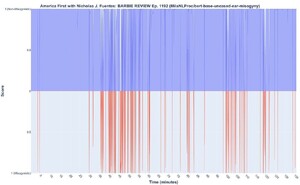
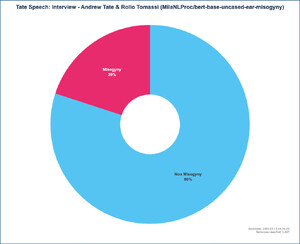
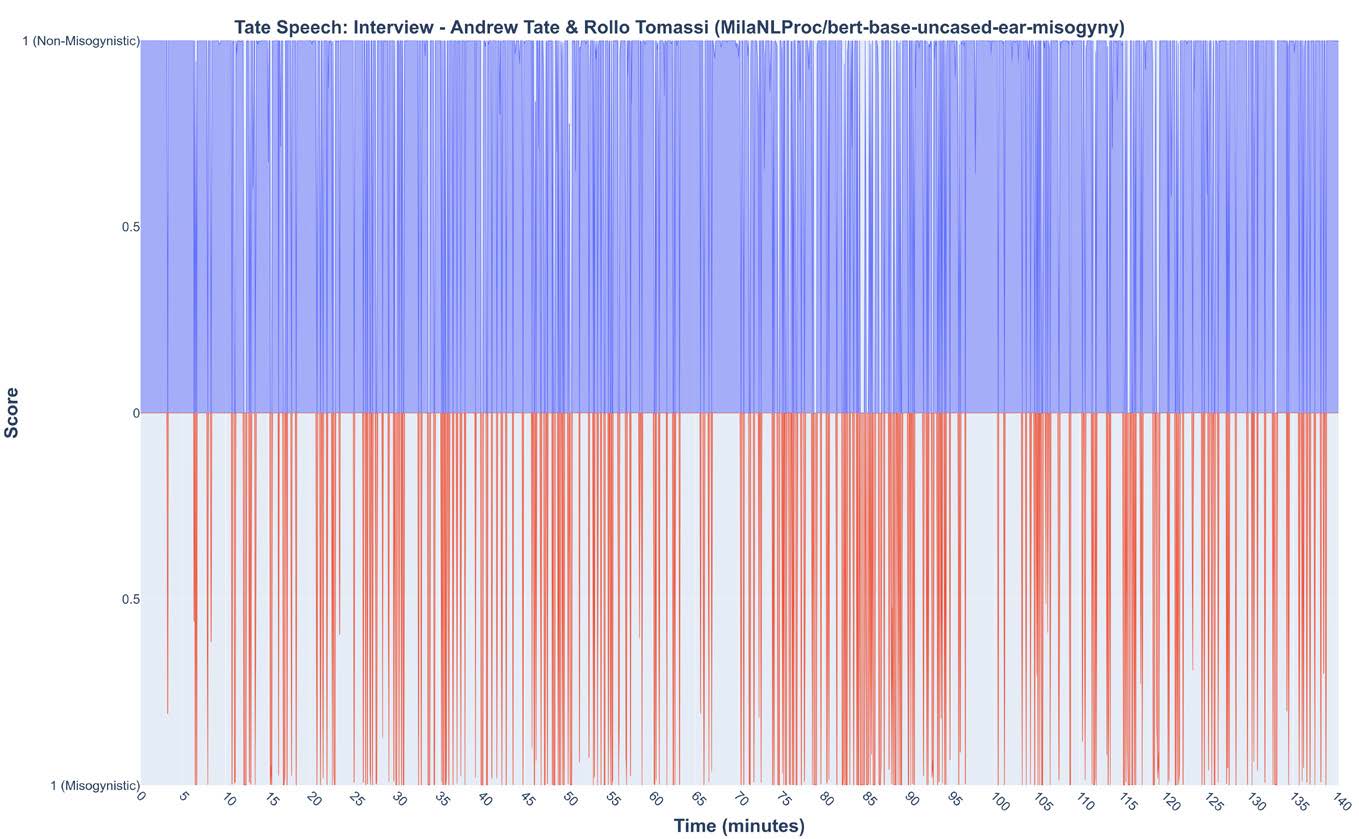
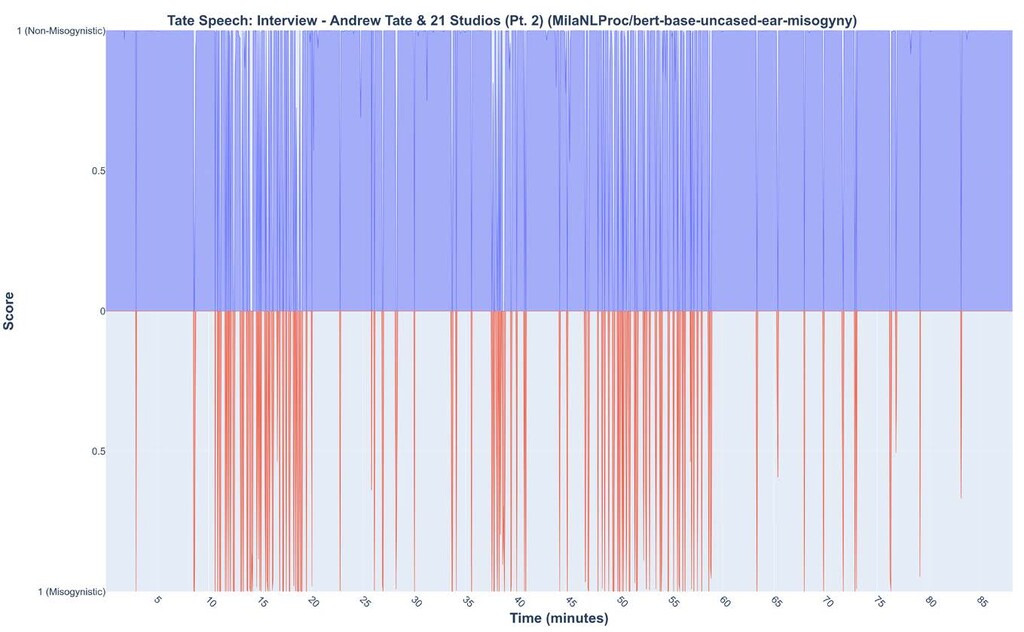
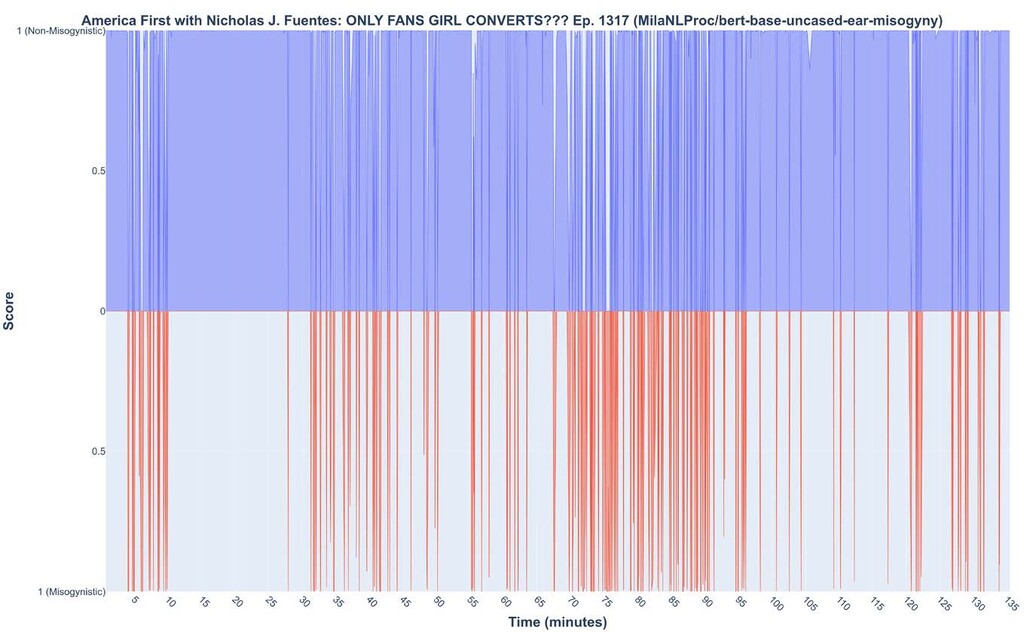
Using Python libraries, including Transformers and Plotly, we generated dual axis time series charts to visualize misogynistic and non-misogynistic sentences over time in each episode (Figures 1–3 and 5), and generated pie chart (Figure 4) that show the overall percentage of sentences classified as misogynistic or non-misogynistic sentences in each episode (Author3, 2024). In these charts, red bars indicate sentences classified as misogynistic, while blue shading represents non-misogynistic content. The colour overlay helps illustrate the density and distribution of misogynistic speech across each episode’s runtime. It is worth noting that these charts will show that most of the sentences are classified as non-misogynistic, and one might be inclined to dismiss the results. However, the prevalence of sentences that are classified as misogynistic in our dataset as compared to our control data (an episode of the “No Dunks” podcast) is magnitudes higher; less that a 0.5% compared to 20%. These visual tools helped illuminate the tone and frequency of gendered language across episodes, especially in discussions about femininity.
Building on this computational layer, we conducted a thematic discourse analysis following Braun and Clarke’s (2006) framework. This close reading focused on rhetorical strategies, ideological tropes, and the construction of hegemonic femininity. Themes were developed inductively but interpreted through a critical feminist lens, drawing attention to how gender norms are enforced, disrupted, and justified in manosphere discourse. While our analysis is based on transcript data, we also reviewed the audio and video for each of the selected episodes. This was essential for interpreting tonal cues, visual performance, and affective delivery, elements central to the communicative strategies for both podcasters. Our analysis treats podcasts as rhetorical and affective artifacts, sites where ideology, embodiment, and public discourse are produced and negotiated (Conley, 2021). Through this dual-layered, multi-method approach, we found conservative beliefs about gender are embedded within manosphere podcasting and amplified through platform affordances. These podcasts not only prescribe rigid gender roles but also work to marginalize and punish femininity among those whose experiences contradict the manosphere’s idealized vision of femininity.
Analysis
Our analysis of Tate and Fuentes’ podcasts highlighted two distinct yet overlapping forms of femmephobic discourse that advanced sexist and misogynist principles. These are best understood via Schipper’s distinction between hegemonic and pariah femininity outlined in the literature review above. We will explore in our analysis here how Tate and Fuentes each define these so-called good and bad forms of femininity and how this links to femmephobia. This opens the analysis to consider how Fuentes and Tate both police what they see as bad or pariah femininity through hateful language, leading each podcaster to advocate violence against noncompliant women. Finally, we consider how both Tate and Fuentes situate feminists and those not upholding idealized hegemonic femininity as largely responsible for the downfall of society, positioning them as dangerous and evil. We make links to the concept of the monstrous feminine here to demonstrate how Fuentes and Tate advance a form of stochastic terrorism against women, demonizing them to incite violence against them.
Framing Femininity: Manospheric Articulations of the Hegemonic vs. Pariah
Our close analysis of Fuentes and Tate’s podcasts reveals how each reinforces a hegemonic gender order that supports hegemonic femininity and vilifying its opposite, pariah femininity (Schippers, 2007). Rather than solely promoting masculine dominance, these manosphere podcasters relegate women to acceptable forms of femininity that defer to male power, emphasize sexual purity, and conform to a hyper-feminine aesthetic. They also direct violent and threatening language to those who do not uphold these norms. These distinctions function as gendered gatekeeping mechanisms whereby both Tate and Fuentes voice their expectations of women that create a sharp binary between a femininity that prioritizes sexual purity and their role as the family caregiver and those that enact more agency in their lifestyle choices, sexuality, and politics. For both podcasters the only acceptable women are those who remain within the traditional bounds of gender conservatism. The manosphere thus aggressively targets women who reject traditional gender roles and simultaneously promotes socially acceptable forms of femininity. This is particularly evident in the way it valorizes a soft femininity, which presents a seemingly empowering yet ultimately constrained version of gender roles. Unlike overt misogyny, soft feminine enforcement selectively embraces and rewards femininity that conforms to patriarchal limits (Schwartz, 2020).
This is seen quite clearly in the episode by Fuentes which reveals his feelings about the Barbie movie. This is worth considering in detail given Barbie’s role as an icon of soft femininity that nostalgically hails back to an imagined time of less complicated and more compliant forms of gender hegemony. Fuentes argues the movie is “weird” and “a sign of the times” (America First – Episode 1192, 00:57:14), offering feminist meta-commentary on society which, for Fuentes, stops Barbie from being “sincere” and “earnest” (America First – Episode 1192, 01:00:19).

Misogyny in America First: Episode 1192
Citation: Journal of Femininities 2026; 10.1163/29501229-bja10032
He argues the movie should instead be about femininity and family but is ruined because of its self-conscious feminist messaging. As a result, Fuentes dismisses, denigrates, and minimizes the film as a form of women’s culture not worthy of serious critical attention (despite spending an hours long episode doing precisely that). This contradicting rhetoric of deep investment followed by dismissal, is visualized in Figure 1, which shows sentences categorized as misogynistic (red) or non-misogynistic (blue) over the duration of Fuentes’ Barbie review. For a sustained 30-minute segment, Fuentes engages in a high concentration of emotionally charged, misogynistic commentary, largely marked by disgust and anger. The figure illustrates how his ideological critique of the film masks sustained affective labour aimed at disciplining femininity.
Fuentes takes issue with the movie overlooking the idealized femininity of Barbie instead framing women’s struggles and lived experiences, which he notes he is tired of hearing about in the media. Fuentes rants on contemporary women’s failings as childless, overweight, unemployed, unpleasant, crass, complain too much about sexism and are sexually unavailable, as opposed to his idealized vision of femininity upheld by Barbie. He notes we live in a “gynocratic society,” by which he means a society where women hold all the power, suggesting the opposite of this is preferable and ideal. He then outlines that for women to be deemed valuable in society the must be “skinny, have kids, pleasant, pure, demure, smart, contribute financially, have skills and job and money, and sexually available” (America First – Episode 1192, 00:50:12). This aligns quite closely with definitions of idealized hegemonic femininity that emerge from a capitalist, white supremacist, heteronormative, patriarchal logic (Hoskin et al., 2023; Menzie, 2022, Schippers, 2007).
Tate advocates for a similar idealized version of femininity in his discussion of women on his podcast. In a 2022 interview with Andrew Johnson, founder of 21 Studios and a self-described king of the manosphere, Tate articulates his discontent with Western women while idealizing Eastern European women who conform more closely to traditional gender expectations. As illustrated in Figure 2, this episode is marked by sustained and emotionally charged misogynistic discourse. The exchange offers insight into how the manosphere constructs failed versus desirable femininity:
Johnson: There is a thirst in America and the West for all kinds of femininity… These women act like men, and then it’s, like, you have nothing left except maybe some physical stuff online.
Tate: Thirst for femininity.
[…]
Tate: Because I’ve had guys literally say to my girls, you’re the first girl who speaks nicely…You’re the only girl who I’ve seen talk like this. You’re the only girl who does her nail. Like, the basic shit. They’re just like, wow, she’s a pedicure and a manicure, and she’s polite.
Johnson: Women in America are a wreck, man, compared to what I’m seeing here. They dress like shit. They act like men. They don’t have manners.
Tate: It’s unattractive.
andrew tate & 21 studios, 00:58:03 – 00:58:31
Misogyny in Tate Speech Interview with 21 Studios (Pt.2)
Citation: Journal of Femininities 2026; 10.1163/29501229-bja10032
Here, femininity is reduced to aesthetics and subservience—having manicures, dressing well, and speaking nicely. These women are praised for their compliance and polish, both literal and behavioural. Tate’s reference to his girls alludes to his webcam business, which he claimed involved up to 75 women across multiple locations (bbc News, 2025). His approval of these women stems not from their autonomy, but from their conformity to a curated, commodified version of femininity that centers male pleasure and dominance. As with Fuentes, this reflects an idealized hegemonic femininity tied to soft feminine aesthetics—submissive femininity circumscribed by patriarchal norms. Women who fall outside of this model are seen not just as undesired but as transgressive. They are unattractive because they do not cater to the male gaze; rude because they speak freely; and masculine because they assert autonomy, traits that defy the prescribed gender order. This dichotomy is not simply symbolic. As Schippers (2017) argues, pariah femininity threatens the symbolic order of gender hierarchy by supposedly contaminating masculinity or undermining the legitimacy of male dominance. For Tate and Fuentes, the danger of feminine noncompliance is both ideological and emotional; it signals disorder, emasculation, and social decline (something we address in our final analysis point).
Femmephobia and the Policing of Gender Transgression
Schippers’ (2017) framework allows us to see that the regulation of femininity within manosphere podcasts is not only about ideologizing hegemonic traits, but also about policing deviations, what Hoskin (2020) and others call femmephobia. Within the manosphere, femmephobia operates as a gendered control mechanism, shaming women for perceived excess, too loud, too sexual, too assertive, while pathologizing gender nonconforming or feminist expressions as threats to male order. In such extreme spaces this leads to influencers vilifying them as enemies, the root cause of all social ills, and justifies any violence against them. One of the key places this emerges in manosphere podcast conversations is around women’s sexual desire as deviant from the expectation of feminine purity.
Thus, one of the ways that femmephobia operationalizes the dichotomy between hegemonic and pariah femininities within the manosphere is through the virgin/whore dichotomy, a patriarchal framework that has long been used to regulate women’s behaviour (Hoskin et al., 2023). Within the transcripts we analyzed this binary divides women into two rigid categories: the virgin, or an idealized figure predicated on her sexual purity (untouched by other men) and the whore, a woman already “used” by other men whose sexual prowess is threatening and dangerous. The ideal woman, as we outlined above is portrayed as a “submissive, loyal partner deserving of protection, while “undesirable women”—often feminists, career-driven individuals, or those deemed sexually autonomous—are demonized” (Schwartz, 2020). This framework is deeply embedded in manosphere rhetoric, where femininity itself becomes a site of contempt. As Menzie (2022) shows, incel discourse devalues hyper-feminine women or what they term a “Stacy,” figures who are both desired and despised for embodying emphasized femininity while withholding sexual access. Likewise, what incel’s term a “Becky” represents a more flexible form of femmephobia directed at women perceived as average or insufficiently feminine. In both cases, women are judged less for their individual behaviour than for how well they reproduce patriarchal ideals of availability and submission. However, even those who conform to patriarchal expectations remain trapped in a precarious position—constantly monitored, infantilized, and at risk of being devalued should they step outside the boundaries of accepted femininity (Schwartz, 2020).
The sexist double standard of the virgin/whore dichotomy is seen clearly in Tate’s discussion with Johnson again, where they outline and normalize men’s serial infidelity as an expectation and valorize it while at the same time asserting as an absolute truth that women show their affection and commitment via monogamy. In one segment Tate brags about how much he sleeps around and the woman he loves, his primary partner, doesn’t talk to other guys, while Johnson talks about being both a bad boy and pro-family (Andrew Tate & 21 Studios, 00:06:45) Tate critiques his own mom for being upset about the father’s infidelity and uses this as a pretext for arguing male cheating as negative is “propagated by the powerful females” (Andrew Tate & 21 Studios, 00:08:44). Here, idealized femininity accepts male cheating as natural and pariah femininity is critical of it, thus contaminating the so-called hierarchical gender order.
Misogyny in Tate Speech: Interview with Rollo Tomassi
Citation: Journal of Femininities 2026; 10.1163/29501229-bja10032
In the interview with Tomassi, Tate raises concerns around trends towards polyamory in Western relationships that they decry are being driven by women. They raise the spectre that such relationships cuck men and work against the social order by allowing women to have sex beyond their heteronormative coupling. Tate suggests this “goes against our, our evolutionary imperatives, right?” which Tomassi confirms with a discussion of paternity that establishes men can hold multiple partners but if their women partner’s due there is a risk their children are someone else’s (Andrew Tate & Rollo Tomassi, 00:07:57 – 00:08:34). Again, sanctioned femininity includes women’s fidelity and reproductive labour; while contaminating, pariah femininity threatens this with sexual autonomy outside of heteronormative monogamy.
Proportion of Misogynistic vs. Non-Misogynistic Speech in Tate Speech: Interview with Rollo Tomassi
Citation: Journal of Femininities 2026; 10.1163/29501229-bja10032
This episode, more than any other in our analysis, reflects the highest volume of misogynistic content. As visualized in Figure 3, misogynistic rhetoric is sustained throughout the episode, with consistent spikes in emotionally charged language. Figure 4 confirms that 20% of all sentences in this episode were classified as misogynistic by the model, the highest of any episode analyzed in this paper.
Tate and Tomassi make clear for listeners that there is a double standard to uphold if men are to maintain idealized versions of contemporary gender roles. This double standard includes women’s submission and sexual purity to their male partners. This is disproportionately constrained in contrast to the kinds of sexual freedom given to the men in this dynamic. In fact, both podcasters speak directly to practices of infidelity as a marker of men’s freedom, one not extended to women within this dynamic. This means that freedom is selective based on gender and requires women to be submissive rather than free. If they do not, it leads to the cucking—or femininization—of men. This is the collateral damage of women exploring the same sexual agency and freedom according to men. Femmephobia reasserts itself here as the fear of men being tainted by the very expectations prescribed to women. Femmephobia when applied to men’s status shows very clearly the inequities and misogyny of idealized femininity. The downstream impact of this misogynist logic normalizes abusive forms of control and jealousy in heterosexual relationships. Both Tate and Fuentes use such transgressions as a justification to advocate violence against women in their podcasts.
Within manosphere podcasts women who defy traditional gender norms are portrayed as duplicitous, untrustworthy, and dangerous to men and society. This makes them very clearly aligned with the category of pariah femininity which manosphere influences respond with derision and calls for containment. Such reactions are clear forms of femmephobia as regulatory rhetorical practice. For instance, Fuentes bluntly labels the women whose actions or lifestyle he disapproves of as whores and treats them with open contempt. This is apparent in the Fuentes episode we analyzed where he discusses the controversy around Nala Rae who was formerly ranked in the top 1% of OnlyFans accounts but then publicly converted to born-again Christianity (America First – Episode 1317). Fuentes feels women acting as free sexual agents are responsible for many social ills. He mockingly introduces Rae as, “a former whore… She was a whore, but she’s not anymore. So everyone needs to try and marry her and respect her…” (America First – Episode 1317, 00:04:02 – 00:04:09). His sarcastic tone makes clear he does not truly consider her reformed; to him, her past sexual independence permanently marks her as a so-called bad woman. For him Rae is duplicitous for using her attractiveness to capture men’s attention. He declares that “it’s time for men to get tough on women and say shut up” (America First – Episode 1317, 01:19:54). This rhetorical escalation maps onto Figure 5, which shows a distinct spike in misogynistic language between the 70–90-minute mark—corresponding to Fuentes’ most aggressive calls for the re-domestication of women.
Misogyny in America First: Episode 1317
Citation: Journal of Femininities 2026; 10.1163/29501229-bja10032
He advises that what he labels bad women leave public space and that they should “cover up…go away. Get married. And raise some kids” (America First – Episode 1317, 01:20:21). Here Fuentes uses his denigration of Rae to advocate for an idealized hegemonic femininity where sexuality is acceptable within heterosexual marriage and raising children. Fuentes argues “women need to be modest, and they need to be segregated, and they need to be groomed not for pornography or for telling their truth on TikTok, but for being a submissive housewife” (America First – Episode 1317, 01:21:57). He lays out a division of labour within this schema where men work and provide, and women do all the care labour for the family including household duties and child rearing.
Fighting the Monstrous Feminine: Containing the Threat Pariah Femininity Poses to Civilization
While the virgin/whore dichotomy delineates boundaries of acceptable sexuality, the manosphere’s most extreme rhetorical moves occur when femininity crosses into perceived danger—when it becomes monstrous. As mentioned earlier, for Tate and Fuentes, pariah femininity is destabilizing, duplicitous and socially corrosive. Drawing on Barbara Creed’s (1993) theorization of the monstrous feminine, these podcasters depict feminists, queer people, and non-submissive women as both symbolic and material threats to patriarchal order. In doing so, they mobilize a politics of fear and incite a reactionary call to reassert control. Fuentes, for example, openly advocates physical violence (“why should we not grab these women by their necks?”) against modern day women (America First – Episode 1192, 00:53:05). Similar narratives appear in Tate’s conversation with both Johnson and Tomassi, where is idea of controlling women through physical violence is discussed casually. For both, the offense is not just women’s defiance, but their audacity to desire autonomy. As Fuentes puts it, women’s greatest offense is “they want to have it all. They really want to have it all ways” (America First – Episode 1192. 00:53:14). This rhetorical move frames women’s demands for equity as unreasonable, while men’s similar aspirations are never questioned. The implicit message is clear: the social contract accepts women only as objects of exchange—attractive, domestic, emotionally supportive, and sexually available. Any deviation from this model is framed not merely as inappropriate, but as an attack on masculinity itself, an act deserving of punishment.
This depiction of women as inherently threatening reflects a broader manosphere narrative that positions women as catalysts for civilizational decline. Both Fuentes and Tate frequently invoke the idea of an existential crisis in the West, blaming feminism and queer culture for its perceived collapse. Tate and Johnson’s interview focuses quite heavily at the start on state of western civilization prompted by a t-shirt that reads “the future is queer” where Tate states inversely, “The future is masculine, of course” (Andrew Tate & 21 Studios, 00:04:51 – 00:04:52) as if it is a self-evident natural fact. This builds a narrative that men are responsible for all of history and civilization and women benefit at no cost except for playing a role as supporter (Andrew Tate & 21 Studios, 00:05:34 – 00:05:37). They explicitly discuss that the “female imperative on society” is not making anything better (Andrew Tate & 21 Studios, 00:05:58). It is unclear what they mean by the female imperative as they gloss over it quickly. It appears as a shorthand, commonly used phrase in Tate’s discourse, that hails his listeners into a shared space of understanding. This assertion of the future being masculine as well as the narrative of men as the sole producer of civilization belies an anxiety around women and queer folks as threats to the (moral) order of things.
Creed’s (1993) theory helps contextualize this dynamic. She argues that “all human societies have a conception of the monstrous-feminine, of what it is about woman that is shocking, terrifying, horrific, abject” (1). Manosphere culture is no different and it is worth considering the contours of what is shocking, terrifying, horrific and abject about women for male influencers in this realm. Chang (2022) offers important insights on this via her analysis of a now inactive incel subreddit. She employs the monstrous-feminine to explore incel rhetoric that demonizes and dehumanizes women (via the term femoids which reduces them to bodies) to advocate for violence and justify gendered hate. As Chang notes “the monstrous-feminine has no inherent qualities. She is created through representation to enforce behavior and justify patriarchal oppression” (2022, p. 257). This includes an enforcement of properly feminine behaviors and the demonization of those who disobey. The abjection and terror of disobedient women within manosphere discourse seems to center around women seeking equal access to freedoms and personal agency that men in these spaces feel entitled to as a natural or given imperative (Manne, 2021).
This idea of the treacherous so-called female imperative comes up often in the podcast discourse of both Tate and Fuentes. In Tate’s conversations with Tomassi he notes that the entire Western system is rigged against men and is only getting worse. He notes “everything from marriage to having kids to divorce, everything, the whole system is rigged against you and they will destroy your life” (Andrew Tate & Rollo Tomassi, 00:07:12 – 00:07:19). Tate presents non-compliant women as threats, though often in terms of what they do to men. He describes modern life as a minefield for men, “Being a man’s always been shit, and compared to being a woman, it will always be permanently shit… The situations men are in, if they were reversed, would be global tragedies.” Here, women are implicitly cast as a protected class, while men are victims. It also carries an undertone that women are less exposed to hardship (i.e., kept safe at men’s expense), and thus when women do step into traditionally male arenas or challenge men, it is seen as disruptive or unfair. Such rhetoric portrays women as a threat to men, bolstering an us vs. them mentality between the sexes.
The conclusion, or endgame, for manosphere influencers like Tate and Fuentes is indeed to depict this moment as a gender war. While we may treat this critically as a hyperbolic means by which to capture their audience’s attention, the way it is taken up in manosphere podcasts suggests something more troubling. At the end of Tate’s conversation with Johnson in what appears to be an ad for Tate’s digital men’s self-help courses he states the following:
‘Just kill any man that you see.’ You see Christian mothers of six talking about, you know, open castration or castration of men. That has become normalized for American women today. And it’s getting worse every day, every month, every year. So we see women now marching in the streets by the millions. No other hate movement in history has scaled to that level. In 2019, the war on feminism goes global. Feminism has of course infected Europe as well. Feminazis have overrun Europe. We need to fight back. We need to defend ourselves.
andrew tate & 21 studios, 01:02:36 – 01:04:25
There is a level of fearmongering here to sell Tate-branded products that is alarming. There is a dangerous level of disinformation and sensationalist, fantastical positioning of women, even the good Christian mother, as not only untrustworthy but entirely diabolical. It positions women as a threat. It vilifies their right to assemble in protest as evidence of this threat. It makes feminism not only a global war but an infection and a fascist evil. We find the troubling aspect of this to be the call to arms, so to speak, telling the men listening of the need to defend themselves by fighting back. By situating women’s advocacy for equity as a disease and a war they are laying the groundwork to justify real world violence against any women, femmes, or gender non-conforming people who transgress the acceptable bounds of idealized femininity. This, at its core, is an explicit example of stochastic terrorism which uses mass media dissemination to incite violent acts against the group being demonized (Angove, 2024). The term stochastic terrorism is used to raise alarms around the statistical probabilities that such inflamed problematic speech will lead to online and in some cases real world violence (Angove, 2024; Braddock, 2020). It is thus useful to see how stochastic terrorist speech holds an authoritarian impulse to “enforce conformity with an ideal or a ruler, circumscribing the allowable to a tight area usually coded in terms of race, gender, and sexual orientation” (Angove, 2024, p. 37). This describes perfectly the discourse of Tate and Fuentes who both have demonstrated the circumscription of femininity within a tight area of gendered possibilities. As Angove notes this relies on establishing a “‘fear” or “terror” around any form of push back by the targeted group noting this use of terror is a “sure driver of this authoritarian conformity through violence” (Angove, 2024, p. 37). This we would suggest is what is at stake in the femmephobia of manosphere podcast discourse.
While we examined the smallest fraction of the discourse here in our analysis, we would argue as stochastic terrorist speech the intentions towards justifying violence against women and gender minorities upheld by these four podcasts are equally present elsewhere in the media ecosystem of the manosphere. It is, arguably, the defining feature of what is clearly a misogynist hate movement committed to the containment and policing of women and other genders not upholding a heteronormative, capitalist, patriarchal status quo.
Conclusion
Our study demonstrates that femmephobia is not only present within the manosphere, but a defining ideological mechanism through which patriarchal control is reasserted, maintained, and violently defended in digital spaces. Through our mixed-method analysis of podcasts hosted by Andrew Tate and Nick Fuentes, we uncover how these influential manosphere figures construct and enforce narrow, binary definitions of femininity. Drawing on Schippers’ concept of hegemonic and pariah femininity, we showed how femininity is either valorized as submissive, sexually modest, and domestic, or demonized as deviant, threatening, and corrupting. Femmephobia thus becomes the ideological glue binding these binaries, used to police acceptable expressions of femininity while vilifying those that fall outside patriarchal norms. While misogyny in the manosphere has been extensively documented, our findings emphasize the need to attend specifically to femmephobia as a distinct but intersecting form of gendered oppression. Tate and Fuentes do not simply hate women, they fear and loathe femininity itself, particularly when it refuses to remain subordinate. Femmephobia in these podcasts operates both rhetorically and affectively, targeting not just women, but any individual or ideology that celebrates feminine autonomy, queerness, or emotional vulnerability. Through shaming, mockery, and overt calls for re-domestication or violence, these podcasters position femininity as the root of civilizational decline. This ideological stance has material consequences, helping to normalize and justify gender-based violence under the guise of social restoration.
Moreover, our research illustrates how platform affordances enable and intensify the spread of femmephobic discourse. Podcasts, with their parasocial intimacy and long-form narrative structure, create fertile ground for ideological indoctrination. Soundbites, memes, and out-of-context quotes from Tate and Fuentes travel far beyond their original platforms, often stripped of nuance and repackaged as digestible slogans promoting gender essentialism and male entitlement. This contributes to a broader culture of networked misogyny, in which femmephobic ideas are algorithmically amplified and socially normalized. Perhaps most concerning is the connection between femmephobic discourse and stochastic terrorism. Both Tate and Fuentes deploy war metaphors, frame feminism as an existential threat, and depict women’s agency as deserving of punishment. These rhetorical moves are not merely symbolic, they invite action. By constructing femininity as monstrous and civilization-threatening, they incite emotional responses that blur the line between speech and violence. As Angove (2024) and Braddock (2020) argue, such speech does not need to explicitly call for violence to be dangerous; it only needs to create a cultural atmosphere in which violence feels justified, even inevitable. The manosphere does not just fear femininity, it disciplines it, brands it as a threat, and prepares its audience to punish it.
Funding provided by the Social Sciences and Humanities Research Council
References
Abdul, G. (2025, February 27). What is Andrew Tate accused of and why has he travelled to the US? The Guardian. https://www.theguardian.com/news/2025/feb/27/what-is-andrew-tate-accused-of-and-why-has-he-travelled-to-the-us
adl. (2025, April 4). Nicholas J. Fuentes: Five Things to Know. Anti-Defamation League. https://www.adl.org/resources/article/nicholas-j-fuentes-five-things-know
Ahmed, S. (2023). The feminist killjoy handbook: The radical potential of getting in the way (First edition). Seal Press.
Alig, M., Atsin, O., Neapole, J., & Thompson, K. (2022). Feminist Responses to the Global Rise in Right-Wing Extremism: A summary [Summary]. CRIAW-ICREF. https://www.criaw-icref.ca/publications/feminist-responses-to-the-global-rise-in-right-wing-extremism-a-summary/
Angove, J. (2024). Stochastic terrorism: Critical reflections on an emerging concept. Critical Studies on Terrorism, 17(1), 21–43. https://doi.org/10.1080/17539153.2024.2305742
Attanasio, G., Nozza, D., Hovy, D., & Baralis, E. (2022). Entropy-based Attention Regularization Frees Unintended Bias Mitigation from Lists. Findings of the Association for Computational Linguistics: acl 2022, 1105–1119. https://doi.org/10.18653/v1/2022.findings-acl.88
Backe, E. L., Lilleston, P., & McCleary-Sills, J. (2018). Networked Individuals, Gendered Violence: A Literature Review of Cyberviolence. Violence and Gender, 5(3), 135–146. https://doi.org/10.1089/vio.2017.0056
Badham, V. (2024, November 16). Women need to be kept safe from the ‘your body, my choice’ peddlers. Here’s how. The Guardian. https://www.theguardian.com/society/commentisfree/2024/nov/17/your-body-my-choice-peddlers-women-self-protection-ntwnfb
Banet-Weiser, S., & and Miltner, K. M. (2016). #MasculinitySoFragile: Culture, structure, and networked misogyny. Feminist Media Studies, 16(1), 171–174. https://doi.org/10.1080/14680777.2016.1120490
bbc News. (2025). Who is Andrew Tate? The self-proclaimed misogynist influencer. bbc News. https://www.bbc.com/news/uk-64125045
Beard, M. (2017). Women & Power: A Manifesto. Liveright.
Botto, M., & Gottzén, L. (2024). Swallowing and spitting out the red pill: Young men, vulnerability, and radicalization pathways in the manosphere. Journal of Gender Studies, 33(5), 596–608. https://doi.org/10.1080/09589236.2023.2260318
Braddock, K. (2020). Weaponized Words: The Strategic Role of Persuasion in Violent Radicalization and Counter-Radicalization. Cambridge University Press. https://doi.org/10.1017/9781108584517
Braun, V., & Clarke, V. (2006). Using thematic analysis in psychology. Qualitative Research in Psychology, 3(2), 77–101. https://doi.org/10.1191/1478088706qp063oa
Bucher T., & Helmond, A. (2018). The Affordances of Social Media Platforms. In The sage Handbook of Social Media (pp. 233–253). Sage Publications.
Bujalka, E., Rich, B., & Bender, S. (2022). The Manosphere as an Online Protection Racket: How the Red Pill Monetizes Male Need for Security in Modern Society. Fast Capitalism, 19(1). https://doi.org/10.32855/fcapital.202201.001
Campbell, S., Greenwood, M., Prior, S., Shearer, T., Walkem, K., Young, S., Bywaters, D., & Walker, K. (2020). Purposive sampling: Complex or simple? Research case examples. Journal of Research in Nursing: jrn, 25(8), 652–661. https://doi.org/10.1177/1744987120927206
Center for Countering Digital Hate. (2025, June 18). Banned, But Not Gone: YouTube Bans Andrew Tate, Then Profits from His Misogyny Anyway. Center for Countering Digital Hate | ccdh. https://counterhate.com/blog/banned-but-not-gone-youtube-bans-andrew-tate-then-profits-from-his-misogyny/
Center on Extremism. (2023). Fuentes Delivers Antisemitic, “Christian Nationalist” Rant to Fellow White Supremacists | adl. Anti-Defamation League. https://www.adl.org/resources/article/fuentes-delivers-antisemitic-christian-nationalist-rant-fellow-white-supremacists
Chan, E. (2023). Technology-Facilitated Gender-Based Violence, Hate Speech, and Terrorism: A Risk Assessment on the Rise of the Incel Rebellion in Canada. Violence Against Women, 29(9), 1687–1718. https://doi.org/10.1177/10778012221125495
Chang, W. (2022). The monstrous-feminine in the incel imagination: Investigating the representation of women as “femoids” on /r/Braincels. Feminist Media Studies, 22(2), 254–270. https://doi.org/10.1080/14680777.2020.1804976
Conley, T. L. (2021). A Sign of the Times: Hashtag Feminism as a Conceptual Framework. In M. Radzikowska, S. MacDonald, B. I. Wiens, & M. MacArthur (Eds.), Networked Feminisms: Activist Assemblies and Digital Practices (pp. 21–46). Rowman & Littlefield.
Creed, B. (1993). The monstrous-feminine: Film, feminism, psychoanalysis. Routledge.
Czerwinsky, A. (2024a). Aggressive communication online: From familiar anti-women sentiments to misogyny influencers and male supremacism in the manosphere. In The Routledge Handbook of Conflict and Peace Communication (1st ed.). Routledge.
Czerwinsky, A. (2024b). Misogynist incels gone mainstream: A critical review of the current directions in incel-focused research. Crime, Media, Culture, 20(2), 196–217. https://doi.org/10.1177/17416590231196125
Das, S. (2022, August 6). Inside the violent, misogynistic world of TikTok’s new star, Andrew Tate. The Guardian. https://www.theguardian.com/technology/2022/aug/06/andrew-tate-violent-misogynistic-world-of-tiktok-new-star
Dowling, J. (2022). The Affordances of Podcasts and Digital News, and What they Teach Us. The City Journal. https://thecityjournal.net/innovation/technology-reflections-2022/the-affordances-of-podcasts-and-digital-news-and-what-they-teach-us/
Fernando, C. (2024, November 30). Emboldened “manosphere” accelerates threats and demeaning language toward women after US election. ap News. https://apnews.com/article/trump-harris-election-womens-rights-social-media-d5cea53480437ac8bf837aaa821e5681
Flood, M., & Pease, B. (2009). Factors Influencing Attitudes to Violence Against Women. Trauma, Violence & Abuse, 10(2), 125–142. https://www.jstor.org/stable/26636200
Franklin-Paddock, B., Platow, M. J., & Ryan, M. K. (2025). From Privilege to Threat: Unraveling Psychological Pathways to the Manosphere. Archives of Sexual Behavior, 54(4), 1325–1340. https://doi.org/10.1007/s10508-025-03114-5
Fuentes, N. (2024, November 26). WIFEJAK PSYOP EXPOSED??? Male Feminists Are NEUTERING The Right Wing (No. 1426) [Broadcast]. https://rumble.com/v5t4pm5-america-first-ep.-1426.html
Ging,D.(2019). Alphas, Betas, and Incels: Theorizing the Masculinities of the Manosphere. Men and Masculinities, 22(4), 638–657. https://doi.org/10.1177/1097184X17706401
Hartmann, J. (2022). Emotion English DistilRoBERTa-base. https://huggingface.co/j-hartmann/emotion-english-distilroberta-base/
Holpuch, A. (2022, August 24). Why Social Media Sites Are Removing Andrew Tate’s Accounts. The New York Times. https://www.nytimes.com/2022/08/24/technology/andrew-tate-banned-tiktok-instagram.html
Hopton, K., & Langer, S. (2022). “Kick the XX out of your life”: An analysis of the manosphere’s discursive constructions of gender on Twitter. Feminism & Psychology, 32(1), 3–22. https://doi.org/10.1177/09593535211033461
Hoskin, R. (2020). “Femininity? It’s the Aesthetic of Subordination”: Examining Femmephobia, the Gender Binary, and Experiences of Oppression Among Sexual and Gender Minorities. Archives of Sexual Behavior. https://doi.org/10.1007/s10508-020-01641-x
Hoskin, R. A. (2017a). Femme interventions and the proper feminist subject: Critical approaches to decolonizing western feminist pedagogies. Cogent Social Sciences, 3(1), 1276819. https://doi.org/10.1080/23311886.2016.1276819
Hoskin, R. A. (2017b). Femme Theory: Refocusing the Intersectional Lens.
Hoskin, R. A. (2019). Femmephobia: The Role of Anti-Femininity and Gender Policing in lgbtq+ People’s Experiences of Discrimination. Sex Roles, 81(11), 686–703. https://doi.org/10.1007/s11199-019-01021-3
Hoskin, R. A., Serafini, T., & Gillespie, J. G. (2023). Femmephobia versus gender norms: Examining women’s responses to competing and contradictory gender messages. The Canadian Journal of Human Sexuality, 32(2), 191–207. https://doi.org/10.3138/cjhs.2023-0017
Jamieson, A. (2023, June 20). Andrew Tate charged with rape and human trafficking. The Independent. https://www.independent.co.uk/news/world/europe/andrew-tate-tristan-rape-trafficking-trial-b2360793.html
Jane, E. A. (2017). Feminist Digilante Responses to a Slut-Shaming on Facebook. Social Media + Society, 3(2), 2056305117705996. https://doi.org/10.1177/2056305117705996
Kristeva, J. (2010). Powers of Horror: An Essay on Abjection (L. Roudiez, Trans.). Columbia University Press.
Llinares, D., Fox, N., & Berry, R. (Eds.). (2018). Podcasting: New Aural Cultures and Digital Media. Springer International Publishing. https://doi.org/10.1007/978-3-319-90056-8
Manne, K. (2018). Down girl: The logic of misogyny. Oxford University Press.
Marwick, A. E., & and Caplan, R. (2018). Drinking male tears: Language, the manosphere, and networked harassment. Feminist Media Studies, 18(4), 543–559. https://doi.org/10.1080/14680777.2018.1450568
Menzie, L. (2022). Stacys, Beckys, and Chads: The construction of femininity and hegemonic masculinity within incel rhetoric. Psychology & Sexuality, 13(1), 69–85. https://doi.org/10.1080/19419899.2020.1806915
Milmo, D., & Keenan, R. (2025, March 13). Spotify takes down Andrew Tate ‘pimping’ podcast after complaints. The Guardian. https://www.theguardian.com/news/2025/mar/13/spotify-takes-down-andrew-tate-pimping-podcast-after-complaints
Nelson, L.K. (2020). Computational Grounded Theory: A Methodological Framework. Sociological Methods & Research, 49(1), 3–42. https://doi.org/10.1177/0049124117729703
O’Donnell, C., & Shor, E. (2022). “This is a political movement, friend”: Why “incels” support violence. The British Journal of Sociology, 73(2), 336–351. https://doi.org/10.1111/1468-4446.12923
Owen, T. (2022, June 7). They Love Jesus, Bon Iver, and Incels. Inside America’s New Ultranationalist Youth Movement. vice. https://www.vice.com/en/article/groyper-young-christian-nationalists-movement/
Özkula, S. M., Prieto-Blanco, P., Tan, X., & Mdege, N. (2024). Affordances and platformed visual misogyny: a call for feminist approaches in visual methods. Feminist Media Studies, 24(5), 962–983. https://doi.org/10.1080/14680777.2024.2311355
Rashid, H. (2024). maga Is Out in Full Force After Trump’s Win—And More Violent Than Ever. The New Republic. https://newrepublic.com/post/188099/maga-trump-win-reaction
Ribeiro, M. H., Blackburn, J., Bradlyn, B., Cristofaro, E. D., Stringhini, G., Long, S., Greenberg, S., & Zannettou, S. (2021). The Evolution of the Manosphere across the Web. Proceedings of the International aaai Conference on Web and Social Media, 15, 196–207. https://doi.org/10.1609/icwsm.v15i1.18053
Rich, B., & Bujalka, E. (2023, February 12). The draw of the ‘manosphere’: Understanding Andrew Tate’s appeal to lost men. The Conversation. http://theconversation.com/the-draw-of-the-manosphere-understanding-andrew-tates-appeal-to-lost-men-199179
Roberts, S., Jones, C., Nicholas, L., Wescott, S., & Maloney, M. (2025). Beyond the Clickbait: Analysing the Masculinist Ideology in Andrew Tate’s Online Written Discourses. Cultural Sociology, 17499755241307414. https://doi.org/10.1177/17499755241307414
Ronzhyn, A., Cardenal, A. S., & Batlle Rubio, A. (2023). Defining affordances in social media research: A literature review. New Media & Society, 25(11), 3165–3188. https://doi.org/10.1177/14614448221135187
Ruest, N. (2024). ManoWhisper (Version 1.0.0) [Python]. Digital Feminist Network. https://doi.org/10.5281/zenodo.14794744
Schippers, M. (2007). Recovering the Feminine Other: Masculinity, Femininity, and Gender Hegemony. Theory and Society, 36(1), 85–102. https://www.jstor.org/stable/4501776
Schwartz, A. (2020). Soft Femme Theory: Femme Internet Aesthetics and the Politics of “Softness.” Social Media + Society, 6(4), 2056305120978366. https://doi.org/10.1177/2056305120978366
Simonsen, E. (2025). Knowledge Fight Interactive Search Tool. https://fight.fudgie.org/
Smith, C. R., Brammer, S. E., Cloudy, J., Essary, C., & Pérez, C. (2025). “RIP TOP G:” Rhetoric, Responses, and Realities Surrounding the Social Media Ban of Andrew Tate. Violence Against Women, 10778012251319308. https://doi.org/10.1177/10778012251319308
splc. (2025). Nick Fuentes. Southern Poverty Law Center. https://www.splcenter.org/resources/extremist-files/nick-fuentes/
Srivastava, K., Chaudhury, S., Bhat, P. S., & Sahu, S. (2017). Misogyny, feminism, and sexual harassment. Industrial Psychiatry Journal, 26(2), 111–113. https://doi.org/10.4103/ipj.ipj_32_18
Stoner, E. (2025, February 5). ‘Men Win Again’: Who is far-right influencer Nick Fuentes? vox – Pol. https://voxpol.eu/men-win-again-who-is-far-right-influencer-nick-fuentes/
Strathern, W., & Pfeffer, J. (2022). Identifying Different Layers of Online Misogyny (arXiv: 2212.00480). arXiv. https://doi.org/10.48550/arXiv.2212.00480
Sullivan, J. L. (2019). The Platforms of Podcasting: Past and Present. Social Media + Society, 5(4), 2056305119880002. https://doi.org/10.1177/2056305119880002
Theocharis, Y., Boulianne, Shelley, Koc-Michalska, Karolina, & and Bimber, B. (2023). Platform affordances and political participation: How social media reshape political engagement. West European Politics, 46(4), 788–811. https://doi.org/10.1080/01402382.2022.2087410
Vallerga, M., & Zurbriggen, E. L. (2022). Hegemonic masculinities in the ‘Manosphere’: A thematic analysis of beliefs about men and women on The Red Pill and Incel. Analyses of Social Issues and Public Policy, 22(2), 602–625. https://doi.org/10.1111/asap.12308
Walker, P., & Farmer, B. (2025, March 6). Kyle Clifford trial: Crossbow murderer found guilty of raping ex. https://www.bbc.com/news/articles/cr52r7ndjl6o
Williamson, L., & Wright. (2023, June 20). Andrew Tate charged with rape and human trafficking. bbc News. https://www.bbc.com/news/world-europe-65959097
Wolfe, A., & Cammarata, S. (2025). Inside the Telegram Groups Doxing Women for Their Facebook Posts. Wired. https://www.wired.com/story/inside-the-telegram-groups-doxing-women-for-their-facebook-posts/