Abstract
The unique collection of Erasmiana in the Rotterdam Public Library has a long history in which there has been varying attention to acquisition, preservation and presentation. This article describes how individuals such as donors, directors and curators developed the collection since it was first mentioned in 1868. This development is reconstructed through archival sources such as year reports, newspaper articles and material evidence in the collection itself. From this reconstruction, it is possible to distinguish three phases in the history of the Erasmus Collection in which it was treated as respectively an archival collection, a scholarly source and a heritage collection. The case study shows why it is important for scholars who make use of a collection to understand the historical development of its contents and the status of the collection as such. Furthermore, knowledge of the history of a collection is valuable for exploring today’s balance between preservation and presentation.
1 Introduction
“It is cold in the Dutch cultural climate” said the eccentric Dutch writer, poet and television presenter Boudewijn Büch in his television show Büch in the eighties, because “the Erasmus Collection is doing poorly.”1 His interview with curator Han van de Roer-Meyers and conservator Jan Schollaart showed that the Rotterdam Public Library housed an invaluable collection of Erasmiana but lacked the financial means to restore the books and preserve them for later generations. Bindings were falling apart, and the books were degrading more and more every day. The tenuous condition of the collection should be situated in a general disregard of the heritage function of libraries and archives, which only started to be recognized around that time.2 More specifically, the poor state of the collection was the natural result of the unfortunate financial position of the Rotterdam Public Library.3 Yet, fortunately, the collection can still be accessed today and continues to expand. In 2023, it was even registered as UNESCO Memory of the World, emphasizing the collection’s function as heritage. UNESCO regards the Rotterdam Erasmus Collection as “a fundamental source of knowledge of Desiderius Erasmus of Rotterdam (1466–1536), his influential ideas on religion, society, and education, the way they spread over the world, and the various ways in which readers used his texts and ideas”.4 Through this Register, UNESCO aims “to guard against the collective amnesia” by preserving documentary heritage, making it more accessible, and by enhancing the public esteem of documentary heritage.5 The aims of preserving both the physical materials and the memories associated with them are complementary aims, as it is crucial to protect heritage against degradation or destruction in order for it to play a role in our collective memory.6 At the same time, the two functions are contradictory, because the sensory experience of heritage contributes to a lively memory but also to its sometimes rapid degradation.7 With this contradiction in mind, we wish to understand how the objects from a heritage collection such as the Erasmus Collection can be preserved whilst at the same time being a space to counteract collective amnesia. We will approach this question historically by mapping the process of heritagization of the Erasmus Collection in order to find significant moments for its use.8
The aim of this article is twofold. Firstly, we believe that it is important to understand the history of collections and archives whenever they are used for scholarly research. Adopting this general concern, we consciously build forth on the work of postcolonial and feminist scholars in which it originated. We will accordingly provide a coherent narrative of how the collection became the Erasmus Collection and what this designation has represented throughout its history. Doing so, we emphasize the expansion of the collection and the increase of its operations. The expansion can give insight into questions of agency, exclusion, and moments of significant growth, important aspects when considering the relevance and possible biases characterizing the collection as a source. Some insights about this topic can be found in publications devoted to the specific history of the Erasmus Collection or the history of Rotterdam Public Library in general, although these are focused on qualitative developments rather than the collection’s cultural, social and scholarly functions.9 These publications, moreover, have for the most part been published in Dutch, while the Erasmus Collection and its history is of relevance to an international audience. In order better to understand the history of the collection, we will supplement these secondary sources with our own quantitative and qualitative study of collection catalogues and registers of acquisitions and donations available in the Rotterdam City Archive. Furthermore, we will bring the history of the collection to life, as it were, by telling the stories behind these numbers, stories involving the people who were responsible for them. In this way, we emphasize that the collection is a construction by individuals.
The second aim of this article is to explore how collections such as the Erasmus Collection can function on a scale that runs between preservation and utilization. Doing so, we study the changing accessibility of the collection and its given functions as recorded in archival sources such as statements by curators, news reports, and material evidence in the objects themselves. Our findings will be compared to broader developments that may be observed in the way heritage aspects function in the context of library collections.10 We will apply our findings to assess how the Erasmus Collection is currently being deployed.
Scholarly interest in connections between library history and cultural history gradually developed over the last century. In 1957 Leendert Brummel argued that the main relevance of library history is found in cultural history, but such an approach became customary only around the turn of the century.11 Archives and collections as objects of research are a relatively new phenomenon.12 In this paper, we step into this tradition by trying to understand the Erasmus Collection as a product of individual agency. Directors of the library, curators of the collection, donors of books and visitors to the collection all influence the meaning of the collection and should therefore be taken into account when studying the collection itself.13
2 A Developing Collection
The Rotterdam Erasmus Collection primarily consists of books by and about Erasmus, which can be captured under the umbrella term Erasmiana. Usually, the origin of the collection is traced back to 1604 when the Rotterdam city council for the first time established a public library in the Laurence Church.14 The oldest books in the Erasmus Collection do indeed originate from this Laurentiana collection. When this historic collection was catalogued in the early nineteenth century, it included seven editions by Erasmus, all works of early Christian authors that he edited. These editions are still part of the Erasmus Collection today. The collection in the Laurence Church focused on theological and scholarly books, and there was no specific emphasis on Erasmus per se other than that he was a prolific editor of theological works.15 During the early eighteenth century, another library was formed in Rotterdam, namely a bookery in the City Archive. Judith Keyser characterized the collection of this library as Latin books, works by Erasmus, and political books.16 However, it seems that in the early decades of this collection there was not yet a coherent section of Erasmiana. Although some of the objects from these early collections are now part of the Erasmus Collection, these collections cannot be identified as the starting point of deliberately gathering Erasmiana in Rotterdam. The origins for this should instead be found in the last decades of the nineteenth century, which witnessed a growing concern for a public collection of books in general. Assortments of books that had been collected by various departments of the city administration were gathered in the City Archive’s bookery. Especially in the first three decades after the foundation of an individual municipal library in 1906, moreover, modern as well as heritage collections were significantly expanded with the support of the municipality, individual donors, Friends of the Library, and harbour investors.
1868 could be determined as the year in which the Erasmus Collection was established: for the first time, the official year report of the Archive Committee mentions a collection of printed works by and about Desiderius Erasmus in the Rotterdam City Archive, suggesting that it had grown to a considerable quantity. In 1879, the collection of Erasmiana had grown to 250 objects, which then almost doubled within 10 years to 490 in 1888.17 Around 1936, the collection consisted of circa 2,000 works and since then, it has developed further to encompass more than 6,000 Erasmiana, including books, medals, prints, research articles and autograph letters.18 Throughout the development of the Erasmus Collection, we can recognize a changing emphasis and therefore distinguish different phases in the history of the collection, in which it was respectively understood as an archival collection, a scholarly collection, and a heritage collection.

Figure 1
Quantitative development of the Erasmus Collection 1814–2024. Numerical data is drawn from year reports and collection catalogues and are in most cases exact amounts and in some cases estimates.
Citation: Erasmus Studies 44, 2 (2024) ; 10.1163/18749275-04402004
3 The Erasmus Collection as an Archival Collection (1868–1919)
As we have seen, the Erasmus Collection was understood as a coherent collection only in the second half of the nineteenth century, when the collection started to grow considerably. The collection was by then still part of the City Archive and was, since 1867, housed in the seventeenth-century Schielandshuis together with the Boymans Museum. The rooms allocated to the library were soon piled with books from several communal departments, such as the library in the city hall. Only a small section of this library is part of today’s Erasmus Collection; as we have seen, in 1879 the number of Erasmiana was a mere 250.19 Importantly, at this time the library was not yet a public service. Lending became possible only in 1881 and the reading room itself was opened for the public in 1891. However, there existed no free access and the institution functioned as a gatekeeper to see to it that use of the collection was restricted to scientific and educational purposes.20 From numbers about viewings and loans in the annual reports of this period, it is clear that the Erasmus Collection was used consistently, although not very frequently: 1891, for example, counts only thirty-three viewed books and ten loaned; at no time between 1891 and 1904 did either the loaned or the viewed books exceed 60 in number.21
Despite the limited loans and viewings, the increasingly scarce space in the library due to the growth of all collections prompted the decision in the late nineteenth century to relocate the city archive and to establish the library as an individual organisation. The doors of this new ‘Public Library and Reading Room’ were opened on 11 February 1907. Rotterdam was now the first city in the Netherlands with a public library that was substantially financed by the local government.22 This development should be understood in the light of a growing interest in the Netherlands for the Anglo-Saxon system of public libraries. Although most Dutch cities had multiple facilities at which readers could access literature and books, these reading rooms, communities, and private libraries focused on specific audiences within society. There were for instance Protestant as well as Catholic facilities, and institutions that predominantly served working class visitors.23 Public libraries that offered a neutral base for personal development to the community as a whole did not yet exist. One of the pioneers who fiercely advocated the public library system was Rudolph Zimmerman (1869–1939), a high civil servant and later mayor in the city of Dordrecht. He argued that a public library, properly housed, neutrally managed, and with generous opening hours, could be a decisive factor to increase public welfare and an incentive for the settlement of new citizens.24 Not surprisingly, Zimmerman’s hometown Dordrecht became the first city in the Netherlands that founded such a library. Although the Dordrecht library became an example for many other cities, the conditions that Zimmerman advocated were not effectively realised: at the start, there was no public funding and borrowing books was not possible. Soon, other public facilities appeared throughout the country, first in Utrecht, Groningen, Leeuwarden, The Hague, and Rotterdam. In the meantime, Zimmerman had himself become mayor of Rotterdam, which position he held until 1923. During his term, the public library in Rotterdam was firmly established and financially supported by the local government. Although this was not the merit of Zimmerman alone, his visionary ideas about the public library system seem to have been at least a stimulating factor for the development of Rotterdam Public Library.
During the starting years of the new library, the Erasmus Collection, together with the other heritage parts of the collection, does not seem to have played a significant role in the library’s mission. In 1915, the Rotterdam library director Jan Arend Vor der Hake held a lecture at a national conference of public reading rooms, that gives a clear view of the intended function of the public library, as a pedagogical institute:
The public reading room plays a role in society. It should provide those books, that matter for all kinds of people. […] Its pedagogical character is strongly present in giving information: in many cases visitors do not know how to search, often they cannot even clearly bring to mind what they want to read. There is a great need for guidance in choosing reading material. […] All this leads to the conclusion that [the function of] library staff primarily requires civilisation.25
Vor der Hake’s speech makes clear that the public library in the early twentieth century was not in the first place a scholarly or scientific institute. This had also not been the city administration’s intention when they properly started to fund the library in the early 1900s. First and foremost, the library had to stimulate the cultural development of the masses in a broad sense.26 Notwithstanding the presence of a large number of early modern books in the collection, these did not play an important part in fulfilling the library’s public mission. They were kept as reference works and sources of information available to visitors, just as the more modern parts of the collection. There was no special focus on collecting Erasmus editions, even if there was a general reappraisal of collecting and protecting pieces of heritage in the last decades of the nineteenth century. For example, in 1873 Victor de Stuers wrote his iconic article Holland op zijn smalst about the threatening dispersal and destruction of artworks from the Netherlands. Two years later, he became head of the Department for Arts and Sciences at the Ministry of the Interior.27 Heritage objects in archives and libraries, however, did not receive as much attention as paintings and architecture did.28 In Rotterdam, there was no budget for purchasing early modern materials, because this was not part of the Public Library’s purpose. Although the Rotterdam budget available for new collections in the early 1900s was higher than in other cities, it was still insufficient to assemble an up to date collection, as Vor der Hake noted in his year report of 1918, not to mention to expand the collection of Erasmiana.29 The Erasmus Collection was clearly not understood as contributing towards the pedagogical function of the library. Instead, the collection was treated as an archival collection, aimed at stabilized storage of documents.
Despite the financial constraints and the focus on pedagogical rather than archival acquisitions, the collection grew considerably in the late nineteenth and early twentieth centuries. This growth cannot be attributed to an acquisition policy, because while early prints of works by Erasmus were purchased, for example from the dealer Van Stockum in 1864, these were not significant either in terms of their amount or their price. Within the group of purchased Erasmiana, there was a clear focus on works by Erasmus rather than works about Erasmus,30 but instead of resulting from acquisitions, the bulk of the growth of the collection can be attributed to individual donations. Every donation to the archives and the bookery between 1870 and 1903 has been carefully documented, stating the date, the name of the donor, and some bibliographic information of the gifted publication. This documentation sometimes allows us to connect a donation to an edition in the collection today, especially when, as in several instances, the donor is inscribed in the book. Most donations in this period were made on a smaller scale and only incidentally. Two donors that stood out for the nature and amount of donations are J.B. Kan and C. van Ommeren, whose donations and connection to Erasmus are worth dwelling on in some detail.
Figure 2
Jan Veth, Portrait of Johannes Benedictus Kan, 1896
Citation: Erasmus Studies 44, 2 (2024) ; 10.1163/18749275-04402004
Amsterdam: Rijksmuseum, inv. no. RP-P-1897-A-19456Figure 3
Henri Berssenbrugge, Portrait of Cornelis van Ommeren, 1925
Citation: Erasmus Studies 44, 2 (2024) ; 10.1163/18749275-04402004
Rotterdam: Atlas Van Stolk, inv. no. 54179Johannes Benedictus Kan (1831–1902) recurs ten times in the archives as donor of books between 1876 and 1893. From the books gifted by J.B. Kan, four are written by himself and most others are roughly contemporary to Kan. For example, he gifted three books about Erasmus’ testament by Ludwig Sieber (1833–1891), librarian of Basel University Library, who had himself gifted four books as well. From well-preserved letters, we can deduce that J.B. Kan corresponded with this same Ludwig Sieber, among many other scholars of Erasmus.31 J.B. Kan was part of a group of Erasmus scholars and seemingly considered it important that the Rotterdam archives possessed some recent research about Erasmus. Kan himself published works by and about Erasmus several times, for example an article about Erasmus in Italy in 1888, a newly found poem by Erasmus in 1896 and a Dutch translation of Praise of Folly in 1899. Besides being an amateur historian, Kan was also rector of the Erasmiaans Gymnasium in Rotterdam. This school had been established around 1300 and became, after a long history as Rotterdam’s Latin School, the ‘Stedelijk of Erasmiaansch Gymnasium’ in 1842.32 While this means that the school was already called after Erasmus before J.B. Kan became rector in 1873, he strongly emphasized the relation between the school and its namesake. He frequently based his yearly speeches on research he conducted on Erasmus and made sure Erasmus was visually omnipresent in the new school hall that was built under his principalship. For example, Erasmus was portrayed on the fronton, flanked by the muses of the rivers and by school children, and a verse inscribed in the school refers to Erasmus: “Artibus ingenuis duce Erasmo limina sacra / Aan onderwijs en vorming in Erasmus’ geest zij dit gebouw gewijd” (“this building is devoted to education and growth in Erasmus’ spirit”).33 It is thus clear that J.B. Kan was historically and professionally interested in Erasmus, which is also evident from his donations of contemporary publications about Erasmus to the Rotterdam archives in the last quarter of the nineteenth century.
Another frequent donor of Erasmiana was Cornelis van Ommeren (1855–1935), who was born to a prominent Rotterdam family active in harbour commerce. After the early death of his father, Van Ommeren started to work at a bookshop which he would eventually run himself. In this position, he published a magazine about books and prints until the shop went bankrupt in 1889. A few years later, Van Ommeren started working on a catalogue of the Atlas Van Stolk, a nineteenth-century collection of prints, drawings, and photographs concerning Dutch history that is now housed in the Rotterdam Public Library. Van Ommeren would soon become curator of the Atlas, in which position he organized a few expositions and substantially increased the collection.34 Also privately the curator was a fervent collector of books and prints, as is evident from the inventory of books that he left upon his passing in 1935 and from his numerous gifts to the bookery of the Rotterdam City Archive.35 Among a multitude of gifts, Van Ommeren frequently donated Erasmiana between 1877 and 1880. Works by Erasmus comprise the majority of his donations and many of these are valuable works, such as several early editions from Erasmus’ own lifetime but also many sixteenth-, seventeenth- and eighteenth-century editions. Five of these can be identified with certainty in the Erasmus Collection, based on either inscriptions in the book or inserted pages naming C. van Ommeren as donor, but it is likely that many other gifts by Van Ommeren still reside in the collection today.
In the last decades of the nineteenth century, the Erasmus collection was steadily growing but this was not the result of a focused acquisition policy. Rather, researchers and collectors such as Kan and Van Ommeren donated books by and about Erasmus. It is also clear that the collection was not used frequently, with viewing and loaning numbers that may all be attributed to a single visitor. While the collection might have been used by researchers such as J.B. Kan, there was no focus on research but rather on storing heritage and modern publications. However, the character of the collection would significantly change with the appointment of a new director of the young public library in 1919.
4 The Erasmus Collection as a Scholarly Source (1919–1973)
Figure 4
Albert Neuhuys, Portrait of Willem de Vreese
Citation: Erasmus Studies 44, 2 (2024) ; 10.1163/18749275-04402004
Erasmus Collection, Rotterdam Public LibraryThe mission of Rotterdam Public Library changed under the directorship of Willem de Vreese, 1919–1934. Before he came to Rotterdam, De Vreese was a professor at Ghent University, and director of the Ghent University Library. As a scholar of Middle-Dutch manuscripts he composed the Bibliotheca Neerlandica Manuscripta, an impressive reference database on medieval Dutch sources worldwide.36 He was also one of the editors of the Dictionary of the Dutch Language (Woordenboek der Nederlandse taal), the most important reference work on the history of the Dutch language. In his home country of Belgium, he strove for the use of Dutch instead of French, and his university lectures were among the few in Dutch. In the University Library, he carried the responsibility for an impressive number of early modern Erasmiana, amongst many other special collections. Ferdinand Vanderhaeghen, his predecessor as head of the library, had already used this collection to compose the famous reference work Bibliotheca Erasmiana. Répertoire des oeuvres d’Érasme (1897). His work at Ghent makes it likely that De Vreese was familiar with the extensive early modern Erasmus printing tradition available in the public library upon his arrival in Rotterdam.
During the First World War, De Vreese got involved in political activities that aimed at the supremacy of the Dutch language, highly encouraged by the German occupier. This made his position untenable after the war—he even was sentenced to death—and so De Vreese took flight to the Northern Netherlands where he could make use of the scholarly network he had built up, for instance in relation to his editorial work on the dictionary. He was advised to apply for the position of director of the Rotterdam Public Library, as Vor der Hake’s successor.37 His application led to some discussion within the selection committee, not because of his political background, but because of his foreign nationality.38 Although the committee eventually concluded that he was the most suitable candidate and exceptionally competent to manage the Public Library, his application also raised questions regarding his scholarly background. Vor der Hake himself, for example, expressed his concerns in a letter to one of De Vreese’s acquaintances:
[S]omeone who comes from a university library is for this reason already unsuitable for a library like the one in Rotterdam, which stands in the midst of [city] life and aims to work from a social pedagogical perspective, where one almost comes into contact more with people than with books, which intends to influence and lead life in Rotterdam. If the future leader of the Rotterdam library imagines—and also wishes—that he can study in the library for a few hours or a large part of the day, then let him not apply, because that cannot be the case. His job is to lead, to think of new possibilities, to always be ready to overcome new difficulties, etc.39
In the many notes that De Vreese himself wrote during his directorship, Vor der Hake’s job description turns out to have been quite accurate. The library director is occupied with staff issues, problems with visitors, theft, financial management, decisions on furnishing, and so on.40 Nonetheless, De Vreese extended the mission of the public library and established a scholarly base that he regarded as a necessary condition for the survival of any library. According to him, a library with only recreational reading material and without a robust and modern scientific collection would ultimately perish as ‘idle, dead capital’.41 De Vreese tried to build up this scholarly character in three distinctive ways: 1) by professionalising the practice of cataloguing; 2) by establishing a modern and up to date scholarly reference collection; and 3) by acquiring heritage collections on a large scale.
An important focus lay on early modern editions of Erasmus, of which the library already kept 587 copies, and another 113 books about Erasmus. During his years as director, De Vreese added 1,140 copies, developing the Rotterdam Erasmus Collection as the most extensive in the world at that time.42 The collection was growing so extensive that a permanent exhibition room was established on the second floor of the new library building in 1923. In this prominent ‘Erasmus Room’, visitors could get a glimpse of the heritage collection, with showcases exhibiting some of the most interesting books. In his collection policy, De Vreese explicitly aimed to develop Rotterdam as a centre of Erasmian studies and to prevent heritage objects from disappearing to America.43 Doing so, he decisively contributed to what is now still the world’s largest Erasmus Collection, containing over three thousand copies of works printed before 1900. De Vreese was supported in his hunt for early Erasmus editions by the newly established foundation ‘Friends of the Public Library’ (Stichting Vrienden van de Gemeente-bibliotheek) in 1924. This foundation provided the extra funding that enabled De Vreese to purchase numerous early modern editions and other heritage materials (such as medieval manuscripts) which it would otherwise not have been possible to acquire on the basis of the regular acquisitions budget.44 The foundation had the acquisition of works by and about Erasmus as its main focus. In the undated application form for Friends of the library, which likely dates from the time of its establishment in 1924, a special emphasis is made on the
very important—although not yet fully complete—collection of Erasmiana. If there is one city and one library, in which a complete collection of Erasmus-publications and publications about him and his works should reside, then it is our city and our municipal library.45
From the correspondence and financial administration of the foundation, it is indeed clear that it financed many works by Erasmus, old and new. This included expensive acquisitions such as the De octo partibvs orationis libellvs (1531) for 165 guilders. After he had retired, De Vreese continued working on properly cataloguing the Erasmus Collection.46 In 1936, the Public Library published the first part (Adagia-Apophthegmata) of his catalogue Bibliotheca Erasmiana Rotterdamensis, an alphabetically arranged overview of editions ordered by title. The second part (De libero arbitrio-De civilitate morum puerilium) was published in 1941, by De Vreese’s successor Friedrich K.H. Kossmann. Although this second publication mentions the preparations of a third part (Colloquia), this particular catalogue project was not continued thereafter. Kossmann did publish a Dutch index of copies in the Erasmus Collection: Overzicht van de werken en uitgaven van Desiderius Erasmus aanwezig in de bibliotheek der Gemeente Rotterdam (Rotterdam: Public Library, 1936–1937), including a supplement that records acquisitions over the period from July 1936 until November 1937. It was published in the context of the commemoration of the 400th anniversary of Erasmus’ death. Kossmann organised an international Erasmus festival in Rotterdam, once more underscoring the prominent position of Rotterdam and its public library when it came to Erasmus. Although bibliographically not entirely satisfying due to its brevity, this overview for the first time made clear how comprehensive the collection was. It lists no less than 1,776 items, excluding the books about Erasmus, for which a separate catalogue was produced.47
The library contributed to several exhibitions on the occasion of the celebratory year 1936, such as the exhibition at the bookshop of W.P. van Stockum and Son and an exhibition at the Boijmans Museum. However, merely a year later a permanent exhibition of Erasmiana opened in the Rotterdam Public Library on the occasion of the 30th anniversary of the library. This exhibition presented some very valuable objects, such as the handwritten letter by Erasmus to Viglius Zuichemus of 1533 (Ep. 2810; Rotterdam Public Library, sign. 94 D 2) and some medals, but also recent acquisitions.48 It is unknown how long these objects remained exhibited, but in 1949 there was apparently still a monthly Erasmus exhibition with “letters, incunabula, old maps, prints and medals” in the Erasmus room of the library.49
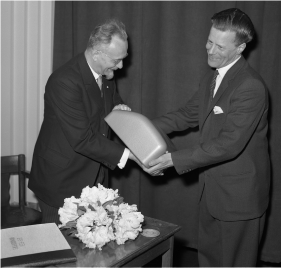
Figure 5
Farewell to the director of the municipal library, Dr. F.K.H. Kossmann (left); he receives a gift, presented by librarian C. Reedijk in 1958.
Citation: Erasmus Studies 44, 2 (2024) ; 10.1163/18749275-04402004
Photo by Ary Groeneveld. SAR 4121-1345-1Figure 6
Egbertus van Gulik, 1968
Citation: Erasmus Studies 44, 2 (2024) ; 10.1163/18749275-04402004
Photo by Ary Groeneveld. SAR 4121-11270Through the efforts of De Vreese, Rotterdam Public Library acquired a collection that enabled the library to establish itself as a research institute on Erasmus that flourished in the 1960s under his successors Cornelis Reedijk and Egbertus van Gulik, both distinguished Erasmus scholars. Reedijk was employed in 1945 as an employee in the public library. Kossmann had known Reedijk since he was a young boy and a friend of his two sons. When Reedijk was looking for a subject for his PhD research, Kossmann recommended him to work on a scholarly edition of Erasmus’ poems.50 As all the sources that he needed would be available in the Erasmus Collection, Reedijk took up this project, which resulted in what was, until ASD I-7 and CWE 85, the standard edition of this corpus: The poems of Desiderius Erasmus (Leiden: Brill, 1956). In 1953, he was appointed as the curator of the heritage collections of Rotterdam Public Library, followed by his appointment as director in 1958 as the successor of his patron Kossmann. Only a few years later, however, he left Rotterdam to become head of the Royal Library in The Hague.
Reedijk played an important role in creating an international impact for the Rotterdam collection. Under his directorship in 1960, the local historical society Roterodamum proposed to start preparations for a new critical edition of Erasmus’ oeuvre based on the many editions available in the Rotterdam collection. The municipality of Rotterdam, in cooperation with the Royal Netherlands Academy for Arts and Sciences, assembled a committee to establish an international organisation to realise this initiative. Reedijk was one of the committee members. On 6–8 December 1963, an international group of distinguished Erasmus scholars, amongst them Leon Halkin and Roger Mynors, gathered in Rotterdam. The group decided to establish the Conseil international pour l’édition des oeuvres complètes d’Érasme, and to publish the first volume of the Erasmi Opera Omnia—currently known as the ASD edition—in 1969, the commemoration year of Erasmus’ 500th birthday. During their stay in Rotterdam, the scholars visited the Public Library and its permanent exhibition on Erasmus.51 Reedijk became the first secretary of the Conseil, the organisation under whose auspices the work on the ASD edition is still carried out today. Since then, the Rotterdam Erasmus Collection has been an important source for scholars who worked on the extensive ASD project, as the ‘General Introduction’ to the series acknowledges: “It goes without saying that the best possible use was made of the matchless collection of Erasmiana in the City Library of Rotterdam”.52 During the 1960s, photocopies of essential editions that were not present in the Rotterdam collection were ordered, enabling researchers to continue to work from Rotterdam. These photocopies are still part of the collection today. In 1969, the first volume of the ASD was offered to Her Majesty Queen Juliana, and its publication celebrated in an international conference in Rotterdam from 27–29 October. Although Reedijk had left Rotterdam for The Hague at this point, he was closely involved in the organisation of the conference and, for example, acted as editor of the scholarly Actes du Congrès (1971). In many international publications and lectures, Reedijk showed himself a prominent Erasmus expert.
When Reedijk left the Rotterdam Public Library, another eminent Erasmus scholar was appointed to be in charge of the Erasmus Collection: Egbertus van Gulik. Van Gulik was a historian and had worked in different positions as a curator and librarian in a scholarly context, especially at Leiden University Library. By appointing a candidate of such a profile, the city of Rotterdam underscored the scholarly ambition of the Rotterdam Public Library. The fact that Van Gulik would be a member of the Conseil international from 1965 until 1989 shows his engagement with the Erasmus Collection from the start of his directorship. In this way, the Rotterdam Public Library continued to be directly involved in the ASD project. Van Gulik also started his own project: from 1964 onwards, he collected bibliographical information on every known edition of Erasmus. In many instances, he could make use of the Rotterdam Erasmus Collection, but he also included lots of information from numerous other collections worldwide. He deliberately collected all the information that he gathered through his international network of librarians in a card index system, currently known as the ‘Apparatus Van Gulik’, which is still kept in the Rotterdam Public Library as part of the Erasmus Collection. The ‘General Introduction’ to the ASD edition explicitly recognises Van Gulik’s bibliographical efforts: “[The Rotterdam City Library’s] chief librarian E. van Gulik, who later joined the Conseil, made a further contribution towards bibliographical efficiency by building up a union catalogue of Erasmian holdings in the principal libraries of the world.”53
Within Rotterdam, Van Gulik was involved in the organisation of the 1969 festivities commemorating Erasmus’ 500th birthday as a member of various committees working not only on the organisation of an international scholarly conference, but also a national convention and a comprehensive exhibition ‘Erasmus and his time’ in Museum Boijmans Van Beuningen, in which many early modern editions from the Erasmus Collection were shown.54 In 1973, Van Gulik decided to step back as director. This turned out to be an important turning point for the library: Van Gulik was the last director who was a book historical researcher himself. From now on, the Rotterdam Public Library entered an era in which knowledge of the heritage collections and organisation management became separate fields of expertise. Until his retirement in 1975, Van Gulik focused on the Erasmus Collection and his research on a reconstruction of Erasmus’ own private library as a part-time employee of the library.55 Van Gulik’s monograph was eventually published posthumously only in 2018 by the University of Toronto Press as Erasmus and his books (translated by J.C. Grayson, edited by James K. McConica and Johannes Trapman).
From the 1920s onwards, successive scholars who stood at the head of the Rotterdam Public Library developed the library not only into a flourishing facility for citizens to collect information and find modern reading materials, but also transformed it into a modern research institute based on the presence of an ever-growing Erasmus Collection. This development turned out to be a crucial step towards a third phase in the development of the collection, namely as heritage collection.
5 The Erasmus Collection as Heritage (1973–present)
After Van Gulik stepped back, the scholarly ambitions of the Erasmus Collection were no longer the focal point for the Rotterdam Public Library. Besides academic audiences, a new urgency arose to reach a broader audience, especially given the fact that the collection formed part of a public library. This change of focus is evident in the appointment of curators, in the funds made available and in the organised activities. While the shift itself seems closely related to Van Gulik’s decision to step back, the development of the collection since the 1970s should also be seen in the light of a more general change of vision with respect to heritage and a concern for preservation of archival collections. The 1970s witnessed a broad revaluation of the past and a sense of urgency to protect witnesses of the past from degradation and destruction, a development which inspired David Lowenthal to conceive his canonical The Past is a Foreign Country (1985), in which he traces how the past shapes our lives in different ways. A time of instability and insecurity, people in the 1970s and 1980s looked back to history to formulate their identity, according to Lowenthal.56 The establishment of the UNESCO Memory of the World programme in 1992 shows that the preservation of documentary heritage was increasingly considered important in the light of this identity formation.57
The new attention to the preservation of documentary heritage is also evident in the new storage facilities for vulnerable books in the Rotterdam Public Library. In 1983, the library had moved to another building that was newly built to facilitate a library organisation that had outgrown its early twentieth-century housing. The old collections were now placed together in a modern depot with climate control and became part of a new Special Collections department. This was an enormous improvement for the way in which the heritage collections were kept compared to the 1923 building in which the collections were scattered over various storerooms. Concerns about the material conditions of the books, however, continued to be voiced throughout the century, funding for restoration always being a problem. In the 1980s, some restoration work took place which was done by the binding department of the library itself. In 1986, forty restored books were exhibited in the public library to call attention to the 1,200 books that were in dire need of restoration. Jan Schollaart, who had worked as bookbinder for the Rotterdam Public Library since the age of fourteen, was worried about the future of the collection, especially because, at the age of 55, he did not yet have a successor: “I might be a nag, but if there are no restorers to tackle the 1,200 serious cases of the Erasmus collection, there will soon be little left to study for Erasmus experts.”58 From the 1990s onwards, various restoration projects have been carried out by external professionals, in the first place focused on the Erasmiana.
Figure 7
Boudewijn Büch and Van de Roer-Meyers in the Erasmus Collection
Citation: Erasmus Studies 44, 2 (2024) ; 10.1163/18749275-04402004
SAR, Collecties Bewegend Beeld THA, 2186Figure 8
Adrie van der Laan in the Erasmus Collection
Citation: Erasmus Studies 44, 2 (2024) ; 10.1163/18749275-04402004
Photo by Victor Wollaert, 2016From 1976 until 2004, the classicist Johanna (Han) van de Roer-Meyers worked as the curator of the Erasmus Collection. It was her job to facilitate research, to expand the collection, to catalogue acquisitions, and to present the collection to visitors and the general public. With only a small budget, Van de Roer-Meyers focused on making the collection accessible. For the broader public, she curated exhibitions such as Erasmus and bookprinting in 1976. The setup of this exhibition demonstrates the curator’s concern with the conservation of the collection, as the older works were all represented through photocopies: “I would be mad if I would lay those old, irreplaceable books in the displays. As long as I cannot secure them well, they remain downstairs.”59 Doing so, she started a new way in presenting the heritage collection, one that is still important today. Only recently in 2023, for example, the autograph letters by Erasmus were reproduced extremely accurately by hand as facsimiles to enable a more extensive use of these unique and vulnerable highlights from the collection. Besides curating exhibitions for a broader public, Van de Roer-Meyers increased the accessibility of the collection for more academic purposes. In 1982, she published a short-title catalogue of authors edited, translated or annotated by Erasmus in the Rotterdam collection, and in 1990 the general catalogue of the Erasmus Collection in the City Library of Rotterdam was published.60 Both of these works were strongly rooted in the work that Van Gulik had done in previous decades. His apparatus was digitised in the beginning of the twenty-first century by Van de Roer’s successor Adrie van der Laan (curator of the collection until 2019), another classicist. Today, the digitised apparatus is freely accessible online as the Erasmus Online database (EOL).61 That the Rotterdam collection still plays an important role for the ASD project in the twenty-first century shows the involvement of Van der Laan as a member of the editorial board as well as the Conseil International.
The exhibition room that had opened in the new library building in 1923 was still used in the same way in 1971, although Van Gulik mentions that the presentation at that point was old fashioned. A low visitors rate did not legitimise expenses for modernisation, he argued.62 Only five years later, the exhibition room would be used for other purposes, although there were still regular exhibitions about Erasmus on the first floor of the building.63 The way in which the Erasmiana and the other heritage collections were used as part of the library did not change until the first decade of the twenty-first century: the old books were positioned as beautiful treasures of the library, which were shown to the public in private visits, presentations, and expositions as impressive curiosities. This changed in 2016.
On 28 September 2016, His Majesty King Willem-Alexander opened the Erasmus Experience. This permanent and interactive exhibition challenges visitors at Rotterdam Public Library to discuss key topics relevant to present-day society in an innovative way derived from Erasmus’ life and works. Visitors are introduced to Erasmus and his world, and subsequently have to choose where they stand in various dilemmas: Is everyone free always to say whatever they want? Can you discuss everything openly by using humour? After having answered these questions, visitors are invited to compare their answers with Erasmus’ ideas on religion, tolerance, language, education, and peace. A digital application automatically starts a chat with Erasmus himself, to sharpen your mind even further. The contents of this concept highly relied upon the input of the collection’s curator Van der Laan. The exhibition, which is still freely accessible in the library, does not present the books of the Erasmus Collection in any traditional way: although the collection forms the background to the exhibition, the exhibition does not focus on the books themselves. The collection has been employed as a means to contribute to the general mission of the public library, which is to facilitate citizens in their personal growth. It not only focuses on visitors wondering at old treasures, but on deploying the old treasures for a modern, societal purpose. This is how Rotterdam Public Library intends to continue to position its heritage collections in the future.
A second development that influences the current position of the Erasmus Collection within Rotterdam Public Library is its recent addition to the international UNESCO Memory of the World Register (2023). Important arguments for granting this addition have been its unique assemblage of early Erasmiana, the way in which the collection has contributed to our knowledge on Erasmus in the twentieth century, and the ongoing scholarly value of the collection: “In this way, the collection stands at the basis of our current knowledge of the innovative way in which Erasmus laid the foundations for our society today.”64 The Memory of the World Programme formulates three aims: to facilitate preservation of the world’s documentary heritage, to enable universal access to documentary heritage worldwide, and to enhance public awareness about the significance of documentary heritage among the wider public.65 This creates the ethical obligation for the library not only to cherish and properly take care of the collection, but also to unlock it for researchers as well as the general public.
6 Conclusion
The origins of the Rotterdam Erasmus Collection have traditionally been considered in the context of the history of the Rotterdam Public Library from the seventeenth until the nineteenth centuries. It was not until the second half of the nineteenth century, however, that Rotterdam intentionally began to acquire early printed editions of Erasmus. From a part of the City Archive under user restrictions, the collection gradually became a growing source for scholarly research available to the public. Acquisitions in the first decades of the newly founded public library depended on donations by individuals and later on the ‘Friends of the Library’ Foundation. Library director Willem de Vreese, a book historian, hugely extended the collection, which would become the world’s largest during the 1920s and 1930s. At the same time, he professionalized the access to the collection by improving the cataloguing practice. Doing so, De Vreese laid the basis for the Erasmus Collection as one of the most important sources for Erasmian research in the twentieth century. In the twenty-first century, the function of the collection became less focused on an exclusive use for academic purposes. Although there had already been a long tradition of presenting the collection in exhibitions throughout the twentieth century, from 2016 onwards, Rotterdam Public Library truly started to focus on the broader public.
This recent positioning of the Erasmus Collection to play a role in the understanding and development of modern society fits the changing role of heritage in general. The UNESCO organisation is an influential forerunner in propagating the idea that heritage should be kept in order to be used. As such, the obligation of heritage institutions goes beyond preserving the objects for future users and has come to include presenting the objects for users and increasing their accessibility. Rotterdam Public Library has the ambition to strengthen its emphasis on deploying the collection in ways that may increase its societal value, starting from the idea of using Erasmus’ heritage to enable people to become active, critical and self-conscious world citizens.66 Keeping the Erasmus Collection safe for the future is a strong requirement to be able to do this. In this way, preservation is a precondition for presentation. At the same time, in the case of documentary heritage, presentation can have a negative influence on preservation targets. For this reason, a balance should be found between the two responsibilities for heritage collections. From this short history of the Erasmus Collection, it has also become evident that, where preservation becomes a pressing issue, technical reproductions are making it increasingly easy to continue to exhibit a heritage fund without damaging the objects. In the 1970s, Van de Roer-Meyers already made use of photocopies. Today, interactive screens present the contents of the Erasmus Collection. Due to these technical innovations, thousands of visitors—children and adults alike—can interact with the collection without any risks for the original objects. Future digital developments will only increase the possibilities to open up heritage collections safely to a broad public.67
Of course, the recourse to technical or mechanical reproductions brings up new questions. To speak with Walter Benjamin, “even the most perfect reproduction of a work of art is lacking in one element: its presence in time and space, its unique existence at the place where it happens to be.”68 A reproduction always lacks the authenticity, the aura of the original. While Benjamin focuses on art, we can extrapolate this to documentary heritage collections such as the Erasmus Collection. Even if the original objects in the collection may not seem to be unique because other copies are preserved elsewhere, each copy is unique because of its social life, to speak with Arjun Appadurai.69 Additionally, each object has its own material life: the specific material character of each copy from the same edition, for example, is constituted by elements such as reader’s traces, damage and binding, which has received prominent attention from cultural historians since the 1980s.70 The value of an object is thus constituted by what makes it unique—by its aura and materiality. The original handwritten letters in the Erasmus Collection have been very meticulously copied in facsimiles to give visitors a sense of authenticity. However, the facsimile was never touched by Erasmus, carried over long distances by a courier, or stored for centuries in a sequence of different repositories. As a consequence, it does not have the aura of the original, nor its authenticity. This example indicates how preservation and presentation always have to be weighed against each other in order to find a balance that will offer a satisfying result in terms of both objectives. For most visitors, the original document will not provide a deeper experience than the facsimile: they are primarily interested in getting a proper impression of early modern communication, the contents of Erasmus’ writing, or Erasmus’ signature. Only if a deeper understanding makes it necessary to see the original document, will it be of interest to provide this.
Today, heritage is closely connected to identity and in this sense, as we have seen above, the Erasmus Collection is related to what we consider to be “the foundations for our society today.” This connection is not just based on the objects themselves, bus also on the influential contents of the objects, and their relevance for current societal issues, which is reflected in the Erasmus Experience. The actual objects receive their value from their social and material lives. Together with the contents of Erasmus’ works, it is also in the history of his readership, in the acquisitions that make up the collection, and in our commitment to preserving and presenting the objects that carry his words, that we may trace how Erasmus and his heritage could lay the foundations for our society today.
“Erasmus Collectie van Bibliotheek Rotterdam,” Büch (VARA, 1987), Collecties Bewegend Beeld THA, Stadsarchief Rotterdam (Rotterdam City Archive, hereafter SAR).
Hugh A. Taylor, “The Collective Memory: Archives and Libraries as Heritage,” Archivaria, 1982, 118–130.
Judith Keyser, Gemeentebibliotheek Rotterdam, 1974–1994 (Rotterdam: Phoenix & Den Oudsten, 1994), 54–58. About the budget cuts of 1986–1989 see SAR 588-01 inv. no. 394.
“Erasmus Collection Rotterdam,” UNESCO, accessed June 21, 2024,
Abdelaziz Abid, “ ‘Memory of the World’: Preserving Our Documentary Heritage,” Museum International 49, no. 1 (1997): 40–45,
Thijs Weststeijn, De toekomst van het verleden: Erfgoed en klimaat (Amsterdam: Prometheus, 2023).
Athinodoros Chronis, “Heritage of the Senses: Collective Remembering as an Embodied Praxis,” Tourist Studies 6, no. 3 (December 2006): 267–296,
W.T.M. Frijhoff, “Herdenkingscultuur Tussen Erfgoed En Ritueel: De Verleiding van Het Presentisme,” Jaarboek Voor Liturgie Onderzoek, no. 28 (2012): 169–182.
J.J.M. van de Roer-Meyers, “De Erasmuscollectie van de Gemeentebibliotheek Rotterdam,” Rotterdamsch Jaarboekje, 1985, 259–265; Els Meeldijk, De gemeentebibliotheek te Rotterdam, 1858–1974, Historische werken over Rotterdam. Kleine reeks, nr. 30 (Schiedam: Interbook International, 1977); Christiane Minter, “Die Gemeindebibliothek Rotterdam,” Bibliothek Forschung und Praxis 15, no. 2 (1991): 234–259,
Paul Schneiders, Nederlandse bibliotheekgeschiedenis: van librije tot virtuele bibliotheek (The Hague: NBLC, 1997).
Leendert Brummel, “Een Stiefkind Der Geschiedenis: Bibliotheekgeschiedenis,” in Miscellanea Libraria. Opstellen over Boek-En Bibliotheekwezen Ter Gelegenheid van Zijn 60e Verjaardag Aan de Schrijver Aangeboden Door Vakgenoten En Vrienden (The Hague: Nijhoff, 1957), 64–80; Hannie van Goinga, “Hoezo stiefkind? Bibliotheekgeschiedenis als cultuurgeschiedenis,” Jaarboek voor Nederlandse Boekgeschiedenis 10 (2003): 209–219; Wayne A. Wiegand, Part of Our Lives: A People’s History of the American Public Library (Oxford University Press, 2015).
Peter Burke, What Is the History of Knowledge?, What Is History? (Cambridge: Polity, 2016), 52–53.
Robert Darnton, “What Is the History of Books?” Daedalus, 1982, 65–83; Marlene Manoff, “Archive and Library,” in Oxford Research Encyclopedia of Literature, 2019,
Van de Roer-Meyers, “De Erasmuscollectie van de Gemeentebibliotheek Rotterdam”; Adrie van der Laan, “De Erasmuscollectie van de Gemeentebibliotheek Rotterdam,” in Historische stadsbibliotheken in Nederland: studies over openbare stadsbibliotheken in de Noordelijke Nederlanden vanaf circa 1560 tot 1800, ed. Ad Leerintveld and J.C. Bedaux, Bijdragen tot de geschiedenis van de Nederlandse boekhandel 18 (Zutphen: Walburg Pers, 2016), 73–81.
Johannes Clarisse, Catalogus librorum, quos complectitur Bibliotheca Publica, ad ædem S. Laurentii, Roterodami (excudebat Jacobus van Baalen, 1814).
Keyser, Gemeentebibliotheek Rotterdam, 1974–1994, 7.
SAR 297-01 inv. no. 18, 1868, p. 14: ‘de verzameling gedrukte werken van en over Desiderius Erasmus’; 1879, p. 5; 1888 p. 9.
SAR 558-01 inv. no. 60; Keyser, Gemeentebibliotheek Rotterdam, 1974–1994, 68–69.
Unfortunately, this catalogue cannot be traced anymore so we do not know the exact contents of the collection. SAR 297-01 inv. no. 18, 1879.
B. Maandag, BIEB. Bibliotheek En Rotterdam (Rotterdam: Stad en Bedrijf, 2023), 103.
SAR 297-01 inv. no. 18.
Rotterdam Public Library, Special Collections, Year report 1907, p. 1. G.A. van Riemsdijk, Van de Beginjaren Tot Mei 1940, Geschiedenis van de Openbare Bibliotheek in Nederland 1 (Den Haag: NBLC, 1978), 35 shows that the Rotterdam library budget surpassed that of the other six cities with a public library in 1909.
B. de Vries, Een Stad Vol Lezers. Leescultuur in Haarlem 1850–1920 (Nijmegen: Vantilt, 2011), for example, provides an image of the vivid nineteenth-century reading culture in the city of Haarlem. See also: M. Mathijsen, L. De Lezer van de 19de Eeuw (Amsterdam: Balans, 2021).
Paul Schneiders, Lezen Voor Iedereen. Geschiedenis van de Openbare Bibliotheek in Nederland (Den Haag: NBLC, 1990), 59.
“De O.L. [Openbare Leeszaal] speelt een rol in het maatschappelijk leven. Zij moet die boeken beschikbaar stellen, die voor allerlei soorten van mensen van belang zijn. […] Sterk komt bij het geven van inlichtingen het paedagogies karakter van de O.L. uit; in veel gevallen weten de bezoekers niet hoe ze moeten zoeken, dikwels staat hun niet eens duidelijk voor de geest, wat zij willen lezen. […] Door dit alles komen wij tot de konklusie dat voor O.L.-ambtenaren voor alles beschaving nodig is.” Cited from Van Riemsdijk, Van de Beginjaren Tot Mei 1940, 28.
Meeldijk, De gemeentebibliotheek te Rotterdam, 1858–1974, 31.
Frans Grijzenhout, “Inleiding,” in Erfgoed: De geschiedenis van een begrip, ed. Frans Grijzenhout (Amsterdam University Press, 2009), 5.
Taylor, “The Collective Memory.”
Rotterdam Public Library, Special Collections, Year report 1918, pp. 5–6.
SAR 297-01 inv. no. 498.
SAR 62, inv. nos. 508, 758–768.
N. van der Blom, “650 Jaar in Vogelvlucht,” in Grepen Uit de Geschiedenis van Het Erasmiaans Gymnasium 1328–1978 (Rotterdam: W. Backhuys, 1978), 28.
Thomas Nolen, “Levensbericht van Johannes Benedictus Kan,” Jaarboek van de Maatschappij der Nederlandse Letterkunde, 1903, 262–296; N. van der Blom, “Rector, Schoolhistoricus, ‘Vir Erasmianus,’ ” in Grepen Uit de Geschiedenis van Het Erasmiaans Gymnasium 1328–1978 (Rotterdam: W. Backhuys, 1978), 165–181.
Abm. van der Hoeven, “Ter Herinnering Aan C. van Ommeren,” in Catalogus van de Bibliotheek van Wijlen Den Heer C. van Ommeren, Conservator van de “Atlas van Stolk” Rotterdam (Utrecht: A.J. van Huffel’s antiquariaat, 1935), 3–5; J.F. Heijbroek, “De Atlas van Stolk. Enkele Facetten Uit de 150-Jarige Geschiedenis,” De Boekenwereld 3 (1986): 74–78.
Catalogus van de Bibliotheek van Wijlen Den Heer C. van Ommeren, Conservator van de “Atlas van Stolk” Rotterdam (Utrecht: A.J. van Huffel’s antiquariaat, 1935).
Cf. A. Bouwman, “Op Expeditie Langs Europese Bibliotheken. Willem de Vreese En de Middelnederlandse Handschriften,” De Boekenwereld 4 (2012): 18–25; P.J.H. Vermeeren, “De Bibliotheca Neerlandica Manuscripta van Willem de Vreese” (PhD Thesis, University of Amsterdam, 1953).
J.A.A.M. Biemans, “Willem de Vreese: Een Vlaming in de Maasstad,” Rotterdams Jaarboekje, 1991, 411–14; see also: R. Roemans, Het Werk En de Betekenis van Prof. Dr. Willem de Vreese (Antwerpen: De Vlijt, 1950).
Rotterdam Public Library, Special Collections, ‘Notulen van de Vergaderingen der Commissie voor de Bibliotheek en Leeszalen der Gemeente Rotterdam’, 25-6-1919, p. 253.
Leiden University Library, BPL 2998, J.A. Vor der Hake to J.W. Muller, 7 May 1919, “iemand die van een universiteitsbibliotheek komt is daardoor reeds ongeschikt voor een bibliotheek als de Rotterdamse, die in ’t volle leven staat, die bedoelt sociaal-pedagogies te werken, waar men haast nog meer met mensen dan met boeken in aanraking komt, die het leven van Rotterdam wil beïnvloeden, leiden. Wanneer de toekomstige leider van de Rotterdamse bibliotheek zich verbeeldt—en ook wenst—dat hij in de bibliotheek ook enige uren of een groot deel van de dag kan studeren—laat hij dan maar niet solliciteren—want: daarvan kan geen sprake zijn. Zijn taak is: leiding geven, nieuwe mogelikheden bedenken, altijd klaar staan om nieuwe moeielikheden te overwinnen enz.”
These ‘journals’ from 1919–1933 are kept by Rotterdam Public Library as part of the Special Collections; John Tholen, “Achter de Schermen van de Gemeentebibliotheek. De Journalen van Willem de Vreese,” De Boekenwereld 40 (2024): 38–43.
Rotterdam Public Library, Special Collections, Year report 1919, p. 8: “een renteloos, dood kapitaal”.
F. Kossmann, Overzicht van de werken en uitgaven van Desiderius Erasmus aanwezig in de bibliotheek der Gemeente Rotterdam. (Rotterdam: Bibliotheek der Gemeente, 1936), 3–4; all acquisitions by De Vreese have been documented in detail in the year reports 1920–1935, which also mention donors of books, although without specifying who donated which books (Willem de Vreese, Bibliotheek en Leeszalen der Gemeente Rotterdam. Verslag over het jaar 1920-Verslag over het jaar 1935; Rotterdam Public Library, Special Collections, Year reports); SAR 588-01 inv. no. 115.
SAR 588-01 inv. no. 250. Letter to D.H. Kolff (Erasmus Foundation) of 14 February 1927; letter to E. van Rijckevorssel, 22 December 1925. See also “De Nieuwe Gemeentebibliotheek,” Nieuwe Rotterdamsche Courant, September 13, 1923, Ochtend edition, 2, in which the collection of Erasmiana is called “a hobby of the librarian”.
SAR 588-01 inv. no. 250.
SAR 588-01 inv. no. 251; “Fraaie Geschenken Voor de Gemeente-Bibliotheek,” Het Vrije Volk: Democratisch-Socialistisch Dagblad, June 25, 1949, Dag edition,
SAR, 588-01 inv. no. 292.
Bibliotheek der Gemeente Rotterdam, Catalogus van geschriften over leven en werken van Desiderius Erasmus aanwezig in de bibliotheek der Gemeente Rotterdam, Catalogus van de bibliotheek der Gemeente Rotterdam, lijst 133 (Rotterdam: Bibliotheek der Gemeente, 1936).
“Gemeentebibliotheek 1907–1937,” Rotterdamsch Nieuwsblad, February 16, 1937, Dag edition.
“Erasmiana-Tentoonstelling,” Het Rotterdamsch Parool, February 4, 1949, Dag edition.
W.R.H. Koops, “Cornelis Reedijk. Rotterdam 1 April 1921—Zeist 7 Mei 2000,” Jaarboek van de Maatschappij Der Nederlandse Letterkunde, 2003, 191.
Els Meeldijk, “Egbertus van Gulik. Hoorn 21 Juli 1910—Oegstgeest 8 Oktober 1998,” Jaarboek van de Maatschappij Der Nederlandse Letterkunde, 2001, 85.; see also ASD I-1: xv–xvi.
ASD I-1: xvi.
ASD I-1: xvi.
See the exhibition catalogue: J. Besse, Erasmus en zijn tijd: tentoonstelling ingericht ter herdenking van de geboorte, 500 jaar geleden, van Erasmus te Rotterdam in de nacht van 27 op 28 oktober (Rotterdam: Museum Boymans-van Beuningen, 1969).
Meeldijk, “Egbertus van Gulik. Hoorn 21 Juli 1910—Oegstgeest 8 Oktober 1998,” 87.
David Lowenthal, The Past Is a Foreign Country—Revisited (Cambridge: Cambridge University Press, 2015), 4–5.
Ray Edmondson, “Memory of the World: An Introduction,” in The UNESCO Memory of the World Programme: Key Aspects and Recent Developments, ed. Ray Edmondson, Lothar Jordan, and Anca Claudia Prodan (Cham: Springer International Publishing, 2020), 19–29.
“Twee Mensen Beheren Erasmusboeken. Restaurator Schollaart: ‘Ik ’n Zeiknest? Dat Moet!,’ ” Het Vrije Volk: Democratisch-Socialistisch Dagblad, November 6, 1986, Dag edition.
“Ik zal … wel gek zijn om die oude, onvervangbare boeken daar in de vitrines te leggen. Zolang ik ze niet goed kan beveiligen, blijven ze beneden”, in Jan Meijer, “Echte Erasmus Blijft Veilig in de Kelder,” Het Vrije Volk: Democratisch-Socialistisch Dagblad, August 12, 1976, sec. Interlokaal.
Johanna Jacoba Maria Meijers, Authors edited, translated or annotated by Desiderius Erasmus: a short-title catalogue of the works in the city library of Rotterdam (Rotterdam: Gemeentebibliotheek, 1982).
SAR 588-01 inv. no. 445: Van Gulik, ‘Nota over de Erasmusverzameling’ (1971), p. 5.
“Erasmus in Gemeentebibliotheek,” Het Vrije Volk: Democratisch-Socialistisch Dagblad, April 5, 1976, Dag edition.
Rotterdam Public Library, Meerjarenbeleidsplan 2025–2028 [multi-annual policy plan] (Rotterdam, 2024), p. 14.
Universities are more and more engaged in this development of the future library, see for example the Future Libraries Lab of TU Delft (Delft University of Technology):
Walter Benjamin, “The Work of Art in the Age of Mechanical Reproduction,” in Illuminations, ed. Hannah Arendt, trans. Harry Zohn (New York: Schocken Books, 2007), 220.
Arjun Appadurai, “Introduction: Commodities and the Politics of Value,” in The Social Life of Things: Commodities in Cultural Perspective, ed. Arjun Appadurai (Cambridge: Cambridge University Press, 1986), 3–63.
Peter Burke, What Is Cultural History? (Cambridge: Polity, 2004), 69–70.