Abstract
Lived Catholicism proposes a new way to study being Catholic. Through a focus on individual experiences and practices, it seeks to unpack ‘what sorts of people those who are baptised Catholic are becoming through their ordinary practices’.1 Although many studies of Catholicism tell us what Catholics practice and believe, far fewer tell us why. This study of the Lived Catholicism of teenagers in the UK will explore what motivates them to go to Mass, how the Mass going relates to their wider Catholicity, and the surprising gaps that emerge. Connecting these experiences to those of previous generations shows how the methods of Lived Catholicism can begin to answer questions not previously asked.
Introduction
The Mass and the doctrine of the Eucharist are two of the most significant tenets of the Catholic faith. The Catechism of the Catholic Church says: ‘The Eucharist is the heart and the summit of the Church’s life’ (1407) and it still is a doctrine of the Church that failing to attend Mass on a Sunday is a mortal sin.2 The Church itself asks every parish to count Mass attendance through the Sundays in October and send them in to be compiled into a world-wide picture. Much is written on the declining rates of Mass attendance in the West, from newspaper articles to scholarly books.3 This is not least because Catholics themselves place a high value on Mass attendance. If you want your child to attend a Catholic school in the UK, Sunday Mass-going will often be a criteria.4 However, you do not have to prove what you believe. Beneath the assumptions lie a wide variety of attitudes. Peter McGrail recorded two very different approaches towards Mass-going in First Communion programmes in parishes in Liverpool: ‘for priest and catechists (and some families) First Communion is the beginning of regular practice of weekly receiving communion. Whereas for many of the families, this was a generational practice: you had to make your First Communion to be a Catholic, but the First Communion was an end to itself.’ 5
Are Catholics right to be so concerned about the importance of weekly Sunday practice? The research would seem to bear this out. Hoge et al’s study of Catholic young adults found that those who were regular Mass attenders rated every item of faith as more essential than non-regular Mass attenders.6 In Ben Clement’s study of British adult Catholics, of those that said that the Church was the most important or one of the most important elements of their life, 72% were weekly attenders.7 Pew Research concluded that while, overall only a third of Catholics believe that the Eucharist is the Body and Blood of Christ, the rate among weekly Mass attenders was 63%.8 These findings consistently connect weekly practice with higher levels of orthodoxy, correlating salience with belief. Given that weekly Mass attendance has been falling every year for decades in the West, it is particularly important to understand why Catholics go to Mass. What motivates them and what hinders them?
In this special edition of Ecclesial Practices, Lived Catholicism offers an alternative approach to such difficult questions. Drawing on Lived Religion, it focusses on an ethnographical exploration of the everyday experiences of people, seeking to understand what part Catholicism plays in people’s wider meaning-making. From this perspective, Mass-going is not assessed against a norm of weekly practice, it is just part of that person’s life, however it manifests. Lived Catholicism is more interested in the motivations behind people’s actions, than in counting those actions themselves (it can never operate on a scale which allows for statistical comparison). Drawing on studies of practice and belief among nones (the religiously unaffiliated) it seeks to find traces of Catholicity outside institutional engagement.9 Following Ammerman’s call for Lived Religion not just to examine everyday practices, it also explores what institutional engagement looks like on a personal basis.10
This article asks whether Lived Catholicism can add anything to the knowledge we have about being Catholic. It explores Mass-going among young people, sketching out the variety of their experiences. Looking beyond the theological motivations of duty and Eucharist, a new light is shone on the importance of family, community and a negotiated spirituality.
Methodology
Fieldwork with young people is complicated, while fieldwork with young people regarding religion is even more fraught. There are issues of access, safeguarding, power, consent, gatekeepers and much more. Of even greater concern is the quality of the data. Most young Catholics in the UK have spent some time in Catholic schools. If they are in a Catholic secondary school, gcse Religious Studies is mandatory. This creates a very strong normative pull towards getting answers right. My concern was to craft a method that would, as much as possible, allow young people to speak for themselves. Following examples drawn from lived and material religion, I started to look for a broadly ethnographical approach.11 There was much to draw on. In particular, Lois Lee’s work tracked the lived practices of atheists. Abby Day intentionally crafted interview questions that spoke around subjects of belief and worldview without mentioning religion. Ward and Dunlop took a visual ethnographic approach with Polish migrants.12 In each project, participants were able to construct their own meaning from the practices and objects around them, imbuing them with family, cultural and religious meaning that was both personal and recognisable.
Difficulties in studying Catholicism were also matched by difficulties in studying young people. As a practitioner, I knew that young people were interested in discussing religion, but I in a school setting, there would be negative social implications in expressing such an interest.13 Outside school settings, the issue was how to find the young people in the first place. I wanted to study a mixture of engaged and disengaged young people who were in Catholic education, and also young people not in Catholic schools. This meant finding a method that could be replicated within a school timetable and that would maintain its informal nature even in a formal setting. Ethically, young people cannot be compelled to participate (as when teachers ask whole classes to complete a survey) and so the research instrument had to be interesting, capable of attracting volunteers as advertised in a five-minute slot at an assembly or at the end of Mass. The research also had to receive ethical clearance, encompassing a range of eventualities such as the young people withdrawing part-way through, or a potential abuse disclosure. Even receiving completed consent forms would be problematic.14 Engaging the young people as co-researchers interested me the most, as it seemed to offer a broad range of possibilities.15
After much research, I felt that a visual ethnographic approach would bear the most fruit. Drawing on Dunlop’s research with Polish young people, I constructed the following sequence:
- –Initial focus group with participatory mapping asking them to jot down whatever came into their head when they thought of the word ‘Catholic’.
- –Discussion on taking good photos, along with discussion of consent and further use of images
- –A week’s gap for participants to take photos on the theme ‘This is Catholic’
- –Interview based around the photos taken
- –Focus group to look at all the photos taken
- –Exhibition of chosen photos from all the groups.
In practice, while there were glitches (the young people forgetting to send me their photos being a key one), this proved to be a rich methodology. The young people shared thoughtful and beautiful pictures, telling me stories of their families, friends, key events of their lives, and some of the major difficulties that they had overcome.
Sample
Often Mass attendance is used by sociologists as a one of a suite of data to create typologies, for example Hornsby-Smith’s ‘core’ and ‘customary’ Catholics, or Christian Smith’s five-fold typology.16 At the beginning of my study I set out to capture three groups of young people – with low, mid and high religiosity – and looked for three different settings where I could find these groups: school, parish and diocesan retreat. In reality, the groups were much more diverse than I had anticipated. There were twenty-five young people in total, aged mostly 16–18, although a few were younger. Eight were boys (the imbalance due to the school groups being entirely female. Other groups were mixed.). Just over half were first generation immigrants. The retreat group had the highest number of young people who did not pray or go to Mass regularly, and the school group had young people who not only went to Mass weekly, but said the rosary on the bus on the way to school. There were weekly Mass-goers who never prayed, those who prayed daily who rarely went to Mass, and even a non-Catholic who was a devoted Mass-goer. One of the young people most committed to their parish community in service was only 50/50 convinced about the existence of God. It took some time for me to realise that this diversity was not so much representative of my failures as a researcher, as of the failures of the religiosity categories themselves.
Mass-Going Habits
Although Mass clearly featured in many of my participants’ lives, in general, they hardly spoke of it. It arose in the participatory mapping exercise when they were asked to write down anything they thought of connected with the word ‘Catholic’, and then in the focus groups, but hardly at all in the interviews or final groups. When they spoke of what they might do differently into the future, it might include a range of options such as adoration, daily office, confession (this particularly among the Summer Camp participants) but rarely going to Mass. Why was this so? There are a few possibilities. Perhaps Mass is the unspoken core of Catholic identity? Is it so obvious a theme that it went unmentioned? Alternatively, perhaps Mass is as peripheral to these young people as the data would suggest. Through the data, the themes develop from institutional understandings of Catholicism to a more personal, affective view in which community, peers and nature come to the fore. This article sets out to explore what part the Mass played in the lives of young people through the lenses of practice, motivation and agency.
A post-pandemic note: prior to March 2020, weekly Mass-going would have been in person on a Sunday.
Practices
Interviewer: Would you have a routine to faith stuff, or would it be more as and when?
Michael: At the moment, I wouldn’t have, I think it’s just going to church on Sunday and that’s about it. That’s why my relationship with God isn’t, wasn’t that really good, it wasn’t that really close.18
In the past, Catholics went to Mass in part at least because of a sense of duty and obligation. There was no mention of either word by my participants. There was no mention of the Church’s teaching that missing Sunday Mass is a mortal sin, in fact there was not much awareness that Catholics are supposed to go to Mass every Sunday.19 Without mention of this traditional motivation, what was bringing these young people to church?
Motivations
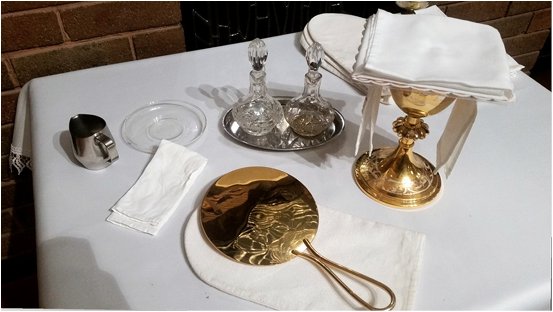
Again, this is how we have to lay it out on the altar and everything, but it’s also one of the key moments of Mass where the transubstantiation happens, and holy communion, so… And then obviously praying, erm…22

Marzena: A credence table laid out for Mass.
Citation: Ecclesial Practices 9, 1 (2022) ; 10.1163/22144471-bja10035
Natasha: And the communion is, because the Eucharist that you take every Mass.
Interviewer: Excellent. And is the communion important?
Natasha: Well, yes, because it’s the Body of Jesus <uncertainly>.23
But for me, I have to feel the faith to be actually part of it, because, if you take the Eucharist, you take the body of Christ, and you don’t believe it, it doesn’t help you, personally.24
My mum, she’s like, if you pray at home, if you read your Bible, just do it that way, if I don’t want to, because it doesn’t change I guess, I mean the Eucharist, that’s the most important thing, but at the same time, whether I go..or not.25
Whatever her ability to express traditional Catholic theology, the notion of Eucharist is not motivating her to go to church on a Sunday. For neither participant is Eucharist connected with a spiritual experience, nor linked to a personal experience of Jesus, as described by Harris’ participants several decades before. It is clear that whatever the Church teaches, the Eucharist is not motivating this group of young people to go to Mass. What else might be behind their practice?
Family
Becca: I feel like because we’ve been going to church every week, and Dad’s been bringing us since we were really little…
Immie: I remember when I was really, really small, just coming to church.
Becca: I don’t remember not ever coming to church. 26
Interviewer:Sure. And, erm, do you go to church on Sundays?
Tom: Sometimes…
Interviewer: Not so much? <laughter>
And do your family go?
Tom: Er, sometimes as well. Like, I go with them if they go.27
Whenever the decline in Mass attendance started, it was not with this generation. They reflect the practice of their parents.
Sarah: I think I’m just always going to be Catholic, but whether I go to church more often or not, I don’t really know. It depends on where I go in life.28
it’s just that whenever I go to church it makes me feel a little bit better. So hopefully when I’m older, I’m obviously going to teach my children and take them to church. Like she said, I won’t be going to church like every week, cos I’m going to have, like, a lot of studying to do when I’m going to uni, but if not, then I’ll put time in. But yeah, I won’t leave being Catholic.29
Interviewer: What helps you stay Catholic, do you think?
Kasha: I think like, I think school does, and the way they do Mass and stuff. Cos to be honest I don’t really go, out of school, but I feel less bad cos I do it during school. <laughter> So I’m like, ah it’s fine, at least I was there like a couple of weeks ago when we did it for St Cecilia or whatever. So yeah, I feel a bit less bad for not going outside. <laughs>30
But some could argue that, erm, being a good Catholic would be attending church, saying your prayers, looking after people who are in need, but, in the end it comes down to less what you’re doing outwardly, and more what you’re believing internally.31
Community
Interviewer: Makes you feel… how does it make you feel, church?
Red: It makes me feel like I belong to somewhere, I belong somewhere. That… that you’ve got a reason to be there.33
Nancy: so when I like go to church, I think of all of us as a community, like, we’re all together, we’re all praying, we’re all believing in the same beliefs.34
Interviewer: what did you put? <for the mapping exercise>
Marianna: Discipline, because I think being Catholic is all about the way of life, and how you respect others and how you present yourself. And communion because it’s a united community.35
And I wrote church-goer, because even if you don’t go every week, people still go to church and celebrate stuff together.36
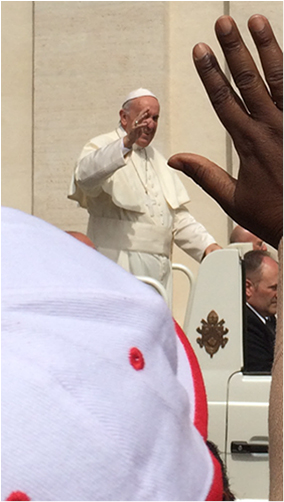
And when I went to see the Pope, when there were thousands of us there, that showed how big faith, how important it is.37
Sean: Pope Francis greets worshippers in St Peter’s Square.
Citation: Ecclesial Practices 9, 1 (2022) ; 10.1163/22144471-bja10035
Agency
Interviewer: Do you see Catholic friends on a Sunday?
Patrick: Well, only for Mass and it’s like, they go off and they go out and do something, and then I have to go back home because I don’t live in the same area. It takes me about 30–45 minutes to get to church.
Interviewer: So you’re still going back to your own church?
Patrick: I’m still going back our old church because it’s really the only one that me and my mum feel comfortable going to because it’s the church we’ve been at pretty much all of our lives.38
Interviewer: You feel like your faith helped you through your exams?
Nancy: It has, no, it definitely did, because, on gcse days, I was like, Mom, we need to go church, in the morning, I think I went to church in the morning, and like I’d do that, and after gcse s I would just stop, we need to go after, I can’t do this all the time! 39
Like, I won’t say every Sunday, but like sometimes I feel a little bit closer to God, after church on a Sunday, for some reason it just shocks me like, my mum was like, do you have that spiritual feeling inside and I was like yeah, and it’s weird, and I don’t know how to explain it…40
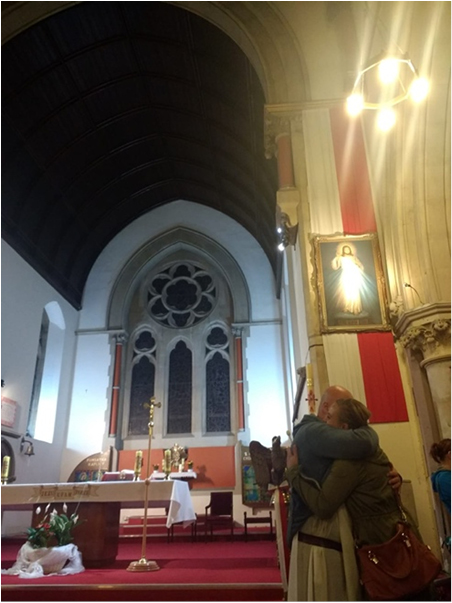
Natasha: there’s photos of the congregation, people, and Mass, and it just felt really, it just felt like a community, because sometimes it just doesn’t, so it was really lovely to experience it.
Interviewer: It doesn’t, at your normal Sunday Mass?
Natasha: Erm, I feel like it’s more traditional, it’s more like stricter in like, it’s the word, and you’re meant to respect it, but he talks about it in a very, just like a friendly way, he’s not like distant, you feel close to your faith. And songs that we sang weren’t the traditional ones, we got to like clap along and it was really engaging <laughs> I don’t know.41
Natasha: Fr Adam greeting a member of the congregation.
Citation: Ecclesial Practices 9, 1 (2022) ; 10.1163/22144471-bja10035
Becca: And I’ve learned more, I’ve learned interesting things and I’ve met new people and that’s just led to new opportunities and I can go with my dad and stuff. But then… Sometimes I do debate, am I just doing this to make my parents proud? Am I just doing it because, oh, I said I’d help with my dad, and now I’m like, I’m too pretty afraid. But I don’t feel that. But my brain’s still kind of mixed up with…have I chosen this, am I doing the right thing, are my parents like…making me do it. I don’t know.42
But I realised that I do enjoy it, and obviously I didn’t have to sit next to my dad <laughs> and in general it kind of opened me to a whole new world of just worshipping God because obviously I, I’m closer to the priest in the way that I’m actually talking to him about religion, he teaches me all the symbols of why do we do everything at Mass, why we say certain prayers, and that did open my eyes a bit more, especially when I was growing up as well, it made me actually think about it more and question it, and kind of kept me together when other people may have went off the religion.43
Embedded within these accounts are a range of ways in which young people are negotiating Mass-going within their sense of self. Here we can see Mass-going becoming a source of faith, learning, personal satisfaction and even social capital (Figure 3). This is a long way from the first description we heard of Mass as being insufficient for growing a personal relationship with God.
Discussion
This article set out to explore what part the Mass played in the lives of young people through the lenses of practice, motivation and agency. In contrast to large-scale surveys, a Lived Catholicism approach is able to provide context for participants’ practices, looking beyond traditional Catholic teaching of a Sunday obligation or piety connected to the Eucharist. Frequency of Mass-going was prompted by family practice, although this was mostly pragmatic: ‘I go when they go’. Community, on the other hand, was special to them. Mass-going provided a place where they belonged, a meaningful action undertaken with others. They conflated the words communion and community. By listening to the meaning-making of the young people themselves, it can be seen that some of the participants were able to craft Mass-going as a resource for the challenges of their teenage lives, providing friendship, social capital and a relief to exam stress. It also provided real spiritual encounters.
However, the surprising gap which emerged in the research has to be accounted for. The Eucharist, “source and summit” of the Catholic faith, is not overtly present.44 To what extent is this a generational change, and if it is not new, why has it gone without comment to date? One answer can be found in secularisation theory, in which religious discourse becomes weakened from generation to generation. In this study, however, the young people’s Mass-going mirrored that of their parents. Alternatively, perhaps the Eucharist is not at the heart of the Catholic faith in the way that the Institution would like it to be. By looking at other accounts of Catholicity, it may be possible to discern previous attitudes to the Eucharist. This raises questions as to the extent that this has been in the data all along.
It is important to note that research into attitudes to the Eucharist occur only rarely in the literature. It is easier to quantify church attendance than to try and probe the myriad different ways in which Catholics think about communion. Hoge et al conducted research about the essential elements of the Catholic faith including the Eucharist, and states ‘We have never seen research on Catholics which asked questions like these.’ 45 The Eucharist (or equivalent term) does not occur in the index of Michele Dillon’s profile of Catholic Identity (1999), nor in Jerome Baggett’s Sense of the Faithful (2008). It is only mentioned briefly in Christian Smith’s comprehensive Young Catholic Adults (2014). It does not appear at all in Linda Woodhead’s article: ‘New Poll: ‘Faithful Catholics’ an Endangered Species’ (2013).46 It seems as if it is not just the Catholic Church that presumes that Mass attendance equals institutional belief.
When they do refer to it, researchers take one of two approaches. For some scholars, participants who express standard Catholic doctrine in this area are examples of particularly devout behaviour. For Christian Smith, Tommy was the closest any participant came to the ‘devout’ category. Exemplifying this, he writes ‘Tommy also believes completely in the traditional doctrine of transubstantiation… and stands firm on this position, even when we probe him about it.’ 47 In Hoge’s aforementioned list of the nineteen elements essential to the Catholic faith, ‘Belief that Christ is really present in the Eucharist’ was ranked fourth in terms of priority. Greeley, reflecting on this then theorises that the list shows that ‘whatever the alienation of young people may be on some items of Catholic teaching, their imagination is still Catholic.’ 48
This hopeful picture is not seen elsewhere. The alternative response is to present the results as divergent from the norm, as we see in the title of the 2019 Pew Research on this subject: ‘Just one-third of U.S. Catholics agree with their church that Eucharist is body, blood of Christ’. Rymarz and Graham, studying committed young Australian Catholics, find only naturalistic views on the Eucharist, describing the Mass as a ‘community event’.49 Fulton, in describing his core and intermediate Catholics, notes that ‘only a few have any sense of an encounter with Christ on reception of Communion. I probed continually on the matter and found little sense of real eucharistic presence or of communion with Christ.’ 50 Hornsby-Smith, researching Roman Catholics in England in the early 1980s, used the statement ‘at the consecration the bread and wine are really changed into the Body and Blood of Christ’ as the definitive statement of orthodoxy. Nonetheless, as far back as the 1970s, he was also finding significant levels of disagreement over the Eucharist. 51 Once again this is passed over as deviation from the norm, and not of significance.
In this brief outline, it is clear that scholars have not often questioned the Eucharistic views of their participants. Sometimes the question is asked in survey form, where it is difficult to know whether participants are answering what they believe, or, from Catholic schooling, what they know to be the right option. When the research method is interview-based, the Eucharist is rarely spoken of. Yet because the normative force of Catholicism is so strong, the assumption seems to be that views that disagree with official church teaching are anomalous or straightforwardly incorrect, and therefore not of interest. Lived Catholicism focusses on the everyday experience of participants. It resists thinking in terms of orthodoxy or anomaly. With this approach it is possible to see the absence of Eucharistic thinking among my participants as mainstream. What if Catholics have not thought in terms of orthodox Eucharistic theology for decades? Smith writes, ‘Whatever religious decline that may have happened must have taken place before the 1970s…The crucial historical changes took place not between today’s emerging adults and their parents’ generation, but rather between today’s emerging adults’ parents’ generation and the generation preceding them.’ 52 This raises a further question. Who names the norm, and what happens when this diverges radically from the institution? Returning to Peter McGrail’s research on First Communion, there is an institutional approach, which would regard the ceremony as the beginning of a lifetime of receiving communion; and an anomalous approach, in which First Communion is an end in itself. Analysing the gap in Eucharistic understanding among Catholics might suggest a similar binary. But if the institutional understanding of the Eucharist is not widespread, which is normative?
Conclusion
In conclusion, when asking the question why young people go to Mass, we have to look beyond the expected motivations of obligation and devotion to the Eucharist. Rather than a linear range of high to low religiosity we have a collection of different practices and attitudes which relates as much to Mass-going as to other aspects of their lives. What is sacred to young people in this project is not so much the prayers and rituals of Mass, as the community gathered. These are family practices with young people replicating the Mass-going of their parents, whether this be every week or only a few times a year. Salience comes through a sense of choice and personal experience and particularly in connecting with other people, motivating participants to keep on attending through adolescence. However, very few of the young people in the study (and remember that these are really practicing young people) spoke about a central tenet of Catholic faith: Jesus really present in the Eucharist.
…the greatest treasure is, of course, the sacramental life of the Church, and, pre-eminently, the Eucharist. It is the Eucharist, the celebration of the Mass, that makes the Church; and it is the Church, in the gift of the Holy Spirit, which makes the Eucharist. The Holy Sacrifice of the Mass is the lifeblood of the Church.53
What does it mean for the Church if young people do not feel the same?
Tom Beaudoin and J. Patrick Hornbeck ii, ‘Deconversion and Ordinary Theology: A Catholic Study’, in Exploring Ordinary Theology: Everyday Christian Believing and the Church, ed. Jeff Astley and Leslie J. Francis, Explorations in Practical, Pastoral and Empirical Theology (Farnham, Surrey, UK ; Burlington, VT: Ashgate, 2013), 36.
‘Catechism of the Catholic Church’ (Libreria Editrice Vaticana, Citta del Vaticano, 1993), http://www.vatican.va/archive/ENG0015/_INDEX.HTM#fonte.
Linda Woodhead, ‘New Poll: “Faithful Catholics” an Endangered Species’, Religion Dispatches, 12 December 2013, http://religiondispatches.org/new-poll-faithful-catholics-an-endangered-species/; Ben Clements, ‘Catholics and Church Attendance in Britain – Catholics in Britain’ (Catholics in Britain, 31 January 2020), https://catholicsinbritain.le.ac.uk/resources/catholics-and-church-attendance-in-britain/#.XrKsRxNKhQJ; Stephen Bullivant, Mass Exodus: Catholic Disaffiliation in Britain and America Since Vatican II (Oxford: oup, 2019).
Voluntary aided schools can control their admissions through particular criteria on a supplementary form. For Catholic schools, this can include asking parents to prove their child’s baptism and asking their parish priest to confirm their weekly Mass attendance. See this example from Cardinal Newman School, Luton: https://www.luton.gov.uk/Education_and_learning/Lists/LutonDocuments/PDF/LEA%20Documents%20and%20Publications/Supplementary-form-for-Cardinal-Newman-Catholic-School.pdf.
Peter McGrail, First Communion: Ritual, Church and Popular Religious Identity, Liturgy, Worship and Society Series (Aldershot: Ashgate, 2007), p. 34.
Dean R. Hoge et al., Young Adult Catholics: Religion in the Culture of Choice (University of Notre Dame Press, 2001), p. 202.
Clements, ‘Catholics and Church Attendance in Britain – Catholics in Britain’.
Gregory A. Smith, ‘Just One-Third of U.S. Catholics Agree with Their Church That Eucharist Is Body, Blood of Christ’, Pew Research Center (blog), accessed 21 November 2020, https://www.pewresearch.org/fact-tank/2019/08/05/transubstantiation-eucharist-u-s-catholics/.
Abby Day, Believing in Belonging : Belief and Social Identity in the Modern World (Oxford: Oxford University Press, 2011); Lois Lee, Recognizing the Non-Religious : Reimagining the Secular. (Oxford: Oxford University Press, 2015).
Nancy T. Ammerman, ‘Lived Religion as an Emerging Field: An Assessment of Its Contours and Frontiers’, Nordic Journal of Religion and Society 1, no. 02 (1 December 2016): 83–99,
Nancy T. Ammerman, Sacred Stories, Spiritual Tribes: Finding Religion in Everyday Life (New York ; Oxford: Oxford University Press, 2013); Meredith B. McGuire, Lived Religion: Faith and Practice in Everyday Life (New York ; Oxford: Oxford University Press, 2008); Robert A. Orsi, Between Heaven and Earth: The Religious Worlds People Make and the Scholars Who Study Them (Princeton, NJ; Oxford: Princeton University Press, 2005).
Lee, Recognizing the Non-Religious; Day, Believing in Belonging; Sarah Dunlop and Pete Ward, ‘Narrated Photography: Visual Representations of the Sacred among Young Polish Migrants in England’, Fieldwork in Religion 9, no. 1 (2014): 30–52,
Jennifer B. Barrett et al., ‘Adolescent Religiosity and School Contexts*’, Social Science Quarterly 88, no. 4 (1 November 2007): pp. 1024–37,
Hammersly and Atkinson even recommend raffling consent forms with vouchers for prizes to ensure a good take up. Martyn Hammersley and Paul Atkinson, Ethnography: Principles in Practice, 3rd ed. (London: Routledge, 2007), http://www.loc.gov/catdir/toc/ecip0710/2007005419.html.
Caitlin Cahill, ‘Doing Research with Young People: Participatory Research and the Rituals of Collective Work’, Children’s Geographies 5, no. 3 (1 August 2007): pp. 297–312,
Michael P. Hornsby-Smith, Roman Catholic Beliefs in England : Customary Catholicism and Transformations of Religious Authority (Cambridge: Cambridge University Press, 1991); Christian Smith et al., Young Catholic America: Emerging Adults In, Out of, and Gone from the Church, 1 edition (Oxford University Press, 2014).
Stephen Bullivant, ‘Contemporary Catholicism in England and Wales: A Statistical Report Based on Recent British Social Attitudes Survey Data’, Catholic Research Forum Reports (Benedict xvi Centre for Religon and Society, 2016), http://www.stmarys.ac.uk/benedict-xvi/docs/2016-may-contemporary-catholicism-report.pdf.
Michael, interview P, #05:22–5#. All names have been changed.
‘Catechism of the Catholic Church’, para 2181.
Margaret M. McGuinness, ‘Let Us Go to the Altar: American Catholics and the Eucharist 1926–76’, in Habits of Devotion (Cornell University Press, 2005), pp.187–235, https://www-degruyter-com.ezphost.dur.ac.uk/document/doi/10.7591/9781501726668-005/html.
Alana Harris, Faith in the Family: A Lived Religious History of English Catholicism, 1945–82 (Manchester: Manchester University Press, 2013).
Marzena, Interview G, #00:03:08–1#.
Natasha, Focus Group Q, #00:04:14–9#.
Natasha, Interview K, #00:09:26–8#.
Ibid, #00:13:32–0#.
Focus group F, #00:17:59–5#.
Teresa, interview F, #00:03:45–4#.
Sarah, Focus group Q, #00:21:45–9#.
Nancy, Focus group M, #00:17:51–5#.
Marianna, Interview D, #00:12:27–2#.
Marianna, Interview D, #00:12:27–2#.
Karen Andersen, ‘Irish Secularization and Religious Identities: Evidence of an Emerging New Catholic Habitus’, Social Compass 57, no. 1 (3 January 2010): pp.15–39,
Red, Focus Group X, #00:41:59–7#.
Nancy, Focus Group M, #00:05:46–3#.
Marianna, Focus Group Q, #00:04:29–2#.
Kasha, Focus Group Q, #00:06:58–1#.
Sean, Interview S, #00:07:51–8#.
Patrick, Interview O, #00:05:21–3#.
Nancy, Interview H, #00:11:24–7#.
Ibid. #00:17:31–3#.
Natasha, Interview K, #00:04:56–5#.
Becca, Interview F, #00:13:33–9#.
Marzena, Interview G, #00:09:29–7#.
Sacrosanctum Concilium: 14.
Hoge et al., Young Adult Catholics, p. 202.
Woodhead, ‘New Poll’.
Smith et al., Young Catholic America, 111.
Andrew Greeley, The Catholic Revolution: New Wine, Old Wineskins, and the Second Vatican Council (Univ of California Press, 2004).
Richard Rymarz and John Graham, ‘Going to Church: Attitudes to Church Attendance amongst Australian Core Catholic Youth’, Journal of Beliefs & Values 26, no. 1 (1 April 2005): pp. 55–64,
John Fulton, ‘Young Adult Core Catholics’, in Catholics in England 1950–2000 : Historical and Sociological Perspectives, by Michael P. Hornsby-Smith (London: Cassell, 1999), p. 173.
Michael P. Hornsby-Smith, Roman Catholics in England: Studies in Social Structure since the Second World War (Cambridge: Cambridge University Press, 1987).
Smith et al., Young Catholic America, p. 50.
Catholic Bishops of England and Wales, ‘Day of the Lord’, cbcew, 23 April 2021, https://www.cbcew.org.uk/wp-content/uploads/sites/3/2021/04/Day-of-the-Lord-220421.pdf.