Abstract
This paper explores the concept of locality, first as a physical law dictating direct influence only between proximate entities in space and time, and second, as a conception about reality as it is constrained by locality. Drawing on principles of cognitive grammar, the paper proposes that locality is an experientially grounded, primordial conceptual archetype fundamental to language structure. An analysis of Argentine Sign Language (LSA) illustrates how Places—symbolic structures that map semantic content onto physical spatial locations—iconically leverage this conceptual archetype. The strategic spatial placement of signs creates phonological and conceptual contiguity, thereby instantiating Behagel’s law, which states that mentally related elements are placed syntactically close. The paper concludes that locality functions as a powerful conceptual archetype in human communication, enabling the construction of meaningful linguistic expressions through various forms of expressive closeness, including temporal contiguity for both signed and spoken languages and spatial overlap in signed languages.
A fact about the physical world dictates that entities are only directly influenced by what is nearby in space and time. When one entity influences another at a distance, it goes against this fact and seems weird. Voodoo, sticking a pin in a doll in one country to harm a person in a far away country, flies in the face of our understanding of how the world works. This fact about the world, and our understanding of it, have had a profound impact on cognition, language, and scientific thought.
Within the field of physics this foundational fact of reality is called locality. Physicist Lee Smolin defines locality as “the property of physical law that systems are only directly influenced by what is nearby in space and time” (Smolin 2019, 300). Up through Isaac Newton and into the early twentieth century, locality faithfully described the classical world of our day-to-day experience. Locality was called into question with the advent of quantum mechanics. In the world of the quantum, it seemed that one entity could influence another entity even when they were not nearby—even, in fact, if the two entities were separated at opposite ends of the universe. This phenomenon of nonlocality implied that the influence travels faster than light. Albert Einstein had just shown, with his theory of special relativity, that the speed of light is a limit beyond which nothing could travel. He found the idea of instantaneous influence completely unacceptable and called it “spooky action at a distance.”
But locality is more than just a property of the physical world. Locality shapes the thinking of those who live in and interact with this world. As the philosopher and physicist Albert (2024) explains, locality “is a very deep intuition with which we come to the world. This is a primordial, pre-scientific, pre-human, hardwired by natural selection, intuition we have about how the world works, and about what can be expected from the world and its reactions to what I do.” In this sense, locality refers to our conception of how the world works. Locality thus is a property of physical law, and an intuition, an expectation, a conception about reality as it is constrained by locality. It is this second sense that I will explore—how locality as a conception of the world pertains to language.
This second aspect of locality will be recognizable to cognitive linguists, especially to those who work within the theory of cognitive grammar, where we would call the conception of locality a conceptual archetype. Conceptual archetypes are experientially grounded concepts frequent and fundamental in our everyday life (Langacker 2008, 33). Conceptual archetypes are claimed to be “primal” conceptions with “non-linguistic origin” (Langacker 1991, 285). Simple examples include a physical object, an object in a location, an object moving through space, the human body, and the human face.
Though they have non-linguistic origin, conceptual archetypes play a foundational role in grammar. They function as the prototypes for clausal elements and the experiential basis of grammatical categories, including noun and verb. The archetype for a noun is a physical object, and for a verb a force-dynamic event in which an agent exerts force to bring about a change through an action chain (Langacker 2026), yet another conceptual archetype. A complex example pertaining to semantic roles and clausal elements is “the organization of a scene into a global setting and any number of smaller, more mobile participants” (Langacker 2008, 355) with each participant occupying a location, capable of interacting and transferring energy. Locality is a conceptual archetype in which one entity influences another only when they are placed nearby. As the archetype pertains to grammatical relations, the influence may be manifest by such operations as modification or elaboration.
We can now explore how locality as a conceptual archetype is used in language with a discourse example. First, a brief background in the basic elements of cognitive grammar is needed. Cognitive grammar posits only three kinds of structures: semantic structures, phonological structures, and symbolic structures. Symbolic structures associate semantic and phonological structures as their two poles. Cognitive grammar makes the claim that grammatical notions are symbolic structures. This is the case for all languages.
The example comes from Argentine Sign Language. Signed languages are especially revealing for a discussion of locality because they have unique symbolic structures called Places (Martínez and Wilcox 2019; Wilcox and Occhino 2016). 1 The semantic pole of a Place is a thing in cognitive grammar terms. Its phonological pole is a location in physical space. When fully specified in use, a Place may be used to profile a noun or to establish a group of entities treated as single, higher-order entity, such as A stack of papers. Notably, signers may create a schematic Place and then place other signs at this location, thereby elaborating the meaning of the Place. This and other uses of Places in signed language discourse have been explored more fully in a series of publications (Wilcox et al. 2022, 2025).
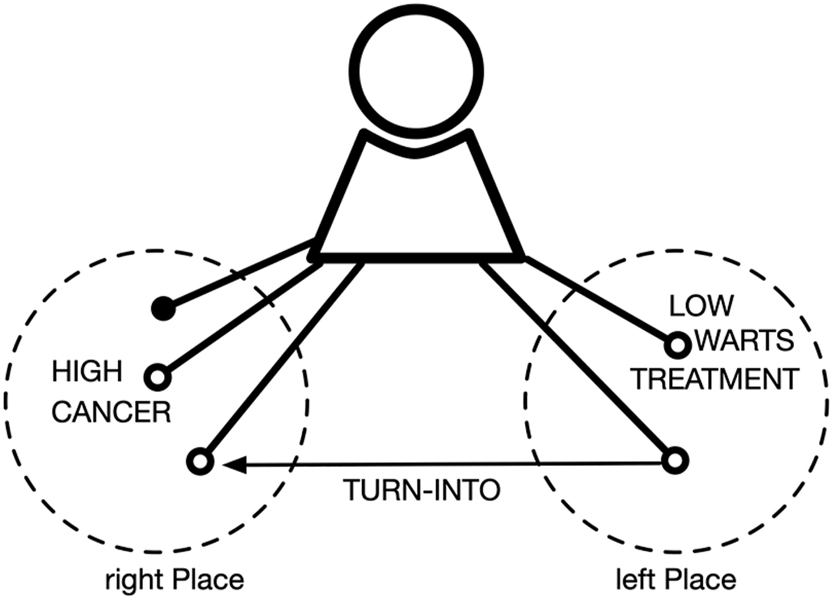
In this example, from Wilcox et al. (2026), the signer is describing the dangers of the human papillomavirus (HPV) being transmitted and spreading quickly, and warns that if not treated HPV can cause cancer. She explains that there are two types of HPV. The first type is low risk, causing warts and requiring treatment. If this low risk type is not treated, it can turn into the high risk type and lead to cancer. She signs that two types are created, GROUP-SPLIT TWO. 2 One is placed on the left, GROUP-left, and one is placed on the right, GROUP-right. These two placing constructions create two Places. The spatial locations of the signs on the left and right in front of the signer elaborate the schematic phonological poles of the Places. At this point we only know that the semantic poles are two types of HPV. Next, she places the signs LOW, WARTS, and TREATMENT at the left Place. Continuing, she explains that if the virus is not treated it can turn into cancer. The protasis starts at the left Place. Then, she signs TURN-INTO, a verb with a path movement beginning at the left Place and moving to the right Place. Finally, she points at and places HIGH and CANCER at the right Place, specifying the apodosis. The entire utterance is depicted in Figure 1. Left and right Places are labeled from the signer’s perspective; lines ending with hollow circles indicate placing; the line ending with a solid circle indicates pointing. For simplicity, the placing of three signs at the left Place and two at the right Place are shown with single placing lines. The verb TURN-INTO is shown as an arrow moving from the left Place to the right Place. The hollow circles indicate placing the beginning and ending locations of TURN-INTO at the left and right Places, respectively.

Using locality conceptual archetype in Argentine Sign Language.
Citation: Cognitive Semantics 2026; 10.1163/23526416-bja10097
In this example, we see Places used to establish the initial two types of HPV. At first, the Places are semantically schematic; we don’t know the nature of these types. When the signer places the signs LOW, WARTS, and TREATMENT at the left Place, she creates not just a contiguity relationship but actual overlap in phonological space. This phonological closeness invokes conceptual closeness; the placed signs influence the meaning of the Place, elaborating it as a low risk type associated with warts and requiring treatment. The same process occurs at the right Place and the placed signs HIGH and CANCER; their phonological closeness triggers conceptual closeness, and the signs influence by elaboration the meaning of the right Place.
This iconic correlation between phonological closeness and conceptual closeness is well-known as Behagel’s law, a maxim of grammar which states that “What belongs together mentally is placed close together syntactically” (Slobin 1985, 228). The best spoken languages can do to place elements together syntactically, that is, to create phonological togetherness, is to place elements contiguously in the temporal speech stream. While signed languages can also express togetherness temporally in the ongoing sign stream, they have the potential to express togetherness more directly by placing the elements that go together semantically at the same phonological spatial location. Locality as a conceptual archetype is likely the non-linguistic, primordial origin of Behagel’s law.
The notion of locality is part of the biological heritage of animals who engage the everyday macroscopic world through embodied motor and perceptual experience. In this way, locality also extends to thought in non-linguistic domains. Einstein famously used embodied thought experiments to arrive at his remarkable theoretical insights—the experience of viewing a beam of light in a moving train as seen from different perspectives for special relativity, and the equivalent feeling of gravity and accelerated motion for general relativity. Locality as an experientially grounded concept about how the classical world works led Einstein to trust that his intuition about locality could be extended to the quantum world, and to resist action at a distance. But his intuition led him astray. We now know that action at a distance, quantum entanglement, and particles that exist in two locations at the same time are proven scientific facts.
The essence of locality is that entities must be contiguous to influence other entities. When locality enters the domain of language as a conceptual archetype, it proves to be a powerful tool for shaping utterances. Speakers and signers place elements together phonologically—either temporally contiguous in the speech or sign stream, or spatially overlapped in signed languages—to symbolize semantic closeness, with the result that one conceptual element can influence another element, e.g., by modification or elaboration.
The realm of the quantum apparently feels no obligation to respect locality; influence even at distances as far apart as opposite ends of the universe is permitted. In the everyday world, however, animals respect the restrictions of locality. The prey does not fear a distant predator until it comes close. I know that if I want to take a book off a shelf, unless I have the power of telekinesis I must be close enough that I can reach out and grab it. In the domain of language, humans take full advantage of our shared conception of locality, manipulating symbolic structures to craft meaningful linguistic expressions. The appeal of cognitive semantics is that it directs us to search for the ability to make meaning in language in our drive to make sense of the world.
The term Places is capitalized to indicate that it names the entire symbolic structure.
Argentine Sign Language words (signs) are glossed in uppercase.
References
Albert, David. 2024. “The Metaphysics of Quantum Mechanics.” [Robinson’s Podcast #157]. https://www.youtube.com/watch?v=tYL7HwzCyC0&t=4661s(accessed March 15, 2026).
Langacker, Ronald W. 1991. Foundations of Cognitive Grammar. Volume II, Descriptive Application. Stanford: Stanford University Press.
Langacker, Ronald W. 2008. Cognitive Grammar: A Basic Introduction. Oxford: Oxford University Press.
Langacker, Ronald W. 2026. “Verbs, Time, and Existence.” In Thinking and Speaking About Time: A Cognitive Linguistic Approach, edited by Rita Brdar-Szabó , and Mario Brdar . Amsterdam: John Benjamins Publishing Company.
Martínez, Rocío , and Sherman Wilcox . 2019. “Pointing and Placing: Nominal Grounding in Argentine Sign Language.” Cognitive Linguistics 30 (1): 85–121. https://doi.org/10.1515/cog-2018-0010.
Slobin, Dan I. 1985. “The Child as a Linguistic Icon-Maker.” In Iconicity in Syntax, edited by John Haiman , 221–48. Amsterdam: John Benjamins Publishing Company.
Smolin, Lee . 2019. Einstein’s Unfinished Revolution: The Search for What Lies Beyond the Quantum. New York: Penguin.
Wilcox, Sherman , and Corrine Occhino . 2016. “Constructing Signs: Place as a Symbolic Structure in Signed Languages.” Cognitive Linguistics 27 (3): 371–404, https://doi.org/10.1515/cog-2016-0003.
Wilcox, Sherman , Rocío Martínez , and Diego Morales . 2022. “The Conceptualization of Space in Signed Languages: Placing the Signer in Narratives.” In Pragmatics of Space, edited by Andreas Jucker , and Heiko Hausendorf , 63–94. Berlin: Mouton de Gruyter.
Wilcox, Sherman , Rocío Martínez , and Sara Siyavoshi . 2025. Signed Language and Cognitive Grammar. Cambridge: Cambridge University Press.
Wilcox, Sherman , André Xavier , and Rocío Martínez . 2026. “Conceptual Overlap and Multiple Symbolization in Signed Languages.” Review of Cognitive Linguistics.