Abstract
This paper investigates motion ideophones in Basque, a high-salient-path verb-framed language with a large repertoire of Manner-of-motion ideophones (Ibarretxe-Antuñano, 2015, 2017, 2019, 2023, 2025). Two main questions are addressed: Does the presence of Manner ideophones affect the inclusion of this component in Basque motion descriptions, and what factors influence its use? Three datasets were analysed: the IdEus-Psylex Stimulus Kit, the IdEus Motion Questionnaire, and different motion event stimuli (Frog stories, Canary Row, and novels). Results show that (i) Manner is more frequent in Basque motion events than in other verb-framed languages but less frequent than in satellite-framed languages, and (ii) motion ideophones are used across contexts regardless of sociolinguistic factors (age), diatopic variation (all Basque dialects), and discourse mode (oral, written). However, their distribution is uneven: some ideophones are widely known and used by all speakers, while others are more age- and dialect-specific.
1 Motion Ideophones: From Inventories to Usage
Ideophones are a characteristic feature of the Basque language. They form an open lexical word class in this language (see Ibarretxe-Antuñano, 2017, 2023, for a detailed review). As a highly-ideophonic language, Basque also has a large inventory of motion ideophones (Ibarretxe-Antuñano, 2006). This is only natural since the category of âmovement imitativesâ, as Hinton et al. (1994) would call it, is one of the semantic domains likely to be encoded by means of ideophones from a cross-linguistic perspective. Ibarretxe-Antuñano (2019) compiles about 453 ideophones for this domain. Based on Talmyâs (1991, 2000) classification of motion event components, motion ideophones in Basque cover all types of motion information as shown in (1):

However, all these motion ideophones are not evenly distributed. On the one hand, some semantic categories attract more ideophones than others do. In general, the highest concentration of ideophones is found in the Manner category. In Ibarretxe-Antuñanoâs (2019) study of 186 motion ideophones from 16 genetically and geographically distinct languages, she finds that Manner is one of the most salient categories in the semantic classification of motion ideophones. In the case of Basque, as shown in Table 1, 97.15% out of the motion ideophone corpus encodes Manner.
Despite the usefulness of such broad semantic categorisations to facilitate an initial overview of motion ideophone information, they are not sufficient to capture, characterise, and compare motion ideophone preferences from a cross-linguistic perspective. In this study, Ibarretxe-Antuñano (2019: 156â157) also finds that encoding preferences emerge when the Manner component is further subdivided into finer semantic subcomponents, for example, motor pattern information, i.e., the body positions required to perform a movement, is the most prominent subcategory, and within this subcategory, there is a clear preference for walking ideophones (e.g., Ashéninka Perené pitso pitso âa woman walking with gyrating hipsâ). She also finds a tendency for languages to include manner ideophones describing fast, unrestrained, irregular, noisy, abrupt motion of large bodies.
On the other hand, the existence of motion ideophones does not necessarily go hand in hand with the actual use of these elements for the characteristic description of motion events. In other words, the existence of a large inventory of motion ideophones does not necessarily mean that all of these elements are used pervasively to describe motion events in all contexts and by all speakers. That is to say, firstly, the distribution of these motion ideophones may be restricted by sociolinguistic as well as diatopic and pragmatic factors. Ideophones are generally reported to occur in informal, oral contexts, to show a high degree of dialectal variation, and to fulfil expressive functions. Second, the role of Manner in the lexicalisation of motion events is more crucial and evident for satellite-framed rather than for verb-framed language speakers. The latter are reported to omit Manner information unless it is crucial for the discourse context (Slobin, 1996, 2006).
Given this general background on the use of ideophones, several questions arise: Do these tendencies apply to Basque ideophones? Is their use different due to these sociolinguistic, linguistic, and semantic typological factors? The aim of this article is to answer these questions. To this end, data from three previous sets of studies on motion events and/or ideophones in Basque are selected and reviewed in Section 2. Dataset 1 comes from the ideophone elicitation tool IdEus-Psylex Stimulus Kit (see, Ibarretxe-Antuñano, 2025). Dataset 2 comes from a survey on motion ideophone use and knowledge: the IdEus Motion Questionnaire (Ibarretxe-Antuñano, 2016). Dataset 3 is built on previous results in the study of motion based on different stimuli for eliciting motion events (namely, Frog stories, Canary Row, and novels; see, Ibarretxe-Antuñano, 2004, 2015, 2016). Section 3 discusses these datasets in relation to the questions raised about the use and scope of ideophones for motion description in Basque. Section 4 offers some conclusions.
2 Analysis: The Use of Basque Ideophones in Three Datasets
2.1 Dataset 1: Motion Ideophones in the IdEus-Psylex Stimulus Kit
The IdEus-Psylex Stimulus Kit (hereafter, IdEus-psk) is a collection of thirty-six short target ideophone video clips (three warm-ups) and four images designed to investigate the knowledge and use of ideophones in Basque. It is a naming task in which informants have to describe these clips and pictures. These materials were designed on the basis of three main variables:
- âMeaning. Ideophones were selected from ten different semantic fields: creatures, actions (motion, communication, light, ingestion, destruction, hitting, boiling, laughing, body functions).
- âType. Entity and object ideophones were represented by means of a static picture; event ideophones, by dynamic video clips. All motion stimuli were dynamic.
- âFunction in language use. There were three possibilities: (i) the ideophone is the only lexical choice for encoding an event or entity (e.g. karramarro âcrabâ); (ii) it is a common, well-known ideophone, although Basque has other non-ideophonic lexical items (e.g. bor-bor and irakin âboilâ), and (iii) the ideophone exists but its use is not that frequent (e.g., txir-txir and frijitu âfryâ).
The IdEus-psk contains twelve motion stimuli. Their characterisation is summarised in Table 2.
The procedure for this naming task is simple. In the first round, after watching each video clip twice or looking at the pictures for a few seconds, the informant has to answer the questions âWhat is [entity] doing?â for the videos or âWhat is that?â for the pictures. Their responses are taken as first answers. Since each stimulus was assigned at least one possible ideophone response (see details in Ibarretxe-Antuñano, 2025), the experimenter could ask the informant to describe the stimuli further in a second round if necessary. These are considered second answers. At the end of the elicitation, there is a short think-aloud protocol session in which the experimenter asks about any aspect related to the use of ideophones in the elicitation. The sessions are videotaped. Raw responses are transcribed onto an Excel spreadsheet and later prepared for analysis on a second spreadsheet.
The IdEus-psk was first tested in the field in 2009. Thirty-seven speakers participated in the study, distributed in three age groups (16â30 yrs = 17; 31â60 yrs = 12; 61â90 yrs = 8) with different schooling backgrounds. They all came from rural areas and were native speakers of four main dialects: Western Basque (wb; twelve subjects), Central Basque (cb; six subjects), Navarrese Basque (nb; twelve subjects), and Navarrese-Lapurdian Basque (nlb; seven subjects).
Table 3 shows the raw answers provided by all informants (organised in age groups) for each stimulus. Shaded slots represent non-ideophonic answers.
Data in Table 3 reveal several trends in the use of motion ideophones in Basque. First, all informants, regardless of their sociolinguistic or dialectal background, used ideophones in their first responses. There was a qualitative difference between older informants and younger informants. The former used a higher number of items that were classified as rare ideophones. For example, stimulus 37 hardly elicited an ideophonic response. Only one of the older informants, IdEus-11, offers the ideophone girrintzi for the air moved by a spinning windmill. In the think-aloud protocol, the informant explained that this ideophone was used to describe the movement of old mills.
Secondly, the degree of agreement between informants when giving an ideophone response varies. Table 4 organises the data from the previous table according to the number of informants who gave ideophone answers (column 4), and the ideophones and their frequency (column 5).
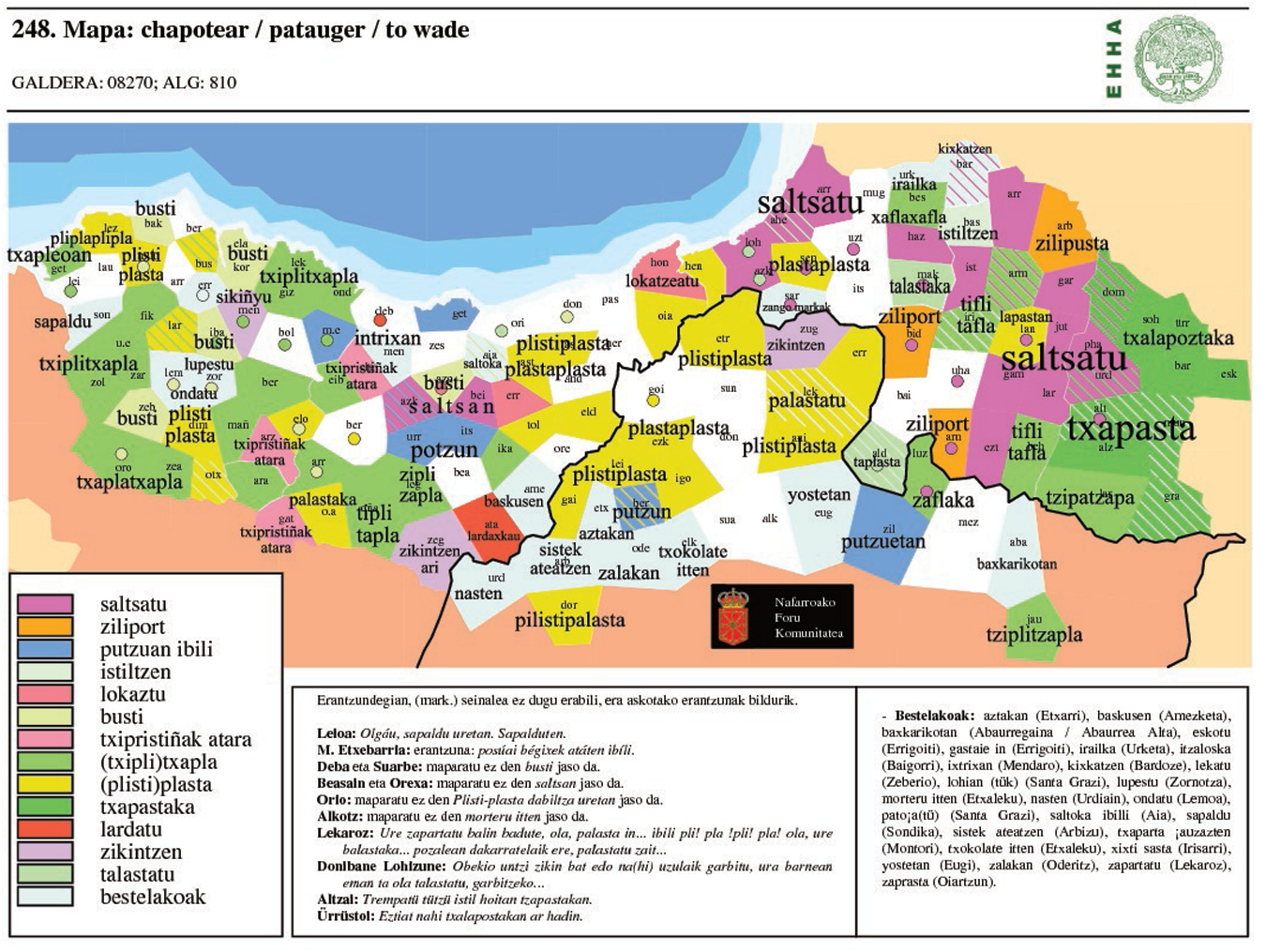
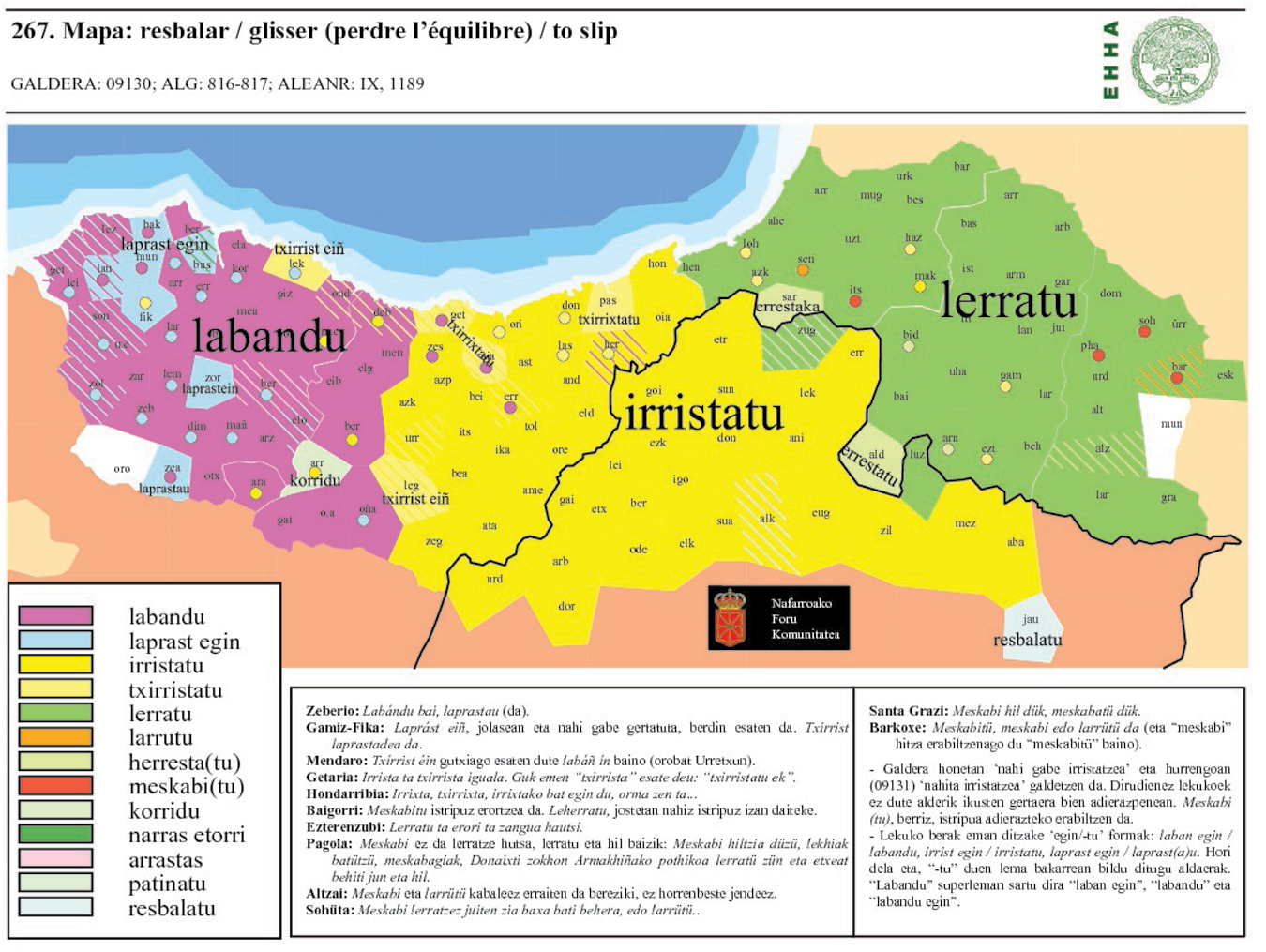
Table 4 shows that the variation in responses seems to depend on two factors. One is the type of stimulus: ideophones that were categorised as the only option and common were those that attracted more ideophone responses. For example, most of the informants (more than 81%) gave ideophones for stimuli 6, 17, and 35. The other is dialect variation: informants used their dialect form for the ideophone. For instance, stimulus 30 (wade) and stimulus 35 (slid), elicited different diatopic responses covering similar meanings as shown in their respective dialectal maps in Figures 1 and 2.
Wade across Basque dialects (Euskaltzaindia 2005â2008, ehha, p. 441, map 248)
Citation: Cognitive Semantics 11, 2 (2025) ; 10.1163/23526416-bja10081
© euskaltzaindia. all rights reserved.Slid across Basque dialects (Euskaltzaindia 2005â2008, ehha, p. 477, map 267)
Citation: Cognitive Semantics 11, 2 (2025) ; 10.1163/23526416-bja10081
© euskaltzaindia. all rights reserved.2.2 Dataset 2: Motion Ideophones in the IdEus Motion Questionnaire
The IdEus Motion Questionnaire (hereafter, IdEus-MotQuest) is a survey that investigates the knowledge and use of Basque motion ideophones. It is designed to elicit responses about native speakersâ perceptions of their active and passive knowledge of ideophones as well as their self-perceived oral and written use. To this end, the questionnaire contains five yes-no questions, as shown in (2).
The questionnaire compiles 834 motion ideophones extracted from Ibarretxe-Antuñanoâs (2006) study. This list includes not only semantically distinct ideophones (e.g., dingili-dangala âswinging, swayingâ vs. firi-firi âspin, roll when thrown in the airâ), but also their standard and dialectal variants, which are treated as separate items in the survey (e.g., nine variants of dindili-dangala: dingili, dindili, dindilizka, dingilizka, dingilin-dangalan, dingili-dongolan, dingilikatu, dingiliztu, dintzili-dantzalaka). These variations are included to test both the prevalence of diatopic preferences and the effect of standardisation in the use of Basque ideophones.
As far as the procedure is concerned, the questionnaire is distributed on paper or electronically. Informants have to answer yes or no to each item. They are not allowed to use any aids such as dictionaries to complete the survey. There is no time limit for completion, which takes about half an hour. After completing the questions, the experimenter collects the answers on an Excel sheet.
The IdEus-MotQuest was tested in the field in 2009 and 2016. Six speakers took part in the study. They belong to the same age group (16â30 yrs = 22.5 yrs) and were all university students. They all came from rural areas, were educated (Standard) Basque and were native speakers of two main dialects: Western Basque (four subjects), and Central Basque (two subjects).
Table 5 summarises the quantitative results of the survey. In general, these figures show that the knowledge and use of ideophones varies considerably between individuals, from around one hundred (informant 1) to less than twenty (informants 6 and 4). In terms of oral or written mode, these scalar differences are maintained, but all speakers agree that they have heard or used more ideophones in the oral mode than in the written mode.
Given these quantitative differences, the next step is to analyse these results from a qualitative perspective in order to see if there is any agreement in the ideophones known by the speakers. Table 6 shows the ideophones agreed upon by at least four speakers in the first question.
Data in Table 6 show that there is a group of ideophones that are known by (almost) all speakers in all contexts such as irrist (egin) âslipping, slidingâ, tipi-tapa âpitter-patterâ, zalapartaka âmove violently; helter-skelterâ or mara-mara âsoft, gentle movementâ. The knowledge and use of some ideophone variants seem to be favoured by the normativisation of the language. Standard Basque ideophones are learned at school and these seem to be the most common and preferred choices.
2.3 Dataset 3: Motion Ideophones in Motion Event Studies
The encoding and conceptualisation of motion events has been studied using a wide variety of well-known stimuli such as the frog stories (Berman and Slobin, 1994), the Canary Row cartoon (McNeill, 1992), and narrative events in novels (Slobin, 1996), to name just three of the most popular. The procedure2 in these tasks is as follows. In the frog stories, the informant has to describe what happens after looking at the picture book, which tells the story of a boy who, accompanied by his dog, searches for his lost frog in the forest. In the Canary Row, the informant has to describe what happens in the cartoon immediately after having seen it (all together or divided into eight parts). In the novels, twenty motion events are chosen at random by opening the book in different parts.
All of these stimuli were used to the study of Basque motion events. The frog stories were first collected in the field in 2003 (12 adult speakers) and later, together with the Canary Row data, from 2015 to 2019 (21 children, longitudinal data from age 3 to 7). For the narrative events in novels, four contemporary novels from well-known contemporary Basque writers were selected (80 motion events). Results from these elicitation tools have shown that Basque can be classified as a verb-framed language since Path is generally encoded in the main verb and Manner outside (Ibarretxe-Antuñano, 2004). However, it has also been shown that Basque is also a high-salient-path language with a preference for elaborate and detailed path descriptions (Ibarretxe-Antuñano, 2009), and despite being a verb-framed language; Manner is mentioned more often than in other V-languages (Ibarretxe-Antuñano, 2015, 2016).
Regarding the role of ideophones, these studies have shown that motion ideophones are used in both oral and written narratives. This means that the use of ideophones is not limited by the mode of communication as the examples in (3) and (4) illustrate.
Table 7 compiles the list of ideophones together with their place of lexicalisation (verb / outside) and syntactic role (verbal, adjectival, adverbial, interjection) in the motion event in the adult frog stories and novels. Note that manner ideophones mainly encode detailed information about motor pattern information (walking), smooth motion, forced motion, posture, and rate.
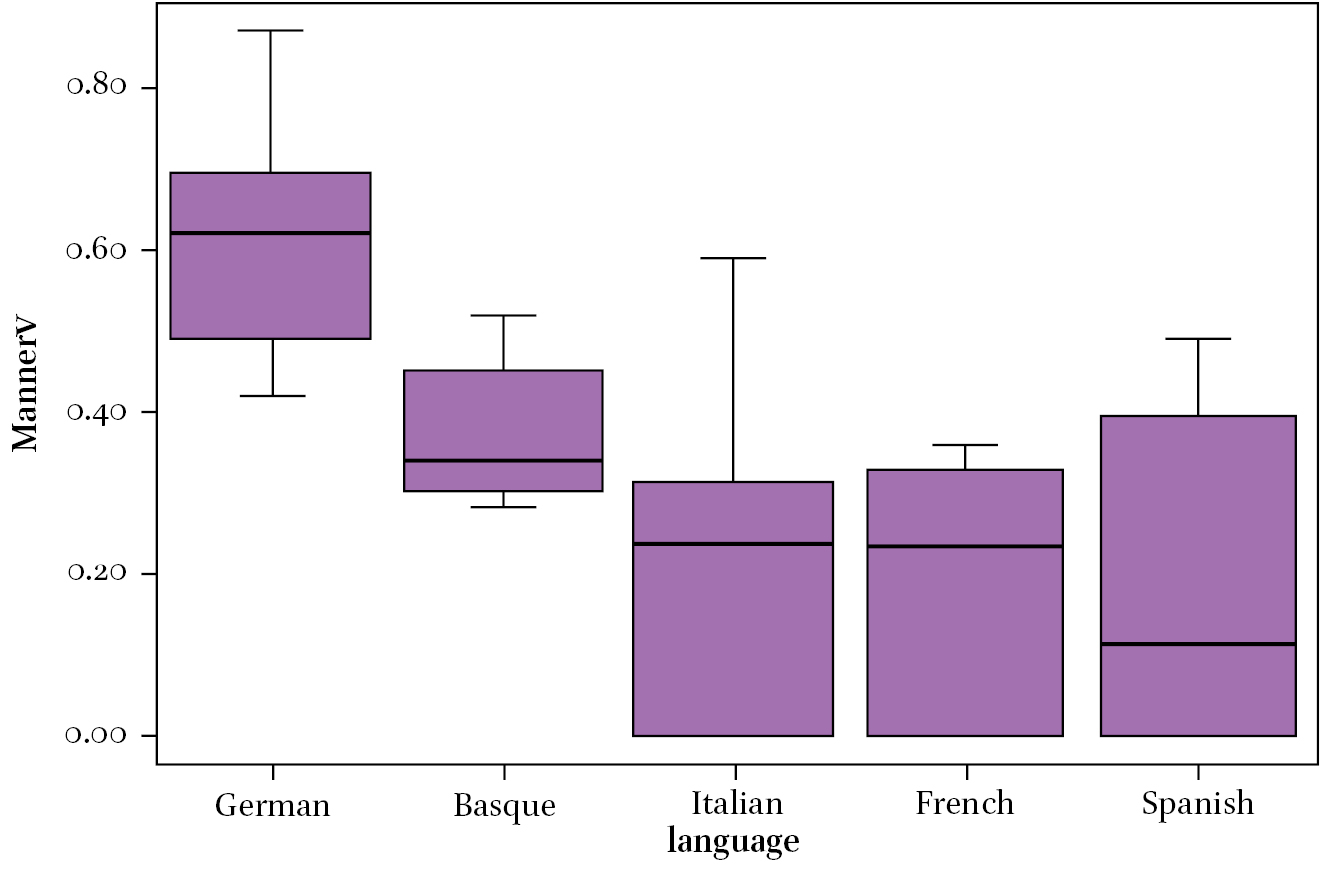
As mentioned above, Basque is a verb-framed language and as such, the description of Manner tends to be less frequent and less detailed than in satellite-framed languages unless required by the discourse context (Slobin, 1997: 455; ÃzçalıÅkan and Slobin, 2003: 264). Although it is true that Manner is less salient and pervasive than Path, a comparison of the use of Manner in the frog stories in Basque and in four languages reveals a different, unexpected, pattern as shown in Figure 3.
Manner information in the frog stories in five languages
Citation: Cognitive Semantics 11, 2 (2025) ; 10.1163/23526416-bja10081
Figure 3 reveals that Basque is somewhere in the middle with regard to the encoding of Manner information. As expected, Basque Manner does not reach the level of description found for German, a satellite-framed and high-manner salient language. However, the description of Manner is statistically different from that in the three Romance verb-framed, and hence, low-manner-salient languages: French (p =.016), Italian (p =.027), and Spanish (p =.069) (see, Hijazo-Gascón, 2021 for detailed information). Its different position along the cline of Manner salience may be due to the existence of Manner ideophones in Basque.
Finally, another important finding in these motion event studies is the presence of ideophones in both adult and young speakers. Examples (5) and (6) are produced by young speakers. Example (5) corresponds to the same scene from the frog stories elicitation tool described by an adult speaker in example (4). On this occasion, the young speaker chooses the ideophone txipi-txapa, which has a similar meaning to that of the adult plisti-plasta âwadeâ. Figure 4 captures the moment when the child narrates what the boy is doing. The gesture represents the walking movement contained in the txipi-txapa ideophone. The ideophone tipi-tapa âwalk in small stepsâ in (6) describes one of the scenes in the Canary Row when the cat Sylvester runs after the bird Tweety.
The txipi-txapa ideophone and its gestural encoding
Citation: Cognitive Semantics 11, 2 (2025) ; 10.1163/23526416-bja10081
3 Discussion
The main aim of this paper has been to answer to two main questions about the possible impact of a rich repertoire of Manner of motion ideophones on the lexicalisation of motion events in this Basque. This language is classified as a verb-framed language according to Talmyâs lexicalisation patterns. In this type of language, Manner is usually encoded outside the verb and, based on Slobinâs Thinking for Speaking hypothesis, is only mentioned in a motion event description when it is relevant to the context. Slobin also suggests that the more linguistic resources a language has for encoding a semantic component, the more likely it is that speakers will pay attention to that specific information in the online processing. More specifically, if a language has rich resources for describing Manner, its speakers will pay attention to Manner of motion when thinking and talking about motion events. Since the ideophonic lexicon of Manner in Basque is very large and expressive, it follows that Basque speakers will pay attention to this semantic component.
Results from the three datasets revised in Section 2 suggest that, as far as the first question is concerned, i.e., whether the presence of Manner ideophones has an impact on the inclusion of Manner in Basque motion descriptions, Basque speakers tend to describe Manner more often than speakers of other verb-framed languages, but less often than speakers of satellite-framed languages, as shown in the frog story contrastive data (Section 2.3). Naming tasks such as those described in Section 2.1 also suggest that speakers, when confronted with motion clips representing different types of motion, will generally choose an ideophone provided that this ideophone is either the only or the most common encoding strategy for such a motion event. Finally, despite the large repertoire of Manner of motion ideophones in Basque, data suggest that only a relatively small proportion of these ideophones belongs to the regular daily resources that these speakers use to encode motion. This last result should be tested in more detail in future studies given the small number of participants in the study reported in Section 2.2.
With regard to the second question, i.e., whether the use of these ideophones is restricted by sociolinguistic, linguistic, and semantic typological factors, there are several possible answers. As far as sociolinguistic factors are concerned, results from the three datasets suggest that ideophones are used by speakers of all ages, dialects and origins, as well as in oral and written modes of communication. Therefore, such limitations do not seem to be due to these factors. However, datasets 1 and 2 also show that there is a qualitative difference in the type of ideophones that speakers know and use. On the one hand, as mentioned above, only a small proportion of ideophones appear in all datasets. This may be due to the nature of tasks administered.
On the other hand, older speakers seem to be aware of a greater variety of ideophones than younger speakers. It is not clear why this might be the case, but the literacy factors are bound to play a role in this qualitative difference. Older speakers were generally illiterate in Basque, whereas younger speakers were educated in Standard Basque. Until very recently, and despite traditional grammatical descriptions of the language (Azkue, 1923â1925; Urtel, 1919; Zamarripa, 1913; see also, Trask, 1997), ideophones have been a marginal element in both descriptive and pedagogical Standard Basque grammars (de Rijk, 2008; Euskaltzaindia, 1985â2011; Hualde and Ortiz de Urbina, 2003; Zubiri and Zubiri, 1995). In teaching, they have been introduced as âonomatopoeiaâ but with the connotation that they are only âimitationsâ of animal soundsârecalling the Saussurian idea that they are not an integral part of languageâand only as lexical items for advanced vocabulary learning. This has led to a general identification of ideophones with rural and elderly speakers of non-standard varieties, and therefore, an element to be avoided in Standard Basque. This biased perspective is also due to the unfortunately common tendency in mainstream linguistics to study languages not from within the language itself, but from a general linguistic theory; a theory based on a small number of majority languages that do not cover the linguistic typological diversity of the world (Henrich et al., 2010; Kirk, 2023; Ngué Um, 2020). Ideophones are a clear example of this exclusion (Dingemanse, 2018).
4 Conclusions
All languages include ideophonic elements in their lexical inventories. All languages contain direct imitations of sounds such as English splash or zigzag, but not all have large ideophonic vocabularies or ideophones for cross-modal depictions such as Japanese ira-ira âirritated, impatient, agitated, frustratedâ or Bini liÌkpaÌliÌkpaÌ âvery roughâ. The type of ideophone discussed in this article, namely motion ideophones, occurs across languages (Ibarretxe-Antuñano, 2019), but again the cross-linguistic difference lies in the number and specificity of motion ideophones that languages possess. Consequently, researchers interested in describing motion events in one particular language or cross-linguistically cannot avoid examining what ideophones and how many exist in their target languages and what kind of information they provide. Basque is a highly-ideophonic language with a large inventory of motion ideophones. However, the crucial question posed in this article is not related to the quantity or the quality of motion ideophones, but to their actual use in the language.
In this article, this question has been tested on the basis of three motion datasets that combine different types of elicitation tools (naming tasks, questionnaires, static images, video-clips, narrative texts) and procedures (oral, written), and that have been tested on groups of Basque speakers with different diatopic variation (standard, all main varieties) and sociolinguistic backgrounds (young-adult; rural-urban; schooling). Results have shown that all types of speakers in all datasets have used ideophones to describe motion events. In other words, motion ideophones do play a role in motion events in Basque. However, this general result needs to be further explained. The knowledge and use of these ideophones by Basque speakers is not evenly distributed: one group of ideophones seems to be known and used by all speakers (plisti-plasta âwadeâ), whereas some other ideophones are more limited and depend on age and dialect (girrintzi âair moved by a spinning windmillâ). In terms of Talmyâs lexicalisation patterns, Basque is known to be a high-salient-path verb-framed language (Ibarretxe-Antuñano, 2009). For Manner, this component is not as salient as in satellite-framed languages, but it is still more frequent than in verb-framed motion descriptions. As noted for other highly-ideophonic languages such as Japanese (Sugiyama, 2005; Akita, 2017; Matsumoto, 2025), Emai (Schaefer, 2001), Teko (Rose, 2024) or Chinese (Van Hoey, 2025), among many others, the presence of a rich articulated manner of motion ideophone lexicon could be a plausible explanation for this higher preference to mention Manner in motion descriptions. These findings do not contradict general tendencies in Talmyâs lexicalisation patterns or Slobinâs Thinking for Speaking hypothesis, but simply point to the need for clines in the salience of semantic components and the influence of linguistic resources in the conceptualisation of a semantic domain such as motion.
Acknowledgments
This research has been funded by the Spanish Ministry of Science and Innovation (aei/feder Funds: motiv pid2021-123302nb-i00), the Government of Aragon (Psylex H11-17R), and the Iberus Campus (icon action group). I would like to thank Kiyoko Toratani and Kimi Akita for their inspiring work on ideophones (both in research and in organising âideophone eventsâ), and for their patience with me.
References
Akita, Kimi. 2017. The typology of manner expressions: A preliminary look. In I. Ibarretxe-Antuñano (ed.), Motion and Space across Languages: Theory and Applications, 39â60. Amsterdam/Philadelphia: John Benjamins.
Azkue, Resurreción M.ª 1923â1925. MorfologÃa vasca. Bilbao: La Gran Enciclopedia Vasca.
Berman, Ruth A. and Dan I. Slobin. 1994. Relating Events in Narrative: A Crosslinguistic, Developmental Study. Hillsdale, NJ: Lawrence Erlbaum Associates.
De Rijk, Rudolf P. G. 2008. Standard Basque. A Progressive Grammar. Volume 1. The Grammar. Cambridge, MA: MIT Press.
Dingemanse, Mark. 2018. Redrawing the margins of language: Lessons from research on ideophones. Glossa: A Journal of General Linguistics 3(1): 4.
Euskaltzaindia. 1985â2011. Euskal Gramatika. Lehen urratsak (eglu). Bilbo: Euskaltzaindia.
Euskaltzaindia. 2005â2008. Euskararen Herri Hizkeren Atlasa (ehha). Bilbo: Euskaltzaindia.
Henrich, Joseph, Steven J. Heine and Ara Norenzayan. 2010. The weirdest people in the world?. Behavioral and Brain Sciences 33(2â3): 61â83.
Hijazo-Gascón, Alberto. 2021. Moving across Languages: Motion Events in Spanish as a Second Language. Berlin: De Gruyter.
Hinton, Leanne, Johanna Nichols and John J. Ohala (eds.). 1994. Sound Symbolism. Cambridge: Cambridge University Press.
Hualde, José Ignacio and Jon Ortiz de Urbina (eds.). 2003. A Grammar of Basque. Amsterdam: John Benjamins.
Ibarretxe-Antuñano, Iraide. 2004. Language typologies in our language use: The case of Basque motion events in adult oral narratives. Cognitive Linguistics 15(3): 317â349.
Ibarretxe-Antuñano, Iraide. 2006. Sound Symbolism and Motion in Basque. München: Lincom Europa.
Ibarretxe-Antuñano, Iraide. 2009. Path salience in motion events. In J. Guo, E. Lieven, N. Budwig, S. Ervin-Tripp, K. Nakamura and Å. ÃzçalıÅkan (eds.), Crosslinguistic Approaches to the Psychology of Language: Research in the Tradition of Dan Isaac Slobin, 403â414. New York: Psychology Press.
Ibarretxe-Antuñano, Iraide. 2015. Going beyond motion events typology: The case of Basque as a verb-framed language. Folia Lingvistica 49(2): 307â352.
Ibarretxe-Antuñano, Iraide. 2016. The importance of ideophones in the lexicalisation of motion events. Paper presented at The International Symposium on Mimetics in Japanese and Other Languages of the World. National Institute for Japanese Language and Linguistics (NINJAL), Tokyo (Japan). 17â18 December 2016.
Ibarretxe-Antuñano, Iraide. 2017. Basque ideophones from a typological perspective. The Canadian Journal of Linguistics / Revue canadienne de linguistique 62(2): 196â220.
Ibarretxe-Antuñano, Iraide. 2019. Towards a semantic typological classification of motion ideophones: The motion semantic grid. In K. Akita and P. Pardeshi (eds.), Ideophones, Mimetics, and Expressives, 137â166. Amsterdam/Philadelphia: John Benjamins.
Ibarretxe-Antuñano, Iraide. 2023. Vindicating the role of ideophones as a typological feature of Basque. In J. P. Williams (ed.), Expressivity in European Languages, 313â334. Cambridge: Cambridge University Press.
Ibarretxe-Antuñano, Iraide. 2025. Eliciting ideophones in the field: The IdEus-Psylex stimuli collection. In J. P. Williams (ed.), Capturing Expressivity: Contexts, Methods, and Techniques for Linguistic Research, 53â73. Oxford: Oxford University Press.
Kirk, Neil W. 2023. mind your language(s): Recognizing Minority, Indigenous, Non-standard(ized), and Dialect variety usage in âmonolingualsâ. Applied Psycholinguistics 44: 358â364.
Matsumoto, Yo. 2025. The co-occurrence of motion ideophones and motion verbs: The case of Japanese. Cognitive Semantics, 11.
McNeill, David. 1992. Hand and Mind. What Gestures Reveal about Thought. Chicago: The University of Chicago Press.
Ngué Um, Emmanuel. 2020. Had Ferdinand de Saussure spoken Wolof or Basaa â¦, the discipline of linguistics would have fared differently. Language, Culture and Society 2(1): 107â115.
ÃzçalıÅkan, Åeyda and Dan I. Slobin. 2003. Codability effects on the expression of manner of motion in Turkish and English. In A. S. Ãzsoy, D. Akar, M. NakipoÄlu-Demiralp, E. Erguvanlı-Taylan and A. Aksu-Koç (eds.), Studies in Turkish Linguistics, 259â270. Istambul: BoÄaziçi University Press.
Rose, Françoise. 2024. Teko ideophones: description of a word class. Linguistic Typology at the Crossroads 4â1: 91â146.
Schaefer, Ronald P. 2001. Ideophonic adverbs and manner gaps in Emai. In E. F. K. Voeltz and K. Kilian-Hatz (eds.), Ideophones, 339â354. Amsterdam: John Benjamins.
Slobin, Dan I. 1996. Two ways to travel: Verbs of motion in English and Spanish. In M. Shibatani and S. A. Thompson (eds.), Grammatical Constructions: Their Form and Meaning, 195â220. Oxford: Clarendon Press.
Slobin, Dan I. 1997. Mind, code and text. In J. Bybee, J. Haiman and S. A. Thompson (eds.), Essays on Language Function and Language Type: Dedicated to T. Givón, 437â467. Amsterdam: John Benjamins.
Slobin, Dan I. 2006. What makes manner of motion salient? Explorations in linguistic typology, discourse, and cognition. In M. Hickmann and S. Robert (eds.), Space in Languages: Linguistic Systems and Cognitive Categories, 59â81. Amsterdam/Philadelphia: John Benjamins.
Sugiyama, Yukiko. 2005. Not all verb-framed languages are created equal: The case of Japanese. Proceedings of the Thirty-First Annual Meeting of the Berkeley Linguistics Society 31: 299â310.
Talmy, Leonard. 1991. Path to realization: A typology of event conflation. Proceedings of the Seventeenth Annual Meeting of the Berkeley Linguistics Society 17: 480â520.
Talmy, Leonard. 2000. Toward a Cognitive Semantics. 2 vols. Cambridge, MA: MIT Press.
Trask, R. Larry. 1997. The History of Basque. London: Routledge.
Urtel, Hermann. 1919. Zur baskischen Onomatopoesis. Berlin: Reichsdruckerei.
Van Hoey, Thomas. 2025. Waddling, wandering and waving: Literary Chinese ideophones and the motion semantic grid. Cognitive Semantics, 11: 1â28.
Zamarripa, Pablo. 1913. Manual del vascófilo. Bilbao: Lerchundi.
Zubiri, Ilari and Entzi Zubiri. 1995. Euskal Gramatika Osoa. Bilbo: Didaktiker.
Event extension is an extra semantic component added in Ibarretxe-Antuñanoâs (2019: 148) motion grid. It covers information related to âphaseâ (event stage; e.g., beginning, middle, end, etc.) and âaspectâ (attributes related to the event; e.g., iterative, punctual, resultative, etc.).
Since these are well-known tools and for the sake of brevity, only basic procedure is described. The interested reader can consult the references for more detailed information.