Abstract
This study begins by highlighting the largely unrealized potential of biblical stained glass as a source for students of visual biblical reception and its treatment thus far in terms of either âvisual exegesisâ or âvisual criticismâ. It then suggests that while a stained-glass window may serve as an instance of reception, it may also serve as a metaphor for the visual reception of the Bible in various media, including stained glass. The interpretive utility of this metaphor is suggested by an analysis of David Instructing Solomon (1883), a stained-glass window designed by the famous Victorian artist, Edward Burne-Jones, for Trinity Church in Boston, Massachusetts. This analysis suggests that a stained-glass windowâs refraction of the Bible may be illumined by attention to a variety of personal, artistic and circumstantial contexts and factors but that a window may also invite fresh reflection on the biblical text which it interprets.
1 Window as Reception
1.1 Stained Glass: A Rich Vein of Biblical Reception
In an important essay penned in the mid-1980s, the stained-glass historian, Madeline Caviness, took issue with the long and widely held assumption that the stained glass of the 12th and 13th centuries simply served as a âBible for the Poorâ, anticipating the later Biblia Pauperum manuscript tradition. 1 In doing so, Caviness noted that the subject matter of these windows is by no means restricted to the Bible, but also includes heraldic and contemporary imagery along with figures of post-biblical saints. She also observed that the windows readily departed from the narrative sequence of the canon (i.e. the Vulgate) in favour of a typological treatmentâconnecting the Christian New Testament narrative both with its Old Testament antecedents and its contemporary analogues. Yet, if Caviness helpfully illuminates the ways in which medieval stained glass is not merely biblical, her essay, in fact, incidentally illustrates how very biblical medieval stained glass is. While she notes that Sainte Chappelle offers the parade example, with more than 800 subjects drawn from the Old Testament alone, her study highlights the extent to which the windows of St Denis, the Benedictine choir of Canterbury Cathedral, the Franciscan Church of Assisi, as well as the French cathedrals in Bourges, Poitiers, Rouen, Auxerre and Chartres are all replete with biblical subjects.
Given the prominence of biblical subjects in the stained glass of the Gothic tradition, it is hardly surprising that they remained prominent when the art was revived and the number of windows burgeoned again in the 19th century. For example, in Great Britain, of the 3336 stained-glass windows recorded in Wales, 2175 (65%) contain biblical imagery and/or references, 2 and of those found in churches, the percentage of biblical windows is even higher (84%). 3 Elsewhere, the predominance of biblical imagery would appear to be comparable. On the Isle of Wight, for instance, of the 405 windows recorded, 338 (83.5%) include biblical imagery, while in North Oxfordshire, for instance, fully 87.5% (507) of the total number of windows recorded (582) contain biblical imagery or references. 4 In the continuing absence of comprehensive cataloguing of stained glass, the prevalence of the Bible in stained glass in the UK cannot be fully calculated, but, if the above figures are representative, we might expect the Home Counties alone (not including London) to have just short of 15000 biblical windows. 5 This is clearly but a fraction of the number of stained-glass windows in England and when it is considered that windows elsewhere in the UK are unlikely to have less biblical imagery, one begins to grasp just how much Bible may be found in the stained glass of the United Kingdom, let alone in continental Europe and the rest of the world. Indeed, on this basis, it seems safe to assume that even when the re-use of original designs is taken into account, 6 stained glass represents one of the largest and richest veins of original visual biblical reception in existence. Even more remarkable, however, than the scale of this vein, is the extent to which it has remained unmined by scholars of visual biblical reception.
1.2 Art History: Stained Glass and the Narratological Turn
Biblical imagery has not of course escaped the attention of historians of stained glass, as the pervasiveness of the Bible in the medium up until relatively recently makes this all but impossible. Indeed, what has been called the ânarratological turn in stained-glass studiesâ in the last decades of the 20th century, has resulted in considerable gains in our understanding of how biblical narratives are presented in medieval stained glass. Caviness, in the essay noted above, also observed that medieval biblical windows typically tell stories from bottom to top, highlight thematic similarities or reversals through repetitions, and enhance the clarity of the narrative by clothing main protagonists similarly. 7 Moreover, Cavinessâ attention to versions of the Joseph story in early French medieval windows revealed significant additions to the biblical narrative, some of which had parallels in textual sources, but some of which were related to the sites where the windows were located.
Another example of concerted interest in the Bible in stained glass may be found in Wolfgang Kempâs The Narratives of Gothic Stained Glass, which lingers at length on representations of the parables of the Good Samaritan and the Prodigal in early French medieval stained glass. 8 Kemp considers the ways in which these windows tell the stories and how the scenes are ordered, organized and related to each other, often typologically. He is also interested in how homiletical techniques influence texts both visual and verbal and the ways in which the windows reflect the times and situations of their production. Further studies by Deremble and Manhes and then Deremble-Manhes cover somewhat similar ground, with the latter offering a more nuanced view of the role of artisans and donors in selecting subjects and influencing their rendering. 9 Focusing exclusively on Sainte Chapelle, Alyce Jordanâs study usefully highlights the way in which the chapelâs expanded Old Testament scheme is paralleled by popular aural and written storytelling techniques and was intentionally shaped to reinforce Capetian claims of sacral kingship. 10 From these examples and others, 11 it is clear that the comparative prominence of biblical subjects in medieval windows and the narratological turn in the study of them in recent decades has inevitably and happily shed considerable light on the reception of the Bible in medieval stained glass.
In turning to later stained glass, it is clear that the Bible in 19th and 20th century windows has a rather different cast, in more than one sense. While the stained glass of the so-called Gothic revival and Arts and Crafts movement (19th and early 20th centuries) generally lacks the earlier periodâs vast schemes of biblical scenes, biblical imagery and text are hardly less prominent, as we have seen above and as is clear from the art historical consideration of it in recent decades. The point may be illustrated rather unscientifically by the illustration of Martin Harrisonâs important Victorian Stained Glass, in which 86% (102/119) of the monochrome and colour plates of windows and designs contain biblical subjects. 12 However, while the Bible is clearly crucial to the illustration of Harrisonâs analysis, it is largely incidental to the analysis itself which seeks to document the artists, studios, technical developments and artistic styles characteristic of the stained glass of the period. Nevertheless, Harrisonâs seminal work and more recent efforts, 13 and indeed the valuable contributions of other historians of 19th and 20th century (and earlier) stained glass, 14 offer many useful reference points for appreciating the extent and context of biblical stained glass. 15
1.3 Biblical Studies: Visual Exegesis, Visual Criticism and Stained Glass
While art-historiansâ largely incidental interest in the Bible in stained glass is perhaps not surprising, its comparative neglect by scholars concerned with biblical reception is perhaps more curious. 16 Most of the little work which has appeared falls into one of the two categories into which the visual reception of the Bible more generally is sometimes divided, namely, visual exegesis and visual criticism. 17
Paolo Berdiniâs âvisual exegesisâ, illustrated by his work on Jacopo Bassanoâs paintings of the New Testament, is interested in a paintingâs âreadingâ of the Bible through the lens of the artistâs historical and cultural context. Indeed, this fundamentally art historical character of Berdiniâs visual exegesis reflects many of the interests we have already seen above, in the narratological turn in medieval biblical stained glass. Given Berdiniâs influence on the visual reception of the Bible generally, thanks especially to the work of Martin OâKane, 18 it is understandable that a âvisual exegeticalâ approach is discernible when stained glass has been included in, for instance, more general studies of the visual reception of biblical figures. 19 While such treatments are typically cursory, the situating of the stained glass within the context of other types of visual reception from various periods, including illuminated manuscripts and paintings, can be useful. Additionally, Klaus Koenen has sought to situate biblical stained glass within other ecclesial art in the Cathedral in Cologne and in St. Nikolaus in Brauweiler, west of Cologne, where Franz Pauliâs scheme of 1960s windows uses biblical imagery and pictures Hitler himself in order to critique the tendency toward leader-worship. 20 Indeed, we can see such approaches combined to good effect in Brigitta Rotachâs analysis of the depiction of âMoses striking the rockâ in Bern Cathedralâs âHostienmühleâ window. 21 Finally, a more explicit dependence on Berdini may be seen in recent studies of the reception of the Bible in stained glass in Ireland and in Wales. 22
While most of the modest number of treatments of biblical stained glass reflect a âvisual exegeticalâ approach which focuses on contextualizing the âreadingâ offered by the imagery, the deployment of the âvisual criticalâ approach associated with Cheryl Exumâs work on the Bible in art has been less common. In an article published in 1998, Exum and Fiona Black offer an analysis of scenes from the Song of Songs in a stained-glass window which was almost certainly designed in 1862 by Edward Burne-Jones, one of the best- known British artists of the latter half of the 19th century. 23 Their article reflects to a significant extent Exumâs intention, increasingly evident in her later work, to shift the focus away from artists and their historical circumstances in order to see what the work can teach about the biblical text. 24 Thus, Black and Exum argue that Burne-Jonesâ visual reading of Song of Songs mirrors the original source text by reflecting its lack of narrative linearity, thereby highlighting the importance of the reader in constructing its âplotâ. 25 They also note that Burne-Jonesâ visual illustration of the womanâs siblingsâ anger and her beating by the watchmen resist readings of the original text which pass over these as disruptive of the Songâs celebration of fulfilled desire. Lastly, they argue that Burne-Jonesâ final panel refuses to resolve the ambiguity which they see in the source text.
In introducing these conclusions, Black and Exum supply a heading which articulates the visual critical task as a âlooking through the window at the source textâ. 26 This formulation encourages a consideration of how a âwindowâ might serve not only as an instance of visual biblical reception, but also as an integrating metaphor for the study of biblical windows and indeed the visual reception of the Bible more generally.
2 Reception as Window
In order to see the original text properly, as it really is, the translation has to be transparent, so that the eye does not rest on the glass itself but looks through it, imagining that what it sees is really the original, with nothing intervening. The translation (and hence the translator who produced it) is therefore literally invisible. If, on the other hand, the translation is like a stained-glass window, the eye rests on the patterned surface and does not look through it. 31
In applying these observations to the visual reception of the Bible, we need only imagine that Chestermanâs original text is the biblical one, that the translation is a visual reception and that Chestermanâs textual translator is the visual interpreter. Indeed, the latter analogy is even more apt because while no translation into a new language offers an entirely transparent view of its source, a clear pane of glass does permit the viewer a more or less transparent view of the source text, while a stained-glass window more or less prevents this.
2.1 Visual Criticism as Refraction and Visual Exegesis as Reflection
While William Durand in the 13th century saw stained-glass windows themselves in textual terms (i.e. as Holy Scriptures), transmitting the divine light into the hearts of the faithful, 32 the metaphor of window as visual interpretation suggests the more ancient equation of text with light. 33 Unlike many other forms of visual art, stained glass depends primarily on the transmission of light, with the different types and treatments of the glass absorbing certain wavelengths of light and refracting the rest, producing the rainbow of colours which bring the visual design to life for the viewer.
At times, the incident, unrefracted, light behind the glass is visible, but the more extensive the treatment of the glass, the less visible the incident light behind the glass is. This, and the way that the designer selects different types of glass, what they add to the glass, and above all how they arrange the glass to create the visual effect, offers an analogue to the visual interpreterâs own engagement with the text (see Figure 1): the visual interpreter selects different elements of the text, adds to it and arranges it to form a visual exegesis. Indeed, the character of this visual representation of the text is informed by the sorts of factors highlighted by art historians and biblical scholars adopting a âvisual exegesisâ approach. These factors include social, cultural and political influences, visual and textual antecedents, the artistâs personal predilections, artistic style, and what might be termed the circumstances of the commission (including the influence of donors, institutions and families). While the artistâs encounter with the biblical text itself may also be refracted in their exegesis, various studies have shown that it is often less easy to demonstrate a biblical windowâs direct exegesis of the biblical text itself than to illustrate its dependence on a later visual or literary interpretation of the Bible. In the case of 19th and 20th century stained glass, this transmission or refraction can be seen in the influence of biblical paintings from this and earlier periods. 34 On this analogy, âreadingâ a visual exegesis of a biblical text in a stained-glass window involves explaining what factors and influences have impacted the particular transmission/refraction of the light/text visible in the stained-glass window.

Visual criticism, visual exegesis, refraction and reflection.
Citation: Biblical Interpretation 34, 2 (2026) ; 10.1163/15685152-bja10074
If analysing a visual representation of the Bible as an âexegesisâ of a text resembles attending to a windowâs capacity to transmit and refract light, the advantage of the window metaphor is that glass does not merely transmit light, but also reflects it. This is most obviously true of a mirror, but it is also true of stained glass: when it is light outside and the viewer is in the darkened interior of a church, it is the transmitted light pouring through the glass which is noted by the viewer and illuminates the design (apart from the leading); by contrast when it is dark outside and the interior of the church is light, the reflection of this light allows the design of the window to still be seen, albeit dimly âas if in a glassâ. But staining or treating the glass itself doesnât just affect the transmission and increase the refraction; it also increases the reflection.
With this in mind, rather than seeing the visual critical process as one of âlooking through the window at the source textâ (so Black and Exum), 35 it might be preferable to see the viewer/scholar as looking at the text in light of the window, or to put it more fully, in the light reflected by the window. Indeed, whether intentionally or not, this is precisely what Black and Exum seem to invite when they immediately note that their engagement with Burne-Jonesâ stained-glass window âhas inevitably cast the source text in a new light for us.â 36 The interest of visual criticism in how the visual interpretation illuminates the text is well accounted for by the notion of âreflectionâ. Moreover, the analogy makes sense of our perception that the more âinterpretiveâ a visual biblical interpretation is, the more it refracts the text/light (i.e. the focus of visual exegesis) but also the more it illuminates the text/light itself (i.e. the focus of visual criticism).
We have seen already that Black and Exumâs primary interest is in considering how Burne-Jonesâ stained-glass interpretation compares with the biblical text, how its privileging of the elusive quality of love and the violence in the Song destablilizes conventional readings of the biblical text which tend to elide these elements. 37 However, Black and Exum do also note how Burne-Jonesâ emphasis on unrequited or much delayed love in his stained-glass interpretation of the Song resonates strikingly with this same theme in many of his paintings. 38 They also hint at the possibility that this emphasis may reflect aspects of his personal experience as recollected by Burne-Jonesâ wife, Georgiana, in her biography of him. 39 Thus while Exumâs later work seems to eschew any interest in such âart historicalâ interests, she and Black here do leave the window open, as it were, to considering them and their value for visual interpretation. In illustrating this (see Figure 1) we suggest that âvisual criticismâ might be characterised by an analytical trajectory which begins with the visual interpretation(s) but ends by considering how Exumâs ânew lightâ (i.e reflected) illuminates the biblical source text. By the same token, while a âvisual exegesisâ approach clearly focuses on the artistic, social and personal influences which shape a particular visual interpretation of the Bible, it is also worth noting Martin OâKaneâs acknowledgment that attending to the visual exegesis of a biblical work of art may also shed light on the biblical texts which have given rise to them. 40 It is clear that âvisual exegesisâ is no less interested in the relationship between text and visual interpretation than âvisual criticismâ. However, its analytical trajectory might instead be seen as beginning with the biblical text but ending with the ways in which the light of the text, but also the contextual considerations, have produced the visual interpretation in question.
In short, we suggest that attending to refraction involves considering how a visual interpretation of the Bible illuminates and is illuminated by the personal, social, ideological and material contexts in which it was produced, while attending to reflection asks how a visual interpretation of the Bible illuminates the biblical text itself. While these interests are discrete and may be pursued independently of one another, there seems no obvious reason why they may not be complementary and mutually illuminating.
In considering how a visual interpretation (including a stained-glass window) illuminates both its own interpretive contexts (refraction) and the biblical text (reflection), the relationship between the biblical text and the visual interpretation must be interrogated: What if any elements of the biblical tradition does it omit, ignore, or downplay? What does it add, emphasize, or embellish? What if anything in the biblical tradition does it resist or endorse? 41
To understand why a visual interpretation refracts the biblical traditions in particular ways, another set of questions must often be posed: How does the visual interpretation depend on and depart from earlier depictions of the same subjects in other artistsâ work in various media? How does it reflect the personal predilections, pre-occupations and life circumstances of the artist? To what extent and in what ways does its refraction of biblical traditions betray the influence of those who commissioned the visual interpretation and/or paid for it or were commemorated by it? Indeed, how might the visual interpretation betray the artistâs engagement with the biblical text itself?
Finally, the exploration of how the reflected light of a visual interpretation illuminates the biblical traditions themselves, might consider the following: Does the visual interpretation alert us to particular features in the text which have been overlooked? Does it suggest alternative interpretations? Does it highlight something which is conspicuously absent? Does it invite the reader to read the biblical text in light of other texts within the canon with which they are not typically connected? How, if at all, does the visual interpretation draw fresh attention to the ideology of the writer? To test the value of this approach and these questions, we turn our attention to another window designed by Edward Burne-Jones.
3 Edward Burne-Jonesâ David Instructing Solomon for the Building of the Temple (Trinity Church, Copley Square, Boston, Mass., 1883)
It is to be hoped that the glass selected, instead of a brilliant kaleidoscope of prismatic colors, will present a series of scriptural designs. Our faith resting on the incidents of revelation, these designs should consist of the prominent events of sacred history, or its principal personages in single figures or groups. Could some systematic selection of such subjects be distributed throughout the sacred pile, the general effect would be much more pleasing and harmonious, and yet that latitude be left for the preference of contributors, which the variety of scriptural illustrations admits. 42
While installing a single coherent scheme of windows at the time of the churchâs construction proved impossible, the Committeeâs more modest hope that the stained glass would be devoted to events or figures from sacred (i.e. scriptural) history and that these would be distributed throughout the church was eventually realized. In fact, David figured in the first Old Testament window installed, which was devoted to the âRemoval of the Ark to Jerusalemâ (2 Sam. 6) and made by a notable English firm, Clayton and Bell, for the right side of the south wall of the nave. 43 In the late 1920s, scenes of the life of David (along with those of Samuel and Solomon) were also included in the Cary memorial window made by Margaret Redmond for the north side of the west vestibule. 44 However, the most prominent depiction of David in Trinity church was to be the window Edward Burne-Jones designed for the baptistry.
While Burne-Jones is perhaps best known for his paintings of mythical and English medieval subjects, it is sometimes overlooked that he designed more than 350 biblical scenes and figures for stained glass, making him by some margin, the most prolific and most viewed British visual interpreter of the Bible in the 19th century. 45
Over his long career, Burne-Jones had ample opportunity to depict King David, given the latterâs popularity as a subject for stained glass. 46 In addition to regularly depicting the figure of Davidâoften harp in hand 47 âBurne-Jones had also designed a predella portraying David beheading Goliath for Christ Church in Oxford (1872). A decade later, Burne-Jones was commissioned to produce a window for Bostonâs Trinity Church on the subject of âpreparations for the building of the Templeâ (see Figure 2)âa title found in Burne-Jonesâ account book alongside a note of what he thought of the design when heâd finished: âThis work may be said to represent the culmination of my power â To culmination of power £150â.
Edward Burne-Jones, David Instructing Solomon for the Building of the Temple (Trinity Church, Copley Square, Boston, Mass., 1883). Nate Bergin, CC BY 4.0 <https://creativecommons.org/licenses/by/4.0>, via Wikimedia Commons.
Citation: Biblical Interpretation 34, 2 (2026) ; 10.1163/15685152-bja10074
â¦the subject is âDavid giving instructions to Solomon for the building of the templeâ. The space occupied by this work is small, only being some 6ft. square, but it is a space glowing with the richest colour, and replete with the genius of a great artist. At the entrance to an archway in the centre of the composition sits the aged figure of David holding in his hand a model of that house which was to be âexceeding magnificent;â in front stands the youthful Solomon receiving his instructions as to the carrying out of the great work, and we can almost fancy that dignified and venerable figure to be uttering the words, âNow my son the Lord be with thee, and prosper thou and build the house of the Lord thy God, as He hath said of thee.â 48
The windowâs final title: âDavid giving instructions to Solomon for the building of the temple.â offers an apt description of what David does in 1 Chron. 22:6-11 and explains the Manchester reviewerâs imagining of verse 11 on the lips of the elderly David. However, as we will see, closer inspection of the window confirms that it is almost certainly 1 Chronicles 28 (and 29) which Burne-Jones had in mind. 49
3.1 Refraction
In considering why this window depicts the relatively rare subject of David instructing Solomon regarding the temple, it is important to note the inscription in the lower right-hand corner of the window, which seems to have been added after it arrived in Boston: âIn Memory of George Minot Dexter 1800â1872â. 50 In fact, Dexter was born in 1802, but for many of his seventy years was deeply involved in Trinity Church as member, vestryman, warden, senior warden and eventually chair of the Building Committee for the new church, being the committeeâs only architect. 51 Sadly, Dexterâs tenure as chair was short-lived: he fell ill in the Autumn of 1872 and died in November. To commemorate Dexterâs contribution to the building of the church he did not live to see completed, the proprietors chose to memorialize Dexter with both a tablet, which appears in the north transept, and the Burne-Jones window, which was installed in the baptistry. While the commemoration of Dexter with a depiction of David charging Solomon to build the temple seems entirely fitting, the question arises whether Burne-Jones chose this subject, as he did on other occasions, or whether it was chosen by the church or even by Brooks himself.
Certainly, Reverend Brooks had taken an active role in procuring stained glass for his church, visiting the studios of both Clayton and Bell, as well as Burlison and Grylls in a trip to England in the summer of 1877. 52 Because Brooks visited England again in 1882 and called on Burne-Jones and Morris, 53 and because Burne-Jones noted his work on the window in May of that year, it seems safe to assume that Brooksâ visit related to either the selection of the windowâs subject or its execution. Indeed, the subject of David instructing Solomon to build the temple was well-known to Brooks, who several years earlier, had preached a sermon on none other than 1 Chron. 29:19, in which David prays for Solomon to build the temple.
[David] asks that Solomon may have the privilege to âbuild the palace for the which I have made provision.â The fatherâs work was done. The preparations for the temple of Jehovah were all made. The wood was hewn; the gold, the iron, and the brass were lying waiting for their places; the costly curtains were woven and ready to be hung. David might do all this, but David might not build the palace. He stood among his preparations. He surveyed the piled materials, which in his dreams he had a thousand times built into the architecture of the temple that he longed to see, and, calmly accepting the limits of the work that was allowed to him, gave the accumulations of his lifetime to his son, that he might realize their result⦠54
Given Brooksâ vivid description of the âpiled materialsâ in preparation for Solomonâs building of the temple and their apt illustration as we will see in the finished window, it seems most probable that the subject for the memorial window was chosen by Brooks himselfâfinding in David a suitable foreshadowing and commemoration of Dexter, who had likewise prepared so much for the building of Bostonâs own âtempleâ, but did not live to see it built.
While David instructing Solomon to build the temple was far from the most popular biblical subject in 19th century art, engravings of the subject by other artists were widely distributed in illustrated Bibles in French (La Bible Populaire, 1864) and in English (Cassellâs Illustrated Family Bible, 1880) 55 (Figure 3) and also to be found occasionally in stained glass already in the 1860s (Figure 4). 56
David instructing Solomon, Cassellâs Illustrated Family Bible, 1880.
Citation: Biblical Interpretation 34, 2 (2026) ; 10.1163/15685152-bja10074
David instructing Solomon, Lavers, Barraud & Westlake, early 1860s, St. Maryâs, Ashford, Kent. J. Guffogg and J. Hannan, UK, CC BY 2.0 <https://creativecommons.org/licenses/by/2.0>, via Wikimedia Commons.
Citation: Biblical Interpretation 34, 2 (2026) ; 10.1163/15685152-bja10074
Admittedly, even the most limited of these windows supplies an audience for Davidâs instructing of Solomon and, in the engravings, the soldiers described in 1 Chron. 28:1 are especially prominent, but Burne-Jonesâ window expands the cast significantly.
For instance, across the top of the window (Figure 2), Burne-Jones adds musicians with harps looking down on King David and Solomonâa group which resonates with the musicians who look down upon King Cophetua and the Beggar Maid, which Burne-Jones was painting at around the same time. 57 To the lower left, Burne-Jones adds a group of women, one of whom seems to be bearing a gift, while the leading and brightest figure might be Bathsheba, wife of David and mother of Solomon. Above these women, still on the left, a fulsomely bearded man leads other men, one of whom also bears a box presumably containing contributions for the temple (1 Chron. 29: 6â7), very similar to those which cover the foreground, along with the âvesselsâ (1 Chron. 28:13) mentioned in the text (vv. 13â14). One notable novelty in comparison with other 19th century treatments of this scene is Burne-Jonesâ addition of the scribes seated amongst the donations, one of whom anachronistically consults a book or codex, while the other reads a scroll. The two others on the left, Burne-Jones seemingly portrays recording the gifts for the temple, with one offering the viewer a glimpse of script resembling Hebrew. The inspiration for this detail may well have been 1 Chron. 29:8âs report that some items were entrusted into âthe care of Jehiâel the Gershoniteâ, or possibly Burne-Jonesâ awareness of Ezra 8:34, which, in confirming delivery of the donations to rebuild the temple after the exile, notes that: âEverything was accounted for by number and weight, and the entire weight was recorded at that time.â
Perhaps most prominent amongst the onlookers in Burne-Jonesâ window are the soldiers, reflecting their pride of place in 1 Chronicles 28, which mentions both leaders/captains of military units but also Davidâs âmighty menâ (×××ר ×××), a phrase associated with men of war (e.g. 1 Chron. 7:11). While the anachronistic quality of their medieval arms and armourâseen in Burne-Jonesâ earlier painting and stained glassâwas noted and defended by at least one contemporary reviewer, 58 the most notable features of this group are the standards and banners they bear (see Figure 5).
Detail: Banners.
Citation: Biblical Interpretation 34, 2 (2026) ; 10.1163/15685152-bja10074
One banner, partially obscured, depicts David as a young shepherd fighting with a wild beast as he had recounted to Saul (1 Sam 17:34â36), while in the other banner, David displays the wounded head of Goliath after beheading him. 59 Though a parallel to Davidâs battle with Goliath is lacking in 1 Chronicles, these visual allusions to Davidâs own early violent exploits in the window seem likely to reflect Burne-Jonesâ awareness of Davidâs own explanation in 1 Chron. 28:3 for why he will instruct Solomon to build the temple: âBut God said unto me, Thou shalt not build an house for my name, because thou hast been a man of war, and hast shed blood.â 60 Indeed, to underline this point, while Goliathâs sword is not included in the scene on the banner, Burne-Jones does supply the elderly David seated on the throne with a sword, the scabbard of which is sized and decorated not dissimilarly to the one Burne-Jones included in the version of Davidâs beheading of Goliath designed for the Christ Church Oxford predella a decade earlier. 61
The other notable feature of the banners is the use of more leading and smaller pieces of glass, creating the impression of a stained-glass window within the larger window. Because this feature is not reflected in Burne-Jonesâ sketches or designs for the window, it is unclear whether this was his idea or that of Bowman, who was the glass-painter responsible for producing the actual window at Merton Abbey. 62 Nevertheless, what is clear is that the use of this technique not only sets the banners apart as âartâ from the rest of the scene, but also highlights them and even tacitly (if anachronistically) suggests the antiquity and thus legitimacy of stained glass as an art form.
Burne-Jones similarly places âartâ at the very heart of his design by having David illustrate his instruction to Solomon with an image of the temple (Figure 6). Burne-Jones had already depicted Solomon with an image of the temple several years earlier (1874) when he designed the windows for another overseas commission for St. Paulâs Cathedral in Kolkata (Calcutta). In one of these windows, Burne-Jones follows the iconographic tradition of depicting Solomon holding what appears to be a model of the âtempleâ. In the Boston window, David instead holds not a model of the temple but a two-dimensional illustration of a building of an entirely different character. Indeed, the tower and the pair of domes âone smaller, one largerâvisible in the illustration suggest that Burne-Jones may have intended for this illustration to resemble the Church of the Holy Sepulchre in Jerusalem.
Detail: David showing Solomon.
Citation: Biblical Interpretation 34, 2 (2026) ; 10.1163/15685152-bja10074
While Burne-Jonesâ Mediterranean travels do not appear to have included Palestine, he will almost certainly have been well-aware of the work of artists like David Roberts, whose lithographs based on his visits to Palestine in the middle of the 19th century were widely distributed and included a view of the Church of the Holy Sepulchre in which the tower and both domes are visible (Figure 7). 63 Burne-Jonesâ awareness of the architecture of the Holy Land may also have been encouraged by his friendship with and longstanding admiration for Holman Hunt, whose visits to the Holy Land were inspirational for Huntâs own visual interpretation of the Bible. While Hunt only painted his interior scene of The Miracle of the Holy Fire, Church of the Holy Sepulchre after his final visit to Jerusalem in the spring of 1892, his interest in the exterior of the Church is illustrated by a chalk drawing of cornices on the churchâs façade dated to Oct 20, 1876. 64 Whether Burne-Jones drew specific inspiration from Huntâs own fascination or other sources, Burne-Jonesâ depiction of the famed church as âSolomonâs templeâ seems more likely to reflect orientalist tendencies than supercessionist ones. 65
Church of the Holy Sepulchre, David Roberts, 1839, Cleveland Museum of Art (www.clevelandart.org).
Citation: Biblical Interpretation 34, 2 (2026) ; 10.1163/15685152-bja10074
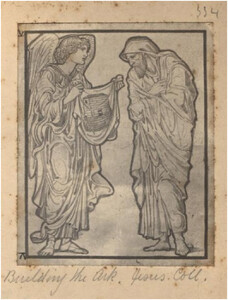
In depictions of David instructing Solomon found in some engravings and windows in the 19th century, David is seen referring to architectural plans of the Temple (Figures 3 and 4). 66 In considering why Burne-Jones instead supplies his Solomon with a picture, it is worth noting that Burne-Jones had already adopted a similar approach some years before, in one of the predella windows he designed for the chapel of Jesus College, Cambridge in 1874 (Figure 8). In this design, Burne-Jones depicts the issuing of the divine instructions to build the ark (Gen 6:14â16) by having an angelic figure present Noah with not an architectural plan or blueprint, but an image of the ark on a cloth. 67 In the design for the Boston window, the image which Burne-Jones has David supply to Solomon is seemingly on paper or board, rather than cloth, and it is monochrome. This then is not merely an artistâs rendering of the temple, but one which closely resembles in both form and medium, Burne-Jonesâ own designs for stained glass, as exemplified by his Noah design (Figure 8). This in turn suggests that beyond the resonance between the subject and the commemoration of Dexter, the window also reflects Burne-Jonesâ conceptualization of his own artistic process. Burne-Jones evidently identifies the crux of the production of a window not in the physical execution of it, but in the artistâs initial rendering, i.e. the monochrome design in pencil or ink. Just as David delivers his monochrome design to Solomon for him to execute by building the temple, so Burne-Jones delivers his monochrome designs for this and other windows to Morris and his glass painters at Merton Abbey for them to execute by producing the window. Indeed, the analogy of the elderly David delivering designs to the younger Solomon seems particularly apt given that by the 1880s, some of the workers at Merton Abbey to whom Burne-Jonesâ designs were delivered were considerably more junior than the artist himself. 68 Curiously, Burne-Jonesâ wife, Georgiana, recollects a photograph of him as a seven year-old boy holding a slate with a drawing of a church on it, suggesting that the drawing of a church and the display of it reflected one of Burne-Jonesâ earliest artistic impulses. 69
Building the Ark, Design for Jesus College Cambridge, Edward Burne-Jones, 1873â74, Huntington Library, San Marino, CA.
Citation: Biblical Interpretation 34, 2 (2026) ; 10.1163/15685152-bja10074
Burne-Jonesâ monochrome rendering of the temple offered by David to Solomonâtaken together with the rendering of the flags as âstained glassâ (whether Burne-Jonesâ idea or Bowmanâs)âoffer an example of the way in which Burne-Jonesâ refraction of the Bible in his stained glass sheds light on the role of the commission, but also the artistsâ contribution to the visual reception of biblical traditions.
3.2 Reflection
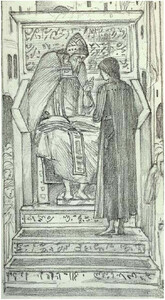
In considering what light Burne-Jonesâ depiction of David instructing Solomon might shed on the biblical traditions themselves, it is worth comparing his finished window with a later sketch of Solomon and David preserved in the âSecret Book of Designsâ (Figure 9). 70
David/Solomon, sketch, Edward Burne-Jones, âSecret Book of Designsâ c. 1886, British Museum (courtesy of The Trustees of the British Museum).
Citation: Biblical Interpretation 34, 2 (2026) ; 10.1163/15685152-bja10074
While the sketchâs angled walls enclosing the steps up to the throne echo the final design of the window (Figure 10), the throne in the sketch itself lacks the peaked canopy found in the earlier window, and unlike in that design, both the canopy and the steps are decorated with what appears to be writing partially resembling paleo-Hebrew. 71 The Solomon of the later sketch resembles the portrayal of him in the earlier window, but it is notable that the sword with which David is furnished in the window is gone or no longer obviously visible in the later sketch. 72 More interestingly, whereas Davidâs verbal instructing of Solomon in the window is signalled by a raised hand and pointed finger and, as we have seen, his other hand displays the image of the temple, in the later sketch, the image of the temple is absent. In the latter, Davidâs hand instead rests on a large book which lies open on his lap. Because the contents of the codex are not visible to the viewer, it is not impossible that Burne-Jones intends the book in this later sketch to contain the law, having in mind Davidâs charge to Solomon in 1 Kgs 2:3 to walk ââ¦in his ways and keep his statutes, and his commandments, and his judgments, and his testimonies, as it is written in the law of Moses.â However, it is equally possible that Burne-Jones intends for the book he included in his later sketch to be seen as containing the plans for the temple which David communicates to the young Solomon in the text (1 Chron. 28:11ff.). If so, Burne-Jonesâ inclusion of a codex in his sketch suggests not a book of blueprints, but more likely plans expressed verbally. This suggestion certainly resonates with, for instance some commentatorsâ view that when Chronicles was written originally, the âplanâ was probably a description in words, rather than a drawingâon analogy with the âplanâ of the tabernacle and candlestick referred to in Exodus 25 (vv. 9, 40). 73 Further encouragement in this direction might be taken from the fact that the words are in fact written out in 1 Chron. 28:11ff and also from the reference to âin writingâ in 1 Chron. 28:19:19 All this, said David, the LORD made me understand in writing by his hand upon me, even all the works of this pattern (KJV). The tacit assumption of some interpreters that the âplanâ (ת×× ×ת) delivered by David to Solomon is to be understood as a written document may also be reflected in the recent tendency to translate it in English as âplanâ (e.g. NIV, NRSV, ESV, JPS [1985]), which can suggest either a written description or a visual presentation.
Detail: Davidâs Throne.
Citation: Biblical Interpretation 34, 2 (2026) ; 10.1163/15685152-bja10074
We have suggested above that Burne-Jonesâ preference for David to present to Solomon a visual elevation of the âtempleâ in his earlier design for Boston may well have reflected Burne-Jonesâ desire to present Davidâs designing of the temple as an analogue to his own designing of windows. It is, however, not impossible that his inclusion of a visual illustration in his design for Boston may also have been encouraged by the fact that Burne-Jonesâ Bible, the King James Version, translated Hebrew ת×× ×ת in 1 Chron. 28, not with âplanââwhich might be verbalâbut âpatternâ, which is decidedly more visual. In any case, Burne-Jonesâ interpretation of the ת×× ×ת as visual, invites a reconsideration of the possibility that the ancient ת×× ×ת may have been visual after all, rather than verbal, as is generally assumed.
In reconsidering this, it is worth recognizing that while the parallels between the giving of the ת×× ×ת of the temple in Chronicles and that of the tabernacle (in Exod. 25:9, 40) are clear, 74 it is rather less obvious that the plans in Exodus were necessarily written in wordsânot least considering that they are not read to Moses, but in fact merely âshownâ (×ר××) to him. 75
The Masoretesâ division of 1 Chron. 28:19 reflects the view that v. 19a and 19b both begin with ×× / ××× âallâ. While it is widely acknowledged that the verse is difficult to decipher, 76 the âallâ of verse 19a seems likely to be the object of the 3rd masculine singular verb âhe made clear/caused to understandâ (×ש×××). It also seems likely that the âheâ who âmade all clearâ is the LORDânot only because the LORD is the final word of the preceding verse (28:18), but also because the âmeâ upon whom the LORDâs hand rests later in the clause (v. 19a) is most plausibly identified as David. 77 It also seems quite evident from verse 19a that the âallâ which âthe LORD made clearâ was âin writing from the hand of the LORD upon meââwith the latter phrase referring to divine empowerment here and elsewhere. 78 Finally, v. 19b offers further clarity regarding what âallâ had been communicated in writing, namely: all the âworks/tasksâ (×××××ת) of the âpattern/planâ (ת×× ×ת). The singular form âworkâ (×××××) appears in the parallel passage (e.g. 1 Chron. 22:15) but also here in Davidâs instructions (e.g. 28:21, 29:1) including in 29:5 with a collective meaning. Here, in 28:19b, unusually, the plural form is used, glossed by HALOT as âjobsâ, which suggests v. 19b might be translated as âall the works/tasks of the pattern/planâ. 79 Crucially, it is the âworks/tasksâ which are made clear in writing from the hand of the LORD (upon David), which suggests the possibility of a distinction between on one hand, a written record of the âworks/jobsâ necessary to realize the ת×× ×ת âpattern/planâ delivered to/by David and, on the other hand, the ת×× ×ת or âpatternâ itself which might take another form, including a visual one.
The possibility that 1 Chronicles invites the ancient reader to imagine the ת×× ×ת not as verbal description but as visual design is strengthened by the widespread use of visual building elevations and plans in the Ancient Near East. Both types of visual aids were produced in Egypt, 80 including, for example, the plan for the tomb of Rameses IV found on the Turin papyrus. 81 In Mesopotamia, one finds ground-plans of houses, with openings in the walls clearly noted, and also elevations, for instance of a ziggurat, with its dimensions again clearly marked. 82 On the basis of this, and archaeological evidence of planning in ancient Israel, it is not unreasonable to conclude with Isserlin that building plans were likely used in Israel and that they may have had dimensions annotated, given that passages like 1 Kgs 6 (and 2 Chron. 3) supply the measurements of the temple David instructs Solomon to build. 83 Burne-Jonesâ provision of David with the visual aid of an elevation of the temple in instructing Solomon to build it encourages biblical scholarship to remain open to the possibility that this is how the ancient author of Chronicles would have intended the ת×× ×ת to be understood by their reader.
4 Window as Reception and Reception as Window
In the present study, we have attempted to offer a brief glimpse of the riches which remain to be unearthed by studying the reception of the Bible in stained glass. There is much work still to be done even in measuring the depth and breadth of this vein, which has been growing since the medieval period and continues to expand, if more slowly, right up to the present day, not only in Europe and North America, but around the world. 84 Burne-Jonesâ David Instructing Solomon has been presented here as but one example of what may be extracted from this rich vein when we consider a stained-glass window as reception. However, the present study has also offered some ways of mining such jewels, by suggesting the notion of reception as window. As we have seen, such a metaphor invites consideration of how a visual interpretation of the Bible might both refract biblical tradition but also reflect light back on the biblical text, illuminating aspects which have been previously neglected or overlooked. Thus, Brooksâ likely role in selecting the subject of David Instructing Solomon and Burne-Jonesâ monochrome visual rendering of the temple and the rendering of the flags as âstained glassâ serve as examples of how the refraction of the Bible in the window is illuminated by exploring the donorâs commissioning and the artistsâ designing and making of the window. At the same time, Burne-Jonesâ inclusion of the visual aid of an elevation of the temple invites a renewed reflection on the ancient text of Chronicles and the possibility that the ת×× ×ת might have been understood in antiquity as a visual plan after all, rather than a verbal one. Whether future studies focus on refraction or reflection or both, the hope is that the present study will encourage a fuller appreciation of the riches of biblical stained glass for both biblical reception and art history. 85
M. H. Caviness, âBiblical stories in windows: were they Bibles for the poor?â in B.S. Levy (ed.), The Bible in the Middle Ages: its Influence on Literature and Art (Binghamton: ACMRS Press, 1992), pp. 103â 47. Caviness also notes that the height at which some of the biblical imagery was positioned made it unintelligible from the ground. However, H. L. Kessler, ââConsider the Glass, It Can Teach Youâ: the Mediumâs Lessonâ, in B. Kurmann-Schwarz and E. Pastan (eds.) Investigations in Medieval Stained Glass (Leiden: Brill, 2019), pp. 143â56, suggests that the lightâs illumination of biblical scenes through the glass underscored the divine illumination and incarnation of scripture, however unintelligible the detail may have been in some cases.
These numbers are drawn from the excellent database developed by Martin Crampin: https://stainedglass.wales/catalogue/, which contains images and details of many stained-glass windows in Wales.
Based on the approximately 800 windows noted in M. Crampin, Stained Glass from Welsh Churches (Talybont: Y Lolfa, 2014).
Figures based on data recorded on https://www.stainedglassrecordings.org.uk/; This classifies windows referring to the virtues (e.g. charity, hope) as biblical, but excludes windows depicting only angels unless they are clearly those named in the biblical tradition.
As of 05.06.25 a total of 17,159 windows were recorded in the counties of Berkshire, Buckinghamshire, Essex, Surrey, Kent, Sussex and Hertfordshire (https://www.stainedglassrecordings.org.uk/). If 85% of these windows contain biblical imagery, it suggests a total of 14,584 biblical windows.
For an illustration of the extent of this reuse see the âIndex of Subjectsâ in A. C. Sewter, The Stained Glass of William Morris and his Circle: A Catalogue (New Haven: Yale University Press, 1975).
Caviness, âBiblical storiesâ.
W. Kemp, The Narratives of Gothic Stained Glass (trans. C. D. Saltzwedel, Cambridge: Cambridge University Press, 1997).
J.-P. Deremble and C. Manhes, Les vitraux légendaires de Chartres: des récits en images (Paris: Desclée de Brouwer, 1988). C. Manhes-Deremble, Les vitraux narratifs de la cathedrale de Chartres: Etude iconographique (Paris: Le Léopard d'Or, 1993).
A. A. Jordan, Visualizing Kingship in the Windows of the Sainte-Chapelle (Turnhout: Brepols, 2002).
For a fuller discussion of these and other contributions to the ânarrative turnâ see the excellent discussion in A. A. Jordan, âStories in Windows: the Architectonics of Narrativeâ, in B. Kurmann-Schwarz and E. Pastan (eds.) Investigations in Medieval Stained Glass (Leiden: Brill, 2019), pp. 189â201.
M. Harrison, Victorian Stained Glass (London: Barrie & Jenkins, 1980).
Biblical imagery is even more vividly illustrated in the volumes by William Waters and Alastair Carew-Cox, published by Seraphim Press in Abbots Morton: Angels & Icons: Pre-Raphaelite Stained Glass, 1850â1870 (2012); Damozels & Deities: Edward Burne-Jones, Henry Holiday & Pre-Raphaelite Stained Glass: 1870â1898 (2017); Saints & Symbols: Pre-Raphaelite Stained Glass; Ford Madox Brown, John George Sowerby, William De Morgan, Walter Crane & Frederic Shields (2021).
See e.g. J. Cheshire, Stained Glass and the Victorian Gothic Revival (Manchester: Manchester University Press, 2004); J. Allen, Windows for the world: nineteenth-century stained glass and the international exhibitions, 1851â1900 (Manchester: Manchester University Press, 2018). P. Cormack, Arts & Crafts Stained Glass (London: Paul Mellon/Yale University Press, 2015).
See recently, A. Rager, The Radical Vision of Edward Burne-Jones (London: Paul Mellon/Yale University Press, 2022), pp. 252ff where she takes up Burne-Jonesâ biblical windows in Hawarden and at St. Philips in Birmingham and see also J. Cheshire, âWhat does Victorian stained glass mean?â, in M. Kirby (ed.) Stained Glass Revivals: Proceedings of the Ecclesiological Society Conference, Volume 5, London Conference, 2023. (London: Ecclesiological Society, 2025), pp. 65â91, for a recent and illuminating example of the role of donors in the imagining of the Bible in Victorian stained glass. For more wide-ranging treatments of stained glass over time which reference biblical iconography see V. Cheiffo Raguin, The Illuminated Window: Stories Across Time (London: Reaktion Books, 2023) and especially M. Crampin, Stained Glass from Welsh Churches.
One notable exception is the survey found in C. Rogers, ââFor thine is the kingdomâ: Portraying the Bible in Nineteenth Century Stained Glassâ, in S. Prickett (ed.), Edinburgh Companion to the Bible and the Arts (Edinburgh: Edinburgh University Press, 2014), p. 327â345.
For a very useful and recent survey of biblical reception in visual art which references these categories and her own approach, see Morseâs contribution in D. Rooke, H. Morse and D. J. Shepherd, âReception of the Hebrew Bible in Music, Visual Art, Literature, and Filmâ, in J. Barton (ed.), Understanding the Hebrew Bible: Essays by Members of the Society for Old Testament Study (Oxford: Oxford University Press, 2025), pp. 361â76.
M. OâKane, Painting the Text: The Artist as Biblical Interpreter (Sheffield: Sheffield Phoenix Press, 2007).
See for instance the following in the Bible in the Arts/Bibel in der Kunst (https://www.die-bibel.de/en/bible_in_the_arts), which for some reason have focused on the Hebrew Bible and largely on the prophets: K. Koenen, âAmos in der bildenden Kunst: Hirte, Gelehrter, Sozialkritiker, Unheilsbote, Heilsbote, Christusbote (Teil 1)â, Die Bibel in der Kunst / Bible in the Arts 4 (2020); K. Koenen, âAmos in der bildenden Kunst: Hirte, Gelehrter, Sozialkritiker, Unheilsbote, Heilsbote, Christusbote (Teil 2)â, Die Bibel in der Kunst / Bible in the Arts 5 (2021); R. Kessler, âMicha in der bildenden Kunst: Heilsprophet, Gerichtsprophet, Mahnerâ, Die Bibel in der Kunst / Bible in the Arts 6 (2022); H.-J. Fabry, âHabakuk in der bildenden Kunst: Visionär, Ankläger Gottes und unermüdlicher Beterâ, Die Bibel in der Kunst / Bible in the Arts 6, (2022); B. A. Anderson, âVisualising the (Invisible) Prophets: Artistic Strategies for Representing Joel and Obadiah in Christian and Western Traditionsâ, Die Bibel in der Kunst / Bible in the Arts 7 (2023). For treatments of Solomon and Ezra-Nehemiah see: K. Koenen, âBildliche Darstellungen Salomos in Kirchen und anderen öffentlichen Räumenâ, Die Bibel in der Kunst / Bible in the Arts 1 (2017); Maria Häusl, âEsra schreibend und Nehemia bauend. Die Bücher Esra und Nehemia in (christlichen) Bildernâ, Die Bibel in der Kunst / Bible in the Arts 5 (2021).
K. Koenen, ââBiblische Theologieâ im Kölner Domâ Die Bibel in der Kunst / Bible in the Arts 3 (2019); K. Koenen, âDaniel â Adenauer â Hitler. Das alttestamentliche Bildprogramm zum Gesang der Jünglinge im Feuerofen (Dan 3) von Franz Pauli in St. Nikolaus, Brauweilerâ Die Bibel in der Kunst / Bible in the Arts 7 (2023).
B. Rotach, Moses Quellwasserwunder: Ex 17 und Paraschat Chukkat (Num 20) in Jüdischen und Christlichen Bildrezeptionen (Studies of the Bible and its Reception 18; Berlin: De Gruyter, 2024).
For instance, M. Hayes, Seeing ourselves in stained glass â a comparative study of nineteenth and twentieth-century Irish stained glass. (https://dspace.mic.ul.ie/handle/10395/2061?show=full), PhD. Diss. Mary Immaculate College, Limerick, 2016, compares the iconography of the 20th century stained glass of the Roman Catholic Loughrea Cathedral and the Honan Chapel (Cork) with the 19th century biblical glass of St. Fin Barreâs (Church of Ireland) Cathedral in Cork; see also J. Rogers, âThe Honan Chapelâs St John Window: Journey of the Beloved Discipleâ, in S. Ryan and L.M. Tracey (eds.), The cultural reception of the Bible: explorations in theology, literature and the arts: essays in honour of Fr. Brendan McConvery CSsR (Dublin: Four Courts Press, 2018), pp. 240â48; S. Huws, The Virgin Mary as the Window of Heaven: Reception of the Bible in Marian Stained Glass from Luke-Acts, Dublin, 1850â1932. PhD Diss. Trinity College Dublin, 2025, surveys stained-glass depictions of Mary in Protestant and Catholic churches in Dublin, exploring, amongst other things, their dependence on antecedent literary and visual traditions and the interplay between text and image in the windows. Considerable attention is also afforded to the Bible in stained glass in, for instance, M. OâKane and J. Morgan-Guy (eds.) Biblical Art from Wales (Sheffield: Sheffield Phoenix Press, 2010). See esp. N. Gordon Bowe, âInterpreting the Bible through Painted Glass: The Harry Clarke Studios and Wilhelmina Geddes (1887â1955)â (pp. 205â216); A. Smith, âLight, Colour and the Bible: The Stained Glass Windows of John Petts (1914â91)â (pp. 217â234), but also L. J. Kreitzer, âImages of the Apostle Paul in Nineteenth and Twentieth-Century Walesâ, (pp. 235â252) and M. Crampin, âBiblical Art from Wales: The Mediaeval Influenceâ, (pp. 120â137).
F. C. Black and J. C. Exum, âSemiotics in Stained Glass: Edward Burne-Jonesâs Song of Songsâ, in J. C. Exum and S. D. Moore (eds.), Biblical Studies/Cultural Studies: The Third Colloquium. Sheffield: Sheffield Academic Press, 1998, pp. 315â342. While there is no entry relating to this window in Burne-Jonesâ account book, this is true of other designs known or strongly suspected to have been produced by him, and as Sewter, Catalogue, p. 60 notes, their style bespeaks Burne-Jones as surely as the emblems, lettering and borders reflect the work of Philip Webb, even though this work too is missing from the latterâs account book.
For a summation and differentiation from other approaches, see J. C. Exum, Art as Biblical Commentary: Visual Criticism from Hagar the Wife of Abraham to Mary the Mother of Jesus (London: T & T Clarke/Bloomsbury, 2019), pp. 6â7.
Black and Exum, âSemiotics in Stained Glassâ, pp. 340â42.
Ibid, p. 340.
M. Krieger, A window to criticism: Shakespeareâs Sonnets and modern poetics (Princeton: Princeton University Press, 1964).
See, for instance, N. Petersen, Literary Criticism for New Testament Critics (Philadelphia: Fortress, 1978), p. 19.
E.g. S. M. Schneiders, The Revelatory Text: Interpreting the New Testament as Sacred Scripture (San Francisco: HarperSanFrancisco, 1992), p. 11.
Ibid.
A. Chesterman, and E. Wagner, Can Theory Help Translators?: A Dialogue Between the Ivory Tower and the Wordface (2nd ed.; New York: Routledge, 2014), p. 28.
W. Durandus, Rationale divinorum officiorum, 1.1.24. (transl. J. M. Neale and B. Webb, The Symbolism of Churches and Church Ornaments). (Leeds: T. W. Green, 1843).
See most famously, Ps. 119:105: âYour word is a lamp to my feet and a light to my pathâ, but compare also Ps. 119:130 and Prov. 6:26.
For example, see M. Harrison and W. Waters, Burne-Jones (London: Barrie & Jenkins, 1973), for the influence of Andrea del Sartoâs treatment of the Sacrifice of Isaac (c. 1527) on Burne-Jonesâ predella window of the same subject for Jesus College Cambridge (1874).
Black and Exum, âSemiotics in Stained Glassâ, p. 340.
Ibid.
Black and Exum, âSemiotics in Stained Glassâ, pp. 325â342.
Black and Exum, âSemiotics in Stained Glassâ, 319â21.
Ibid.
As noted by Morse, âReception of the Hebrew Bibleâ, p. 366.
See J. C. Exum, Art as Biblical Commentary, pp. 10â11, for questions relating to the relationship between text and visual interpretation and the latterâs illumination of the former.
R. Karo, âThe Stained-Glass Windows: Parish Memorialsâ, in B. A. Norton (ed.), Trinity Church: The Story of An Episcopal Parish in the City of Boston (Boston: The Wardens & Vestry of Trinity Church in the City of Boston, 1978), p. 44.
Ibid., p. 45.
For more on Redmond and the Cary window see C. Staples, âA Glimpse into the Life of Margaret Redmondâ, in (ed. C. Staples) From the Historian (https://trinitychurchboston.org/from-the-historian-touches-of-scarlet-2); Nov 15, 2022.
This number has been arrived at by identifying all biblical subjects attributed to Burne-Jones in the âChronological check-list of principal designsâ in Sewter, Catalogue, Appx. V and in D. Schoenherr, âAnnotated checklist of Edward Burne-Jonesâ designs for Morris & Company in order of entry in his Account Booksâ Journal of Stained Glass XXXV (2011), pp. 184â239. For the Pre-Raphaelite Brotherhoodâs mid-19th century contribution see M. Giebelhausen, Painting the Bible: Representation and Belief in Mid-Victorian Britain (Ashgate: Farnham, 2006/Routledge: Abingdon, 2016).
Burne-Jones designed at least 10 original depictions of David, beginning with the figure of David for Bradford Cathedral Church of St. Peter around 1863 and ending with David Lamenting and David Consoled for St. Cuthbert (Newcastle-on-Tyne) in 1896.
See, for instance, the depictions of the figure of David in Bradford (Cathedral), Torquay (St John), Glasgow (Townhead), Calcutta (Cathedral), Walthamstow (Forest School), Ashton-under-Lyne (Albion Congregational Church).
Manchester Courier and Lancashire General Advertiser, 31 Oct 1882, p. 5.
Unlike 1 Chron. 22, both Burne-Jonesâ scene and 1 Chron. 28 include an extensive audience for Davidâs instructing of Solomon and both also foreground Davidâs provision of a pattern/plan. For a useful and concise outlining of other differences and some similarities, see R. Braun, 1 Chronicles (Waco, TX: Word Books, 1986), pp. 267â68.
See Sewter, Catalogue, p. 224.
B. A. Norton (ed.), Trinity Church: The Story of An Episcopal Parish in the City of Boston (Boston: The Wardens & Vestry of Trinity Church in the City of Boston, 1978), pp. 30â32. For Dexterâs contribution to residential development in Boston, see B. Bunting, Houses of Bostonâs Back Bay (Cambridge, Mass.: Belknap/Harvard University Press, 1967).
A. V. G. Allen, Life and Letters of Phillips Brooks (Vol. 2; New York: Dutton and Company, 1900), pp. 151â152.
Ibid., p. 335: âIn London he went to Stanleyâs grave and had much talk about him with Lady Frances Baillie. He called upon Burne-Jones, the artist, and William Morris, the poet.â
Phillips Brooks, Davidâs Prayer for Solomon: A Sermon Preached at the Request of the American Sunday-School Union, in the Church of the Holy Trinity, Philadelphia, on Sunday Evening, June 5, 1864 (Philadelphia, American Sunday School Union, n.d), pp. 5â6.
Cassellâs Illustrated Family Bible (London, Paris, New York: Cassell, Petter and Galpin, 1880).
For instance, this scene and the text of 1 Chron. 28:10 are included not only in a Lavers, Barraud & Westlake window from the 1860s in St. Maryâs, Ashford, in Kent (Figure 4), but also in a window in the nave of St. Michael and All Angels in Mitcheldean, Gloucestershire, produced by Bell & Son in 1862.
So Waters (and Carew-Cox), Damozels and Deities, p. 96, who also notes that Burne-Jonesâ original intention to have the singers looking down on both sides of his painting was even more similar to the composition of the window.
See e.g., M. Bell, Sir Edward Burne-Jones: A Record and Review (London, G. Bell & Sons, 1901), pp. 54â55, who notes that âthe armour of the king and his attendant knights is frankly mediaeval in designâ¦â an aesthetic decision which Bell proceeds to defend against what he sees as futile attempts to recreate more original and ancient portrayals. Bell was as conscious as Burne-Jones himself was of how the biblical illustrations of James Tissot, who had travelled to Palestine, laid claim to an âauthenticityâ which was seen as lacking in more obviously anachronistic portrayals. For more on Tissotâs biblical illustrations see M. E. Buron, âTwixt two worlds: the visions of James Tissot. PhD Diss. Birkbeck College, 2022, pp. 139â185. For Burne-Jonesâ views of these illustrations see M. Lago (ed.), Burne-Jones Talking: his conversations 1895â1898 preserved by his studio assistant Thomas Rooke (Columbia: University of Missouri Press, 1981), pp. 96â97.
This may be contrasted with Burne-Jonesâ earlier predella window for Christ Church Oxford (1872) which depicts the moment before David beheads Goliath and with which the scene on the banner has very little in common. The resemblance of Goliathâs head on the banner to Burne-Jonesâ employer and friend, William Morris, may be no coincidence (https://glessnerhouse.blogspot.com/2020/07/#:â¼:text=The%20year%201882%20also%20saw,than%20that%20of%20William%20Morris). Burne-Jones was fond of caricaturing Morris (see for instance the album of caricatures in the British Museum, 1939, 0513.13 [https://www.britishmuseum.org/collection/object/P_1939-0513-13)] and regularly complained in his account book about what he saw as the miserly remuneration he received from Morris for his designs.
While the slaying of Goliath might illustrate Davidâs status as a man of war, the blood which the deity views as disqualifying David from building the temple is âinnocentâ and thus not Goliathâs. See D. J. Shepherd, King David, Innocent Blood, and Bloodguilt (Oxford: Oxford University Press, 2023), pp. 1â2.
The shape of the sword and scabbard even more closely resembles the one included by Burne-Jones in his design of this scene for St. Patrickâs Cathedral, Dublin in 1875, currently in the collection of the Fitzwilliam Museum (#1234 in the Holiday Bequest).
According to the entry in the catalogue of designs, dated February 1883 (so Sewter, Catalogue, p. 224).
For contextualization of Robertsâ work see W. D. Davies, E. M. Meyers and S. W. Schroth, (eds.), Jerusalem and the Holy Land Rediscovered: The Prints of David Roberts (1796â1864) (Durham, NC: Duke University Museum of Art, 1996) and more recently, U. Baram. âImages of the Holy Land: The David Roberts paintings as artifacts of 1830s Palestineâ, Historical Archaeology 41 (1) (2007), pp. 106â117.
See J. Bronkhurst, William Holman Hunt: A Catalogue Raisonné, L105, who notes that the drawing is of the cornice on the Crusader façade of the south transept (entrance) of the Church.
For more on orientalism in 19th century biblical art see A. M. Burritt, Visualizing Britainâs Holy Land in the Nineteenth Century (Cham: Palgrave Macmillan/Springer, 2020).
A window depicting Solomon building the temple which Burne-Jones designed for St John the Baptist Church, Kentish town, 1863 [subsequently moved to Exeter College, Oxford] includes architectural plans and is paired with a depiction of Noah building the ark which includes both model and architectural plans. Ford Madox Brownâs predella scene for Jesus College Cambridge (1872) of Solomon building the temple also includes an impressive front elevation in blueprint form.
The scene and the presentation of the image on a cloth resonates most clearly with depictions of Veronica displaying the image of Jesusâ face on a veil or cloth. While it was only later that Burne-Jones designed a window depicting Veronica and her cloth (Whitelands College Chapel, 1891), similar depictions have a long history (see K. T. Brown, The Legend of Veronica in Early Modern Art (New York: Routledge, 2020)).
John Henry Dearle, for instance, was 26 years younger than Burne-Jones. For a list of glaziers and glass painters employed by the Morris firm based on the âCatalogue of Designsâ, see A. C. Sewter, The Stained Glass of William Morris and his Circle (New Haven and London: Yale University Press, 1974), p. 101 and for much fuller information see especially, T. Benyon, âStained glass workers employed by James Powell & Sons and by Morris, Marshall, Faulkner & Company and Morris & Company: a biographical listingâ, Journal of Stained Glass XXXV (2011), pp. 242â256.
G. Burne-Jones, Memorials of Edward Burne-Jones: Volume 1, 1833â1867 (London: MacMillan and Co. Limited, 1904), pp. 10â11.
British Museum (1899, 0713.446).
The script is clearly different from the one which is produced by the crouching scribe who seems to be recording the gifts for the temple.
While it is possible that the pommel of the hilt of a sword is visible in the sketch, the rest of the sword clearly is not.
E. L. Curtis and A. A. Madsen, The Books of Chronicles (Edinburgh: T. & T. Clark, 1910), p. 298.
See for instance Curtis and Madsen, Chronicles, p. 298; R.W. Klein, 1 Chronicles (Minneapolis, MN: Fortress Press, 2006), p. 524; Braun, Chronicles, p. 272.
Braun, Chronicles, p. 272, also notes that Yahweh âshowsâ the ת×× ×ת to Moses.
So Curtis and Madsen, Chronicles, p. 299. For discussion of earlier (esp. German) commentary on the verse see J. W. Rothstein and D. J. Hanel, Das erste Buch der Chronik (Kommentar zum Alten Testament 18/2; Leipzig: Deichert, 1927).
This severely complicates the suggestion of Braun, Chronicles, pp. 266â267, that David is the verbal subject and the one who is doing the clarifying.
Curtis and Madsen, Chronicles, p. 299; Klein, 1 Chronicles, p. 527.
L. Koehler, W. Baumgartner and J. J. Stamm, The Hebrew and Aramaic lexicon of the Old Testament. (Leiden: Brill, 2001).
See, for example, A. Badawy, Ancient Egyptian Architectural Design (Berkeley and Los Angeles: University of California Press, 1965), pp. 35ff. and idem, Le Dessin Architecturel Chez Les Anciens Egyptiens (Cairo: Imprimerie Nationale, 1948). See also S. Clarke and R. Engelbach, Ancient Egyptian Masonry. The Building Craft (London: Humphrey Milford/Oxford University Press, 1930), pp. 46ff. and the article by D. Arnold, âBaupläneâ, in W. Helck and E. Otto (eds.), Lexikon der Agyptologie 1, cols. 661â3.
While the plan is not to scale, it does include measurements. See H. Carter and A.H. Gardiner, âThe tomb of Ramesses IV and the Turin plan of a royal tombâ, Journal of Egyptian Archaeology 4 (1917), pp. 130â158.
For the former see British Museum 38217 (probably originating from Babylon) and for the latter see the reverse of British Museum 46740. For discussion of these see D. J. Wiseman, âA Babylonian Architect?â Anatolian Studies 22 (1972), pp. 141â147 and E. Heinrich and U. Seidl, âGrundriÃzeichnungen aus dem Alten Orientâ, MDOG 98 (1967), pp. 24â45 and for more recent bibliography, see M. Gruber and M. Roaf, âAlternative Interpretations of the Early Mesopotamian Building Plan on Rtc 145â, Revue d'assyriologie et d'archéologie orientale 110(1) (2016), pp. 35â52.
B. S. J. Isserlin, âIsraelite Architectural Planning and the Question of the Level of Secular Learning in Ancient Israelâ, Vetus Testamentum 34 (1984), pp. 169â178 (esp. p. 175).
For further glimpses of these riches see, for example, the primarily medieval windows imaged on www.therosewindow.com and the 19th and 20th century windows in Ireland on www.gloine.ie.
This study thus echoes and begins to answer the welcome call for a greater literacy regarding the theological content of 19th century stained glass and its biblical references in J. Allen, G. Atkins and K Nichols, âRoundtableâ in âReframing Stained Glass: Culture, Aesthetics, Contextsâ, 19: Interdisciplinary Studies in the Long Nineteenth Century 30 (2020) doi: https://doi.org/10.16995/ntn.3013. While biblical iconography remains largely illustrative in this themed issue on stained glass, the interdisciplinary vision of the contributions and the editorsâ introduction is very promising.
Acknowledgement
This article is dedicated to the memory of J. Cheryl Exum (1946â2024) whose work in biblical studiesânot least on the visual reception of biblical textsâwas so instructive and inspirational for so many, including the present author.