Abstract
In 111
Literature Review
In 111
The first hypothesis (hereafter Hypothesis 1), proposed by Henri Maspero, holds that the Leilou Citadel was located south of Hanoi. Maspero cited a note in Yuanhe junxian tuzhi (å åé¡ç¸£åå¿) that suggested that Leilou was located 75 li (é) northwest of the Tangâs Protectorate Citadel.1 This hypothesis, however, has been criticized for its lack of evidence, as it relies on a single piece of evidence.2
The second hypothesis (hereafter Hypothesis 2, simplified as âLÅ©ng Khê = Leilouâ), proposed by Claude Madrolle based on fieldwork by Henry Wintrebert, holds that the Leilou Citadel was located at the same place as the later LÅ©ng Khê Citadel (Thuáºn Thà nh, Bắc Ninh).3 This hypothesis has been backed and developed by many other scholars,4 based on the following sources. First, Viá»t sá» thông giám cÆ°Æ¡ng mục (è¶å²éé綱ç®) and Äại Nam nhât thông chà (大åä¸çµ±å¿), compiled under the Nguyá» n (1802â1945), both affirm that the LÅ©ng Khê Citadel was the Leilou Citadel under Han rule. Second, Viá»t Äiá»n u linh (ç²µç¸å¹½é), compiled under the Trân (1225â1400), suggests that Shi Xie (士ç®, Vietnamese: SÄ© Tiêp/Nhiêp, 137â 226), the head of Jiaozhi Commandery, based his headquarters in Leilou. Ngụy Viá»t ngoại ká»· (å½è¶å¤ç´), cited in Annan zhi(å®åå¿), which was compiled under the Ming (1368â1644), also states that Shi Xie built the Leilou Citadel. In fact, the inner and surrounding areas of the LÅ©ng Khê Citadel include many relics and legends related to Shi Xie. Also, as Sakurai Yumio observed, the view that Leilou was located at LÅ©ng Khê does not contradict the notes on rivers in Shuijing zhu (æ°´ç¶æ³¨).5
Based on Hypothesis 2, scholars such as Äá» VÄn Ninh argue that the Leilou Citadel was also the Longbian Citadel under the Han, and that both were the same as the LÅ©ng Khê Citadel (hereafter Hypothesis 3, simplified as âLÅ©ng Khê = Leilou = Longbianâ). The equation of Leilou with Longbian is based on records in Äại Viá»t sá» ký toà n thÆ° (Toà n thÆ°) (大è¶å²è¨å ¨æ¸).6 However, this hypothesis was criticized by Trân Quôc Vượng because in many historical documents from the Han to the Song period (960â1279), Leilou and Longbian are described as two different administrative units.7
In 2011, based on his excavation at LÅ©ng Khê, Nishimura Masanari proposed a new theory, arguing that the LÅ©ng Khê Citadel is the Longbian Citadel, and both are distinct from the Leilou citadel (hereafter Hypothesis 4, simplified as âLÅ©ng Khê = Longbian â Leilouâ). Nishimuraâs hypothesis is based on three lines of reasoning. First, although he did not pursue an in-depth analysis, Nishimura did question the reliability of historical documents (the earliest being Viá»t Äiá»n u linh) that hold that LÅ©ng Khê was Leilou. Second, in reference to Jiaozhou department heads such as Bu Zhi (æ¥é¨), Nishimura recognized that these mandarinsâ titles often included the names of the places where they established their headquarters. As Shi Xie received the title of âLongbian marquessâ (é¾ç·¨ä¾¯), Nishimura believed that Shi Xieâs headquarters was at Longbian. Therefore, the LÅ©ng Khê Citadel, with many relics and legends associated with Shi Xie, should be at Longbian, not Leilou. Third, results from archaeological excavations by Nishimura and Vietnamese archaeologists have also suggested that the LÅ©ng Khê Citadel was occupied in the period between the Late Han (25
A review of the literature on the LeilouâLongbianâLÅ©ng Khê question highlights several shortcomings. First, when discussing the issue of Leilou and Longbian, it is crucial to note that Leilou and Longbian were the headquarters of the Jiaozhi Commandery. As will be discussed in the second section of this paper, under Han rule there were two parallel administrative units in the region: the Jiaozhi Commandery and the Jiaozhi Department, headed respectively by the Jiaozhi taishou (交趾太å®) and the Jiaozhi cishi (交趾åºå²). Differentiating between the two headquarters of these two administrative units, the author will analyze their relationship, changes in their location over time, and the relationship between Leilou, Longbian, and Shi Xie.
Second, although many works mention Leilou and Longbian, no study has offered a comprehensive and systematic analysis of the relevant historical records. Information about Leilou and Longbian is distributed across a tremendous amount of material dated between the early Common Era and the early twentieth century. Within this vast historical time span, it seems that at certain points, in addition to the original data, some misinformation about LeilouâLongbian emerged and was later taken to be reliable. The subsequent use and interpretation of the original data and the later misleading information has yielded sedimentary layers of material in conflict with each other. It is difficult to locate Leilou and Longbian without properly distinguishing these layers. Indeed, it was the accumulation of undifferentiated historical and nonhistorical data that gave rise to the diverse hypotheses on Leilou, Longbian, and LÅ©ng Khê.
In this context, Nishimura Masanari proposed some important steps toward solving the problem by combining archaeological evidence with written records. Based on the existing scholarly literature and particularly the ideas advanced by Nishimura, the author will try to separate the accumulated data into the sedimentary layers that led to each hypothesis. The author thereby attempts to recover the original sources in order to shed further light on the issue of Leilou and Longbian.
The Headquarters of the Jiaozhi Commandery and the Jiaozhi Department
To clarify the relationship between Leilou and Longbian, it is important to distinguish between two administrative units, the Jiaozhi Commandery and the Jiaozhi Department, and their respective headquarters.
The name Jiaozhi originated from the name of one of the two commanderies established on the territory of Ãu Lạc (çé) by the Nanyue Kingdom, namely, Jiaozhi (交趾) and Jiuzhen (ä¹ç). The Nanyue administrated the two commanderies via two representatives, known as the âtwo envoysâ (äºä½¿è
). After the conquest of the Nanyue in 111
In parallel with the Jiaozhi Commandery, the Han established a new administrative unit with the same name, the Jiaozhi Department.9 Five years after the conquest of the Nanyue, in 106
Thus, under Han rule, in the period between 106
As highlighted above, the headquarters of the Jiaozhi Commandery was the commandery center (é¡æ²» or é¡å®) of the Jiaozhi taishou. The headquarters of the Jiaozhi Department, meanwhile, was the department center (å·æ²») of the Jiaozhi cishi (and later the Jiaozhou cishi). As the Jiaozhi cishi ruled over all seven commanderies, the department center could have been located anywhere within the boundaries of the seven commanderies. The headquarters of the Jiaozhi taishou, however, had to be somewhere within the boundaries of the Jiaozhi Commandery. The following paragraphs trace the shifting location of the headquarters of the Jiaozhi Commandery and the Jiaozhi Department.
According to Jiaozhou waiyuji (交å·å¤åè¨), cited in Shuijing zhu, initially the headquarters of both the Jiaozhi Commandery and the âoriginalâ headquarters of the Jiaozhi Department (å·æ¬æ²») were located in Miling County.12 Wang Fanâs (çç¯) Jiaoguang chunqiu (交廣æ¥ç§), written under the Western Jin (265â420) and cited in Shuijing zhu, holds that in 106
Many texts mention that Zhou Chang (å¨æ) moved the headquarters from Leilou to Longbian in the first half of the second century. However, it is vital to clarify that what was moved was the headquarters of the Jiaozhi Commandery or the Jiaozhi Department. According to Jiu Tangshu (èåæ¸) and Taiping huanyu ji (太平ç°å®è¨), Zhou Chang was the Jiaozhi taishou, and the relocation from Leilou to Longbian was the relocation of the commandery center (é¡å®).14 Therefore, this event was the relocation of the headquarters of the Jiaozhi Commandery. This evidence shows that by the time of Zhou Chang, the headquarters of the Jiaozhi Commandery was no longer in Miling, but Leilou. This may be confirmed by the remark in Hanshu (æ¼¢æ¸) that Leilou was the most important county of the Jiaozhi Commandery.15 In addition, Zhou Chang relocated the headquarters of the Jiaozhi Commandery from Leilou to Longbian, and consequently in Hou Hanshu (å¾æ¼¢æ¸) Longbian was listed as the leading county of the Jiaozhi Commandery.16
Furthermore, according to Jinshu (ææ¸), in 141
Based on the texts cited above, Table 1 summarizes the changes in the location of the headquarters of the Jiaozhi Commandery and the Jiaozhi Department.
As seen in Table 1, prior to the tenth century, there is no historical evidence that after the term of Zhou Chang, the headquarters of the Jiaozhi Commandery was relocated back to Leilou. In other words, there is no indication that Shi Xie (137â226) made Leilou his headquarters.
Second, Leilou and Longbian could not have been the same county (縣) (Leilou â Longbian). As illustrated in Table 1, in both Hanshu and Hou Hanshu, Leilou and Longbian were listed as two distinct counties. Shuijing zhu (compiled in the early sixth century
However, after Vietnam became independent from China in the tenth century, a new opinion emerged in Toà n thÆ°, according to which Leilou was the same as Longbian (âLeilou = Longbianâ). In Toà n thÆ°, the chapter on Shi Xie states, â(Shi Xie) was appointed Jiaozhou taishou, received the title of Long Äá» Äình hâu (é¾åº¦äºä¾¯), and situated his headquarters in Leilou (also known as Longbian).â With the words âLeilou (also known as Longbian),â Toà n thÆ° established the equation âLeilou = Longbian.â As Toà n thÆ° was the official historical book of the state, the idea of âLeilou = Longbianâ was officially and widely accepted from the fifteenth century onward. And in the twentieth century, some scholars, notably Äá» VÄn Ninh, building on Toà n thÆ°, put forth Hypothesis 3: âLeilou = Longbian.â22
Relocations of the headquarters of the Jiaozhi Commandery and the Jiaozhi Department

The view that âLeilou = Longbian,â however, was evidently in conflict with the idea that Leilou â Longbian, which is well established in earlier sources, including Hanshu, Hou Hanshu, Shuijing zhu, and Jiu Tangshu. Thus, the earliest sources provide no support for Hypothesis 3: âLeilou = Longbian.â
Leilou in Historical Records
Tested against materials written before the tenth century, Hypothesis 3 does not hold water. Leilou and Longbian under the Han were two different citadels. Before considering the relationship between Leilou, Longbian, and the Lũng Khê Citadel, it is necessary to review the locations of Leilou according to pre-tenth century literature.
Before the Tenth Century: Leilou Located in the West of Hanoi
Generally speaking, before the tenth century, it was believed that the Leilou Citadel and Leilou County in the Han were located west of Hanoi.
Although Leilou County was established during the Han and existed until the sixth century
Previously, scholars dismissed what was written in Yuanhe junxian tuzhi as unreliable, because it is the only historical record that suggests that Leilou was situated west of Hanoi.25 However, several other sources also indicate that Leilou County under the Han was to the west of Hanoi. Jiu Tangshu states that part of Leilou County of the Han overlapped with Jiaozhi County of the Tang after 627
The territory of Jiaozhi County under the Tang Dynasty partly overlapped with the area northeast of Hanoi. According to Jiu Tangshu, 10 li (5 km) to the northeast of the Protectorate Citadel was Fusheng (ç¦ç), which belonged to Jiaozhi County.29 The same thing was noted in Tongdian (éå ¸) by Du You (æä½).30 Combining these sources, it is clear that Jiaozhi County under the Tang spanned a vast territory that overlapped the area west and northwest of Hanoi, as well as part of the area to the northeast. According to Jiu Tangshu and Yuanhe junxian tuzhi, the territory of Jiaozhi County under the Tang included both Leilou and Longbian counties of the Han.31
Furthermore, Leilou County under the Han was partly located southwest of Hanoi. According to Yuanhe junxian tuzhi, Nanding (åå®) County (established in 791
Therefore, Leilou County under the Han was partly located to the west and southwest of Hanoi. This concurs with Yuanhe junxian tuzhi, which located the old Leilou Citadel 75 li west of the Protectorate Citadel. In Jiaozhi County under the Tang, according to Jiu Tangshu, there was also âthe old Jiaozhi Citadel of the Han.â33 âThe old Jiaozhi Citadel of the Hanâ mentioned here did not refer to the Longbian Citadel, because as noted earlier, the Longbian citadel was situated in the territory of Longbian County during the Han-Tang period. Therefore, âthe old Jiaozhi citadel under the Han,â situated in Jiaozhi County under the Tang, could only be the Leilou Citadel.
In short, in pre-tenth century literature, it was widely accepted that Leilou County and the Leilou Citadel under the Han were located west of Hanoi.
After the Tenth Century: Leilou = Lũng Khê
From the beginning of the eleventh century, however, new sources appeared that suggested that Leilou was located at the position of the LÅ©ng Khê Citadel (Leilou = LÅ©ng Khê). The earliest sources that contain this view are Thiên uyên táºp anh (禪èéè±) and Toà n thÆ°.
First, the Pháp Hiên (æ³è³¢) chapter in Thiên uyên táºp anh referred to Pháp Vân Pagoda as Pháp Vân Pagoda of Leilou (羸𨻻æ³é²å¯º), implying that the Pháp Vân Pagoda (which overlaps with the area of the LÅ©ng Khê Citadel) was part of Leilou County.34 Although the chapter of Thông Biá»n (é辨) did not directly suggest that âLeilou = LÅ©ng Khê,â it mentioned that Khâu Äà La (ä¸éç¾ ), Ma La Kỳ Vá»±c (æ©ç¾ èå), and Pháp Hiên, the famous Zen masters associated with Pháp Vân Pagoda, once practiced Buddhism in the Leilou area.35 Thus the view that âLeilou = LÅ©ng Khêâ already appeared in the two chapters of Thiên uyên táºp anh.
However, in Thiên uyên táºp anh, the chapters on Tỳ Ni Äa LÆ°u Chi (æ¯å°¼å¤æµæ¯) (VinÄ«taruci, the master of Pháp Hiên) and Sùng Phạm (å´ç¯) referred to Pháp Vân Pagoda of Cô Châu Hamlet of Longbian (é¾ç·¨å¤å·é·æ³é²å¯º), implying that Pháp Vân Pagoda was situated in the Cô Châu hamlet of Longbian.36 Although the chapter on Thiên Nham (禪岩) mentions the location of another pagoda, Trà Quả (è´æ), it shares the view that Cô Châu hamlet was situated in the Longbian area.37 Therefore, there are two views that coexist in Thiên uyên táºp anh: âLÅ©ng Khê = Leilouâ (the chapters on Pháp Hiên and Thông Biá»n), and âLÅ©ng Khê = Longbianâ (the chapters on Tỳ Ni Äa LÆ°u Chi, Sùng Phạm, and Thiên Nham).
Second, according to Toà n thư, in 1188
Third, in the Shi Xie chapter of Toà n thÆ°, Ngô SÄ© Liên suggests that the Leilou Citadel was situated in LÅ©ng Khê. First, in the account of the life of Shi Xie, Ngô SÄ© Liên states that Shi Xie located his headquarters in Leilou, noting that â(Leilou) means Longbianâ (âLeilou = Longbianâ). Then, in his comments at the end of the Shi Xie chapter, Ngô SÄ© Liên remarks that the shrine dedicated to Shi Xie (located in the area of LÅ©ng Khê) was once part of âthe former Longbian Citadelâ (âLÅ©ng Khê = Longbianâ). In other words, by combining the two equations âLeilou = Longbianâ and âLÅ©ng Khê = Longbian,â Ngô SÄ© Liên indirectly suggests that Leilou was LÅ©ng Khê (âLeilou = LÅ©ng Khêâ).
The question, however, is whether Shi Xie really based his headquarters in Leilou. As demonstrated in the previous section, pre-tenth century literature never mentioned Shi Xieâs headquarters in Leilou. So where did this idea come from?
The following table compares the notes in Viá»t Äiá»n u linh, Toà n thÆ°, and Sanguo zhi in order to prove that the idea that âShi Xieâs headquarters = Leilouâ in Toà n thÆ° originated from Viá»t Äiá»n u linh. What was written in Viá»t Äiá»n u linh, however, was largely unsubstantiated. Table 2 cites specific sentences in Viá»t Äiá»n u linh and compares them with parallel statements in Toà n thÆ° and Sanguozhi.
Shi Xie in Sanguo zhi, Viá»t Äiá»n u linh, and Toà n thÆ°
As seen in Table 2, except in the case of sentences 11 and 30, Viá»t Äiá»n u linh copied almost every word in the Shi Xie story in Sanguo zhi. In Viá»t Äiá»n u linh, only some characters were modified: for example, Jingshi (京師) in Sanguo zhi in sentence 5 was changed to Hanjing (漢京), and the character cha (å¯) in sentence 8 was changed to ju (æ). In Viá»t Äiá»n u linh, some content from Sanguo zhi was also removedâfor example, the section about Liu Ziqi (ååå¥) in sentence 5. In the case of sentences 31 onward, the order of the sentence was changed. In Sanguo zhi, these sentences were in the first section, but in Viá»t Äiá»n u linh they were relocated to later sections.
Sentence 30, âwang zhi di you sanziâ (çä¹å¼æä¸å), was inferred from sentence 31 in Sanguo zhi (Shi Xie had three younger siblings), but Viá»t Äiá»n u linh mistook âthe three siblingsâ as âthe three children of his younger brother.â
In Sentence 11, Viá»t Äiá»n u linh added a new sentence with no equivalent content in Sanguo zhiââwang zhi leilou ji guangxin ersuoâ (ç治羸𨻻å廣信äºæ)âstating that Shi Xie located the headquarters in the counties of Leilou and Guangxin. Comparing the content of the Shi Xie chapter in Toà n thÆ° with Viá»t Äiá»n u linh and Sanguo zhi in Table 2, it is clear that the idea of âLeilou = Longbianâ in Toà n thÆ° was based on Viá»t Äiá»n u linh.
In the Shi Xie chapter, although Toà n thÆ° makes reference to Sanguo zhi,39 in general it largely copies Viá»t Äiá»n u linh. This is evidenced by the fact that Toà n thÆ° retains almost every modification that Viá»t Äiá»n u linh made when copying Sanguo zhi, notably Hanjing in sentence 5, or ju in sentence 8.
Toà n thÆ° also copied from Viá»t Äiá»n u linh, as the comments by Ngô SÄ© Liên in the chapter on Shi Xie show. In the comments, Ngô SÄ© Liên mentioned the event of Linyi warriors unearthing Shi Xieâs tomb at the end of the Jin. When compared with the contents of Viá»t Äiá»n u linh (Table 3), it is apparent that Ngô SÄ© Liên copied almost the same contents from Báo cá»±c truyá»n (å ±æ¥µå³), cited in Viá»t Äiá»n u linh.
When copying from Viá»t Äiá»n u linh, Ngô SÄ© Liên modified sentence 11 (ç治羸𨻻å廣信äºæ) in Viá»t Äiá»n u linh into é½ç¾¸ð¨»»ï¼ð¨»»ä¸ä½æ¨ï¼å³é¾ç·¨ï¼, meaning âsituate the headquarters in Leilou, which was Longbian.â In short, Toà n thÆ°âs idea that âShi Xieâs headquarters = Leilouâ was inherited from Viá»t Äiá»n u linh.
âShi Xieâs Headquarters = Leilouâ in Viá»t Äiá»n u linh
The above sections have shown that the idea that âShi Xieâs headquarters = Leilou,â a premise that the editors of Toà n thÆ° including Ngô SÄ© Liên used to establish that âLeilou = LÅ©ng Khê,â was actually adopted from Viá»t Äiá»n u linh. The question, then, is how reliable the information in Viá»t Äiá»n u linh is.
As shown above, regarding the life of Shi Xie, in addition to the idea that he established his headquarters in Leilou, Viá»t Äiá»n u linh took most of its details from Sanguo zhi. However, the sentence ç治羸𨻻å廣信äºæ is in conflict with a historical fact: Shi Xie never situated his headquarters in Guangxin County.
All the historical records concerning Shi Xie in Hou hanshu or Sanguo zhi agree that Shi Xie was not the Jiaozhou cishi (Department Head), but only the Jiaozhi taishou (Commandery Head). Both Hou hanshu and Sanguo zhi indicate that the position of Jiaozhou cishi existedâ it was held by Zhang Jin and Bu Zhi, for example. After the Jiaozhou cishi Zhang Jin died, to prevent Shi Xie from taking the side of Liu Biao (å表), Emperor Xian of the Hanâbut in practice Cao Cao (æ¹æ)âtried to gain the loyalty of Shi Xie by granting him the authority to âsupervise seven commanderiesâ (è£ç£ä¸é¡). The question is whether Shi Xie could possibly have situated the headquarters in Guangxin.
Comparison of Ngô SÄ© Liênâs comments and Viá»t Äiá»n u linh
First, although Emperor Xian granted Shi Xie the authority to âsupervise seven commanderies,â Shi Xie was retained as âthe Jiaozhi taishou as normalâ (é 交é¯å¤ªå®å¦æ ). Meanwhile, Liu Biao appointed Lai Gong (è³´æ) as the Jiaozhou cishi in place of Zhang Jin, and Wu Ju (å³å·¨) as the Cangwu taishou in place of Shi Huang (å²ç). This meant that even after the death of Zhang Jin, Shi Xie was not the Jiaozhou cishi and his power did not extend to the area of Guangxin (Cangwu).40
In short, all historical records in Houhan shu affirm that Shi Xie was never appointed as a Jiaozhou cishi who ruled over all seven commanderies, and that his highest position was only as a Jiaozhi taishou who ruled over the Jiaozhi Commandery. Guangxin County was part of the Cangwu Commandery, the headquarters of the Jiaozhi (Jiaozhou) cishi. Shi Xie, as the Jiaozhi taishou, could not have established his headquarters in Guangxin. The misleading information in Viá»t Äiá»n u linh might originate from the fact that Shi Xieâs homeland was Guangxin, or because the author of Viá»t Äiá»n u linh mistook Shi Xieâs position of Jiaozhi taishou for Jiaozhi cishi.
In conclusion, the viewpoint that âLeilou = LÅ©ng Khêâ was established very early; passages in the Pháp Hiên and Thông Biá»n chapters in Thiên uyên táºp anh and in Toà n thÆ° provided the basis for the conclusion that âLeilou = Longbian = LÅ©ng Khê.â However, considering Thiên uyên táºp anh as a collection of chapters that were written in different periods, it is clear that that that claim that âLeilou = LÅ©ng Khêâ in the Pháp Hiên and Thông Biá»n chapters was not very popular. Other chapters offered a different opinion, namely, that the area of LÅ©ng Khê was part of Longbian (âLongbian = LÅ©ng Khêâ).
In Toà n thÆ°, Ngô SÄ© Liên inherited from Viá»t Äiá»n u linh the idea that âShi Xieâs headquarters = Leilou,â and he later noted that âLeilou means Longbian (Leilou = Longbian).â So he finally drew on the idea that âthe shrine dedicated to Shi Xie was located in the old Longbian Citadel (LÅ©ng Khê)â to establish that âLeilou = Longbian = LÅ©ng Khê.â However, Leilou could not be Longbian. Moreover, the idea that âShi Xieâs headquarters = Leilouâ in Viá»t Äiá»n u linh was inserted when the author of Viá»t Äiá»n u linh copied Sanguo zhi, and is thus not reliable. Apart from this piece of information, however, Viá»t Äiá»n u linh copied almost every word in Sanguo zhi. It means that Viá»t Äiá»n u linh was not informed by a different and new source of material about Shi Xie. Furthermore, the sentence that linked Shi Xie and Leilou in Viá»t Äiá»n u linh contained misleading information, particularly as it implied that Shi Xie situated his headquarters in Guangxin.
Although the idea that âLeilou = LÅ©ng Khêâ developed very early in Vietnam (possibly since the Trân with the compilation of Viá»t Äiá»n u linh), it was not based on reliable material, and it was in conflict with the idea widely held in pre-tenth century literature that Leilou was located west of Hanoi.
Meanwhile, if we assume that âLeilou = LÅ©ng Khê,â we will have difficulty locating the Longbian Citadel. If âLeilou = LÅ©ng Khê,â because âLeilou â Longbianâ there must have been another Longbian Citadel different from LÅ©ng Khê. To solve this puzzle, some scholars have tried to locate Longbian in the provincial center of Bắc Ninh or Yên Phong. However, investigations and fieldwork from French colonial rule until the present day have not found any remains corresponding to the location of this hypothetical Longbian Citadel.
âLongbian = LÅ©ng Khêâ: Recently Discovered Epigraphic Materials
Compared to the view that âLeilou = LÅ©ng Khê,â the view that âLongbian = LÅ©ng Khêâ is even more widely held in the existing literature.
As illustrated above, in Thiên uyên táºp anh, apart from the two chapters on Pháp Hiên and Thông Biá»n, other chapters agree that the LÅ©ng Khê area and adjacent areas belonged to Longbian (âLongbian = LÅ©ng Khêâ). Äại Viá»t sá» lược, compiled under the Trân, does not contain any information on Leilou in the notes for 1034 and 1161.41
Although Toà n thÆ° embraced the view that âLeilou = LÅ©ng Khê,â the manner in which Ngô SÄ© Liên phrased his notes and his comments indirectly implied that in the fifteenth century, the LÅ©ng Khê area was widely known as âthe old Longbian Citadelâ (é¾ç·¨æ å). First, it is important to clarify how Ngô SÄ© Liên described the area where the shrine dedicated to Shi Xie was situated (LÅ©ng Khê). He did not call the area âthe old Leilou Citadelâ but rather âthe old Longbian Citadel.â When he mentioned Leilou, Ngô SÄ© Liên noted that âLeilou means Longbian.â This shows that in Ngô SÄ© Liênâs view, in the fifteenth century the location of Leilou was not well known. Hence, he had to use Longbian as a cross-reference, for Longbian (the old Longbian citadel) was widely known as the place where the shrine dedicated to Shi Xie was located.42 This fact is compatible with Nishimura Masanariâs view that âLongbian = LÅ©ng Khê,â43 which has been confirmed by recently discovered stele inscriptions.
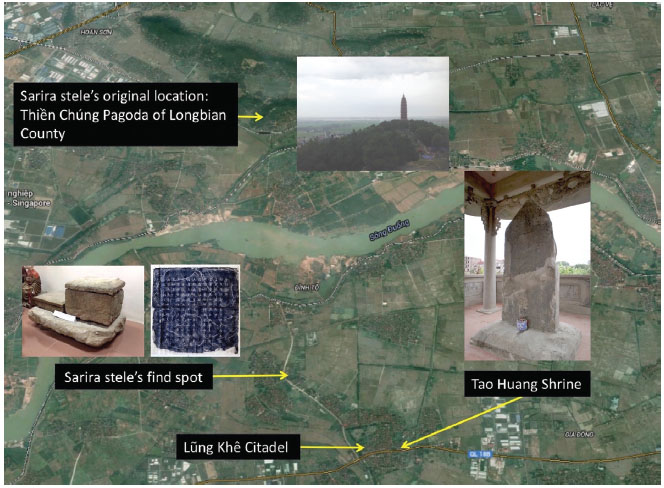
First, in 2004, an inscribed stele from the Jiaozhou Sarira Stupa (Figs. 1, 2), dated 601
However, my research on the stele suggests that the location where this stele was discovered in 2004 was not the original location of the Thiên Chúng Pagoda. Rather, based on the notes in Thiên uyên táºp anh, the Thiên Chúng Pagoda in Longbian County under the Sui was located on 天ç¦å³¯, namely, on Thiên Phúc Mount, one of the eight mounts of Tiên Du Mountain (ä»éå±±). Tiên Du Mountain was five km north of the area where the stele was discovered in 2004, and approximately 6.5 km northwest of the LÅ©ng Khê Citadel.44
Area near the Lũng Khê Citadel, showing the original location of the stele bearing the Sarira Stupa inscription and the place where it was discovered, and the location of the shrine built by Tao Huang.
Citation: Asian Review of World Histories 5, 2 (2017) ; 10.1163/22879811-12340004
Map Source: Google Maps.Rubbing of the Sarira Stupa inscription discovered at Trà Quả commune (Thuáºn Thà nh, Bắc Ninh) in 2012.
Citation: Asian Review of World Histories 5, 2 (2017) ; 10.1163/22879811-12340004
Photo: Phạm Lê Huy.This identification of the original location of the sarira stele suggests that the area of the LÅ©ng Khê Citadel belonged to Longbian County under the Northern and Southern Dynastiesâi.e., in the SuiâTang periods.45 Because Longbian County under the Tang was part of Longbian County under the Han, the area of the citadel was also part of Longbian County under the Han.
Regarding the location of the Longbian Citadel under the Han, Yuanhe junxian tuzhi suggests that in Longbian County under the Tang there was a citadel called âthe old Jiaozhou Citadelâ (交å·æ å) built by the Jiaozhou cishi, Tao Huang (é¶ç), during the Wu period, about 14 li (7 km) to the east of the Longbian County headquarters.46 Although there are still different views on the location of Leilou, the majority of contemporary scholars, including Nishimura, agree that âthe old Jiaozhou Citadelâ built by Tao Huang was the LÅ©ng Khê Citadel.
This view is further confirmed by a stele inscription discovered in 2013. In the shrine of Tao Huang in Thanh Hoà i hamlet (Thuáºn Thà nh, Bắc Ninh), near the LÅ©ng Khê Citadel (Fig. 1), Nguyá»
n Phạm Bằng, a researcher from Bắc Ninh museum, discovered an ancient stone stele. On the front and back of the stele are two inscriptions with different dates. Although the inscription on the front has faded and hence cannot provide much information, the inscription on the reverse has a clear date of 450
The discovery of this stele indicates that Tao Huangâs shrine in Thanh Hoà i hamlet was built and redecorated no later than the fifth century. Because the shrine was located only 2 km to the west of the LÅ©ng Khê Citadel, it is important evidence that the LÅ©ng Khê Citadel was the Longbian Citadel built by Tao Huang.48
Conclusion
In Vietnam, it has long been held that Leilou and Longbian were the same citadel (âLeilou = Longbianâ). However, building on ideas proposed by Trân Quôc Vượng and Nishimura Masanari,49 this paper has examined historical documents and reached the conclusion that in pre-tenth century records, Leilou and Longbian were listed as two distinct administrative counties (âLeilou â Longbianâ). Early records such as Hanshu, Hou Hanshu, and Shuijing shu provide good evidence for rejecting the view that Leilou and Longbian were the same citadel.
Regarding the location of the Leilou Citadel under the Han, some materials in post-tenth century literature state that the Leilou Citadel and Leilou County under the Han were located west of modern Hanoi. However, as Vietnam entered the era of independence, a new idea emerged that Leilou was located in the area of the LÅ©ng Khê Citadel and surrounding areas, notably in Toà n thÆ° and the chapters on Pháp Hiên and Thông Biá»n in Thiên uyên táºp anh.
In the fifteenth century, Ngô SÄ© Liên and Toà n thÆ° played an important role in disseminating the idea that Leilou was located in LÅ©ng Khê. The equation of Leilou with LÅ©ng Khê in Toà n thÆ° was largely based on the statement in Viá»t Äiá»n u linh that âShi Xie situated his headquarters in Leilou and Guangxin.â However, this statement cannot be trusted. Throughout his lifetime, Shi Xieâs highest position was the head of Jiaozhi Commandery, not the head of Jiaozhi Department (Jiaozhou). Shi Xie therefore could not have situated his headquarters in the Guangxin Commandery as written in Viá»t Äiá»n u linh. The confusion in Viá»t Äiá»n u linh (and later Toà n thÆ°) may have originated because Shi Xieâs homeland was Guangxin, or because the author of Viá»t Äiá»n u linh failed to recognize the difference between the positions of the Jiaozhi taishou and the Jiaozhou cishi.
When Ngô SÄ© Liên compiled the Shi Xie chapter of Toà n thÆ°, he cited the statement in Viá»t Äiá»n u linh as evidence that Shi Xie had situated his headquarters in Leilou. Because Shi Xieâs shrine was located in the area of the LÅ©ng Khê Citadel, Ngô SÄ© Liên concluded that Leilou was LÅ©ng Khê. And a new body of literature in the later periodâToà n thÆ°, stone stele inscriptions (the earliest being the stele 羸𨻻åéèèå»ç¢, 1661
By examining the texts in Thiên uyên táºp anh and Toà n thÆ°, it can be shown that apart from the idea that âLeilou = LÅ©ng Khê,â there is another, more widely held idea that âLongbian = LÅ©ng Khê.â In Thiên uyên táºp anh, the view that âLeilou = LÅ©ng Khêâ existed only in the Pháp Hiên and Thông Biá»n chapters,50 while other chapters such as Tỳ Ni Äa LÆ°u Chi, Sùng Phạm, and Thiên Nham all agree that the area of LÅ©ng Khê and the surrounding areas were the same as Longbian. Although Ngô SÄ© Liên adopted the view that âLeilou = LÅ©ng Khê,â he phrased his notes in Toà n thÆ° in a manner that demonstrates that by the fifteenth century, the area of Shi Xieâs shrine (LÅ©ng Khê Citadel) was widely known as âthe old Longbian Citadel,â not Leilou. Toà n thÆ° noted that Leilou âmeans Longbian,â further supporting the above view.
Given the existing evidence, the view that the LÅ©ng Khê citadel was the Longbian Citadel (âLÅ©ng Khê = Longbianâ), represented by Nishimura Masanari, is the most plausible opinion and is consistent with what is written in both pre-tenth century texts and recently discovered stele inscriptions. The Sarira Stupa stele inscription of 601
If we accept the hypothesis of Nishimura Masanari that the LÅ©ng Khê Citadel was the Longbian Citadel, the question then is how to pinpoint the location of the Leilou Citadel under the Han. If Yuanhe junxian tuzhiâs assertion that the Leilou Citadel under the Han was located 75 li to the west of the capital of the Protectorate under the Tang is correct, it can be hypothesized that the Quèn Citadel in the area of Tuyêt NghÄ©a commune (Quôc Oai, Hà Ná»i) had some connection with the Leilou Citadel under the Han. Indeed, fieldwork on the Quèn Citadel has shown that it was constructed during the Han period.51
Henri Maspero, âEtudes dâhistoire dâAnnam,â
Sakurai Yumio æ¡äºç±èº¬é, âA Reconsideration of Lạc ÄiênâA Discussion of the Reclamation of the Red River Delta in the Ancient Periodâ (ããç°åé¡ã®æ´ç : å¤ä»£ç´ æ²³ãã«ã¿éæ試è«), Journal of Southeast Asia Studies (æ±åã¢ã¸ã¢ç 究) 17, no. 1 (1979): 19.
Claude Madrolle, âLe Tonkin ancien. Lei-leou 羸ï¼é³é£ï¼ð¨»» et les districts chinois de lâépoque des Han. La population. Yue-chang,â
Trân Quôc Vượng, âA Geographical-Historical Issue: Political Centres of our Country in the Ancient Era (From the late Primitive Communism to the Han Rule),â (Má»t vân Äê Äá»a là há»c lá»ch sá»: Những trung tâm chÃnh trá» của Äât nÆ°á»c ta trong thá»i cô Äại), Journal of Historical Studies (Nghiên cứu Lá»ch sá») 6 (1959): 36â37; Äà o Duy Anh, Vietnam through Ages: A Historical and Geographical Study of Vietnam (Äât nÆ°á»c Viá»t Nam qua các Äá»i) (Hanoi: Science Publisher (
Sakurai, âA Reconsideration of Lạc Äiên,â 19.
Äá» VÄn Ninh, Ancient Towns in Vietnam (Äô thá» cô Viá»t Nam) (Hanoi: Institute of History, 1989), 82â84.
Trân Quôc Vượng, âThe Position of Luy Lâuâ (Vá» thê Luy Lâu), Journal of Historical Studies (Nghiên cứu Lá»ch sá») 315 (2001): 3â7.
Nishimura Masanari, Archaeology and Ancient History of Vietnam (Betonamu no Koko-Kodaigaku) (Tokyo: Doseisha, 2011), 155â176.
The Jiaozhi Department is mentioned in the chapter Zhu Jun æ±å in Houhan Shu. ãæ交é¯é¨ç¾£è³ä¸¦èµ·ï¼ç§å®è¼å¼±ä¸è½ç¦ãï¼ãå¾æ¼¢æ¸ãå· 71ï¼æ±åå³ï¼.
Shuijing zhu states that the appointment of the Jiaozhi Department head was made in 116
lã建å®å «å¹´ï¼å¼µæ´¥çºåºå²ï¼å£«ç®çºäº¤é¯å¤ªå®ï¼å ±è¡¨ç«çºå·ï¼ä¹ææ´¥çºäº¤å·ç§ãâ ï¼ãææ¸ãå· 15ï¼äº¤å·ï¼.
lãéºæ³ 縣ï¼æ¼¢æ¦å¸å é¼å å¹´éé½å°æ²»ï¼äº¤å·å¤åè¨æ°ï¼ä¸ç¥ï¼äº¤è¶¾é¡åå·æ¬æ²»æ¼æ¤ä¹ãï¼ãæ°´ç¶æ³¨ãå· 37ï¼.
lãçæ°äº¤å»£æ¥ç§æ°ï¼å å°äºå¹´ï¼äº¤å·èªç¾¸ð¨»»ç¸£ç§»æ²»äºæ¤ãï¼ãæ°´ç¶æ³¨ãå·37æå¼çæ°ã交廣æ¥ç§ãï¼.
lãé¾ç·¨ï¼æ¼¢äº¤è¶¾é¡å®æ²»ç¾¸ð¨»»ï¼å¾æ¼¢å¨æçºäº¤è¶¾å¤ªå®ï¼ä¹ç§»æ²»é¾ç·¨ãï¼ãèåæ¸ãå· 41ï¼å®ååºï¼.ãé¾ç·¨ç¸£ï¼æ±åååäºéåéï¼æ¼¢äº¤è¶¾é¡å®æ²»å¬´åï¼å¾æ¼¢å¨æçºäº¤å·å¤ªå®ï¼ä¹ç§»æ²»é¾ç·¨ï¼è¨ç«åä¹å§æèé¾ç¤ç·¨æ¼æ±æ´¥ä¹éï¼å çºæ¦åãkkï¼ã太平寰å®è¨ãå· 170ï¼é¾ç·¨ç¸£ï¼.
lã交趾é¡ï¼ï¼ä¸ç¥ï¼ç¸£åï¼ç¾¸ð¨»»ï¼æç¾å®ï¼å®å®ï¼èå±ï¼éºæ³ ï¼é½å°æ²»ï¼æ²æï¼æ¤å¸¶ï¼ç¨½å¾ï¼è¥¿æ¼ï¼é¾ç·¨ï¼æ±é³¶ãï¼ãæ¼¢æ¸ãå·28ä¸ï¼äº¤è¶¾é¡ï¼.
lã交趾é¡æ¦å¸ç½®ï¼å³å®é½çåï¼éé½åè¬ä¸åéï¼åäºåï¼é¾ç·¨ï¼ç¾¸ð¨»»ï¼å®å®ï¼lèæ¼ï¼éºæ³ ï¼æ²é½ï¼å帶ï¼ç¨½å¾ï¼è¥¿æ¼ï¼æ±é³¶ï¼å°è°¿ï¼å»ºæ¦åä¹å¹´ç½®ï¼ï¼ææµ·ï¼å»ºæ¦åä¹å¹´ç½®ï¼ãï¼ãå¾æ¼¢æ¸ãå¿ç¬¬23ï¼äº¤è¶¾é¡ï¼.
lãé å¸æ°¸åä¹å¹´ï¼äº¤é¯å¤ªå®å¨ææ±ç«çºå·ï¼æè°ä¸è¨±ï¼å³ææçºäº¤è¶¾åºå²ãlkï¼ãææ¸ãå·15ï¼äº¤å·ï¼.
lã交趾åºå²æ²»é¾ç·¨ï¼æ¼¢ç»å¸å»ºå®å «å¹´ï¼æ¹æ°äº¤å·ï¼æ²»è¼æ¢§å»£ä¿¡ç¸£ï¼åå å¹´ï¼å¾æ²»åæµ·çªç¦ºç¸£ï¼ååçºå»£å·ï¼æ²»çªç¦ºï¼äº¤å·éæ²»é¾ç·¨ãï¼ãå®æ¸ãå·38ï¼äº¤å·ï¼.
lãåé»æ¦äºå¹´ï¼å²åæµ·ï¼è¼æ¢§ï¼é¬±æä¸é¡ç«å»£å·ï¼äº¤é¯ï¼æ¥åï¼ä¹çï¼å浦åé¡çºäº¤å·ï¼æ´è¯çºåºå²ï¼å¼äºä¸å¾å ¥ï¼åå²±æå¹³ä¹ï¼å¾©é并交é¨ï¼èµ¤çäºå¹´ï¼å¾©ç½®ç å´é¡ï¼æ°¸å®ä¸å¹´ï¼å¾©ä»¥åä¸é¡ç«å»£å·ãï¼ãææ¸ãå·15 ï¼äº¤å·ï¼ã
lãé³è¥²è¨æ·®äººï¼æ°¸å®ä¸å¹´çºäº¤å·ç§ï¼å¼å«è«èæ¿å¾ï¼å¾©åæµ·æ±åé¡çºå»£å·ï¼ä»¥çç§çºåºå²ï¼æµ·åä¸é¡çºäº¤å·ï¼ä»¥è¥²çºåºå²ï¼ç§»æ²»é¾ç·¨ãï¼ãå®åå¿ç¥ãå·7ï¼.
lãå ¶æ¬¡ä¸æ°´æ±éå°æºªç¸£åï¼å西åé西äºç¸£åï¼åæ±é羸𨻻縣åï¼åæ±éå帯縣åï¼åæ±é稽å¾ç¸£ï¼æ¶æ°´æ³¨ä¹ï¼æ°´åºé¾ç·¨ç¸£é«å±±ï¼æ±åæµå ¥ç¨½å¾ç¸£ï¼æ³¨æ¼ä¸æ°´ãï¼ãæ°´ç¶æ³¨ãå·37ï¼.
Äá» VÄn Ninh, Ancient Towns in Vietnam, 82â84.
Nanqi shu åé½æ¸ (compiled in the sixth century CE) still listed Leilou as one of the eleven counties in the Jiaozhi Commandery.
lãé£ð¨»»ï¼é³è®ç°ï¼æ åï¼å¨ç¸£è¥¿ä¸åäºéï¼æ¬æ¼¢ç¸£ï¼å±¬äº¤å·é¡ï¼æç¾å®ï¼å¾æ¼¢äº¤è¶¾å²çæ¼æ¤ï¼å¾å¾é¾ç·¨ãï¼ãå åé¡ç¸£åå¿ãå·38ï¼å®åï¼å®å¹³ç¸£ï¼.
Sakurai, âA Reconsideration of Lạc Äiên,â 19.
lã交趾ï¼æ¼¢äº¤è¶¾é¡ä¹ç¾¸ð¨»»ãï¼ãèåæ¸ãå·41ï¼å®åé½ç£åºï¼. When investigating the case of Jiaozhi County, it is important to note that the location of Jiaozhi County changed many times. The Jiaozhi County that we mention here was the one established in 627 (è²è§1) under the Tang, named on the basis of âthe old Jiaozhi citadel under the Hanâ (which we believe is the Leilou citadel).
lãå®åç¶äº¤è¶¾å¤ªå¹³ï¼ç¾é¤éè³å³¯å·ãï¼ãæ°åæ¸ãå·43ä¸ï¼å³¯å·é½ç£åºï¼.
lã交趾縣ä¸æ å»æã. Claudine Salmon and Phan VÄn Các, eds., Ãpigraphie en chinois du Viêt Nam, vol. 1, De lâoccupation chinoise à la dynastie des Lý (Paris: Presses de lâÃcole française dâExtrême-Orient, 1998), 47.
lãæ±åè³äº¤è¶¾ç¸£çç¦çå»åéä¹ãï¼ ãèåæ¸ãå·41ï¼å®åé½ç£åºï¼.
lãæ±åå°äº¤è¶¾ç¸£åéã ï¼ãéå ¸ãå· 184ï¼å®åé½è·åºï¼.
Yuanhe junxian tuzhi assumes that Jiaozhi County under the Tang was a part of Longbian County under the Han.ã交趾縣æ¬æ¼¢é¾ç·¨ç¸£å°ãï¼ãå åé¡ç¸£åå¿ãå· 38ï¼.
lãåå®ç¸£ï¼ä¸ä¸ï¼æ±åè³åºå åéï¼æ¬æ¼¢ç¾¸ð¨»»ç¸£å°ï¼è²å ä¸å¹´äºæ¤ç½®åå®ç¸£ï¼å ¶èåå®ç¸£ï¼å¨ä»ç¸£æ±åäºç¾é¤éï¼ç¾ç¸»é·å·å´è¿ï¼éå åå¹´å¾å»¢ãï¼ãå åé¡ç¸£åå¿ãå· 38ï¼.
lãæ¦å¾·åå¹´ï¼æ¼å®å¹³ç½®å®å·ï¼é å®å¹³ï¼å¼æï¼åå®ä¸ç¸£ï¼äºå¹´ï¼ååå®å¹³ç½®äº¤è¶¾ï¼æ·å¾·äºç¸£ï¼èªè²è§å å¹´ï¼å»¢åå®å·ï¼ä»¥å¼æï¼æ·å¾·ï¼äº¤è¶¾ä¸ç¸£çå ¥å®å¹³ç¸£ï¼ç§»äº¤è¶¾ç¸£ï¼åæ¼æ¼¢æ 交趾åç½®ãï¼ãèåæ¸ãå· 41ï¼å®ååºï¼.
lã羸𨻻æ³é²å¯ºãï¼ã禪èéè±ãæ³è³¢å³ï¼.
lãä½æ³åä¾æ±æ±ï¼æªè¢«è羸𨻻åéåµè寶å¹äºåé¤æï¼åº¦å§äºç¾é¤äººï¼è¯çµä¸åäºå·ï¼ä»¥å ¶å ä¹æ ä¹ï¼äºæåå·²ææ¯ä¸åéç¾ èåï¼åº·å§æï¼æ¯åµè¯ï¼çæä¹å±¬å¨ãï¼ã禪èéè±ãé辨å³ï¼.
lãé¾ç·¨å¤å·é·æ³é²å¯ºãï¼ã禪èéè±ãæ¯å°¼å¤æµæ¯å³Â·å´ç¯å³ï¼.
lãé¾ç·¨å¤å·æºæ寺ãï¼ã禪èéè±ã禪岩å³ï¼. Trân Quôc Vượng, âThe Historical and Geographical Book of Hanoi Region (before the eleventh century),â Journal of Historical Studies 15 (1960): 50.
lãå¤äºææ±ï¼å¸è¦ªå¹¸çå©æ³é²å¯ºï¼ç¥é¨ï¼å è¿æ³é²ä½åæ¸å ±å¤©å¯ºï¼ä»æååç¶ä¹èä¿ãï¼ã大è¶å²è¨å ¨æ¸ãæ¬ç´å·4ï¼æç³å¤©è³åç3å¹´ã1188å¹´ã5ææ¢ï¼.
That Toà n thÆ° did make reference to Sanguo zhi is shown by the fact that Toà n thÆ° added some contents that had been removed from Viá»t Äiá»n u linh, such as the part about ååå¥ in sentence 5, and an erratum that suggests that the phrase çä¹å¼æä¸å in Viá»t Äiá»n u linh, sentence 30 should be çä¹å¼ä¸äºº.
lãæ´¥å¾åçºå ¶å°åæ¯æ殺ï¼èèå·ç§å表é£é¶éµè³´æ代津ï¼æ¯æè¼æ¢§å¤ªå®å²çæ»ï¼è¡¨åé£å³å·¨ä»£ä¹ï¼èæ俱è³ï¼æ¼¢è張津æ»ï¼è³ç®ç½æ¸æ°ï¼äº¤å·çµåï¼å帶æ±æµ·ï¼ä¸æ©ä¸å®£ï¼ä¸ç¾©å£ éï¼ç¥éè³å表åé£è³´æéçååï¼ä»ä»¥ç®çºç¶åä¸éå°ï¼è£ç£ä¸é¡ï¼é 交é¯å¤ªå®å¦æ ï¼å¾ç®é£åå¼µæ»å¥è²¢è©£äº¬é½ï¼æ¯æ天ä¸åªäºï¼éè·¯æ·çµï¼èç®ä¸å»¢è²¢è·ï¼ç¹å¾©ä¸è©æå®é å°è»ï¼å°é¾åº¦äºä¾¯ãï¼ãä¸åå¿ãåæ¸ï¼å·49ï¼.
lãå¤å·æ³é²å¯ºå§ä¸è¨ï¼å¯ºä¸æ¾å æ¸éï¼é¨å æä¹ï¼å¾ç³å½ä¸ï¼å½å æéå½ï¼éå½å æéå½ï¼éå½å æç çç¶ï¼ç¶ä¸æèå©ãï¼ãè¶å²ç¥ãå·ä¸ï¼ç²æ天æ 7 å¹´ã1034ãæ¢ï¼.ãç§ä¸æï¼èµ·å¤å·æ³é²å¯ºãï¼ãè¶å²ç¥ãå·ä¸ï¼è¾å·³å¤§å® 22 å¹´ã1161ã7 ææ¢ï¼.
There is only one place in Toà n thÆ°, namely in the notes for 1188, where the authors suggested that Pháp Vân Pagoda was located in Leilou. The notes for 1034 and 1161, however, indicate that Pháp Vân Pagoda was located in Cô Pháp hamlet. We therefore believe that the note âLeilouâ in the notes of 1188 was added by Ngô SÄ© Liên himself.
Nishimura, Archaeology and Ancient History of Vietnam, 155â176.
Phạm Lê Huy, âNhân Thá» Sarira Stupa and the Recently Discovered Sarira Stupa Inscription in Bắc Ninhâ (Nhân Thá» xá lợi tháp và VÄn bia tháp xá lợi má»i phát hiá»n tại Bắc Ninh), Vietnam Archaeology (Khảo cô há»c) 181 (2013): 60â79; Phạm Lê Huy, âThe Recently Discovered Jiaozhou Sarira Stupa Inscription in Vietnamâ (æ°çºè¦ã®ä»å¯¿å å¹´ã®äº¤å·èå©å¡éã«ã¤ãã¦), in Bukkyo Bunmei to Sezoku Chitsuzo (ä»æææã¨ä¸ä¿ç§©åº), ed. Shinkawa Tokio æ°å·ç»äºç· (Tokyo: Bensei Shuppan, 2014), 28â64.
That Tiên Du Mountain was part of Longbian County corresponds to a note in Jiaozhou Diaries (交å·è¨) (cited from Houhan shu) that in the west of Longbian County stood Mount Tiên SÆ¡n, and Taiping huanyu ji wrote that in Longbian County was located Mount Pháºt TÃchä½è·¡å±±. ãï¼é¾ç·¨ï¼ç¸£è¥¿å¸¶æ±ï¼æä»å±±æ¸ç¾éãï¼ãå¾æ¼¢æ¸ãå¿ç¬¬ 23 æå¼ã交å·è¨ãï¼ï¼ãä½è·¡å±±ãï¼ã太平寰å®è¨ãå· 170ï¼é¾ç·¨ç¸£ï¼.
lã交å·æ åï¼å¨ç¸£æ±ååéï¼åæåºå²é¶çæç¯ãï¼ãå åé¡ç¸£åå¿ãå·38ï¼.
Phạm Lê Huy, âResearch on the stele of Äà o Hoà ng shrine (Thanh Hoà i commune, Thuáºn Thà nh district, Bắc Ninh province)â (Khảo cứu Bia Miêu Äà o Hoà ng [Nghè thôn Thanh Hoà i, Thuáºn Thà nh, Bắc Ninh]), Vietnam Archaeology (Khảo cô há»c) 199 (2016): 48â59.
The assumption that Tao Huangâs citadel was the Longbian Citadel also agrees with the notes of Jinshu. According to the Wang Liang çè« chapter in Jinshu, in the fourth century CE, when Wang Liang fought Liang Shuo æ¢ç¢© for the post of Jiaozhou Department head, they fought battles in Longbian. ãè«é°è¬èª 碩ï¼ä½¿å®¢åºä¹ï¼å¼å ï¼éçç¾åè«æ¼é¾ç·¨ãï¼ãææ¸ãå·89ï¼çè«å³ï¼.
Trân Quôc Vượng, âThe Positon of Luy Lâu,â 3â7; Nishimura, Archaeology and Ancient History of Vietnam, 155â176.
According to Nguyá» n Lang (1973), Thông Biá»n (?â1134), a Zen master of the Ly, was the first to compile the chapters of Tỳ Ni Äa LÆ°u Chi and his disciple, Pháp Hiên. However, differences in opinion between these chapters regarding the location of Pháp Vân Pagoda show that they were modified at a later stage. For example, in the chapter on Pháp Hiên, there is a note stating, ârefer to the chapter on Thông Biá»nâ (詳å¨é辨禪師å³), which shows that the chapter on Pháp Hiên was edited by someone who lived after Thông Biá»n.
Äá» VÄn Ninh, âQuèn Citadel â The Base of Äá» Cảnh Thạc, One of the Twelve Warlords in the Tenth Centuryâ (Thà nh Quèn, cÄn cứ của Äá» Cảnh Thạc, má»t trong mÆ°á»i hai sứ quân thê ká»· thứ X), Journal of Historical Studies (Nghiên cứu Lá»ch sá») 132 (1970): 93â94; Nishimura, Archaeology and Ancient History of Vietnam, 167.