Abstract
This study analyses empirical research concerning the use of Augmented Reality applications in physics teaching and learning. While many literature reviews have explored AR in education, there is limited empirical research documenting its specific role in physics education. We screened 1,861 articles from 20 journals, equally representing science education and educational technology, and identified 12 empirical studies for analysis. Most studies highlighted visualization gaps and the need to enhance learning experiences as key rationales for using AR. The reviewed studies contributed to AR design by integrating text and virtual objects to support the development of cognitive and affective skills. Furthermore, these studies demonstrated how immersive features, capturing sensory, actional, and social aspects, could foster active and collaborative learning, providing experiences that enrich students’ conceptual understanding and teamwork abilities. The paper’s concluding sections discuss the implications of these findings, particularly in curriculum design and the integration of AR in physics classrooms.
1 Introduction
The use of technology has significantly enhanced students’ understanding of scientific concepts. In particular, many scientific phenomena are unobservable or difficult to investigate directly. In such cases, technology can help bridge this gap by offering visualizations that support conceptual understanding. One such technology is Augmented Reality (AR), which can superimpose digital content onto the physical environment (Sotiriou & Bogner, 2008). In the context of physics education, AR can enrich laboratory activities by integrating model visualizations into real-time experiments, thereby augmenting students’ practical experiences with layered digital information (Sánchez & Diaz, 2022).
In recent years, several academic studies have investigated the benefits of AR in science teaching and learning. For example, Byun and Park (2023) examined research trends in AR-related studies within science education, focusing on variables such as equipment, subject, participants, research methods, and measurement variables. Similarly, Arici et al. (2019) conducted a bibliometric and content analysis of AR studies, identifying key themes such as authorship patterns, methodologies, and sample characteristics. Notably, these systematic literature reviews emphasized research variables, rather than exploring the pedagogical or experiential dimensions of AR use in science education.
This study addresses that gap by conducting a systematic literature review focused on the integration of AR in physics teaching, particularly in laboratory settings. Unlike prior reviews centered on methodological aspects, this study adopts a theoretical framework developed by Dede et al. (2017), as employed by Matovu et al. (2023), to examine how AR fosters different forms of immersion: actional immersion (engagement through interaction), symbolic/narrative immersion (understanding through storytelling or abstract representation), sensory immersion (stimuli engaging the senses), and, and social immersion (collaborative or communicative experiences).
This framework is especially relevant to physics instruction, where AR can enhance the teaching and learning process in multiple ways. First, physics teaching using AR can engage students in interactions with digital content that is perceived as equally engaging as real-world learning experiences, potentially fostering actional immersion. Through active manipulation of digital simulations during lab work, students are encouraged to explore and interact with content in meaningful ways. Second, the virtual representation of unobservable or sub-microscopic phenomena, common in many physics concepts, can support learners in forming semantic associations when they later encounter the same phenomena in real laboratory environments. This supports symbolic or narrative immersion, helping students better understand abstract or invisible processes by visualizing them in context. Third, the use of AR devices during laboratory activities offers opportunities for sensory immersion, as students engage with both digital and physical stimuli, enhancing their overall experience through multisensory interaction. Finally, AR-based digital content can foster social immersion by promoting collaboration and communication among peers within teaching groups. These shared experiences, facilitated through AR-enhanced tasks, can support peer learning and collaborative meaning-making, which are essential in modern science education.
This review explores how AR applications have been integrated into physics teaching and learning, with particular attention to laboratory settings where abstract or unobservable phenomena are often difficult to demonstrate. In contrast to previous literature reviews that primarily focused on research variables, this study adopts the immersion framework developed by Dede et al. (2017), as applied by Matovu et al. (2023), to examine how AR contributes to students’ experiences in terms of actional, symbolic/narrative, sensory, and social immersion. This framework is particularly relevant for understanding how AR can enhance students’ engagement and learning in physics labs by making abstract phenomena more accessible and meaningful. In addition to analyzing immersive experiences, this review also considers the rationales behind AR integration, the design of AR applications, and the learning outcomes they aim to support. The following research questions guide the review:
What are the rationales for integrating AR applications into physics teaching and learning?
How have AR designs been employed for use in physics teaching and learning?
What skills or learning outcomes have been targeted through the integration of AR applications into physics teaching and learning?
How have immersive experiences been represented in terms of actional immersion, symbolic/narrative immersion, sensory immersion, and social immersion?
2 Literature Review
2.1 Physics Teaching and Laboratory Activities
Prior research has reported a negative public image of physics among students (Angell et al., 2004), often stemming from traditional teaching approaches that emphasize facts, definitions, and formulas (Mulhall & Gunstone, 2012; Wallace & Louden, 2003). Such pedagogies may not promote deep conceptual understanding, as they frequently ask students to confirm known principles without engaging in meaningful inquiry (Tobin et al., 1997). Considering that physics often involves hands-on or laboratory-based exploration, involving students in appropriate practical activities can foster intrinsic motivation and spark situational interest in physics learning (Nikitin et al., 2025). However, not all physical phenomena can be easily demonstrated in classroom settings due to limited equipment, and in some cases, it is simply impractical or impossible to provide fully equipped labs.
In ideal physics instruction, students’ understanding should be developed through meaningful learning experiences that also support positive attitudes toward the nature of science (Osborne, 1990; Mintzes et al., 1997; Stadermann & Goedhart, 2020). There is a growing need to move away from traditional methods toward more comprehensive approaches that engage students in constructing understanding and applying scientific thinking. Laboratory activities, both longstanding and evolving, have played a central role in this process, building on theoretical texts and inquiry-based investigations (Gumilar & Ismail, 2023; Herron, 1971).
Inquiry labs, in particular, have been widely recommended by science educators and researchers for their ability to help students develop scientific thinking skills (Kipnis & Hofstein, 2008). These labs support student-driven exploration, encouraging the formulation of hypotheses, design of experiments, collection and analysis of data, and drawing of inferences (Kipnis & Hofstein, 2007). However, a limitation of real-world labs is that they cannot always present unobservable phenomena. For instance, while students can measure electrical current in a circuit, they cannot directly observe the movement of electrons through a wire, which may lead to misconceptions or only superficial understanding.
To address such challenges, laboratory practices have expanded from traditional to virtual labs. Virtual labs offer benefits such as flexibility in time, ease of use, lower costs, reduction in experimental error, and increased accuracy in data collection (Zacharia & Constantinou, 2008; Zacharia & Michael, 2016). Nonetheless, they can also limit students’ opportunities for hands-on engagement, which is vital for conducting authentic scientific observations.
As technology continues to evolve, hybrid approaches that combine real and virtual elements are emerging. AR represents one such advancement, enabling the visualization of otherwise unobservable phenomena during laboratory activities (Jiang et al., 2022). For example, when investigating heat conduction, students can measure temperature changes during the experiment (Hitt & Townsend, 2015) while also using AR to visualize heat flow in the material. This is especially valuable for students who struggle to comprehend sub-microscopic phenomena due to a lack of relevant experience. When AR effectively overlays meaningful digital content onto physical lab equipment, it can support a multisensory immersive experience, deepening engagement and conceptual understanding.
2.2 Multisensory Immersion in a Technology-Enhanced Environment
A broader and foundational definition of AR has been offered by Azuma et al. (2001), who describe AR as a system characterized by three core features: the combination of real and virtual elements within a real environment, real-time interactivity, and alignment between real and virtual objects. This integration is particularly relevant in educational contexts, where students can interact with both physical and digital components simultaneously. As a result, learners experience immersion by investigating real phenomena enhanced by virtual representations.
In physics teaching, AR offers an effective approach for helping students observe phenomena that are otherwise unobservable. This is achieved by simulating invisible processes through digital model visualizations. For example, although students cannot see electrons moving through a wire in a live circuit, AR can display a simulation of electron flow that is anchored to real lab equipment. Here, the physical circuit serves as an objective marker that activates the digital content. In this way, AR enables immersive learning experiences that seamlessly blend virtual and real-world elements. Unlike virtual reality (VR), which immerses users in a fully artificial environment, AR maintains the user’s presence in the real world while enriching it with digital overlays (Shin, 2019).
AR technology enhances real-world experiences with contextual digital content that is aligned with real-world objects and can be interacted with in real time (Chen et al., 2016; Mikropoulos et al., 2020). Immersion, in this context, is often understood through comparisons with gaming and virtual environments (Christou, 2014; Shin, 2019), where users feel present in and engaged with digital worlds. In games, for example, players may become absorbed in simulated environments that provoke emotional responses. Similarly, VR offers sensory stimuli, such as visuals and sound, that create fully immersive experiences. However, AR’s unique value lies in bringing digital content into the real environment, enabling learners to have new, grounded experiences while maintaining awareness of the physical world. Immersion through AR is often experienced as a mental and emotional engagement, where users feel present in both the real and digitally enhanced environment (Burns & Fairclough, 2015). This affective engagement helps explain why AR can create powerful multisensory learning experiences, making it a useful analytical lens for reviewing research on AR in physics laboratories.
According to Dede et al. (2017), four types of immersion can occur in multisensory learning environments: actional immersion, symbolic/narrative immersion, sensory immersion, and social immersion. In this review, we consider how each of these forms of immersion manifests when AR applications are used in laboratory settings. This is important, as students engaging with AR in hands-on activities are expected to experience meaningful learning by observing, collecting, analyzing, and interpreting data in enhanced environments.
In terms of actional immersion, immersive virtual reality has long allowed users to interact with digital environments that simulate real-world possibilities (Ternier et al., 2012). In AR, however, the focus is on integrating the digital world into real-world settings. When digital elements are overlaid on objective markers, such as lab apparatus, students remain physically grounded in the real world but interact meaningfully with augmented content. This interactivity can lead students to take consequential actions in real time (Dede et al., 2017), such as manipulating equipment while viewing related digital feedback. For example, setting up a simple circuit with a battery, wire, and bulb can be augmented with a simulation showing the movement of electrons along the wire. In this context, real-time user interaction and observation enhance learning, contributing to the sense of actional immersion.
Sensory immersion also emerges through students’ interaction with AR technology, often via mobile screens. For instance, the Insect Go application (Wommer et al., 2023), modeled after Pokémon GO, enables students to explore digital representations of insects using smartphones. While sensory immersion in AR may not be as intense as in VR, it still provokes emotional engagement and motivation by allowing learners to interact with rich digital content situated in real environments.
AR can also support social immersion, as learning is inherently a social activity. AR applications often elicit emotional responses from both students and teachers, creating shared engagement with the content. Features such as videos, 3D models, and interactive simulations foster collaboration and discussion, especially around abstract or complex science concepts (Tang, 2023). In this way, AR enhances not only individual understanding but also group learning dynamics.
Finally, narrative immersion is possible when AR content evokes semantic and emotional associations. In contrast to traditional texts, AR-enhanced materials – such as AR books – can display animated models that help students visualize processes like electron flow at the subatomic level. Even though learners remain in a real-world setting, the narrative visualization enables them to mentally simulate these processes, strengthening conceptual understanding and refining mental models.
3 Method
3.1 Literature Selection
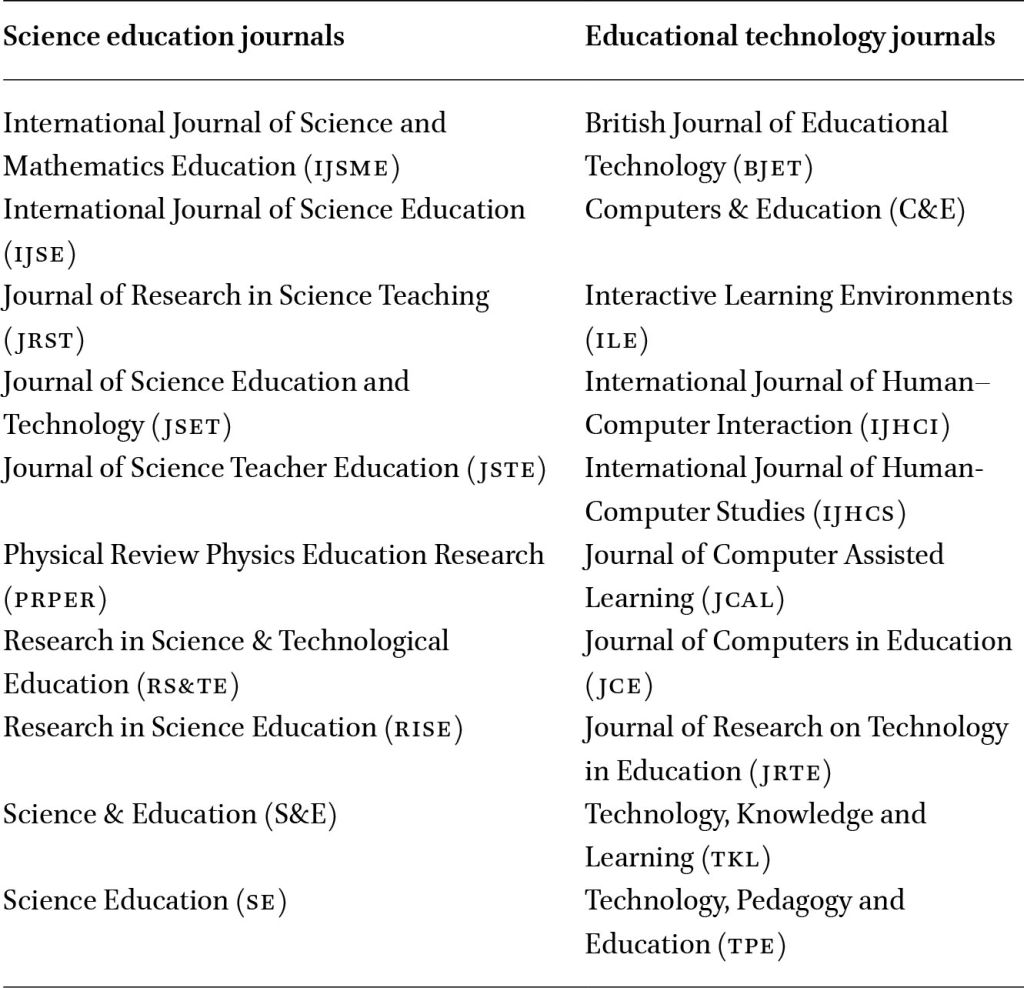
We reviewed articles from ten leading science education journals and ten educational technology journals. These top-tier journals, indexed in both Scopus and Web of Science, were selected based on their strong reputations, high CiteScores, and broad coverage of physics education and AR in educational contexts. While not all focus exclusively on physics, each journal includes content that explicitly addresses physics-related research. The selected journals, listed in Appendix 1, reflect diverse international contributions and are well-regarded for publishing empirical studies on both physics teaching and AR integration, particularly in laboratory settings.
Journal selection followed defined criteria. For science education journals, we prioritized those that regularly publish physics-related research and feature contributions from a wide range of countries, enhancing global relevance. For educational technology, we selected established top-tier journals known for publishing empirical AR studies with relevance to physics education. All selected journals rank within the top ten in their respective categories according to Scopus CiteScores, reflecting their influence within the academic community (see Table 1).

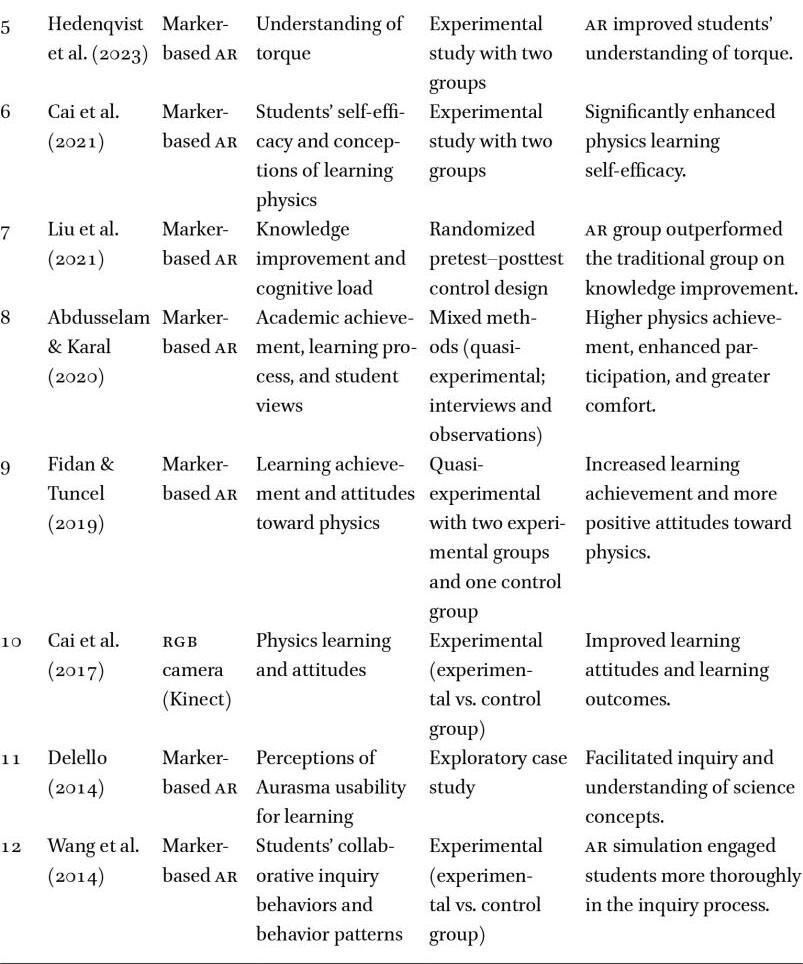
Final articles (2014–2024) after screening
Citation: Asia-Pacific Science Education 11, 2 (2025) ; 10.1163/23641177-bja10102
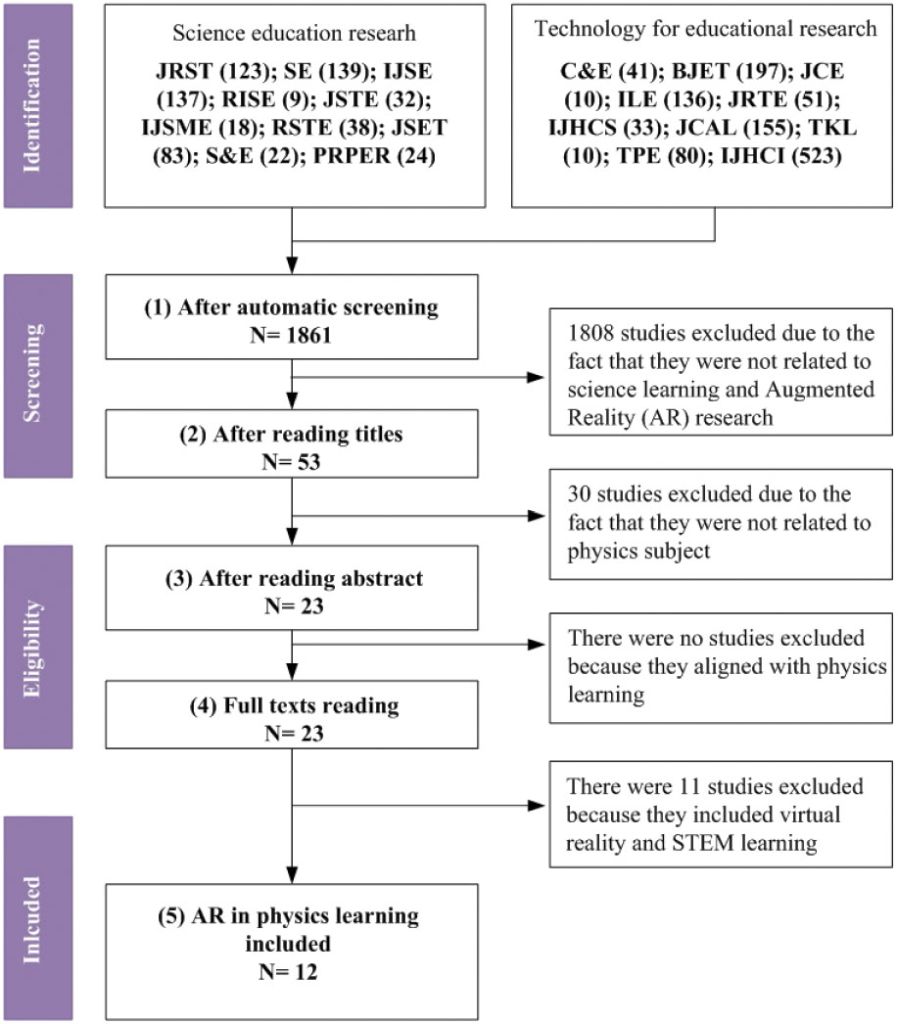
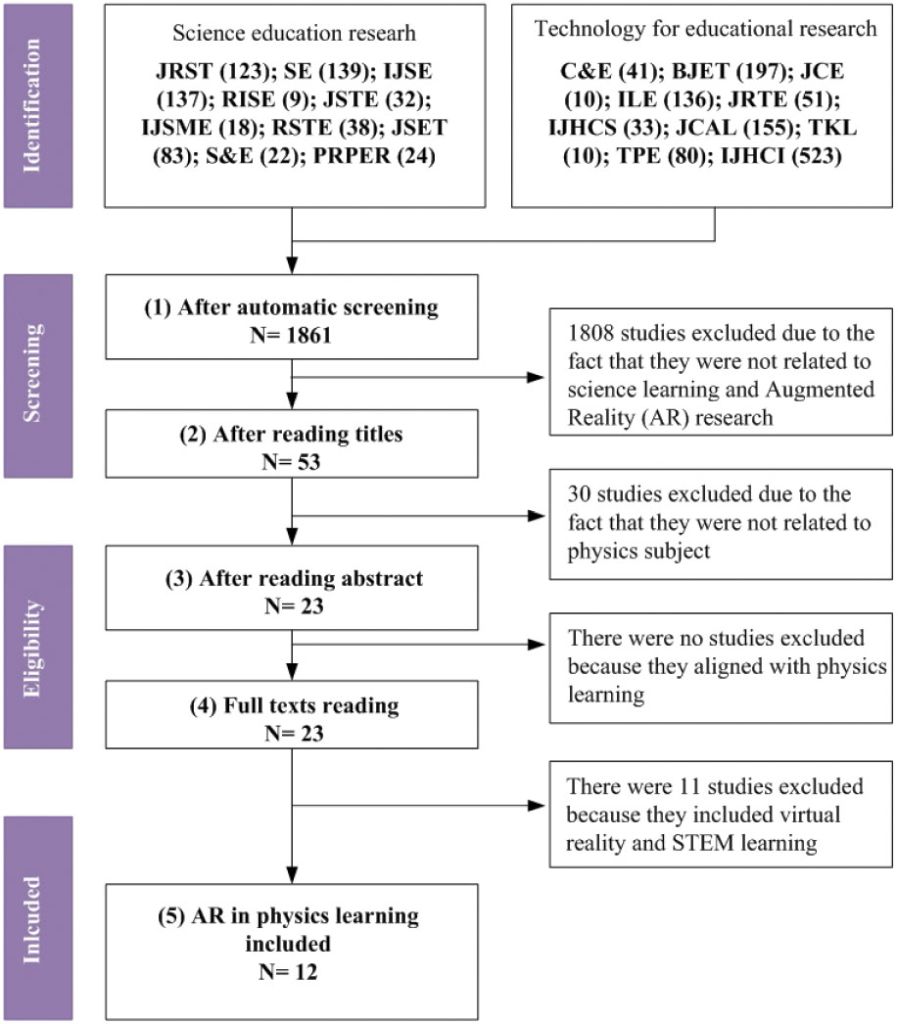
To identify relevant articles, we conducted direct searches on the websites of each selected journal. We searched for empirical studies focusing on the integration of AR into physics teaching and learning, particularly in laboratory contexts. Search terms included “Augmented Reality (AR)” and “Augmented Reality AND Physics Teaching and Learning.” This yielded 1,861 articles: 625 from science education journals and 1,236 from educational technology journals.
The first step, title screening, involved identifying articles containing keywords related to “AR” and “physics/science teaching,” which narrowed the pool to 53 articles. Review papers were excluded (see Arici et al., 2019; Ibáñez & Delgado-Kloos, 2018). In the abstract screening phase, two researchers independently reviewed abstracts for relevance, resulting in 23 articles. Full-text review then excluded 11 articles due to their broader STEM focus (Li et al., 2024) or emphasis on virtual reality (VR) rather than AR (Canright & White Brahmia, 2024). Ultimately, 12 articles remained, approximately 0.8% of the initial pool. Although small in number, the strength of a systematic review lies in its methodological rigor rather than volume (Bennett et al., 2005; Nightingale, 2009). These 12 articles, published between 2014 and 2024, cover diverse physics topics and represent multiple countries. See Figure 1 for selection process.
Selection criteria for reviewed articles between 2014 and 2024
Citation: Asia-Pacific Science Education 11, 2 (2025) ; 10.1163/23641177-bja10102
3.2 Coding Analysis
This study addressed four research questions, which guided the coding analysis process. Two members of the research team conducted the initial coding and worked collaboratively to reach consensus on interpretations.
We began with a set of predetermined categories based on existing literature. For example, in analyzing research rationales, we drew on the framework provided by Matovu et al. (2023). Textual evidence from each article was examined to determine alignment with these categories. If data did not fit within existing categories, new codes were developed inductively. However, all rationales identified ultimately aligned with those previously established.
To ensure reliability, disagreements or ambiguities were resolved through discussion. Inter-rater reliability was calculated using the method proposed by Miles and Huberman (1984), assigning a score of one (1) for agreement and zero (0) for disagreement. The percentage agreement was calculated by dividing the number of agreements by the total number of coding decisions, resulting in an agreement rate of 0.82. According to Miles and Huberman, a rate above 80% indicates acceptable reliability.
3.2.1 Coding to Analyze Research Rationales
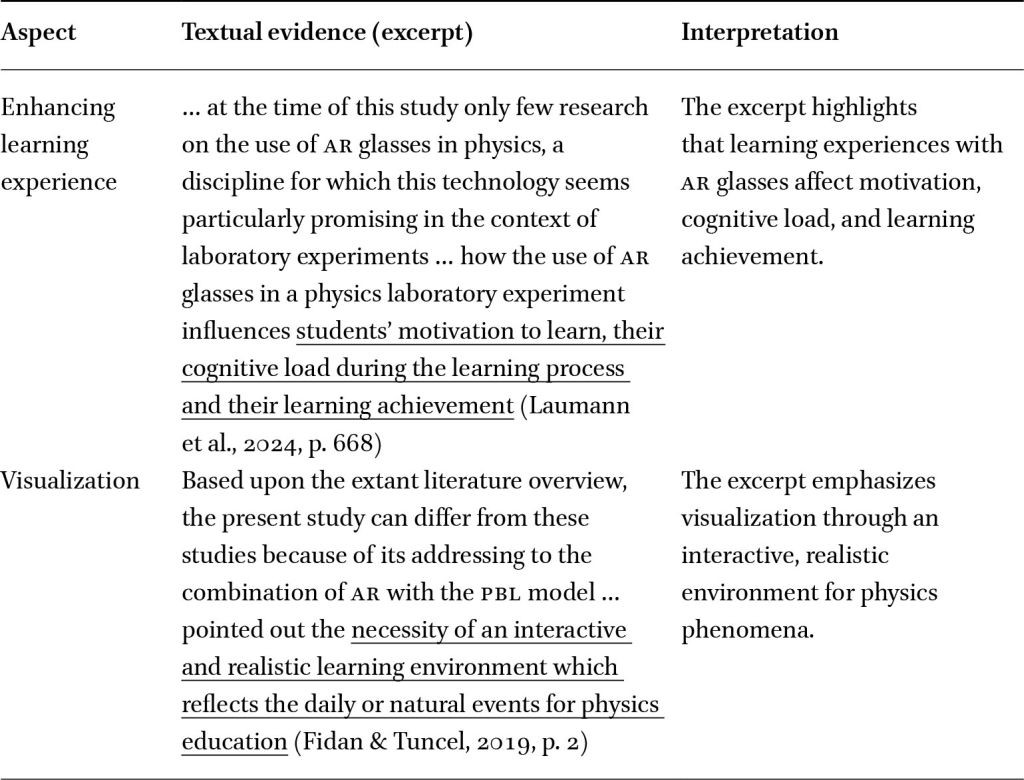
The coding process for identifying rationales for using AR in physics education was guided by Matovu et al. (2023), who outlined five categories for adopting immersive virtual reality in science education: visualization, enhancing learning experience, procedural skills development, field trips, and first-person experience. Two authors analyzed the introduction and literature review sections of each article, where such rationales are typically discussed.
From this analysis, four key rationales emerged: visualization, enhancing learning experience, procedural skills development, and first-person experience. Although slightly fewer than Matovu et al.’s five categories, these were consistently supported across the reviewed studies and deemed highly relevant to physics education. For instance, AR enables the visualization of abstract concepts by overlaying digital content onto real environments (Olim & Nisi, 2020), making invisible phenomena observable. It also supports meaningful learning, particularly for phenomena that are difficult to replicate through hands-on experiments (Roth, 1994). In addition, AR helps develop procedural skills, such as practicing technical tasks using virtual simulations (Blattgerste et al., 2021) and enhances engagement through first-person perspectives.
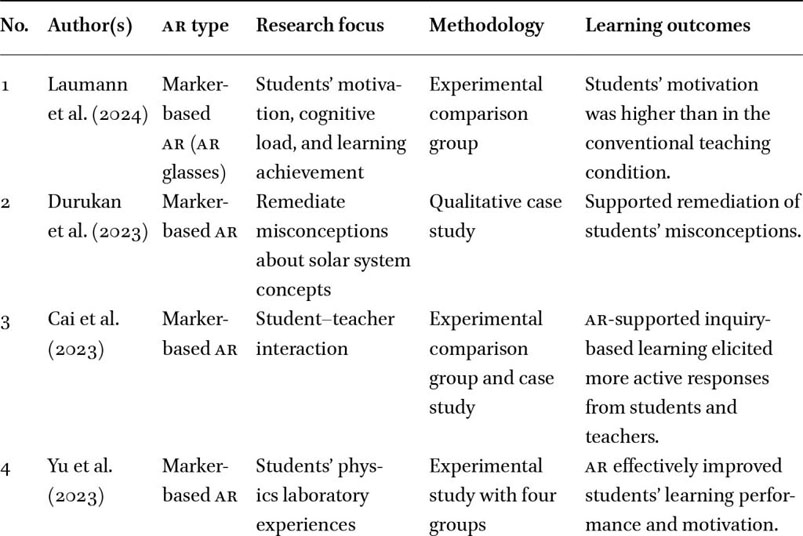
Throughout the coding process, we documented textual evidence from the reviewed articles corresponding to these four categories, while remaining open to other potential rationales (see Table 2).
Sample coding for analyzing rationales in selected articles
Citation: Asia-Pacific Science Education 11, 2 (2025) ; 10.1163/23641177-bja10102
3.2.2 Coding to Analyze AR World Design
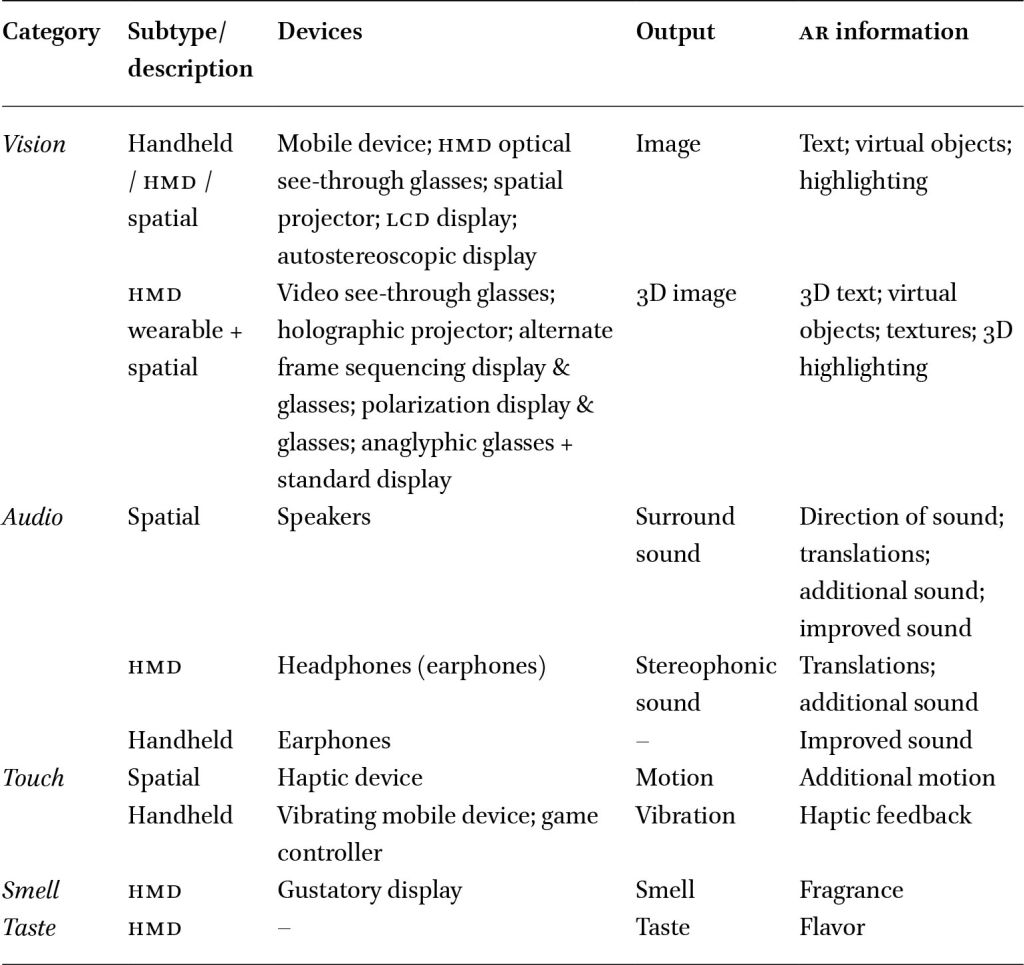
We analyzed AR application design based on five categories of AR information, drawing on Brito and Stoyanova (2018). These include types of input and output devices such as mobile phones, optical see-through glasses, projectors, LCD s, and autostereoscopic displays. Each device type provides different AR outputs, including text, virtual objects, and highlighted elements (see Table 3).
A code was applied when a study used one of the five categories. We noted the types of devices used and the AR information provided. Agreement was recorded when both researchers applied the same code independently.
Outputs of AR design features (adapted from Brito & Stoyanova, 2018, p. 820)
Citation: Asia-Pacific Science Education 11, 2 (2025) ; 10.1163/23641177-bja10102
3.2.3 Coding to Analyze Skills Trained
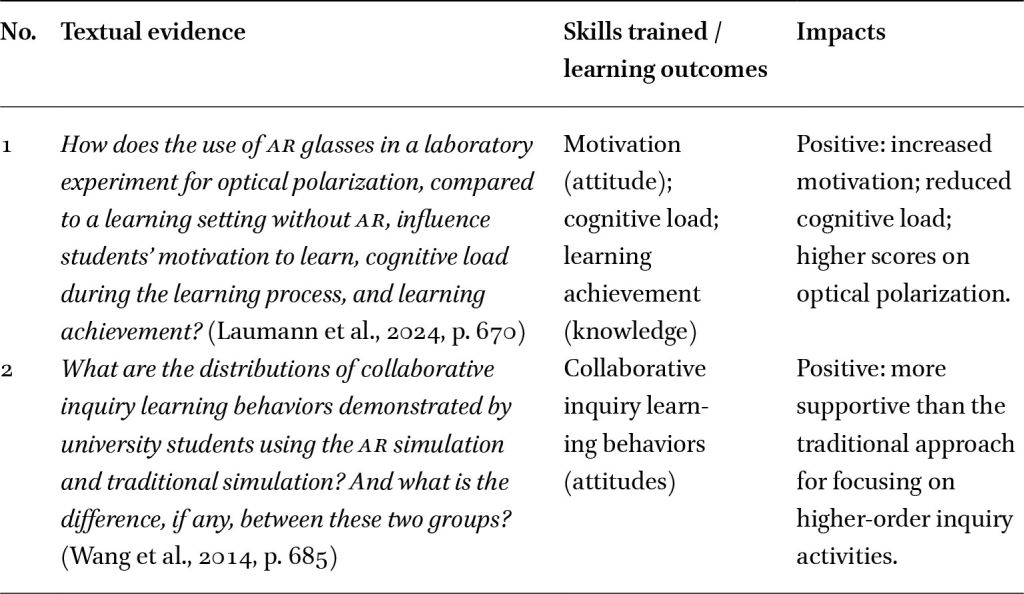
We used a similar approach to analyze the types of skills addressed in AR-integrated physics teaching. We examined two main areas of each study: the stated research purposes or questions (to identify intended learning outcomes) and the findings sections (to determine actual skills developed).
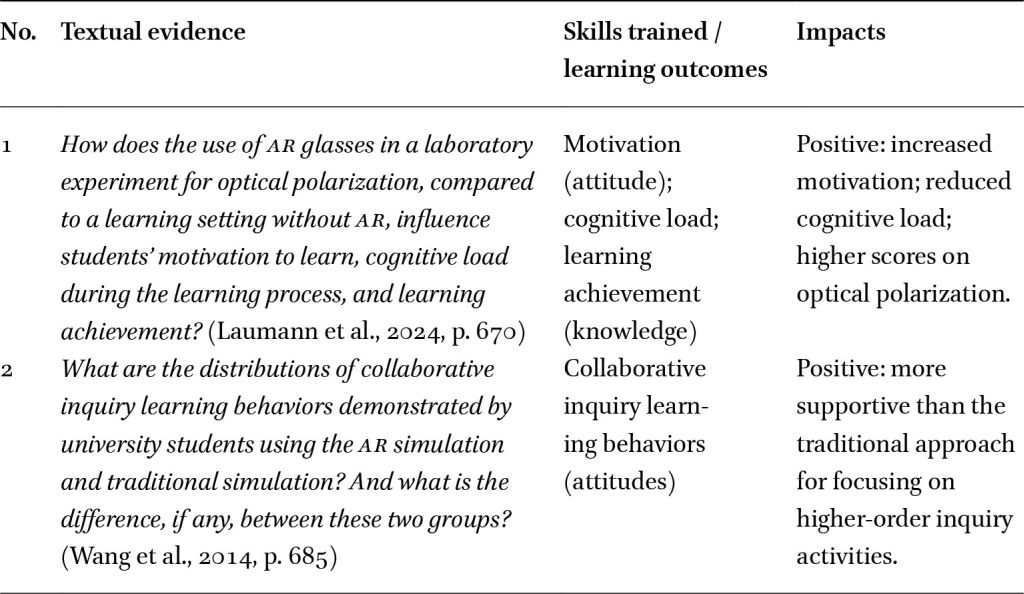
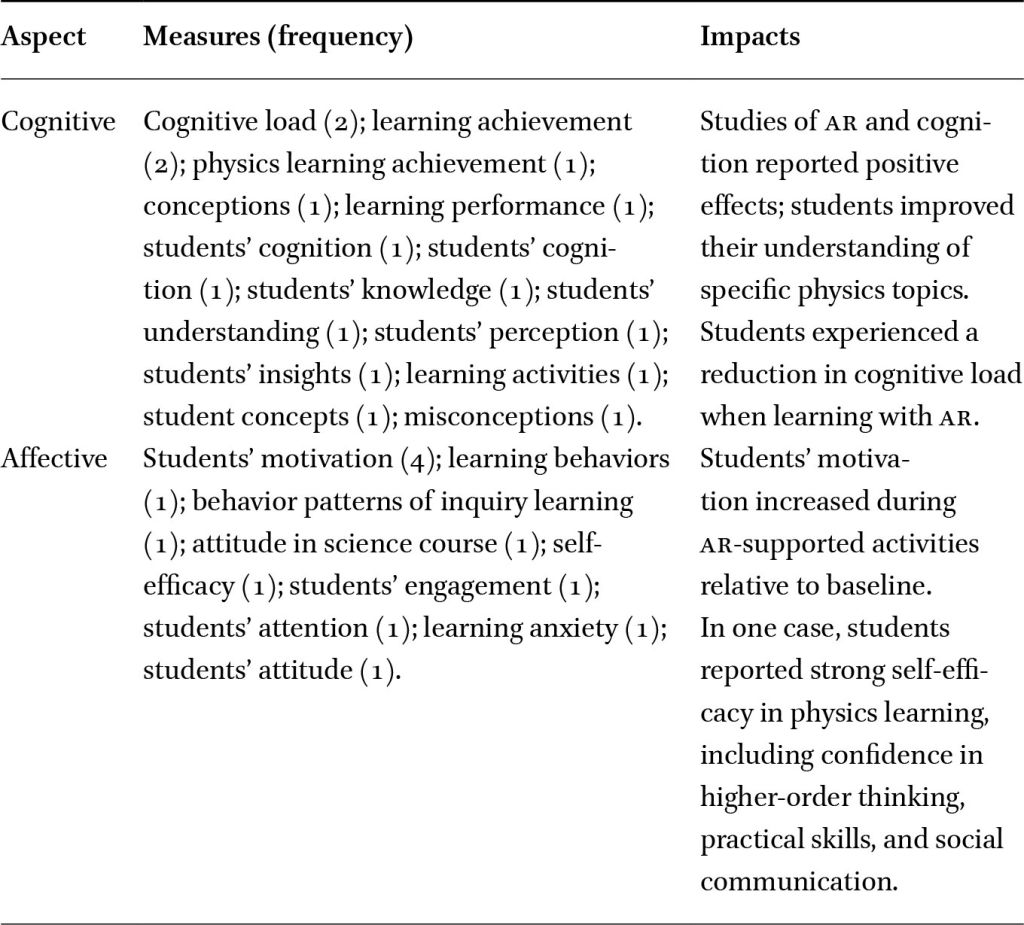
Following Savickiene (2010), we defined learning outcomes to include cognitive and procedural/practical skills, as well as values and attitudes. Table 4 summarizes the coding process for identifying these outcomes.
Learning and skill outcomes identified from textual evidence
Citation: Asia-Pacific Science Education 11, 2 (2025) ; 10.1163/23641177-bja10102
We classified skill-related outcomes into positive or negative impacts. A positive outcome was coded when skills improved compared to a baseline. Negative consequences were coded when performance or engagement declined. Table 5 includes examples of changes in student motivation, cognitive load, and learning achievement. For instance, AR applications had a positive impact on students’ motivation to learn specific physics topics, such as optical polarization.
3.2.4 Coding to Analyze Immersive Experiences
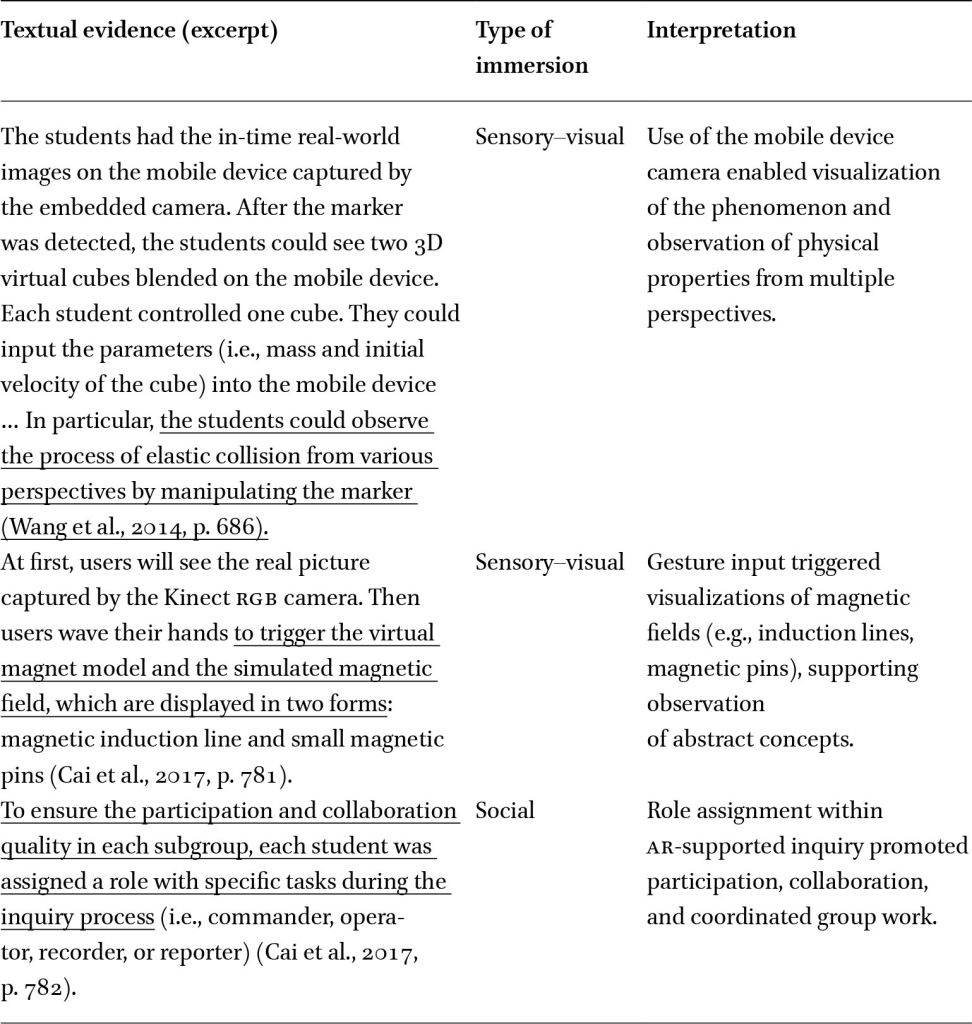
The final coding category focused on immersive experiences reported in the studies. These were divided into four categories based on Dede et al. (2017): actional immersion, symbolic/narrative immersion, sensory immersion, and social immersion. We examined the results, discussion, and conclusion sections of each study to identify how students engaged with AR content.
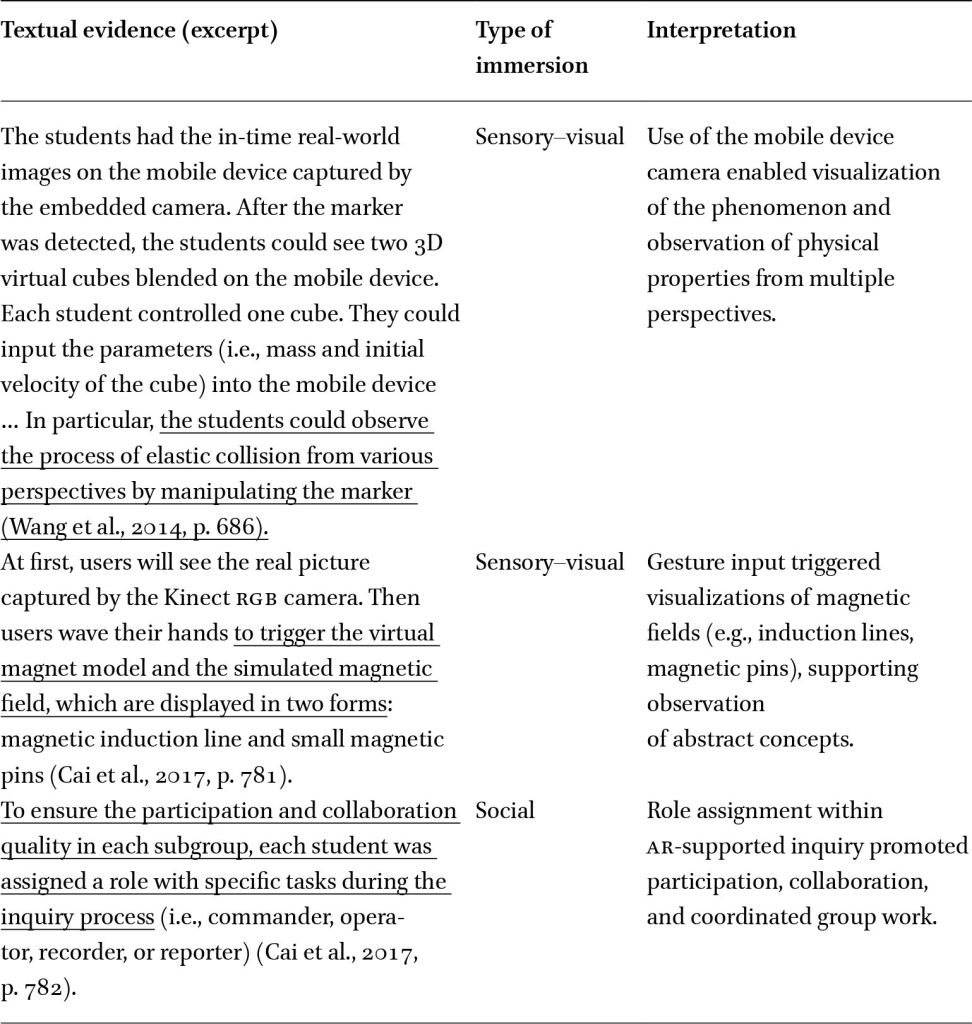
Two researchers independently coded the presence of each type of immersion, using textual evidence to support their interpretations. Disagreements were resolved through discussion. For example, AR applications that enabled students to manipulate virtual representations of physical systems while working with real lab equipment were coded as actional immersion. Those that helped students visualize narrative sequences or abstract processes were coded as symbolic/narrative immersion. Sensory immersion was identified when students interacted with AR through touch, sight, or sound, and social immersion was recognized when AR content facilitated peer collaboration or discourse (see Table 5).
Samples of interpretation from textual evidence about immersion in AR
Citation: Asia-Pacific Science Education 11, 2 (2025) ; 10.1163/23641177-bja10102
4 Results
We organized the findings around the research questions. Before addressing each question, we first summarize the physics content areas into which AR has been integrated.
4.1 AR Integration and Physics Content
We examined whether AR integration aligns with the argument that digital content embedded in real contexts can visualize unobservable phenomena in physics. Our analysis identified the physics topics most frequently used when integrating digital content into AR applications. Topics included magnetism (33.3%), the solar system (16.7%), the photoelectric effect (16.7%), torque, momentum and kinetic energy, optical polarization, and air pressure (Fidan & Tuncel, 2019).
Wang et al. (2014), for example, used elastic collisions as the context for AR integration. While the apparatus for demonstrating elastic collisions is familiar, it is difficult to calculate momentum and kinetic energy values during the event itself. In this case, digital content within the AR application displayed momentum and kinetic energy, helping students see that the square of momentum is proportional to kinetic energy. Hedenqvist et al. (2023) followed a similar rationale, examining mechanics with AR support. Delello (2014) selected Earth’s rotation for AR visualization. Although the study did not state the reason for this choice, simulating Earth’s rotation is challenging in a classroom because the relevant scales (size and mass) cannot be reproduced; AR thus offers a feasible alternative. Durukan et al. (2023) similarly used the solar system to engage students in physics learning.
Several researchers (Abdusselam & Karal, 2020; Cai et al., 2017; Liu et al., 2021; Yu et al., 2023) focused on magnetism, exploring diverse concepts such as the magnetic field around a bar magnet, magnetic fields in solenoids, magnetic force between current-carrying wires, and forces on a current-carrying wire. Because the magnetic field is abstract, AR is well suited to support visualization. Other studies examined concepts related to the photoelectric effect (Cai et al., 2021, 2023). Although this topic is central in modern physics and depicted in textbooks, apparatus for hands-on visualization is often limited, especially in high schools. AR can therefore support learning by showing how electrons are ejected from a metal surface under illumination with different wavelengths. Finally, AR has been used for optical polarization (Laumann et al., 2024), where visualizing the direction of the polarization vector is otherwise difficult.
4.2 Rationales for AR Research in Physics Learning
We identified four recurring rationales for integrating AR in physics learning: visualization, enhancing the learning experience, developing procedural skills, and providing a first-person experience. These trends are described systematically below.
4.2.1 Visualization
Nearly all studies emphasized AR’s role in helping students visualize abstract phenomena. The physics concepts introduced, momentum and kinetic energy in elastic collisions, mechanics, Earth’s rotation, the solar system, magnetism, the photoelectric effect, single-slit diffraction, air pressure, and optical polarization, include elements that are difficult to observe directly. Several studies (Abdusselam & Karal, 2020; Cai et al., 2017; Liu et al., 2021; Yu et al., 2023; Laumann et al., 2024) explicitly aimed to bridge this visualization gap so that students could meaningfully engage with the content. While model visualizations do not fully replace real phenomena, they can strengthen engagement and understanding. Even when phenomena are visible (e.g., collisions), specific physical quantities (e.g., momentum, kinetic energy, force) are not directly observable and must be inferred; AR helps make those relationships salient within realistic learning environments.
4.2.2 Enhancing the Learning Experience
Rationales varied across studies. Wang et al. (2014) investigated collaborative learning by comparing AR with a 2D simulation and analyzing differences in learning behaviors. Delello (2014) focused on pre-service science teachers’ experiences of AR integration in physics teaching. Cai et al. (2017) used AR to address “unnatural” or “unrealistic” experiences of magnetic fields. Fidan and Tuncel (2019) combined AR with problem-based learning to leverage the complementary strengths of realistic visualization and real-world problem contexts. Overall, these studies framed enhanced learning experiences as closely tied to improved visualization.
4.2.3 Recent Work (2020–Present)
Studies since 2020 generally continue these themes. Abdusselam and Karal (2020) provided students with 3D technology, a microcontroller, and a triaxial magnetic field sensor, reporting improvements in understanding magnetism and academic achievement. Cai et al. (2021a) examined effects on self-efficacy and conceptions of learning physics. Cai et al. (2023) emphasized inquiry-based learning in interactive AR environments that support teacher–student and peer interaction. Liu et al. (2021) reported that AR exposed students to materials and device–environment interaction tasks of varying complexity, improving knowledge, enhancing perceptions of learning tools, and reducing cognitive load. For students struggling with torque, AR-based experiences supported conceptual development and application (Hedenqvist et al., 2023). Additional studies explored whether AR moderated the effects of anxiety on learning and found that AR-based materials on solar system concepts effectively enhanced understanding. Laumann et al. (2024) focused on learning experiences with AR glasses for optical polarization. Notably, most studies used mobile devices (phones or tablets) to access AR content.
4.3 AR Design for Physics Teaching
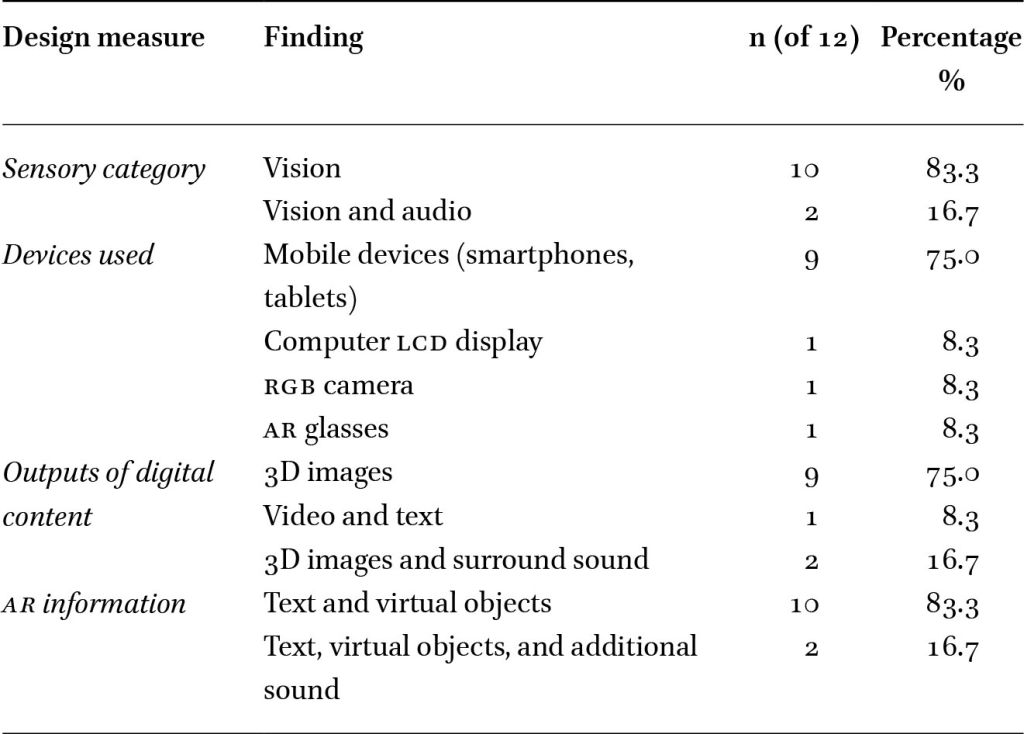
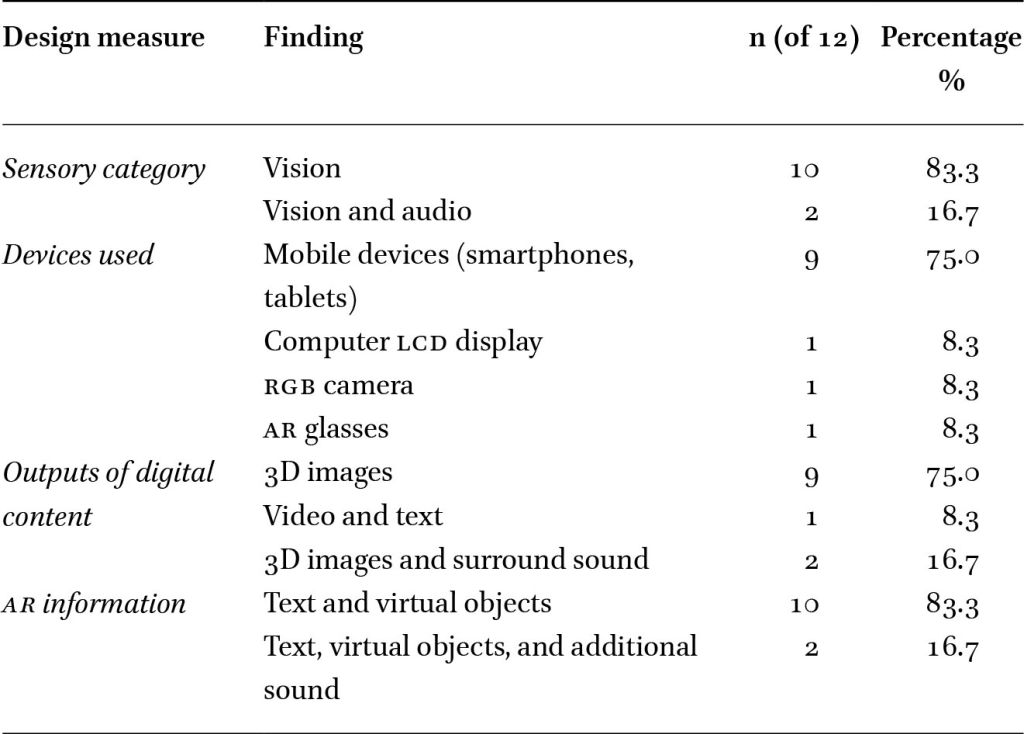
We examined four aspects of AR design: sensory experience, devices used, outputs of digital content, and AR information. Regarding sensory experience, most studies relied on vision; 9 of 12 studies fell into this category, while 2 (16.7%) combined visual and auditory elements. This pattern reinforces the emphasis on visualizing abstract phenomena, such as magnetic fields or polarization angle, by overlaying digital content on real environments.
With respect to devices, mobile phones and tablets predominated. Given their ubiquity among students, these devices were a practical choice for laboratory activities. Other devices included desktop or laptop computers with LCD displays, RGB cameras, and AR glasses (Laumann et al., 2024). The use of AR glasses is notable because it can allow students to observe digital content hands-free, potentially creating a more naturalistic lab experience.
Regarding outputs, most digital content presented 3D images to support visualization. Although 3D modeling is more involved than 2D, it can feel more naturalistic. For instance, in illustrating the photoelectric effect, electrons were rendered as 3D spheres moving from a metal surface under illumination with specific energies. Some studies augmented 3D visualization with audio and textual information. Durukan et al. (2023), for example, supplemented 3D planetary models with audio and text, which may evoke different emotional responses during learning.
Finally, AR information was dominated by text and virtual objects (see Table 6). Much of the textual information displayed values of physical variables. In Wang et al. (2014), for example, momentum and kinetic energy values were shown alongside the visualization of an elastic collision. Such outputs help address abstract phenomena that are difficult to represent in the classroom by engaging students directly with relevant digital content.
AR design features across four categories
Citation: Asia-Pacific Science Education 11, 2 (2025) ; 10.1163/23641177-bja10102
4.4 Skills or Learning Outcomes Fostered through AR Applications
Across the 12 empirical studies, we mapped the skills and learning outcomes associated with AR use in physics teaching and learning. Based on textual evidence, outcomes were grouped into cognitive and affective domains. Table 7 summarizes the measures used for each domain. Although terminology varied (such as, “students’ understanding,” “learning achievement,” “learning performance,” “students’ knowledge”), these constructs consistently reflected cognitive outcomes. Several studies documented positive cognitive impacts, including statistically significant improvements (Laumann et al., 2024). In some cases, AR reduced cognitive load when students worked with unobservable or sub-microscopic phenomena.
Learning and skill outcomes identified through AR integration
Citation: Asia-Pacific Science Education 11, 2 (2025) ; 10.1163/23641177-bja10102
In the affective domain, AR integration influenced motivation, engagement, and attitudes. AR-enhanced environments were generally perceived as more supportive than conventional settings. Students’ engagement and attention improved, potentially because they felt less anxious when investigating and manipulating materials with accompanying information (Yu et al., 2022). In other cases, AR strengthened self-efficacy, supporting higher-order cognitive skills, practical work, and social communication. Overall, the evidence indicates positive contributions of AR to affective aspects of learning.
4.5 Types of Immersive Experiences Stimulated by AR Applications
Across the 12 studies, we identified three types of immersion: actional, sensory, and social. Sensory immersion was most common and typically involved visual, and sometimes auditory, elements (see Table 8). This prevalence reflects AR’s core purpose of connecting abstract concepts to macroscopic reality by overlaying digital content on the real world.
Evidence for actional immersion was more limited. Liu et al. (2021) reported strong student willingness to use AR, finding AR-based molecular visualization engaging. Hedenqvist et al. (2023) showed that visualizing torque supported students in completing torque-related experimental tasks, such as varying force magnitude and the angle between the force and the arm.
Social immersion was observed when students coordinated roles and shared tasks during investigations. Cai et al. (2017) documented group roles, including commander, operator, recorder, and reporter, that supported participation and collaboration. Other studies emphasized how AR prompted inquiry into physics concepts and their relationships (Fidan & Tuncel, 2019). In inquiry-based contexts, students worked individually and in groups to evaluate results (Abdusselam & Karal, 2020). Sharing AR-based exploration results with peers also supported consensus building (Cai et al., 2023). With pre-service teachers, social activity included sharing experiences in creating images for AR applications (Delello, 2014). Together, these findings show how AR can foster actional, sensory, and social immersion.
Types of immersive experiences identified in the AR world
Citation: Asia-Pacific Science Education 11, 2 (2025) ; 10.1163/23641177-bja10102
5 Discussion of the Research Findings
This discussion considers the study’s findings from three perspectives: the integration of AR-based education into the curriculum, insights from science education, and perspectives from technology-based education.
5.1 Rationales for Using AR in Physics Teaching
From the perspective of science education, our findings emphasize that the primary rationale for using AR applications lies in their ability to enhance visualization and provide immersive learning experiences. These advantages should align with key learning theories, including constructivism (Boddy, 2003; Skamp et al., 2021) and cognitive load theory (Chandler & Sweller, 1991), which are foundational to effective physics instruction. Visualization and experiential learning serve as tools to help students build new understandings by connecting them to prior knowledge. AR is particularly valuable for visualizing sub-microscopic phenomena, offering meaningful representations that support the development and correction of mental models (Anam et al., 2019, 2023; Schnotz et al., 1993). When such corrections occur, deeper and more immersive learning experiences often follow. AR also plays a crucial role in illustrating the behavior of particles or molecules that cannot be observed at the macroscopic level (Arici et al., 2019). From the perspective of cognitive load theory, AR can reduce the burden on working memory, particularly the visuospatial sketchpad, by providing clear, simple visualizations that promote germane cognitive load and facilitate meaningful learning (Cook, 2006). Consequently, students using AR often show improved conceptual understanding and academic performance compared with students in conventional classrooms (Chang & Hwang, 2018). Students also tend to demonstrate greater confidence in applying higher-order thinking skills, engage more actively in experiments and discussions, and experience less anxiety. Furthermore, AR fosters positive attitudes toward science by sustaining students’ attention and motivation throughout the learning process (Li et al., 2024).
5.2 AR Design for Physics Teaching
AR application design in physics teaching can be critically examined through the lens of technology-based education. Our findings show that mobile devices, particularly smartphones and tablets, are the most commonly used platforms because of their accessibility, affordability, and widespread familiarity among students. These factors have contributed to the growing adoption of AR in educational settings (Bano et al., 2018). However, evaluating AR applications requires attention to pedagogical value. From a pedagogical standpoint, science education emphasizes alignment between instruction and learner characteristics. Our findings indicate that most AR applications in use were image-based, which raises important design considerations. Specifically, AR tools should be sensitive to differences in gender, age, and prior knowledge to ensure equitable and effective learning experiences (Cheng & Tsai, 2013). In this context, a critical evaluation of AR design should extend beyond functionality to consider whether the technology effectively supports learning across diverse student characteristics (Wu et al., 2013).
5.3 Skills or Learning Outcomes Obtained through the Integration of AR Applications
From a curriculum integration perspective, AR applications should become a regular feature of physics teaching and learning, contributing meaningfully to pedagogical goals. This implies that physics teachers treat AR as a standard multimodal resource, integrating it purposefully to augment the physical environment with digital information (Salmi et al., 2017). Importantly, the use of AR should align with the nature of science. Hands-on experiments and demonstrations remain essential for understanding the empirical foundations of physics (Duit et al., 2013) and should not be replaced when real laboratory activities are sufficient to convey scientific concepts. The selection of AR must be sensitive to the characteristics of each topic. AR is most appropriate when traditional methods fall short, such as when phenomena are abstract, invisible, or difficult to simulate physically. In such cases, AR-based games, books, and applications can enhance accessibility, support e-learning, and encourage active thinking, thereby fostering independent and self-regulated learning (Alkhabra et al., 2023; Wang, 2020).
5.4 Experiences Represented in Terms of Several Immersions
Meaningful learning and experience occur when AR applications are designed to accommodate variations in learners’ background knowledge, age, and gender. When such learning is achieved, students are more likely to experience sensory, actional, and social immersion. This immersion enables AR to deliver rich, multifaceted experiences that move beyond passive content consumption. Students are actively engaged through visual, auditory, and interactive elements that promote both individual understanding and collaborative learning (Dede et al., 2017). Consequently, AR not only deepens scientific comprehension but also enhances communication and teamwork skills, making it a valuable tool in physics teaching (Dunleavy et al., 2009).
5.5 Synthesis, Implications, and Future Research
This section synthesizes the rationales for AR use, AR design, skills or outcomes obtained, and immersive experiences. The development and integration of AR in physics teaching should be guided by the rationale for its use and the intended outcomes. Decisions about when and where to infuse AR, whether as a classroom demonstration or as part of laboratory activities, should be aligned with learning goals. When the goal is to foster motivation, students should be engaged in activities that connect meaningfully to AR. Using AR to provide new immersive experiences may change students’ motivation in physics classrooms; when immersion is meaningful, goals and outcomes are more readily achieved.
Despite these benefits, several challenges hinder effective integration (Alalwan et al., 2020). Not all science or physics teachers are familiar with AR technologies. For educators accustomed to conventional methods, incorporating AR may require additional preparation to ensure lessons proceed smoothly. Teachers who lack the technical skills to develop AR content may struggle to design, model, and render representations of physical phenomena, potentially interfering with lesson planning and instruction. Limited technological infrastructure also presents barriers: although AR applications can often be accessed via smartphones or tablets, devices must meet certain technical specifications. In under-resourced settings, where students may not have reliable access to such devices, integration becomes particularly challenging.
Creating AR content frequently demands basic programming knowledge, 3D modeling skills, and familiarity with rendering software – skills many teachers may not possess or have time to develop. These challenges underscore the need for professional development, institutional support, and accessible AR tools. Effective use of AR additionally requires a solid understanding of pedagogical approaches for technology integration. Without appropriate instructional strategies, the intended benefits of AR, such as reducing cognitive load and supporting multiple representations, may not be realized. Instead, students may experience cognitive overload, especially when AR content does not align with prior knowledge or learning objectives (Cook, 2006). Improper use of multiple representations can overwhelm rather than support understanding. Thus, successful AR integration depends not only on access to technology but also on teachers’ capacity to align AR use with sound pedagogical principles that support meaningful and cognitively manageable learning.
Despite the valuable insights gained from this study, several limitations should be acknowledged. A key limitation is the relatively small number of articles analyzed. Although we identified important aspects of AR application in physics teaching, such as underlying rationales, design features, targeted learning outcomes, and immersive experiences, the analysis was based on only 12 systematically selected articles. As a result, generalizations should be made with caution. Future research should expand the dataset and synthesize findings from a larger body of literature. Nevertheless, these insights provide a foundation for subsequent reviews and empirical investigations, contributing to a more comprehensive understanding of the role of AR in physics teaching and learning.
6 Conclusion
AR has positioned itself as a crucial technology for supporting physics teaching and learning. It can be integrated into classroom and laboratory activities to achieve goals ranging from improving learning outcomes to fostering motivation. AR design should be guided by the rationale for its use, the intended learning outcomes, and the quality of immersive experiences it provides. In practice, AR must be grounded in instructional needs and teacher capacity. Although AR offers many potential benefits, its application should complement rather than duplicate what real activities already provide, avoiding unnecessary overlap in multimodal representations. Because AR integrates digital information with the real world, careful attention is needed to ensure that digital content does not introduce misconceptions or oversimplified models.
When AR development emphasizes rationale, learning outcomes, and immersive experience, it aligns with the nature of physics and allows students to engage in meaningful learning that improves outcomes and fosters higher-order thinking skills. Theoretically, this work highlights the role of multisensory immersion in addressing complex physics concepts, particularly unobservable phenomena, by bridging real laboratory contexts with enhanced digital content. Practically, science and physics educators should design AR-supported lab tasks aligned with the purposes of laboratory activities and integrate them thoughtfully to maximize effectiveness. At the curriculum level, learning outcomes, teaching materials, and AR tools must be synchronized so teachers can plan and implement AR-supported tasks effectively. Because AR remains relatively new for many teachers in developing countries, policymakers should provide infrastructure, equitable access to technology, and training programs that build the capacity and literacy needed to use AR confidently in physics teaching.
Acknowledgements
We wish to express our gratitude to Professor Sonya N. Martin in this journal, whose helpful proofreading has greatly improved this paper. We also would like to acknowledge the Indonesian Ministry of Higher Education, Science, and Technology, Institut Pendidikan Indonesia (IPI), and other partner institutions, including Universitas Pendidikan Indonesia (UPI), Universitas Khairun, and Universitas PGRI Semarang. These institutions have supported researchers in collaborative projects related to Augmented Reality (AR) in science teaching.
Funding
This study was supported by the Indonesian Ministry of Higher Education, Science, and Technology through the Katalis Grant (Research Identification Number: 018/SP2H/PL.BACTH.2/LL4/2024).
Ethical Consideration
The data reported in this study do not require human subject approval.
About the Authors
Surya Gumilar is a junior lecturer in the Department of Physics Education at Institut Pendidikan Indonesia (Garut, Indonesia) and a graduate student at the Graduate Institute of Science Education, National Taiwan Normal University (Taiwan). His research interests include multiple representations, textbook analysis, gender in science education, and technology-enhanced science teaching. His contributions to this article include developing ideas for the systematic literature review, conducting framework analysis, searching for relevant articles, and discussing the findings.
Irma Fitria Amalia is a junior lecturer and assistant professor in the Department of Physics Education at Institut Pendidikan Indonesia (Garut, Indonesia). Her research focuses on science textbook analysis and pedagogical content knowledge in physics education. She holds a master’s degree in Materials Science from Institut Teknologi Bandung (ITB), Indonesia. Her contributions to this article include analyzing the framework, conducting database searches, and contributing to the findings analysis.
Iman Nasrulloh is a senior lecturer and associate professor in the Department of Information Technology Education at Institut Pendidikan Indonesia (Garut, Indonesia). His research focuses on the development of teaching materials in technology education. He holds a doctoral degree in Technological Education from Universitas Negeri Jakarta (UNJ), Indonesia. His contributions to this article include framework and methodology analysis, as well as coding and data analysis.
Ali Ismail is a senior lecturer and associate professor in the Department of Elementary Teacher Education at Universitas Pendidikan Indonesia (UPI), Indonesia. His research interests include science education and the use of technology in science teaching. He holds a doctoral degree in Science Education from Universitas Pendidikan Indonesia. His contributions to this article include proofreading both the initial and final drafts of the manuscript.
Saprudin is a senior lecturer and associate professor in the Science Education Program at Universitas Khairun, Indonesia. His research focuses on the development of teaching materials in science and technology education, as well as teaching strategies. He holds a doctoral degree in Science Education from Universitas Pendidikan Indonesia (UPI). His contributions to this article include framework analysis and coding.
Muhammad Syaipul Hayat is a senior lecturer and associate professor in the Department of Science Education at Universitas PGRI Semarang, Indonesia. His research interests include creative thinking skills and the development of teaching strategies in science education. He holds a doctoral degree in Science Education from Universitas Pendidikan Indonesia (UPI). His contributions to this article include framework analysis and coding.
Rifat Shafwatul Anam is a senior lecturer and associate professor in the Teacher Professional Program at Universitas Terbuka, Indonesia. His research interests include multiple representations, science teaching in primary education, and argumentation skills. He holds a doctoral degree in Primary Education from Universitas Pendidikan Indonesia (UPI). His contributions to this article include proofreading both the initial and final drafts of the manuscript.
References
Abdusselam, M. S., & Karal, H. (2020). The effect of using augmented reality and sensing technology to teach magnetism in high school physics. Technology, Pedagogy and Education, 29(4), 407–424. https://doi.org/10.1080/1475939X.2020.1766550.
Alalwan, N., Cheng, L., Al-Samarraie, H., Yousef, R., Ibrahim Alzahrani, A., & Sarsam, S. M. (2020). Challenges and prospects of virtual reality and augmented reality utilization among primary school teachers: A developing country perspective. Studies in Educational Evaluation, 66, 100876. https://doi.org/10.1016/j.stueduc.2020.100876.
Alkhabra, Y. A., Ibrahem, U. M., & Alkhabra, S. A. (2023). Augmented reality technology in enhancing learning retention and critical thinking according to STEAM program. Humanities and Social Sciences Communications, 10(1), 174. https://doi.org/10.1057/s41599-023-01650-w.
Anam, R. S., Gumilar, S., & Widodo, A. (2023). the use of the constructivist teaching sequence (CTS) to facilitate changes in the visual representations of fifth-grade elementary school students: A case study on teaching heat convection concepts. International Journal of Science and Mathematics Education, 22, 73–99. https://doi.org/10.1007/s10763-023-10358-x.
Anam, R. S., Widodo, A., & Sopandi, W. (2019). Teachers, pre-service teachers, and students understanding about the heat conduction. Journal of Physics: Conference Series, 1157, 022012. https://doi.org/10.1088/1742-6596/1157/2/022012.
Angell, C., Guttersrud, Ø., Henriksen, E. K., & Isnes, A. (2004). Physics: Frightful, but fun. Pupils’ and teachers’ views of physics and physics teaching. Science Education, 88(5), 683–706. https://doi.org/10.1002/sce.10141.
Arici, F., Yildirim, P., Caliklar, Ş., & Yilmaz, R. M. (2019). Research trends in the use of augmented reality in science education: Content and bibliometric mapping analysis. Computers & Education, 142, 103647. https://doi.org/10.1016/j.compedu.2019.103647.
Bano, M., Zowghi, D., Kearney, M., Schuck, S., & Aubusson, P. (2018). Mobile learning for science and mathematics school education: A systematic review of empirical evidence. Computers & Education, 121, 30–58. https://doi.org/10.1016/j.compedu.2018.02.006.
Blattgerste, J., Luksch, K., Lewa, C., & Pfeiffer, T. (2021). TrainAR: A scalable interaction concept and didactic framework for procedural trainings using handheld augmented reality. Multimodal Technologies and Interaction, 5(7), 30. https://doi.org/10.3390/mti5070030.
Boddy, N. (2003). A referent model for constructivist teaching and learning. Research in Science Education, 33(1), 27–42. https://doi.org/10.1023/A:1023606425452.
Brito, P. Q., & Stoyanova, J. (2018). Marker versus markerless augmented reality. Which has more impact on users? International Journal of Human–Computer Interaction, 34(9), 819–833. https://doi.org/10.1080/10447318.2017.1393974.
Burns, C. G., & Fairclough, S. H. (2015). Use of auditory event-related potentials to measure immersion during a computer game. International Journal of Human-Computer Studies, 73, 107–114. https://doi.org/10.1016/j.ijhcs.2014.09.002.
Byun, T., & Park, J. (2023). A literature review on augmented reality and virtual reality in science education. Journal of Korean Elementary Science Education, 42(2), 227–244.
Cai, S., Chiang, F.-K., Sun, Y., Lin, C., & Lee, J. J. (2017). Applications of augmented reality-based natural interactive learning in magnetic field instruction. Interactive Learning Environments, 25(6), 778–791. https://doi.org/10.1080/10494820.2016.1181094.
Cai, S., Liu, C., Wang, T., Liu, E., & Liang, J. (2021). Effects of learning physics using Augmented Reality on students’ self‐efficacy and conceptions of learning. British Journal of Educational Technology, 52(1), 235–251. https://doi.org/10.1111/bjet.13020.
Cai, S., Niu, X., Wen, Y., & Li, J. (2023). Interaction analysis of teachers and students in inquiry class learning based on augmented reality by iFIAS and LSA. Interactive Learning Environments, 31(9), 5551–5567. https://doi.org/10.1080/10494820.2021.2012808.
Chandler, P., & Sweller, J. (1991). Cognitive load theory and the format of instruction. Cognition and Instruction, 8(4), 293–332. https://doi.org/10.1207/s1532690xci0804_2.
Chang, S.-C., & Hwang, G.-J. (2018). Impacts of an augmented reality-based flipped learning guiding approach on students’ scientific project performance and perceptions. Computers & Education, 125, 226–239. https://doi.org/10.1016/j.compedu.2018.06.007.
Chen, C.-H., Lee, I.-J., & Lin, L.-Y. (2016). Augmented reality-based video-modeling storybook of nonverbal facial cues for children with autism spectrum disorder to improve their perceptions and judgments of facial expressions and emotions. Computers in Human Behavior, 55, 477–485. https://doi.org/10.1016/j.chb.2015.09.033.
Cheng, K.-H., & Tsai, C.-C. (2013). Affordances of augmented reality in science learning: suggestions for future research. Journal of Science Education and Technology, 22(4), 449–462. https://doi.org/10.1007/s10956-012-9405-9.
Christou, G. (2014). The interplay between immersion and appeal in video games. Computers in Human Behavior, 32, 92–100. https://doi.org/10.1016/j.chb.2013.11.018.
Cook, M. P. (2006). Visual representations in science education: The influence of prior knowledge and cognitive load theory on instructional design principles. Science Education, 90(6), 1073–1091. https://doi.org/10.1002/sce.20164.
Dede, C. (2009). Immersive interfaces for engagement and learning. Science, 323(5910), 66–69.
Dede, C.J., Jacobson, J., & Richards, J. (2017). Introduction: Virtual, Augmented, and Mixed Realities in Education. In: Liu, D., Dede, C., Huang, R., & Richards, J. (eds) Virtual, Augmented, and Mixed Realities in Education. Smart Computing and Intelligence. Springer, Singapore. https://doi.org/10.1007/978-981-10-5490-7_1.
Delello, J. A. (2014). Insights from pre-service teachers using science-based augmented reality. Journal of Computers in Education, 1(4), 295–311. https://doi.org/10.1007/s40692-014-0021-y.
Duit, R., Niedderer, H., & Schecker, H. (2013). Teaching physics. In S. Abel & N. Lederman (Eds.), Handbook of research on science education (pp. 599–629). Routledge.
Dunleavy, M., Dede, C., & Mitchell, R. (2009). Affordances and limitations of immersive participatory augmented reality simulations for teaching and learning. Journal of Science Education and Technology, 18(1), 7–22. https://doi.org/10.1007/s10956-008-9119-1.
Durukan, Ü. G., Turan Güntepe, E., & Dönmez Usta, N. (2023). Evaluation of the effectiveness of augmented reality-based teaching material: the solar system. International Journal of Human–Computer Interaction, 39(12), 2542–2556. https://doi.org/10.1080/10447318.2022.2121041.
Fidan, M., & Tuncel, M. (2019). Integrating augmented reality into problem-based learning: The effects on learning achievement and attitude in physics education. Computers & Education, 142, 103635. https://doi.org/10.1016/j.compedu.2019.103635.
Gumilar, S., & Ismail, A. (2023). The representation of laboratory activities in Indonesian physics textbooks: a content analysis. Research in Science & Technological Education, 41(2), 614–634. https://doi.org/10.1080/02635143.2021.1928045.
Hedenqvist, C., Romero, M., & Vinuesa, R. (2023). Improving the learning of mechanics through augmented reality. Technology, Knowledge and Learning, 28(1), 347–368. https://doi.org/10.1007/s10758-021-09542-1.
Herron, M. D. (1971). The nature of scientific enquiry. The School Review, 79(2), 171–212.
Jiang, S., Tatar, C., Huang, X., Sung, S. H., & Xie, C. (2022). Augmented reality in science laboratories: investigating high school students’ navigation patterns and their effects on learning performance. Journal of Educational Computing Research, 60(3), 777–803. https://doi.org/10.1177/07356331211038764.
Kipnis, M., & Hofstein, A. (2007). Inquiring the inquiry laboratory in high school. In R. Pinto & D. Couso (Eds.), Contributions from science education research (pp. 297–306). Springer.
Kipnis, M., & Hofstein, A. (2008). The inquiry laboratory as a source for development of metacognitive skills. International Journal of Science and Mathematics Education, 6(3), 601–627. https://doi.org/10.1007/s10763-007-9066-y.
Laumann, D., Schlummer, P., Abazi, A., Borkamp, R., Lauströer, J., Pernice, W., Schuck, C., Schulz-Schaeffer, R., & Heusler, S. (2024). Analyzing the effective use of augmented reality glasses in university physics laboratory courses for the example topic of optical polarization. Journal of Science Education and Technology, 33(5), 668–685. https://doi.org/10.1007/s10956-024-10112-0.
Li, S., Jiao, X., Cai, S., & Shen, Y. (2024). Enhancing AR‐based learning environments for STEM education: A design‐based study on design features, kinematics learning and mathematics self‐efficacy. British Journal of Educational Technology, 56(4), 1438–1462. https://doi.org/10.1111/bjet.13528.
Liu, Q., Yu, S., Chen, W., Wang, Q., & Xu, S. (2021). The effects of an augmented reality based magnetic experimental tool on students’ knowledge improvement and cognitive load. Journal of Computer Assisted Learning, 37(3), 645–656. https://doi.org/10.1111/jcal.12513.
Matovu, H., Ungu, D. A. K., Won, M., Tsai, C.-C., Treagust, D. F., Mocerino, M., & Tasker, R. (2023). Immersive virtual reality for science learning: Design, implementation, and evaluation. Studies in Science Education, 59(2), 205–244. https://doi.org/10.1080/03057267.2022.2082680.
Mikropoulos, T. A., Delimitros, M., Gaintatzis, P., Iatraki, G., Stergiouli, A., Tsiara, A., & Kalyvioti, K. (2020). Acceptance and user experience of an augmented reality system for the simulation of sensory overload in children with autism. 2020 6th International Conference of the Immersive Learning Research Network (ILRN), 86–92. https://doi.org/10.23919/iLRN47897.2020.9155113.
Miles, M. B. (1984). Qualitative data analysis: A sourcebook of new methods. Beverly Hills.
Mulhall, P., & Gunstone, R. (2012). Views about learning physics held by physics teachers with differing approaches to teaching physics. Journal of Science Teacher Education, 23(5), 429–449. https://doi.org/10.1007/s10972-012-9291-2.
Nikitin, A., Kácovský, P., Snětinová, M., Chvál, M., Houfková, J., & Koupilová, Z. (2025). Physics demonstrations, science show, or hands-on practical work? Exploring students’ intrinsic motivation. Physical Review Physics Education Research, 21(1), 010146. https://doi.org/10.1103/PhysRevPhysEducRes.21.010146.
Olim, S. C., & Nisi, V. (2020). Augmented reality towards facilitating abstract concepts learning. In N. J. Nunes, L. Ma, M. Wang, N. Correia, & Z. Pan (Eds.), Entertainment Computing – ICEC 2020 (pp. 188–204). Springer International Publishing.
Roth, W. (1994). Experimenting in a constructivist high school physics laboratory. Journal of Research in Science Teaching, 31(2), 197–223. https://doi.org/10.1002/tea.3660310209.
Salmi, H., Thuneberg, H., & Vainikainen, M.-P. (2017). Making the invisible observable by augmented reality in informal science education context. International Journal of Science Education, Part B, 7(3), 253–268. https://doi.org/10.1080/21548455.2016.1254358.
Sánchez, J., & Diaz, M. H. R. (2022). Augmented reality in physics teaching. European Journal of Physics Education, 13(1), 14–27.
Savickiene, I. (2010). Conception of learning outcomes in the Bloom’s taxonomy affective domain. Quality of Higher Education, 7, 37–59.
Schnotz, W., Picard, E., & Hron, A. (1993). How do successful and unsuccessful learners use texts and graphics? Learning and Instruction, 3(3), 181–199. https://doi.org/10.1016/0959-4752(93)90003-I.
Shin, D. (2019). How does immersion work in augmented reality games? A user-centric view of immersion and engagement. Information, Communication & Society, 22(9), 1212–1229. https://doi.org/10.1080/1369118X.2017.1411519.
Skamp, K., Boyes, E., Stanisstreet, M., Rodriguez, M., Malandrakis, G., Fortner, R., Kilinc, A., Taylor, N., Choker, K., Shweta, D., Ambusaidi, A., Cheong, I., Kim, M., & Yoon, H.-G. (2021). Voting for change: an international study of students’ willingness to support measures to ameliorate climate change. Research in Science Education, 51(3), 861–887. https://doi.org/10.1007/s11165-019-09864-2.
Sotiriou, S., & Bogner, F. X. (2008). Visualizing the invisible: augmented reality as an innovative science education scheme. Advanced Science Letters, 1(1), 114–122.
Stadermann, H. K. E., & Goedhart, M. J. (2020). Secondary school students’ views of nature of science in quantum physics. International Journal of Science Education, 42(6), 997–1016. https://doi.org/10.1080/09500693.2020.1745926.
Tang, K. (2023). The characteristics of diagrams in scientific explanations: Multimodal integration of written and visual modes of representation in junior high school textbooks. Science Education, 107(3), 741–772. https://doi.org/10.1002/sce.21787.
Ternier, S., Klemke, R., Kalz, M., Van Ulzen, P., & Specht, M. (2012). ARLearn: augmented reality meets augmented virtuality. Journal of Universal Computer Science-Technology for Learning across Physical and Virtual Spaces, 18(15), 2143–2164.
Tobin, K., McRobbie, C., & Anderson, D. (1997). Dialectical constraints to the discursive practices of a high school physics community. Journal of Research in Science Teaching: The Official Journal of the National Association for Research in Science Teaching, 34(5), 491–507.
Wallace, J., & Louden, W. (2003). What we don’t understand about teaching for understanding: Questions from science education. Journal of Curriculum Studies, 35(5), 545–566. https://doi.org/10.1080/0022027032000066677.
Wang, H.-Y., Duh, H. B.-L., Li, N., Lin, T.-J., & Tsai, C.-C. (2014). An investigation of university students’ collaborative inquiry learning behaviors in an augmented reality simulation and a traditional simulation. Journal of Science Education and Technology, 23(5), 682–691. https://doi.org/10.1007/s10956-014-9494-8.
Wang, Y.-H. (2020). Integrating games, e-books and AR techniques to support project-based science learning. Educational Technology & Society, 23(3), 53–67.
Wu, H.-K., Lee, S. W.-Y., Chang, H.-Y., & Liang, J.-C. (2013). Current status, opportunities and challenges of augmented reality in education. Computers & Education, 62, 41–49. https://doi.org/10.1016/j.compedu.2012.10.024.
Yu, S., Liu, Q., Ma, J., Le, H., & Ba, S. (2023). Applying augmented reality to enhance physics laboratory experience: does learning anxiety matter? Interactive Learning Environments, 31(10), 6952–6967. https://doi.org/10.1080/10494820.2022.2057547.
Zacharia, Z. C., & Constantinou, C. P. (2008). Comparing the influence of physical and virtual manipulatives in the context of the Physics by Inquiry curriculum: The case of undergraduate students’ conceptual understanding of heat and temperature. American Journal of Physics, 76(4), 425–430. https://doi.org/10.1119/1.2885059.
Zacharia, Z. C., & Michael, M. (2016). Using physical and virtual manipulatives to improve primary school students’ understanding of concepts of electric circuits. In M. Riopel & Z. Smyrnaiou (Eds.), New developments in science and technology education (pp. 125–140). Springer International Publishing. https://doi.org/10.1007/978-3-319-22933-1_12.
Appendix 1
Citation: Asia-Pacific Science Education 11, 2 (2025) ; 10.1163/23641177-bja10102
Source journals for the literature review (science education and educational technology)