Abstract
This study aimed to measure hazard literacy among adults, addressing five domains, including knowledge and understanding, reasoning and skill, values and attitudes, psychology and emotion, and behavioral and practical engagement, and examining variations by gender, age, and disaster education. A self-assessment survey was conducted with 1,000 adults. Results showed the highest scores in the values and attitudes domain and the lowest scores in the knowledge and understanding and reasoning and skill domains, especially scientific content knowledge and systems thinking. Men and younger adults tended to have higher scores overall, whereas women and older adults showed higher scores in non-cognitive aspects. While participants with disaster education experience scored higher in most domains, its impact on critical thinking and certain values appeared to be limited. Findings call for targeted, life course-sensitive education balancing strong value orientations with enhanced scientific and analytical skills to support evidence-based disaster education.
1 Introduction
The accelerated pace of industrialization and urbanization, coupled with unchecked development and environmental imbalances driven by climate change, have led to a marked increase in both the frequency and severity of natural disasters globally (Ismail-Zadeh et al., 2017). Rapid advances in science and technology have undeniably enhanced human well-being, but they have also given rise to new, complex risks. Events such as nuclear power plant accidents, chemical spills, widespread power outages, loss of control over artificial intelligence systems, and the global proliferation of infectious diseases have illustrated technology-driven hazards. These examples show that contemporary risks extend far beyond natural causes alone.
Disasters in modern society emerge from the intricate interplay between natural and human-induced hazards. This interplay is shaped by a constellation of factors, including socioeconomic and political structures, institutional fragilities, information gaps, and disparities in hazard-response capabilities. Therefore, disasters cannot be simply understood as natural occurrences or technological failures. Instead, they must be viewed as multifaceted social phenomena that disrupt societal functions and imperil the well-being of communities (United Nations International Strategy for Disaster Reduction, 2009). Accordingly, disaster management is increasingly viewed not only as a means of reducing physical harm but also as a fundamental strategy for enhancing community resilience and promoting sustainable development (Cerulli et al., 2020).
Despite this growing awareness, significant gaps remain in the understanding and promotion of hazard preparedness, particularly among adults. Most disaster education efforts have been concentrated in elementary and secondary schools, with adult populations remaining relatively underserved (Johnson et al., 2014; Nakum et al., 2022). Although adults are the principal actors in disaster response, comprehensive assessments of their hazard literacy levels remain limited, especially within the context of adult and lifelong learning (Gülsoy et al., 2025; İşleyen et al., 2025; Karacaoğlu & Biamba, 2025). This lack of empirical data and conceptual frameworks has hindered the development of effective educational strategies tailored to the diverse needs of adult learners (Lacher, 2025; Lacher & Rohs, 2023).
Accordingly, this study aims to provide foundational data for disaster and hazard education tailored to adults, offering implications for science education. Specifically, the study diagnoses the hazard literacy levels of adult populations and analyzes differences based on demographic characteristics, drawing on the multidimensional framework of hazard literacy proposed by Lee et al. (2025).
The following research questions guided this inquiry:
What are the overall levels of hazard literacy among adults across the five domains of the multidimensional framework?
How do adults’ hazard literacy levels differ across the five domains according to the demographic factors of gender and age and the experiential factor of recent disaster education?
2 Background
2.1 Disaster Education and International Policy Context
Amidst growing global attention to disaster risk reduction, education has been increasingly recognized as a critical strategy. In South Korea, the Framework Act on the Management of Disasters and Safety (Act No. 19838) highlights the national government’s responsibility to promote disaster prevention, preparedness, and safety culture, including education and training activities aimed at enhancing citizens’ disaster awareness and resilience (Republic of Korea, 2023). In particular, there has been an increasing emphasis on competency-based education, which goes beyond the mere transfer of knowledge and aims to foster learners’ understanding of the root causes and social structures of disasters, thereby equipping them with proactive response capacities (Jang et al., 2012; Petal & Izadkhah, 2008; Zhu & Zhang, 2017).
International frameworks, such as the United Nations International Strategy for Disaster Reduction (2009) and United Nations Office for Disaster Risk Reduction (2015), have explicitly recognized education as a key strategy for disaster risk reduction. Numerous studies have demonstrated the effectiveness of disaster education in improving risk awareness, response attitudes, and preparedness (Abas et al., 2020; Azmi et al., 2020; Cerulli et al., 2020; Mulilis et al., 2000; Santos-Reyes & Gouzeva, 2018). Park (2023) also argued that understanding the complexities of disasters caused by scientific and technological advances requires citizens to critically reflect on the nature and limitations of science and technology – a process closely linked to the development of scientific literacy.
2.2 Existing Literacy Frameworks in Disaster Education
Prior studies have introduced a range of conceptual approaches, among which disaster literacy and risk literacy have received particular attention. Disaster literacy emphasizes the ability to comprehend information throughout all phases of a disaster and to apply it effectively across the prevention, preparedness, response, and recovery stages (Brown et al., 2014; Çalışkan & Üner, 2021; Seifi et al., 2018). In contrast, risk literacy has been defined as the capacity of individuals to make informed, rational decisions and act responsibly amid the uncertain risks of modern society, focusing on cognitive and analytical skills such as statistical interpretation, comparative evaluation, and decision making (Aven, 2024; Garcia-Retamero & Cokely, 2017).
While disaster literacy primarily highlights practical response competencies and risk literacy centers on cognitive judgment and decision making, both frameworks have limitations in capturing the broader socioscientific and emotional dimensions of hazard understanding. They tended to address either the procedural or analytical aspects of risk without fully integrating the scientific, ethical, and psychological foundations of hazard-related behavior. Particularly in science education, disasters are often fragmented into natural phenomena or technical issues, frequently excluding complex factors such as social inequality, information credibility, and policy accountability from curricular discussions (Hansen & Hammann, 2017; Park et al., 2023; Schenk et al., 2021). Nonetheless, complex disasters, encompassing natural hazards and technological catastrophes, require an integrated approach that views them as socioscientific and ethical issues, advocating for education that goes beyond scientific knowledge transmission to include social structures of risk, value judgments, and communal responses (Cerulli et al., 2016; Park et al., 2023; Quimada et al., 2024).
2.3 The Concept of Hazard Literacy
To address these conceptual and practical limitations, this study introduces the concept of hazard literacy. Unlike risk literacy and disaster literacy, hazard literacy is conceived as an integrative and multidimensional framework encompassing the continuum from risk recognition and cognitive appraisal to affective readiness and behavioral adaptation. It unifies scientific reasoning, value orientation, emotional engagement, and practical competence into a single construct of civic capacity, thereby extending beyond the descriptive scope of previous literacies (Lee et al., 2025). Recent work has also reframed hazard literacy as a justice-oriented civic competence that interrogates structural vulnerabilities and supports collective action (Park, 2025).
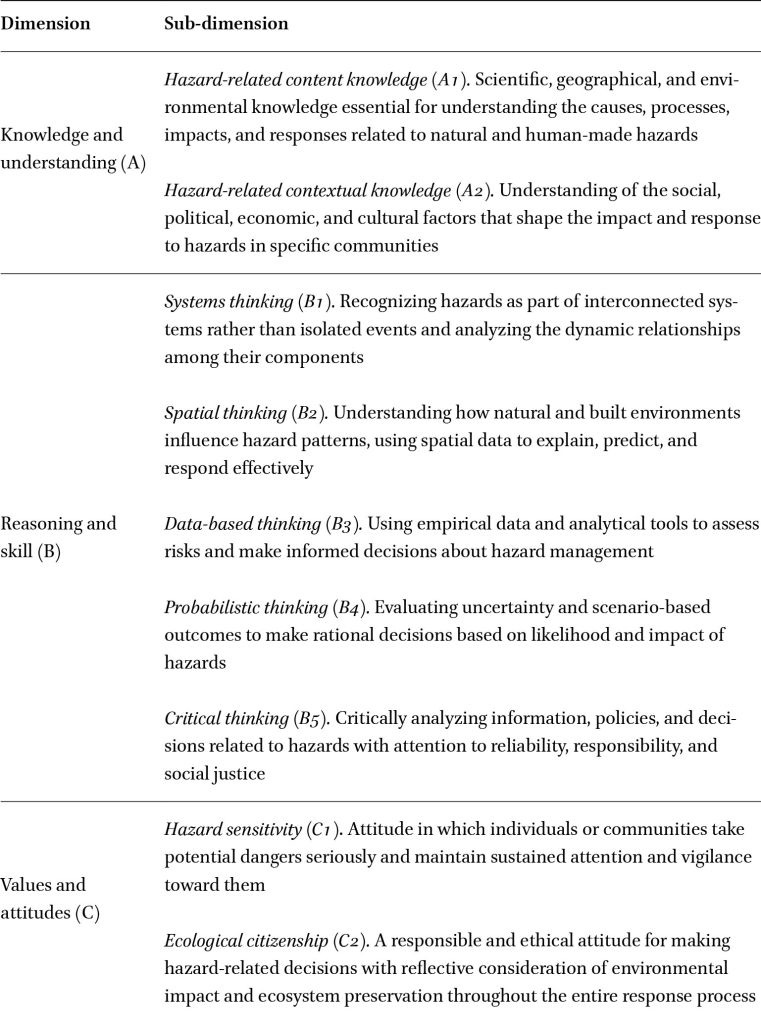
According to Lee et al. (2025), hazard literacy comprises five domains and 16 sub-components, encompassing knowledge and understanding, reasoning and skill, values and attitudes, psychology and emotion, and behavioral and practical engagement (see table 1). This comprehensive conceptualization aligns with the recent policy trajectory of the OECD (2025), which has sought to strengthen the competencies of today’s citizens who are continually exposed to multifaceted hazards such as climate crises, pandemics, and technological disasters.

Multidimensional hazard literacy framework
Citation: Asia-Pacific Science Education 11, 2 (2025) ; 10.1163/23641177-bja10103
Traditional instructional methods face significant limitations in effectively addressing complex and emerging hazards, particularly within adult learning contexts (Basri et al., 2025; Choudhury & Wu, 2023). Adults tend to exhibit heterogeneous learning characteristics shaped by differences in age, occupation, social role, and disaster experience, necessitating educational approaches distinct from those used for children and adolescents (Kitagawa, 2021).
However, as noted earlier, most disaster education efforts have focused on younger learners. Although adults are key agents in disaster preparedness and response, empirical assessments of their hazard literacy remain scarce, particularly in the context of adult and lifelong education (Gülsoy et al., 2025; İşleyen et al., 2025; Karacaoğlu & Biamba, 2025). This lack of data and diagnostic tools has hindered the development of evidence-based educational strategies and policy interventions tailored to adult learners (Lacher, 2025; Lacher & Rohs, 2023).
Building upon this theoretical framework and the identified gaps in adult hazard education, the following section outlines the methodological approach used to assess adults’ hazard literacy levels across multiple domains and demographic variables.
3 Methods
3.1 Participants
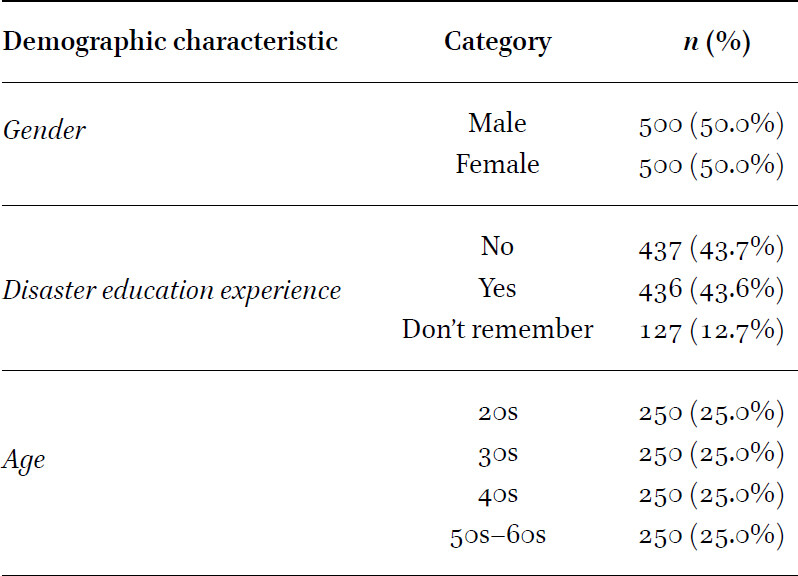
This study was aimed at assessing the hazard literacy levels of Korean adults and analyzing differences across groups based on key background variables. In June 2025, an online survey was conducted with 1,000 adults aged 20 to 69 residing nationwide. Participants reviewed an information sheet detailing the study goals, data confidentiality, and voluntary participation guidelines, and provided informed consent prior to participating. To ensure national representativeness, the sample was stratified by gender (50% male, 50% female) and age groups (20s, 30s, 40s, and 50–69). The survey also included items assessing participants’ prior disaster education experience, covering whether they had received disaster-related education within the past 3 years and, if so, the type and source of education, such as school, community, or online program. Table 2 presents the demographic characteristics of the 1,000 participants.
Demographic characteristics of the study participants
Citation: Asia-Pacific Science Education 11, 2 (2025) ; 10.1163/23641177-bja10103
3.2 Research Instruments
3.2.1 Hazard Literacy Self-Assessment Scale
This study employed the Hazard Literacy Self-Assessment Scale, developed by Sim et al. (2025), to assess hazard literacy perceptions among adults in South Korea. The scale was designed to measure the general public’s perceptions of hazard literacy, grounded in the conceptual framework proposed by Lee et al. (2025). The initial items were developed through an extensive review of previous studies and discussions with eight experts in disaster education and psychology. Feedback from expert evaluation was incorporated to refine the items, followed by a pilot test to ensure clarity and reliability before finalizing the questionnaire for the main survey.
In the pilot test stage, exploratory factor analysis was conducted. Based on multiple criteria, including eigenvalues greater than 1.0 (Kaiser–Guttman rule; Kaiser, 1970), the shape of the scree plot (Cattell’s scree test; Cattell, 1966), and the interpretability of the structure matrix, a five-factor solution consistent with the hazard literacy framework was supported. The psychometric adequacy of items was evaluated comprehensively by considering factor loadings, Cronbach’s
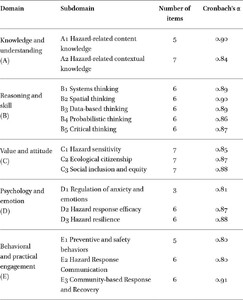
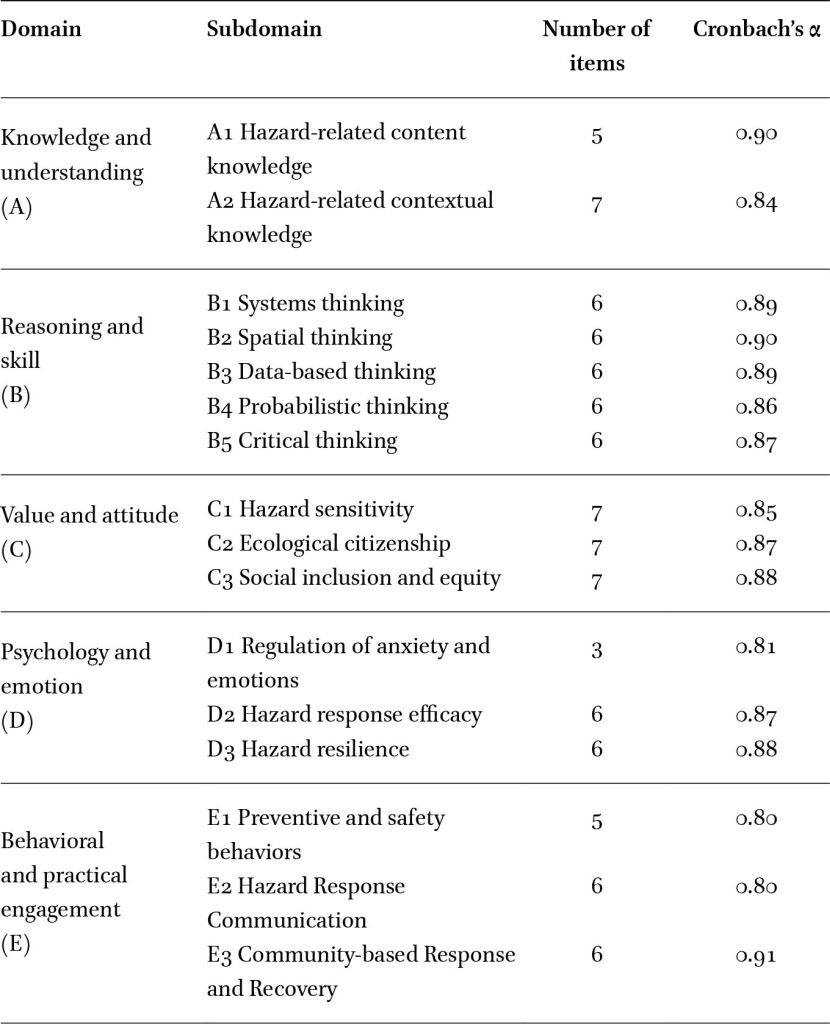
As shown in Table 2, the scale consisted of 95 items spanning five domains and utilized a 5-point Likert scale ranging from 1 (strongly disagree) to 5 (strongly agree). The questionnaire was composed of two sections: a demographic information section and the hazard literacy assessment section. The demographic section included basic information such as gender, age, and experience with disaster-related education, totaling between 17 and 45 items. The variation in the number of items resulted from the inclusion of disaster experience questions, which varied depending on participants’ prior experiences. The reliability analysis of all subdomains in this study showed Cronbach’s
Number of items and reliability of the Hazard Literacy Self-Assessment Scale
Citation: Asia-Pacific Science Education 11, 2 (2025) ; 10.1163/23641177-bja10103
3.3 Data Collection and Analysis
The survey was administered to a nationwide sample of 1,000 adults in South Korea, stratified by gender, age, and region, and conducted through a professional online research agency. To minimize response bias related to the order of domain presentation and to enhance the reliability of responses, the items in the scale were presented in the following manner. During content validity review, the reasoning and skill (B) domain was identified as relatively challenging and was therefore fixed in the second position for all respondents. The remaining domains were presented in random order (e.g., A-B-C-D-E, D-B-E-C-A, etc.).
Data from the 1,000 respondents were analyzed using SPSS 25.0 and R. Responses marked as “Don’t remember” (12.7%) for the disaster education experience item were excluded from analyses involving that variable, while analyses of other variables included the full sample of 1,000 participants. First, frequency and descriptive statistics were utilized to examine the demographic characteristics of the respondents. Independent-samples t-tests and a one-way analysis of variance were carried out to analyze differences in hazard literacy across gender and age groups. For cases where analysis of variance results were significant, post hoc comparisons were conducted using the Tukey honestly significant difference test to identify specific group differences.
4 Results
In this study, hazard literacy was classified into five domains: knowledge and understanding (A), reasoning and skill (B), values and attitudes (C), psychology and emotion (D), and behavioral and practical engagement (E), encompassing a total of 16 subdomains. Differences across each domain and subdomain were analyzed according to participants’ gender, age, and prior experience with disaster-related education.
4.1 Descriptive Statistics by Domain and Subdomain
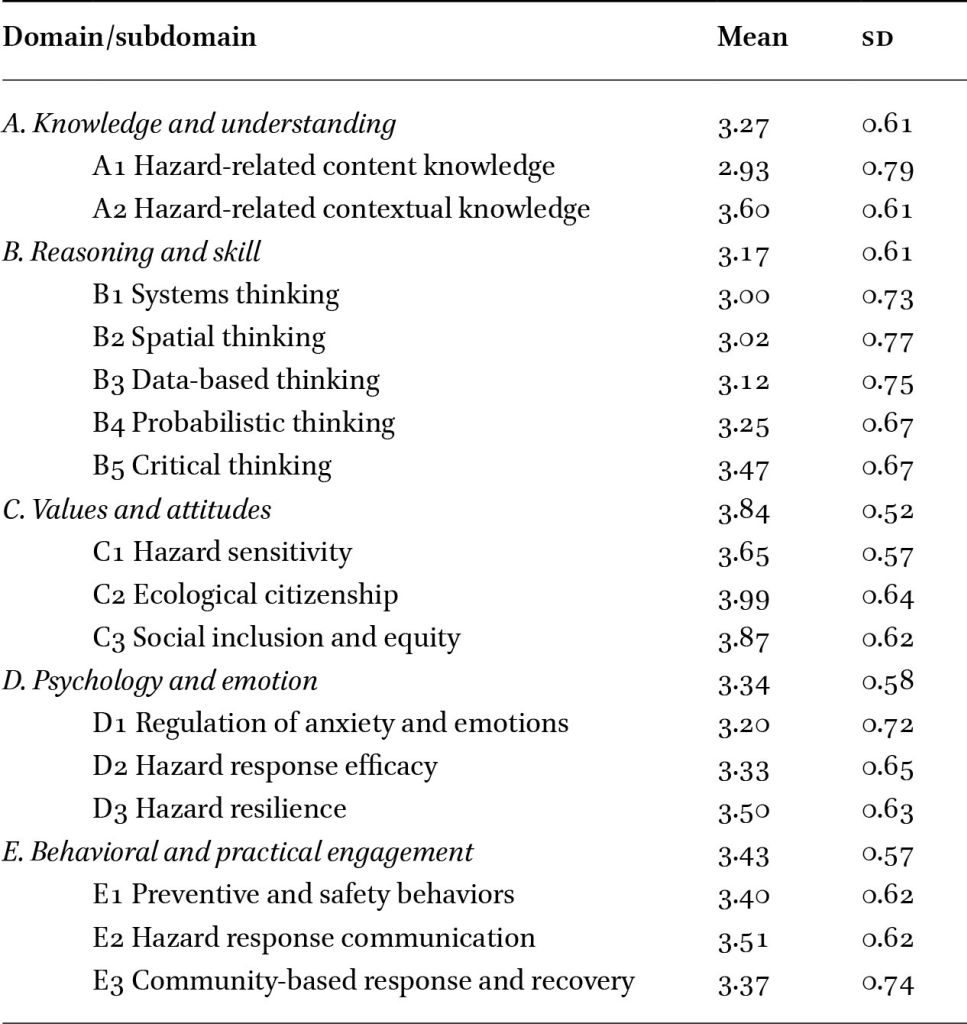
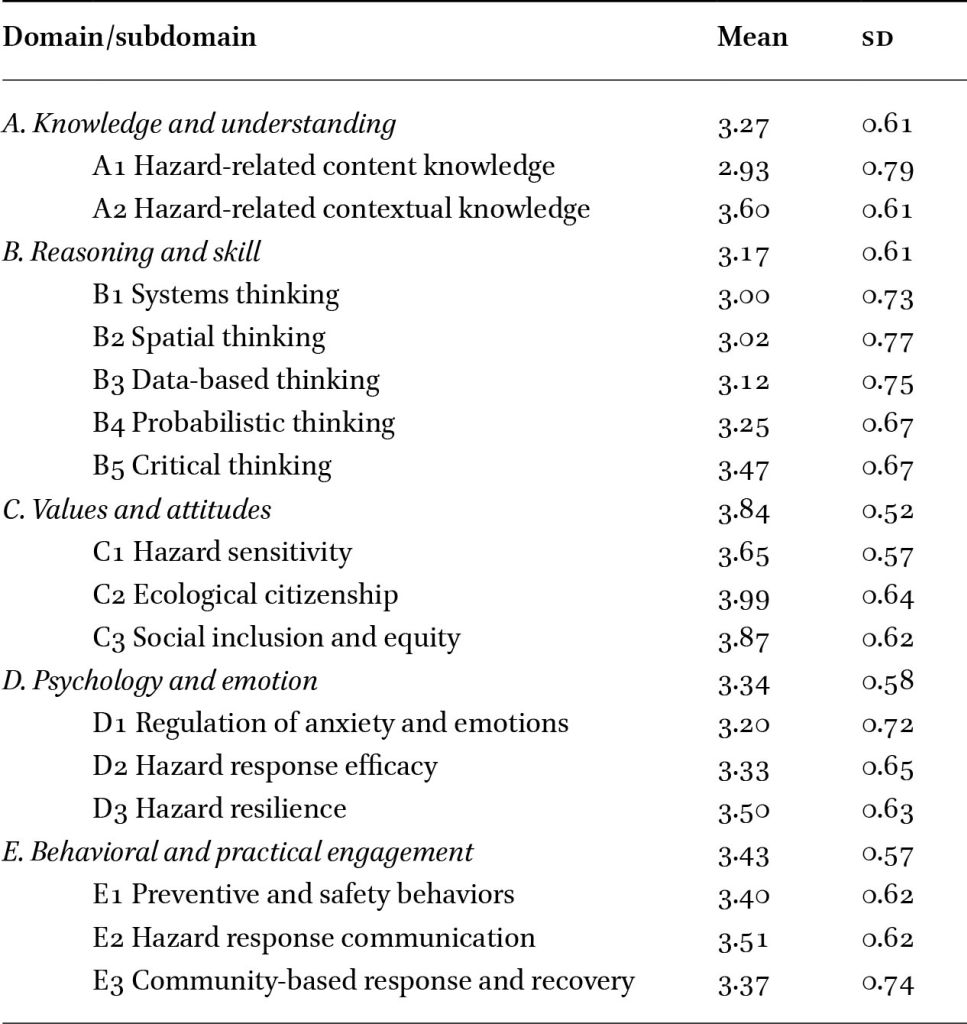
Knowledge and understanding (A) domain scores indicated that participants reported relatively lower levels of hazard-related content knowledge (A1; 2.93), whereas contextual knowledge (A2; 3.60) was somewhat higher. Within the knowledge and understanding domain, contextual knowledge exceeded content knowledge, indicating a within-domain divergence. In the reasoning and skill (B) domain, respondents generally showed modest levels across subdomains and relatively lower levels of systems thinking (B1; 3.00) and spatial thinking (B2; 3.02). In the values and attitudes (C) domain, participants tended to endorse value-based orientations such as ecological citizenship (C2; 3.99) and social inclusion and equity (C3; 3.87).
Among all domains, values and attitudes (C) displayed the highest overall mean. For the psychology and emotion (D) domain, perceived resilience to hazards (D3; 3.50) was somewhat higher than other aspects of psychological capacity. Finally, in the behavioral and practical engagement (E) domain, respondents reported comparable levels across preventive and safety behaviors (E1; 3.40), hazard response communication (E2; 3.51), and community-based response and recovery (E3; 3.37), reflecting engagement in practical and communicative aspects to some extent. In summary, the findings suggest that while the participants exhibited relatively well-developed values and contextual awareness regarding hazards, their knowledge-based and analytic capacities tended to be less robust. Strengthening scientific content knowledge and functional reasoning skills related to hazards remains an important area for educational intervention. Detailed results are presented in Table 4.
Overall, the descriptive results indicate clear variation among the five domains of hazard literacy. Among them, values and attitudes (C) showed the highest mean score, suggesting that participants demonstrated strong civic and ethical orientations such as social inclusion and ecological citizenship. In contrast, reasoning and skill (B) exhibited the lowest overall mean, implying relatively limited cognitive and analytical competencies in processing hazard-related information. This pattern highlights the need to strengthen scientific reasoning and analytical skills while maintaining the participants’ positive value orientations before examining group differences in the subsequent section.
Descriptive statistics by domains and subdomains
Citation: Asia-Pacific Science Education 11, 2 (2025) ; 10.1163/23641177-bja10103
4.2 Group Differences by Gender, Age, and Education
To further explore the factors influencing hazard literacy, analyses were conducted to examine group differences across gender, age, and prior disaster-related education experience within each domain and subdomain.
4.2.1 Knowledge and Understanding Domain
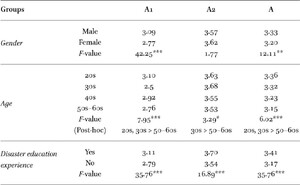
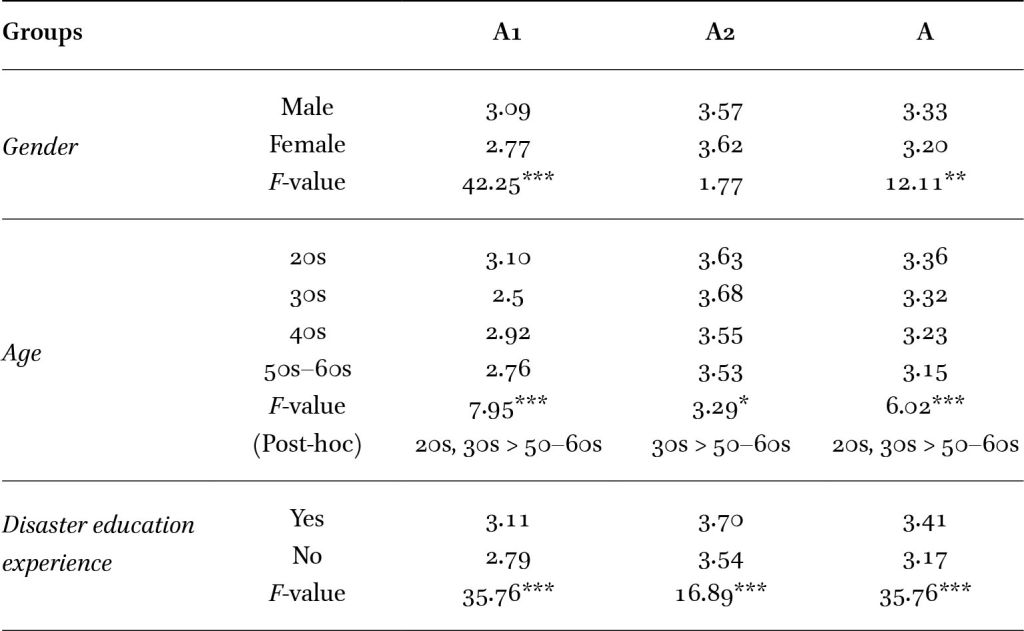
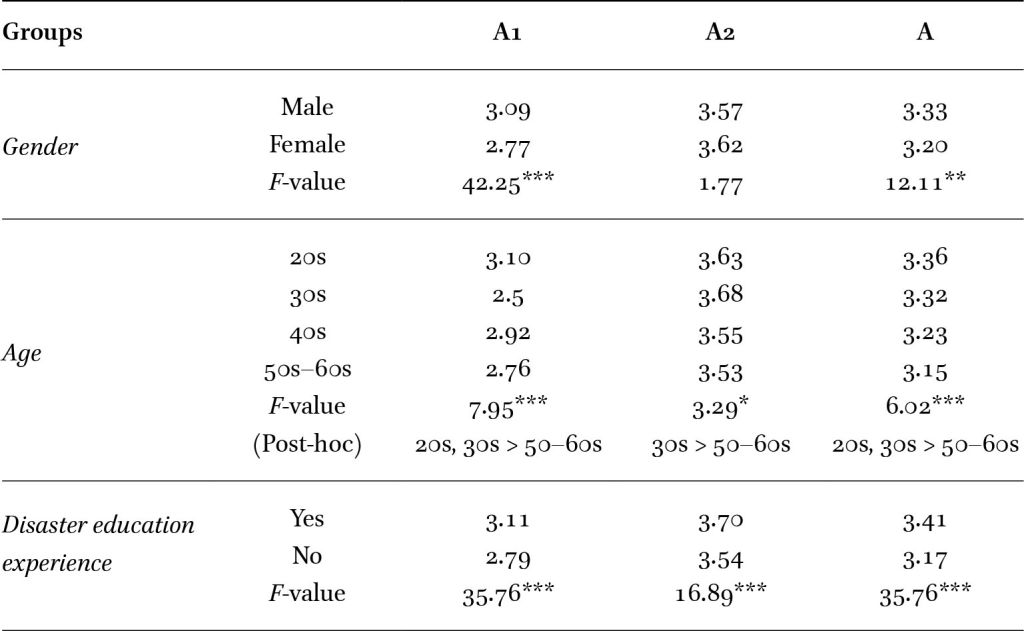
The knowledge and understanding domain (A) of the Hazard Literacy Self-Assessment Scale comprises two subdomains: Hazard-related content knowledge (A1) and Hazard-related contextual knowledge (A2). Group differences in this domain were examined based on gender, age, and prior experience with disaster-related education. Detailed results are presented in Table 5.
Group differences in the knowledge and understanding domain
Citation: Asia-Pacific Science Education 11, 2 (2025) ; 10.1163/23641177-bja10103
In the A1 subdomain, male participants reported a significantly higher mean score than their female counterparts (F = 42.25, p < .001). This suggests that men tended to rate themselves higher in content knowledge regarding hazards. In contrast, there was no significant gender difference in the A2 subdomain. When the two subdomains were combined, the overall mean for the A domain was also significantly higher for men than for women (F = 12.11, p < .01), indicating a gender-based difference in self-assessed hazard-related knowledge and understanding.
Regarding age differences, the A1 subdomain exhibited a clear trend in which mean scores decreased with increasing age. Younger participants in their 20s and 30s scored significantly higher than those in their 50s–60s (F = 7.95, p < .001), with the largest mean difference observed between the 20s and 50s–60s, yielding a gap of 0.34 points. This indicated a generational disparity in levels of content knowledge related to hazards. In contrast, for the A2 subdomain, the overall difference across age groups was smaller (maximum mean difference = 0.15), but a significant difference was detected between participants in their 30s and those in their 50s–60s (F = 3.29, p < .05). For the combined knowledge and understanding (A) domain, age-based differences were also statistically significant (F = 6.02, p < .01), with participants in their 20s and 30s scoring significantly higher than those in their 50s–60s. These findings highlight the need to reinforce foundational hazard literacy education for older adults.
With respect to disaster-related education in the previous 3 years, participants who had received such education reported significantly higher mean scores in both A1 and A2 compared to those without educational experience. These differences were statistically highly significant for both A1 (F = 35.76, p < .001) and A2 (F = 16.86, p < .001). These findings provided empirical evidence that disaster education had a positive effect on self-assessed knowledge and understanding of hazards.
4.2.2 Reasoning and Skill Domain
The reasoning and skill domain (B) comprises five subdomains: systems thinking (B1), spatial thinking (B2), data-based thinking (B3), probabilistic thinking (B4), and critical thinking (B5). Group differences in each subdomain were analyzed according to gender, age, and disaster-related education experience. Detailed results are presented in Table 6.
Group differences in the reasoning and skill domain
Citation: Asia-Pacific Science Education 11, 2 (2025) ; 10.1163/23641177-bja10103
For gender differences, male participants reported a significantly higher mean score than female participants in the B domain (F = 17.22, p < .001). Statistically significant gender differences were observed across four subdomains, B1, B2, B3, and B4, with men outperforming women in all cases. In contrast, no significant gender difference was found in B5, indicating that self-reported critical thinking did not differ by gender.
With respect to age, a pattern similar to that in the A domain emerged. Reasoning and skill scores tended to decrease with increasing age. For all subdomains, the mean differences by age group were statistically significant, with the largest gaps observed in B3 and B4 subdomains. B1 also showed a significant difference only between the 20s and 50s–60s age groups (F = 5.24, p < .01), while B2, B3, and B4 exhibited pronounced disparities across multiple age groups. Although B5 also showed a statistically significant age effect (F = 4.95, p < .01), the maximum difference in mean scores between age groups was relatively small. Overall, these findings suggest a pattern of age-related differences in analytic and reasoning capacities within the reasoning and skill domain.
With respect to disaster-related education in the previous 3 years, participants who had received such education reported significantly higher mean scores in B1, B2, B3, and B4 compared to those without educational experience, with all differences reaching statistical significance (p < .001). This finding suggests that disaster education had a positive influence on respondents’ abilities related to analyzing complex causes of hazards, spatial understanding, and data interpretation. In contrast, there was no statistically significant difference in B5. This result may suggest that existing educational interventions were not sufficiently targeted to foster critical thinking skills within the context of hazard literacy. Also, as previous research has indicated, critical thinking competence tends not to be solely developed through short-term instruction but tends to be substantially shaped by individuals’ cognitive dispositions and prior learning experience (Facione, 1990; Halpern, 2014). Therefore, it is plausible that participants’ critical thinking abilities reflected enduring cognitive tendencies rather than recent educational exposure.
4.2.3 Values and Attitudes Domain
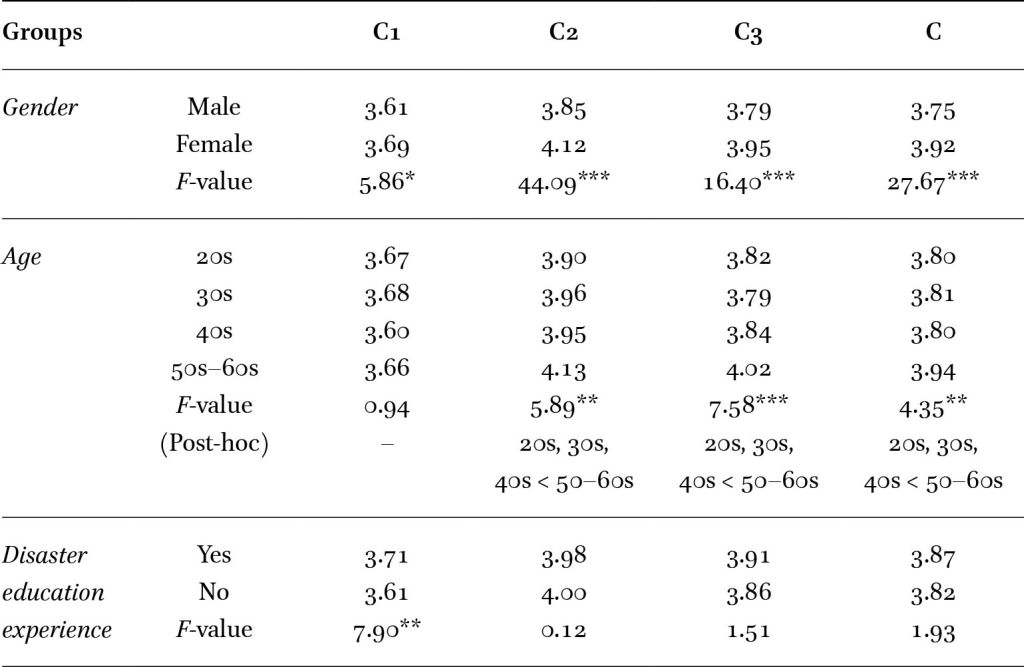
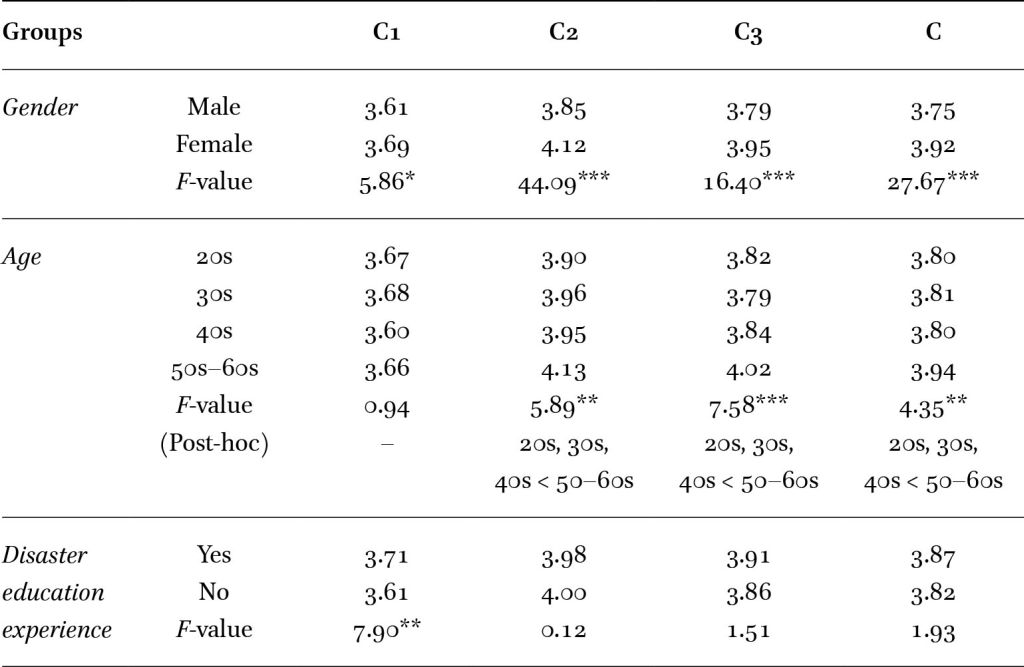
The values and attitudes (C) domain comprises three subdomains: hazard sensitivity (C1), ecological citizenship (C2), and social inclusion and equity (C3). Group differences in mean scores by gender, age, and disaster-related education experience were analyzed for each subdomain. Detailed results are presented in Table 7.
Group differences in the values and attitudes domain
Citation: Asia-Pacific Science Education 11, 2 (2025) ; 10.1163/23641177-bja10103
In contrast to the patterns observed in A and B domains, female participants reported significantly higher scores across all three subdomains of the values and attitudes (C) domain compared to their male counterparts. The largest gender difference was found in C2, where women scored markedly higher than men (F = 44.09, p < .001). In C3, the mean score for women was also significantly higher than for men (F = 16.40, p < .001).
These results indicated that female respondents tended to exhibit greater emotional empathy, social solidarity, and a heightened sense of responsibility with regard to hazards. Such gender differences may be shaped by an interplay of both biological predispositions and sociocultural influences. Accordingly, educational interventions should be designed with sensitivity to these potential gender-related variations and their broader contextual determinants.
With respect to age differences, there was no statistically significant difference among age groups in C1. In contrast, mean scores for both C2 and C3 were highest among participants in their 50s–60s. Both subdomains exhibited a trend of increasing mean scores with age, and post hoc comparisons indicated that the significant differences primarily involved the 50s–60s group versus younger age groups, rather than among the 20s, 30s, and 40s. These results suggested that value-oriented attitude relating to social responsibility and empathy may mature and strengthen with age.
In terms of disaster-related education experience, there was generally little difference across groups in the values and attitudes domain. Notably, only in C1 did the group with recent disaster education experience score significantly higher than those without such experience (F = 7.90, p < .01). This finding suggests that, apart from hazard sensitivity, value-oriented attitudes may likely be shaped and accumulated through daily experiences and sociocultural influences rather than by short-term educational interventions. Accordingly, the development of the affective domain may require sustained, experience-based educational approaches. Alternatively, this may also imply that current disaster-related education primarily addresses hazard sensitivity rather than other attitudinal aspects.
4.2.4 Psychology and Emotion Domain
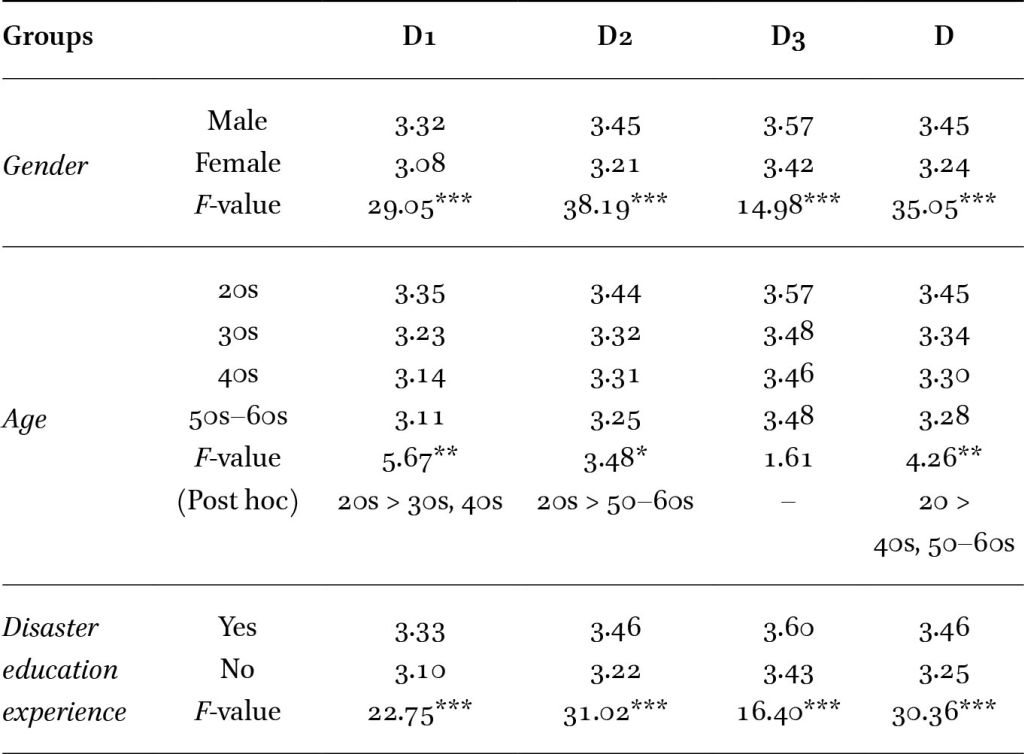
The psychology and emotion (D) domain comprises three subdomains: regulation of anxiety and emotion (D1), hazard response efficacy (D2), and hazard resilience (D3). Group differences across these subdomains were analyzed according to gender, age, and disaster-related education experience. The key results are presented in Table 8.
Group differences in the psychology and emotion domain
Citation: Asia-Pacific Science Education 11, 2 (2025) ; 10.1163/23641177-bja10103
With respect to gender, in contrast to the pattern observed in Domain C, male participants reported significantly higher mean scores than women across all subdomains of the psychology and emotion (D) domain. The largest gender gap was observed in D2, with men outscoring women, a difference that was highly significant (F = 38.19, p < .001). A similar pattern was found in D1, where the mean score for men was also significantly higher than for women (F = 29.05, p < .001). In D3, men likewise scored significantly higher than women. These results suggest that, while women demonstrated greater affective empathy in the attitudinal domain, men tended to rate themselves more highly in emotional regulation, response efficacy, and resilience related to hazards, which may be associated with socially influenced perceptions or norms regarding emotional and coping capacities.
In terms of age, significant differences were found in D1 and D2. Post hoc analysis indicated that participants in their 20s scored higher than those in their 40s and 50s–60s, revealing a trend in which self-assessed capacities for emotional regulation and response efficacy tended to decrease with increasing age. For D3, no statistically significant age differences were observed. However, overall mean scores were relatively high across all age groups.
With regard to recent disaster-related education experience, participants who had received such education scored significantly higher across all subdomains of D compared to those without such experience. The largest difference was observed in D2 (F = 31.02, p < .001). Significant group differences were also found in D1 (F = .75, p < .001) and D3 (F = 16.40, p < .001). These results suggest that disaster education may have exerted a positive influence not only on knowledge and functional competencies, but also on emotional regulation and perceived resilience.
4.2.5 Behavioral and Practical Engagement Domain
The behavioral and practical engagement (E) domain consists of three subdomains: preventive and safety behaviors (E1), hazard response communication (E2), and community-based response and recovery (E3). Group differences in mean scores were analyzed by gender, age, and disaster-related education experience for each subdomain. The results are summarized in Table 9.
Group differences in the behavioral and practical engagement domain
Citation: Asia-Pacific Science Education 11, 2 (2025) ; 10.1163/23641177-bja10103
Regarding gender differences, female participants reported a significantly lower mean scores in E3 compared to male participants (F = 4.48, p < .05), although the magnitude of this difference was small. No significant gender differences were observed in E1 or E2, and the overall mean score for the E domain did not differ significantly by gender (F = 0.79, n.s.). These results may indicate there were subtle differences in the perceived efficacy or expected social influence of practical and community engagement between genders.
With respect to age, significant differences emerged in both E1 and E3. In E1, participants in their 20s and 30s scored significantly higher than those in their 50s–60s (F = 6.70, p < .001), as shown by post hoc tests. In contrast, the mean score for E3 was significantly lower for participants in their 30s compared to those in their 50s–60s, with post hoc analysis showing this age group difference (F = 3.18, p < .05). No significant age differences were found for E2, as mean scores across all age groups hovered around 3.5. These findings suggested that preventive and practical actions were more pronounced among younger adults, whereas institutional engagement and policy-oriented participation may be more salient among middle-aged and older adults.
With regard to recent disaster-related education experience, participants who had received such education reported significantly higher scores in both E1 and E2 compared to those without such experience. E1 showed the largest difference among the subdomains (F = 47.06, p < .001). For E3, although those with education experience reported a higher mean score, the difference did not reach statistical significance. The overall mean score for Domain E was significantly higher among those with disaster education experience than among those without (F = 20.34, p < .001). These results suggested that disaster education may have had a positive effect on reinforcing preventive attitude and practical engagement in hazard-related behaviors.
5 Discussion and Implications
5.1 Summary and Key Patterns
This study conceptualized hazard literacy as comprising five core domains, knowledge and understanding, reasoning and skill, values and attitudes, psychology and emotion, and behavioral and practical engagement (Lee et al., 2025). Utilizing a self-assessment instrument developed on the basis of this multidimensional framework, we analyzed the characteristics of hazard literacy among respondents in relation to gender, age, and recent disaster education experience. The findings revealed that hazard literacy differs across groups, with distinct patterns of perceived competence and awareness within each domain according to demographic and experiential factors.
The analyses revealed that among the five domains of hazard literacy, the values and attitudes domain (C) exhibited the highest overall mean score, whereas the knowledge and understanding (A) and reasoning and skill (B) domains recorded the lowest means. Most notably, A1 (hazard-related content knowledge) showed the lowest mean across all subdomains. This pattern indicates that while respondents demonstrated strong sensitivity to risk, internalized social responsibility, and a pronounced sense of community solidarity in the face of hazards, their scientific conceptual knowledge, logical analysis, and reasoning abilities remained comparatively limited.
Such disparities between cognitive-analytical capacities (such as, knowledge and understanding, reasoning, and skill) and affective or attitudinal strengths (including, risk sensitivity, social responsibility, and practical commitment) are consistently reported in cross-national and group-specific research. Previous studies have attributed these gaps to curricular imbalances in disaster education, limitations in instructional approaches, sociocultural contexts, and individual disaster experiences (Fatoni et al., 2022; Türker & Sözcü, 2021). The extant literature has also shown that individuals’ knowledge and educational background substantially influenced both their receptivity to disaster education and its practical effectiveness (Hoffmann & Blecha, 2020; Muttarak & Pothisiri, 2013).
In light of these findings, the relatively low scores observed in the knowledge and understanding and reasoning and skill domains in this study highlighted a potentially critical weakness that may undermine the long-term effectiveness and practical applicability of disaster education interventions. This underscores the educational imperative to address and strengthen scientific content knowledge and reasoning skills alongside affective and behavioral components within hazard literacy programs.
5.2 Group-Based Interpretations
5.2.1 Gender Differences
Consistent with previous studies that have emphasized gendered distinctions in risk perception and disaster response (Lindell & Perry, 2012; Paton, 2007), our results revealed clear gender-related patterns across the multidimensional domains of hazard literacy. Specifically, male respondents reported significantly higher mean scores in the domains of knowledge and understanding, reasoning and skill, and psychology and emotion, while female respondents scored higher in the values and attitudes domain. In the behavioral and practical engagement domain, however, gender differences were largely nonsignificant.
The finding that women demonstrated significantly higher scores in the values and attitudes domain aligns with prior evidence from the social-psychological literature, which suggests that women often exhibit greater affective sensitivity and heightened risk perception, potentially reflecting differential social roles, expectations, and lived experiences (Cvetković et al., 2018; Tyler & Fairbrother, 2018). This pattern supports the contention that affective and normative components of hazard literacy may be more fully internalized by women, as a function of both socialization and psychosocial influences. To translate these patterns into practice, hazard-literacy initiatives should explicitly adopt gender-responsive designs that align with the profiles observed in the results, ensuring that objectives, participation modes, and evaluation metrics are sensitive to such differences.
Conversely, the absence of marked gender differences in the behavioral and practical engagement domain represented a somewhat unexpected result, diverging from the expectation that higher affective sensitivity would necessarily translate into increased preventive or participatory actions. This nuance is consistent with prior research indicating that heightened risk perception or attitudinal sensitivity did not always directly lead to more proactive preparedness or actual behavior, often due to limitations such as restricted time, lack of support, or limited access to resources (Shiwaku et al., 2007; Zamboni & Martin, 2020). These findings underscore the complexity of translating risk recognition and affective disposition into tangible preparedness or resilience behaviors, and highlight the need for disaster education and policy to address not only attitudinal and perceptual factors but also structural and contextual barriers to engagement.
These patterns may reflect broader socialization processes and contextual factors rather than fixed or biologically rooted traits. Gender differences in hazard literacy likely emerge from a complex interplay of lived experience, societal expectations, and access to resources and education. Recognizing gender as a sociocultural variable rather than a prescriptive category allows for more equity-informed and context-sensitive approaches to disaster education.
5.2.2 Age Differences
The data revealed a general trend in which increasing age was associated with lower scores in the domains of knowledge and understanding, reasoning and skill, psychology and emotion, and preventive and safety behaviors within the behavioral and practical engagement domain. In contrast, scores for C2 (ecological citizenship) and C3 (social inclusion and equity) within the values and attitudes domain tended to rise with age. These results indicated that distinct facets of hazard literacy were differentially influenced by age, while affective and value-oriented capacities may have been maintained, or even enhanced, throughout adulthood and into later life. To sum up, cognitive and functional competencies related to hazard knowledge and reasoning appeared more vulnerable to age-related decline.
This pattern aligns with previous research documenting that health, risk, and disaster literacy, notably the domains dependent on timely information access, cognitive processing, and behavioral agility, tended to decrease gradually with age, often due to diminished access to information, physical limitations, and cognitive decline (Al-rousan et al., 2014; Gülsoy et al., 2025; Lee et al., 2017). These findings are also consistent with the broader literature on cognitive aging, which has highlighted age-related declines in processing speed, working memory, and executive functioning that can influence how individuals acquire, interpret, and act upon risk-related information (Salthouse, 2019; Park & Reuter-Lorenz, 2009; Lövdén et al., 2020).
However, more granular analyses have revealed that socioemotional competencies, such as ecological attitudes and social inclusiveness, which reflect self-transcendent values, tend to remain stable or even increase with age, likely as part of ongoing socioemotional development (Lin & Fung, 2024; Wang et al., 2021).
Interestingly, whereas some prior studies have found that psychological regulation and emotional resilience may improve with age, suggesting greater affective stability in older adults, even in disaster contexts (Charles & Carstensen, 2010; Cong et al., 2021; Rafiey et al., 2016; Strough et al., 2024), this trend was not observed in the present study. One possible explanation is the influence of response biases associated with self-reported surveys, including social desirability and the tendency either to underestimate or overestimate one’s abilities. Additionally, given that psychological and emotional factors are often shaped by cultural context, this unexpected pattern may also reflect sociocultural characteristics unique to Korean adults. In particular, cultural norms emphasizing emotional restraint and modesty in self-expression might have led individuals to underreport their perceived emotional regulation or resilience levels compared with respondents in other contexts.
Collectively, these findings underscore that the landscape of hazard literacy tends to be shaped by complex, age-related dynamics, whereby affective and value-laden elements (such as social responsibility and ecological concern) may be progressively reinforced with age, while cognitive, informational, and practical skills require targeted educational interventions to maintain or enhance them across the lifespan. This highlights the necessity for differentiated disaster education strategies that simultaneously leverage the inherent strengths of older adults in social-emotional domains, while providing robust support for the retention and updating of cognitive and behavioral competencies. Building on these observations, disaster-education programs should move beyond a uniform approach and incorporate age-responsive themes and delivery methods that align with each group’s strengths, experiences, and motivational patterns. This alignment would help educational objectives and engagement strategies remain meaningful and effective across different life stages.
5.2.3 Disaster Education Experience
The analyses indicated that participants with disaster-related education experience within the previous 3 years consistently recorded significantly higher scores across nearly all subdomains of hazard literacy, providing compelling evidence that disaster education exerted a tangible effect on the development of hazard literacy competencies. However, notable exceptions were observed in B5 (critical thinking), C2 (ecological citizenship), C3 (social inclusion and equity), and E3 (community-based response and recovery), while no statistically significant differences emerged between groups with and without disaster education experience.
These findings resonate with previous research that has suggested that the attitudinal dimensions of hazard literacy can often be influenced relatively quickly through educational interventions (Min et al., 2024). Nevertheless, the absence of significant education-related gains in certain domains may have reflected the fact that these competencies – especially those relating to critical thinking, integrative citizenship skills, and authentic community engagement – had not been sufficiently emphasized or systematically incorporated within existing disaster education curricula. Prior studies have similarly highlighted that traditional disaster education often prioritizes the transmission of factual knowledge and safe behaviors, while devoting less systematic attention to the promotion of higher-order reasoning, functional skills, or the development of community-based and integrative civic competences (Hoffmann & Muttarak, 2017; Karanci et al., 2005). The generally high baseline levels observed in the values and attitudes domain could partly explain the absence of significant education-driven differences in these subdomains; ceiling effects or pre-existing internalization of these values may have reduced the observable impact of further educational exposure.
Importantly, even if affective and communal values are well formed, a substantial body of research has demonstrated that translating these dispositions into specific knowledge, systematic thinking, and active behavioral engagement required targeted educational efforts and extended experiential learning (Paton & Johnston, 2017; Takahashi et al., 2025; Wang et al., 2022; Yildiz et al., 2023). Accordingly, to achieve truly integrated advancement in hazard literacy, it is imperative to design and implement comprehensive and sustained educational programs that deliberately foster critical thinking, holistic civic competences, and authentic community-based participation, beyond merely transmitting knowledge or promoting isolated safety behaviors. This integrative approach is essential for bridging existing gaps and ensuring that gains in affective or attitudinal domains are consistently translated into knowledge-rich, analytically grounded, and actively engaged responses to hazards.
5.3 Educational and Policy Implications
Based on these findings, several implications emerge. First, the average scores for all subdomains of hazard literacy were relatively low, with no single domain exhibiting a markedly higher mean; in fact, mean values across all subdomains failed to exceed 4 out of 5. This pattern suggests that current disaster education remains limited to the delivery of fragmented information and, in many cases, does not extend to fostering deeper understanding or practical application among learners.
The absence of substantial score disparities among the domains also indicates that learners may perceive hazard literacy not as a set of compartmentalized competencies, but rather as an integrated and holistic construct. This finding implies that future curriculum design should avoid treating aspects of hazard literacy as isolated educational goals. Instead, educational programs are likely to be more effective if they employ integrated approaches that deliberately emphasize the interconnectedness and multidimensionality of hazard literacy components.
Second, this study found that recent disaster education experience was associated with significant differences in most dimensions of hazard literacy. This provides empirical evidence that hazard literacy is an improvable competency through educational interventions, thereby supporting the legitimacy and necessity for both policy and educational initiatives at school and societal levels. Notably, the impact of education experience extended beyond the transmission of knowledge to exert significant effects on affective and behavioral domains, including psychological and emotional and behavioral and practical engagement. This finding underscores the potential for hazard literacy education to evolve from an exclusively cognitive focus toward a more holistic and experience-based pedagogical approach.
Third, the observation of significant differences in hazard literacy levels according to personal background variables such as gender and age further suggests that hazard literacy is not merely an aggregate of cognitive capacities, but rather a multifaceted competence shaped by sociocultural context and life experience. The higher scores of women in value- and attitude-oriented components and the tendency for cognitive capacities to decline with age while social responsibility and community-oriented attitude improved, highlight the need for differentiated educational designs that are sensitive to the social context of learners. This supports the imperative to tailor hazard literacy education to accommodate learners’ diverse backgrounds and evolving social roles throughout the life course. In practical terms, program planning and evaluation should include explicit criteria for gender- and age-responsiveness, thereby ensuring that the group-level patterns identified in the results are systematically translated into design decisions.
5.4 Contribution and Instrument Utility
This study represents one of the first empirical attempts in Korea to conceptualize and measure hazard literacy as a form of civic competence within a multidisciplinary context that includes science education. The self-assessment instrument developed and employed in this research enabled the multidimensional structure of hazard literacy to be measured in a robust, empirical manner. As such, the tool demonstrated its utility in diagnosing civic competencies and in identifying individual or group educational needs, supporting its role as an effective instrument for educational planning and needs analysis. In particular, it holds promise as a foundational diagnostic instrument for non-formal educational programs targeting local communities or adult learners and for the planning and evaluation of such interventions. By focusing on key individual variables such as gender, age, and disaster education experience, this study also offered foundational insights into group differences and provided a basis for more in-depth investigations encompassing broader sociocultural and structural factors.
5.5 Limitations and Future Research
Despite these contributions, this study has several limitations. Its reliance on self-reported perceptions to assess hazard literacy may not fully capture the behavioral manifestations of civic competence, practical engagement, and participatory dimensions that are central to the concept. To address this limitation, future research could incorporate performance-based evaluations, such as credentialed practicum or field tasks, to provide evidence beyond perception measures (Oda & Ichinose, 2025). Mixed-method approaches combining self-assessment, behavioral indicators, and observational data would further enhance the comprehensiveness and objectivity of hazard literacy assessment.
Building upon these methodological improvements, future hazard literacy initiatives may align with the emerging global “resilience pathways” proposed by Shaw (2025), which integrate systemic risk perspectives, citizen science, youth innovation, and immersive learning as routes to foster civic competencies and community preparedness. Moreover, integrating interdisciplinary and multivariate approaches could better capture the dynamic interplay among cognitive, behavioral, and sociocultural factors shaping hazard literacy. Ultimately, advancing this line of inquiry through longitudinal and multilevel research designs and through advanced statistical modeling of inter-domain relationships will deepen our understanding of hazard literacy as a complex and evolving construct of civic competence.
Funding
This work was supported by the Ministry of Education of the Republic of Korea and the National Research Foundation of Korea (NRF-2024S1A5C3A03046593).
Ethical Consideration
Approval to conduct this study was granted by the Ewha Womens University Ethics Review Board. All data were collected and analyzed in accordance with the approved ethical guidelines, ensuring participant anonymity and confidentiality throughout the research process
About the Authors
Youngjin Choi received her PhD in science education from Ewha Womans University, Seoul, South Korea. Her research focuses on expanding equitable science learning opportunities by developing individualized programs for diverse learner. Her ongoing work explores how individuals develop hazard literacy, civic competence, and participatory engagement in social and environmental issues. She is currently a researcher at the Hazard Literacy Center, where she investigates how people and communities develop competence and resilience in responding to complex hazards.
Donghee Shin is a professor in the Department of Science Education at Ewha Womans University, Seoul, South Korea. She has conducted various studies on earth and environmental education and cultural diversity in science education. Her current research interests focus on expanding new areas in geoscience education, such as education through geoethics and disaster education.
Mikyung Sim earned her PhD in psychology (quantitative psychology and psychometrics) from Ewha Womans University, Seoul, South Korea. Her research aims to enhance the statistical validity and reproducibility of social science research. She has conducted simulation studies on sample size and statistical power of mediation and moderated mediation models, providing practical guidelines for research design. Drawing on her expertise in quantitative psychology, she also conducts applied research involving scale development and validation, structural equation modeling, latent profile analysis, and measurement invariance to rigorously investigate human behavior and psychological constructs.
Jihee Lee is a research professor at the Hazard Literacy Center, Ewha Womans University, Seoul, South Korea. Her research focuses on environmental education and socially acute question-based science teaching. She investigates how learners cultivate critical thinking, personalization of the environment, and decision-making competence through issue-based learning on environmental topics and conducts research focusing on hazard literacy education.
Hyunju Lee is a professor in the Department of Science Education at Ewha Womans University, Seoul, South Korea. Her research focuses on science teaching and teacher professional development in the context of socioscientific issues (SSI s). She has published numerous papers on decision-making patterns related to SSI s, instructional approaches for SSI s, and the development of teachers’ practical knowledge for SSI teaching.
References
Abas, M. A., Ibrahim, N. E., Wee, S. T., Sibly, S., & Mohamed, S. (2020). Disaster resilience education (DRE) programmes in schools: A case study in Kelantan, Malaysia. Earth and Environmental Science, 549, 12–78. https://doi.org/10.1088/1755-1315/549/1/012078.
Al-rousan, T. M., Rubenstein, L. M., & Wallace, R. B. (2014). Preparedness for natural disasters among older US adults: a nationwide survey. American Journal of Public Health, 104(3), 506–511. https://doi.org/10.2105/AJPH.2013.301559.
Aven, T. (2024). Risk literacy: foundational issues and its connection to risk science. Risk Analysis, 44, 1011–1020. https://doi.org/10.1111/risa.14223.
Azmi, E. S., Rahman, H. A., & How, V. (2020). A two-way interactive teaching-learning process to implement flood disaster education in an early age: the role of learning materials. Malaysian Journal of Medicine and Health Sciences, 16(11), 166–174.
Basri, T. H., Ilyas, I., & Nuraini, N. (2025). Development of digital disaster mitigation map: learning innovations in identifying disaster prone points. Journal Evaluation in Education, 6(2), 501–516. https://doi.org/10.37251/jee.v6i2.1504.
Brown, L. M., Haun, J. N., & Peterson, L. (2014). A proposed disaster literacy model. Disaster Medicine and Public Health Preparedness, 8(3), 267–275. https://doi.org/10.1017/dmp.2014.43.
Çalışkan, C., & Üner, S. (2021). Disaster literacy and public health: A systematic review and integration of definitions and models. Disaster Medicine and Public Health Preparedness, 15(4), 518–527. https://doi.org/10.1017/dmp.2020.100.
Cattell, R. B. (1966). The scree test for the number of factors. Multivariate behavioral research, 1(2), 245–276. https://doi.org/10.1207/s15327906mbr0102_10.
Cerulli, D., Scott, M., Aunap, R., Kull, A., Pärn, J., Holbrook, J., & Mander, Ü. (2020). The role of education in increasing awareness and reducing impact of natural hazards. Sustainability, 12(18), 7623–7637. https://doi.org/10.3390/su12187623.
Cerulli, D., Holbrook, J., & Mander, Ü. (2016). Devising an instrument for determining students’ preparedness for an education through science learning approach within the topic of natural hazards. Science Education International, 27(1), 59–87.
Charles, S. T., & Carstensen, L. L. (2010). Social and emotional aging. Annual review of Psychology, 61, 383–409. https://doi.org/10.1146/annurev.psych.093008.100448.
Choudhury, M., & Wu, H. (2023). Disaster education in the context of postsecondary education: A systematic literature review. Natural Hazards Review, 24(3), 04023028. https://doi.org/10.1061/NHREFO.NHENG-1778.
Cong, Z., Chen, Z., & Liang, D. (2021). Barriers to preparing for disasters: Age differences and caregiving responsibilities. International Journal of Disaster Risk Reduction, 61, 102338. https://doi.org/10.1016/j.ijdrr.2021.102338.
Cvetković, V. M., Roder, G., Öcal, A., Tarolli, P., & Dragićević, S. (2018). The role of gender in preparedness and response behaviors towards flood risk in Serbia. International journal of Environmental Research and Public Health, 15(12), 2761. https://doi.org/10.3390/ijerph15122761.
Facione, P. A. (1990). Critical thinking: A statement of expert consensus for purposes of educational assessment and instruction. American Philosophical Association.
Fatoni, F., Panduragan, S. L., Sansuwito, T. B., & Pusporini, L. S. (2022). Disaster preparedness: Knowledge, attitude, and practice among rural communities in Indonesia: A cross- sectional survey. Malaysian journal of Medicine and Health Sciences, 18, 163–170.
Garcia-Retamero, R., & Cokely, E. T. (2017). Designing visual aids that promote risk literacy: A systematic review of health research and evidence-based design heuristics. Human Factors, 59(4), 582–627. https://doi.org/10.1177/0018720817690634.
Gülsoy, A., Uyan, Y., Özcan, E., & Durmuş, M. (2025). The relationship between disaster literacy levels and disaster preparedness among adults. Natural Hazards, 121, 10667–10681. https://doi.org/10.1007/s11069-025-07225-z.
Hair, J. F., Black, W. C., Babin, B. J., & Anderson, R. E. (2019). Multivariate data analysis (8th ed.). Cengage Learning.
Halpern, D. F. (2014). Thought and knowledge: An introduction to critical thinking (5th ed.). Psychology Press.
Hansen, J., & Hammann, M. (2017). Risk in science instruction: The realist and constructivist paradigms of risk. Science & Education, 26(7), 749–775. https://doi.org/10.1007/s11191-017-9923-1.
Hoffmann, R., & Muttarak, R. (2017). Learn from the past, prepare for the future: Impacts of education and experience on disaster preparedness in the Philippines and Thailand. World Development, 96, 32–51. https://doi.org/10.1016/j.worlddev.2017.02.016.
Hoffmann, R., & Blecha, D. (2020). Education and disaster vulnerability in Southeast Asia: Evidence and policy implications. Sustainability, 12, 1401. https://doi.org/10.3390/su12041401.
İşleyen, E., Serpen, E., Boztoprak, Z., Çınkır, Ö., & Çınar, E. (2025). The relationship between disaster literacy and disaster preparedness in community: After earthquake study. Disaster Medicine and Public Health Preparedness, 19(e51), 1–7. https://doi.org/10.1017/dmp.2025.48.
Ismail-Zadeh, A. T., Cutter, S L., Takeuchi, K., & Paton, D. (2017). Forging a paradigm shift in disaster science. Natural hazards, 86, 969–988. https://doi.org/10.1007/s11069-016-2726-x.
Jang, S., Johnson, B. R., & Kim, Y. (2012). Eagle Scouts: Merit beyond the badge. Baylor University.
Johnson, V. A., Ronan, K. R., Johnston, D. M., & Peace, R. (2014). Implementing disaster preparedness education in New Zealand primary schools. Disaster Prevention and Management, 23(4), 370–380. https://doi.org/10.1108/DPM-09-2013-0151.
Kaiser, H. F. (1970). A second generation little jiffy. Psychometrika, 35, 401–415. https://doi.org/10.1007/BF02291817.
Karanci, A. N., Aksit, B., & Dirik, G. (2005). Impact of a community disaster awareness training program in Turkey: Does it influence hazard-related cognitions and preparedness behaviours. Social Behavior and Personality: an international journal, 33(3), 243–258. https://doi.org/10.2224/sbp.2005.33.3.243.
Karacaoǧlu, O., & Biamba, C. (2025). Disaster literacy basic skills according to the views of earthquake survivors. Journal of Emergency Management, 23(3). https://doi.org/10.5055/jem.0872.
Kitagawa, K. (2021). Conceptualising ‘disaster education’. Education Sciences, 11(5), 233. https://doi.org/10.3390/educsci11050233.
Kline, R. B. (2023). Principles and practice of structural equation modeling. Guilford publications.
Lacher, S., & Rohs, M. (2023). Civil protection through adult and continuing education in Germany. A scoping review of an emerging research field. International Journal of Lifelong Education, 42(6), 532–549. https://doi.org/10.1080/02601370.2023.2263651.
Lacher, S. (2025). Exploring disaster preparedness: A scoping review of adult and continuing education approaches in international civil protection research. Journal of Risk Research, 27(10), 1273–1289. https://doi.org/10.1080/13669877.2024.2447252.
Lee, E. J., Lee, H. Y., & Chung, S. (2017). Age differences in health literacy: Do younger Korean adults have a higher level of health literacy than older Korean adults? Health and Social Work, 42(3), 133–142. https://doi.org/10.1093/hsw/hlx026.
Lee, H. J., Shin, D. H., Shin, E. H., Choi, Y. J., Lee, J. H., Sim, M. K., Mun, S. Y., & Mun, M. K. (2025). Hazard literacy as a key competency for future citizenship: Developing a multidimensional conceptual framework. Journal of The Korean Association For Science Education, 45(3), 337–351. https://doi.org/10.14697/JKASE.2025.45.3.337.
Lin, Z., & Fung, H. H. (2024). Age differences in pro-environmental behaviors: Is it about me or the next generation? Innovation in Aging, 8(1), 1372. https://doi.org/10.1093/geroni/igae 098.4373.
Lindell, M. K., & Perry, R. W. (2012). The protective actions decision model: Theoretical modifications and additional evidence. Risk Analysis, 32(4), 616–632. https://doi.org/10.1111/j.1539-6924.2011.01647.x.
Lövdén, M., Fratiglioni, L., Glymour, M. M., Lindenberger, U., & Tucker-Drob, E. M. (2020). Education and cognitive functioning across the life span. Psychological Science in the Public Interest, 21(1), 6–41. https://doi.org/10.1177/1529100620920576.
Min, K. D., Baek, Y. J., Hwang, K. W., Shin, N. R., Lee, S. D., Kan, H. S., & Yeom, J. S. (2024). Fine-scale spatial prediction on the risk of Plasmodium vivax infection in the Republic of Korea. Journal of Korean Medical Science, 39(22), e176. https://doi.org/10.3346/jkms.2024.39.e176.
Mulilis, J. P., Duval, T. S., & Bovalino, K. (2000). Tornado preparedness of students, nonstudent renters, and nonstudent owners: Issues of PrE Theory. Journal of Applied Social Psychology, 30(6), 1310–1329. https://doi.org/10.1111/j.1559-1816.2000.tb02522.x.
Muttarak, R., & Pothisiri, W. (2013). The role of education on disaster preparedness: Case study of 2012 Indian Ocean earthquakes on Thailand’s Andaman Coast. Ecology and Society, 18(4), 51. http://dx.doi.org/10.5751/ES-06101-180451.
Nakum, V. K., Ahamed, M. S., Isetani, S., Chatterjee, R., Shaw, R., & Soma, H. (2022). Developing a framework on school resilience for risk-informed decision-making. Progress in Disaster Science, 15, 100237. https://doi.org/10.1016/j.pdisas.2022.100237.
Oda, T., & Ichinose, T. (2025). Fostering disaster risk reduction competencies in teacher education: The role of national DRR hubs and certification systems. Journal of Hazard Literacy, 1(2), e7. https://doi.org/10.63737/jhl.25.0021.
Organisation for Economic Co‑operation and Development [OECD]. (2025). Trends Shaping Education 2025. OECD Publishing. https://doi.org/10.1787/ee6587fd-en.
Park, D. C., & Reuter-Lorenz, P. (2009). The adaptive brain: Aging and neurocognitive scaffolding. Annual Review of Psychology, 60, 173–196. https://doi.org/10.1146/annurev.psych.59.103006.093656.
Park, J. (2023). Facing disasters with science. Minumsa [In Korean].
Park, W., Lee, H., Ko, Y., & Lee, H. (2023). “Safety” and “integration”: Examining the introduction of disaster into the science curriculum in South Korea. Journal of Curriculum Studies, 55(5), 580–597. https://doi.org/10.1080/00220272.2023.2239887.
Park, W. (2025). STEM education for transformative hazard literacy: From technological fixes to slow learning. Journal of Hazard Literacy, 1(1), e3. https://doi.org/10.63737/jhl.25.0014.
Paton, D. (2007). Preparing for Natural Hazards: The Role of Community Trust. Disaster prevention and management: An international Journal, 16(3), 370–379. https://doi.org/10.1108/09653560710758323.
Paton, D., & Johnston, D. (2017). Disaster resilience: An integrated approach (2nd ed.). Charles C. Thomas Publisher.
Petal, M. A., & Izadkhah, Y. O. (2008, May). Concept note: formal and informal education for disaster risk reduction. In Proceedings of the International Conference on School Safety, Islamabad, Pakistan.
Quimada, G. M., Kilag, O. K. T., Vestal, A. B. E., Lastimoso, J. R., Binagatan, M. A., & Abendan, C. F. K. (2024). Integrating scientific literacy into disaster risk reduction strategies in the philippine basic education program. International Multidisciplinary Journal of Research for Innovation, Sustainability, and Excellence, 1(3), 269–275. https://doi.org/10.5281/zenodo.11124018.
Rafiey, H., Momtaz, Y. A., Alipour, F., Khankeh, H., Ahmadi, S., Khoshnami, M. S., & Haron, S. A. (2016). Are older people more vulnerable to long-term impacts of disasters? Clinical Interventions in Aging, 11, 1791–1795. https://doi.org/10.2147/CIA.S122122.
Republic of Korea. (2023). Framework Act on the Management of Disasters and Safety (Act No. 19838). Korea Law Translation Center. https://elaw.klri.re.kr/kor_service/lawView.do?lang=ENG&hseq=64709&joseq=JO0003000.
Santos-Reyes, J. R., & Gouzeva, T. (2018, December). High school students’ knowledge and seismic risk perception: The case of Mexico City. Paper presented at the IEEE International Conference on Industrial Engineering and Engineering Management, New Jersey, USA. https://doi.org/10.1109/IEEM.2017.8290088.
Salthouse, T. A. (2019). Trajectories of normal cognitive aging. Psychology and Aging, 34(1), 17–24. https://doi.org/10.1037/pag0000288.
Schenk, L., Hamza, K., Arvanitis, L., Lundegård, I., Wojcik, A., & Haglund, K. (2021). Socioscientific issues in science education: An opportunity to incorporate education about risk and risk analysis? Risk Analysis, 41(12), 2209–2219. https://doi.org/10.1111/risa.13737.
Seifi, B., Ghanizadeh, G., & Seyedin, H. (2018). Disaster health literacy of middle-aged women. Journal of Menopausal Medicine, 24(3), 150–154. https://doi.org/10.6118/jmm.2018.24.3.150.
Shaw, R. (2025). Ten pathways for resilience in an era of systemic risks. Journal of Hazard Literacy, 1(2), e10. https://doi.org/10.63737//jhl.25.0025.
Shiwaku, K., Shaw, R., Kandel, R. C., Shrestha, S. N., & Dixit, A. M. (2007). Future perspective of school disaster education in Nepal. Disaster Prevention and Management: An International Journal, 16(4), 576–587. https://doi.org/10.1108/09653560710817057.
Sim, M., Lee, H., Lee, J., Choi, Y., Shin, E., Mun, S., Mun, M., & Shin, D. (2025). Development and validation of the hazard literacy self-assessment scale. Paper presented at the 2025 Annual Conference of the Korean Association for Science Education, Seoul, Korea.
Strough, J., Parker, A. M., Ayer, L., Parks, V., & Finucane, M. L. F. (2024). Aging and emotional well-being after disasters: Vulnerability and resilience. The Gerontologist, 64(3), gnad099. https://doi.org/10.1093/geront/gnad099.
Takahashi, M., Inoguchi, M., & Kimura, R. (2025). Studies on disaster prevention literacy: A review. Journal of Disaster Research, 20(2), 150–159. https://doi.org/10.20965/jdr.2025.p0150.
Türker, A., & Sözcü, U. (2021). Examining natural disaster literacy levels of pre-service geography teachers. Journal of pedagogical Research, 5(2), 207–221. https://doi.org/10.33902/JPR.2021270164.
Tyler, M., & Fairbrother, P. (2018). Gender, households, and decision-making for wildfire safety. Disasters, 42(4), 697–718. https://doi.org/10.1111/disa.12285.
United Nations International Strategy for Disaster Reduction (UNISDR). (2009). The terminology on disaster risk reduction. United Nations.
United Nations Office for Disaster Risk Reduction (UNDRR). (2015). Sendai framework for disaster risk reduction 2015–2030. United Nations.
Wang, X., Peng, L., Huang, K., & Deng, W. (2022). Identifying the influence of disaster education on the risk perception of rural residents in geohazard-prone areas: A propensity score-matched study. International journal of Disaster Risk Reduction, 71, 102795. https://doi.org/10.1016/j.ijdrr.2022.102795.
Wang, Y., Hao, F., & Liu, Y. (2021). Pro-environmental behavior in an aging world: Evidence from 31 countries. International journal of Environmental Research and Public Health, 18(4), 1748. https://doi.org/10.3390/ijerph18041748.
Yildiz, A., Dickinson, J., Priego-Hernández, J., Teeuw, R., & Shaw, R. (2023). Effects of disaster education on children’s risk perception and preparedness: A quasi-experimental longitudinal study. The Geographical Journal, 190(2), e12556. https://doi.org/10.1111/geoj.12556.
Zamboni, L. M., & Martin, E. G. (2020). Association of US households’ disaster preparedness with socioeconomic characteristics, composition, and region. JAMA Network Open, 3(4), e206881. https://doi.org/10.1001/jamanetworkopen.2020.6881.
Zhu, T. T., & Zhang, Y. J. (2017). An investigation of disaster education in elementary and secondary schools: Evidence from China. Natural hazards, 89, 1009–1029. https://doi.org/10.1007/s11069-017-3004-2.
Appendix
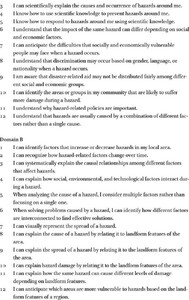
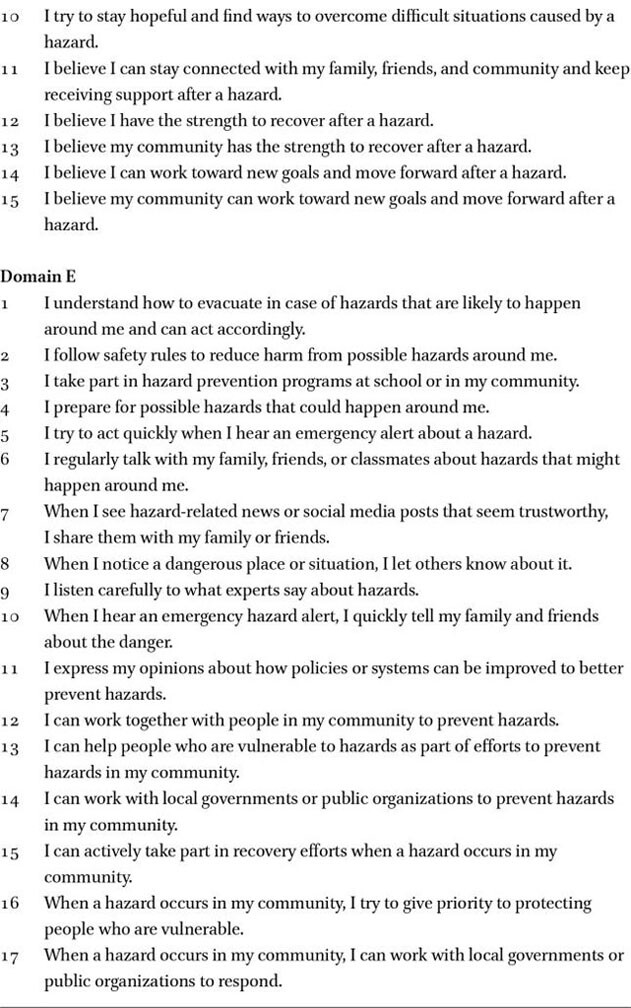
Hazard Literacy Self-Assessment Scale
Please indicate how much you agree with the following statement.
Citation: Asia-Pacific Science Education 11, 2 (2025) ; 10.1163/23641177-bja10103