In the summer of 2014, when Russia occupied Crimea, I took part in archaeological excavations in Kaliningrad Oblast. Our joint Lithuanian–Danish–Russian expedition investigated the remains of the famous Kaup/Wiskiauten barrow.1 First excavated by German archaeologists in the late nineteenth century, the site yielded two remarkably well-preserved skeletons attributed to the Corded Ware culture. We hoped to recover new data, particularly fresh DNA samples, since parts of the barrow appeared to have remained undisturbed. The swift and violent turn of events came as a shock, also to those local people I had interacted with at the time – fellow colleagues, taxi drivers, hotel staff. They were genuinely saddened by the fact that “brother is killing brother”. Ukraine was widely perceived as a ‘brother nation’, bound by linguistic ties. A considerable number of Kaliningrad’s residents were descendants of Ukrainians and Belarusians resettled there after the Second World War. Under Soviet policies, relocation often targeted large, economically disadvantaged families who could be more easily uprooted and sent to repopulate territories vacated by fleeing Germans. They inherited well-kept farms, fruit orchards, and houses – properties that soon deteriorated due to the newcomers’ insufficient knowledge of farm management.
At the time, I found myself reflecting upon Kaliningrad’s own contested history – territory transferred to the Soviet Union at the Potsdam Conference in 1945,2 a decision whose historical justification remains unsubstantiated. The world, it seems, has a tendency to forget inconvenient truths.
Staying on for several more weeks, with Internet sources increasingly filtered (international news sites became suddenly unavailable) and exposed to some twenty Russian television channels, I began to grasp how profoundly propaganda had evolved since my youth in Soviet Lithuania. Back then, we in the Baltic states were routinely branded ‘fascists’ (this rhetoric now reapplied by the Kremlin against Ukrainians), largely because we spoke non-Slavic languages and, perhaps more importantly, enjoyed higher living standards than many other parts of the Soviet Union. Back then, it was simpler: we assumed that whatever appeared in the newspapers or on the two state television channels was false. Transmissions of Voice of America, distorted by harsh jamming interference, offered a narrow but vital window through which to glimpse an alternative account of reality, to discern, however faintly, what was up and what was down.
But today the propaganda has advanced, incorporating genuine documented events, but narrating in an inverted fashion. “Is Ukraine responsible for blowing up a train and killing children on their way to summer camp?” A phone call to Denmark would adjust this story in an opposite way: “Russians were behind the explosion”. But how long can one sustain immunity to manipulated news? Prolonged exposure to disinformation, without many channels to the outer world, will undoubtedly start to affect the hearts and minds of those exposed, and slowly, without even noticing, one becomes a mankurt.3 Since the occupation of Crimea, disinformation has become an effective instrument of warfare in Ukraine, making the attempts of decolonisation even more praiseworthy than most in the free world would imagine. It was in this context that the idea emerged to present Ukrainian archaeology under the conditions of war.
When Russia launched its full-scale invasion on 24 February 2022, Ukrainian society was shaken to its core. The new reality overturned the structural matrix of the society, its identity, its political and cultural orientations, its affinities and assumptions about humanity in general. In this context, archaeology became more than an academic discipline; it emerged as a form of resistance. Excavating material evidence and re-examining inherited narratives, scholars began to challenge long-standing myths about Russian-Ukrainian ‘brotherhood’ and historical inevitability. For decades, research produced in Russia has been shaped by entrenched imperial frameworks that privilege Russian perspectives while marginalising the voices and pasts of other nations. This hegemonic dominance has not remained confined within Russia’s borders; it has also influenced Western academia, distorting scholarly interpretations through colonially inflected, Russia-centric models of the region.4 It therefore became increasingly clear that archaeology itself must confront its own postcolonial condition,5 shedding elements of the Soviet legacy that persist in institutional structures, interpretive narratives, academic writing traditions, and even the continued reliance on the Russian language in scholarly discourse.6
In particular, this need became evident in reclaiming Ukrainian names, toponyms and hydronyms, so Dnipro is no longer ‘Dnepr’, and Bakhmut has become a symbol of Ukrainian heroism rather than being referred to by its Soviet-era name, Artemivsk, commemorating a Bolshevik revolutionary. Such changes are not symbolic. They form part of a broader struggle against Russia’s rhetoric of ‘denazification’ – a slogan deployed to undermine Ukrainian identity and relegate it to a subaltern status within the ideological construct of the ‘Russkiy mir’.7 It is a resistance movement against epistemic subjugation and against the persistence of chauvinistic imperial paradigms that seek to define Ukraine’s past and, by extension, its future.
Archaeology is relevant. Even, and especially so, during the conditions of war. Several contributions are therefore devoted to recording losses and destruction, as well as to mapping and documenting newly exposed archaeological remains resulting from shelling, defensive trenches, and observation posts positioned on barrows and hillforts.8 The destruction of archaeological sites inflicted by the war has paradoxically created a temporary window of opportunity for research. Freshly cut trenches, impact craters, and other soil disturbances reveal cultural layers, subsurface features, and occasionally even previously unknown substantial sites that would otherwise have remained undetected.9 Of course, this opportunity is both fragile and fleeting due to natural erosion, land reclamation, reconstruction efforts, and the ever-present personal risks faced by researchers.
Archaeology is also vulnerable. It can be instrumentalised to serve the narratives of autocrats, to materialise their ideology and to legitimise political agendas. The once exceptional UNESCO World Heritage site of Chersonesus Taurica in occupied Crimea stands as one of the most striking casualties of such malpractice and neglect.10 Founded as a Greek colony in the fifth century BC, the site preserves substantial remains of city walls and towers, temples, residential quarters, early Christian basilicas, and cultural layers spanning the Roman and Byzantine periods, in places exceeding ten metres in depth. Its archaeological significance lies not only in the monumentality of its architecture, but also in the extraordinary stratigraphy that documents centuries of continuous occupation. Yet institutions operating ‘on the other side of the barricades’, i.e. under Russian authority, including the Institute for the History of Material Culture, the State Hermitage Museum, and Russian universities, have been associated with large-scale interventions at the site, acting more like treasure hunters. Rather than adhering to the standards of heritage protection expected of scholarly bodies, their activities demonstrate prioritisation of political spectacle over scientific integrity. In pursuit of constructing the so-called ‘New Chersonesus’ archaeological park, more than 80,000 square metres of the World Heritage site were reportedly destroyed, placing both the material fabric and the scholarly value of the site at serious risk.
The memorial dedication of this volume might also have encompassed the growing number of museums and their collections, archaeological and historical sites, churches, and memorials damaged or destroyed by the Russians. Many of these places have been deliberately targeted; this is not collateral damage. Such attacks reveal a calculated understanding that monuments, sacred spaces, and historical landscapes are integral to social identity and collective resilience. By striking at them, the aggressor seeks to erode memory, continuity, and the cultural foundations that sustain a society in times of crisis.11
The destruction of the Nova Kakhovka dam, which held back an enormous water reservoir on the Dnipro River, was yet another disaster of epic proportions.12 Following an explosion attributed to Russian forces on June 6, 2023, vast quantities of water were released, endangering 17,000 people, who were evacuated from the flooded areas. The scale of damage to archaeological sites (as well as natural ecosystems) is of equally devastating proportions and remains to be revealed by various monitoring organisations operating with very limited resources and specialists.13
The resilience of archaeology is evident in its capacity to adapt and seize opportunity amidst adversity. The war has fundamentally transformed archaeological practice: researchers must innovate, operate with limited resources and restricted access, and navigate both ethical and scientific challenges when documenting and preserving sites threatened or damaged by ongoing belligerent impacts.14 The vulnerability of museum collections, especially historical archives connected to archaeological research, has prompted extensive digitisation initiatives. These efforts, supported by students, volunteers, and international assistance in the form of equipment, aim to safeguard knowledge and ensure that cultural memory endures even under conditions of extreme disruption.15
War touches every aspect of life. This volume focuses on archaeology and heritage, often the next casualties after the loss of human lives. Personal stories inevitably emerge, such as that of Oleksandr Herman, one of the authors, whose dedication to documenting the ongoing erasure of Ukraine’s cultural past leaves us with grim uncertainty about his fate. Oleksandr was an active member of a team monitoring cultural sites in the occupied territories of the Donetsk region. On one of his routine missions, he went missing on October 28, 2025, likely attempting to transmit his findings from a sole protruding hillock in the otherwise flat landscape – a spot offering some telecommunication coverage, known among the few remaining locals as ‘the post office’. Several have been known to lose their lives there already, a ‘playground’ for Russian snipers. Oleksandr has spent his life as Filipov, after his father. But recently, he discovered his father’s sympathies for the enemy, an unbearable truth for a Ukrainian patriot. So Oleksandr’s article is being published with his new surname, Herman, after his mother.
The final article in this volume is dedicated to the late Klavs Randsborg (1944–2016), professor at the University of Copenhagen and the longest-serving chief editor of Acta Archaeologica. With characteristic enthusiasm, he welcomed the collapse of the East-West divide and immediately initiated numerous projects, including those in Ukraine, aimed at bridging scientific divisions. He successfully published the results of surveys in Crimea,16 yet the findings from fieldwork in Ukrainian Bessarabia (Odesa Oblast) remained incomplete, as he planned to return for further fieldwork. This work has now been carried forward and completed by his former student and field assistant through several collaborative projects, including in Ukraine.17
Ukrainian archaeology today demonstrates a clear intellectual maturity by moving beyond its earlier role as a tool of nation-building.18 Recognising identities as social constructs opens an important new field of inquiry: the study of how past identities were formed, maintained, and expressed. Freed from narrow nationalist frameworks, archaeology can instead address broader and more meaningful social and cultural questions. In a multiethnic society such as Ukraine, it is crucial to develop a genuinely multivocal interpretation of the archaeological record, one that acknowledges and integrates the perspectives of diverse ethnic, religious, and cultural communities. While scholarly discourse has historically been dominated by a limited segment of society, expanding the range of voices enriches interpretation and challenges monolithic understandings of the past. Far from weakening resistance to Russian imperialist narratives, this inclusive and critical approach counters them more effectively by emphasising human agency, cooperation, and historical processes, and by exposing claims of ‘historical rights’ as ideological constructions rather than ‘legitimate foundations’ for political power.
This special volume of Acta Archaeologica is thus a testimony to the enduring relevance and resilience of archaeology, even under the most challenging wartime conditions. Its contributors have remained steadfast in their calling to protect, document, preserve, and interpret cultural heritage despite restricted access, limited resources, and the constant threats posed to sites and archives. Their work has continued amid relentless air-raid alarms, bombings, drones, power shortages, and bitter winters often endured without heat. They have persevered even in the face of profound personal loss – the deaths of relatives, friends, and colleagues – demonstrating courage and dedication that transcend circumstance. In doing so, they continue to produce research that advances regional knowledge, particularly when many sites remain inaccessible to most scholars.19 Slava Ukraini!

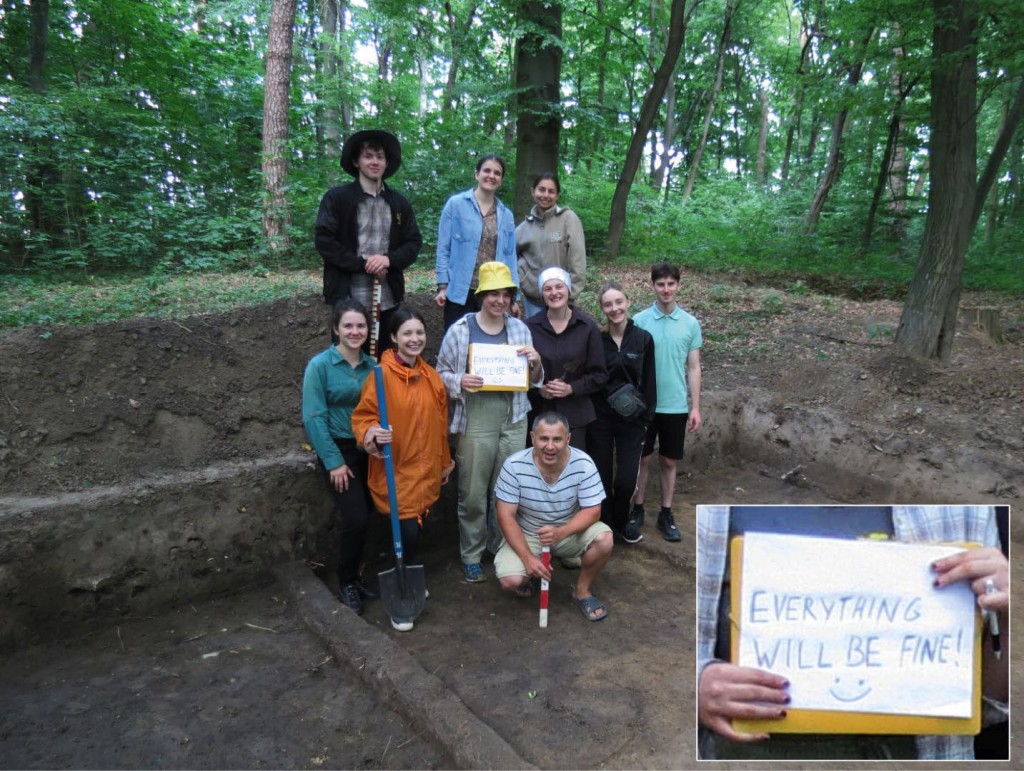
Andriy Havinskyi and student volunteers during excavation of Mount Lysivka near Lviv, western Ukraine, in summer 2025. Courtesy of Andriy Havinskyi, used with permission
Citation: Acta Archaeologica 96, 1 (2025) ; 10.1163/16000390-12341035
Randsborg, K., I. Merkyte, I., A. Merkevicius & V.I. Kulakov. 2016. Kaup 2014: Archaeological Excavations & Research History. Acta Archaeologica 87 (1). 85–130.
Mankurt – a person stripped of memory, identity, and will through brutal enslavement was first described by a Kyrgyz author, Chinghiz Aitmatov, in 1980 in a novel, The Day Lasts More Than a Hundred Years (
Krapfl, J. 2023. Decolonizing minds in the ‘Slavic area’, ‘Slavic area studies’, and beyond. Canadian Slavonic Papers 65 (2), 141–145.
Hutcheon, L. 1995. Introduction: colonialism and the postcolonial condition: complexities abounding. Publications of the Modern Language Association 110 (1). 7–16.
Dmytro Kiosak, this volume.
‘Russkiy mir’ (Russian:
Oleksandr Herman, this volume.
Lesia Chmil and Vitalii Koziuba, this volume.
Evelina Kravchenko and Roman Reida, this volume.
Lesia Chmil and Vitalii Koziuba, this volume; Oleksandr Herman, this volume. See also: https://www.science.org/content/article/wherever-we-ve-looked-we-see-destruction-ukraine-war-s-impact-buried-archaeological; Shydlovskyi, P., I. Kuijt, V. Skorokhod, I. Zotsenko, V. Ivakin, W. Donaruma & S. Field. 2023. The tools of war: conflict and the destruction of Ukrainian cultural heritage. Antiquity 97 (396). e36. doi.org/10.15184/aqy.2023.159.
Symonenko et al., this volume; Methods for Monitoring and Research of Archaeological Heritage Objects. Vita Antiqua: https://vitaantiqua.org.ua/en/archives/category/archive.
Andriy Havinskyi, this volume; Andriy Havinskyi et al., this volume.
Halyna Stanytsyna, this volume; Oleksandra Buzko, this volume.
Randsborg, K. 1994. A Greek Episode: The Early Hellenistic Settlement on Western Crimea. Acta Archaeologica 65. 171–196.
Thomas Roland, this volume.
Dmytro Kiosak, this volume; Simon Radchenko, this volume.
Alla Kurzenkova, this volume; Myhailo Videiko and Tatiana Hoshko, this volume; Andryi Havinskyi, this volume.