


In just a decade (1516–1526), the Habsburgs and the Ottomans dramatically raised their Euro-Mediterranean status: in the first case, the House of Austria went from owning a few meagre Austrian possessions to inheriting the domains of the Trastámaras (the powerful Spanish monarchy, with its recent Italian conquests and ongoing exploration of the Americas), and the Jagellons (the crowns of Hungary and Bohemia). Meanwhile, the Ottomans defeated both the Jagellons and the Mamluks, expanding through Levant, Egypt and the Maghreb, in addition to Hungary. The face-off between the two dynasties in both the Mediterranean and Central Europe has traditionally been interpreted as a proof of an insurmountable clash between the civilizations of Christendom and Islam. Even today political discourse adopts a nationalist lens drawing on anachronistic anti-Turkish rhetoric.
There is no doubt that an enduring dynastic-imperial competition existed, but it only accounted for a part of the Habsburg relations with Islam: both branches happily allied with other Islamic powers to counterbalance Ottoman preponderance, from Maghreb dynasties to the Safavid Empire, or enjoyed a relationship of calm coexistence with the Ottoman Empire over protracted periods. Beyond macropolitics, their proximity led to complicated choices for Habsburg policymakers: how should they deal with trade relations between Islamic powers and their own vassals? How could they find mediators to rescue captives without risking their reputation?
The chapter addresses three main questions: How did shifting perceptions of Islamic power shape Habsburg policymaking? How did they overcome and nuance the oppositional framework for Habsburg-Muslim relationships? How did the Islamic material and visual legacy reach the Habsburgs and how did it contribute to the self-fashioning of the Habsburgs?
1
Information-gathering on Islamic powers became a key necessity for Habsburg policymakers after the early sixteenth century due to Ottoman expansion in the Balkans and the Mediterranean. There was a clear difference between Spanish and Austrian reconnaissance: while the Austrian monarchy had shared borders with the Ottoman Empire since the 1520s and had honed its collection techniques, the Spanish monarchy had easier access to Maghreb and news from the Mediterranean.
In the sixteenth century, information about the Ottomans was primarily delivered to the court in Vienna via diplomatic exchange. However, at the beginning of the century only a few individual diplomats were sent to the sultan’s court for negotiations. It was not until the mid-sixteenth century that a permanent Austro-Habsburg embassy was installed in Constantinople (after 1547), which also allowed the sending of so-called Großbotschaften, official diplomatic envoys.1 Mostly senior officials and aristocrats were part of these Austro-Habsburg delegations, while lesser Ottoman envoys were received in Vienna. These missions were documented in illustrated travel reports, which give an insight into perceptions of foreign ceremonies and court customs at the time. However, these accounts were also a means for self-representation and propaganda.
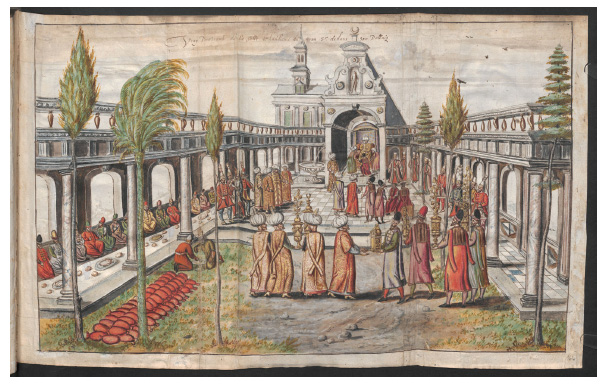
The diplomatic missions were a spectacle for both the Habsburgs and the Ottomans, with banquets, receptions given by the rulers, and the presentation of diplomatic gifts. All these aspects were documented in several illustrated travelogues, and those relating to the Habsburg delegations to Constantinople in the years 1572, 1577 and 1629 are particularly impressive. The report from the 1572 delegation led by David Ungnad (1538–1600), for example, shows the Habsburg envoy’s procession into the city, observed by the locals, and the ceremonial presentation of diplomatic gifts to Sultan Selim II. (Figure 8.1).2 The mission also served to deliver annual tribute payments by Emperor Maximilian II to the Sultan. Once back home, these travelogues were often reproduced, and the images studied at court. Another such travelogue was written by Salomon Schweigger, who travelled from Vienna to Constantinople in 1577 with the Habsburg delegation under ambassador Joachim von

Lambert Wyts, Itinera in Hispaniam, Viennam et Constantinopolim, Belgium, 1573, © Austrian National Library (ÖNB), Vienna, Manuscript Cod. 3325*, fol. 164
The Austro-Habsburg espionage system was not yet fully developed in the sixteenth century, and just a few individuals were operating on behalf of the crown. Only after the signing of the Peace Treaty of Zsitvatorok in 1606 was a lasting information network established by the Habsburgs that allowed a continuous supply of information to and from Constantinople.4 The Imperial War Council (Hofkriegsrat) oversaw this network which consisted of official couriers, travelling craftsmen, spies, and interpreters. However, the delivery of the messages could be dangerous, as the Austrian envoys had to travel through Ottoman
Salomon Schweigger, Ein newe Reyßbeschreibung auß Teutschland Nach Constantinopel vnd Jerusalem (etc.), 1608, © Austrian National Library (ÖNB), Vienna, Manuscript 35858-B, p. 94.

Diplomatic relations were also exploited to play power games, which could have political consequences if they went too far. We know of the harassment, in the mid-seventeenth century, of Austrian delegations staying at the Constantinople court, who were locked in their quarters or forced to salute in front of the sultan’s palace.6 This was firstly an attempt by the Sultan to show
In the Spanish case, the Habsburgs resorted to a system of ‘avisos’ or notifications that helped them to form opinions on Ottoman and Maghreb policy, especially in the Mediterranean, a system that worked with varying degrees of success between 1520 and 1620. Due to the lack of formal relations between the Spanish monarchy and the Ottoman Empire, the political image that policymakers received in Spain was shaped by the information provided by dynastic allies, beginning with the aforementioned Austrian-Habsburgs, but also from Genoa, and, indirectly, Venice. They formed their own supplementary spy networks at different moments, especially after the Spanish defeat in the Battle of Djerba in 1560, when Philip II decided to send the Genoese agent Giovanni Maria Renzo to Constantinople.7 In the last decade of the sixteenth century, the frequency of the information decreased because of the detention of intelligence agents in 1592, the death of the principal spy Marco Antonio Stanga in 1593, and the rise of anti-Habsburg diplomacy in Constantinople caused by the activities of the French and English representatives.8 The Habsburgs compensated for this lack of information by resorting to Ragusa or Venetian sources. Thanks to their intermediary position between Christendom and Islam, both cities were able to gather information about the Spanish and the Ottomans, making them important partners of Habsburg and Ottoman intelligence systems. Ragusa was of particular strategic importance as ‘the entrance and exit’ of the Catholic world into the Ottoman lands, especially for the diplomats on their way to Constantinople, as well as their merchant network in Mediterranean-wide commerce, providing comprehensive information that could then be sold to both the Spanish and the Ottoman authorities.9 Venetian
The monopolization and systematization of the information-gathering about the greatest Islamic rival was necessary for the Spanish monarchy’s decision-making processes, above all for strategic and economic reasons. Reliable information was priceless since a timely notification about the Ottoman navy’s intentions could help prevent the loss of a strategic post or avoid the unnecessary deployment of human or economic resources in the defence of the Mediterranean.11 Thus, what mattered was not only the gathering of information but also its interpretation by viceroys in Naples and Sicily and by Crown counsellors in Madrid, which proved to be critical in taking the best decision and executing policies based on the information received. In 1560, having received many avisos about the Ottomans’ internal problems during the final years of the reign of Suleyman I, the Duke of Medinaceli, as viceroy of Sicily, was encouraged to organize an expedition against the sultan’s North African territories. The expedition ended in the major naval disaster of Djerba, after which numerous Spanish and Italian captives were taken to Constantinople.12
Consequently, in the late sixteenth century, when the Ottoman navy had lost its previous grandeur in the Mediterranean, the Spanish monarchy opted not to embark on any similar adventures, however much the reports from Constantinople emphasized problems in the Ottoman government and the deficiencies of Ottoman naval power. Gian Andrea Doria, Admiral to Philip II since 1583, was influential in determining a Spanish Mediterranean policy based on prudence and the avoidance of risk-taking because of his experience in the Mediterranean wars that dated back to the 1560s. Unlike other counsellors of Philip II who saw the Ottomans’ structural and financial difficulties as an opportunity to attack the enemy, Doria weighed the information received against the backdrop of his personal historical experience, and his surprise and
The fearful image of the ‘Turk’ remained intact until the end of the seventeenth century, given their capacity to organize huge armies and hit the area from Poland to Morocco by both land and sea with force. Meanwhile, the Maghreb powers had earned a corrupt and weak image, as they were progressively conquered by the Ottomans while offering unreliable alliances which deserved little credit, as the cases of Tlemcen and Kouko had shown. Only Morocco remained independent, earning itself a mixed reputation for being either a land of easy conquest or a complicated context in which it was best not to meddle.16
Until recently, the pervasive influence of the crusade context has eclipsed the variety and vivacity of diplomatic experiences between the Habsburg and Islamic powers. In this sense, the imperial competition with the Ottomans both fostered wide propaganda production on the one hand, and overshadowed and justified diplomatic relations – sometimes acknowledged, sometimes concealed – with other sultans and emirs on the other. The Habsburg rhetoric of power retained a traditional Catholic justification of its political actions, allegedly designed to benefit Christendom and the Holy Church. Thus, they were careful to justify their dealings with the ‘infidels’ on moral theological premises: to avoid a greater evil for Christians or to confront the ‘pernicious’
After that, the methods with which Charles V pursued his negotiations with the Ottomans aimed at circumventing Ottoman pressure to publicly recognize their supremacy. Thus, the imperial envoys sent to the Ottoman capital always presented themselves as representatives of his brother Ferdinand, which meant that they were representing neither the Empire nor the Spanish kingdoms. Nevertheless, Charles V’s attempts to hide behind the figure of Ferdinand also prevented him from achieving a proper treaty with the sultan since the Ottomans barred Charles V from using the title of Emperor in the negotiations or in any official document. Ferdinand’s recognition in the Treaty of Istanbul (1547) of his status as a tributary of the Sublime Porte was Charles V’s implicit admission of Ottoman supremacy. But this would then prove to be a turning point after which Charles V and Philip II would resort only to the agency of spies and not to official public negotiation processes.18 Hence, when Spanish-Ottoman truces were negotiated and concluded between 1578 and 1581, the Spanish did not appear to have made any real concessions to the sultan since Philip II’s representative Giovanni Margliani was a secret agent without ambassadorial rank.19 For Ottomans this was an aberration of their traditional diplomatic practice to which they became strictly reticent to resort again without official public recognition by the Spanish monarchs. This led to a dead end in the Spanish-Ottoman relations because the negotiations were based on opposing demands: while the Spanish considered Giovanni Margliani’s truce an exemplary model to follow in future negotiations, the Ottomans insisted on an embassy with appropriate ceremonies and credentials.20 This
By contrast, in 1535, the Spanish branch only publicized its dealings with the King of Tunis because the pact was signed after Charles V had defeated an Ottoman army and reinstated Mulay Hassan to the Tunisian throne as his vassal; Charles V was therefore able to appear as the true emperor and champion of the faith.22 For the rest of the sixteenth and seventeenth centuries, the exchange of agents and ambassadors between Spanish Habsburgs and Maghreb powers was almost continuous, but dissimulated. A similar approach was followed in France, where most Muslim embassies left few document trails or records.23 Accordingly, diplomatic gifts, texts, and material culture were either poorly preserved or simply not registered. That was not the case with Safavid Persia, where Shah Abbas I sent numerous embassies to Europe in the early seventeenth century. Both the Spanish and Austrian branches accepted and lavishly entertained these ambassadors, who were potential allies against the Ottoman Empire and could ease the spread of Catholic missionaries in Persia. However, no image or portrait was made of them in Spain, whereas the imperial Flemish engraver Aegidius Sadeler portrayed them as dignified elite agents operating against the evil Turkish nemesis.24
2 Trade and Ransom
The question of sixteenth- and seventeenth-century Christian-Muslim trade has recently received widespread attention, especially regarding overcoming
On the Hungarian border, the situation between Habsburgs and Ottomans was equally porous. Current historiography emphasizes that “the histories of
A special type of intercultural trade was the lucrative ransoming of captives, which captured European imagination throughout the Early Modern Period. Due to the aforementioned diplomatic and trading constraints, the Spanish Monarchy did not take a direct part in these processes because this would have implied acknowledging the legitimate agency of piratical powers and compromised the royal authority in pacts with ‘infidels’. But the Crown did give licences to other agents – chiefly redeemer friars (Mercedarians and Trinitarians) in its Iberian realms and pious confraternities in Italy – and protected (or controlled) their ransom activities. Although the friars did not act on behalf of the Crown, they were compelled to follow very precise, rigid and impractical royal instructions. The Spanish Habsburgs tended to conceal this uncomfortable reality, as they were unable either to offer solutions for this constant low-intensity Mediterranean warfare or to deal directly with Muslim powers.32 Accordingly, several texts expressed subtle criticism that the King had abandoned his poor vassals, a censure aimed at much of European royalty, including the English monarchs.33
Prisoners from higher social classes were dealt with differently – they were used as political leverage and an official procedure was therefore implemented to free them. In the cases of Hungarian nobility, military officials and imperial couriers kidnapped by Ottoman soldiers, official letters of complaints could be sent to the Sublime Porte and the Pasha of Buda to demand their return. However, these pleas were often dismissed, as such high-ranking captives were valuable, and the Ottomans wished to extract the maximum amount of profit.
Meanwhile, the Ottomans neither developed a centralized rescuing system for dealing with the Habsburgs nor did they organize regular large-scale practices aimed at the systematic liberation of Ottoman captives.36 Instead they resorted to at least four different indirect instruments. First was the clientelist mediation of influential Ottoman individuals on behalf of captive Ottoman state officials (like the intervention of the Valide Sultan for the redemption of kadi Macuncuzade Mustafa Çelebi from the Maltese).37 Second, French officials acted as ransom dealers, motivated both by the potential for financial gains and to increase their political prestige.38 Third, the exchange of Muslim captives for Christians (or appreciated merchandise like sugar) in the Mediterranean, was undertaken by regional authorities, like the governor of Algiers
3 Material Culture and Art Commissions
These multi-layered encounters with Islamic power in the Mediterranean region, as well as in Central Europe, also left significant traces in their cultures. On the one hand, political agendas were demonstrated through the power of art: battles won by the Habsburgs were reproduced as oil paintings and engravings in a public display of their supposed military superiority. Moreover, sculptures, monuments and symbols were installed in public spaces to remind people of the Islamic threat and to cultivate the image of the enemy. Those images were part of the visual propaganda that was linked to the fight against the ‘infidels’ – an example of which are coats of arms, which from the sixteenth century onwards included so-called Turkish heads, but also Moorish heads, intended as a reminder of the bloody conflicts with Islamic opponents.
At the same time, a fascination for Islamic culture developed, especially for its crafted objects, including carpets, tents, weapons, clothing and fabrics. This fascination built up over the sixteenth and seventeenth centuries and then culminated in the eighteenth century in the so-called Turkish fashion or Moda alla turca. The result was a positive reception and an integration of Islamic culture into Christian culture, in an imitation that in some cases even led to a cultural hybridization. Particularly influenced by this were costumes and dress at the Habsburg courts, but also music, including opera, as well as theatre and everyday culture. Of particular importance in these attitudes were Islamic material goods that came to Europe through trade, war, migration, and diplomatic relations.
In the Austrian-Habsburg Empire, Ottoman objects were extremely popular collectors’ items and often found their way into the armouries and cabinets of curiosities, which became a fixed component of princely and courtly collections from the Renaissance onwards. An important example is the Ambras
The handling of Ottoman cultural goods makes it clear that various, sometimes contradictory, images of ‘the Turk’ circulated among the Habsburgs, according to which the Ottoman was hostile but also exotic and cultured. These ambiguities can also be found in the courts of other European rulers, such as the Polish-Lithuanian.
Furthermore, Ottoman weapons and armour were also used as costumes in courtly festivities and tournaments like the aforementioned Spanish juegos de cañas. The ‘Turk’ featured as a character throughout the German-speaking world as early as the beginning of the sixteenth century.44 By depicting the ‘Turks’ as the losing party, these objects also served indirectly to demonstrate Habsburg superiority. Pictorial representations of this can be found in one of the tournament books commissioned by Archduke Ferdinand II of Tyrol (Figure 8.3).
These Ottoman and Ottoman-related objects also served as memorabilia, as a reminder of the achievements of the House of Habsburg. A particular example in this context is the former spire of St. Stephen’s Cathedral in Vienna (Figure 8.4), with the crescent and star mounted in 1519.45 Historical sources
Sigmund Elsässer, Kolowrat-Hochzeit Codex, Innsbruck 1580, fol. 10, Schloss Ambras Collection, Innsbruck, Inv.-nr. Kunstkammer, 5269 ©KHM-Museumsverband.

As we have seen, there were also forms of cultural blending in which Ottoman stylistic idiom was incorporated into the language. In the art of blacksmithing this ‘Ottomanizing’ style can already be found from the sixteenth century onwards – especially in the production of weapons and armour. Many of these objects were also used in costumes at court and thus endowed with a new context. In the case of the Habsburgs, these objects were mostly produced in Germany and Austria, but after the Ottoman pushback at the end
Unknown, “Mondschein”, former spire of St. Stephan’s Cathedral Vienna, 1514–1519, Wien Museum Inv.-Nr. 561, CC BY 4.0, Foto: Enver Hirsch, Wien Museum (https://sammlung.wienmuseum.at/objekt/50222/).

In Spain, Habsburg self-representation and legitimacy as a dominant dynasty heavily relied on the image of crusaders against Islam. It was shown both by collecting and displaying Islamic material culture as war trophies and commissioning art objects to fix the memory of victorious moments. A problematic point is the attitude towards the Islamic architectural legacy: in southern Spain, the relation with Andalusian architecture was more problematic, as the so-called Mudéjar style had become a traditional local language that transcended religious confession. The preservation of the Alhambra, the Nasrid
Regarding Islamic material culture as war trophies, the Spanish royal collections did not follow a systematic approach until the reign of Philip II. Prior to that the Catholic Monarchs, for instance, presented the clothes and sword taken from Boabdil, the last Nasrid King of Granada, to the knight Diego Fernández de Córdoba and only in 1904 did his descendants donate them to Spain’s Army Museum.47 Philip II built a Royal Armoury in the 1560s and ordered that its collections be considered part of the Crown’s indivisible heritage which, as such, could not be auctioned after the monarch’s death as was the tradition.48 This Royal Armoury included numerous Muslim war trophies, with monographic sections added as of the nineteenth century for the triumphs of Tunis (1535), Lepanto (1571), and Oran (1732). Before that, the key pieces from Lepanto were collected in special furniture (the Royal Armoury’s Wardrobe 10), among the most important mediaeval relics and the swords of Francis I of France or King Boabdil of Granada. Most of them were part of the inheritance of John of Austria, Philip II’s half-brother and Christian admiral of Lepanto. After John’s death, Philip II ordered that the Lepanto trophies be incorporated into the royal collections. One of the highlights were 34 flags from the battle, half of which Philip III donated in 1616 to Toledo Cathedral, where they are still preserved. Apart from those flags, Philip II and the Pope were gifted two from the Ottoman flagship: the Roman one returned to Turkey in the 1960s while the other was publicly displayed in El Escorial library, a highly symbolic and semi-public space for the dynasty, until it was destroyed when the monastery caught fire in 1671.49
Indo-Portuguese tent, formerly possessed by Charles V, sixteenth century, Museum of the Army, Toledo © Museo del Ejército.

Apart from such direct Islamic remains, the Habsburgs also commissioned a vast array of royal and imperial artefacts to celebrate victories over the religious enemy. In the Spanish case, the crusader image was crucial for forging powerful propaganda, and was visible in the most official royal space, the Hall of Mirrors in the Royal Alcázar of Madrid, where (after 1629) two paintings on the providential role of the Habsburgs against infidels flanked the longer side of the room: Titian’s Philip II offering the Infante Fernando to Victory and Velázquez’s Expulsion of the Moriscos.53 That crusader spirit is still more present in the dynasty’s most symbolic portable decoration, the lavish set of 12 tapestries of the conquest of Tunis (1548–54). Mary of Hungary, sister of Charles V and governor of the Netherlands, commissioned and supervised the work, which Charles V gifted to Philip II for his wedding with Mary I of England. After that, the tapestries were used to decorate key dynastic events in Iberia: the wedding of Philip II and Anna of Austria, the proclamation of Philip II as king of Portugal (Tomar, 1581), the Corpus Christi’s processions in Descalzas Reales, the signing of the Anglo-Spanish peace of 1603 in the Royal Palace of Valladolid, amongst others.54 The two material legacies of the Spanish Habsburgs that Philip V of Bourbon and Charles VI of Austria disputed
Artworks and objects commissioned by the Habsburgs were therefore used as political instruments as a means of both self-presentation and presentation of the Muslim Other. At the same time, there is an ambiguity in the use of Islamic and Islamized objects, which was based on the diverse, partly contradictory images of Muslims that circulated in the Habsburg Empires.
4 Conclusion
Both the Austrian and Spanish houses of Habsburg were confronted with Islam in the sixteenth and seventeenth centuries, but they found different ways of addressing the issue. This was mainly due to their different geo-political positions. Since the Spanish realms had coexisted alongside neighbouring Muslim powers and even with local Muslim minorities for centuries, the Habsburgs rapidly adapted to this situation and largely continued the Catholic Monarchs’ cautious approach, combining limited coastal conquests in the Mediterranean, recurrent informal pacts with friendlier Muslim authorities, and tolerating or dissimulating trade and ransom activities. While the imperial competition against the Ottomans was real and the royal military apparatus adapted to this confrontation, there were also spaces of non-violent communication and even fruitful alliances in the Maghreb. However, the Spanish Habsburgs consistently built a crusade-related royal image, in continuity with the Trastámara dynasty, in which images of friendship or cooperation with Muslim allies were excluded and the interactions were presented in terms of submission.
This differed from the situation in the Austrian-Habsburg Empire, which was confronted with an Islamic power for the first time only after the Ottomans spread to western Hungary at the beginning of the sixteenth century. Until the end of the seventeenth century, they remained neighbouring empires, and consequently had to accommodate one other. For this purpose, diplomatic relations were particularly important and were suspended for only a very short time in the event of military attacks. Trade relations and slave trafficking were
During peaceful times, a certain co-dependency can even be said to have developed, both in the Mediterranean and Central European areas, seeking as far as possible to coexist in a manner that was satisfactory for both parties. By shedding light on relations in times of peace, which were far more regular than those of war, it becomes clear that mutual exchange was the more common approach, outside an oppositional framework. In particular, diplomatic events allowed for closer insights into Islamic politics and culture, developing a more nuanced image and positively influencing the perception of the Muslim Other.
Neither should the role of (material) cultural exchange be underestimated. The circulation of images, stories, objects, and people generated new images of Islamic courts and society, and the artistic skill, cultivation and military abilities of the Ottomans were recognized. However, these cultural fragments were also misused by the Habsburgs for their own agendas, such as when they used Ottoman and Ottomanized objects to propagate anti-Ottoman messages at tournaments, or when demonstrating their own superiority through the possession and display of precious Islamic objects in their collections.
Works Cited
Primary Sources
Schweigger, Salomon, Ein newe Reyßbeschreibung auß Teutschland Nach Constantinopel vnd Jerusalem …, 1608.
Wyts, Lambert, Itinera in Hispaniam, Viennam et Constantinopolim, 1573.
Secondary Sources
Acıpınar, Mikail, “XVII. Yüzyılın İlk Yarısında Toskana Grandukalığında Türk Esirler”, Tarih İncelemeleri Dergisi 25 (2010), 15–38.
Barbeito, José Manuel, “De arte y arquitectura. El Salón de los Espejos en el Alcázar de Madrid”, Boletín del Museo del Prado 51 (2015), 24–43.
Beßler, Gabriele, Wunderkammern – Weltmodelle von der Renaissance bis zur Kunst der Gegenwart (Berlin, 2009).
Biegman, N.H., “Ragusan Spying for the Ottoman Empire: Some 16th-Century Documents from the State Archive at Dubrovnik”, Belleten 26, no. 106 (1963), 237–255.
Checa Cremades, Fernando, ed., Los inventarios de Carlos V y la familia imperial. (Madrid, 2010).
Crooke y Navarrot, Juan, “Bilderinventar der Waffen, Rüstungen, Gewänder und Standarten Karl V. in der Armeria Real zu Madrid, [2]”, Jahrbuch der Kunsthistorischen Sammlungen des Allerhöchsten Kaiserhauses 11 (1890), CCXLII–CCCXXIV.
Cutillas Ferrer, José F., “Did Shah `Abbas I Have a Mediterranean Policy?”, Journal of Persianate Studies 8 (2015), 254–75.
Deluga, Waldemar, “The Oriental Portraits of Aegidius Sadeler”, Print Quarterly 25, no. 4 (2008), 424–26.
Do Paço, David, The Ottoman Empire in early modern Austrian history: assessment and perspectives, EUIMWP, 2014/07, http://hdl.handle.net/1814/31652
Dorfner, Thomas, “Der Preis der Freiheit: Der Freikauf des Soldaten Bernhard Teutschmann aus osmanischer Gefangenschaft (1605–1611)”, Frühneuzeit-Info 31 (2020), 126–39.
Dueñas Beraiz, Germán, “Las espadas nazaríes: entre el arma y la joya”, in Tesoros del Museo del Ejército (Madrid, 2007), pp. 191–206.
Escribano Páez, José Miguel, “Negotiating with the ‘Infidel’: Imperial Expansion and Cross-Confessional Diplomacy in the Early Modern Maghreb (1492–1516)”, Itinerario 40, no. 2 (2016), 189–214.
Falomir Faus, Miguel, El arte del poder. La Real Armería y el retrato de corte (Madrid: 2010).
Fernández Flórez, Marina, “Artes de diplomacia y representación para las redenciones ibéricas en Berbería (siglo XVII)”, in Francesco Caprioli and Rubén González Cuerva, eds., Reconocer al infiel: la representación en la diplomacia hispano-musulmana (siglos XVI y XVII) (Madrid, 2021), pp. 95–120.
Fernández Puertas, Antonio, La tienda turca otomana de la Real Armería (c.1650–1697) (Madrid, 2003).
Fernández-Santos Ortiz-Iribas, Jorge and Hüseyin Serdar Tabakoglu, “The Unexpected Ottoman Guest: Ahmed Agha in Madrid (1649–50)”, in Ambassadors in Golden Age Madrid. The Court of Philip IV through Foreign Eyes, Jorge Fernández-Santos and José Luis Colomer, eds. (Madrid, 2020), pp. 461–92.
Fodor, Pál, “Trade and traders in Hungary in the age of Ottoman conquest: An outline”, Acta Orientalia Academiae Scientiarum Hungaricae 60, 1 (2007), 1–8.
Fodor, Pál, “Piracy, Ransom Slavery and Trade: French Participation in the Liberation of Ottoman Slaves from Malta during the 1620s”, in Critical Readings on Global Slavery (Leiden, 2017), pp. 880–94.
García-Arenal Rodríguez. Mercedes, Ahmad Al-Mansur: The Beginnings of Modern Morocco (Oxford, 2009).
García Ramírez, Susana, “La tienda de campaña del Museo del Ejército: espacios y tiempos”, in Tesoros del Museo del Ejército, María Jesús Rubio Visiers and Carmen García Campa, eds. (Madrid, 2007), pp. 11–36.
González Cuerva, Rubén, “Infidel Friends: Charles V, Mulay Hassan and the Theatre of Majesty”, Mediterranea Ricerche Storiche 49 (2020), 445–68.
González Castrillo, Ricardo, “La embajada de García de Loaysa al sultán Selim I: según el ms. II/2222 de la Biblioteca del Palacio Real de Madrid”, Reales Sitios 121 (1994), 12–20.
Graf, Tobias P., “Knowing the ‘hereditary enemy’: Austrian-Habsburg intelligence on the Ottoman Empire in the late sixteenth century”, Journal of Intelligence History 21, no. 3 (2022), 268–88.
Grenet, Mathieu, “Muslim Missions to Early Modern France, c.1610-c.1780: Notes for a Social History of Cross-Cultural Diplomacy”, Journal of Early Modern History 19, no. 2–3 (2015), 223–44.
Gürkan, Emrah Safa, Espionage in the 16th century Mediterranean: Secret Diplomacy, Mediterranean go-betweens and the Ottoman-Habsburg Rivalry (PhD Diss., Georgetown University, 2012).
Hamilton, Alastair. “Michel d’Asquier, Imperial Interpreter and Bibliophile”, Journal of the Warburg and Courtauld Institutes 72 (2009), 237–41.
Hanß, Stefan, Die materielle Kultur der Seeschlacht von Lepanto (1571): Materialität, Medialität und die historische Produktion eines Ereignisses (Würzburg: 2017).
Harper, James G., The Turk and Islam in the Western Eye, 1450–1750: Visual Imagery before Orientalism (Burlington: 2011).
Hershenzon, Daniel, “The Political Economy of Ransom in the Early Modern Mediterranean”, Past and Present 231 (2016), 61–95.
Iordanou, Ioanna, “The secret service of Renaissance Venice: intelligence organization in the sixteenth century”, Journal of Intelligence History 21, no. 3 (2022), 251–67.
Irigoyen-García, Javier, “‘Poco os falta para moros, pues tanto lo parecéis’: Impersonating the Moor in the Spanish Mediterranean”, Journal of Spanish Cultural Studies 12, 3 (2011), 355–69.
Köse, Metin Ziya, “Esaret ve Fidye: Akdeniz’de Osmanlı Esirleri (1600–1700)”, Cappadocia Journal of History and Social Science 9 (2017), 331–47.
Krause, Stefan and Matthias Pfaffenbichler eds., Turnier: 1000 Jahre Ritterspiele (Vienna, 2017).
López Guzmán, Rafael, Arquitectura mudéjar: del sincretismo medieval a las alternativas hispanoamericanas (Madrid, 2000).
Martín Corrales, Eloy, “De cómo el comercio se impuso a la razzia en las relaciones hispano-musulmanas en tiempos del Quijote: hacia la normalización del comercio con el norte de África y el Levante otomano a caballo de los siglos XVI y XVII”, Revista de Historia Económica 23, no. 1 (2005), 139–59.
Matar, Nabil, Britain and Barbary, 1589–1689 (Gainesville, 2005).
Meienberger, Peter, Johann Rudolf Schmid zu Schwarzenhorn als kaiserlicher Resident in Konstantinopel in den Jahren 1629–1643 (Bern, 1973).
Pálffy, Géza, “Ransom Slavery along the Ottoman-Hungarian Frontier in the Sixteenth and Seventeenth Centuries”, in Ransom Slavery along the Ottoman Borders, Pál Fodor and Geza David, eds. (Leiden, 2007), pp. 35–83.
Pötschner, Peter and Walther Brauneis, “Die Bekrönung des Stephansturmes im Wandel der Zeiten”, Der Dom. Mitteilungsblatt des Wiener Domerhaltungsvereins 2 (1979). 3–8.
Reitter, Elisabeth, “Zu den sammlungsrelevanten Beziehungen Erzherzog Ferdinands II. (1529–1595)”, in Österreich interdisziplinär-Beiträge des Innsbrucker Doktoratskollegs “Austrian Studies” (Vienna, 2021), pp. 122–41.
Rey Hazas, Antonio, “Cervantes, la corte y la política de Felipe II: vida y literatura”, Felipe II (1598–1998): Europa y la monarquía católica (Madrid, 1998), pp. 437–62.
Rodríguez Salgado, María José, Felipe II, el ‘Paladín de la Cristiandad’ y la paz con el turco (Valladolid, 2004).
Rudolph, Harriet, “Türkische Gesandtschaften ins Reich am Beginn der Neuzeit- Herrschaftsinszenierung, Fremdheitserfahrung und Erinnerungskultur”, in Das Osmanische Reich und die Habsburger (Vienna, 2005), pp. 295–314.
Salas Almela, Luis, “Portugal y Castilla en el reino de Fez. Tensiones y mudanzas en una frontera colonial postergada (1540–1588)”, in España y Portugal en el mundo (1581–1668), Carlos Martínez Shaw and José Antonio Martínez Torres, eds. (Madrid, 2014), pp. 219–48.
Samson, Alexander, Mary and Philip: The Marriage of Tudor England and Habsburg Spain (Manchester, 2020).
Sandbichler, Veronika, Türkische Kostbarkeiten aus dem Kunsthistorischen Museum (Vienna, 1997).
Schimmer, Karl August, Wien’s Belagerungen durch die Türken und ihre Einfälle in Ungarn und Österreich (Vienna, 1845).
Schmitz-von Ledebur, Katja, “Emperor Charles V Captures Tunis: a Unique Set of Tapestry Cartoons”, Studia Bruxellae 11 (2019), 387–404.
Sempere Marín, Alicia, “Conquistas y tesoros. La recepción de objetos suntuarios foráneos durante el reinado de Carlos V”, Archivo Español de Arte 387 (2024), 1287.
Severi, Bart, “‘Denari in Loco Delle Terre … ‘ Imperial Envoy Gerard Veltwijck and Habsburg Policy Towards the Ottoman Empire, 1545–1547”, Acta Orientalia Academiae Scientiarum Hungaricae 54 (2001), 211–56.
Severi, Bart, “Representation and Self-Consciousness in 16th century Habsburg Diplomacy in the Ottoman Empire”, in Das Osmanische Reich und die Habsburger (Vienna: 2005), pp. 281–94
Skilliter, Susan, “The Hispano-Ottoman Armistice of 1581”, in Iran and Islam: in Memory of the Late Vladimir Minorsky, Clifford Edmund Bosworth, ed. (Edinburg, 1971), pp. 491–515.
Sola, Emilio, Los que van y vienen: información y fronteras en el Mediterráneo clásico del siglo XVI (Madrid, 2005).
Soler del Campo, Álvaro, “La armería de Felipe II”, Reales Sitios 135 (1998), 24–37.
Soler del Campo, Álvaro, “Los trofeos de Lepanto en la Real Armería”, in Oriente en Palacio: Tesoros asiáticos en las colecciones reales españolas (Madrid, 2003), pp. 44–57.
Szabados, János, “Habsburg-Ottoman Communication in the Mid-17th Century-The Death of Imperial Courier Johann Dietz. A Case Study”, The Journal of Ottoman Studies 54 (2019), 119–40.
Tejada Carrasco, Cristina, La embajada Margliani: Encuentros y desencuentros entre el Imperio Otomano y España en la época de Felipe II (1578–1581) (Ph. Diss., Universidad de Alcalá, 2017).
Türkçelik, Evrim, “Las negociaciones falsas: agentes e impostores entre la Monarquía Hispana y el Imperio Otomano (1590–1625)”, in Reconocer al infiel: la representación en la diplomacia hispano-musulmana (siglos XVI y XVII), Francesco Caprioli and Rubén González Cuerva, eds. (Madrid, 2021), pp. 145–62.
Urquízar-Herrera, Antonio, Admiration and Awe: Morisco Buildings and Identity Negotiations in Early Modern Spanish Historiography (Oxford, 2017).
Varriale, Gennaro, “El espionaje hispánico después de Lepanto: el proyecto de fray Diego de Mallorca”, Studia Historica: Historia Moderna 36 (2014), 147–74.
Vatin, Nicolas, “Note sur l’attitude des sultans ottomans et de leurs sujets face à la captivité des leurs en terre chrétienne (fin XVe–XVIe siècle)”, Wiener Zeitschrift für die Kunde des Morgenlandes 82 (1992), 375–95.
White, Joshua M., Piracy and Law in the Ottoman Mediterranean (Stanford, 2018).
Williams, Phillip, Empire and Holy War in the Mediterranean: The Galley and Maritime Conflict between the Habsburgs and Ottomans (London, 2014).
Tobias P. Graf, “Knowing the ‘hereditary enemy’: Austrian-Habsburg intelligence on the Ottoman Empire in the late sixteenth century”, Journal of Intelligence History 21, no. 3 (2022), 268–88.
Lambert Wyts, Itinera in Hispaniam, Viennam et Constantinopolim, 1573.
Salomon Schweigger, Ein newe Reyßbeschreibung auß Teutschland Nach Constantinopel vnd Jerusalem …, 1608.
Peter Meienberger, Johann Rudolf Schmid zu Schwarzenhorn als kaiserlicher Resident in Konstantinopel in den Jahren 1629–1643 (Bern, 1973), pp. 83–86.; Alastair Hamilton, “Michel d’Asquier, Imperial Interpreter and Bibliophile”, Journal of the Warburg and Courtauld Institutes 72 (2009), 237–41.
János Szabados, “Habsburg-Ottoman Communication in the Mid-17th Century – The Death of Imperial Courier Johann Dietz. A Case Study”, The Journal of Ottoman Studies 54 (2019), 119–40.
Bart Severi, “Representation and Self-Consciousness in 16th century Habsburg Diplomacy in the Ottoman Empire” and Harriet Rudolph, “Türkische Gesandtschaften ins Reich am Beginn der Neuzeit – Herrschaftsinszenierung, Fremdheitserfahrung und Erinnerungskultur”, in Das Osmanische Reich und die Habsburger, eds. Marlene Kurz et al. (Vienna, 2005), 281–94, 295–314.
Emilio Sola, Los que van y vienen: información y fronteras en el Mediterráneo clásico del siglo XVI (Alcalá de Henares, 2005), 199–248; Emrah Safa Gürkan, Espionage in the 16th century Mediterranean: Secret Diplomacy, Mediterranean go-betweens and the Ottoman-Habsburg Rivalry (PhD Diss., Georgetown University), 2012, pp. 267–85.
Gürkan, Espionage in the 16th century Mediterranean, 326–30.
N.H. Biegman, “Ragusan Spying for the Ottoman Empire: Some 16th-Century Documents from the State Archive at Dubrovnik”, Belleten 26, no. 106 (1963), 237–55; Gürkan, Espionage in the 16th century Mediterranean, pp. 206–07.
Ioanna Iordanou, “The secret service of Renaissance Venice: intelligence organisation in the sixteenth century”, Journal of Intelligence History 21, no. 3 (2022), 251–67.
Cristina Tejada Carrasco, La embajada Margliani: Encuentros y desencuentros entre el Imperio Otomano y España en la época de Felipe II (1578–1581) (PhD. Diss., Universidad de Alcalá, 2017), pp. 67–68; Gürkan, Espionage in the 16th century Mediterranean, 192.
Gennaro Varriale, “El espionaje hispánico después de Lepanto: el proyecto de fray Diego de Mallorca”, Studia Historica: Historia Moderna 36 (2014), 148–49.
Phillip Williams, Empire and Holy War in the Mediterranean: The Galley and Maritime Conflict between the Habsburgs and Ottomans (London, 2014), pp. 123–40.
“Perhaps with the arrival of Zigala [Cigalazade] they [the Ottomans] could have decided in Constantinople to really arm [their navy] and it is good that we understand it here as soon as possible”. Philip II to Count of Miranda, Madrid, 30 December 1591, Archivo General de Simancas (AGS), Estado, 1092, n. 234.
“The armada that this year will leave from the Turk will not be very large […] and this is how the Venetian ambassador in Constantinople writes it”. Francisco de Vera to Philip II, Venice, 6 May 1595, AGS, Estado, 1346, n. 25.
José Miguel Escribano Páez, “Negotiating with the “Infidel”: Imperial Expansion and Cross-Confessional Diplomacy in the Early Modern Maghreb (1492–1516)”, Itinerario 40, no. 2 (2016), 189–214; Mercedes García-Arenal Rodríguez, Ahmad Al-Mansur: The Beginnings of Modern Morocco (Oxford, 2009), pp. 77–96.
Ricardo González Castrillo, “La embajada de García de Loaysa al sultán Selim I: según el ms. II/2222 de la Biblioteca del Palacio Real de Madrid”, Reales Sitios 121 (1994), 12–20.
Bart Severi, “‘Denari in Loco Delle Terre … ‘ Imperial Envoy Gerard Veltwijck and Habsburg Policy Towards the Ottoman Empire, 1545–1547”, Acta Orientalia Academiae Scientiarum Hungaricae 54, no. 2/3 (2001), 211–56.
Susan Skilliter, “The Hispano-Ottoman Armistice of 1581”, in Iran and Islam: in Memory of the Late Vladimir Minorsky, ed. Clifford Edmund Bosworth (Edinburgh, 1971), 491–515; María José Rodríguez Salgado, Felipe II, el ‘Paladín de la Cristiandad’ y la paz con el turco (Valladolid, 2004).
Evrim Türkçelik, “Las negociaciones falsas: agentes e impostores entre la Monarquía Hispana y el Imperio Otomano (1590–1625)”, in Reconocer al infiel: la representación en la diplomacia hispano-musulmana (siglos XVI y XVII), eds. Francesco Caprioli and Rubén González Cuerva (Madrid, 2021), p. 161.
Reglamento de Ceremonial de 25 de abril de 1717, Biblioteca Nacional de España, Mss., 10411, fols. 37v-38r; Jorge Fernández-Santos Ortiz-Iribas and Hüseyin Serdar Tabakoglu, “The Unexpected Ottoman Guest: Ahmed Agha in Madrid (1649–50)”, in Ambassadors in Golden Age Madrid. The Court of Philip IV through Foreign Eyes, eds. Jorge Fernández-Santos and José Luis Colomer (Madrid, 2020), pp. 461–92.
Rubén González Cuerva, “Infidel Friends: Charles V, Mulay Hassan and the Theatre of Majesty”, Mediterranea Ricerche Storiche 49 (2020), 445–68.
Mathieu Grenet, “Muslim Missions to Early Modern France, c.1610-c.1780: Notes for a Social History of Cross-Cultural Diplomacy”, Journal of Early Modern History 19, no. 2–3 (2015), 236.
José F. Cutillas Ferrer, “Did Shah `Abbas I Have a Mediterranean Policy?”, Journal of Persianate Studies 8 (2015), 254–75; Waldemar Deluga, “The Oriental Portraits of Aegidius Sadeler”, Print Quarterly 25, no. 4 (2008), 424–26; James G. Harper, The Turk and Islam in the Western Eye, 1450–1750: Visual Imagery before Orientalism (Burlington, 2011), p. 208.
Eloy Martín Corrales, “De cómo el comercio se impuso a la razzia en las relaciones hispano-musulmanas en tiempos del Quijote: hacia la normalización del comercio con el norte de África y el Levante otomano a caballo de los siglos XVI y XVII”, Revista de Historia Económica 23, no. 1 (2005), 139–59.
Real cédula, Valladolid, 24/12/1554, (AGS), Guerra y Marina, 1318, n. 83.
Luis Salas Almela, “Portugal y Castilla en el reino de Fez. Tensiones y mudanzas en una frontera colonial postergada (1540–1588)”, in España y Portugal en el mundo (1581–1668), eds. Carlos Martínez Shaw and José Antonio Martínez Torres (Madrid, 2014), pp. 224–28.
Javier Irigoyen-García, “‘Poco os falta para moros, pues tanto lo parecéis’: Impersonating the Moor in the Spanish Mediterranean”, Journal of Spanish Cultural Studies 12, no. 3 (2011), 361–62.
Gabriele Serbelloni, “Il novo disegno di Tunisi et la Goletta fatto con le factioni haute per gl’ultimi avisi,” engraving (Rome, 1574), in AGS, Mapas, Planos y Dibujos, 06, 025.
David Do Paço, The Ottoman Empire in early modern Austrian history: assessment and perspectives, EUI MWP, 2014/07.
Pál Fodor, “Trade and traders in Hungary in the age of Ottoman conquest: An outline,” Acta Orientalia Academiae Scientiarum Hungaricae 60, no. 1 (2007), 2–5.
Daniel Hershenzon, “The Political Economy of Ransom in the Early Modern Mediterranean,” Past and Present 231 (2016), 61–95.
Antonio Rey Hazas, “Cervantes, la corte y la política de Felipe II: vida y literatura”, in Felipe II (1598–1998): Europa y la monarquía católica, ed. José Martínez Millán (Madrid, 1998), 4, p. 446; Nabil Matar, Britain and Barbary, 1589–1689 (Gainesville, 2005), p. 8.
Géza Pálffy, “Ransom Slavery along the Ottoman-Hungarian Frontier in the Sixteenth and Seventeenth Centuries”, in Ransom Slavery along the Ottoman Borders, eds. Pál Fodor and Geza David (Leiden, 2007), 35–83.
Thomas Dorfner, “Der Preis der Freiheit: Der Freikauf des Soldaten Bernhard Teutschmann aus osmanischer Gefangenschaft (1605–1611)”, Frühneuzeit-Info 31 (2020), 126–39.
Nicolas Vatin, “Note sur l’attitude des sultans ottomans et de leurs sujets face à la captivité des leurs en terre chrétienne (fin XVe–XVIe siècle)”, Wiener Zeitschrift für die Kunde des Morgenlandes 82 (1992), 375–95.
Joshua M. White, Piracy and Law in the Ottoman Mediterranean (Stanford, 2018), pp. 60–99.
Pál Fodor, “Piracy, Ransom Slavery and Trade: French Participation in the Liberation of Ottoman Slaves from Malta during the 1620s” in Critical Readings on Global Slavery, eds. Damian Alan Pargas and Felicia Roşu (Leiden, 2017), pp. 880–94.
Mikail Acıpınar, “XVII. Yüzyılın İlk Yarısında Toskana Grandukalığında Türk Esirler”, Tarih İncelemeleri Dergisi 25 (2010), 15–38.
Metin Ziya Köse, “Esaret ve Fidye: Akdeniz’de Osmanlı Esirleri (1600–1700)”, Cappadocia Journal of History and Social Science 9 (2017), 331–47.
Veronika Sandbichler, Türkische Kostbarkeiten aus dem Kunsthistorischen Museum (Innsbruck, 1997).
Elisabeth Reitter, “Zu den sammlungsrelevanten Beziehungen Erzherzog Ferdinands II. (1529–1595)”, in Österreich interdisziplinär – Beiträge des Innsbrucker Doktoratskollegs “Austrian Studies” (Wien, 2021), pp. 123–33.
Gabriele Beßler, Wunderkammern – Weltmodelle von der Renaissance bis zur Kunst der Gegenwart (Berlin, 2009).
Stefan Krause and Matthias Pfaffenbichler (ed.), Turnier: 1000 Jahre Ritterspiele (Wien, 2017).
Karl August Schimmer, Wien’s Belagerungen durch die Türken und ihre Einfälle in Ungarn und Österreich (Wien, 1845); Peter Pötschner and Walther Brauneis, “Die Bekrönung des Stephansturmes im Wandel der Zeiten“, Der Dom. Mitteilungsblatt des Wiener Domerhaltungsvereins 2 (1979), 3–8.
Antonio Urquízar-Herrera, Admiration and Awe: Morisco Buildings and Identity Negotiations in Early Modern Spanish Historiography (Oxford, 2017), pp. X–XI, 58–60; Rafael López Guzmán, Arquitectura mudéjar: del sincretismo medieval a las alternativas hispanoamericanas (Madrid, 2005), p. 407.
Germán Dueñas Beraiz, “Las espadas nazaríes: entre el arma y la joya”, in Tesoros del Museo del Ejército, eds. María Jesús Rubio Visiers and Carmen García Campa (Madrid, 2007), pp. 191–206.
Álvaro Soler del Campo, “La armería de Felipe II”, Reales Sitios 135 (1998), 24–37.
Álvaro Soler del Campo, “Los trofeos de Lepanto en la Real Armería”, in Oriente en Palacio. Tesoros asiáticos en las colecciones reales españolas (Madrid, 2003), pp. 44–57, 45–48; Stefan Hanß, Die materielle Kultur der Seeschlacht von Lepanto (1571): Materialität, Medialität und die historische Produktion eines Ereignisses (Würzburg, 2017), pp. 379–83.
Juan Crooke y Navarrot, “Bilderinventar der Waffen, Rüstungen, Gewänder und Standarten Karl V. in der Armeria Real zu Madrid, [2],” Jahrbuch der Kunsthistorischen Sammlungen des Allerhöchsten Kaiserhauses 11 (1890), CCXLII–CCCXXIV, CCLIII; Susana García Ramírez, “La tienda de campaña del Museo del Ejército: espacios y tiempos”, in Tesoros del Museo del Ejército, eds. María Jesús Rubio Visiers and Carmen García Campa (Madrid, 2007), pp. 11–36; Antonio Fernández Puertas, La tienda turca otomana de la Real Armería (c.1650–1697) (Madrid, 2003), pp. 11–14.
Crooke y Navarrot, Catálogo Histórico-Descriptivo de la Real Armería de Madrid (Madrid, 1898), inv. G171, K185-8, K189-92, K193, K194-7, K206, K237-8, K239-40.
Accountacy of jewels and goods of Mulay Hassan, King of Tunis, 1545–1554, AGS, Contaduría Mayor de Cuentas, I, 1219; Fernando Checa Cremades ed., Los inventarios de Carlos V y la familia imperial (Madrid, 2010), pp. 281–830; Alicia Sempere Marín, “Conquistas y tesoros. La recepción de objetos suntuarios foráneos durante el reinado de Carlos V”, Archivo Español de Arte 387 (2024), 1287.
José Manuel Barbeito, “De arte y arquitectura. El Salón de los Espejos en el Alcázar de Madrid”, Boletín del Museo del Prado 51 (2015), 24–43, 30–35; Miguel Falomir Faus, El arte del poder. La Real Armería y el retrato de corte (Madrid, 2010), p. 192.
Alexander Samson, Mary and Philip: The Marriage of Tudor England and Habsburg Spain (Manchester, 2020), pp. 105–06, 132; “Peace with Spain,” Cecil Papers, 190/96 (1605, May 30/June 9).
Katja Schmitz-von Ledebur, “Emperor Charles V Captures Tunis: a Unique Set of Tapestry Cartoons”, Studia Bruxellae 11 (2019), 387–404.