


Borders and border areas have been a fruitful avenue for historical research for more than a century. However, the momentum of this research is paired with a growing awareness of the difficulties of speaking about premodern frontiers, since the concept in itself is closely linked to the modern nation-state.1 Frontiers and borders were traditionally studied as spaces of conflict, delimiting political entities, as well as ethnicities and religious groups. With the rise of postcolonial theories in the 90s, the concept of ‘border’ has been approached on a different level, touching on the phenomenon of liminality and liminal space, setting it in a much broader cultural and historical context. Borders have become a category of inquiry as varied, complex, and dynamic transitional zones of cultural interaction and ambiguity that reveal processes of assimilation, acculturation, or ethnogenesis.2 Theoretical tools, such as Marie Louise Pratt’s ‘contact zones’ or Homi K. Bhabha’s ‘third space’ have been used to reframe manifestations of cultural differences and how these mediated between lived and imagined encounters at different historical moments.3
This chapter departs from previous studies on the workings of Mediterranean frontiers, while shifting its focus towards the construction and transformation of narratives about the frontier across different parts of the Mediterranean. We will examine three different areas and chronologies: medieval Iberia; the early modern North African coast; and the Balkans. There can be no doubt that these areas deserve to be studied on their own, since they were rich cultural centres that generated their own systems of meaning.8 Nevertheless, by centring our analysis on different experiences of borders between
Our analysis focuses on actors and material culture, as two productive areas for research. More precisely, our inquiry delves into the movement of people and objects as part of the frontier meaning-making processes. Our goal is not to compare how people acted or objects moved in and across different frontiers, but rather to show how these actions and movements contributed to stage and produce narratives about the frontier. This approach, we believe, helps to better acknowledge bottom-up tacit understandings of the frontier that coexisted and interplayed with the religious and political elites’ models of these zones.
The Iberian Peninsula, like southern Italy, was an important contact zone between Islam and Christian kingdoms in medieval Europe.10 Although in Italy, the so-called Norman conquest ended the presence of Islamic powers by the end of the eleventh century, in the Iberian Peninsula, the Nasrid kingdom of Granada endured until 1492. The medieval Iberian frontier was characterized by its longevity and the intensity and variety of the interactions coursing through it. Until recently, scholarly discourse on medieval Iberia has been framed in frontier terms albeit following two divergent historical paradigms. One strain underscores conflict and difference, highlighting the advance of the frontier and the imposition of a new culture, while the other focuses on hybridity and exchange, whether as a product of convivencia (coexistence) or as the outcome of violent encounters.11 Within this context, the Iberian frontier has frequently been treated as an exception, something which minimizes its embeddedness within the broader Mediterranean and the intricate ties that linked al-Andalus with the wider Islamic World.12
The demise of al-Andalus coincided with the ascension of the Ottoman Empire, and the creation of new frontiers across the region. To the west, the Mediterranean was marked by an increase in North African privateering and the extension of Ottoman sovereignty on the Maghreb. At the same time, beginning with the conquest of Ceuta (1415), the Portuguese and Spanish incursions along the North African coast led to the creation of strongholds (presidios) – small enclaves in North African Muslim territories. While locally they operated as trading hubs, they also served as launching pads for violent Iberian raids into neighbouring territories. Further east, during the fourteenth and fifteenth centuries, the Balkan Peninsula was the arena of successive Ottoman conquests, and quickly turned into one of the empire’s core regions. In the subsequent centuries it became the starting point for further expansion of Ottoman frontiers into parts of central and eastern Europe. Geopolitical circumstances in this economically, culturally, and religiously heterogeneous region stimulated the adoption of diverse ways of border management.
The conceptions of borders held by Ottoman political elites were influenced by traditional Islamic legal thought. Since the early medieval period, the world was imagined as divided into the ‘abode of Islam’ (Ar. Dār al-Islām) and the ‘abode of war’ (Ar. Dār al-Ḥarb). This implied that truces could only be brokered with non-Muslim nations until opportunities arose for further expansion. This led some researchers to stress the importance of the continuous holy war with the infidels (Ott. Tur. gazâ) as a leading principle in Ottoman politics,
As demonstrated above, in medieval Iberia, early modern North Africa and the Balkans, the conceptual underpinnings of the frontier bore a striking resemblance, emphasizing a clear demarcation between the Islamic and Christian political entities. Nevertheless, exploring the trajectories of individuals and objects across these three regions, and their collective influence in shaping frontier narratives, yields key insights into a more complex reality. Not only was the perception of the border far from uniform across local societies, but every day, seemingly mundane interactions played a key role in shaping understandings of the frontier, which were just as integral to its functioning as the narratives crafted at the highest echelons of governance.
1 Real and Imagined Frontiers: Practices, Narratives, and Actors
Frontiers existed not only as physical or fixed and geographically located spaces, but also as imagined and ideological landscapes marked, constructed, and crossed by individuals, objects, and the ebb and flow of transformative ideas. From Iberia to the Balkans, religious narratives and political discourses forged specific perceptions of the frontier, and decisions about truces, war, or commercial exchanges could be taken at the highest levels of the state. However, this was by no means the only space where narratives and decisions regarding the frontier were produced. A myriad of ordinary individuals, from shepherds and monks to artisans and prisoners, exerted influence on the definition, stabilization, and evolution of the frontier through their actions. Tacit understandings of what the frontier embodied, how it functioned, and the
In fourteenth- and fifteenth-century Iberia, the border was characterized by a relative stability, punctuated by intermittent episodes of violence, including full-scale wars, and strategic initiatives and institutions devoted to peace-making.16 Within this framework, the administration and delineation of borders took place at two levels: court and local. Distinct infrastructures marked the frontier, some of them fortified and with a clear military and symbolic purpose.17 Others were linked to the management of transborder trade, on both sides of the frontier, with taxation spaces and control posts to enforce customs regulations defined by the type and quantity of products that could be exchanged.18 However, the local interests of both the population and frontier lords favoured contraband and the organization of alternative trade routes that would subtly reshape the border on a localized scale. The materiality of the frontier also bore witness to such management: landmarks and boundary stones were erected and updated locally with the concurrence of Christians and Muslims on both sides. In 1471, for instance, inhabitants from different locations around the River Guadiaro, both from Castile and al-Andalus, met to adjust the boundary-line, relying on local knowledge and traditions.19
In parallel to this tangible landscape, the frontier stood as a symbolic and imagined space, where Iberian rulers projected their respective rhetoric of war, peace, religion, good governance, and chivalric honour. While religion played an important role in the creation of these frontier ideologies, it was not the sole determinant. Other important elements contributed to either igniting or
This apparent ambiguity is clearly reflected in the frontier ballads and romances that helped develop a memory and a specific culture around the frontier and its complex dynamics.21 Objects originating from the frontier zone testify to this specificity. The Alhambra ceilings provide a rich example (Figure 4.1). They have been interpreted as depictions of stories associated with chivalric romances (from the Arthurian matière) and frontier stories
Apparent ambiguity and contradictions were no less pervasive in early modern conceptions of the North African coast as the new separation between Islam and Christianity. Rather counterintuitively, the western Mediterranean frontier was simultaneously a central and peripheral concern to Iberian and North African states throughout the early modern period. Even if, as many have claimed, North Africa remained a secondary matter for the Spanish Crown throughout the sixteenth and seventeenth centuries, it was not in the least ‘forgotten’ by Iberian populations, as demonstrated by the great number of writings regarding events unfolding in the Maghrib published in the Peninsula throughout the period.24 In 1613, for instance, the sudden death of the Sultan Mūlāy al-Shaīkh near the stronghold of Tangiers, amidst wars internal to the Saʿdī dynasty, was mentioned in pamphlets and chronicles

Chivalric scenes (fourteenth century). Hall of the Kings, Lion’s palace. Alhambra Palace
PHOTO: ELENA PAULINO-MONTERO

Similarly, even if Spain often remained peripheral to the concerns of Maghrebi governments, the Iberian incursions did have an important impact on North African societies, catalysing the emergence of novel forms of governance. While their precise impact has been the subject of debate, Portuguese incursions in the western Maghreb played a role in destabilizing the tribal Waṭṭasī dynasty, facilitating its replacement by the Saʿdī dynasty. Furthermore, as recently evidenced by Jocelyn Hendrickson, these same incursions kindled fresh scholarly debates within Maghrebi centres of learning. These discussions grappled with the intricate legal conundrum of Maghrebi Muslims now residing under Christian dominion – an unprecedented situation in the region.26 Further north, mirroring the situation in Iberia, Spanish and Portuguese raids in North African territories resulted in the enslavement of inhabitants in the neighbourhood of the presidios, who were often transported to the Peninsula.
Apparently ambiguous notions of frontiers can be perceived in the early modern Balkans as well. Some of the earliest practices of Ottoman border management included the establishment of a series of border marches, whose governors were tasked both with organizing raiding attacks on neighbouring states and with establishing new towns and creating the military, economic, religious, and cultural infrastructure necessary for the full incorporation of the border provinces into the empire.27 From the fifteenth until the end of the
However, the border areas – both those marked by linear frontiers and those with vaguer delimitations – were far from impermeable and were not always under the full control of the central authorities. These domains, while indeed highly militarized, concurrently thrived as arenas of economic and cultural exchange. In the Adriatic hinterland, there was no strict regime of border control, and mobility of people on both sides was not systematically hindered. Examples of ‘blood brotherhood’, or ritualized oaths of cooperation among Venetian and Ottoman subjects that crossed state and religious borders, attest
Other local experiences of borders, both physical and mental, are tellingly showcased by the activities of the monks from the Orthodox Christian monasteries on Mount Athos.34 Even though this monastic community was situated on an isolated peninsula and enjoyed certain privileges that limited the need for frequent recourse to the state’s institutions, the lives of Athonite monks were marked by the crossing of multilayered borders, either the borders of the monasteries themselves, of the monastic community and the Ottoman provinces, or the interstate frontiers. In that framework, their activities reflected different aspects of both the permeability and the restrictiveness of early modern borders.
Athonite monasteries systematically sent their monks on trips across the Balkans and beyond, mainly for the collection of alms and the management of faraway estates.35 Once assigned such a task by his elders, a monk had to obtain a written permit from the Ottoman administration that provided him with legal protection outside of Mount Athos.36 Economic needs were not the sole reason for travel: by bringing icons, relics, and engravings and retelling vitae sanctorum, the Athonite monks could spread the cults of their monasteries’
These practices were not limited to the territories of the Ottoman Empire, but also spanned interstate borders. For example, the monks of the Athonite monastery of Hilandar visited Venetian-ruled areas on the Adriatic coast and the territories under the rule of the Russian emperors seeking financial help. After the Peace of Karlowitz, Hilandar’s monks also started to nurture ties with the Orthodox Christians dwelling in the territories of the Habsburg monarchy and acquired properties in the towns of southern Hungary.38 Even though the political, cultural, and economic contexts were different, the monks were able to adapt and to establish the influence of their monasteries through developed cultural networks. Thus, from Mount Athos to Guadiaro, individuals and objects criss-crossed the frontiers, giving rise to tacit understandings both about their meanings and how they functioned. Through activities like privateering, small-scale warfare, and everyday trade, their trajectories fostered multivalent narratives of the frontier that intertwined with official accounts, literary creations, and court ideologies.
2 Gift-Giving and Border-Making
Amongst other forms of material exchange, gift-giving was one of the most recurrent and prominent catalysts to transborder flows of objects, people, and
In medieval Iberia, gift-giving was a basic tool of diplomatic communication among different political entities. On a local level, the exchange of presents played a pivotal role in the negotiation of truces and maintenance of the peace between Castile and al-Andalus. Although the Nasrid kingdom of Granada was forced to pay tribute to Castile and sign a vassal pact with the Christian kings during the thirteenth century, the aftermath of the civil war in Castile (1351–69) witnessed their ability to renew the truces without any of those obligations. In the fourteenth and fifteenth centuries, imbalances of power between Castile and the Nasrid kingdoms could also be measured in material exchanges, both as real gifts in courtly exchanges and as tribute formally defined as gifts.41 It is important to note that theoretically Islamic law did not allow the payment of tribute to Christian kingdoms, except in particular circumstances and only for short periods. As such, Nasrid sultans deliberately left out any mention of tribute in official truce documents and only inserted references to gifts in their private correspondence.42
Beyond tribute, the signature of truces was customarily accompanied by the exchange of gifts to ‘soften the mood’, in the form of jewels, weapons, and silks, which were highly appreciated and also a frequent method of payment for
In the broader Mediterranean region, Iberian monarchs also exchanged gifts with both Mamluk and Maghrebi rulers during the Middle Ages – a trend that endured into the sixteenth and seventeenth centuries. As early as the middle of the thirteenth century, King Alphonse X (d. 1284) was gifted an array of precious animals from both Ḥafsī and Mārinī sultans.44 Similarly, we know of the arrival of a Mamluk embassy in Castile in the same period which aimed to establish diplomatic and commercial relations with Castile and Aragon.45 The objects that were exchanged in these different embassies were part of a Mediterranean horizon of shared ideas about luxury and power.46 But the gifts also served to symbolize the military threat, staging violence and materializing hostility. A case in point is the exchange of gifts between Alphonse XI and the Mamluk sultan al-Nassir Muhammad in which Mamluk sources described the contempt and hostility that surrounded the transaction. Alphonse XI sent a single un-jewelled sword, a Venetian robe, and a coffin-like object that was interpreted as a threat. Al-Nassir answered by gifting a stone and a rope, to symbolize the sultan’s view of the Castilian king as a dog that should be leashed or stoned.47 Even if the metaphors were perhaps only partially understood by the parties involved, the underlying meaning of those gifts seemed clear on both sides of the Mediterranean.
In the Ottoman Empire, the receipt of gifts from foreign rulers was also part of a ceremony marked by ideological overtones. H. Reindl-Kiel stresses that the practice of gift exchange as a part of diplomatic etiquette served as a tangible marker of the recipient’s status. The envoys of Muslim rulers, such as the Safavids, exhibited a heightened understanding of Ottoman customs compared to their Christian counterparts, resulting in offerings that corresponded more closely with the tastes prevalent among the Ottoman elite.49 In the fifteenth century, the gifts were brought in a procession behind a foreign envoy, while it seems that in the seventeenth century a new practice evolved, in which the gifts were sent a day before the diplomatic audience, and were put on display in the palace.50 Bearing gifts in a procession was such an important part of the imperial ideology that several books with miniature paintings depict the audiences of the Safavid shahs’ envoys before the Ottoman sultans during the second half of the sixteenth century.51 After the ceremony, the gifts lost their symbolic value and would then be placed in the treasury rather than being continuously displayed in public. Certain Western envoys took offense at the perceived lack of proper presentation for the valuable metalware bestowed upon Ottoman sultans by their rulers. However, it is important to recognize that this likely was not the intention of the sultans. In contrast to gifts from Iran, the style of metal objects gifted by Christian rulers often diverged from Ottoman aesthetic preferences and didn’t align with typical home interior decor.52
Gift-giving was not only an important mechanism in the management of external borders, but also for the administration of what can be seen as internal cross-confessional ones. Besides being an expression of personal relations, gifts also played both a symbolic and a practical role in the relations between local Christian and Jewish communities and the Muslim officials in the the Ottoman Empire. The Orthodox inhabitants of Sarajevo, for instance, provided gifts of food (bread, eggs, lamb) for the Muslim notables every year, in order to secure peaceful celebration of the holidays. Church prelates and monks similarly used gifts to maintain good relations with the representatives of the Ottoman administration and to ensure unhindered management of the monastic economy.53 In al-Andalus, during the 15th century we have testimonies of gifts of food offered by Jews to their Muslim neighbours for Passover.54 Despite the fact that the exchange of gifts on special occasions, often holidays, was problematised by Muslim legal authorities, the mentioned examples and the existence of prohibitions suggest that it was a widespread practice.55
Beyond the establishment of political and religious alliances, objects exchanged on different occasions helped to create shared tastes and frequently became carriers of formal and technical innovation. Since the late twentieth century, Mediterranean port cities have been recognized as hubs of artistic exchange and innovation in both art and fashion. Luca Molà, for instance, has demonstrated how Ottoman requests for elaborate fabrics and intricate
In medieval Iberia, both the gifts from al-Andalus as well as the objects coming from further afield around the Mediterranean were appreciated for their value and craftsmanship. By the fourteenth century, they had been integrated into a well-established pattern of consumption among the Castilian elites.57 That was especially true of textiles, incorporated into the courtly ceremonies, associated with the status of rulers, but also in ecclesiastical circles, as shrouds for bishops. Textiles used at royal burials in Las Huelgas (Burgos), Seville, and la Cartuja de Miraflores in Burgos, between the twelfth and fifteenth centuries, show how the blessings in Arabic or the mention of different Islamic rulers did not challenge the repurposing of the textile (Figure 4.2). In addition, these textiles were also used to wrap relics. As Feliciano has shown, they could be the product of coeval exchanges, but also part of a historical collection, as in the case of the tenth- and eleventh-century textiles transferred to Leon with the relics of St. Marcellus in the fifteenth century.58 Such textiles were
Cushion of Queen Berenguela (end of thirteenth century). Colección de Telas Medievales. Las Huelgas de Burgos. Patrimonio Nacional

A similar example in the Balkans is the Ottoman silk of the Studenica Monastery in modern-day Serbia. The silk (Figure 4.3) is a woven shroud, bearing a dedication that is most probably to Sultan Bayezid I (1389–1402). It represents
Details from the silken shroud with a dedication to Sultan Bayezid I, preserved in Studenica Monastery (sixteenth century)
PHOTO: VLADMIR ZARIĆ

Mirroring Iberian practices, this Ottoman silk was used for a time as a shroud for the reliquary holding the relics of St. Stefan the First-Crowned, a saint from the medieval Serbian ruling dynasty of the Nemanjićs. St. Stefan’s remains were kept in the Sopoćani Monastery, so it can be assumed that the shroud was first gifted to that monastery. It was restored at the beginning of the eighteenth century and brought to Studenica, where a couple of years earlier the reliquary had been transferred as well.61 While it was being used as a shroud for a reliquary, this object bearing the name of an Ottoman sultan was part of Orthodox Christian religious practices connected with the worship of the holy relics.
Textiles were especially valued offerings throughout the Mediterranean. In the sixteenth and seventeenth centuries, Spanish Mercedarians and Trinitarians sailed to the Maghreb to redeem Christian captives and brought woollen textiles as both currency and gifts for the slave owners and merchants of Algiers and Tétouan. Throughout the period, the most commonly bestowed item was cloth (paño) of different qualities. Most of these textiles were sourced from cities located south of Madrid, like Baeza and Segovia. In addition, a few luxury textiles appear in the accounts of expenditure drawn up by the friars: Iberian silk textiles, such as coloured damask and velvets, were sometimes bestowed on influential Algerian or Tetouanese elites to facilitate deals or as payment for captives.62
Textiles were also prized gifts further east, as they were not only easily transported but, as luxury items, the preferred way to display status. Of course, they were not always valued only for their materiality and craftsmanship, but sometimes held important associated meanings, as with the robes
The complex ideological meaning of gifts was also evident outside the Ottoman borders. In 1650, the Ottoman sultan sent a lavish gift to the Habsburg emperor in Vienna which contained, among many valuable objects, a collection of sumptuously made turbans and robes of honour. H. Reindl-Kiel interprets the turbans as a call to convert to Islam, because new converts would usually receive such gifts and as the hil‘ats were a representation of the idea that the ‘German king’ was an Ottoman vassal.66 In medieval Iberia, similar ideas regarding conversion were attached to robes. For instance, in 1334, after signing the truce between Castile, Granada, and Egypt, the Benimerin ambassador was executed by Nasrid officials for wearing the textiles given to him by Alphonse XI, as they claimed it meant he had converted to Christianity.67
The mobility of artefacts, and textiles in particular, testifies to how gift-giving engendered ambiguous and multilayered understandings surrounding the notion of frontier. Their exchange stood as a politically charged practice that helped to construct, maintain, destroy, or transform relations among different entities, be they regional or local. Beyond their political use, their economic worth, composition, and craftsmanship stimulated trade, technological advancement, and circulation of practical knowledge. These processes themselves provided fertile ground for the entanglement of objects and displays, which told distinct narratives about the meaning and essence of a frontier.
3 Objects Translated and Transformed
Beyond the specific case of gifts, the exchange of objects fostered the establishment of shared tastes amongst the elites, stimulating the joint appreciation of
However, not all contact zones in the Mediterranean have been perceived as equally conducive to innovation by historians of the region and early modern observers. North African cities, in particular, were largely left out of this narrative. Nevertheless, just like Venice or Constantinople, North African coastal centres such as Tétouan, Tunis, and Algiers were characterized by an ethnically diverse population and lively trading communities. These cities, whose prosperity was closely linked to the practice of the corso across the western Mediterranean and the eastern Atlantic, were depicted by early modern Europeans as places of violence towards not only individuals but also objects.
Recent studies by María Cruz de Carlos Varona, Catherine Infante, and Daniel Hershenzon have shown that closer attention to the early modern narratives surrounding the fragmented itineraries of specific objects makes it possible to restore the ‘creative’ character of this western contact zone.69 It is worth mentioning that the study of these early modern discourses about objects at the border, either printed or in manuscript form, do not allow a complete reconstruction of the objects’ biographies. Rather, these texts typically focus on a specific episode of an item’s Mediterranean itinerary and pay less attention to other key segments of their trajectories. In this regard, the accounts of ‘imagenes rescatadas’ (rescued statues) printed across sixteenth- and seventeenth-century Spain are particularly revealing. Focusing on the capture of Christian objects by North African corsairs, these narratives depict the defilement of sacred materiality at the hands of Muslims (and sometimes
While these accounts do not at first glance contradict the image of violence associated with North African society, they all emphasize the meanings acquired by the sacred objects after their passage through Algiers, Tunis, and other cities on the Maghrebi coast. The statues that were dragged through the streets or that were struck or burnt by Maghrebi Muslims were considered to gain additional prestige and sacred powers. Statues that were once ordinary and anonymous became glorified objects in Spanish coastal societies – like Christ the Redeemer (Cristo del Rescate) in Valencia (Figure 4.4) – or even at
Jerónimo Jacinto Espinosa, El milagro del Cristo del Rescate (1623). Private collection. Wikimedia Commons
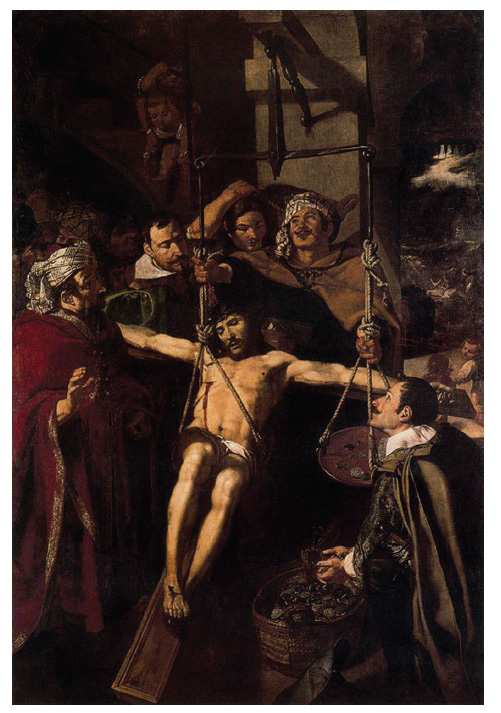
In these accounts, the mixed urban environment of the North African coast marked by violence – whether real or imagined – played a critical role in the production of sacred objects venerated by Peninsular Christians. In other words, how Christians handled, understood, and prayed to these objects in Valencia and in Madrid was entirely shaped by events at the frontier. In that framework, frontier societies were not only zones of creation, but also spaces of transformation: as objects transited across them, their symbolic meanings and physical characteristics were transposed, translated, and transformed.71
Similar dynamics of transformation and translation were also at play in medieval Iberia. Objects associated with the frontier, such as the Virgin of the Monarchs, (la *Virgen de los reyes*) a statue that allegedly accompanied and favoured the victories of Christian monarchs, acquired a new miraculous character. Other images associated with frontiers and frontier buildings, such as the Virgin of the Antigua or depictions of local martyrs, both from the pre-Islamic and Andalusi period, were used during the early modern era for their transformative powers, allowing the Christianization of a conceptually problematic Islamic built heritage.72
Exploring these material translations and transformations prompts the question of how knowledge about objects travelled with them across frontier zones. Exploring the transformative impact of the frontier on the meaning and knowledge attached to objects invites us to expand the range of sources used to construct these material histories. Besides accounts and chronicles, discursive documents, like expenditure accounts, probate inventories, and lists of gifts, are key to conveying early modern discourses about objects in transit. By providing details about the price, materials, and shape of items, such lists
Similar cases of material translations were also rife in the Ottoman Balkans. Copper engravings with religious themes were produced in Venice and the towns of the Habsburg monarchy and the Russian Empire for Orthodox Christian monasteries under Ottoman rule, especially those situated on Mount Athos. They attest to the fact that the technique was well received and quickly adapted to suit the specific cultural context of the Ottoman Balkans. Images of saints and vedutas of monasteries are the most common subjects represented in the engravings (Figure 4.5).
Pierre Belon du Mans, Mount Athos (1553)
REPRODUCED FROM: DINKO DAVIDOV, HILANDARSKA GRAFIKA (BELGRADE: PROSVETA–BALKANOLOŠKI INSTITUT SANU-NARODNA BIBLIOTEKA SRBIJE, 1990), P. 24

In the eighteenth century, local Balkan cultural and political ideas and practices were clearly perceptible in the engravings, although they were still produced outside the region. One example is the engravings of the monasteries of Studenica (1733) and Hilandar (1743), both commissioned by Metropolitan Archbishop Arsenije IV, as well as those of the monasteries of the patriarchate in Peć (in 1745–46) and Dečani (in 1746).76 The engraving’s visual repertoire was influenced by the metropolitan’s ideological programme. One of its components was the revival of the cults of the medieval Serbian ruler saints, thus showcasing the influence of historicism. Beside the representation of the monastery’s architecture, the engravings contained numerous images of saints chosen with special care and according to a political message the engravings were intended to propagate.77 Nevertheless, copperplates were not sponsored and designed only by senior members of the church hierarchies, monks themselves commissioned them. For example, in 1779, Hilandar’s monk Atanasije ordered the production of an engraving with a complex visual repertoire (Figure 4.6).78
Pseudo-Orfelin (Zaharija), Hilandar Monastery (1779)
REPRODUCED FROM: DINKO DAVIDOV, HILANDARSKA GRAFIKA (BELGRADE: PROSVETA–BALKANOLOŠKI INSTITUT SANU-NARODNA BIBLIOTEKA SRBIJE, 1990), P. 75

Some of these engraving prints were created in the political and ideological framework of the Habsburg monarchy, the Venetian Republic, or the Russian Empire, but ended up being transferred across interstate borders and widely distributed among the public dwelling in Ottoman territories. There, they were adapted to the local communal religious and cultural practices, and their production and circulation was enabled by the aforementioned cross-border networks nurtured by the Orthodox monks. Monasteries recognized the usefulness of prints, which were given as gifts or sold to pilgrims and donors, thus finding their way across the Balkan Peninsula. They became one of the means of spreading the cults of patron saints of monasteries and contributed to the development of a shared religious and cultural landscape of Orthodox Christians inside and outside the borders of the Ottoman Empire.80
Translation processes were far from straightforward, as the meaning of specific objects in frontier societies often became deeply ambiguous. Investigating the use of rosaries along the North African coast, Daniel Hershenzon demonstrated how sacred Christian devotional objects were used across confessional lines by Christian captives and Muslim converts alike.81 In addition, not all objects were freely transposed and translated across contact zones: in some cases, meanings and expertise tied to specific items were deliberately distorted or altogether ignored. For instance, the expenditure accounts of Spaniards in the Maghreb provide some insights into their routine recourse to Maghrebi materia medica, remedies, and medical devices. However, Spanish accounts of travel to North Africa, often systematically omit or belittle the medicinal products and objects they encountered there: the Mercedarian friar Ignacio Vidondo mentioned in his writings having refused the care provided to him by Algerian healers, when accounts of expenditure show that his fellow redeemers did rely on North African remedies.82 Just like the exploration of cross-border contacts, recognizing such disconnections and unequal circulations of knowledge about materials and objects is pivotal to a deeper understanding of the complexity of Mediterranean contact zones.
4 Conclusion
Political and religious narratives, crafted at the highest echelons of governance, created specific ideas about the concept of ‘frontier’ across the Mediterranean. These were, however, not the only discourses to circulate and were by no means hegemonic. While frontiers acted as spaces of projection and identification for intellectual elites and rulers, they also stimulated other types of contacts that redefined the concept of borders and their operation. Although sometimes characterized by highly militarized areas, these zones could also be quite permeable, stimulating economic and cultural contacts.
A diverse array of individuals – ranging from ransomers to monks, and travellers to the inhabitants of frontier towns – were instrumental in the creation of real and imagined borders, as well as in stabilizing or reshaping their meanings. Objects, much like people, also traversed borders, sometimes through commerce, often through war and violence, and occasionally as part of complex gift-giving practices across cultural and religious borders. As these artefacts moved through space and time, their meanings and usage were transformed.
In this chapter, we have considered three main border zones: medieval Iberia, the early modern North African coast, and the Ottoman Balkans. While these regions have long been subjects of study for scholars of relations between Islam and Christianity in the late medieval and early modern periods, they have tended to be analysed in isolation. Connecting research on different border zones proves especially fruitful when analysing different types of interactions, particularly at the local level, but also in a wider Mediterranean context. Focusing on the social and cultural backgrounds that developed around these three border areas, this interconnected approach has unveiled commonalities in the bottom-up formation of narratives about the frontier across these regions, as well as site-specific practices that set them apart. Beyond these three cases, the joint exploration of distinct border spaces serves as a statement of the potential inherent in trans-Mediterranean comparative studies to provide a more comprehensive understanding of past relations between Christianity and Islam in the European context and beyond.
Primary Sources
Secondary Literature
Bertrand, Michel, and Natividad Planas “Introduction”, in Les sociétés de frontière: de la Méditerranée à l’Atlantique (XVIe–XVIIIe siècle) (Madrid, 2011) http://books.openedition.org/cvz/1026
Fotić, Aleksandar, “Athonite Travelling Monks and the Ottoman Authorities (16th‒18th Centuries)”, in Perspectives on Ottoman Studies: Papers from the 18th Symposium of the International Committee of Pre-Ottoman and Ottoman Studies (CIEPO) at the University of Zagreb 2008, eds. Ekrem Čaušević, Nenad Moačanin, and Vjeran Kursar (Zagreb, 2010), pp. 157–65.
Kitromilides, Paschalis M., “Orthodox Culture and Collective Identity in the Ottoman Balkans during the Eighteenth Century”, in Ottoman Rule and the Balkans, 1760–1850: Conflict, Transformation, Adaptation; Proceedings of an International Conference Held in Rethymno, Greece, 13–14 December 2003, eds. Athanasios Anastasopoulos and Elias Kolovos (Rethymno, 2007), pp. 131–45.
Michel Bertrand and Natividad Planas, “Introduction”, in Les sociétés de frontière: de la Méditerranée à l’Atlantique (XVIe–XVIIIe siècle) (Madrid, 2011) http://books.openedition.org/cvz/1026 Daniel Powers, “Introduction”, in Frontiers in Question: Eurasian Borderlands (London, 1999), pp. 1–31.
Robert Bartlett and Angus MacKay, eds., Medieval Frontier Societies (Oxford, 1989); Daniel Powers and Nora Standen, eds., Frontiers in Question: Eurasian Borderlands (London, 1999); David Abulafia and Nora Berend, eds., Medieval Frontiers: Concepts and Practices (Burlington, 2002); Florin Curta, Borders, Barriers, and Ethnogenesis: Frontiers in Late Antiquity and the Middle Ages (Turnhout, 2005); David Mullin, ed., Places in Between: The Archaeology of Social, Cultural and Geographical Borders and Borderlands (Oxford, 2011); A. Asa Eger, The Archaeology of Medieval Islamic Frontiers: From the Mediterranean to the Caspian Sea (Louisville, 2019); Christian M. Langer and Manuel Fernandez-Gotz, “Boundaries, Borders and Frontiers: Contemporary and Past Perspectives”, eTopoi: Journal for Ancient Studies (2020), 33–47.
Homi K. Bhabha, The Location of Culture (London, 2006 (1994)); Mary Louise Pratt, “Arts of the Contact Zone”, Profession (1991), 33–40 (pp. 33–34); on these theoretical reflections, see Maria Judith Feliciano and Leyla Rouhi “Interrogating Iberian Borders”, Medieval Encounters 12, no. 3 (2006), 317–28.
On this, see Steven Hutchinson, Frontier Narratives: Liminal Lives in the Early Modern Mediterranean (Manchester, 2020). See also the works mentioned in n. 1 and n. 2.
See Feliciano and Rouhi, “Interrogating”, p. 318.
Powers, “Introduction”, pp. 1–31.
Robert Bartlett and Angus MacKay, Medieval Frontier Societies (Oxford, 1989). See also the essays collected in Michel Bertrand and Natividad Planas, Les sociétés de frontière: de la Méditerranée à l’Atlantique (XVIe–XVIIIe siècle) (Madrid, 2011) and Florin Curta, “The Centrality of the Periphery: The Archaeology of al-Andalus”, Early Medieval Europe 19, no. 4 (2011), 377–84.
Moving away from traditional centre-periphery interpretations, borders, frontiers, transperipheries, and contact zones have sparked new interest. See Katarzyna Murawska-Muthesius, Borders in Art: Revisiting Kunstgeographie; Proceedings of the Fourth Joint Conference of Polish and English Art Historians (Warsaw, 2000); Gerhard Wolf and Henrike Haug, “Lu mari è amaru. La Sicilia nel Medioevo”, Sicilia: Arte e archeologia dalla preistoria all’unità d’Italia (2008), 87–103. See also Clara Bargellini, “At the Center on the Frontier. The Jesuit Tarahumara Missions of New Spain”, in Time and Place: The Geohistory of Art, eds. Thomas DaCosta Kaufmann and Elizabeth Pilliod (Burlington, 2005), pp. 113–34.
See Planas and Bertrand, “Introduction”, passim.
Kordula Wolf and Klaus Herbers, Southern Italy as Contact Area and Border Region during the Early Middle Ages (Cologne, 2018).
Angus MacKay, Spain in the Middle Ages: From Frontier to Empire, 1000–1500 (London, 1977); Andrew C. Hess, Forgotten Frontier (Chicago, 1978); Charles J. Bishko, Studies in Medieval Spanish Frontier History (London, 1980); Robert I. Burns, “The Significance of the Frontier in the Middle Ages”, in Medieval Frontier Societies, eds. Robert Bartlett and Angus MacKay (Oxford, 1992), pp. 1–35; Thomas F. Glick, From Muslim Fortress to Christian Castle: Social and Cultural Change in Medieval Spain (Manchester, 1995); David Abulafia, “Introduction”, in Medieval Frontiers: Concepts and Practices, eds. David Abulafia and Nora Berend (Burlington, 2002); Ryan Szpiech, “The Convivencia Wars: Decoding Historiography’s Polemic with Philology,” in A Sea of Languages: Rethinking the Arabic Role in Medieval Literature History (Toronto, 2013), pp. 135–161.
See also Suzanne Conklin Akbari “Introduction,” in A Sea of Languages: Rethinking the Arabic Role in Medieval Literature History (Toronto, 2013).
See Dominique Urvoy’s seminal work, “Sur l’évolution de la notion de Gihad dans l’Espagne musulmane”, Mélanges de la Casa de Velázquez 9 (1973), 335–71.
José Enrique López de Coca, “Institutions on the Castilian-Granadan Frontier 1369–1482”, in Medieval Frontier Societies, eds. Robert Bartlett and Angus MacKay (Oxford, 1992), pp. 127–50. Simon Barton insisted on the idea that the religious ideology was just one element among the different competing cultural, social, or economic forces. “Islam and the West: A View from Twelfth-Century León”, in Cross, Crescent and Conversion: Studies on Medieval Spain and Christendom in Memory of Richard Fletcher (Leiden, 2008), pp. 153–74.
Reuven Firestone, Jihad: The Origin of Holy War in Islam (Oxford-New York 1999), pp. 75–76, 84–91; Colin Heywood, “The Frontier in Ottoman History: Old Ideas and New Myths”, in Frontiers in Question: Eurasian Borderlands 700–1700, eds. Daniel Power and Naomi Standen (London, 1999), pp. 228–50; Maria Pia Pedani, “The Border from the Ottoman Point of View”, in Tolerance and Intolerance on the Triplex Confinium: Approaching the “Other” on the Borderlands; Eastern Adriatic and Beyond 1500–1800, eds. Egidio Ivetić and Drago Roksandić (Padua, 2007), pp. 200–01; Dariusz Kołodziejczyk, “Between Universalistic Claims and Reality: Ottoman Frontiers in the Early Modern Period”, in The Ottoman World, ed. Christine Woodhead (London, 2012), pp. 206–08, 215–17.
Juan de Mata Carriazo, “Relaciones fronterizas entre Jaén y Granada el año 1479”, Revista de archivos, bibliotecas y museos 61, no. 1 (1955), 237–64; López de Coca, “Institutions”; José Enrique López de Coca, “La frontera de Granada: acerca del territorio y la línea divisoria (siglos XIV y XV)”, Historia, instituciones, documentos 45 (2018), 187–205.
J. Santiago Palacios Ontalva, “Fortalezas de la fe. La dimensión simbólica de la arquitectura militar en las fronteras entre la cristiandad y el islam en torno a 1212”, in La Península Ibérica en tiempos de Las Navas de Tolosa (Madrid, 2014), pp. 93–108.
López de Coca, “Institutions”, pp. 142–45; Ana Echevarría Arsuaga, “Enrique IV de Castilla, un rey cruzado”, Espacio, tiempo y forma, 3rd ser., Medieval 17 (2004), 143–56.
López de Coca, “Institutions”, 148.
Ana Echevarría, Kings of the Frontier: The Moorish Guard of the Kings of Castile (1410–1467) (Leiden, 2009); Housseim Fancy, The Mercenary Mediterranean: Sovereignty, Religion, and Violence in the Medieval Crown of Aragon (Chicago, 2016).
Angus MacKay, “The Ballad and the Frontier in Late Mediaeval Spain”, Bulletin of Hispanic Studies 53 (1976), 15–33; and Angus MacKay “Religion, Culture, and Ideology on the Late Medieval Castilian–Granadan Frontier”, in Medieval Frontier Societies, eds. Robert Bartlett and Angus MacKay (Oxford, 1992), pp. 216–43.
Rocío Sánchez Ameijeiras, “History and Stories of Love and Conversion in Fourteenth-Century Burgos”, Hispanic Research Journal Iberian and Latin American Studies 13, no. 5 (2012), 449–67; Cynthia Robinson, “Arthur in the Alhambra? Narrative and Nasrid Courtly Self-Fashioning in the Hall of Justice Ceiling Painting”, in Courting the Alhambra: Cross-Disciplinary Approaches to the Hall of Justice Ceilings, eds. Cynthia Robinson and Simone Pinet (Leiden, 2008), pp. 12–46; and Rosa Rodriguez Porto, “Courtliness and Its Trujamanes: Manufacturing Chivalric Imagery across the Castilian–Grenadine Frontier”, in Courting the Alhambra: Cross-Disciplinary Approaches to the Hall of Justice Ceilings, eds. Cynthia Robinson and Simone Pinet (Leiden, 2008), pp. 67–114.
Rosa Rodríguez Porto, “Troy-upon-Guadalquivir: Imagining Ancient Architecture at King Alfonso XI’s Court”, Troianalexandrina 5 (2005), 8–35.
Andrew C. Hess, The Forgotten Frontier: A History of the Sixteenth-Century Ibero-African Frontier (Chicago, 1972); Mercedes García-Arenal and Miguel Ángel de Bunes Ibarra, Los españoles y el Norte de África, siglos XV–XVIII (Madrid, 1992).
See for instance Alonso Rodríguez Gamarra, Relacion de las guerras de Africa, y muerte del Rey Muley Xeque, que estuvo en España (Seville, 1613).
Jocelyn Hendrickson, Leaving Iberia: Islamic Law and Christian Conquest in North West Africa (Cambridge, MA, 2021).
Adem Handžić, “O formiranju nekih gradskih naselja u Bosni u XVI stoljeću”, Prilozi za orijentalnu filologiju 25 (1975), 133–68; Aleksandar Fotić, “Uloga vakufa u razvoju orijentalnog grada: beogradski vakuf Mehmed-paše Jahjapašića”, in Socijalna struktura srpskih gradskih naselja (XII–XVIII vek), eds. Jovanka Kalić and Milosav Čolović (Smederevo, 1992), pp. 149–59 (in Cyrillic); Mariya Kiprovska, “Shaping the Ottoman Borderland: The Architectural Patronage of the Frontier Lords from the Mihaloğu Family”, in Bordering Early Modern Europe, eds. Maria Baramova, Grigor Boykov, Ivan Parvev (Wiesbaden, 2015), pp. 185–211. Similar practices are documented in the Iberian Peninsula after the Christian conquest of the Islamic cities. See Begoña Alonso, “Restaurar y mejorar Granada en religión, gobierno y edificios. Las transformaciones urbanas tras la conquista castellana”, in Civitas: Expresiones de la ciudad en la Edad Moderna (Santander, 2015), pp. 73–108.
For more on militarized frontier areas along the northern and western borders of the Ottoman Empire, see: Vasa Čubrilović, ed., Vojne krajine u jugoslovenskim zemljama u novom veku do Karlovačkog mira 1699 (Belgrade, 1989).
The most important of these buffer polities were the principalities of Wallachia, Moldavia, and Transylvania, as well as the Crimean Khanate, Pedani, “The Border”, pp. 201, 206; Kołodziejczyk, “Between Universalistic Claims and Reality”, p. 207.
Pedani, “The Border”, pp. 196–97, 205–06; Jovan Pešalj, “The Distinctiveness of the Habsburg-Ottoman Border in the Eighteenth Century”, in Bordering Early Modern Europe, eds. Maria Baramova, Grigor Boykov, and Ivan Parvev (Wiesbaden, 2015), pp. 28–29.
Pešalj, pp. 23–30; Maria Baramova, “Negotiating Borders: Habsburg-Ottoman Peace Treaties of the Seventeenth and Eighteenth Centuries”, in Bordering Early Modern Europe, eds. Maria Baramova, Grigor Boykov, and Ivan Parvev (Wiesbaden, 2015), pp. 115–20.
Pedani, “The Border”, 199; Pešalj, p. 31.
Pešalj, pp. 25–26; Klára Hegyi, “Regulations and Practice: Fiction and Reality in Ottoman Hungary (Thoughts on Source Criticism)”, in Şerefe: Studies in Honour of Prof. Géza Dávid on His Seventieth Birthday, eds. Pál Fodor, Nándor E. Kovács, and Benedek Péri (Budapest, 2019), pp. 243–63.
The monastic community of Mount Athos (the easternmost peninsula of Halkidiki, in modern-day northern Greece), whose beginnings reached back to the early Middle Ages, came under Ottoman rule in the fifteenth century. The community retained a special status, characterized by a relatively high level of isolation from the state apparatus: there was only one representative of the Ottoman administration on the peninsula, the monasteries paid their taxes collectively as a lump sum, and they were not legally obligated to have recourse to the sharia court to solve any internal problems that did not include Muslims, Aleksandar Fotić, Sveta Gora i Hilandar u Osmanskom carstvu, XV–XVII vek (Belgrade, 2000), pp. 37–87 (in Cyrillic); Ognjen Krešić, Manastir Hilandar i istočni Balkan u XVIII veku: Kulturne i ekonomske veze (Belgrade, 2021), pp. 43–46 (in Cyrillic).
Ognjen Krešić, Manastir Hilandar, pp. 77–81.
Hilandar Monastery Archives, Turcica, box 3, doc. 246a, 415; Aleksandar Fotić, “Athonite Travelling Monks and the Ottoman Authorities (16th‒18th Centuries)”, in Perspectives on Ottoman Studies: Papers from the 18th Symposium of the International Committee of Pre-Ottoman and Ottoman Studies (CIEPO) at the University of Zagreb 2008, eds. Ekrem Čaušević, Nenad Moačanin, and Vjeran Kursar (Zagreb, 2010), pp. 157–65.
Paschalis M. Kitromilides, “Orthodox Culture and Collective Identity in the Ottoman Balkans during the Eighteenth Century”, in Ottoman Rule and the Balkans, 1760–1850: Conflict, Transformation, Adaptation; Proceedings of an International Conference Held in Rethymno, Greece, 13–14 December 2003, eds. Athanasios Anastasopoulos and Elias Kolovos (Rethymno, 2007), pp. 131–45 (pp. 135–36); Ognjen Krešić, “Adapting to Shifting Imperial Realities: Mount Athos (Chilandar Monastery) in the Political Context of the Eighteenth-Century Ottoman Empire”, Recueil de Chilandar 14 (2017), 135–45; Idem, Manastir Hilandar, pp. 86–125.
Dejan Medaković, “Manastir Hilandar u XVIII veku”, Recueil de Chilandar 3 (1974), 9–29 (in Cyrillic).
On medieval and early modern gifts in various contexts, see among others: Diana Carrió-Invernizzi, “Gift and Diplomacy in Seventeenth-Century Spanish Italy”, The Historical Journal 51, no. 4 (2008), 881–99; Linda Komaroff, Gifts of the Sultan: The Arts of Giving at the Islamic Courts, 1st ed. (Los Angeles, 2011); Doris Behrens-Abouseif, Practising Diplomacy in the Mamluk Sultanate: Gifts and Material Culture in the Medieval Islamic World (London, 2014); Giorgio Riello, Anne Gerritsen, and Zoltán Biedermann, eds., Global Gifts: The Material Culture of Diplomacy in Early Modern Eurasia (Cambridge, 2017); Sinem Arcak Casale, Gifts in the Age of Empire: Ottoman-Safavid Cultural Exchange, 1500–1639 (Chicago, 2023).
José M. Escribano-Páez, “Diplomatic Gifts, Tributes and Frontier Violence: Circulation of Contentious Presents in the Moluccas (1575–1606)”, Diplomatica 2, no. 2 (2020), 248–69.
Juan Carlos Ruiz Souza, “Botín de guerra y tesoro sagrado”, in Maravillas de la España Medieval: Tesoro Sagrado y Monarquía (Valladolid, 2001), pp. 31–40.
López de Coca, “Institutions”, pp. 134–36. This occurred in 1334 and 1390. See Crónica de Alfonso XI (Madrid, 1787), pp. 256–57 and Crónicas de los Reyes de Castilla, Don Pedro, Don Enrique II, Don Juan I, Don Enrique III (Madrid, 1787), p. 339.
Abd Allâh of Granada prepared a huge pile of gifts for Alfonso VI (tapestries, cloaks, vessels …) to “spare me of his evil”. Cit. Ruiz Souza, “botín de guerra”, p. 34. Yusuf I gave jewels and silks to Alphonse XI, when signing the truce: Crónica de Alfonso XI, p. 251.
Roser Salicrú Lluch, “La diplomacia y las embajadas como expresión de los contactos interculturales entre cristianos y musulmanes en el Mediterráneo Occidental durante la Baja Edad Media”, Estudios de historia de España 9 (2007), 77–106.
Pedro Martínez Montávez, “Relaciones de Alfonso X de Castilla con el sultán mameluco Baybars y sus sucesores”, Al Andalus 27 (1962), 343–76; Doris Behrens-Abouseif, Practising Diplomacy in the Mamluk Sultanate: Gifts and Material Culture in the Medieval Islamic World (London, 2016).
María Judith Feliciano, “Muslim Shrouds for Christian Kings? A Reassessment of Andalusi Textiles in Thirteenth-Century Castilian Life and Ritual”, in Under the Influence: Questioning the Comparative in Medieval Castile, eds. Cynthia Robinson and Leyla Rouhi (Leiden, 2005), pp. 101–31; see the essays collected in Lieselotte E. Saurma-Jeltsch and Anja Eisenbeiß, eds., The Power of Things and the Flow of Cultural Transformations (Munich, 2010); Catarina Schmidt Arcangeli and Gerhard Wolf, eds., Islamic Artefacts in the Mediterranean World: Trade, Gift Exchange and Artistic Transfer (Venice, 2011).
As al-Qashqani details. See Doris Behrens-Abouseif, Practising Diplomacy, p. 26.
Pedro Martínez Montávez, “Relaciones de Alfonso X”, pp. 343–76.
Hedda Reindl-Kiel, “East Is East and West Is West, and Sometimes the Twain Did Meet: Diplomatic Gift Exchange in the Ottoman Empire”, in Frontiers of Ottoman Studies: State, Province and the West, vol. 2, eds. Colin Imber, Keiko Kiyotaki and Rhoads Murphey (London, 2005), pp. 113–23, 114–15.
Ibid., p. 115.
Sinem A. Casale, “Diplomacy and Imperial Self-Fashioning at the Ottoman Court”, The Art Bulletin 100, no. 1 (2018), 97–123; Sinem Arcak Casale, Gifts in the Age of Empire: Ottoman-Safavid Cultural Exchange, 1500–1639 (Chicago, 2023).
Reindl-Kiel, “Ottoman-European”, pp. 115–17.
Vladislav Skarić, “Srpski pravoslavni narod i crkva u Sarajevu u 17. I 18. vijeku”, in idem, Izabrana djela, vol. 2 (Sarajevo, 1985), pp. 35, 78–79; Krešić, “Adapting to Shifting Imperial Realities”, pp. 135–45; Priscilla Mary Işın, “Gifts of Food in Ottoman Culture”, İstanbul Üniversitesi Sosyoloji Dergisi 40 (2020), 20–21. Examples of 18th-century register books connected to religious institutions and containing numerous entries about purchases, sales, and gifts: Tefter niškog hrama Svetog Nikolaja, National Library of Serbia (Belgrade), MSS. 60, 61; Hilendarskata kondika ot XVIII vek, ed. Bozhidar Raykov (Sofia 1998).
Notice n°252320, projet RELMIN, “Le statut légal des minorités religieuses dans l’espace euro-méditerranéen (Ve–XVe siècle)”, http://www.cn-telma.fr/relmin/extrait252320/
Al-Wansharīsī, al-Miʿyār, ed. M. Ḥağğī, vol. XI (Beirut, 1981), p. 111.
Luca Molà, “Material Diplomacy. Venetian Luxury Gifts for the Ottoman Empire in the Late Renaissance”, in Global Gifts: The Material Culture of Diplomacy in Early Modern Eurasia, eds. Giorgio Riello, Anne Gerritsen, and Zoltán Biedermann (Cambridge, 2017), pp. 69–77; Suraiya Faroqhi, “Ottoman Textiles in European Markets”, in The Renaissance and the Ottoman World, eds. Anna Contadini and Claire Norton (Farnham, 2013), pp. 231–44 (pp. 237–40).
See Feliciano “Musim Shrouds”. Much less is known about the Nasrid patterns of consumption.
María Judith Feliciano, “Sovereign, Saint, and City: Honor and Reuse of Textiles in the Treasury of San Isidoro (Leon)”, Medieval Encounters 25, no. 1–2 (2019), 118–44.
Feliciano “Sovereign, Saint”.
Angelina Vasilić, “Orijentalni pokrov iz Studeničke riznice”, Zbornik Muzeja primenjene umetnosti 2 (1956), 45–59.
Vasilić, “Orijentalni pokrov iz Studeničke riznice”, p. 50; Mirjana Šakota, Studenička riznica (Novi Sad, 2015), pp. 62–63. For newer research on this case and on the production of textiles in the Ottoman Empire see: Amanda Phillips, Sea Change: Ottoman Textiles between the Mediterranean and the Indian Ocean (Berkeley, 2021).
Ana Struillou, Objects on the Move: The Material Culture of Travel in the Western Mediterranean (1530–1640) (Florence, 2023), pp. 228–29.
Ibid., p. 118.
The ruler’s title in the Danubian principalities.
Roxana Coman, “Between the Sultan and the Boyars: Gifts in the Power Dynamics of Phanariot Investiture in Wallachia and Moldavia”, Diyâr 3 (2022), 242–61.
Reindl-Kiel, “Ottoman-European”, p. 119.
Crónica de Alfonso XI, p. 252.
Noelia Silva Santacruz, “Un ejemplo excepcional de marfil pintado nazarí: la arqueta del rey de Aragón Don Martín el Humano”, Anales de historia del arte 20 (2011), 29–49.
Maria Cruz de Carlos Varona, “Imágenes ‘rescatadas’ en la Europa Moderna: el caso de Jesús de Medinaceli”, Journal of Spanish Cultural Studies 12, no. 3 (2011), 327–54; Daniel Hershenzon, “Objets captifs: les artefacts catholiques en Méditerranée au début de l’époque moderne”, Annales: histoire, sciences sociales 76, no. 2 (2021), 269–99; Catherine Infante, The Arts of Encounter: Christians, Muslims, and the Power of Images in Early Modern Spain (Toronto, 2022).
See for instance Bonifacio Torres, “Recuperación del cuerpo del P.M. Fray Bernardo de Monroy En Argel”, Trinitarium: Revista de historia y espiritualidad trinitaria 1 (1988), 11–22.
For the Mediterranean, see for instance, Schmidt and Wolf, Islamic Artefacts.
For a detailed account of early modern discourses about Islamic Iberian heritage see Antonio Urquízar-Herrera, Admiration and Awe: Morisco Buildings and Identity Negotiations in Early Modern Spanish Historiography (Oxford, 2017).
Molà, “Material Diplomacy”, p. 70.
Dinko Davidov, “Manastir Hilandar na bakrorezima”, in idem, Studije o srpskoj umetnosti XVIII veka (Belgrade, 2004), p. 31.
Ibid., p. 32.
He was the archbishop of Peć and the Serbian patriarch (1725–37), but after his migration from the Ottoman Empire to the Habsburg lands he became the metropolitan archbishop of Karlovci (1737–48).
Davidov, “Manastir Hilandar”, pp. 34–38.
Ibid., pp. 38–42.
Dinko Davidov, “Svetogorska grafika – poznovizantijski i barokni izraz”, in idem, Studije o srpskoj umetnosti XVIII veka (Belgrade, 2004), pp. 60–63.
Dinko Davidov, “Ktitori i priložnici srpske grafike XVIII veka”, in idem, Studije o srpskoj umetnosti XVIII veka (Belgrade, 2004), pp. 134–35; O. Krešić, Manastir Hilandar, pp. 79–81.
Hershenzon, “Objets captifs”.
Ignacio Vidondo, Espejo católico de la caridad divina, y christiana con los cautivos de su pueblo (Pamplona, 1658), p. 400.