


1 Codification Work in the Free City of Cracow between 1816 and 18181
When establishing on 3 May 1815 the Free, Independent and Strictly Neutral City of Cracow, Austria, Russia and Prussia did not decide what judicial law would apply there.2 At the same time, they made it clear that they did not accept the status quo left behind by the Duchy of Warsaw in Cracow, at least in terms of the French civil law in force from 1810.3 This was expressed explicitly by the Prussian Resident in Cracow, Baron Ernest Reibnitz, when he described the French codes as a âshocking memory of Bonaparteâs usurpationâ.4 According to Article xii of the Constitution of the Republic of Cracow of 3 May 1815, it was the Assembly of Representatives that was to deal with the establishment of the civil and criminal code and the shape of procedure. To this end, the Assembly was to appoint a special committee which, in its preparatory work, was to take into account âthe local character of the country and the spirit of its inhabitantsâ (aux localités du pays et à lâesprit des habitants).5 Until new laws are enacted, the existing codes remained in force,6 namely the
By a decision of the Organising Commission,8 whose task it was to bring the provisions of the Constitution into effect, the implementation of Article xii of the Constitution had already begun at the first extraordinary session of the Assembly of Representatives,9 solemnly inaugurated on 22 January 1816.10 âThe Committee for the laying down of laws for the inhabitants of the Free City of Cracow and its Districtâ (the Legislative Committee) was established by the Assembly a day later. It consisted of seven members elected by the Assembly âby silent voteâ and, in accordance with the Constitution, two delegated members of the Senate. The elected members were professors of the Faculty of Law of the Academy: Father Bonifacy Garycki, Adam Krzyżanowski, Walenty LitwiÅski, MikoÅaj Hoszowski; professional judges11 Józef Nikorowicz and Józef Januszewicz; and the justice of the peace, and owner of the estate of MysÅowice, StanisÅaw Mieroszewski. The Senate was represented by Kajetan Florkiewicz and StanisÅaw Kostka Zarzecki.12 Having completed its task, i.e. the establishment of the Committee, the Assembly was postponed âuntil an indefinite
As the Assembly of Representatives had not enacted a procedure for the work of the Legislative Committee, on 16 February 1816, the Organising Commission imposed a special instruction.14 It was prepared by Reibnitz, who, on behalf of the Commission, oversaw the codification work from the beginning.15 In addition to an introduction of a historical-legal nature, the instruction contained specific guidelines in the form of four sets of questions, dealing successively with the matter of: the Civil Code, the Criminal Code, civil procedure and criminal procedure.16 Furthermore, âin order to expedite the workâ, Committee members were required to meet three times a week, and to report their progress at a meeting with the Organising Commission every week. The Committee was also to elect its chairman and deputy members.17 Judges Jakub MÄ kolski, Franciszek Piekarski and Bernard Dwernicki were also appointed to support the work of the Committee âon behalf of the Commissionâ, and thus contrary to Article xii of the Constitution.18
The Commissionâs guidance on civil law largely concerned the law of succession, which was the subject of one in three of the 23 questions to the Civil Code.19 In these, the commissioners asked about: the allowance of the statutory succession of ascendants (question six);20 the extent of the right of representation in the lateral line (question seven);21 the distinction between the origins of the property to be inherited (question eight);22 the distinction
Soon after, the Organising Commissionâs interference in the codification work led to satisfactory results. But Reibnitzâs recommendations were ignored by the Committee, which continued its work on the drafts of the individual codes on its own.28 As a result, on 13 July 1816, again on the initiative of a Prussian colleague, the Residents explicitly decided to change the subject matter of the work of the Legislative Committee. Its role as a drafting body was limited to the preparation of specific assumptions (principles) for individual codes in the form of legal questions to be discussed and decided upon at an extraordinary session of the Assembly of Representatives. Only the principles thus enacted, were to become the basis for the preparation of the final draft acts. However, this would now be entrusted to a newly elected committee and to individual codifiers, which clearly expressed the Commissionâs dissatisfaction with the interference of the Committee up to that time.29

Prothocole législatif of 13 December 1816, (manuscript, paper, 1816)
source: national archives in cracow, ank, 29/200/8, 1; photo & permission by national archives in cracow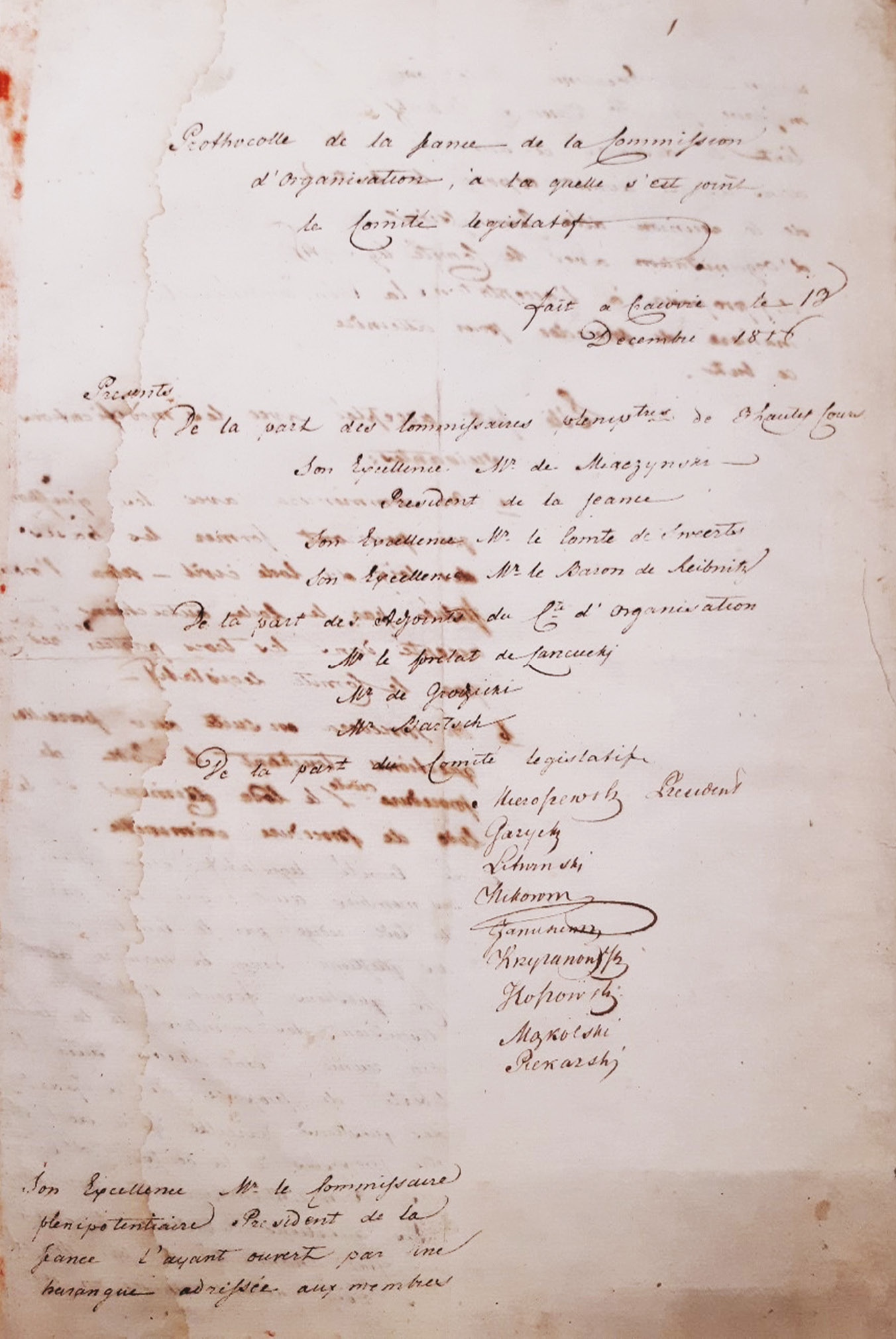
Following the decision to convene the Assembly, the Commission sent to the Senate âfor official useâ a printout of the legal questions for the Sejm that had been prepared with the Committee.41 It consisted of 40 pages with 297 questions in Latin and Polish in two columns. It was followed first by 130 questions on civil law. These were divided into parts and titles. âPart i. on Personsâ included the titles: âi. On the Laws concerning personal qualitiesâ (nine questions); âii. On Marital Rightsâ (eight questions); âiii. On Rights between Parents and Childrenâ (seven questions); âiv. On Adoptionâ (one question); and âV. On Guardianshipâ (four questions). In âPart iiâ the titles were: âvi. On Mattersâ (four questions); âvii. On Pledgesâ (six questions); âviii. On Servitudesâ (one question); âix. On Wills and Inheritancesâ (24 questions); âx. On Joint Property of Spousesâ (one question); âxi. On Contracts in Generalâ (six questions); âxii.
Convened on 20 October 1817, the Legislative Assembly did not, however, proceed to answer the questions prepared for it, as for formal reasons it âdid not come into effectâ.47 The representatives assembled at the inauguration objected to its formation, pointing out that they had been elected/delegated to the Ordinary Assembly, which had been held and dissolved in February 1817. Consequently, their mandates expired because âthe High Organising Commission itself, in its rescript stated that the character and office of a representative lasts only until the end of the Sejmâ.48 In these circumstances, the Commission had to admit its mistake and, by a decision of 22 October, ordered the dissolution of the Assembly.49 At the same time, it instructed the Ruling Senate to hold elections and to convene another extraordinary session of the Assembly on 7 January 1818.50 This took place with a proclamation of 13 December 1817, in which the Senate summoned to the Sejm representatives elected in the individual communes and delegated by the corporations (Chapter and Academy). In addition, those members of the Legislative Committee who did not sit in the new Assembly as representatives were also allowed to attend âin an advisory capacityâ.51
arrange the questions in a disjunctive form as to the most serious matters with regard to both civil and criminal legislation and procedure, and particularly as to the subjects in respect of which the codes of the civilised nations differ most widely.
which would take place between 1816 and 1817; (3) âA representation convened on an ad hoc basis shall decide these questions by a majority of votes and with unrestricted freedom by the choice of one alternative or the other of the questionsâ; (4) the Assembly shall elect a new committee (the Editorial Committee) âto which the editing of the codes shall be entrustedâ; (5) the Legislative Committee âshall guardâ that in the codes prepared by the Editorial Committee ânothing contraryâ to the principles passed by the Assembly âshall be adoptedâ.54
After such careful preparations, on 7 January 1818 the opening of the Legislative Assembly was ceremonial and undisturbed by unexpected events.55 However, the very next day a dispute arose between the Organising Commission and the Legislative Committee. Contrary to Reibnitzâs policy of fait accompli, he continued to demand that he be allowed to complete its task to the end, that is, to prepare draft codes and put them to the vote of the Sejm. Mieroszewski, as the Chairman of the Committee, therefore proposed a resolution of the Assembly to this effect. Despite the motion being supported by other representatives, the chairman of the session, Senator MikoÅaj Hoszowski, refused to put Mieroszewskiâs motion to a vote. Instead, he agreed to turn it into a request
Meeting place of the Legislative Assembly of 1818 (Collegium Novodvorscianum) â current view
photo by zygmunt put from 2022 in public domain (wikimedia commons) â gnu free documentation license (cc by-sa 4.0)
The extraordinary session of the Assembly, which lasted until 3 March 1818, deserves to be called the Legislative Assembly, as during the 23 days of its work58 its Representatives responded to the 297 legal questions presented
The Legislative Sejm of 1818 seemed to be an important step towards the introduction of the Republic of Cracowâs own codifications. The adopted principles were approved in June by the Organising Commission, which made only one remark,62 and, at the Assembly of Representatives in December, the Senate expressed the expectation that the Editorial Committee would soon complete its work.63 In reality, however, neither in 1818 nor in the following years were the codifications in preparation completed, and the Committee confined itself to submitting drafts of a few special acts.64 It was not until 1826 that Mieroszewskiâs successor as chairman, Józef Nikorowicz, officially acknowledged that the Editorial Committee was unable to perform the task entrusted to it, and proposed its reform.65 This did not, however, improve the situation, and the Committee was eventually dissolved in 1833; and in the Free
2 The Enactment of the Principles of Personal and Family Law in the Civil Code of the Free City of Cracow in 1818
Of the 130 principles of civil law enacted by the Legislative Sejm of 1818, it is worth taking a closer look at the principles of personal and family law, and the law of succession, the enactment of which in many cases was preceded by a heated debate related to key social issues for the inhabitants of the Free City of Cracow.67 The debate in the Assembly of Representatives on the questions as to the principles of civil law, began at the sitting of 13 January 1818 with nine questions on personal law, and were collected under Title I: âOn the rights attached to personal qualitiesâ.68 The representatives answered these questions in unison, leaning towards the opinion of the Legislative Committee. Only in the case of the question of the continuation of civil registry records was an objection raised, by Father Professor Feliks JaroÅski, who âin a long speech argued that they were unnecessaryâ.69 However, he was decisively voted down (34 against three) and the Parliament passed the several principles of law.
These were: âA foreigner shall enjoy the same rights in the country of the Republic of Cracow as local citizens enjoy in the foreignerâs countryâ (principle one);70 âThe domicile of a person is to be considered as to personal obligations where he lives, but as to obligations in rem where he has immovable propertyâ (principle two);71 âThe domicile of a public official is to be considered where he holds officeâ (principle three); âThere shall be no difference between life and elected officialsâ (principle four);72 âThe wifeâs domicile as regards the exercise
Principles of law enacted by the Legislative Assembly of 1818, (manuscript, paper, 1818)
source: national archives in cracow, ank, 29/200/201, 63; photo & permission by national archives in cracow
On the same day, the Legislative Assembly enacted four more principles of marriage law. In the first: âA man before the age of 18 and a woman before the age of 15 may not marryâ (principle five), thus the age of matrimonial capacity adopted in Article 144 of the nc was confirmed. In the second: âThe Senate may grant exemption from this provision for important reasons, as long as the physical capacity to marry is presentâ (principle six), thus exemption for its absence was allowed.87 In the third principle, the canonical principle of the legitimation of illegitimate children ipso jure by the subsequent marriage of the parents (legitimatio per subsequens matrimonium), was maintained, stipulating that âChildren begotten before marriage become legitimate through the marriage subsequently contracted of the father and mother when they legally recognise it before their marriage or in the very act of marriageâ (principle
The following day, 15 January 1818, the Assembly answered seven further questions, this time relating to Title iii: âOf the Rights between Parents and Childrenâ.91 A vote on the question of the religious upbringing of children of parents of different faiths, preceded the debate. Professor Feliks SÅotwiÅski argued that according to Article 1 of the Constitution of the Free City of Cracow, which established the Catholic religion as the State religion,92 if one parent is of this confession, the common children must be brought up in the Roman religion. On the other hand, in the case of other Christian denominations, as well as non-Christian religions, the principle of tolerance should apply, i.e. sons should be brought up in the religion of their father and daughters in the religion of their mother. He made the reservation, however, that the above positions do not apply to situations in which parents have concluded an agreement on the religious upbringing of their children. The former position was supported by Father Professor JaroÅski, and the latter by Senator Karol Hube, who referred in this respect to Article 2 of the Constitution, which equates Christian denominations in civil rights.93 In contrast, Father Mateusz Dubiecki took the opposite view, demanding the right for a father, who exercises parental authority, to decide on the religious upbringing of his children.94
As might be expected, there was also no controversy among the representatives on the question of consent as to the search for paternity by illegitimate children and the means of proof admissible in these proceedings.99 It was decided in accordance with the then generally accepted rule that âA child born out of wedlock is not allowed to seek paternityâ (principle five), which made it unnecessary to address the question of evidence, which âBecause of the answer to five [was] negatively settledâ (principle six). The real split in the Assembly, however, was caused by the question of the obligation to provide alimony to an illegitimate child, but recognised by the father, once the child had reached the age of 14. In the debate, Father Dominik Markiewicz and Professor SÅotwinski encouraged the adoption of such a solution. The former proposed alimony âuntil the age of 30, or at least until the age when the child will be able to earn his or her own livingâ, and the latter until the age of majority, i.e. 21. In the end, in a secret ballot, the Sejm decided by a majority of one vote (16 to 15) that âAn acknowledged child from an illegitimate childbed shall be
3 The Enactment of the Principles of Succession Law into the Civil Code of the Free City of Cracow in 1818
The Legislative Assemblyâs debate on the questions relating to the principles of succession law, collected under Title ix: âOn Wills and Inheritancesâ, began its session on 19 January 1818 with the question of whether the oral form of a will should be allowed.101 Father Dubiecki was in favour of its introduction, arguing that it was necessary due to the illiteracy of the majority of the Free Cityâs inhabitants. Judge MÄ kolski took the opposite view, arguing that allowing oral wills opened the way to âconsiderable litigationâ, âand peasants who cannot read and write can make wills before a Court of the Peaceâ. In a secret ballot, a majority of representatives supported Dubiecki (17 against 14) and the House passed a resolution that âIn addition to written wills, verbal wills will also be allowedâ (principle one).102 The Sejm unanimously also agreed that âMonastic persons in special cases, such as the abolition of a monastic order, a foundation or a monastery, or when they have benefices or income attached to a secular office, may dispose of their property by willâ (principle two).103
The subject of a wider debate was the question of limiting the testamentary capacity of a judicially recognised prodigal, which the Committee advised to be limited to half of the estate. Professor LitwiÅski, contrary to this opinion,
At the meeting on 19 January, four more principles were adopted, unanimously without debate. Three concerned âsubstitutionâ, which, being a âmodelâ institution of the ancien régime, in the nc was threatened with the sanction of absolute nullity.106 In the first of these, the Sejm decided that âFideicommissary substitution has no further place above the second degree of substitutionâ (principle five);107 in the second that âParents may make a pupillary substitution in the event of their childâs death before the age of 14 or in the event that they are unable to make a willâ (principle six); and in the third that âSuch a substitution may not take place as regards property which would otherwise have been vested in the childâ (principle seven).108 The last principle adopted on this first day of the work on the law of succession, was a principle establishing that âAn inheritance without a preceding judicial attribution may not be taken into possession, but a legacy mayâ (principle eight).109 This principle, too, was contrary to the system of succession adopted in the nc, where the institution of the seising (saisine) of legal heirs (héritiers légitimes) in the succession was
On 20 January, the deliberations began with the question of the limitation of the freedom to testate due to the rights of the necessary heirs. First of all, in accordance with the Committeeâs opinion, the House resolved that âA will does not become invalid if the testator omits one necessary or all of the children, but the necessary heirs, whether one or more, have the right to apply to the court for the compulsory portionâ (principle nine), and that âIf, of several children, a share of one is omitted in the will, the will shall not become invalid, but the omitted heir is allowed to apply to the court for the compulsory portionâ (principle ten).112 Both of these principles, in terms of testamentary freedom itself, were compatible with the provisions of the nc, which left the testator full freedom to shape the content of his or her last will.113 However, as was already the case with principle eight, they indicated a departure from the reserve system adopted in the nc in favour of the legitime system in force under Austrian law. During the debate on securing the rights of the necessary heirs, Professor SÅotwiÅski spoke actively. Inter alia, he opposed the Committeeâs opinion equating the amount of the compulsory portion of minors with that of adults, as in the nc.114 He argued that âthe legal duties of parents towards their children end when the children comes of age, and it cannot be denied that a minor needs more than an adult in order to be brought up and prepared for civil life and all higher purposesâ. Professor LitwiÅski, his colleague from the Faculty of Law, agreed, adding that âparents should give their children an equal share of the estate: this would not be the case if such a compulsory share was assigned to a minor as well as to an adult, because an adult has had more through educationâ.115 However, the view of the academics did not convince the Assembly, which stood by the Committeeâs position and, by a majority of 19 votes against 11, resolved that âSuch a compulsory portion shall be due to an adult as well as to a minorâ (principle 11). Furthermore, also following the nc, the Chamber
The surviving spouse of a deceased testator, whether he or she has his own property or not, is entitled to an equal share of the estate with each child, if there are three or more children; if there are fewer than three children, then a fourth part of the succession is due, for lifetime use, the ownership of this part remains with the children, if there is no child but another heir according to the law, then the surviving spouse receives a fourth part of the succession estate in unrestricted ownership, however, in both cases everything should be included in the succession estate which is due to the surviving spouse from the estate of the other spouse by virtue of the marriage contract, the agreement of succession, or the last will (principle 14).118
The rights of a natural child for the estate of his dead father or mother shall be arranged as follows: if the father or mother has left legitimate descendants, such right shall count for one third of the hereditary portion which the natural child would have had if he or she were legitimate, and for one half if the father or mother has left no descendants but only ascendants or brothers or sisters; and for three-quarters if neither the father nor mother has left any descendants, ascendants, brothers or sisters (principle 15).120
The second principle stipulated that âIn the case of a person who dies without issue, the brothers and sisters with their surviving parents shall take the inheritance in this order: half the parents and the other half the brothers and sistersâ (principle 16).121
A further part of the debate that day was devoted to the inheritance of estates from the clergy and to testation for the benefit of the Church, which, given the social and property structure of the Republic of Cracow, was an important issue. In the end, the Sejm passed as many as five principles regulating this issue.122 The first principle whereby âAfter a lay clergyman of the Catholic religion without a will dies, the inheritance is divided into three parts â one for the successors, one for the Church, one for the poorâ (principle 17); the second whereby âSuch a clergyman, when he has made a will, is not obliged to leave a compulsory partâ (principle 18); the third stipulating that âWhere the inheritance is without a will, it does not matter where the property of the deceased came fromâ123 (principle 19). The fourth principle that was agreed was âWith the exception of academic institutes, it shall not be permitted to dispose of real estate by will for the benefit of the clergy, or pious institutesâ124 (principle 20); and the fifth principle, already passed at the beginning of the session on 22 January, was that the Chamber agreed that âWith the exception of academic institutes, it shall be permissible, but with a limitation, to make bequests of capital sums for the benefit of clergy or pious institutesâ (principle 21).125
in this case, where there is an evident fear that what they [the parents â p.m.] leave from their estate to their son or daughter will be of no benefit to them [the children â p.m.], but will be immediately swallowed up by their creditors, who have often, through their favours, contributed considerably to the prodigality of the children and the distress of the parents, and in the meantime the children and grandchildren must remain in poverty and deprivation ⦠Roman and Austrian legislation128 allows ⦠to disinherit them [the children â p.m.] with a good thought.129
the law cannot and is not even capable of looking into a personâs thought, because this thought, being internal, cannot be judged by an external judgment; who would be able to prove the good thought of the testator, supposing that disinheritance by a good thought takes place, thus the rule laid down above, that such a thing only takes place for legal and valid reasons [principle 22 â p.m.], would be abolished.
In the end, the Sejm, by a majority of 18 votes against 15, followed the Committeeâs opinion and adopted the rule that âA disinheritance done by a good thought should not take placeâ (principle 23). After this discourse, the
Over the course of further deliberations on the principles of civil law, however, the Sejm returned several times to the law of succession. As late as 22 January, during the debate on the law of obligations, further rules directly concerning inheritance were passed. One was included in Title xi: âOn Contracts in generalâ, stating that âThe inheritance of a person who is still alive must not be ceded to anyone elseâ131 (principle four).132 The next four rules were included in Title xii: âOn Donationsâ. The first stipulating that âAn heir who is entitled to the compulsory part, and who is harmed by donations, may demand the fulfilment of the compulsory part, starting from the latest beneficiary and proceeding backwards towards the eldest beneficiariesâ133 (principle three). The second stated that âA donation to a child born later falls, as to the obligatory partâ (principle five). The third stipulating that âHealth officials and religious ministers attending the last illness of the deceased, from which the death occurred, may not take what was a donation between the living, or from a will made at the time of that illnessâ (principle six). The fourth rule that was agreed stated that âSuch a disposition of property to persons unable to benefit from it, is invalid when it is covered by a contract of any name, or by other substituted persons, such as parents, ascendants or the spouseâ (principle seven).134
At the sitting of 27 January, when the Sejm debated the rules of Title xvii: âOn Statutes of Limitationsâ, it was further decided that âThe five-year statute of limitations is against the power to challenge a will for invalidityâ (principle seven), and that âA similar length of time shall remit the right to claim a compulsory part and the fulfilment thereofâ (principle eight).135 At the end of the debate on civil law principles, at its 5 February sitting, the Chamber returned to the âquestion in Title ix on wills and successions left in deliberationâ, and resolved that âA minor from 14 to 18 years of age may dispose of half of the estate by willâ (principle four).136 In this way, the Legislative Sejm
4 Conclusion
When the Free City of Cracow began to function in the autumn of 1815, the French codes â the Civil Code, the Code of Civil Procedure and Commercial Code â had been binding on its inhabitants for five years. This period was definitely too short for the legal institutions adopted in the nc to take root in society. These few years, however, were enough for Cracovian lawyers, educated mainly in Austrian law, to begin to appreciate the advantages of Napoleonic codification.137 Other representatives of the elite and ordinary inhabitants of the city also more or less consciously associated the new law with a period of relative freedom and independence, not only in the political and social dimension, but also in the personal one.138 These circumstances undoubtedly influenced the course of the codification work between 1816 and 1818, and the content of the principles of law enacted at the Legislative Assembly of 1818. Determining the extent of this Napoleonic influence is one of the subjects of this monograph, pursued in this chapter in terms of the legislative process itself.
It is clear from the surviving source material analysed in the first subchapter above that the spiritus movens behind the introduction of new legal codifications in the Free City of Cracow, and in particular a new civil code to replace the nc, were the Protective Powers. As SzczÄsny Wachholz and WacÅaw Uruszczak139 rightly pointed out, the Residents representing the interests of Austria, Russia and Prussia (Joseph Sweerts-Spork, Ignacy MiÄ czyÅski and Ernest Reibnitz), acting through the Organising Commission, consistently pursued this objective throughout their entire tenure in Cracow. This aspiration was mainly politically motivated, as the victorious powers wanted to eliminate the remnants of the French empire on the territory they controlled, as Reibnitz unequivocally expressed in his statement about âBonaparteâs usurpationâ. To a lesser extent, this aspiration was also supported by legal argumentation, which was an important element of the codification work of the Organising Commission.
Contrary to expectations, the above friction continued to remain unresolved. An analysis of the legislative minutes of the joint meetings of the Commission and the Committee from December 1816 to April 1817, show that the Commission rejected the Committeeâs draft civil code and forced it to cooperate in the preparation of legal questions for the Assembly, but these questions were prepared by Committee members based on this very draft. From the material in the minutes, however, we do not learn how the discussion on the individual questions proceeded, as the minutes only report on the scope of the subject matter of the meeting and the list of questions adopted.141 Consequently, all we know about the content of the draft civil code prepared by the Committee is that it replicated the structure of the three parts of the Austrian Code (abgb), which were divided into titles adopted in the list of legal questions submitted to the Assembly of Representatives.142 This is certainly not enough evidence to put forward the thesis that the solutions adopted in the Code Napoléon were applied in the Committeeâs draft. The fact is, however, that Reibnitzâs aim of accelerating the codification work by drafting legal
We learn much more about the assessment of the nc by the Cracovian legislators from the reports in Gazeta Krakowska on the debate and resolutions of the Legislative Sejm of 1818, than from the legislative minutes. Both the discussion held by the representatives and the content of the principles adopted, leave no doubt that the Assembly had no intention to replicate French law en masse into the Civil Code of the Free City of Cracow. The principles of law adopted by the Sejm are in fact an original selection of solutions adopted from Austrian law â known to Cracovians from the West Galician Code and the abgb, and French law (i.e. the Code Napoléon still in force in Cracow and the neighbouring Kingdom of Poland). It is evident from the catalogue of legal questions and the Committeeâs opinions on some of them, cited in the reports, that it was the Committeeâs aim to make such a selection from the outset. The representatives themselves were also aware of this, as evidenced by their statements during the debate and the resolutions adopted.
These conclusions are supported in detail by the analysis presented in subchapters two and three above. It shows that only in the area of personal and matrimonial law were the legal principles enacted generally based on the provisions of the nc. For example, in the Civil Code of the Free City of Cracow under preparation, majority was set at 21 years of age according to Article 488 of the nc (rule nine of Title i), and matrimonial capacity according to Article 144 of the nc, at 18 years for men and 15 for women (rule five of Title ii). Slight modifications, as in the case of the rules regulating the place of residence of an official (rules three and four of Title i) or the exercise of the functions of civil registrars by clergy (rule eight of Title I), obviously resulted from the political and administrative characteristics of the Republic of Cracow. Particularly noteworthy is the fact that the Legislative Assembly fully accepted the French model for the registration of civil registry records143 (principle seven of Title I) and a secular model of marriage (rule four of Title ii), with civil marriage144 as well as the admissibility of divorce for all regardless of their religion.145 The wording of principle seven of Title ii also implies the adoption of the French model of legitimatio per subsequens matrimonium, the condition of which, according to Article 331 of the nc, was the official recognition of a child.
In the field of family and inheritance law, only part of the principles enacted reproduced specific provisions of the nc. For example, principle five of Title iii prohibited the search for paternity in accordance with Article 340 of the nc, and principle three of Title xii concerning the reduction of donations to complete the compulsory part, repeated the regulation of Article 923 of the nc. However, a similar situation existed as regards the Austrian Code; for example, principles one and two of Title iii, defining the religion of children, adopted the solutions arising from § 140 of the abgb; and principle 14 of Title ix regulating the statutory succession of a spouse, copied § 757 and 758 of the abgb. Some of the principles adopted were a compromise between the Austrian and French solutions, as in principle three of Title iii modifying the age of discretion of a child in § 140 abgb from 14 to 16 years, following Article 377 of the nc and in principles 22 and 23 of Title ix, which, according to the Committeeâs opinion, allowed disinheritance unknown to the Code Napoléon, but rejected exheredatio bona mente facta adopted in the abgb.
In the light of the arguments presented, the thesis that the Cracovian legislators aimed to preserve the validity of French civil law in the Free City en masse is untenable. Prepared on the basis of the legal principles enacted, the new civil code, although essentially faithful to French solutions in the field of personal and matrimonial law, was closer to the Austrian abgb in the field of family and inheritance law. However, in spite of the enactment of such legal principles, after the Residents left Cracow, the Legislative Committee abandoned work not only on the Civil Code but also on more extensive changes in the field of private law. The result was that the provisions of the nc, which some of the representatives and most of the members of the Committee applied in their daily legal practice, remained in force.
This situation is difficult to understand and explain, and prima facie suggests the illusory nature of the legislative work of both the Committee and the Legislative Sejm, which may provide a weighty argument in favour of the thesis of a methodical obstruction against the efforts of the Protective Courts to eliminate Napoleonic codifications from Cracowâs legal system. However, such a conclusion is too far-fetched, as it ignores the results of this contradiction, apparent from the research carried out on the application of the Code Napoléon by the courts of the Free City of Cracow. As it turns out, Cracovian lawyers, in a situation of incompatibility between the provisions of French law and the solutions established in their legal consciousness, were ready to
To sum up the discussion in this chapter, it has to be assumed that over the course of the codification work of 1816â18, the intention of the Committee and the Legislative Sejm was to introduce, in place of the personal, family and inheritance law provisions of the nc, a regulation modified by the solutions adopted in the Austrian abgb. At the same time, however, at the formal level, this codification work took place under pressure from the Organising Commission, which ultimately failed to realise the goal of the Protecting Powers to eradicate the Napoleonic codifications from the legal system of the Free City of Cracow. It seems that it was the cessation of this pressure in the autumn of 1818 that changed the situation, so much so that work on enacting a new civil code was abandoned. This did not, however, mean that Cracovian lawyers automatically accepted the entirety of French civil law, which was largely rejected in the principles enacted by the Legislative Sejm of 1818. They simply opted for the easier route, that is, selectively, the modification of that law by special acts,149 and for the rest the application of the nc by Cracowâs courts.
Napoleonic Code of 1807, (print, paper, 1810)
source: national library of france, 8-z larrey-248; scan by gallica digital library in public domain (wikimedia commons)
This chapter is a modified and expanded version of the authorâs article on the principles of succession law in the Free City of Cracow: Michalik 2022.
Traktat tzw. dodatkowy, dotyczÄ cy Krakowa zawarty przez AustriÄ, Prusy i RosjÄ, Tokarz ed. 1932, 3â9.
The applicability of the nc was extended to the territories taken from Austria in 1809 from 15 August 1810. See Dekret z 9 kwietnia 1810 r., dpkw, vol. 2, 220â221.
Tokarz ed. 1932, 161; Uruszczak 1997, 94. The quote by Reibnitz about the âshocking memory of Bonaparteâs usurpationâ, was introduced into the study of the subject by Franciszek Xawery Fierich. As early as more than a century ago, he postulated a comprehensive analysis of âthe history of the attempts to reform civil and criminal legislation in the Republic of Cracow, the Duchy of Warsaw and the Kingdom of Polandâ: Fierich 1917, 170. This chapter is another contribution to such an ambitious synthesis.
Tokarz ed. 1932, 12; Uruszczak 1997, 93.
UrzÄ dzenia tymczasowego dla wÅadz sÄ downiczych Wolnego Miasta Krakowa z 5 grudnia 1815 r., Nos. 1904 and 1796 dgs, DRRz.WMK of 1816, 91â104.
Dekret z 26 lipca 1810 r., dpkw, vol. 2, 291â303; Pauli 1968, 21â23.
The Commission, established under Article vii of the Treaty of 3 May 1815, consisted of the three Residents of the Protective Powers: Austria (Count Joseph Sweerts-Spork), Russia (Count Ignacy MiÄ czyÅski) and Prussia (the aforementioned Baron Ernest Reibnitz), and three representatives of the citizens of the Free City of Cracow selected by them at the first session on 12 October 1815: Count Feliks Grodzicki (representing the nobility), Father Wincenty ÅaÅcucki (representing the clergy) and Walenty Bartsch (representing the burghers). The latter three, however, had a âdecisive voteâ only in the event of a complete divergence of the Residentsâ votes: Tokarz ed. 1932, 31â36; Wachholz 1957, 133â135.
Tokarz ed. 1932, 76â77. The literature refers to extraordinary sessions of the Assembly of Representatives convened to implement Article xii of the Constitution as âextraordinary Legislative Sejmsâ (see, for example, Bartel 1976, 63â64; Pauli 1968, 27). The minutes of the Organising Commission of 22 October 1817 refer to an âextraordinary sessionâ (séance extraordinaire), and the minutes of 30 December 1817 refer to an âassembly convened extraordinarily (lâassemblée convoquée extraordinairement)â: Tokarz ed. 1932, 395 and 455. The latter phrase in the letter from the Organising Commission to the Senate of 30 December 1817, is translated as the âextraordinarily convened Sejmâ, and the term âLegislative Sejmâ is used in Gazeta Krakowskaâs account of the extraordinary session of the Assembly of Representatives in 1818: see below, footnotes 54 and 55.
Gazeta Krakowska No. 9 of 31 January 1816, 107â108.
Professional judges were also LitwiÅski and Hoszowski; Krzyżanowski and Florkiewicz were advocates.
Gazeta Krakowska No. 10 of 4 February 1816, 119â120; Pauli 1968, 27.
Gazeta Krakowska No. 10 of 4 February 1816, 121.
Tokarz ed. 1932, 103.
Already in the instruction to the Organising Commission of 4 July 1815, it was recommended to the future legislative committee to read Reibnitzâs work Versuch über das Ideal einer Gerichtsordnung. This recommendation was implemented in an instruction of 16 February 1816, Tokarz ed. 1932, 18 and 108. The special role of Reibnitz in the codification work in the Free City of Cracow was already pointed out by Fierich 1917, 170â173.
Tokarz ed. 1932, 104â108.
Mieroszewski became the chairman.
Tokarz ed. 1932, 108.
A full catalogue of them in Polish translation is presented by Uruszczak 1997, 94â95.
See Articles 731 and 746 of the nc. The Code Napoléon did not provide for restrictions on the succession of ascendants who came into the succession in the absence of the testatorâs descendants (parents concurrently with siblings).
See Article 742 of the nc, which limited the principle of representation to the descendants of the testatorâs siblings.
See Article 732 of the nc, which rejected the customary lawâs fundamental differentiation of the order of succession on the basis of the nature and origin of property.
See Articles 733 and 752 of the nc, which provided for the succession of ascendants and collateral relatives (parents collatéraux), divided into paternal (ligne paternelle) and maternal (ligne maternelle) lines, each of which was entitled to half the inheritance. They all inherited within their line. This rule applied to all the aforementioned relatives with the exception of siblings from the same bed (germains). Indeed, according to Article 752 nc, the testatorâs brother or sister by birth inherited in both lines at the same time.
See articles 723 and 767 of the nc. The nc included the spouse, together with the natural children and the State (in the original text âthe Republicâ) among the irregular heirs (successeurs irrégulières). The spouse only inherited by statute in the absence of relatives and natural children.
The Code Napoléon, as a safeguard for the rights of necessary heirs (héritiers réservataires), provided for a reserve (réserve héréditaire): see Articles 913â919 of the nc. The terms used in question 11, i.e. portion légitime and héritiers nécessaires, are more general and include both the institution of a reserve and a legitime.
Tokarz ed. 1932, 105.
See below, pp. 78â79.
Wachholz 1957, 268. On 5 April 1816 Mieroszewski informed the Commission that, due to the other duties of its members, the Committee was able to meet not thrice, but only once a week. However, he would endeavour to increase the number of meetings to two, the clear implication being that there would no longer be enough time to meet together with the Commission: Tokarz ed. 1932, 128â129.
Tokarz ed. 1932., 161; Uruszczak 1997, 94.
Tokarz ed. 1932, 211 presents the text: âLe comité législatif présente son projet des bases des codes: civil et criminel en 115 feuillesâ, omitting an illegible word. It may be read as âquantâ, which would suggest that the recording clerk originally wanted to write: âLe comité législatif présente son projet quant á des bases des codesâ, ank, 29/200/3 (wmk i-3), 185. Unfortunately, this draft could not be found in the files of the Organising Commission and the Senate (WacÅaw Tokarz had not found it there). The protocol of 22 November 1816 only shows that the Commission commissioned its translation into French and German. Its further history is unknown.
ank, 29/200/8 (wmk i-8).
The idea that there was an advanced codification draft is confirmed both by Mieroszewskiâs request to the Legislative Sejm on 8 January 1818 (see below, pp. 80â81) and by Reibnitzâs note of 12 January 1818 arguing against it. He notes that accepting Mieroszewskiâs request would be a retreat to the state of 1816, when the draft codes had already been presented to the representatives for discussion: Tokarz ed. 1932, 465â466.
ank, 29/200/8 (wmk i-8), 1â2. Unfortunately, we learn virtually nothing from the protocol about the content of the Committeeâs draft, other than concluding that its draft code consisted of three parts âaccording to the order adopted in the Austrian Codeâ, i.e. the abgb.
Tokarz ed. 1932, 217; Wachholz 1957, 268; ank, 29/200/8 (wmk i-8), 1â92.
Tokarz ed. 1932, 238.
Gazeta Krakowska No. 14 of 16 February 1817, 158.
Gazeta Krakowska No. 17 of 26 February 1817, 197; Meciszewski 1849, 16â18.
ank, 29/200/8 (wmk i-8), 89 and 92.
Tokarz ed. 1932, 341.
Ibidem, 370â371; ank, 29/200/1 (wmk v-1), 663. It is clear from both the protocol of the Commission and its letter to the Senate of 30 August 1817, that the reason for the delay in convening the Legislative Assembly was that the residents were waiting for Vienna to ratify the amendments to the text of Article xiii of the Constitution, which had already been adopted by the Residents on 17 February 1817, and not the prolongation of the work of the Legislative Committee. See ank, 29/200/7 (wmk i-7), 32.
Letter from the Organising Commission to the Senate of 25 September 1817, ank, 29/200/200 (wmk v-1), 669.
ank, 29/200/200 (wmk v-1), 671â696.
Ibidem, 697â711.
Ibidem, 713â724.
Ibidem, 725.
Ibidem, 727â730.
Meciszewski 1849, 21.
The Senate Report for the Commission of 20 October 1817, ank, 29/200/200 (wmk v-1), 893â894; in addition, the question of whether the representatives elected to the Extraordinary Assembly in January 1816 should sit in the Assembly, remained unresolved, as it was only postponed (see above, pp. 73â74). For more details, see Meciszewski 1849, 19â27.
Ibidem, 25.
Senate Order of 24 October 1817, ank, 29/200/200 (wmk v-1), 945â947.
UniwersaÅ zwoÅujÄ cy nadzwyczajne Zgromadzenie Reprezentantów of 13 December 1817, ank, 29/200/200 (wmk v-1), 949.
Tokarz ed. 1932, 395.
Ibidem, 452.
Ibidem, 455â457; letter from the Organising Commission to the Senate of 30 December 1817, ank, 29/200/201 (wmk v-2), 1â7.
Gazeta Krakowska No. 5 of 18 January 1818, 49â51. As the minutes of the Sejm meetings have not been preserved, the course of the debate and the votes on the individual principles can only be presented on the basis of the reports in Gazeta Krakowska.
Gazeta Krakowska No. 6 of 21 January 1818, 61â63; Letter from the President of the Assembly of Representatives to the Senate of 8 January 1818, ank, 29/200/201 (wmk v-2), 11â13; Tokarz ed. 1932, 462â465 (French translation for the Commission).
Tokarz ed. 1932, 460; Gazeta Krakowska No. 6 of 21 January 1818, 64.
13â15, 19â20, 22â23, 26â27 January; 5â6, 9â10, 12, 16â17, 19â20, 24, 26â27 February; 2â3 March 1818.
Odpowiedzi przez Nadzwyczajne prawodawcze Zgromadzenie Reprezentantów roku 1818. na pytania przez RzÄ dzÄ cy Senat przy Reskrypcie de dato 13. Grudnia 1817. do Nr 3732 przysÅane â Uchwalone, ank, 29/200/201 (wmk v-2), 63â95 (manuscript). Studies to date (Pauli 1968, 27; Bartel 1976, 101; Uruszczak 1997, 96) erroneously give a total number of 295 principles, including 128 principles of civil law, when in fact 130 were enacted. The footnotes in these works indicate that the source of this information was the findings of H. Meciszewski (Meciszewski 1849, 28).
Gazeta Krakowska No. 5 of 18 January 1818, 49.
Gazeta Krakowska No. 44 of 3 June 1818, 521â522; Letter from the President of the Assembly of Representatives to the Senate of 3 March 1818, ank, 29/200/201 (wmk v-2), 61â62.
Tokarz ed. 1932, 532.
Pauli 1968, 34.
Wachholz 1957, 271. For more, see Chapter 4.
Wachholz 1957, 271â272.
Pauli 1968, 35â36.
These principles are also the point of reference for the analysis of the application of personal and family law in Chapter 5 and of succession law in Chapter 8.
ank, 29/200/200 (wmk v-1), 671.
Gazeta Krakowska No. 6 of 21 January 1818, 64.
See Article 11 of the nc; § 33 of the abgb.
See Articles 102â103 of the nc. In the nc, a âdomicileâ (un domicile) was a legal relationship between a person and the place where the person has his or her principal dwelling (un principal établissement) and may or may not correspond to a âresidenceâ (une habitation; une résidence), which is the actual stay of a person in a given place: BurzyÅski 1852, 177. Principles 2â5 do not take this distinction into account.
See Articles 106â107 of the nc. Determining the exclusive domicile according to the place of holding office was important due to the fact that many officials of the Free City of Cracow lived and owned immovable property outside its borders.
See Article 108 of the nc. Article 214 of the nc obliged a wife to actually live together with her husband, so the wife could not have a separate residence and domicile from her husband. According to French legal scholarship and case law, the exceptions to this rule were the separation of the spouses as to persons (une séparation de corps: Article 306 of the nc). The wife could also have her own domicile when she was appointed guardian of her incapacitated husband (Article 507 of the nc), but then it was the husband who shared her domicile (Article 108 of the nc).
In contrast to the abgb (§ 24 in conjunction with § 278 of the abgb), the nc did not have the institution of declaration of death, but instead provided for the complex institution of âunconsciousnessâ (une absence). This meant that a marriage concluded by an absent spouse always suffered from the defect of nullity resulting from an obstacle of bigamy (see Article 147 in conjunction with Article 184 of the nc): BurzyÅski 1852, 209. However, the position of those commentators who â on the basis of Article 139 of the nc, understood as lex specialis in relation to the rules on marriage â grant the right to revoke such a marriage only to the returning absentee, seems to be correct.
Principles seven and eight reflected the factual and legal situation introduced in Cracow after its incorporation into the Duchy of Warsaw, and which was an adaptation of the provisions of the nc on civil registry records to Polish realities: see below, Chapter 5.
See Article 488 of the nc a contrario to § 21 of the abgb.
Gazeta Krakowska No. 6 of 21 January 1818, 64; ank, 29/200/201 (wmkv-2), 63â64.
In accordance with the classification of the nc, this title covered only personal matrimonial law.
Gazeta Krakowska No. 7 of 25 January 1818, 73â77, No. 8 of 28 January 1818, 85â88, No. 9 of 1 February 1818, 97â101, No. 10 of 4 February 1818, 109â110. A presentation of the debate, due to its length, is beyond the scope of this chapter.
âSo, are the principles of the Austrian code to be preserved in Cracowâs legislation as regards the principles of marriage, obstacles and divorce?â, ank, 29/200/200 (wmk v-1), 673.
The question did not explicitly state this, referring to the âcode hitherto in force in Cracowâs legislationâ, ank, 29/200/200 (wmk v-1), 673.
ank, 29/200/201 (wmkv-2), 64.
âThe principles of the Austrian code will not be preserved in Cracowâs legislation as far as the rules on marriage, obstacles and divorce are concernedâ (principle one), ank, 29/200/201 (wmkv-2), 64.
âThe principles of the Prussian code regarding the rules on marriage, obstacles and divorce shall not be adoptedâ. (principle two), ank, 29/200/201 (wmkv-2), 64.
âWhen the Polish Code does not exist you have no place to adopt the rules of thisâ (principle three), ank, 29/200/201 (wmkv-2), 64.
Following Article 145 of the nc.
ank, 29/200/201 (wmkv-2), 64. The manuscript erroneously repeats âlegitimateâ instead of âlegallyâ. The correct word, i.e. in accordance with Article 331 of the nc, is given by: Gazeta Krakowska No. 10 of 4 February 1818, 110.
It could take place through a voluntary official act of the father or mother (Article 334 of the nc), a judicial recognition of paternity or maternity (Articles 340 and 341 of the nc) or a recognition in a marriage certificate (Article 331 of the nc), see BurzyÅski 1852, 309.
âThe legitimation of children by a Senateâs rescript may not take placeâ, ank, 29/200/201 (wmkv-2), 64.
ank, 29/200/200 (wmk v-1), 675.
âThe Apostolic Roman Catholic religion (professed by the majority of the inhabitants of the Free City of Cracow and its district) is maintained as the religion of the countryâ.
âAll Christian denominations make no difference as to social rightsâ.
Gazeta Krakowska No. 10 of 4 February 1818, 110â111.
Ibidem; ank, 29/200/201 (wmkv-2), 65.
See § 140 and 148 of the abgb.
See § 1220 and 1221 of the abgb.
Gazeta Krakowska No. 10 of 4 February 1818, 111; ank, 29/200/201 (wmkv-2), 65.
ank, 29/200/200 (wmk v-1), 675.
Gazeta Krakowska No. 10 of 4 February 1818, 111; ank, 29/200/201 (wmkv-2), 65.
Absent in the nc (Article 969), but adopted from the Codex Theresianus in the Austrian codes (§ 577 and 585 of the abgb). For more, see Dziadzio 2022a, 463.
Gazeta Krakowska No. 11 of 8 February 1818, 122; ank, 29/200/201 (wmkv-2), 67.
Ibidem. See Article 902 of the nc. The Code Napoléon, in accordance with the principle of universality of law (Articles 6 and 7 of the nc), did not limit the testamentary capacity of the clergy, unlike the Austrian West Galician Code, which granted it only in exceptional situations (§ 367 Part ii of the West Galician Code).
See Article 513 of the nc, which, while enumerating the scope of the limitation of the capacity for legal acts of a prodigal (prodigue), does not mention testation.
Gazeta Krakowska No. 11 of 8 February 1818, 122â123; ank, 29/200/201 (wmk v-2), 67.
See Article 896 of the nc. The exceptions were substitutions of the first degree between the closest relatives provided for in Articles 1048 and 1049 nc, the so-called permitted substitutions (substitution permises). Article 898 of the nc also allowed for common substitution (substitution vulgaire), which did not limit the testamentary freedom of the heir.
Principle four of the title âOn Wills and Inheritancesâ was not adopted until 5 February, see below, p. 95.
The nc also did not allow pupillary substitutions.
Gazeta Krakowska No. 11 of 8 February 1818, 122â123; ank, 29/200/201 (wmkv-2), 67. See § 797 of the abgb.
See Articles 724 and 1004 of the nc.
See Articles 1004, 1011 and 1014 of the nc.
Gazeta Krakowska No. 11 of 8 February 1818, 123; ank, 29/200/201 (wmkv-2), 68.
See Articles 967, 1002 and 1003 of the nc.
See Article 914 of the nc.
The Code Napoléon, taking the position of equal shares of the inheritance (reserve) of all children, provided in Article 843 for the obligation to restore to the inheritance before its division generosities (gifts and legacies) received from a parent. However, funds received for education were exempted from this obligation (Article 852 of the nc).
Gazeta Krakowska No. 11 of 8 February 1818, 123â124; ank, 29/200/201 (wmkv-2), 68. See Article 913 of the nc.
See Article 755 in conjunction with Article 738 of the nc and above, footnote 24.
Principle 14 reiterates the content of § 757 and 758 of the abgb. Rule 13, however, provides for a legitime for a spouse, which was absent in the abgb, by granting the spouse in § 796 only âdecent livelihood which he or she does not haveâ, Gazeta Krakowska No. 12 of 11 February 1818, 133â134; ank, 29/200/201 (wmkv-2), 68â69.
Gazeta Krakowska 1818, No. 12 of 11 February 1818, 133â134.
Ibidem; ank, 29/200/201 (wmkv-2), 69. This was the content of Article 757 of the nc.
Gazeta Krakowska No. 12 of 11 February 1818, 134; ank, 29/200/201 (wmkv-2), 69. This was the content of Article 748 of the nc.
See also above, p. 89.
See above, footnote 22.
Gazeta Krakowska No. 12 of 11 February 1818, 134â136; ank, 29/200/201 (wmk v-2), 69.
Gazeta Krakowska No. 13 of 15 February 1818, 145; ank, 29/200/201 (wmkv-2), 70.
Ibidem.
See Article 727 of the nc.
See § 773 of the abgb.
Gazeta Krakowska No. 13 of 15 February 1818, 146.
Ibidem, 147; ank, 29/200/201 (wmkv-2), 70.
See Articles 1130 and 1600 of the nc, which expressly prohibit inheritance contracts.
ank, 29/200/201 (wmkv-2), 70.
See Article 923 of the nc.
Gazeta Krakowska No. 13 of 15 February 1818, 148â149; ank, 29/200/201 (wmkv-2), 71.
Gazeta Krakowska No. 18 of 4 March 1818, 205; ank, 29/200/201 (wmk v-2), 75.
Gazeta Krakowska No. 18 of 4 March 1818, 206; ank, 29/200/201 (wmkv-2), 67.
Dziadzio 2020a, 270.
CichoÅ 2021, 44.
Wachholz 1957, 271; Uruszczak 1997, 93â94.
Bartel 1976, 100â101; Uruszczak 1997, 93â95.
The exceptions are a few written positions of members of the Commission or Committee on certain legal questions attached to the protocols.
See above, pp. 78â79.
Ibidem.
See Chapters 1 and 8.
Michalik 2021, 319 and 322.
For more, see the remaining chapters.