


1 The Legal Status of Jews in the Free City of Cracow1
Following the incorporation of Cracow and its environs into Austria as part of the Third Partition of Poland in 1795, the Jews living there became subject to the regulations of Austrian law. This meant bringing the hitherto autonomous Jewish community2 under the emancipatory reforms of Maria Theresa and Joseph ii.3 Among the numerous regulations issued by Vienna for the territory partitioned in the first partition of Poland in 1772 (Galicia, from 1795 onwards Eastern Galicia), there were also provisions for the conclusion of Jewish marriages. Inter alia, in 1773, the conclusion of such a marriage was made conditional on obtaining a special permission from the State authorities and the payment of a wedding fee.4 However, these injunctions were not respected, and Jews married in a religious form without complying with the administrative requirements.5 After subsequent legislative changes, Joseph iiâs Edict of Toleration of 1789 finally lifted the earlier restrictions and brought Jewish marriages under the regime of universal civil law,6 i.e. the Codex Josephinus of 1786.7 At the same time, it was made compulsory for all heads of families to adopt a permanent surname, and for commune heads, together with rabbis, to keep records of Jewish births, marriages and deaths.
This legislation was gradually introduced in the territories seized by Austria in 1795, known as Western (New) Galicia. It remained unchanged even after the introduction of the Austrian West Galician Code of 1797 in Cracow on 1 January 1798,10 which, like Joseph iiâs earlier civil code, did not contain separate regulations on Jewish marriages.11 This did not change until the Napoleonic Wars, which, by virtue of the Peace of Schönbrunn of 14 October 1809, led to Western Galicia being incorporated into the Duchy of Warsaw. This meant that the Jewish population was also covered by a new legal regime, the framework of which was set by the Duchyâs constitution of 22 July 1807, imposed by Napoleon. Formally, in Article iv, it introduced equality before the law of all citizens.12 In practice, however, by the Decrees of Frederick Augustus, King of Saxony and Duke of Warsaw, dated 7 September and 17 October 1808, this provision of political rights was suspended for the Jews for ten years, âin the hope that during this time they would destroy in themselves the distinctive marks which distinguish them so much from other inhabitantsâ.
Although the Government of the Duchy of Warsaw was working on a comprehensive regulation of the legal status of Jews, which was to be based on solutions already adopted in the Prussian partition,15 by the end of the existence of the Duchy it had not been introduced.16 Instead, a number of partial administrative and legal regulations were introduced, limiting the rights of the Jewish population. These included: decrees limiting civil rights, such as the Decree of
The fall of Napoleon in 1815 also ended the existence of the Duchy of Warsaw, and as a consequence Cracow changed its political affiliation for the third time in a generation, becoming a Free City by the will of the victorious powers. This also meant that Cracowâs Jews were subject to a new legal regime based on the successive constitutions of the Republic of Cracow.23 Following the model of the constitution of the Duchy of Warsaw, Article iii of the 1815 Constitution guaranteed the equality of all citizens and the legal protection of tolerated religions.24 This norm was confirmed by Article iii of the 1818 Constitution,25 as well as Articles iii and vi of the 1833 Constitution.26 The former granted expressis verbis legal protection to the Judaic religion.27 At the same time, however, the constitutions of the Free City of Cracow excluded Jews from equality in the âuse of civil and political rightsâ that only Christians were entitled to.28 Consequently, the 1818 Constitution, in Article vii, deprived Jews of the active
The above constitutional regulations only provided a framework for the formation of the legal status of Jews in Cracow, especially as they did not establish the extent to which they enjoyed civil rights. Based on the Austrian models and the legacy of the Duchy of Warsaw, there was a conviction among the political elite of Cracow that such a determination was necessary as part of the continuation of the process of emancipation of the âFollowers of the Old Testamentâ. To this end, as early as late 1815, the Senate of the Free City began work on preparing a comprehensive regulation of the rights and obligations of the Jewish community under its authority. The result of this work was the preparation of a draft which, after approval by the Senate, was forwarded in July 1816 to the Organising Commission.31 On the basis of this, a final draft regulation was drawn up by the Austrian Resident Joseph Sweerts-Spork and presented to the Commission on 12 September 1816, under the name Rapport sur le système futur de juifs.32 Discussions on the report, to which reservations were raised by the Prussian Resident Ernest Reibnitz,33 continued at meetings of the Commission until 7 December 1816, when its contents were agreed in French.34 However, it was not until 14 April 1817 that it was finally accepted by Reibnitz, and formally by the whole Commission, and forwarded to the Senate for translation into Polish.35 The official content of the regulation was promulgated by the Senate in the Journal of Governmental Regulations as the Statute Organising the Followers of the Old Testament in the Free City of Cracow and its District, with effect from 1 June 1817.36

First page of the Statute Organising the Followers of the Old Testament of 1817, (print, paper, 1817)
source: jagiellonian library, bj 10979 i; scan by jagiellonian digital library in public domain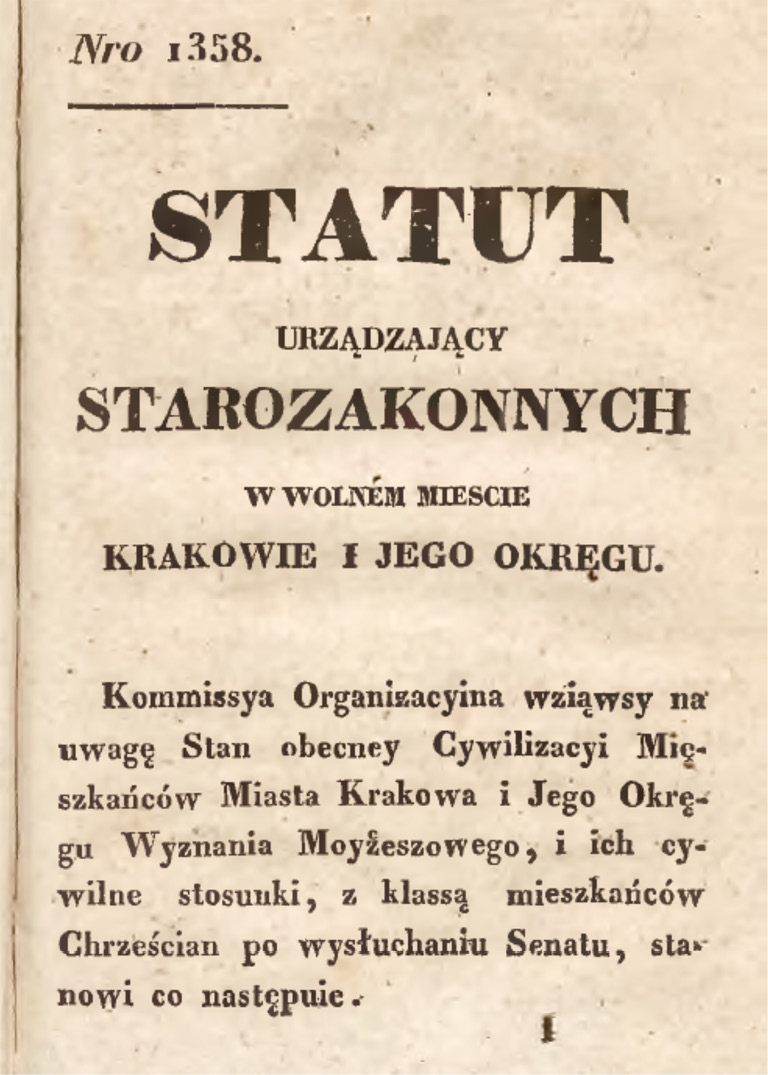
As in the case of Kahals, the Statute also reinstated the obligation for every Jew to have âa permanent family name, from father to son to pass hereditarilyâ.42 In order to fulfil this obligation, the law prescribed a census of the Jewish population, in which each family was to be assigned a specific surname ex officio, while families with surnames given in Austrian times retained them. The possession of such a surname was the basis for the head of a family or an unmarried person to receive a certificate of âlocal-nationalityâ, containing âa description of the person, age, profession, condition, or employmentâ. According to the Act, the certificate was the holderâs primary identity document, certifying the holderâs status as a resident of the Free City of Cracow and entitling the holder to deal with all official matters. The lack of a certificate, on the other hand, constituted a misdemeanour punishable by up to 15 daysâ imprisonment and, in the case of persistence, was even a crime.43
2
As of 15 August 1810, by the Royal Decree of 9 June 1810, the nc came into force in the Cracow Department of the Duchy of Warsaw, which was part of Western Galicia, incorporated into the Duchy of Warsaw on 14 October 1809.
The situation was different with the introduction of civil weddings in Cracow. This institution was unknown in Polish-Lithuanian Commonwealth law, in which, by virtue of the Constitution of the Piotrków Sejm of 1577, the canonical religious form of marriage was obligatory for Catholics according to the Tametsi Decree of 1563, and for other denominations and religions.50 Nor was the civil wedding known in Austrian law, which, from the time of Joseph iiâs Ehepatent of 1783, had recognised marriage as a civil contract, but could be concluded only in a religious form. This was also provided for by the regulations of the West Galician Code of 1797 in force in Cracow at the time of its incorporation into the Duchy of Warsaw.51 Also, according to Joseph iiâs Edict
At the time of the introduction of French regulations in Cracow, the Government of the Duchy of Warsaw had already worked out legal and administrative solutions for the application of the new regulations. First of all, this entailed the appointment of civil registrars who were authorised to draw up the civil registry records required by the nc and to make announcements and perform civil weddings. Following the French model, these should be secular persons. Administrative and social realities only allowed this solution in large cities, where there was a qualified civil staff of mayors or their deputies. In smaller places, it was necessary to entrust this function mainly to clergymen, who had the relevant education and experience both from the times of the Polish-Lithuanian Commonwealth and the Prussian partition.53 This was done by a Council of Ministersâ Regulation of 21 April 1808, which ordered Catholic parish priests to temporarily act as civil registrars in villages âwhere there are parishes and there is not a considerable number of Jewsâ.54 In the case of villages âwhere there are many dissenters and where a fit organist can be found, he may substitute for a civil registrarâ.55
The provisional nature of the Regulation was already perpetuated by § 24 of the Decree of 9 May 1808, in which the obligation to âmaintain recordsâ was placed expressis verbis on âparish priests and their vicars, priests of the Greek rite, pastors of Evangelical denominations, rabbis and all those who by then ⦠had [this] instructed to themselvesâ.56 This principle was finally confirmed by Article 1 of the Decree of 23 February 1809 on fees for civil registrars, stating that âcivil registrars are to be clergymen performing parish dutiesâ. The
With regard to the legal regulations themselves, i.e. the provisions of Title ii of Book 1 of the nc of Acts before the Civil Authorities (Articles 34â101), the Government of the Duchy of Warsaw found it necessary to adapt them to local administrative conditions. This was done by a resolution of the Chamber of Deputies promulgated by the Royal Decree of 18 March 1809, which amended Articles 41, 43â45, 49, 53, 70â72 of the nc, with effect from 18 March 1809.61 The amended provisions dealt with the general organisation of civil registry records (Articles 34â53 of the nc), including particularly important obligations for the functioning of the whole system: the keeping of civil registry records in two copies (Article 40 of the nc); the numbering (Article 41 of the nc) and continuity of the registers (Article 42 of the nc); the obligation to close them annually and transfer them to the competent archives (Article 43 of the nc), together with appendices attached to the records (Article 44 of the nc); and, linked to the establishment of the marriage record (Articles 63â76 of the nc), the institution of the act of notoriety (lâacte de notoriété), which was a substitute for the birth certificates that were missing for persons about to be married (Articles 70â72 of the nc).
In all the amended provisions, the relevant civil registry authorities were replaced by the Code Napoléon. This was not due to the lack of Polish equivalents of the French bodies, since the administration of justice of the Duchy
The remaining provisions of Title ii of the Code Napoléon remained in force in their original wording. Doubts in this respect, at least formally, were finally resolved by the Royal Decree of 10 October 1809, which was a transitional law to the nc, already in force in the Duchy for more than a year. According to the law, all the provisions of the new Code â of which the French text remained the authentic text, with the Polish text published in 1808 in the Printing House of the Piarist Fathers in Warsaw (Article 2) â had âfull force of lawâ, subject to the amendments already introduced (Article 3), for all âactions and incidents which have occurredâ from 1 May 1808 (Article 2 in conjunction with Article 5).63 This meant that from that date both civil marriages concluded and marriage certificates drawn, as well as all the legal effects of these acts (Article 10), were exclusively governed by the nc in the wording established by a resolution of the Chamber of Deputies promulgated by the Royal Decree of 18 March 1809. A contrario, these acts, and in fact the corresponding legal acts occurring before 1 May 1808, were subject to prior law and could not be rescinded âunder the guise of the Napoleonic Codeâ (Article 9).64 Obviously, in the case of Cracow, the terminus a quo for the application of the Code Napoléon was 15 August 1810.65
The regulations developed between 1808 and 1809 were implemented in full in Cracow. Pursuant to Article 1 of the Royal Decree of 23 February 1809, from
âhaving read all the above-mentioned papers and Six of the Title of the Napoleonic Code on Marriage, we asked the future husband and wife whether they wished to be united in marriage. To which, when each of them separately answered that it is their will, we declare in the name of the law that Joachim Wocicki, bachelor, and Miss Agnieszka Karwacka are joined to each other by the bond of marriage. We have drawn up the act in the presence ofâ four witnesses whose names, age, state and place of residence as well as relationship to the parties have also been specified in the marriage certificate [Article 76(9) of the nc] by the vicar.71
The records of the civil registry of Cracowâs parishes show that Catholic clergy generally performed their duties as civil registrars correctly.72 Secular registrars were even more diligent,73 initially acting directly on the basis of Article 4 of the Decree of 23 February 1809,74 and then on the basis of an implementing rescript issued to by the Minister of Justice on 6 September 1811.75 According to these regulations, in Cracow, each âmunicipal presidentâ or his deputy was âthe civil officer of the County and City of Cracow, [required â p.m.] to declare and record according to the law, civil divorces, also to make announcements, and to receive marriage certificates between civilly divorced personsâ.76 The first such secular civil registrars were, in the years 1810â15, the mayor of the city, StanisÅaw Kostka Zarzecki, and his deputy and first juror, Walenty Bartsch, who drew up the first âsecularâ civil registry record in Cracow, which was the announcement of the divorce of Kajetan Wytyszkiewicz and Józefa Wytyszkiewiczowa, née Sobieniowska, on 13 December 1810.77 The first âsecularâ civil wedding was conducted, and the marriage certificate drawn up, by StanisÅaw Zarzecki on 6 October 1811.78
At the turn of 1815 and 1816, i.e. at the time of the constitution of the authorities of the Free City of Cracow, regulations from the time of the Duchy of
3 Consent for the Marriages of Jews from Cracow
As already indicated, the provisions introducing civil marriages and marriage certificates of the nc in Cracow also applied to the Jewish population. However, irrespective of the Code regulations, marriages of Jews, following the solutions of the Theresian era, were subjected to the regulations of the Statute of 1817. Formally, these regulations, although incompatible with the
Consent for Jewish marriage (konsens) from 1827, (manuscript, paper, 1827)
source: national archives in cracow, ank, 29/1472/119, 1053 photo & permission by national archives in cracow
the Followers of the Old Testament, by entering into religious marriages in secret,90 and by frequently abusing the benefit of the law, which allows them to substitute proof of their age by means of witness statements, are attempting in this way to undermine the aim pursued by the provisions of the civil laws and the statute governing the organisation of the Followers of the Old Testament.91
The provisions of the Statute were therefore not respected, as Jews either did not enter into civil marriages at all or circumvented the law by relying on the dubious testimony of relatives and acquaintances. Furthermore, due to the fact that the provisions of the Statute were not specific enough, permissions were issued to unauthorised persons.92
In order to counteract âsimilar abuseâ, the Act of 1821, in force from 1 February 1822, provided for a number of sanctions for breaching the rules governing the civil marriages of Jews. First of all, it modified, with regard to the âFollowers of the Old Testamentâ, the institution of a witness statement. This was to rule out the circumvention of civil conditions, in particular the age of marital capacity. According to the amendment, the testimony of witnesses given for the purpose of drawing up a witness statement, was to be given under oath and in the presence of the prospective spouse in whose favour the testimony was given. In addition, giving or seeking to give a false testimony was qualified as the crime of fraud under § 178, Part I of the Criminal Code (Franciscana), and in the case where âif it turns out that in place of the right person, another person has been substituted to circumvent the lawâ this will be seen as judicial perjury under § 183 of the Criminal Code.93 The scope of sanctions provided for these offences was very broad, as it ranged from six months to one year in prison in the basic type (§ 178 in conjunction with § 181 of the Criminal Code), up to a severe sentence of life imprisonment in the qualified type (§ 183 of the Criminal Code).
Not on the basis of the Criminal Code, but on the basis of Article 5 of the 1821 Act, âThe Followers of the Old Testament marrying religiously, openly or secretly, without having first concluded a civil marriage contract before a competent civil registrar are to be punishedâ.94 The fine of 1,000 zlotys, half of which was paid to the informer, was to be imposed by the court not only on the prospective spouses, but also on the clergy and witnesses assisting at the religious ceremony. In the event of an inability to pay it, which, due to the amount of the fine, would affect the majority of prospective spouses,95 the court converted it into a correctional arrest penalty of five days for every 30 zlotys of the fine not paid. An additional sanction provided by Article 5 was the inadmissibility of
The changes introduced by the 1821 Act to the regulation of § 17 of the Statute finally constituted the institution of permission for marriage of the Followers of the Old Testament in the Free City of Cracow. According to the Act, permission was formally issued no longer for the purpose of concluding a prenuptial agreement, but directly for the purpose of concluding a marriage. Moreover, obtaining a permission was a civil prerequisite for the validity of a marriage, and consequently its absence constituted its nullity. This was stated expressis verbis in Article 5, which refers to children born of a âcivilly invalid marriageâ,98 and Article 4 introducing the sanction of ânullity of the certificateâ for the drawing up of a marriage certificate earlier than 30 days after the issuing of the permission for this marriage by a wójt.99 The importance of the changes introduced by the Act of 1821 was confirmed by the tightening of the legal prerequisites for obtaining a permission and, in particular, by the criminal sanctions it laid down, the severity of which clearly demonstrated its deterrent function. The additional formal requirements for drawing up a marriage certificate and the sanctions protecting them, had a similar objective, especially since, in practice, a witness statement was the basic document certifying the matrimonial capacity of the prospective spouses.100
Like the provisions of the Statute, the regulations of 1821 also failed to produce the expected results. For the most part, Jewish marriages continued to be conducted exclusively in a religious form. In spite of this, the authorities of the Free City of Cracow maintained the existing legislation.101 The Assembly of Representatives did not decide to amend the legislation until more than 16 years later, on 30 January 1838.102 The preamble to the new Act acknowledged that the 1821 Act âis not sufficient to restrain the Followers of the Old
legal proof of this kind of transgression, in the absence of the defendantsâ own admission, or the evidence of witnesses or accomplices, shall be the coincidence of the following two circumstances in addition to cohabitation: a) the raising of offspring, b) the cutting of the hair by the woman, and c) the use of a tallit by the man.106
In accordance with the will of the legislator, the provisions of the new Act, in force from 1 April 1838, were entered in place of Article 5 of the 1821 Act, which had been repealed in its entirety. This meant that the authorities of the Free City of Cracow did not intend to change the remaining regulations of the institution of the permission, and thus their previous policy towards Jewish marriages. However, the preamble of the 1838 law itself indicated that the repeal of Article 5 of the 1821 law brought about a significant change in the status of children from religious marriages contracted without a permission. This is because the âundeserved consequenceâ that was the prohibition of legitimation of these children both per subsequens matrimonium and by adoption, was abolished. The sanctions imposed on civil registrars for registering such children as legitimate on the birth certificate had also been derogated.107
In the assessment of the authorities of the Republic of Cracow, the numerous amendments to the regulations in the late 1830s and early 1840s also failed to produce the expected results. According to the preamble to the Act of the Assembly of Representatives of 3 July 1844, the problem was to be solved by a new comprehensive regulation of the institution of the permission, replacing the qualifying conditions for betrotheds in § 17 letter b of the Statute, and in the entirety of the Acts of 1821 and 1838.116 In the former respect, the comprehensive Article 1 of the law detailed all the existing conditions necessary for obtaining a permission.117 In addition, Article 1 also contained new conditions, which, depending on the age of the bridegroom, either tightened or softened the rigour of the old conditions accordingly. On the one hand, according to the Act, any âFollower of the Old Testament wishing to marry before the 30th
The repeal of the 1821 and 1838 Acts did not mean, however, that the 1844 Act abandoned the criminal law protection of the institution of the permission. According to its Article 2, the conclusion of a religious marriage by Jews openly or secretly, but without a prior civil marriage, continued to constitute a criminal offence. Unlike under previous laws, however, the 1844 law referred in this respect to the grave police offences of § 252 and § 253 of Part ii of the Criminal Code.121 Consequently, prospective spouses and âall persons giving aid and facilitation in this kind of marriagesâ were liable for their act as âentering into a marriage contrary to the law without a dispensationâ (§ 252 of the Criminal Code), and parents or guardians for âforcing their children into a legally invalid marriageâ (§ 253 of the Criminal Code). In both cases, the sanction provided for by the Code was âstrict arrestâ for three to six months. This punishment, although temporally similar to the substitute punishment of correctional detention provided for by Article 1 of the 1838 Act, was nevertheless a more severe punishment, as âstrict arrestâ as a qualified form was exercised with a number of restrictions, in particular the shackling of the legs and the prohibition of uncontrolled prison visits (§ 12 of Part ii of the Criminal Code).122 By analogy with the substantive law, the 1844 Act also referred to the provisions of § 360 of Part ii of the Criminal Code with respect to the proceedings concerning the offence of entering into a religious marriage. Consequently, the circumstantial evidence enumerated in Article 2 of the 1838 Act indicating the conclusion of such a marriage,123 was qualified as âcircumstancesâ, the
The provisions of the Act of 1844, the last in the history of regulation of the permission for marriage by Followers of the Old Testament in the Free City of Cracow, indicate that its aim was primarily to unify the legislation. Indeed, despite the repeal of § 17 letter b of the Statute and the Acts of 1821 and 1838, the fundamental shape of the institution of the permission was not changed. From a civilian point of view, it remained an extra-Code condition for the validity of a marriage, as is clearly evidenced by the penal provisions of the 1844 Act, treating its absence as a marital obstacle. Furthermore, Article 4 of the Act required parents wishing to register the birth of a child to submit a marriage certificate, which the registrar was obliged to mention in the birth certificate, under penalty of a fine of 500 zlotys. If a marriage certificate was not produced, the child would be registered as natural, which, as in the Act of 1838, did not, however, close the way to his or her legitimisation per subsequens matrimonium or through adoption.125 Similarly, from an administrative law perspective, the permission remained a means of stimulating the assimilation of the Jewish community. At the same time, it was a measure that was far from effective, as evidenced by the small number of civil marriages concluded by Jews,126 despite the dynamic increase in their number in the Free City of Cracow.127
4 The Civil Weddings and Marriage Certificates of Jews from Cracow
In the National Archives in Cracow, in the fonds Akta stanu cywilnego Izraelickiego OkrÄgu Metrykalnego w Krakowie (Civil Registry Records of the Israeli District in Cracow),128 there are preserved civil registry records of the marital status of Cracovian Jews, prepared on the basis of the provisions of the nc, in force in Cracow from 15 August 1810 to 19 April 1852, i.e. until the
StanisÅaw Dudzicz, being one of two secular civil registry officials in Cracow,134 remained a civil registrar for the Jewish community for the first 12 years, i.e. until 1822.135 From October 1815, Dudzicz titled himself âa civil registry official in the Free City of Cracow established for persons of the Jewish faithâ,136 and later also âthe civil status official of the sixth, tenth and 11th commune of the Free City of Cracow established for the Followers of the Old Testamentâ.137 His jurisdiction in the Republic of Cracow, however, extended to all â Followers of the Old Testament residing within the city of Cracowâ, which was confirmed by the Senate in 1823.138 The marriage certificates prepared by StanisÅaw Dudzicz in the years 1811â22 show that he duly fulfilled his obligations, both in terms of the marriage certificates themselves (Articles 63â76 of the nc) and the general requirements of keeping files and registers, i.e. civil registry books (Articles of the 34â54 of the nc).139 Interestingly, Dudzicz also
It is also worth emphasising that the entries in each book are continuous, âleaving no white paperâ (Article 42 of the nc), and in the event of rare mistakes, a blank page is crossed out and sometimes also described.141 Immediately after the last marriage certificate in a given year, entries are closed with an appropriate annotation dated 31 December, prepared and signed by Dudzicz in accordance with Article 43 of the nc. Moreover, on the last page of each book there is an annotation signed by the justice of the peace competent for the seat of the civil registrar (Kazimierz). Pursuant to Article 41 of the nc, he confirmed that âI numbered the book for acts of announcements, marriages and divorces for the Jewish community in Kazimierz near Cracow for the year ⦠covering pages ⦠and put initialsâ.
Civil registry for Jewish population in Cracow (1811â22)
Year |
Civil registrar |
Number of civil marriages |
Requirements of articles 34â54 and articles 63â76 of the nc |
Requirements of the 1817 Statute and the 1821 Act â permission |
Justice of the peace |
Remarks |
|---|---|---|---|---|---|---|
1811 |
StanisÅaw [Habdank] Dudzicz |
23 |
fulfilled |
not required |
Konstanty ChoÅciak-Popiel |
lack of the second copy of the book |
1812 |
StanisÅaw [Habdank] Dudzicz |
36 |
fulfilled |
not required |
MikoÅaj Gostkowski |
lack of one entry on card 71 |
1813 |
StanisÅaw [Habdank] Dudzicz |
35 |
fulfilled |
not required |
StanisÅaw Mieroszewski |
|
1814 |
StanisÅaw [Habdank] Dudzicz |
41 |
fulfilled |
not required |
StanisÅaw Mieroszewski |
|
1815 |
StanisÅaw [Habdank] Dudzicz |
16 |
fulfilled |
not required |
MikoÅaj Gostkowski |
records till August |
Erazm Bieniecki [deputy] |
2 |
fulfilled |
not required |
Jan Rudnicki |
records of November; no index |
|
1816 |
StanisÅaw [Habdank] Dudzicz |
11 |
fulfilled |
not required |
StanisÅaw Mieroszewski |
records from October to December |
1817 |
StanisÅaw [Habdank] Dudzicz |
23 |
fulfilled |
not required for ten weddings; lack of mention and appendix for 13 weddings |
Jan Nepomucen Gaspary |
|
1818 |
StanisÅaw [Habdank] Dudzicz |
28 |
fulfilled |
lack of mention and appendix for all weddings |
Jan Nepomucen Gaspary |
mistake in page numbering from card 21 |
1819 |
StanisÅaw [Habdank] Dudzicz |
44 |
fulfilled |
lack of mention and appendix for all weddings |
Szczepan Lubowiecki |
in record no.1 on card three, December was erroneously entered instead of January |
1820 |
StanisÅaw [Habdank] Dudzicz |
42 |
fulfilled |
lack of mention and appendix for all weddings |
Szymon BiaÅecki |
|
1821 |
StanisÅaw [Habdank] Dudzicz |
53 |
fulfilled |
lack of mention and appendix for all weddings |
Wojciech Like |
|
1822 |
StanisÅaw [Habdank] Dudzicz |
23 |
fulfilled |
lack of mention for all weddings but there are permissions in the appendices |
Wojciech Like |
records January (18) and February 1822 (5); (the latter formally invalid!) |
Wojciech KucieÅski |
24 |
fulfilled |
mentions (19) and appendices (18) for all weddings, except non-local-nationals (five) |
Wojciech Like |
records from April to December; no appendices for the marriage certificate of 16 June 1822 |
A partial change in the composition of the appendices took place in 1819, when birth certificates began to be replaced by extracts drawn up by Dudzicz himself from Jewish birth records kept by the Austrian authorities between 1798 and 1809.153 This was made possible by the finding and putting in order in 1818 of the records in question, and handing them over to Dudzicz for âofficial useâ,154 which nota bene coincided with the entry of the persons covered by them into the age of marital capacity. This state of affairs continued between 1820 and 1822, but the majority of the records still consisted of witness statements.155 It is worth emphasising that, contrary to the literal wording of the
The second half of StanisÅaw Dudziczâs years in office coincides with the entry into force of the Statute of 1817. In § 17, it obliged civil registrars to keep separate books of births, marriages and divorces and the deaths of Jews. These books were to be kept according to general principles, i.e. in accordance with the modified provisions of the nc.157 As already indicated, this issue did not pose any major difficulties, as these requirements had already been implemented in practice from 1811 onwards. What was new, however, was the introduction of the institution of the permission and the regulations associated with it. Formally, these regulations entered into force on 30 June 1817, meaning that a Jewish wedding concluded after that date should be preceded by obtaining a permission from the wójt. However, in the marriage certificates drawn up by Dudzicz between 1817 and 1821, we do not find a mention of the permission.158 Also, in the attached appendices, there are no documents concerning the requirements of § 17 of the Statute, in particular the permissions themselves.159 In the light of the above, it may be presumed that StanisÅaw Dudzicz was of the opinion that the Statute did not impose any additional obligations on him as a civil registrar, and that obtaining or not obtaining a permission was irrelevant from the point of view of the validity of the wedding and the marriage certificate itself.
the Followers of the Old Testament, Dawid Früciuf and Gitla Treibitz ⦠proved their age as prescribed by law ⦠and being of a tailorâs profession from which they can make a living, and for this being authorised by a rescript of the Ruling Senate ⦠for these reasons we have issued a permission for them to enter into marriage, sending them back to the competent registrar for the performance of what the law requires.160
The same was the case with a further 22 weddings concluded before StanisÅaw Dudzicz in 1822.161 However, until the end of his de facto term of office, i.e. 24 February 1822, Dudzicz did not mention in the marriage certificates that the prospective spouses had submitted a permission from the competent wójti.162 It seems that his sudden recall of the requirement for the prospective spouses to obtain permissions, was forced upon Dudzicz by the Senate, and that he himself was opposed to the radicalism of the 1821 Act. This is evidenced not only by his resignation on 19 February 1822,163 but it also turns out that the last five marriage certificates drawn up by him in February 1822 were technically invalid under Article 4 of the 1821 Act. This was because they occurred earlier âthan within 30 daysâ of the issue of permissions for the conclusion of these marriages by the wójt.164
In such circumstances, Dudziczâs duties were taken over by Wojciech KucieÅski, who had been responsible for the civil status records of divorced Christians from 1816, thus combining in one person both functions of a secular
It is worth noting that the small number of civil marriages contracted by Jews during the tenure of StanisÅaw Dudzicz,172 only slightly increased during the term of office of Wojciech KucieÅski. In the 1820s, it still amounted to only several dozen marriages per year, and in the 1830s it approached 100. The lowest annual number of civil weddings in that period concluded by Jews was in 1823 (only 43), and the highest (117), ten years later in 1833.173 These statistics remained at a similar level during the last decade of the existence of the Republic of Cracow. At that time, from 1 June 1838, the registrar for the Jewish residents of the city of Cracow was Franciszek Salezy GawroÅski.174 During his
5 Conclusion
Undoubtedly, the introduction of the French marriage law of the Code Napoléon in Cracow in 1810 was a landmark event for its inhabitants. The Code provisions regulating the registration of a marriage by a State official and, in particular, the entry into marriage in the form of civil wedding, were complete novelties in the Polish legal culture of the time. Therefore, it is particularly noteworthy that these provisions were actually applied, and generally very meticulously. This was certainly facilitated by their technical nature and their clarity and precision, which did not hinder the work of officials. At the same time, the new system of civil status registration very quickly revealed its advantages for the functioning and development of the State administration, and was therefore strongly supported by it. It is worth noting, however, that both the authorities of the Duchy of Warsaw and of the Free City of Cracow decided not to create a civil service corps, entrusting the keeping of civil status records to the clergy of individual denominations, mainly Catholic. This meant that for the Christian majority of Cracowâs inhabitants, the new system of civil status registration was introduced in its old form and thus was not revolutionary in nature.
The situation was different for the community of Cracowâs Jews however, who were not Christian and were subject to the rigours of the Governmentâs assimilation policy. As Jewish clergy were excluded from acting as civil registrars of their religion, this position was entrusted to secular officials. Consequently, for the Jews, not only the letter, but also the spirit of the post-revolutionary nc, was fully applied in this regard. Yet, since the Constitution of the Free City of Cracow allowed for a restriction of the civil rights of the âFollowers of the Old
An analysis of the application of the provisions of the nc by Cracowâs civil officials and judges, shows that they were competent and committed to the process of building a new legal and administrative system. However, in the social perspective, their work did not have much direct effect, as the resistance of the Jewish population to the assimilation policy of the Government proved to be extremely effective. This is evidenced both by the small number of civil marriages concluded by âFollowers of the Old Testamentâ during the entire period under discussion, and by the powerlessness of the authorities of the Free City of Cracow in their efforts
to force Jews to enter into such marriages. Irrespective of the above, the fact remains that the French marriage laws, with the secular registration of marriage certificates and civil weddings, which are today the basic institutions of Polish marriage law, were first applied for an extended period of time, from 1810 to 1852, in Cracow.
This chapter is a modified and expanded version of the authorâs article on the consent to marry for Jews in the Free City of Cracow: Michalik 2020, 102â109. Due to the fact that the marriage law of the nc was in force in Cracow from 1810 to 1852, the timeframe of the analysis presented here extends slightly beyond the period of the Republic of Cracow.
Until 1795, the structure of the autonomous Cracow municipality was regulated by a statute of 1595. See Jakimyszyn 2005, 41â49.
See Grodziski 2007, 73â85; Eisenbach 1983, 615â629.
Piller 1794, No. I, 4.
Grodziski 2007, 77.
Piller 1789, No. xliv, 105.
Which was introduced in Galicia as of 1 May 1787. See PÅaza 1993, 45.
Piller 1789, No. xliv, 106. Records were to be kept in German. The records of Jews in the Kazimietrz district of Cracow from 1798 to 1809, kept in Latin and German, have survived to this day. See, for example: Geburtsbuch für der kasimirer Judengem 1798. anno-1809, ank 29/1472/1.
Piller 1791, No. xiii, 29â30.
By the Imperial Patent of Francis ii of 13 February 1797.
The latter, including the institution of a divorce letter, were finally introduced into the Austrian Civil Code (abgb) of 1811. See Dziadzio 2022a, 462.
Ustawa Konstytucyjna KsiÄstwa Warszawskiego, dpkw, vol. 1, ii.
Bartel, Kosim, Rostocki eds. 1964â69, vol. 1, 142 and 148.
Dekret z 27 stycznia 1808 r., dpkw, vol. 1, 46â47.
More specifically, based on Generalne UrzÄ dzenie Å»ydów w prowincjach Prus PoÅudniowych i Nowo-Wschodnich of 17 April 1797 r.
Filipiak 2016, 147â149.
Bartel, Kosim, Rostocki eds. 1964â69, vol. 1, 159.
Ibidem, vol. 2, 26â30.
dpkw, vol. 2, 34â36.
Dekret z 22 maja 1810 r. wprowadzajÄ cy podatek od miÄsa koszernego w departamentach âgalicyjskichâ i dotyczÄ cy Årodków na umorzenie dÅugów kahalnych, dpkw, vol. 2, 189â192.
Ibidem; Dekret z 14 czerwca 1810 r. ustalajÄ cy na rok 1810 zasady uiszczania rozmaitych podatków w nowo do KsiÄstwa Warszawskiego wcielonych departamentach galicyjskich, Bartel, Kosim, Rostocki eds. 1964â69, vol. 4, 179â181.
Dekret zezwalajÄ cym Å»ydom krakowskim na zamieszkanie zarówno na Kazimierzu żydowskim, jak i katolickim, Bartel, Kosim, Rostocki eds. 1964â69, vol. 3, 235â237.
See above, Chapter 1 and Jakimyszyn 2008, 23â67.
Konstytucja Wolnego Miasta Krakowa, Tokarz ed. 1932, 10â15.
Konstytucja Wolnego Miasta Krakowa i Jego OkrÄgu, Kallas and Krzymkowski eds. 2006, 183â190.
Konstytucja Wolnego Miasta Krakowa i Jego OkrÄgu, No. 4711 dgs, DPr.WMK of 1833.
âLa loi protège les Cultes tolérés, au nombre desquels est compris celui des Israëlitesâ.
Article iv of the 1833 Constitution: âLa différence des Cultes Chrétiens nâen établit aucune dans la jouissance des droits civils et politiquesâ. Article ii of the 1815 and 1833 Constitutions refers to social rights (les droits sociaux).
âNe jouissent pas du droit politique dâélection, même lorsquâils posséderaient dâailleurs les qualités prescrites ⦠Les individus professant des religions seulément tolerées, tells que les Juifs et autres non-chrétiens, avant dâavoir acquis les droits politiquesâ.
The term âFollower of the Old Testamentâ (in Polish, Starozakonny) was used to refer to a Jew in the official documents of the Free City of Cracow.
Wachholz 1957, 364.
Tokarz ed. 1932, 197.
Ibidem, 201â202. For more, see Wachholz 1957, 365.
Tokarz ed. 1932, 218â219. The manuscript is located in ank, 29/200/3 (wmk i-3), 195â203.
Tokarz ed. 1932, 283.
Statut UrzÄ dzajÄ cy Starozakonnych w Wolnym MieÅcie Krakowie i Jego OkrÄgu, No. 1358 dgs, DRRz.WMK of 1817, 287â320 (henceforth cited as the Statute). The date on which the provisions of the Act came into force was established by the Senate in its decision of 28 May 1817, DRz.WMK of 1817, No. 20, 87.
Statute, preamble; § 23.
Ibidem, § 28. Assimilation was to be confirmed by living (with prior consent) in the Christian part of Cracow, speaking Polish or German, wearing Christian clothes and sending children to public schools (under § 13 Jewish public schools in the Free City of Cracow were abolished).
Ibidem, § 1.
Ibidem, § 3.
Ibidem, § 7.
Ibidem, § 16.
Ibidem, § 16 and 20.
dpkw, vol. 2, 220â221.
Szpak 1973, 55. Weddings began to be recorded in St Maryâs Parish from 1548, births from 1568 (St Anneâs and St Stephenâs Parishes), deaths from 1712 (Parish of Corpus Christi).
In most parishes, separate registers for baptisms, marriages and deaths were kept from the beginning.
Ibidem, 54â58.
See below, Chapter 5, Section 4.
Karabowicz 2004, 175.
Dziadzio 2020c, 159.
See Michalik 2023.
The territory of the Duchy of Warsaw was created from the lands taken from Poland by Prussia in the Second and Third Partitions in 1792 and 1795. From 1 June 1794 and 1 September 1797 respectively, the Prussian Landrecht of 1794 was in force on them. However, the ecclesiastical marriage law and jurisdiction in force in the Republic was maintained. See PÅaza 1993, 47. This jurisdiction was, however, limited, inter alia by the possibility for Catholics to obtain a divorce before a State court. See Karabowicz 2004, 175â176; Pomianowski 2018, 63â65.
Obviously with the cooperation of the ecclesiastical authorities, which is confirmed by the Governmentâs correspondence with the Catholic bishops and consistories. See Jemielity 1995, 165â166.
UrzÄ dzenie urzÄdników aktów cywilnych w KsiÄstwie Warszawskim, Pomianowski 2015, 104.
dpkw, vol. 1, 54.
Based on Article 258 of the nc. The announcement of a divorce, from which a civil record was drawn up under the general rules (Articles 34â54 of the nc), was constitutive in the sense that the plaintiffâs failure to announce the divorce judgment within two months of it becoming final, resulted in the loss of its legal force (Articles 264â266 of the nc).
Ibidem, 195â196.
Pomianowski 2015, 98.
Dekret z 18 marca 1809 r., dpkw, vol. 1, 231â236.
Dekret z 18 marca 1809 r., dpkw, vol. 1, 234â235.
dpkw, vol. 2, 84â86.
Ibidem, 90.
Fonds from the individual parishes are in: ank, 29/328/0, 29/324/0, 29/334/0, 29/327/0, 29/323/0, 29/326/0, 29/329/0, 29/330/0, 29/333/0, 29/331/0, 29/332/0. Records kept by the clergy of the Evangelical Augsburg parish of St Martinâs have also been preserved, but only from 1818 onwards, ank, 29/325/0.
According to the literal wording of Article 63 of the nc, it should be the door of the âtown-hallâ (maison commune). The vicar also used this term, ank, 29/328/2, 1 and 8.
Ibidem, 2â3.
Ibidem, 7â8.
This was a superfluum, as according to Article 76(4) of the nc, permission was required âwhen necessaryâ, i.e. when the prospective spouse were minors. The age of majority for marriage, i.e. the possibility to marry independently, was, according to Article 148 of the nc, for persons who had reached the age of 25 (male) and 21 (female) respectively. On the other hand, the certificate rightly does not mention respectful acts (Article 76(5) of the nc), as the parents and grandparents of the bride and groom were no longer alive.
ank, 29/328/2, 7â8.
See above, footnote 66.
See a fond of certificates drawn up by secular civil registrars of the city of Cracow from the period when the nc was in force in the city, i.e. from 1810â52, entitled Akta rozwodowe z terenu gmin, powiatu i miasta Krakowa, ank, 29/336/0.
ank, 29/336/2, 1.
ank, 29/336/17, 1.
ank, 29/336/2, 1.
ank, 29/336/1, 1.
ank, 29/336/2, 1. The spouses were Kajetan Wytyszkiewicz, a divorcee, and Marianna Toryani, a widow.
UrzÄ dzenie tymczasowego dla wÅadz sÄ downiczych Wolnego Miasta Krakowa z 5 grudnia 1815 r. placed civil registrars under the supervision of the Tribunal of First Instance, DRRz.WMK of 1816, 93.
By the decision of the Organising Commission of 10 June 1816, only the fee charged by the former was changed, DRRz.WMK of 1816, 127â140.
ank, 29/336/16, 1â32. At that time, executive power in the Free City of Cracow was already exercised by the Ruling Senate, whose chairman, StanisÅaw Wodzicki, took over the powers of mayor.
DRz.WMK of 1816, No. 5, 20.
Ibidem; ank, 29/336/16, 32â33. This Resolution also appointed Karol Spandel, Head of the Chrzanów Commune, as the secular civil registrar for the District, i.e. the remainder of the territory of the Republic of Cracow.
No. 849 dgs, Dz.Pr.rk of 1826. The validity of these provisions was confirmed by the Decree of the Ruling Senate of 30 November 1841 Rygor na urzÄdników stanu cywilnego za udzielanie Ålubów maÅżeÅskich, bez poprzedniego spisania aktu cywilnego, No. 638 dgs, DPr.WMK of 1842. It introduced a fine of 100 to 1,000 zlotys for both clerical registrars and prospective spouses for attending a church wedding âwithout a previous civil actâ.
Statute, § 17.
According to Article 144 of the nc, 15 years for women and 18 years for men respectively.
Ibidem.
Ibidem, in fine.
The name was officially introduced in the Act of 20 December 1821 Prawo o zapobieżeniu nadużyciom Starozakonnych, promulgated by the Senate on 28 December 1821, No. 4831 dgs, DRRz.WMK of 1822, 5â12 (hereinafter referred to as the Act of 1821).
âThe Followers of the Old Testament after an engagement, in the town of Kazimierz, in the suburbs, or in the District in the villages, religiously unite in secret, and there celebrate the wedding feastâ, DRz.WMK of 1818, No. 24, 99.
The Act of 1821, preamble.
The Act of 1821, preamble.
Act of 1821, Article 3.
Ibidem, Article 5.
CichoÅ 2016, 182.
Act of 1821, Article 5.
Ibidem, Article 2.
Ibidem, Article 5.
Ibidem, Article 4.
See below, Chapter 5, Section 4.
DRz.WMK of 1824, Nos. 41â42 and of 1830, Nos. 36â37.
Ustawa o karach na Starozakonnych zawierajÄ cych zwiÄ zki maÅżeÅskie bez poprzedniego spisania przed urzÄdnikiem stanu cywilnego kontraktu, No. 539 dgs, DPr.WMK of 1838 (hereinafter referred to as the Act of 1838).
Ibidem, preamble.
The repeal of the provision for half of the fine to be passed on to the informer probably indicates the ineffectiveness of this measure due the cohesion of the Jewish community.
Act of 1838, Article 1.
Ibidem, Article 2.
Ibidem, preamble in fine.
DRz.WMK of 1839, No. 25.
DRz.WMK of 1840, No. 6.
DRz.WMK of 1841, No. 13.
DRz.WMK of 1843, No. 93â94.
DRz.WMK of 1839, No. 25, point 2.
DRz.WMK of 1841, No. 13, point 2.
To which applications were to be submitted through the Police Directorate in Cracow or the district commissioners in the District.
DRz.WMK of 1839, No. 25, point 1.
Prawo co do zawierania maÅżeÅstw przez Starozakonnych, No. 3106 dgs, DPr.WMK of 1844 (hereinafter referred to as the Act of 1844), preamble and Article 5.
Ibidem. Article 1 points iâiii.
Ibidem, Article 1 in fine.
A farmer âwho has been personally engaged in agricultural work for three years and who owns or leases a house and five morgens of landâ was not subject to the requirement of elementary Christian education, but he too was subject to the requirement of Christian attire until the age of 30.
Act of 1844, Article 1, points ivâv.
Ibidem, Article 2.
At the same time, the problem of the unenforceability of the financial penalty sanction provided for by the previous provisions was resolved â see above, footnote 95.
Act of 1838, Article 2.
Act of 1844, Article 3.
Idem, Article 4. According to the same provision, it was also punishable to fail to report the birth of a child to a registrar for the purpose of drawing up a birth certificate. The sanction for this act was a fine of 20 to 200 zlotys or detention from three to 20 days.
See below, next subchapter.
Between 1818 and 1843, the number of Jewish residents in the Free City of Cracow increased twofold, from 8,522 to 16,746 people. See Zdanie sprawy o stanie i poÅożeniu Kraju w.m. Krakowa i Jego OkrÄgu w Zgromadzeniu Reprezentantów w r. 1844 przedÅożone przez Senatora do tegoż Zgromadzenia delegowanego, DPr.WMK 1844, 27â28.
ank, 29/1472/0.
In force from 20 April 1852, under the Imperial Patent of Francis Joseph I of 23 March 1852.
Dudzicz signed the documents he prepared as either âStanisÅaw Dudziczâ or âStanisÅaw Habdank Dudziczâ. See e.g.ank, 29/1472/20, 38â39.
ank, 29/1472/6, 3.
Ibidem.
Ibidem; ank, 29/1472/7, 3â14.
See above, pp. 145â146.
ank, 29/1472/48, 2.
ank, 29/1472/68, 43.
DRz.WMK of 1823, No. 4, 13â14. Jews living outside Cracow, i.e. in the District, were subject to the jurisdiction of the civil registrar in Chrzanów.
This is confirmed by an analysis of the individual volumes of the files: ank: 29/1472/6 [1811]; 29/1472/12 [1812]; 29/1472/20 [1813]; 29/1472/27 [1814]; 29/1472/36 and 29/1472/37 [1815]; 29/1472/48 [1816]; 29/1472/52 [1817]; 29/1472/58 [1818]; 29/1472/63 [1819]; 29/1472/68 [1820]; 29/1472/75 [1821]; 29/1472/82 [1822], on the basis of which Table 3 was prepared.
ank, 29/1472/52, 23.
See e.g. ank, 29/1472/38, 1; 29/1472/75, 42â43.
ank, 29/1472/48, 91.
See ank, 29/1472/13, 38; 29/1472/21, 38; 29/1472/28, 43; 29/1472/47, 12.
ank, 29/1472/64, 47.
Individual volumes of copies of the books: ank, [lack for 1811]; 29/1472/13 [1812]; 29/1472/21 [1813]; 29/1472/28 [1814]; 29/1472/38 and 29/1472/39 [1815]; 29/1472/47 [1816]; 29/1472/53 [1817]; 29/1472/59 [1818]; 29/1472/64 [1819]; 29/1472/69 [1820]; 29/1472/76 [1821]; 29/1472/83 [1822].
Individual volumes: ank, 29/1472/7 [1811]; 29/1472/14 [1812]; 29/1472/22 [1813]; 29/1472/29 [1814]; 29/1472/40 [1815]; 29/1472/49 [1816]; 29/1472/54 [1817]; 29/1472/60 [1818]; 29/1472/65 [1819]; 29/1472/70 [1820]; 29/1472/77 [1821]; 9/1472/84 [1822].
ank, 29/1472/49, 5.
An interesting practice, not explicitly resulting from the law, was the insertion of remarks on the appearance of the persons included in the record, i.e. the future spouses, by the sub-judges or scribes of the Courts of the Peace. As a rule, they express their acceptance of the age given by the witnesses. However, doubts do occur, as in the certficate of 30 April 1811: âAlthough it is difficult to determine that the Jewish woman Drobne Adelung on Saint Michaelâs Day of the current year will be 16 years old, as the witnesses testify, nevertheless it seems to the undersigned that Drobne Adelung according to her sex and body arrangement may be those years old, the more so that the Jews morally maintaining themselves, even if they are older, seem to be youngerâ., ank, 29/1472/7, 83.
See e.g. ank, 29/1472/7, 29.
See e.g. ank, 29/1472/60, 37 and 39; 29/1472/77, 179.
See e.g. ank, 29/1472/77, 309â312.
ank, 29/1472/65, 1 and 3.
ank, 29/200/407, 118â119; ank, 29/1472/65, 197.
See e.g. ank, 29/1472/70, 117 i 119; 29/1472/77, 93 and 95.
See e.g. ank, 29/1472/22, 9â12; 29/1472/49, 9â12. It can therefore be concluded that the assessment of the state of civil status registration inherited from the Duchy of Warsaw, presented by Senator Wojciech KucieÅski to the Assembly of Representatives on 10 December 1818, was too harsh, at least as far as Jewish records were concerned. In it, KucieÅski pointed out that âThe introduction into the order of civil registry records, which have a beneficial influence on almost the entire course of the lives of the inhabitants, was the subject of the efforts of the Government and the judicial authorities, whose task it is by law to watch over their maintenance. When our Government found them in disorder, it detected numerous shortcomings in the form of books and records and inadequacies in the administration, it punished those responsible and saw to it that the shortcomings were rectifiedâ, ank, 29/200/407, 118â119. It is likely that KucieÅski, who was also a secular civil registrar, wished to emphasise his contribution in this field.
Statute, § 17.
See above, footnote 146.
ank, 29/1472/84, 1.
Ibidem, 17, 29, 41, 53, 65, 77, 93, 109, 121, 133, 145, 157, 177, 193, 205, 221, 233, 245, 257, 269, 281 and 293.
ank, 29/1472/82, 3â25.
DRz.WMK of 1822, No. 6, 21. The resignation was accepted on 22 February 1822. After his resignation, Dudzicz drew up three more marriage certificates: on 20, 22 and 24 February 1822, ank, 29/1472/82, 23â25.
Ibidem, 21â25; ank, 29/1472/84, 245, 257, 269, 281 and 293. This fact has not been officially established. Had this occurred, Dudzicz would have been fined 1,000 zlotys, as he could no longer be dismissed: Act of 1821, Article 4.
DRz.WMK of 1822, nr 6, 21. See also above, footnote 156.
ank, 29/1472/82, 26â56.
Ibidem, 32â33, 49â54. Three were from the Kingdom of Poland, one from Galicia and one from Hungary.
ank, 29/1472/84, 309, 325, 337, 361, 393, 409, 421, 437, 453, 465, 485, 505, 521, 533, 549, 567, 647, 667.
See individual volumes of marriage certificates: ank, 29/1472/89 [1823]; 29/1472/96 [1824]; 29/1472/103 [1825 â substituted by BiaÅecki]; 29/1472/110 [1826 â substituted by BiaÅecki]; 29/1472/117 [1827 â substituted by BiaÅecki]; 29/1472/124 [1828 â substituted by BiaÅecki]; 29/1472/132 [1829]; 29/1472/139 [1830]; 29/1472/146 [1831]; 29/1472/153 [1832]; 29/1472/160 [1833]; 29/1472/165 [1834]; 29/1472/172 [1835]; 29/1472/179 [1836]; 29/1472/185 [1837]; 29/1472/192 [1838].
In December 1824, KucieÅski was elected by the Assembly of Representatives to the Ruling Senate. See DRz.WMK 1825, nr 3â4, 15.
See footnote 170.
DRz.WMK of 1838, Nos. 38â39, 149.
See individual volumes of marriage records: ank, 29/1472/192 [1838]; 29/1472/199 [1839 âpartly substituted by Etgens]; 29/1472/207 [1840 â substituted by Etgens]; 29/1472/213 [1841 â partly substituted by Etgens]; 29/1472/221 [1842]; 29/1472/227 [1843]; 29/1472/235 [1844]; 29/1472/241 [1845]; 29/1472/248 [1846 â partly replacing Etgens]; 29/1472/255 [1847 â partly substituted for Etgens]; 29/1472/262 [1848 â substituted by Etgens]; 29/1472/270 [1849 â substituted by Etgens]; 29/1472/276 [1850 â substituted by Etgens]; 29/1472/283 [1851 â substituted by Etgens]; 29/1472/290 [1852 â substituted by Etgens].