


During precisely the same period that Otto Neurath was active in discussions of linguistic philosophy at the Vienna Circle (1925–34), he also directed the development of a “picture language” (Isotype) at the Social and Economic Museum of Vienna. It may be illuminating to explore parallels between these two areas of his work; Neurath himself considered “cross-connections” to be fruitful. A related example is provided by Elisabeth Nemeth’s examination of the connections between visual education and Neurath’s economic theories.2 But how does Isotype relate to the Scientific World-Conception (as defined in the Vienna Circle manifesto of 1929) and to Logical Empiricism?
These areas have often been considered separately, both by contemporaries and by subsequent researchers. Philosophers of science were not generally
But, if this is so, then why did Otto Neurath’s colleagues at the Social and Economic Museum have little or nothing to do with Logical Empiricism: for example, Gerd Arntz, Rudolf Modley, or Friedrich Bauermeister, to name only a few?5 Marie Reidemeister, a key figure at the Social and Economic Museum as the principal “transformer” of scientific data into graphic form – and Neurath’s confidante & later (third) wife – was not permitted to attend meetings of the Vienna Circle, whereas Olga Hahn (Neurath’s second wife from 1912–37), as a mathematician and logician, was a member. No other member of the Vienna Circle was seriously interested in the Vienna Method of Pictorial Statistics (as Isotype was called in its initial phase).6
Neurath himself lamented this separation. In 1939 he wrote to Susan Stebbing, the British philosopher who would become president of the Isotype Institute in Oxford, asking her to review his two books International Picture Language and Basic by Isotype: “I seek always a reviewer for these books, but nobody of our people who are interested in Logic are interested in Visual Education and isotype too. You are the first; I am very glad that you are full of educational ideas.”7 This hints at the centrality of education as the aim of Isotype work, which separates it from pure philosophy.
1
Advertising, the educational billboard, cinema, illustrated newspapers and magazines are broadly responsible for the education of the masses. Even those who read many books are inspired more and more by images and series of images. …
Beyond that, image-based pedagogy is a means to open otherwise unattainable educational possibilities for less educated adults who tend to be more susceptible to optical stimulation, and for disadvantaged youth.9
Neurath’s second point here makes clear the Vienna Method’s context in inter-war “Red Vienna”, where Social Democratic policy dominated with an emphasis on housing, health and social hygiene, education and schooling, and last but not least, worker education. The aim of the Vienna Method of Pictorial Statistics was to educate workers about social and economic connections: statistical charts were important in this respect, although the Social and Economic Museum also displayed other kinds of charts (biology, accident prevention, etc; see Figure 1). As Otto Neurath made clear in numerous texts written during this period, he saw the Vienna Method as part of a larger historical movement to enable the working class to safeguard their political interests through education. The working class was disadvantaged by the prevailing educational system but, as Neurath repeatedly asserted, its members were particularly responsive to statistical correlations and visual education. Through the factual and quantitative images of the Vienna Method, the workers could quickly catch up in terms of education, and even achieve a higher level of argumentation in some subjects than the bourgeoisie.10

Accident prevention warning made at the social and economic museum of Vienna, c.1927
otto and marie neurath isotype collection, university of reading
“Bad” and “good” methods of depicting the same data, according to Otto Neurath in his book International Picture Language, 1936. Neurath’s objection to the first method is that the viewer is not sure what to compare visually: the height of the pictures or their area. The second example shows the first principle of Isotype: “A sign is representative of a certain amount of things; a greater number of signs is representative of a greater amount of things.” (P. 73)

In addition, Isotype was characterized by a utopian perspective, with a clearly defined goal to develop an “international picture language”. For Neurath, Isotype was always something unfinished, beyond the rules and practices that had been established. It never had a fully-articulated theory – at most a theoretical framework – and neither was there an Isotype curriculum that could be easily learned and applied by anyone. Working with Isotype required competence and aptitude to apply its principles to different topics and contexts. Long training and a well-coordinated team of varied specialists was necessary.
2
If we consider Isotype in relation to the manifesto “The Scientific Conception of the World: the Vienna Circle” (1929), written mainly by Neurath and Rudolf Carnap, significant affinities are apparent in the orientation towards empiricism, logic, and anti-metaphysics, but also in the emphasis on collective work and popular education. Isotype is implicated (along with “physicalist” verbal language) in the Vienna Circle’s search for “a neutral system of formulae, for a symbolism freed from the slag of historical languages”.11 Ellen Lupton, one of the few graphic design historians to seriously address the theoretical background of Isotype, drew from this the conclusion that “Isotype is a popular version of logical positivism”.12 It should be observed, however, that Neurath himself never stated the connection so explicitly.
Contains pointers to the affinity between the Scientific World-Conception and the transformation of the present; the connection between statistics as numerical description, their pictorial representation, and the pursuit of a systematic “grid” [Raster] by means of the Scientific World-Conception.
This makes clear that the Vienna Method of Pictorial Statistics aligned with a certain political and activist slant in the Vienna Circle manifesto. No doubt Neurath considered it one of the “intellectual tools” which had to be fashioned “for everyday life, for the daily life of the scholar but also for the daily life of all those who in some way join in working at the conscious re-shaping of life”.13 Isotype was already proving itself as such a tool, applied to educational exhibitions and publications, and in Viennese school curricula.14 In this sense,
Yet some hints toward a party-political agenda for the Scientific World-Conception are contained in an article published under Neurath’s name alone in the Social Democratic newspaper Arbeiter-Zeitung, with exactly the same title as the manifesto: “Wissenschaftliche Weltauffassung”, but without the subtitle “Der Wiener Kreis”; indeed, neither the Vienna Circle, nor any of its members are mentioned in Neurath’s article (nor is the Verein Ernst Mach, which Neurath had developed as the public face of the Circle). Appearing on 13 October 1929, the newspaper article (Figure 3) was published immediately after the manifesto and the Prague Conference where the Scientific World-Conception was introduced. While the content is similar to that of the manifesto, one immediately notices that a different audience is being addressed. Neurath stressed above all the importance of the modern workers’ movement and the consciousness it could develop in opposition to metaphysics and theology.16
Neurath’s article “Wissenschaftliche Weltauffassung” in the Arbeiter-Zeitung, 1929

In this, enlightenment about people and things, about connections of all sorts, plays a decisive role. Excitation of enthusiasm and the portrayal of glorious goals do not come to the fore, rather much more the purely factual description of that which is.
Pictograms of “people and things” were essential components of Isotype, and were arranged in its charts to convey “connections of all sorts” – social, economic, and biological.
We are not concerned with fathoming secrets about the spirit of the world [Weltgeist], nor with ascertaining man’s place in the cosmos, but rather with the behaviour of organised masses of people and its influence on happiness and unhappiness, on living conditions and length of life.17
The worker has an interest in knowing how war and peace can depend on the oil conflict between Standard Oil and the Shell group, and wants to understand how it happens that the Soviet Union makes its oil available to the USA when it stands against the capitalist world in other ways. … It is not sufficient to learn about the interdependencies, one must know how to assess their relative implications, the extent of the individual measures and movements!19
Such issues were addressed in the 100 pictorial charts about many interrelated subjects of population, energy supply, industrial production, and trade in the atlas produced at the Social and Economic Museum, Gesellschaft und Wirtschaft (Society and economy, 1930; Figures 4 and 5).20
“Import trade to Western and Central Europe”, Gesellschaft und Wirtschaft, no. 32, 1930
otto and marie neurath isotype collection, university of reading
“Development of sugar production since 1870”, Gesellschaft und Wirtschaft, no. 40, 1930
otto and marie neurath isotype collection, university of reading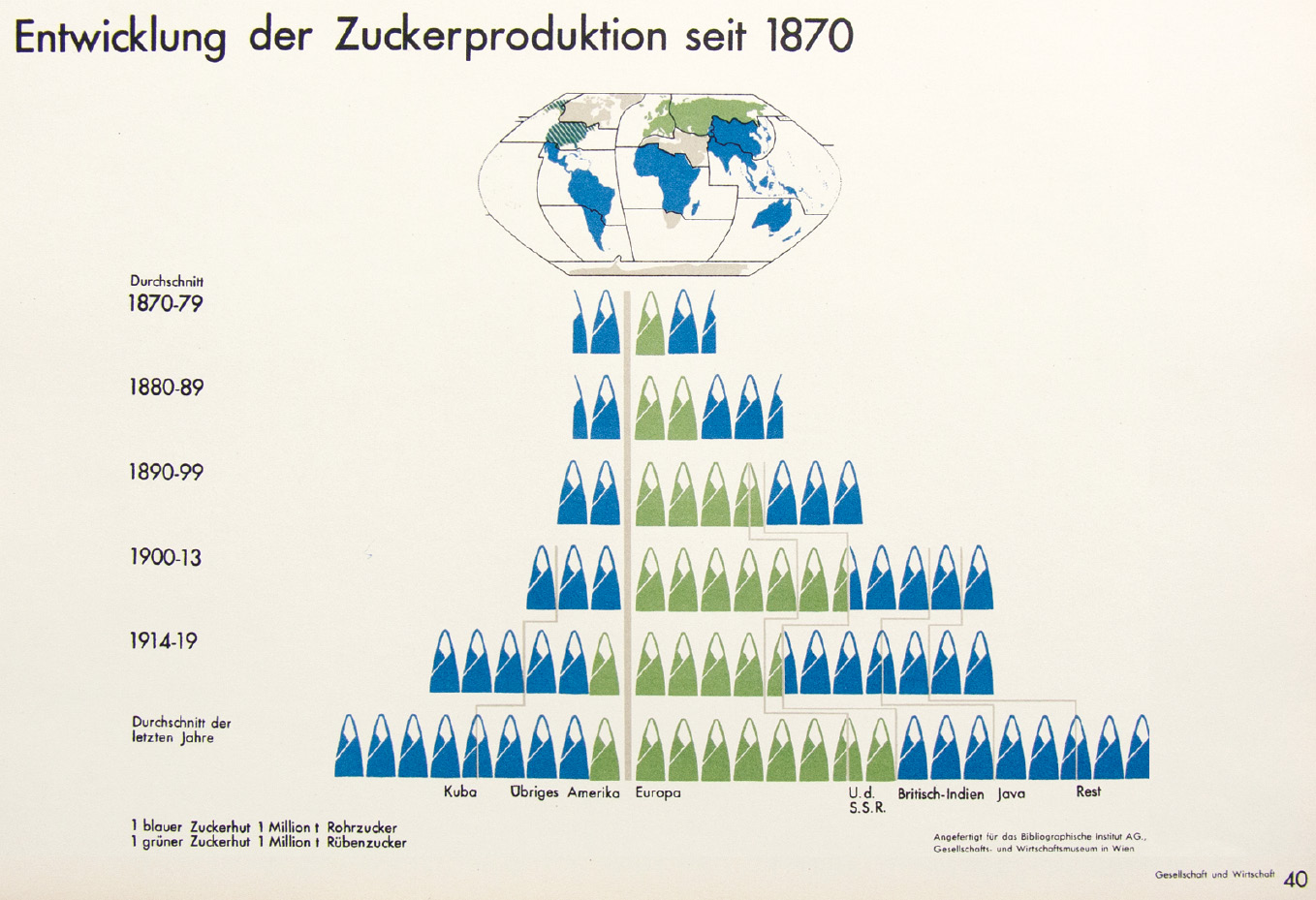
Isotype itself is not a science but a method of visual education. However, as Neurath repeatedly emphasised, it should be based on science: its object was to transform scientifically collected, verified data into images; or, as Neurath himself put it in his book International picture language, “turning the statements of science into pictures”.25
3
Alongside numerous, short essays, International picture language (1936) is the second of three lengthy texts written by Neurath about visual education. It is partly an English adaptation of his first book on the subject Bildstatistik nach Wiener Methode in der Schule (1933). The third text is “Visual education: humanisation versus popularisation” (1945), a book he wrote at the end of his life, which was published posthumously.26 Many clues can be found in these writings about connections with other areas of Neurath’s work.
What a triumph it was when we freed ourselves from the bounds of picture-script; what a triumph when language, in its flexibility and multiformity, adapted itself to all the demands of scientific work, as we learned to master this instrument of logic. Of course, liberation from pictures also led to mistakes, into the realm of the senseless. Nominalization gave rise to ever newer problems. In particular, the German language leads us into such metaphysical errors: it allows extensive discussions about “das Nichts, welches nichtet” (Heidegger), about “Being”; as if “Being” could be used in a sentence in the same way as sword or table. Pure picture-script does recognize a sword and a table, but not Being.27
Of course, no fact-picture can show the subtleties or provide as much information as the extensive formulas of physics or other similar tools of highly developed science. The certainty and immediacy of educational effect is acquired at the expense of a certain coarseness; but such a price must be paid for all pedagogy.
He was careful not to overstate the potential of visual education, but he believed that the rough orientation it provided is often more important in “practical life” than comprehensive knowledge. These were not mutually exclusive, moreover: “It is a widespread error to think that simplified early orientation prejudices against further scientific education. On the contrary, it offers a solid foundation on which to build.”28 This parallels Neurath’s proposal of a “physicalist everyday language” which could be learned by children, who could then advance to a more specialized language of science.29 “Fact-pictures” [Sachbilder] were similarly a “bridge” between different levels of learning, and had the added advantage of being “independent of linguistic borders” – they were “international from the outset”.30
Neurath also stressed the importance of statistics for the Vienna Method: “All discussions of social and economic questions link to statistical data. Planned control of healthcare, transport, production and consumption today needs extensive statistics.”31 This accords with Neurath’s intention, stated in the Vienna Circle manifesto, to explore statistical representation in his book as part of the Scientific World-Conception.
Cover and pages from International Picture Language, 1936
otto and marie neurath isotype collection, university of reading
The isotype picture language is not a sign-for-sign parallel of a word language. … the uses of a picture language are much more limited than those of normal languages. It has no qualities for the purpose of exchanging views, of giving signs of feeling, orders, etc. It is not in competition with the normal languages; it is a help inside its narrow limits. But in the same way as Basic English is an education in clear thought – because the use of statements without sense is forced upon us less by Basic than by the normal languages, which are full of words without sense (for science) – so the picture language is an education in clear thought – by reason of its limits.33
The limited vocabulary of only 850 words in Basic English corresponds to Neurath’s oft-made suggestion that avoiding certain problematic words aids clarity in language. Despite some awkward phrases forced by the restrictions of Basic, International picture language remains Neurath’s pithiest exposition of Isotype.
Every process, however simple, has to be in harmony with the rules of logic and mathematics. No process, however clear-cut, and however well based on science and delicate thought, will have any value for science or for education if it is not in harmony with the rules of this poor logic and mathematics.34
Subjects that depend on verbal expression only cannot be taught by pictures, e.g. theological or philosophical doctrines. It is however perfectly possible to make quite complicated matters of fact intelligible by pictures. …
This is the great advantage of visual aids: They appeal to adults and children, literates and illiterates equally – they are universal. …
visualisation itself is not a protection against metaphysical speculation but it makes it simpler to maintain an empiricist attitude.35
The same visual aids which speak to us here in Britain may reach the Americans, the Russians, the Africans, the Indians, and the people in the Far East. Such a feeling prepares the environment for a kind of World Health Education which could support and be supported by the great international health services already in action.36
We may create certain conventions in language without unifying the laws: a world language does not imply a world dictatorship but may help world understanding. For a democratic society it is important to have a common knowledge in a common language.39
Neurath expressed similar sentiments in his “visual autobiography” From Hieroglyphics to Isotype, in which he further clarified that Isotype was not really a language but an “international language-like technique”.40
4 Isotype and Logical Empiricism
The Vienna Circle invested a lot of effort in extracting the logical core from the Tractatus which had been so highly praised by Russell, so as to free it from its metaphysical shell. Directly and indirectly, this yielded extremely noteworthy results, in particular the one that logic was now understood as the syntax of language.43
- 2.1We make to ourselves pictures of facts. …
- 2.12The picture is a model of reality. …
- 2.141The picture is a fact. …
- 3The logical picture of the facts is the thought. …
- 3.01The totality of true thoughts is a picture of the world.
The meaning of these gnomic statements is still open to debate: Wittgenstein does not seem to be referring principally to mental pictures but instead to be using “picture” as a metaphor for linguistic expression.44 Concrete, graphic pictures seem not to have been his concern, whereas Neurath and his colleagues (particularly the artist Gerd Arntz) were actively concerned with making these in order to show social and economic connections. There seems to be no apparent kinship between Wittgenstein’s theory and Neurath’s reasons for developing a practical method of pictorial communication. While Neurath accepted Wittgenstein’s “extremely fruitful approach to the radical analysis of language”, he rejected the accompanying “mystical metaphysics”, citing Tractatus 2.12 (above) as an example of it.45
It was Friedrich Waismann who took on the burden of exegesis for Wittgenstein’s ideas within the Vienna Circle. At its meeting on 26 February 1931, Rose Rand recorded him as saying that “we make pictures of facts for ourselves.” Hans Hahn replied: “We also make pictures for ourselves of states of
Further ambiguity arises in the Tractatus from Wittgenstein’s distinction between “showing” and “saying”. He stated (4.1212): “What can be shown cannot be said.”47 Intriguingly, some later remarks made by Neurath about the practice of Isotype evoke Wittgenstein’s distinction, but in more concrete terms. In an essay ambitiously titled “The pedagogical world-importance of picture-statistics in the Vienna Method”, Neurath asserted: “What can be shown with a picture, one should not say with words.”48 In a letter to an American colleague, with whom he had collaborated on educational posters about tuberculosis, he wrote: “It is hopeless, my dear[,] to explain Isotype to anybody – it is important to get the possibility to show it.”49 Yet the shift of attitude from Wittgenstein’s apodictic phrasing is significant: in the Tractatus, Wittgenstein was preaching to the converted, by his own admission; Neurath’s aim with Isotype was pragmatic and educational – he advocated the use of whichever mode of communication was most appropriate for a certain context.
This means of course a retreat to some extent from the predominant scholastic tradition based on words and concepts, which often works against an empirical attitude, while pictorial education favours empiricism. Pictorial statistics operate from the outset with spatio-temporal patterns, while in verbal language the possibility exists of using senseless links, which can often only be got rid of with difficulty.51
Neurath’s position on physicalist verbal language is fraught with ambiguity. It is difficult to reconcile his view that “The language of physicalism is nothing new as it were; it is the language familiar to certain ‘naive’ children and peoples”52 with his advocacy of a rarefied discourse in which “statements are compared with statements, not with a ‘reality’, not with ‘things’.”53 This latter position earned him criticism from Schlick and Carnap for resembling a coherence theory of truth.54 Surprisingly, Neurath believed that such linguistic self-reflexivity ensured empiricism, but it seems to be a contradiction of the principle set out in the Vienna Circle manifesto that “there is knowledge only from experience, which rests on what is immediately given”.55 In clarifying his position on Physicalism, Neurath asserted: “it is impossible to turn back behind or before language”.56 Isotype, however, is an attempt to do so, to circumvent the semantic problem of ineffability in verbal language: instead of using the symbolic notation of a Western alphabet, Isotype uses the iconic notation of a picture-script. The individual pictograms are homomorphic with real beings and objects.57 Isotype depiction therefore required a suspension of epistemological doubt in accepting that there is a real world made of physical objects to which the pictograms corresponded (as such it is nearer a correspondence model of truth). Creating and “reading” the pictograms relied on a common, visual experience of physical objects in order for the iconic signification to work. When such an experience is lacking, it does not work: for example, the
Page for “potato” from the picture “lexicon” prepared at the Social and Economic Museum of Vienna, c.1930
otto and marie neurath isotype collection, university of reading
Such an analysis relies on the triadic definition by Charles Peirce as the basis for semiotic theory: icon, index, and symbol. Neurath no doubt knew of Peirce’s work on logic, but it is unclear whether he digested Peirce’s semiotic theory; Neurath made no specific reference to it in his writings or correspondence. Indeed, when writing in English about Isotype, he persisted in calling the pictograms “symbols”, although they were principally icons.58
5 “Logic” and “Syntax” of Picture Script
The unity of conceptual representation requires unity of pictorial depiction. Each chart can be compared with the others, and by comparison new connections become apparent, which a single chart could not show. The design of each individual chart always takes the totality into account: where the same object is represented, the same symbol is used, essential divergences in form mean divergences in content.61
The design of the individual pictograms had to be so simple that they could be lined up like the characters of a picture-script. Neurath sometimes referred to them as being like “letters”, but they are more like lexical units – indeed he called the repertory of signs a “Lexikon”. In terms of their design, he felt that “The charms of painterly qualities are a diversion”:64 “Nothing is more dangerous than a pictogram that says more to some visitors than one really wished to express.”65 The internal guidelines of the Vienna Museum stated: “The pictogram may not denote more than is necessary to the statement of facts for which it is chosen” – certainly a Logical Empiricist approach. They were often silhouettes, without internal detail; as such they could have symbols superimposed on them as qualifiers, similar to an adjective’s relation to a noun (Figure 8).
One of the pages for “man” from the picture “lexicon” prepared at the Social and Economic Museum of Vienna, c.1930
otto and marie neurath isotype collection, university of reading
Pages showing the principles of Isotype picture statistics, from International picture language, 1936
otto and marie neurath isotype collection, university of reading
In terms of the syntax of combining modular, repeatable picture-units, Otto Neurath explained this in relation to a logic of visualizing mathematical quantities (Figure 9). After initial years of experiment, it was resolved to line them up in horizontal (not vertical) rows, with time running on the vertical axis. Taking into account the verbal elements always present in Isotype charts, they conformed to the reading direction of Western script: top-to-bottom, left-to-right – although a major difference is that a viewer’s gaze is not locked into linearity as with verbal language. Neurath also pointed out that horizontal lines of pictograms corresponded to the way that objects appeared in reality: “People, animals, cars all move horizontally over the earth’s surface.”66 A certain mimetic quality had to be retained, but Isotype was schematic in its pictorial style, creating an artificial space typically devoid of depth – perspective and three-dimensional depiction were avoided (Figure 10).
“Number of automobiles in the world”, Gesellschaft und Wirtschaft, no. 56, 1930
otto and marie neurath isotype collection, university of reading
Let me add that this whole problem of making a Universal Jargon was put before me in a different shape when I was working out together with my collaborators an International Picture Language for educational
purposes. … The rules of picture writing are different. Starting with “icons” implies far-reaching limitations of language, but these limitations sometimes eliminate much danger.69
a fact-picture [Sachbild] prepared on the principles of picture-script should only contain such elements as are scientifically necessary in a systematic description. The fact-picture is hereby conceived in opposition to the naturalistic picture, to the photograph. … The Vienna Method will, when possible, transform a spatial order into a flat order. … to strive for spatial order for its own sake is uneducational.73
Again, this emphasizes that the aim of Isotype was primarily educational, not philosophical. Protocol sentences (as defined by Neurath, at least) had to
How does this tally with Neurath’s requirement that Isotype be based on science and empirical facts? “To remember simplified pictures is better than to forget accurate figures” was an oft-repeated catchphrase of Neurath’s to justify the inevitable reduction of precision when making the graphics striking and memorable.74 This approach and its results were criticized by contemporaries,
“Unemployed”, Gesellschaft und Wirtschaft, no. 87, 1930. The chart was evidently designed early in the preparation for Gesellschaft und Wirtschaft, before data for 1929 became available.
otto and marie neurath isotype collection, university of reading
This shows a striking comparison between three countries, which provokes the question: were there really no unemployed in France between 1920 and 1928?76 But, on reading that one pictogram = 250,000 unemployed, viewers would assume that the figures did not reach that amount, or even half of it, having perhaps noticed that it was common in other charts to halve pictograms. Unemployment in France was indeed low compared to Britain and Germany during these years: the numbers of unemployed who registered for support and who applied unsuccessfully to work-placement agencies were too low to register on the scale of the Isotype chart; but the national census for 1921 recorded over half a million unemployed, which would register as two pictograms. The Vienna Museum team would no doubt have been aware of French census data, and perhaps also of contemporary questions about its accuracy.77 It seems likely that only statistics from unemployment support agencies were used for this chart, but was equivalent data used for Britain and Germany? This is not made explicit, neither on the chart nor in the appendix of Gesellschaft und Wirtschaft, which provides no specific, numerical data for this example.78
“Production of rubber overshoes in the ussr”, from portfolio The struggle for five years in four, 1932. The bottom row is labeled “1932 Plan” and uses projected data.
otto and marie neurath isotype collection, university of reading
Making decisions based on incomplete evidence, despite a desire for exactitude, accords with Neurath’s definition of a Logical Empiricist attitude, which should always expect to find a “corner with dirty unexactness, compromise etc. in it”, as he revealed to a colleague.81 In 1941, he gave a lecture entitled “Logical Empiricism and Everyday Problems” at Bedford College in Cambridge, where he explained that it was also characterized by reticence to make simple cause-and-effect claims. Rather, it was concerned with relations and connections.82 So, empirically based, logical argumentation should be accompanied by recognition of ambiguities: in Neurath’s view, Logical Empiricists “lack the unambiguity of traditional rationalism”.83
“Infant mortality and social position in Vienna”, from Bildstatistik nach Wiener Methode in der Schule, 1933

Let us examine an example of the Vienna Method of Pictorial Statistics to see if it reflects this attitude: a chart titled “Infant mortality and social position in Vienna” (1933; Figure 13). It subtly distinguishes dwellings in what are labelled as “wealthy” and “poor” districts by depicting the former as larger and lighter than the latter. Within these, the number of infant deaths per 20 live-born children is indicated. One may notice first that infant mortality decreased generally during the years 1925–9 compared to the beginning of the century. The simple explanation for this is the improved medical care developed under the health policy of Red Vienna, which would have been an obvious interpretation by the first viewers of this chart. The connection was made explicit
“Decrease of infant mortality in Vienna” (c.1929). The title of this chart, as depicting a “decrease”, is less ambiguous than the title and design of fig. 13.
otto and marie neurath isotype collection, university of reading
6
In the 1940s, Neurath increasingly called Isotype charts “visual arguments”.85 He meant this, perhaps, not only in the sense of logical argumentation but also in an everyday sense: an argument builds on information to initiate debate towards a conclusion. The ambiguities in Isotype charts leave room for interpretation and require completion by verbal language – not merely by their titles and explanatory keys, which (though essential) are plain and descriptive, but through questioning, reasoning, and discussion among viewers. (It should be pointed out that Neurath alone was not responsible for instilling such rhetoric into Isotype work: it depended on others in the production team sharing this approach, principally the “transformers”, Marie Reidemeister and Friedrich Bauermeister.)
An illuminating comparison arises from Neurath’s writings that demonstrates his differing stances towards a physicalist language of unified science and towards pictorial education (to some extent, this was a difference between statements and arguments). In his essay “Protocol statements” (1932/3), Neurath proposed that
one could think of a scientific cleaning machine into which protocol statements are thrown. The “laws” and other “factual statements”, including “protocol statements”, which have their effect through the arrangement of the wheels of the machine, clean the stock of protocol statements thrown in and make a bell ring when a “contradiction” appears. Now either the protocol statement has to be replaced by another or the machine has to be reconstructed.86
Apart from being a remarkable prefiguration of the hypothetical machines conceived by Alan Turing a few years later, this reveals that the Vienna Circle wanted to refine language as a scientific instrument – “a scientific description which does no more than formulate statements for observational verification”.87 Such an approach neglects any aesthetic element of language; Neurath appreciated poetry but (like Carnap) considered it irrelevant to science.
Since the application of the rules cannot become standardized, but each new picture needs, as it were, a somewhat new invention of combinations, there is no possibility to transfer the rules in a simple way, one has to become acquainted with the whole structure of rules and to learn how to weigh them from case to case … .89
I myself stress the point, that Isotype is mainly a technique of educational style and a highly complicated grammar. The elements are stable, but the wit is in the arrangement, like Shakespeare is in the arrangement not in the dictionary of our English language.90
These are no longer questions of logic, rather of pedagogical tact. There are many logically justifiable solutions, but they are not all of equal psychological suitability. In deciding on one, psychological factors must be considered, colours and forms assessed for their conspicuity, the viewer's capabilities for perception must be taken into account; one must simplify, omit, underline, and point out connections, not with words, but by the design of the whole, through choice of colours etc.93
An aesthetic element was important in Isotype: attractive, graphic qualities were an aid to effective communication. Each Isotype chart should be visually distinctive, but this did not correspond to wilful and arbitrary invention for its own sake. A balance had to be found with systematic consistency, as Neurath succinctly summarized: “A new picture-script is constructed, which is not only unified and precise, but also forms attractive and appealing pictures and layouts.”94 “It would be an error”, he explained in International picture language, “to put a number of pictures before the eye which were as uninteresting as the statements they take the place of.”95 Verbal statements, formulated in a neutral way, are usually “dull and unattractive”; “Visual education, on the other hand, can be neutral without being dull.”96 Already in the first article he wrote to introduce the Social and Economic Museum (before the Vienna Method had acquired its name), Neurath pointed out that graphic statistics may be accurate but not visually stimulating: “We must consider factors that can as little be formulated, as recipes, as the means that a good poster artist uses.”97 Pictorial statistics had to compete with modern advertising and movies, in Neurath’s view.98
“We should get to the bones of the argument without being boring”, Neurath declared as a goal of visual education.99 To this end, he always wanted to have
“Ancient American cultures around 1500”, Gesellschaft und Wirtschaft, no. 13, 1930
otto and marie neurath isotype collection, university of reading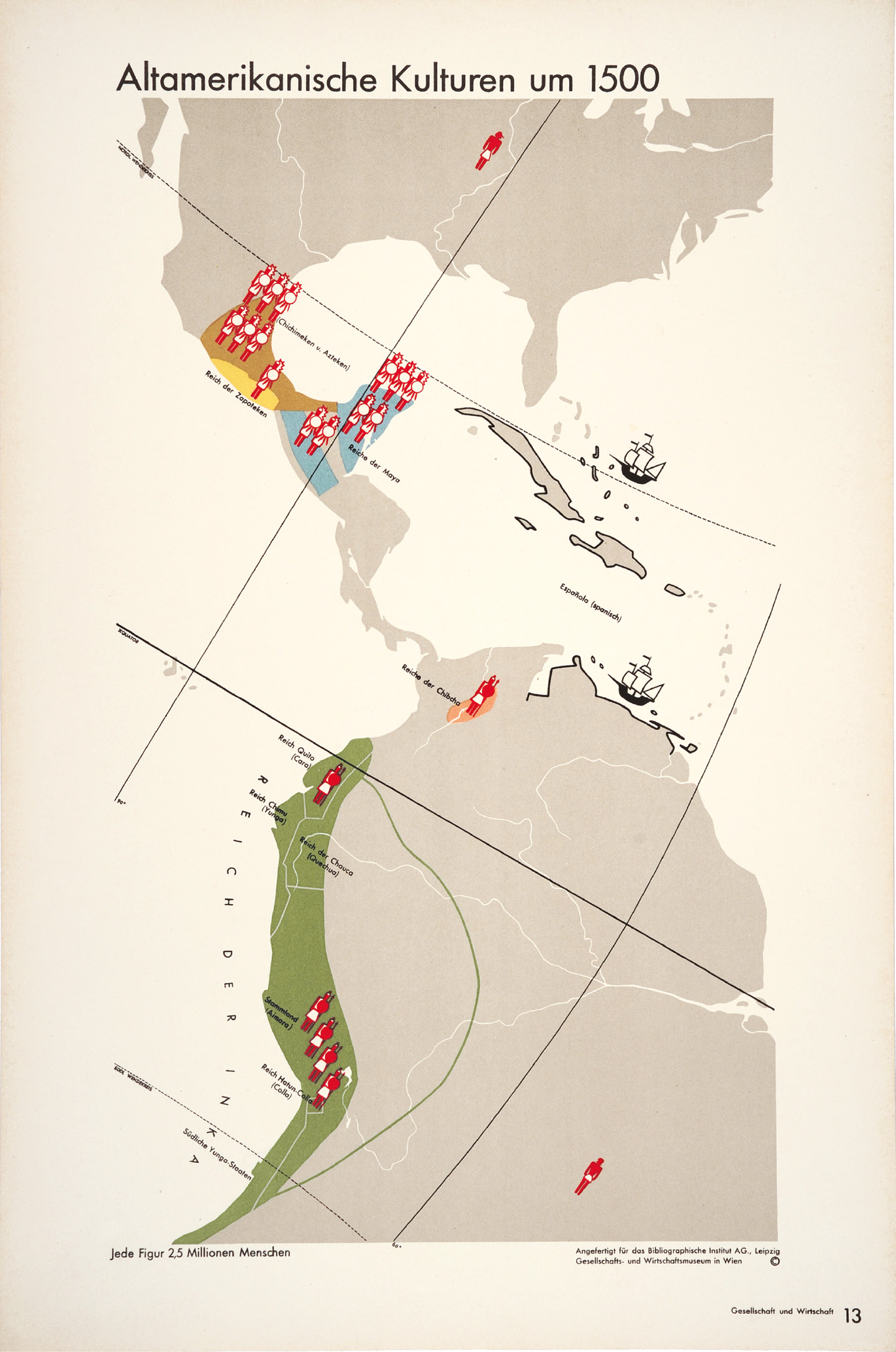
7 Conclusion
Democratisation of knowledge was a leitmotif for both the Social and Economic Museum of Vienna and Ernst Mach Association, as well as for other educational efforts involving representatives of the Vienna Circle’s so-called “left wing”. Science and education were seen as collective projects in both the Vienna Circle and the Vienna Method of Pictorial Statistics: the philosophy of science and visual education were both positioned against the individualistic cult of genius. The concept of collective work appears repeatedly both in the Vienna Circle manifesto and in Neurath’s writings about Isotype. Neurath, in particular, was tireless in listing the work of others (past and present) whom he wanted to embrace within the fold of Logical Empiricism – even, with reservations, Wittgenstein. Yet he bristled at the adulation he detected in the treatment of Wittgenstein by some other Circle members.
Both the Scientific World-Conception and Isotype shared a utopian character in the positive sense: they held out the prospect of a social transformation. Not surprisingly, then, they also shared the same enemies: metaphysics, clericalism, nationalism, and anti-Semitism. The Social and Economic Museum and the Ernst Mach Association were closed down at almost the same time in 1934, both due to their alignment with the Social Democratic Party, although neither of them were strictly party organizations. Nevertheless, they represented the same ideological milieu that was loathsome and threatening to the political right.
So there are obvious personal and institutional connections between Logical Empiricism and Isotype. However, it seems that only Otto Neurath considered visual education part of the Scientific World-Conception, and he developed it largely outside the Vienna Circle. There is one particular, tantalizing parallel that occurs in an essay Neurath wrote about unified science in 1933: his oft-repeated catch-phrase of the Vienna Method, “Words divide – pictures unite”, was modified to become “Metaphysical terms divide – scientific terms unite.”102 It is tempting to interpret an equivalence here, but Neurath certainly did not consider all words metaphysical, nor all pictures scientific; the more significant connection may simply be his favoured rhetorical device of opposing contrasts.
The Unity of Science movement could be seen as a lasting successor to Logical Empiricism, especially considering the project of the International Encyclopedia of Unified Science, of which Neurath was editor-in-chief. He also envisaged a multi-volume “visual thesaurus” as the fourth section of the encyclopedia, although no pictorial volumes were ever produced. In a letter to Susan Stebbing, he stated: “The educational background for Visual Education is that of Unified Science”. Referring to the two elements of his thesaurus/encyclopedia plan, he wrote: “The one Unification by Visualization, the other Unification by Logicalization.”103 This complementarity was inherent in Neurath’s earliest ideas (from around 1920) for such an encyclopedia, and he explained that two stimuli influenced him in the following years: firstly, “As a director of a museum in Vienna … I, together with my collaborators … became profoundly interested in developing a consistent method of visual education”; secondly, and concurrently, was the development of the Vienna Circle, in which philosophy
When Neurath, as the “big locomotive”105 of the Unity of Science movement died in 1945, the strong connection of Isotype to scientific philosophy ceased to a large extent; yet, the connection of Isotype to science was continued by Marie Neurath, who directed the Isotype Institute during the following decades. Her work in researching, writing, and designing books about science for young readers – making complex subjects comprehensible in pictures – was firmly in the spirit of the Scientific World-Conception.
Citations in this chapter are taken from published English translations where possible; all other translations are by Christopher Burke.
A significant exception is Daston/Galison (2007).
Roser 1996, p. 12.
During 1932, Neurath discussed philosophical ideas with junior co-workers at the Vienna Museum, Marie Jahoda, Oskar Umrath, and Rudolf Brunngraber, and he organized seminars at the end of the working day (which Rudolf Carnap also attended) to attempt to render Freud’s theories in physicalist language. See Jahoda (1982), and Carnap (1963), p. 58.
Carnap (2022) recorded in his diary (8 July 1933) that Neurath, despite international success, felt “like a poor little lamb [armes Haserl] and lonely, because he cannot talk about his things, especially picture statistics, with a real expert”.
Neurath to Stebbing, 8 April 1939 (Otto Neurath Nachlass, Vienna Circle Archive, Haarlem [onn]). In an earlier letter (9 March 1935, onn), when International Picture Language was in preparation, Neurath told Stebbing that it would show “the connection between my logical standpoint and my promotion of the picture language as a helping language for education and information”.
Neurath 1930/1, p. 154.
Neurath 1931d, p. 115 (italic in original).
Neurath 1929, p. 139.
Neurath 1929a, p. 306.
Lupton 1986, p. 49.
Neurath 1929a, p. 305.
Romizi 2012, pp. 210, 234.
Neurath also wrote articles about the Vienna Method from 1925 for publications of the Social Democrats and of the labour movement.
Neurath 1929b, pp. 345–346.
This question may have been praying on Neurath’s mind at that very time due to the problem of making a chart about unemployment for Gesellschaft und Wirtschaft (see below and fig. 11).
Neurath 1928, pp. 128–129.
The cover and title page list the subjects shown as “forms of production, social order, cultural stages, and standards of living”.
Uebel 2013, p. 63. Rudolf Goldscheid had already used the expression in 1923; see Sandner 2014, p. 223.
Sigmund 2017, p. 141.
Uebel 2007, p. 170.
Hans Hahn teased Neurath about Einheitswissenschaft with the play on words “Einheiz-Wissenschaft” (heated-up science); see letter Neurath to Carnap, 16 June 1945, in Cat and Tuboly (2019), p. 640. Neurath first mentioned “Logical Empiricism” in “Physikalismus”, Scientia 50/1931, p. 297 (translated as Neurath 1931c). Neurath (1946, pp. 500–501) explained: “Schlick and others have been fond of ‘Radical Empiricism,’ a term used by William James. … I succeeded in getting the word ‘radical’ dropped entirely, as far as I can see; but I have been less successful in promoting ‘Logical Empiricism’ instead of ‘Logical Positivism,’ a term much liked by many friends and critics. Not being a pedant I can bear that.” Both Carnap and Neurath resisted “Logical Positivism” due to its evocation of Comte and earlier positivism; yet a cue had been given in the Vienna Circle manifesto, which stated: “We have characterised the scientific world-conception by two features. First it is empiricist and positivist” (Neurath 1929a, p.309). See Stadler (1991); see also Philip Frank’s reflection on terminology in Erkenntnis 5, 1935 (p. 4), where he neglects to name Neurath as a representative of the “antimetaphysical movement” in Central Europe. It should be pointed out that “Logical Empiricism” was coined by Eino Kaila in 1926 (Uebel 2013, pp. 60, 72).
Neurath 1936a, p. 8.
For Neurath (1945, p. 257), humanization was “a procedure from the simplest to the most complicated”, whereas popularization was the opposite, a top-down process of simplifying complexity.
Neurath (1933), p. 269. Neurath misquoted Heidegger here: the original phrase from Was ist Metaphysik (1929) was “Das Nichts selbst nichtet” (a literal translation is “The nothing itself nothings”). This particular utterance had been criticized for false logic by Neurath’s Vienna Circle colleague, Rudolf Carnap (1931).
Neurath 1933, pp. 271–273.
Neurath 1931e, p. 64.
Neurath 1933, pp. 271–272. By comparison, the “universal jargon” of unified science was surely hampered in its “universality” by language barriers. Neurath (1946, p. 500) explained: “The English Universal Jargon would, therefore, be translatable into the French Universal Jargon or into the Esperanto Universal Jargon.” That sounds deceptively simple, and the quest for a logical syntax of language is complicated by translation, which is not strictly a science.
Neurath 1933, p. 274.
Neurath and Kinross (2009), pp. 47–49. By her account, Marie Neurath co-wrote the text of International picture language.
Neurath 1936a, pp. 18–20.
Neurath 1936a, p. 66, pp. 103–104.
Neurath 1945, pp. 262–263, 278.
Neurath 1945, p. 263.
Neurath 1945, p. 274.
Neurath 1945, p. 332.
Neurath 1945, pp. 319, 331.
Neurath 2010, p. 119. Before leaving Vienna, Neurath referred to the Vienna Method as a picture-script [Bilderschrift], never as a language. “Picture language” seems to have been forced on him partially by the limited vocabulary of Basic English, which does not include “script”.
The first experiments with pictorial statistics occurred at the Museum of War Economy in Leipzig, which Neurath directed between 1918 and 1919. No images have survived of this work. See Sandner 2014, pp. 91–98, and Vossoughian 2008, pp. 49–54.
The evolution of Isotype, in graphic terms, is well documented by Kinross 2013.
Neurath cited in Stadler 2001, p. 217.
Wittgenstein himself later questioned the concept of an “inner picture”; see Mitchell 1988, p. 367.
See the mammoth footnote 2 in Neurath 1933c, p. 274.
Rand’s protocol of meeting on 26 February 1931, in Stadler 2001, p. 257.
See Hintikka 1997, p. 167, for a reflection on what Wittgenstein meant by “showing”.
Neurath 1933b, p. 243. A similar phrase resurfaced in his later writings: for example, in Neurath 1945, p. 328: “If it is not applied too pedantically, the slogan ‘What you can present by means of pictures do not express by means of words,’ might be promoted.”
Neurath to H.E. Kleinschmidt, 8 July 1945 (Otto & Marie Neurath Isotype Collection, University of Reading [ic] 1/46). Another interesting parallel is Tractatus 4.016 “In order to understand the essence of the proposition, consider hieroglyphic writing, which pictures the facts it describes. And from it came the alphabet without the essence of the representation being lost.” Neurath did think that something had been lost in that development; see Neurath 2010, p. 104.
Neurath 1934, p. 109. Intriguingly, Wittgenstein marked “Plagiat l.w.” against a footnote in his own copy of Carnap’s essay “Die physikalische Sprache als Universalsprache der Wissenschaft” (1932, p. 452), in which Carnap credits Neurath’s view and summarizes it. Reproduced in Limbeck-Lilienau/Stadler (2015), p. 237.
Neurath 1931, p. 190. An alternative translation appears in Neurath 1931d.
Neurath 1931e, p. 66.
Neurath 1934, p. 108. On Neurath’s “syntacticism” see Anderson 2019.
Sigmund 2017, p. 302.
Neurath 1929a, p. 309.
Neurath 1931c, p. 54.
Strangely, Neurath wrote to Susan Stebbing that, in the book Basic by Isotype (1937), he “intended to show that certain arrangements of words are ‘isomorph’ to arrangements of visual elements” (letter Neurath to Stebbing, 8 April 1939, onn). In fact, this book shows the opposite – that there is no exact correspondence of form between the two modes of representation (Burke 2011, p. 35). Pietarinen (2011, p.73) argues that “pictures possess special iconic qualities that linguistic assertions by and large lack, which shows up in the ‘greater effect’ of the former by virtue of them being closely related to our actual cognitive structures and processes of thinking and reasoning.” Yet Pietarinen’s attempt, in his otherwise perceptive essay, to reconfigure an Isotype health warning about rickets with an “added logical structure of connectives” robs the example of its rhetorical power, which relies on simple comparison by adjacent placement.
Neurath discussed use of the term “semiotic” with Charles Morris for the International Encyclopedia of Unified Science (Burke 2011, pp. 41–42). It is likely that Neurath came across Peirce’s “Prolegomena to an apology for Pragmaticism” (1906), or the effective summary of it in Ogden/Richards (1923). Peirce (1906) set out a diagrammatic “System of Existential Graphs”: his idea of iconic representation related more to diagrams than pictures, and at one point he seemed to equate icons with syntax (p. 513). In discussing Peirce’s views that a diagram can show logical relations, Ambrosio (2014, p. 263) comments that he should not be seen as “a precursor of the concept of observability that the Logical Positivists, later on, would associate with the meaning of ‘observation statements’”; but she goes on to explain that “diagrams – and indirectly, iconic signs – for Peirce are an opportunity to reflect on the evidential status of logical relations. … relations are discovered through the very process of constructing and inspecting a diagram.” This could serve well, also, to describe the purpose of Isotype charts to reveal connections.
Neurath 1931a, p. 192.
Neurath 1930, p. 144 (italic was bold in original).
Neurath was however keen to use colours “physiologically” on maps, in agreement with cartographic adviser to the Vienna Museum, Karl Peucker. See Neurath 2010, pp. 107–108.
Neurath 1927, p. 187.
Neurath 1926, p. 60.
Neurath 1926a, p. 55.
Neurath 1933, p. 287.
Romizi 2012, p. 216.
Galison 1990, p. 723. Isotype was not “constructivist” in the art-historical sense of tending towards abstract, geometrical form, which was typical of the Bauhaus. Gerd Arntz consciously distinguished his style, applied to Isotype pictograms, as “figurative constructivism”. See Benjamin Benus, “Figurative constructivism and sociological graphics” in Burke/Kindel/Walker 2013, p. 217.
Neurath 1941, p. 218. Jordi Cat (2019, p. 283) characterizes pictorial statistics and physicalist language as representing “the two faces of the Leibnizian algebraic project: the language against the calculus”. Cat (2019, p.319) also mentions Neurath’s familiarity with the work of J.H. Lambert, the second volume of whose Neues Organon was titled Semiotik (1764). Neurath seems to have disliked the term semiotic, and dismissed Lambert as a “mediocre thinker” overshadowed by Kant (Neurath 1936, p. 687). Nevertheless, some of Neurath’s ideas about language and symbolism are prefigured in Lambert’s book.
Neurath 1931, p. 180. Neurath also suggested that a photographic portrait could help to replace the fuzzy term “Otto” in protocol statements.
Neurath 1933a, p. 462.
Neurath 1931, p. 185 (this sentence is italicized in the original).
Neurath 1933, pp. 269–270 (italic in original) and p. 290.
Neurath 1933a, p. 462.
See a summary of contemporary criticism in Burke/Kindel/Walker 2013, p. 196–200, and in Sandner 2014, p. 191.
The chart was reproduced in the exhibition “Das rote Wien” (Red Vienna) at the Wien Museum (2019) and provoked this very question during a guided tour given by Günther Sandner for students of the Social Academy of the Chamber of Workers – precisely the kind of audience Neurath had in mind for workers’ education in the 1920s.
Fuss (1927, pp. 40–58) concludes that the French census figures “cannot be accepted without scrutiny”, and asserts that the number must in fact have been greater due to flaws in the census questions, which did not take into account home workers, for example. He questioned the oft-repeated assertion that France had practically no unemployment during the 1920s. He made further criticism that data from state-supported unemployment funds were not taken into account in official statistics, as they were in other countries.
Instead Gesellschaft und Wirtschaft (p. 123) frames the issue in a broader context of labour, with references to other charts. This was a characteristic strategy of Isotype, to provide connections to a larger body of work, in order to enrich a wider picture. The appendix text on “Workers’ movement” states: “France is moderately industrialized (chart 76), not over-populated, and therefore still attracts workers (charts 74, 87), has weak labour organization (chart 84) and has had few strikes until now compared to Great Britain and Germany (chart 88).” See also the later “Unemployed” chart (1932) discussed by Kinross (2013, p.158), in which the data for 1920–8 remains consistent with figure 11.
See: Chizlett 1992; Kinross 1994; and Emma Minns’s essay in Burke/Kindel/Walker 2013.
See the letter from Neurath to Carnap quoted in Galison 1990, p. 741; and Sandner 2014, p. 232.
Neurath to Patrick Meredith, 20 January 1942 (ic 1/35).
In his Cambridge lecture Neurath gave Weber’s The Protestant ethic and the spirit of capitalism as an example of a dubious cause-effect thesis. Neurath (1945, p.259) wrote: “The Unity of Science Movement is really concerned with a common terminology and with replacing e.g. a ‘cause-effect’ terminology by a ‘grow-out-of’ terminology.”
Neurath 1941, p. 226. Neurath (1930a, p. 45) warned of “the danger that one creates a new idol by the postulate of complete definiteness”.
Nemeth 2019, p.136.
Neurath 1932/3, p. 98.
Neurath 1931b, p. 50.
Neurath 1931, p. 185.
Otto Neurath, “Memorandum: dovetailed plans on series of books, textbooks, books for children”, typescript, c.1944 (ic 3.2/61), cited in Burke/Kindel/Walker 2013, p. 337.
Neurath to H.E. Kleinschmidt, undated [1944] (ic 1/46).
Uebel 2020, p. 45.
Neurath 1933, p. 286.
Neurath 1927, p. 187.
Neurath 1930, p. 145.
Neurath 1936a, p. 66.
Neurath 1945, p. 253.
Neurath 1925, p. 523.
Neurath (1933, p. 284) explained that the element of standardization in Isotype “contradicts the essence of advertising”.
Neurath 1945, p. 305.
Neurath 1933, p. 305.
Neurath 1933c, p. 23.
Neurath 1933c, p. 23.
Neurath to Stebbing, 8 April 1939 (onn).
Neurath 1937, pp. 274–275.
Carnap to Neurath, 23 August 1945, in Cat/Tuboly 2019, p. 648.
References
Burke, C. (2011) ‘The Linguistic Status of Isotype’, in Heinrich, R., Nemeth, E., Pichler, W. and Wagner, D. (eds.), Image and Imaging in Philosophy, Science and the Arts, Proceedings of the 33rd International Ludwig Wittgenstein-Symposium in Kirchberg, 2010, vol. 2. Publications of the Austrian Ludwig Wittgenstein Society – New Series vol. 17, Frankfurt a. M: Ontos Verlag, pp. 31–57.
Neurath, O. (1936a) International Picture Language: the First Rules of Isotype (Psyche miniatures, general series, no. 83), London: Kegan Paul, Trench, Trubner & Co.; reprint of first edition (with German translation), Reading: Department of Typography & Graphic Communication, University of Reading 1980.