


5.1 Overview
Chapter 3 outlined the historical background of environmental litigation in Japan, particularly antipollution cases that attorneys in the current climate lawsuits have consciously treated as legal antecedents. Chapter 4 then identified the key features of Japan’s five climate cases and analyzed their progress through the courts. Building on those discussions, this chapter examines the institutional obstacles that hinder the development of CCL in Japan. In doing so, it offers a refined perspective on the significance and function of CCL within Japan’s sociolegal context.
Like earlier forms of environmental litigation, CCL in Japan has been used by activists as a strategic tool to influence governance on climate and environmental issues. The LOS framework is therefore useful for analyzing the sociolegal conditions under which Japanese CCL unfolds. LOS has been widely used to assess the likelihood that a particular social movement will pursue legal mobilization, typically involving three core indicators: access to courts, existing law, and judicial receptiveness. Originally developed in studies of the Global North, the framework has also been adapted for the Global South. Setzer and Benjamin (2019, 2020) highlighted distinctive characteristics of Global South cases, including stronger reliance on human rights claims and more proactive judicial remedies for climate-related rights violations. Their work illustrates how LOS analysis can reveal contrasts between regions where CCL is more established (in the West) and those where it is still emerging (the Global South).
This study extends that comparative perspective by focusing on Japan – a country generally categorized as part of the Global North but whose CCL practice remains relatively undeveloped compared to Western counterparts. To properly assess Japan’s sociolegal context, the LOS framework requires modification. Certain structural features – low litigation rates, widespread civic unfamiliarity with the judicial system, and limited experience with climate-related judgments – pose major obstacles. With only five major cases to date and no binding precedent, CCL in Japan faces both practical/institutional and cognitive barriers. At the same time, Japan’s legacy of antipollution lawsuits provides important historical reference points.
Accordingly, this study adapts the LOS framework in three ways: First, the indicator of access to the courts (discussed in Section 5.2) is expanded to include not only legal standing but also the resources necessary for citizens to initiate litigation. These resources may be financial (e.g., funding, donations) or professional, particularly access to attorneys willing and able to support climate-related claims.
Section 5.3 examines posed by Japan’s existing legal framework, including its statutes and case law. This second LOS indicator traditionally focuses on analysis of favorable statutory frameworks and legal precedents. In Japan, however, the absence of meaningful CCL precedents has led attorneys in the four major cases to rely heavily on environmental case law to bridge normative gaps in climate regulation. For this reason, the study places greater emphasis on precedents from environmental lawsuits.
In Section 5.4, the focuses switches to judicial receptiveness, the third LOS indicator, which concerns the characteristic tendencies of the Japanese judiciary. Here, too, past environmental rulings are particularly instructive, since judicial attitudes vary across different fields of law in Japan.1
For comparative purposes, these discussions primarily refer to the United States, which accounts for approximately 65 percent of all CCL globally and has generated case law that has shaped the conventional model of CCL. However, a secondary comparison is made with South Korea, whose experience is especially relevant as another East Asian country with a legal system and social conditions resembling Japan’s. Section 5.5 concludes the chapter with a discussion of the procedural relationship and weight distribution between the three LOS indicators.
5.2 Access to the Courts
5.2.1 Standing
Standing – the right of a party to bring a claim – is the first major hurdle in initiating legal litigation. In most jurisdictions, including the United States, South Korea, and Japan, standing requirements are intended to ensure that only appropriate claims are adjudicated. However, when applied too strictly, these requirements can impede access to justice, particularly in environmental cases.
Internationally, various efforts have been made to loosen standing barriers. The Aarhus Convention (1998) operationalizes the participatory principles of Principle 10 of the 1992 Rio Declaration.2 Article 9 calls for broad and flexible interpretations of standing to facilitate public participation in environmental litigation.3
Similarly, the UNEP Bali Guidelines (2010) provide further nonbinding guidance, establishing a normative standard for interpreting Principle 10 through twenty-six recommendations – twelve of which concern access to justice.4 Guideline 18 recommends that states “should provide a broad interpretation of standing in proceedings concerned with environmental matters to achieve effective access to justice.”
Building on these developments, the Environmental Democracy Index (EDI) was launched in 2015 by the World Resources Institute (WRI) and The Access Initiative (TAI).5 The EDI operationalizes the Bali Guidelines through seventy-five legal indicators and twenty-four practice indicators (Okubo 2017). Notably, Indicator 18 addresses standing through both a legal and a practice indicator (Table 6).

Guidance notes for EDI Indicator 18
Source: Reproduced from EDI Technical Note, p. 38
The EDI was the first systematic international assessment of environmental democracy, covering seventy countries with input from over 140 legal professionals. Each indicator, including standing (Indicator 18), was scored from 0 to 3 based to the level of public access to justice.6 Both the United States and Japan were included in this assessment (South Korea was not). As of this writing, none of the three countries has ratified the Aarhus Convention. The EDI ranked the United States third overall, with a mean score of 2.2, while Japan ranked thirty-third, with a mean score of 1.5. Table 7 presents their scores on the issue of standing.
Scores for EDI Indicator 18: United States and Japan
Source: Reproduced from EDI Full Result Data
Both countries scored 1 on the legal indicator, reflecting relatively restricted standing in statutory terms. However, practice indicator 18-1 reveals a sharp divergence: the United States scored 2, while Japan scored 0.7 This difference reflects the fact that, in practice, US law provides multiple pathways for citizen groups to obtain standing, leading to more active legal mobilization, despite the leniency of the statutory system. By contrast, Japanese citizens and NGO s face stricter barriers to participation. The following paragraphs examine how standing is established in each country, the role of group actions, and the relevant judicial precedents shaping these conditions.
In the United States, most environmental cases fall into two categories: judicial review and citizen suit (Hatakeyama 2008; Salzman 2019, 391–393). Judicial review is governed by the Administrative Procedure Act (APA), which establishes a general standing requirement for federal plaintiffs. Article 702 provides that: “A person suffering legal wrong because of agency action, or adversely affected or aggrieved by agency action within the meaning of a relevant statute, is entitled to judicial review thereof.”8
This provision has often been read as enabling public actions in which private individuals act as “private attorneys general,” representing broader public interests (Mashaw, Merrill and Shane 2009, 1101). Relying on this statute, numerous public interest lawsuits have gradually expanded the scope of standing in judicial practice.9 The US Supreme Court has clarified four criteria for the admissibility of standing:10
First, plaintiffs must prove that the questioned action has caused or will cause plaintiff injury in fact. Second, he or she must demonstrate that this injury is attributive to the action. Third, the plaintiff must show that the court can redress the injury by some form of available relief. Fourth, the judiciary prudentially tasks it by itself not to infringe on the legislative or executive domain. The injury must be within the zone of interest that the underlying substantive statute is designed to protect. (Hatakeyama 2008, 148–149; Salzman 2019, 393)
These requirements, designed to establish clear a cause-and-effect relationship, are particularly demanding in CCL, where traceability and redressability are often contested. A key turning point was the 2007 US Supreme Court decision in Massachusetts v. EPA – the first to officially recognize CO₂ as a pollutant subject to regulation under the Clean Air Act (CAA) – which has been viewed as substantially lowering these barriers in favor of climate action.11
The case, brought by twelve US states and thirteen environmental organizations, sought regulation of GHG emissions from new motor vehicles. Standing – especially the element of redressability – was a central focus. The court acknowledged that regulating vehicle emissions alone would not reverse global warming, given other domestic and international sources. Still, it rejected the argument that this limitation stripped courts of authority and affirmed the courts’ jurisdiction to determine whether the Environmental Protection Agency (EPA) was obligated to act against air pollutants.12 The court then modified precedent,13 holding that plaintiffs can satisfy redressability by showing that a favorable ruling would relieve a discrete injury to themselves, even if it does not eliminate all harm. Notably, the court emphasized that the incremental nature of climate change does not negate the relevance of remedies. Measures such as phasing out older, higher-emission vehicles and replacing them with cleaner models could gradually address the harm, and this was sufficient to establish standing.
In 2015, eight years after Massachusetts, the case of Juliana was filed by twenty-one youth plaintiffs under the age of nineteen. The plaintiffs alleged that the federal government had violated their constitutional rights – under the Fifth and Ninth Amendments – to a climate system capable of sustaining human life.14 They further argued that the government had breached its obligations under the public trust doctrine by failing to preserve a stable climate as a shared resource.
In November 2016, the US District Court for the District of Oregon denied the government’s motion to dismiss, citing Massachusetts. The court held that it was sufficient for plaintiffs to demonstrate that the requested remedy would slow or reduce the harm, thereby satisfying the redressability requirement. As discussed earlier, redressability is required to admit standing and generally assumed to involve a complete and timely remedy. However, in CCL, emissions reductions may take decades to manifest, and reductions from a single source may not yield sufficient mitigation. These factors have made redressability a recurring barrier to establishing standing.
The Juliana case proceeded through complex procedural steps until January 2020, when it was dismissed on the grounds that climate regulation was a matter of policy. In March 2020, plaintiffs petitioned for rehearing en banc (“on the bench”) before the Ninth Circuit Court of Appeals, which was granted. In March 2021, they submitted a motion to amend their complaint.15
Since the 1970s, every major US environmental statute has included citizen suit provisions, which empower private parties to enforce environmental laws.16 The first such provision appeared in the 1970 amended CAA,17 granting citizens the right to sue violators for injunctive relief and penalties (Garner et al. 2014, 298). Environmental groups have widely relied on these provisions as tools of advocacy.
Citizen suit provisions enable both individuals and organizations to bring two types of claims not authorized under the APA. First, both may sue public or private entities for violating environmental laws – a strategy frequently used especially by environmental NGO s (Salzman 2019, 392). Second, they may sue government agencies such as the EPA for exceeding their discretion or failing to carry out mandatory duties, thereby enabling private actors to serve as “quasi-public prosecutors.” Citizen suits most frequently invoke the Clean Water Act and the Resource Conservation and Recovery Act (Hatakeyama 2008, 295). For instance, between March 2019 and June 2010, sixty citizen suits were filed under the Clean Water Act in California alone, most initiated by environmental groups (California Environmental Protection Agency 2010).
Citizen suits, however, have limitations. To prevent abuse for personal gain, most statutes restrict them to injunctive relief, excluding claims for monetary compensation. Certain violations are exempted for political reasons, and suits are typically permitted only for ongoing violations, not past actions. These restrictions have influenced the United States’ score on the EDI with respect to the scope of citizen suit provisions.
In South Korea, class action lawsuits are generally prohibited, with the sole exception of certain securities-related transactions (Park 2020). There, Securities-Related Class Action Act specifies both the transactions and eligible plaintiffs (Park 2020). This reflects a narrower approach to standing. However, South Korea’s legal system includes a Constitutional Court, established under Chapter 6 of the Constitution alongside the ordinary courts under Chapter 5.18 This court hears appeals beyond the scope of conventional judicial authority, including: (1) constitutional review of statutes, (2) impeachment trials, (3) dissolution of political parties, (4) disputes over authority among state agencies, and (5) constitutional complaints against unlawful state action (Article 111(1)). Inspired by continental European models, notably Germany and France, the Constitutional Court was designed to check government power while operating independently of the general judiciary (Rodrigo 2010).
Japan’s standing requirements differ markedly from those of both the United States and South Korea. Article 9 ACLA limits standing to individuals who can demonstrate a specific legal interest harmed by an administrative disposition.19 Under this framework, organizations typically lack individual rights or legal interests sufficient to qualify as plaintiffs. This restriction severely narrows the strategic options of environmental movements, since organizations are typically better positioned than individuals to shoulder the evidentiary and financial burdens of proving causation. The supportive role of the Kiko Network in Japan’s CCL must be understood against this backdrop.
Japanese courts have occasionally interpreted standing more flexibly (Uga 2006, 163–178). One early example is Sakamoto v. Japan (1962), a case concerning regulation of public bathhouse locations.20 The plaintiff, a competing bathhouse owner, claimed economic harm from the approval of a nearby competitor’s license. The Kyoto District Court dismissed the case for lack of legal interest, but the Supreme Court reversed the decision, reasoning that the Public Bathhouse Law’s aim of preventing excessive competition created a legally protected interest. It concluded that individual economic harm in this context constituted a legitimate legal interest required to admit individual standing (Upham 1987, 240).
A more recent example is Citizen Group v. Japan (2005), known as the Odakyu Elevated Railroad case.21 Local residents sought cancellation and compensation for a project to build an elevated railway, arguing that it would increase noise and vibration and worsen their living environment. They also claimed the rejection of an underground alternative was unjustified. The Supreme Court held that standing under Article 9 ACLA applies to individuals whose legally protected rights or interests are infringed – or are at risk of infringement – and that the relevant regulation must protect individual rather than merely public interests. Applying this reasoning, standing was granted only to residents of areas specifically designated under the Tokyo Metropolitan Government Ordinance on Environmental Impact Assessment as likely to suffer significant environmental impact from the project.22
These cases illustrate a pattern in Japanese judicial reasoning: courts emphasize whether a statute specifically protects individual legal interests, rather than whether actual harm has occurred – a notable contrast with the US approach, exemplified by Massachusetts (Upham 1987, 240). This interpretive framework, established in the Odakyu case, was later invoked in both the Kobe administrative case and the Yokosuka case, where attorneys submitted local hazard maps to demonstrate plaintiffs’ residence in flood- and storm urge–prone zones, along with plaintiffs’ ages to underscore their heightened vulnerability to heat-related illnesses.23
5.2.2 Available Resources
While regulative standing conditions affect access to justice in formal legal processes, the availability of resources determines whether access is feasible in practice. Litigation entails filing fees, administrative expenses, and (in most cases) the professional costs of attorneys and other legal professionals – burdens that often deter ordinary citizens from pursuing environmental cases without external support.
International conventions directly address this concern. Article 9(1) of the Aarhus Convention provides:
In circumstances where a Party provides for such a review by a court of law, it shall ensure that such a person also has access to an expeditious procedure established by law that is free of charge or inexpensive for reconsideration by a public authority or review by an independent and impartial body other than a court of law.
Similarly, the Guideline 20 of the Bali Guidelines emphasize affordability and assistance mechanisms:
States should ensure that the access of members of the public concerned to review procedures relating to the environment is not prohibitively expensive and should consider the establishment of appropriate assistance mechanisms to remove or reduce financial and other barriers to access to justice.
Building on these principles, the EDI provides specific indicators to evaluate whether legal systems provide affordable access to justice. Table 8 summarizes the legal and practice indicators used in EDI’s Guideline 20 assessment.
Guidance notes for EDI Indicator 20
Source: Reproduced from EDI Technical Note, pp. 42–44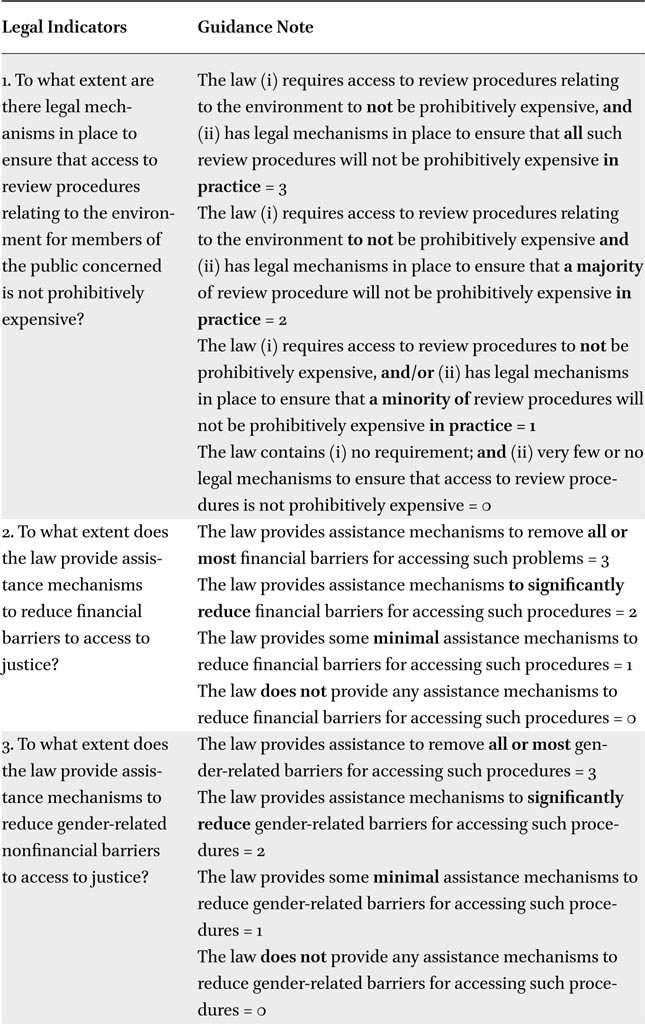
The EDI includes these indicators in part because it was designed to promote citizen participation in environmental matters, particularly in developing countries. The results for the United States and Japan are shown in Table 9.
Scores for EDI Indicator 20: United States and Japan
Source: Reproduced from EDI Full Result Data
Japan outscored the United States on the first two legal indicators, while both countries earned the same points on the remaining ones. Japan’s higher score likely reflects the existence of its official legal aid system, established under the Comprehensive Legal Support Act.24 This system provides financial support to parties unable to pay full legal fees,25 and its presence was a major factor in Japan’s strong EDI showing (Okubo 2017, 42).
In practice, however, the legal aid system is primarily designed to assist parties facing urgent legal issues – such as financial disputes or wrongful accusations – rather than environmental claims, which are not generally regarded as urgent. Statistics confirm that environmental cases receive little to no support under this framework (Figure 4).
Percentages of case categories employing legal aid, 2019
Source: Translated and modified from White Paper on Attorneys (2020b, 252)
Since Figure 4 omits environmental litigation as a category and focuses mainly on individual legal disputes, the EDI results may present a misleading picture.
In reality, plaintiffs in environmental cases are often low-income individuals who face significant obstacles in covering the costs of litigation. This is partly because marginalized communities tend to be disproportionately affected by environmental degradation and pollution. Many such individuals live in areas with poor environmental conditions and limited capacity to shield themselves from harm, while their immediate concern remains maintaining health, livelihoods, and day-to-day stability.
In Japan, as we have seen, the problem is compounded by a lack legal standing for environmental groups. Victims of environmental harm must therefore pursue lawsuits individually, despite the high costs, lengthy procedures, and uncertain outcomes (Hirano 2005, 96–97). Residents of rural areas, where polluting industries often provide vital economic support, are sometimes reluctant to bring cases for fear of jeopardizing local livelihoods (Miyamoto 2012, 6).
These obstacles highlight the need for systematic reform. Despite its challenges, litigation remains one of the most effective means for citizens to raise environmental concerns to both society and government (Awaji 2012, 23–25; Otsuka 2020a, 25–26). In this context, ensuring meaningful access to the courts – particularly through financial support mechanism – is essential to preventing further environmental harm.
Another crucial resource for effective environmental litigation is the availability of qualified legal professionals. In Japan, the number of attorneys specializing in environmental cases is limited, and information on both procedures and litigation costs remains scarce. This uncertainty itself acts as a barrier, discouraging citizens from pursuing legal action.
Figures 5 and 6 present the attorney–citizen and judge–citizen ratios in the United States and Japan between 2011 and 2018.
Number of citizens per attorney in the US and Japan, 2011–2018
Source: Created by the author based on data in White Paper on Attorneys (2018, 63). Due to limited available data, South Korea is not included.
Number of citizens per judge in the US and Japan, 2011–2018
Source: Created by the author based on data in White Paper on Attorneys (2018, 63). Due to limited available data, South Korea is not included – but see International Bar Association (2024, 27).
As the figures show, there is a significant disparity among the two countries. Access to attorneys is considerably more widespread in the US, with one attorney per 260 citizens in 2018. By contrast, Japan had one attorney per 3,162 citizens – roughly twelve times fewer. The ratio differences for citizens per judge is similarly stark. In 2011, there were 9,553 citizens per judge in the US but 44,932 citizens per judge in Japan.
The social position of nonprofit organizations (NPO s) further shapes legal opportunities. In the United States, NPO s have established considerable credibility and status, attracting substantial financial donations and even being viewed as desirable places of employment (Salmon and Tanner 2024). The financial foundation of US NPO s also surpasses that of their Japanese counterparts, as shown in Figure 7.
Percentage share of donations to US (2008) and Japanese (2007) NPO s
Source: Created by the author based on data from the Japanese Cabinet Office, NPO homepage, which includes data both from United States and Japan, https://www.npo-homepage.go.jp/kifu/kifu-shirou/kifu-hikaku (in Japanese)
The orange belt in Figure 7 represents the share of donations to NPO s made by individuals, the yellow donations by legal entities, and the green donations by foundations.26 In 2008, total donations in the United States reached 36.23 trillion yen (approximately 3.54 trillion US dollars).27 That year, donations amounted to 2.2 percent of US nominal GDP – twenty times Japan’s 2007 ratio of 0.11 percent.
This financial capacity, combined with the established social standing of US environmental organizations, enables them to pursue legal action through citizen suits and other administrative procedures. Several climate change cases – including Juliana, supported by Our Children’s Trust,28 – have been made possible by NPO resources. Financial strength allows such organizations to hire full-time attorneys, while pro bono work, highly respected in US legal culture, supplements their capacity. The American Bar Association requires attorneys to provide at least fifty hours of pro bono service annually, a rule that incentivizes participation by offering career benefits.29 Moreover, US courts may order defendants to reimburse prevailing plaintiffs for litigation expenses, including reasonable attorney fees (Salzman 2019, 393), further lowering financial barriers to legal action.
In South Korea, the social status of NPO s has grown significantly since the 1990s, following democratization and broader social transformation (Rodrigo 2010). Prior to this period, the Korean government had controlled political activities and suppressed civic activism. Democratization created an environment more conducive to NPO activity, and today, NPO s often confront government and business interests directly, enjoying considerable media visibility and public support.
By contrast, NPO s in Japan have yet to establish comparable recognition or trust. University students rarely view NPO s as viable employers, and donations remain limited. In 2007, total donations amounted to 591 billion yen – the lowest among the three countries – and represented just 0.11 percent of GDP (Figure 7).30 Unlike in the US, Japanese attorneys are also not subject to any formal pro bono requirements. Since the antipollution era, most have participated in environmental litigation voluntarily basis or for minimal compensation.31 These attorneys, while representing only a small fraction of all registered lawyers in Japan, have shaped the country’s environmental litigation history.
The attorneys leading Japan’s five climate cases reflect this pattern. For instance, the Kobe legal team meets monthly online in the evenings, after completing their regular caseloads.32 Such efforts remain largely invisible to the public, limiting awareness of the potential role of legal professionals in CCL. Consequently, most attorneys prioritize more secure legal practices with guaranteed incomes. Further complicating matters, Japan adheres to the loser-pays rule33 – under which plaintiffs must cover defendants’ costs if they lose – which further discourages litigation, especially where prospects for success are uncertain.
5.3 Existing Law
5.3.1 Statutes
A 2020 policy report by the Grantham Research Institute on Climate Change and the Environment found that every country has at least one climate-related regulation (Setzer and Byrnes 2020, 9).34 However, as the report notes, the relationship between climate legislation and litigation remains ambiguous. Two contrasting examples illustrate this point. In the United States, over a thousand cases have been filed despite relatively few statutes. Over half of the 1,200 US cases rely on just four legislative domains: the National Environmental Policy Act, the CAA, certain state-level impact assessment laws, and wildlife protection statutes. Conversely, Brazil has twenty-eight climate-related laws – including a national Climate Act that provides a comprehensive legal framework35 – but only six climate cases, two of which directly invoked climate legislation. Brazil thus exemplifies a country with extensive legislation but limited litigation.
The Grantham Institute report highlights the complementary roles of legislation and litigation. In countries with few climate laws, litigants may push for new statutes. Where frameworks exist, litigation can be used to enforce or improve them.
In the United States, climate cases have spanned a wide spectrum – from tort liability claims against fossil fuel companies (New York v. BP) to corporate liability suits over failure to disclose climate risks affecting stock prices (Exxon Mobil Corp.).36 Although thirteen climate-related laws and four policies are in force,37 most litigation still rests on the four core statutes noted above.38
The federal system adds another layer of complexity. Multiple venues allow overlapping jurisdiction, often producing disputes about where to file (Sher 2020). Some state courts have dismissed cases, reasoning that climate change falls under federal jurisdiction because of its transboundary nature. A California state district court noted that a “patchwork of fifty different [state court] answers to the same fundamental global issue would be unworkable. … [T]he transboundary problem of global warming raises exactly the sort of federal interests that necessitate a uniform solution.”39 Others have remanded claims to state courts, pointing to savings clauses in the CAA and Clean Water Act that do not bar state-level causes of action.40
South Korea has enacted thirty-one climate-related laws, and twelve cases are listed in the Sabin Center database. These laws cover carbon sinks, emissions trading, insurance for climate disasters, renewable energy, and decarbonization measures. While they have been invoked in litigation, nine of the twelve cases relied on human rights-based claims.41 Of the remaining three, one seeks to halt a loan to a South Korean company for an overseas fossil gas extraction project due to alleged deficiencies in its EIA (Kang et al. v. KSURE and KEXIM); another challenges the National Pension Service for failing to address climate-related risks in its investment strategy, alleging breach of fiduciary duty (Kim Min et al. v. Kim Tae-Hyun et al.); and a third seeks disclosure of records from the Service’s Fund Management Committee concerning its coal divestment policy (SFOC et al. v. Minister of Health and Welfare). All three remain pending.
By contrast, CCL in Japan has drawn on only a handful of statutes. All five cases seek injunctions against CFPP s. The Sendai, Kobe civil, and Youth suits relied solely on Articles 13 and 25 of the Constitution42 – the basis of jinkakuken (personal rights). The Kobe and Yokosuka administrative cases invoked the EIA Act, the EBA (which specifically addresses EIA for power plants), and the ACLA.
Judicial infrastructure also diverges significantly. Serving a population of around 124 million, Japan maintains one Supreme Court, eight appellate courts, and 203 district courts.43 The United States, with a population of about 340 million, has 108 federal courts plus numerous state courts.44 This difference in court-to-citizen ratios may partly explain the stark gap in CCL caseloads (5 in Japan vs. c. 1,200 in the US).
5.3.2 Case Law
Case law, or jurisprudence, shows how statutes are interpreted in practice, shaping expectations for future litigation. In this way, judicial interpretation broadens the scope of legal application over time.
In the United States, case law is foundational within the common law system. The landmark 2007 decision in Massachusetts was later cited in Juliana (2016), where the District Court for Oregon adopted a modified standard for redressability in assessing standing.45 Plaintiffs in Juliana also invoked the public trust doctrine, long applied in environmental cases to argue that governments must safeguard certain natural and cultural resources for public use (Nanda and Ris 1975, 296–298).46
In South Korea, the Constitutional Court ruled in August 2024 that the Climate Change Act violated citizens’ constitutional right to a healthy environment (Article 35). It ordered the National Assembly to amend the law by February 2026. The judgment consolidated four cases, including one brought by nineteen young people in 2020 and another naming a fetus as a plaintiff (Woodpecker et al. v. South Korea).47 The court held that the state has an constitutional duty to mitigate climate change and that national measures must: (1) reflect Korea’s proportional responsibility, based on scientific evidence and international standards; (2) avoid imposing excessive burdens on future generations; and (3) ensure continuous GHG reduction through a clear legal framework. It found the existing law deficient, especially for lacking targets for 2031–2049, and stressed the need to consider impacts on fundamental rights and the limited avenues available to future generations.
Japan also has case law in pollution and environmental litigation, which plaintiffs in the climate cases have drawn upon, as we have seen. One example is the doctrine of shared responsibility under joint tort, developed in the Yokkaichi asthma case (1972), which established that:
When a victim of a joint tort proves the interconnected nature of the tortfeasors’ actions and the causal relationship between the joint tort and the resulting damage, the court presumes causation for each tortfeasor. Under such circumstances, each tortfeasor is liable unless they can prove the absence of causation between their conduct and the damage.48
While this doctrine clarified causation, it left unresolved the question of apportioning liability among tortfeasors. This point was clarified in the first Nishi-Yodogawa case (1978), which involved air pollution–related health damage, where the court held that liability should be distributed in proportion to each tortfeasor’s contribution.49 Relying on this principle, plaintiffs in the Kobe civil case argued that Kobe Steel was evading responsibility for its emissions of PM2.5 and CO₂.
A further issue concerned whether plaintiffs could demand full compensation from a single tortfeasor. If permitted, the defendant could be held responsible for damages caused in part by others, potentially creating inequitous penalties. Legal scholars have long debated this problem. The Kobe plaintiffs advanced a theory of proportionate liability, under which each contributor should bear responsibility based on its share of emissions. On this basis, they demanded that Kobe Steel operate its CFPP in a manner that enables compliance with emission-reduction obligations. This is equivalent to a partial emission-reduction obligation calculated from the company’s share of all emissions. While limiting the operation of CFPP in this way would be economically unfeasible, the attorneys presented this argument strategically to demonstrate the theoretical logic of proportional responsibility and to press the company toward ceasing operations altogether.50
5.4 Judicial Receptiveness
5.4.1 General Cases
Judicial receptiveness refers to the degree to which courts admit, even partially, claims brought by social activists (Vanhala 2020, 1). In this context, the court’s substantive authority over the branches of government becomes significant, as activists often seek systemic reforms to address underlying social issues. Where the judiciary holds strong institutional power, activists can pursue strategies such as public interest litigation or citizen suits to demand institutional reform. Thus, the relationship between the judiciary, legislative, and executive branches – the trias politica – is central in this regard.
The United States is often viewed as a jurisdiction with a strong tradition of judicial activism, though its character has varied over time. Several institutional features contribute to this reputation. First, US Supreme Court justices hold lifetime appointments, which strengthen their independence and capacity to influence other branches of government. While not all US judges enjoy this level of job security, this protection is particularly important for Supreme Court justices, who issue final decisions that constitute binding precedent within American case law. Second, most US judges, particularly at higher levels, have prior experience in legal practice and policymaking roles within government institutions (Tanaka [1991] 2008, 966–69). This background provides them with a concrete understanding of sociolegal realities, enabling them to interpret laws with a balanced perspective that integrates legal theory and real-world context. Third, as a common law system, the United States places case law at the center of legal development. Public interest litigation – including citizen suits – has long been a recognized strategy for advancing not just the interpretation of statutes but broader institutional reform. This long-standing tradition has also been evident in CCL, as was seen in the Juliana case.
In contrast, Japan is widely regarded as a jurisdiction characterized by judicial passivism (Sec. 1.2.3). Rooted in the civil law tradition, the judiciary is generally expected to implement the will of the legislature rather than reshape it. In practice, courts also tend to defer to the discretion of the executive branch, as strongly evidenced in judicial decision-making. Historically, courts have often invoked the doctrine of judicial self-restraint to avoid even minimal risks of encroaching on administrative authority.
A distinctive feature of the Japanese judiciary lies in its system for judge assignment and evaluation. Unlike in the United States, judges in Japan are appointed soon after completing legal training and placed into specific judicial departments. They face reappointment every ten years, based on recommendations from the Supreme Court.51 Additionally, they are routinely transferred to other locations by the Supreme Court every two to three years. These conditions generate subtle but significant pressure arising from the Supreme Court’s evaluations of a judge’s achievements throughout their career. Consequently, many judges hesitate to issue rulings that might conflict with the Court’s implicit preferences – preferences that frequently align, visibly or not, with government policy. This institutional conservatism has long drawn scholarly critique.52
5.4.2 Antipollution and Environmental Cases
The US government’s limited regulatory response to climate change – particularly under the first Trump administration (2017–2021) – prompted a wave of citizen litigation. Plaintiffs sought not only to advance climate legislation (Peel and Osofsky 2015, 29) but also to reinforce constitutional checks and balances. The Massachusetts case (2007) arose during the Bush administration, which had consistently resisted international climate commitments. Under President Trump, further rollbacks of pro-climate initiatives spurred a marked rise in CCL since 2020 (Adler 2019, 5).
In Japan, courts have occasionally departed from their general passivism in the environmental sphere. As we have noted, several landmark rulings of the 1960s and 1970s sided with victims of industrial pollution, contributing to the convening of the “Pollution Parliament” in 1970, which enacted sweeping environmental laws.53 Simultaneously, environmental movements gained momentum nationwide, not only in heavily polluted regions. During this era, legal opportunities proved most effective when judicial intervention coincided with movement-led social mobilization to exert pressure on the legislature to implement environmental protections (Awaji 2012, 25). It is also significant that many plaintiffs in antipollution cases were gravely ill and required urgent relief. Judges, acutely aware of these circumstances, may have felt compelled by a sense of duty to uphold human rights and ensure access to justice.
It is still too early to assess the policy impact of Japanese CCL, as only four rulings have been issued to date – in the Sendai, Kobe civil, Kobe administrative, and Yokosuka cases – and all claims were dismissed. The courts have yet to recognize a legally protected interest, let alone human rights, in relation to climate change. More broadly, Japanese courts have generally taken a highly conservative approach, granting wide administrative discretion in national climate policy. However, the Osaka High Court’s ruling in the Kobe administrative case left open the possibility that a right to be free from climate-related harm could form the basis for standing in the future, depending on evolving domestic and international norms. Japanese CCL, therefore, remains in its early stages.
As discussed in the previous chapter (esp. Sec. 4.4), the climate cases typically involve less immediate and severe harm than the earlier antipollution disputes. Courts may therefore be less responsive to plaintiffs’ appeals for urgent protection or aid. Nonetheless, Prime Minister Suga’s 2020 policy speech announcing Japan’s commitment to net-zero GHG emissions by 2050 marked a turning point.54 Since then, decarbonization efforts have accelerated,55 and CFPP s now face growing political and operational challenges. These broader social changes may in turn influence CCL outcomes.
Civil and administrative procedures, however, operate under different temporal frameworks. Civil courts must consider all matters presented up to the close of proceedings, whereas administrative courts assess conditions as they existed at the time of the challenged administrative act.56 In the Kobe administrative case, the Osaka District Court explicitly considered the sociolegal context surrounding the final notification under the CFPP’s EIA process. This reasoning leaves open the possibility that the Kobe civil case – when adjudicated – may reach a conclusion more favorable to the plaintiffs.57
5.5 Discussion
The LOS framework raises a central question: How do the three indicators – standing, existing laws, and judicial receptiveness – interact in the context of Japanese CCL? Although prior studies applying the LOS framework in other fields have noted interconnections among the indicators, their dynamics in Japanese CCL warrant closer scrutiny. This section first considers the procedural sequence, then evaluates their relative weight.
5.5.1 Procedural Relationship among the LOS Indicators
The foregoing analysis suggests a general procedural relationship among the indicators as they operate within Japanese CCL. First, climate activists seeking institutional reforms to strengthen mitigation typically approach the legislative and executive branches, the most direct and straightforward route. Because most legislation in Japan originates as cabinet-submitted bills, the executive wields substantial influence over lawmaking.58 Open channels between civil society and the government – including the cabinet – are therefore essential for ensuring public voices are heard. This constitutes a sphere of political opportunity rather than legal opportunity.
Yet both the legislative and executive branches often hesitate to pursue stronger climate regulation, largely due to persistent pressure from business interests.59 Public awareness of the climate emergency has also proved insufficient to compel decisive action. The UNDP’s “People’s Climate Vote” (UNDP and University of Oxford 2021) – the world’s largest climate opinion survey – ranked Japan third among thirty-seven countries in recognizing the climate crisis, but only seventeenth in believing citizens should take comprehensive action (Table 10). Although some studies, such as one by the Carbon Tracker Initiative (2019),60 indicate that renewables are becoming cheaper than fossil fuels, many in Japan still perceive large-scale adoption of renewable energy as a driver of higher electricity costs (Yu 2021).
Public recognition and support for climate action by country
Source: Created by the author based on figs. 3 and 6 in UNDP and University of Oxford (2021, 16, 19)
Table 10 suggests that while many Japanese people acknowledge the urgency of climate change, far fewer support immediate, decisive action to address it. This ambivalence allows the government to avoid strong regulation and discourages activists from mobilizing a broad civil movement. As a result, political opportunities for climate action often appear limited.
In this setting, activists may turn to legal opportunities. Even a small group of plaintiffs can initiate litigation if they meet the requirements for court access – including standing and necessary resources – the first LOS indicator. Existing statutory and case law then shape their arguments – the second indicator. Finally, judicial receptiveness, the third indicator, determines how these claims are processed and resolved. When courts respond favorably, their rulings may pressure the legislature and executive to strengthen climate policy, which in turn can generate further legislation and legal mobilization.
5.5.2 Weight Distribution among the LOS Indicators
Although the three LOS indicators function sequentially, examining their relative weight sheds additional light on their role in Japanese CCL. Scholars broadly agree that access to court (standing, resources) – the first indicator – is decisive in shaping legal opportunity (Vanhala 2012, 526–527). As the gateway to litigation, any restriction on standing narrows the range of potential claims.
Here Japan diverges sharply from the United States. Japan’s restrictive standing rules, modeled on an earlier version of the German system, remain among the strictest worldwide. Germany has since reformed its model, introducing an alternative legal avenue granting standing to environmental NGO s (Schall 2008, 436), Japan has not. Attorneys in Japan’s five climate cases attempted to establish standing by linking climate change to air pollution. Yet this strategy backfired in Sendai, where the presiding judge used it to exclude climate-related damage claims early in the proceedings. More broadly, rigid standing rules and entrenched judicial practices deter citizens and attorneys from pursuing novel arguments. They also prolong preliminary reviews, subsequently delaying substantive examination of arguments and ultimately weakening plaintiffs’ and attorneys’ motivation to litigate. By contrast, US courts apply more flexible standards that gradually expanded standing through judicial interpretation.
Available resources – particularly financial capacity – play a decisive role in sustaining litigation. While access to qualified lawyers is valuable, in Japan individuals may file lawsuits without legal representation, making this less of a limiting factor. By contrast, insufficient funds often compel litigants to abandon proceedings regardless of their merits.61 Environmental activists are frequently ordinary citizens or marginalized individuals already burdened with medical expenses, further reducing their ability to finance lawsuits. For this reason, plaintiffs often seek support from organizations and volunteer lawyers. In the five climate cases, most plaintiffs did not suffer direct environmental harm yet still lack the means to sustain long trials. The Kiko Network therefore covers litigation costs and manages financial affairs, while many attorneys participate on a voluntary basis, accepting only nominal fees.
Although resource-related challenges also exist in the United States (Boutcher and McCammon 2019, 309–312), they are generally less severe, as reflected in the large number of climate cases filed there. Numerous nonprofit public interest law organizations, such as Earthjustice, provide stable support.62 In the 2020 fiscal year, Earthjustice paid $4,021,630 in attorney salaries from net assets of $223,636,169.63 No comparable organization exists in Japan.
The second indicator – existing law (statutes and judicial precedents established by case law) – provides the framework for arguments in court. Here Japan presents a distinctive case. Unlike many constitutions that set out detailed human rights protections – for instance, South Africa’s constitutional right to water (Setzer and Benjamin 2020, 97) – Japan’s provisions are sparse and vague. Although Japan has ratified many international human rights treaties, its courts rarely rely on them, since such treaties appear to rank below the Constitution in legal practice.64 Even so, constitutional ambiguity leaves space for creative interpretation. Japanese courts have gradually recognized new human rights concepts in environmental and antipollution litigation, including jinkakuken (personal rights) and derivative rights to a clean environment, sunlight, and quiet (Sec. 3.2.3). The Kobe climate cases extend this line of reasoning by asserting a right to a stable climate system (4.2.2). In several instances, such interpretive strategies have succeeded in securing judicial remedies. Thus, while existing law is not the primary barrier to initiating litigation, it can become a meaningful resource once proceedings begin.
The third indicator – judicial receptiveness – also warrants attention. As noted earlier, Japanese judges wield considerably less influence over policy than their US counterparts. Nevertheless, litigation can achieve indirect effects by raising public awareness and shaping legal discourse. Many plaintiffs pursue litigation not only to win but also to catalyze broader legal and social change.65 This dynamic mirrors the United States, where climate lawsuits often fail on the merits yet still contribute to climate advocacy (McCormick et al. 2018, 831). Globally, the rise in CCL underscores its function as part of wider social movements (Setzer and Byrnes 2020, 4). Within this context, judicial receptiveness in Japan may carry less weight than the other two indicators.
The interrelationship among the three indicators is illustrated in Figure 8. In sum, access to court – including standing and financial resources – emerges as the most decisive factor in shaping legal opportunity. Since Japanese CCL is still in its early stages, the trajectory of future cases may depend largely on how this first indicator develops.
Interrelation among the three LOS indicators as applied to Japanese CCL
Source: Created by the author
5.6 Summary
This chapter examined institutional obstacles hindering the development of Japanese CCL through the lens of the adapted LOS framework. Focusing on access to courts (including standing and resources), existing law, and judicial receptiveness, it identified key features of the Japanese context and contrasted them with those in both the United States and South Korea. Findings indicate that access to courts, particularly standing, is the most decisive factor shaping the trajectory of Japanese CCL.
As we saw earlier, courts in Japan have generally taken a conservative approach on issues that may offend the government’s discretion (Secs. 1.2.3 and 4.2.3). However, they have shown a readiness to protect human rights, for example in interpreting the provisions of the Constitution, especially Article 13 (Urabe 2016, 44–50).
Principle 10 of the Rio Declaration reads: “Environmental issues are best handled with the participation of all concerned citizens at the relevant level. At the national level, each individual shall have appropriate access to information on the environment as held by public authorities, including information on hazardous materials and activities in their communities, and the opportunity to participate in decision-making processes. States shall facilitate and encourage public awareness and participation by making information widely available. Adequate access to judicial and administrative proceedings, including redress and remedy, shall be provided.” Rio Declaration (Chapter 2, supra note 7).
Article 9(2) of the Aarhus Convention (Access to Justice): “Each Party shall, within the framework of its national legislation, ensure that concerned members of the public (a) Having a sufficient interest or, alternatively, (b) Maintaining impairment of a right, where the administrative procedural law of a Party requires this as a precondition, have access to a review procedure before a court of law and/or another independent and impartial body established by law to challenge the substantive and procedural legality of any decision, act, or omission subject to the provisions of Article 6 and, where so provided for under national law and without prejudice to paragraph 3 below, of other relevant provisions of this Convention. What constitutes a sufficient interest and impairment of a right shall be determined in accordance with the requirements of national law and consistently with the objective of giving the public concerned broad access to justice within the scope of this Convention. To this end, the interest of any nongovernmental organization meeting the requirements referred to in Article 2, Paragraph 5 shall be deemed sufficient for the purpose of subparagraph (a) above. Such organizations shall also be deemed to have rights capable of being impaired for the purpose of subparagraph (b) above.” Aarhus Convention (Chapter 2, supra note 7), see https://unece.org/fileadmin/DAM/env/pp/documents/cep43e.pdf.
Bali Guidelines for the Development of National Legislation on Access to Information, Public Participation and Access to Justice in Environmental Matters, adopted by the UNEP Governing Council in 2010, https://www.unep.org/resources/publication/bali-guideline-implementation-guide.
EDI and its Technical Note, May 18, 2015, https://www.wri.org/environmental-democracy-index.
EDI Full Result Data, available for download via https://www.environmentaldemocracyindex.org/node/13967.html.
The scoring of the practice indicators was based qualitative methods due to the difficulty of achieving quantitative evaluations. EDI Technical Note (supra note 5), p. 7.
Administrative Procedure Act, 5 U.S.C. §§ 551–559.
The notion of public interest litigation has many diverse definitions. The tenth edition of Black’s Law Dictionary (Garner et al. 2014) defines it as the “legal practice that advances social justice or other causes for the public good.” See also Ramsden and Gledhill (2019, 425).
These four criteria have been consistently recognized across multiple court rulings as necessary for establishing standing. A typical example is Lujan v. Defenders of Wildlife, 504 U.S. 555 (1992).
Massachusetts (Chapter 1, supra note 5); Clean Air Act, originally established 1963, amended 1965, 1967, 1970, 1977, 1990, and 2022, 42 U.S.C. 85, 7401–7671q.
Per 42 U.S.C. 7602(g): “The term ‘air pollutant’ means any air pollution agent or combination of such agents, including any physical, chemical, biological, radioactive (including source material, special nuclear material, and byproduct material) substance or matter which is emitted into or otherwise enters the ambient air. Such term includes any precursors to the formation of any air pollutant, to the extent the Administrator has identified such precursor or precursors for the particular purpose for which the term ‘air pollutant’ is used.” See https://www.law.cornell.edu/definitions/uscode.php?width=840&height=800&iframe=true&def_id=42-USC-1462657843-1186899448&term_occur=40&term_src=.
Established in Larson v. Valente, 456 U.S. 228, 244, no. 15, 102 Sup. Ct. 1673, 72 L. Ed. 2d 33 (1982).
Amendment 5 reads: “No person shall be held to answer for a capital, or otherwise infamous crime, unless on a presentment or indictment of a Grand Jury, except in cases arising in the land or naval forces, or in the Militia, when in actual service in time of War or public danger; nor shall any person be subject for the same offence to be twice put in jeopardy of life or limb; nor shall be compelled in any criminal case to be a witness against himself, nor be deprived of life, liberty, or property, without due process of law; nor shall private property be taken for public use, without just compensation.” Per Amendment 9, “The enumeration in the Constitution, of certain rights, shall not be construed to deny or disparage others retained by the people.” US Constitution, ratified in 1788, effective from 1789, https://www.senate.gov/civics/constitution_item/constitution.htm.
Our Children’s Trust, the organization supporting the plaintiffs, provides detailed information about the case at https://www.ourchildrenstrust.org/juliana-v-us.
See 42 U.S.C. 7604 (Citizen Suits). The only exception is the Federal Insecticide, Fungicide, and Rodenticide Act or FIFRA (Salzman 2019, 392).
CAA (supra note 11).
Constitution of the Republic of Korea, effective on July 17, 1948, https://elaw.klri.re.kr/eng_service/lawView.do?hseq=1&lang=.
See Secs. 4.2.3 and 4.2.4 for the role of ACLA in the Kobe administrative and Yokosuka cases.
Saiko Saibansyo [Sup. Ct.], January 19, 1962, 16 Minshu 1–57.
Citizen Group (Chapter 4, supra note 39).
Per Article 13(1) of the Tokyo Metropolitan Government Ordinance on Environmental Impact Assessment (Ordinance No. 96 of 1980).
See Secs. 4.2.3 and 4.2.4.
Comprehensive Legal Support Act, Act No. 74 of June 2, 2004, https://www.japaneselawtranslation.go.jp/en/laws/view/3233/en.
Japan Legal Support Center, https://www.houterasu.or.jp/en/consultation_service/index.html (in Japanese).
Kidder and Miyazawa (1993, 607) refer to the existence of thousands of voluntary donors who support social movements in the United States.
Calculated by the author based on the exchange mean rate in 2008.
On Our Children’s Trust, see supra note 15.
According to the Association’s Model Rule 6.1, “Every lawyer has a professional responsibility to provide legal services to those unable to pay. A lawyer should aspire to render at least (50) hours of pro bono publico legal services per year.” See http://www.americanbar.org/groups/probono_public_service/policy/aba_model_rule_6_1.
According to the Charities Aid Foundation’s 2021 World Giving Index report, Japan ranked 107th out of the 125 “Most Charitable Countries”. See https://worldpopulationreview.com/country-rankings/most-charitable-countries.
For a list of such cases, see https://www.jelf-justice.org/jelf/wp-content/themes/jelf-justice/backnumber/newsletter/contents/kougaisoshou.html.
As observed by the author.
Per Article 61 (Principle of Burden of Court Costs) of the Code of Civil Procedure, the defeated party bears the court costs. Code of Civil Procedure (Chapter 4, supra note 49).
See also the Climate Change Laws of the World (CCLW) website: https://climate-laws.org.
Law No. 12, 187, passed in 2009.
City of New York v. BP p.l.c., 325 F. Supp. 3d 466 (S.D.N.Y. 2018), https://climatecasechart.com/case/city-new-york-v-bp-plc; In re Exxon Mobil Corp. Derivative Litigation, No. 3:19-cv-01067-K (N.D. Tex. 2019), https://climatecasechart.com/case/von-colditz-v-exxon-mobil-corp.
Per the CCLW dataset (supra note 34).
The Sabin Center database categorizes US climate litigation into eight types: federal statutory claims, constitutional claims, state law claims, common law claims, public trust claims, securities and financial regulation claims, trade agreement claims, and adaptation claims.
California v. BP plc (/OAK SF I), Nos. C 17-06011 WHA & C 17-06012 WHA, 2018 WL 1064293, at *5 (N.D. Cal. Feb. 27, 2018).
A typical precedent is Boulder, 405 F. Supp. 3d at 968–973.
For a compilation of South Korean CCL cases, see https://climatecasechart.com/non-us-jurisdiction/south-korea. For legislation, see https://climate-laws.org/geographies/south-korea.
For the text of Articles 13 and 25 of the Japanese Constitution, see Chapter 2, supra note 3.
See https://www.courts.go.jp/about/sosiki/kakyusaibansyo/index.html. It should be noted that some of the larger prefectures have several branches within these jurisdictions.
Population figures are World Bank estimates for 2024, see https://data.worldbank.org/indicator/SP.POP.TOTL.
The precedent came from Larson (supra note 13).
For more on the public trust doctrine, see https://www.law.cornell.edu/wex/public_trust_doctrine.
Woodpecker et al. v. South Korea, https://climatecasechart.com/non-us-case/woodpecker-et-al-v-south-korea.
Yokkaichi asthma case (Chapter 3, supra note 8).
Nishi-Yodogawa case (Chapter 4, supra note 15).
Observed at a meeting held following the hearing on February 16, 2021.
Article 81 of the Japanese Constitution provides the Supreme Court with authority to determine the constitutionality of any law, order, regulation, or official act. However, this authority is rarely exercised in practice. The Constitution of Japan (Chapter 2, supra note 3).
Article 76(3) of the Constitution states: “All judges shall be independent in the exercise of their conscience and shall be bound only by this Constitution and the laws.” However, as Urabe (2016, 354–356) claims, the reality is often very far from this ideal.
See Sec. 3.2.2 for a discussion of this era of antipollution lawsuits. On the “Big Four” cases, see Chapter 3, supra note 5. See also Kidder and Miyazawa (1993, 611).
Suga’s speech (Chapter 1, supra note 25).
For example, see the various METI press releases under the theme of “Technology for Carbon Neutral” at https://www.meti.go.jp/english/policy/energy_environment/global_warming/technology.html.
There is no provision specifying the reference time, but both academic societies and legal practice have treated the relevant point as the time when the questioned disposition was made, which deserves acknowledgment (Fujita [1980] 2004, 446–447).
In a previous study on climate change cases in the Global South, each judge’s affirmative recognition of plaintiffs’ rights concerning climate impacts was highly evaluated (Setzer and Byrnes 2019). The authors concluded that such individual judicial efforts cumulatively encouraged many governments to adopt stronger climate measures. This illustrates how judges can exert political influence on governments.
According to a March 2019 Nikkei article, statistics suggest that cabinet-submitted bills are far more likely to pass than those introduced by members of congress (Nikkei 2019).
Top executives from the business community frequently sit on advisory councils on climate policy legislation, while participation by ordinary citizens and NGO s is extremely rare. This suggests that the business community’s perspectives strongly shape the content of climate-related laws and policies. For example, see the list of members of the 11th Subcommittee on the Next-Generation Energy Supply and Demand Structure Aiming for Carbon Neutrality by 2050 at https://www.enecho.meti.go.jp/committee/council/basic_policy_subcommittee/carbon_neutral/011 (in Japanese).
Available via https://carbontracker.org.
In the Civil Litigation Surveys conducted in 2001 and 2016, the high cost of litigation expenses was recognized as the second-largest barrier to filing lawsuits. See Sec. 6.2.
On which see https://earthjustice.org.
According to the organization’s audit report at https://earthjustice.org/sites/default/files/files/earthjusticeauditedfinancialsfy20.pdf.
This hierarchy may be at least partly recognized within the text of the Constitution itself. While Article 7 appears to place “treaty” on an even footing with “the constitution, laws, cabinet orders and treaties,” Article 98(1) states that the Constitution “shall be the supreme law of the nation and no law, ordinance, imperial rescript or other act of government, or part thereof, contrary to the provisions hereof, shall have legal force or validity.” However, Article 98(2) provides that “treaties concluded by Japan and established laws of nations shall be faithfully observed.” The Constitution of Japan (Chapter 2, supra note 3).
Of Kidder and Miyazawa’s (1993) four types of plaintiff objectives, three relate to social change or raising awareness. See Sec 6.4.