


1 Introduction
I write at a moment when Britainâs longest ever reigning monarch has died and, while she is yet to be buried, the U.K. has already smoothly installed a new king upon the throne. The question of whether in the modern age another monarch is justifiable or even moral has fallen under some swiftly stifled protests, a deluge of hyperbolic media, and an outpouring of public emotion. The rhetoric of âproud heritageâ and âlong traditionâ is currently providing an abundant display of the persuasive powers of genealogy, which Sluiter, in her work on innovation in the classical world, describes as a particularly forceful anchoring discourse.1 By this, she means that the new becomes comprehensible and acceptable when it is contextualized in the old and familiarâparticularly if reveredâand when change is presented as a continuation of tradition. Indeed, in the archaic ceremonials surrounding the transferral of power and in the ostentatiously antiquated ritual planned to accompany the coronation proper we see continuity, too, asserting its own peculiar authority in placing a crown firmly on Charlesâ head. It is an instructive backdrop for a chapter on the question of power and legitimacy.
Here, in the context of ancient Rome, this chapter is concerned with the ideological basis of Roman political power, especially among those individuals who rose to superlative positions without the momentum of a hereditary claim. In such cases, those individuals who were most âinnovativeâ with the Roman constitution had to look elsewhere to justify their behavior, validate their authority, and present the discontinuity they embodied as familiar and traditional. Since they could look neither to genes nor the status quo, they turned their eyes to the sky. My argument is, of course, meteorological. I aim to highlight the importance of lightning and the vital role it played in the ideology of Roman power by providing autocrats a conduit not only to Romeâs myth-historical past but a direct line to the divine forces constantly rumbling overhead.
I want to argue that Romeâs first king set a place for thunderbolts and lightning in Roman monarchic rule, which echoed through the centuries of Roman power and which would be revisited in imperial ideology. The point is not to determine the deeds and motivations of any historical Romulus, if such a king ever existed. Rather I am interested in what was said about him by later generations as a lens through which to view those later times, and how later Romans would return repeatedly to Romeâs legendary bedrock to orient and anchor themselves in a changing and often turbulent society. There are accordingly two main sections to this chapter. The first deals with the lightning traditions surrounding Romulus as focalized through the famous fragment of Ennius preserved in Ciceroâs De divinatione (I.107â108).2 Here I test out a new reading of this difficult passage as an exposé of the work thunderbolts came to do more broadly in the conceptual modalities of Roman power. The second section deals briefly with how this played out historically in the political arena by focusing on two key individuals who were instrumental, I believe, in the way thunderbolts became representative of the power wielded by the emperor.
2 First Flashes
We start at the very beginning. When Romulus first raised his city, quarreled with his brother out of what Livy calls âthe greed of kingshipâ (regni cupido, 1.6.4), and became sole ruler, solus potitus imperio (1.7.3), he turned the eyes of the gods upon him. He had to negotiate his place not only in human society but his place in relation to the divine. More cynically, of course, it was the other way round: he negotiated a place for himself in human society by claiming a special relationship with the gods. The act of taking up imperium as the first king of Rome raised the same questions that pursue all rulers: Who has the right to such power? Who gets it? Why? And by what means is it exercised? Throughout history, the response has been varying incarnations of the same answer: God, the gods, the divine.3 Ideologically, kings stand in their elevated positions as mediators between heaven and earth. This is a very ancient and fairly universal phenomenon that was formulated very exactingly in the early modern legal terms of the divine right of kings.4 We see Livy imagining Romulus dealing with this problem at the beginning of his rule. He excuses Romulus for assuming the spectacle of grandeur since he did this, Livy says, because he had been persuaded that his new laws would not seem binding to the eyes of a rustic people unless he invested his own person with majesty and adopted the emblems of authority (1.8.1â2). He states something similar a few passages earlier when he disclaims the truth of his account, stating it is the privilege of antiquity to mingle divine and human things in order to add a sacred majesty (augustiora) to the beginnings of cities. Basically, in order to appear legitimate and to act as if one is legitimate there needs to be a source of legitimation. In the Roman model of majesty, such legitimation was achieved in part through lightning.
Associated with and wielded most often by Jupiter, the king of the gods, lightning always had a close and complex relationship with monarchy. That history can be traced back through the Hellenistic kingdoms, through the classical Greek world, around the Mediterranean to the ancient Near East, and into time immemorial. It was not only because it was the most extreme display of raw power in the human world but because of the way it actually behaved. By striking the highest places and most grand buildings, it inevitably involved itself in the built environment of kings and the splendid places they erected for worship or for living, as well as the conceptual environment in which kings themselves sat in the most elevated positions. It is my contention that lightning provided the Roman world with something akin to the divine right of kings. In its meteorological reality and the myths and memories surrounding it, lightning and representations of the thunderbolt provided a channel for divine endorsement as well as, ultimately, the mortal wielding of divine power.
Divine endorsement is evident in a seminal flash of lightning that occurred during Romulusâ inauguration as ruler. Dionysius of Halicarnassus describes Romulus as enormously satisfied to have been judged worthy of kingship, but Romulus declared he would not accept the honor until the heavens had by auspicious omens likewise given sanction (Ant. Rom. 2.4). A day was therefore appointed to consult the auspices and on that day Romulus rose at dawn and performed his sacrifices and prayers to Jupiter under the open sky. When he asked for a sign from the gods whether it would please them that he should be king of the city, a great flash of lightning (
The question of when such narratives actually emerged and crystallized in the popular imagination and in what political climate the Roman thunderbolt fomented and evolved is important but complex and largely beyond my scope here. Instead, we can narrow the focus to ask when lightning first appears in our written sources behaving in this manner. We turn therefore to Ennius. Although the fragment preserved in Cicero is not a text in which lightning is usually understood to make an appearance at all, I believe it is possible that it is here that lightning first flickers across Romeâs political landscape in the extant textual evidence. It will take some teasing out to show why I think it is there, why the passage makes better sense if it is there, and, moreover, what cultural reasons exist for it to be there, but this process will be useful in laying the groundwork for the larger argument which does not ultimately depend on this new interpretation being correct. If I am wrong, the process of thrashing around the possibility will nevertheless illuminate the work thunderbolts came to do in the thought-worlds of Roman power; if I am correct, then this passage of Ennius becomes a crucial piece in a very fragmented puzzle of Romulusâ relationship with lightning in the mythology of second-century Rome. Moreover, it would present evidence of a tradition (possibly invented by Ennius) that Romulus received auspicious lightning flashes even before the founding of the city and his inauguration, at that decisive moment when he won the contest against his twin, Remus.
3 Ennius, Romulus, and the Candida Lux
The fragment describes the famous contest between Romeâs founding twins. The contest, Ennius tells us, is to decide the very name of the city, whether it was to be Roma or Remora. However, in the subsequent lines it is immediately apparent that more is at stake: whichever brother becomes the eponym of the city will also become its king. It is for this reason that the expectant crowd wait with trepidation to see who will win the prize of great kingship (victoria magni regni). Ennius also tells us, like Livy, that the brothers are desirous of royal power (cupientes regni). Remus positions himself on an uncertain hill and Romulus places himself on the Aventine to wait for signs indicating the divine decision.7 What happens next is familiar; Remus receives six birds as the first omen, but Romulus betters it by thereupon seeing double that number.8
In Enniusâ account, the appearance of the auspicious birds is prefaced with a notoriously difficult passage. The difficulty lies partly in the Latin itself, in both grammar and lexical choice, but to a greater degree in terms of what sense to actually make of it. The passage runs as follows:
What, precisely, sol albus refers to is a matter of debate. Reasonable arguments can be made that this is either the fading sun at the end of the day or the moon retreating into night.9 Since albus is a pale, non-lustrous sort of white, the idea in either case is that this is a retreating heavenly body. This is placed in direct contrast with the golden sun that follows. It is the appearance of the sol aureus that is attended by the appearance of the twelve auspicious birds. The concern is temporal; this is a poetic description of a particular time of day. Now, if we take the sol albus as being the setting sun then, in fact, Ennius is describing the duration of some time between the setting sun and the rising sun in the morning. If the moon is intended, the duration is shorter, and the fading moon indicates the imminent transition from night to day. Either way, there is no doubt that the precipitous moment of the revelation of the divine will occur at dawn. Moreover, at that decisive moment, the temporal focus narrows from indicating a period of time between the soles albus and aureus to a very specific one: the dayâs first light. The simultaneous appearance of the birds and the sun is stressed by use of simul. However, simul is twice repeated. The second time it is used it clearly connects the first dawn light and the flock of birds (avium = gen. pl.). The first time, however, it connects the appearance of a bird singular (volavit avis = nom. sing.) with the phrase: exin candida se radiis dedit icta foras lux. It is this phrase alongside the ambiguous sol albus that has caused so much difficulty in understanding and translating. It is widely read as a complicated reiteration of the same phenomenon of the coinciding birds and dawn. Thus W. A. Falconer in his Loeb translation had the passage as follows:
There is a fair deal of poetic license taken in this translation, which sees the activity of the sun in all cases and unambiguously assigns the shooting rays to the dawn light. Although tidy, it is not a careful translation. Elliot in her 2013 work on Ennius attempts a translation more faithful to the original text:
Meanwhile, the glittering sun retreated to the recesses of night. Then, a bright light, struck forth by [the sunâs] rays, revealed itself, and at that moment from on high a flock portending exceptional success flew by on the left. As soon as the golden sun rose, twelve holy avian beings came down from the sky and betook themselves to lofty and propitious regions.11
Again the âraysâ are attributed to the sun, but Elliot acknowledges in her square brackets that this reading is based on her assumption rather than anything explicit in the text. She, too, reads sol albus as the sun and her imprecise translation of albus as âglitteringâ seems to be an attempt to explain the rays the sun seems abruptly to strike forth in the next sentence; the glittering sun thus retreats into the darkness and then reappears shooting out light again at dawn. However, she has misleadingly transported candida from whatever it is that is going on at dawn to the retreating sol, which is in reality described as albus specifically to contrast with those dazzling events. The events themselves are variously understood. For Falconer, the simul ⦠simul ⦠separates out the flight of a single bird from the left at dawn from the flight of the flock of twelve also at first dawn. Elliot follows Skutsch in reading avis as a collective noun and so the appearance of the flock seems to be a singular event twice repeated by Ennius for dramatic effect.12 By way of a third and final example, Peter Wiseman, with characteristic attention to detail, has analyzed the passage, concluding that Ennius seems to say:
that after the moon had set and the rays of the as yet invisible sun had shot across the sky, a single bird appeared on the left (the favourable side) at the very moment of sunrise; that twelve birds then appeared at the very moment of sunrise.13
For Wiseman, sol albus is the moon and perhaps this allows focus to shift initially from the sun to the darkness that precedes its rising. As well as discerning two separate avian events, in effect, Wiseman seems to suggest two solar ones: the rays of the âas yet invisible sunâ in the darkness before dawn followed by the actual sunrise. Whether or not his translation of âmoonâ is correct, this is a more careful reading of the passage and certainly one possible if ambiguous way for Ennius to describe such events. It seems the appearance of one bird and then a flock of birds indeed constitutes two separate omens and Wiseman seems right to connect these to two separate spectacles of light. What I want to suggest is that these were not both solar in nature. This is, of course, where I want to posit lightning not only as a simpler translation but one which fits well with other evidence for Roman engagement with lightning.14
4 Rays and Bolts: Some Philological Considerations
To begin with the translation issues, in the first pairing indicated by simul, understanding lightning bolts rather than sunbeams involves no stretch of the Latin. While it is true that ârayâ is a possible translation of radiusâindeed, it is the usual translation when associated with the sun or the moonâthere are a variety of other possibilities. In less celestial settings, for instance, it may be a staff or rod or even a spoke. Accordingly, in the heavens, another possibility is the âboltsâ of a thunderbolt. A particularly illuminating instance where radiis is unambiguously used in this sense will be discussed shortly. First, it is worth pointing out where translation as sunbeams falters. This is in the manner in which Ennius describes them behaving. Meunier, who also takes radii to be rays, comments on the difficulty that ensues in furnishing a translation, âqui soit aÌ la fois respecteuse des mots dâauteur et intelligible par les Modernesâ. He highlights the problem translators generally try to gloss over, namely that lux and radiis, âne font manifestement pas reference au meÌme concept, puisquâil est neÌcessaire que les ârayonsâ frappent la âlumiereâ, afin que cette dernieÌre puisse eÌtre visibleâ. Since the light only reveals itself upon being struck, trying to equate this to the behavior of sunbeams is inherently problematic. Wardle, who also translates radiis as rays, notes that the lux has a source which is expressly not the sun and is seen before the sun rises over the horizon though he makes no suggestion what the source might be.15 Meunier even goes so far as to note the explosive quality of the event, describing it as seeming to be âune explosion de lumieÌreâ. However, his explanation then turns to ancient understandings of sight and seeing and in concluding that the rays are actually âvisual raysâ emanating from the eyes of the spectators, the line becomes encumbered with a host of new problems.16
It is the behavior of the light that is uncharacteristic in terms of sunlight. For while radius may be collocated very naturally with the sun and solar activity, it does not collocate anywhere near as effortlessly with icta if rays (whether visual or solar) are intended. Certainly, there are instances where the force implicit in icere makes some sense, such as Tacitusâ description of the statue of Memnon which sings when struck by the dawn light (Ann. 2.61).17 The light here, however, has a causal relationship to the sound, which is supposed to be some sort of reverberation in the stone under the impact of the early morning rays. It therefore makes sense in this peculiar case for the sun to be described as a making tangible, striking action.18 In general, however, the most natural collocation for the hurling, striking connotations of icere is the widespread and well-attested description of objects which are fulmine ictus/ icta. This combination may be seen across the long span of Latin literature. There is an important second-century BCE attestation in Enniusâ predecessor Naevius. If the very late fourth or fifth-century CE commentary by Nonius on this very early source is reliable, then Naevius used the phrase in his tragedy Danae: [â¦] quae quondam fulmine icit Iuppiter (âwhich Jupiter once struck with lightningâ). The fragment is in older Latin and Nonius feels the need to explain that icit indeed means strike (âIcitâ significat percutit, ab ictu [â¦] Non. 123.33) just as he explains that fulgorivit in the phrase Suo sonitu claro fulgorivit Iuppiter means to make lightning or blast with a thunderbolt (Danae, fr. 11 = Non. 110.17). Unless Naevius was being innovative here, it would appear the collocation was in use in the Latin of Enniusâ day. Ennius could therefore simply have replaced fulmen synechdochically with radius also in the ablative, resulting in the same formula: radiis icta. This would read as a familiar collocation readily understandable therefore as struck by thunderbolts. It remains to show that the Latin was used in this way.
One important place where radii occur in a fulgural context is in the next great epic poem of Rome, that of Vergil, where they unambiguously signify the shafts of a thunderbolt.19 In a very illuminating passage in book eight, when Vulcan visits his subterranean smithy in Etna, the scene is set with much hissing and clanking as the Cyclopes work at the forge. Three Cyclopes are namedâBrontes, Steropes, and Pyracmon. These are the elements of the storm well-known from the Greek world.20 They are working, we are told, on a thunderbolt (fulmen). Vergil describes in useful detail the tripartite composition of the thunderbolt they are hammering (8.429â430). The Cyclopes have already formed the body of the thunderbolt:
The thunderbolt thus comprises three types of radii. These are recognizable not only in their meteorological effects but in the iconography of thunderbolts. Vergil was certainly familiar with the thunderbolt imagery propagated in Augustan Rome, such as that which appeared on the coinage (fig. 13.1). The thunderbolt was often portrayed as a bundle of bolts welded at the center into a handle.21 Ennius was certainly also familiar with the same imagery (figs. 13.2â13.3). Moreover, Vergil specifies that this thunderbolt is the type which Jupiter âhurls from all parts of the heavensâ (plurima caelo deicit in terras, 427â428). Here, in this short passage, then, we may discern all the elements of Enniusâ radiis icta laid out clearly. In the active, deicere is the hurling, striking action that appears in Ennius in the passive, and the radii that do the striking are the various shafts of the thunderbolt itself.

Silver denarius 40 BCE. Obverse: Octavian. LegendâC·CAESAR·III·VIR·R·P·C. Reverse: Winged thunderbolt. LegendâQ·SALVIVS·IMP·COS·DESIG. Crawford RRC 523/1a
© The Trustees of the British Museum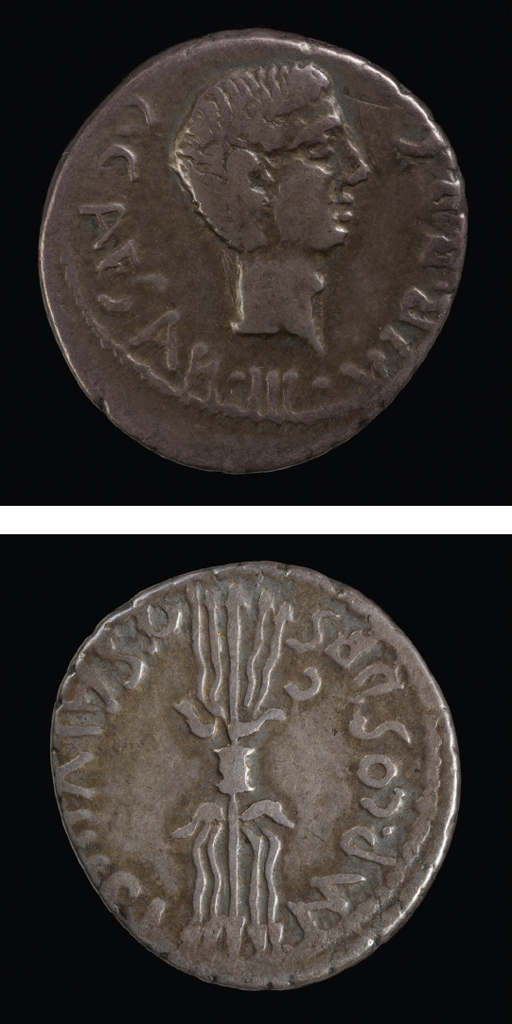
Eagle with thunderbolt. Obverse of bronze ingot. 280â250 BCE. Minted in Rome. Crawford RRC 4/1a
© The Trustees of the British Museum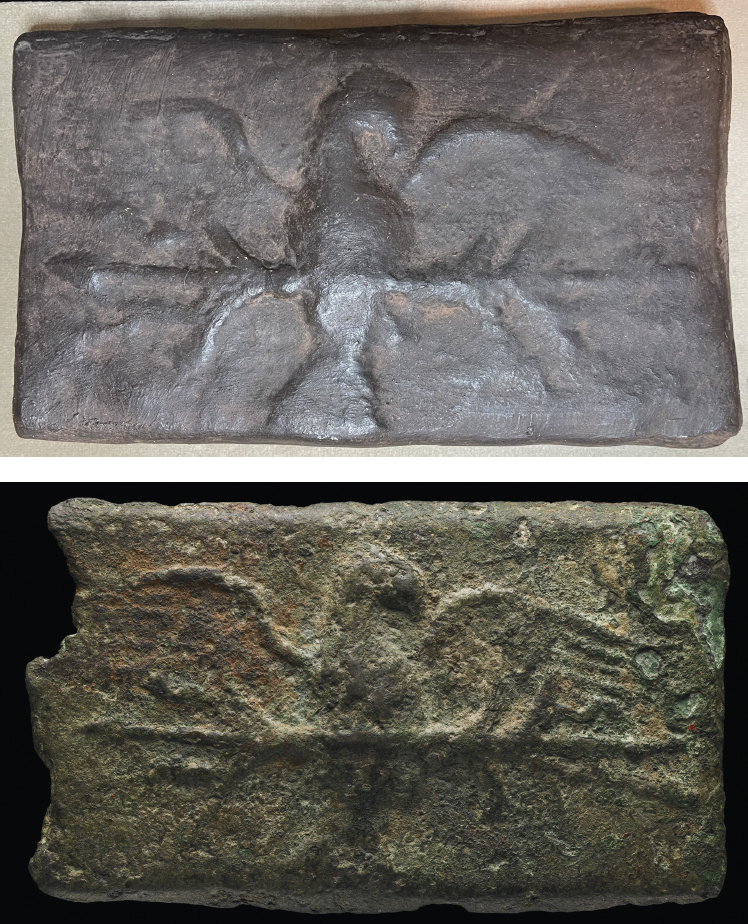
Eagle and thunderbolt. Reverse of gold struck 20âAs. 211 BCE. Minted in Rome. Crawford 44/4
© The Trustees of the British Museum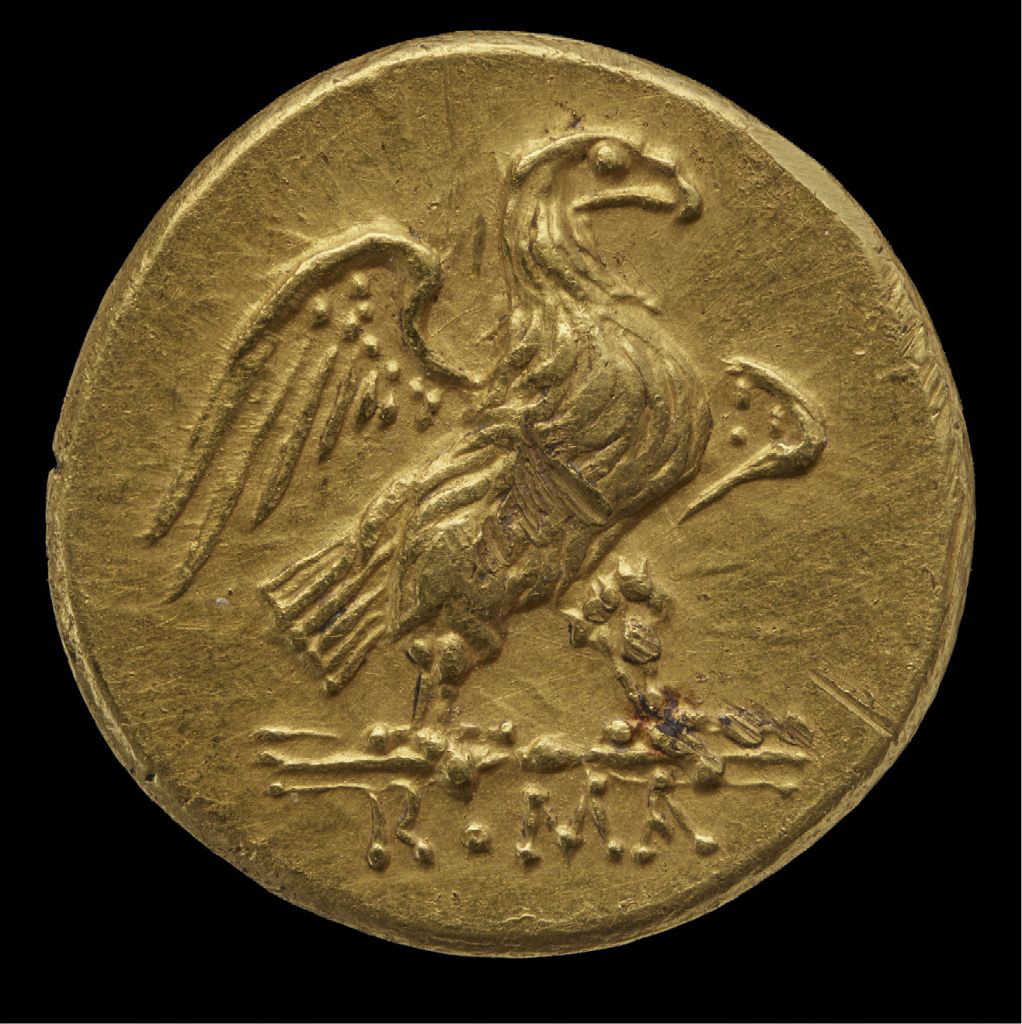
Radius used in conjunction with both thunderbolts and more flashing brilliance described as candidus also appears, rather tellingly, in Pliny the Elderâs description of a stone known as astrapea or âlightning stoneâ (HN 37.189â190). Pliny says the stone has bolts of lightning (fulminis radiis) running through its center on a background that is either a dazzling white or blue (in candido aut cyaneo). It occurs also in Statius (Theb. 10.674) where the striking action is again described, this time blasting cypress trees: fulminis [â¦] radiis afflata cupressus. The phrase is further linked to Roman iconography in a useful passage in the Flavian epic by Valerius Flaccus in which the insigne Iovis is said to be embossed on the shields of a Scythian legion joining Jason (Argonautica VI.53â56). Here, the tripartite nature of the thunderbolt is again specified as three-cleft burning fires: trifidis ardoribus ignes. Flaccus casts the Scythians as proto-Romans and, speaking suddenly to his Roman audience, he tells them they were not the first to sport the âshafts of the gleaming thunderboltâ (radios [â¦] corusci fulminis).22 This comment therefore securely links the Latin to the iconography; the thunderbolt insignia seen on the shields of the Roman army familiar to Flaccusâ audience is clearly described as a fulmen comprised of radii (fig. 13.4).
Winged thunderbolt on shield. Detail of Praetorians Relief c.51 CE
Image: author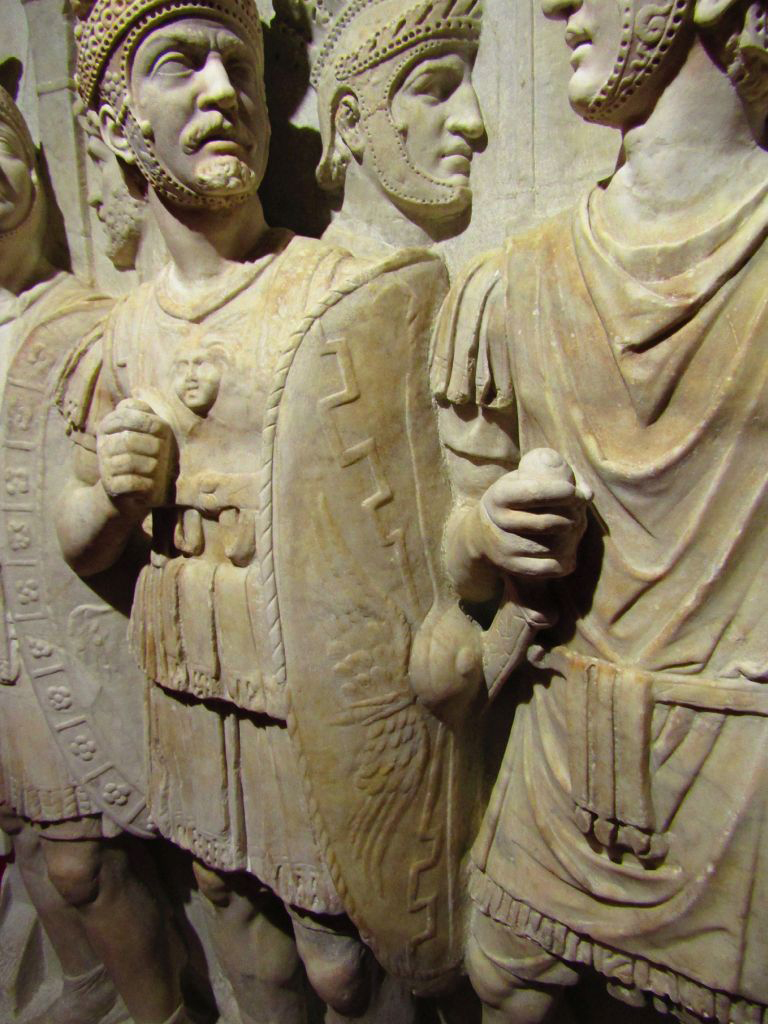
Reading lighting in Enniusâ passage does away with the need to force the sun into the picture or juggle a translation that rationalizes why the sun, if assumed to be the subject of the sentence, is both emanating light and being rays from the sun, which tend to radiate and linger, are being described as shooting out in a fleeting, striking action. It also explains why the source of the candida lux is itself rather than the sun. Leaving aside the sol albus question, a simple translation would then be as follows:
This translation is in accordance with the Latin and also the ancient understanding of how lightning is a product of the thunderbolt.23 Neither the order of events (first the strike and then the light) nor their explosive nature need to be played down or reorganized if radiis is taken to mean bolts: the bolts strike and the bright light bursts forth just as Ennius describes. Replacing sunbeams with thunderbolts therefore works better linguistically and also makes for a far less convoluted mental image.24 In my translation, there are not two but three auspicious signs: a bird flying from the left, twelve birds descending to auspicious places, and a flash of lightning to ratify the good omens. The double simul now makes sense in situating all three at the same moment at the first dawn light.25 Nevertheless, even if it makes for smoother translation, the question must now turn to whether this was in fact the reading Ennius intended and, ultimately, what difference it makes whether it is a thunderbolt rather than some other phenomenon that is the source of light in the passage. These are questions that pan out from the philological to the cultural. The answers are to be found in the way lightning was understood to behave and the role it played in Roman society. If Enniusâ poetic description was indeed an auspicious flash of lighting it was surely not cryptic but rather the obvious reading to an ancient ear.
5 Thunder and Lightning: Some Narrative Considerations
One reason we might suppose Roman audiences understood thunderbolts here is that Cicero seems to have done so. Enniusâ account is preserved as a fragment in Ciceroâs De divinatione during a discussion about the integrity of augury. Cicero has his brother Quintus quote Ennius as evidence that knowledge of the augural arts in Rome had a trustworthy pedigree. The context of this passage within that argument helps with its interpretation. Immediately prior to Ennius, Cicero quotes himself (in his brotherâs voice) reciting one of his earlier poems about an omen which convinced Marius that his return to Rome would be successful (I.106). The two passages are complementary and, since they are separated by only four lines, seem to read as a pair. When composing his poem, Cicero may even have had Ennius in mind. Although in Ciceroâs poem the omen itself takes a Homeric model, which broadly follows the omen shown to Hector and Polydamas of the eagle wrestling then dropping a snake (Il. 12.200â205), it has been pointed out that in terms of meter and diction Ciceroâs model was Ennius.26
The content, too, bears comparison. After the snake has been dropped in the Homeric poem, the eagle flies off shrieking into the wind, but, in the Ciceronian poem, the bird turns itself from the setting sun to the gleaming sunrise (seque obitu a solis nitidos convertit ad ortus, Div. 106 = fr. 20). Besides poetic imagery, the setting sun here contrasted with the rising sun serves an unmistakably directional purposeâthe bird turns from west to east. This has immediate resonance not only with the bird flying from the left but also with the two suns in the passage of Ennius. Perhaps this sheds some light on how sol albus might be interpreted in terms of the cardinal directions as the mindâs eye turns away from its fading to the new light in the east. Clearly the sun cannot set in one place and simultaneously rise in another, but, as with the Ennius passage, if we allow for some poetic license taken with the temporal distance between the two moments of setting and rising in the two parts of the sky, Cicero positions Mariusâ moment of auspicium and augurium as facing towards the dawnâthe same time of day as Romulusâ auspicious signs and, importantly, with not dissimilar results: Romulus received kingship and Marius the consulship.27 In other words, political power in Rome was the central concern of both avian omens. Vital to the current argument is what happens next. Upon understanding that the auspices foretold his successful return to Rome, Marius receives another sign:
partibus intonuit caeli pater ipse sinistris. sic aquilae clarum firmavit Iuppiter omen.
on the left side of the sky, the father himself thundered. Thus, Jupiter confirmed the eagleâs omen true.
Cicero obliges us here by specifying what the sign was and how it functioned: Jupiter thundered on the left side and by so doing confirmed the clear omen of the eagle.28 Here the thunder can be clearly understood as separate from the omen but decisive in qualifying it. This is how we might also imagine any fulminations of Jupiter in the Ennius passage to have functioned. Although Cicero does not state that he has read thunderbolts into the simultaneous signs given to Romulus, it is suggestive that these two similar passages are quoted together and comprise a similar series of omens against a similar celestial backdrop and that the result in both cases is preeminent power at Rome. It must be stressed that the contest between the twins was always remembered as one concerning birds. In Livyâs account, for example, the deadly dispute between the brothers arose because it could not be agreed whether the gods favored the one who saw the first birds or the most birds (1.7). Likewise, Dionysius (Ant. Rom. 1.86) describes the contest as âwatching for auspicious birdsâ (
This resonates also with the omen that portended the future sovereignty of Roman kings and the Julian line in book two of the Aeneid (682â704) when a numinous flame suddenly appears and licks about the head of young Iulus convincing Anchises to embark on the journey west with Aeneas. Upon seeing this, Anchises raises his eyes and hands to the heavens and supplicates Iuppiter omnipotens, asking him to âratify this omenâ (haec omina firma). Ratification comes immediately with a crash of thunder on the left (subitoque fragore intonuit laevum) and a shooting star. Obviously, the shooting star was added in reference to Caesar and the Sidus Iulium but the ratifying thunderbolt is expressly playing the same role for Vergilâs Aeneas and Iulus as it does for Ciceroâs Marius and, I would argue, Enniusâ Romulus.
Such a sign has narrative implications that play out interestingly when Enniusâ account is compared with those of his successors. The problem is that if Romulus had received such unambiguous divine affirmation, it would pre-empt any quarrel with Remus as to whose sign was the winning one. Since it is a dispute about how to interpret the birds that gets Remus killed in Livy and Dionysius, for example, a decisive sign from Jupiter would inconveniently put an end to that argument and ruin the plot.29 Since later accounts of Romulusâ contest with Remus do not describe a lightning flash at this decisive moment, we might be deterred from any exaggeration of its importance in Enniusâ account if it is present at all. However, one key point is that in Ennius, Romulusâ dawn sign is indeed taken to be decisive, and Remus is killed only later when he takes the fateful leap over Romulusâ wall.30 Whether this means that fulgural activity was absent in these later sources as a narrative necessity or because it was never there in the first place is open to debate. Yet if it is present in Ennius it certainly explains why the brothers did not quarrel at that point in his narrative about their respective sightings of birds. Conversely, if the quarrel was to be maintained by tradition (as it was) then the lightning bolts would have to go (which they did).
6 Beyond Augury: Thunderbolts and Power
Although tradition did not maintain an auspicious lightning flash at the contest of the birds, Romulus did nevertheless accrue a portfolio of pivotal encounters with lightning in his biography across later sources. If in Ennius it has an affirmatory role in relation to the birds, it seems in later sources to become a separateâeven more significantâevent unto itself. We have already seen Romulusâ lightning parsed out in this way in both his founding of the city and his inauguration as king. Lightning, moreover, provided him passage from mortal to god. There are varying accounts of the king being taken up by âa blastâ in the Campus Martius having been enveloped in a storm. After this, his body mysteriously vanished, and the soldiers hailed him as a god.31 Lightning could in this way become a mode of divinization and this would later become an important model for imperial apotheosis. By the fourth century the impulse to steep Romulus with lightning lore seems to have resulted in lightning becoming involved even in the manner of his conception. While earlier versions had Rhea Silvia conceive by an eclipse, the Origo Gentis Romanae (20.1) records a version whereby Mars impregnates her, as Zeus had supposedly impregnated Olympias, with a thunderbolt.32 With this one cosmic event swapped out for a meteorological one, the Roman populace thus becomes, from the outset, a people born of the thunderbolt. We have jumped far ahead in time with these diverse sources but in showing that lightning is not only a possible translation of Enniusâ Latin but a good one, we have also glimpsed something of its imperial trajectory.
These various lightning encounters interpolated at different moments in Romulusâ life, on the one hand, suggests what we already know: that there was no canonical Romulus story in which the thunderbolt played a fixed, unchanging part.33 On the other hand, the movable feast of thunderbolts suggests Romulus became so firmly associated with auspicious lightning that over time his story was multiply stricken by it. Whether Ennius also described further thunderbolts in the process of Romulusâ accession as king is, regrettably, unknown. However, behind the impetus to associate Romulus with lightning, there was clearly either an expectation to see that connection or a desire to make one and there is clearly a recurrent idea hovering around thunderbolts from the left and flashes of lightning at dawn heralding the divine endorsement of various candidates for holding power at Rome. It would be significant to the chronology of such a nexus of ideas therefore if, in Romeâs first epic poem, lightning makes its appearance at dawn at the very moment of Romulusâ divine election as king.
Finally, understanding the lux candida as a lightning flash adds potency to the final lines of Enniusâ passage as Cicero quotes it:
conspicit inde sibi data Romulus esse priora, auspicio regni stabilita scamna solumque.
Then Romulus perceived that he had gained a throne whose source and prop was augury.34
For Quintusâ argument, Ennius was evidently a robust authority and by quoting this passage he is satisfied that he has established the reliability and honest origins of augury in Rome.35 However, Romulus realizing that the foundation and stability of his kingship lay in augury also tells us something important about the conceptualization and presentation of power in second-century BCE Rome. It is familiar, of course, that Romans, broadly defined, saw Rome as a divinely endorsed project overseen and protected by the gods. It is equally familiar that certain individuals were believed to be particularly favored by various deities and that the senate worked in careful tandem with the divine will in order to maintain the pax deorum. Augury is a well-known and integral part of that equation.36 Now, we can see the role the thunderbolt played in this moving beyond the straightforward remit of divinationâby which I mean moving beyond the language of divine signs and their interpretationâand becoming more akin to a speech act. In other words, in these cases related to the ratification of power, epiphanic thunder and lightning do not deliver passive messages related to the will of the gods but rather they are performative and enact that will by empowering or stirring to action the individual with whom it is concerned.
In the introduction, I stated my contention that lightning provided the Roman world with something similar to the divine right of kings. This should already be somewhat apparent in the handful of sources so far considered in trying to understand what is happening in the passage of Ennius. The sign from the dawn sky which endorses Marius, for example, seems to flash also through the Vergilian passage mentioned above. In terms of endorsement, the fact that the Cyclopes are working on a thunderbolt as Vulcan arrives at Etna may be no incidental detail. He arrives at dawn as Vergil takes some time to emphasize (8.407â415). The unfinished thunderbolt of the Cyclopes is clearly not ready, but it calls to mind thunderbolts past and future. It may then foreshadow a flash of Aeneasâ regal future.37 In the narrative, Aeneas, himself, is also not ready for kingship as he has only just arrived on the future site of Rome. In fact, as Vulcan visits his forge, Aeneas is waking for the first time in the house of Evander on the Palatine. Vulcan calls the Cyclopes away to put those same skills they are applying to the thunderboltâperhaps the same elementsâto work on the armor which will win kingship for Aeneas and, by long extension, Augustus.
It is surely no accident that Vergil has the Cyclopes turn their attention mid-thunderbolt into forging instead a shield that not only secures but even portrays images of future Roman triumphs. This is redolent with the sign Aeneas will imminently be sent to inform him his new armor is en route (8.524â529). Vergil describes a sudden cacophony of thunder and lightning in the skies (vibratus ab aethere fulgor cum sonitu) among which Aeneas sees armor flashing and thundering in the clouds. The thunderbolt in these passages is not only ratifying; it signifies divine election in the context of political power. Vergil articulates this clearly here. He describes Aeneas hesitating on the brink of seeking Etruscan military aid and so beginning the process that will lead to violent war and, eventually, the establishment of Rome and the Julian line. It is Venus who sends the unexpected sign from a clear sky to convince Aeneas to take the necessary action. Upon seeing the cacophonous bolts from the blue, Aeneas is immediately resolved and makes the telling statement: âI am summoned by Heavenâ (ego poscor Olympo, 8.353). This is the key moment when Aeneas definitively decides to step up to his destiny. The thunder and lightning are in the first instance calling him to arms but beyond that, as Aeneas clearly articulates, they signify the divine call for him to become the leader the future Rome needs.38 The nature of that leadership was ultimately for Aeneas, as for Romulus and, indeed, for Augustus and his successors, monarchic. The thunderbolt, in this configuration, becomes more than a sign or ratification; it is a divine summons.
7 Summoned by Heaven: from Divine Endorsement to Divine Right
We have seen divine endorsements flashing around the kings of nascent Rome. Although there remains much to say about how thunderbolts became entrenched and to some extent systematized in the historical realities of how Roman republican power expressed itself, it has been pointed out that the thunderbolt became increasingly a symbol of the divine providence manifest in the imperium Romanum itself. In the republican period, the regal message remained much the same only transposed to the collective. This power that Rome wielded over other peoples, not unlike a king over his subjects, maintained monarchic connotations in its Greek translation:
Regardless of the fact that such regular and timely strikes can hardly be supposed to have happened, the fact that the ritual continued to be conducted says something about how the power that came with office was supposed to be viewed.40 Although the political manouevres that secured those positions were entirely human, the office itself and the power that came with it was still, in theory at least, divinely sponsored. In effect, the absolute power that would otherwise be wielded by a king was divided among a ruling elite and the lightning bolt that would have endorsed one man, like Romulus, was now required to endorse each of these men individually so that collectively their powers were complete and equal to a kingship shared.41 So, if only in a vestigial manner in the acting out of an arcane ritual, the divine right to rule still unpinned the upper echelons of political power in republican Rome; Romulus was the original placeholder and Jupiter continued to trace the contours of that role with his thunderbolts. What I want to show in the final section of this chapter is how this conceptual framework, which had continued to ripple under the surface of the republican constitution in this dissected sort of way, emerged whole and complete with the return to one-man rule. In the absence of precedent or a valid legal pathway, the thunderbolt was seized uponâand seized quite literallyâas a justification and validation that bypassed and superseded ordinary routes to power.
I will briefly consider two of the men whose reigns were most decisive in the dissolution of the Republic and the return of monarchic rule in Rome: Sulla and Augustus. We know that these men seized power violently, took up unprecedented positions in the state, and then looked to Romulus for supposed precedent. I want to show that Romulusâ legendary lightning guided them and was manipulated by them, and ultimately came to define some key features of the presentation of imperial rule.
8 Sulla
Turning then to Sulla, the first key piece of evidence is an almost throwaway comment from Pliny the Elder (2.143â144). In Book 2 of his Natural History and his description of the different directions of lightning and their meaning when he is explaining which parts of the sky send forth auspicious or foreboding lightning, he remarks, as many did, that lightning which returns to the first part of the skyâthe east or the âleftââwas the most auspicious. Lightning that both originates from and returns to this part of the sky, Pliny explains, is a portent of âsupreme good fortuneâ (summa felicitas portendetur). Then he states apropos of nothing that this was the sign everybody knows was vouchsafed to the dictator Sulla: quale Sullae dictatori ostentum datum accepimus. What makes this comment leap out of the text is the fact that it is the only mention of a person or a historical event in what has otherwise been a long scientific treatment of lightning and its interpretations. It seems that this particular type of lightning bolt is so synonymous with Sulla that in mentioning one Pliny impulsively mentions the other. The verb accepere suggests that this is the received wisdom, and in the first-person plural gives the impression that it is a firm fixture in the collective historical memory. The comment apparently needs no qualification or further elaboration and Pliny moves straight on. His assumption is clearly that this is common knowledge. So common, it seems, that it almost escaped the history books.
It is even more startling that it was Sulla who sprang to Plinyâs mind at the mention of this type of portent since Romulus might have been the obvious example. And against the backdrop of republican political ritual that I have described, in which everyone in office supposedly had their own piece of this lightning bolt, there must have been something very particular, very memorable, about Sullaâs lightning strike. Whatever it was, it must have galvanized the dream Sulla supposedly had in 88 BCE before changing the direction of Roman history forever by leading a Roman army against the capital and taking control of the city by force. On the brink of his unprecedented march on Rome to attack fellow Romans, the cityâs first autocratic ruler since the time of the kings dreamed he was handed a thunderbolt.42 A goddess came to him in his dream, handed him the thunderbolt, named his enemies, and ordered him to strike them all down with it. There is much to be said about this dream but bearing in mind my earlier point about the thunderboltâs signification of a divine right to rule, we see that at a moment when there is no official or legal basis to Sullaâs seizure of power, an appeal to the divine and the thunderbolt fills that gap with an authority and justification more irresistible than petitions and elections. Moreover, by deferring to familiar imagery and recalling the model of Romulus, in both the dream and whatever lightning strike Pliny was referring to, the veneer of something traditional and potentially palatable encased something new and anathema to the state.
We know that Sulla made a conscious effort to evoke Romulus in many of his actions. Notably, the lightning bolt that some said deified Romulus and which foreshadowed imperial apotheosis was seemingly toyed with in Sullaâs insistence on being cremated in the Campus Martius where Romulus had been taken up.43 Most of this was remembered very poorly. His time in power was soon referred to scathingly as the regnum Sullanum (Cic., Att. 8.11.2). As an unwanted king, Sallust (Hist. 1.55.5) calls him âthat perverted Romulusâ (scaevus iste Romulus) and when Livy (6.39.7) in a completely different and unrelated context talks about someone âpicking up the thunderbolt of dictatorshipâ (dictatorium fulmen) surely he had Sullaâs precedent in mind.44 For it is one thing to be endorsed by a flash of lightning and quite another to suggest you might be capable of picking up and wielding a thunderbolt in your own hand. This hubristic leap in imagery is not only indicative of a cognitive shift in conceptualizations of power but of a rupture in the very machinations of that power and the system that supported it. Snatched unconstitutionally and in the grasp of one man rather than the collective, the thunderbolt of dictatorship indeed symbolized a perversion of Roman mores in the handling of political power.
Nevertheless, this matrix of association between Jupiter, supreme power, Romulus, and lightning, and the idea of a divine king who manifests himself in the very bricks of the city was a very powerful vocabulary for formulating one man rule. It is familiar to us through the ideology of imperial rule and is the quintessential description of Augustus as he portrayed himself.
9 Augustus
The long period of violence and bad behavior by which Augustus came to power is well known. Likewise, his careful cultivation of his image once his power was secure is a textbook case of political whitewashing. We also know that before settling on the name Augustus he had wanted to call himself Romulus. The statues of summi viri which lined his forum began with Romulus and culminated in Augustus himself.45 Moreover, Augustus claimed direct lineage from Romulus.46 Claiming to be a relative of Romeâs first king gave his dismantling of the Roman constitution a traditional and nostalgic air. The appeal to long continuity was, of course, a great illusion. These men who sought to cast themselves as âsecond foundersâ of Rome, who alluded to and emulated Romulus in their actions and their ideology, were precisely those who had risen to power via unorthodox if not illegal routes. Through the lens of Hobsbawm and Rangerâs 1983 Invention of Tradition it is clear that men such as Sulla and Augustus, who represented the greatest disjuncts, were leaning on Romulus and thunderbolts to paper over ruptures in the constitution. Similarly, in terms of âanchoring innovationâ it is clear that dangerous novelty was being dressed in powerful if reassuringly familiar imagery.
Like Sulla, Augustus had an interesting relationship with lightning. Being terrified of it, on the one hand, as Suetonius (Aug. 29) relates, and only narrowly escaping actually being struck by it on one occasion, lightning was, on the other hand, very useful to his endeavors. A lightning strike on the Palatine, for example, was the excuse to build a temple to Apollo on that prime spot and, not incidentally, a house for himself. Moreover, the lightning strike he dodged gave him an excuse to build the Temple of Jupiter Tonans on the Capitoline, thereby putting himself topographically right next to Jupiter Optimus Maximus. Perhaps most strikingly, although little has been made of it, Suetonius tells us that after being told in a prophesy that the ruler of the world had been born, his father had once seen the future Augustus in a dream. Augustus appeared in that dream more majestic than a mortal man with the thunderbolt, sceptre, and insignia of Jupiter Optimus Maximus.47 The thunderbolt thus became emblematic of the power Augustus wielded.48 Divinely ordained and again superseding anything the old constitution had to offer, it led to an image popular in Augustan literature of the emperor hurling his thunderbolts of justice.49 Although Augustus famously demurred from making any such grandiose claims for himself preferring instead his masquerade as the primus inter pares, eventually these ideas would culminate in some particularly striking iconography of the emperor as Jupiter himself clutching the thunderbolt in his hand (fig. 13.5). The revolutionary imagery of Sullaâs dream which was supposedly revisited in the dream of Augustusâ father was thus reconciled to the new balance of power at Rome and made manifestâfor the first time in Romeâin official iconography.50 As the principate bedded down and autocratic rule became overt and irreversible, so the thunderbolt came to settle firmly at last in the emperorâs grip.
Augustus wielding the thunderbolt. From the Augusteum of Herculaneum 1st century CE
Museo Archeologico Nazionale, Naples. Image: author
10 Conclusion
Myth and meteorology combine nowhere more potently than in the electrifying sear of lightning. With the divine force of the bolt-hurling Jupiter behind it, there is little wonder its powers were coveted as well as feared. This chapter has aimed to draw attention to the role lightning played in the Roman world beyond the familiar realms of augury and religion and to show the special relationship it bore to kingship and the legitimation of political power. I have argued that thunder and lightning were understood and presented as the meteorological basis of Roman political power.
The early chronology remains unclear and probably irretrievable, but it is certainly the case that in the telling and retelling of the myth-history of the early city as well as in its politico-religious ceremonials Rome came to represent itself as a state that had always defined its powers in terms of thunder and lightning. The thunderbolt became emblematic of the power invested in the Roman republic and as the republic was commandeered by one man, so too was the thunderbolt. I have argued that in this capacity it was more than a sign or divine ratification: just as it had been a divine call that could compel individuals in the cityâs myth-history to step up to kingship and fulfil their destiny for Rome, so it eventually became the very manifestation and symbol of their divine right to do so.
Laying claim to the thunderbolt in this highly individual and tactile manner served not only to parade new autocratic powers behind a familiar veneer; it also made a powerful bid for legitimacy and it seized a new direct conduit for the divine power of the emperorâone that relied neither on the mediation of augury nor, crucially, the happenstance of the weather.
Bibliography
Bacon, H. H. âThe Aeneid as a Drama of Election.â TAPhA 116 (1986): 305â334.
Brisch, N. M. Religion and Power: Divine Kingship in the Ancient World and Beyond. Chicago, 2008.
Brown, J. P. Sacred Institutions with Roman Counterparts. Berlin, 2002.
Buckley, E. âFlavian epic and Trajanic historiography: speaking into the silence.â In Roman Literature under Nerva, Trajan and Hadrian: Literary Interactions, AD 96â138, edited by A. Koenig and C. Whitton, 86â107. Cambridge, 2018.
Burgess, G. âThe Divine Right of Kings Reconsidered.â The English Historical Review 107, no. 425 (1992): 837â861.
Cook, A. B. âThe European Sky-God. III: The Italians.â Folklore 16, no. 3 (1905): 260â332.
Cook, A. B. Zeus: A Study in Ancient Religion. Cambridge, 1914.
Courtney, E., ed. The Fragmentary Latin Poets. Edited with Commentary. Oxford, 1993.
Driediger-Murphy, L. G. Roman Republican Augury. Oxford, 2019.
Dumézil, G. La religion romaine archaïque. Paris, 1974.
Elliott, J. Ennius and the Architecture of the Annales. Cambridge, 2013.
Ewbank, E., ed. The poems of Cicero. Edited with introduction and notes. London, 1933.
Falconer, W. A. Cicero: De senectute; De amicitia; De divinatione, with an English translation by William Armistead Falconer, London, 1923.
Figgis, J. N. The Theory of the Divine Right of Kings. Cambridge, 1865.
Fratantuono, L., and R. A. Smith. Virgil, Aeneid 8: Text, Translation, and Commentary. Leiden, 2018.
Gee, E. âCiceroâs Poetry.â In Cambridge Companion to Cicero, edited by C. Steele, 88â106. Cambridge, 2013.
Goldberg, S. M. Epic in Republican Rome. Oxford, 1995.
Hekster, O., and J. Rich. âOctavian and the Thunderbolt: The Temple of Apollo Palatinus and Roman Traditions of Temple Building.â CQ, n. s. 56, no. 1 (2006): 149â168.
Jocelyn, H. D. âUrbs Augurio Augusto Condita: Ennius ap. Cic. Div. i. 107 (= Ann. 77â96 V²).â Proceedings of the Cambridge Philological Society 17, no. 197 (1971): 44â74.
Liberman, G., ed. Argonautiques / Valerius Flaccus. Tome 1â2, Chants 1â4 & 5â8. Paris, 2002.
Linderski, J. âFounding the City.â In Ten Years of the Agnes Kirsopp Lake Michels Lectures at Bryn Mawr College, edited by S. B. Faris and L. E. Lundeen, 88â107. Bryn Mawr, Pennsylvania, 2006.
MacBain, B. Prodigy and Expiation. A Study in Religion and Politics in Republican Rome. Brussels, 1982.
McClellan, A. M. Abused Bodies in Roman Epic. Cambridge, 2019.
Meunier, N. âEnnius, les astres et les théories anciennes de la vision. à propos de sol albus et de radiis icta lux (v. 84â85 Sk).â RPh 86, no. 2 (2012): 101â121.
Moin, A. A., and A. Strathern. Sacred Kingship in World History: Between Immanence and Transcendence. New York, 2022.
Mommsen, T. Gesammelte Schriften iv. Berlin, 1905.
Nisbet, R. G. M., and M. Hubbard. A Commentary on Horace, Odes, Book I. Oxford, 1970.
Paschalis, M. Virgilâs Aeneid: Semantic Relations and Proper Names. Oxford, 1997.
Peppard, M. The Son of God in the Roman World: Divine Sonship in Its Social and Political Context. New York/ Oxford, 2011.
Platner, S. B., and T. Ashby. A Topographical Dictionary of Ancient Rome. Oxford, 1929.
Rasmussen, S. W. Public Portents in Republican Rome. Rome, 2003.
Rushton Fairclough, H. Virgil. Eclogues. Georgics. Aeneid: Books 1â6. Revised by G. P. Goold. Cambridge, MA, 1999.
Shaya, J. âThe Public Life of Monuments: The Summi Viri of the Forum of Augustus.â AJA 117, no. 1 (2013): 83â110.
Skutsch, O. âEnniana IV: Condendae Urbis Auspicia.â CQ 11, no. 3â4 (1961): 252â267.
Skutsch, O. The Annals of Q. Ennius. Oxford, 1985.
Sluiter, I. âAnchoring Innovation: A Classical Research Agenda.â European Review 25, no. 1 (2016): 20â38.
Smith, C. J., and C. Smith. âThe Origo Gentis Romanae: Facts and Fictions.â BICS 48 (2005): 97â136.
Steel, C. âRethinking Sulla: The Case of the Roman Senate.â CQ 64, no. 2 (2014): 657â668.
Steinby, E. M. Lexicon Topographicum Urbis Romae. Quasar, 1993.
Strachan, V. Lightning in Roman Thought, Politics, and Culture. Thesis. (DPhil). Oxford, 2025.
Sumi, G. âSpectacles and Sullaâs Public Image.â Historia 51 (2002): 414â432.
Timpanaro, S. Contributi di Filologia e di Storia della Lingua Latina. Rome, 1978.
Turfa, J. M. Divining the Etruscan World: The Brontoscopic Calendar and Religious Practice. Cambridge, 2012.
Usener, H. âZeus Keraunos.â RhM 60 (1905): 1â30 [Reprinted in Wünsch, R. Kleine SchriftenIV: Arbeiten zur Relionsgeschichte, Leipzig/ Berlin 1912: 471â497].
Vahlen, J. Ennianae Poesis Reliquiae. Amsterdam, 1854.
Wardle, D. Cicero: On Divination, Book One. Translated with introduction and commentary. Oxford, 2006.
Weinstock, S. âLibri Fulgurales.â PBSR 19 (1951): 122â153.
Wijsman, H. J. W., ed. Valerius Flaccus, Argonautica, Book VI: A Commentary. Leiden, 2000.
Wildfang, R. L., and J. Isager, eds. Divination and Portents in the Roman World. Odense, 1999.
Wiseman, T. P. Remus: A Roman Myth. Cambridge, 1995.
Sluiter (2016), 24.
Fr. 77â96 Vahlen = 72â91 Skutsch.
See Brisch (2008) for an overview in the ancient world. For a global overview, see Moin and Strathern (2022). Brown (2002), 81â115 considers the revival of divine kingship in Rome. Peppard (2011) explores specifically the idea of divine sonship.
The classic work is the 1865 treatise by John Neville Figgis. For a modern appraisal of this work, see Burgess (1992).
Dionysius makes his own explanations (2.5.2â4) and offers an alternative origin story (2.6.5). Cf. Livy 1.18.6; Cic., Off. III.66; Varro, Ling. 7.8; Val. Max. VIII.2.1. See also Platner-Ashby 61; Richardson 45; Coarelli in Steinby (1993) s.v. âAuguraculum (Arx)â: I, 142â143.
âJupiter gave omens with thunder on the left and lightning to the left of the heavens.â Ennius, himself, also describes the good fortune of signs from the left: Non. 51.7: âLaevumâ significari veteres putant quasi a levando [â¦] Ennius annali lib. IIIâOlim de caelo laevum dedit inclutus signum. (âThe ancients believed âleftâ as if derived from âto life/elevateâ [â¦] Ennius Annals Book IIIâOnce the All-Glorious gave a sign from the left of the heavensâ). The omen in this fragment of Ennius is given to Tarquinius Priscus on his way to Rome and kingship. Skutsch (1985) rejects the general consensus since Vahlen that this leftward sign refers to an eagle removing and replacing Priscusâ cap, finding Timpanaroâs 1978 interpretation of thunder or lightning as âgreatly superiorâ. Clearly, the latter would sit well in the current argument.
The text is corrupt and the location of the âRemuriaâ contested. Skutsch (1985), 222 maintains it was a south- eastern outcrop also on the Aventine, but there are other possibilities. On the âSaxum/ Murcusâ see Skutsch (1961), 253â259. Wiseman (1995), 110â117 provides discussion and suggests the Sacred Mount by the Anio as an alternative.
The accounts in Livy (1.7) and Dion. Hal. (Ant. Rom. 1.86) will be discussed below.
Jocelyn (1971) suggested the morning star, but that makes no sense as setting before dawn as Skutsch remarks (1985, 232).
Trans. Falconer (1923).
Elliott (2013), 185.
Skutsch cites Varro Ling. (6.82) avem specere for such collective use. Linderski (2006), 91 emphatically rejects this.
Wiseman (1995), 7.
It is worth noting that the epithet Jupiter Lucetius is derived from lux and although following Cook (1905, 261â263) this is generally said to refer to âlightâ in the sense of daylight and the shining sky, however, the alternative reading proposed by Dumézil (1974, 189) among others, is a direct reference to Jupiterâs lightning and the âflamboiement de lâéclair ou de la foudreâ. Since Lucetius was an early epithet, if lux indeed referred to lightning it is another factor, in the complex of connections available and perhaps obvious to Enniusâ audience.
Wardle (2006), 369.
Meunier (2012). Quotations: page 103 (which is at once true to the words of the author and intelligible to modern readers); 106 (obviously do not refer to the same concept, since it is necessary that the âraysâ strike the âlightâ so that the latter can be visible); 114 (an explosion of light). The problem of what the rays are striking is acknowledged. Meunierâs explanation relies on the philosophy of vision being both common knowledge to Enniusâ audience and clearly applicable in this sentence. His translation is ultimately: âEnsuite, lâeÌblouissante lumieÌre, au contact des rayons visuels, se deÌvoila.â (âThen, the dazzling light, in contact with the visual rays, was revealed.â).
Cf. Pliny the Elder (36.58) who emphasizes the contact but more gently: solis ortu contactum radiis (âtouched by the rays of the rising sun.â).
Meunier (2012), 115â116 highlights the problem of what the rays would be striking in the Ennius passage. It makes no sense in terms of sunlight. His clever but unconvincing answer is that the visual rays strike the object of their vision (the light itself).
Virgil does use solis radiis elsewhere in the poem though note he specifies the sun. See Aen. 6.195 for the sunâs rays never reaching the monster Cacus and again 8.623 for clouds glowing with sunâs rays.
Hes., Theog. 140 for Brontes and Steropes. On Pyracmon, see Serviusâ commentary on âBrontesqueâ. Also, Paschalis (1997), 294 on the etymology of Pyracmon, and the site of Etna as the grave of the thunderstricken giant Enceladus.
RRC 523/1 issued in 40 BCE by Octavian provides many clear examples. RRC 298/1 and 445/2 show the handle in action being grasped.
On the identity of the Roman legion Flaccus may have had in mind, see Wijsman (2000), 38 and Liberman (2002), 202. The Twelfth Legion known as Fulminata were particularly prominent in Flavian ideology for having sacked Jerusalem with Titus. Buckley (2018, n. 45) points out this legion had been posted far east to the Caspian under Domitian and so the comparison with Scythians would have been particularly apt.
Strachan (2025). On the thunderbolt in the Greek world, Cook (1914) remains the authority. See also Usener (1905). Both are in need of an update.
A flash of lightning for Romulus would also answer Mommsenâs (1905) old objection that augury could not be decisive in a contest and that since the birds could only signal whether or not the gods were in favor or not this was an anomalous use of augury altogether: Gesammelte Schriften iv.1, 11. Skutsch (1961), 251 pointed to another occasion mentioned in Festus (Lindsay, 241) when the birds made a choice between two candidates, but the one isolated occasion far-removed in time, though compelling, is not as conclusive as he states. On the flash of lightning being its own source, compare Nonnus (Dion., 2.318â319) where the blazing lightning becomes a self-made torch for the bridal chamber:
Wisemanâs formulation is slightly problematic here in placing the appearance of the candida lux distinctly before the rising of the sun since he has the two bird omens immediately consecutive one after the other. Perhaps he imagines only a fractional amount of time between the ânot yet visibleâ and visible sun.
Goldberg (1995), 141â143. Gee (2013), 99â101 also reads the Ciceronian poem forward into Aeneid 6.
The dates for when the poem was composed are contested. For the broad range variously suggested from the eighties through forties, see Ewbank (1933), 13â16 and more recently Courtney (1993), 177â178. Since Marius held the consulship seven times, knowing which time Cicero had in mind need not worry the current argument.
Wardle (2006), 365 notes that this cannot be classified as a âfulgur attestatumâ according to Caecinaâs categorization preserved in Seneca (QNat. II.49.2) because it is not confirming another lightning portent. However, this is evidence for a known ratifying function of lightning in dialog with other omens. Note also, Seneca is discussing fulmina not fulgura.
Plutarch, Rom. 9, recounts a tradition whereby Romulus actually lied about seeing the twelve birds, which only showed up once Remus had come to consult him about it. Remus ridiculed and jumped Romulusâ wall in retaliation. Clearly, the specifics of the myth were malleable and disputed.
Ann. fr. 94.
Livy 1.16; Dion. Hal. 2.56; Plut., Rom. 27; Ov., Fast. II.491, Met. 14.806â851; Cic., Rep. II.17. Ennius also wrote of a divinised Romulus (Servius, In Vergilii Aeneidos libros 6.763 and 6.77). Plutarch describes the soul leaving the body like lightning from a cloud (Rom. 28.6).
Plut., Alex. 2.2:
Wisemanâs 1995 appendices provide an array of disorienting versions of Romulus and Remus.
This is W. A. Falconerâs 1923 translation for the Loeb, which apparently treats scamnum advisedly as âthroneâ as per Lewisâ Elementary Latin Dictionary of 1890.
He turns to a different issue thereafter as if the point has been well made.
Notably, Weinstock (1951); MacBain (1982); Wildfang and Isager (1999); Rasmussen (2003); Turfa (2012); Driediger-Murphy (2019).
Understanding the role the thunderbolt played in political power significantly changes the reading of this passage. Compare e.g., Fratantuono and Smith (2018), 516: âThe emphasis in the description of the bolt is on the godâs use of the weapon in punishment and retribution; the delay in the completion of the Jovian thunder implies a reprieve for hapless mortals.â
On the Aeneid as altogether a âdrama of electionâ see Bacon (1986), esp. 331â334 for the thunderbolt omen. Bacon rightly points out the peculiarity of Venus sending thunderbolts but in focusing on the âcosmic power of loveâ and the âcosmic revolutionâ by which Venus is promoted in the Roman pantheon, the political implications of the thunderbolt again slip attention. It is of no small significance that Venus should pick up the thunderbolt to convey divine election to the Julian line; Augustus was working with precisely such ideas in Vergilâs Rome and there were important precedents as I will presently show.
Dion. Hal., Ant. Rom. 2.6.
For an excellent corrective to the opinion that auspication was routinely manipulated, see Dreidiger-Murphy (2019), chapter 2.
Of course, one-man rule was not completely alien to Rome even in republican times and perhaps it is no coincidence that the temple to Quirinus was vowed in 325 BCE by L. Papirius Cursor when he was dictator. The divine Romulus may well have come to the mind of someone in that superlative position (Livy 10.46.7; Plin., HN 7.213).
Plut., Sull. 9.4.
App., B Civ. I.12. For the spectacle of Sullaâs funeral, see Sumi (2002). On Lucanâs reception of Sullaâs tomb, see McClellan (2019), 118â120.
N. b. Sullaâs novel use of dictatorship, whereas previously it had been a pragmatic administrative office used in the third century BCE largely for election purposes. Steel (2014) argues for Sullaâs reshaping of the role of dictator as innovative. Also Dionysius (Ant. Rom. 5.77.4) claims the dictatorship became an object of reproach and hatred under Sulla: â[â¦] so that the Romans then perceived for the first time what they had had all along been ignorant of, that the dictatorship is a tyranny.â
On the role of the statues of the summi viri in Augustusâ forum, see Shaya (2013).
Recalling our point in the introduction about genealogy being the most persuasive anchoring discourse.
Suet., Aug. 94.5.
Seen explicitly and repeatedly in Ovidâs Tristia for example. See also Hekster and Rich (2006).
Nisbet and Hubbard (1970), 164â166.
The question of when this image was first officially propagated remains open to question. Imperial keraunophoros iconography seems unlikely to have been disseminated in the artistic outputs of the Augustan era. See, for example, the modest lituus in the princepsâ hand on the Gemma Augustea. In my doctoral work, Strachan (2025), I argue for a Claudian date after which the imagery reappears periodically in imperial art and literature.